Article

Effects of Precipitation Trends, Extremes, and Antecedent Moisture Controls on Landslide Triggering in Hum na Sutli and Northern Croatia


Croatian Geological Survey, Ulica Milana Sachsa 2, 10000 Zagreb, Croatia
*
Author to whom correspondence should be addressed.
Water 2026, 18(12), 1393; https://doi.org/10.3390/w18121393 (registering DOI)
Submission received: 11 May 2026 / Revised: 3 June 2026 / Accepted: 5 June 2026 / Published: 7 June 2026
(This article belongs to the Special Issue Water Management and Geohazard Mitigation in a Changing Climate)

Abstract

Both variability in precipitation and rainfall extremes are key drivers of landslide activity, yet their combined influence with antecedent moisture conditions remains insufficiently quantified at regional or local scales. In this study, daily precipitation records over the past 25 years (2000–2024) were analyzed for five meteorological stations in Northern Croatia across multiple temporal scales. The aim was to investigate the impact of precipitation patterns and regime changes on landslide triggering in Hum na Sutli and the wider area. Statistical analyses (linear regression, Mann–Kendall trend assessment, and Pearson correlation) were applied, and antecedent wetness was quantified using the antecedent precipitation index (API). Results indicate weak, statistically insignificant positive trends in annual precipitation, accompanied by strong interannual variability and coherent regional behavior. Seasonal analysis reveals the dominance of warm-season precipitation with pronounced extremes, while short-duration and multi-day rainfall events exhibit high variability and clustering. The 2024 Hum na Sutli landslide coincided with elevated cumulative precipitation and sustained high API values, despite the absence of exceptionally extreme single-day rainfall events. These findings highlight the critical role of antecedent moisture accumulation combined with episodic high precipitation in slope failure. The study supports a conceptual model in which landslide triggering is governed by the interaction of preconditioning and short-term hydrometeorological factors, providing a basis for improved hazard and risk assessment. Additionally, preliminary rainfall threshold values are proposed as practical early-warning guidance for local communities in landslide-prone regions in Northern Croatia.

1. Introduction

The growing challenges of water management and geohazard mitigation under changing climatic conditions require widespread scientific attention [1,2,3]. Mass movements and hydrological hazards have a strong dependency on climatic stressors, water management practices, other geohazard events (e.g., earthquakes), and anthropogenic activities [4,5]. Among these factors, precipitation is recognized as a primary triggering mechanism of landslides and slope failures [6]. It increases pore water pressure and decreases the shear strength of slope materials [7]. Both short-duration, high-intensity precipitation events and prolonged periods of moderate precipitation can contribute to slope failure, depending on local hydrological and geotechnical conditions [8]. As a dominant landslide trigger, precipitation exhibits highly variable behavior, characterized by asymmetric distributions, temporal clustering, and irregular extremes; it is often accompanied by shifts in variability and trends over time [9]. Understanding these statistical properties and their temporal evolution is essential for defining critical thresholds to improve landslide hazard assessment and support the development of effective monitoring, mitigation, and early-warning systems [10,11].
Northern Croatia is prone to slope failures, with specific regions characterized by high susceptibility to landslides [12,13]. For example, in Zagreb City County, more than a thousand landslides have been triggered and documented over the last 25 years [14,15,16,17,18]. Besides geological conditions and anthropogenic modifications, slope stability is strongly interconnected with climate-driven changes in precipitation patterns [19,20,21]. Although most regional climate studies do not indicate significant long-term trends in annual precipitation since the mid-twentieth century, changes in precipitation regime are evident, including seasonal redistribution and an increase in extreme precipitation indices (e.g., the number of heavy precipitation days and maximum 1- to 5-day precipitation totals) [22,23,24,25,26,27].
This study aims to assess the role of precipitation in the initiation of a landslide in the Hum na Sutli municipality and wider area in Northern Croatia. Furthermore, it aims to assess whether regional meteorological station data can also be representative for local-scale studies such as Hum na Sutli, where in situ monitoring is unavailable. The landslides investigated have a complex activation history involving anthropogenic slope loading, seismic events, and intense precipitation events as direct triggering factors [5]. Daily precipitation records from five nearby meteorological stations covering the period 2000–2024 were used to perform a comprehensive analysis of precipitation characteristics, including climatological variability, extreme precipitation indices, and antecedent wetness conditions [28]. By integrating precipitation time series analysis with a multi-hazard perspective, this study aims to (i) characterize the precipitation conditions leading up to landslide events; (ii) evaluate the extremeness of these conditions within a 25-year climatological context; (iii) reflect on historical precipitation data (1970–2000) [29]; and (iv) discuss indicative precipitation thresholds for slope failure in Northern Croatia. The findings contribute to a better understanding of compound landslide triggers and provide a basis for improving hazard and risk assessments and the development of early-warning systems in similar environments [30,31,32,33].

2. Study Area

The study area is located in Hum na Sutli, a small town in Krapina-Zagorje County in northwestern Croatia (Figure 1a). The relief is characterized by hilly and mountainous terrain, while the landscape comprises forested hills, agricultural land, scattered settlements, and river valleys. The investigated landslide is at an approximate altitude of 335 m above sea level (m a.s.l.) and is influenced by both continental and Mediterranean climate systems. According to the Köppen–Geiger classification, the local climate is Cfb type (a temperate oceanic climate), with warm summers and relatively cold winters [34]. Mean annual air temperature is approximately 12 °C, with mean annual precipitation of 1000–1100 mm [29,34]. The wider area is mostly covered by Miocene deposits, i.e., marls, sandstone, and limestone [35], and the landslide area is characterized by predominantly clastic deposits, i.e., Golubovec formation, consisting of poorly sorted, unconsolidated to weakly consolidated sands, silts, and clays [5]. These weakly consolidated deposits are highly susceptible to slope instability and are commonly associated with landslide occurrences in Northern Croatia [36]. Since there are no meteorological stations in the immediate vicinity of the landslide area in Hum na Sutli, precipitation data from regional meteorological stations were utilized (Figure 1b,c).
Basic characteristics of the meteorological stations and their time series are provided in Table 1. The main meteorological station (i.e., where a full array of meteorological parameters is monitored) is located only in Krapina, while all other stations are precipitation stations; hence, only precipitation is measured. Among these, only meteorological stations in Desinić and Donji Macelj have a sufficiently long time series to enable comparison between present-day precipitation (i.e., 2000–2024) and precipitation from the reference climate period (i.e., 1970–2000 [29]).
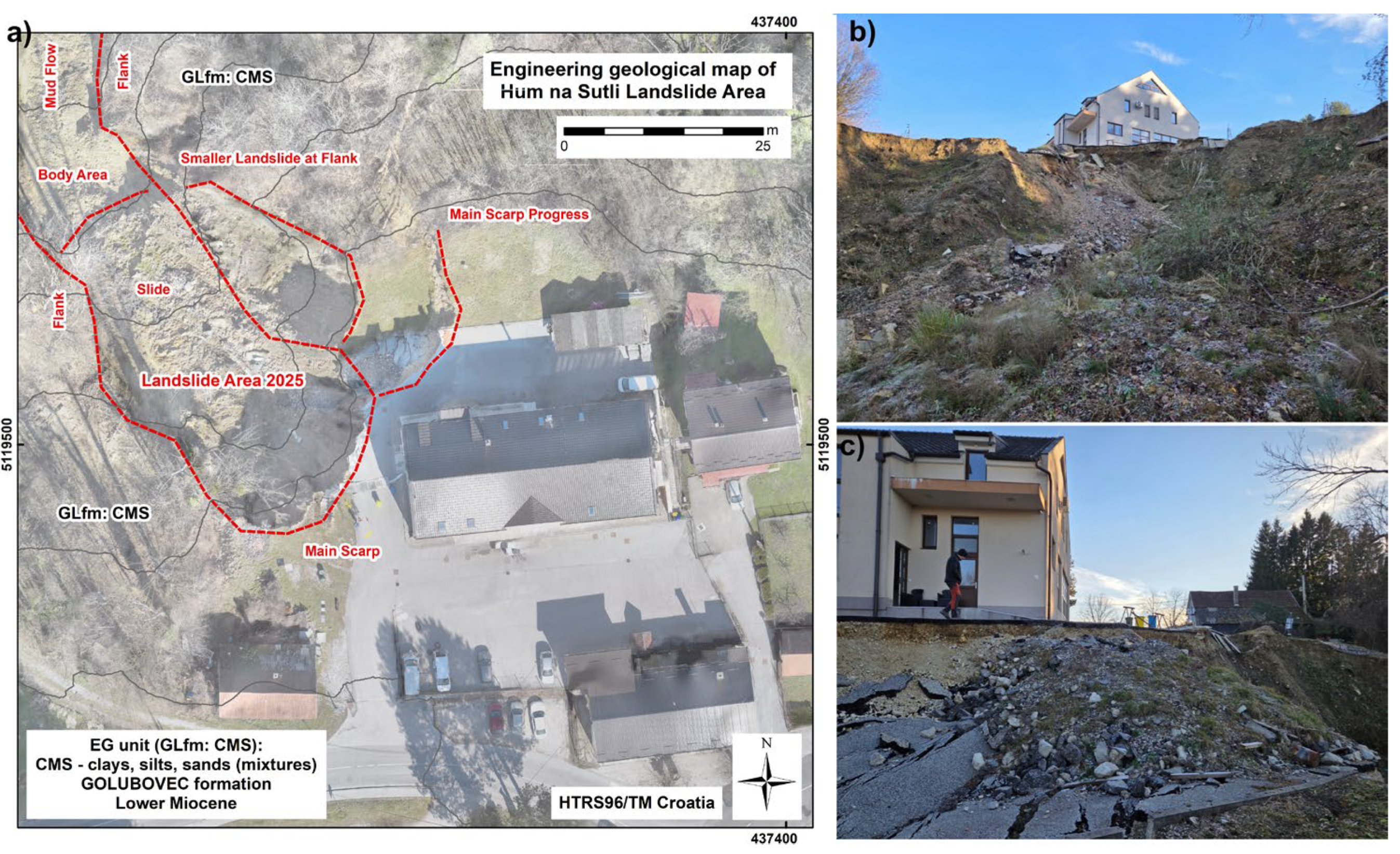
Landslides in Hum na Sutli have a complex history of activation spanning over a decade. Initial sliding was recorded in 2011, and the unstable slope was loaded with construction materials and debris [5]. In the upper section of the slope, in the immediate vicinity of a house and bakery, initial cracks appeared on the slope after the Petrinja earthquake series (December 2020–January 2021, M 6.2, 100 km distance from the epicenter) [38,39]. Landowners have reported constant movements of various degrees from 2022 to the present day, culminating in massive sliding and slope failure during the spring/summer of 2024. The recent landslide is a composite type: the upper part is a rotational slide, while the lower part is a mudflow (Figure 2a). The height of the main scarp is approximately 10 m (Figure 2b), while the sliding plane is at an approximate depth of 5–10 m [5]. Since the landslide remains active, continuous erosion of material from the upper section contributes to the development of mudflow in the lower parts of the landslide, and the main scarp propagates in the NE direction (Figure 2c). The initial deep-seated rotational failure with shallower mudflow mobilization in the lower parts of the Hum na Sutli landslide occurred simultaneously, primarily as a consequence of precipitation.

3. Materials and Methods

During the first phase of research on the Hum na Sutli landslide, interdisciplinary investigations were conducted, including remote sensing, geological mapping, laboratory analyses of soil and sediment, and geophysical surveys, forming the basis of the research presented in this paper [5]. Initial slope deformations and cracks developed after the earthquakes, while subsequent periods of heavy rainfall triggered the landslide [5]. Heavy rainfall and recent changes in precipitation patterns are commonly considered the primary triggers of numerous landslides in Northern Croatia [16,17,40,41].
The precipitation data used in this study were provided by the Croatian Meteorological and Hydrological Service (DHMZ). In this study, precipitation data were analyzed on annual, monthly, and daily scales. Annual precipitation data were investigated to identify the trends and deviations in the long-term climate of this area [29]. Monthly precipitation values were used to detect seasonal patterns and prolonged wet periods, directly influencing progressive soil saturation. Daily precipitation values were examined to detect short-term, high-intensity rainfall events that may have triggered the recent landslide movement in 2024. The combined analyses of these temporal scales enabled the evaluation of both long-term preconditioning effects and short-term triggering mechanisms associated with precipitation.
In particular, linear regressions were performed to detect trends in annual precipitation time series. To assess the statistical significance of trends, a non-parametric Mann–Kendall test was used to minimize the effect of outliers and accommodate non-normal or skewed distributions. In the Mann–Kendall test, the null hypothesis assumes the absence of a monotonic trend, and trends with p-values < 0.05 are considered statistically significant. Furthermore, Pearson’s correlation was used to evaluate the similarity between annual precipitation regimes recorded at the investigated meteorological stations. In addition to overall precipitation analyses, several precipitation indices were calculated from daily precipitation data for the period 2000–2024, including consecutive wet days (CWD; P ≥ 1 mm), consecutive dry days (CDD; P < 1 mm), and maximum 3- and 7-day precipitation totals (Rx3D and Rx7D). CWD and CDD were used to characterize prolonged wet or dry periods that influence soil moisture and slope stability, and Rx3D and Rx7D quantified short-term extreme rainfall events capable of triggering landslides. Furthermore, the number of days with heavy rainfall events (HREs) was analyzed; a threshold of ≥40 mm was used for cumulative daily precipitation, defined based on the analyzed data, engineering judgment, and similarity with previously published landslide studies [5,36].
These indices were calculated to provide a detailed characterization of precipitation patterns relevant to landslide activation. Landslides induced by rainfall strongly reflect antecedent moisture conditions, as prior precipitation events affect soil saturation and the development of pore water pressure, thereby reducing slope stability [42,43,44]. As direct measurements of soil moisture and groundwater conditions are rarely available, antecedent precipitation is commonly used as a proxy for slope wetness [45,46,47]. In this study, antecedent wetness conditions were quantified using the antecedent precipitation index (API), which represents the cumulative effect of rainfall while applying exponential decay to older precipitation events [28,47]. The API is calculated recursively as follows:
APIt = Pt + k × APIt−1
where Pt is daily precipitation (in mm) at time t and k (value between 0–1) is a recession constant representing drainage conditions in the regolith. Based on previous landslide studies integrating API [48,49,50], a k value of 0.9 was chosen in this study, representing high moisture retention in clay-rich soils. The API was specifically computed for the period leading up to the 2024 landslide to quantify antecedent wetness and its potential contribution to slope failure.

4. Results

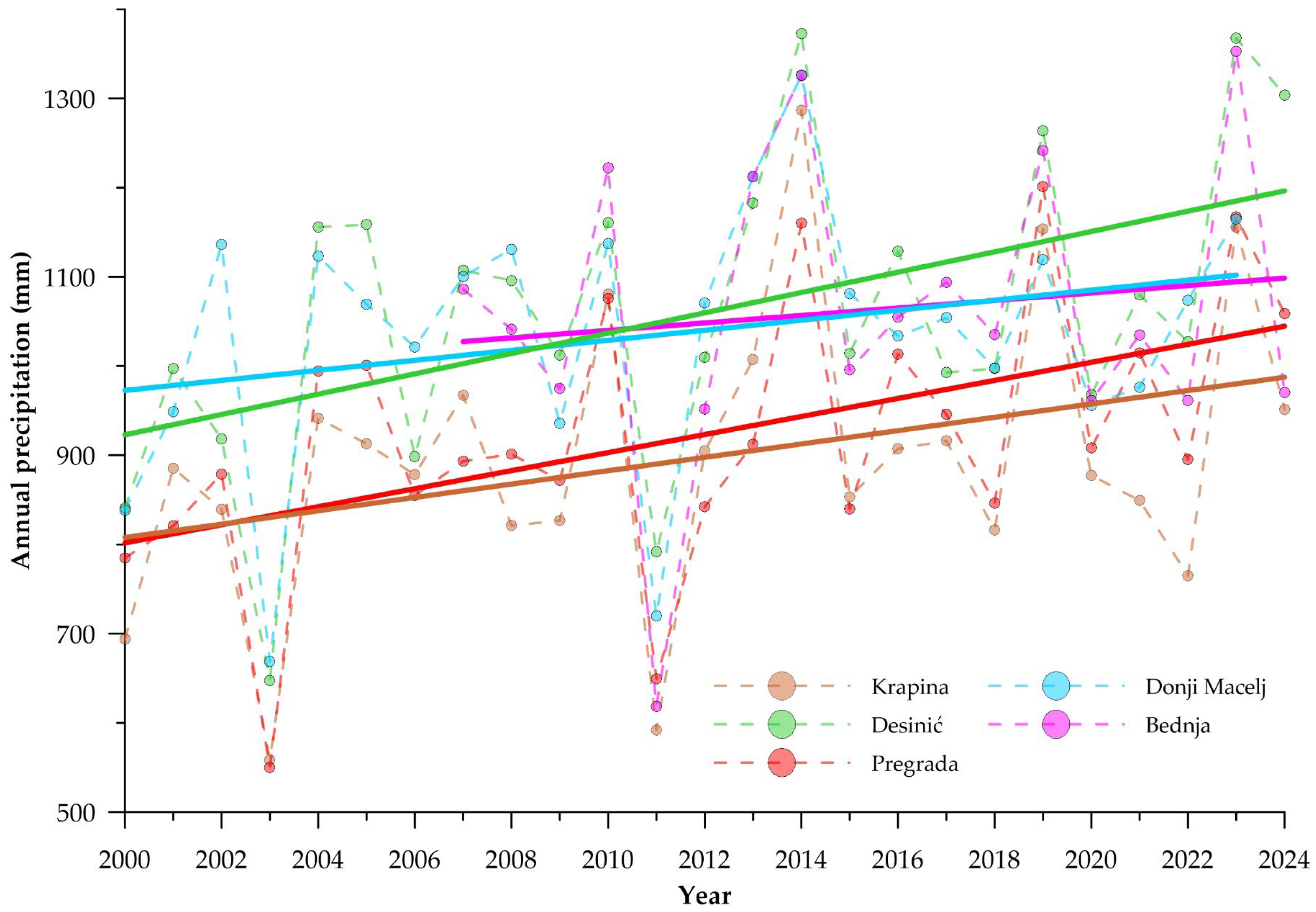
During the period investigated, mean annual precipitation was lowest in Krapina (898 mm), followed by Pregrada (923 mm) and Donji Macelj (1037 mm), while Bednja and Desinić recorded precipitation of approximately 1060 mm (Figure 3). Mean annual precipitation time series exhibit high interannual variability for all stations, with moderate coefficients of variation ranging from 14% in Donji Macelj to 18% in Krapina. Years significantly drier than the average included 2003 and 2013, whereas 2010, 2014, 2019, and 2023 were markedly wetter. Furthermore, the station closest to the investigated landslide (i.e., Desinić) recorded 1304 mm of precipitation in 2024 (the year in which the main sliding events were triggered), representing an anomaly of approximately +23% relative to its long-term mean. Conversely, other stations recorded precipitation levels close to their long-term averages. Annual precipitation exhibited systemic spatial variability during the period investigated, and this was particularly pronounced within individual years (e.g., 2008, 2012, and 2022). Linear regressions indicated weak positive trends at all stations (Figure 3), most pronounced in Desinić and Pregrada (+11.4 mm and +10.4 mm/year, respectively), followed by Krapina (+7.5 mm/year), and Donji Macelj and Bednja with less pronounced trends (+5.6 and 4.2 mm/year, respectively). However, these trends were not statistically significant (i.e., Mann–Kendall p-values > 0.05). Strong positive correlations between station pairs (r = 0.78–0.92) indicated a coherent regional precipitation signal, despite localized spatial variability in individual years.
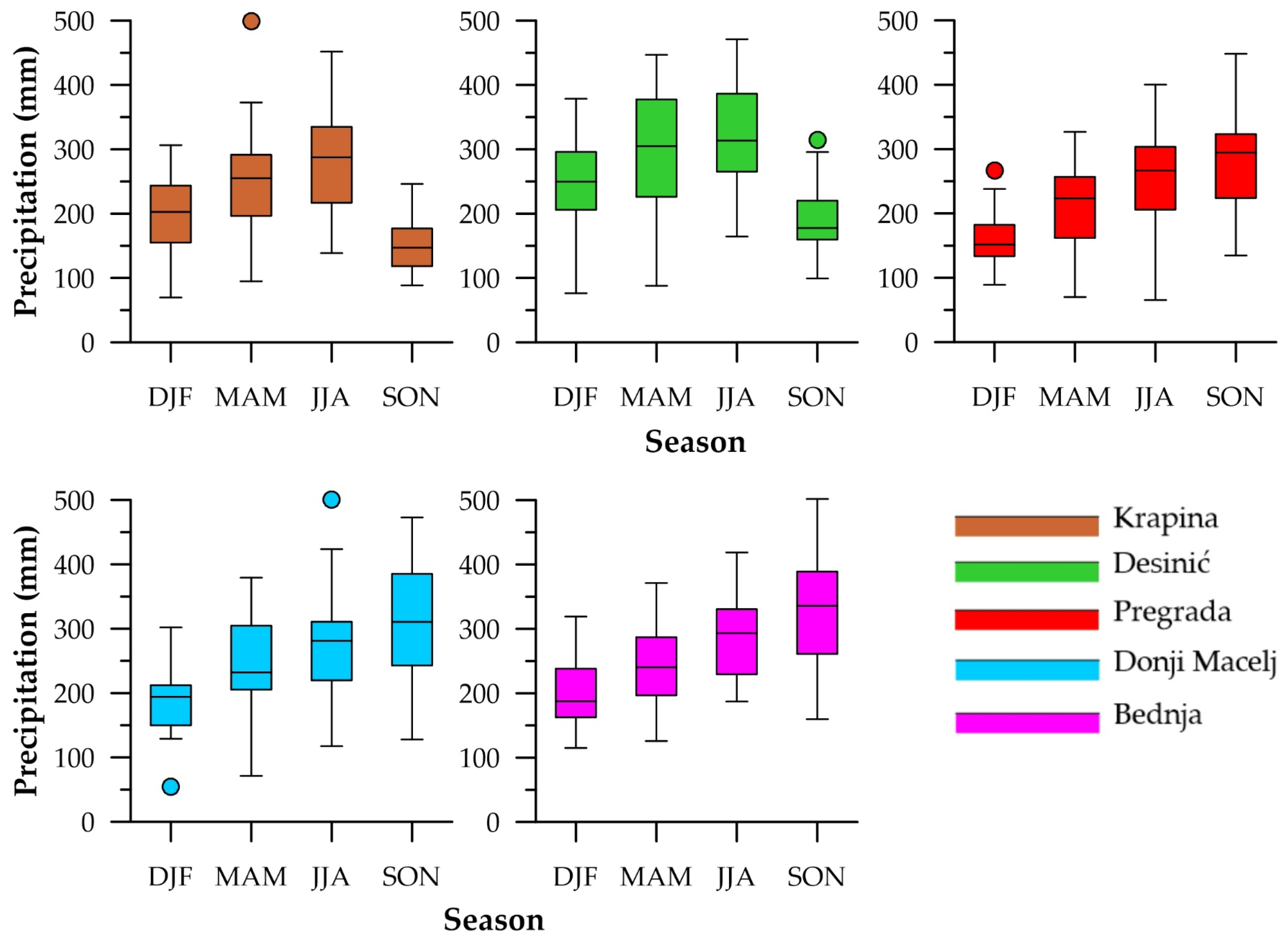
Seasonal precipitation exhibits two distinctive patterns across the region, with the lowest median values observed in winter (i.e., December–February) in Pregrada, Donji Macelj, and Bednja; by contrast, Krapina and Desinić had the lowest values during autumn (i.e., September–November). Median precipitation increases progressively from winter to spring and peaks during summer or autumn, indicating a pronounced warm-season precipitation regime (Figure 4). Krapina and Desinić show peak precipitation predominantly in summer (i.e., June–August), whereas Pregrada, Donji Macelj, and Bednja exhibit the highest median values in autumn (i.e., September–November), highlighting moderate spatial variability in the timing of seasonal maxima. Variability is markedly higher in summer and autumn, as indicated by larger interquartile ranges and extended whiskers. The predominance of longer upper whiskers across seasons indicates positively skewed distributions, suggesting that extreme precipitation events contribute substantially to seasonal totals. Several outliers, particularly in spring and summer, indicate episodic extremely wet seasons (e.g., approximately 500 mm of rainfall for spring in Krapina and autumn in Donji Macelj). In contrast, colder seasons exhibit comparatively lower variability, although occasional outliers indicate intense episodic precipitation events.
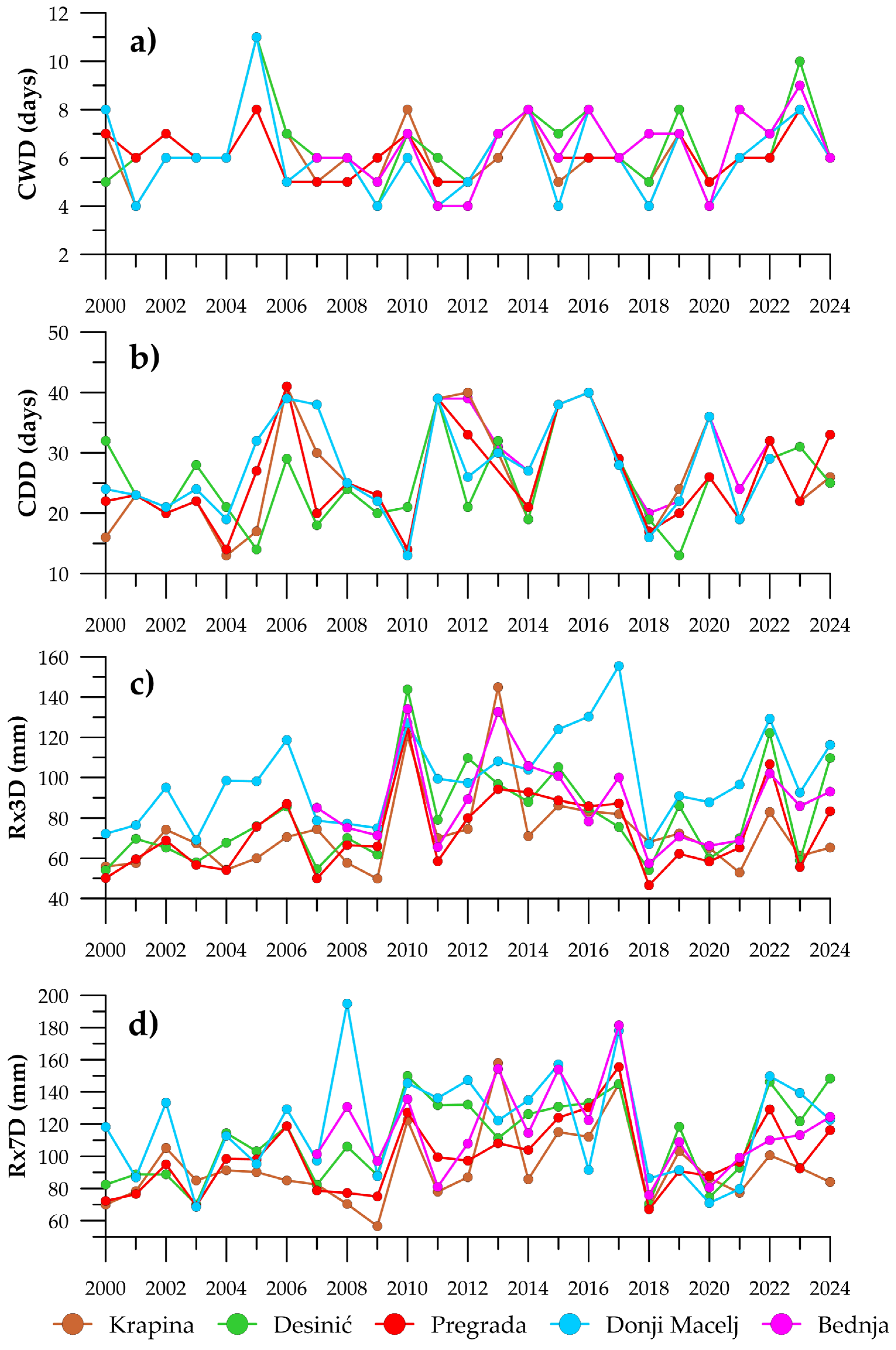
The temporal evolution of precipitation extremes from 2000 to 2024 reveals distinct patterns across the analyzed indices (Figure 5). The maximum number of consecutive wet days (CWD, Figure 5a) remains relatively stable across all stations, generally ranging between 4 and 8 days, with only occasional peaks exceeding 10 days (recorded at Donji Macelj and Desinić in 2005). This indicated limited long-term variability in the duration of wet periods. Moreover, 10 consecutive wet days were recorded in Desinić in 2023, a year prior to the reactivation of the Hum na Sutli landslide. In contrast, the maximum number of consecutive dry days (CDDs, Figure 5b) exhibits pronounced interannual variability, with values fluctuating between approximately 15 and 40 days. Recurrent peaks exceeding 30 days occur throughout the time series (e.g., the mid-2000s, early to middle 2010s, and early 2020s), reflecting episodic prolonged dry periods. Short-duration extreme precipitation, represented by maximum 3-day totals (Rx3D, Figure 5c), shows substantial variability, with multiple events approaching the observed maxima of approximately 140–160 mm of rainfall, particularly in 2010 and 2013–2017. Similarly, maximum 7-day precipitation (Rx7D, Figure 5d) displays higher accumulated totals and pronounced peaks during the same intervals, indicating that extreme rainfall events often occur as part of multi-day episodes. Overall, the results highlight the stable persistence of wet seasons. This contrasts with highly variable dry spells and episodic, yet regionally consistent, multi-day extreme precipitation events.
Intense rainfall events are the primary driving force of landslide development in Northern Croatia as they directly influence soil moisture dynamics and slope stability. Daily threshold values were defined for heavy (i.e., 40–60 mm), severe (i.e., 60–80 mm), and extreme rainfall (i.e., >80 mm), based on analyzed time series, engineering judgment, local climate characteristics, and similarity with existing landslide studies [5,36]. The analysis of intense rainfall events (i.e., number of occurrences within one year) for the period 2000–2024 is shown in Table 2.
The analysis of intense rainfall events between 2000 and 2024 identified several heavy periods (i.e., 40–60 mm/day) annually across all stations. By contrast, severe rainfall (i.e., 60–80 mm/day) occurs less frequently, and remains relatively rare (i.e., >80 mm/day). This distribution highlights a marked decrease in event frequency with increasing rainfall intensity, in accordance with regional climatic characteristics and type (i.e., a humid continental climate). The maximum recorded daily rainfall was substantially higher in Donji Macelj (130 mm/day) and Krapina (109 mm/day) compared to Bednja and Desinić (80 and 86 mm/day, respectively), whereas Pregrada exhibited lower values across all intense rainfall categories, with a maximum rainfall of 69 mm/day. Despite their rarity, extreme events are typically found within years characterized by multiple heavy and severe rainfall occurrences, indicating that they seldom occur in isolation. Pronounced interannual variability is observed, with a notably lower number of intense rainfall events between 2000 and 2005 (excluding Donji Macelj and Bednja, which have no data before 2007). Krapina, Desinić, and Pregrada show similar distributions and occurrences of intense rainfall events. By contrast, Donji Macelj and Bednja show evidence of significantly higher occurrences of extreme rainfall events despite a similar distribution. Moreover, a slightly increasing trend in the occurrence of intense rainfall is evident for Krapina and Desinić. The time series is too short to support definitive conclusions regarding a local climatic shift. However, data indicate local climatic variability and recurring trends.
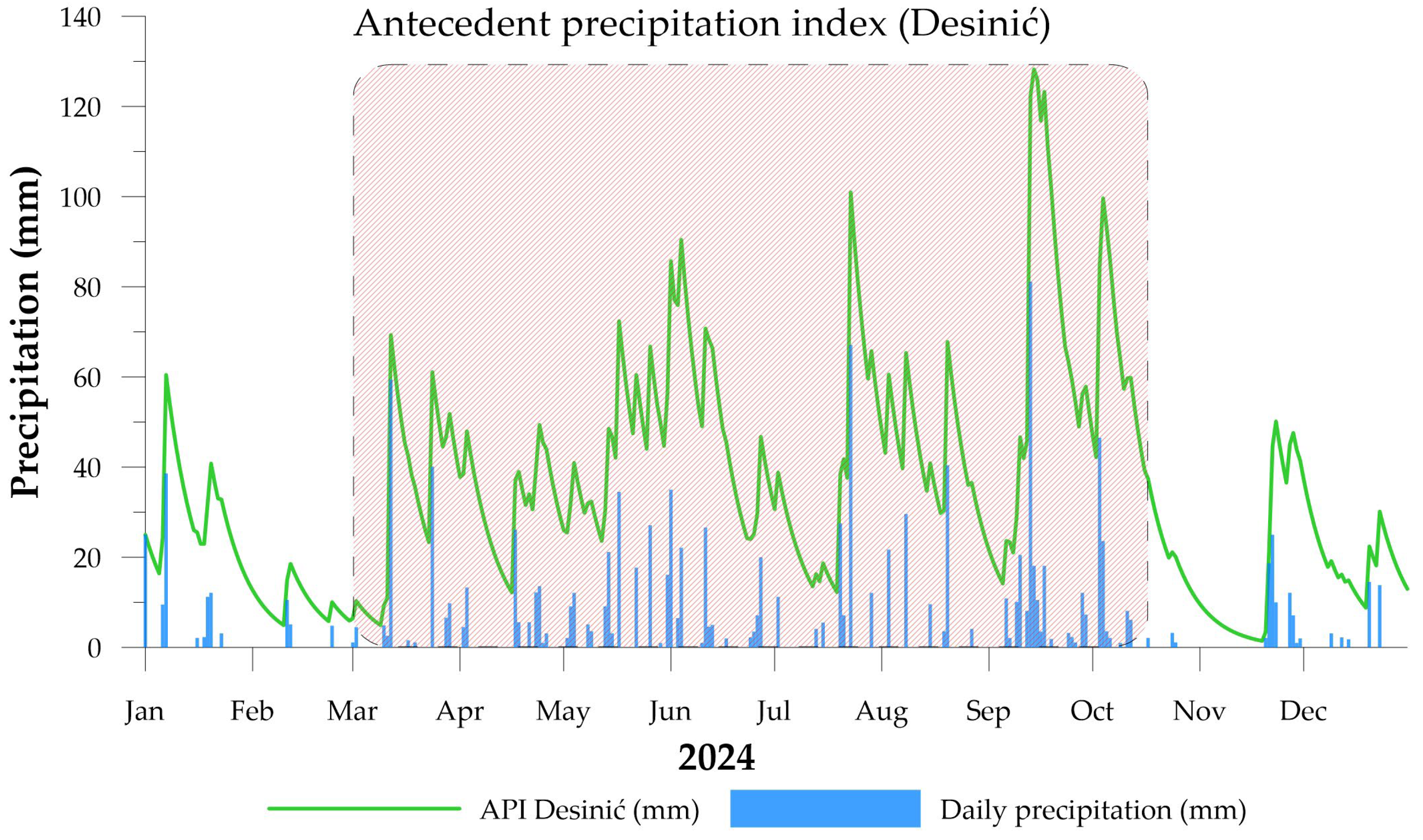
Furthermore, the temporal evolution of daily precipitation and the antecedent precipitation index (API) highlight the critical role of cumulative moisture conditions in landslide triggering [51]. Given its proximity to the landslide in Hum na Sutli, Desinić station was specifically analyzed for its API (Figure 6), using daily precipitation data for 2024. During this year, landowners reported sliding and mass movements. While most individual rainfall events (blue bars) are moderate (i.e., <40 mm/day) and intermittent, with several episodes of intense rainfall (i.e., three heavy, one severe, and one extreme rainfall event, respectively), the API (green line) shows a sustained increase during the late spring, summer and early autumn periods, reflecting the progressive accumulation of antecedent soil moisture and the consequent build-up of conditions favoring slope failure (spring), landslide initiation (summer) and further movements (autumn).

5. Discussion

High-resolution remote sensing data can significantly contribute to optimal landslide research and mitigation planning development [5,18], especially when combined with geological and climatological data [8,50]. Recent trends in landslide studies confirm the benefits of multidisciplinary and multiscale approaches in hazard and risk assessments [19,36,40].
The research presented in this paper is part of a multidisciplinary, multiphase investigation of an active landslide in Hum na Sutli that poses a significant threat to private property, public infrastructure, and general safety. Although the reactivation of the landslide in 2024 was strongly preconditioned by the 2020 Petrinja earthquake series, as evidenced by the development of visible slope deformations in the vicinity of the affected structure [5], intense rainfall acts as the dominant triggering factor, both for this landslide (locally) and in the highly landslide-prone region of Northern Croatia (regionally). Moisture conditions and short-term precipitation extremes play a key role in initiating slope instability. The influence of precipitation on landslide activation in Northern Croatia remains relatively unexplored. Common constraints include the lack of a comprehensive landslide inventory, low spatial resolution of meteorological data, and generally unknown date and conditions of landslide activation. Therefore, this study aimed to assess whether regional meteorological stations could be representative for linking precipitation and API values to landslide triggers, thereby providing a preliminary dataset and methodological framework for defining local precipitation thresholds. This type of approach and analysis, integrating API values, is a novelty in landslide research in Croatia. Similar research has yielded reliable results for Croatia and regional areas [52,53,54,55].
Complex local orography and pronounced relief strongly influence microclimatic conditions in Northern Croatia. Despite the relatively close proximity of the investigated meteorological stations (Figure 1) and minor differences in elevation (Table 2), the time series of mean annual precipitation exhibits substantial spatial variability in intra-annual precipitation distribution (Figure 3). They also show similar temporal patterns (i.e., occurrence of dry and wet years or periods). Strong positive linear correlations (i.e., r values 0.78–0.92) between all station pairs confirm significant regional-scale climate control, suggesting that larger-scale atmospheric patterns affect all stations. Annual precipitation showed slightly positive but statistically insignificant trends during the 2000–2024 period for all stations. Notably, a 25-year period is insufficient to robustly identify long-term changes in precipitation, particularly in Northern Croatia, where precipitation is characterized by substantial interannual and decadal variability. Moreover, statistical analyses revealed no significant differences in minimum, mean, or maximum precipitation between the current climate (i.e., 2000–2024) and the reference period (i.e., 1970–2000) at the Donji Macelj and Desinić stations [29]. This is in line with regional climatological studies, which provide evidence of weak or statistically insignificant long-term trends in annual precipitation totals; however, the regional hydroclimate is shifting toward greater variability and more pronounced extremes [56,57,58,59]. Consequently, the occurrence of heavy rainfall events has increased over the last 20 years in the investigated area (Table 2), which is negative for slope stability.
The analysis of seasonal precipitation (Figure 4) reveals pronounced seasonal variations, particularly during summer and autumn, reflecting more intense precipitation events, most likely linked to enhanced convection. Additionally, several outliers, particularly in spring and summer, indicate episodic extreme rainfall events. In contrast, colder seasons exhibit comparatively lower variability, although occasional outliers indicate episodic intense precipitation events. Despite differences in absolute precipitation amounts, all stations display similar seasonal dynamics, supporting the influence of regional climatic controls, and local factors likely contribute to the observed differences in magnitude and variability between stations.
The coherence of peak years across the investigated meteorological stations in terms of daily precipitation and extreme indices (Figure 5) further corroborates the influence of large-scale climatic drivers in this region. The slightly higher extremes found at Donji Macelj demonstrate the effect of the local topography and orography. The observed patterns of daily precipitation extremes provide important insights into the mechanisms controlling landslide activation in Northern Croatia. The relatively stable duration of consecutive wet days (CWDs) suggests that prolonged continuous precipitation alone is not the primary driver of slope failure in the study area. For example, 10 CWDs were recorded at Desinić in May 2023 with 140 mm of precipitation. However, major slope deformations in Hum na Sutli were not recorded. Instead, the pronounced interannual variability in consecutive dry days (CDDs) indicates alternating periods of soil drying and wetting, which may influence soil structure, permeability, and crack development, thereby affecting subsequent infiltration processes. More importantly, the high variability and clustering of short-duration and multi-day rainfall totals (i.e., Rx3D and Rx7D) highlight the significance of intense rainfall episodes occurring over several consecutive days. Such events are particularly effective in rapidly increasing soil moisture, elevating pore water pressure, and reducing shear strength, especially when preceded by periods of cumulative rainfall. The temporal coincidence of peaks in Rx3D and Rx7D further suggests that extreme precipitation in the region commonly occurs as multi-day events, enhancing their capacity to trigger slope instability. The exact initiation date of the landslide was unavailable. However, the interval identified by landowner testimony was considered the most likely period in which the landscape was triggered (July–August 2024, Figure 6). This period coincided with persistently elevated API values during 2024, despite the absence of extreme single-day precipitation totals. The gradual build-up of API suggests reduced infiltration capacity and increased pore water pressure, creating favorable conditions for slope instability. These findings support a conceptual model in which landslide activation is governed by the interaction between antecedent moisture conditions and short-term intense precipitation, rather than the duration of continuous wet periods alone. Consistent with this, initial soil saturation before rainfall events is critical for landslide occurrence [60]; as such, the specific temporal pattern of antecedent intermittent rainfall, not merely its cumulative total, determines the timing of slope failure [61]. However, these conclusions are somewhat subjective and uncertain due to the lack of precise data.
The presented results provide valuable indicative insights; however, they are subject to certain limitations related to data resolution and geological conditions. The analyses are based on precipitation data of a regional rather than local scale, which could introduce certain margins of error due to the spatial distribution of the precipitation data and its interpretation, mostly observed in the variability of daily indices and HRE timing (Figure 5 and Table 2). Moreover, precise information on the time of landslide activation is rarely available for the study area. Consequently, establishing a direct temporal linkage between specific rainfall events and individual landslide occurrences remains challenging. Nevertheless, datasets compiled by the Croatian Geological Survey [13] offer useful empirical constraints on recent landslide activity in Northern Croatia. Based on available data, preliminary thresholds can be proposed as practical guidance for local communities: (i) extreme precipitation events (≥80 mm/day) may be considered decisive and, in some cases, confirmed as direct triggers of landslides; (ii) severe events (≥60 mm/day) are capable of triggering slope failure, typically in combination with additional preconditioning factors (e.g., anthropogenic slope loading, earthquakes, etc.); and (iii) heavy rainfall events (≥40 mm/day) require increased awareness and preparedness, particularly in areas with high landslide susceptibility. However, the proposed values should be quantitatively back-tested to validate the specific threshold intervals. This can be performed utilizing existing precipitation data and landslide case studies with sufficient detail.
To address the limitations associated with temporal resolution and the uncertainty in linking rainfall events to landslide activation, a subsequent phase of research has been initiated for the Hum na Sutli landslide, involving the installation of a telemetric, autonomous precipitation station with a measuring resolution of 5 min, complemented by a prototype GNSS monitoring network (in total, five GNSS sensors were installed within the investigated landslide) for continuous measurement of ground displacement. This integrated monitoring approach enables high-resolution correlation between rainfall intensity and slope response, allowing for more precise identification of triggering thresholds and temporal relationships between precipitation and landslide activity [43,62,63]. Detailed dataset acquisitions began in February 2026 for the Hum na Sutli landslide. The combined dataset is expected to significantly improve understanding of rainfall-induced slope dynamics and provide a robust basis for developing landslide mitigation measures and early-warning systems in landslide-prone areas in Northern Croatia or in locations with similar climate and geological settings.

6. Conclusions

Precipitation plays a dominant role in landslide triggering in Northern Croatia; however, its impact is controlled by the interaction between rainfall intensity, temporal distribution, and antecedent moisture conditions. The analysis of the Hum na Sutli case study demonstrates that landslide activation cannot be attributed to single extreme rainfall events alone, but rather to the cumulative effect of preceding precipitation levels and progressive soil saturation. Although long-term trends in annual precipitation remain weak and statistically insignificant, the results indicate increasing variability and a tendency toward more frequent extreme and multi-day precipitation events. Seasonal patterns emphasize the importance of warm-season precipitation, particularly in late summer and early autumn, as critical periods for slope instability in this region. The findings confirm that antecedent wetness, represented by elevated API values, is a key preconditioning factor that significantly enhances the susceptibility of slopes to failure. In such conditions, even moderate rainfall events may act as effective triggers. Consequently, preliminary rainfall threshold values are proposed as practical early-warning guidance for local communities in landslide-prone regions in Northern Croatia. The necessity of integrating high-resolution remote sensing data, single heavy rainfall event(s), and cumulative precipitation metrics and analysis into landslide hazard and risk assessment frameworks is highlighted. This can provide a path toward viable early-warning systems and adequate mitigation measures.
Given the limitations of regional-scale precipitation data and uncertainties in local landslide activation, future research should focus on high-resolution monitoring systems and data. The ongoing installation of in situ precipitation and GNSS movement monitoring at the investigated landslide represents a crucial step toward defining reliable triggering thresholds and improving early-warning guidelines for landslide-prone areas in Northern Croatia and comparable environments.

Author Contributions

Conceptualization, M.P. and L.P.; methodology, M.P. and L.P.; software, M.P.; validation, L.P., I.K. and K.U.; formal analysis, M.P. and L.P.; investigation, M.P., L.P., I.K. and K.U.; resources, L.P. and K.U.; data curation, L.P.; writing—original draft preparation, M.P. and L.P.; writing—review and editing, M.P., L.P., I.K. and K.U.; visualization, M.P.; supervision, L.P.; project administration, L.P.; funding acquisition, L.P. and K.U. All authors have read and agreed to the published version of the manuscript.

Funding

The authors would like to acknowledge (I) the H2020-WIDESPREAD-05-2017-Twinning project (project acronym: GeoTwinn, project ID: 809943) and its members, with special thanks for their open-access support, and the (II) Interreg Programme Danube Region project GeoNetSee (project acronym, project ID DRP0200783) and its members and research activities.

Data Availability Statement

In the presented research, third-party data from the Croatian Meteorological and Hydrological Service were used with permission. Restrictions apply to the availability of these data (for further distribution). Any additional or further inquiries can be directed to the corresponding author/s; non-commercial scientific studies, raw data, or working materials can be made available upon reasonable request, even though they are part of ongoing research. Additionally, a minimal research dataset is available without any conditions. The minimal research dataset includes the mapped Hum na Sutli landslide and location of installed movement sensors (MSs), weather stations (WSs), boreholes (BHs), and rain gauge stations. All data is georeferenced (HTRS96/TM Croatia) and available as shape (shp) files.

Acknowledgments

The authors would like to express their thanks to the Croatian Meteorological and Hydrological Service and colleagues from the Croatian Geological Survey (HGI-CGS). Additionally, this paper was supported as a part of GeoNetSee, an Interreg Danube Region Programme project co-founded by the European Union. GenAI has not been used in the presented research.

Conflicts of Interest

The authors declare no conflicts of interest.

Abbreviations

The following abbreviations are used in this manuscript:
APIAntecedent precipitation index
CDDConsecutive dry days
CWDConsecutive wet days
DJFDecember–January–February (i.e., winter season)
HREHeavy rainfall event
JJAJune–July–August (i.e., summer season)
MAMMarch–April–May (i.e., spring season)
PPrecipitation
pProbability value (Mann–Kendall)
rCorrelation coefficient (Pearson)
Rx3DMaximum 3-day precipitation
Rx7DMaximum 7-day precipitation
SONSeptember–October–November (i.e., autumn season)

References

  1. Mengistu, T.D.; Chang, S.W.; Chung, I.M. Modeling and prediction of climate change impacts on water resources vulnerability: A multi-model approach. J. Environ. Manag. 2025, 388, 126025. [Google Scholar] [CrossRef]
  2. Meresa, H.; Tischbein, B.; Mekonnen, T. Climate change impact on extreme precipitation and peak flood magnitude and frequency: Observations from CMIP6 and hydrological models. Nat. Hazards 2022, 111, 2649–2679. [Google Scholar] [CrossRef]
  3. Wu, S.; Xu, C.; Ma, J.; Gao, H. Escalating risks and impacts of rainfall-induced geohazards. Nat. Hazards Res. 2025, 5, 447–454. [Google Scholar] [CrossRef]
  4. Bell, F.G. Geological Hazards: Their Assessments, Avoidance and Mitigation; E&FN Spon Press: London, UK, 2003; pp. 1–648. [Google Scholar]
  5. Podolszki, L.; Kosović, I.; Frangen, T.; Kurečić, T. Remote Sensing and Multi-Level Data Analyses for Hum na Sutli Landslide Impact Assessment in a Changing Climate. Remote Sens. 2025, 17, 3744. [Google Scholar] [CrossRef]
  6. Komolvilas, V.; Tanapalungkorn, W.; Latcharote, P.; Likitlersuang, S. Failure analysis on a heavy rainfall-induced landslide in Huay Khab Mountain in Northern Thailand. J. Mt. Sci. 2021, 18, 2580–2596. [Google Scholar] [CrossRef]
  7. Tiwari, B.; Ajmera, B. Advancements in Shear Strength Interpretation, Testing, and Use for Landslide Analysis. In Progress in Landslide Research and Technology; Alcántara-Ayala, I., Arbanas, Ž., Huntley, D., Konagai, K., Arbanas, S.M., Mikoš, M., Ramesh, M.V., Sassa, K., Sassa, S., Tang, H., et al., Eds.; Springer: Cham, Switzerland, 2023; Volume 2, pp. 3–55. [Google Scholar] [CrossRef]
  8. Guzzetti, F.; Gariano, S.L.; Peruccacci, S.; Brunetti, M.T.; Marchesini, I.; Rossi, M.; Melillo, M. Geographical landslide early warning systems. Earth-Sci. Rev. 2020, 200, 102973. [Google Scholar] [CrossRef]
  9. Gariano, S.L.; Guzzetti, F. Landslides in a changing climate. Earth-Sci. Rev. 2016, 162, 227–252. [Google Scholar] [CrossRef]
  10. Alfieri, L.; Salamon, P.; Pappenberger, F.; Wetterhall, F.; Thielen, J. Operational early warning systems for water-related hazards in Europe. Environ. Sci. Policy 2012, 21, 35–49. [Google Scholar] [CrossRef]
  11. Sim, K.B.; Lee, M.L.; Wong, S.Y. A review of landslide acceptable risk and tolerable risk. Geoenviron. Disasters 2022, 9, 3. [Google Scholar] [CrossRef]
  12. Podolszki, L.; Pollak, D.; Gulam, V.; Miklin, Ž. Development of Landslide Susceptibility Map of Croatia. In Engineering Geology for Society and Territory—Volume 2: Landslide Processes; Lollino, G., Giordan, D., Crosta, G.B., Corominas, J., Azzam, R., Wasowski, J., Sciarra, N., Eds.; Springer: Berlin/Heidelberg, Germany, 2015; Volume 2, pp. 947–950. [Google Scholar] [CrossRef]
  13. Gulam, V.; Pollak, D.; Bostjančić, I.; Frangen, T. Defining the geological units susceptible to landslides in Pannonian Croatia using energy relief index. Bull. Eng. Geol. Environ. 2025, 84, 175. [Google Scholar] [CrossRef]
  14. Miklin, Ž.; Podolszki, L.; Novosel, T.; Sokolić, Ž.; Ofak, J.; Padovan, B.; Zailac, K. Detaljna Inženjerskogeološka Karta Podsljemenske Urbanizirane Zone Mjerila 1:5000 (DIGK-Faza II) [Detailed Engineering Geological Map of Podsljeme Urban Area in Scale of 1:5000 (Phase II)]; Croatian Geological Survey: Zagreb, Croatia, 2018. [Google Scholar]
  15. Gulam, V.; Bostjančić, I.; Hećej, N.; Filipović, M.; Filjak, R. Preliminary analysis of a LiDAR-based landslide inventory in the area of Samobor, Croatia. Geol. Croat. 2022, 75, 51–66. [Google Scholar] [CrossRef]
  16. Podolszki, L.; Miklin, L.; Kosović, I.; Gulam, V. Multi-Level Data Analyses in the Gajevo Landslide Research, Croatia. Remote Sens. 2023, 15, 200. [Google Scholar] [CrossRef]
  17. Podolszki, L.; Kurečić, T.; Bateson, L.; Svennevig, K. Remote landslide mapping, field validation and model development—An example from Kravarsko, Croatia. Geol. Croat. 2022, 75, 67–82. [Google Scholar] [CrossRef]
  18. Miklin, L.; Podolszki, L.; Gulam, V.; Markotić, I. The Impact of Climate Changes on Slope Stability and Landslide Conditioning Factors: An Example from Kravarsko, Croatia. Remote Sens. 2022, 14, 1794. [Google Scholar] [CrossRef]
  19. Segoni, S.; Lagomarsino, D.; Fanti, R.; Moretti, S.; Casagli, N. Integration of rainfall thresholds and susceptibility maps in the Emilia Romagna (Italy) regional-scale landslide warning system. Landslides 2015, 12, 773–785. [Google Scholar] [CrossRef]
  20. Ghosh, K.; Saha, R. A critical review on rainfall induced landslide occurrences and early warning systems. Geomech. Geoengin. 2025, 20, 1052–1074. [Google Scholar] [CrossRef]
  21. Zhao, B.; Zhang, L.; Gu, X.; Luo, W.; Yu, Z.; Yuan, L. How is the occurrence of rainfall-triggered landslides related to extreme rainfall? Geomorphology 2025, 475, 109666. [Google Scholar] [CrossRef]
  22. Moberg, A.; Jones, P.D. Trends in indices for extremes in daily temperature and precipitation in central and western Europe, 1901–1999. Int. J. Climatol. 2005, 25, 1149–1171. [Google Scholar] [CrossRef]
  23. Semenov, V.; Bengtsson, L. Secular trends in daily precipitation characteristics: Greenhouse gas simulation with a coupled AOGCM. Clim. Dyn. 2002, 19, 123–140. [Google Scholar] [CrossRef]
  24. Casanueva, A.; Rodríguez-Puebla, C.; Frías, M.D.; González-Reviriego, N. Variability of extreme precipitation over Europe and its relationships with teleconnection patterns. Hydrol. Earth Syst. Sci. 2014, 18, 709–725. [Google Scholar] [CrossRef]
  25. Gajić-Čapka, M.; Cindrić, K.; Pasarić, Z. Trends in precipitation indices in Croatia, 1961–2010. Theor. Appl. Climatol. 2015, 121, 167–177. [Google Scholar] [CrossRef]
  26. Gajić-Čapka, M. Stationarity, Trend and Periodicity of Precipitation at the Zagreb-Grič Observatory from 1862 to 1990. Croat. Meteorol. J. 1992, 27, 1–10. Available online: https://hrcak.srce.hr/file/101944 (accessed on 15 January 2026).
  27. Bonacci, O.; Andrić, I.; Vrsalović, A.; Bonacci, D. Precipitation Regime Changes at Four Croatian Meteorological Stations. Atmosphere 2021, 12, 885. [Google Scholar] [CrossRef]
  28. Crozier, M.J. Prediction of rainfall-triggered landslides: A test of the Antecedent Water Status Model. Earth Surf. Process. Landf. 1999, 24, 825–833. [Google Scholar] [CrossRef]
  29. Zaninović, K.; Gajić-Čapka, M.; Perčec Tadić, M.; Vučetić, M.; Milković, J.; Bajić, A.; Cindrić, K.; Cvitan, L.; Katušin, Z.; Kaučić, D. Klimatski Atlas Hrvatske: 1961–1990: 1971–2000. [Climate Atlas of Croatia: 1961–1990: 1971–2000.—In Croatian]; Meteorological and Hydrological Service of Croatia: Zagreb, Croatia, 2008; p. 200. [Google Scholar]
  30. Keefer, D.K.; Wilson, R.C.; Mark, R.K.; Brabb, E.E.; Brown, W.M., III; Ellen, S.D.; Harp, E.L.; Wieczorek, G.F.; Alger, C.S.; Zatkin, R.S. Real-time landslide warning during heavy rainfall. Science 1987, 238, 921–925. [Google Scholar] [CrossRef] [PubMed]
  31. Aleotti, P. A warning system for rainfall-induced shallow failures. Eng. Geol. 2004, 73, 247–265. [Google Scholar] [CrossRef]
  32. Chae, B.G.; Park, H.J.; Catani, F.; Simoni, A.; Berti, M. Landslide prediction, monitoring and early warning: A concise review of state-of-the-art. Geosci. J. 2017, 21, 1033–1070. [Google Scholar] [CrossRef]
  33. Van Den Eeckhaut, M.; Hervás, J. State of the art of national landslide databases in Europe and their potential for assessing landslide susceptibility, hazard and risk. Geomorphology 2012, 139–140, 545–558. [Google Scholar] [CrossRef]
  34. Peel, M.C.; Finlayson, B.L.; McMahon, T.A. Updated world map of the Köppen-Geiger climate classification. Hydrol. Earth Syst. Sci. 2007, 11, 1633–1644. [Google Scholar] [CrossRef]
  35. Ančić, B.; Juriša, M. Osnovna Geološka Karta SFRJ 1:100000, Rogatec List L33-68 [Basic Geological Map of SFR of Yugoslavia at a Scale of 1:100,000, Rogatec Sheet L33-68—In Croatian]; Geološki zavod, Ljubljana; Geološki zavod Zagreb; Savezni Geološki Institut: Beograd, Serbia, 1984. [Google Scholar]
  36. Podolszki, L.; Karlović, I. Remote Sensing and GIS in Landslide Management: An Example from the Kravarsko Area, Croatia. Remote Sens. 2023, 15, 5519. [Google Scholar] [CrossRef]
  37. Gulam, V.; Bostjančić, I.; Pollak, D. Landslide Susceptibility Analysis of Krapinsko-Zagorska County; Croatian Geological Survey: Zagreb, Croatia, 2025; pp. 1–147. [Google Scholar]
  38. Pollak, D.; Gulam, V.; Novosel, T.; Avanić, R.; Tomljenović, B.; Hećej, N.; Terzić, J.; Stipčević, J.; Bačić, M.; Kurečić, T.; et al. The preliminary inventory of coseismic ground failures related to December 2020–January 2021 Petrinja earthquake series. Geol. Croat. 2021, 74, 189–208. [Google Scholar] [CrossRef]
  39. Radnić, J.; Grgić, N.; Buzov, A.; Banović, I.; Smilović Zulim, M.; Baloević, G.; Sunara, M. Mw 6.4 Petrinja earthquake in Croatia: Main earthquake parameters, impact on buildings and recommendation for their structural strengthening. Građevinar 2021, 73, 1109–1128. [Google Scholar] [CrossRef]
  40. Podolszki, L.; Kosović, I.; Novosel, T.; Kurečić, T. Multi-Level Sensing Technologies in Landslide Research—Hrvatska Kostajnica Case Study, Croatia. Sensors 2022, 22, 177. [Google Scholar] [CrossRef]
  41. Mihalić Arbanas, S.; Krkač, M.; Bernat, S. Application of innovative technologies in landslide research in the area of the City of Zagreb (Croatia, Europe). Croatia. Geol. Croat. 2016, 69, 231–243. [Google Scholar] [CrossRef]
  42. Zhang, Q.; Shen, D. Rainfall-Induced Landslides: Influencing, Modelling and Hazard Assessment. Water 2024, 16, 3384. [Google Scholar] [CrossRef]
  43. Ebrahim, K.; Gomaa, S.M.M.H.; Zayed, T.; Alfalah, G. Rainfall-Induced Landslide Prediction Models, Part I: Empirical–Statistical and Physically Based Causative Thresholds. Water 2025, 17, 3273. [Google Scholar] [CrossRef]
  44. Rababa, F.; Ngezahayo, E.; Jefferson, I. Laboratory-based physical modeling of rainfall-induced landslides: A systematic review. Model. Earth Syst. Environ. 2026, 12, 118. [Google Scholar] [CrossRef]
  45. Hughes, D.A. Antecedent precipitation. In Encyclopedia of Hydrology and Lakes. Encyclopedia of Earth Science; Springer: Dordrecht, The Netherlands, 1998. [Google Scholar] [CrossRef]
  46. Liang, J.; Hu, Z.; Liu, S.; Zhong, G.; Zhen, Y.; Makhinov, A.N.; Araruna, J.T. Residual-Oriented Optimization of Antecedent Precipitation Index and Its Impact on Flood Prediction Uncertainty. Water 2022, 14, 3222. [Google Scholar] [CrossRef]
  47. Crozier, M.J.; Eyles, R.J. Assessing the Probability of Rapid Mass Movement. In Proceedings of the Third Australia-New Zealand Conference on Geomechanics, Wellington, New Zealand, 12–16 May 1980. [Google Scholar]
  48. Ma, T.; Li, C.; Lu, Z.; Wang, B. An effective antecedent precipitation model derived from the power-law relationship between landslide occurrence and rainfall level. Geomorphology 2014, 216, 187–192. [Google Scholar] [CrossRef]
  49. Glade, T.; Crozier, M.; Smith, P. Applying Probability Determination to Refine Landslide-triggering Rainfall Thresholds Using an Empirical “Antecedent Daily Rainfall Model”. Pure Appl. Geophys. 2000, 157, 1059–1079. [Google Scholar] [CrossRef]
  50. Guzzetti, F.; Peruccacci, S.; Rossi, M.; Stark, C.P. Rainfall thresholds for the initiation of landslides in central and southern Europe. Meteorol. Atmos. Phys. 2007, 98, 239–267. [Google Scholar] [CrossRef]
  51. De Moraes, M.A.E.; Filho, W.M.M.; Mendes, R.M.; Bortolozo, C.A.; Metodiev, D.; De Andrade, M.R.M.; Egas, H.M.; Mendes, T.S.G.; Pampuch, L.A. Antecedent Precipitation Index to Estimate Soil Moisture and Correlate as a Triggering Process in the Occurrence of Landslides. Int. J. Geosci. 2024, 15, 70–86. [Google Scholar] [CrossRef]
  52. Bernat, S.; Mihalić Arbanas, S.; Krkač, M. Landslides Triggered in the Continental Part of Croatia by Extreme Precipitation in 2013. In Engineering Geology for Society and Territory—Volume 2: Landslide Processes; Lollino, G., Giordan, D., Crosta, G.B., Corominas, J., Azzam, R., Wasowski, J., Sciarra, N., Eds.; Springer: Berlin/Heidelberg, Germany, 2015; Volume 2, pp. 1599–1603. [Google Scholar] [CrossRef]
  53. Dugonjić Jovančević, S.; Rubinić, J.; Arbanas, Ž. Conditions and triggers of landslides on flysch slopes in Istria, Croatia. Eng. Rev. 2020, 40, 77–87. [Google Scholar] [CrossRef]
  54. Jemec Auflič, M.; Šinigoj, J.; Krivic, M.; Podboj, M.; Peternel, T.; Komac, M. Landslide prediction System for rainfall induced landslides in Slovenia (Masprem). Geologija 2016, 59, 259–271. [Google Scholar] [CrossRef]
  55. Marjanović, M.; Krautblatter, M.; Abolmasov, B.; Đurić, U.; Sandić, C.; Nikolić, V. The rainfall-induced landsliding in Western Serbia: A temporal prediction approach using Decision Tree technique. Eng. Geol. 2018, 232, 147–159. [Google Scholar] [CrossRef]
  56. Gačnik, J.; Žagar, K.; Hatvani, I.G.; Kern, Z.; Vreča, P. Climate change reflected in 40-year isotopic composition trends of precipitation in Slovenia. Environ. Res. 2026, 288, 123286. [Google Scholar] [CrossRef]
  57. Spinoni, J.; Naumann, G.; Vogt, J.; Barbosa, P. European drought climatologies and trends based on a multi-indicator approach. Glob. Planet. Change 2015, 127, 50–57. [Google Scholar] [CrossRef]
  58. Danilovich, I.S.; Loginov, V.F.; Groisman, P.Y. Changes of Hydrological Extremes in the Center of Eastern Europe and Their Plausible Causes. Water 2023, 15, 2992. [Google Scholar] [CrossRef]
  59. Knez, S.; Štrbac, S.; Podbregar, I. Climate change in the Western Balkans and EU Green Deal: Status, mitigation and challenges. Energ. Sustain. Soc. 2022, 12, 1. [Google Scholar] [CrossRef]
  60. Halter, T.; Lehmann, P.; Wicki, A.; Aaron, J.; Stähli, M. Optimising landslide initiation modelling with high-resolution saturation prediction based on soil moisture monitoring data. Landslides 2025, 22, 2897–2914. [Google Scholar] [CrossRef]
  61. Jayakody, S.H.S.; Uzuoka, R.; Ueda, K.; Xu, J. Unsaturated slopes behavior under antecedent intermittent rainfall patterns: Centrifuge and numerical study. Acta Geotech. 2023, 18, 5773–5790. [Google Scholar] [CrossRef]
  62. Du, B.; Wang, Y.; Fang, Z.; Liu, G.; Tian, Z.; Ullah, K.; Cao, M. Assessing the impact of precipitation variability on landslide hazards in urbanized regions. Int. J. Appl. Earth Obs. Geoinf. 2025, 136, 104360. [Google Scholar] [CrossRef]
  63. Santangelo, M.; Althuwaynee, O.; Alvioli, M.; Ardizzone, F.; Bianchi, C.; Bornaetxea, T.; Brunetti, M.T.; Bucci, F.; Cardinali, M.; Donnini, M.; et al. Inventory of landslides triggered by an extreme rainfall event in Marche-Umbria, Italy, on 15 September 2022. Sci. Data 2023, 10, 427. [Google Scholar] [CrossRef] [PubMed]
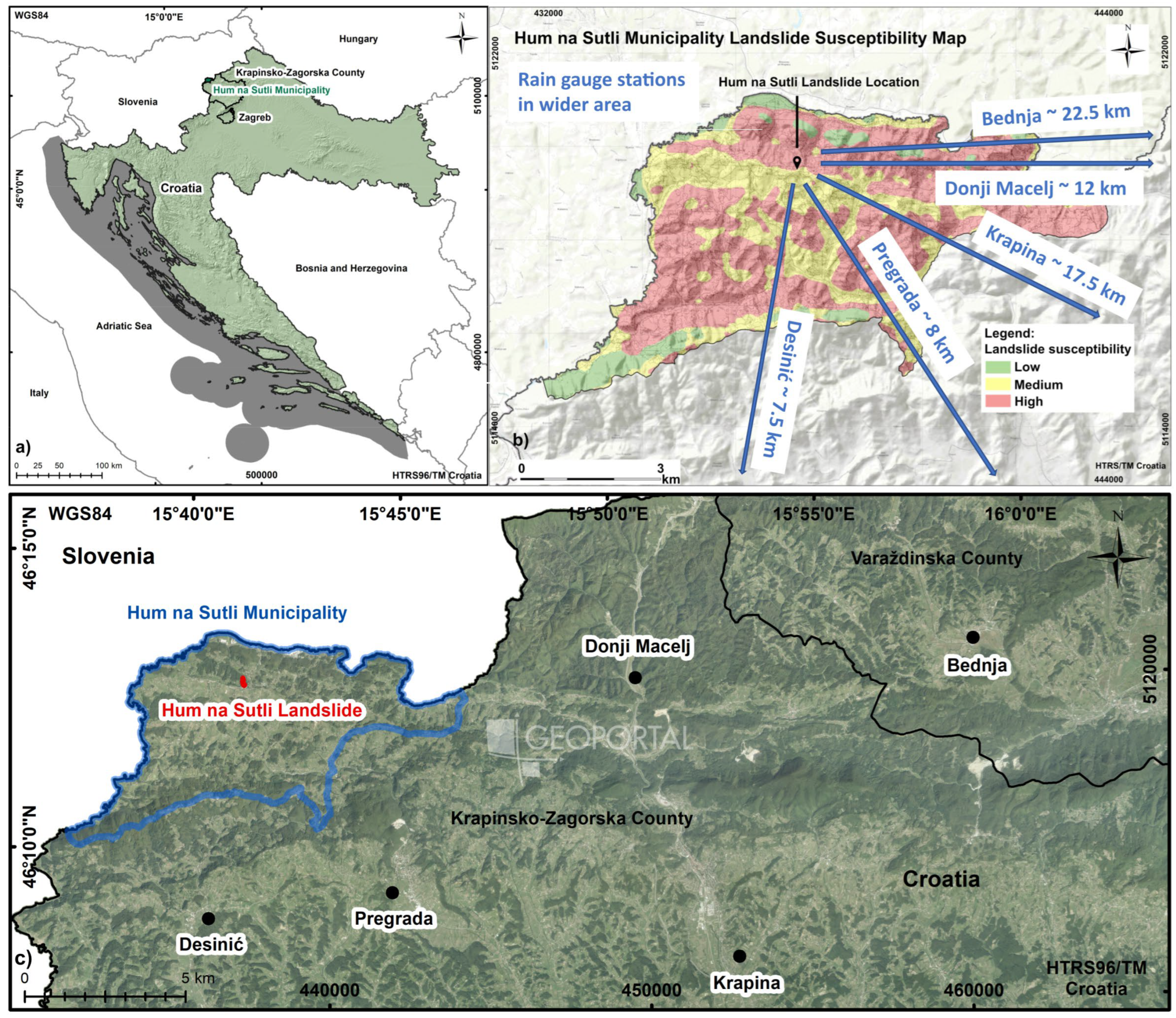
Figure 1. Geographical position of the study area: (a) Hum na Sutli municipality, northwestern Croatia [5]. (b) Landslide susceptibility map of Hum na Sutli municipality [37], with Hum na Sutli landslide location and distances to meteorological stations in the area; (c) position of the investigated meteorological stations in northwestern Croatia.
Water 18 01393 g001
Figure 2. Hum na Sutli landslide: (a) landslide map (red dashed lines); (b) main scarp view from the landslide body; (c) endangered house and bakery (photo by Croatian Geological Survey 2026).
Water 18 01393 g002
Figure 3. Time series of annual precipitation measured at the investigated meteorological stations. Full lines represent linear regressions and weak positive trends at all stations.
Water 18 01393 g003
Figure 4. Seasonal distribution of precipitation at the investigated meteorological stations for the period 2000–2024. Box plots show precipitation totals for winter (December–February, DJF), spring (March–May, MAM), summer (June–August, JJA), and autumn (September–November, SON). Outliers are shown as individual points. The edges of the box represent the first and third quartiles; the whiskers indicate the minimum and maximum; and the central line represents the median of the data.
Water 18 01393 g004
Figure 5. Temporal evolution of precipitation extreme indices at the investigated meteorological stations for the period 2000–2024: (a) maximum number of consecutive wet days (CWD); (b) maximum number of consecutive dry days (CDD); (c) maximum 3-day precipitation total (Rx3D); and (d) maximum 7-day precipitation total (Rx7D).
Water 18 01393 g005
Figure 6. Temporal variation in daily precipitation (blue bars) and antecedent precipitation index (API; green line) at the Desinić station for 2024. The shaded area indicates the period identified from landowner testimony as that of landslide activation (i.e., existing cracks and deformations on the slope developed to full-scale sliding). Although the exact initiation data of the landslide were not observed, API values were examined across the entire uncertainty interval. HREs in 2024 occurred in March (with 59 mm of precipitation), July (with 67 mm of precipitation), August (with 40 mm of precipitation), September (with 81 mm of precipitation), and October (with 47 mm of precipitation).
Water 18 01393 g006
Table 1. Location of the meteorological stations and time series.
DesinićPregradaDonji MaceljKrapinaBednja
Latitude46°08′49.5″46°09′17.8″46°12′55.5″46°08′15.7″46°13′38.5″
Longitude15°40′27.9″15°44′53.9″15°50′43.4″15°53′17.5″15°58′51.5″
H * (m a.s.l.)219181208202240
D ** (km)7.337.8912.1117.5122.60
Available data1952–20242000–20241962–20242000–20242007–2024
Notes * H is the absolute altitude of the meteorological stations; ** D represents the distance between the landslide area and the meteorological station.
Table 2. Analysis of intense rainfall events for the period 2000–2024 at the investigated meteorological stations, following the defined rainfall thresholds: heavy (40–60 mm/day), severe (60–80 mm/day), and extreme (>80 mm/day). Higher values are highlighted in bold.
StationDesinić
(mm/Day)
Pregrada
(mm/Day)
Donji Macelj
(mm/Day)
Krapina
(mm/Day)
Bednja
(mm/Day)
Year40–6060–80>8040–6060–80>8040–6060–80>8040–6060–80>8040–6060–80>80
2000 2 No data
2001 1 1 1
2002 51 1
2003 2
2004 1
20053 2
2006 1 1
20071 1 3 1 11
20082 1 21 2
20091 1 3 1 3
201011 11 31 21 11
20113 1 2 11 2
201212 2 6 11 12
20132 1 31 21 2
20143 2 22 1 1 2
20152113 51 3 3 1
2016 2 11 11 21
201711 3 21 2 21
20182 1 1 1 2
20192 3 3
202021 2 2 2 2
20212 1 1
2022 2 11 2 13 3
20232 4 2 4
202431121 2 3 11
Σ331122740549230613491
Disclaimer/Publisher’s Note: The statements, opinions and data contained in all publications are solely those of the individual author(s) and contributor(s) and not of MDPI and/or the editor(s). MDPI and/or the editor(s) disclaim responsibility for any injury to people or property resulting from any ideas, methods, instructions or products referred to in the content.