Article

Warmer Temperatures and Smaller Body Size May Favor Biological Competition of Invasive Neogobius fluviatilis with Native Gobio gobio in Central European Bioregion


by
Alicja Pawelec
1,2,*,
Małgorzata Grzesiuk
3,
Anna Hauler
2 and
Jay R. Stauffer, Jr.
4,5
1
WWF Poland, 02-386 Warsaw, Poland
2
Department of Hydrobiology, Institute of Ecology, Faculty of Biology, University of Warsaw, 00-927 Warsaw, Poland
3
Department of Biochemistry and Microbiology, Institute of Biology, Warsaw University of Life Sciences, 02-787 Warsaw, Poland
4
Ecosystem Science and Management, College of Agriculture Sciences, Penn State University, University Park, PA 16802, USA
5
South African Institute for Aquatic Biodiversity, Makhanda 6140, South Africa
*
Author to whom correspondence should be addressed.
Water 2026, 18(12), 1394; https://doi.org/10.3390/w18121394
Submission received: 30 March 2026 / Revised: 25 May 2026 / Accepted: 1 June 2026 / Published: 7 June 2026
(This article belongs to the Section Biodiversity and Functionality of Aquatic Ecosystems)

Abstract

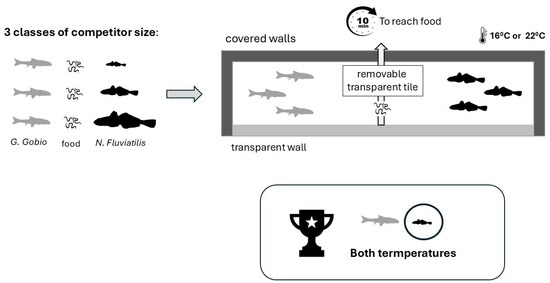
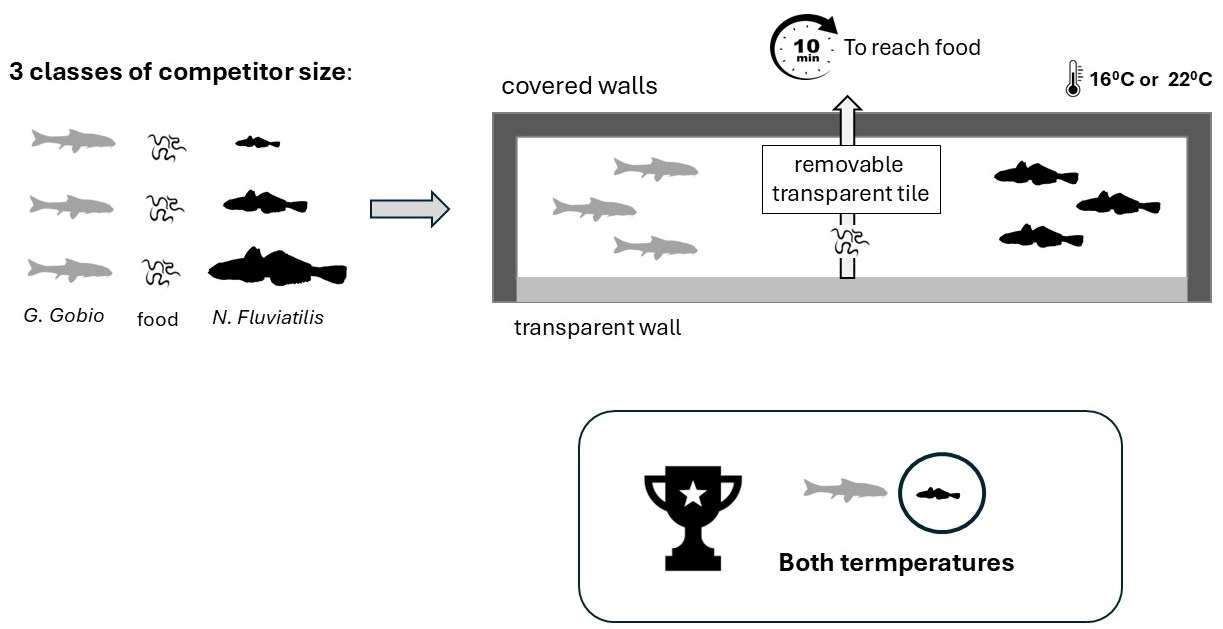
We conducted experiments to assess the importance of the effects of interactions between individuals of co-occurring species, the Common Gudgeon Gobio gobio, native to Europe, and the invasive Monkey Goby Neogobius fluviatilis. We examined the influence of the size of the competitor and the temperature of the water on competition for food between these two species. To investigate whether this food competition is dependent on the size of invasive competitors, we used three size classes of the invasive N. fluviatilis and a single size class of the native G. gobio in a tank-based experiment. To reflect the possible impact of temperature, we used two different water temperatures: 16 °C preferred by the G. gobio and 22 °C preferred by the N. fluviatilis. Based on the number of prey consumed, time to start feeding, and the total time spent hunting prey, we provided direct confirmation that the invasive N. fluviatilis in Europe is the superior competitor for food at both tested temperatures, eating twice as much prey, feeding 2–4 times faster, and spending up to three times more time on hunting. Food competition was size-dependent: the greater threat for native species is invasive fish, which are smaller or similar to them in size. Warmer temperatures (22 °C) gave more than twice as much advantage to the invaders under all tested feeding parameters. Therefore, we concluded that populations of invasive N. fluviatilis present a serious threat to native European benthic fish species (i.e., G. gobio). Increasing temperatures, better tolerated by invasive species, compound this problem.

Graphical Abstract

1. Introduction

The homogenization of the Earth’s biota by the introduction and spread of non-native species is one of the most damaging anthropogenic impacts on biodiversity today [1]. Invasive species, which exert a strong, negative impact on native ecosystems, lead not only to serious environmental threats but economic ones as well [2,3]. The global cost of invasive species reached a minimum of US $1.28 trillion (2017 US dollars) over the past few decades (1970–2017), with an annual mean cost of US $26.8 billion [4]. Invasions of fish have potentially caused the economic loss of at least US $37.08 billion (US2017 value) globally, from just 27 reported species [5]. Rates of invasion by alien species are increasing, favored by climate change, global trade, and many human activities [6,7], and fish are the most common among non-native freshwater animals [8]. Non-native fish can have a strong impact on native species, mostly by (i) [9] being strong food and shelter competitors; (ii) interbreeding with them and creating infertile hybrids, which reduces the reproductive success of native species, or (iii) being unknown vectors for native species, parasites, and diseases to which native species are not immune, making them susceptible.
Particular alien fish differ greatly in their potential for successfully establishing a viable population, as well as their potential to negatively impact native biocenosis (for the latter, see [10,11]. Parameters such as (i) habitat exclusion [12], (ii) level of aggressiveness [13], (iii) disease resistance and parasite transfer [14], (iv) guarding eggs [15], or even (v) sounding [16] have been tested, but other important ecological interactions, such as food competition, remain understudied [3]. Kakareko et al. (2013) [17] measured the time spent by fish near feeders and the correlation with acts of aggression. They showed that invasive Racer Goby Babka gymnotrachelus displaced native European Bullhead Cottus gobio during feeding bouts, with potential negative consequences for foraging efficiency for both species. In the second study, Carmona-Catot et al. (2013) [18] considered the effects of temperature on food competition between invasive Eastern Mosquitofish Gambusia holbrooki and the endemic Spanish Toothcarp Aphanius iberus. In colder water (19 °C), invasive fish ate significantly less than the native fish and showed no aggression. At warmer temperatures (29 °C), however, invasive species swam faster and reached the food first [3]. Grabowska et al. (2019) [19] measured feeding rates and prey capture efficiency of the native Mudminnow Umbra krameri in the presence of the alien competitor Chinese Sleeper Perccottus glenii. Feeding rates and prey capture efficiency were similar in both species, but P. glenii was a superior competitor: in the presence of the alien competitor, the feeding rate of native U. krameri decreased to one third of that observed in control. Mofu et al. (2019) [20] also measured feeding rate between native River Goby Glossogobius callidus and invasive Mosquitofish Gambusia affinis and showed that the invasive species had a higher feeding rate. None of these experiments tested direct food competition between native and invasive fish, incorporating both the size of the invasive competitor and the water temperature [3]. Our aim, therefore, was to investigate direct food competition between invasive and native fish.
Monkey Goby Neogobius fluviatilis (Pallas, 1814), a Ponto-Caspian fish, is an invasive species in Europe [9]. Since its introduction to the rivers of Central and Western Europe from its native areas (Black, Caspian, and Azov sea basins) about 40 years ago [21], it has become one of the most widespread species in the area [9]. It is widely accepted that the expansion of N. fluviatilis represents a serious threat to the benthic fish native to Europe [9]. Common Gudgeon Gobio gobio Linnaeus, 1758, a small benthophagic species, is one of the most abundant native fish in European lowland rivers and lakes [22]. Gobio gobio and N. fluviatilis share a similar feeding behavior and biology, especially concerning their diet, which is dominated by the larvae of chironomids [3,23].
Both species achieve a similar body size and age: a sexually mature G. gobio usually has a total body length of 8–15 cm, a maximum size of 21 cm [24], and can live up to 8 years [24]. Sexually mature N. fluviatilis usually measure up to 13 cm in total body length, but the maximum size they can reach is about 20 cm [24], and they can live up to 6 years [24]. In Europe, both species reach sexual maturity at the age of three [24]. N. fluviatilis occurs in the littoral zone of lakes and the coastal zone of rivers over a sandy bottom [25], enabling it to bury itself as a form of escape in case of danger [23]. These are also typical habitats of the native G. gobio [22]. Thus, it is likely that both species can interact intensively, especially in the context of searching for food resources, and this situation likely results in increased feeding competition. Such long-term competition may reduce the range of both species as well as their population density, which could result in the extirpation of the native species in given localities [3,26]. Levels and forms of competition may be related to the individual body sizes of the fish. Neogobius fluviatilis is an aggressive species, engaging in high levels of territorial behavior when it encounters other species, e.g., chasing them away or biting [3]. The intensity and dynamics of aggressive interactions between individual fish are significantly influenced by their relative body size [27,28]. In this study, we examined food competition between G. gobio and N. fluviatilis and whether body size and water temperature influence their success in obtaining food.
The effect of temperature and body size appears to be coupled [29]. It is most common for invasive species to displace native species, among other mechanisms, because they tolerate temperature changes better and do well in warmer temperatures [30,31]. Moreover, despite many similarities, both G. gobio and N. fluviatilis prefer different water temperatures: native G. gobio prefers water to be at about 16 °C, and the invasive N. fluviatilis favors a temperature of about 22 °C [29]. Neogobius fluviatilis tolerates temperature fluctuations well and easily adapts to lower temperatures [3,32]. The primary aim of our study was to investigate the effectiveness of obtaining food for the native predator G. gobio and alien predator N. fluviatilis at two different water temperatures. Moreover, we wanted to examine whether the size of the invasive competitor N. fluviatilis affects the results of this competition.

2. Materials and Methods

Forty wild individuals of the invasive N. fluviatilis and 40 wild individuals of native G. gobio were caught in Lake Ros, near Pilchy village (53.682 N, 21.889 E; Masuria, Poland), in July and August 2014, using electrofishing (AP has a certificate—certificate no. 1869/17 regarding the use of electric fishing gear, issued by the Inland Fisheries Institute in Olsztyn, Poland—National Research Institute). Both species were collected from the same shallow, near-shore localities of the sandy-bottomed lake. Individuals of N. fluviatilis were divided into three class sizes: (i) 4–5 cm in total body length, which corresponds to the size of juveniles; (ii) 6–8 cm in total body length, which corresponds to the size of young, sexually mature individuals; and (iii) 11–13 cm total body length, which corresponds to the common length of individuals older than 3 years. All individuals of G. gobio were 7–9 cm long in total body length. We used only one size of native competitor because we want to examine the food competition from the native perspective and from sexually mature fish. Classes of invasive fish were chosen deliberately to examine how native fish deal with food competitors that were smaller, equal to, or bigger than them (the “G. gobio perspective”).
All specimens were kept in 10 L aerated tanks (7–10 individuals per tank), with a sandy bottom. The tanks were filled with lake water, of which half of the water (5 L) was changed every two days and always aerated by water stirrers. The fish were fed once every two days ad libitum with frozen chironomid larvae. To asses whether temperature might affect the intensity of feeding, and thus feeding competitiveness, individuals of both species were separated into two groups and acclimated for two weeks to different thermal conditions: 16 °C, as preferred by G. gobio and 22 °C, as preferred by N. fluviatilis [29], with a photoperiod of 16L:8D. The temperature was maintained using thermostats, and additional water stirrers were installed to improve the circulation of water and to ensure thermal homogeneity [3].
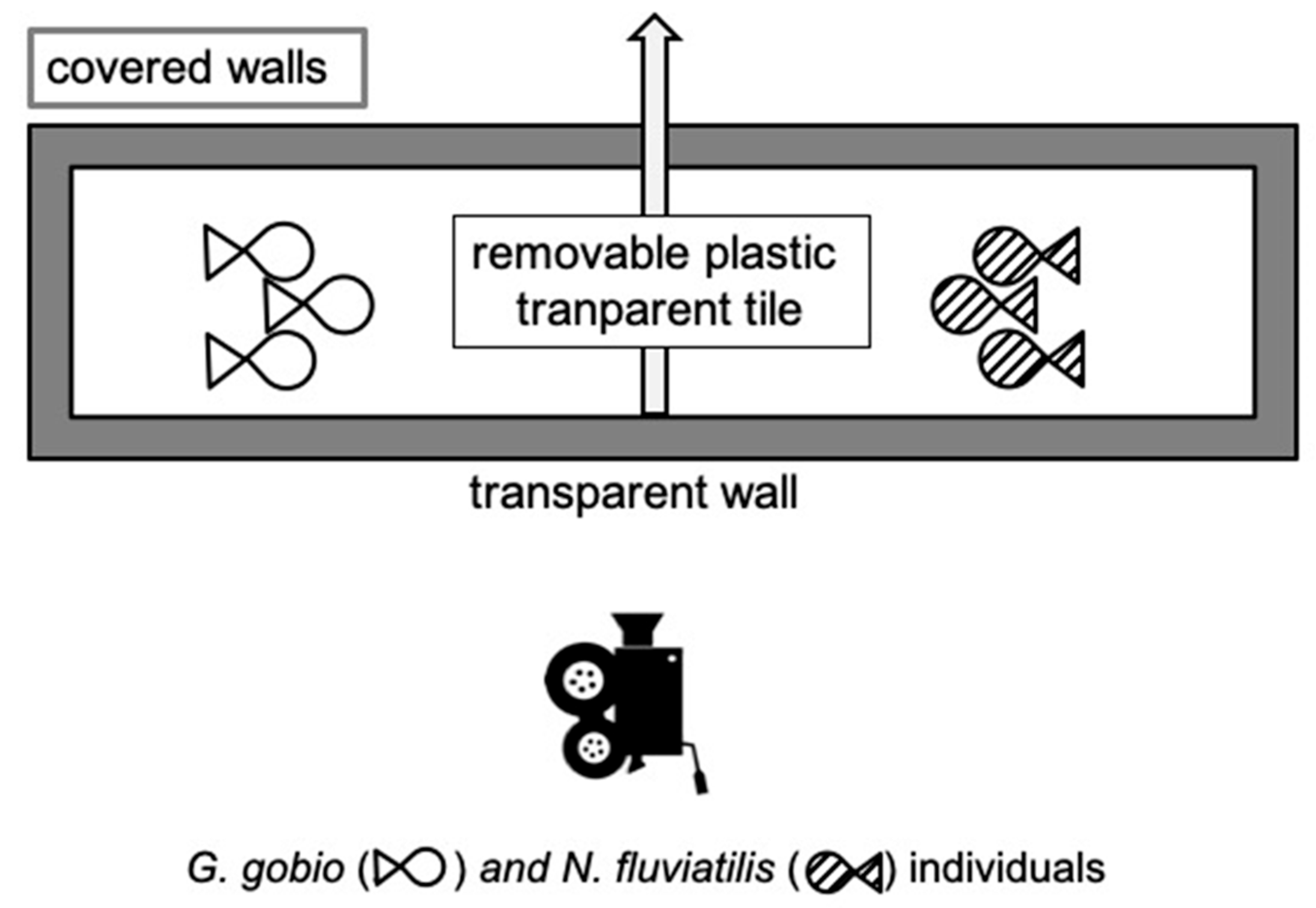
Three walls of the experimental aquarium were covered with gray paper to ensure that the fish would not be disturbed by the activities of the researcher conducting the experiments. The fourth wall remained unobstructed so that a video camera could record the behavior of the fish. We placed a transparent plastic tile in the center of the aquarium, which divided the aquarium into two equal parts [3], Figure 1.
The plate was transparent to allow both species to have visual contact and had small holes on the sides to allow both species olfactory contact with each other but prevented physical contact. Twenty-four hours prior to each experiment, the aquarium was filled with lake water and aerated, and the desired water temperature (16 °C or 22 °C) was established. Next, three individuals of each species were placed in each of the two parts of the aquarium. Because G. gobio are especially social [24], we hypothesized that using one fish per tank in the experiment would result in abnormal behavior because in rivers and lakes these fish species occur in groups. The study of individual animals in a situation of food competition risked obtaining false, inconsistent results. All tested parameters (i.e., the number of prey eaten, the time taken for the feeding to start, and the total time the fish spends hunting) were measured for each of the six individuals (three native and three invasive fish). For each of the six fish (three native and three invasive), the experiments were conducted following a 24 h period in which the fish could acclimate to the experimental aquarium. Subsequently, the experiments were conducted once a day for these six fish. Using the same six fish, the experiment was replicated every day at the same time for three days. For each species, we used 3 individuals for each of the three trials (“small competitor size”; “equal competitor”; “bigger competitor”) for the 16 °C temperature variant. Each trial lasted 3 days (3 repetitions per trial). Per 22 °C temperature treatment, for each species, we used another 3 individuals for each of the three size trials, and again, each trial lasted 3 days (3 repetitions per trial). So, a total of 18 individuals of native species and 18 individuals of invasive species were tested. Every day at the same time, the glass dividing the aquarium into two parts was removed, allowing the six fish to interact. The fish were fed 70 live larvae of Chironomidae (always about 12 mm in body length), a natural food for both species, dispensed in the middle of the aquarium. In the experiments, we used only 70 prey (not ad libitum) to create strong food competition. All reactions (number of eaten prey, time to start feeding, and the total hunting time) were recorded for 600 s (the exact time point at which each recording stopped). After the experiment, the fish were captured in nets and returned to their half of the experimental aquarium to await the next repetition. After three days of repetitions, all fish were taken to their home aquarium and euthanized (MS -222, 250 mg per 1 L). This procedure was used during the whole research, for both temperature variants and for all three size-class variants. First, we tested the variant “small competitor (N. fluviatilis) class size” at 16 °C, then “equal” at 16 °C, then “bigger” at 16 °C. Then, we tested the “small competitor (N. fluviatilis) class size” at 22 °C, then “equal” at 22 °C, then “bigger” at 22 °C. To avoid the possibility that some scent might remain, the experimental aquariums were cleaned, and the water was changed and aerated for 24 h between each experiment. On the other hand, the examination of the parameters of each individual over the following days was used to check how repeatable the observed behavior of the individual fish was, so as to rule out random behavior of individuals. Such methodology is properly selected for this type of behavioral research because it is the closest to the actual situation in their natural environment and gives the researcher confidence that the observations are the actual responses of the animals and that conclusions are not drawn from random behavior.
Behavior was recorded using two cameras: one filming from above and the other from the side. After each experiment (in each temperature and size-class variant), the recorded videos were analyzed for the following: (i) the number of larvae of Chironomidae eaten by each fish was counted (feeding rate of an individual in different temperatures); (ii) the time from the beginning of the observation to the first attack on chironomids was noted (time taken for each individual to start feeding); (iii) the total time from the beginning to the end of feeding or the active search for food by the subject (hunting time). If the fish did not react (i.e., they stayed in the same place or did not eat during the whole experiment), we assigned them the maximum experimental time—600 s with 0 larvae eaten [3].

Statistical Analysis

We used a nested ANOVA (p < 0.05) to analyze the effect of temperature between the two fish species on the feeding behavior, the effect of N. fluviatilis’s body size on the amount of food eaten by G. gobio, the time taken to start feeding, and the total feeding time. The nested procedure was used because the same six fish individuals were used for three replicates; hence, we nested the replicates within their associated trials. The nested ANOVA is the appropriate test because we had one measurement variable (i.e., feeding rate, time to start feeding, and hunting time) in each of the trials and more than one nominal variable (i.e., days and individual fish). All statistical analyses were performed in the SAS 9.4. System.

3. Results

3.1. Effect of Invasive Competitor’s (N. fluviatilis) Class Size and Temperature on Native G. gobio (Av. ~7 cm TBL)

3.1.1. Small Competitor (Av. ~5 cm TL)

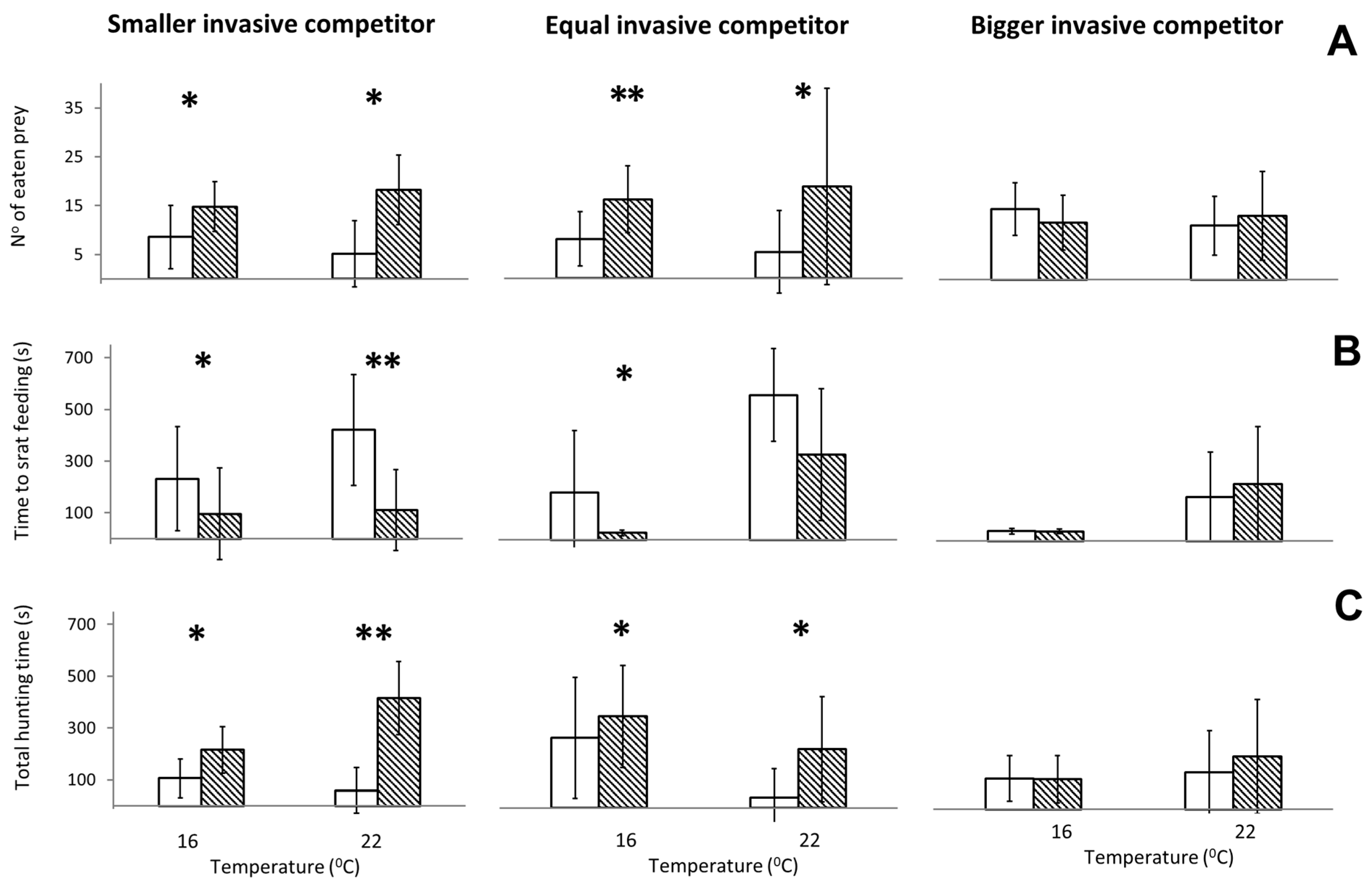
Small N. fluviatilis ate significantly more prey items, started eating faster, and spent significantly more time hunting prey than the native G. gobio at both temperatures. This difference was more pronounced at 22 °C. Neogobius fluviatilis ate more than 3.5 times more prey (nested ANOVA p < 0.05, df = 9 Nf av/s p 18.2 prey, Gg av/sp 5.1 prey), started hunting almost four times faster (nested ANOVA p < 0.05, df = 9, Nf av/sp 109.78 s, Gg av/sp 420.22 s), and hunted almost seven times longer than the native fish (nested ANOVA p < 0.05, Nf av/sp 414.67 s, Gg av/sp 59.44 s, Figure 2). When the water was 16 °C, invasive N. fluviatilis ate almost two times more prey (nested ANOVA p < 0.05, df = 9 Nf av/sp 14.8 prey, Gg av/sp 8.7 prey), started hunting more than two times faster (nested ANOVA p < 0.05, df = 6 Nf av/sp 96.22 s, Gg av/sp 232 s), and spent twice as much time hunting than the native G. gobio. (nested ANOVA p < 0.05, df = 6 Nf av/sp 215.67 s, Gg av/sp 106.44), Figure 2).

3.1.2. Small Competitor (Av. ~ 7 cm TL)

When G. gobio and N. fluviatilis were the same body size, the differences in total hunting time and prey eaten were significant at both of the tested temperatures. At 16 °C, invasive N. fluviatilis ate twice as much prey (nested ANOVA p < 0.05, df = 9 Nf av/sp 15.6 prey, Gg av/sp 7.8 prey), started to hunt almost seven times faster (nested ANOVA p < 0.05, Nf av/sp 25.89 s, Gg av/sp 175.67 s), and spent more time hunting prey (nested ANOVA p < 0.05, df = 9 Nf av/sp 338.44 s, Gg av/sp 259.78 s). When the temperature was higher, the invasive N. fluviatilis ate almost 3.5 times more prey (nested ANOVA p < 0.05, df = 9 Nf av/sp 18.1 prey, Gg av/sp 5.2 prey), started hunting faster (nested ANOVA p < 0.05, df = 9 Nf av/sp 316.89 s, Gg av/sp 538.89 s), and spent more time hunting. The native G. gobio almost did not feed and often did not even start hunting prey (nested ANOVA p < 0.05, df = 9 Nf av/sp 217.33 s, Gg av/sp 37.67 s; Figure 2).

3.1.3. Bigger Competitor (Av. ~ 12 cm TL)

There were no differences in the number of prey eaten, time taken to start eating, or hunting time between native G.gobio and larger N. fluviatilis, at either temperature. (Figure 2).

4. Discussion

Fish shape trophic webs as they can be both prey and predator at the same time. Interaction between species may not only lead to the extirpation of one of the competitors, but may also change the character of the entire ecosystem [33]. Negative impacts on native ecosystems remain an important problem [34,35]. In the current study, we tested feeding competition between fish of different size classes and found that invasive N. fluviatilis were more effective feeders than native G. gobio when the invasive species were smaller than the native one. Warmer temperatures influenced food competition between these two species, favoring the invasive N. fluviatilis. Our results support those reported by Mofu et al. (2019) [20], who showed the reduction in the consumption rate of native G. callidus in the presence of invasive G. affinis and the enhanced consumption rate by invasive G. affinis in the presence of native G. callidus.
Our results support those of Kakareko et al. (2013) [17], who measured time spent by an invasive B. gymnotrachelus and a native C. gobio near a feeder and found that the invasive fish won over the native species. Unlike Kakareko et al. (2013) [17], we have presented results concerning direct food competition by measuring the number of prey consumed. A study similar to ours was conducted by Grabowska et al. (2019) [19]. They also directly measured food competition (counting eaten prey), and our results were consistent with theirs. In the presence of the alien competitor, the feeding rate of the native U. krameri decreased to one-third, and the invasive P. glenii was a superior competitor. A likely explanation is that the N. fluviatilis fish have much bigger mouths than most European benthic fish [36], which may directly translate into their greater observed feeding success. Carmona-Catot et al. (2013) [18] compared the behavior of the invasive G. holbrooki with that of the endemic A. iberus. Their results were similar to ours: at warmer temperatures (29 °C in this study), the invasive species ate more prey items than the native ones.
In our experiments, we used larval chironomids as food for the fish. The diet of the invasive N. fluviatilis in European waters primarily consists of Chironomidae (66.6–89.6% of gut content, [23]). Gobio gobio, Spine Loach, Cobitis taenia Linnaeus, 1758, and Stone Loach Barbatula barbatula (Dybowski 1869), declining and endangered European benthic species, also depend on Chironomidae [23]. It is thus reasonable to suggest that the invasive N. fluviatilis are strong food competitors of the native European benthic fish species. Moreover, two additional factors should be considered that might help to explain our results: (i) the location of the eyes on the head and (ii) the body movement of both species. The invasive N. fluviatilis have eyes placed on the top of their heads, whereas G. gobio’s eyes are on the sides [36], thus giving these species different fields of vision. The invasive N. fluviatilis can probably see across a wider field than the G. gobio. Secondly, N. fluviatilis and G. gobio move through the water in very different ways. Gobio gobio are more active, are capable of floating freely in the water column, and are able to control their depth due to the presence of a swim bladder [37]. The invasive N. fluviatilis, which lack swim bladders, move along on the bottom in leaps, only occasionally swimming actively using their pectoral fins [38]. The invasive N. fluviatilis move faster, thus they are generally the first to reach the prey. Their less active style of swimming may be compensated for by their higher levels of aggression and better eyesight (a wider field of view). Taken together with their larger mouth size, their behavior can translate directly into their greater feeding success compared to the native species, and, consequently, to the native species displacement. In addition, this is one of the first such studies that measure invasive competitive abilities at different temperatures. We conducted our whole study during the day, so that it would be possible for the same study to be conducted at night, which could give us results that might differ from our current results. Thus, it is an interesting topic that requires further research.

4.1. The Effect of Invasive Competitor N. fluviatilis Size on Native G. gobio

We demonstrated the significant effect of the size of the invasive competitor on their feeding competition with the native fish species. Under both temperature regimes, size-classed invasive competitors, both smaller and equally sized, won competitively against the native fish, as they ate more, started hunting faster, and spent more time hunting prey. The invasive species are often found to be more aggressive than the native ones, which appears to favor them in competition with the native fish [39]. It was expected that the most intense competition would be when both competitors have a similar body size because their physical conditions seem to be equal, so their chances would be as well. Furthermore, to win, another factor is needed, and it seems that this factor can be hidden in behavioral differences, like differences in the level of aggression. We were able to find only one experimental study on invasive fish in which the authors investigated the effects of the body size of competitors. Sanches et al. (2012) [38] showed that in fights staged between pairs of invasive Nile Tilapia Oreochromis niloticus (L.) and native Pearl Cichlid Geophagus brasiliensis of different body sizes, the O. niloticus were more aggressive. Because this effect prevailed over body-size effects, the native G. brasiliensis were at a disadvantage. In general, there is very little experimental research comparing food competition between native and invasive fish [17,18,19,20], and to our knowledge, none of them have taken into account the size of the invasive competitor. With different body sizes, the competitive advantage changes [39]. Body size and the associated age can be important factors determining feeding success. Grabowska et al. (2019) [19] showed that the difference in feeding efficiency did not depend on species-specific prey capture abilities, as the time needed to catch prey items was similar for both species. Instead, the lower foraging rate of the native species resulted from their competitive interactions with invasive species, which aggressively interfered with the native species’ foraging. In our study, on the one hand, the invasive N. fluviatilis that are smaller (and younger) than the bigger, mature native G. gobio are more active and swim faster, so they were able to reach prey faster. On the other hand, the N. fluviatilis that are equal in size to the G. gobio but more active and aggressive are perceived by the latter as more dangerous and were able to chase away less aggressive fish, so the calmer G. gobio could give up competing and swim away. We would expect the most intense interactions to occur when both competitors are of equal body length; in these cases, the outcome of feeding competition is difficult to predict. Here, species-level aggressiveness may play a key role: the N. fluviatilis are considered to be the more aggressive species compared to the common G. gobio [40].
Our results indicate that the greatest threat to the native fish is invasive fish, which are smaller or the same body size. In this population of invasive species, N. fluviatilis, which is at an early stage of invasion (it has occurred in Europe for less than 40 years [41]), juveniles (smaller) and young (equal) are relatively numerous [42]. Therefore, populations of invasive N. fluviatilis, comprising a majority of highly competitive young fish, could present a serious threat to the native benthic fish species.
Moreover, although the results are not statistically significant, we observed that in the presence of an invasive competitor that is two times bigger, the native G. gobio ate the food, reached the food sooner, and spent a similar amount of time hunting as the invasive N. fluviatilis (Figure 2C). These results are an interesting case. The reason could be that the smaller the size of the fish, the more streamlined it is, which may have an impact on the speed of swimming and translate into a similar (or faster) time taken to reach food.
Furthermore, it seems that in this case, the smaller native fish perceives a greater threat from the larger invasive fish and can react in two ways: to swim away or to take up the challenge, which might be the case here. At the same time, the larger invasive fish need not be so “afraid” of the threat of the smaller fish, which can lower their incentive to act. However, these are very cautious assumptions, the confirmation of which requires further research, especially field-based research.

4.2. The Effect of Temperature on Native G. gobio

Nowadays, another one of the greatest threats to organisms is the increasing temperature caused by global warming [43]. The increasing temperatures favor biological invasions [44]. Our research supports this thesis. We showed that warmer temperatures drastically affected behavior (Figure 2). At warmer temperatures, the invasive N. fluviatilis began hunting more quickly than the native G. gobio. Moreover, with warmer water temperatures (22 °C), the native species spent less time hunting prey. At 22 °C, when the invasive competitor was in the same size category as the natives, the G. gobio did not hunt or eat at all. Feeding competition is one of the most important factors shaping the relationships between native and invasive species, and temperature can have a strong impact on behavior [18]. Carmona-Catot et al. (2013) [18] showed that at a warmer temperature (29 °C), the invasive species G. holbrooki was faster than the native A. iberus to reach the food. At a colder temperature (19 °C), the invasive fish ate significantly less food than the native fish, and our results are similar to Carmona-Catot’s. Invasive species have a superior tolerance for sudden environmental change than native ones [45]. Therefore, it is very important while considering the effects of biological invasions to also take into account the effects of warming, as both effects seem to be strongly coupled [46]. Most invasive species originate from environments with higher average water temperatures and more extreme fluctuations in temperature than Central Europe. Many Ponto-Caspian endemic species, like N. fluviatilis, are characterized by wide environmental tolerances and high phenotypic variability [47]. Over millions of years, Ponto-Caspian fauna evolved in large lakes and seas with widely varying salinities and water levels and alternating periods of isolation and open connections between the Caspian Sea and Black Sea. These conditions probably resulted in the selection of Ponto-Caspian species for high environmental tolerances and euryhalinity. The Baltic Sea catchment is quite young geologically and presents much lower levels of environmental fluctuation [48]. Thus, invasive species, originating from the Ponto-Caspian catchment, like N. fluviatilis, tolerate temperature fluctuations better. Temperatures considered as “high” for native species, i.e., G. gobio, are “still in the optimum of tolerance” for invasive species like N. fluviatilis. Furthermore, native species (including European benthic fish species like G. gobio) react poorly to increasing water temperatures, due to the following sequence of events: large filter-feeding cladocerans begin to decline, blooms of cyanobacteria begin to appear, and consequently, the level of oxygen drops [49,50]. In such a situation, native European species, which have higher oxygen requirements than invasive fish, are weakened, swim more sluggishly, eat less, etc., and they are accordingly less competitive than the invasive species. As a consequence, they begin to die off, while the invasive fish tolerate such fluctuations with little problem. This can lead to serious consequences for freshwater inland ecosystems. Our research was a microcosm-based study, and examining these relationships even more precisely requires conducting research in the environment to determine whether the competitive interactions observed in this study are pertinent to ongoing ecological interactions. Moreover, our study focused on examining the interactions between these two species during the day. Considering that benthic fish species may exhibit different activity patterns across the diel cycle, in future studies, we want to investigate whether and how these interactions change when the experiment is conducted at night.
Displacement of a native species by an alien species can irreversibly change the relationships in a preexisting complex trophic web in unpredictable ways. It is almost certain that this process will lead to a decline in biodiversity.

5. Conclusions

  • We have provided evidence that the invasive N. fluviatilis may be a real threat to native European species because they are stronger feeding competitors.
  • Ours is the first study showing the effect of the size of an invasive competitor on food competition: invasive fish of a smaller or similar size to the native benthic fish are the best competitors and the greatest threat.
  • We have provided empirical evidence that warming temperatures may affect feeding competition between the native and invasive benthic species, favoring the invaders.

Author Contributions

A.P. conceived the ideas and designed the methodology; A.P. and A.H. collected the data; A.P., M.G., J.R.S.J. and A.H. analyzed the data; A.P. led the writing of the manuscript. All authors have read and agreed to the published version of the manuscript.

Funding

Funding was provided by grant 2018/29/N/NZ8/02436 from the Polish National Science Center.

Institutional Review Board Statement

All authors confirm that, following the provisions of the law in force in Poland, defining the rules for the use of live animals in experiments, i.e., behavioral tests that do not cause suffering and/or death of animals, and which are based only on behavioral observations, the consent of the National Ethical Committee was not required. All authors confirm that all methods were carried out following relevant guidelines and regulations. We have licenses held for the study Polish Society for Science on Laboratory Animals; separate licenses for A. Pawelec and M. Grzesiuk; POLLASA training for persons responsible for planning procedures and experiments and for conducting them; for persons performing procedures; and for persons killing animals used in procedures.

Data Availability Statement

Acknowledgments

We extend special thanks to Paweł Koperski for the statistical consultation for the preliminary results. The participation of Jay R. Stauffer was funded in part by the Agriculture Experiment Station Project 04584 (Penn State University). We also thank Thurston Cleveland Hicks for language revision and constructive comments on the manuscript.

Conflicts of Interest

The authors declare no conflicts of interest. The manuscript provides original research data that has not been published or considered for publication elsewhere.

References

  1. Dueñas, M.A.; Ruffhead, H.J.; Wakefield, N.H.; Roberts, P.D.; Hemming, D.J.; Diaz-Soltero, H. The role played by invasive species in interactions with endangered and threatened species in the United States: A systematic review. Biodivers. Conserv. 2018, 27, 3171–3183. [Google Scholar] [CrossRef] [Scilit]
  2. Kettunen, M.; Genovesi, P.; Gollasch, S.; Pagad, S.; Starfinger, U.; Ten Brink, P.; Shine, C. Technical Support to EU Strategy on Invasive Alien Species (IAS)—Assessment of the Impacts of IAS in Europe and the EU; Institute for European Environmental Policy: Brussels, Belgium, 2009. [Google Scholar]
  3. Pawelec-Olesińska, A. Ecological and Behavioural Factors Determining Relationships Between Native and Invasive Species of Freshwater Fish. Doctoral Thesis, University of Warsaw, Warsaw, Poland, 2020. [Google Scholar]
  4. Diagne, C.; Leroy, B.; Vaissière, A.C.; Gozlan, R.E.; Roiz, D.; Jaric, I.; Salles, J.-M.; Bradshaw, C.J.A.; Courchamp, F. High and rising economic costs of biological invasions worldwide. Nature 2021, 592, 571–576. [Google Scholar] [CrossRef] [Scilit]
  5. Haubrock, P.J.; Bernery, C.; Cuthbert, R.N.; Liu, C.; Kourantidou, M.; Leroy, B.; Turbelin, J.A.; Kramer, A.M.; Verbrugge, L.N.H.; Diagne, C.; et al. Knowledge gaps in economic costs of invasive alien fish worldwide. Sci. Total Environ. 2021, 803, 149875. [Google Scholar] [CrossRef] [Scilit]
  6. Bellard, C.; Thuiller, W.; Leroy, B.; Genovesi, P.; Bakkenes, M.; Courchamp, F. Will climate change promote future invasions? Glob. Change Biol. 2013, 19, 3740–3748. [Google Scholar] [CrossRef] [Scilit] [PubMed]
  7. Seebens, H.; Briski, E.; Ghabooli, S.; Shiganova, T.; MacIsaac, H.J.; Blasius, B. Non-native species spread in a complex network: The interaction of global transport and local population dynamics determines invasion success. Proc. R. Soc. B 2019, 286, 20190036. [Google Scholar] [CrossRef] [Scilit] [PubMed]
  8. Keller, R.P.; Geist, J.; Jeschke, J.M.; Kühn, I. Invasive species in Europe: Ecology, status, and Policy. Environ. Sci. Eur. 2011, 23, 23. [Google Scholar] [CrossRef] [Scilit]
  9. Grabowska, J.; Kotusz, J.; Witkowski, A. Alien invasive fish species in Polish waters: An overview. Folia Zool. 2010, 59, 73–85. [Google Scholar] [CrossRef] [Scilit]
  10. Gallardo, B.; Clavero, M.; Sánchez, M.I.; Vilà, M. Global ecological impacts of invasive species in aquatic ecosystems. Glob. Change Biol. 2016, 22, 151–163. [Google Scholar] [CrossRef] [Scilit]
  11. Strayer, D.L. Alien species in fresh waters: Ecological effects, interactions with other stressors, and prospects for the future. Freshw. Biol. 2010, 55, 152–174. [Google Scholar] [CrossRef] [Scilit]
  12. Vorburger, C.; Ribi, G. Aggression and competition for shelter between a native and an introduced crayfish in Europe. Freshw. Biol. 2001, 42, 111–119. [Google Scholar] [CrossRef] [Scilit]
  13. Pintor, L.M.; Sih, A.; Bauer, M.L. Differences in aggression, activity and boldness between native and introduced populations of an invasive crayfish. Oikos 2008, 117, 1629–1636. [Google Scholar] [CrossRef] [Scilit]
  14. Poulin, R.; Paterrson, R.A.; Townsend, C.R.; Tompkins, D.M.; Kelly, D.W. Biological invasions and the dynamics of endemic diseases in freshwater ecosystems. Freshw. Biol. 2011, 56, 676–688. [Google Scholar] [CrossRef] [Scilit]
  15. Corkum, L.D.; Sapota, M.R.; Skora, K.E. The round goby, Neogobius melanostomus, a fish invader on both sides of the Atlantic Ocean. Biol. Invasions 2004, 6, 173–181. [Google Scholar] [CrossRef] [Scilit]
  16. Horvatić, S.; Cavraro, F.; Zanella, D.; Malavasi, S. Sound production in the Ponto-Caspian goby Neogobius fluviatilis and acoustic affinities within the Gobius lineage: Implications for phylogeny. Biol. J. Linn. Soc. 2016, 117, 564–573. [Google Scholar] [CrossRef] [Scilit]
  17. Kakareko, T.; Kobak, J.; Grabowsk, J.; Jermacz, Ł.; Przybylski, M.; Poznańska, M.; Pietraszewski, D.; Copp, G.H. Competitive interactions for food resources between invasive racer goby Babka gymnotrachelus and native European bullhead Cottus gobio. Biol. Invasions 2013, 15, 2519–2530. [Google Scholar] [CrossRef] [Scilit]
  18. Carmona-Catot, G.; Magellan, K.; García-Berthou, E. Temperature-Specific Competition between Invasive Mosquitofish and an Endangered Cyprinodontid Fish. PLoS ONE 2013, 8, e54734. [Google Scholar] [CrossRef] [Scilit]
  19. Grabowska, J.; Błońska, D.; Kati, S.; Nagy, S.A.; Kakareko, T.; Kobak, J.; Antal, L. Competitive interactions for food resources between the invasive Amur sleeper (Perccottus glenii) and threatened European mudminnow (Umbra krameri). Aquat. Conserv. Mar. Freshw. Ecosyst. 2019, 29, 2231–2239. [Google Scholar] [CrossRef] [Scilit]
  20. Mofu, L.; South, J.; Wasserman, R.J.; Dalu, T.; Woodford, D.J.; Dick, J.T.A.; Weyl, O.L.F. Inter-specific differences in invader and native fish functional responses illustrate neutral effects on prey but superior invader competitive ability. Freshw. Biol. 2019, 64, 1655–1663. [Google Scholar] [CrossRef] [Scilit]
  21. Smirnov, A.I. Perciformes (Gobioidei), Scorpaeniformes, Pleuronectiformes, Gobiesociformes, Lophiiformes. Fauna Ukrainy 8, Ryby (5); Naukova Dumka: Kiev, Ukraine, 1986; pp. 1–320. [Google Scholar]
  22. Kottelat, M.; Freyhof, J. Handbook of European Freshwater Fishes; Publications Kottelat: Cornol, Switzerland, 2007; p. 646. [Google Scholar]
  23. Grabowska, J.; Grabowski, M.; Kostecka, A. Diet and feeding habits of monkey goby (Neogobius fluviatilis) in a newly invaded area. Biol. Invasions 2009, 11, 2161–2170. [Google Scholar] [CrossRef] [Scilit]
  24. Froese, R.; Pauly, D. (Eds.) FishBase 2022; 2000; Available online: https://www.fishbase.se/summary/Gobio-gobio.html; https://www.fishbase.se/summary/Neogobius-fluviatilis.html (accessed on 10 May 2026).
  25. Czeglédi, I.; Preiszner, B.; Vitál, Z.; Kern, B.; Boross, N.; Specziár, A.; Takács, P.; Erős, T. Habitat use of invasive monkey goby (Neogobius fluviatilis) and pumpkinseed (Lepomis gibbosus) in Lake Balaton (Hungary): A comparison of electrofishing and fyke netting. Hydrobiologia 2019, 846, 147–158. [Google Scholar] [CrossRef] [Scilit]
  26. Jakovlić, I.; Piria, M.; Šprem, N.; Tomljanović, T.; Matulić, D.; Treer, T. Distribution, abundance and condition of invasive Ponto-Caspian gobies Ponticola kessleri (Günther, 1861), Neogobius fluviatilis (Pallas, 1814), and Neogobius melanostomus (Pallas, 1814) in the Sava River basin, Croatia. J. Appl. Ichthyol. 2015, 31, 888–894. [Google Scholar] [CrossRef] [Scilit]
  27. Mills, M.D.; Rader, R.B.; Belk, M.C. Complex interactions between native and invasive fish: The simultaneous effects of multiple negative interactions. Oecologia 2004, 141, 713. [Google Scholar] [CrossRef] [Scilit]
  28. Scaia, M.F.; Morandini, L.; Noguera, C.A.; Ramallo, M.R.; Somoza, G.M.; Pandolfi, M. Fighting cichlids: Dynamic of intrasexual aggression in dyadic agonistic encounters. Behav. Process. 2018, 147, 61–69. [Google Scholar] [CrossRef] [Scilit] [PubMed]
  29. Dawes, J. Akwarystyka Słodkowodna; MULTICO Oficyna Wydawnicza: Warszawa, Poland, 2004; p. 180+260. [Google Scholar]
  30. Hellmann, J.; Byers, E.J.; Bierwagen, B.G.; Dukes, J.S. Five potencial consequences of climat change for invasive species. Conserv. Biol. 2008, 22, 534–543. [Google Scholar] [CrossRef] [Scilit]
  31. Leuven, R.S.E.W.; Hendriks, A.J.; Huijbregts, M.A.J.; Lenders, H.J.R.; Matthews, J.; Velde, G.V.D. Differences in sensitivity of native and exotic fish species to changes in river temperature. Curr. Zool. 2011, 57, 852–862. [Google Scholar] [CrossRef] [Scilit]
  32. Goudswaard, K.P.C.; Witte, F.; Katunzi, E.F.B. The invasion of an introduced predator, Nile perch (Lates niloticus, L.) in Lake Victoria (East Africa): Chronology and causes. Environ. Biol. Fishes 2006, 81, 127–139. [Google Scholar] [CrossRef] [Scilit]
  33. Sala, O.E.; Chapin, F.S.; Armesto, J.J.; Berlow, E.; Bloomfield, J.; Dirzo, R.; Huber-Sanwald, E.; Huenneke, L.F.; Jackson, R.B.; Kinzig, A.; et al. Global Biodiversity Scenarios for the Year 2100. Science 2000, 287, 1770–1774. [Google Scholar] [CrossRef] [Scilit] [PubMed]
  34. Roy, H.E.; Bacher, S.; Essl, F.; Adriaens, T.; Aldridge, D.C.; Bishop, J.D.D.; Blackburn, T.M.; Branquart, E.; Brodie, J.; Carboneras, C.; et al. Developing a list of invasive alien species likely to threaten biodiversity and ecosystems in the European Union. Glob. Change Biol. 2019, 25, 1032–1048. [Google Scholar] [CrossRef] [Scilit] [PubMed]
  35. Brylińska, M. Ryby słodkowodne Polski; Wyd. Nauk. PWN: Warszawa, Poland, 2000. [Google Scholar]
  36. Kennedy, M.; Fitzmaurice, P. Some aspects of the biology of gudgeon Gobio gobio (L.) in Irish waters. J. Fish Biol. 1972, 4, 425–440. [Google Scholar] [CrossRef] [Scilit]
  37. Randall, J.E. Coastal Fishes of Oman; University of Hawaii Press: Honolulu, HI, USA, 1995; pp. 324–345. [Google Scholar]
  38. Sanches, F.H.C.; Miyai, C.A.; Costa, T.M.; Christofoletti, R.A.; Volpato, G.L.; Barreto, R.E. Aggressiveness Overcomes Body-Size Effects in Fights Staged between Invasive and Native Fish Species with Overlapping Niches. PLoS ONE 2012, 7, e29746. [Google Scholar] [CrossRef] [Scilit]
  39. Brandner, J.; Cerwenka, A.F.; Schliewen, U.K.; Geist, J. Invasion strategies in round goby (Neogobius melanostomus): Is bigger really better? PLoS ONE 2018, 13, e0190777. [Google Scholar] [CrossRef] [Scilit]
  40. Van Kessel, N.; Dorenbosch, M.; De Boer, M.R.M.; Leuven, R.S.E.W.; Van der Velde, G. Competition for shelter between four invasive gobiids and two native benthic fish species. Curr. Zool. 2011, 57, 844–851. [Google Scholar] [CrossRef] [Scilit]
  41. Bij de Vaate, A.; Jażdżewski, K.; Ketelaars, H.A.M.; Gollasch, S.; Van der Velde, G. Geographical patterns in range expantion of macroin vertebrate Ponto-Caspian species in Europe. Can. J. Fish. Aquat. Sci. 2002, 59, 1159–1174. [Google Scholar] [CrossRef] [Scilit]
  42. Konečná, M.; Jurajda, P. Population structure, condition, and reproduction characteristics of native monkey goby, Neogobius fluviatilis (Actinopterygii: Perciformes Gobiidae), in the Bulgarian Danube. Acta Ichthyol. Piscat. 2012, 42, 321–327. [Google Scholar] [CrossRef] [Scilit]
  43. Malcolm, J.R.; Liu, C.; Neilson, R.P.; Hansen, L.; Hannah, L. Global Warming and Extinctions of Endemic Species from Biodiversity Hotspots. Conserv. Biol. 2006, 20, 538–548. [Google Scholar] [CrossRef] [Scilit]
  44. Walther, G.R.; Roques, A.; Hulme, P.E.; Sykes, M.T.; Pyšek, P.; Kühn, I.; Czucz, B. Alien species in a warmer world: Risks and opportunities. Trends Ecol. Evol. 2009, 24, 686–693. [Google Scholar] [CrossRef] [Scilit]
  45. Lee, C.E. Evolutionary genetics of invasive species. Trends Ecol. Evol. 2002, 17, 386–391. [Google Scholar] [CrossRef] [Scilit]
  46. Dukes, J.S.; Mooney, H.A. Does global change increase the success of biological invaders? Trends Ecol. Evol. 1999, 14, 135–139. [Google Scholar] [CrossRef] [Scilit]
  47. Grabowska, J.; Przybylski, M. Life-history traits of non-native freshwater fish invaders differentiate them from natives in the Central European bioregion. Rev. Fish Biol. Fish. 2015, 25, 165–178. [Google Scholar] [CrossRef] [Scilit]
  48. Reid, F.D.; Orlova, M. Geological and evolutionary underpinnings for the success of Ponto-Caspian species invasions in the Baltic Sea and North American Great Lakes. Can. J. Fish. Aquat. Sci. 2002, 59, 1144–1158. [Google Scholar] [CrossRef] [Scilit]
  49. Giebelhausen, B.; Lampert, W. Temperature reaction norms of Daphnia magna: The effect of food concentration. Freshw. Biol. 2001, 46, 281–289. [Google Scholar] [CrossRef] [Scilit]
  50. Paerl, H.W.; Otten, T.G. Harmful Cyanobacterial Blooms: Causes, Consequences, and Controls. Microb. Ecol. 2013, 65, 995–1010. [Google Scholar] [CrossRef] [Scilit] [PubMed]
Figure 1. Scheme of experimental aquarium system.
Water 18 01394 g001
Figure 2. The effects (average per species ± SD) of invasive Neogobius fluviatilis (stripe bar) competitor class size (smaller, equal, or bigger) on the native Gobio gobio (white bar) in two different temperatures, 16 °C and 22 °C. Number of prey eaten (Chironomidae larvae) (A), time taken to start feeding (B), and hunting time (C). The star (s) indicate statistically significant differences shown by nested ANOVA (* p < 0.05 and ** p < 0.01).
Water 18 01394 g002
Disclaimer/Publisher’s Note: The statements, opinions and data contained in all publications are solely those of the individual author(s) and contributor(s) and not of MDPI and/or the editor(s). MDPI and/or the editor(s) disclaim responsibility for any injury to people or property resulting from any ideas, methods, instructions or products referred to in the content.