Ecofriendly Biosorbent for the Removal of Hexavalent Chromium from Drinking Water

 ,
, 
Abstract
1. Introduction
2. Materials and Methods
2.1. Materials
2.2. Methods
2.2.1. Modification of Natural Diatomaceous Earth with Chitosan
2.2.2. Characterization of Adsorbent Material
Chemical Composition and Surface Chemistry
Surface Morphology, and Physical Characteristics
2.2.3. Adsorption Equilibrium Studies
Equilibrium Isotherm
Effects of Solution pH
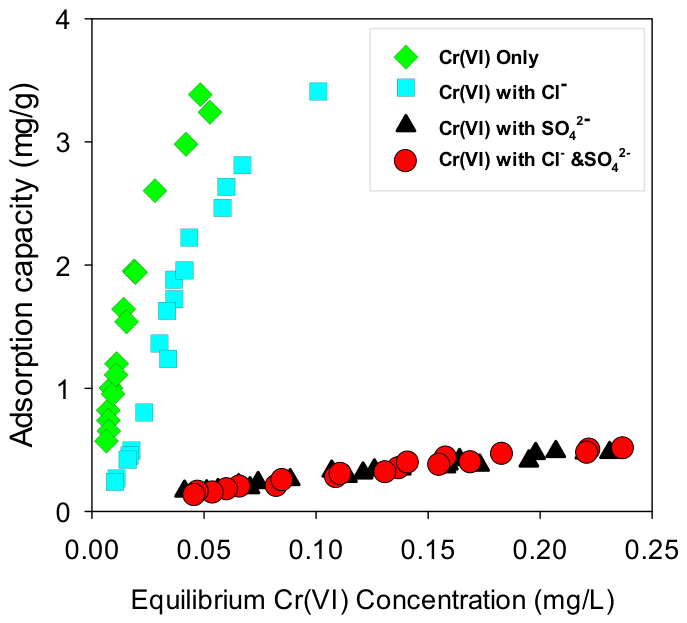
Effects of Common Anions: Chlorides and Sulfates
2.2.4. Kinetics of Adsorption of Cr(VI) on CNDE
2.2.5. Regeneration and Reuse of Spent Chitosan DE Adsorbent
3. Results and Discussions
3.1. Material Characterization
3.1.1. Elemental Composition
3.1.2. FTIR Spectroscopy
3.1.3. Scanning Electron Microscopy (SEM) Imaging
3.1.4. Appearance, Morphology, Structure, and Stability
3.1.5. Thermogravimetric Analyses
3.1.6. Specific Surface Area (SSA)
3.1.7. Total Alkalinity/Total Acidity
3.1.8. Zetapotential and Surface of Zero Charge
3.2. Equilibrium Adsorption of Cr(VI) onto CNDE
3.2.1. Effect of Initial Adsorbate Concentration
3.2.2. Adsorption Isotherm and Thermodynamics


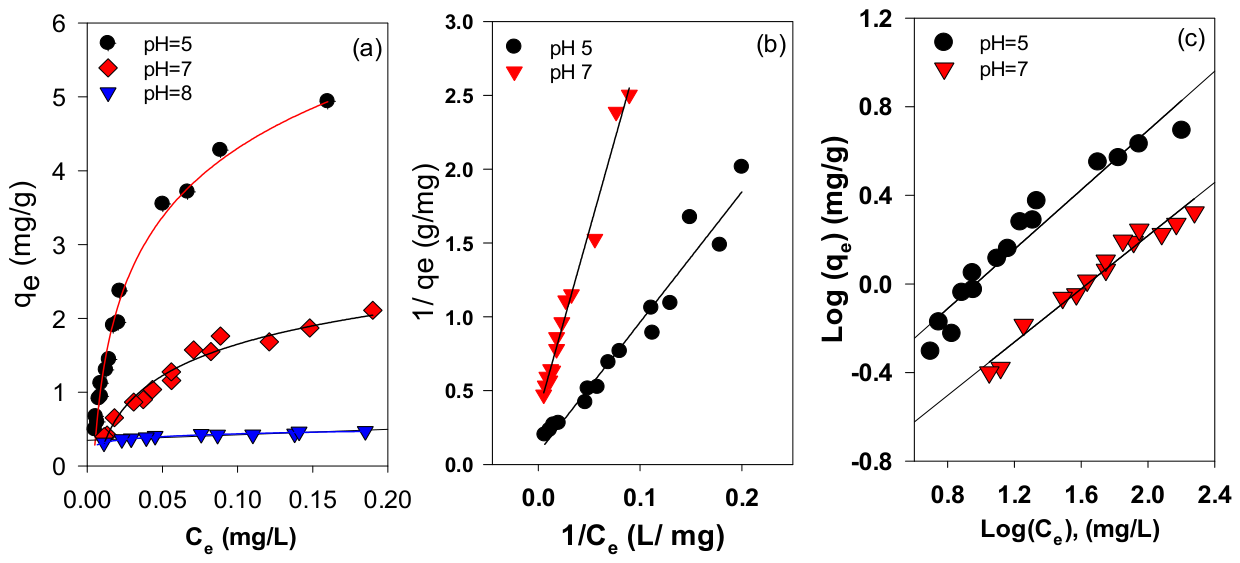
| Model Parameters | Langmuir Model | Freundlich Model | ||||
|---|---|---|---|---|---|---|
| pH | Qm (mg/g) | b | R2 | Kf (mg/g) | n | R2 |
| 5 | 15.01 | 0.00745 | 0.9502 | 23.117 | 1.4916 | 0.9496 |
| 7 | 2.811 | 0.01446 | 0.9841 | 0.1041 | 1.666 | 0.9603 |
| 8 | 0.45 | 189.076 | 0.9259 | 0.61 | 6.8729 | 0.9539 |
3.2.3. Effect of pH
3.2.4. Effect of Common Anions
3.3. Adsorption Kinetics
3.3.1. Adsorption and Rate of Adsorption
3.3.2. Adsorption Rate Models
3.3.3. Mass Transfer Mechanism and Limiting Step
3.4. Regeneration and Reuse of Spent CNDE Biosorbent
3.5. Mechanisms of Adsorption
4. Conclusions
Supplementary Materials
Author Contributions
Funding
Data Availability Statement
Conflicts of Interest
References
- Hossini, H.; Shafie, B.; Niri, A.D.; Nazari, M.; Esfahlan, A.J.; Ahmadpour, M.; Nazmara, Z.; Ahmadimanesh, M.; Makhdoumi, P.; Mirzaei, N. A comprehensive review on human health effects of chromium: Insights on induced toxicity. Environ. Sci. Pollut. Res. 2022, 29, 70686–70705. [Google Scholar] [CrossRef]
- World Health Organization. Chromium in Drinking-Water; World Health Organization: Geneva, Switzerland, 2020; Available online: https://iris.who.int/bitstream/handle/10665/338062/WHO-HEP-ECH-WSH-2020.3-eng.pdf (accessed on 22 May 2026).
- Jain, C.; Ali, I. Arsenic: Occurrence, toxicity and speciation techniques. Water Res. 2000, 34, 4304–4312. [Google Scholar] [CrossRef]
- Abarikwu, S.; Lichtfouse, E.; Schwarzbauer, J.; Robert, D. Lead, Arsenic, Cadmium, Mercury: Occurrence, Toxicity and Diseases. Pollut. Dis. Remediat. Recycl. 2013, 4, 351–386. [Google Scholar]
- Yuan, P.; Liu, D.; Fan, M.; Yang, D.; Zhu, R.; Ge, F.; Zhu, J.; He, H. Removal of hexavalent chromium [Cr(VI)] from aqueous solutions by the diatomite-supported/unsupported magnetite nanoparticles. J. Hazard Mater. 2010, 173, 614–621. [Google Scholar] [CrossRef] [PubMed]
- Zhitkovich, A. Chromium in Drinking Water: Sources, Metabolism, and Cancer Risks. Chem. Res. Toxicol. 2011, 24, 1617–1629. [Google Scholar] [CrossRef]
- Bissen, M.; Frimmel, F. Arsenic—A review—Part 1: Occurrence, toxicity, speciation, mobility. Acta Hydrochim. Hydrobiol. 2003, 31, 9–18. [Google Scholar] [CrossRef]
- Izbicki, J.A.; Wright, M.T.; Seymour, W.A.; McCleskey, R.B.; Fram, M.S.; Belitz, K.; Esser, B.K. Cr (VI) occurrence and geochemistry in water from public-supply wells in California. Appl. Geochem. 2015, 63, 203–217. [Google Scholar] [CrossRef]
- Rowbotham, A.L.; Levy, L.S.; Shuker, L.K. Chromium in the environment: An evaluation of exposure of the UK general population and possible adverse health effects. J. Toxicol. Environ. Health Part B Crit. Rev. 2000, 3, 145–178. [Google Scholar]
- U.S. EPA. IRIS Toxicological Review of Hexavalent Chromium (External Review Draft, 2022); U.S. Environmental Protection Agency: Washington, DC, USA, 2022; pp. 3-157–3-159.
- U.S. EPA. Manual of Treatment Techniques for Meeting the Interim Primary Drinking Water Regulations; EPA-600/8-77-005; ORD—Water Supply Research Division: Cincinnati, OH, USA, 1977.
- Sharma, S.K.; Petrusevski, B.; Amy, G. Chromium removal from water: A review. J. Water Supply Res. Technol. AQUA 2008, 57, 541–553. [Google Scholar] [CrossRef]
- Qin, G.; McGuire, M.J.; Blute, N.K.; Seidel, C.; Fong, L. Hexavalent Chromium Removal by Reduction with Ferrous Sulfate, Coagulation, and Filtration: A Pilot-Scale Study. Environ. Sci. Technol. 2005, 39, 6321–6327. [Google Scholar] [CrossRef]
- Xiao, Y.; Liang, H.; Chen, W.; Wang, Z. Synthesis and adsorption behavior of chitosan-coated MnFe2O4 nanoparticles for trace heavy metal ions removal. Appl. Surf. Sci. 2013, 285, 498–504. [Google Scholar] [CrossRef]
- California State Water Resources Control Board (SWRCB) (Ed.) Hexavalent Chromium MCL Initial Statement of Reasons DPH-11-005; California Water Boards: Sacramento, CA, USA, 2013; pp. 1–9. Available online: https://www.waterboards.ca.gov/drinking_water/certlic/drinkingwater/DPH-11-005HexavalentChromiumMCL.html (accessed on 22 May 2026).
- Mor, S.; Ravindra, K.; Bishnoi, N.R. Adsorption of chromium from aqueous solution by activated alumina and activated charcoal. Bioresour. Technol. 2007, 98, 954–957. [Google Scholar] [CrossRef]
- Sousa, F.W.; Oliveira, A.G.; Ribeiro, J.P.; Rosa, M.F.; Keukeleire, D.; Nascimento, R.F. Green coconut shells applied as adsorbent for removal of toxic metal ions using fixed-bed column technology. J. Environ. Manag. 2010, 91, 1634–1640. [Google Scholar] [CrossRef]
- Hasany, S.M.; Ahmad, R. The potential of cost-effective coconut husk for the removal of toxic metal ions for environmental protection. J. Environ. Manag. 2006, 81, 286–295. [Google Scholar] [CrossRef] [PubMed]
- Bhatnagar, A.; Vilar, V.J.P.; Botelho, C.M.S.; Boaventura, R.A.R. Coconut-based biosorbents for water treatment—A review of the recent literature. Adv. Colloid Interface Sci. 2010, 160, 1–15. [Google Scholar] [CrossRef] [PubMed]
- Foo, K.Y.; Hameed, B.H. Utilization of rice husk ash as novel adsorbent: A judicious recycling of the colloidal agricultural waste. Adv. Colloid Interface Sci. 2009, 152, 39–47. [Google Scholar] [CrossRef] [PubMed]
- Futalan, C.M.; Huang, Y.S.; Chen, J.H.; Wan, M.W. Arsenate removal from aqueous solution using chitosan-coated bentonite, chitosan-coated kaolinite and chitosan-coated sand: Parametric, isotherm and thermodynamic studies. Water Sci. Technol. 2018, 78, 676–689. [Google Scholar] [CrossRef]
- Bello, O.S.; Adegoke, K.A.; Oyewole, R.O. Insights into the adsorption of heavy metals from wastewater using diatomaceous earth. Sep. Sci. Technol. 2014, 49, 1787–1806. [Google Scholar] [CrossRef]
- Matheickal, J.T.; Yu, Q. Biosorption of lead from aqueous solutions by marine algae Ecklonia radiata. Water Sci. Technol. 1996, 34, 1–7. [Google Scholar] [CrossRef]
- Jung, C.; Heo, J.; Han, J.; Her, N.; Lee, S.-J.; Oh, J.; Ryu, J.; Yoon, Y. Hexavalent chromium removal by various adsorbents: Powdered activated carbon, chitosan, and single/multi-walled carbon nanotubes. Sep. Purif. Technol. 2013, 106, 63–71. [Google Scholar] [CrossRef]
- Cesaro, R.; Fabbricino, M.; Lanzetta, R.; Mancino, A.; Naviglio, B.; Parrilli, M.; Sartorio, R.; Tomaselli, M.; Tortora, G. Use of chitosan for chromium removal from exhausted tanning baths. Water Sci. Technol. 2008, 58, 735–739. [Google Scholar] [CrossRef]
- Salih, S.S.; Ghosh, T.K. Adsorption of Zn (II) ions by chitosan coated diatomaceous earth. Int. J. Biol. Macromol. 2018, 106, 602–610. [Google Scholar] [CrossRef]
- Salih, S.S.; Ghosh, T.K. Preparation and characterization of chitosan-coated diatomaceous earth for hexavalent chromium removal. Environ. Process. 2018, 5, 23–39. [Google Scholar] [CrossRef]
- DeMessie, J.A.; Sorial, G.A.; Sahle-Demessie, E. Removing chromium (VI) from contaminated water using a nano-chitosan–coated diatomaceous earth. In Separation Science and Technology; Elsevier: Amsterdam, The Netherlands, 2022; Volume 15, pp. 163–176. Available online: https://www.sciencedirect.com/science/article/pii/B9780323907637000056 (accessed on 20 May 2026).
- Koumai, O.T.; Sorial, A.G.; Sahle-Demessie, E. Facile preparation, characterization and application of natural diatomaceous earth for the removal of Arsenic V from dirinking water. In Proceedings of the American Chemical Society—Fall Conference 2022, Chicago, IL, USA, 21–25 August 2022; American Chemical Society: Chicago, IL, USA, 2022. [Google Scholar]
- Khan, T.A.; Khan, E.A. Shahjahan, Removal of basic dyes from aqueous solution by adsorption onto binary iron-manganese oxide coated kaolinite: Non-linear isotherm and kinetics modeling. Appl. Clay Sci. 2015, 107, 70–77. [Google Scholar] [CrossRef]
- Islam, M.A.; Angove, M.J.; Morton, D.W. Recent innovative research on chromium (VI) adsorption mechanism. Environ. Nanotechnol. Monit. Manag. 2019, 12, 100267. [Google Scholar] [CrossRef]
- Baran, A.; Bıçak, E.; Baysal, Ş.H.; Önal, S. Comparative studies on the adsorption of Cr (VI) ions on to various sorbents. Bioresour. Technol. 2007, 98, 661–665. [Google Scholar] [CrossRef]
- Huang, R.; Liu, Q.; Huo, J.; Yang, B. Adsorption of methyl orange onto protonated cross-linked chitosan. Arab. J. Chem. 2017, 10, 24–32. [Google Scholar] [CrossRef]
- Li, Z.; Li, T.; An, L.; Fu, P.; Gao, C.; Zhang, Z. Highly efficient chromium (VI) adsorption with nanofibrous filter paper prepared through electrospinning chitosan/polymethylmethacrylate composite. Carbohydr. Polym. 2016, 137, 119–126. [Google Scholar] [CrossRef] [PubMed]
- Humelnicu, D.; Dragan Ecaterina, S. Evaluation of phosphate adsorption by porous strong base anion exchangers having hydroxyethyl substituents: Kinetics, equilibrium, and thermodynamics. Environ. Sci. Pollut. Res. 2021, 28, 7105–7115. [Google Scholar] [CrossRef] [PubMed]
- Largitte, L.; Pasquier, R. A review of the kinetics adsorption models and their application to the adsorption of lead by an activated carbon. Chem. Eng. Res. Des. 2016, 109, 495–504. [Google Scholar] [CrossRef]
- Aydin, S.K.; George, W.; Serkan, E.; Atakan, O.; Kurtulus, O. Modelling of Adsorption Kinetic Processes—Errors, Theory and Application. In Sorption (pp.19) Project: Removal of Trace from Wastewater; IntechOpen Limited: London, UK, 2018; Available online: https://books.google.com/books?hl=en&lr=&id=xRf8DwAAQBAJ&oi=fnd&pg=PA187&dq=Aydin,+S.+K.,+George+William%3B+Emik,+Serkan%3B+Ongen,+Atakan%3B+Ozcan,+Kurtulus,+Modelling+of+Adsorption+Kinetic+Processes%E2%80%94Errors,+Theory+and+Application.+In+Sorption+(pp.19)+Project:+Removal+of+trace+from+wastewater,+IntechOpen+Limited:+2018.&ots=p2vKAExSnX&sig=vCxVKTeril0nlEPXm9CftCiTW_c (accessed on 20 May 2026).
- Crini, G.; Badot, P.-M. Application of chitosan, a natural aminopolysaccharide, for dye removal from aqueous solutions by adsorption processes using batch studies: A review of recent literature. Prog. Polym. Sci. 2008, 33, 399–447. [Google Scholar] [CrossRef]
- Bhatnagar, A.S. Applications of chitin- and chitosan-derivatives for the detoxification of water and wastewater—A short review. Adv. Colloid Interface Sci. 2009, 152, 26–38. [Google Scholar] [CrossRef] [PubMed]
- Chauhan, D.; Jaiswal, M.; Sankararamakrishnan, N. Removal of cadmium and hexavalent chromium from electroplating waste water using thiocarbamoyl chitosan. Carbohydr. Polym. 2012, 88, 670–675. [Google Scholar] [CrossRef]
- Corazzari, I.; Nisticò, R.; Turci, F.; Faga, M.G.; Franzoso, F.; Tabasso, S.; Magnacca, G. Advanced physico-chemical characterization of chitosan by means of TGA coupled on-line with FTIR and GCMS: Thermal degradation and water adsorption capacity. Polym. Degrad. Stab. 2015, 112, 1–9. [Google Scholar] [CrossRef]
- Mirzaei, N.; Ghaffari, H.R.; Sharafi, K.; Velayati, A.; Hoseindoost, G.; Rezaei, S.; Mahvi, A.H.; Azari, A.; Dindarloo, K. Modified natural zeolite using ammonium quaternary based material for Acid red 18 removal from aqueous solution. J. Environ. Chem. Eng. 2017, 5, 3151–3160. [Google Scholar] [CrossRef]
- Weber, W.J., Jr.; Morris, J.C. Kinetics of adsorption on carbon from solution. J. Sanit. Eng. Div. 1963, 89, 31–59. [Google Scholar] [CrossRef]
- Kwok, K.C.; Koong, L.F.; Chen, G.; McKay, G. Mechanism of arsenic removal using chitosan and nanochitosan. J. Colloid Interface Sci. 2014, 416, 1–10. [Google Scholar] [CrossRef]
- Ho, Y.S.; Ng, J.C.Y.; McKay, G. Removal of lead (II) from effluents by sorption on peat using second-order kinetics. Sep. Sci. Technol. 2001, 36, 241–261. [Google Scholar] [CrossRef]
- Koumai, O.T.; Sorial, A.G.; Sahle-Demessie, E.; Nadagouda, M. A new environmentally friendly and sustainable biosorbent for the removal of chromium VI from drinking water. In Proceedings of the American Chemical Society—Fall Conference 2023, San Francisco, CA, USA, 12–17 August 2023. [Google Scholar]




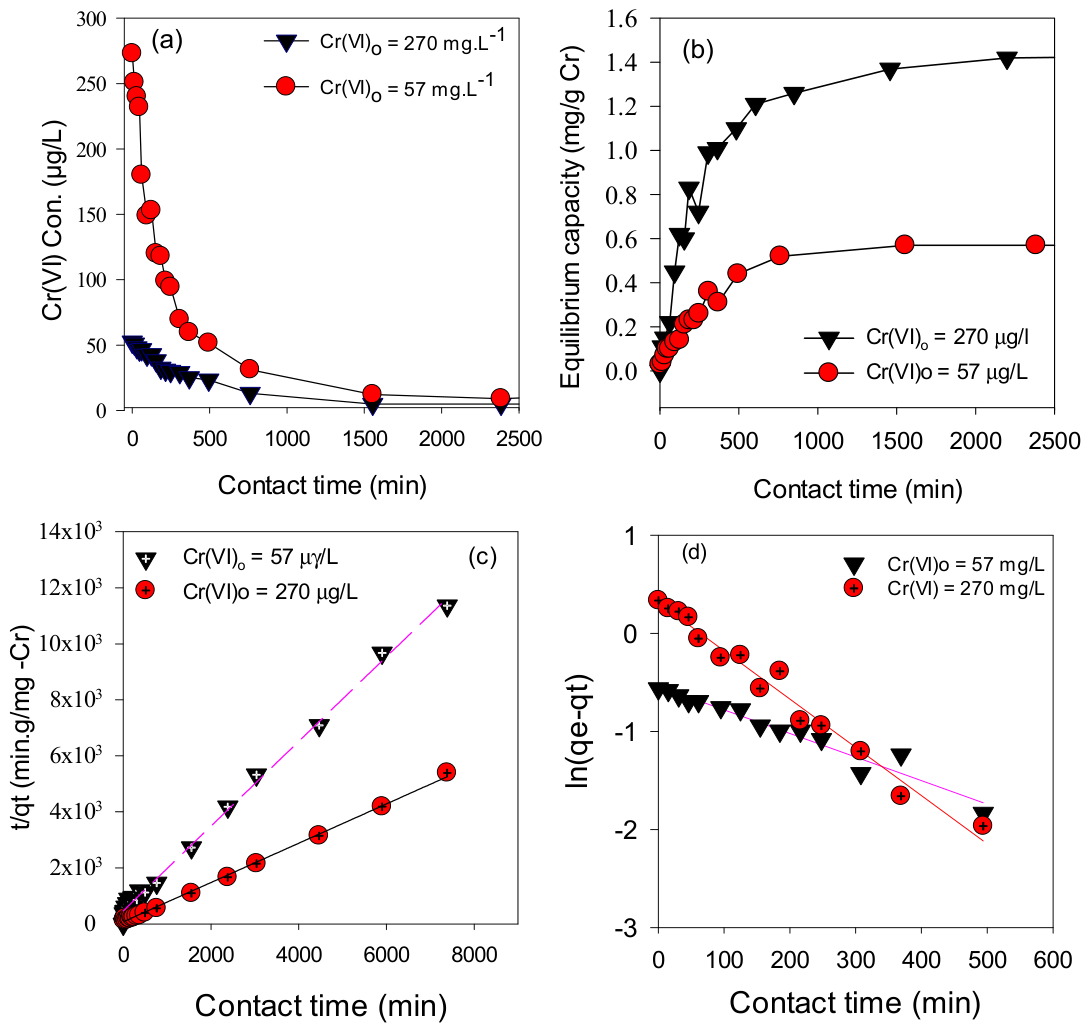
| Kinetic Model | Co (µg/L) | Qe (mg/g) | k (g/mg/min or min−1) | R2 |
|---|---|---|---|---|
| PSO | 270 | 1.425 | 0.0267 | 0.9983 |
| 50 | 0.662 | 0.0009 | 0.9967 | |
| PFO | 270 | 0.594 | 0.005 | 0.9896 |
| 50 | 1.382 | 0.0025 | 0.9767 |
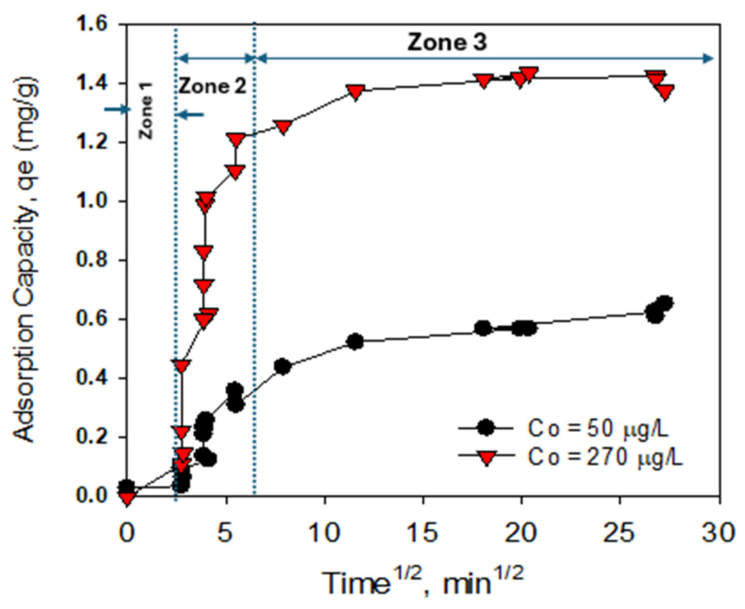
| Initial Cr(VI) Concentration | Weber–Morris Coefficients | Zone 1 (0–369 min) | Zone 2 (369–762 min) | Zone 3 (762 min–∞) |
|---|---|---|---|---|
| 50 µg/L | c (mg/g) | 0.0013 | 0.2801 | 1.4008 |
| kp (mg/g/min1/2) | 0.0441 | 0.0019 | 2 × 10⁻⁴ | |
| 270 µg/L | c (mg/g) | 0.002 | 1.1616 | 0.5008 |
| kp (mg/g/min1/2) | 0.0121 | 0.0016 | 1.0 × 10⁻⁵ |
Disclaimer/Publisher’s Note: The statements, opinions and data contained in all publications are solely those of the individual author(s) and contributor(s) and not of MDPI and/or the editor(s). MDPI and/or the editor(s) disclaim responsibility for any injury to people or property resulting from any ideas, methods, instructions or products referred to in the content. |
© 2026 by the authors. Licensee MDPI, Basel, Switzerland. This article is an open access article distributed under the terms and conditions of the Creative Commons Attribution (CC BY) license.
Share and Cite
Koumai, O.T.; Sorial, G.A.; Sahle-Demessie, E.; Nadagouda, M. Ecofriendly Biosorbent for the Removal of Hexavalent Chromium from Drinking Water. Water 2026, 18, 1373. https://doi.org/10.3390/w18111373
Koumai OT, Sorial GA, Sahle-Demessie E, Nadagouda M. Ecofriendly Biosorbent for the Removal of Hexavalent Chromium from Drinking Water. Water. 2026; 18(11):1373. https://doi.org/10.3390/w18111373
Chicago/Turabian StyleKoumai, Ouro T., George A. Sorial, Endalkachew Sahle-Demessie, and Mallikarjuna Nadagouda. 2026. "Ecofriendly Biosorbent for the Removal of Hexavalent Chromium from Drinking Water" Water 18, no. 11: 1373. https://doi.org/10.3390/w18111373
APA StyleKoumai, O. T., Sorial, G. A., Sahle-Demessie, E., & Nadagouda, M. (2026). Ecofriendly Biosorbent for the Removal of Hexavalent Chromium from Drinking Water. Water, 18(11), 1373. https://doi.org/10.3390/w18111373