Spatial Cascading of Extreme Water–Sediment Imbalance Risks in a Heavily Regulated River Reach: A Copula-CoVaR Framework



Abstract
1. Introduction
2. Materials and Methods
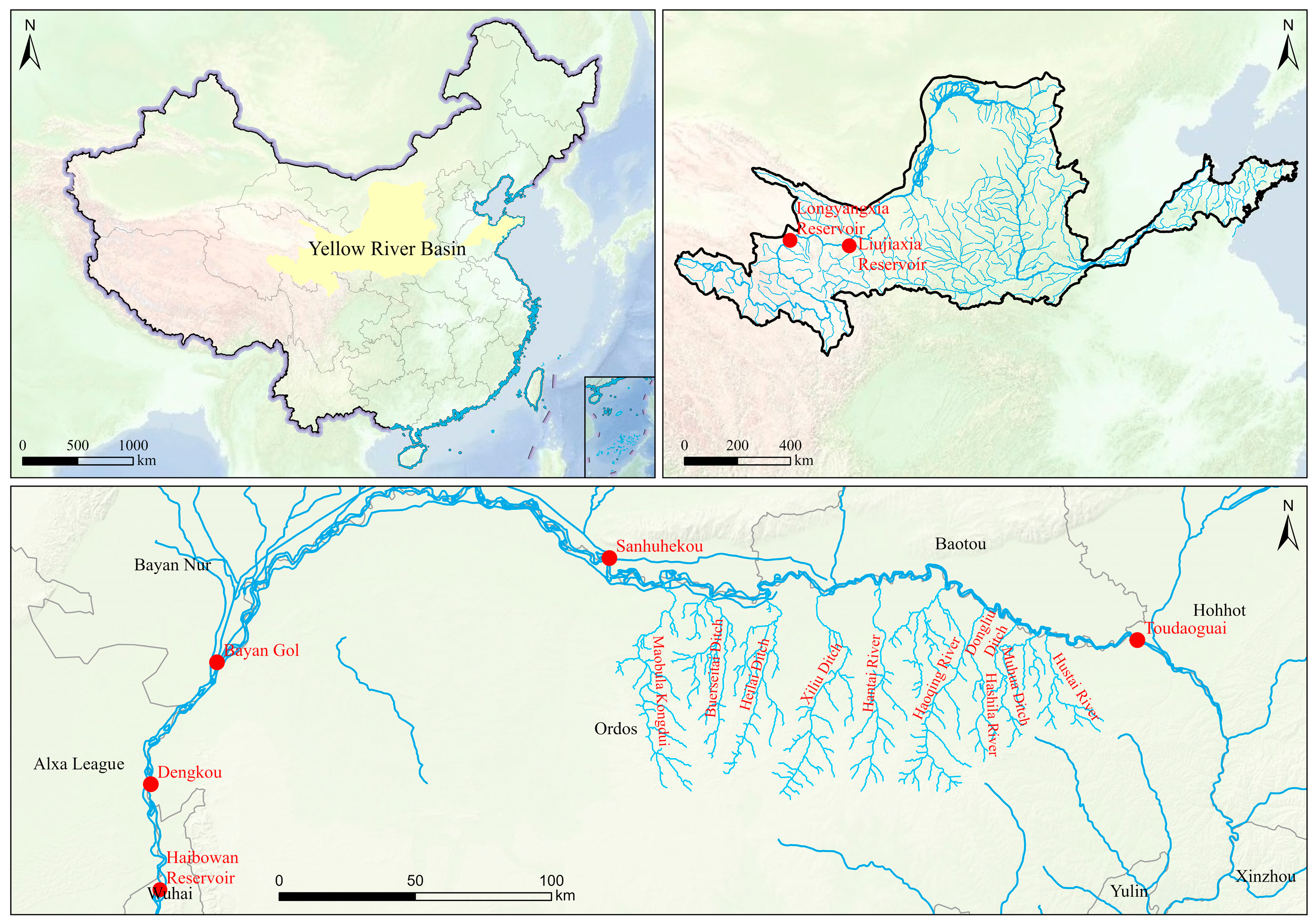
2.1. Study Area Description
2.2. Data Acquisition and Reconstruction
2.3. Risk Metrics and Period Division
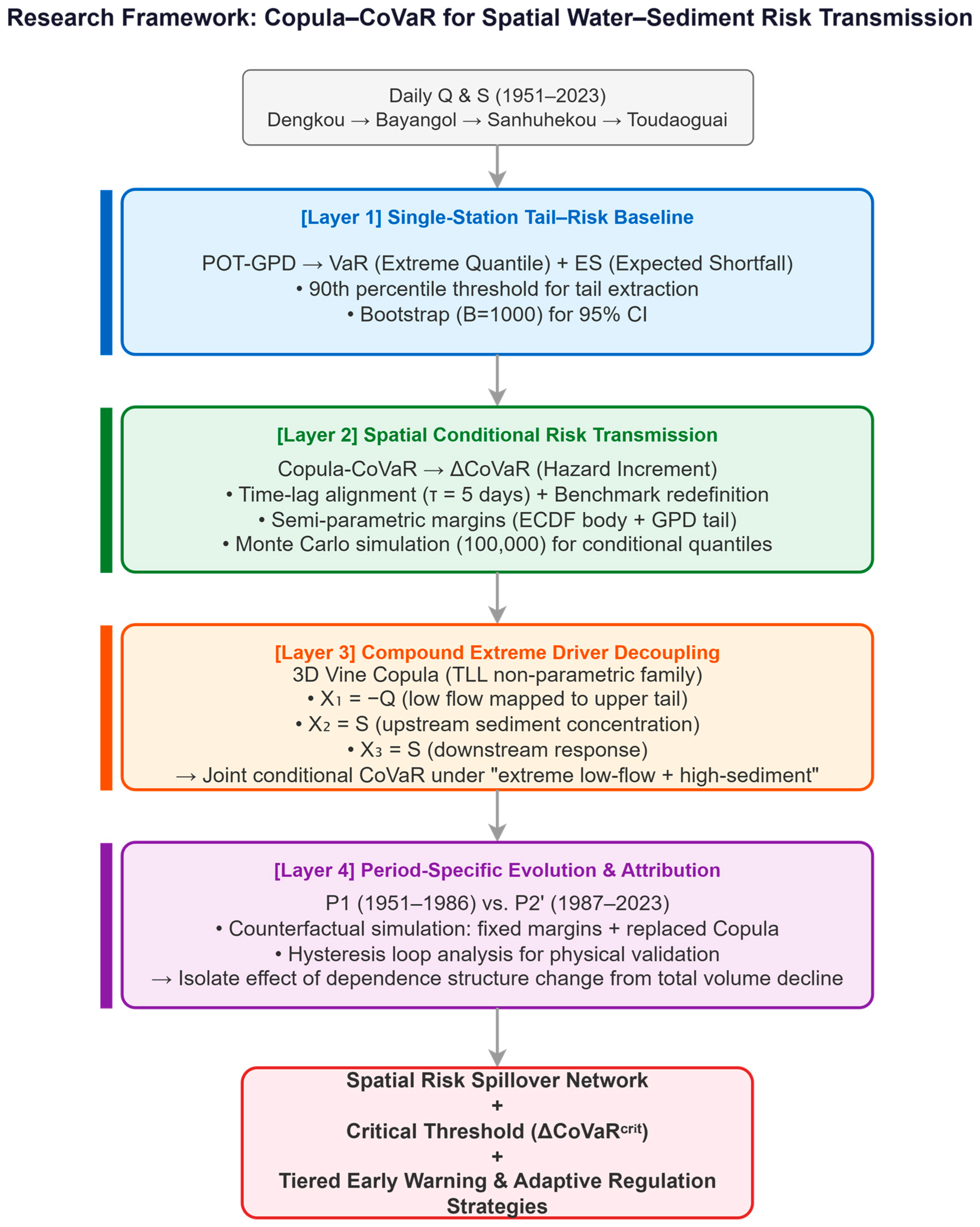
2.4. Research Framework
2.5. Univariate Tail Risk Modeling: The POT-GPD Framework
2.5.1. Risk Indicator and Threshold Selection
2.5.2. Extreme Quantile (VaR) and Expected Shortfall (ES)
2.6. Spatial Risk Transmission Modeling: The Copula-CoVaR Framework
2.6.1. Logical Basis for the Cross-Disciplinary Transfer
2.6.2. Construction of Semi-Parametric Marginal Distributions and Copula Selection
2.6.3. Calculation of CoVaR and ΔCoVaR
2.7. Decoupling Analysis of Compound Extreme Drivers: A Three-Dimensional Vine Copula
2.7.1. Necessity of Decoupling
2.7.2. Variable Definition and Unification of Tail Direction
2.7.3. Three-Dimensional Vine Copula and Joint Conditional CoVaR
2.7.4. Joint Conditional CoVaR and ΔCoVaR
2.8. Stage-Wise Evolution and Attribution Analysis
2.8.1. Study Period Division
2.8.2. n Counterfactual Simulation Design
2.8.3. Comparison with Traditional Correlation Analysis
2.8.4. Analysis of the Hysteresis Effect (Supplementary Verification)
2.9. Software, Reproducibility, and AI Assistance Statement
3. Results
3.1. Univariate Tail Risk Characteristics
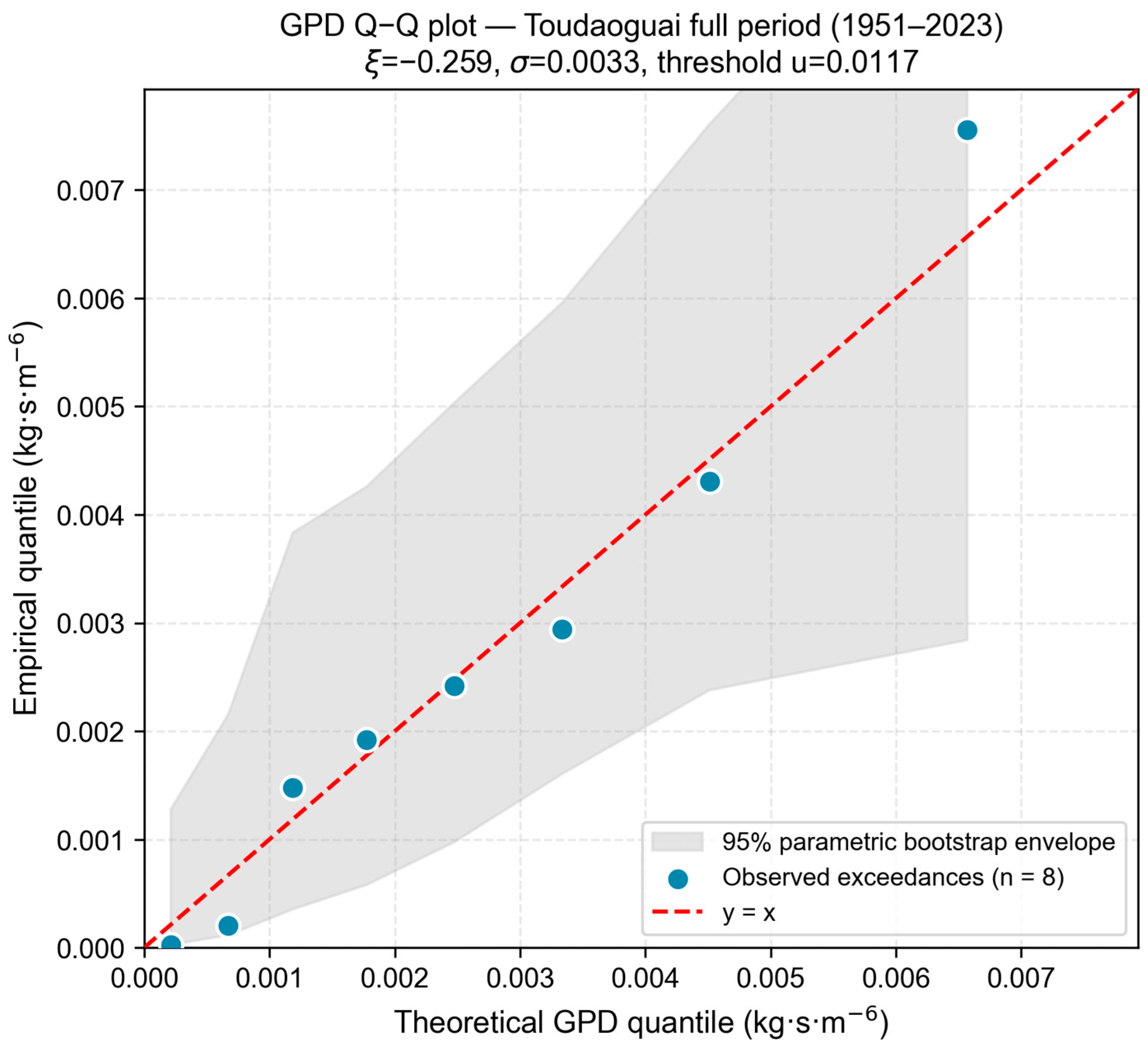
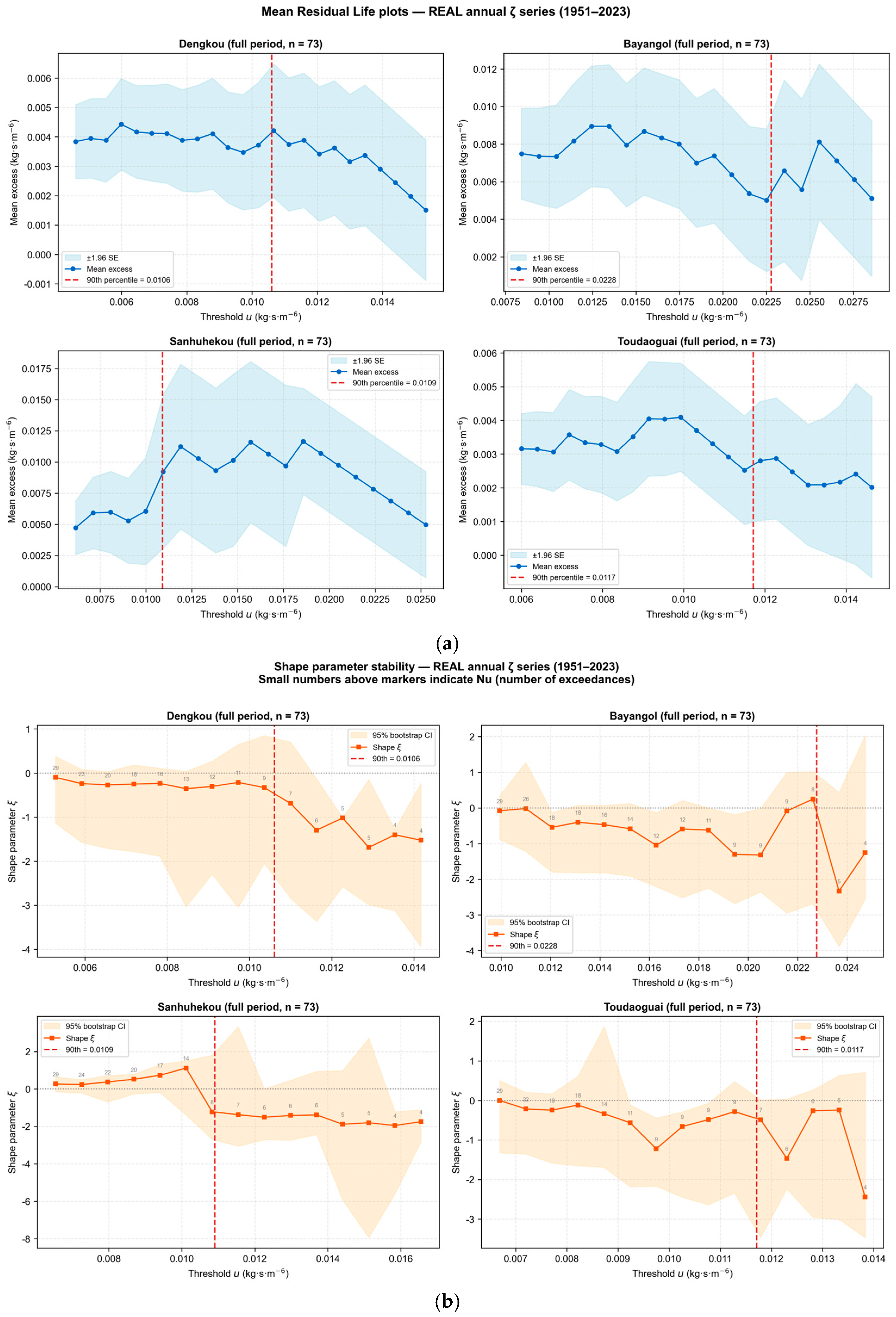
3.1.1. Threshold Selection and GPD Fitting
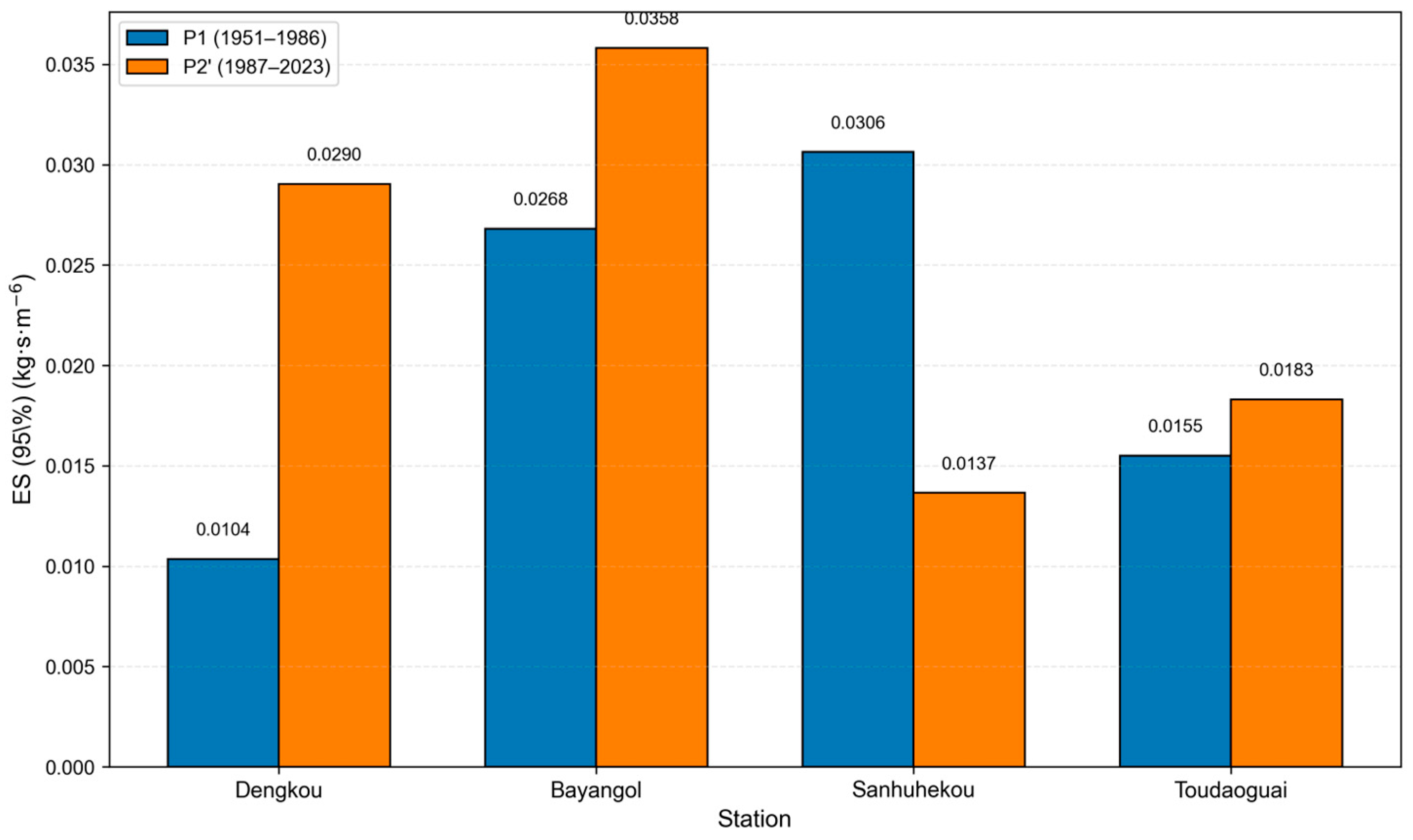
3.1.2. VaR and ES Analysis per Station
3.1.3. Robustness Check
3.2. Bivariate Copula Dependence Structure and Spatial Pattern of ΔCoVaR
3.2.1. Copula Selection and Tail Dependence
3.2.2. Spatial Patterns of ΔCoVaR
3.3. Decoupling of Compound Extreme Risks via Three-Dimensional Vine Copula
3.3.1. Structural Characteristics of the Vine Copula
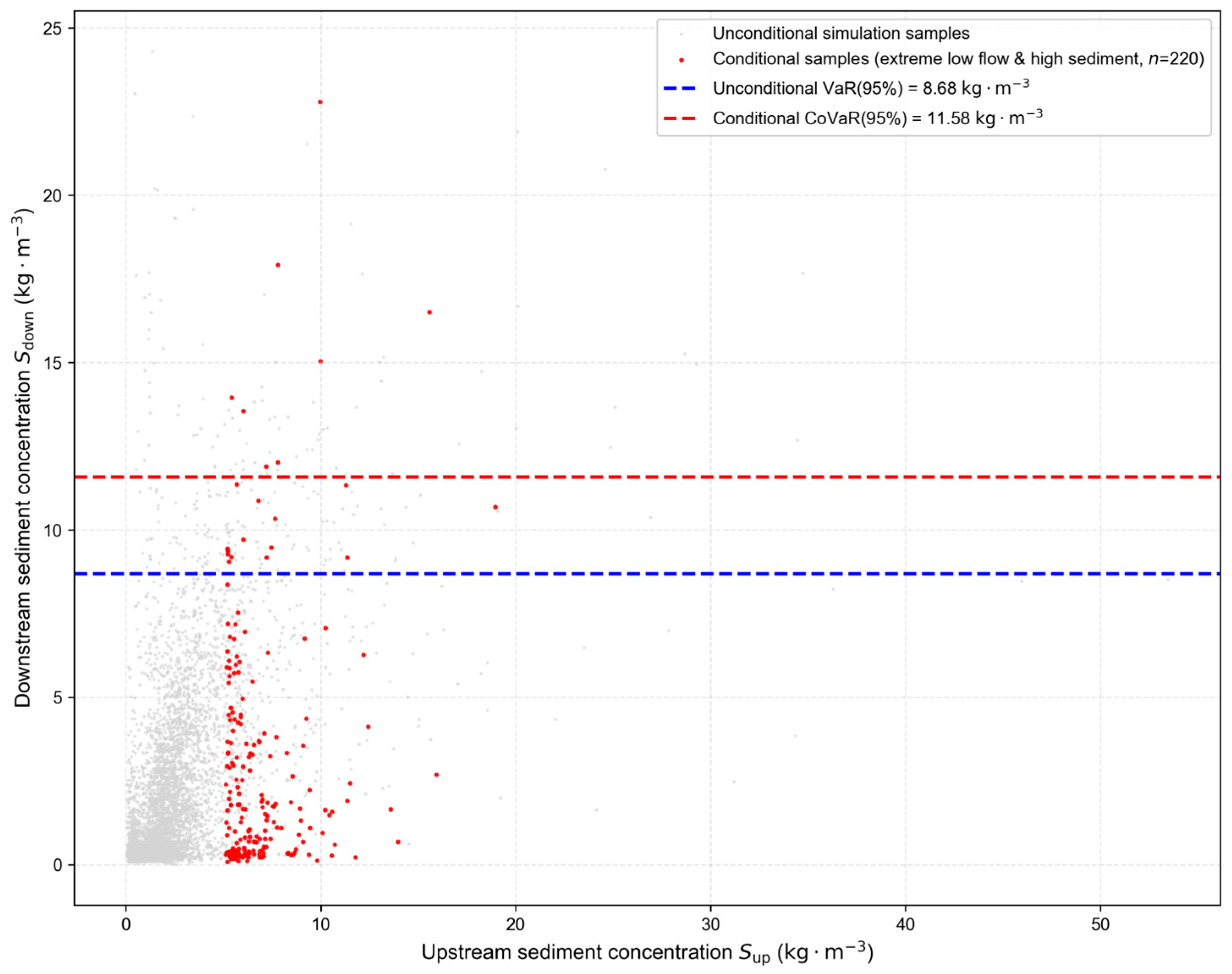
3.3.2. Risk Amplification Under Compound Extreme Conditions
3.4. Stage-Wise Evolution and Counterfactual Attribution
3.4.1. Inter-Period Comparison of ΔCoVaR
3.4.2. Counterfactual Simulation
3.5. Comparison with Traditional Correlation Analysis and the Hysteresis Effect
3.5.1. Empirical Comparison of ΔCoVaR with Traditional Correlation Measures
3.5.2. Hysteresis Effect
4. Discussion
4.1. Asymmetric Pattern of Spatial Risk Transmission: Physical Mechanism Interpretation
4.2. Comparison Between ΔCoVaR and Traditional Correlation Analysis
4.3. Driving Mechanisms of Reservoir Regulation on Risk Patterns
4.4. Implications for Reservoir Operation and River Channel Management
4.5. Limitations and Future Research
5. Conclusions
Supplementary Materials
Author Contributions
Funding
Data Availability Statement
Acknowledgments
Conflicts of Interest
Abbreviation
| AIC | Akaike Information Criterion |
| BIC | Bayesian Information Criterion |
| CDF | Cumulative Distribution Function |
| CoES | Conditional Expected Shortfall |
| CoVaR | Conditional Value-at-Risk |
| CV | Coefficient of Variation |
| CvM | Cramér-von Mises |
| DOY | Day of Year |
| ECDF | Empirical Cumulative Distribution Function |
| ES | Expected Shortfall |
| EVT | Extreme Value Theory |
| GEV | Generalized Extreme Value |
| GPD | Generalized Pareto Distribution |
| LOESS | Locally Estimated Scatterplot Smoothing |
| MAPE | Mean Absolute Percentage Error |
| MK | Mann–Kendall |
| MLE | Maximum Likelihood Estimation |
| MRL | Mean Residual Life |
| NSE | Nash–Sutcliffe Efficiency |
| PBIAS | Percent Bias |
| PIT | Probability Integral Transform |
| POT | Peaks Over Threshold |
| RF | Random Forest |
| RMSE | Root Mean Square Error |
| TLL | Transformation Local Likelihood |
| VaR | Value at Risk |
| VIF | Variance Inflation Factor |
References
- Xu, J.; Zhao, Y.; Chen, Y.; Du, P.; Qu, L. Hydrological changes and sediment dynamics in the Inner Mongolia section of the Yellow River: Implications for reservoir management. Water 2024, 16, 810. [Google Scholar] [CrossRef]
- Shen, Y.; Zheng, S.; Qin, C.; Li, J.; Ma, Z.P.; Wu, B.S.; Xu, M.Z.; Xue, Y. Equilibrium tendency of river channel adjustment in response to upstream damming: A case study of the Lower Yellow River. J. Hydrol. 2024, 650, 132494. [Google Scholar] [CrossRef]
- Brandt, S.A. Classification of geomorphological effects downstream of dams. Catena 2000, 40, 375–401. [Google Scholar] [CrossRef]
- Graf, W.L. Downstream hydrologic and geomorphic effects of large dams on American rivers. Geomorphology 2006, 79, 336–360. [Google Scholar] [CrossRef]
- Wang, S.; Song, S.; Zhang, H.; Yu, L.; Jiao, C.; Li, C.; Wu, X.; Zhao, W.; Best, J.; Roberts, P.; et al. Anthropogenic impacts on the Yellow River Basin water systems. Nat. Rev. Earth Environ. 2025, 6, 656–671. [Google Scholar] [CrossRef]
- Wang, S.J.; Liu, W.; Yan, M.; He, L. Stepped changes in suspended sediment transport efficiency and discharge ration and the main causes in lower reaches of Yellow River. Res. Soil Water Conserv. 2020, 27, 104–111. (In Chinese) [Google Scholar] [CrossRef]
- Macdonald, E.; Merz, B.; Guse, B.; Wietzke, L.; Ullrich, S.; Kemter, M.; Ahrens, B.; Vorogushyn, S. Event and catchment controls of heavy tail behavior of floods. Water Resour. Res. 2022, 58, e2021WR031260. [Google Scholar] [CrossRef]
- Latif, S.; Simonovic, S. Parametric vine copula framework in the trivariate probability analysis of compound flooding events. Water 2022, 14, 2214. [Google Scholar] [CrossRef]
- Salvadori, G.; De Michele, C. Frequency analysis via copulas: Theoretical aspects and applications to hydrological events. Water Resour. Res. 2004, 40, W12511. [Google Scholar] [CrossRef]
- Joe, H. Dependence Modeling with Copulas; CRC Press: London, UK, 2014. [Google Scholar]
- Aas, K.; Czado, C.; Frigessi, A.; Bakken, H. Pair-copula constructions of multiple dependence. Insur. Math. Econ. 2009, 44, 182–198. [Google Scholar] [CrossRef]
- Wang, S.; Fu, B.; Piao, S.; Lu, Y.; Ciais, P.; Feng, X.; Wang, Y. Reduced sediment transport in the Yellow River due to anthropogenic changes. Nat. Geosci. 2016, 9, 38–41. [Google Scholar] [CrossRef]
- Adrian, T.; Brunnermeier, M.K. CoVaR. Am. Econ. Rev. 2016, 106, 1705–1741. [Google Scholar] [CrossRef]
- Coles, S. An Introduction to Statistical Modeling of Extreme Values; Springer: London, UK, 2001. [Google Scholar]
- Pickands, J. Statistical inference using extreme order statistics. Ann. Stat. 1975, 3, 119–131. [Google Scholar] [CrossRef]
- Balkema, A.A.; de Haan, L. Residual life time at great age. Ann. Probab. 1974, 2, 792–804. [Google Scholar] [CrossRef]
- Gençay, R.; Selçuk, F. Extreme value theory and Value-at-Risk: Relative performance in emerging markets. Int. J. Forecast. 2004, 20, 287–303. [Google Scholar] [CrossRef]
- Zhang, L.; Singh, V.P. Copulas and their Applications in Water Resources Engineering; Cambridge University Press: Cambridge, UK, 2019. [Google Scholar]
- Poulin, A.; Huard, D.; Favre, A.-C.; Pugin, S. Importance of tail dependence in bivariate frequency analysis. J. Hydrol. Eng. 2007, 12, 394–403. [Google Scholar] [CrossRef]
- Zhao, F.Z.; Yi, P.; Wang, Y.J.; Wan, X.Y.; Wang, S.; Song, C.; Xue, Y.T. Trivariate frequency analysis of extreme sediment events of compound floods based on vine copula: A case study of the Middle Yellow River in China. J. Hydrol. Eng. 2025, 30, 05024027. [Google Scholar] [CrossRef]
- Milly, P.C.D.; Betancourt, J.; Falkenmark, M.; Hirsch, R.M.; Kundzewicz, Z.W.; Lettenmaier, D.P.; Stouffer, R.J. Stationarity is dead: Whither water management? Science 2008, 319, 573–574. [Google Scholar] [CrossRef]
- Wu, J.T.; Liu, X.M.; Liu, T.X.; Deng, A.J.; Huang, H. Hundred-year changes in water and sediment in the Inner Mongolia reach of the Yellow River: Trend transitions, driving mechanisms, and attribution quantification. J. Hydrol. 2026, 132700, 135605. [Google Scholar] [CrossRef]
- Yao, W.Y.; Hou, S.Z.; Ding, Y. Effects on flow and sediment in the upper Yellow River by operation of Longyangxia Reservoir and Liujiaxia Reservoir. Adv. Water Sci. 2017, 28, 1–13. (In Chinese) [Google Scholar]
- Qian, N.; Wan, Z. Mechanics of Sediment Transport; Science Press: Beijing, China, 1983. (In Chinese) [Google Scholar]
- Zhang, Y.F.; Wang, P.; Hu, T.; Guo, X.J.; Wu, B.S. An experimental study of fluvial processes at asymmetrical river confluences with hyperconcentrated tributary flows. Geomorphology 2015, 230, 26–36. [Google Scholar] [CrossRef]
- Wu, B.S.; Wang, G.Q.; Xia, J.Q.; Fu, X.D.; Zhang, Y.F. Response of bankfull discharge to discharge and sediment load in the Lower Yellow River. Geomorphology 2008, 100, 366–376. [Google Scholar] [CrossRef]
- Serinaldi, F.; Kilsby, C.G. Stationarity is undead: Uncertainty dominates the distribution of extremes. Adv. Water Resour. 2015, 77, 17–36. [Google Scholar] [CrossRef]
- Northrop, P.J.; Attalides, N. Posterior propriety in Bayesian extreme value analyses using reference priors. Stat. Sin. 2016, 26, 721–743. [Google Scholar] [CrossRef]
- Renard, B.; Sun, X.; Lang, M. Bayesian methods for non-stationary extreme value analysis. In Handbook of Engineering Hydrology: Fundamentals and Applications; Najafzadeh, M., Ed.; Springer: Dordrecht, The Netherlands, 2013; pp. 39–95. [Google Scholar]
- Tao, H.; Al-Khafaji, Z.S.; Qi, C.; Zounemat-Kermani, M.; Kisi, O.; Zhang, Z.; Safari, M.J.S.; Mahariq, I.; Tufa, A.D.; Alawi, O.A.; et al. Artificial intelligence models for suspended river sediment prediction: State-of-the-art, modeling framework appraisal, and proposed future research directions. Eng. Appl. Comput. Fluid Mech. 2021, 15, 1585–1612. [Google Scholar] [CrossRef]
- Meles, M.B.; Goodrich, D.C.; Gupta, H.V.; Shea Burns, I.; Unkrich, C.L.; Razavi, S.; Guertin, D.P. Multi-criteria, time dependent sensitivity analysis of an event-oriented, physically-based, distributed sediment and runoff model. J. Hydrol. 2021, 598, 126268. [Google Scholar] [CrossRef]







| Analysis Level | Financial Systemic Risk (Original Context) | Water–Sediment Spatial Transmission (This Study) |
|---|---|---|
| System unit | Individual financial institution | Individual hydrological station (e.g., Dengkou, Bayangol) |
| Unit state indicator | Return rate | Incoming sediment coefficient |
| Extreme risk definition | Return falls below an extreme quantile threshold | exceeds an extreme upper quantile threshold |
| Inter-unit linkage | Balance-sheet cross-holdings, market panic contagion | Fluvial flow routing, sediment erosion and deposition along the channel |
| Core quantification objective | Risk increment to system j when institution i fails | Hazard increment to downstream section when upstream section experiences extreme imbalance |
| Metric | ΔCoVaR (systemic risk spillover) | ΔCoVaR (spatial hazard increment) |
| Key Element | Financial Domain (Original Setting) | Hydrological Domain (Physical Constraints & Challenges) | Adaptation in This Study |
|---|---|---|---|
| Transmission timing | Instantaneous information transmission (zero-lag assumption) | Flood and sediment propagation involves hydraulic time delays; the “instantaneous synchrony” assumption is invalid | Introduce hydrodynamic time-lag: τ = 5 days adopted as a representative compromise within the lag plateau identified by Pearson cross-correlation analysis (Figure S4) and Kendall’s τ stability check (Figure S3) |
| Risk benchmark | Median state (50th percentile) as the normal benchmark | The channel can naturally transport sediment at median state, which does not constitute a “distress” condition | Redefine the benchmark as the downstream unconditional VaR, so ΔCoVaR directly measures the “excess hazard increment”(statistical conditional increment, not a causal effect; see footnote above) caused by upstream extremes |
| Marginal distribution | Data often assumed to follow normal or t distributions | Sediment extreme events exhibit pronounced heavy tails; normality assumption systematically underestimates extreme event return probability | Semi-parametric tail modeling: POT extraction of extremes with GPD fitting for the tail |
| Station | Period | Sample Size n | Threshold u (kg·s·m−6) | Exceedances Nu |
|---|---|---|---|---|
| Sanhuhekou | 1951–1986 (P1) | 36 | 0.0169 | 4 |
| Sanhuhekou | 1987–2023 (P2′) | 37 | 0.0105 | 4 |
| Sanhuhekou | Full period (1951–2023) | 73 | 0.0109 | 8 |
| Toudaoguai | 1951–1986 (P1) | 36 | 0.0127 | 4 |
| Toudaoguai | 1987–2023 (P2′) | 37 | 0.0104 | 4 |
| Toudaoguai | Full period (1951–2023) | 73 | 0.0117 | 8 |
| Bayangol | 1951–1986 (P1) | 36 | 0.0134 | 4 |
| Bayangol | 1987–2023 (P2′) | 37 | 0.0240 | 4 |
| Bayangol | Full period (1951–2023) | 73 | 0.0228 | 8 |
| Dengkou | 1951–1986 (P1) | 36 | 0.0070 | 4 |
| Dengkou | 1987–2023 (P2′) | 37 | 0.0142 | 4 |
| Dengkou | Full period (1951–2023) | 73 | 0.0106 | 8 |
| Station | Period | n | VaR Median | VaR Lower 95% CI | VaR Upper 95% CI | ES Median | ES Lower 95% CI | ES Upper 95% CI |
|---|---|---|---|---|---|---|---|---|
| Sanhuhekou | P1 (1951–1986) | 36 | 0.0277 | 0.0118 | 0.0325 | 0.031 | 0.018 | 0.0331 |
| Sanhuhekou | P2′ (1987–2023) | 37 | 0.0112 | 0.0103 | 0.014 | 0.0132 | 0.0105 | 0.0168 |
| Sanhuhekou | Full (1951–2023) | 73 | 0.0229 | 0.0109 | 0.031 | 0.0299 | 0.0153 | 0.0357 |
| Toudaoguai | P1 (1951–1986) | 36 | 0.0145 | 0.0091 | 0.0159 | 0.0155 | 0.0131 | 0.016 |
| Toudaoguai | P2′ (1987–2023) | 37 | 0.0129 | 0.0095 | 0.0184 | 0.0167 | 0.0109 | 0.0193 |
| Toudaoguai | Full (1951–2023) | 73 | 0.0145 | 0.0104 | 0.0183 | 0.0163 | 0.0136 | 0.0191 |
| Bayangol | P1 (1951–1986) | 36 | 0.0152 | 0.0119 | 0.0237 | 0.0215 | 0.0134 | 0.0416 |
| Bayangol | P2′ (1987–2023) | 37 | 0.0322 | 0.0235 | 0.0362 | 0.0347 | 0.0245 | 0.0364 |
| Bayangol | Full (1951–2023) | 73 | 0.027 | 0.0213 | 0.0342 | 0.0329 | 0.024 | 0.0366 |
| Dengkou | P1 (1951–1986) | 36 | 0.0096 | 0.0063 | 0.0106 | 0.0103 | 0.0071 | 0.0106 |
| Dengkou | P2′ (1987–2023) | 37 | 0.0162 | 0.0126 | 0.0197 | 0.019 | 0.0145 | 0.0208 |
| Dengkou | Full (1951–2023) | 73 | 0.0146 | 0.0106 | 0.0191 | 0.0168 | 0.0129 | 0.0202 |
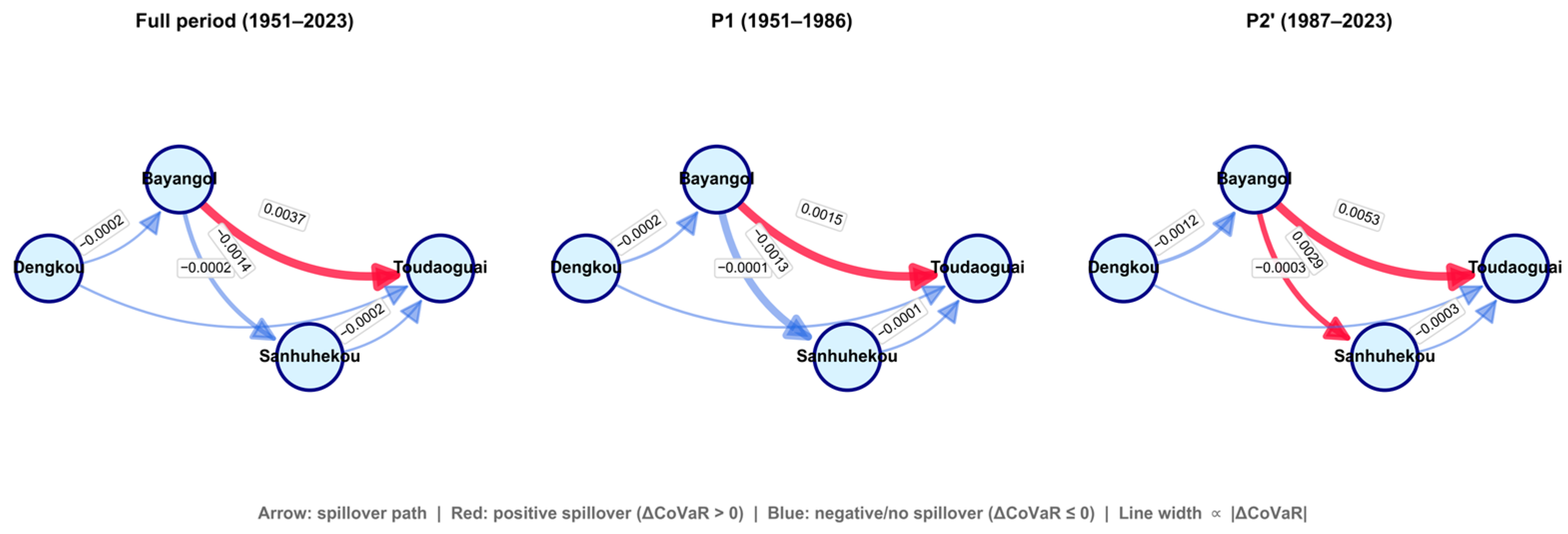
| Upstream → Downstream | Period | τ | Optimal Copula () | ΔCoVaR (kg·s·m−6) |
|---|---|---|---|---|
| Dengkou → Toudaoguai | Full | 0.4 | Gumbel (0.39) | −0.0002 |
| P1 | 0.3 | Gumbel (0.21) | −0.0001 | |
| P2′ | 0.52 | Gumbel (0.50) | −0.0003 | |
| Bayangol → Toudaoguai | Full | 0.44 | Gaussian (0) | 0.0037 |
| P1 | 0.53 | Gaussian (0) | 0.0015 | |
| P2′ | 0.43 | Gaussian (0) | 0.0053 | |
| Sanhuhekou → Toudaoguai | Full | 0.52 | Clayton (0) | −0.0002 |
| Dengkou → Bayangol | Full | 0.61 | Gumbel (0.67) | −0.0002 |
| P2′ | 0.77 | Clayton (0) | −0.0012 | |
| Bayangol → Sanhuhekou | Full | 0.55 | Clayton (0) | −0.0014 |
| P1 | 0.46 | Clayton (0) | −0.0013 | |
| P2′ | 0.66 | Gaussian (0) | 0.0029 |
| Tree | Edge | Conditioning Variable | Conditioned Variables | Copula Family | Parameter | Kendall τ |
|---|---|---|---|---|---|---|
| 1 | 1 | — | TLL | [30 × 30] | −0.46 | |
| 1 | 2 | — | TLL | [30 × 30] | 0.41 | |
| 2 | 1 | Frank | −2.06 | −0.22 |
| Metric | Value (kg/m3) |
|---|---|
| Unconditional VaR (95%) | 8.68 |
| Unconditional ES (95%) | 11.45 |
| Joint conditional CoVaR (95%) | 11.58 |
| Joint conditional CoES (95%) | 14.47 |
| ΔCoVaR (hazard increment) | 2.89 |
| ΔCoES (Expected Shortfall spillover) | 3.02 |
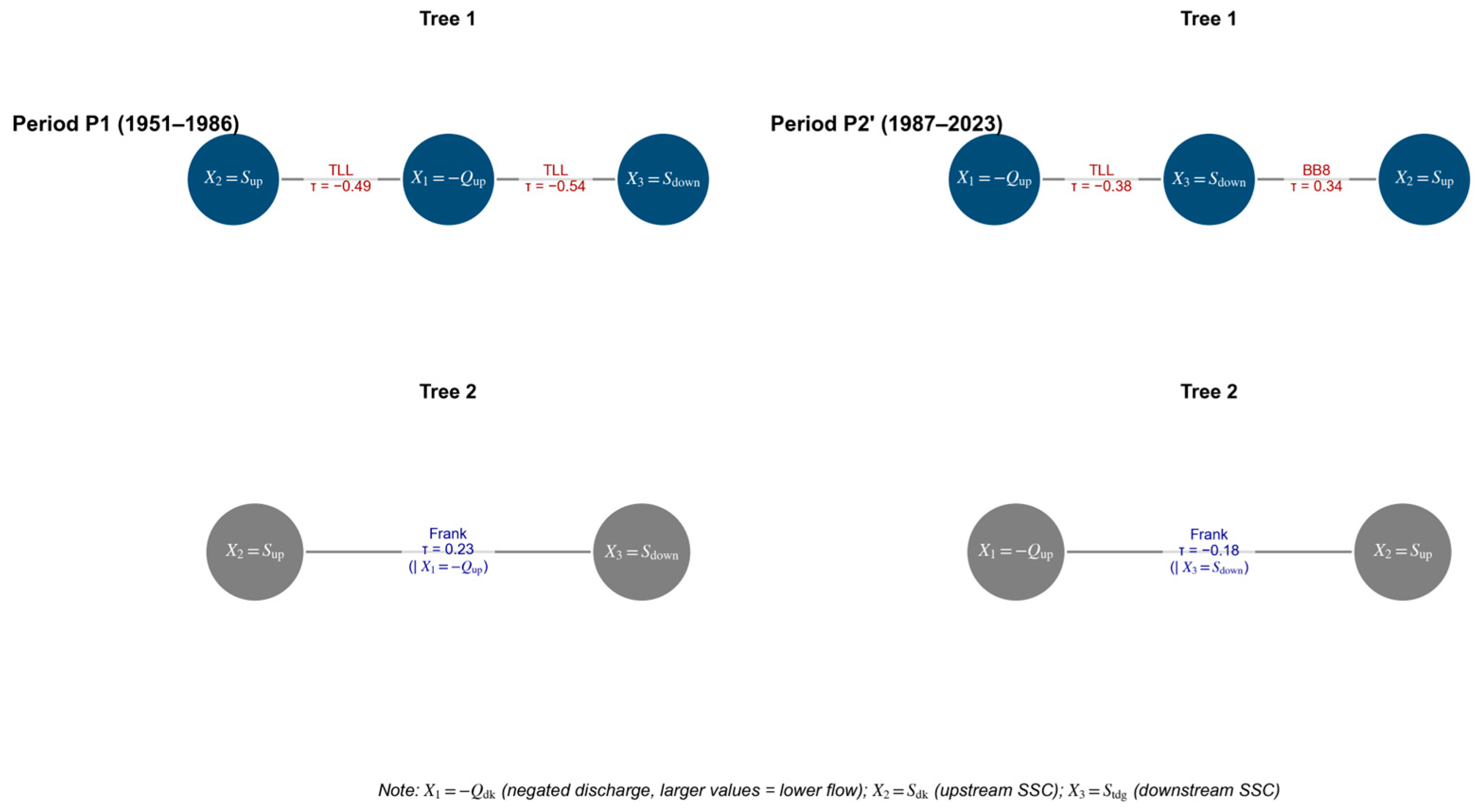
| Period | Tree | Edge | Conditioning Variable | Conditioned Variables | Copula Family | Kendall τ |
|---|---|---|---|---|---|---|
| P1 | 1 | 1 | — | () | TLL | −0.49 |
| P1 | 1 | 2 | — | TLL | −0.54 | |
| P1 | 2 | 1 | Frank | 0.23 | ||
| P2′ | 1 | 1 | — | TLL | −0.38 | |
| P2′ | 1 | 2 | — | BB8 | 0.34 | |
| P2′ | 2 | 1 | Frank | −0.18 |
| Station Pair | Period | Pearson r | Kendall τ | ΔCoVaR (kg·s·m−6) | Key Insight |
|---|---|---|---|---|---|
| Dengkou → Toudaoguai | Full | 0.368 | 0.398 | −0.0002 | Moderate overall correlation, but zero positive spillover under extremes |
| Bayangol → Toudaoguai | Full | 0.516 | 0.439 | 0.0037 | Only moderate correlation, yet significant tail conditional risk elevation |
| Bayangol → Toudaoguai | P2′ | 0.555 | 0.429 | 0.0053 | Traditional correlations change modestly, but ΔCoVaR increases markedly |
| Bayangol → Sanhuhekou | P2′ | 0.82 | 0.661 | 0.0029 | Strong overall correlation, yet additional tail spillover persists |
Disclaimer/Publisher’s Note: The statements, opinions and data contained in all publications are solely those of the individual author(s) and contributor(s) and not of MDPI and/or the editor(s). MDPI and/or the editor(s) disclaim responsibility for any injury to people or property resulting from any ideas, methods, instructions or products referred to in the content. |
© 2026 by the authors. Licensee MDPI, Basel, Switzerland. This article is an open access article distributed under the terms and conditions of the Creative Commons Attribution (CC BY) license.
Share and Cite
Zhang, C.; Dong, Z.; Wang, W. Spatial Cascading of Extreme Water–Sediment Imbalance Risks in a Heavily Regulated River Reach: A Copula-CoVaR Framework. Water 2026, 18, 1372. https://doi.org/10.3390/w18111372
Zhang C, Dong Z, Wang W. Spatial Cascading of Extreme Water–Sediment Imbalance Risks in a Heavily Regulated River Reach: A Copula-CoVaR Framework. Water. 2026; 18(11):1372. https://doi.org/10.3390/w18111372
Chicago/Turabian StyleZhang, Cheng, Zengchuan Dong, and Wenzhuo Wang. 2026. "Spatial Cascading of Extreme Water–Sediment Imbalance Risks in a Heavily Regulated River Reach: A Copula-CoVaR Framework" Water 18, no. 11: 1372. https://doi.org/10.3390/w18111372
APA StyleZhang, C., Dong, Z., & Wang, W. (2026). Spatial Cascading of Extreme Water–Sediment Imbalance Risks in a Heavily Regulated River Reach: A Copula-CoVaR Framework. Water, 18(11), 1372. https://doi.org/10.3390/w18111372