Article

Ecofriendly Biosorbent for the Removal of Hexavalent Chromium from Drinking Water

by
Ouro T. Koumai
1,
George A. Sorial
1,
Endalkachew Sahle-Demessie
2,* and
Mallikarjuna Nadagouda
2
1
701 Engineering Research Center, Department of Chemical and Environmental Engineering, College of Engineering and Applied Science, University of Cincinnati, 2901 Woodside Drive, Cincinnati, OH 45219, USA
2
Center for Environmental Solution and Emergency Response, Office of Research and Development, U.S. Environmental Protection Agency, 26 W. Martin Luther King Drive, Cincinnati, OH 45268, USA
*
Author to whom correspondence should be addressed.
Water 2026, 18(11), 1373; https://doi.org/10.3390/w18111373
Submission received: 18 April 2026 / Revised: 22 May 2026 / Accepted: 29 May 2026 / Published: 4 June 2026
(This article belongs to the Section Water Quality and Contamination)

Abstract

For the removal of hexavalent chromium [Cr(VI)] from drinking water, a hybrid biosorbent designated chitosan–natural diatomaceous earth (CNDE) was developed and thoroughly characterized. The material couples the ion-exchange and chelating capacity of chitosan—applied at an 85% degree of deacetylation—with the high-surface-area mineral framework of natural diatomaceous earth, onto which the polymer was deposited as a conformal coating. Surface morphology and internal microstructure were examined by scanning and transmission electron microscopy (SEM/TEM), while elemental composition across the hybrid matrix was resolved by energy-dispersive X-ray spectroscopy (EDX). Fourier transform infrared (FTIR) spectroscopy was employed to identify the surface functional groups responsible for chromate binding, and streaming current measurements established the pH of zero charge (pH_pzc), which governs the electrostatic environment at the sorbent–solution interface. Specific surface area was quantified by the Brunauer–Emmett–Teller (BET) method, and the balance of surface acidic and basic sites was determined through titrimetric analysis of total acidity and alkalinity. Thermogravimetric analysis (TGA) was conducted to assess thermal stability. Batch equilibrium isotherm experiments were performed to evaluate Cr(VI) uptake from model drinking water prepared using dilute potassium dichromate solutions adjusted to target pH levels. The effects of solution pH and competing anions (chloride and sulfate) were also investigated. Kinetic studies were conducted to determine the rate of Cr(VI) adsorption, and residual metal concentrations were measured using inductively coupled plasma mass spectrometry (ICP-MS). Results indicated that CNDE containing 30% chitosan (CNDE30) achieved effective Cr(VI) removal at pH 5. Adsorption was strongly pH-dependent, decreasing as pH increased from 5 to 8. Equilibrium data were well described by both Langmuir and Freundlich isotherm models, while kinetic data followed a pseudo-second-order model. The presence of chloride ions (15 mg/L) reduced adsorption capacity by approximately one-third, whereas sulfate at the same concentration significantly inhibited Cr(VI) removal. Overall, the isotherm results suggest that CNDE30 is a promising material for Cr(VI) removal from drinking water. Its cost-effectiveness, ease of synthesis, and potential for reuse make it particularly attractive for small-scale and decentralized water treatment applications.

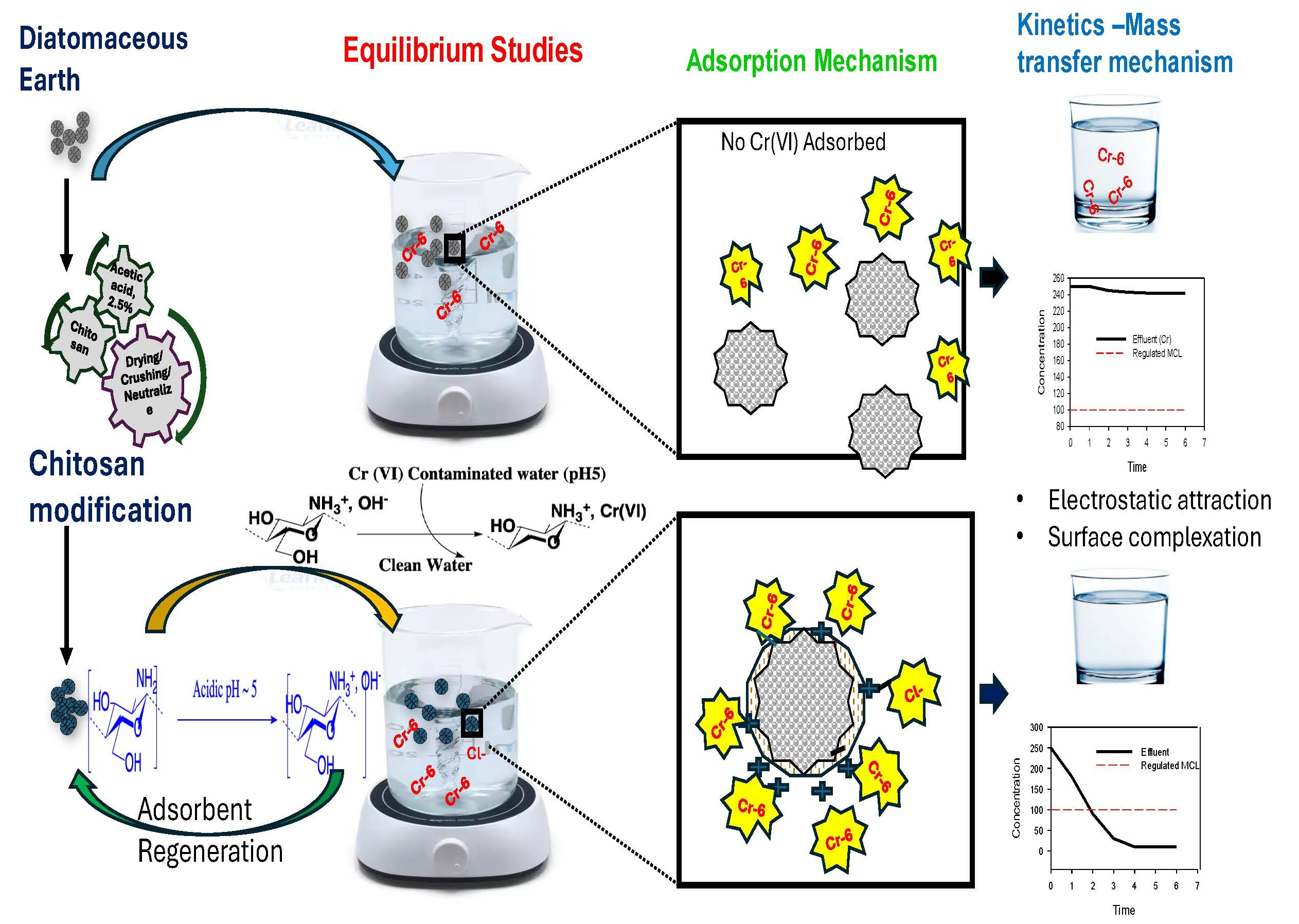
Graphical Abstract

1. Introduction

Chromium exists in aquatic environments predominantly as two oxidation states whose biological significance could not be more different: Cr(III) is an essential trace element in human metabolism, while Cr(VI) is highly soluble, mobile, and among the most toxic forms of heavy metal contamination encountered in drinking water—associated with stomach ulcers, liver and kidney damage, respiratory cancers, reproductive effects, and gastrointestinal distress [1,2].
This toxicological contrast makes the source and speciation of chromium in water supplies a matter of direct public health consequence. Chromium enters the environment through both geogenic and anthropogenic pathways: natural release occurs via volcanic activity, bedrock weathering, and leaching from chromium-bearing soils and sediments, while industrial inputs—spanning mining, electroplating, automotive manufacturing, painting, plumbing, textile production, and wood preservation—introduce Cr(VI) directly into surface and groundwater systems [3,4,5,6].
The resulting exposure is widespread: reported chromium concentrations in U.S. drinking water supplies have reached as high as 84 µg/L, groundwater concentrations up to 50 µg/L have been documented, and an estimated 18% of the U.S. population has been exposed to drinking water containing between 2 and 60 µg/L of chromium, although most public water systems report levels below 5 µg/L [1,7,8]. Cr(VI) sits alongside arsenic, cadmium, lead, and mercury as one of the heavy metal contaminants of greatest global concern in drinking water [1,2], and its combination of high mobility, persistence, and toxicity makes its removal a priority target for water treatment research [9].
Existing regulatory standards for chromium in drinking water reflect a widening gap between precautionary science and enforceable limits. The WHO guideline of 50 µg/L for total chromium—adopted also by the California State Water Resources Control Board as a state-level MCL specifically for Cr(VI)—is already more protective than the U.S. EPA’s federal MCL of 100 µg/L for total chromium, a threshold increasingly criticized as outdated in light of accumulating evidence linking Cr(VI) exposure to cancer risk. That the federal standard regulates total chromium rather than Cr(VI) specifically compounds the concern, since Cr(III) and Cr(VI) differ fundamentally in toxicity yet are treated interchangeably under the current framework. Advances in analytical chemistry have largely removed the technical barriers that once made Cr(VI)-specific regulation impractical, enabling reliable speciation and quantification of the two oxidation states at environmentally relevant concentrations. Against this backdrop, the EPA has released the fourth draft of its Integrated Risk Information System (IRIS) assessment for hexavalent chromium for peer review and public comment; once finalized, that assessment will inform the agency’s determination of whether and how the federal MCL should be revised through the periodic six-year review process, with the outcome likely to have significant implications for treatment requirements at water systems currently operating in compliance with the existing but increasingly scrutinized 100 µg/L standard [10].
Although the regulatory process for establishing or revising maximum contaminant levels (MCLs) in drinking water can be lengthy, the U.S. EPA may pursue several approaches, including lowering the existing MCL for total chromium or establishing a new standard specifically for Cr(VI), the species of greatest toxicological concern. Regardless of the regulatory pathway adopted, ensuring compliance and maintaining safe drinking water will likely become increasingly challenging for many public water systems (PWSs), particularly small and resource-limited utilities [11].
Conventional treatment processes, such as lime softening, alum or ferric coagulation, and filtration—are generally effective for removing the less toxic Cr(III), but they are inefficient for the more soluble and potentially carcinogenic Cr(VI), which can constitute anywhere from 2% to 100% of total chromium in water [12]. Although Cr(VI) can be chemically reduced to Cr(III) under acidic conditions prior to coagulation and filtration [13], these approaches are often impractical for small systems due to their operational complexity, chemical requirements, and associated costs. Moreover, such processes generate significant volumes of low-density sludge, creating additional challenges related to handling, disposal, and overall system management [14].
Advanced treatment technologies, including ion exchange (IX) and reverse osmosis (RO), have demonstrated effectiveness in removing Cr(VI) at concentrations up to approximately 30 µg/L [15]. Adsorptive methods using granular activated carbon (GAC) and activated alumina (AA) have also shown promise [16]. However, the broader applicability of adsorption-based technologies depends heavily on the availability of cost-effective, low-maintenance, and environmentally sustainable sorbent materials. In response, recent research has focused on developing alternative, low-cost adsorbents derived from natural and waste materials. These include coconut shells, rice husks, sand and clay minerals, diatomaceous earth, biochar, algal biomass, and biopolymers such as chitin and chitosan, often enhanced through surface modification. While many of these materials have shown promising performance in industrial wastewater treatment studies, further work is needed to evaluate their scalability, long-term stability, and suitability for drinking water applications [17,18,19], rice husk [20], sand rock, clay deposits [21], diatomaceous earth [22], biochar and algal biomass [23,24], chitin and chitosan biopolymers as well as their derivatives [25]. This study specifically targets drinking water applications, where regulatory constraints, lower contaminant concentrations, and the need for non-toxic, food-safe materials impose stricter requirements than industrial wastewater treatment contexts.
This study aims to develop a biobased, low-cost, and sustainable adsorptive technology for Cr(VI) removal suited to small drinking water systems—one that minimizes secondary pollution risk by drawing on two abundant natural materials, diatomaceous earth (DE) and chitosan, selected for their complementary physicochemical properties and environmental compatibility. The primary objective is to synthesize a hybrid chitosan–natural diatomaceous earth (CNDE) biosorbent by coating DE with chitosan through a simple and environmentally benign procedure, then evaluate its performance systematically across the conditions relevant to real drinking water treatment.
The work builds directly on prior demonstrations by Salih and Ghosh of chitosan-coated and nano-chitosan-coated diatomaceous earth for chromium removal [26,27,28], extending those investigations in three substantive directions: it targets model drinking water matrices at environmentally relevant Cr(VI) concentrations of 50–300 µg/L, well below the industrial wastewater levels typically employed in predecessor studies; it introduces competing anions—chloride and sulfate at concentrations representative of natural groundwater—as a systematic experimental variable essential for predicting real-world performance but not previously addressed comprehensively for this material system; and it examines regeneration through pH adjustment as a low-energy, infrastructure-light strategy appropriate for decentralized applications.
The synthesized CNDE will be characterized structurally and physicochemically to elucidate surface morphology, elemental composition, functional group identity, textural properties, and electrokinetic behavior. Equilibrium adsorption experiments will quantify the effects of initial Cr(VI) concentration, solution pH, and competing anion identity and concentration; kinetic studies will establish adsorption rates and identify rate-limiting mass-transfer mechanisms; and regeneration experiments will assess reusability over multiple adsorption–desorption cycles, together providing the evidence base needed to evaluate CNDE as a practical drinking water treatment technology.

2. Materials and Methods

2.1. Materials

All aqueous preparations were made with Milli-Q® ultrapure water (average conductivity 18 µS/cm; TOC < 0.3 mg/L). Model Cr(VI)-bearing waters were generated from stock solutions of high-purity potassium dichromate (K2Cr2O7; MilliporeSigma®), diluted to the desired initial concentrations and brought to the target pH using technical-grade HCl or NaOH (Sigma-Aldrich, Saint Louis, MO, USA); the same reagents served for all acid–base neutralization throughout the study. The biosorbent itself was assembled from two primary constituents: natural diatomaceous earth (DE), supplied by EP Minerals Inc. (Reno, NV, USA) as the mineral substrate, and medium molecular weight chitosan (~190,000–310,000 Da; 85% degree of deacetylation; MilliporeSigma®, Merck KGaA, Darmstadt, Germany) as the polymeric coating phase. To render the chitosan soluble and processable for deposition onto the DE surface, it was dissolved in a 2.5% (v/v) acidic medium prepared from glacial acetic acid (ReagentPlus®, purity > 99%; Sigma-Aldrich, Saint Louis, MO, USA).

2.2. Methods

2.2.1. Modification of Natural Diatomaceous Earth with Chitosan

Modification of natural diatomaceous earth (NDE) with chitosan (CTS) was carried out via a slurry-coating method adapted from established chitosan functionalization protocols. The method was specifically optimized in this study for granular-scale production suitable for drinking water applications, using glacial acetic acid as the solubilizing agent for chitosan. Unlike prior approaches that employed fine-powder or nano-scale chitosan materials, the procedure described here produces a coarser, mechanically stable granular composite that retains the macroscopic particle size of the DE substrate, facilitating application in packed-bed or batch treatment configurations without requiring additional pelletization or binder steps [29]. The target formulation was 100 g of CNDE at a 30 wt% chitosan loading. Dissolution of the polymeric phase preceded all other steps: 30 g of chitosan powder was dispersed into a 2.5% (v/v) acetic acid solution prepared by diluting 12.5 mL of glacial acetic acid into 500 mL of Milli-Q® water, yielding a viscous, homogeneous dope. The mineral phase—70 g of washed and dried diatomaceous earth—was incorporated directly into this dope and blended thoroughly to produce a uniform slurry, ensuring intimate contact between the chitosan matrix and the DE substrate. The slurry was portioned into small pieces, arranged on a ceramic plate, and consolidated by drying in a vacuum oven at 67 °C (~20 psi) for 24 h.
Once solidified, the material was crushed with a mortar and pestle to reduce particle size, then subjected to a base-wash to remove residual acetic acid: the crushed solid was immersed in approximately 1 L of 0.05 M NaOH and agitated for ~15 min, after which it was recovered and rinsed repeatedly with deionized water until the effluent reached neutral pH. A second vacuum-oven drying cycle (67 °C, ~20 psi, 24 h) drove off retained moisture. After cooling, the dried product was crushed and homogenized to ensure compositional uniformity, then stored in a sealed glass container pending use.

2.2.2. Characterization of Adsorbent Material

Chemical Composition and Surface Chemistry
Energy-dispersive X-ray spectroscopy (EDX), performed with a Perkin-Elmer Model 240C elemental analyzer (Shelton, CT, USA), resolved the elemental composition of both the unmodified diatomaceous earth and the finished CNDE hybrid. The resulting compositional profiles served three interpretive functions: confirming successful deposition of the chitosan coating, quantifying the change in chemical makeup introduced by the modification step, and establishing a baseline elemental fingerprint for the new sorbent. Fourier-transform infrared (FTIR) spectroscopy, conducted on an Agilent Cary 600 Series spectrometer (Santa Clara, CA, USA), was then applied to map the surface functional groups present across the chitosan–NDE interface. Characteristic absorbance peaks at diagnostic wavenumbers were assigned to specific functional and reactive moieties, providing direct spectroscopic evidence of the groups available to participate in Cr(VI) uptake.
The total acidic and basic surface functional groups were quantified via acid–base uptake methods. In this procedure, 100 mg of the developed sorbent was equilibrated with 20 mL of either 0.05 N NaOH or 0.05 N HCl in sealed 25 mL Teflon-lined vials. Samples were agitated in a rotary tumbler at room temperature for 48 h. Control vials containing only the acid or base solution served as blanks. After equilibration, 10 mL of the supernatant was titrated with standardized acid or base to predetermined pH endpoints (pH 4.5 for acidity, pH 11.5 for basicity). The total acidity and basicity were calculated based on the difference in titrant volumes required to reach the endpoints for the sample and corresponding blanks.
Surface Morphology, and Physical Characteristics
Surface morphology, particle size, coating uniformity, and chitosan layer thickness across the NDE substrate were interrogated by environmental scanning electron microscopy (ESEM; Philips XL30 ESEM-FEG, 30 kV accelerating voltage, Hillsboro, OR USA), which resolved fine surface features at sufficient resolution to judge the integrity and spatial distribution of the polymeric coating. Textural characterization moved inward from the surface: nitrogen adsorption–desorption isotherms collected at −77.3 °C on a Quantachrome Nova 2000e analyzer (Boynton Beach, FL, USA) yielded the specific surface area via the BET equation and the total pore volume from the quantity of nitrogen adsorbed at P/P0 = 0.99, with all samples degassed under nitrogen at 67 °C for 4 h beforehand to eliminate moisture and physisorbed contaminants.
The electrokinetic response of the hybrid sorbent across the pH range was characterized using a SurPASS® 3 electrokinetic analyzer (Anton Paar, Styria, Australia), with zeta potential measurements tracking how surface charge evolves with solution pH; the pH at which the zeta potential passed through zero was taken as the point of zero charge (pH_pzc), which delimits the boundary between net-positive and net-negative surface character and therefore governs electrostatic interaction with chromate anions. Thermal behavior was assessed by thermogravimetric analysis (TGA; TA Instruments®, New Castle, DE, USA), in which neat NDE, chitosan, and CNDE were each heated from 30 to 800 °C at 10 °C min−1 under nitrogen; the resulting thermograms were interpreted for mass-loss onset temperatures, peak degradation events, and residual ash fraction to compare the compositional stability and volatile burden of the unmodified and hybrid materials.

2.2.3. Adsorption Equilibrium Studies

Equilibrium Isotherm
Equilibrium uptake of Cr(VI) from synthetic drinking water was mapped across a wide concentration–dose space using an 8 × 4 factorial design: initial Cr(VI) concentrations were varied across eight levels spanning 50–300 µg/L, and CNDE doses were varied across four levels within the 2–450 mg range. Each combination was assembled in a 125 mL amber bottle—chosen to minimize photoreduction of Cr(VI)—filled to the neck with model water at pH 5 and sealed to prevent headspace exchange. The loaded bottles were tumbled on a rotary mixer at 20 rpm for approximately 14 days, a duration established in preliminary trials as sufficient to reach equilibrium.
At the close of the equilibration period, each sample was passed through a 0.45 µm membrane filter to remove suspended solids before the residual Cr(VI) concentration was quantified by inductively coupled plasma mass spectrometry (ICP-MS) or optical emission spectrometry (ICP-OES). The equilibrium adsorption capacity was then calculated as:
q e = ( C i C e ) V m a
where q e is the equilibrium capacity or the solid phase chromium (VI) concentration, Ci and Ce are respectively the initial and the equilibrium liquid phase Cr(VI) concentrations, v is the volume of solution, and ma is the mass of adsorbent. Equilibrium adsorption isotherm data were correlated with the Langmuir (Equation (2)) and Freundlich (Equation (3)) models to test the predictability of the isotherm data from the single solute system.
q e = Q m b C e 1 + b C e
q e = K f C e 1 n
q e is the Langmuir monolayer capacity (mg/g), b is the Langmuir constant. K f and n are the Freundlich constants; Kf and n are Freundlich parameters.
Effects of Solution pH
The pH of aqueous systems plays a critical role in controlling the solubility, speciation, and availability of chemical species, as well as influencing complexation and precipitation processes during water treatment. In adsorption-based systems, influent pH is a key parameter governing contaminant uptake. Previous studies have shown that the effect of pH on Cr(VI) adsorption is adsorbent-dependent. For example, Khan et al. reported increased Cr(VI) adsorption with increasing pH for iron-coated manganese oxide, whereas Islam, Angove, and Morton observed optimal adsorption typically in the pH range of 5–7, with decreasing capacity at higher pH values [30,31,32]. In contrast, adsorption of organic dyes such as methyl orange has been reported to be largely pH-independent [33].
pH governs three coupled phenomena in this system: the protonation state of chitosan’s amino groups, which determines the density of positively charged binding sites; the speciation and aqueous mobility of Cr(VI), which shifts between chromate and dichromate forms across the pH range relevant to drinking water; and the resulting adsorption mechanism, whose character changes as these two variables evolve in concert.
To isolate and quantify these effects, equilibrium isotherm experiments were carried out at pH 5, 7, and 8—values bracketing the range typically encountered in drinking water treatment—with each target pH established by dropwise addition of 0.1 N NaOH or HCl. Samples were sealed to prevent CO2-driven pH drift and equilibrated on a rotary tumbler at 20 rpm for approximately 14 days at laboratory temperature (~21 °C). All isotherms were performed in at least duplicate to confirm reproducibility, and differences in adsorption capacity and isotherm shape across the three pH conditions were interpreted as direct evidence of pH’s mechanistic influence on Cr(VI) uptake by CNDE.
Effects of Common Anions: Chlorides and Sulfates
Chloride (Cl) and sulfate (SO42−) are among the most prevalent anions in natural groundwater and surface waters. These ions can influence contaminant removal, particularly in adsorption systems where ion exchange or electrostatic interactions contribute to uptake mechanisms [34].
To evaluate their effects on Cr(VI) removal, batch adsorption and equilibrium isotherm experiments were conducted as described previously, with chloride and sulfate concentrations varied from 0 to 30 mg/L. Additional isotherm studies were performed using model waters containing: (i) chloride at 16 mg/L, (ii) sulfate at 16 mg/L, and (iii) a mixture of both ions at 15 mg/L chloride and 7 mg/L sulfate. The resulting adsorption behavior was analyzed to assess competitive interactions and their impact on Cr(VI) uptake by the chitosan-modified diatomaceous earth (CNDE).

2.2.4. Kinetics of Adsorption of Cr(VI) on CNDE

Contaminant uptake rate governs practical sorbent performance as directly as equilibrium capacity does, since a material that adsorbs slowly relative to the hydraulic retention time of a full-scale system cannot deliver its theoretical removal potential. Three kinetic models—pseudo-first-order (PFO), pseudo-second-order (PSO), and Elovich (rate Equations (5), (6) and (7), respectively)—were selected to interpret the time–concentration trajectories and extract rate parameters, with differences in model fit used to infer the operative uptake mechanism.
Experiments were designed around two Cr(VI) concentrations, 50 and 300 µg/L, that bracket the range examined in the equilibrium study; CNDE dosages were set accordingly based on the equilibrium results, and solution pH was fixed at approximately 5 with 0.1 N HCl. For each concentration, at least twenty 125 mL amber bottles—each containing 125 mL of model water and a fixed CNDE mass—were prepared alongside adsorbent and reagent-water blanks, sealed, and placed on a rotary tumbler at 20 rpm at laboratory temperature.
Rather than sampling a single bottle repeatedly, individual bottles were sacrificed at predetermined time intervals across a total monitoring window of 14 days (336 h), preserving sample integrity at each time point; residual Cr(VI) in the filtered supernatant was then quantified by ICP-MS or ICP-OES. All experiments were conducted in duplicate to confirm reproducibility, and the assembled time–concentration dataset was fitted to the three kinetic models to determine equilibrium contact time and assess predictive capability. The PFO, PSO, and Elovich [35,36] models are presented in rate Equations (4)–(6).
d q t d t = k 1 ( q e q t )
d q t d t = k 2 ( q e q t ) 2
d q t d t = a   e ( b q t )
Across the three rate models, the shared currency is the solid-phase adsorbate concentration: qt denotes this quantity at any time t during the experiment, while qe is its limiting value at equilibrium, and the difference between them tracks the progress of uptake. The rate coefficients k1 and k2 scale the speed of that approach to equilibrium under PFO and PSO assumptions, respectively, and their magnitudes carry implicit mechanistic information about whether physisorption or chemisorption dominates. The Elovich parameters serve a different interpretive role: a, the initial sorption rate (mg g−1 min−1), characterizes the vigor of uptake at the moment of first contact, while b, the Elovich desorption constant, reflects the extent of surface coverage and the energetic heterogeneity of available adsorption sites. To move beyond surface reaction rates and identify whether mass transfer within the sorbent particle constitutes the true rate-limiting step, the Weber and Morris intra-particle (IP) diffusion model (Equation (7)) was applied to the same time–concentration data [37].
q t = k p t + c
where the rate constant and the boundary layer thickness are shown as kp (mg/g0.5), c (mg/g), respectively.

2.2.5. Regeneration and Reuse of Spent Chitosan DE Adsorbent

Chitosan-based sorbents are amenable to regeneration through pH adjustment alone, because the same protonation equilibrium that drives Cr(VI) uptake at acidic pH can be reversed under alkaline conditions to release the bound anions and restore active sites—a feature that distinguishes them from many mineral sorbents requiring aggressive chemical stripping [38,39]. Exploiting this property, two sequential regeneration stages were designed to identify both the optimal eluent strength and the optimal eluent pH. In the first stage, spent CNDE was contacted with NaOH solutions spanning 0.01–0.2 N, rinsed with deionized water, and returned to service; four consecutive adsorption–desorption cycles were completed under this scheme. In the second stage, deionized water adjusted to pH 5, 7, or 10 replaced the NaOH solutions as the regenerating medium, and four further cycles were carried out to decouple the effect of pH from ionic strength [40]. Across both stages, removal efficiency after each cycle (Equation (8))—expressed as the percentage of the initial adsorbate mass captured per cycle—served as the quantitative indicator of how well the sorbent recovered its uptake capacity, with performance tracked over up to five total adsorption cycles to characterize the trajectory of any capacity loss.
The adsorption removal efficiency Re is expressed as the percent mass ratio of the mass of adsorbate adsorbed to the total (initial) mass:
R e   ( % ) = 100 × ( C i C e ) C i
where Ci and Ce are initial and equilibrium concentrations.

3. Results and Discussions

3.1. Material Characterization

3.1.1. Elemental Composition

EDX spectroscopy of the CNDE hybrid revealed a composition that shifts systematically with chitosan-to-DE loading ratio: carbon and oxygen contents rise as the polymeric phase contributes more mass to the composite, while the silica signal diminishes proportionally as the mineral substrate is increasingly encased—a pattern that constitutes direct compositional evidence of successful coating.
The two end-member compositions that anchor this interpretation are well-defined: neat chitosan carries primarily carbon (45–55%), oxygen (35–40%), nitrogen (8–15%), and hydrogen (8–10%), consistent with the expected stoichiometry of commercial medium molecular weight chitosan, while dry NDE is dominated by silica (~72%), followed by oxygen (~16%), aluminum (~9%), iron (~3%), and minor trace elements. The CNDE data therefore reflect a weighted superposition of these signatures, with the nitrogen signal serving as a particularly diagnostic marker of chitosan presence against the silicon-rich DE background. Full EDX spectra and tabulated elemental compositions for CTS and NDE are provided in the Supplementary Information (Figure S1).

3.1.2. FTIR Spectroscopy

FTIR spectra collected from 400 to 4000 cm−1 across the CNDE series (10–50% CTS loading) show superimposed contributions from both constituents, confirming that chitosan is present and retained on the DE surface across the full loading range. More diagnostically, the O–H stretching band at 3634 cm−1 and the silanol (Si–OH) band at 790 cm−1—both prominent in bare NDE—are substantially attenuated or absent in the hybrid spectra, indicating that hydroxyl and silanol groups at the DE surface are directly engaged in interactions with the deposited chitosan layer.
No new absorption bands emerge in CNDE relative to the two parents, which constrains the nature of that interaction to physical association rather than covalent bond formation, consistent with a surface coating mechanism. The parent-material spectra that underpin these assignments are as follows.
For CTS, bands at 3378, 3289, and 2895 cm−1 reflect O–H, N–H, and C–H stretching, respectively; the mid-infrared region at 1643, 1574, 1426, 1386, 1326, 1184, 1068, 908, and 667 cm−1 encompasses C=O stretching (amide I), N–H bending, CH3 and CH2 deformations, C–O stretching in C–O–C linkages, and hydroxyl/amino-group vibrations; and the band at 2175 cm−1 is assigned to H–O–H vibrations. For NDE, the 3634 cm−1 band marks O–H stretching, the 1643 cm−1 peak reflects adsorbed water and C=O contributions, and the 1037 cm−1 band is attributed to siloxane (Si–O–Si) stretching alongside the silanol feature at 790 cm−1. Full spectra for all materials are provided in the Supplementary Information (Figure S3).

3.1.3. Scanning Electron Microscopy (SEM) Imaging

SEM provides detailed information on surface microstructure and topography. Figure S2 presents SEM images of (a) dry chitosan, (b) natural diatomaceous earth (NDE), (c) chitosan-modified diatomaceous earth (CNDE), and (d) Cr(VI)-loaded CNDE.
The chitosan surface appears relatively smooth, flat, and flaky, with only occasional surface grooves. In contrast, natural diatomaceous earth exhibits a highly rugged and irregular morphology, characterized by surface cavities, depressions, and grooves, indicative of a porous granular structure with heterogeneous particle size and shape.
After modification, the CNDE composite shows a distinct chitosan coating layer covering the rough surface of NDE particles, suggesting successful surface functionalization. This coating appears to partially mask surface irregularities and may contribute to a reduction in accessible porosity.

3.1.4. Appearance, Morphology, Structure, and Stability

Raw natural diatomaceous earth (NDE) (EP Minerals® Inc., Reno, NV, USA) is a grayish, granular, and porous material. The NDE particles are heterogeneous in size and morphology, reflecting the diversity of diatom species contributing to the deposit. The average particle diameter ranges from approximately 200 to 400 µm.
Chitosan coating substantially alters the physical properties of the material, increasing particle cohesion and mechanical strength. The resulting CNDE particles are more resistant to crushing, irregular in shape, and exhibit non-uniform chitosan surface coverage. The coated particles are approximately 300–500 µm in diameter and appear brown to yellow-brown in color.
In aqueous environments the chitosan layer enveloping the diatomaceous earth particles absorbs water and swells in a manner characteristic of a hydrogel, a behavior that expands the accessible polymer volume and facilitates diffusive transport of contaminants from the bulk solution into the sorbent matrix. This hydrogel-like character does not compromise structural integrity: CNDE30 remains physically stable under prolonged aqueous contact and retains its adsorption performance over at least two years of dry storage in sealed glass containers. Optical microscopy images documenting the surface structure and topography of CNDE30 are provided in the Supplementary Information (Section S2, Figure S2).

3.1.5. Thermogravimetric Analyses

The thermal response of CNDE30 is most readily understood by first establishing the behavior of its two end members. NDE (Figure S6, curve a) is thermally inert across the full 30–800 °C window, producing a nearly featureless profile with a total mass loss of only ~7%, attributable to adsorbed moisture and minor volatile surface species—a baseline that confirms the DE matrix contributes no significant decomposition signal of its own. Neat CTS (Figure S6, curve b) behaves in sharp contrast: a first mass-loss event at 67–70 °C reflects the departure of physically adsorbed water, and a dominant second stage centered near 300 °C marks the thermal breakdown of the chitosan backbone, generating volatile products including H2O, NH3, CO, CO2, and CH3COOH alongside carbonaceous residues, with cumulative mass loss reaching approximately 70% between 30 and 600 °C—behavior consistent with previously reported chitosan thermograms [27,41]. CNDE30 (Figure S6, curve c) inherits this two-stage decomposition pattern from its polymeric constituent, but the DE matrix moderates its expression: the peak degradation temperature shifts slightly below 300 °C, and the maximum mass-loss rate drops substantially from 1.3 to 0.22 mg °C−1, reflecting dilution of the thermally active chitosan phase by the inert mineral framework. The DTG curves (dashed lines throughout) resolve these staged events more sharply and confirm that the Cr(VI)-loaded CNDE (Figure S6, curve d) follows the same overall decomposition trajectory, with any deviations attributable to the bound chromate fraction.

3.1.6. Specific Surface Area (SSA)

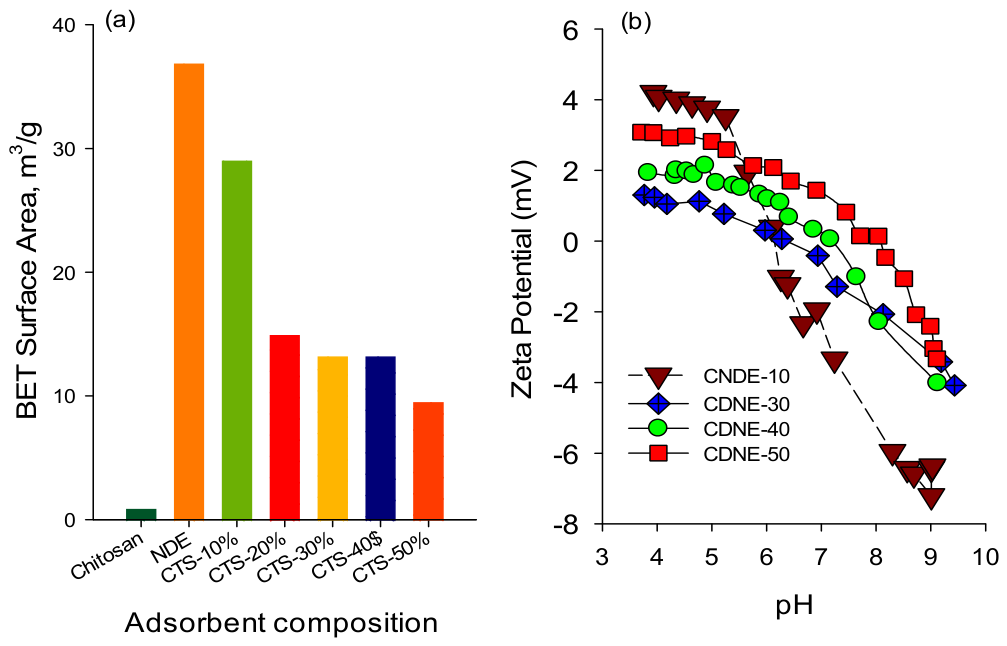
The two parent materials occupy opposite ends of the textural spectrum: NDE presents a specific surface area of 36.84 m2 g−1 and a pore volume of 0.118 cm3 g−1, reflecting its inherently microporous frustule architecture, while neat CTS contributes negligible texture with a surface area of ~1 m2 g−1 and a pore volume of 0.007 cm3 g−1. Depositing chitosan onto the DE surface progressively bridges and occludes the mineral pore network: as the CTS-to-DE mass ratio increases from 0 to 50%, both specific surface area and pore volume decline monotonically, trading accessible mineral surface for the hydrogel-like polymer layer that governs contaminant uptake in aqueous media. The full trajectory of this textural evolution across neat CTS, NDE, and the CNDE10–CNDE50 series is shown in Figure 1a.

3.1.7. Total Alkalinity/Total Acidity

The two adsorbent materials present sharply divergent acid–base profiles: neat chitosan is amphoteric, carrying basicity of 0.584 meq g−1 and acidity of 0.24 meq g−1, while dried NDE is weakly acidic (0.169 meq g−1) with negligible basicity (−0.10 meq g−1), reflecting the dominance of silanol and siloxane surface sites over any basic functionality. The CNDE hybrids blend these characters in a loading-dependent manner: total acidity stabilizes at approximately 0.3 meq g−1 across the full compositional range, while total basicity rises progressively from 0.189 to ~0.30 meq g−1 as the chitosan-to-DE mass ratio increases from 0.1 to 0.5, then plateaus—a trend that tracks directly with the density of amino (–NH2) groups introduced by the chitosan phase, since these surface sites are the primary source of basic character in both chitosan and its derivatives. Acidity and basicity profiles for NDE, CTS, and the full CNDE series are plotted in the Supplementary Information (Section S4, Figure S4).

3.1.8. Zetapotential and Surface of Zero Charge

Zeta potential measurements of the CNDE hybrid biosorbent were conducted over a titration pH range of 4 to 9. Figure 1b shows that the zeta potential (in mV) of chitosan-coated natural diatomaceous earth decreases with increasing pH, ranging from 4 to 9, for chitosan contents of 10% to 50%. The zeta potential decreased from approximately +4 mV at pH 4 to 0 mV at pH 6.3–7, corresponding to the isoelectric point or point of zero charge (IEP/pHpzc). The isoelectric range for the adsorbents is between pH 6.28 and 7.7, shifting to higher pH values with more chitosan coating, after which the zeta potential becomes negative. This trend is due to the depletion of hydronium ions, which leads to the protonation of amine groups and results in a positive charge on the chitosan-coated DE surface. With further increases in pH, the zeta potential became increasingly negative, reaching approximately −6 mV at pH 9.

3.2. Equilibrium Adsorption of Cr(VI) onto CNDE

3.2.1. Effect of Initial Adsorbate Concentration

Bottle-point equilibrium experiments were conducted to investigate Cr(VI) adsorption onto the CNDE hybrid adsorbent. In batch equilibrium tests, 15 mg of CNDE achieved nearly complete removal of Cr(VI) from 125 mL solution at an initial concentration (C0) of 100 µg/L, while 39 mg of CNDE was sufficient to completely remove Cr(VI) from 125 mL solution at 300 µg/L.
Overall removal efficiencies ranged from 77% to 96% as the initial Cr(VI) concentration increased from 100 to 300 µg/L. At a constant adsorbent mass, both adsorption capacity and removal efficiency increased with increasing aqueous-phase Cr(VI) concentration.

3.2.2. Adsorption Isotherm and Thermodynamics

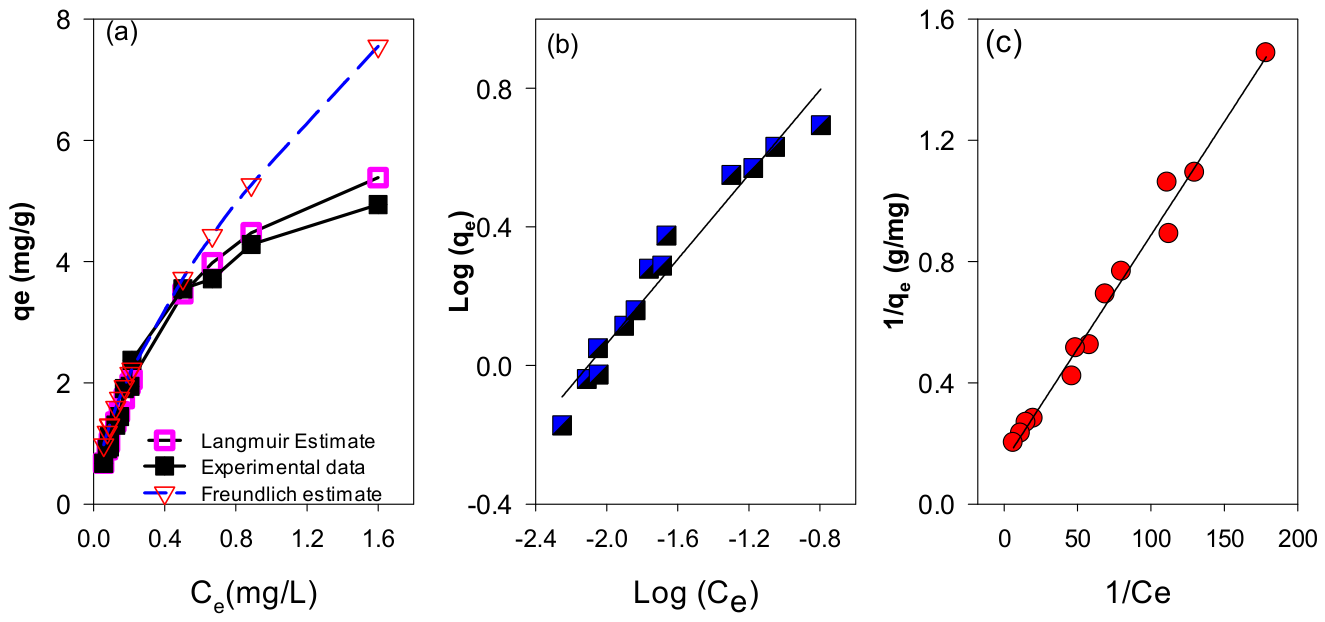
Cr(VI) uptake by CNDE is strongly concentration-dependent: adsorption capacity rises steeply as equilibrium aqueous-phase concentration increases from 0 to approximately 2.5 mg/L, then approaches a plateau near 5 mg/g as the residual Cr(VI) concentration converges on 150 µg/L, tracing the characteristic convex isotherm shape associated with finite, saturable surface sites. Both the Langmuir and Freundlich models describe this behavior satisfactorily, indicating that the data are consistent with either monolayer uptake on energetically uniform sites or adsorption across a heterogeneous surface, without either framework being decisively excluded. Model parameters—(Qm, b, Kf, and n)—together with the corresponding correlation coefficients R2 were obtained by fitting the experimental data to the linearized forms of Equations (9) and (10), respectively, and are compiled in Table 1. The equilibrium adsorption capacity and residual Cr(VI) concentration at pH 7 are presented in Figure 2a, and the Langmuir and Freundlich fits to the pH 5 isotherm data are shown alongside the experimental points in Figure 2b,c.
1 q e = 1 Q m b C e + 1 Q m
l o g q e = l o g K f + 1 n l o g C e
The nature of adsorption was determined to be favorable with the separation factor RL value of 0.45 for a maximum initial Cr(VI) concentration 250 µg/L. The separation factor RL is expressed as in Equation (11) below:
R L = 1 ( 1 + b   . ( C i ) )
where b is Langmuir constant associated with affinity and Ci is the highest adsorbate concentration. When RL = 0, the nature of adsorption is qualified as irreversible. When RL > 0 and <1 the adsorption is favorable as observed in this case; when RL = 1, the nature of adsorption is linear; and when RL > 1 the adsorption is unfavorable [34,42].
Figure 2. (a) Comparison of experimental results of equilibrium capacity of 30% chitosan coated DE for Cr(VI) at pH 7, and Langmuir isotherm (solid line) and Freundlich isotherm (broken line), (b) Freundlich isotherm model for Cr(VI), and (c) Langmuir isotherm model for Cr(VI).
Water 18 01373 g002
Table 1. Freundlich and Langmuir fitting parameters at selected solution pH.
Model
Parameters
Langmuir ModelFreundlich Model
pHQm (mg/g)bR2Kf (mg/g)nR2
515.010.007450.950223.1171.49160.9496
72.8110.014460.98410.10411.6660.9603
80.45189.0760.92590.616.87290.9539

3.2.3. Effect of pH

The standard Gibbs free energy of adsorption is related to the equilibrium state of the system through the expression as in Equation (12):
Δ G ° = R T l n   K
where ΔG° is the standard Gibbs free energy change (J/mol), R is the universal gas constant (8.314 J mol−1 K−1), T is the absolute temperature (K), and K is the thermodynamic equilibrium constant. This relationship rests on the principle that adsorption equilibrium reflects the thermodynamic balance between adsorbate molecules remaining in solution and those bound to the surface; the Langmuir affinity constant b serves as a practical approximation for K, encoding the relative strength of that surface–adsorbate interaction under a given set of conditions. A negative ΔG° indicates spontaneous, thermodynamically favorable adsorption, with increasingly negative values reflecting stronger and more energetically driven uptake. Applying this framework to the b values in Table 1, the Langmuir constant, b, increase from 0.007 to 189.1 as pH rises from 5 to 8, which yields ΔG° values that shift from positive at pH 5 to increasingly negative at higher pH. This trend implying that adsorption becomes progressively more thermodynamically spontaneous and favorable as pH increases. These thermodynamic estimates warrant careful interpretation alongside the experimental isotherm and capacity data, as the magnitude and sign of ΔG° derived from b are sensitive to the units and concentration basis used in defining the equilibrium constant.
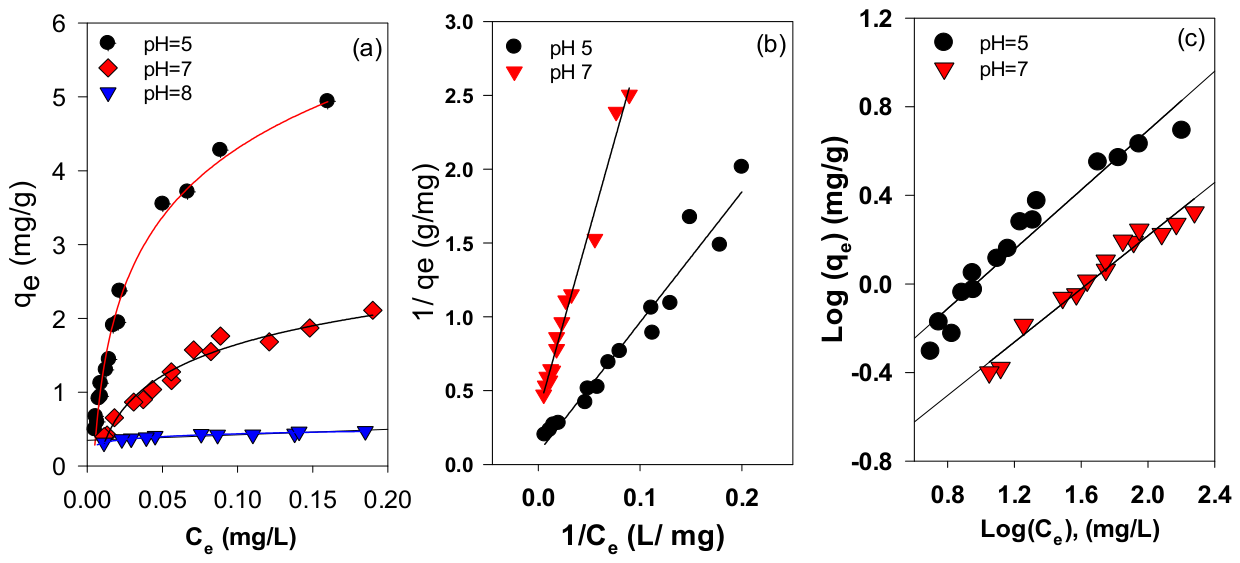
The strong pH dependence of Cr(VI) uptake by CNDE reflects the dual sensitivity of this system to solution pH: as pH rises, the protonation of chitosan’s amino groups diminishes, reducing the density of positively charged binding sites available for electrostatic attraction of chromate anions, while simultaneously shifting Cr(VI) speciation toward forms that interact less favorably with the sorbent surface. Batch equilibrium experiments at pH 5, 7, and 8 quantify this effect across the drinking-water-relevant range: capacity is highest at pH 5, where amino group protonation is most extensive; drops sharply at pH 7 as that protonation is progressively lost; and becomes practically negligible at pH 8, where uptake is effectively suppressed. The adsorption capacity and removal efficiency thus decrease monotonically as pH increases from 5 to 8, rendering CNDE most effective under mildly acidic conditions (Figure 3a).
Ion exchange between incoming chromate oxyanions (HCrO4, NaCrO4, and CrO42−) and hydroxyl ions displaced from the sorbent surface predicts a net release of OH into solution, and the slight rise in treated-effluent pH observed after adsorption is consistent with exactly this stoichiometry, providing indirect confirmation that anion exchange is operative. Taken together with the capacity data across the pH 5–8 range, pH 5 emerges as the optimal operating condition for Cr(VI) removal by CNDE.
The pH dependence observed in this study reflects the interplay between chitosan surface chemistry and Cr(VI) speciation at drinking-water-relevant concentrations. Under acidic conditions (pH 5), the primary amine groups on chitosan (pKa ≈ 6.3–6.5) are extensively protonated, generating –NH3+ surface sites. These positively charged sites exert strong electrostatic attraction toward the dominant Cr(VI) aqueous species at pH 5—namely HCrO4 (~90%) and minor contributions from CrO42− and NaCrO4 (confirmed by MINEQL+ speciation modeling, Section S5). The high adsorption capacity at pH 5 observed in the present work (Qm = 15 mg/g) considerably exceeds values reported by Salih and Ghosh [27] for a related chitosan-coated DE system tested at higher initial Cr(VI) concentrations, indicating that CNDE30 is particularly effective in the dilute concentration regime characteristic of drinking water. As pH increases from 5 to 7 and 8, protonation of amine groups diminishes progressively, reducing the density of positively charged binding sites and simultaneously shifting the Cr(VI) speciation toward the doubly charged CrO42− and NaCrO4 ions, which face greater competition from co-occurring hydroxide ions for surface sites. The combined effect of reduced site protonation and altered chromate speciation drives the sharp decline in adsorption capacity observed above pH 6.
To further verify this behavior, chemical equilibrium modeling was performed using MINEQL+, 5.0 a chemical equilibrium calculation software, to assess Cr(VI) speciation in a potassium dichromate solution containing 270 µg/L Cr(VI) over a pH range of 1 to 14. The results indicated that under experimental conditions at pH 5, the dominant aqueous species were HCrO4 and CrO42−. The speciation results are provided in the Supplementary Information (Section S5, Figure S5).
As pH increases toward neutral and alkaline conditions, progressive deprotonation of chitosan’s amino groups erodes the density of positively charged sites, and electrostatic attraction of chromate anions weakens accordingly. Any residual uptake observed above pH 7 is therefore attributed to a mechanistic transition rather than a continuation of ion exchange: coordination bonds between Cr species and the lone-pair-donating –NH2 and –OH groups on the CNDE surface become the dominant pathway once electrostatic driving force is no longer available.
Both the Langmuir and Freundlich models describe the isotherm data satisfactorily across all three pH conditions, indicating that neither a uniform monolayer nor a heterogeneous surface assumption is inconsistent with the observations; linearized fits at pH 5, 7, and 8 are shown in Figure 3b and Figure 3c, respectively. The resulting model parameters—Qm, b, Kf, n, and R2—are compiled in Table 1 and are consistent with values previously reported for chitosan and chitosan-based adsorbents in the literature [27,31].

3.2.4. Effect of Common Anions

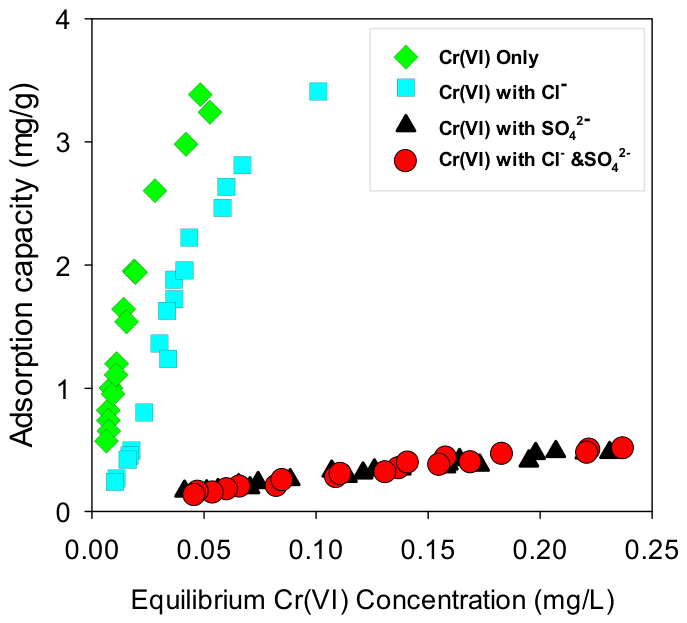
Sulfate exerts a far more disruptive competitive effect on Cr(VI) uptake than chloride does, and the two anions together behave no worse than sulfate alone—findings that point to sulfate as the binding-site competitor of primary concern in real drinking water matrices. In the absence of competing ions, Cr(VI) removal ranged from 77% to 96% across initial concentrations of 50–300 µg/L; the introduction of 16 mg/L chloride suppressed this only modestly, to 65–93%, while 7 mg/L sulfate reduced removal far more severely, to 9–57%, consistent with sulfate’s higher charge density and greater affinity for the protonated amino sites that drive anion exchange.
Systems containing both anions simultaneously tracked the sulfate-only response rather than exhibiting additive suppression, indicating that sulfate saturates the competitive effect before chloride can contribute meaningfully (Figure 4). SEM/EDX analysis of the spent adsorbent confirmed the surface retention of both Cl and SO42−, providing direct physical evidence that these anions do indeed occupy sorption sites and displace Cr(VI) species through competitive interaction. To generate these conditions, model waters were spiked with NaCl and Na2SO4 at the target anion concentrations prior to equilibration.
In general, increasing concentrations of chloride and/or sulfate resulted in stronger inhibition of Cr(VI) adsorption. While both anions compete with chromate species for adsorption sites, sulfate exhibited a more pronounced inhibitory effect than chloride. This behavior is likely due to its higher charge density and stronger affinity for protonated functional groups on the CNDE surface, as well as its structural similarity to chromate species. Electrostatic interactions therefore appear to be a dominant driving force governing the competitive adsorption of negatively charged species onto protonated CNDE binding sites.

3.3. Adsorption Kinetics

3.3.1. Adsorption and Rate of Adsorption

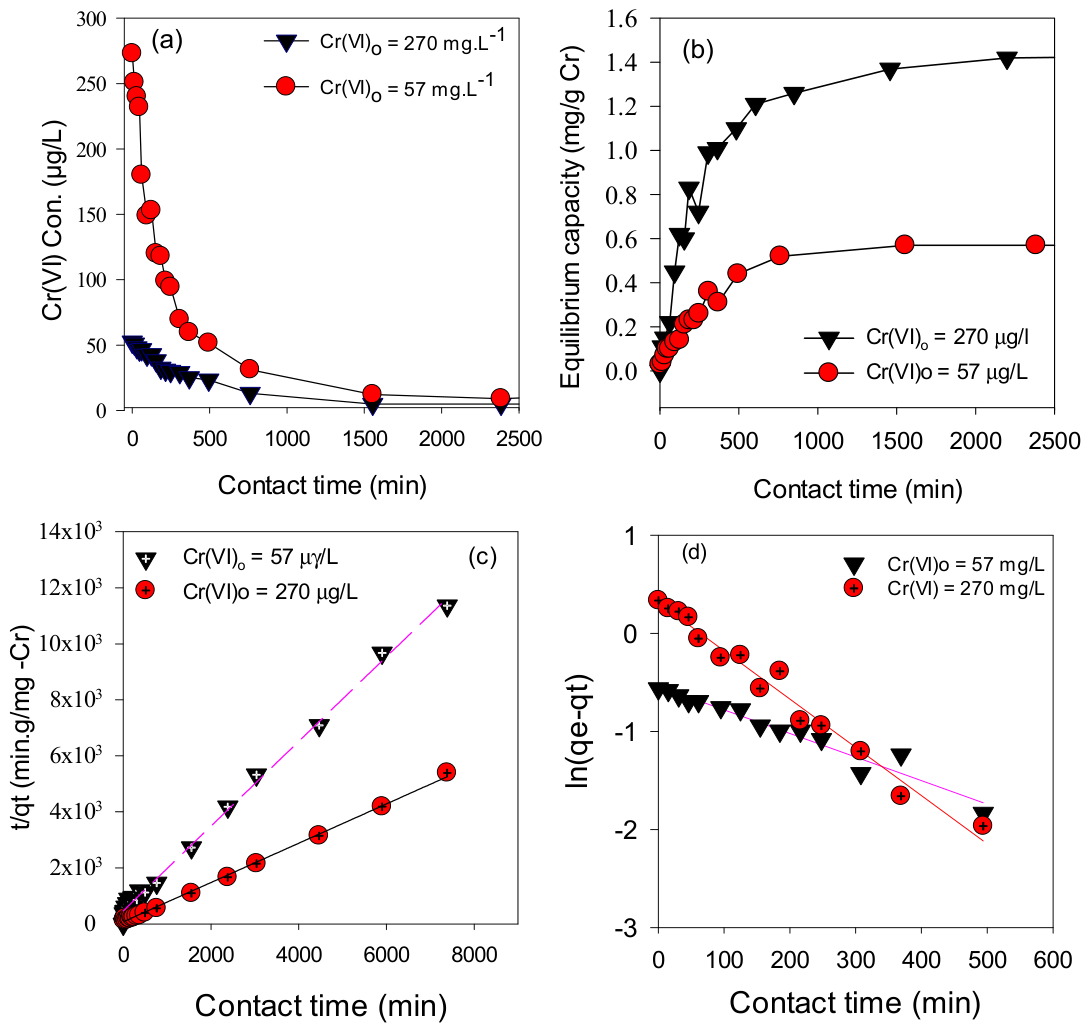
Adsorption equilibrium was reached at approximately 494 min (~8 h) under both concentration conditions tested, and this equilibration time was independent of initial Cr(VI) concentration—a result that points to surface site availability rather than bulk concentration as the rate-controlling variable. The approach to equilibrium followed a two-phase trajectory in both cases: uptake was rapid during the first ~1.5 h as the most accessible and energetically favorable sites were occupied, then decelerated progressively as the remaining available sites became harder to reach and the driving-force concentration gradient narrowed, until the adsorption capacity plateaued and the aqueous Cr(VI) concentration stabilized. These dynamics were captured at initial concentrations of 50 and 270 µg/L using CNDE masses of 10 and 23 mg, respectively, with time-dependent concentration profiles and adsorption capacities for both conditions shown in Figure 5a.

3.3.2. Adsorption Rate Models

Among the three kinetic frameworks applied—pseudo-first-order (PFO), pseudo-second-order (PSO), and Elovich (Equations (5)–(7))—the PSO model provided the best description of the experimental data across the full 0–500 min contact window (Figure 5b), implying that chemisorption, rather than a purely physical rate-limiting process, governs Cr(VI) uptake by CNDE. The PFO model yielded only partial agreement over the same time range (Figure 5c), capturing the early-stage kinetics less faithfully and diverging progressively as equilibrium was approached. Estimated rate constants and equilibrium capacities for both models are compiled in Table 2, and the overall pattern of PSO dominance is consistent with kinetic behavior previously reported for metal adsorption onto chitosan and chitosan-based adsorbents [28,32].

3.3.3. Mass Transfer Mechanism and Limiting Step

The Weber and Morris [43] model (Equation (10)) was used to the Intra-particle (IP) diffusion as mass transfer mechanism for mass transport for Cr(VI) to CNDE adsorbent.
q t = k p t + c  
where the constant c (mg/g) represents the boundary layer thickness.
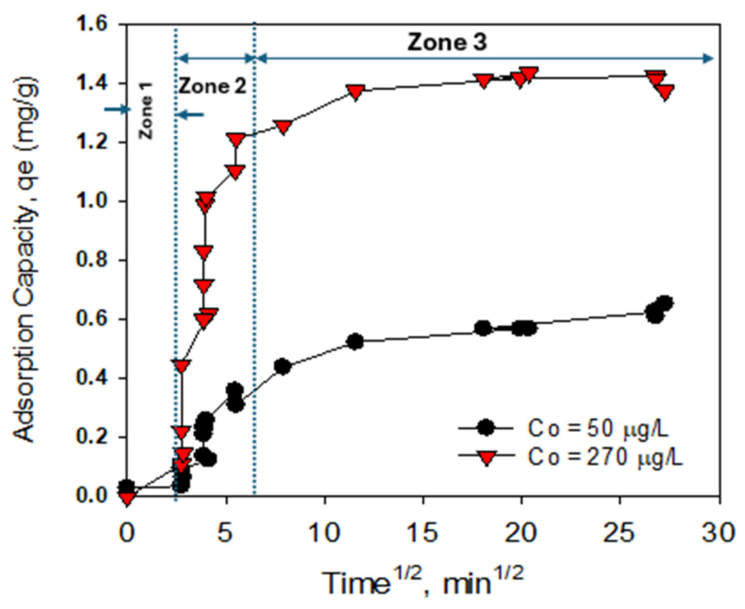
The Weber–Morris intraparticle diffusion plots at both initial Cr(VI) concentrations (50 and 270 µg/L) resolve into three distinct linear segments rather than a single line through the origin, establishing immediately that intraparticle diffusion alone does not govern the overall rate and that mass transfer proceeds through sequentially dominant mechanisms (Figure 6; parameters compiled in Table 3).
In Zone 1 (0–369 min), adsorption capacity rises steeply and the linear segment carries a positive intercept, indicating that film diffusion across the external boundary layer is fast and that uptake during this phase is driven primarily by the large concentration gradient between bulk solution and sorbent surface, with intraparticle diffusion contributing but not limiting. Zone 2 (369–762 min) shows a shallower slope and reflects a transition to mixed control, in which both film diffusion and intraparticle transport through the chitosan-coated pore network impose comparable resistance and neither alone dictates the rate. Beyond 762 min, Zone 3 marks the approach to dynamic equilibrium, where net adsorption slows to a standstill as forward and reverse exchange rates balance; external film diffusion is considered the dominant residual resistance in this terminal region. Across both concentration conditions, kp and the boundary layer parameter c increase with rising aqueous-phase Cr(VI) concentration, confirming that a higher driving-force gradient accelerates both intraparticle diffusion and boundary layer transport proportionally.

3.4. Regeneration and Reuse of Spent CNDE Biosorbent

Two pH-based desorption strategies were evaluated for restoring spent CNDE, exploiting the same protonation sensitivity that drives uptake at pH 5–6 but applying it in reverse [38].
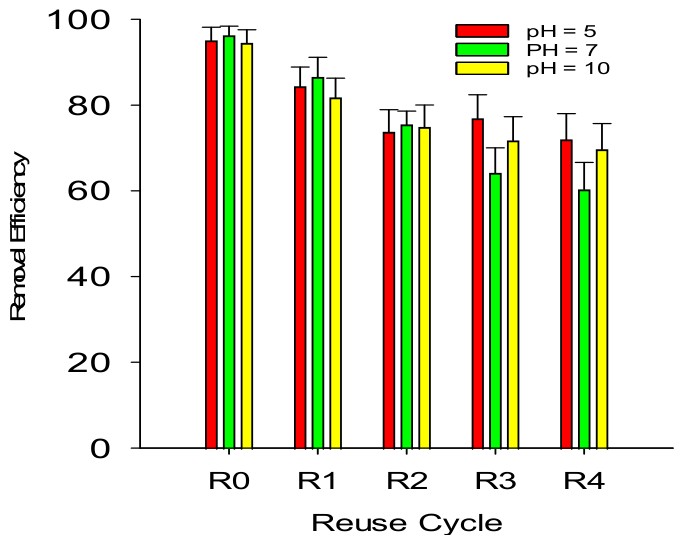
Alkaline stripping with NaOH (0.01–0.20 N) proved largely ineffective: despite the thermodynamic expectation that strongly alkaline conditions would deprotonate amino groups and release bound chromate, recovery efficiencies were consistently below 20% across the concentration range tested, with only marginal improvement at the lowest NaOH concentration (0.01 N; pH~12)—an outcome that suggests irreversible site blockage or partial chromate reduction rather than simple reversible ion exchange. Washing with pH-adjusted deionized water (pH 5, 7, and 10) produced substantially better results: initial Cr(VI) removal efficiency of ~93% at 250 µg/L was preserved at the outset of cycling and declined only gradually over successive reuse events, with more than 60% of the original adsorption capacity retained after five complete adsorption–regeneration cycles (Figure 7).
The progressive capacity loss across cycles is attributed to cumulative depletion or partial occlusion of active surface sites rather than catastrophic sorbent degradation. That a simple, low-energy wash under near-neutral pH conditions outperforms concentrated alkali treatment has direct practical relevance: it suggests that CNDE can be regenerated without aggressive chemical inputs, supporting its application in decentralized or resource-limited drinking water treatment settings.

3.5. Mechanisms of Adsorption

The mechanism governing the transport and attachment of chromate anions from the bulk solution to the CNDE surface was investigated and is interpreted here in the context of prior mechanistic studies on related chitosan-based adsorbents. Salih and Ghosh [27] attributed Cr(VI) uptake by chitosan-coated DE primarily to electrostatic interactions between protonated amine groups and chromate species at low pH, a finding consistent with the behavior observed in the present study. However, the current work extends that interpretation by quantifying the relative contribution of competing ions—particularly SO42− and Cl—at drinking-water-relevant concentrations, and by linking the pH-dependent adsorption behavior directly to MINEQL+-based speciation modeling of HCrO4, CrO42−, and NaCrO4 across the pH range 5–8. These additions provide a more mechanistically grounded basis for predicting CNDE performance under variable groundwater chemistry conditions. Specifically, under mildly acidic conditions (pH ≈ 5), protonation of primary amine functional groups on chitosan generates positively charged –NH3+ sites, which promote electrostatic attraction toward negatively charged chromate species in solution, thereby facilitating adsorption onto the chitosan-modified surface.
Electrostatic attraction between protonated –NH3+ groups on the CNDE surface and negatively charged Cr(VI) oxyanions is the dominant adsorption mechanism, and three independent lines of evidence converge on this conclusion. First, adsorption capacity peaks near pH 5, where amino group protonation is maximal, and declines monotonically as pH rises to 7 and 8 and the hydronium ion concentration falls, progressively deprotonating the surface and eroding its electrostatic affinity for chromate. Second, zeta potential measurements across pH 4–9 place the isoelectric point at pH 6.3, confirming that the surface carries net positive charge precisely within the pH window of highest Cr(VI) uptake, and transitions to net negative charge in the region where adsorption collapses. Third, MINEQL+ speciation simulations reveal that the dominant Cr(VI) form shifts with pH in a way that tracks adsorption performance: at pH 5 approximately 90% of dissolved Cr(VI) exists as monovalent HCrO4—the species most readily attracted to a cationic surface—with NaCrO4 (~7%) and CrO42− (~2%) as minor constituents; by pH 6 the distribution has shifted to roughly equal proportions of HCrO4 and NaCrO4 (~45% each) with ~10% CrO42−; and at pH 7–8 NaCrO4 dominates at ~80%, with the remainder as CrO42−, coinciding with the near-total loss of adsorption capacity.
The competitive anion experiments add mechanistic specificity: SO42− suppresses Cr(VI) uptake far more severely than Cl at comparable molar concentrations, and systems containing both anions behave identically to SO42− alone, demonstrating that binding affinity scales with anion charge density and structural resemblance to chromate rather than with ionic concentration—a selectivity pattern diagnostic of electrostatic and ion-exchange control, and one that distinguishes CNDE from adsorbents governed primarily by chemisorption or surface complexation, which would be comparatively insensitive to competing anion valence. Above the isoelectric point, where net surface charge is negative and electrostatic attraction is no longer available, residual Cr(VI) uptake is attributed to a secondary pathway: coordination of Cr species through lone-pair donation by –NH2 and –OH surface groups, consistent with behavior reported for related chitosan adsorbent systems in the literature [27,34,44,45,46].

4. Conclusions

Coating natural granular diatomaceous earth with a chitosan slurry at a 30% mass ratio results in a hybrid biosorbent. This biosorbent’s ability to uptake Cr(VI) is primarily influenced by electrostatic attraction between the protonated –NH3+ surface groups and the chromate oxyanions, particularly HCrO4, at an optimal pH of 5. This effect has been confirmed through pH-dependent isotherm data, zeta potential measurements, and MINEQL+ speciation modeling.
This mechanistic clarity translates into well-defined performance boundaries: maximum adsorption capacity reaches 15 mg g−1 at pH 5 and collapses to approximately 0.45 mg g−1 at pH 8, reflecting the progressive deprotonation of amino groups and the concurrent shift in Cr(VI) speciation toward less-affinitive forms. In practical dosing terms, 15 mg of CNDE achieved near-complete removal from 125 mL at 100 µg/L, and 39 mg delivered complete removal at 300 µg/L. Uptake kinetics were rapid and best described by the pseudo-second-order model, consistent with chemisorptive character at the amino-group sites, while equilibrium data were equally well represented by both Langmuir and Freundlich isotherms.
Competitive anion experiments revealed that sulfate is a more disruptive co-solute compared to chloride. It significantly hinders Cr(VI) removal and makes combined sulfate-chloride systems indistinguishable from those containing only sulfate. This finding is particularly relevant for groundwater sources with high sulfate concentrations.
In terms of regeneration, the use of pH-adjusted deionized water instead of concentrated alkali retained over 60% of adsorption capacity after five cycles. This supports the idea of low-energy, chemically simple reuse methods suitable for decentralized treatment systems.
Further research is needed to quantify the effects of coexisting metal oxyanions, natural organic matter, and complex real water mixtures before applying these findings beyond the synthetic model water conditions tested here. Nonetheless, the straightforward fabrication process and the clarity of the mechanistic understanding suggest that CNDE is a promising option for small-scale and point-of-entry drinking water treatment applications.

Supplementary Materials

The following supporting information can be downloaded at: https://www.mdpi.com/article/10.3390/w18111373/s1, Figure S1. X-ray diffraction patterns of (a) chitosan, (b) diatomaceous earth, and (c) diatomaceous earth coated with Chitosan; Figure S2. (a) Optical micrographs and (b) scanning electron images of raw natural diatomaceous earth, as well as (c,d) coated natural diatomaceous earth, show changes in surface topography; Figure S3. FTIR Spectra of NDE, CTS and CNDE hybrids (with varying chitosan diatomaceous earth mass ratios of 10, 20, 30, and 50%); Figure S4. Plots of surface acidity and basicity of NDE, Chitosan and CNDEs hybrids; Figure S5. Changes in the various mole fraction of total Cr(VI) as a function of pH; Figure S6. Thermogravimetric decomposition profiles of NDE, chitosan neat, and hybrids.

Author Contributions

O.T.K. conducted the experiments and gathered the data. G.A.S. conceptualized the project, provided leadership and oversight for the project. E.S.-D. played a key role in advising on experimental methods, as well as revising and editing the manuscript. M.N. contributed insights into the analytical methods and assisted in manuscript revisions. All authors have read and agreed to the published version of the manuscript.

Funding

This research received no external funding.

Data Availability Statement

The original contributions presented in this study are included in the article/Supplementary Material. Further inquiries can be directed to the corresponding author.

Conflicts of Interest

Authors declare no conflict of interest.

References

  1. Hossini, H.; Shafie, B.; Niri, A.D.; Nazari, M.; Esfahlan, A.J.; Ahmadpour, M.; Nazmara, Z.; Ahmadimanesh, M.; Makhdoumi, P.; Mirzaei, N. A comprehensive review on human health effects of chromium: Insights on induced toxicity. Environ. Sci. Pollut. Res. 2022, 29, 70686–70705. [Google Scholar] [CrossRef]
  2. World Health Organization. Chromium in Drinking-Water; World Health Organization: Geneva, Switzerland, 2020; Available online: https://iris.who.int/bitstream/handle/10665/338062/WHO-HEP-ECH-WSH-2020.3-eng.pdf (accessed on 22 May 2026).
  3. Jain, C.; Ali, I. Arsenic: Occurrence, toxicity and speciation techniques. Water Res. 2000, 34, 4304–4312. [Google Scholar] [CrossRef]
  4. Abarikwu, S.; Lichtfouse, E.; Schwarzbauer, J.; Robert, D. Lead, Arsenic, Cadmium, Mercury: Occurrence, Toxicity and Diseases. Pollut. Dis. Remediat. Recycl. 2013, 4, 351–386. [Google Scholar]
  5. Yuan, P.; Liu, D.; Fan, M.; Yang, D.; Zhu, R.; Ge, F.; Zhu, J.; He, H. Removal of hexavalent chromium [Cr(VI)] from aqueous solutions by the diatomite-supported/unsupported magnetite nanoparticles. J. Hazard Mater. 2010, 173, 614–621. [Google Scholar] [CrossRef] [PubMed]
  6. Zhitkovich, A. Chromium in Drinking Water: Sources, Metabolism, and Cancer Risks. Chem. Res. Toxicol. 2011, 24, 1617–1629. [Google Scholar] [CrossRef]
  7. Bissen, M.; Frimmel, F. Arsenic—A review—Part 1: Occurrence, toxicity, speciation, mobility. Acta Hydrochim. Hydrobiol. 2003, 31, 9–18. [Google Scholar] [CrossRef]
  8. Izbicki, J.A.; Wright, M.T.; Seymour, W.A.; McCleskey, R.B.; Fram, M.S.; Belitz, K.; Esser, B.K. Cr (VI) occurrence and geochemistry in water from public-supply wells in California. Appl. Geochem. 2015, 63, 203–217. [Google Scholar] [CrossRef]
  9. Rowbotham, A.L.; Levy, L.S.; Shuker, L.K. Chromium in the environment: An evaluation of exposure of the UK general population and possible adverse health effects. J. Toxicol. Environ. Health Part B Crit. Rev. 2000, 3, 145–178. [Google Scholar]
  10. U.S. EPA. IRIS Toxicological Review of Hexavalent Chromium (External Review Draft, 2022); U.S. Environmental Protection Agency: Washington, DC, USA, 2022; pp. 3-157–3-159.
  11. U.S. EPA. Manual of Treatment Techniques for Meeting the Interim Primary Drinking Water Regulations; EPA-600/8-77-005; ORD—Water Supply Research Division: Cincinnati, OH, USA, 1977.
  12. Sharma, S.K.; Petrusevski, B.; Amy, G. Chromium removal from water: A review. J. Water Supply Res. Technol. AQUA 2008, 57, 541–553. [Google Scholar] [CrossRef]
  13. Qin, G.; McGuire, M.J.; Blute, N.K.; Seidel, C.; Fong, L. Hexavalent Chromium Removal by Reduction with Ferrous Sulfate, Coagulation, and Filtration: A Pilot-Scale Study. Environ. Sci. Technol. 2005, 39, 6321–6327. [Google Scholar] [CrossRef]
  14. Xiao, Y.; Liang, H.; Chen, W.; Wang, Z. Synthesis and adsorption behavior of chitosan-coated MnFe2O4 nanoparticles for trace heavy metal ions removal. Appl. Surf. Sci. 2013, 285, 498–504. [Google Scholar] [CrossRef]
  15. California State Water Resources Control Board (SWRCB) (Ed.) Hexavalent Chromium MCL Initial Statement of Reasons DPH-11-005; California Water Boards: Sacramento, CA, USA, 2013; pp. 1–9. Available online: https://www.waterboards.ca.gov/drinking_water/certlic/drinkingwater/DPH-11-005HexavalentChromiumMCL.html (accessed on 22 May 2026).
  16. Mor, S.; Ravindra, K.; Bishnoi, N.R. Adsorption of chromium from aqueous solution by activated alumina and activated charcoal. Bioresour. Technol. 2007, 98, 954–957. [Google Scholar] [CrossRef]
  17. Sousa, F.W.; Oliveira, A.G.; Ribeiro, J.P.; Rosa, M.F.; Keukeleire, D.; Nascimento, R.F. Green coconut shells applied as adsorbent for removal of toxic metal ions using fixed-bed column technology. J. Environ. Manag. 2010, 91, 1634–1640. [Google Scholar] [CrossRef]
  18. Hasany, S.M.; Ahmad, R. The potential of cost-effective coconut husk for the removal of toxic metal ions for environmental protection. J. Environ. Manag. 2006, 81, 286–295. [Google Scholar] [CrossRef] [PubMed]
  19. Bhatnagar, A.; Vilar, V.J.P.; Botelho, C.M.S.; Boaventura, R.A.R. Coconut-based biosorbents for water treatment—A review of the recent literature. Adv. Colloid Interface Sci. 2010, 160, 1–15. [Google Scholar] [CrossRef] [PubMed]
  20. Foo, K.Y.; Hameed, B.H. Utilization of rice husk ash as novel adsorbent: A judicious recycling of the colloidal agricultural waste. Adv. Colloid Interface Sci. 2009, 152, 39–47. [Google Scholar] [CrossRef] [PubMed]
  21. Futalan, C.M.; Huang, Y.S.; Chen, J.H.; Wan, M.W. Arsenate removal from aqueous solution using chitosan-coated bentonite, chitosan-coated kaolinite and chitosan-coated sand: Parametric, isotherm and thermodynamic studies. Water Sci. Technol. 2018, 78, 676–689. [Google Scholar] [CrossRef]
  22. Bello, O.S.; Adegoke, K.A.; Oyewole, R.O. Insights into the adsorption of heavy metals from wastewater using diatomaceous earth. Sep. Sci. Technol. 2014, 49, 1787–1806. [Google Scholar] [CrossRef]
  23. Matheickal, J.T.; Yu, Q. Biosorption of lead from aqueous solutions by marine algae Ecklonia radiata. Water Sci. Technol. 1996, 34, 1–7. [Google Scholar] [CrossRef]
  24. Jung, C.; Heo, J.; Han, J.; Her, N.; Lee, S.-J.; Oh, J.; Ryu, J.; Yoon, Y. Hexavalent chromium removal by various adsorbents: Powdered activated carbon, chitosan, and single/multi-walled carbon nanotubes. Sep. Purif. Technol. 2013, 106, 63–71. [Google Scholar] [CrossRef]
  25. Cesaro, R.; Fabbricino, M.; Lanzetta, R.; Mancino, A.; Naviglio, B.; Parrilli, M.; Sartorio, R.; Tomaselli, M.; Tortora, G. Use of chitosan for chromium removal from exhausted tanning baths. Water Sci. Technol. 2008, 58, 735–739. [Google Scholar] [CrossRef]
  26. Salih, S.S.; Ghosh, T.K. Adsorption of Zn (II) ions by chitosan coated diatomaceous earth. Int. J. Biol. Macromol. 2018, 106, 602–610. [Google Scholar] [CrossRef]
  27. Salih, S.S.; Ghosh, T.K. Preparation and characterization of chitosan-coated diatomaceous earth for hexavalent chromium removal. Environ. Process. 2018, 5, 23–39. [Google Scholar] [CrossRef]
  28. DeMessie, J.A.; Sorial, G.A.; Sahle-Demessie, E. Removing chromium (VI) from contaminated water using a nano-chitosan–coated diatomaceous earth. In Separation Science and Technology; Elsevier: Amsterdam, The Netherlands, 2022; Volume 15, pp. 163–176. Available online: https://www.sciencedirect.com/science/article/pii/B9780323907637000056 (accessed on 20 May 2026).
  29. Koumai, O.T.; Sorial, A.G.; Sahle-Demessie, E. Facile preparation, characterization and application of natural diatomaceous earth for the removal of Arsenic V from dirinking water. In Proceedings of the American Chemical Society—Fall Conference 2022, Chicago, IL, USA, 21–25 August 2022; American Chemical Society: Chicago, IL, USA, 2022. [Google Scholar]
  30. Khan, T.A.; Khan, E.A. Shahjahan, Removal of basic dyes from aqueous solution by adsorption onto binary iron-manganese oxide coated kaolinite: Non-linear isotherm and kinetics modeling. Appl. Clay Sci. 2015, 107, 70–77. [Google Scholar] [CrossRef]
  31. Islam, M.A.; Angove, M.J.; Morton, D.W. Recent innovative research on chromium (VI) adsorption mechanism. Environ. Nanotechnol. Monit. Manag. 2019, 12, 100267. [Google Scholar] [CrossRef]
  32. Baran, A.; Bıçak, E.; Baysal, Ş.H.; Önal, S. Comparative studies on the adsorption of Cr (VI) ions on to various sorbents. Bioresour. Technol. 2007, 98, 661–665. [Google Scholar] [CrossRef]
  33. Huang, R.; Liu, Q.; Huo, J.; Yang, B. Adsorption of methyl orange onto protonated cross-linked chitosan. Arab. J. Chem. 2017, 10, 24–32. [Google Scholar] [CrossRef]
  34. Li, Z.; Li, T.; An, L.; Fu, P.; Gao, C.; Zhang, Z. Highly efficient chromium (VI) adsorption with nanofibrous filter paper prepared through electrospinning chitosan/polymethylmethacrylate composite. Carbohydr. Polym. 2016, 137, 119–126. [Google Scholar] [CrossRef] [PubMed]
  35. Humelnicu, D.; Dragan Ecaterina, S. Evaluation of phosphate adsorption by porous strong base anion exchangers having hydroxyethyl substituents: Kinetics, equilibrium, and thermodynamics. Environ. Sci. Pollut. Res. 2021, 28, 7105–7115. [Google Scholar] [CrossRef] [PubMed]
  36. Largitte, L.; Pasquier, R. A review of the kinetics adsorption models and their application to the adsorption of lead by an activated carbon. Chem. Eng. Res. Des. 2016, 109, 495–504. [Google Scholar] [CrossRef]
  37. Aydin, S.K.; George, W.; Serkan, E.; Atakan, O.; Kurtulus, O. Modelling of Adsorption Kinetic Processes—Errors, Theory and Application. In Sorption (pp.19) Project: Removal of Trace from Wastewater; IntechOpen Limited: London, UK, 2018; Available online: https://books.google.com/books?hl=en&lr=&id=xRf8DwAAQBAJ&oi=fnd&pg=PA187&dq=Aydin,+S.+K.,+George+William%3B+Emik,+Serkan%3B+Ongen,+Atakan%3B+Ozcan,+Kurtulus,+Modelling+of+Adsorption+Kinetic+Processes%E2%80%94Errors,+Theory+and+Application.+In+Sorption+(pp.19)+Project:+Removal+of+trace+from+wastewater,+IntechOpen+Limited:+2018.&ots=p2vKAExSnX&sig=vCxVKTeril0nlEPXm9CftCiTW_c (accessed on 20 May 2026).
  38. Crini, G.; Badot, P.-M. Application of chitosan, a natural aminopolysaccharide, for dye removal from aqueous solutions by adsorption processes using batch studies: A review of recent literature. Prog. Polym. Sci. 2008, 33, 399–447. [Google Scholar] [CrossRef]
  39. Bhatnagar, A.S. Applications of chitin- and chitosan-derivatives for the detoxification of water and wastewater—A short review. Adv. Colloid Interface Sci. 2009, 152, 26–38. [Google Scholar] [CrossRef] [PubMed]
  40. Chauhan, D.; Jaiswal, M.; Sankararamakrishnan, N. Removal of cadmium and hexavalent chromium from electroplating waste water using thiocarbamoyl chitosan. Carbohydr. Polym. 2012, 88, 670–675. [Google Scholar] [CrossRef]
  41. Corazzari, I.; Nisticò, R.; Turci, F.; Faga, M.G.; Franzoso, F.; Tabasso, S.; Magnacca, G. Advanced physico-chemical characterization of chitosan by means of TGA coupled on-line with FTIR and GCMS: Thermal degradation and water adsorption capacity. Polym. Degrad. Stab. 2015, 112, 1–9. [Google Scholar] [CrossRef]
  42. Mirzaei, N.; Ghaffari, H.R.; Sharafi, K.; Velayati, A.; Hoseindoost, G.; Rezaei, S.; Mahvi, A.H.; Azari, A.; Dindarloo, K. Modified natural zeolite using ammonium quaternary based material for Acid red 18 removal from aqueous solution. J. Environ. Chem. Eng. 2017, 5, 3151–3160. [Google Scholar] [CrossRef]
  43. Weber, W.J., Jr.; Morris, J.C. Kinetics of adsorption on carbon from solution. J. Sanit. Eng. Div. 1963, 89, 31–59. [Google Scholar] [CrossRef]
  44. Kwok, K.C.; Koong, L.F.; Chen, G.; McKay, G. Mechanism of arsenic removal using chitosan and nanochitosan. J. Colloid Interface Sci. 2014, 416, 1–10. [Google Scholar] [CrossRef]
  45. Ho, Y.S.; Ng, J.C.Y.; McKay, G. Removal of lead (II) from effluents by sorption on peat using second-order kinetics. Sep. Sci. Technol. 2001, 36, 241–261. [Google Scholar] [CrossRef]
  46. Koumai, O.T.; Sorial, A.G.; Sahle-Demessie, E.; Nadagouda, M. A new environmentally friendly and sustainable biosorbent for the removal of chromium VI from drinking water. In Proceedings of the American Chemical Society—Fall Conference 2023, San Francisco, CA, USA, 12–17 August 2023. [Google Scholar]
Figure 1. (a) Measured material specific surface area of neat chitosan powder, natural diatomaceous earth, and the various mixture of chitosan–natural diatomaceous used for adsorption studies. (b) shows the zeta potential of chitosan coaptated diatomaceous earth with percent levels of 10, 30, 40 and 50.
Water 18 01373 g001
Figure 3. (a) Plot the adsorption capacity for Cr(VI) as function of the equilibrium liquid phase Cr(VI) concentration, at selected pH of 5, 7, 8. The experimental conditions are: 21 °C, pH ~5 and 7 and 8, and initial Cr(VI) concentration 50–250 µg/L. (b) The linear Langmuir and (c) Freundlich plots of the adsorption isotherm data for chromium (VI) were conducted at 21 °C, with pH levels around 5 and 7, and initial chromium (VI) concentrations ranging from 50 to 250 µg/L Minimal adsorption was observed at a pH of 8, and that data is not included in this plot.
Water 18 01373 g003
Figure 4. Adsorption capacity of chitosan-coated DE for Cr(VI) under four solution conditions—deionized water, 16 mg/L chloride, 7 mg/L sulfate, and both anions combined—demonstrating that sulfate is the controlling competitor. Sulfates presence alone suppresses uptake to the same extent as the combined-anion system, rendering the additional chloride effectively inconsequential.
Water 18 01373 g004
Figure 5. Temporal evolution of Cr(VI) removal in batch systems at two initial concentrations, shown as (a) residual aqueous concentration and (b) adsorption capacity over time, together illustrating the two-phase uptake trajectory and the concentration-independent equilibration time. Panels (c,d) present the linearized Langmuir and Freundlich fits to the equilibrium isotherm data collected at pH 5 and 21 °C, respectively, quantifying the model parameters that describe the distribution of Cr(VI) between the aqueous and solid phases at steady state.
Water 18 01373 g005
Figure 6. The results of the Weber–Morris model fittings for mass transfer, as well as studies of mechanisms and limiting steps, indicate that the mass transfer mechanism remains consistent across varying initial concentrations of Cr(VI). However, the range of each zone is observed to differ depending on the initial concentrations.
Water 18 01373 g006
Figure 7. The plot illustrates the removal efficiencies for each reuse cycle of the adsorbent. The values correspond to R0 (fresh adsorbent) and R1 to R4 (adsorbent reused for cycles 1 to 4), while the pH of the wash water varied between 5, 7, and 10.
Water 18 01373 g007
Table 2. Kinetic parameters extracted from pseudo-first-order (PFO) and pseudo-second-order (PSO) model fits to Cr(VI) adsorption data on CNDE, with PSO providing the superior description; values include rate coefficients and predicted equilibrium capacities for both initial concentration conditions.
Kinetic ModelCo (µg/L)Qe (mg/g)k (g/mg/min or min−1)R2
PSO2701.4250.02670.9983
500.6620.00090.9967
PFO2700.5940.0050.9896
501.3820.00250.9767
Table 3. Estimated Weber–Morris model coefficients for Cr(VI) on CNDE at 50 and 270 µg/L.
Initial Cr(VI) ConcentrationWeber–Morris CoefficientsZone 1
(0–369 min)
Zone 2
(369–762 min)
Zone 3
(762 min–∞)
50 µg/Lc (mg/g)0.00130.28011.4008
kp (mg/g/min1/2)0.04410.00192 × 10−4
270 µg/Lc (mg/g)0.0021.16160.5008
kp (mg/g/min1/2)0.01210.00161.0 × 10−5
Disclaimer/Publisher’s Note: The statements, opinions and data contained in all publications are solely those of the individual author(s) and contributor(s) and not of MDPI and/or the editor(s). MDPI and/or the editor(s) disclaim responsibility for any injury to people or property resulting from any ideas, methods, instructions or products referred to in the content.