Hybrid Deep Learning Versus Empirical Methods for Daily Potential Evapotranspiration Estimation in the Nakdong River Basin, South Korea

Abstract
1. Introduction
1.1. Traditional Empirical Approaches
1.2. Advancements in Machine Learning and Deep Learning
1.3. Research Gaps and Objectives

| Study | Study Area/Dataset | Methods (Empirical/ML) | Inputs | Key Findings |
|---|---|---|---|---|
| [37] | Northwest China | ANN vs. MLR & empirical formulas | Tmax, Tmin, RH, U2, N | ANN outperformed MLR and empirical methods; Tmax, Tmin, and RH were the most important |
| [38] | Central Florida | M5P, Bagging, RF, SVR | Radiation, heat flux, soil moisture, wind, RH, T | Strong performance; input quality strongly influenced accuracy |
| [39] | India | ANN vs. empirical equations | Temperature, RH, radiation, wind | ANNs often outperform empirical equations |
| [40] | India | RBF neural networks | Limited climatic data | RBF is effective under sparse data |
| [41] | Iraq | ELM vs. standalone ML | Temperature-based & multivariable inputs | ELM competitive; lightweight ML effective |
| [42] | Sichuan Basin, China | ELM, GRNN, RF + empirical | Temp-only & multivariable | Intelligent temp-only models are competitive; RF robust |
| [43,44] | China | SVM, ELM, LightGBM, CatBoost | Limited meteorological datasets | Tree boosting is competitive; it emphasizes transferability |
| [45,46] | Iran, Brazil, global | GRNN, MARS, GEP, ANFIS | Temp-only & multivariate | No single best algorithm; performance data-dependent |
| [47,48] | Semiarid sites | Sequential RBF + empirical hourly formulas | Hourly meteorology | Highlighted the value of hourly modeling |
| Study | Study Area/Dataset | Methods (DL/Hybrid) | Inputs | Key Findings |
|---|---|---|---|---|
| [16] | Minas Gerais, Brazil | ANN, RF, XGBoost, 1-D CNN (DL) | Daily/hourly Temperature, RH, Ra | Hourly CNN improved RMSE by ~28%; sequence-aware DL advantageous |
| [49] | Prince Edward Island, Canada | LSTM, bi-LSTM | Tmax, RH | High R2 (>0.90); DL effective with few inputs |
| [50] | India | ANN interpretability (DL-related review) | Multiple parameters | Explained the physical interpretability of ANN hydrological models |
2. Materials and Methods
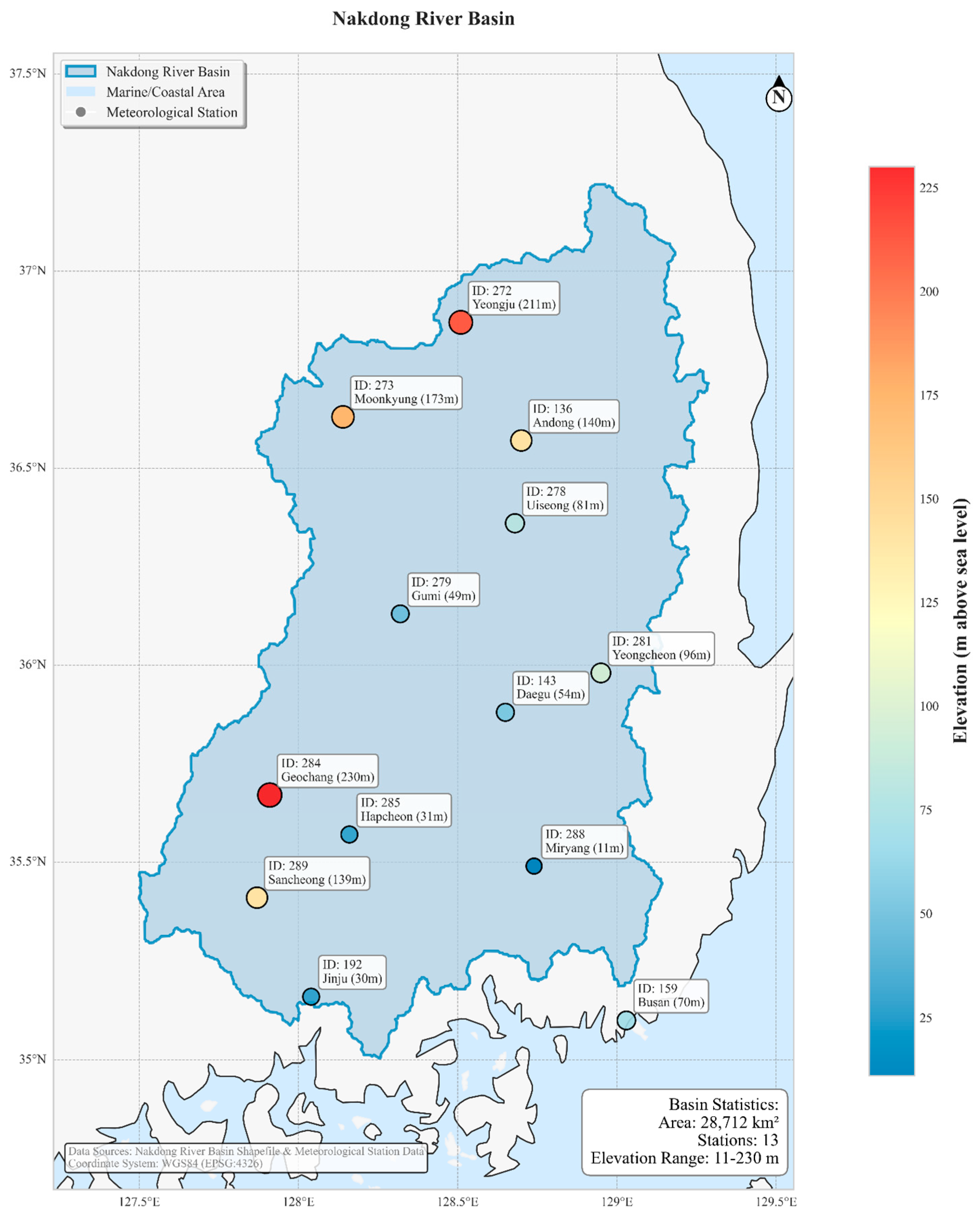
2.1. Study Area
2.2. Data Acquisition and Quality Checking
2.3. Empirical Methods
2.3.1. Penman–Monteith (FAO-56 PM) Equation
2.3.2. Priestley–Taylor (P-T) Method
2.3.3. Hargreaves–Samani (H-S) Equation
2.4. DL Methods
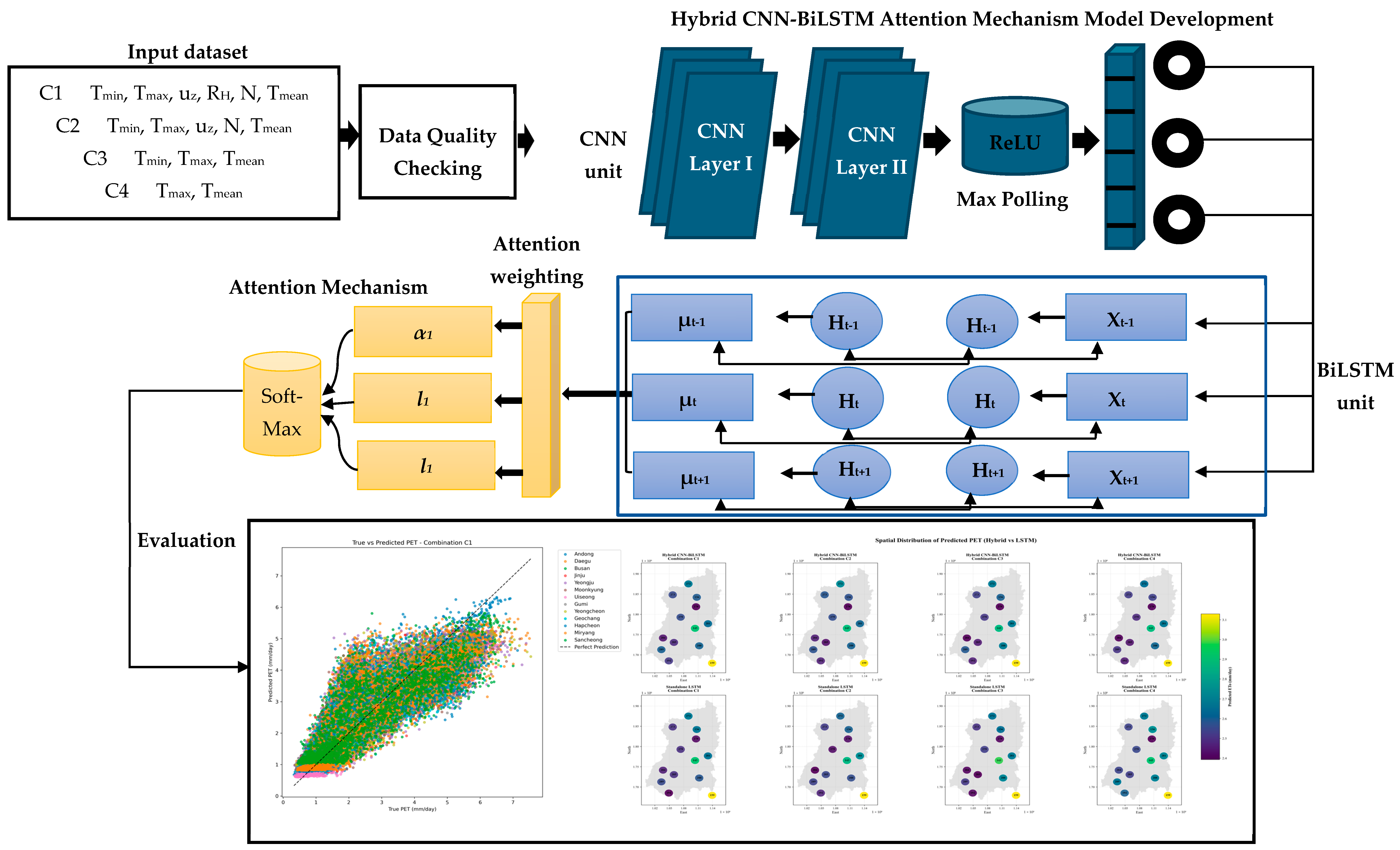
Hybrid CNN–Bidirectional LSTM Model with Attention Mechanism
3. Results
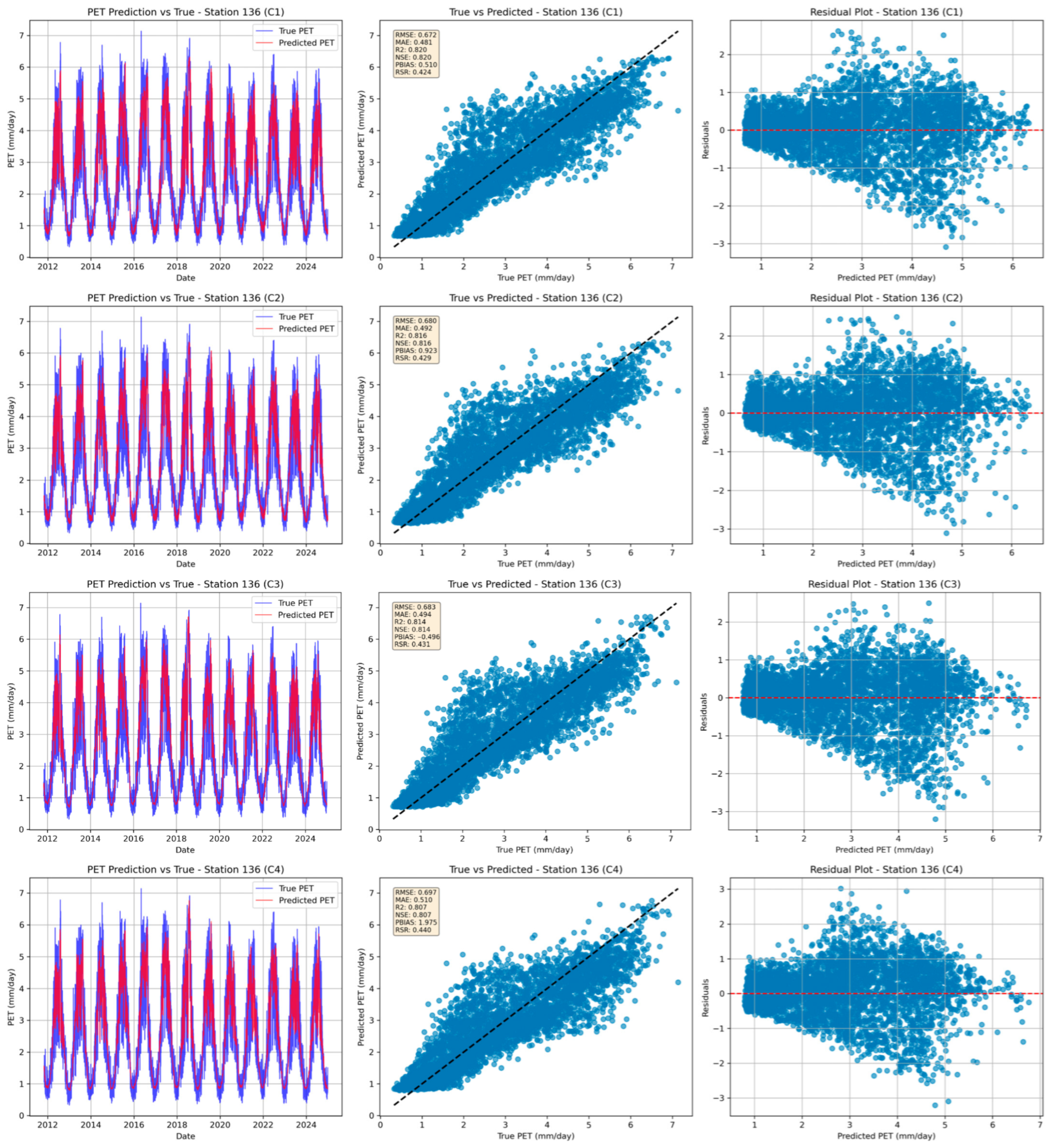
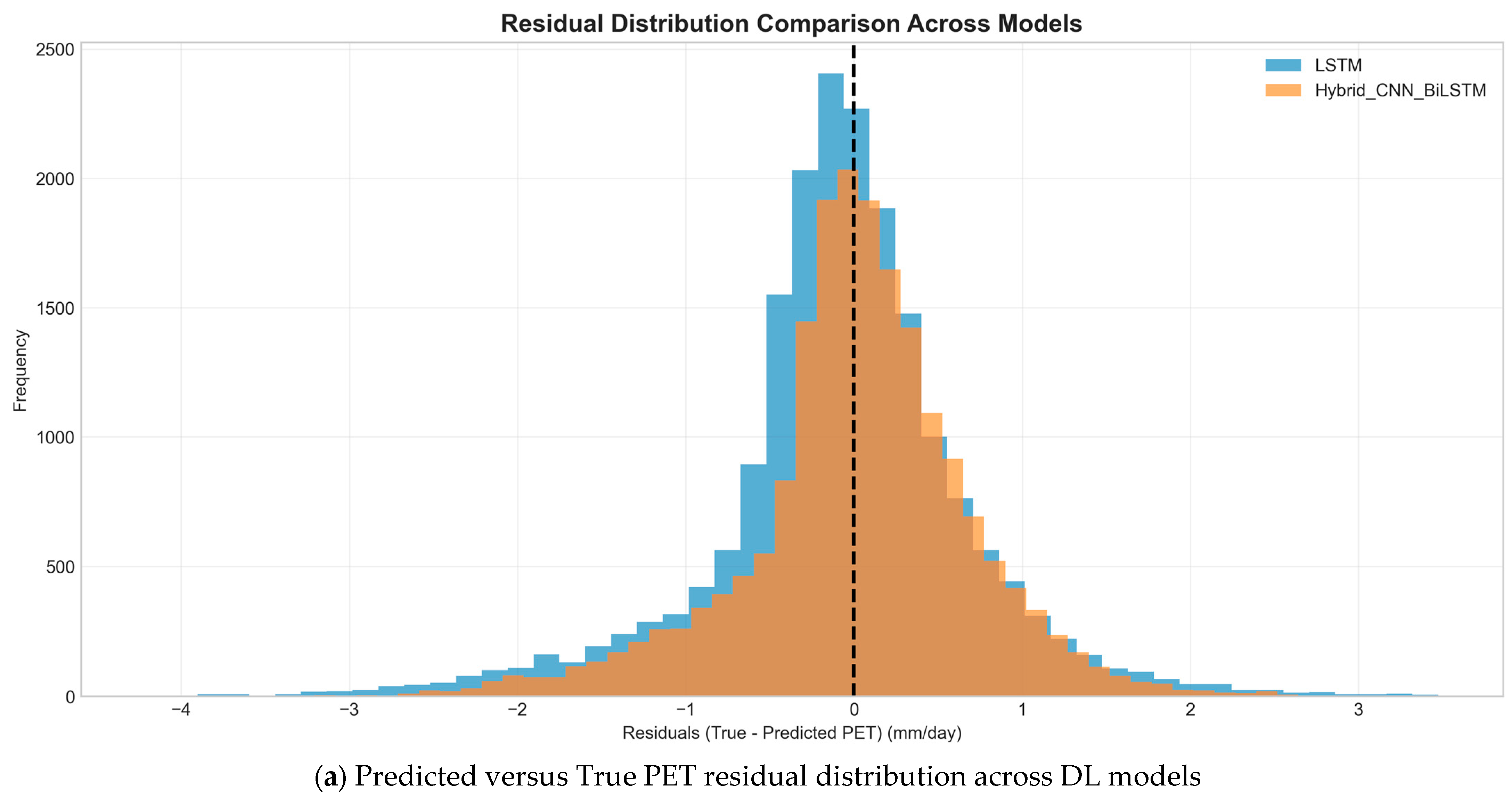
3.1. Comparative Evaluation of DL Models
3.2. Comparison Between Empirical and DL Methods
4. Discussion
5. Conclusions and Recommendations
Supplementary Materials
Author Contributions
Funding
Data Availability Statement
Conflicts of Interest
Abbreviations
| PET | Potential Evapotranspiration |
| NRB | Nakdong River Basin |
| DL | Deep Learning |
| ML | Machine Learning |
| PM | Penman–Monteith (FAO-56) |
| P-T | Priestley–Taylor method |
| H-S | Hargreaves–Samani method |
| LSTM | Long Short-Term Memory |
| CNN | Convolutional Neural Network |
| BiLSTM | Bidirectional Long Short-Term Memory |
| RMSE | Root Mean Square Error |
| MAE | Mean Absolute Error |
| R2 | Coefficient of Determination |
| NSE | Nash–Sutcliffe Efficiency |
| KGE | Kling–Gupta Efficiency |
| RH | Relative Humidity |
| Tmax | Maximum Temperature |
| Tmin | Minimum Temperature |
| Tmean | Mean Temperature |
| uz | Wind Speed |
| N | Sunshine Duration |
References
- Wanniarachchi, S.; Sarukkalige, R. A review on evapotranspiration estimation in agricultural water management: Past, present, and future. Hydrology 2022, 9, 123. [Google Scholar] [CrossRef]
- Wang, W.; Li, C.; Xing, W.; Fu, J. Projecting the potential evapotranspiration by coupling different formulations and input data reliabilities: The possible uncertainty source for climate change impacts on hydrological regime. J. Hydrol. 2017, 555, 298–313. [Google Scholar] [CrossRef]
- Allen, R.G.; Pereira, L.S.; Raes, D.; Smith, M. Crop evapotranspiration-Guidelines for computing crop water requirements-FAO Irrigation and drainage paper 56. Fao Rome 1998, 300, D05109. [Google Scholar]
- Liu, J.; Yu, K.; Li, P.; Jia, L.; Zhang, X.; Yang, Z.; Zhao, Y. Estimation of potential evapotranspiration in the Yellow River basin using machine learning models. Atmosphere 2022, 13, 1467. [Google Scholar] [CrossRef]
- Pino-Vargas, E.; Taya-Acosta, E.; Ingol-Blanco, E.; Torres-Rúa, A. Deep machine learning for forecasting daily potential evapotranspiration in arid regions, case: Atacama Desert header. Agriculture 2022, 12, 1971. [Google Scholar] [CrossRef]
- Chen, Z.; Zhu, Z.; Jiang, H.; Sun, S. Estimating daily reference evapotranspiration based on limited meteorological data using deep learning and classical machine learning methods. J. Hydrol. 2020, 591, 125286. [Google Scholar] [CrossRef]
- Priestley, C.H.B.; Taylor, R.J. On the assessment of surface heat flux and evaporation using large-scale parameters. Mon. Weather Rev. 1972, 100, 81–92. [Google Scholar] [CrossRef]
- Shahidian, S.; Serralheiro, R.P.; Serrano, J.; Teixeira, J.L. Parametric calibration of the Hargreaves–Samani equation for use at new locations. Hydrol. Process. 2013, 27, 605–616. [Google Scholar] [CrossRef]
- Shaloo; Kumar, B.; Bisht, H.; Rajput, J.; Mishra, A.K.; TM, K.K.; Brahmanand, P.S. Reference evapotranspiration prediction using machine learning models: An empirical study from minimal climate data. Agron. J. 2024, 116, 956–972. [Google Scholar] [CrossRef]
- Shiri, J.; Nazemi, A.H.; Sadraddini, A.A.; Landeras, G.; Kisi, O.; Fard, A.F.; Marti, P. Comparison of heuristic and empirical approaches for estimating reference evapotranspiration from limited inputs in Iran. Comput. Electron. Agric. 2014, 108, 230–241. [Google Scholar] [CrossRef]
- Hargreaves, G.H.; Samani, Z.A. Reference crop evapotranspiration from temperature. Appl. Eng. Agric. 1985, 1, 96–99. [Google Scholar] [CrossRef]
- Senatore, A.; Mendicino, G.; Cammalleri, C.; Ciraolo, G. Regional-scale modeling of reference evapotranspiration: Intercomparison of two simplified temperature-and radiation-based approaches. J. Irrig. Drain. Eng. 2015, 141, 04015022. [Google Scholar]
- Ippolito, M. Assessing Crop Water Requirements and Irrigation Scheduling at Different Spatial Scales in Mediterranean Orchards Using Models, Proximal and Remotely Sensed Data. 2023. Available online: https://tesidottorato.depositolegale.it/handle/20.500.14242/172965 (accessed on 18 November 2025).
- Jung, K.; An, H.; Lee, M.; Um, M.-J.; Park, D. Assessment of non-linear models based on regional frequency analysis for estimation of hydrological quantiles at ungauged sites in South Korea. J. Hydrol. Reg. Stud. 2024, 52, 101713. [Google Scholar] [CrossRef]
- Lee, J.S.; Choi, H.I. Improved streamflow calibration of a land surface model by the choice of objective functions—A case study of the nakdong river watershed in the Korean peninsula. Water 2021, 13, 1709. [Google Scholar] [CrossRef]
- Ferreira, L.B.; da Cunha, F.F. New approach to estimate daily reference evapotranspiration based on hourly temperature and relative humidity using machine learning and deep learning. Agric. Water Manag. 2020, 234, 106113. [Google Scholar] [CrossRef]
- Waqas, M.; Humphries, U.W.; Wangwongchai, A.; Dechpichai, P.; Ahmad, S. Potential of artificial intelligence-based techniques for rainfall forecasting in Thailand: A comprehensive review. Water 2023, 15, 2979. [Google Scholar] [CrossRef]
- Rahmstorf, S.; Box, J.E.; Feulner, G.; Mann, M.E.; Robinson, A.; Rutherford, S.; Schaffernicht, E.J. Exceptional twentieth-century slowdown in Atlantic Ocean overturning circulation. Nat. Clim. Change 2015, 5, 475–480. [Google Scholar] [CrossRef]
- Patil, A.P.; Deka, P.C. An extreme learning machine approach for modeling evapotranspiration using extrinsic inputs. Comput. Electron. Agric. 2016, 121, 385–392. [Google Scholar] [CrossRef]
- Kisi, O.; Mirboluki, A.; Naganna, S.R.; Malik, A.; Kuriqi, A.; Mehraein, M. Comparative evaluation of deep learning and machine learning in modelling pan evaporation using limited inputs. Hydrol. Sci. J. 2022, 67, 1309–1327. [Google Scholar] [CrossRef]
- Wang, S.; Fu, Z.-y.; Chen, H.-s.; Nie, Y.-p.; Wang, K.-l. Modeling daily reference ET in the karst area of northwest Guangxi (China) using gene expression programming (GEP) and artificial neural network (ANN). Theor. Appl. Climatol. 2016, 126, 493–504. [Google Scholar]
- Li, M.; Zhou, Q.; Han, X.; Lv, P. Prediction of reference crop evapotranspiration based on improved convolutional neural network (CNN) and long short-term memory network (LSTM) models in Northeast China. J. Hydrol. 2024, 645, 132223. [Google Scholar] [CrossRef]
- Kamamba, M. Exploring Forest-Water Nexus in a Changing Environment of Kafue River Basin, Zambia; The University of Zambia: Lusaka, Zambia, 2025. [Google Scholar]
- Cho, M.; Kim, C.; Jung, K.; Jung, H. Water level prediction model applying a long short-term memory (lstm)–gated recurrent unit (gru) method for flood prediction. Water 2022, 14, 2221. [Google Scholar] [CrossRef]
- Waqas, M.; Humphries, U.W. Artificial intelligence-driven precipitation downscaling and projections over Thailand using CMIP6 climate models. Big Earth Data 2025, 9, 583–614. [Google Scholar] [CrossRef]
- Trivedi, A.; Pyasi, S.; Galkate, R. Estimation of evapotranspiration using CROPWAT 8.0 model for shipra river basin in Madhya Pradesh, India. Int. J. Curr. Microbiol. Appl. Sci 2018, 7, 1248–1259. [Google Scholar] [CrossRef]
- Kang, K.H.; Kim, J.; Jeon, H.; Kim, K.; Byun, I. Assessment of Nakdong River basin management: Target water quality achievement and future challenges. J. Korean Soc. Hazard Mitig. 2020, 20, 251–263. [Google Scholar] [CrossRef]
- Lee, J.; Lee, Y.; Woo, S.; Kim, W.; Kim, S. Evaluation of water quality interaction by dam and weir operation using SWAT in the Nakdong River Basin of South Korea. Sustainability 2020, 12, 6845. [Google Scholar] [CrossRef]
- Seo, M.; Heo, J.; Kim, Y. Present and potential future critical source areas of nonpoint source pollution: A case of the Nakdong River watershed, South Korea. Environ. Sci. Pollut. Res. 2021, 28, 45676–45692. [Google Scholar] [CrossRef]
- Kim, M.; Kim, Y.; Kim, H.; Piao, W.; Kim, C. Enhanced monitoring of water quality variation in Nakdong River downstream using multivariate statistical techniques. Desalin. Water Treat. 2016, 57, 12508–12517. [Google Scholar] [CrossRef]
- Jang, E.-K.; Kang, W. Improvement of the Existing Flow Discharge-Sediment Load Regression Estimation Method Near the Nakdong River Estuary Bank (NREB). J. Coast. Res. 2024, 116, 116–120. [Google Scholar]
- Son, K.I.; Jang, C.-L. Characteristics of sediment transportation and sediment budget in Nakdong River under weir operations. J. Korea Water Resour. Assoc. 2017, 50, 587–595. [Google Scholar] [CrossRef]
- Lee, A.; Cho, S.; Kang, D.K.; Kim, S. Analysis of the effect of climate change on the Nakdong river stream flow using indicators of hydrological alteration. J. Hydro-Environ. Res. 2014, 8, 234–247. [Google Scholar] [CrossRef]
- Lee, J.H.; Park, S.Y.; Kim, J.S.; Sur, C.; Chen, J. Extreme drought hotspot analysis for adaptation to a changing climate: Assessment of applicability to the five major river basins of the Korean Peninsula. Int. J. Climatol. 2018, 38, 4025–4032. [Google Scholar] [CrossRef]
- Ha, J.Y.; Kim, S.M. Spatio-temporal Analysis of Potential Evapotranspiration and Precipitation for Nakdong River Basin. J. Korean Soc. Agric. Eng. 2025, 67, 45–54. [Google Scholar]
- Sur, C.; Lee, J.; Park, J.; Choi, M. Spatial estimation of Priestley-Taylor based potential evapotranspiration using MODIS imageries: The Nak-dong river basin. Korean J. Remote Sens. 2012, 28, 521–529. [Google Scholar] [CrossRef]
- Huo, Z.; Feng, S.; Kang, S.; Dai, X. Artificial neural network models for reference evapotranspiration in an arid area of northwest China. J. Arid Environ. 2012, 82, 81–90. [Google Scholar] [CrossRef]
- Granata, F. Evapotranspiration evaluation models based on machine learning algorithms—A comparative study. Agric. Water Manag. 2019, 217, 303–315. [Google Scholar] [CrossRef]
- Kumar, M.; Raghuwanshi, N.; Singh, R.; Wallender, W.; Pruitt, W. Estimating evapotranspiration using artificial neural network. J. Irrig. Drain. Eng. 2002, 128, 224–233. [Google Scholar] [CrossRef]
- Sudheer, K.; Gosain, A.; Ramasastri, K. Estimating actual evapotranspiration from limited climatic data using neural computing technique. J. Irrig. Drain. Eng. 2003, 129, 214–218. [Google Scholar] [CrossRef]
- Abdullah, S.S.; Malek, M.A.; Abdullah, N.S.; Kisi, O.; Yap, K.S. Extreme learning machines: A new approach for prediction of reference evapotranspiration. J. Hydrol. 2015, 527, 184–195. [Google Scholar] [CrossRef]
- Feng, Y.; Cui, N.; Zhao, L.; Hu, X.; Gong, D. Comparison of ELM, GANN, WNN and empirical models for estimating reference evapotranspiration in humid region of Southwest China. J. Hydrol. 2016, 536, 376–383. [Google Scholar] [CrossRef]
- Fan, J.; Yue, W.; Wu, L.; Zhang, F.; Cai, H.; Wang, X.; Lu, X.; Xiang, Y. Evaluation of SVM, ELM and four tree-based ensemble models for predicting daily reference evapotranspiration using limited meteorological data in different climates of China. Agric. For. Meteorol. 2018, 263, 225–241. [Google Scholar] [CrossRef]
- Fan, J.; Ma, X.; Wu, L.; Zhang, F.; Yu, X.; Zeng, W. Light Gradient Boosting Machine: An efficient soft computing model for estimating daily reference evapotranspiration with local and external meteorological data. Agric. Water Manag. 2019, 225, 105758. [Google Scholar] [CrossRef]
- Nourani, V.; Elkiran, G.; Abdullahi, J. Multi-station artificial intelligence based ensemble modeling of reference evapotranspiration using pan evaporation measurements. J. Hydrol. 2019, 577, 123958. [Google Scholar] [CrossRef]
- Mehdizadeh, M.; Al-Taey, D.K.; Omidi, A.; Yasir, A.H.; Abbood, S.A.; Topildiyev, S.; Pallathadka, H.; Rajab, R. Advancing agriculture with machine learning: A new frontier in weed management. Front. Agric. Sci. Eng. 2025, 12, 288–307. [Google Scholar] [CrossRef]
- Trajković, S. Estimating hourly reference evapotranspiration from limited weather data by sequentially adaptive RBF network. Facta Univ. Ser. Archit. Civ. Eng. 2011, 9, 473–480. [Google Scholar] [CrossRef]
- Trajkovic, S. Testing hourly reference evapotranspiration approaches using lysimeter measurements in a semiarid climate. Hydrol. Res. 2010, 41, 38–49. [Google Scholar] [CrossRef]
- Afzaal, H.; Farooque, A.A.; Abbas, F.; Acharya, B.; Esau, T. Computation of evapotranspiration with artificial intelligence for precision water resource management. Appl. Sci. 2020, 10, 1621. [Google Scholar] [CrossRef]
- Jain, S.; Nayak, P.; Sudheer, K. Models for estimating evapotranspiration using artificial neural networks, and their physical interpretation. Hydrol. Process. Int. J. 2008, 22, 2225–2234. [Google Scholar] [CrossRef]
- Duffie, J.A.; Beckman, W.A. Solar Engineering of Thermal Processes; John Wiley & Sons: Hoboken, NJ, USA, 2013. [Google Scholar]
- Angstrom, A. Solar and terrestrial radiation. Report to the international commission for solar research on actinometric investigations of solar and atmospheric radiation. Q. J. R. Meteorol. Soc. 1924, 50, 121–126. [Google Scholar] [CrossRef]
- De Bruin, H. A model for the Priestley-Taylor parameter α. J. Appl. Meteorol. Climatol. 1983, 22, 572–578. [Google Scholar] [CrossRef]
- Droogers, P.; Allen, R.G. Estimating reference evapotranspiration under inaccurate data conditions. Irrig. Drain. Syst. 2002, 16, 33–45. [Google Scholar] [CrossRef]
- Samani, S.; Vadiati, M.; Kishi, O. Deep Learning: A Game Changer for Spatio-Temporal Prediction. Available online: https://www.researchgate.net/publication/371616713_Deep_Learning_A_Game_Changer_for_Spatio-Temporal_Prediction (accessed on 17 December 2025).
- Vaswani, A.; Shazeer, N.; Parmar, N.; Uszkoreit, J.; Jones, L.; Gomez, A.N.; Kaiser, Ł.; Polosukhin, I. Attention is all you need. In Proceedings of the 31st Conference on Neural Information Processing Systems (NIPS 2017), Long Beach, CA, USA, 4–9 December 2017. [Google Scholar]
- Paszke, A.; Gross, S.; Massa, F.; Lerer, A.; Bradbury, J.; Chanan, G.; Killeen, T.; Lin, Z.; Gimelshein, N.; Antiga, L. Pytorch: An imperative style, high-performance deep learning library. In Proceedings of the 33rd International Conference on Neural Information Processing Systems, Vancouver, BC, Canada, 8–14 December 2019. [Google Scholar]
- Bharti, B.; Pandey, A.; Tripathi, S.; Kumar, D. Modelling of runoff and sediment yield using ANN, LS-SVR, REPTree and M5 models. Hydrol. Res. 2017, 48, 1489–1507. [Google Scholar] [CrossRef]
- Goodwin, L.D.; Leech, N.L. Understanding correlation: Factors that affect the size of r. J. Exp. Educ. 2006, 74, 249–266. [Google Scholar] [CrossRef]





| Station Name | Station ID | Lat | Long | Elevation (msl) | Average Tmax °C | Average Tmin °C | Average RH (%) | Average WS (m/s) | Average Sunshine Hours | ||||||||||
|---|---|---|---|---|---|---|---|---|---|---|---|---|---|---|---|---|---|---|---|
| Mean | Std | CV (%) | Mean | Std | CV (%) | Mean | Std | CV (%) | Mean | Std | CV (%) | Mean | Std | CV (%) | |||||
| Geochang | 284 | 35.67 | 127.91 | 230 | 6.09 | 10.32 | 169.36 | 18.67 | 9.53 | 51.07 | 1.33 | 0.80 | 59.69 | 70.04 | 13.09 | 18.68 | 6.57 | 3.60 | 54.86 |
| Miryang | 288 | 35.49 | 128.74 | 11 | 7.84 | 10.30 | 131.39 | 20.08 | 9.15 | 45.56 | 1.38 | 0.76 | 55.19 | 66.89 | 14.51 | 21.69 | 6.42 | 3.70 | 57.66 |
| Sancheong | 289 | 35.41 | 127.87 | 139 | 7.80 | 9.77 | 125.28 | 19.35 | 9.34 | 48.25 | 1.52 | 1.16 | 76.33 | 66.95 | 14.95 | 22.34 | 6.20 | 3.66 | 59.00 |
| Jinju | 192 | 35.16 | 128.04 | 30 | 7.94 | 10.31 | 129.80 | 19.65 | 8.87 | 45.17 | 1.49 | 0.88 | 58.90 | 69.67 | 14.37 | 20.62 | 6.23 | 3.78 | 60.60 |
| Hapcheon | 285 | 35.57 | 128.16 | 31 | 7.60 | 10.29 | 135.27 | 19.83 | 9.28 | 46.78 | 1.20 | 0.69 | 57.75 | 67.95 | 13.70 | 20.16 | 6.44 | 3.71 | 57.61 |
| Gumi | 279 | 36.13 | 128.32 | 49 | 7.55 | 10.17 | 134.71 | 18.90 | 9.96 | 52.68 | 1.58 | 1.10 | 69.71 | 66.74 | 14.64 | 21.93 | 6.21 | 3.68 | 59.26 |
| Moonkyung | 273 | 36.63 | 128.14 | 173 | 6.86 | 10.06 | 146.69 | 17.90 | 10.13 | 56.57 | 1.63 | 0.96 | 59.22 | 65.13 | 16.44 | 25.24 | 6.48 | 3.90 | 60.18 |
| Andong | 136 | 36.57 | 128.70 | 140 | 6.69 | 10.60 | 158.40 | 18.29 | 10.11 | 55.26 | 1.62 | 0.89 | 54.73 | 67.45 | 15.01 | 22.25 | 6.35 | 3.71 | 58.39 |
| Yeongju | 272 | 36.87 | 128.51 | 211 | 5.94 | 10.44 | 175.58 | 17.57 | 10.33 | 58.75 | 2.21 | 1.60 | 72.57 | 66.97 | 14.82 | 22.13 | 6.73 | 3.72 | 55.30 |
| Yeongcheon | 281 | 35.98 | 128.95 | 96 | 7.06 | 10.18 | 144.20 | 19.04 | 9.65 | 50.66 | 1.73 | 1.03 | 59.36 | 65.52 | 14.45 | 22.05 | 6.20 | 3.60 | 58.10 |
| Uiseong | 278 | 36.36 | 128.68 | 81 | 5.19 | 11.21 | 215.87 | 19.01 | 10.07 | 52.94 | 1.13 | 0.74 | 65.61 | 69.36 | 12.50 | 18.03 | 6.21 | 3.69 | 59.45 |
| Busan | 159 | 35.10 | 129.03 | 70 | 11.52 | 8.75 | 75.92 | 19.06 | 7.87 | 41.31 | 3.62 | 1.43 | 39.64 | 64.58 | 17.72 | 27.44 | 6.46 | 4.00 | 61.89 |
| Daegu | 143 | 35.88 | 128.65 | 54 | 9.53 | 9.78 | 102.64 | 19.63 | 9.78 | 49.80 | 2.57 | 1.21 | 46.90 | 61.79 | 15.46 | 25.02 | 6.33 | 3.84 | 60.63 |
| Component | Parameter | Value |
|---|---|---|
| Sequence Length | Lookback Days | 60 |
| Batch Size | Batch Size | 32 |
| Epochs | Epochs | 150 |
| CNN Layer 1 | Channels/Kernel/Padding | 64/3/1 |
| CNN Layer 2 | Channels/Kernel/Padding | 128/5/2 |
| BiLSTM | Hidden Size/Layers/Dropout | 128/2/0.3 |
| Attention | Hidden Dim | 256 |
| Optimizer | Type/LR/Weight Decay | AdamW/1 × 10−4/1 × 10−5 |
| Loss Function | Type | Huber Loss (δ = 1.0) |
| Scheduler | Type/Factor/Patience | ReduceLROnPlateau/0.5/10 |
| Early Stopping | Patience | 20 epochs |
| Tmin | Tmax | uz | RH | N | Tmean | PET | |
|---|---|---|---|---|---|---|---|
| Tmin | 1.00 | ||||||
| Tmax | 0.91 | 1.00 | |||||
| uz | −0.20 | −0.28 | 1.00 | ||||
| RH | 0.47 | 0.30 | −0.47 | 1.00 | |||
| N | −0.16 | 0.12 | 0.23 | −0.62 | 1.00 | ||
| Tmean | 0.98 | 0.98 | −0.25 | 0.39 | −0.02 | 1.00 | |
| PET | 0.70 | 0.82 | 0.08 | −0.13 | 0.49 | 0.77 | 1.00 |
| Input Combination | Selected Variables |
|---|---|
| C1 | Tmin, Tmax, uz, RH, N, Tmean |
| C2 | Tmin, Tmax, uz, N, Tmean |
| C3 | Tmin, Tmax, Tmean |
| C4 | Tmax, Tmean |
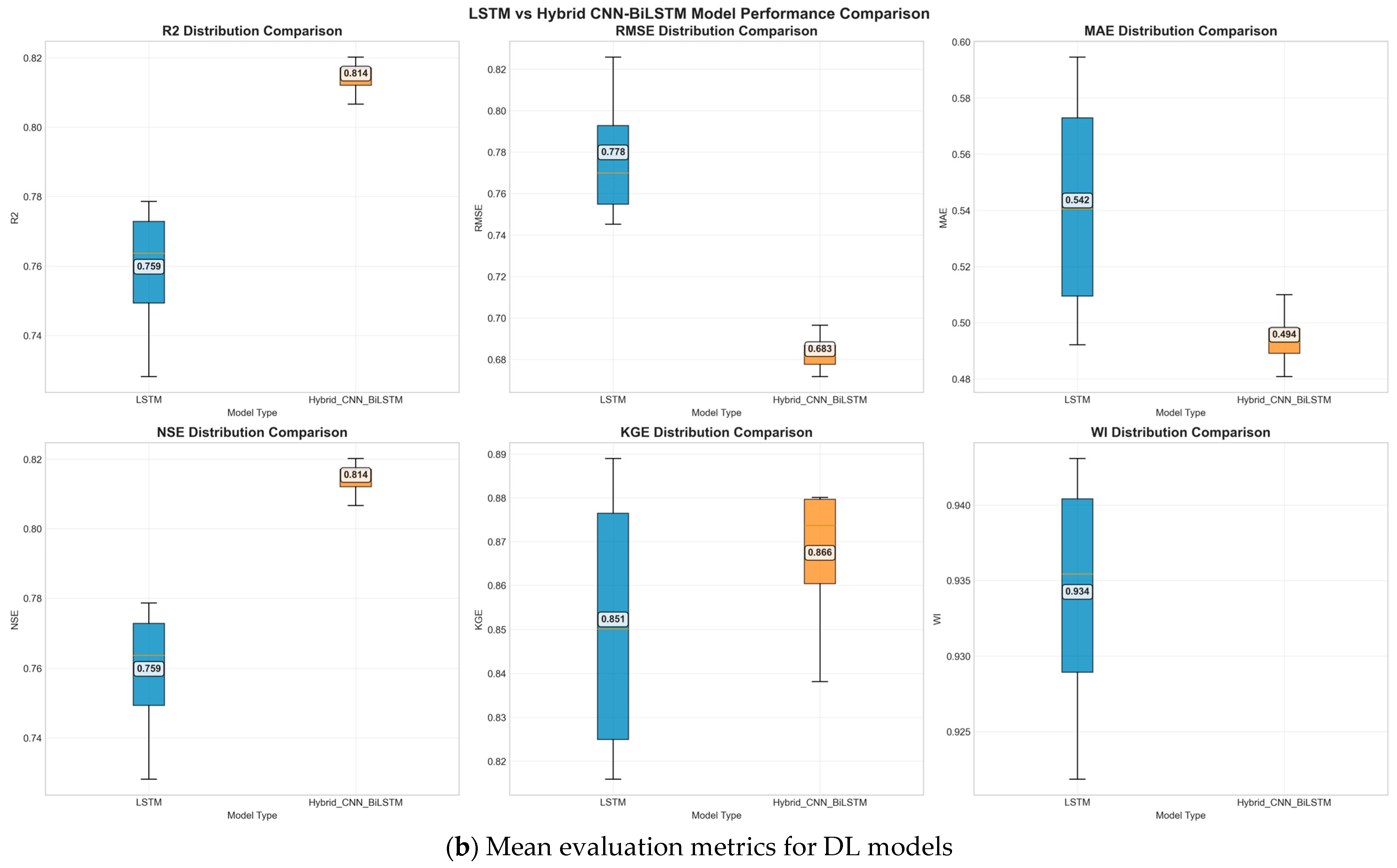
| Input Combination | R2 | RMSE | MAE | NSE | KGE |
|---|---|---|---|---|---|
| Mean | Mean | Mean | Mean | Mean | |
| Hybrid CNN-LSTM Attention Mechanism Model | |||||
| C1 | 0.820 | 0.672 | 0.481 | 0.820 | 0.880 |
| C2 | 0.816 | 0.680 | 0.492 | 0.816 | 0.868 |
| C3 | 0.814 | 0.683 | 0.494 | 0.814 | 0.880 |
| C4 | 0.807 | 0.697 | 0.510 | 0.807 | 0.838 |
| Standalone LSTM Model | |||||
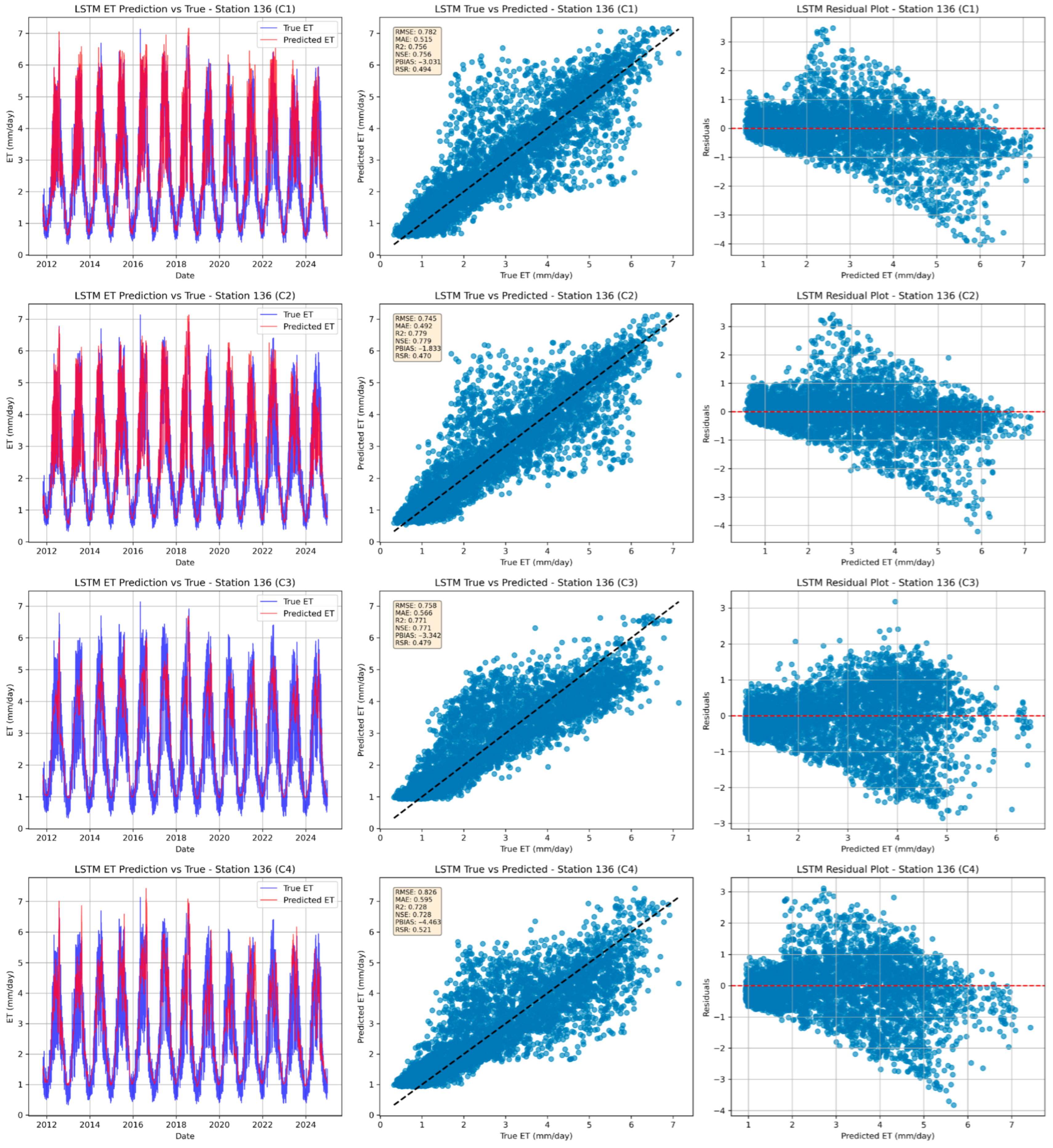
| C1 | 0.756 | 0.782 | 0.515 | 0.756 | 0.872 |
| C2 | 0.779 | 0.745 | 0.492 | 0.779 | 0.889 |
| C3 | 0.771 | 0.758 | 0.566 | 0.771 | 0.816 |
| C4 | 0.728 | 0.826 | 0.595 | 0.728 | 0.828 |
Disclaimer/Publisher’s Note: The statements, opinions and data contained in all publications are solely those of the individual author(s) and contributor(s) and not of MDPI and/or the editor(s). MDPI and/or the editor(s) disclaim responsibility for any injury to people or property resulting from any ideas, methods, instructions or products referred to in the content. |
© 2025 by the authors. Licensee MDPI, Basel, Switzerland. This article is an open access article distributed under the terms and conditions of the Creative Commons Attribution (CC BY) license.
Share and Cite
Waqas, M.; Kim, S.M. Hybrid Deep Learning Versus Empirical Methods for Daily Potential Evapotranspiration Estimation in the Nakdong River Basin, South Korea. Water 2026, 18, 32. https://doi.org/10.3390/w18010032
Waqas M, Kim SM. Hybrid Deep Learning Versus Empirical Methods for Daily Potential Evapotranspiration Estimation in the Nakdong River Basin, South Korea. Water. 2026; 18(1):32. https://doi.org/10.3390/w18010032
Chicago/Turabian StyleWaqas, Muhammad, and Sang Min Kim. 2026. "Hybrid Deep Learning Versus Empirical Methods for Daily Potential Evapotranspiration Estimation in the Nakdong River Basin, South Korea" Water 18, no. 1: 32. https://doi.org/10.3390/w18010032
APA StyleWaqas, M., & Kim, S. M. (2026). Hybrid Deep Learning Versus Empirical Methods for Daily Potential Evapotranspiration Estimation in the Nakdong River Basin, South Korea. Water, 18(1), 32. https://doi.org/10.3390/w18010032