Article

Spatiotemporal Distribution Characteristics and Removal Efficiency of Microplastics in a Wastewater Treatment Plant

by
Xudong Chen
,
Yang Li
*,
Keyi Lu
,
Xishu Liang
,
Kaibo Jin
,
Tianyu Ao
,
Lei Zhang
,
Jingjing Lv
,
Yanyan Dou
* and
Xuejun Duan
School of Smarts Energy and Environment, Zhongyuan University of Technology, Zhengzhou 450007, China
*
Authors to whom correspondence should be addressed.
Water 2025, 17(17), 2614; https://doi.org/10.3390/w17172614
Submission received: 24 July 2025 / Revised: 1 September 2025 / Accepted: 2 September 2025 / Published: 3 September 2025

Abstract

This study examined the removal efficiency of microplastics (MPs) in a wastewater treatment plant (WWTP) in Zhengzhou, China. A three-point sampling approach (influent, process effluent, and final effluent) was employed, with samples collected across three seasons (summer, winter, and autumn) to investigate seasonal variations in MPs. The abundance of MPs in influent ranged from 184.3 ± 4.0 to 145.3 ± 24.0 n/L, while in the process effluent it decreased to 79.3 ± 18.7 to 62.3 ± 15.0 n/L. Furthermore, in final effluent it was further reduced to 26.0 ± 7.0 to 38.7 ± 5.1 n/L. Fragments and granule-shaped MPs predominated (>80%), with polypropylene (PP, 42.6%) and polyethylene terephthalate (PET, 31.8%) emerging as the dominant polymer types. The removal efficiency of MPs in the WWTP was 86%, 81%, and 73% in summer, autumn, and winter, respectively. Additionally, the plant exhibited differing removal efficiencies for MPs of varying sizes. Notably, residual sludge retained substantial MPs loads, with seasonal abundances measuring 22.3 ± 3.2, 14.2 ± 2.4, and 29.1 ± 6.7 n/g in summer, autumn, and winter samples, respectively. The findings underscore the importance of implementing effective management strategies and interventions in wastewater systems to mitigate MP pollution.

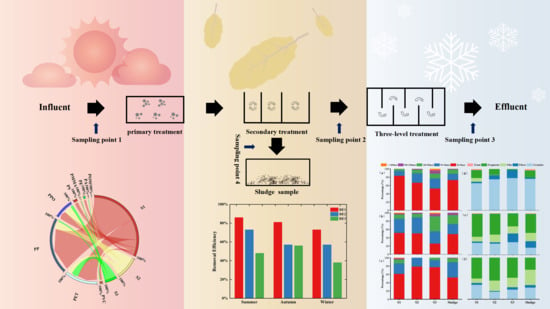
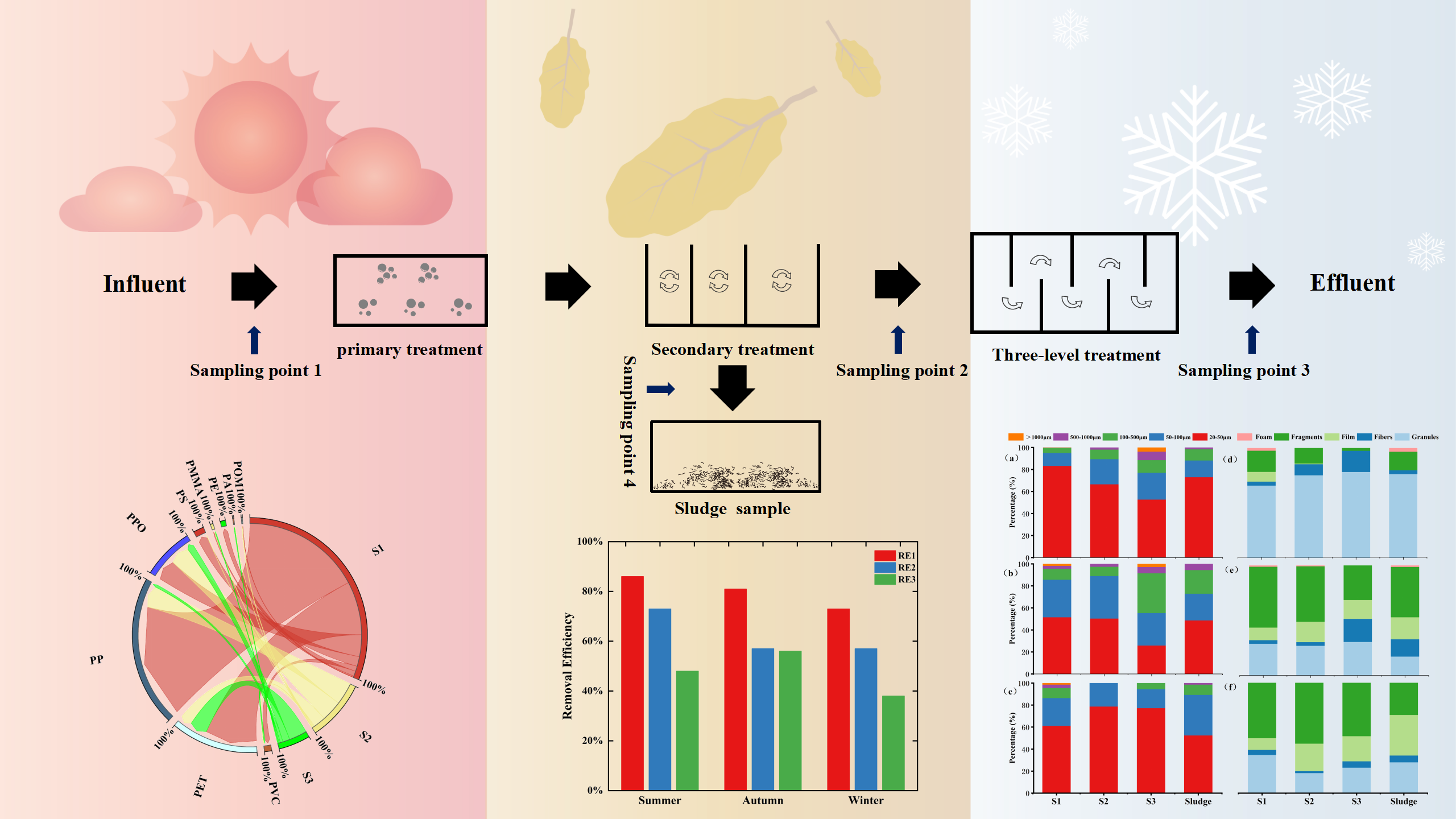
Graphical Abstract

1. Introduction

Plastics have emerged as one of the most essential materials for the survival and development of human society. Microplastics (MPs), which are defined as plastic fragments and particles smaller than 5 mm in diameter, have increasingly become a significant global pollutant and a focal point of research in recent years [1]. They have been universally recognized as persistent emerging contaminants due to their high specific surface areas. Their small size facilitates the adsorption and transport of toxic substances, thereby posing significant threats to both environmental and human health [2]. They pose a greater risk to the environment and human health than biodegradable plastics. This significant gap between plastic production and recycling efficiency results in plastic waste infiltrating ecosystems, where oxidation and mechanical abrasion cause them to fragment into MPs [3]. Owing to their indigestible nature, MPs can accumulate in biological organisms over prolonged periods, resulting in diseases and mortality among animals [4]. These persistent particles pose significant threats to respiratory, reproductive, and metabolic functions in organisms, thereby introducing unpredictable risks to human health [5,6]. Furthermore, in wastewater, MPs exhibit synergistic interactions with a variety of contaminants, such as contaminants of emerging concern, pathogenic bacteria, antibiotic-resistant bacteria, and antibiotic resistance genes [7].
The emergence and persistence of MPs are primarily attributed to terrestrial anthropogenic activities, with wastewater treatment plants (WWTPs) playing a crucial role in MP management [8]. These facilities serve as dual interfaces by simultaneously receiving and potentially discharging MPs, thereby forming critical components in urban water systems, particularly in water-scarce regions where treated effluents are reused. WWTPs’ effluents and biosolids serve as indirect pathways for MPs to enter the environment and the majority of MPs intercepted during treatment accumulate in sludge matrices, which are often repurposed as agricultural fertilizers [9,10]. Although conventional wastewater treatment plants do not have dedicated MP filtration mechanisms, they can have a positive effect on the removal of MPs from wastewater [11]. Globally, approximately 300 million metric tons of plastics are produced annually, yet only 21% are recycled, leaving the remaining 79% to enter the environment [12]. This practice sustains the environmental impact of MPs through agricultural applications, a phenomenon observed globally across treatment facilities [13]. These realities position MPs in WWTPs as a critical environmental issue garnering increasing scientific and regulatory attention in recent years [14].
Our understanding of the presence and removal efficiency of MPs in different units of WWTPs remains limited [15,16]. Previous studies have confirmed that seasonal variations in wastewater characteristics significantly influence MP abundance [17,18]. However, research aiming to establish clear correlations between MP distribution and seasonal weather patterns necessitates further data exploration and analysis [19]. Given the divergent outcomes observed regarding seasonal and precipitation effects, enhanced investigations remain essential for clarifying inter-seasonal variations.
Existing research on MPs in WWTPs has predominantly focused on MP abundance, removal efficiency, and transport dynamics within urban, suburban, and riverine systems [20,21,22], with comparatively less emphasis on cyclical seasonal variations [23,24]. This knowledge gap underscores the necessity for deeper insights into seasonal variations in MP characteristics, removal performance, and occurrence patterns in municipal WWTPs. This study investigates the removal efficiency of MPs in two treatment processes (secondary and tertiary) during summer, autumn, and winter in a WWTP located in Zhengzhou, China. The spatiotemporal distribution characteristics and removal efficiency of MPs in this WWTP were investigated. Experimental data reveal significant seasonal differences in polymer-specific MP abundance in secondary and tertiary treatment processes. Different sizes of microplastics have different removal efficiencies. Microplastics larger than 1 mm can be completely removed in the secondary treatment process. By analyzing the abundance and characterization of MPs in this WWTP, the study provides robust data to support seasonal assessments of MP removal efficiency and offers empirical evidence for drawing conclusions regarding seasonal correlations. Numerous studies have identified WWTPs as critical hotspots for the release of MPs into the environment [25,26]. These findings emphasize the pressing need to enhance monitoring efforts and implement targeted intervention measures to mitigate the role of WWTPs in MPs dissemination. Furthermore, they highlight the significance of optimizing treatment processes and adopting effective mitigation strategies to address this pressing environmental challenge.

2. Materials and Methods

2.1. Sampling

Wastewater and sludge samples were collected from a WWTP in Zhengzhou, China. The WWTP treats the sewage of 440,000 inhabitants of the area, with a capacity of 100,000 m3/d, and a service area of 74 km2. The plant is equipped with a three-stage treatment unit. The primary treatment consists of a grille and rotational flow grit chamber, the secondary treatment includes an anaerobic–anoxic–oxic (AAO) oxidation ditch and radial-flow-sedimentation tank, and the tertiary treatment comprises a fiber rotary filter and ultraviolet disinfection tank. Water samples were collected from three key locations: the inlet (S1), the process effluent (S2), and the final effluent (S3) during three distinct seasons: summer (July 2023), autumn (November 2023), and winter (January 2024). Sludge samples were taken at the sludge dewatering plant room. These sampling points are illustrated in Figure 1. At each sampling site, three separate 1 L wastewater samples were collected in stainless steel buckets and subsequently transferred to brown glass bottles for parallel experiments. For the sludge sample, approximately 500 g was collected using a stainless steel shovel and sealed in an aluminum foil bag for storage. Upon the completion of sample collection, the samples were transported back to the laboratory for further processing.

2.2. Sample Processing

Experimental pretreatment protocols followed some literature sources [27,28,29]. Firstly, three sets of parallel samples were prepared for both wastewater and sludge. Each set of wastewater comprised 1 L, while each set of sludge weighed 50 g. The wastewater samples were filtered through a stainless steel sieve with a mesh aperture of 0.0385 mm. At the same time, they were rinsed multiple times with ultra-pure water into the labelled beaker. For sludge samples, we accurately weighed 50 g and transferred it to a clean labelled beaker. Additionally, we weighed 100 g of sludge, dried it in a 105 °C oven for 24 h, and then reweighed it to determine the moisture content of the sludge. Density-based separation used a NaCl (Sinopharm Group Chemical reagent Co., LTD, Shanghai, China) solution (1.3 g/cm3) with a solid-to-liquid ratio of 1:10—an economical salt solution selected based on density differences for polymer separation. After 8 h of settling, the sample was floated, and this was repeated three times. Organic matter in wastewater and sludge was removed by digestion with 30% H2O2 (volume ratio 2:1, Sinopharm Group Chemical reagent Co., LTD, Shanghai, China). The mixtures were homogenized and the reaction was performed at 60 °C in a water bath for 48–72 h. Post-digestion samples were vacuum-filtered through a filtration apparatus. Ultrapure water rinses ensured the complete transfer of residual particles from separatory funnels onto filter membranes. Final MP-bearing membranes (0.45 µm of pore size, Delvstlab Co., LTD, Haining, Zhejiang, China) were preserved in sterilized Petri dishes under controlled laboratory conditions. Air-dried filters were preserved for subsequent microscopic and spectroscopic analyses.

2.3. Detection Method

The filtered mixed cellulose membranes were examined under a digital optical microscope (Motic, BA310Digital, Motic Industrial Group Ltd., Xiamen, China). Samples were photographed through the integrated camera system (Motic Images Plus 3.0 ML, Motic Industrial Group Ltd., Xiamen, China) to visually identify the morphology, color, and size of the suspected MPs. Suspected MP particles were manually counted and marked on the filtered membranes. A confocal Raman microscopy spectrometer (gora-Lite, Ideaoptics Co. Ltd., Shanghai, China) with an excitation wavelength of 785 nm, coupled with the Gora Dawn software (gora. Dawn v1.0) was used to identify the MPs (spectral range: 60–3500/cm, resolution: <5/cm). The obtained spectra were compared against standard Raman spectral libraries for polymer identification. The identified images of MPs are shown in Figure S1. Due to the high particle density, particularly in influent water samples, 30% of each filtered membrane’s area was systematically analyzed by random field selection to ensure representative quantification. The Raman detection results for various types of polymers are summarized in Figure S2.

2.4. Data Analysis

The removal efficiency (RE) of MPs in the WWTP was calculated using the following equation:
RE (%) = 100 − (MPs abundance in Sn+1 × 100/MPs abundance in Sn)
MP samples were collected at three sampling sites, S1, S2, and S3, at the WWTP to assess the effect of WWTP structures on MP abundance. A one-way analysis of variance (ANOVA) was conducted using SPSS 26.0 software to assess differences in MPs abundance across different seasons. Spearman’s rank correlation test was employed to evaluate the relationship between MP removal efficiency and particle characteristics, including size, shape, and color.

2.5. Quality Control

Before each sampling event, the sampling equipment was sterilized using ethanol to minimize the risk of contamination. Personnel involved in the sampling process were required to wear gloves and lab coats to prevent potential skin-contact contamination. Sample collection bottles were subjected to thorough cleaning and sterilization procedures, followed by rinsing with ultrapure water to ensure purity. All sludge or treated water samples were protected from environmental exposure during handling and storage by being covered with aluminum foil or Petri dishes.

3. Results and Discussion

3.1. Abundance and Removal Efficiency of MPs

The abundance of MPs across wastewater treatment stages during monitored months are displayed in Table 1. The abundance of MPs in S1 fluctuated between 145.3 ± 24.0 n/L and 184.3 ± 4.0 n/L (mean ± standard deviation, S.D.). In contrast, the data in S2 exhibited MP levels ranging from 62.3 ± 15.0 n/L to 79.3 ± 18.7 n/L, while the abundance in S3 varied between 26.0 ± 7.0 n/L and 38.7 ± 5.1 n/L. Seasonal analysis revealed higher MP abundance in S1 during summer (184.3 ± 4.0 n/L), compared to autumn levels (184.0 ± 8.9 n/L), and minimal winter values (145.3 ± 24.0 n/L). Final effluent showed no marked seasonal variation, with summer–autumn–winter measurements at 26.0 ± 7.0 n/L, 35.0 ± 11.5 n/L, and 38.9 ± 5.1 n/L, respectively, ANOVA tests showed that there were significant seasonal differences in MP abundance in S1 (P < 0.05). Observational data indicated that the abundance of MPs in S1 during summer and autumn was 20–30% higher than in winter. This seasonal disparity may be attributed to increased plastic packaging demand during summer due to weather-related consumption patterns and summer clothes being washed more frequently [30], coupled with higher rainfall intensity compared to autumn and winter. In addition, elevated precipitation enhances surface runoff, mobilizing greater quantities of MPs into wastewater systems [31].
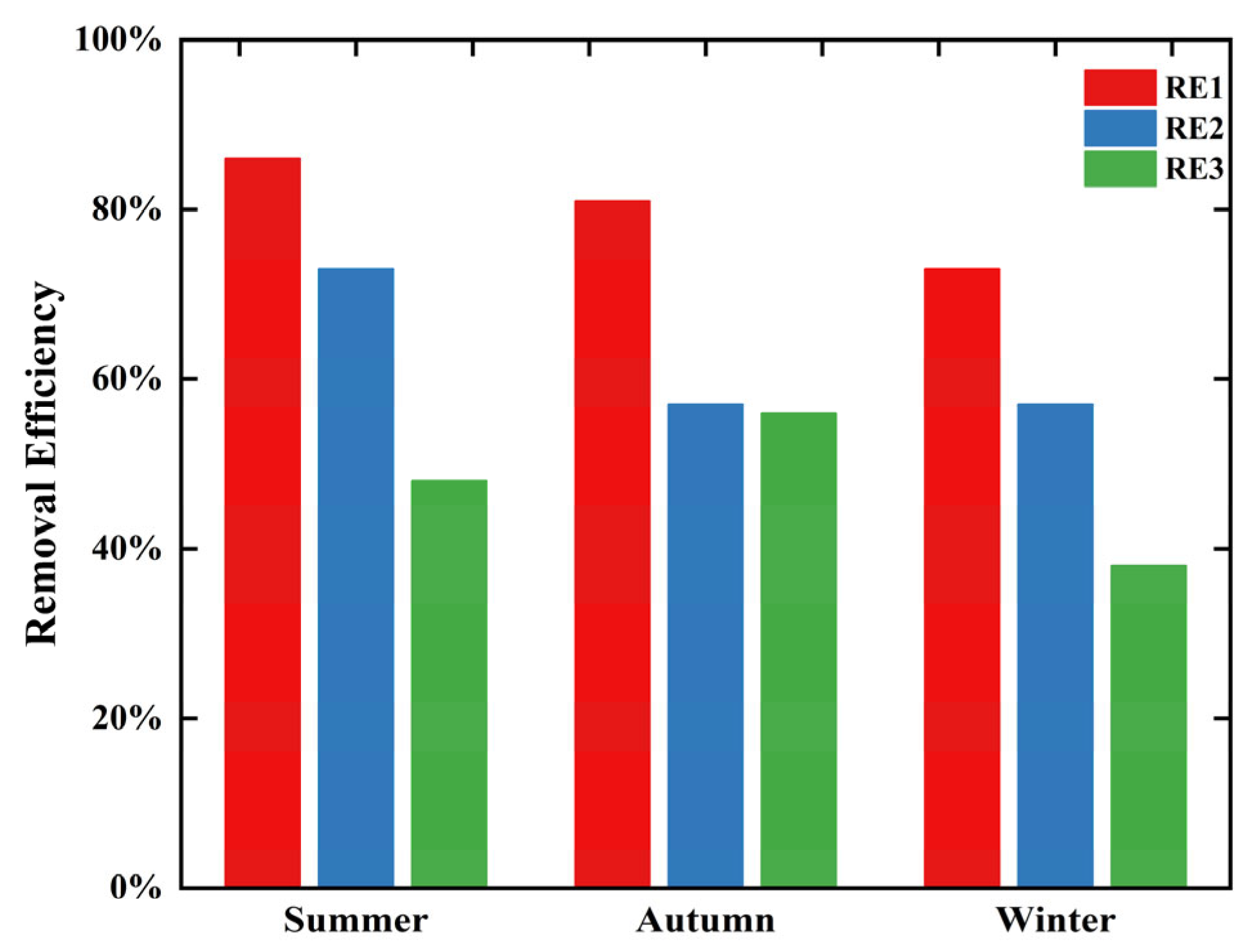
Regarding MP abundance in S2, concentrations measured 49.7 ± 10.1 n/L (summer), 79.3 ± 18.7 n/L (autumn), and 62.3 ± 15.0 n/L (winter), translating to the removal efficiencies of 73%, 57%, and 57%, respectively (Figure 2). The superior summer removal performance potentially relates to enhanced biological process efficiency under warmer thermal conditions. Tertiary treatment demonstrated MP removal efficiencies of 48%, 56%, and 38% across different seasons, while secondary treatment significantly outperformed tertiary processes in terms of overall efficiency. The diminished winter tertiary removal efficiency likely results from the low-temperature inhibition of specialized purification mechanisms. Cumulative seasonal removal efficiency reached maximums of 86% (summer), 81% (autumn), and 73% (winter), aligning with global municipal WWTPs’ MP removal benchmarks (Table 2). Sludge analysis (dry weight) revealed retained MP abundances of 22.3 ± 3.2 n/g (summer), 14.2 ± 2.4 n/g (autumn), and 29.1 ± 6.7 n/g (winter), confirming biosolids as major reservoirs of MPs in wastewater systems [12]. These findings emphasize sludge management’s critical role in environmental MP control.
Table 2 summarizes the digestion reagents and removal efficiencies of MPs in various WWTPs with differing treatment scales. There are some differences in the characterization of MPs in the studies of different wastewater plants. It can be seen that the removal efficiencies of MPs in foreign WWTPs are maintained at a high level. Comparative analysis reveals generally superior MP removal efficiency in foreign WWTPs, with this study’s cumulative MP elimination exceeding some domestic counterparts while remaining below international benchmarks. As shown in Table 2, there are significant differences in the relationship between pretreatment reagents and total removal efficiency. This may be attributed to the strong oxidative action of hydroxyl radicals in Fenton reagents, which efficiently degrade complex pollutants. In contrast, the effect of H2O2 as a pretreatment reagent varies significantly, potentially due to its weaker oxidative capacity, its influence on water pH, and variations in organic matter concentration.
It had been calculated that this WWTP, from the total effluent, will discharge many MP particles into nature in summer (19.0 to 33.0 × 10⁸ n/d), autumn (23.5 to 46.5 × 10⁸ n/d), and winter (33.8 to 4.0 × 10⁸ n/d), which will be discharged into the river and will cause different kinds of impacts on the water environment. It was shown that PA, PE, and PP polymer types were the most common polymer types found in fish samples and because of this, ingested organisms and associated food chains were threatened due to the high distribution of PP [39,40]; studies have shown that these MPs were not only ecologically hazardous, but also acted as carriers of dissolved pollutants, thus exacerbating environmental pollution [41].

3.2. Size of MPs

MPs exhibit distinct characteristics that provide valuable insights into their sources and potential environmental impacts. This study classified MPs based on their size, shape, color, and polymer type. As presented in Table 3, to systematically investigate the seasonal variations in removal efficiencies of MPs of various sizes by this WWTP, this study compared and analyzed the retention patterns of different treatment units for specific MPs sizes across the summer, autumn, and winter seasons. After verification, there were no significant seasonal differences in the MP abundance of various particle sizes in S1 of the WWTP in the three seasons (P > 0.05), significant correlation between MP removal for sizes 20–50 μm and >1000 μm (P < 0.05), and no correlation between 50 and 1000 μm removals across seasons (P > 0.05).
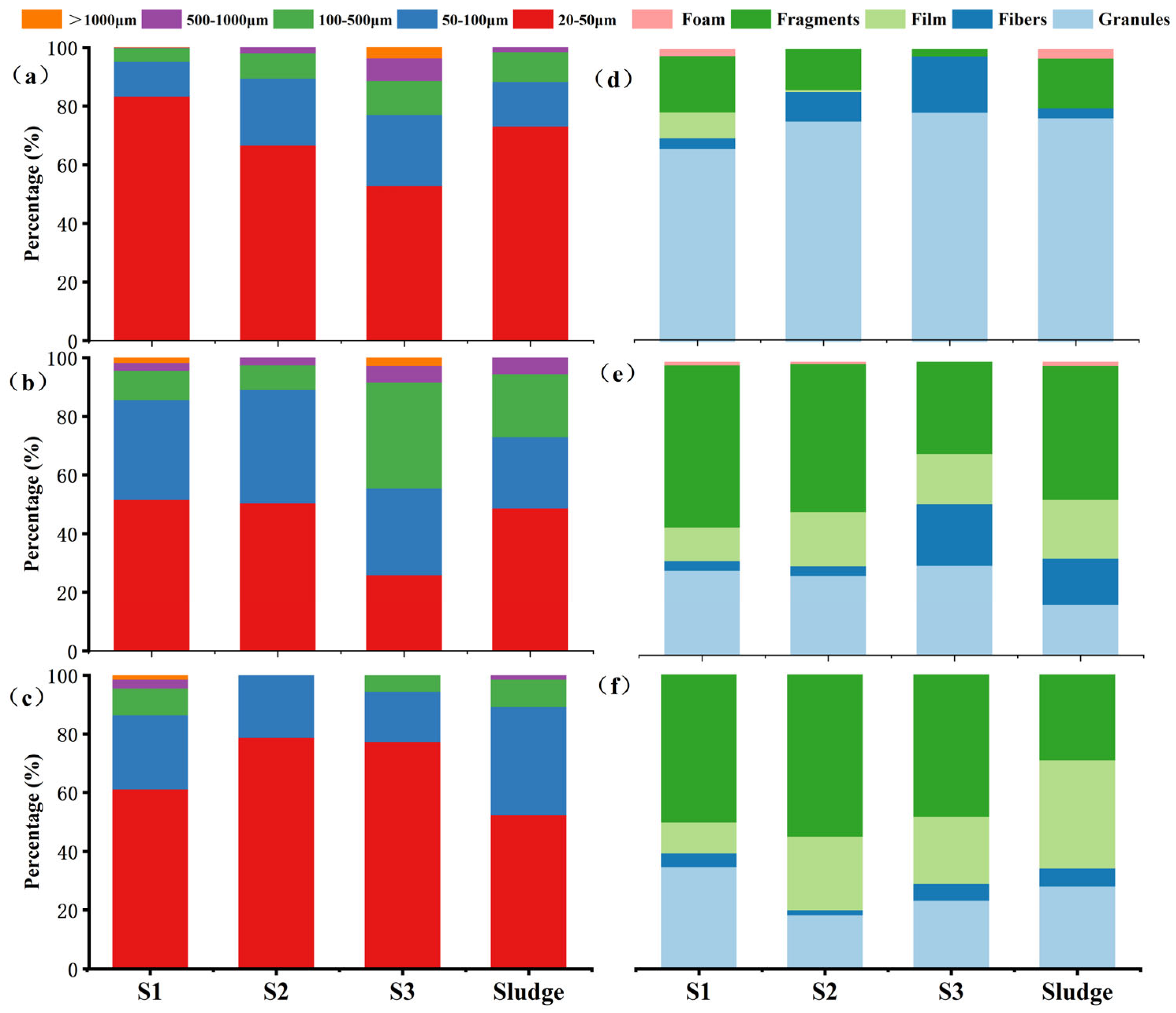
Figure 3a–c and Table 3 collectively demonstrate the removal efficiency of MPs across various size ranges at different treatment stages and seasons. Summer influent exhibited the highest abundance of MPs in the 20–50 μm size fraction (153.7 ± 44.2 n/L, accounting for 83% of the total), followed by the 50–100 μm size fraction (21.7 ± 29.7 n/L, accounting for 12% of the total). Larger size fractions (100–500 μm, 500–1000 μm, >1000 μm) collectively represented only 5.4% of the total MPs. The treatment sequence exhibited significantly higher removal efficiency for MPs in the 50–500 μm range compared to finer MPs in the 20–50 μm range, primarily due to gravitational settling mechanisms in the primary treatment process [38]. The results in S2 indicated a significant reduction in the distribution of MPs across all particle sizes, with particularly pronounced removal for MPs in the range of 20–50 μm. The abundance decreased to 33.0 ± 18.5 n/L, corresponding to a removal rate of 79%. Due to the high adsorption capacity of sludge, MPs with small particle sizes are more likely to be adsorbed and retained in it [25].
The removal of MPs in the particle size range of 50–100 μm and 100–500 μm was 48% and 50%, respectively. Previous studies had demonstrated that in the secondary treatment process, MPs were either adsorbed by bioflocs or encapsulated by biofilm, eventually leading to their deposition into the sludge [38,42]. In addition, the removal effect of the secondary treatment significantly reduced the amount of MPs in the effluent at this stage [43]. The experimental results showed that at the S3 sampling site, the highest removal rate of MPs was 59% for particle sizes 20–50 μm, and the lowest rate was 30% for 100–500 μm. As a result, a large number of MPs with particle sizes of 20–50 μm were treated in the sludge, and the largest proportion of MPs with this size was detected in the sludge samples in this quarter with 73%, followed by 50–100 μm with 15%. Table 3 showed that S2 had a higher removal efficiency (79%) for MPs of small particle size 20–50 μm. However, as particle size increased, the removal efficiency decreased, and particles with a particle size of 500–1000 μm even exhibited negative values. In the tertiary treatment stage, the removal efficiency of MPs with the same particle size was relatively stable, except for those in the >1000 μm range, which exhibited greater variability. MPs in the >1000 μm range had no retention capacity (0%), and the removal effect was poor. In summer, the removal efficiency of large-particle MPs in S2 was more pronounced compared to S3. Meanwhile, it could be observed that during the tertiary treatment stage, there were limitations in intercepting large-particle MPs.
Autumn data revealed distinct MP distribution patterns, with the influent predominantly consisting of 20–50 μm (94.7 ± 9.3 n/L, 51.4%) and 50–100 μm (62.7 ± 7.1 n/L, 34.1%). The results showed that the distribution of MPs in S2 was significantly reduced in all particle sizes. Specifically, the removal rates in the 20–50 μm, 50–100 μm, and 100–500 μm particle size ranges were similar, in the range of 60–70%. In S3, the removal of MPs in the 20–50 μm particle size range was significantly increased by 71%, while the removal of MPs in the 50–100 μm particle size range was 58%. Findings indicated that the abundance of MPs with particle sizes greater than 100 μm increased compared to autumn. This may be attributed to the input of polymers from the WWTP or experimental limitations observed during the study. In this season, the highest proportion of MPs with a particle size of 20–50 μm in the sludge reached 49%. The removal efficiency of MPs smaller than 500 μm in S2 remained stable at 67–71%, with the majority of MPs being retained within the biofilm carriers during this stage [44], which was lower compared to the summer season. It was found that the high temperatures characteristic of the summer season positively influence the biological reactions occurring during this stage. Additionally, high-temperature conditions enhance the ability of biofilms to retain MPs more effectively. However, the RE 3 was significantly lower, between 31 and 44%, and there may be particle fragmentation or a re-suspension phenomenon [45]. The secondary treatment process was still more effective than the tertiary treatment process in treating large-sized MPs in this season.
The winter data showed that the abundance of MPs was mainly composed of particles in the size ranges of 20–50 μm (61%) and 50–100 μm (25%). The experimental results at the S2 sampling site showed that the removal of MPs in the size ranges of 20–50 μm and 50–100 μm was 45% and 64%, respectively. It is interesting to note that the MPs in the 100–500 μm and 500–1000 μm size ranges showed complete removal (100% removal) during the winter treatment, indicating an enhanced ability to remove larger particles under cold conditions. In the effluent, the removal of MPs in the 20–50 μm, 50–100 μm, and 100–500 μm size ranges was 39% and 50%, respectively, and no MPs with particle sizes larger than 500 μm were detected. In sludge samples, 20–50 μm still accounted for the largest proportion of 52%. The physical retention effect of the secondary treatment process demonstrated a significantly higher removal efficiency for MPs > 100 μm, as evidenced by the experimental results, particularly when compared to the summer and autumn seasons. This can be attributed to the low-temperature environment in winter, which inhibits microbial activity in activated sludge, thereby enhancing the retention effect at this stage. However, the physical retention effect during the tertiary treatment process showed abnormal negative values for the removal of MPs within the particle size range of 100–500 μm.
Overall, the removal efficiency of small-sized MPs ranging from 20 to 500 μm was primarily attributed to the activated sludge in the secondary treatment process. In this process, a significant amount of extracellular polymeric substances secreted by microorganisms within the activated sludge adsorbed the MPs, forming larger flocs [46]. The increased relative densities and settling velocities of these flocs facilitated the efficient removal of MPs through sedimentation in the secondary treatment process [45,47]. Seasonal performance variations showed winter flocculation efficiency exhibited stronger temperature dependence compared to summer, while the fiber disc filtration maintained consistent performance. Notably, the secondary treatment process exhibited a superior removal of large MPs (>500 μm) during winter through enhanced flocculation and sedimentation. This contrasts with the negative removal efficiency observed in summer and autumn, which may be attributed to increased apparent concentrations caused by sludge recirculation. In the tertiary treatment process, the effective removal of large MPs could not be achieved due to the absence of a targeted process. Specifically, fiber disc filtration tanks failed to achieve a satisfactory removal of large-sized MPs, likely because high suspended solids loads led to clogging, thereby impairing the retention of large particle-sized MPs.

3.3. Shape of MPs

All of the detected MPs were categorized into four main forms: particles, fibers, fragments, and films. Fibers, which were elongated and thread-like particles, likely originate from the washing of synthetic fabrics and the degradation of textiles such as cloth, linen, and carpets during their aging process [48]. Fragments, typically characterized by broken or fragmented pieces of larger plastic items, were likely the result of the degradation or disintegration of plastic products. Film, which manifested as soft flakes of MPs, typically originates from items such as plastic bags or packaging materials. The statistical results showed that there were no significant seasonal differences in the MP abundance of different shapes in S1 (P > 0.05); there was no significant correlation between the shape of the MPs and the removal efficiency in different seasons (P > 0.05). As illustrated in Figure 3d–f, which displays the percentages of MP shapes at each stage across the three seasons, Figure 3d indicates that this WWTP had the highest percentage of particles in the influent water during the summer months, accounting for 66% with an abundance of 121.3 ± 28.5 n/L. Many types of facial washes, facial scrubs, or exfoliating products contain MP particles, and these were considered to be one of the sources of particles [49]. The hot weather in summer leads to an increased usage of household products, such as facial cleansers, which are prone to releasing MPs. Fragmented MPs accounted for the second highest percentage at 19%, with an average abundance of 35.3 ± 9.0 n/L. The results from S2 demonstrated that particles, thin-film, and fragmented MPs were largely removed at this stage, with removal efficiencies of 69%, 98%, and 80%, respectively. Their abundances decreased to 37.3 ± 11.0 n/L, 1.0 ± 0.3 n/L, and 7.0 ± 2.0 n/L, respectively. Thin-film shaped MPs, characterized by their relatively low density and large surface area, tend to float on the water surface, facilitating their removal along with flotsam [50]. In the effluent, all other shapes of MPs were removed in large quantities, and the removal effect of fibrous MPs was not obvious in this stage relative to other shapes of MPs. The largest percentage of particle-shaped MPs was 76%, followed by debris, at 17%, in sludge samples.
Figure 3e indicates that in autumn, fragmented MPs accounted for the largest share of MPs, reaching 55% with an abundance of 40.0 ± 17.3 n/L in S1. Irregular fragmented shapes usually come from fragments of larger plastic objects, such as tires, bottles, and plastic bags [51], and particles accounted for the next largest share of MPs, reaching an abundance of 29% with an abundance of 21.3 ± 3.2 n/L. In this season, the secondary treatment process demonstrated greater effectiveness in removing MPs across all shapes, except for film-like MPs. The removal efficiency exceeded 60% in all cases, with the exception of films. Among the various MP shapes, fragmented MPs, which were the most abundant, exhibited the most significant removal rate in S3. This is likely due to their faster settling velocity compared to fibers, spheres, and films, leading to their eventual adsorption in the sludge [52]. Consequently, fragments constituted the highest proportion (46%) of the mud samples collected during the fall quarter, followed by films at 20%. Figure 3f indicated that during the winter season, the fragmented MPs in this WWTP accounted for the largest proportion, approximately 50%, followed by particle and film, which each constituted 20% to 30%. The most significant removal occurred for particle and fibrous MPs during the S2 phase of the season, achieving removal rates of 78% and 88%, respectively. Overall, the removal efficiency for particles was the highest during the winter phase at 82%, followed by fragmented MPs at 74%. Films and fragments represented the higher proportions during the winter phase, accounting for 37% and 29%, respectively.

3.4. Color of MPs

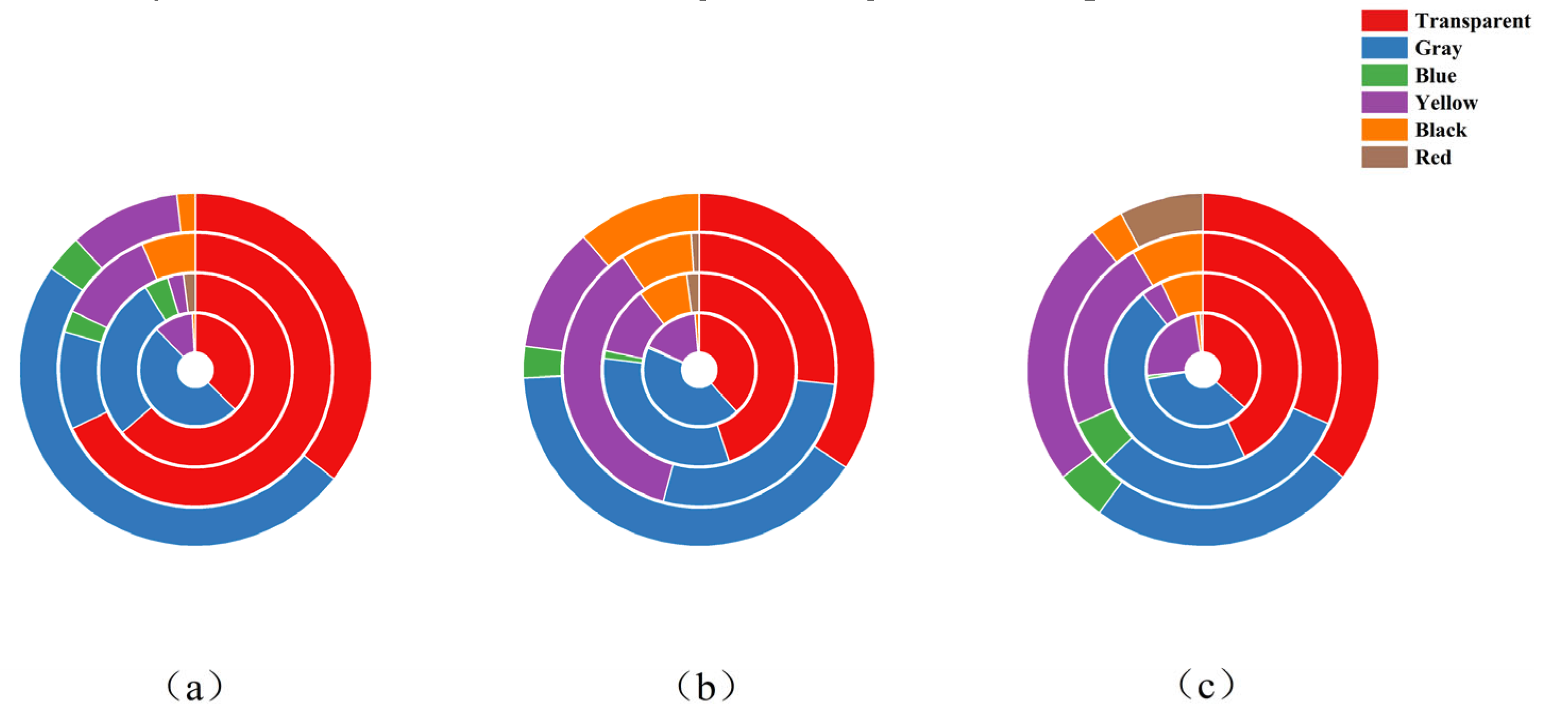
The analysis of the MPs collected from the wastewater samples revealed a diverse range of colors and the distribution of different color groups (grey, black, blue, red, yellow, and transparent) is presented in Figure 4. Among the identified colors, gray was the most prevalent, accounting for 36–51% of the total observed MPs. This finding indicated that gray MPs dominated in wastewater, and their presence may be associated with various consumer products, such as packaging materials or plastic products. Transparent MPs ranged from 37% to 38%, while the color distribution varied across other studies. Several studies had demonstrated that transparent MPs constitute a significant proportion of effluent [36,53]. This range indicated a relatively consistent distribution of transparent MPs in wastewater. Additionally, both grey and transparent MPs exhibited a relatively uniform total removal rate of approximately 80% compared to other colors in this study, with grey MPs achieving the highest removal rate of 97% in summer. While transparent MPs exhibited the highest treatment efficiency in the autumn season, with a removal rate of 87%, summer biosolids consisted of 49% grey and 36% transparent particles, shifting to 40% grey and 34% transparent particles in autumn. Winter samples displayed distinct coloration patterns, with yellow (25%) and grey (35%) MPs forming the predominant fractions. Yellow MPs showed variable prevalence ranging from 11% to 24%, with peak removal efficiencies observed in summer (86%), followed by autumn (59%) and winter (75%). The sources of these colors are diverse and may include packaging materials, plastic film fragments, or other yellow and transparent plastic items. The proportions of blue and red MPs were relatively low, ranging from 0% to 0.8%. While these colors were consistently detected, their prevalence is significantly lower compared to grey and clear MPs. The presence of blue and red MPs suggested the existence of plastic debris and its specific pigments in wastewater. These colors might also originate from items such as bottles, containers, or synthetic fibers released during washing machine operations.
The color distribution of MPs offers critical insights into the types and sources of plastic fragments entering wastewater systems. For instance, the incorporation of heavy metals, such as chromium (Cr), copper (Cu), cobalt (Co), selenium (Se), lead (Pb), and cadmium (Cd), during manufacturing processes results in the production of vividly colored polymers. These metals are often added as pigments or stabilizers, which not only influence the polymer’s coloration but also enhance its durability and resistance to environmental degradation [54]. Pale yellow to reddish-brown coloration potentially signals environmental weathering through photo-oxidative degradation [55,56]. Seasonal chromatic shifts in MPs exhibited distinct patterns. Grey MPs were predominant in summer influent (51% at site S1), with decreased proportions observed in autumn (43%) and winter (36%). Transparent MPs showed higher proportions in summer and autumn influent streams. Winter data indicate potential correlations between color profiles and increased outdoor plastic usage or climatic changes, warranting further investigation. By analysis, there were no significant seasonal differences (P > 0.05) in MP abundance by season for different colors in S1 among the three seasons, and there was no significant correlation between the color and removal efficiency of MPs between seasons (P > 0.05). This finding underscores the necessity for systematic investigations to ascertain whether seasonal variations affect the removal efficiency of differently colored MPs. Specifically, controlled experiments were required to isolate chromatic properties from other physicochemical factors.

3.5. Polymer Types of MPs

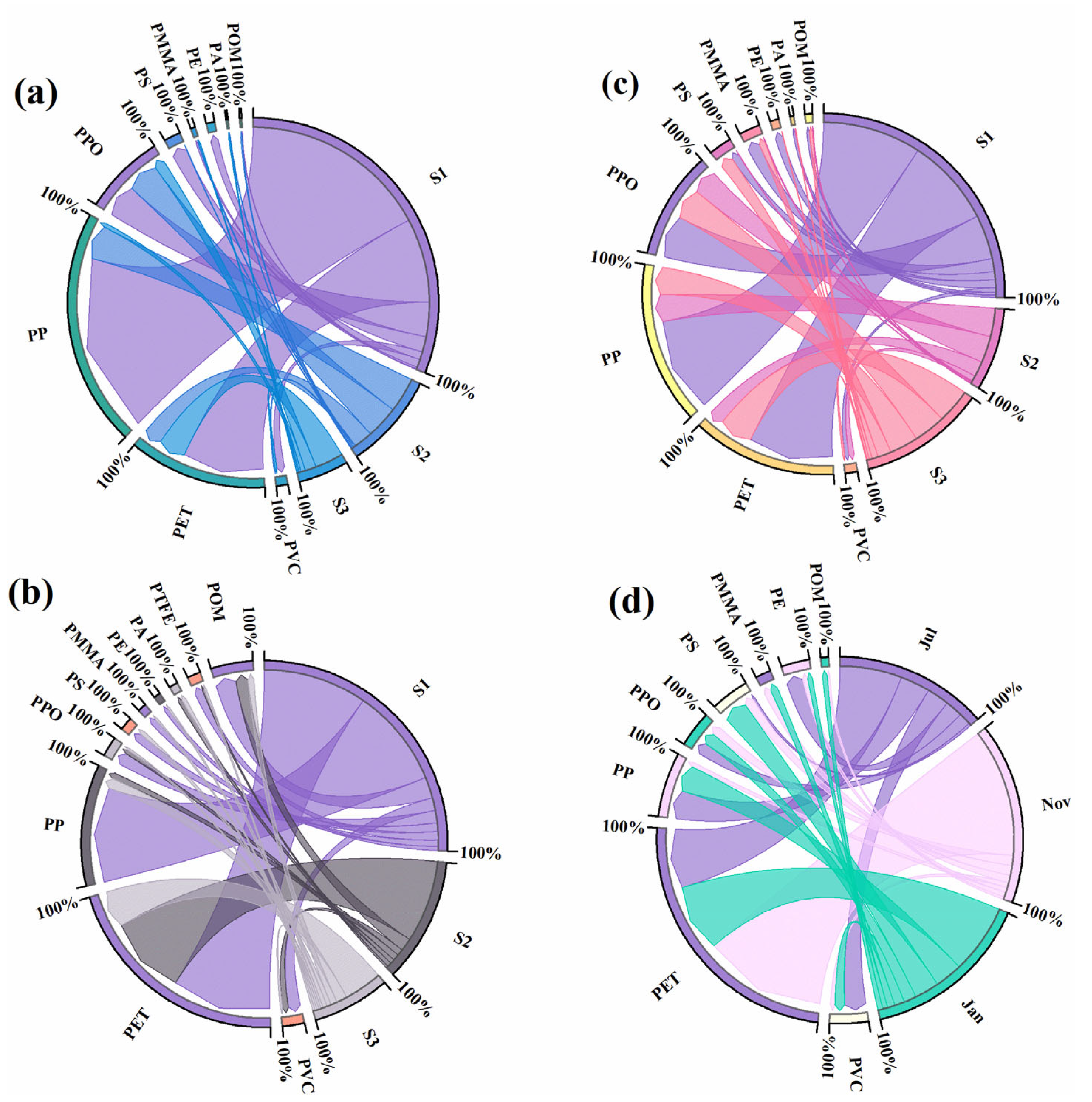
In the results of this experiment, polypropylene (PP) and polyethylene terephthalate (PET) were identified as the two polymer types with the highest abundance percentages during the study period (Figure 5). These two polymers are widely used in food packaging and food containers (such as beverage bottle caps), as they were extensively processed and produced in the plastic supply market through traditional processes (such as plastic processing, film processing, or plastic molding) [57]. The detailed experimental results are presented in the Supplementary Materials (Tables S1–S3). The standardization of priorities and methods for future polymer investigations can be guided by these conclusions drawn from WWTP data. Moreover, the detection of material information on MPs indicated that the majority of MPs in wastewater are predominantly derived from daily human activities [58].
Polymer-specific analysis revealed distinct seasonal variations in polymer composition across different stages of WWTP. In summer influent (S1), PP was the predominant polymer, accounting for 101.7 ± 7.1 n/L (55%), followed by PET at 45.7 ± 2.3 n/L (29%) and polyphenylene oxide (PPO) at 18.7 ± 13.8 n/L (10%). High-density PET removal occurred through gravity sedimentation in the secondary treatment process, demonstrating density-dependent elimination patterns [59,60]. In S2, the abundance of PP was reduced to 19.0 ± 4.4 n/L, corresponding to a removal rate of 81%. Low-density MPs, such as PE and PP, tend to naturally float on the surface of the effluent [61]. Meanwhile, medium-density polymers, like polyamide (PA) and PS, were transported to the effluent surface by bubbles generated during the air flotation process [62]. Other polymers, including PVC, PET, and PS, were removed at rates of 85%, 82%, and 96%, respectively. In S3, the polymer PET exhibited the highest removal percentage, while polymers PP and PPO demonstrated the most significant removal efficiencies of 88% and 66%, respectively.
In autumn, the influent of the WWTP contained relatively high levels of the polymers PP and PET, accounting for 32% and 36%, respectively. Based on the process effluent test results, the removal efficiencies for the polymers PP, PET, PE, and PA were 61%, 71%, 94%, and 80%, respectively, indicating that the treatment effects for these polymers were the most significant. The content of PS and polytetrafluoroethylene (PTFE) showed no significant changes or abnormalities, which might be attributed to observational errors or measurement limitations. In S3, the main polymers PP, PPO, and POM were more significantly removed, with removal efficiencies of 90%, 83%, and 75%, respectively. In contrast, the removal efficiency of the polymer PET was only 22% in this stage. Notably, while PE was completely removed (100%) during the test, its abundance at S1 was relatively low, making it difficult to objectively conclude that it was entirely removed.
In addition, PA and PTFE showed consistently increasing abundance in the observations, which might contribute to local sampling errors. During winter at site S1, the abundances of PET and PP were measured as 16.3 ± 4.0 n/L and 15.7 ± 8.1 n/L, respectively, accounting for 37% and 36% of the total polymer content. The treatment effects on polymers PVC, PP, PPO, and PTFE were more pronounced at site S2, with removal efficiencies reaching 50%, 94%, 67%, and 75%, respectively. Based on these results, the removal rates for PS, polymethyl methacrylate (PMMA), and PE were relatively low, at 20% and 40%, while the concentrations of PPO, PS, PMMA, PE, and PTFE remained at 1.0 ± 0.3 n/L. The main component of the wastewater was PET, with an abundance of 6.0 ± 1.0 n/L and 5.0 ± 1.7 n/L, respectively. The abundance of PVC, PPO, PS, PMMA, PE, PA, and PTFE was approximately 1.0 ± 0.3 n/L. It is evident that the removal of polymers PVC, PET, PPO, and POM at this stage was relatively significant, with removal efficiencies of 67%, 54%, 50%, and 50%, respectively. In contrast, there were no significant changes in the abundance of PP, PS, PMMA, and PE. PET was identified as the most prevalent polymer type across all three seasons of the mud samples. In summer, PET constituted 42% of the MPs, followed by PP at 20%. During autumn, PET accounted for 74% of the sludge samples, while other polymer types, such as PP and PPO, collectively represented only 5% on average. In winter, PET made up 47% of the polymers in the sludge samples, with PP following at 19%.

4. Limitations

The composition of various types of wastewater, local lifestyles, population structure, sampling techniques (e.g., sampling duration and mesh size), extraction methods (e.g., digestion and density separation), and identification techniques, as well as sampling locations and times, are among the key factors influencing the abundance of MPs in WWTPs within a study area. Subjective misjudgments by observers during testing and potential errors in pre-processing may lead to inaccuracies in the results. Furthermore, the randomness of sampling failed to account for seasonal variations across the three sampled seasons, contributing to uncertainty in quantifying MPs discharged from the WWTP. In this study, it was observed that the abundance of larger MPs was relatively low, with flocculation and gravity settling identified as effective primary treatment methods for intercepting larger particles. Larger MPs tend to settle at the bottom of the pool or adsorb onto suspended solids, potentially introducing error into the sampling results. Current sampling tools and techniques may not fully capture all sizes and forms of MP particles, particularly those smaller than 20 microns. The distribution of MPs in WWTP is typically uneven, and human errors during sampling may affect result accuracy. During data processing, the diversity and complexity of MPs, combined with the limitations of different testing techniques, may introduce subjectivity into result interpretation, complicating inter-laboratory comparisons and validations. Additionally, continuous observation and more meticulous sampling are required to better understand the effects of seasonal variations and to accurately characterize MP abundance in WWTPs.

5. Conclusions

This study investigated the abundance, characterization, and removal efficiency of MPs in the influent, process effluent, and final effluent of the WWTP and analyzed the results through experimental testing. The main findings of this study revealed that the total removal rate of the WWTP was highest at 86% during the summer, followed by 81% in autumn, and lowest at 73% in winter. Specifically, secondary treatment removed 73% of MPs in summer, similar to the efficiency in autumn, while achieving only 57% removal in winter. Tertiary treatment demonstrated removal efficiencies of 48%, 56%, and 38% for summer, autumn, and winter, respectively. The overall removal rate is highest in summer, higher than in autumn and winter, indicating that overall treatment efficiency is better during the hot season. Secondary treatment shows seasonal fluctuations, with a secondary removal rate of 73% in summer, which is significantly different from autumn and winter. Tertiary treatment shows non-linear seasonal characteristics, with tertiary removal rates showing “summer < autumn < winter”. The high retention efficiency of secondary treatment in summer reduces the tertiary load. These results demonstrate the WWTP’s efficacy in removing the majority of MPs; however, substantial quantities are still released into the environment on a daily basis, underscoring the urgent need for enhanced environmental protection measures. The shape of MPs in the effluent from this WWTP was predominantly fragments and particles across the three seasons. Specifically, granular MPs constituted the largest proportion in summer, whereas fragmented MPs were more prevalent in autumn and winter. PET and PP were identified as the predominant components of MPs in the effluent. Specifically, PP exhibited the highest concentration during summer observations, whereas both PP and PET accounted for more than one-third of the total concentration in autumn and winter. Transparent and grey were the most frequently observed colors across all three seasons. The most prevalent sizes during the three seasons ranged from 20 to 50 μm, followed by 50 to 100 μm. In addition, the study revealed distinct seasonal trends in MP abundance, with a higher abundance observed during specific seasons, particularly summer and autumn. This correlation with seasonal weather patterns indicates that hydrologically-driven human activities and weather-related changes may play a crucial role in influencing MP levels. This study offers several recommendations and suggestions for future research. First, it is crucial to broaden the investigation of MPs in wastewater by incorporating a more extensive range of sampling locations across the region. Such an approach would yield a more comprehensive understanding of the extent and origins of MP contamination. Furthermore, long-term monitoring studies are essential for elucidating spatiotemporal trends and seasonal variations in MPs concentrations with greater precision. Consequently, it is imperative to examine the potential impacts of MP pollution on aquatic ecosystems. The findings of this study underscore the importance of implementing effective management strategies and interventions in wastewater systems to mitigate MP pollution.

Supplementary Materials

The following supporting information can be downloaded at https://www.mdpi.com/article/10.3390/w17172614/s1: Figure S1: Electron micrograph of MPs (fiber: a; fragment: b, f, g, and j; film: c; and granules: d, e, and h); Figure S2: Raman spectra of various polymers (PS: polystyrene; PET: polyethylene terephthalate; PPO: polyphenylene oxide; PE: polyethylene; PMMA: polymethyl methacrylate; PVC: polyvinyl chloride; PP: polypropylene; POM: polyoxymethylene; PTFE: polytetrafluoroethylene; and PA: polyamide); Table S1: Percentages of polymer types in summer; Table S2: Percentages of polymer types in autumn; and Table S3: Percentages of polymer types in winter.

Author Contributions

Data curation, X.C. and Y.L.; Formal analysis, X.C., K.L. and X.L.; Funding acquisition, Y.L. and Y.D.; Investigation, X.C., K.L., X.L., K.J. and T.A.; Methodology, Y.L. and J.L.; Project administration, X.D.; Resources, Y.L.; Software, X.C., K.L. and L.Z.; Supervision, Y.D. and X.D.; Validation, K.J. and T.A.; Visualization, L.Z.; Writing—original draft, X.C. and Y.L.; Writing—review and editing, J.L. and Y.D. All authors have read and agreed to the published version of the manuscript.

Funding

This research was supported by the Natural Science Foundation of Henan (No. 242300421666), Postgraduate Education Reform and Quality Improvement Project of Henan Province (No. YJS2023JD17, YJS2024KC16).

Data Availability Statement

The original contributions presented in this study are included in the article and Supplementary Materials. Further inquiries can be directed to the corresponding authors.

Conflicts of Interest

The authors declare no conflict of interest.

References

  1. Liu, X.; Wei, W.; Chen, Z.; Wu, L.; Duan, H.; Zheng, M.; Wang, D.; Ni, B.-J. The threats of micro- and nanoplastics to aquatic ecosystems and water health. Nat. Water 2025, 3, 764–781. [Google Scholar] [CrossRef]
  2. Leslie, H.A.; van Velzen, M.J.; Brandsma, S.H.; Vethaak, A.D.; Garcia-Vallejo, J.J.; Lamoree, M.H. Discovery and quantification of plastic particle pollution in human blood. Environ. Int. 2022, 163, 107199. [Google Scholar] [CrossRef]
  3. Wu, T.; Ding, J.; Wang, S.; Pang, J.-W.; Sun, H.-J.; Zhong, L.; Ren, N.-Q.; Yang, S.-S. Insight into effect of polyethylene microplastic on nitrogen removal in moving bed biofilm reactor: Focusing on microbial community and species interactions. Sci. Total. Environ. 2024, 932, 173033. [Google Scholar] [CrossRef]
  4. Ragusa, A.; Svelato, A.; Santacroce, C.; Catalano, P.; Notarstefano, V.; Carnevali, O.; Papa, F.; Rongioletti, M.C.A.; Baiocco, F.; Draghi, S.; et al. Plasticenta: First evidence of microplastics in human placenta. Environ. Int. 2021, 146, 106274. [Google Scholar] [CrossRef]
  5. Bhatt, P.; Pathak, V.M.; Bagheri, A.R.; Bilal, M. Microplastic contaminants in the aqueous environment, fate, toxicity consequences, and remediation strategies. Environ. Res. 2021, 200, 111762. [Google Scholar] [CrossRef] [PubMed]
  6. Eze, C.G.; Nwankwo, C.E.; Dey, S.; Sundaramurthy, S.; Okeke, E.S. Food chain microplastics contamination and impact on human health: A review. Environ. Chem. Lett. 2024, 22, 1889–1927. [Google Scholar] [CrossRef]
  7. Zhao, K.; Li, C.; Li, F. Research progress on the origin, fate, impacts and harm of microplastics and antibiotic resistance genes in wastewater treatment plants. Sci. Rep. 2024, 14, 1–19. [Google Scholar] [CrossRef] [PubMed]
  8. Talbot, R.; Chang, H. Microplastics in freshwater: A global review of factors affecting spatial and temporal variations. Environ. Pollut. 2022, 292, 118393. [Google Scholar] [CrossRef] [PubMed]
  9. Freeman, S.; Booth, A.M.; Sabbah, I.; Tiller, R.; Dierking, J.; Klun, K.; Rotter, A.; Ben-David, E.; Javidpour, J.; Angel, D.L. Between source and sea: The role of wastewater treatment in reducing marine microplastics. J. Environ. Manag. 2020, 266, 110642. [Google Scholar] [CrossRef]
  10. Schell, T.; Hurley, R.; Buenaventura, N.T.; Mauri, P.V.; Nizzetto, L.; Rico, A.; Vighi, M. Fate of microplastics in agricultural soils amended with sewage sludge: Is surface water runoff a relevant environmental pathway? Environ. Pollut. 2022, 293, 118520. [Google Scholar] [CrossRef]
  11. Kruglova, A.; Muñoz-Palazón, B.; Gonzalez-Martinez, A.; Mikola, A.; Vahala, R.; Talvitie, J. The dangerous transporters: A study of microplastic-associated bacteria passing through municipal wastewater treatment. Environ. Pollut. 2022, 314, 120316. [Google Scholar] [CrossRef]
  12. Enfrin, M.; Dumée, L.F.; Lee, J. Nano/microplastics in water and wastewater treatment processes—Origin, impact and potential solutions. Water Res. 2019, 161, 621–638. [Google Scholar] [CrossRef]
  13. Lv, X.; Dong, Q.; Zuo, Z.; Liu, Y.; Huang, X.; Wu, W.-M. Microplastics in a municipal wastewater treatment plant: Fate, dynamic distribution, removal efficiencies, and control strategies. J. Clean. Prod. 2019, 225, 579–586. [Google Scholar] [CrossRef]
  14. Jani, V.; Wu, S.; Venkiteshwaran, K. Advancements and Regulatory Situation in Microplastics Removal from Wastewater and Drinking Water: A Comprehensive Review. Microplastics 2024, 3, 98–123. [Google Scholar] [CrossRef]
  15. Jiang, J.; Wang, X.; Ren, H.; Cao, G.; Xie, G.; Xing, D.; Liu, B. Investigation and fate of microplastics in wastewater and sludge filter cake from a wastewater treatment plant in China. Sci. Total. Environ. 2020, 746, 141378. [Google Scholar] [CrossRef] [PubMed]
  16. Tagg, A.S.; Sapp, M.; Harrison, J.P.; Sinclair, C.J.; Bradley, E.; Ju-Nam, Y.; Ojeda, J.J. Microplastic Monitoring at Different Stages in a Wastewater Treatment Plant Using Reflectance Micro-FTIR Imaging. Front. Environ. Sci. 2020, 8, 145. [Google Scholar] [CrossRef]
  17. Bayo, J.; Olmos, S.; López-Castellanos, J. Microplastics in an urban wastewater treatment plant: The influence of physicochemical parameters and environmental factors. Chemosphere 2020, 238, 124593. [Google Scholar] [CrossRef] [PubMed]
  18. Cheung, P.K.; Hung, P.L.; Fok, L. River Microplastic Contamination and Dynamics upon a Rainfall Event in Hong Kong, China. Environ. Process. 2018, 6, 253–264. [Google Scholar] [CrossRef]
  19. Constant, M.; Ludwig, W.; Kerhervé, P.; Sola, J.; Charrière, B.; Sanchez-Vidal, A.; Canals, M.; Heussner, S. Microplastic fluxes in a large and a small Mediterranean river catchments: The Têt and the Rhône, Northwestern Mediterranean Sea. Sci. Total. Environ. 2020, 716, 136984. [Google Scholar] [CrossRef]
  20. Hongprasith, N.; Kittimethawong, C.; Lertluksanaporn, R.; Eamchotchawalit, T.; Kittipongvises, S.; Lohwacharin, J. IR microspectroscopic identification of microplastics in municipal wastewater treatment plants. Environ. Sci. Pollut. Res. 2020, 27, 18557–18564. [Google Scholar] [CrossRef]
  21. Huang, Q.; Liu, M.; Cao, X.; Liu, Z. Occurrence of microplastics pollution in the Yangtze River: Distinct characteristics of spatial distribution and basin-wide ecological risk assessment. Water Res. 2022, 229, 119431. [Google Scholar] [CrossRef]
  22. Iordachescu, L.; Vest Nielsen, R.; Papacharalampos, K.; Barritaud, L.; Denieul, M.-P.; Plessis, E.; Baratto, G.; Julien, V.; Vollertsen, J. Point-source tracking of microplastics in sewerage systems. Finding the culprit. Water Res. 2024, 257, 121696. [Google Scholar] [CrossRef]
  23. Can, T.; Üstün, G.E.; Kaya, Y. Characteristics and seasonal variation of microplastics in the wastewater treatment plant: The case of Bursa deep sea discharge. Mar. Pollut. Bull. 2023, 194, 115281. [Google Scholar] [CrossRef]
  24. Bengüsu, I.K.; Gökhan, E.Ü.; Tuğba, C. Characteristics, and seasonal change of microplastics in organized industrial zone wastewater treatment plant. J. Environ. Chem. Eng. 2025, 13, 115516. [Google Scholar] [CrossRef]
  25. Hamidian, A.H.; Ozumchelouei, E.J.; Feizi, F.; Wu, C.; Zhang, Y.; Yang, M. A review on the characteristics of microplastics in wastewater treatment plants: A source for toxic chemicals. J. Clean. Prod. 2021, 295, 126480. [Google Scholar] [CrossRef]
  26. Tadsuwan, K.; Babel, S. Microplastic abundance and removal via an ultrafiltration system coupled to a conventional municipal wastewater treatment plant in Thailand. J. Environ. Chem. Eng. 2022, 10, 107142. [Google Scholar] [CrossRef]
  27. Turan, N.B.; Erkan, H.S.; Engin, G.O. Microplastics in wastewater treatment plants: Occurrence, fate and identification. Process. Saf. Environ. Prot. 2021, 146, 77–84. [Google Scholar] [CrossRef]
  28. Zhang, B.; Wu, Q.; Gao, S.; Ruan, Y.; Qi, G.; Guo, K.; Zeng, J. Distribution and removal mechanism of microplastics in urban wastewater plants systems via different processes. Environ. Pollut. 2023, 320, 121076. [Google Scholar] [CrossRef]
  29. Mathew, J.; Pulicharla, R.; Rezai, P.; Brar, S.K. Microplastics in wastewaters: Pretreatment to detection trail. J. Water Process. Eng. 2024, 64, 105702. [Google Scholar] [CrossRef]
  30. Liu, W.; Zhang, J.; Liu, H.; Guo, X.; Zhang, X.; Yao, X.; Cao, Z.; Zhang, T. A review of the removal of microplastics in global wastewater treatment plants: Characteristics and mechanisms. Environ. Int. 2021, 146, 106277. [Google Scholar] [CrossRef]
  31. Kittipongvises, S.; Phetrak, A.; Hongprasith, N.; Lohwacharin, J. Unravelling capability of municipal wastewater treatment plant in Thailand for microplastics: Effects of seasonality on detection, fate and transport. J. Environ. Manag. 2022, 302, 113990. [Google Scholar] [CrossRef]
  32. Uogintė, I.; Pleskytė, S.; Pauraitė, J.; Lujanienė, G. Seasonal variation and complex analysis of microplastic distribution in different wastewater treatment plant treatment stages in Lithuania. Environ. Monit. Assessm. 2022, 194, 829. [Google Scholar] [CrossRef]
  33. Lares, M.; Ncibi, M.C.; Sillanpää, M.; Sillanpää, M. Occurrence, identification and removal of microplastic particles and fibers in conventional activated sludge process and advanced MBR technology. Water Res. 2018, 133, 236–246. [Google Scholar] [CrossRef]
  34. Zhaxylykova, D.; Alibekov, A.; Lee, W. Seasonal variation and removal of microplastics in a central Asian urban wastewater treatment plant. Mar. Pollut. Bull. 2024, 205, 116597. [Google Scholar] [CrossRef]
  35. Bastakoti, S.; Adhikari, A.; Thaiba, B.M.; Neupane, B.B.; Gautam, B.R.; Dangi, M.B.; Giri, B. Characterization and removal of microplastics in the Guheshwori Wastewater Treatment Plant, Nepal. Sci. Total. Environ. 2024, 935, 173324. [Google Scholar] [CrossRef] [PubMed]
  36. Tang, N.; Liu, X.; Xing, W. Microplastics in wastewater treatment plants of Wuhan, Central China: Abundance, removal, and potential source in household wastewater. Sci. Total. Environ. 2020, 745, 141026. [Google Scholar] [CrossRef] [PubMed]
  37. Mi, J.H.; Lu, J.P.; Liu, T.X.; Liu, Y.; Shi, X.H.; Zhang, X.J.; Shi, Z.Y.; Liu, Y.H. Whole Process Analysis and Fate Behavior of mi-croplastics in Urban Wastewater Treatment Plants, Including their Occurrence Forms, Components, and Removal Efficiency. Environ. Sci. 2024, 45, 4052–4062. [Google Scholar] [CrossRef]
  38. Zhang, Y.; Wang, H.; Xu, J.; Su, X.; Lu, M.; Wang, Z.; Zhang, Y. Occurrence and Characteristics of Microplastics in a Wastewater Treatment Plant. Bull. Environ. Contam. Toxicol. 2021, 107, 677–683. [Google Scholar] [CrossRef] [PubMed]
  39. Djekoun, M.; Gaaied, S.; Romdhani, I.; Rida, A.M.; Missaoui, Y.; Boubekeur, M.S.; Trea, F.; Lakbar, C.; Ouali, K.; Banni, M. Abundance and distribution of environmental microplastic in edible fish and mussels from the south Mediterranean coasts. Mar. Pollut. Bull. 2024, 206, 116705. [Google Scholar] [CrossRef]
  40. Oo, P.Z.; Boontanon, S.K.; Boontanon, N.; Tanaka, S.; Fujii, S. Horizontal variation of microplastics with tidal fluctuation in the Chao Phraya River Estuary, Thailand. Mar. Pollut. Bull. 2021, 173, 112933. [Google Scholar] [CrossRef]
  41. Saud, S.; Yang, A.; Jiang, Z.; Ning, D.; Fahad, S. New insights in to the environmental behavior and ecological toxicity of microplastics. J. Hazard. Mater. Adv. 2023, 10, 100298. [Google Scholar] [CrossRef]
  42. Xiao, L.; Wen, K.; Ming, X.; Zhen, L.; Jun, W. Transfer and fate of MPs during the conventional activated sludge process in one wastewater treatment plant of China. Chem. Eng. J. 2019, 362, 176–182. [Google Scholar] [CrossRef]
  43. Lofty, J.; Muhawenimana, V.; Wilson, C.; Ouro, P. Microplastics removal from a primary settler tank in a wastewater treatment plant and estimations of contamination onto European agricultural land via sewage sludge recycling. Environ. Pollut. 2022, 304, 119198. [Google Scholar] [CrossRef]
  44. Jose, S.; Lonappan, L.; Cabana, H. Prevalence of microplastics and fate in wastewater treatment plants: A review. Environ. Chem. Lett. 2024, 22, 657–690. [Google Scholar] [CrossRef]
  45. Li, L.; Liu, D.; Song, K.; Zhou, Y. Performance evaluation of MBR in treating microplastics polyvinylchloride contaminated polluted surface water. Mar. Pollut. Bull. 2020, 150, 110724. [Google Scholar] [CrossRef] [PubMed]
  46. Xu, Z.; Bai, X.; Ye, Z. Removal and generation of microplastics in wastewater treatment plants: A review. J. Clean. Prod. 2021, 291, 125982. [Google Scholar] [CrossRef]
  47. Ali, I.; Ding, T.; Peng, C.; Naz, I.; Sun, H.; Li, J.; Liu, J. Micro- and nanoplastics in wastewater treatment plants: Occurrence, removal, fate, impacts and remediation technologies – A critical review. Chem. Eng. J. 2021, 423, 130205. [Google Scholar] [CrossRef]
  48. Napper, I.E.; Thompson, R.C. Release of synthetic microplastic plastic fibres from domestic washing machines: Effects of fabric type and washing conditions. Mar. Pollut. Bull. 2016, 112, 39–45. [Google Scholar] [CrossRef] [PubMed]
  49. Cheung, P.K.; Fok, L. Evidence of microbeads from personal care product contaminating the sea. Mar. Pollut. Bull. 2016, 109, 582–585. [Google Scholar] [CrossRef]
  50. Vardar, S.; Onay, T.T.; Demirel, B.; Kideys, A.E. Evaluation of microplastics removal efficiency at a wastewater treatment plant discharging to the Sea of Marmara. Environ. Pollut. 2021, 289, 117862. [Google Scholar] [CrossRef]
  51. Wang, W.; Ndungu, A.W.; Li, Z.; Wang, J. Microplastics pollution in inland freshwaters of China: A case study in urban surface waters of Wuhan, China. Sci. Total. Environ. 2017, 575, 1369–1374. [Google Scholar] [CrossRef]
  52. Bilgin, M.; Yurtsever, M.; Karadagli, F. Microplastic removal by aerated grit chambers versus settling tanks of a municipal wastewater treatment plant. J. Water Process. Eng. 2020, 38, 101604. [Google Scholar] [CrossRef]
  53. Hidayaturrahman, H.; Lee, T.-G. A study on characteristics of microplastic in wastewater of South Korea: Identification, quantification, and fate of microplastics during treatment process. Mar. Pollut. Bull. 2019, 146, 696–702. [Google Scholar] [CrossRef]
  54. Razzak, S.A.; Faruque, M.O.; Alsheikh, Z.; Alsheikhmohamad, L.; Alkuroud, D.; Alfayez, A.; Hossain, S.M.Z.; Hossain, M.M. A comprehensive review on conventional and biological-driven heavy metals removal from industrial wastewater. Environ. Adv. 2022, 7, 100168. [Google Scholar] [CrossRef]
  55. Abaroa-Pérez, B.; Ortiz-Montosa, S.; Hernández-Brito, J.J.; Vega-Moreno, D. Yellowing, Weathering and Degradation of Marine Pellets and Their Influence on the Adsorption of Chemical Pollutants. Polymers 2022, 14, 1305. [Google Scholar] [CrossRef] [PubMed]
  56. Liu, P.; Zhan, X.; Wu, X.; Li, J.; Wang, H.; Gao, S. Effect of weathering on environmental behavior of microplastics: Properties, sorption and potential risks. Chemosphere 2020, 242, 125193. [Google Scholar] [CrossRef] [PubMed]
  57. Gritsch, L.; Breslmayer, G.; Rainer, R.; Stipanovic, H.; Tischberger-Aldrian, A.; Lederer, J. Critical properties of plastic packaging waste for recycling: A case study on non-beverage plastic bottles in an urban MSW system in Austria. Waste Manag. 2024, 185, 10–24. [Google Scholar] [CrossRef] [PubMed]
  58. Sun, J.; Dai, X.; Wang, Q.; van Loosdrecht, M.C.; Ni, B.-J. Microplastics in wastewater treatment plants: Detection, occurrence and removal. Water Res. 2019, 152, 21–37. [Google Scholar] [CrossRef]
  59. Xu, X.; Zhang, L.; Jian, Y.; Xue, Y.; Gao, Y.; Peng, M.; Jiang, S.; Zhang, Q. Influence of wastewater treatment process on pollution characteristics and fate of microplastics. Mar. Pollut. Bull. 2021, 169, 112448. [Google Scholar] [CrossRef]
  60. Long, Z.; Pan, Z.; Wang, W.; Ren, J.; Yu, X.; Lin, L.; Lin, H.; Chen, H.; Jin, X. Microplastic abundance, characteristics, and removal in wastewater treatment plants in a coastal city of China. Water Res. 2019, 155, 255–265. [Google Scholar] [CrossRef]
  61. Petroody, S.S.A.; Hashemi, S.H.; van Gestel, C.A. Transport and accumulation of microplastics through wastewater treatment sludge processes. Chemosphere 2021, 278, 130471. [Google Scholar] [CrossRef] [PubMed]
  62. Ngo, P.L.; Pramanik, B.K.; Shah, K.; Roychand, R. Pathway, classification and removal efficiency of microplastics in wastewater treatment plants. Environ. Pollut. 2019, 255, 113326. [Google Scholar] [CrossRef] [PubMed]
Figure 1. Location of water sampling sites in the WWTP (AAO: anaerobic–anoxic–oxic; R-F-S: radial-flow-sedimentation).
Water 17 02614 g001
Figure 2. Removal efficiency of MPs in different seasons (RE 1 represents the total removal efficiency of MPs; RE 2 represents the removal efficiency of MPs at S2; and RE 3 represents the removal efficiency of MPs at S3).
Water 17 02614 g002
Figure 3. Percentages of MPs’ size and shape in different seasons (a) size in summer; (b) size in autumn; (c) size in winter; (d) shape in summer; (e) shape in autumn; and (f) shape in winter.
Water 17 02614 g003
Figure 4. Percentages of MP colors in different seasons (from the inner ring to the outer ring are S1, S2, S3, and sludge samples, respectively; (a) summer, (b) autumn, and (c): winter).
Water 17 02614 g004
Figure 5. Percentages of MP polymer types in different seasons, (a) summer, (b) autumn, and (c) winter, and (d) in sludge.
Water 17 02614 g005
Table 1. Abundance of MPs in different seasons.
Sampling Time Mean Abundance of MPs
S1 (n/L)S2 (n/L)S3 (n/L)Sludge Sample (n/g)
Summer184.3 ± 4.049.7 ± 10.126.0 ± 7.022.3 ± 3.2
Autumn184.0 ± 8.979.3 ± 18.735.0 ± 11.514.2 ± 2.4
Winter145.3 ± 24.062.3 ± 15.038.9 ± 5.129.1 ± 6.7
Table 2. Removal efficiency of MPs in sewage plants in different regions.
RegionScale of Treatment (m3/d)Digestion ReagentTotal RE (%)Influent Abundance (n/L)Effluent Abundance (n/L)Reference
Lithuania225,000H2O297.01964 ± 50–2982 ± 54744 ± 13–1244 ± 21[32]
Mikelli, Finland10,000Fenton reagent98.357.6 ±12.41.05 ± 0.4[33]
Astana, Kazakhstan253,900H2O288.6–93.047.1 ± 37.6–69.4 ± 41.04.1 ± 3.1–5.4 ± 3.5[34]
Kathmandu, Nepal32,400Fenton reagent72.531.2 ± 17.38.5 ± 5.6[35]
Wuhan, China70,000H2O266.123.3 ± 2.07.9 ± 1.1[36]
Hohhot, China180,000Fenton reagent80.8 ± 12.173.0 ± 5.014.0 ± 2.0[37]
Nanjing, China80,000Fenton reagent96.044.1 ± 3.22.0 ± 0.3[38]
Zhengzhou, China100,000H2O273–86171.3 ± 22.333.3 ± 6.6This study
Table 3. Removal efficiency of size-specific MPs in different seasons.
SeasonSizeRE2 (%)RE3 (%)
Summer20–50 μm79%59%
50–100 μm48%44%
100–500 μm50%31%
500–1000 μm−200%−100%
>1000 μm100%0%
Autumn20–50 μm67%59%
50–100 μm61%44%
100–500 μm71%31%
500–1000 μm67%−100%
>1000 μm100%0%
Winter20–50 μm45%72%
50–100 μm64%58%
100–500 μm100%−138%
500–1000 μm100%−20%
>1000 μm100%0%
Disclaimer/Publisher’s Note: The statements, opinions and data contained in all publications are solely those of the individual author(s) and contributor(s) and not of MDPI and/or the editor(s). MDPI and/or the editor(s) disclaim responsibility for any injury to people or property resulting from any ideas, methods, instructions or products referred to in the content.