1. Introduction
To calculate the Probable Maximum Flood (PMF) associated with a Probable Maximum Precipitation (PMP) for a chosen duration (e.g., 24 h), the PMP must first be converted to a synthetic hyetograph known as the Probable Maximum Storm (PMS) [
1,
2,
3,
4,
5,
6,
7,
8], which represents the cumulative rainfall distribution across the PMP duration. These design storms are critical for modeling probabilistic worst-case flood scenarios [
9,
10,
11]. In essence, design storms represent realistic precipitation patterns intended for use in the design of hydrologic infrastructure such as dams, culverts, and bridges [
7,
12]. The magnitude and temporal distribution of these storms strongly influence the shape and timing of the resulting runoff hydrograph in rainfall-runoff models [
13,
14,
15], making them essential for accurate PMF modeling.
Within the conterminous United States (CONUS), design storms are typically derived from the Precipitation Frequency Atlas of the United States, which is based on observations from gauge stations [
16,
17,
18,
19,
20,
21]. This Atlas, hereafter referred to as the NOAA Atlas 14 temporal distribution, expresses precipitation probabilities as cumulative percentages at either 30 min or 1 h intervals. These distributions offer several advantages, including the categorization of storm events into a nine-decile family (10, 20, …, 90%) of design storms based on degree of precipitation frontloading.
Previous studies often modeled design storms using Natural Resources Conservation Service (NRCS) curves [
1,
4,
22,
23]; however, NRCS curves are increasingly being replaced by NOAA Atlas 14 temporal distribution curves in contemporary engineering practices [
18,
20]. Despite this shift, no current research evaluates satellite precipitation products (SPPs) against NOAA Atlas 14 temporal distributions which were estimated from gauge records predating the year 2000. To address this gap, the present study compares design storms estimated using Integrated Multi-satellitE Retrievals for Global Precipitation Measurement (IMERG) data to NOAA Atlas 14 design storms. SPPs such as IMERG, which offers near-global coverage, provide an opportunity to model design storms in both gauged and ungauged regions beyond CONUS [
24,
25].
IMERG time series can be used to model design storms across a wide range of regions and for both short and long storm durations [
26,
27,
28,
29,
30,
31,
32]. IMERG features a spatial resolution of 0.1° (~11 km), a temporal resolution of 30 min, and covers latitudes up to 65° N/S. Studies suggest that IMERG outperforms other SPPs in precipitation estimation when compared to gauge observations [
33,
34,
35]. With data spanning from the early 2000 s to the present and incorporating extensive gauge calibration, IMERG is considered a next-generation SPP capable of capturing recent extreme precipitation events on a near-global scale [
36,
37,
38].
The aim of this work is to assess the degree of correspondence between NOAA Atlas 14 design storms and those estimated from IMERG, which will shed light on the general use of IMERG for this purpose in other locations around the globe.
Section 2 introduces the study area,
Section 3 and
Section 4 present the methodology and results, and
Section 5 and
Section 6 discuss the findings and conclude the paper.
2. Study Area and Datasets
2.1. Study Area
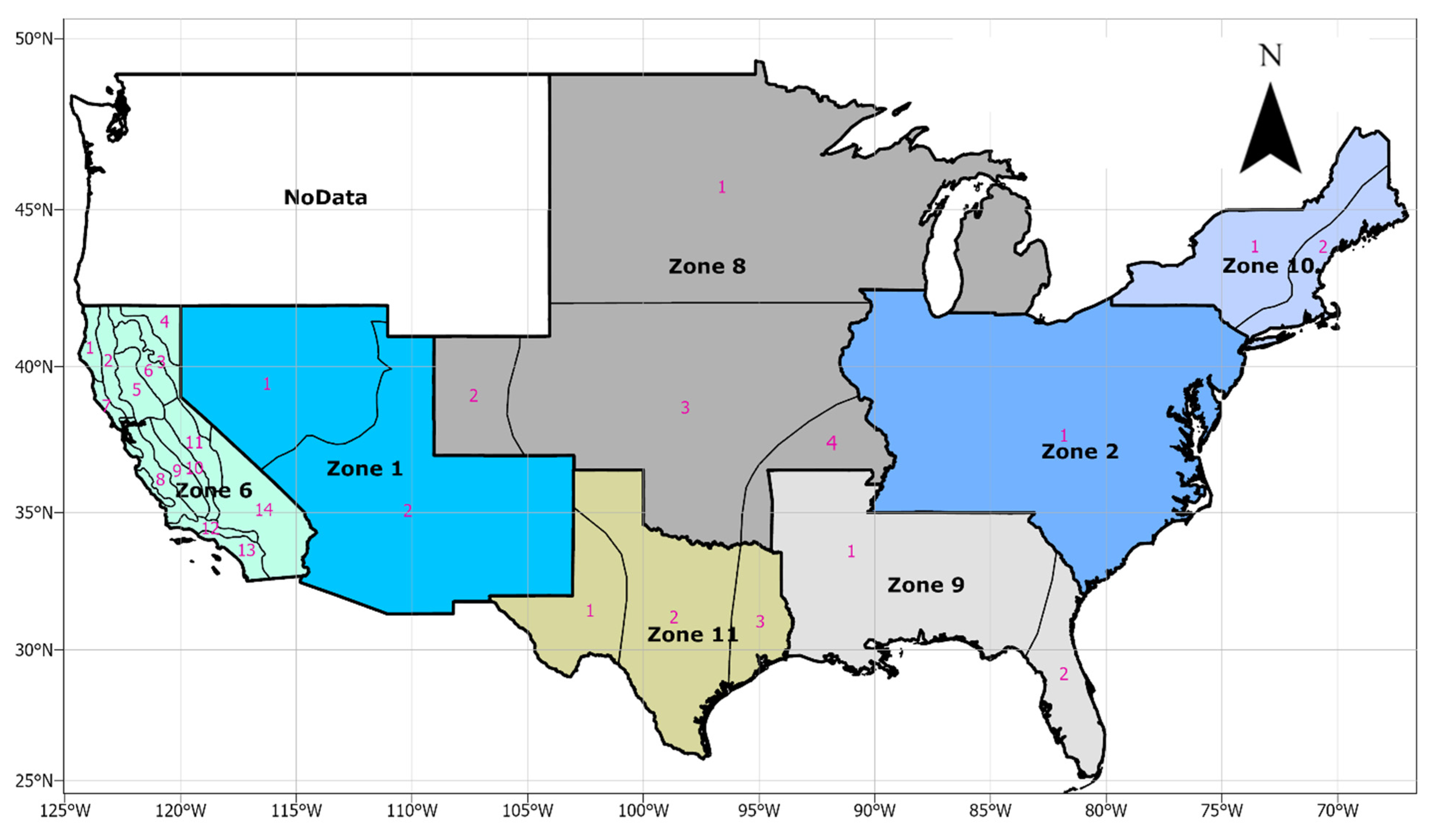
The NOAA Atlas 14 temporal distributions have been established for twenty-eight regions comprising seven distinct zones across CONUS (
Figure 1). The zones are defined based on unique climatic characteristics that differentiate them [
17,
18]. The zones include: the semiarid Southwest (Zone 1, consisting of two regions), the Ohio River Basin and surrounding states (Zone 2, one region), California (Zone 6, fourteen regions), the Midwestern states (Zone 8, four regions), the Southeastern states (Zone 9, two regions), the Northeastern states (Zone 10, two regions), and Texas (Zone 11, three regions). The delineations made by NOAA Atlas 14 are based on observed patterns of extreme precipitation, utilizing factors such as 24 h mean annual maximum precipitation, elevation, and latitude [
18].
2.2. IMERG Precipitation Datasets
The IMERG dataset, which begins in 2000, features a spatial resolution of 0.1° (~11 km), a temporal resolution of 30 min, and provides near-global coverage between 65° N and 65° S. IMERG is a satellite-based precipitation dataset generated by merging inputs from several sources, including the GPM Profiling Algorithm (GPROF), Precipitation Retrievals and Profiling Scheme (PRPS), PERSIANN-Cloud Classification System (PERSIANN-CCS), Combined Radar-Radiometer Algorithm (CORRA), and the Global Precipitation Climatology Project’s monthly satellite-gauge product (PCP-SG) [
36,
39]. The IMERG final product is calibrated against more than 80,000 stations from the Global Precipitation Climatology Centre (GPCC) [
36,
40].
IMERG Version 7 provides three precipitation variables in each product: PrecipitationCal, PrecipitationUncal, and HQprecipitation. PrecipitationUncal represents the original multi-satellite precipitation estimate, while HQprecipitation provides the merged microwave-based precipitation estimate. PrecipitationCal is a calibrated product that combines information from both PrecipitationUncal and HQprecipitation, adjusted using GPCC gauge observations [
37,
41]. For this study, the PrecipitationCal variable from the final run of IMERG Version 7 (which served as the target dataset) was retrieved from Google Earth Engine Cloud Computing platform, and the python code used for this analysis is provided in the data section.
2.3. NOAA Atlas 14 Temporal Distributions
For this study, NOAA Atlas 14 temporal distributions were obtained for the 24 h duration precipitation events that exceed the precipitation frequency estimates for a 2-year average recurrence interval [
17,
18]. The temporal distribution type considered is the “All” case, which utilizes the complete storm event catalog to determine the distribution of cumulative precipitation profiles. Values within these cumulative precipitation profiles are expressed as percentages of the total storm precipitation at 30 min intervals, except for Zones 1 and 2, where data are provided at hourly intervals. Temporal distribution curves corresponding to nine percentiles (10, 20, …, 90%) corresponding with increasing frontloading are downloaded for the probabilities of occurrence of cumulative precipitation totals [
18] across the various regions within CONUS. It is important to note that while the IMERG percentiles for this study are calculated (details in the method section), the NOAA reference data are downloaded as is for the different regions and zones.
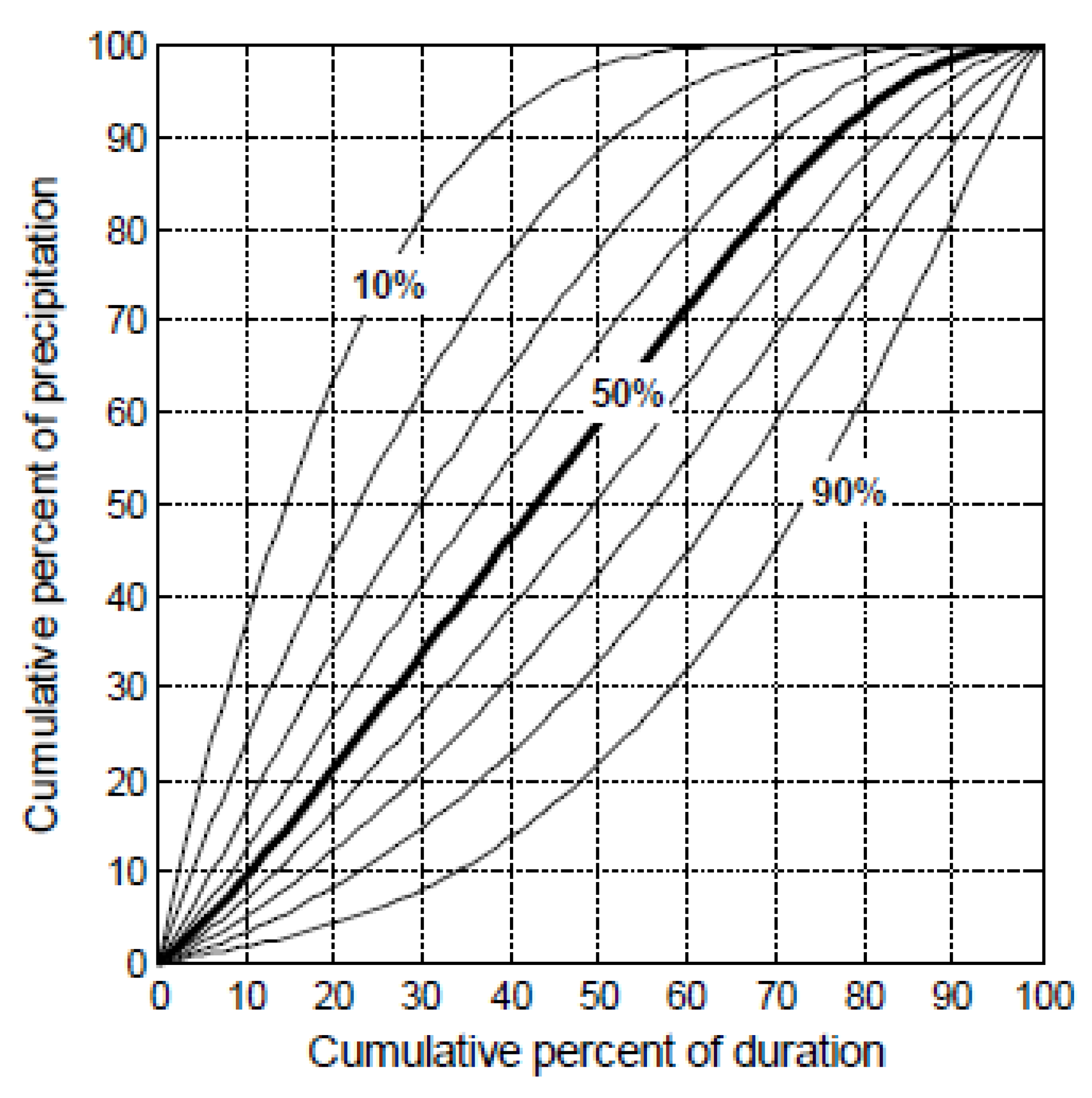
Figure 2 illustrates a sample temporal distribution curve for a 24 h duration for the Mississippi Valley region (region 4) which serves as reference data for the IMERG assessment [
16].
3. Method
3.1. Modeling 24 h Design Storms with a 2-Year Return Period Using IMERG
To model IMERG-based design storms, we used a procedure designed to be directly comparable with the NOAA Atlas 14 design storms. Due to NOAA data availability limitations at the time of the study, 22 years of IMERG data (2001–2022) were considered. For each IMERG pixel with its centroid in a particular zone or region, at each IMERG 30 min observation, the cumulative total precipitation from the 24 h ending at that time was computed. From this list of 24 h accumulations, the top 11 non-overlapping events (approximating the 2-year return period across the 22-yr dataset) from each pixel were retained for the design storm analysis.
Let R be an arbitrary NOAA zone or region (
Figure 1). Define the following:
N = number of IMERG pixel centroids (pseudo stations) in R
X = [xst] = (11·N) × 48 matrix, where each row is the 24 h time series (30 min time step) from a top-11 IMERG 24 h precipitation event (storm) from an IMERG pseudo station in R
P = [pst], where
Here, pst represents the cumulative rainfall at time t as a percentage of the 24 h total for storm s.
q = 1:9, representing deciles 10, 20, …, 90%
D = [dqt] = 9 × 48 matrix, where dqt is the decile-q percentile from column t of X
With these definitions,
D contains the percentage distribution of the 2-year design storm curves from the IMERG dataset according to decile-based, increasing degree of frontloading.
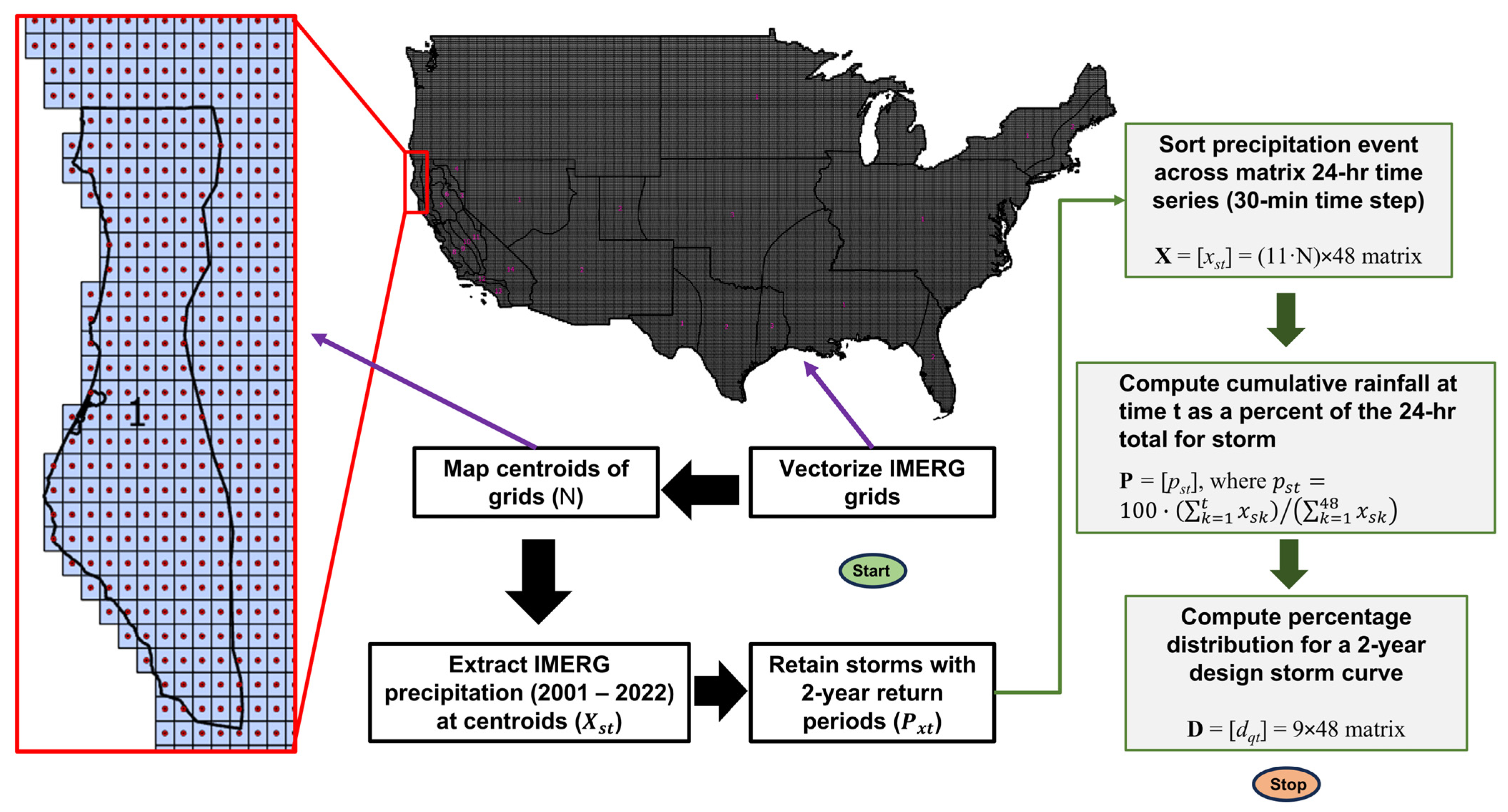
Figure 3 summarizes the methodology adopted in this study to compute percentage precipitation for 24 h storms at 30 min intervals across the regions.
3.2. Evaluations Metrics
Three statistical metrics were employed to evaluate the percentage precipitation distributions modeled from IMERG data: relative bias (RB), root mean square error (RMSE), and the normalized storm loading index (NSLI) (
Table 1). RB indicates whether IMERG hyetographs underestimate (negative values, less frontloaded) or overestimate (positive values, more frontloaded) compared to the NOAA Atlas 14 hyetographs [
42,
43]. RMSE quantifies the average magnitude of squared differences between the IMERG and NOAA Atlas 14 hyetographs [
42,
43]. NSLI measures the difference in cumulative percentage precipitation between the first and second halves of the 24 h period, normalized by the total precipitation over the entire duration [
14,
44,
45].
The mathematical expressions and units of the evaluation metrics are provided in
Table 1, where “O” represents NOAA (observed) percentile precipitation, and “P” stands for IMERG (predicted) percentile precipitation. Both O and P are in unit of %.
is total percentage precipitation after the midpoint, and
is total percentage precipitation for the 24 h analysis period.
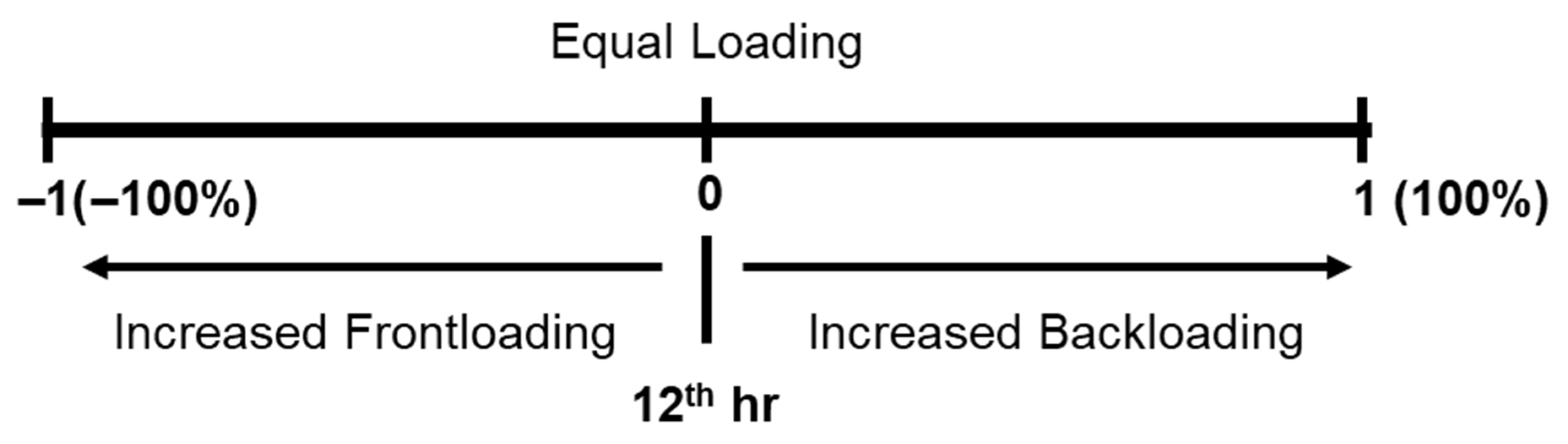
NSLI values range from −100% to +100%, where an NSLI value of 0 indicates an equal quantity of precipitation in the front and back halves of a 24 h event. A negative NSLI suggests that a greater proportion of precipitation occurred before the midpoint (frontloaded), while a positive NSLI indicates that more precipitation occurred after the midpoint (backloaded).
Figure 4 illustrates the range of NSLI values relative to the 0-reference point, with values increasing toward the negative axis representing frontloaded storms and those increasing toward the positive axis representing backloaded storms.
4. Results
4.1. Assessment of IMERG Cumulative Distribution at Region Scale
To evaluate the concordance between IMERG and NOAA Atlas 14 percentage precipitation across nine percentile increments (ranging from 10% to 90%), the percentage cumulative distributions of NOAA Atlas 14 were first converted into percentage precipitation for each respective region. For visual comparison,
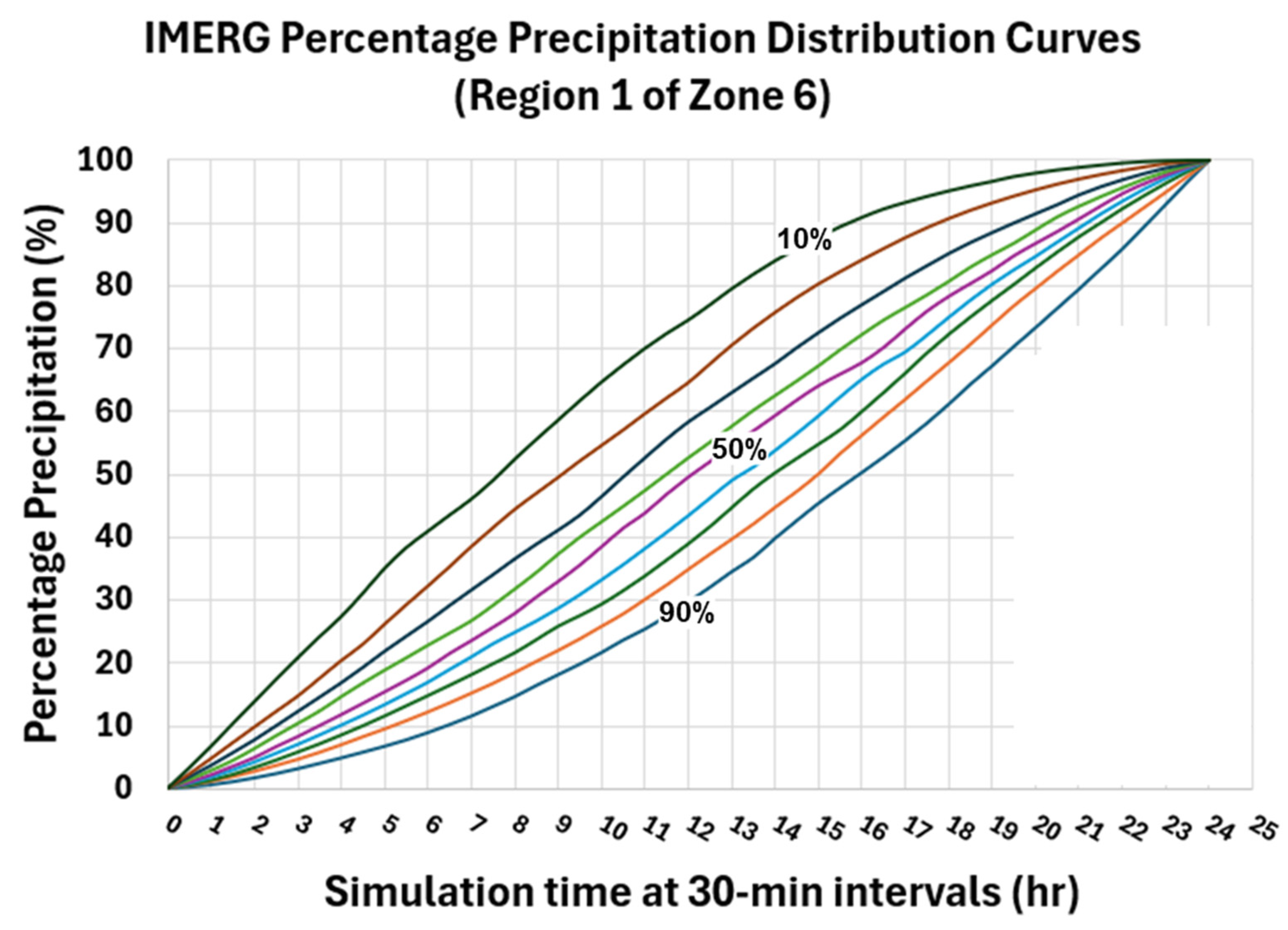
Figure 5 illustrates a randomly selected family of curves showing the IMERG percentage cumulative distributions across the investigated percentile spectrum for one of the regions (e.g., region 1). For each percentile, the IMERG estimates were evaluated against NOAA observation, and the statistical result reported for each level of percentile.
The results of the mean statistical analyses across the percentile spectrum are presented in
Table 2. Region 1 (Zone 1) exhibited the highest RMSE at 10.75%, while Region 4 (Zone 6) demonstrated the lowest RMSE at 1.30%. Across all regions and percentile ranges, the average RMSE was 3.7%, with a corresponding mean RB of 1.4%. In terms of precipitation loading, NOAA Atlas 14 exhibited a mean NSLI of −7.7%, indicating that, on average, NOAA Atlas 14 storms are frontloaded by approximately 8% of the total percentage precipitation. In comparison, IMERG storms exhibited a mean NSLI of approximately −4.1%, suggesting that IMERG is also frontloaded but to a lesser extent than NOAA Atlas 14, with an average difference of −3.6%. The tendency for IMERG to exhibit lesser frontload capability than NOAA can be attributed to the coarse temporal resolution of IMERG; for instance, IMERG has a 30 min resolution compared to NOAA’s 5 min. This indicates IMERG may miss short storm events, causing lower cumulative totals than NOAA. A backloaded bias in IMERG could alter hydrograph peaks in PMF modeling.
Overall, these statistics indicate reasonable alignment between IMERG and NOAA Atlas 14 distributions. However, the RB analysis indicates that IMERG tends to underestimate precipitation relative to NOAA Atlas 14 in drier regions, while overestimating it in wetter regions, consistent with findings from a previous study [
31].
4.2. Assessment of IMERG Cumulative Distribution at Zone Scale
The IMERG data were also evaluated at the zones based on percentage distribution. For each zone, statistical data from the constituent regions across the nine deciles were aggregated to derive mean statistical values. The mean statistics for each zone across the decile spectrum are summarized in
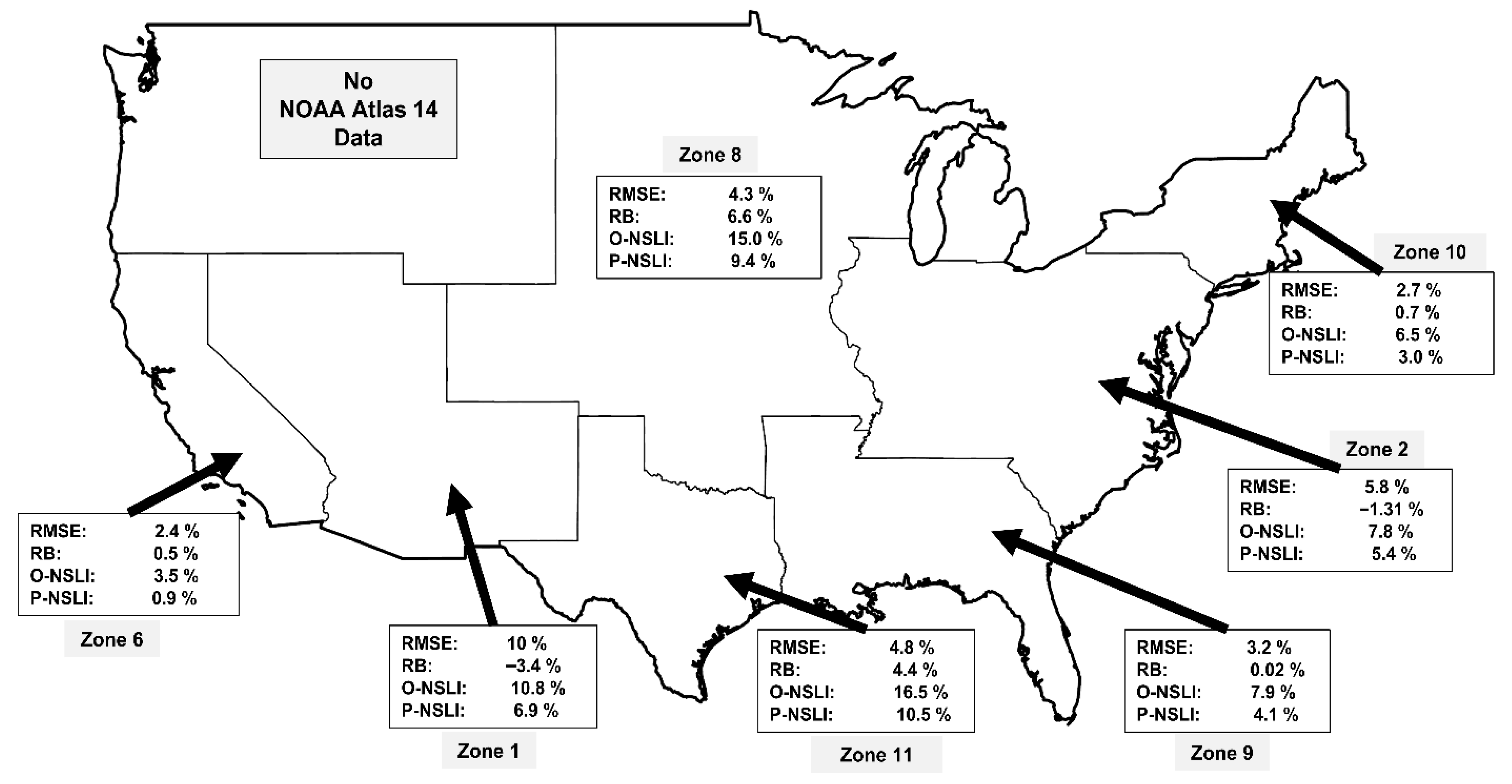
Table 3. Zone 1 recorded the highest RMSE value at approximately 10%, while Zone 6 exhibited the lowest RMSE value at 2.4%. Across all zones, the mean RMSE was calculated to be 4.8%, with a corresponding mean RB of 1.066%.
In terms of storm loading, NOAA Atlas 14 produced a mean NSLI of −9.7%, while IMERG presented a mean NSLI of −5.7%. The RB analysis suggests that IMERG tends to overestimate precipitation compared to NOAA Atlas 14 across most zones, with the exception of Zones 1 and 2, where IMERG generally underestimates relative to NOAA Atlas 14. Additionally, the NSLI results indicate that IMERG is relatively more backloaded.
4.3. Assessment of IMERG Cumulative Distribution at the Percentiles
Assessing the entire percentile spectrum is crucial for assisting users in selecting the most appropriate distribution curves for different regions and zones. The evaluations covered the nine deciles across both regions and zones.
Table 4 presents the summarized results of the mean statistics at these percentiles for each region. Notably, the 60th percentile exhibited the lowest RB value of −0.1%, indicating a closer agreement between IMERG and NOAA Atlas 14. Although the 60th percentile recorded a low RB, its has a RMSE of 3.7% compared to the 20th percentile which had the least RMSE value of 2.1%.
When assessing the NSLI for NOAA Atlas 14 and IMERG across all regions and percentiles, the results revealed that the NSLI values for NOAA Atlas 14 decreased consistently from the 10th percentile (25.2%) to the 90th percentile (−38.5%). The best agreement occurred between the 40th and 50th percentiles, with NSLI differences (Diff-NSLI) of −0.7% and −8.0%, respectively. Similarly, IMERG NSLI values showed a decline from the 10th percentile (26.8%) to the 90th percentile (−36.2%), with the best agreement occurring between the 40th and 50th percentiles, where the PD values were 4.2% and −4.8%, respectively.
The overall pattern of the NSLI suggests that both IMERG and NOAA Atlas 14 show better agreement in the lower percentiles (from the 10th to the 40th percentiles), where NSLI values are positive and gradually decrease. Conversely, from the 50th to the 90th percentiles, the models exhibit more frontloaded behavior, with negative NSLI values that also decrease. On average, both IMERG and NOAA Atlas 14 exhibit stronger agreement between the 40th and 60th percentiles, where the NSLI values are close to equal loading. These findings underscore the importance of carefully selecting the appropriate curves based on specific locations and infrastructure design needs.
Table 5 summarizes the mean results across the percentile ranges at the zones. Notably, the 30th to 60th percentiles exhibited low RB, ranging from 0.03% to 1.32%, indicating agreement between IMERG and NOAA Atlas 14 within this range. The RMSE showed an increasing trend, from 2.52% at the 10th percentile to 8.1% at the 90th percentile.
When evaluating the NSLI for NOAA Atlas 14 and IMERG across the percentiles, the results for NOAA Atlas 14 showed an overall decrease in NSLI values, from 28.3% at the 10th percentile to −44.9% at the 90th percentile. The best agreement was observed between the 40th and 50th percentiles. Similarly, IMERG NSLI values also decreased from 29.1% at the 10th percentile to −41.2% reaching the 90th percentile, with the best agreement occurring between the 40th and 50th percentiles.
The overall pattern of the NSLI indicates that both IMERG and NOAA Atlas 14 exhibit more backloaded behavior between the 10th and 40th percentiles, with positive NSLI values that decrease gradually. In contrast, both models are more frontloaded between the 50th and 90th percentiles, where negative NSLI values decrease further. On average, the results demonstrate that both IMERG and NOAA Atlas 14 exhibit better agreement between the 40th and 60th percentiles.
5. Discussion
5.1. IMERG Percentage Precipitation Distribution at the Region
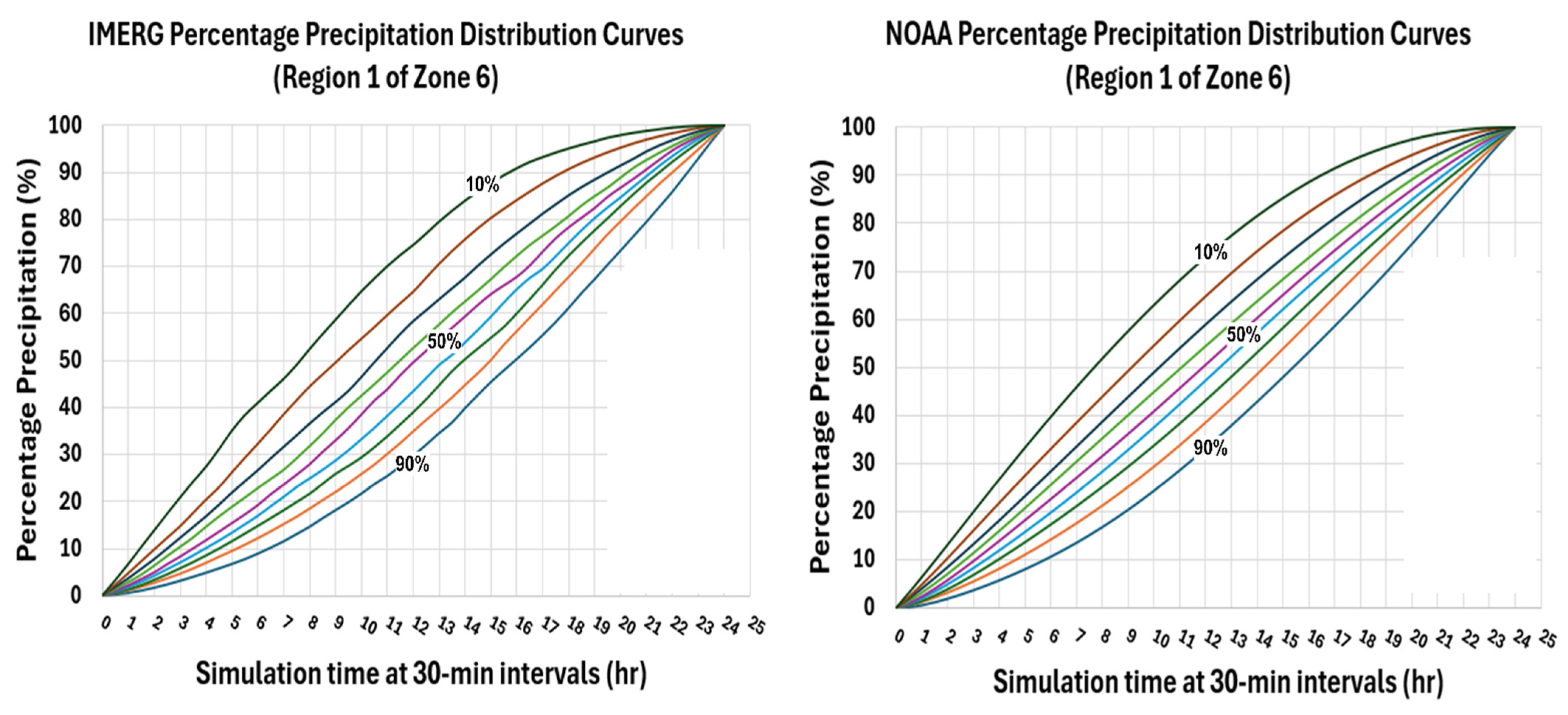
A quick visual comparison between the percentage precipitation distribution estimated from IMERG at a randomly selected region (Region 1 of Zone 6) suggests a fairly good agreement with NOAA Atlas 14 percentage precipitation distribution curves (
Figure 6).
Figure 6 suggests that the implemented IMERG design storm model was fairly consistent. The consistent agreement between the IMERG and NOAA percentage precipitation distribution curves in
Figure 6 shows the capability of IMERG to capture design storms relatively consistent with NOAA Atlas 14. This demonstrates the potential of utilizing IMERG beyond CONUS and at ungauged regions. In addition, the percentile ranges (10% to 90%) shown in
Figure 6 for each of the plots allow users to model the uncertainty in design storm characteristics.
5.2. Patterns in IMERG Percentage Precipitation Across Zones
The evaluation of IMERG percentile precipitation curves reveals interesting patterns that can be discussed under three main themes: across regions, zones, and the nine-percentile range (10–90%). In terms of regions, the study revealed that the least RMSE (1.3%) occurred in region 4 of zone 6. Region 4 of Zone 6 is situated in the northeastern part of California and is influenced by rainfall patterns that are intense and short-lived [
46,
47,
48,
49]. Not all precipitation in Region 4 of Zone 6 is captured by IMERG radar due to its short lifespan [
50]. The minimal RMSE observed in this region suggests that IMERG may be capturing the precipitation storms effectively. Similarly, Region 1 of Zone 1 recorded the highest RMSE value (10.8%). This region borders arid states such as Nevada, Utah, and parts of Arizona, characterized by low average rainfall throughout most of the year. Additionally, the sparse distribution of gauges in Region 1 implies limited station data availability for calibrating IMERG, which could contribute to the observed high RMSE values, as highlighted by Da Silva [
34].
We showed that zone 1 exhibited the most RMSE (10%). Zone 1 consistently records the lowest annual average precipitation across the United States due to its arid nature [
51,
52]. It has been observed that low-precipitation regions tend to exhibit higher RMSE when comparing station records with IMERG, as it perform relatively well in areas with high precipitation but struggle in arid regions [
53]. Conversely, zone 6 showcased the least RMSE estimate (2.4%) compared to other zones. Zone 6 is influenced by cyclonic storms, particularly in its northeastern portions, owing to its proximity to the Pacific Ocean, resulting in frequent rainfall throughout the year [
53].
Figure 7 provides a concise overview of IMERG performance across different zones.
At the percentile level, IMERG and NOAA Atlas 14 have better agreement between the 40th to 60th percentile indicated by low RB values, low RMSE, and minimal NSLI values between the 40th to 60th percentile range. The variation across percentile ranges offers options for understanding how IMERG curve behaves at specific regions and zones. These percentile ranges provide a balanced window for engineers to select appropriate IMERG storm curves for PMF modeling.
6. Conclusions
In this study, 24 h design storms were derived from IMERG data based on rainfall storms that meet 2-year return periods for pixels within NOAA Atlas 14 regions. The percentage rainfall distribution was computed from IMERG time-series precipitation data from 2001 to 2022 for regions and zones using the IMERG pixels with their centroids falling in the regions and zones. Nine percentile distributions (ranging from 10% to 90%) were derived from the series of percentage distributions and juxtaposed against observed NOAA Atlas 14 percent distribution curves.
Across the regions, the average RMSE was estimated at 3.7% while the average RB was estimated at 1.42%. NOAA Atlas 14 showed a mean NSLI value of −7.7% indicating that NOAA Atlas 14 is more frontloaded by ~8% of the total depth, while IMERG yielded a mean NSLI value of −4.1%, indicating IMERG is frontloaded but not as frontloaded as NOAA Atlas 14 with a difference of −3.6%. Across the zones, the mean RMSE was computed at 4.8%, mean RB was 10.7%. NOAA Atlas 14 estimated an average NSLI value of −9.7%, while IMERG presented a mean NSLI value of −5.7% indicating that IMERG was less frontloaded than NOAA Atlas 14 across the zones. The study found the 40th to 60th percentile curve harbors the highest agreement between IMERG and NOAA Atlas 14.
Although the IMERG dataset has shown promise for modeling design storms and can be a useful resource for storm design in ungauged locations, uncertainties still exist regarding how IMERG differs from the reference NOAA data in terms of temporal range, spatial resolution, and data retrieval methods. For example, NOAA data is provided as a set of percentile precipitation distribution curves, but the underlying base datasets used to compute these curves are not made available. It is understood that some regions may rely on base data dating back to the 1950s from which these curve families were derived, whereas IMERG data only dates back to the year 2000. In future evaluations, we plan to access station data that aligns with the IMERG temporal window (2001–2022) for a more robust assessment.
Additional uncertainties that are worthy of note are the lack of proper smoothening mechanism on the NOAA temporal distribution curve, which was not integrated in this study due to lack of transparency on the method used. We believe adding a smoothing effect could potentially enhance the comparability of IMERG to the NOAA data. Lastly, the base data that were used to construct the NOAA temporal distribution curves were not provided, as such the evaluations were limited to the provided percentile curves. Providing such reference data would potentially increase our validation.
In conclusion, the IMERG precipitation has shown prospect for modeling design storms in CONUS to further curb impact on hydrologic infrastructure such as dams, culverts, and bridges. However, the agreement with observation may vary across precipitation regions and quantiles. When compared against CONUS-bound NOAA Atlas 14 data, IMERG design storms exhibited moderate consistency with observed values. These modeled design storms provide valuable insights that can assist practitioners in selecting appropriate percentile curves for infrastructure design (e.g., within the 10% to 90% range). Future research will extend the evaluation of IMERG design storms to locations beyond CONUS.
Author Contributions
Conceptualization, K.O.E., X.L., J.K., J.K.R., and D.B.M.; methodology, K.O.E., X.L., J.K., J.K.R., and D.B.M.; software, K.O.E., X.L., and J.K.; validation, K.O.E., X.L., J.K., J.K.R., and D.B.M.; formal analysis, K.O.E., X.L., and J.K.; investigation, K.O.E., X.L., and J.K.; resources, K.O.E., X.L., and J.K.; data curation, K.O.E.; writing—original draft preparation, K.O.E., X.L., and J.K.; writing—review and editing, K.O.E., X.L., J.K., J.K.R., and D.B.M.; visualization, K.O.E., X.L., J.K., J.K.R., and D.B.M.; supervision, X.L., J.K., J.K.R., and D.B.M.; project administration, X.L. and J.K.; funding acquisition, J.K. All authors have read and agreed to the published version of the manuscript.
Funding
This work was funded by the National Science Foundation under the Kansas NSF-EPSCoR (award number OIA-2148878).
Data Availability Statement
Conflicts of Interest
The authors declare no conflict of interest.
References
- Adams, B.J.; Howard, C.D.D. Design Storm Pathology. Can. Water Resour. J. Rev. Can. Ressour. Hydr. 1986, 11, 49–55. [Google Scholar] [CrossRef]
- Boota, M.W.; Nabi, G.; Abbas, T.; Yaseen, M.; Faisal, M.; Azam, M.I. Estimation of Probable Maximum Flood (PMF): A Case Study of Pothwar Region, Pakistan. Sci. Int. 2015, 27, 6471–6476. [Google Scholar]
- Haxton, T.; Vesuviano, G.; Pucknell, S.; Kjeldsen, T.R. Probable Maximum Flood: The Potential for Estimation in the UK Using ReFH2. Hydrol. Res. 2023, 54, 360–371. [Google Scholar] [CrossRef]
- Jun, C.; Qin, X.; Lu, W. Temporal Pattern Analysis of Rainstorm Events for Supporting Rainfall Design in a Tropical City: UDM 2018. In Green Energy and Technology; Springer: Cham, Switzerland, 2019; pp. 380–384. ISBN 978-3-319-99866-4. [Google Scholar]
- Larsen, T. Real Rainfall Time Series for Storm Sewer Design; Laboratoriet for Hydraulik og Havnebygning: Aalborg, Denmark, 1981. [Google Scholar]
- Watt, W.; Chow, A.; Hogg, W.; Lathem, K. A 1-h Urban Design Storm for Canada. Can. J. Civ. Eng. 2011, 13, 293–300. [Google Scholar] [CrossRef]
- Chow, V.; Maidment, D.; Mays, L. Applied Hydrology, 1st ed.; McGraw-Hill Science/Engineering/Math: New York, NY, USA, 1988; ISBN 978-0-07-010810-3. [Google Scholar]
- Ekpetere, K. Validating the IMERG Remote Sensing Precipitation Data for Extremes Analysis Using the New Hybrid Depth Duration Frequency Model. Remote Sens. Appl. Soc. Environ. 2025, 38, 101547. [Google Scholar] [CrossRef]
- Gordon, K. Probable Maximum Flood Estimation Using a Statistical Approach and a Storm Model Approach for a Watershed in Southern St. Vincent. Civil Engineering Undergraduate Honors, University of Arkansas, Fayetteville, AR, USA, 2019. [Google Scholar]
- LaRocque, A. Probable Maximum Flood (PMF). In Encyclopedia of Natural Hazards; Bobrowsky, P.T., Ed.; Springer: Dordrecht, The Netherlands, 2013; pp. 777–778. ISBN 978-1-4020-4399-4. [Google Scholar]
- Ekpetere, K.; Coll, J.M.; Mehta, A.V. Revisiting the PMP Return Periods: A Case Study of IMERG Data in CONUS. Total Environ. Adv. 2024, 13, 200120. [Google Scholar] [CrossRef]
- Parrett, C.; USGS; USDI; Montana Department of Natural Resources and Conservation. Characteristics of Extreme Storms in Montana and Methods for Constructing Synthetic Storm Hyetographs; U.S. Geological Survey: Reston, VA, USA, 1998.
- Hewlett, J.D.; Fortson, J.C.; Cunningham, G.B. The Effect of Rainfall Intensity on Storm Flow and Peak Discharge from Forest Land. Water Resour. Res. 1977, 13, 259–266. [Google Scholar] [CrossRef]
- Chowdhury, S.; Sharma, A. A Simulation Based Approach for Representation of Rainfall Uncertainty in Conceptual Rainfall Runoff Models. Hydrol. Res. Lett. 2008, 2, 5–8. [Google Scholar] [CrossRef]
- Ahn, J.; Cho, W.; Kim, T.; Shin, H.; Heo, J.-H. Flood Frequency Analysis for the Annual Peak Flows Simulated by an Event-Based Rainfall-Runoff Model in an Urban Drainage Basin. Water 2014, 6, 3841–3863. [Google Scholar] [CrossRef]
- Bonnin, G.M.; Martin, D.; Lin, B.; Parzybok, T.; Yekta, M.; Riley, D. Precipitation-Frequency Atlas of the United States; U.S. Department of Commerce: Washington, DC, USA; National Oceanic and Atmospheric Administration and National Weather Service: Silver Spring, MD, USA, 2006.
- Perica, S.; Lin, B.; Martin, D.; Martin, F.; Brewer, D.; Trypaluk, C.; Yekta, M.; Hiner, L.; Heim, S.; Dietz, S.; et al. NOAA Atlas 14 Precipitation-Frequency Atlas of the United States; U.S. Department of Commerce: Washington, DC, USA; National Oceanic and Atmospheric Administration and National Weather Service: Silver Spring, MD, USA, 2011; Volume 5.
- Perica, S.; Martin, D.; Pavlovic, S.; Roy, I.; St. Laurent, M.; Trypaluk, C.; Unruh, D.; Yekta, M.; Bonnin, G. Precipitation-Frequency Atlas of the United States; U.S. Department of Commerce: Washington, DC, USA; National Oceanic and Atmospheric Administration and National Weather Service: Silver Spring, MD, USA, 2013.
- Navarro, A.; García-Ortega, E.; Merino, A.; Sánchez, J.L.; Tapiador, F.J. Orographic Biases in IMERG Precipitation Estimates in the Ebro River Basin (Spain): The Effects of Rain Gauge Density and Altitude. Atmos. Res. 2020, 244, 105068. [Google Scholar] [CrossRef]
- NOAA-OWP NOAA ATLAS 15: Update to the National Precipitation Frequency Standard 2022. Atlas-15; Volume 1, pp. 1–2. Available online: https://www.weather.gov/media/owp/hdsc_documents/NOAA_Atlas_15_Flyer.pdf (accessed on 15 July 2025).
- NOAA. NOAA Atlas 14 Time Series Data of Annual Maximum Precipitation. 2017; Volume 2, Version 3.0. Available online: https://hdsc.nws.noaa.gov/pfds/pfds_series.html (accessed on 24 June 2025).
- Trang, B.T.T.; Hanh, N.T.H.; Thuong, N.T.H.; Thuan, N.V. Analysis of Storm Pattern for Design Urban Drainage System in the Monsoon Areas of Vietnam. J. Environ. Sci. Eng. A 2018, 7, 49–68. [Google Scholar] [CrossRef]
- Wang, A.; Qu, N.; Chen, Y.; Li, Q.; Gu, S. A 60-Minute Design Rainstorm for the Urban Area of Yangpu District, Shanghai, China. Water 2018, 10, 312. [Google Scholar] [CrossRef]
- Yuan, F.; Wang, B.; Shi, C.; Cui, W.; Zhao, C.; Liu, Y.; Ren, L.; Zhang, L.; Zhu, Y.; Chen, T.; et al. Evaluation of Hydrological Utility of IMERG Final Run V05 and TMPA 3B42V7 Satellite Precipitation Products in the Yellow River Source Region, China. J. Hydrol. 2018, 567, 696–711. [Google Scholar] [CrossRef]
- Yuan, F.; Zhang, L.; Ren, L.; Zhao, C.; Zhu, Y.; Jiang, S.; Liu, Y. Applications of TRMM- and GPM-Era Multiple-Satellite Precipitation Products for Flood Simulations at Sub-Daily Scales in a Sparsely Gauged Watershed in Myanmar. Remote Sens. 2019, 11, 140. [Google Scholar] [CrossRef]
- Aksu, H.; Taflan, G.Y.; Yaldiz, S.G.; Akgül, M.A. Evaluation of IMERG for GPM Satellite-Based Precipitation Products for Extreme Precipitation Indices over Turkiye. Atmos. Res. 2023, 291, 106826. [Google Scholar] [CrossRef]
- Gebregiorgis, A.S.; Kirstetter, P.-E.; Hong, Y.E.; Gourley, J.J.; Huffman, G.J.; Petersen, W.A.; Xue, X.; Schwaller, M.R. To What Extent Is the Day 1 GPM IMERG Satellite Precipitation Estimate Improved as Compared to TRMM TMPA-RT? J. Geophys. Res. Atmos. 2018, 123, 1694–1707. [Google Scholar] [CrossRef]
- Peinó, E.; Bech, J.; Udina, M. Dependence of GPM IMERG Products on Precipitation Intensity in Catalonia. In Proceedings of the EGU General Assembly Conference, Vienna, Austria, 23–28 April 2023. [Google Scholar]
- Weng, P.; Tian, Y.; Jiang, Y.; Chen, D.; Kang, J. Assessment of GPM IMERG and GSMaP Daily Precipitation Products and Their Utility in Droughts and Floods Monitoring across Xijiang River Basin. Atmos. Res. 2023, 286, 106673. [Google Scholar] [CrossRef]
- Ekpetere, K. Assessment of the PMPs and Design Storms Estimated from the IMERG Satellite Precipitation Data. Available online: https://www.proquest.com/openview/243115218caa400d60aae35bb84191f3/1?pq-origsite=gscholar&cbl=18750&diss=y (accessed on 24 December 2024).
- Ekpetere, K.O. Development and Evaluation of the Modified and Standardized Rainfall Anomaly Indices for Extreme Variability Analysis. J. Environ. Manag. 2025, 375, 124160. [Google Scholar] [CrossRef]
- Ekpetere, K.O.; Mehta, A.V.; Coll, J.M.; Liang, C.; Onochie, S.O.; Ekpetere, M.C. Estimating Rainfall Anomalies with IMERG Satellite Data: Access via the IPE Web Application. Remote Sens. 2024, 16, 4137. [Google Scholar] [CrossRef]
- Anjum, M.N.; Ding, Y.; Shangguan, D.; Ahmad, I.; Ijaz, M.W.; Farid, H.U.; Yagoub, Y.E.; Zaman, M.; Adnan, M. Performance Evaluation of Latest Integrated Multi-Satellite Retrievals for Global Precipitation Measurement (IMERG) over the Northern Highlands of Pakistan. Atmos. Res. 2018, 205, 134–146. [Google Scholar] [CrossRef]
- Da Silva, N.A.; Webber, B.G.M.; Matthews, A.J.; Feist, M.M.; Stein, T.H.M.; Holloway, C.E.; Abdullah, M.F.A.B. Validation of GPM IMERG Extreme Precipitation in the Maritime Continent by Station and Radar Data. Earth Space Sci. 2021, 8, e2021EA001738. [Google Scholar] [CrossRef]
- Xin, Y.; Yang, Y.; Chen, X.; Yue, X.; Liu, Y.; Yin, C. Evaluation of IMERG and ERA5 Precipitation Products over the Mongolian Plateau. Sci. Rep. 2022, 12, 21776. [Google Scholar] [CrossRef]
- Lu, D.; Yong, B. Evaluation and Hydrological Utility of the Latest GPM IMERG V5 and GSMaP V7 Precipitation Products over the Tibetan Plateau. Remote Sens. 2018, 10, 2022. [Google Scholar] [CrossRef]
- Huffman, G.J. Algorithm Theoretical Basis Document (ATBD). In Version 06 of NASA Global Precipitation Measurement (GPM) Integrated Multi-satellitE Retrievals for GPM (IMERG); National Aeronautics and Space Administration: Washington, DC, USA, 2020. [Google Scholar]
- Wu, X.; Su, J.; Ren, W.; Lü, H.; Yuan, F. Statistical Comparison and Hydrological Utility Evaluation of ERA5-Land and IMERG Precipitation Products on the Tibetan Plateau. J. Hydrol. 2023, 620, 129384. [Google Scholar] [CrossRef]
- NASA Giovanni|NASA Global Precipitation Measurement Mission. Available online: https://gpm.nasa.gov/data/sources/giovanni (accessed on 9 February 2021).
- Schamm, K.; Ziese, M.; Becker, A.; Finger, P.; Meyer-Christoffer, A.; Schneider, U.; Schröder, M.; Stender, P. Global Gridded Precipitation over Land: A Description of the New GPCC First Guess Daily Product. Earth Syst. Sci. Data 2014, 6, 49–60. [Google Scholar] [CrossRef]
- Huffman, G.J.; Bolvin, D.T.; Nelkin, E.J.; Wolff, D.B.; Adler, R.F.; Gu, G.; Hong, Y.; Bowman, K.P.; Stocker, E.F. The TRMM Multisatellite Precipitation Analysis (TMPA): Quasi-Global, Multiyear, Combined-Sensor Precipitation Estimates at Fine Scales. J. Hydrometeorol. 2007, 8, 38–55. [Google Scholar] [CrossRef]
- Bono, R.; Arnau, J.; Alarcón, R.; Blanca, M.J. Bias, Precision, and Accuracy of Skewness and Kurtosis Estimators for Frequently Used Continuous Distributions. Symmetry 2020, 12, 19. [Google Scholar] [CrossRef]
- von Hippel, P. Skewness. In International Encyclopedia of Statistical Science; Lovric, M., Ed.; Springer: Berlin/Heidelberg, Germany, 2011; pp. 1340–1342. ISBN 978-3-642-04898-2. [Google Scholar]
- Wachulec, K.; Walega, A.; Młyński, D. The Effect of Time of Concentration and Rainfall Characteristics on Runoff Hydrograph in Small Ungauged Catchment. Przegląd Nauk. 2016, 25, 72–82. [Google Scholar]
- Yoo, C.; Cheolsoon, P.; Jun, C. Evaluation of the Concept of Critical Rainfall Duration by Bivariate Frequency Analysis of Annual Maximum Independent Rainfall Event Series in Seoul, Korea. J. Hydrol. Eng. 2015, 21, 05015016. [Google Scholar] [CrossRef]
- AghaKouchak, A.; Ragno, E.; Love, C.; Moftakhar, H. Projected Changes in California’s Precipitation Intensity-Duration-Frequency Curves; California Energy Commission: Sacramento, CA, USA, 2018.
- Hoell, A.; Quan, X.-W.; Hoerling, M.; Diaz, H.F.; Fu, R.; He, C.; Lisonbee, J.R.; Mankin, J.S.; Seager, R.; Sheffield, A.; et al. Water Year 2021 Compound Precipitation and Temperature Extremes in California and Nevada. Bull. Am. Meteorol. Soc. 2022, 103, E2905–E2911. [Google Scholar] [CrossRef]
- Hu, F.; Zhang, L.; Liu, Q.; Chyi, D. Environmental Factors Controlling the Precipitation in California. Atmosphere 2021, 12, 997. [Google Scholar] [CrossRef]
- Najibi, N.; Steinschneider, S. Extreme Precipitation-Temperature Scaling in California: The Role of Atmospheric Rivers. Geophys. Res. Lett. 2023, 50, e2023GL104606. [Google Scholar] [CrossRef]
- Zhou, Z.; Lu, D.; Yong, B.; Shen, Z.; Wu, H.; Yu, L. Evaluation of GPM-IMERG Precipitation Product at Multiple Spatial and Sub-Daily Temporal Scales over Mainland China. Remote Sens. 2023, 15, 1237. [Google Scholar] [CrossRef]
- Akinsanola, A.A.; Jung, C.; Wang, J.; Kotamarthi, V.R. Evaluation of Precipitation across the Contiguous United States, Alaska, and Puerto Rico in Multi-Decadal Convection-Permitting Simulations. Sci. Rep. 2024, 14, 1238. [Google Scholar] [CrossRef]
- Hoerling, M.; Smith, L.; Quan, X.-W.; Eischeid, J.; Barsugli, J.; Diaz, H.F. Explaining the Spatial Pattern of U.S. Extreme Daily Precipitation Change. J. Clim. 2021, 34, 2759–2775. [Google Scholar] [CrossRef]
- Liu, Y.; Zheng, Y.; Li, W.; Zhou, T. Evaluating the Performance of Satellite-Based Precipitation Products Using Gauge Measurement and Hydrological Modeling: A Case Study in a Dry Basin of Northwest China. J. Hydrometeorol. 2022, 23, 541–559. [Google Scholar] [CrossRef]
Figure 1.
NOAA Atlas 14 regions and zones: Semiarid Southwest (Zone 1, consisting of two regions), Ohio River Basin and surrounding states (Zone 2, one region), California (Zone 6, fourteen regions), Midwestern states (Zone 8, four regions), Southeastern states (Zone 9, two regions), Northeastern states (Zone 10, two regions), and Texas (Zone 11, three regions).
Figure 1.
NOAA Atlas 14 regions and zones: Semiarid Southwest (Zone 1, consisting of two regions), Ohio River Basin and surrounding states (Zone 2, one region), California (Zone 6, fourteen regions), Midwestern states (Zone 8, four regions), Southeastern states (Zone 9, two regions), Northeastern states (Zone 10, two regions), and Texas (Zone 11, three regions).
Figure 2.
The 24 h temporal distribution curve for the Mississippi Valley region (region 4) [
16,
17,
18]. The temporal distribution percentile curves (10–90%) denote the range of values at each time step that capture most of the variability in the dataset, allowing for both median and extreme behavior assessment through time.
Figure 2.
The 24 h temporal distribution curve for the Mississippi Valley region (region 4) [
16,
17,
18]. The temporal distribution percentile curves (10–90%) denote the range of values at each time step that capture most of the variability in the dataset, allowing for both median and extreme behavior assessment through time.
Figure 3.
Estimating 24 h design storms with 2-year return periods using IMERG data.
Figure 3.
Estimating 24 h design storms with 2-year return periods using IMERG data.
Figure 4.
NSLI chart showing the range of values from −1 to +1 (scaled −100% to +100%) with reference to the mid-point (at the 0-mark). Values increasing towards the negative axis are frontloaded while values increasing towards the positive axis are backloaded.
Figure 4.
NSLI chart showing the range of values from −1 to +1 (scaled −100% to +100%) with reference to the mid-point (at the 0-mark). Values increasing towards the negative axis are frontloaded while values increasing towards the positive axis are backloaded.
Figure 5.
Family of curves showing 24 h percentage cumulative distribution curve for region 1. The plot compares the percentage precipitation distribution estimated from IMERG against NOAA Atlas 14. The figure shows fair agreement between IMERG and NOAA Atlas 14.
Figure 5.
Family of curves showing 24 h percentage cumulative distribution curve for region 1. The plot compares the percentage precipitation distribution estimated from IMERG against NOAA Atlas 14. The figure shows fair agreement between IMERG and NOAA Atlas 14.
Figure 6.
Percentage precipitation distribution curves estimated from IMERG at a randomly selected region (Region 1 of Zone 6). The unsmoothed curves depicts the uncertainties with data-driven estimate against the use of functions as demonstrated in
Figure 5.
Figure 6.
Percentage precipitation distribution curves estimated from IMERG at a randomly selected region (Region 1 of Zone 6). The unsmoothed curves depicts the uncertainties with data-driven estimate against the use of functions as demonstrated in
Figure 5.
Figure 7.
IMERG-derived percentile precipitation distribution compared with NOAA across the zones. The comparison is based on an average over the nine percentiles (10–90%). Within the illustration, “O” denotes NOAA Atlas 14, while “P” represents IMERG.
Figure 7.
IMERG-derived percentile precipitation distribution compared with NOAA across the zones. The comparison is based on an average over the nine percentiles (10–90%). Within the illustration, “O” denotes NOAA Atlas 14, while “P” represents IMERG.
Table 1.
Statistical formulas, and their corresponding units.
Table 1.
Statistical formulas, and their corresponding units.
| Metric | Formula | Unit |
|---|
| Relative Bias (RB) | | % |
| Root Mean Square Error (RMSE) | | % |
| Normalized Storm Loading Index (NSLI) | | −100% to 100% |
Table 2.
Results of mean statistics at the 28 NOAA Atlas 14 regions summarized across the percentile range (10–90%). R is region, Z is zone, Diff-NSLI is the NSLI difference between NOAA and IMERG.
Table 2.
Results of mean statistics at the 28 NOAA Atlas 14 regions summarized across the percentile range (10–90%). R is region, Z is zone, Diff-NSLI is the NSLI difference between NOAA and IMERG.
| S/N | Regions | Centroids | RMSE (%) | RB (%) | NOAA-NSLI (%) | IMERG-NSLI (%) | Diff-NSLI (%) |
|---|
| 1 | R1 (Z1) | 3907 | 10.7 | 1.7 | −6.1 | −1.7 | −4.4 |
| 2 | R2 (Z1) | 7572 | 9.2 | −8.5 | −15.4 | −12.0 | −3.4 |
| 3 | R1 (Z2) | 11,644 | 5.8 | −1.3 | −7.8 | −5.4 | −2.4 |
| 4 | R1 (Z6) | 162 | 2.4 | 2.9 | −0.3 | 1.6 | −1.9 |
| 5 | R2 (Z6) | 236 | 2.4 | 5.4 | 0.2 | 2.0 | −1.8 |
| 6 | R3 (Z6) | 266 | 2.5 | 1.8 | −4.6 | −1.6 | −3.0 |
| 7 | R4 (Z6) | 240 | 1.3 | 1.5 | −5.4 | −3.8 | −1.6 |
| 8 | R5 (Z6) | 285 | 2.4 | −1.6 | 0.1 | 1.9 | −1.8 |
| 9 | R6 (Z6) | 275 | 2.4 | −7.4 | 2.3 | 3.6 | −1.3 |
| 10 | R7 (Z6) | 170 | 2.3 | 2.5 | −0.8 | 1.3 | −2.0 |
| 11 | R8 (Z6) | 300 | 2.4 | 1.6 | −6.5 | −3.0 | −3.5 |
| 12 | R9 (Z6) | 299 | 2.7 | 0.8 | −6.1 | −2.7 | −3.4 |
| 13 | R10 (Z6) | 211 | 2.5 | 1.8 | −4.2 | −1.3 | −2.9 |
| 14 | R11 (Z6) | 307 | 2.5 | 2.5 | −3.5 | −0.8 | −2.7 |
| 15 | R12 (Z6) | 132 | 2.4 | −1.2 | −4.1 | −1.3 | −2.9 |
| 16 | R13 (Z6) | 219 | 2.7 | −3.1 | −7.9 | −4.1 | −3.8 |
| 17 | R14 (Z6) | 1175 | 2.8 | −0.4 | −7.9 | −4.1 | −3.8 |
| 18 | R1 (Z8) | 12,054 | 5.0 | 7.0 | −19.4 | −12.7 | −6.7 |
| 19 | R2 (Z8) | 1483 | 4.2 | 5.6 | −13.8 | −8.5 | −5.3 |
| 20 | R3 (Z8) | 8584 | 5.0 | 4.0 | −18.1 | −11.7 | −6.4 |
| 21 | R4 (Z8) | 7851 | 3.0 | 10.0 | −8.7 | −4.7 | −4.0 |
| 22 | R1 (Z9) | 7851 | 3.0 | 10.0 | −8.7 | −4.7 | −4.0 |
| 23 | R2 (Z9) | 1393 | 3.4 | −10.0 | −7.0 | −3.4 | −3.6 |
| 24 | R1 (Z10) | 2361 | 2.9 | 7.4 | −8.6 | −4.6 | −3.4 |
| 25 | R2 (Z10) | 1011 | 2.5 | −6.1 | −4.5 | −1.5 | −3.0 |
| 26 | R1 (Z11) | 1728 | 6.5 | −0.5 | −22.4 | −14.9 | −7.4 |
| 27 | R2 (Z11) | 3977 | 4.7 | 10.4 | −16.8 | −10.7 | −6.1 |
| 28 | R3 (Z11) | 1094 | 3.4 | 3.2 | −10.3 | −5.9 | −4.4 |
| Average | 3.70 | 1.4 | 3.7 | −4.1 | −3.6 |
| Standard Deviation | 2.1 | 5.3 | 2.1 | 4.8 | 1.9 |
Table 3.
Results of mean statistics at the 7 NOAA Atlas 14 zones summarized across the percentile range.
Table 3.
Results of mean statistics at the 7 NOAA Atlas 14 zones summarized across the percentile range.
| ZONES | ZONES | RMSE (%) | RB (%) | NOAA-NSLI (%) | IMERG-NSLI (%) | Diff-NSLI (%) |
|---|
| 1 | 11,479 | 10.0 | −3.4 | −10.8 | −6.9 | −3.9 |
| 2 | 11,644 | 5.8 | −1.3 | −7.8 | −5.4 | −2.4 |
| 6 | 4277 | 2.4 | 0.5 | −3.5 | −0.9 | −2.6 |
| 8 | 29,972 | 4.3 | 6.6 | −15.0 | −9.4 | −5.6 |
| 9 | 9244 | 3.2 | 0.02 | −7.9 | −4.1 | −3.8 |
| 10 | 3372 | 2.7 | 0.7 | −6.5 | −3.1 | −3.5 |
| 11 | 6799 | 4.8 | 4.4 | −16.5 | −10.5 | −6.0 |
| Average | 4.8 | 1.1 | −9.7 | −5.7 | −4.0 |
| St. Dev. | 2.6 | 3.4 | 4.7 | 3.5 | 1.4 |
Table 4.
Results of mean statistics at the percentiles summarized across the regions.
Table 4.
Results of mean statistics at the percentiles summarized across the regions.
| S/N | Percentile (%) | RMSE (%) | RB (%) | NOAA-NSLI (%) | IMERG-NSLI (%) | Diff-NSLI (%) |
|---|
| 1 | 10 | 2.2 | 0.2 | 25.2 | 26.8 | −1.6 |
| 2 | 20 | 2.1 | 2.1 | 14.9 | 18.0 | −3.0 |
| 3 | 30 | 3.3 | 0.3 | 6.8 | 11.0 | −4.4 |
| 4 | 40 | 3.4 | 3.5 | −0.7 | 4.2 | −4.9 |
| 5 | 50 | 3.9 | 6.7 | −8.0 | −4.8 | −3.2 |
| 6 | 60 | 3.7 | −0.1 | −15.4 | −10.7 | −4.7 |
| 7 | 70 | 4.1 | −0.5 | −23.0 | −18.6 | −4.4 |
| 8 | 80 | 4.7 | 1.3 | −31.0 | −26.7 | −4.3 |
| 9 | 90 | 5.7 | −0.7 | −38.5 | −36.2 | −2.3 |
| Average | 3.7 | 1.4 | −7.7 | −4.1 | −3.6 |
| St. Dev. | 1.1 | 2.4 | 21.3 | 21.0 | 1.2 |
Table 5.
Results of mean statistics at the percentiles summarized across the zones.
Table 5.
Results of mean statistics at the percentiles summarized across the zones.
| S/N | Percentile (%) | RMSE (%) | RB (%) | NOAA-NSLI (%) | IMERG-NSLI (%) | Diff-NSLI (%) |
|---|
| 1 | 10 | 2.5 | 2.2 | 28.3 | 29.1 | −0.9 |
| 2 | 20 | 2.4 | 3.5 | 16.8 | 19.3 | −2.5 |
| 3 | 30 | 3.9 | 0.03 | 7.4 | 11.5 | −4.1 |
| 4 | 40 | 4.1 | 6.2 | −1.3 | 3.6 | −4.8 |
| 5 | 50 | 4.9 | 5.6 | −9.9 | −6.4 | −3.6 |
| 6 | 60 | 4.9 | 1.3 | −18.8 | −13.5 | −5.3 |
| 7 | 70 | 5.5 | −8.5 | −27.8 | −22.4 | −5.4 |
| 8 | 80 | 6.6 | 2.1 | −37.2 | −31.7 | −5.5 |
| 9 | 90 | 8.1 | −2.9 | −44.9 | −41.2 | −3.7 |
| Average | 4.8 | 1.1 | −9.7 | −5.7 | −4.0 |
| St. Dev. | 1.8 | 4.5 | 24.8 | 23.7 | 1.5 |
| Disclaimer/Publisher’s Note: The statements, opinions and data contained in all publications are solely those of the individual author(s) and contributor(s) and not of MDPI and/or the editor(s). MDPI and/or the editor(s) disclaim responsibility for any injury to people or property resulting from any ideas, methods, instructions or products referred to in the content. |
© 2025 by the authors. Licensee MDPI, Basel, Switzerland. This article is an open access article distributed under the terms and conditions of the Creative Commons Attribution (CC BY) license (https://creativecommons.org/licenses/by/4.0/).




 ,
,