Article

Drought–Flood Abrupt Alternation in the Heilongjiang River Basin Under Climate Change: Spatiotemporal Patterns, Drivers, and Projections

1
Northeast Institute of Geography and Agroecology, Chinese Academy of Sciences, No. 4888, Shengbei Street, Changchun 130102, China
2
Heilongjiang River-Lake Chief Systems College, Heilongjiang University, Harbin 150080, China
*
Authors to whom correspondence should be addressed.
Water 2025, 17(23), 3436; https://doi.org/10.3390/w17233436
Submission received: 1 November 2025 / Revised: 27 November 2025 / Accepted: 29 November 2025 / Published: 3 December 2025
(This article belongs to the Special Issue Advances in Extreme Hydrological Events Modeling)

Abstract

Climate change has exacerbated the occurrence of complex extreme hydrological events in high-latitude cold regions, among which drought–flood abrupt events (DFAAEs) threaten food and water security, and accurately predicting their future evolution remains a key challenge. This study used the Community Water Model (CWatM) hydrological model, combined with five CMIP6 climate models, to simulate runoff datasets for historical periods (1985–2014) and future shared socioeconomic pathways (SSPs: SSP126, SSP370, SSP585: 2015–2100). We calculated the DFAA index (DFAAI), analyzed the spatiotemporal distribution patterns and predicted future trends of DFAAEs in the Heilongjiang River Basin, and explored their climatic driving mechanisms. The main conclusions are as follows: (1) Under SSPs, precipitation and evaporation increase from northwest to southeast, and temperature increases from north to south; hotspots expand inland. By 2100, annual precipitation will reach 655, 700, and 720 mm; mean air temperature will rise by 3, 6, and 7 °C; and annual evapotranspiration will reach 460, 515, and 521 mm. (2) Relative to the historical period, DFAAEs increase from 5.9 to 6.6, 7.1, and 7.5 events per year (SSP126/370/585). Coverage rises from 10.6% to 12.7%, 17.1%, and 19.0%, while mean intensity remains 1.8–2.0. Across both the historical period and SSPs, the shares of light (69–74%), moderate (20–24%), and severe (6–8%) events are stable. (3) Principal Component 1 (PC1,62.9%) reflects a precipitation-dominated wetting mode with synchronous increases in evapotranspiration and is the primary driver of DFAAI variability. PC2 (20.3%) captures an energy-related mode governed mainly by evapotranspiration and indirectly modulated by air temperature, providing a secondary contribution. These results clarify DFAA mechanisms and inform water-resources security planning in the Heilongjiang River Basin.

1. Introduction

Global warming is profoundly altering the frequency, intensity, and spatial extent of extreme hydrological events. According to the Intergovernmental Panel on Climate Change (IPCC) Sixth Assessment Report (AR6), the global mean surface temperature during 2011–2020 was about 1.1 °C higher than in 1850–1900 and is projected to continue rising over the coming decades [1]. Warming enhances atmospheric moisture-holding capacity and dynamical instability, reshaping moisture transport, precipitation formation, and runoff processes [2]. Consequently, compound extreme hydrological events are occurring more frequently, posing frontier challenges for climate-risk research [3]. Compound extreme events refer to multiple climatic drivers or extremes that occur concurrently or sequentially across time, space, or variables, with impacts that exceed those of any single event. Among compound extreme events, drought–flood abrupt alternation (DFAA) is highly destructive [4]. Its core feature is the rapid transition between drought and flood on short time scales, with two principal types: drought-to-flood and flood-to-drought [5]. Such events are typically abrupt, short-lived, and intense, often exceeding the response capacity of conventional hydrological regulation and early warning systems and triggering yield losses, water-system imbalance, and cascading urban–rural impacts [6]. They pose a severe challenge to traditional single-hazard-oriented early-warning systems [7].
Recently, both the size and number of regions affected by DFAA have increased markedly year by year. In urban systems, secondary risks triggered by DFAA are becoming increasingly prominent. Soil desiccation during drought suppresses infiltration when rainfall arrives, significantly increasing surface runoff and thereby amplifying the intensity and frequency of urban flooding [7,8]. During the 7·20 Zhengzhou rainstorm in 2021, 201.9 mm of rain fell within one hour, causing severe urban disasters—a typical compound hydrological crisis driven by DFAA [9,10]. Against the backdrop of increasingly frequent extreme climate events, the rising incidence of compound dry–wet hazards will further exacerbate agriculture’s vulnerability to climate change [4,6]. In agricultural systems, DFAA events disrupt water-supply continuity and rhizosphere oxygen availability during critical phenological stages, seriously jeopardizing yield stability [11,12]. Studies show that in major rice-growing regions—the middle–lower Yangtze Plain and Northeast China—DFAA events can reduce rice yields by 10–35%; the impacts of DFAA events generally exceed those of drought-only stress events, and disturbances during the heading and grain-filling stages are particularly harmful [6,13]. Recent studies indicate that drought–flood abrupt alternation events (DFAAEs) have evolved from regional hazards into a global compound risk, with systemic impacts, spatial synchrony, and intensity all increasing [14,15]. These events are typically driven by multiple climatic factors and exhibit pronounced synergy, nonlinearity, and amplification effects [4,16]. Subseasonal anomalies dominated by the El Niño–Southern Oscillation (ENSO) are seriously disrupting precipitation stability in monsoon-margin regions such as the Horn of Africa, the Indian subcontinent, and Central America, heightening risks to agriculture and water security [17]. In South Asia, for example in Pakistan, changes in DFAA intensity have exacerbated cotton yield losses and volatility in farmers’ incomes [18]. Based on CMIP6 multi-model simulations and reanalysis datasets, studies project that under high-emission pathways, the intensity and frequency of DFAA will increase significantly in monsoon-margin and climatic transition zones worldwide, with the most pronounced escalation in East and South Asia and Central America [14,15]. These trends manifest not only as more frequent flash droughts and heavy rainfall, but also as systemic features such as seasonal mismatch and synchronized atmospheric forcing [17,19]. High-risk belts are projected to extend from mid- to low-latitude monsoon regions toward higher latitudes, cold regions, and transition zones; the Asian monsoon margins and the boreal–temperate monsoon zone are considered particularly vulnerable [15,20]. However, for the Heilongjiang River Basin —a high-latitude cold-region basin highly sensitive to climate change—quantitative studies and analyses on future projections of DFAA remain scarce [21,22].
At present, research on the drivers of DFAA is mainly concentrated in a few river basins, and most studies emphasize single meteorological factors [4,8]. Mean water vapor pressure has been identified as a primary factor influencing DFAA variability in the Huai River Basin, and analyses of DFAA evolution and prediction have been conducted [7,23]. The eastern China monsoon region is influenced by Niño-3.4, the Pacific Decadal Oscillation, the Southern Oscillation Index, the Atlantic Multidecadal Oscillation, and land-use change [16,24]. Precipitation is the principal factor leading to DFAA changes in the Yangtze River Basin [25]. Studies in the Yellow River Basin indicate that mean water vapor pressure is a key driving factor [7]. Traditional single-variable approaches struggle to capture multi-source drivers, underscoring the need for cross-variable, multi-source data-fusion frameworks for compound-hazard risk assessment and response [4,8,16]. Findings from monsoon-margin regions further indicate that DFAA hazards are intensifying, highlighting the necessity of adopting comprehensive, physically consistent multivariate methods [14,17]. Therefore, in the high-latitude cold-region HRB, it is crucial to quantitatively investigate the driving mechanisms of DFAA under the synergistic effects of multiple climatic factors [21,26].
As a representative transboundary cold-region basin, the HRB lies in China’s northernmost temperate monsoon zone and exhibits distinct cryospheric hydrology: snow cover persists for more than 180 days, and permafrost occupies over 60% of the area, leading to pronounced spatiotemporal heterogeneity in water availability [21,27,28]. In spring, snowmelt combined with precipitation readily triggers flooding; in autumn, reduced evaporation and earlier first frost intensify regional drought [29,30]. Early-winter soil freezing and an abrupt decline in precipitation further exacerbate moisture deficits, producing seasonal DFAAEs, with drought-to-flood typically occurring within 2–3 months [15,22]. In recent decades, human activities have accelerated hydrological restructuring: the Sanjiang Plain has added more than 3 million hectares of irrigation, groundwater tables have declined by more than 2.4 m, and revised reservoir operation rules have significantly delayed flood peaks [31,32]. Against the backdrop of warming and permafrost degradation, the basin’s hydrological system has shifted from a climate-dominated regime to a climate–human coupled system, with increasingly complex hydrological responses [29,33]. Owing to its geographic particularity, the HRB is highly sensitive to climate change [1,26]. Recent studies examining DFAA frequency and intensity from 1970 to 2019 indicate a basin-wide trend of increasing drought-to-flood frequency and decreasing flood-to-drought frequency, with pronounced seasonality [15,22,34]. Nevertheless, comprehensive research on the historical and projected frequency, intensity, and affected area of DFAA in the HRB is still needed [16,35].
This study employs the Community Water Model (CWatM) driven by five CMIP6 climate models to simulate monthly runoff in the Heilongjiang River Basin from 1985 to 2100. Based on these simulations, a runoff-based DFAA Index (DFAAI) is developed to identify and characterize DFAA events during the historical period (1985–2014) and under future scenarios (SSP126, SSP370, SSP585; 2015–2100). Compared with previous DFAA studies, our framework extends precipitation-only indices by using basin-scale runoff and by combining linear regression with principal component analysis (PCA) to quantify the relative roles of precipitation, temperature, and evapotranspiration. The objectives are to (1) reveal the spatiotemporal differentiation of key future climate variables in the basin; (2) elucidate the evolution of future DFAAEs at the monthly runoff scale; and (3) clarify how the main climatic drivers control the occurrence and characteristics of these events. The findings provide a scientific basis for monitoring, early warning, and risk prevention of extreme hydrological events in cold-region basins.

2. Materials and Methods

2.1. Study Area

The Heilongjiang River Basin is located in Northeast Asia (41° N to 56° N latitude, 108° E to 141° E longitude), spanning China, Russia, and Mongolia (Figure 1). With a catchment area of approximately 184.3 × 10⁴ km2, it is the largest transboundary river basin in Northeast Asia. Its transnational nature endows it with significant geoecological influence. This region serves not only as a vital water resource strategic zone within the Belt and Road Initiative but also as a key area for studying composite hydrological extremes in cold regions. The basin exhibits pronounced topographical variation, with mountain ranges such as the Greater Khingan, Lesser Khingan, and Changbai Mountains forming its periphery, while vast plains dominate the central area. This configuration determines the high spatial heterogeneity of climatic and hydrological processes [36].
The basin exhibits a typical cold-temperate monsoon climate, with a long-term average temperature of approximately 0.79 °C and average annual precipitation of about 460 mm, generally increasing from west to east [21]. The cryosphere exhibits pronounced characteristics, with a snow cover period exceeding 180 days and permafrost covering over 60% of the basin. These conditions create temporal mismatches between water supply and demand. In spring, snowmelt coinciding with rainfall often triggers floods, whereas in autumn drought conditions are intensified due to reduced evapotranspiration and early frosts [22,29,36].
The Heilongjiang River Basin drains into the Sea of Okhotsk through the main stem of the Heilongjiang River and ranks among the world’s large rivers in terms of discharge. The long-term mean annual runoff is about 330–380 km3, with an average discharge of roughly 10,000 m3 s−1 near the river mouth, and about 80–90% of the annual flow occurs between April and October when snowmelt and the East Asian summer monsoon jointly control the hydrograph. The basin has a dense river network, with the Songhua, Ussuri, Zeya, and Bureya rivers contributing most of the streamflow, and the Amur River typically exhibits a bimodal annual cycle with a moderate snowmelt freshet in May and a main flood season in July–September. Summer–autumn rain-induced floods can be catastrophic in some years, whereas multi-year drought episodes (e.g., 1999–2001 and 2007–2009) can reduce annual runoff by more than 20% relative to the long-term mean, causing serious agricultural and ecological water shortages in the Songhua and Sanjiang Plain sub-basins.
In recent decades, human activities have profoundly altered the basin’s hydrological patterns. Agricultural expansion across the Sanjiang Plain has increased irrigated land to over 3 million hectares, while excessive groundwater extraction has lowered the water table by more than 2.4 m [37]. At the same time, the regulation of runoff by large and medium-sized reservoirs has further reshaped the temporal and spatial distribution of surface runoff. Under the combined influence of global warming and permafrost degradation, the basin’s hydrological system is gradually shifting from a climate-dominated regime to a complex coupled system influenced by the cryosphere, climate, and human activities, significantly increasing its sensitivity to DFAA events [35]. The severe DFAA event in 2013, characterized by a rapid transition from multi-year hydrological drought to record-breaking summer floods with prolonged high water levels along the main stem, affected over 4 million people and caused economic losses of approximately USD 4 billion, highlighting the urgency of deepening understanding of the mechanisms of compound hydrological risks and enhancing collaborative governance capabilities in this transboundary cold-region watershed.

2.2. Data

2.2.1. Runoff Data

The runoff data used in this study were obtained from the daily runoff simulation run by the Community Water Model (CWatM), which is a large-scale hydrological and water resources model with a spatial resolution of 0.5°. The model can simulate global and regional hydrological processes within a daily timestep range of 30 arcmin to 30 arcsec. The CWatM encompasses general surface water and groundwater hydrological processes, while also accounting for human activities—such as water use and reservoir regulation—by calculating water demand, water use, and backflow. Reservoirs and lakes are also incorporated into the model framework. In this study, the runoff data spanning from 1970 to 2019 were selected for analysis. In this study, runoff and evapotranspiration data from 2007 to 2012 were used for calibration, and data from 2012 to 2017 were used for validation. The model’s performance was evaluated using the Kling–Gupta Efficiency (KGE) metric, which provided a comprehensive assessment of the simulation accuracy. The model was calibrated and validated in our previously published work; readers are referred to that publication for details [22]. The model produces daily runoff on a 0.5° × 0.5° grid, which in this study is aggregated to monthly discharge series for the historical period and future scenario analysis.

2.2.2. Meteorological Data

The historical meteorological data used in this study mainly include daily precipitation (mm), daily temperature (°C), and daily actual evapotranspiration (mm), all with a spatial resolution of 0.25°, spanning from 1985 to 2014. The data are sourced from the China Meteorological Administration, website: http://www.nmic.cn/data (accessed on 25 July 2025). The high-precision dataset in the grid is derived from 2472 national meteorological stations.
Meteorological data for the future period comes from the ISIMIP3b repository and includes daily precipitation (kg m−2 s−1) and near-surface air temperature tas (K), with a grid of 0.5°. The forcings were generated with ISIMIP3BASD v2.5 using the W5E5 v2.0 reference with a 1979–2014 training period and are available for the historical window 1850–2014 and the future scenarios SSP126, SSP370, and SSP585 during 2015–2100. Evapotranspiration data come from the Water global sector model CWatM and consist of monthly total evapotranspiration evap-total in kg m−2 s−1 on 0.5° grids defined as the sum of plant transpiration, soil and canopy evaporation, interception loss, and sublimation. All three datasets are provided as a consistent five-model CMIP6 ensemble under ISIMIP3b to ensure comparability across variables, scenarios, and periods. All datasets were obtained from the ISIMIP data portal, website: https://data.isimip.org (accessed on 27 July 2025). These five GCMs (Table 1) were chosen because they provide the daily variables required for 0.5° resolution under historical scenarios and SSP126/370/585 scenarios, and they have been shown in previous assessments to reasonably reproduce temperature and precipitation patterns in East Asia.

2.3. Methods

2.3.1. Drought–Flood Abrupt Alternation Index

In this study, the Drought–Flood Abrupt Alternation Index (DFAAI) is used to quantitatively identify DFAAEs, which describe the rapid alternation between drought and flood. This index is calculated based on runoff, serving as a quantitative indicator for evaluating the frequency and intensity of such events [7].
D F A A I = N Q i N Q i 1 · | N Q i + N Q i 1 · α N Q i + N Q i 1 i = 2 , 3 , 4 , , n
N Q i = Q i Q ¯ σ
where N Q i and N Q i 1 represent the normalized monthly runoff for month i and month i−1; Q i is the average monthly runoff; Q ¯ and σ are the mean and standard error of Q i ; α is the monthly weight coefficient (a value of 3.2 is more appropriate); i is the month number, and n is the total number of months in the study period [7]. The item ( N Q i N Q i 1 ) represents the intensity of the DFAAs; the item ( | N Q i | + | N Q i 1 | ) denotes the magnitude of the droughts and floods; and α | N Q i + N Q i 1 | is the weight coefficient (which may decrease the weight of droughts or floods in two consecutive months and increase the weight of the DFAAEs). DFAAI values greater than 1 (>1) or less than −1 (<−1) are defined as drought-to-flood or flood-to-drought, respectively. The greater the absolute value of the DFAAI, the stronger the DFAAEs. The intensity classification used in this study is summarized in Table 2.
In this study, DFAAEs refer to the sum of drought-to-flood and flood-to-drought events.
For each consecutive grid cell and each year, the frequency of DFAA events is calculated as the number of months where |DFAAl| > 1 (i.e., months classified as drought-to-flood or flood-to-drought).
The intensity of drought–flood abrupt events is calculated as the average of |DFAAI| across all drought-to-flood and flood-to-drought months in that year.
The areal coverage of DFAA events is defined as the ratio between (i) the total area of grid cells that experience at least one DFAA month in a given year and (ii) the total land area of the basin.

2.3.2. Linear Regression Method

The linear regression method is used to analyze the linear trend relationship between two variables. Its basic form is
y = β 0 + β 1 x + ε y
where β 0 is the intercept, representing the value of y when x = 0 ; β 1 is the slope, indicating the average change in y with a unit change in x ; and ε is the error term, representing the influence of unobserved or omitted factors in the model.
In general, the ordinary least squares (OLS) method is used to estimate the values of β 0 and β 1 . The goal is to minimize the sum of squared errors (SSE) between observed values y i and predicted values y ˆ i . For the SSE function with respect to β 0 and β 1 , taking partial derivatives and setting them equal to zero gives the estimates of β 0 and β 1 :
S S E = i = 1 n ( y i y i ^ ) 2 = i = 1 n [ y i ( β 0 + β 1 x i ) ] 2
β ^ 1 = i = 1 n ( x i x ¯ ) ( y i y ̿ ) i = 1 n ( x i x ¯ ) 2
β ^ 0 = y ¯ β ^ 1 x
where x = 1 n i = 1 n   x i ,     y = 1 n i = 1 n   y i are the sample means of x and y , respectively.
In this study, least-squares linear regression is applied to the annual DFAA indicators and climate variables, and trend significance is assessed with a Student’s t-test at the 0.05 level, because this method provides a simple and widely used way to quantify long-term tendencies and compare the influence of different drivers.

2.3.3. Principal Component Analysis

Principal component analysis (PCA) is used to transform multiple correlated variables into a few mutually uncorrelated comprehensive indices, i.e., principal components. Suppose there are n samples, each with p variables; the data matrix can be expressed as
X = x i j n × p
First, standardize the data to obtain the standardized matrix
Z = z i j n × p
with
z i j = x i j x j s j
where x i j is the j -th variable of the i -th sample, x j is the mean of the j -th variable, and s j is the standard deviation of the j -th variable.
The covariance matrix of Z is denoted as
S = s i j p × p
where
s i j = 1 n 1 k = 1 n   z k i z i z k j z j
and z i is the i -th variable of the k -th row in the standardized matrix Z (with mean value 0 after standardization).
Then, perform eigenvalue decomposition of the covariance matrix S :
S = i = 1 P   λ i u i u i
Here, λ i are the eigenvalues ( λ 1 λ 2 λ p 0 ), and u i are the corresponding eigenvectors.
The i -th principal component F i can be expressed as a linear combination of the original variables:
F i = u i 1 x 1 + u i 2 x 2 + + u i p x p ,   i = 1 , 2 , , p
where u i j is the j -th element of the i -th eigenvector. In practical applications, usually only the first m principal components ( n < p ) are selected, such that the cumulative contribution rate i = 1 m λ i / i = 1 p λ i reaches a predetermined threshold (e.g., 80–90%), thereby achieving the dimensionality reduction purpose.
PCA is performed on the correlation matrix of standardized annual anomalies of precipitation, temperature, evapotranspiration, and DFAAI in order to reduce multicollinearity and extract a few dominant modes that summarize the combined effect of these strongly correlated variables.

3. Results

3.1. Spatiotemporal Characteristics of Future Meteorological Factors

3.1.1. Temporal Characteristics of Future Climate Factors

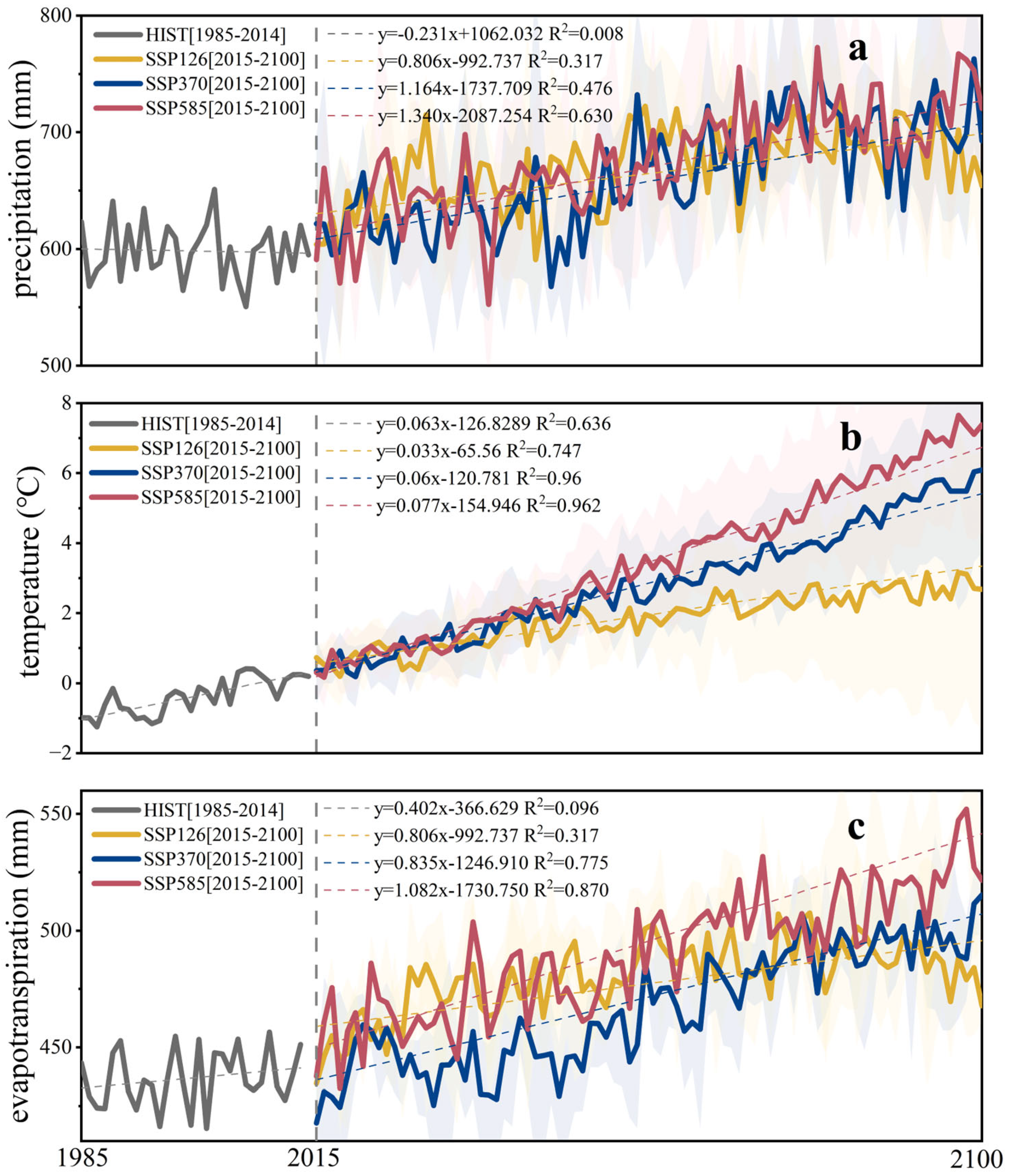
Figure 2a–c illustrate the interannual variations of precipitation, temperature, and evapotranspiration under different SSPs during historical periods (1985–2014) and future periods (2015–2100). Figure 2a shows that the annual precipitation growth rate during the historical period was −0.231 mm/a, with an R2 of 0.008, indicating significant interannual variations but small long-term increases and decreases. Under the future SSP126, SSP370, and SSP585 scenarios, the annual precipitation growth rates are 0.806 mm/a, 1.164 mm/a, and 1.340 mm/a, respectively, with R2 values of 0.317, 0.476, and 0.630, respectively, indicating that with increasing emissions, humidification accelerates, and annual precipitation shifts from a predominantly fluctuating pattern to a smoother increase. Annual precipitation is projected to reach 655 mm, 700 mm, and 720 mm by 2100, respectively.
Figure 2b shows that the historical average annual temperature rose by 0.063 °C/a, with an R2 of 0.636, indicating a generally continuous increase accompanied by interannual fluctuations. Looking ahead, under SSP126, SSP370, and SSP585 scenarios, the annual average temperature is projected to rise by 0.033 °C/a, 0.060 °C/a, and 0.077 °C/a, respectively, with R2 values of 0.747, 0.960, and 0.962. With increasing emissions, the warming rate accelerates, resulting in a continuous rise in annual average temperature without a significant decline. It is projected that by 2100, temperatures will reach approximately 3 °C, 6 °C, and 7 °C, respectively.
Figure 2c shows that historically, annual evapotranspiration increased by 0.402 mm/a, with an R2 of 0.096, exhibiting significant interannual fluctuations and the smallest long-term increase, making it the least pronounced of the three factors. Under SSP126, SSP370, and SSP585 scenarios, future evapotranspiration is projected to increase by 0.806 mm/a, 0.835 mm/a, and 1.082 mm/a, respectively, with R2 values of 0.317, 0.775, and 0.870. With increasing emissions, the increase shifts from a slight rise to a steady increase, with the enhancement primarily occurring in medium to high emission scenarios. The magnitude of this increase remains lower than that of temperature and close to, but slightly lower than, precipitation. Evapotranspiration is projected to reach approximately 460 mm, 515 mm, and 520 mm by 2100, respectively.
Overall, the future climate background will be characterized by warming, increased humidity, and enhanced evapotranspiration, and this trend will become more pronounced with increasing emissions.

3.1.2. Spatial Characteristics of Future Climate Factors

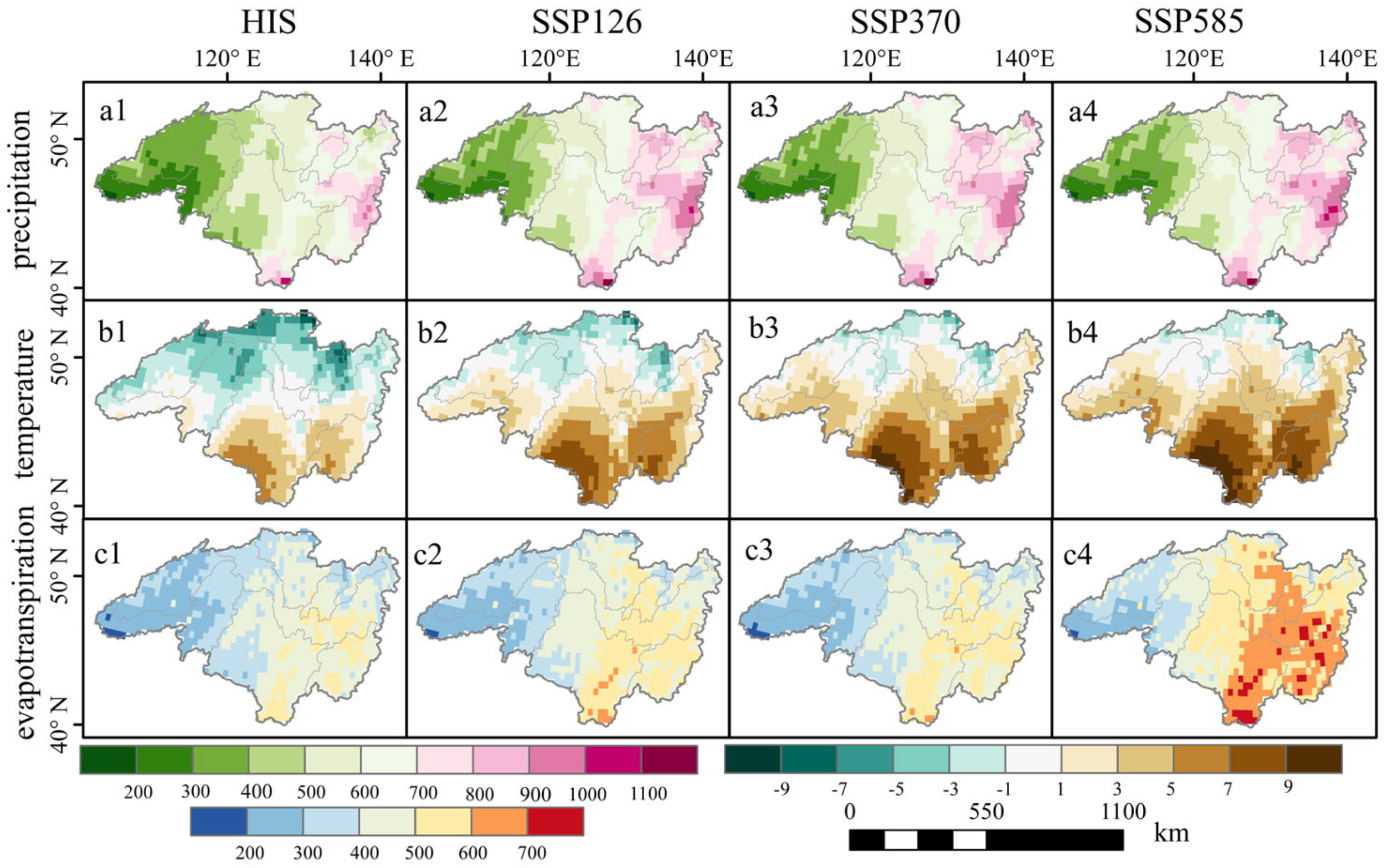
Figure 3a–c shows the spatial distribution of multi-year average precipitation, temperature, and evapotranspiration in the Heilongjiang River Basin during historical periods (1985–2014) and future periods (2015–2100) under SSPs. Figure 3a shows that annual precipitation in each period follows a pattern of low in the northwest and high in the southeast. Historically, areas with low annual precipitation are located in Erguna, Shilka, Heilongjiang Mainstream, and the upper reaches of Songhua River Basin, with annual precipitation of approximately 200–500 mm; areas with moderate annual precipitation are located in the middle reaches of Songhua River Basin, the middle reaches of Heilongjiang Mainstream, and Bureya River Basin, with annual precipitation of approximately 500–700 mm; and areas with high values are concentrated in the middle and lower reaches of Ussuri River Basin, the eastern section of Heilongjiang Mainstream, and the southeastern edge of Songhua River Basin, with annual precipitation of approximately 800–1100 mm. In future scenarios, the spatial pattern remains unchanged, but areas with annual precipitation exceeding 700 mm continue to expand outwards, while the temperature of the upstream low-temperature zone increases in value and decreases in area. Under scenario SSP585, the low-temperature zone expands towards the southeastern edge of Ussuri and Songhua River Basin, with annual precipitation reaching 900–1200 mm.
Figure 3b shows the regional distribution pattern of annual average temperature increasing from north to south. Historically, the low-temperature zone was mainly located in the Zeya, Bureya, ARB, and Shilka River, as well as northern HRB, with temperatures below freezing. The mid-temperature zone was mainly located in Songhua and Ussuri River Basin, with temperatures between 1 and 3 °C. As the scenarios intensify, the isotherms generally shift southward and rise in temperature. Under scenarios SSP370 and SSP585, the high-temperature zone in Songhua and Ussuri River Basin and the southeastern section of the main stream generally has temperatures between 5 and 10 °C, while the temperatures in the upper reaches of Erguna, Shilka, and Zeya River Basin, although still below 5 °C, are significantly higher than historical levels.
Figure 3c shows that historically, annual evapotranspiration has tended to be lower in the northwest and higher in the southeast. Low evapotranspiration areas are mainly distributed in the upper reaches of Erguna, Shilka, and Zeya River Basin, with evapotranspiration of approximately 100–400 mm; the middle reaches of HRB and Bureya River Basin have evapotranspiration of approximately 400–500 mm. Moderate evapotranspiration areas are located along the southeastern edges of Ussuri and Songhua River Basin and their southeastern sections, with evapotranspiration of approximately 500–700 mm. Future scenarios show an overall upward trend in evapotranspiration. Under scenario SSP585, Bureya, Heilongjiang Mainstream, Songhua River Basin, and the southeastern section of Ussuri River Basin will form a continuous high evapotranspiration area, with evapotranspiration of 600–800 mm; while evapotranspiration in the upper northwest region will increase to approximately 300–500 mm, still at a relatively low level.
Overall, evapotranspiration remained stable under both historical and future scenarios. However, as the scenario evolved from SSP126 to SSP585, evapotranspiration generally showed an upward trend, with the high evapotranspiration area expanding outward and the upstream low evapotranspiration area shrinking and moving upward.

3.2. Spatiotemporal Variations of DFAAEs

3.2.1. Temporal Characteristics of Future DFAAEs

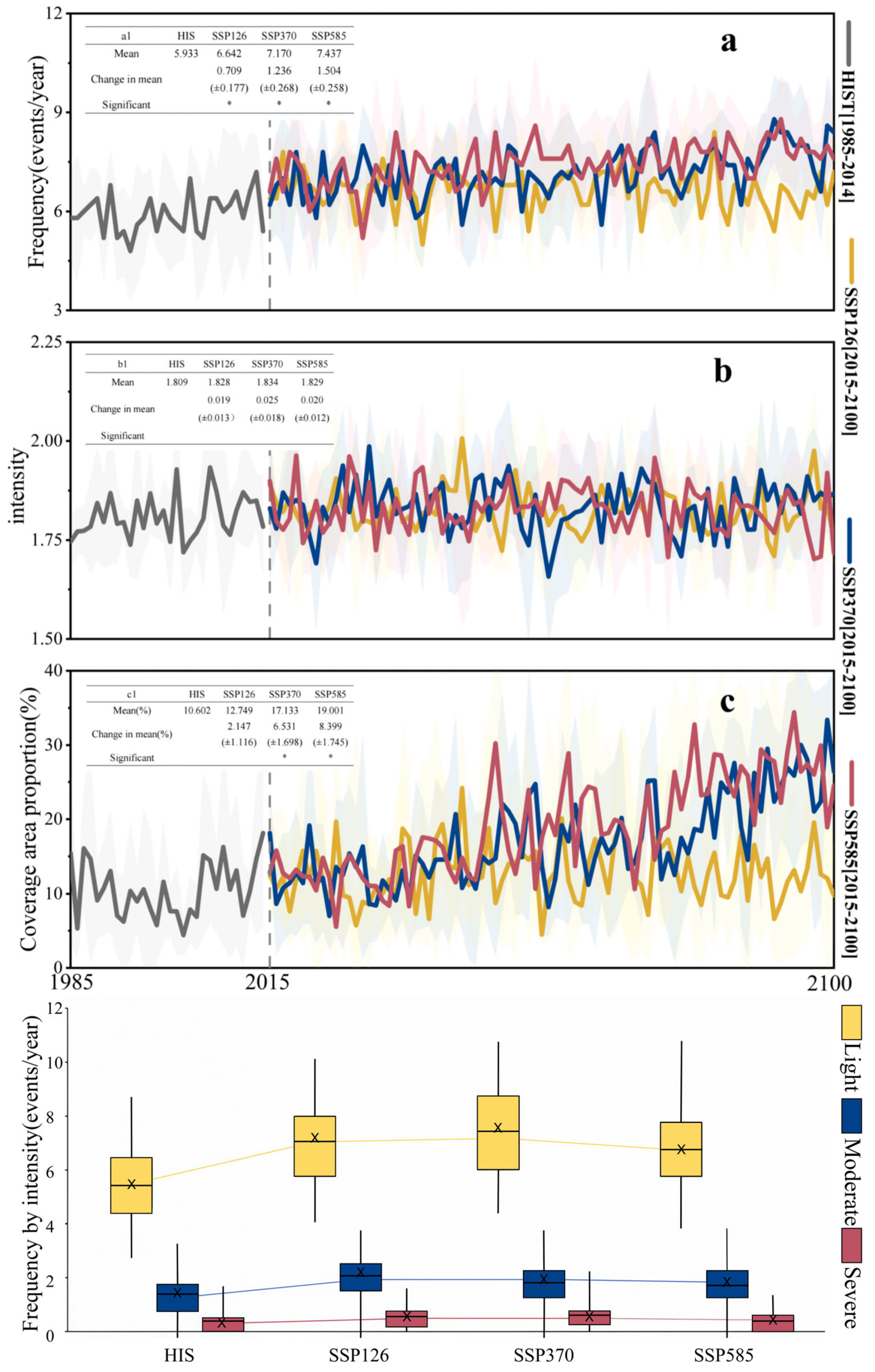
Figure 4a–d comprehensively illustrates the evolution of interannual frequency, intensity, and coverage area of DFAAEs in the Heilongjiang River Basin over historical periods (1985–2014) and future SSPs (2015–2100), as well as the frequency distribution of events at different intensity levels. The historical mean annual frequency is about 5.9 events per year. Under SSP126, SSP370, and SSP585, the frequency rises to 6.6, 7.1, and 7.5 events per year, which correspond to increases of approximately 12 percent, 21 percent, and 28 percent relative to the historical baseline (Figure 4a). The multi-year mean coverage area proportion by DFAAEs expands from 10.6 percent in the historical period to 12.7% under SSP126, 17.1% under SSP370, and 19.0% under SSP585, representing increases of about 20 percent, 62 percent, and 79 percent (Figure 4c).
Event intensity remains near 1.8 across scenarios, with a slight rise to about 2.0 under SSP585 (Figure 4b). The frequency of DFAA events of various severities consistently increased during the SSPs compared to the HIS. Light events rose from 5.47 to 7.16 events/year, a 31% increase; moderate events increased from 1.26 to 1.97 events/year, a 56.5% increase; and severe events grew from 0.3 to 0.47 events/year, a 59.4% increase. Although light events dominated all SSPs, the proportions of severity varied across the scenarios. In the HIS, the proportions of light–moderate–severe events were 77.9%, 17.9%, and 4.2%, respectively. For the SSP126 (SSP585) scenario, the proportion of light events decreased to 69.8% (69.3%), and the moderate–severe increased to 22.8% (23.7%), respectively. For the SSP370 scenario, light events decreased to 70.4%, and the moderate–severe increased to 22.6% and 7.1%. This explains the phenomenon in Figure 4b, where the difference in multi-year mean intensity is greater for SSP126 and SSP585 than for SSP370 (Figure 4d), and the corresponding mean changes in DFAAEs frequency, intensity, and coverage among different SSP scenarios are summarized in Table 3.

3.2.2. Spatial Characteristics of Future DFAAEs

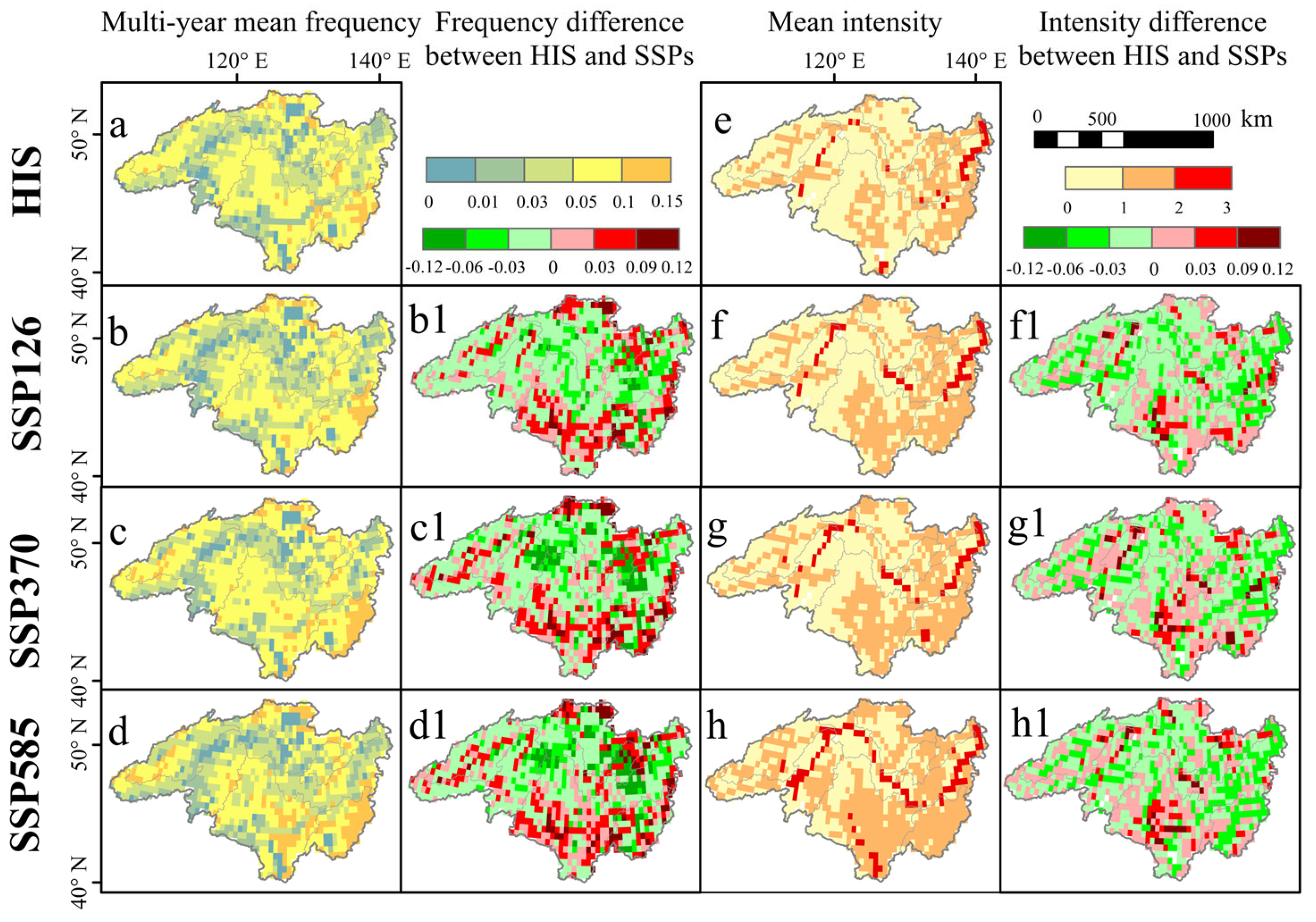
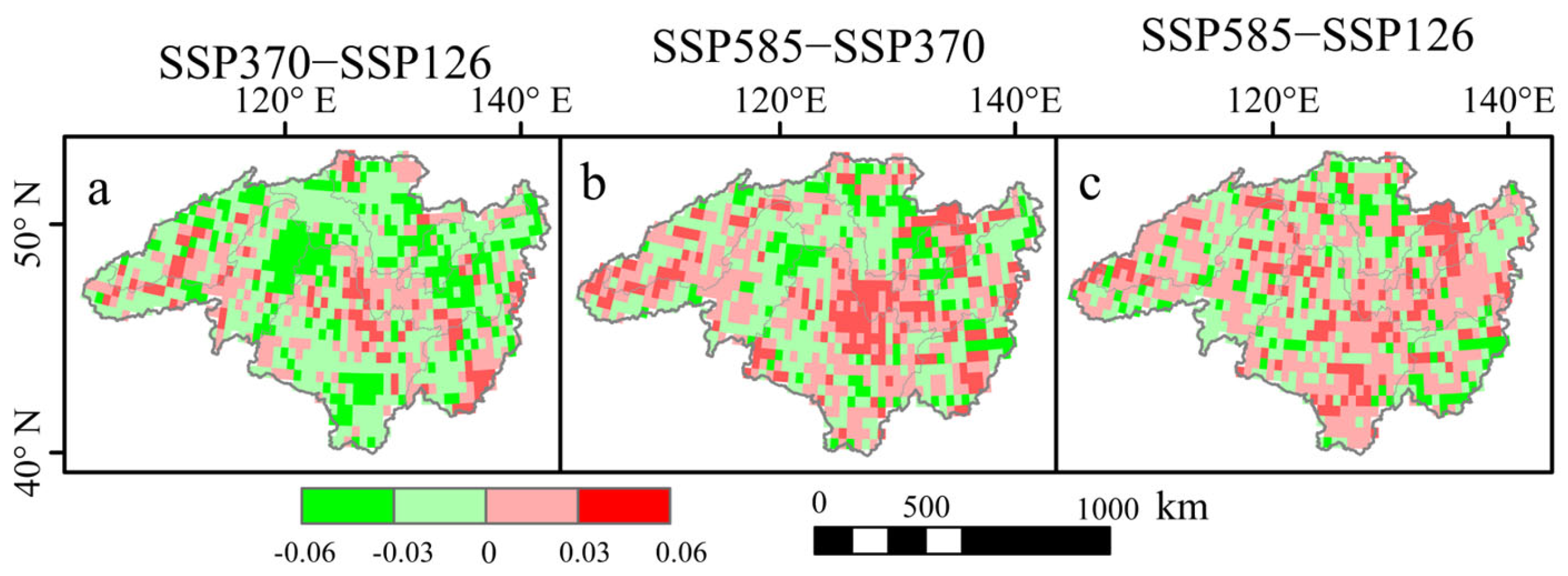
To eliminate the influence of different time spans, Figure 5 shows multi-year averages of the frequency and intensity of DFAAEs based on a 30-year historical period and an 86-year future SSPs scenario. Historically, events were concentrated in the southeastern edge of Ussuri River Basin, with lower frequency in the upper northwest (Figure 5a). Under the future SSPs scenario, this concentrated distribution persists and further extends to the middle and southeastern edges of Heilongjiang Mainstream, the eastern Songhua River Basin, and the northern Zeya River Basin (Figure 5a–d). Compared to historical periods, the proportion of regions with increased event frequency increased from 23.7% in SSP126 to 32.7% in SSP370 and 39.7% in SSP585 (Figure 5(b1–d1)). Further comparisons among future SSPs show that, compared to SSP126 and SSP370, the increased areas are mainly concentrated in the southeastern sub-basin; compared to SSP370 and SSP585, the increased areas have expanded further and extended inland; and compared to SSP126 and SSP585, the entire basin has almost entirely seen net increases, with only sporadic no increases or slight decreases remaining in the upper reaches of the Ergun and Shilka rivers (Figure 6a–c). The event frequency increased significantly in the southern and northern regions of the basin, subsequently advancing inland along the main stream, while the event frequency decreased in the central and western regions. With increasing emissions, the area of decreased event frequency shrank, indicating that under extreme scenarios, the event frequency across the entire basin shows an increasing trend (Figure 5 and Figure 6).
In terms of intensity, stronger events are more frequent in the middle reaches of HRB, Shilk River, and Ussuri River Basin, with typical intensities of around level 1 to 3 in Erguna River Basin. Under the SSP scenario, the high-intensity area extends to the southeastern Songhua River and Ussuri River, Heilongjiang Mainstream, and Erguna River Basin (Figure 5e–h). Under the SSP126 scenario, the proportion of areas with increased intensity reaches 21.37%; under the SSP370 scenario, it reaches 25.06%; and under the SSP585 scenario, it reaches 27.31% (Figure 5(f1–h1)). Although the basin-wide average intensity remains generally stable, hotspots intensify and expand under high-emission scenarios, thus showing an overall upward trend in both frequency and intensity at the high-emission end.

3.3. Mechanisms of Climatic Factors Influencing DFAAEs

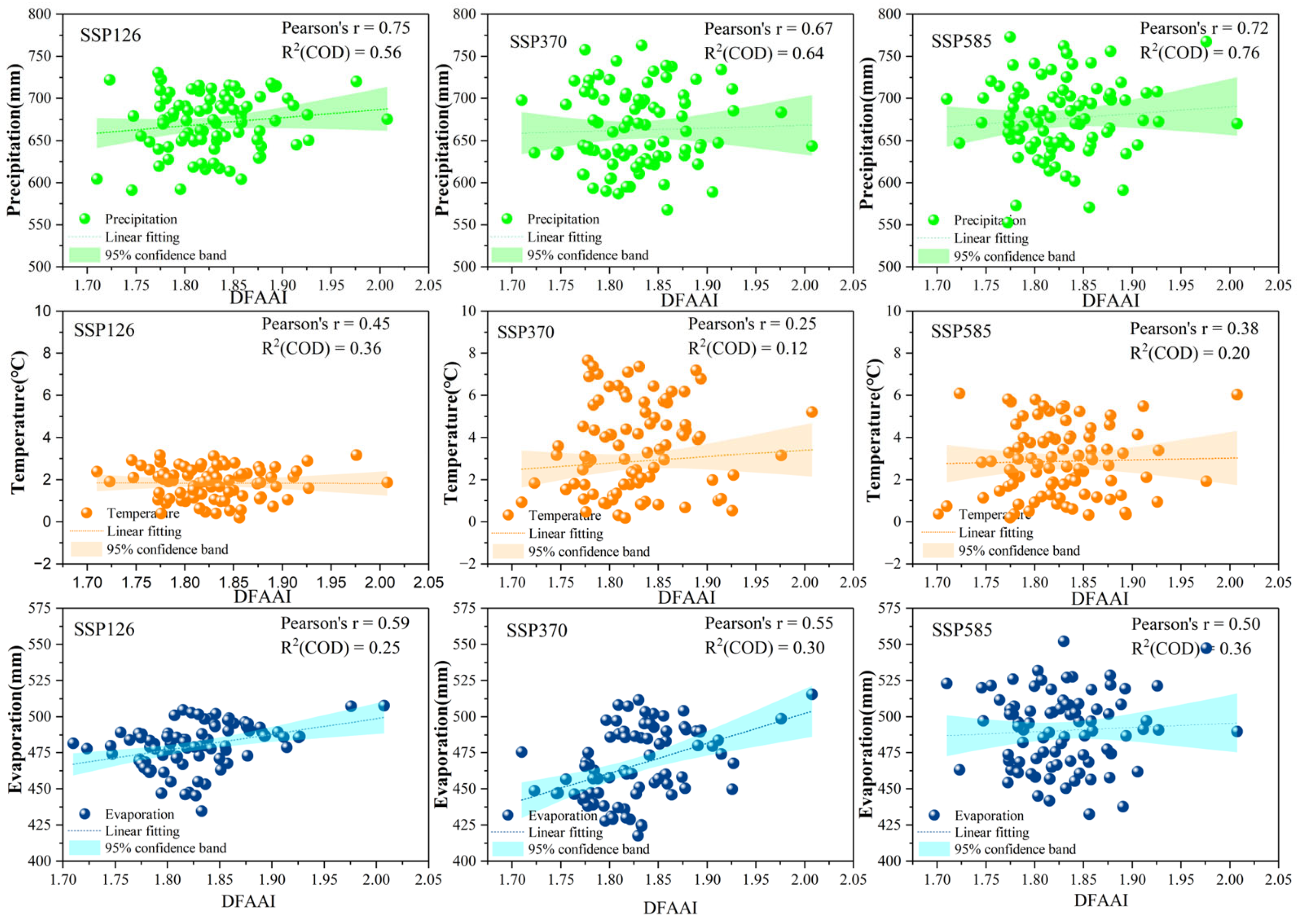
Figure 7 and Figure 8 use linear fitting and principal component analysis to analyze the individual and combined effects of precipitation, temperature, and evapotranspiration on DFAAI under different SSPs. The linear fitting results in Figure 7 show that under all SSPs, DFAAI is significantly positively correlated with precipitation, making it the primary driving factor: r values under these SSPs range from 0.67 to 0.75, and R2 values range from 0.56 to 0.76. With increasing radiative forcing, greater precipitation increases the DFAAI, and the linear explanatory power strengthens. Evapotranspiration exhibits a moderate positive correlation with DFAAI, acting as a secondary driver, with r values ranging from 0.50 to 0.59 and R2 values ranging from 0.25 to 0.36 under these SSPs. This suggests that increased atmospheric evaporative demand has an amplifying effect under warmer and wetter conditions. The relationship between temperature and DFAAI is weaker but still positive, with r values ranging from 0.25 to 0.45 and R2 values ranging from 0.12 to 0.36 under the SSPs, indicating limited linear indicative power.
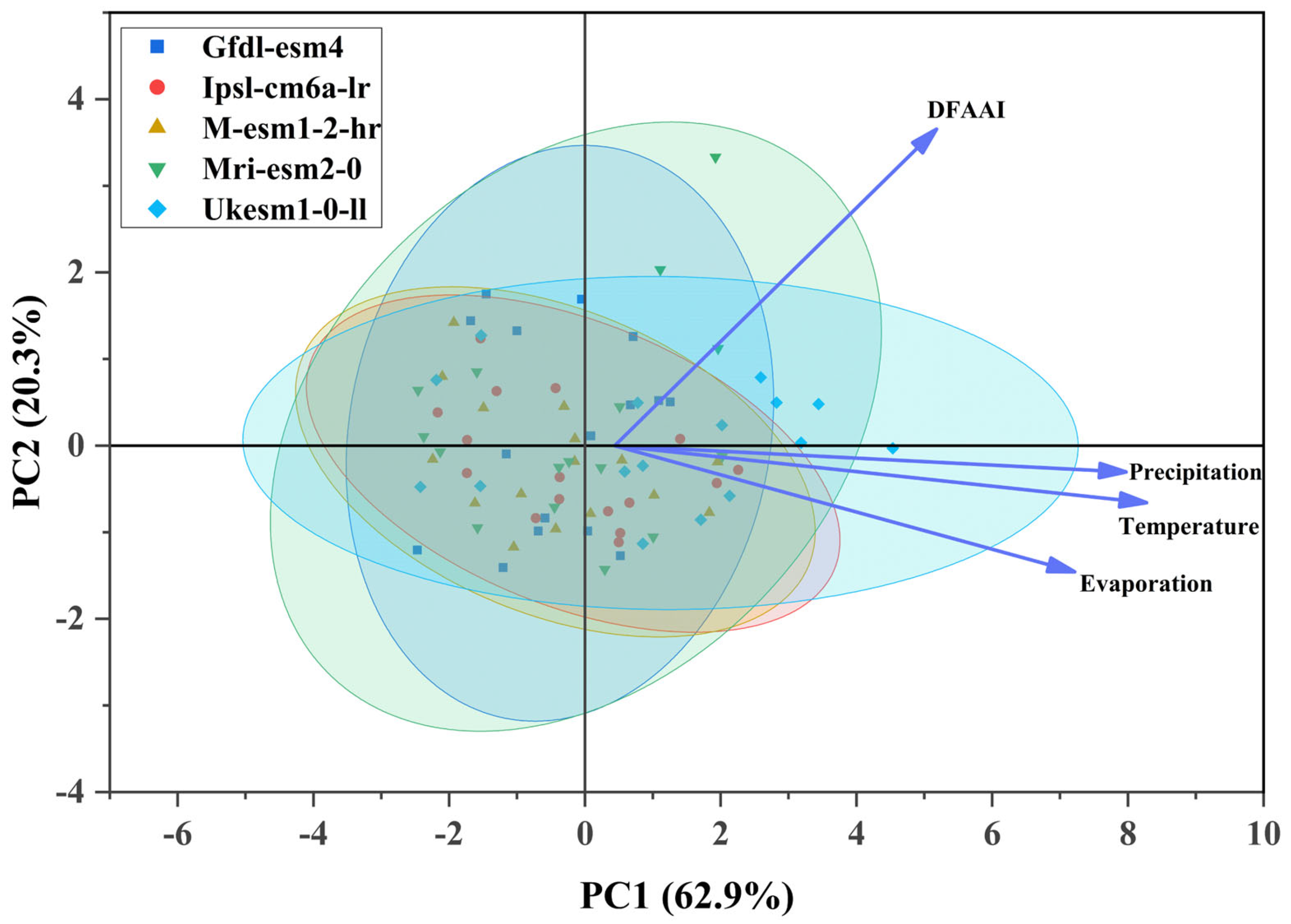
Figure 8 shows that the first two principal components cumulatively explain 83.2% of the DFAAI variance, revealing a synergistic influence of humidity and evapotranspiration coupling as the core dominant modes. PC1 contributes 62.9%, representing a wetting gradient dominated by precipitation and accompanied by enhanced evapotranspiration. DFAAI increases synchronously along this gradient, indicating that the synergistic effect of moisture supply and evapotranspiration conditions is the main factor driving DFAAI changes. PC2 contributes 20.3%, representing the energy dimension, dominated by evapotranspiration and indirectly driven by temperature. This indicates that when precipitation levels are roughly equal, enhanced heat provides additional gains to DFAAI by increasing evapotranspiration. The five GCMs highly overlap in the PCA space, indicating the existence of a consistent and robust cross-mode mechanism. Changes in DFAAI are jointly driven by PC1, dominated by precipitation, and PC2, which superimposed the evapotranspiration energy channel, while temperature mainly manifests as an indirect drive through energy constraints.

4. Discussion

4.1. Worsening DFAA Events in the Future

As shown in Figure 4 and Figure 5, future scenarios indicate that the frequency and area coverage of DFAA events in the Heilongjiang River Basin will generally increase, while the average intensity will not change significantly. Under different emission pathways, the frequency and extent of DFAA events in the Heilongjiang River Basin all increased, while the average intensity remained largely unchanged [4,34,38]. This pattern is consistent with research findings on complex extreme events in the margins of the Chinese monsoon and other regions, namely, under enhanced external forcing, the increase in event frequency and extent often precedes changes in average intensity [4,8,15]. The historical multi-year average frequency was approximately 5.9 events per year. By 2100, under scenario SSP585, this frequency increased to 7.5 events per year, and the basin coverage increased from 10.6% to 19.0%. Compared to SSP126, the frequency of events decreased by 0.528 events per year under scenario SSP370, while the coverage increased by 0.044%. Under scenario SSP585, the frequency of events increased by 0.795 events per year, and the coverage increased by 0.063%. Compared to SSP370, the number of events per year increased by 0.267, and the coverage increased by 0.019. The pairwise differences in mean intensity ranged from −0.005 to 0.006 and were not significant (Figure 4a–c). These values are typical of the eastern monsoon-affected area, indicating that the response of the basin is regionally representative [34,39]. These projected increases in frequency and areal coverage are comparable to the reported changes in compound dry–wet events over Northeast China and the East Asian monsoon margins, but our results extend these findings to a high-latitude transboundary basin with strong cryospheric influence. The spatial pattern evolved with emissions. Under the SSP370 scenario, the increased events were distributed in isolated patches. Under the SSP585 scenario, the increased events converged into a nearly continuous band along the entire Ussuri River, the southeastern edge of the Songhua River, and the confluence of the Heilongjiang River and its tributaries, extending into the basin. Compared with SSP126, SSP585 produced an increase almost throughout the entire basin, with only sporadic and slight decreases in the western cold source areas of the Ergun River and Shilka River (Figure 5). This evolution is consistent with observations and simulations in the Northeast Plain of China and other mid-to-high latitude monsoon margins [22,38,40]. The emergence of continuous enhancement zones increases the risk of spatial synchronicity, making multi-site early warning and reservoir joint operation more complex and increasing the possibility of cascading effects between upstream and downstream areas and across riverbanks [8,41]. Meanwhile, the composition of light, moderate, and heavy precipitation remains basically stable under different scenarios, indicating that future risks mainly stem from increased precipitation frequency and expanded coverage, rather than a systematic increase in average intensity (Figure 4d). This is consistent with nationwide assessments, where light precipitation events still dominate, and the proportion of moderate to heavy precipitation events has only slightly increased [5,15].
In the context of climate warming, thermodynamic humidification increases atmospheric water-holding capacity by approximately 7% for every 1 degree Celsius increase, enhancing water vapor transport and convection potential, as well as increasing the probability of short-duration heavy precipitation [1,2]. Therefore, under similar perturbations, more grid cells will cross the threshold of wet–dry alternation, mainly manifested as more frequent alternation and wider coverage, rather than higher average intensity [8,17]. The northward shift of the East Asian summer monsoon and stronger lower tropospheric water vapor fluxes increase the likelihood of heavy rainfall in the southeastern Songhua River, Ussuri River Basin, and the confluence corridor [21,42]. Topographically concentrated and highly interconnected river networks enhance runoff generation and transport, transforming isolated hotspots into zonal regions and driving inland expansion, consistent with multi-basin evidence [16,38,40]. As climate warming leads to shorter snow cover, deeper active layers, reduced soil moisture, and increased potential evapotranspiration, surface memory shortens while evaporation demand increases [21,29,43]. Soil-vegetation systems respond more quickly to precipitation pulses, making short-duration precipitation events more likely to trigger runoff jumps, increasing the number of alternations and affected areas, rather than necessarily increasing average intensity [8,40]. Furthermore, the construction of the DFAAI uses weighted normalized runoff difference, making the index more sensitive to state-flipping events than to the amplitude of individual events [16]. When increased emissions lead to more grid cells reaching the threshold more frequently, statistics preferentially reflect the increase in frequency and coverage, while average intensity remains stable [17,44].

4.2. The Impact of Climate Change on DFAAEs

As shown in Figure 7 and Figure 8, the variability of DFAA events in the Heilongjiang River Basin is mainly controlled by precipitation, while temperature and evapotranspiration have relatively minor effects on event frequency and intensity. Linear regression and principal component analysis were used to study how precipitation, temperature, and evaporation affect the DFAA event index (Figure 7 and Figure 8). The results show that the combined effects of precipitation, temperature, and evaporation control the intensity and frequency of DFAA events, with a sudden increase in precipitation being the direct triggering factor [7,16]. Under the SSP585 scenario, precipitation itself can explain 53.9% of the variance in intensity in arid regions, meaning that one or several sudden precipitation events usually trigger DFAA events. As drought approaches its end, land–atmosphere feedback strengthens the coupling between the soil and atmospheric boundary layer [1,15]. Under these hot and dry conditions, the arrival of strong water vapor transport belts or frontal convergence systems forms a tight physical chain—abundant water vapor, strong updrafts, and subsequent precipitation—which can easily trigger atmospheric circulation events in arid regions [17,45].
The effect of temperature on DFAAs is two-stage; warming strengthens the hydrological cycle through thermodynamic effects [1,2]. Along the PC1 axis, Tas is positively correlated with DFAAI, reflecting that climate warming leads to an increase in saturated vapor pressure through the Clausius–Clapeyron equation, thus providing more moisture for subsequent heavy precipitation. Along the PC2 axis, Tas is negatively correlated with DFAAI, indicating that climate warming will shorten the snow cover period and enhance spring evaporation, reducing early soil moisture and preparing for rapid drying; this mechanism is consistent with runoff changes, rain–snow alternation, and ROS events in years with less snow [30,43] (Figure 8). The PC1 and energy-related mode PC2 therefore provide a process-based explanation for why DFAA risk increases under warming, consistent with previous studies that emphasize the joint role of enhanced moisture transport and land–atmosphere feedbacks in triggering rapid drought-to-flood transitions. With the increase in greenhouse gas emissions, evaporation exacerbates the asymmetry between the dry and wet ends, significantly increasing the frequency of DFAA events [15,16,19]. This conclusion is consistent with research results in Northeast China, North China, and the wider Northeast Asia region. These studies show that an increase in potential or actual evaporation accelerates soil moisture loss and exacerbates the physical evolution from meteorological drought to agricultural drought and then to hydrological drought [45]. Evaporation (the combined flux of surface evaporation and plant transpiration) is enhanced under conditions of high temperature, dry air, and strong winds, thus rapidly absorbing water from terrestrial ecosystems [16].

4.3. Limitations and Prospects

This study combines the DFAAI index, the CWatM model, and the CMIP6 multi-model and multi-scenario framework to investigate the spatiotemporal evolution and climate drivers of HRB drought–flood abrupt changes (DFAAEs) from 1985 to 2100. However, two limitations most relevant to the conclusions need clarification: First, there is uncertainty in climate forcing and the characterization of cold-region processes [1]. Simulations of solid precipitation and cloud facies in high-latitude cold regions still exhibit systematic biases, easily affecting the discrimination of precipitation and snow phases, snow cover accumulation, and melting rhythms and transmitting these biases to runoff response through sleet (ROS) and spring flood processes, thus expanding the uncertainty zone in the estimation of DFAA frequency and intensity [30,43]. Second, although the CWatM has a diurnal scale and explicitly represents human water use and reservoir operation, it still simplifies key cold-region mechanisms such as permafrost degradation, active layer hydrothermal activity, frozen soil infiltration, and snow-energy balance, potentially causing deviations in peak timing and the magnitude of inter-monthly abrupt changes [29,33,46]. This paper has mitigated the aforementioned problems to some extent through calibration with measured runoff data from the watershed outlet stations and multi-model ensemble analysis. However, residual uncertainties still exist [1,47,48]. Future research should prioritize integrating ground-based and satellite multi-source precipitation and evapotranspiration data for remote sensing correction and strengthen the constraints and sensitivity analysis of permafrost/snow cover parameters [29,43,49,50]. Secondly, there are uncertainties related to scenarios and schemes. Differences in emission pathways, model structures, and internal decadal variability among different SSPs collectively determine the width of the future projection interval, leading to variations in the confidence levels of conclusions such as increased frequency, near-stable intensity, or slight changes in intensity across different time periods and sub-regions [51,52]. To improve interpretability and comparability, it is recommended to continue using parallel multi-scenario analysis and ensemble statistics, presenting results with median and quantile bands, and conducting source decomposition and consistency checks of forcing/structural/internal variability [4,8]. Overall, by (i) improving forcing data and characterizing cold-region processes and (ii) maintaining parallel multi-model and multi-scenario analysis and explicitly reporting uncertainty intervals, the robustness and decision-making value of future HRB DFAA risk quantification can be further enhanced [35,44].The two most critical limitations of this study concern (a) uncertainties in climate forcings and cold-region hydrological processes and (b) scenario and model-structure uncertainties in the CMIP6–CWatM framework, which should be borne in mind when interpreting the projected DFAA risks.

5. Conclusions

Due to the rapid alternation of drought and flood within a short period, drought–flood alternation events (DFAAEs) can trigger disasters such as urban flooding, farmland flooding, flash floods, landslides, and debris flows. The occurrence of DFAAEs poses a significant challenge to flood and drought prevention, making their prediction urgent. This study, based on five global climate models (GCMs), hydrological models, and the Drought–Flood Alternation Event Index (DFAAI) under SSP126, SSP370, and SSP585 scenarios, explores the changes in DFAAEs and their climate drivers in the Heilongjiang River Basin under the background of climate change from 1985 to 2100. The main conclusions are as follows:
(1)
The Heilongjiang River basin is transitioning to a warmer and more humid climate pattern in the future, while maintaining a gradient from a low-pressure zone in the northwest to a high-pressure zone in the southeast. By 2100, annual precipitation under SSP126, SSP370, and SSP585 scenarios will reach 655 mm, 700 mm, and 720 mm, respectively; average temperature will reach 3 °C, 6 °C, and 7 °C, respectively; and evapotranspiration will reach 460 mm, 515 mm, and 521 mm, respectively. Hydrothermal activity will continue to intensify along the Ussuri River, the southeastern Songhua River, and the lower Amur River corridor.
(2)
The risk escalation of DFAA is reflected in its frequency and scope of impact, while its average intensity is not significant. Compared to historical periods, the frequency of DFAA under SSP126, SSP370, and SSP585 scenarios increased from 5.9 times per year to 6.6, 7.1, and 7.5 times, respectively, with the affected area expanding from 10.6% to 12.7%, 17.1%, and 19.0%, while the average intensity remained around 1.8–2.0. Hotspots spread from the humid southeast into the basin interior. SSP585 includes the extreme year 2094, which saw eight events, covering 34% of the basin.
(3)
Mechanistically, principal component analysis (PCA) shows that PC1 (62.9%) is a precipitation-dominated covariant axis related to evapotranspiration, explaining most of the DFAAI variability, while PC2 (20.3%) is an evapotranspiration-dominated, temperature-modulating axis with a smaller contribution; the combined contribution of both (83.2%) indicates that increased water supply driven by amplified atmospheric demand is the main pathway for future exacerbation.
This study, based on runoff data under climate change, explores the spatiotemporal distribution patterns of future deep-seated hydrological events (DFAAEs), filling a gap in future DFAAE research and deepening our understanding of extreme hydrological event changes under the background of climate change. Furthermore, the study reveals that the Ussuri River region will face severe risks of floods and extreme flood and drought events in the future. The findings will help policymakers develop efficient and sustainable adaptation strategies to reduce the risk of floods and droughts during climate change and improve flood and drought resistance capabilities in the Ussuri River basin and other cold-region areas.

Author Contributions

F.H. contributed to this manuscript. J.J. and P.Q. conceived the research approach for this paper; F.H. and P.Q. carried out all data collection and analysis. P.Q. and C.D. contributed valuable analysis and manuscript review. All authors have read and agreed to the published version of the manuscript.

Funding

This research was supported by the National Natural Science Foundation of China (42371037) and the Yunnan Provincial Key Laboratory of International Rivers and Transboundary Ecological Security Open Fund (NO. 2022KF03). We would also like to express our gratitude to the editors and reviewers for their efforts and suggestions.

Data Availability Statement

The data of this study are available from the corresponding authors upon reasonable request.

Acknowledgments

The authors would like to express their sincere gratitude to the Key Laboratory of International Rivers and Trans-boundary Ecological Security in Yunnan Province and the Heilongjiang Provincial Department of Science and Technology for their valuable support. We also appreciate the assistance provided by our classmates and teachers for their insightful discussions and technical support. Special thanks go to the institutions and individuals who contributed data and resources essential for this study. Their support has been instrumental in the successful completion of this research.

Conflicts of Interest

The authors declare no conflicts of interest.

References

  1. Masson-Delmotte, V.; Zhai, P.; Pirani, A.; Connors, S.L.; Péan, C.; Berger, S.; Caud, N.; Chen, Y.; Goldfarb, L.; Gomis, M.; et al. Climate Change 2021: The Physical Science Basis. Contribution of Working Group I to the Sixth Assessment Report of the Intergovernmental Panel on Climate Change; Cambridge University Press: Cambridge, UK; New York, NY, USA, 2021; Volume 2, p. 2391. [Google Scholar]
  2. Trenberth, K.E. Changes in precipitation with climate change. Clim. Res. 2011, 47, 123–138. [Google Scholar] [CrossRef]
  3. Seneviratne, S.; Nicholls, N.; Easterling, D.; Goodess, C.; Kanae, S.; Kossin, J.; Luo, Y.; Marengo, J.; McInnes, K.; Rahimi, M.; et al. Changes in Climate Extremes and Their Impacts on the Natural Physical Environment; Cambridge University Press: Cambridge, UK; New York, NY, USA, 2012; pp. 109–230. [Google Scholar]
  4. Zscheischler, J.; Westra, S.; Van Den Hurk, B.J.; Seneviratne, S.I.; Ward, P.J.; Pitman, A.; AghaKouchak, A.; Bresch, D.N.; Leonard, M.; Wahl, T.; et al. Future climate risk from compound events. Nat. Clim. Change 2018, 8, 469–477. [Google Scholar] [CrossRef]
  5. Zhou, W.; Liu, D.; Zhang, J.; Jiang, S.; Xing, S.; Wang, J.; Cheng, Y.; Chen, N. Identification and frequency analysis of drought–flood abrupt alternation events using a daily-scale standardized weighted average of the precipitation index. Front. Environ. Sci. 2023, 11, 1142259. [Google Scholar] [CrossRef]
  6. Chen, H.; Wang, S. Compound dry and wet extremes lead to an increased risk of rice yield loss. Geophys. Res. Lett. 2023, 50, e2023GL105817. [Google Scholar] [CrossRef]
  7. Shi, W.; Huang, S.; Liu, D.; Huang, Q.; Han, Z.; Leng, G.; Wang, H.; Liang, H.; Li, P.; Wei, X. Drought-flood abrupt alternation dynamics and their potential driving forces in a changing environment. J. Hydrol. 2021, 597, 126179. [Google Scholar] [CrossRef]
  8. Brunner, M.I. Floods and droughts: A multivariate perspective. Hydrol. Earth Syst. Sci. 2023, 27, 2479–2497. [Google Scholar] [CrossRef]
  9. Sun, J.; Li, R.; Zhang, Q.; Trier, S.B.; Ying, Z.; Xu, J. Mesoscale factors contributing to the extreme rainstorm on 20 july 2021 in zhengzhou, china, as revealed by rapid update 4dvar analysis. Mon. Weather Rev. 2023, 151, 2153–2176. [Google Scholar] [CrossRef]
  10. Chen, Y.; Zheng, H.; Sun, T.; Meng, D.; Qin, L.; Yin, J. Improving forecasts of the “21⋅ 7” henan extreme rainfall event using a radar assimilation scheme that considers hydrometeor background error covariance. Mon. Weather Rev. 2024, 152, 1379–1397. [Google Scholar] [CrossRef]
  11. Huang, J.; Hu, T.; Yasir, M.; Gao, Y.; Chen, C.; Zhu, R.; Wang, X.; Yuan, H.; Yang, J. Root growth dynamics and yield responses of rice (Oryza sativa L.) under drought—Flood abrupt alternating conditions. Environ. Exp. Bot. 2019, 157, 11–25. [Google Scholar] [CrossRef]
  12. Xiong, Q.Q.; Shen, T.H.; Zhong, L.; Zhu, C.L.; Peng, X.S.; He, X.P.; Fu, J.R.; Ouyang, L.J.; Bian, J.M.; Hu, L.F.; et al. Comprehensive metabolomic, proteomic and physiological analyses of grain yield reduction in rice under abrupt drought–flood alternation stress. Physiol. Plant. 2019, 167, 564–584. [Google Scholar] [CrossRef]
  13. Gao, Y.; Hu, T.; Wang, Q.; Yuan, H.; Yang, J. Effect of drought–flood abrupt alternation on rice yield and yield components. Crop Sci. 2019, 59, 280–292. [Google Scholar] [CrossRef]
  14. Deng, S.; Zhao, D.; Chen, Z.; Liu, L.; Zhu, Y.; Wang, K.; Gao, X.; Wu, H.; Zheng, D. Global distribution and projected variations of compound drought-extreme precipitation events. Earth’s Future 2024, 12, e2024EF004809. [Google Scholar] [CrossRef]
  15. Tan, X.; Wu, X.; Huang, Z.; Fu, J.; Tan, X.; Deng, S.; Liu, Y.; Gan, T.Y.; Liu, B. Increasing global precipitation whiplash due to anthropogenic greenhouse gas emissions. Nat. Commun. 2023, 14, 2796. [Google Scholar] [CrossRef] [PubMed]
  16. Bai, X.; Zhao, C.; Tang, Y.; Zhang, Z.; Yang, B.; Wang, Z. Identification, physical mechanisms and impacts of drought–flood abrupt alternation: A review. Front. Earth Sci. 2023, 11, 1203603. [Google Scholar] [CrossRef]
  17. Fang, B.; Lu, M. Asia faces a growing threat from intraseasonal compound weather whiplash. Earth’s Future 2023, 11, e2022EF003111. [Google Scholar] [CrossRef]
  18. Rahman, K.U.; Hussain, A.; Ejaz, N.; Shang, S.; Balkhair, K.S.; Khan, K.U.J.; Khan, M.A.; Rehman, N.U. Analysis of production and economic losses of cash crops under variable drought: A case study from punjab province of pakistan. Int. J. Disaster Risk Reduct. 2023, 85, 103507. [Google Scholar] [CrossRef]
  19. Yuan, X.; Wang, Y.; Ji, P.; Wu, P.; Sheffield, J.; Otkin, J.A. A global transition to flash droughts under climate change. Science 2023, 380, 187–191. [Google Scholar] [CrossRef]
  20. Abbas, S.; Ameer, A.; Lv, F.; Li, T.; Chen, Y.; Cao, L.; Lu, H.; Latif, Y.; Yaseen, M.; Lu, S.; et al. Southward to northward shifting trends of monsoonal precipitation and their connections with atmospheric circulations over pakistan: A comparative study of 1961–1990 and 1991–2020. J. Hydrol. 2025, 664, 134440. [Google Scholar] [CrossRef]
  21. Yue, Q.; Yu, G.; Miao, Y.; Zhou, Y. Analysis of meteorological element variation characteristics in the heilongjiang (amur) river basin. Water 2024, 16, 521. [Google Scholar] [CrossRef]
  22. Ma, H.; Jing, J.; Dai, C.; Xu, Y.; Qi, P.; Song, H. Spatiotemporal dynamics of drought–flood abrupt alternations and their delayed effects on vegetation growth in heilongjiang river basin. Water 2025, 17, 1419. [Google Scholar] [CrossRef]
  23. Ren, J.; Wang, W.; Wei, J.; Li, H.; Li, X.; Liu, G.; Chen, Y.; Ye, S. Evolution and prediction of drought-flood abrupt alternation events in huang-huai-hai river basin, China. Sci. Total Environ. 2023, 869, 161707. [Google Scholar] [CrossRef]
  24. Sun, L.; Yang, X.-Q.; Tao, L.; Fang, J.; Sun, X. Changing impact of enso events on the following summer rainfall in eastern China since the 1950s. J. Clim. 2021, 34, 8105–8123. [Google Scholar] [CrossRef]
  25. Yang, P.; Zhang, S.; Xia, J.; Zhan, C.; Cai, W.; Wang, W.; Luo, X.; Chen, N.; Li, J. Analysis of drought and flood alternation and its driving factors in the yangtze river basin under climate change. Atmos. Res. 2022, 270, 106087. [Google Scholar] [CrossRef]
  26. Li, J.; Wang, R.; Huang, Q.; Xia, J.; Wang, P.; Fang, Y.; Shamov, V.V.; Frolova, N.L.; She, D. Climate warming-induced hydrological regime shifts in cold northeast asia: Insights from the heilongjiang-amur river basin. Land 2025, 14, 980. [Google Scholar] [CrossRef]
  27. Xing, Z.; Li, X.; Mao, D.; Luo, L.; Wang, Z. Heterogeneous responses of wetland vegetation to climate change in the amur river basin characterized by normalized difference vegetation index from 1982 to 2020. Front. Plant Sci. 2023, 14, 1290843. [Google Scholar] [CrossRef]
  28. Ding, X.; Zhang, B.; Liu, J. Effects of climate and land use change on groundwater depth in sanjiang plain. In Proceedings of the 2017 2nd International Conference on Machinery, Electronics and Control Simulation (MECS 2017); Atlantis Press: Dordrecht, The Netherlands, 2016; pp. 320–326. [Google Scholar]
  29. Walvoord, M.A.; Kurylyk, B.L. Hydrologic impacts of thawing permafrost—A review. Vadose Zone J. 2016, 15, vzj2016.01.0010. [Google Scholar] [CrossRef]
  30. Musselman, K.N.; Lehner, F.; Ikeda, K.; Clark, M.P.; Prein, A.F.; Liu, C.; Barlage, M.; Rasmussen, R. Projected increases and shifts in rain-on-snow flood risk over western north america. Nat. Clim. Change 2018, 8, 808–812. [Google Scholar] [CrossRef]
  31. Tashiro, Y.; Hiyama, T.; Kanamori, H.; Kondo, M. Impact of permafrost degradation on the extreme increase of dissolved iron concentration in the amur river during 1995–1997. Prog. Earth Planet. Sci. 2024, 11, 17. [Google Scholar] [CrossRef]
  32. Guo, D.; Wang, C.; Zang, S.; Hua, J.; Lv, Z.; Lin, Y. Gap-filling of 8-day terra modis daytime land surface temperature in high-latitude cold region with generalized additive models (gam). Remote Sens. 2021, 13, 3667. [Google Scholar] [CrossRef]
  33. Qin, J.; Ding, Y.; Shi, F.; Cui, J.; Chang, Y.; Han, T.; Zhao, Q. Links between seasonal suprapermafrost groundwater, the hydrothermal change of the active layer, and river runoff in alpine permafrost watersheds. Hydrol. Earth Syst. Sci. 2024, 28, 973–987. [Google Scholar] [CrossRef]
  34. Zhang, Y.; You, Q.; Ullah, S.; Chen, C.; Shen, L.; Liu, Z. Substantial increase in abrupt shifts between drought and flood events in china based on observations and model simulations. Sci. Total Environ. 2023, 876, 162822. [Google Scholar] [CrossRef]
  35. Zhang, G.; Wang, H.; Gan, T.Y.; Zhang, S.; Zhao, J.; Su, X.; Fu, X.; Shi, L.; Xu, P.; Lu, M.; et al. A comprehensive review of recent progress on the drought-flood abrupt alternation. J. Hydrol. 2025, 661, 133806. [Google Scholar] [CrossRef]
  36. Li, Z.; Yang, H.; Jia, M. Factors affecting the spatiotemporal variation of precipitation in the songhua river basin of china. Water 2024, 16, 2. [Google Scholar] [CrossRef]
  37. Nikitina, O.I.; Bazarov, K.Y.; Egidarev, E.G. Application of remote sensing data for measuring freshwater ecosystems changes below the zeya dam in the russian far east. Proc. Int. Assoc. Hydrol. Sci. 2018, 379, 49–53. [Google Scholar] [CrossRef]
  38. Wang, R.; Li, X.; Zhang, Q.; Cheng, J.; Li, J.; Zhang, D.; Liu, Y. Projection of drought-flood abrupt alternation in a humid subtropical region under changing climate. J. Hydrol. 2023, 624, 129875. [Google Scholar] [CrossRef]
  39. Wei, Y.; Li, H.; Zhou, Y.; Commey, N.A.; Jin, J.; Zhou, P. Study on the evolution of regional future drought-flood abrupt alternation events. J. Hydrol. Reg. Stud. 2025, 59, 102459. [Google Scholar] [CrossRef]
  40. Qiu, J.; He, C.; Liu, X.; Gao, L.; Tan, C.; Wang, X.; Kong, D.; Wigneron, J.-P.; Chen, D.; Xia, J. Projecting dry-wet abrupt alternation across china from the perspective of soil moisture. NPJ Clim. Atmos. Sci. 2024, 7, 269. [Google Scholar] [CrossRef]
  41. Zheng, S.; Weng, B.; Bi, W.; Yan, D.; Ren, L.; Wang, H. Significant increase and escalation of drought-flood abrupt alteration in china’s future. Agric. Water Manag. 2025, 312, 109449. [Google Scholar] [CrossRef]
  42. Wang, Z.; Fu, Z.; Liu, B.; Zheng, Z.; Zhang, W.; Liu, Y.; Zhang, F.; Zhang, Q. Northward migration of the east asian summer monsoon northern boundary during the twenty-first century. Sci. Rep. 2022, 12, 10066. [Google Scholar] [CrossRef]
  43. Yang, Y.; Chen, R.; Liu, G.; Liu, Z.; Wang, X. Trends and variability in snowmelt in china under climate change. Hydrol. Earth Syst. Sci. Discuss. 2022, 26, 305–329. [Google Scholar] [CrossRef]
  44. Chen, Z.; Li, X.; Zhang, X.; Xu, L.; Du, W.; Wu, L.; Wang, D.; Zhang, Y.; Chen, N. Global drought-flood abrupt alternation: Spatio-temporal patterns, drivers, and projections. Innov. Geosci. 2025, 3, 100113-1. [Google Scholar] [CrossRef]
  45. Weng, X.; Zhu, J.; Wang, D.; Chen, H.; Wang, S.; Qing, Y. Exploring the relationship between drought-flood abrupt alternation and soil erosion over guangdong, china through a convection-permitting model. Geomat. Nat. Hazards Risk 2024, 15, 2383779. [Google Scholar] [CrossRef]
  46. Burek, P.; Satoh, Y.; Kahil, T.; Tang, T.; Greve, P.; Smilovic, M.; Guillaumot, L.; Wada, Y. Development of the community water model (cwatm v1. 04) a high-resolution hydrological model for global and regional assessment of integrated water resources management. Geosci. Model Dev. Discuss. 2020, 13, 3267–3298. [Google Scholar] [CrossRef]
  47. Gupta, H.V.; Kling, H.; Yilmaz, K.K.; Martinez, G.F. Decomposition of the mean squared error and nse performance criteria: Implications for improving hydrological modelling. J. Hydrol. 2009, 377, 80–91. [Google Scholar] [CrossRef]
  48. Kling, H.; Fuchs, M.; Paulin, M. Runoff conditions in the upper danube basin under an ensemble of climate change scenarios. J. Hydrol. 2012, 424, 264–277. [Google Scholar] [CrossRef]
  49. Beck, H.E.; Van Dijk, A.I.; Levizzani, V.; Schellekens, J.; Miralles, D.G.; Martens, B.; De Roo, A. Mswep: 3-hourly 0.25 global gridded precipitation (1979–2015) by merging gauge, satellite, and reanalysis data. Hydrol. Earth Syst. Sci. 2017, 21, 589–615. [Google Scholar] [CrossRef]
  50. Martens, B.; Miralles, D.G.; Lievens, H.; Van Der Schalie, R.; De Jeu, R.A.; Fernández-Prieto, D.; Beck, H.E.; Dorigo, W.A.; Verhoest, N.E. Gleam v3: Satellite-based land evaporation and root-zone soil moisture. Geosci. Model Dev. 2017, 10, 1903–1925. [Google Scholar] [CrossRef]
  51. Diffenbaugh, N.S.; Singh, D.; Mankin, J.S. Unprecedented climate events: Historical changes, aspirational targets, and national commitments. Sci. Adv. 2018, 4, eaao3354. [Google Scholar] [CrossRef] [PubMed]
  52. Grose, M.R.; Narsey, S.; Delage, F.; Dowdy, A.J.; Bador, M.; Boschat, G.; Chung, C.; Kajtar, J.; Rauniyar, S.; Freund, M.; et al. Insights from cmip6 for australia’s future climate. Earth’s Future 2020, 8, e2019EF001469. [Google Scholar] [CrossRef]
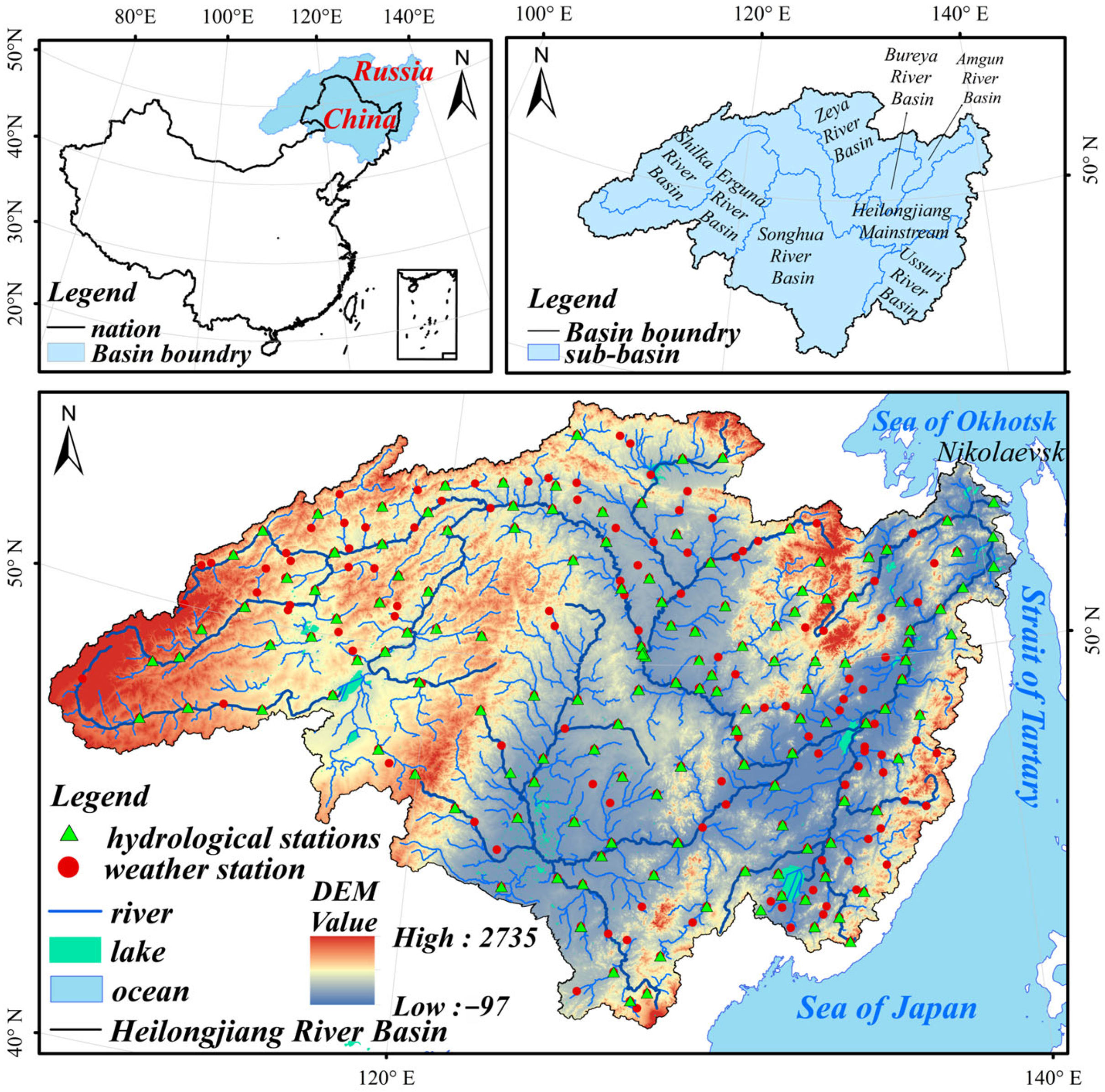
Figure 1. Geographic characteristics of the Heilongjiang River Basin and distribution of meteorological stations.
Water 17 03436 g001
Figure 2. Interannual variation of annual climate factors in the Heilongjiang River Basin under historical (1985–2014) and future scenarios (2015–2100): (a) annual precipitation; (b) annual average temperature; (c) annual evapotranspiration.
Water 17 03436 g002
Figure 3. Spatial distribution of multi-year average climate factors in the Heilongjiang River Basin under historical (1985–2014) and future scenarios (2015–2100): (a) multi-year average precipitation (mm); (b) annual average temperature (°C); (c) annual evapotranspiration (mm).
Water 17 03436 g003
Figure 4. Evolution of frequency, intensity, and coverage area of DFAAEs under HIS and different SSP scenarios. (ac) show the interannual variations in the frequency, intensity, and coverage area of DFAAEs under HIS and each SSP scenario. The thick line represents the ensemble mean of the five patterns, and the shaded area represents the ±95% confidence interval. The small table above shows the multi-year average and its variation for each scenario, and indicates the significance of differences, where * indicates a significant difference at the p < 0.05 level. (d) shows the box plot of the frequency of DFAAEs of different intensity levels under HIS and each SSP scenario. The boxes represent the interquartile range, the horizontal line represents the median, “×” represents the mean, the whiskers represent the data range, and the broken line represents the trend of the average frequency with the scenario.
Water 17 03436 g004
Figure 5. Spatial distribution of multi-year average frequency and intensity of DFAAEs and their differences under the HIS and SSP scenarios. (ae) show the spatial distribution of multi-year average frequencies under HIS and SSP scenarios, while (b1d1) depict the frequency differences between HIS and various SSP scenarios. Red indicates an increase in frequency under SSP scenarios compared to HIS scenarios, and green indicates a decrease in frequency. (fh) show the average intensity of DFAAEs, and (f1h1) show the intensity differences between HIS and SSP scenarios. The color scheme for (f1h1) is the same as that for (b1d1).
Water 17 03436 g005
Figure 6. Spatial distribution of differences in DFAA frequency among SSPs. (a) SSP370 – SSP126; (b) SSP585 – SSP370; (c) SSP585 – SSP126. Green areas indicate negative differences (<0), signifying a higher frequency under the lower-emission scenario, whereas red areas indicate positive differences (>0), signifying a higher frequency under the higher-emission scenario.
Water 17 03436 g006
Figure 7. Linear relationship between DFAAI and precipitation, temperature, and evaporation under future SSPs (scatter plots represent annual values over many years in the watershed; solid lines represent least-squares linear regression; shading represents the 95% confidence band. Pearson’s r indicates the correlation strength, and R2 is the coefficient of determination of the regression, used to measure the explanatory power of each factor for DFAAI).
Water 17 03436 g007
Figure 8. Principal component analysis (PCA) biplot. PC1 62.9% and PC2 20.3% together explain 83.2% of the variance; arrows represent variable loadings (DFAAI, precipitation, temperature, evapotranspiration), scatter plots represent the annual values of each GCM, and ellipses represent the 95% confidence region of the model group.
Water 17 03436 g008
Table 1. List of five CMIP6 models used in this study.
ModelModeling CenterResolution (Lon° × Lat°)
GFDL-ESM4NOAA Geophysical Fluid Dynamics Laboratory (GFDL), USA1.00 × 1.00
IPSL-CM6A-LRInstitut Pierre-Simon Laplace (IPSL), France2.50 × 1.27
MPI-ESM1-2-HRMax Planck Institute for Meteorology (MPI-M), Germany0.94 × 0.94
MRI-ESM2-0Meteorological Research Institute (MRI), Japan1.125 × 1.125
UKESM1-0-LLMet Office Hadley Centre and UK Earth System Model partners, UK1.875 × 1.25
Table 2. Intensity classification of DFAA events based on DFAAI values.
No.DFAAI RangeClass
1|DFAAI| > 3Severe DFAAE
22 < |DFAAI| < 3Moderate DFAAE
31 < |DFAAI| < 2Light DFAAE
Table 3. Mean changes in DFAA characteristics among different SSPs.
Change Between SSPs SSP126SSP370
Frequency (events/year)SSP3700.528
(±0.284)
SSP5850.7950.267
(±0.219) *(±0.139) *
IntensitySSP3700.006
(±0.022
SSP5850.001−0.005
(±0.018(±0.022)
Coverage area proportion (%)SSP3704.384
(±0.007) *
SSP5856.2521.868
(±0.007) *(±0.005) *
Note: The differences in DFAA characteristics between different SSPs are statistically significant (p < 0.05, *). The mean changes (±95% confidence interval) are calculated by subtracting the lower emission scenario from the higher emission scenario.
Disclaimer/Publisher’s Note: The statements, opinions and data contained in all publications are solely those of the individual author(s) and contributor(s) and not of MDPI and/or the editor(s). MDPI and/or the editor(s) disclaim responsibility for any injury to people or property resulting from any ideas, methods, instructions or products referred to in the content.