Article

Modeling Multi-Objective Synergistic Development Scenarios for Wetlands in the International Wetland City: A Case Study of Haikou, China


1
College of Urban and Rural Construction, Shanxi Agricultural University, Taigu 030801, China
2
School of Tropical Agriculture and Forestry (School of Agriculture and Rural Affairs, School of Rural Revitalization), Hainan University, Haikou 570228, China
3
Center of Subtropical Forestry, Chinese Academy of Forestry, Xinyu 336600, China
*
Author to whom correspondence should be addressed.
Water 2025, 17(17), 2565; https://doi.org/10.3390/w17172565
Submission received: 8 June 2025 / Revised: 4 August 2025 / Accepted: 22 August 2025 / Published: 30 August 2025
(This article belongs to the Special Issue Impacts of Climate Change & Human Activities on Wetland Ecosystems)

Abstract

Wetland ecosystems are critical for biodiversity conservation and carbon sequestration, underpinning climate regulation and sustainable development. Accurate prediction of wetland evolution is therefore essential for informed regional planning, particularly in International Wetland Cities. As one of the first designated International Wetland Cities, Haikou exemplifies the intensifying pressures faced by coastal wetlands in rapidly urbanizing regions, balancing economic development imperatives with ecological conservation. This study addresses this challenge by employing the PLUS model to simulate the spatiotemporal dynamics of wetland evolution in Haikou from 2010 to 2030 under four distinct scenarios: Business-as-Usual (BAU), Ecological Conservation (EC), Economic Development (ED), and Multi-Objective Development (MOD). The integrated approach combines landscape pattern dynamics analysis, land-use transition matrices, and quantitative assessment of driving factor contributions. Key findings reveal significant historical wetland loss between 2010 and 2020 (21.01 km2), characterized by substantial declines in artificial wetlands (paddy fields: −14.43 km2; agricultural ponds: −8.99 km2) alongside resilient growth in natural wetlands (rivers: +2.70 km2; mangroves: +1.25 km2), highlighting fundamental trade-offs between economic and ecological priorities. Scenario projections indicate that unregulated development (ED) would exacerbate wetland loss (−26.33 km2; dynamic change rate: −0.61%), including unprecedented river fragmentation (−16.0%). Conversely, strict conservation (EC) achieves near net-zero wetland loss (−0.05%) but constrains economic development capacity by 24%. Critically, the MOD scenario demonstrates an effective balance, maintaining 86% of EC’s wetland preservation efficacy while satisfying 73% of ED’s development demand. This is achieved through strategic interventions including establishing wetland protection constraints and optimizing bidirectional land conversion rules, yielding synergistic benefits. Spatial analysis identifies key conflict hotspots such as Nandu River shoreline, Dongzhai Port mangroves, necessitating targeted management strategies aligned with the heterogeneity of driving factors. This study advances the framework for sustainable wetland governance by demonstrating how multi-objective spatial planning can transform ecological-economic trade-offs into synergistic co-benefits. It provides a transferable methodological approach for coastal cities in the Global South and other International Wetland City.

1. Introduction

Wetland ecosystems, functioning as transitional interfaces between terrestrial and aquatic environments with distinctive hydrology, soils, and biotic assemblages, constitute indispensable components of the Earth’s biosphere. These ecosystems deliver critical services, including climate regulation through carbon sequestration, water quality enhancement via filtration and pollutant retention, and the sustenance of rich biodiversity [1]. Alarmingly, these vital systems are undergoing unprecedented global degradation. Estimates indicate a loss of approximately 82% of coastal wetlands worldwide since the Industrial Revolution [1], with natural wetlands overall experiencing a decline exceeding 80%. The ongoing disappearance of coastal wetlands at an annual rate nearing 1%, overwhelmingly driven by anthropogenic pressures [1,2], presents a severe sustainability challenge, particularly for rapidly developing coastal regions. This trend is starkly evident in China, where extensive land reclamation has led to the near halving of coastal wetlands over the past four decades [3], and a documented decade-long reduction in natural wetland area equates to the entire landmass of Hainan Province [4].
The Ramsar Convention’s recognition of “International Wetland Cities” represents a significant initiative to foster the integration of wetland conservation within urban development paradigms. As one of China’s inaugural cities to receive this designation, Haikou, with its substantial tropical coastal wetland resources, serves as a pertinent case study for examining the tensions between urban expansion and ecological preservation, challenges shared by comparable cities like Singapore and Bangkok [5]. However, Haikou’s wetlands face intensifying threats. The accelerated industrialization propelled by the Hainan Free Trade Port initiative, alongside urban sprawl and coastal development, is exacerbating habitat fragmentation, increasing water pollution burdens, and driving measurable wetland loss [6,7]. This situation exemplifies the core ecological-economic conflict inherent in managing growth within ecologically sensitive urban areas, a conflict mirrored in Haikou’s combination of governance coordination challenges akin to Singapore [5] and significant sediment loss rates comparable to the Mississippi Delta [8].
Scientific understanding and management approaches for wetlands have evolved considerably. Foundational work established classification systems based on hydrogeomorphic characteristics [9] and functional attributes [10], while diverse conservation strategies have emerged globally, encompassing legislated ecological compensation mechanisms [11], community-centric initiatives [12], and interagency collaborative restoration efforts [13]. Mangroves, recognized as globally vital coastal wetlands, provide crucial habitats supporting high biodiversity and act as significant carbon sinks [14], yet their vulnerability to climate change impacts, such as sea-level rise exceeding adaptive thresholds [15], necessitates integrated policy responses [16]. Contemporary research increasingly utilizes converging methodologies, including genomic tools to uncover microbial metabolic pathways [17], spatial models like CLUE-S and InVEST for simulating future landscape scenarios [18,19], and refined ecological assessment indices such as the Index of Biological Integrity [20]. In China, wetland science has progressed through phases of resource inventory, international engagement following the 1992 accession to the Ramsar Convention, and ongoing disciplinary consolidation [21], culminating in the landmark 2022 Wetland Protection Law [22]. Methodological advances leverage multi-scale remote sensing frameworks [23], landscape pattern analysis using GIS and spatial statistics [24], and spatiotemporal simulation models including CA-Markov [25] and CLUE [26], consistently identifying anthropogenic activities and hydrological alterations as primary degradation drivers [27]. Research specific to Hainan Island, including Haikou, has addressed mangrove fragmentation dynamics [28], ecological security assessments [29], and the impacts of aquaculture [30], though limitations in sustained interdisciplinary collaboration and long-term monitoring persist [31].
Notwithstanding these advances, specific knowledge gaps remain pertinent to understanding and conserving wetlands within the context of rapidly urbanizing International Wetland Cities: A need persists for integrated spatiotemporal analyses that systematically quantify the cumulative impacts of land use/cover change on wetland ecosystem structure and function across extended timeframes and multiple spatial scales. Scenario modeling efforts often lack explicit reconciliation of economic development imperatives, such as those associated with free trade port growth, with the constraints imposed by ecological conservation redlines. The dynamics and response mechanisms of artificial wetlands—human-created or modified systems including reservoirs, ponds, and constructed treatment wetlands—within urban matrices are less explored compared to natural wetlands [26,30], despite their growing significance.
To contribute to addressing these gaps, this study examines the wetland ecosystems of Haikou City. Our primary aim is to elucidate the mechanisms driving the evolution of wetland landscape patterns under urban expansion pressures and to derive spatially informed conservation strategies. The specific objectives are as follows:
(1) To quantify the spatiotemporal dynamics of seven defined wetland categories over the recent decade and project their potential trajectories to 2030 under multiple development scenarios using remote sensing and GIS.
(2) To identify critical thresholds within key urbanization indicators that correlate with significant degradation of ecologically important wetland types.
(3) To delineate spatially explicit priority areas for wetland conservation and restoration, informed by the integration of observed trends, projected risks, and ecological value assessments.
Methodologically, the study employs the Land Expansion Analysis Strategy (LEAS) module within the PLUS model to quantify the contributions of socio-environmental drivers to wetland change [32]. We develop and simulate scenarios designed to explore potential trade-offs and synergies between Free Trade Port development goals and ecological protection objectives. Furthermore, particular attention is given to discerning potential differences in the evolution mechanisms between natural and artificial wetlands [26,30]. By investigating how different development pathways may shape future wetland configurations and identifying spatial priorities for intervention, this research seeks to provide a scientific basis for enhancing Haikou’s ecological resilience and sustainable development, offering insights potentially applicable to similar coastal urban contexts globally.

2. Materials and Methods

2.1. Study Area

Haikou City, located between 19°31′32″ N and 20°04′52″ N and 110°07′22″ E and 110°42′32″ E, experiences a typical tropical monsoon climate characterized by an average annual temperature of 24.3 °C and approximately 1674 mm of rainfall. The city encompasses four administrative districts—Xiuying, Longhua, Qiongshan, and Meilan—covering a total area of 3126.82 square kilometers (Figure 1). Key characteristics include its diverse wetland composition spanning seven categories, paddy fields, lakes, rivers, reservoirs, agricultural ponds, mangroves, and Nearshore and Coastal Wetlands (excluding mangroves), alongside a 2020 socioeconomic profile featuring a GDP of CNY 179.8 billion and a population of 2.87 million.
Following the implementation of policies such as the International Tourism Island initiative (2009) and the Free Trade Port development plan (2018), Haikou underwent rapid urban expansion. This growth, however, posed significant challenges in balancing economic development with ecological conservation. Consequently, the Haikou Territorial Spatial Plan (2020–2035) established dedicated wetland protection policies. Key measures include enhancing water retention capabilities within the Nandu River Basin, conserving critical ecological resources such as wetlands, and mangroves, and strengthening the integrated protection of urban rivers, estuaries, bays, and coastal waters.

2.2. Data Sources and Preprocessing

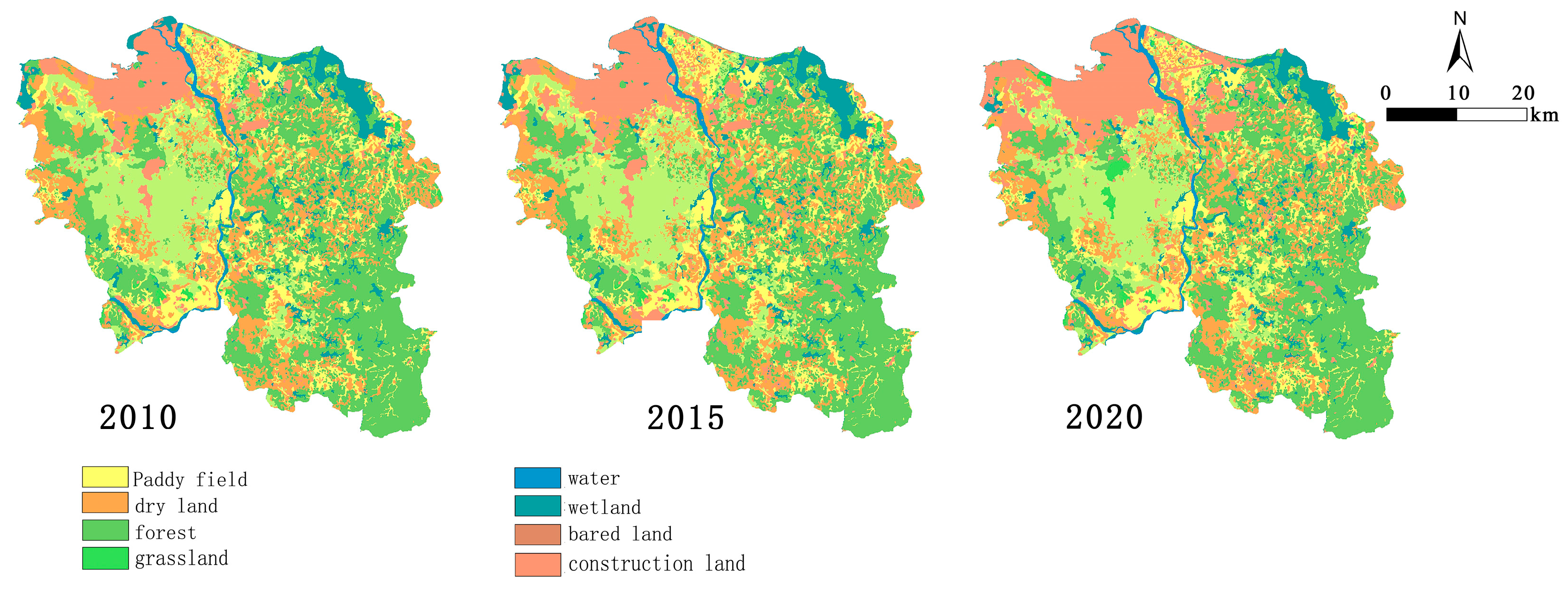
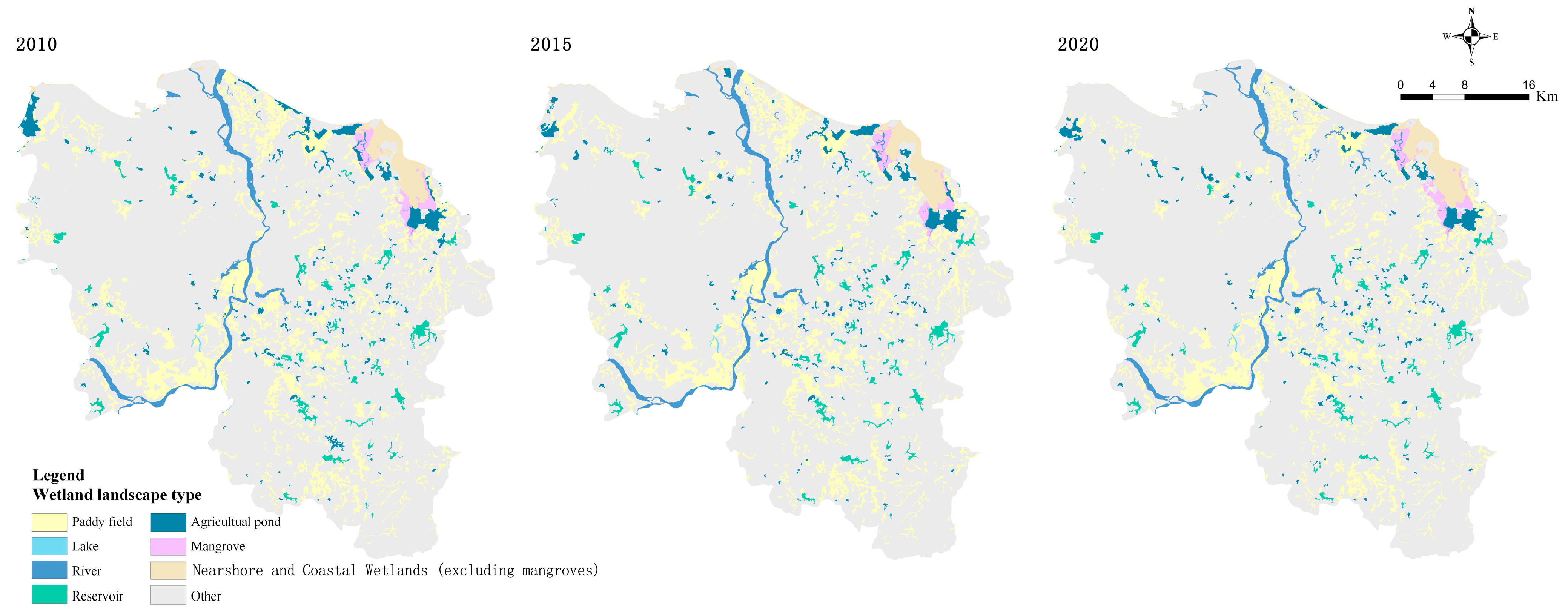
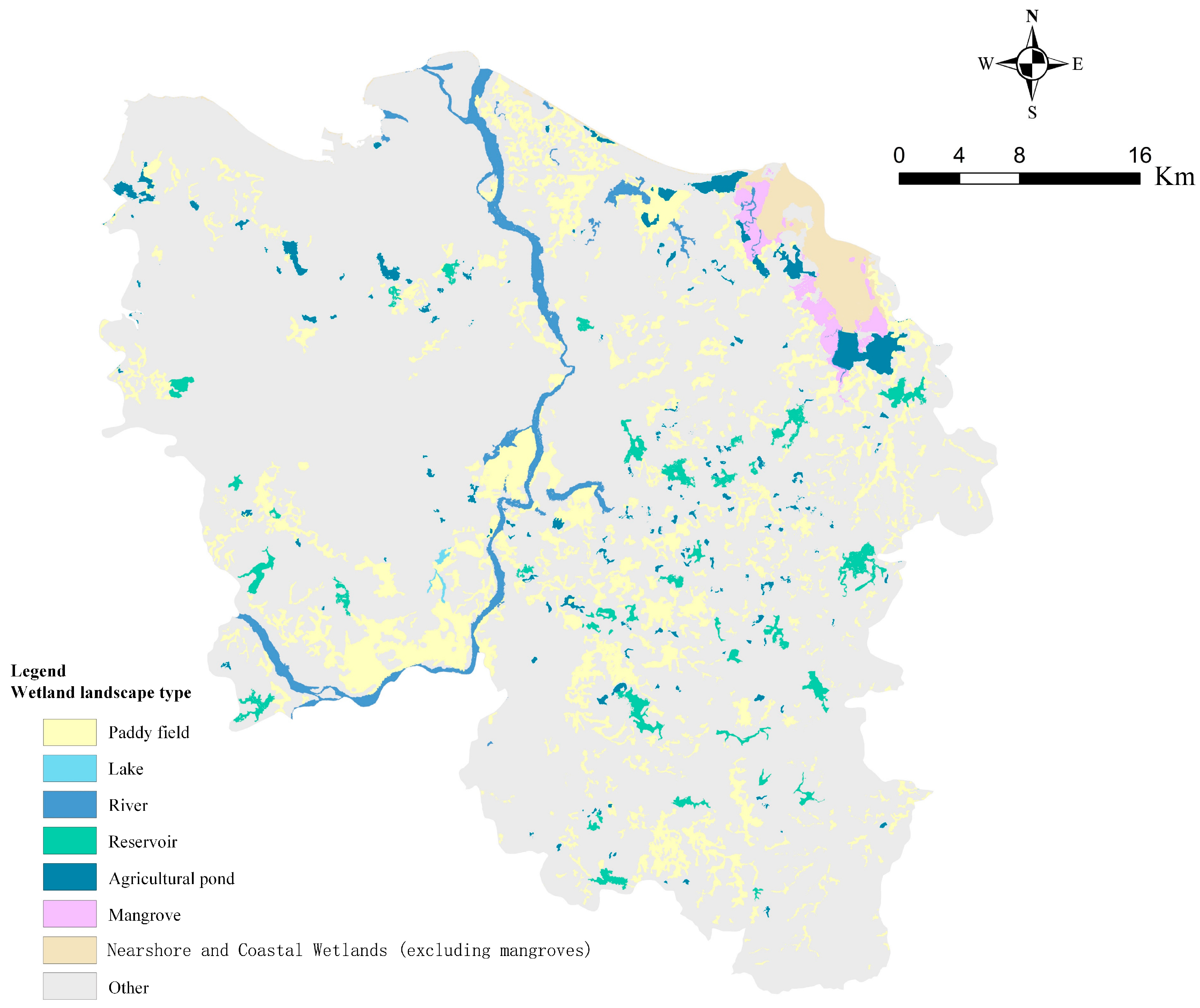
This study utilized land use remote sensing monitoring datasets (30 m resolution) from the Data Center for Resources and Environmental Sciences (https://www.resdc.cn/) of the Chinese Academy of Sciences, covering three annual periods: 2010, 2015, and 2020 (Table 1). The dataset is categorized into six primary land types: cropland, forest, grassland, water, construction land, and bare land. Cropland is further divided into two subtypes—paddy fields and dry land—while water is classified into six subtypes including rivers, channels, lakes, reservoirs, and ponds (Figure 2). Based on the Wetland Classification Standard (GB/T 24708-2009) and wetland resource conditions in Haikou, this study categorizes wetlands into natural wetlands and artificial wetlands [33]. Natural wetlands comprise four major categories: mangroves, rivers, nearshore and coastal wetlands, and lakes. Notably, mangroves are elevated to a separate category in this classification system due to their unique ecological structure, functions, and conservation value. Artificial wetlands include paddy fields, reservoirs, ponds. Through visual interpretation of Google historical imagery and land use map of Haikou (2013), along with field surveys to verify ambiguous areas, we refined classification results to achieve overall accuracy > 92%, ultimately producing maps ‘Spatial distribution of wetland inHaikou 2010, 2015, 2020 (Figure 3).

2.3. Landscape Dynamics Modeling

Landscape dynamics (K) is used to quantify the intensity of changes in landscape types during a specific time period, and is calculated by the formula:
K = U b U a U a × 1 T 100 %
K represents the annual change rate of wetland landscape, U a and U b represent the area of a certain landscape type in the early and late stages of the study, and T represents the number of years in the early and late stages.
The landscape transfer matrix can reveal the number and direction of transfer between different landscape types:
S i j = S 11 S 1 n S n 1 S n n
where S indicates the area (km2) of landscape type, n represent the number of landscape pattern types before and after transfer; i and j represent the landscape types at the end of primary study period and the end of research period, respectively.

2.4. PLUS Model Construction and Verification

The PLUS model is an innovative land use simulation framework that integrates land use expansion analysis strategies with multi-type random patch seeding [34]. By combining random seed generation and threshold reduction mechanisms, it achieves precise land use modeling [35,36]. Compared to the traditional CLUE-S model, PLUS demonstrates two key innovations: First, its LEAS module employs a random forest algorithm to analyze multiple drivers of land use expansion, overcoming the limitations of CA-Markov models that only support binary conversion. Second, its CARS module incorporates a random seed mechanism to accurately simulate the dynamic evolution of fragmented landscapes such as pond wetlands [34].

2.4.1. Driver Factor Data Processing

To analyze the driving mechanisms behind wetland evolution, relevant socio-economic data (including population, economy, and road networks) and natural indicator data (including annual average temperature, annual precipitation, elevation, and slope) were collected (Table 1). For non-raster format driving factor data (especially point or polygon-based socio-economic and some natural data), Kriging spatial interpolation was performed using ArcGIS 10.8 software to convert them into continuous raster surfaces. The interpolation results all passed spatial autocorrelation tests to ensure their validity.
To guarantee spatial consistency and compatibility among all datasets, the Haikou City administrative boundary was used as a mask to clip all raster data (including the wetland distribution maps and the interpolated driving factors). Subsequently, all raster data were resampled to a 30 m pixel resolution and unified within the same geospatial coordinate system. Finally, all preprocessed raster data were exported in TIFF format, with strict adherence to ensuring all data layers possessed identical row and column counts, achieving perfect spatial alignment. This standardized preprocessing pipeline established a reliable data foundation for subsequent import into the PLUS model to conduct wetland landscape dynamic simulations, driving mechanism analysis, and future scenario predictions.

2.4.2. Set the Transfer Cost Matrix

The transfer cost matrix shows the possibility of mutual conversion between two land types, where 1 means that they can be converted to each other and 0 means that they cannot be converted. Based on the actual conditions of Haikou, a coastal city, the cost transfer matrix is established according to the following principles: prioritizing the protection of ecologically sensitive land categories (prohibiting construction land conversion to water bodies and restricting water body conversion to farmland), strictly adhering to cropland protection policies (prohibiting paddy fields from being converted to construction land), following natural succession patterns (allowing free conversion between vegetation types), implementing strict conversion restrictions for special protected areas like mangroves, while considering flexibility in utilization for certain land categories such as ponds(Table 2).

2.4.3. Neighborhood Weight Setting

The Neighborhood weight indicates the expansion intensity of different land use types, with values ranging from 0 to 1. A higher value closer to 1 signifies stronger expansion capacity, while a lower value indicates weaker capacity. Using data from 2010 and 2020 as the basis, we calculated the expansion capabilities of various land use categories [35,37]. The expansion intensity was then dimensionless processed using the following formula, with the resulting parameters shown in Table 3.
X i * = X i X m i n X m a x X m i n
X i * represents the weight value, X i is the area of land use type, and X m a x X m i n respectively represent the number of the largest and smallest land use types.

2.4.4. Model Accuracy Verification

In order to verify the accuracy of the PLUS model simulation, the wetland in 2020 was simulated based on the wetland data in 2010 and 2015, and the accuracy of the simulation results was verified with the actual wetland data in 2020. The results showed that the Kappa coefficient was 0.83 and the overall accuracy was 0.86, indicating that the simulation results were scientific and reliable.

2.4.5. Scenario Setting

(1) Business-As-Usual Scenario
As the baseline scenario, BAU extends the 2010–2020 evolutionary trajectory of Haikou’s wetland landscapes without imposing land conversion restrictions. This scenario simulates autonomous wetland evolution under current urban development trends, serving as the reference for comparative analysis with other scenarios.
(2) Ecological Conservation Scenario
Prioritizing ecological security for Hainan Free Trade Port, this scenario enforces “zero net loss of total wetland area” through these rules:
a. Restricting artificial wetland loss:
Conversion probability from reservoirs/agricultural ponds to cropland is reduced by 20%;
Conversion probability from reservoirs/agricultural ponds/mangroves to construction land is reduced by 40%;
Conversion probability from rivers to construction land is reduced by 30%.
b. Promoting ecological restoration:
Conversion probability from cropland to rivers/agricultural ponds is increased by 30%;
Conversion probability from unutilized land to rivers is increased by 30%;
Conversion probability from agricultural ponds/other coastal wetlands to mangroves is increased by 30%.
(3) Economic Development Scenario
To support Free Trade Port construction demands, this scenario facilitates development in key zones (e.g., Jiangdong New Area, Airport Industrial Park):
a. Accelerating construction land expansion:
Conversion probability from cropland to construction land is increased by 30%;
Conversion probability from forest/grassland/rivers/othe coastal wetlands to construction land is increased by 40%;
Conversion probability from reservoirs/agricultural ponds to construction land is increased by 50%
b. Limiting construction land reversion:
Conversion probability from construction land to wetlands (excluding lakes/mangroves) is reduced by 50%;
Conversion probability from construction land to cropland/forest is reduced by 30%;
Conversion probability from unutilized land to other coastal wetland is reduced by 50%.
(4) Multi-Objective Development Scenario
Aiming to balance ecological and economic objectives, follow the Haikou Territorial Space Master Plan (2021–2035):
a. Rigorous wetland protection:
Conversion probability from all wetlands to construction land is reduced by 40%;
Rivers and mangroves are designated as inviolable constraints.
b. Flexible development accommodation:
Conversion probability from construction land to wetlands (rivers/reservoirs/agricultural ponds/mangroves/other coastal wetlands) is reduced by 30%;
Conversion probability from cropland/forest/grassland/unutilized land to construction land receives a moderate increase.

3. Results

3.1. Analysis of Wetland Landscape Structural Changes

3.1.1. Overall Loss and Structural Reorganization

As shown in the Table 4, Haikou’s wetland landscape exhibits a pattern characterized by “paddy field dominance with natural wetlands clustered and embedded.” Paddy fields are the absolute dominant type, consistently accounting for over 60% of the total wetland area (63.08% in 2010, 62.81% in 2020). This is followed by agricultural ponds (10.29% in 2010, 8.72% in 2020), river wetlands (8.45% in 2010, 9.48% in 2020), and reservoirs (6.89% in 2010, 6.72% in 2020).
Between 2010 and 2020, the total wetland area in Haikou City showed a declining trend (455.51 km2 to 434.5 km2), with significant internal structural changes and pronounced spatial differentiation.
(1) Artificial wetlands continued to shrink: Paddy field area decreased by 14.43 km2 (287.33 km2 to 272.9 km2). The main loss areas were located around CLTown and the urban core, with conversion to urban construction land accounting for a high 69.00% of the converted paddy area (data from the “Paddy field” to “Other” category in the transition matrices, Table 4). Agricultural pond area decreased by 8.99 km2 (46.86 km2 to 37.87 km2). The hotspot for loss was concentrated around Xinhaigang Port.
(2) Conversely, natural wetlands overall demonstrated resilience in recovery, with their proportion rising from 19.74% in 2010 to 21.76% in 2020:
River wetland area increased by 2.7 km2 (38.49 km2 to 41.19 km2), with its proportion rising by 1.03% (8.45% to 9.48%), which was primarily driven by the Nandu River ecological restoration project. Mangrove area showed a net increase of 1.25 km2 (15.55 km2 to 16.8 km2) after fluctuations, with its proportion rising by 0.46% (3.41% to 3.87%). Wetland aggregation significantly improved within the Dongzhai Port Mangrove Nature Reserve. The proportion of Lake wetlands increased slowly at an average annual rate of approximately 0.01% (0.21% to 0.23%). Nearshore and Coastal Wetlands (excluding mangroves) area remained relatively stable (34.92 km2 to 35.54 km2), with its proportion slightly increasing (7.67% to 8.18%). Reservoir area decreased (31.38 km2 to 29.22 km2), leading to a drop in its proportion (6.89% to 6.72%).

3.1.2. Stage-Specific Evolution Patterns

Analysis of the landscape dynamic degree reveals stage-specific characteristics of wetland changes:
2010–2015: Driven by rapid urban expansion, the shrinkage of artificial wetlands intensified, with a dynamic degree of −2.75%, which primarily reflected in the reduction in paddy fields and agricultural ponds. Changes in natural wetlands were relatively mild overall, with a dynamic degree of 0.84% which mainly reflected in increases in rivers and Nearshore and Coastal Wetlands (excluding mangroves), despite a decrease in mangroves.
2015–2020: Under the influence of conservation policies such as wetland restoration projects, the loss rate of artificial wetlands slowed, with a dynamic degree of −1.12%, which reduced decline in paddy fields and agricultural ponds. The recovery trend of natural wetlands significantly strengthened, with the dynamic degree rising to 1.56%, which primarily driven by continued river increases and notable mangrove recovery.

3.1.3. Spatial Conflict Hotspots

Based on the transition matrices (Table 5 and Table 6), three typical types of conflict/conversion zones can be identified:
High-Intensity Conversion Zone (Artificial to Construction Land): Concentrated in urban expansion hotspots (e.g., Jiangdong New Area on Haikou’s east coast). This zone is the core area of paddy field loss. From 2010 to 2015, a total of 12.55 km2 was converted, of which 8.66 km2 (69.00% of the converted area) was transformed into construction land.
Ecological Restoration Zone (Artificial to Natural): Primarily located in YF Town (within the buffer zone of the Dongzhai Port Nature Reserve). Guided by ecological protection policies, a “pond-to-wetland” restoration project covering 3.24 km2 of agricultural ponds was implemented between 2015 and 2020, and agricultural pond conversion to natural types like rivers, Nearshore and Coastal Wetlands (excluding mangroves), and mangroves.
Natural Fluctuation Zone (Inter-conversion among Natural wetland Types): Mainly situated in the core area of the Dongzhai Port Nature Reserve. Within this zone, mangroves and other coastal wetlands exhibit a dynamic equilibrium with reciprocal changes in area due to ecological succession and periodic dynamics, as reflected in mutual conversion data between mangroves and other coastal wetlands.

3.2. Analysis of Wetland Evolution Driving Forces

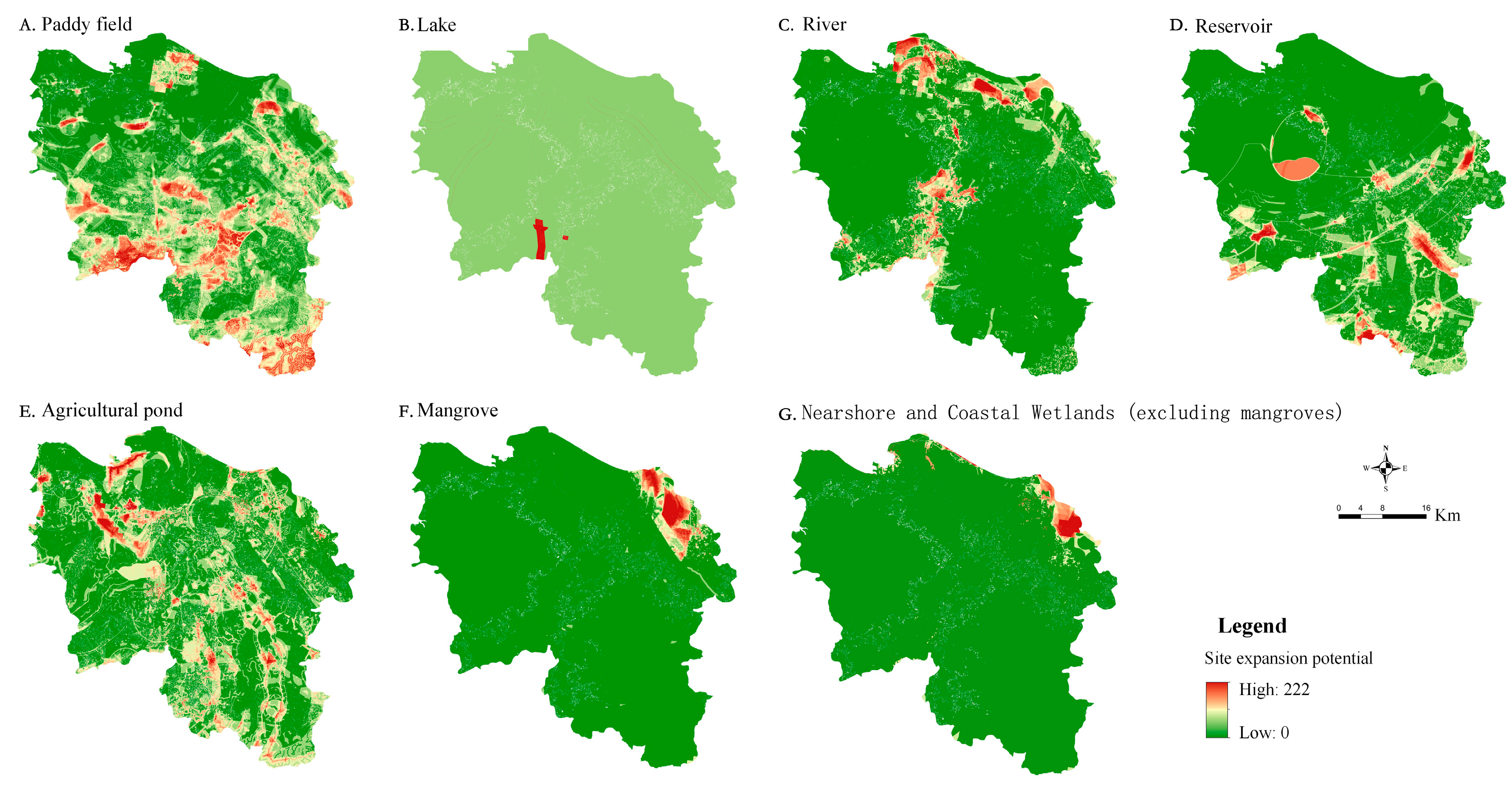
As shown in Table 7 and Figure 4, the expansion of paddy fields is influenced relatively evenly by various factors, with GDP (economic factor) exhibiting the most significant impact (contribution: 0.16). This prominence stems from the direct link between paddy fields and staple food production, making them integral to the primary agricultural economy. Areas identified with high paddy field expansion potential are concentrated in central-southern Haikou, specifically XP Town, JZ Town, and HQ Town. Additionally, the northern part of LS Town, west of the urban core, shows high potential partly due to its relatively higher annual average temperature (a driver with a contribution of 0.15), warranting focused protection of its paddy field ecological environment and optimal utilization of favorable growing conditions for high-quality development.
Figure 4 indicates high river wetland expansion potential primarily in the Nandu River estuary areas flanking Haidian Island and Xinbu Island in the north, Jiangdong New Area, and central LQ Town. Environmental-climatic drivers dominate river wetland changes, with elevation (contribution: 0.16) and annual average temperature (contribution: 0.13) being the most influential. Jiangdong New Area in northeast Haikou possesses favorable conditions for river wetland development: relatively high annual temperature and precipitation, combined with low-lying topography featuring a south-to-north elevation gradient, facilitating natural surface runoff formation.
Population emerges as the overwhelmingly dominant driver for reservoir wetland change (contribution: 0.34), followed distantly by GDP. Figure 4D reveals that high reservoir expansion potential areas are located away from the urban core, concentrated in sparsely populated southern regions like SMP Town and ZT Town. This spatial pattern indicates a negative correlation between population density and reservoir expansion. Both reservoirs and agricultural ponds exhibit significant expansion potential in the Yangshan area of LQ Town. This is attributed to the region’s volcanic lava landform, which fosters the development of numerous small water bodies like ponds and marshes. Enhancing connectivity among these micro-wetlands is crucial to strengthen material and energy flows, potentially forming a vital green ecological barrier for Haikou.
Similar to paddy fields, agricultural ponds play a significant role in Haikou’s agricultural economy. Consequently, GDP is a key driver of their evolution (contribution: 0.20). While proximity to various road levels shows some correlation (notably distance to trunk roads: contribution 0.10), elevation exerts a negative influence (contribution: −0.11), reflecting their typical location in low-lying areas. Figure 4E highlights the Wuyuan River–Yongzhuang Reservoir–Shapo Reservoir–Meishe River corridor as an area of high agricultural pond expansion potential. Future development here should prioritize protecting existing river and reservoir wetland landscapes. Preventing anthropogenic disruptions that fragment wetland connectivity and diminish ecological benefits is essential. Concurrently, strengthening the protection of micro-wetlands in this corridor could facilitate their coalescence into larger-scale agricultural pond systems.
Mangrove wetlands and other coastal wetlands cluster within the Dongzhai Port Nature Reserve and exhibit some mutual transformation, which are influenced by similar topographic and climatic drivers. Conversely, other coastal wetlands are primarily driven by elevation (contribution: 0.48), reflecting their specific submerged distribution. Furthermore, annual average temperature (contribution: 0.14) is also a significant driver, as subtle temperature changes can trigger pronounced responses in seagrass beds characteristic of these habitats.

3.3. Predictive Analysis of Wetland Landscape Evolution Under Different Scenarios

3.3.1. BAU Scenario

Total wetland area decreased from 434.50 km2 to 429.10 km2, representing a net reduction of 5.40 km2 (Table 8). The comprehensive dynamic degree was −0.12%, significantly lower than the rate of −0.33% observed during the 2010–2020 period, indicating stabilization of the wetland system.
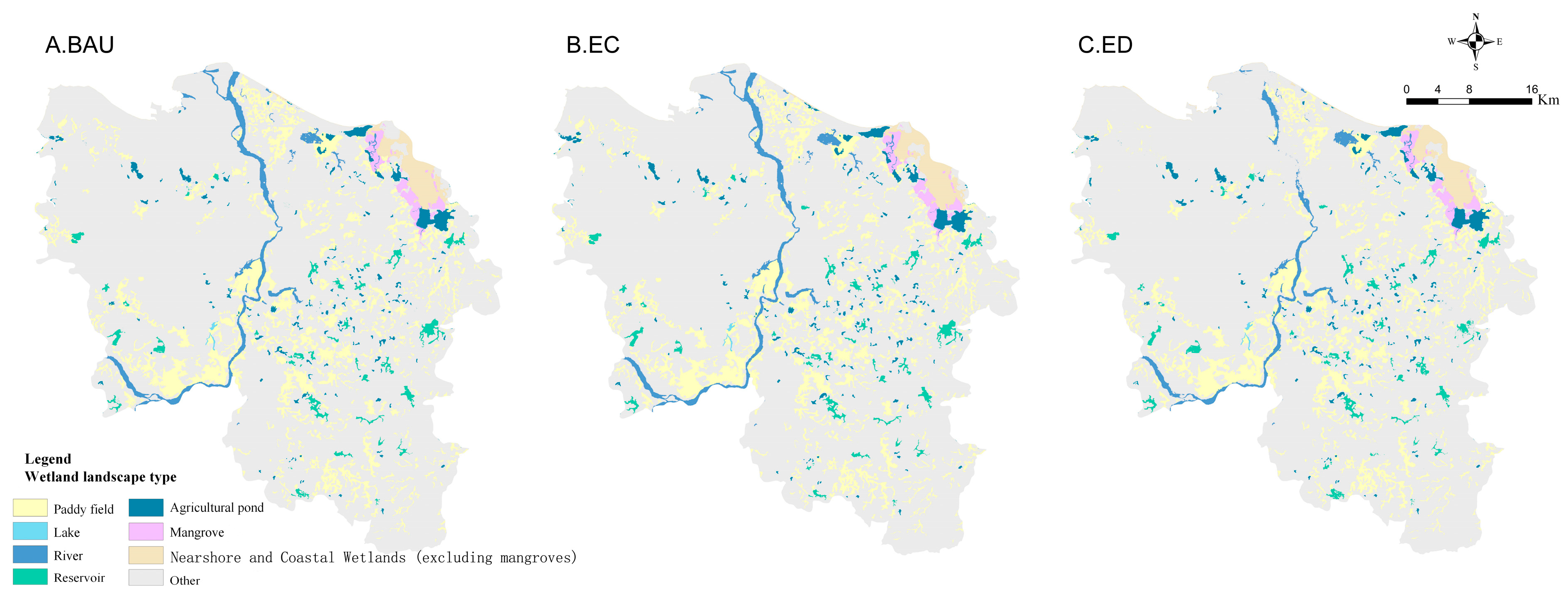
As shown in Table 8 and Figure 5, key changes exhibited concurrent expansion and contraction patterns. Specifically, paddy fields increased by 1.64 km2 (dynamic degree +0.06%), with growth concentrated in XP and HQ Towns (Figure 4A), aligning spatially with identified wetland expansion potential zones (Figure 4A); rivers expanded by 1.88 km2 (dynamic degree +4.6%), primarily attributed to channel widening in the GLY area; mangrove area increased by 0.92 km2 (dynamic degree +5.5%), showing consolidation of fragmented patches near the Dongzhai Port entrance, reflecting effective restoration outcomes. Conversely, aquaculture ponds decreased substantially by 6.16 km2 (dynamic degree −16.3%), with loss hotspots in southern JZ Town (Figure 4B) and the Xinhai Port area (due to port development encroachment); subtidal aquatic beds declined by 2.88 km2 (dynamic degree −8.1%), exhibiting significantly inverse distribution dynamics with mangroves, primarily within Dongzhai Port, while localized losses also occurred on Beigang Island from reclamation activities. Based on these dynamics, conservation recommendations include urgently strengthening pollution control measures for aquaculture ponds in JZ Town and implementing flood drainage infrastructure in coastal villages to address the eastward expansion trend of subtidal aquatic beds.

3.3.2. EC Scenario

As shown in Table 8 and Figure 5, total wetland area remained largely stable at 432.37 km2, exhibiting a minimal net loss of 2.13 km2 and a comprehensive dynamic degree of −0.05% (Table 8), thereby approaching a state of near-net-zero loss. Artificial wetland restoration efforts yielded differentiated outcomes: reservoir area maintained stability (29.22 km2), spatially consistent with expansion potential zones (Figure 4D), while agricultural ponds continued to decline (−3.52 km2), primarily attributable to port development encroachment. Natural wetland optimization was evidenced by enhanced connectivity and aggregated spatial distribution of paddy fields in HQ Town. Concurrently, severe constraints on construction land supply emerged as a critical development limitation, restricting regional economic growth.

3.3.3. ED Scenario

As shown in Table 8 and Figure 5, total wetland area experienced a sharp decline of 26.33 km2 (from 434.50 km2 to 408.17 km2), yielding a comprehensive dynamic degree of −0.61% (Table 8) that markedly exceeded historical loss rates. This reduction was primarily driven by severe contraction of paddy fields (−14.43 km2; dynamic degree −5.3%), largely converted to construction land along expressways in LS and XX Towns—confirming strong correlations with GDP growth and road proximity drivers (Table 7). Notably, rivers registered their first documented decline (−6.60 km2; dynamic degree −16.0%), attributable to flow interruptions in the Binjiang Street segment (Nandu River Bridge to Hairui Bridge) and reclamation activities at the Haidianxi estuary. Structural ecosystem risks intensified through continued shrinkage of agricultural ponds (−4.95 km2) and coastal wetlands (−0.54 km2), progressively compromising ecological barrier functions. These dynamics necessitate immediate conservation prioritization, specifically establishing ecological redlines along the Nandu River to prohibit channel encroachment.

3.3.4. Comparative Study of Multi-Scenario Future Development

Total wetland area registered a net loss of 7.20 km2 (427.30 km2 remaining), with a comprehensive dynamic degree of −0.17% (Table 9), demonstrating successful balancing of dual conservation and development objectives. As shown in Table 9 and Figure 6, this equilibrium manifested through an 86% ecological preservation rate relative to the EC scenario, significantly exceeding the 73% economic fulfillment under the ED scenario. Key dynamics included moderate paddy field reduction (−11.54 km2), confirming conversion linkages to urban periphery expansion; intensified fragmentation of agricultural ponds revealing insufficient protection in HQ Town, though emerging wetland patches partially offset this through enhanced urban ecological services; and substantial reservoir expansion (+7.32 km2; dynamic degree +25.1%) necessitating improved ecological utilization strategies. River connectivity improvements followed elimination of downstream flow interruptions, yet new agricultural encroachment emerged in DS Town. Optimization pathways therefore require strengthened shoreline control along the Nandu River to prevent agricultural encroachment and systematic integration of reservoir ecological functions.

4. Discussion

This study quantitatively dissects the complex interplay of economic drivers and ecological resilience governing Haikou’s wetland dynamics. Artificial wetlands (paddy fields, agricultural ponds) exhibit acute vulnerability to urbanization pressures, whereas natural wetlands (rivers, mangroves) demonstrate measurable recovery under conservation. Critically, our PLUS simulations project that unregulated development (ED scenario) would accelerate wetland loss to a dynamic degree of −0.61%—surpassing historical rates—primarily through GDP-driven paddy field conversion (−14.43 km2) and unprecedented river fragmentation (−16.0%). These outcomes validate anthropogenic dominance quantified in driver contribution analysis (Table 7: population/GDP contributions >0.3 for reservoirs/paddies). While the ecological conservation scenario (EC) achieved near net-zero loss (−0.05% dynamic degree), it imposed prohibitive economic trade-offs via construction land restrictions, underscoring the infeasibility of isolationist preservation in free-trade port contexts.
The multi-objective scenario (MOD) resolves this dichotomy by synchronizing wetland integrity with development imperatives. It retains 86% of EC’s preservation efficacy while fulfilling 73% of ED’s economic demand through strategic spatial constraints (e.g., inviolable rivers/mangroves) and bidirectional probability adjustments. Notably, MOD’s 25.1% reservoir growth—absent under EC—demonstrates targeted interventions can enhance ecosystem services beyond area retention. Spatially explicit analyses—transition matrices (Table 7) and expansion potential mapping (Figure 4)—converge to identify priority conservation zones: Nandu River shorelines (agricultural encroachment risk), Dongzhai Port (mangrove connectivity), and JZ Town (pond pollution), where historical loss patterns and driver contributions exhibit maximal alignment.
These findings advance land system science through three contributions:
Mechanistic insight: Road proximity (contribution >0.4 for mangroves) and elevation (0.48 for subtidal beds) emerge as critical yet spatially heterogeneous drivers, necessitating spatially differentiated governance rather than uniform city-wide policies.
Planning innovation: MOD’s “flexible constraints” framework outperforms conventional scenarios by enabling context-dependent conversions (e.g., pond-to-mangrove transitions in degraded zones), providing a transferable model for Global South coastal cities.
Policy synergy: Integrating wetland conservation with infrastructure planning—exemplified by aligning reservoir expansion (+7.32 km2 under MOD) with green stormwater infrastructure—can generate synergistic co-benefits transcending area-based metrics.
Notwithstanding these advances, two limitations warrant attention: unquantified climate change impacts (e.g., sea-level rise on subtidal beds) and static “inviolable” designations requiring adaptive thresholds for tidal dynamics. Future research should integrate lateral and vertical hydrological connectivity indices to refine functional wetland assessments.

5. Conclusions

This study systematically simulated the wetland evolution (2020–2030) in Haikou City using the PLUS model under four scenarios (Business-As-Usual: BAU, Ecological Conservation: EC, Economic Development: ED, and Multi-Objective Development: MOD). By integrating landscape dynamics, transition matrices, and driver analysis, we revealed the spatiotemporal patterns and underlying mechanisms.
Key findings demonstrate: From 2010 to 2020, Haikou’s wetlands experienced continuous decline, with a net loss of 21.01 km2. This process was characterized by the marked shrinkage of artificial wetlands (paddy fields: −14.43 km2; aquaculture ponds: −8.99 km2) alongside the resilient recovery of natural wetlands (rivers: +2.70 km2; mangroves: +1.25 km2), highlighting the inherent conflict between economic growth and ecological integrity within coastal free-trade zones.
Future scenario projections reveal:
(1) BAU Scenario: Projected a decelerated yet persistent wetland loss (−5.40 km2; dynamic change rate: −0.12%/a). Localized gains in paddy fields (+1.64 km2) and mangroves (+0.92 km2) were insufficient to offset severe degradation of aquaculture ponds (−6.16 km2).
(2) EC Scenario: Achieved near net-zero loss (−2.13 km2; −0.05%/a) through stringent conversion controls. However, this induced a 24% deficit in built-up land allocation, significantly constraining economic development potential.
(3) ED Scenario: Triggered unprecedented wetland erosion (−26.33 km2; −0.61%/a), including the first recorded significant contraction of rivers (−6.60 km2, −16.0%) primarily due to channel fragmentation, underscoring the unsustainability of such development trade-offs.
(4) MOD Scenario (Critical Finding): Effectively balanced dual objectives by maintaining 86% of EC’s wetland preservation efficiency (loss: −7.20 km2; −0.17%/a) while fulfilling 73% of ED’s development demand. Notably, this scenario achieved significant reservoir expansion (+7.32 km2, +25.1%) and restored river connectivity without causing critical ecological damage.
Based on spatial heterogeneity, we propose targeted management strategies:
(1) Establish ecological redlines along the Nandu River to curb agricultural encroachment;
(2) Enhance mangrove corridor connectivity in Dongzhai Port;
(3) Strengthen pollution prevention for aquaculture ponds in YF Town;
(3) Optimize construction land sourcing towards non-ecologically sensitive areas.
(4) Integrate reservoirs into the green infrastructure network.
This research validates that multi-objective spatial planning can reconcile wetland conservation with free-trade port development. It provides actionable strategies, including defining wetland constraint zones and establishing tidal-adapted redlines. Furthermore, the developed analytical framework is transferable, offering valuable insights for coastal megacities navigating similar ecological-economic tensions. Future studies are recommended to incorporate climate pressures to enhance vulnerability assessments of wetland systems.

Author Contributions

Y.C.: Writing—original draft, Writing—review and editing, Methodology, Formal analysis, Data curation, Conceptualization. R.Y.: Writing—review and editing, Methodology, Formal analysis, Data curation, Conceptualization. S.C.: Writing—review and editing, Formal analysis, Visualization, Resources. G.F.: Writing—review and editing, Formal analysis, Visualization, Resources. H.F.: Writing—review and editing, Supervision, Conceptualization. All authors have read and agreed to the published version of the manuscript.

Funding

The research was funded by Hainan Institute of National Park, Hainan Provincial Philosophy and Social Science Planning Project (HNSK(ZX)24-252); Hainan Provincial Higher Education Teaching Reform Research Fund (Hnjg2024-10); Hainan University Teaching Reform Research Project (hdjy2420); Hainan University Humanities and Social Sciences Young Scholar Support Project (24QNFC-14); National Research Incubation Program of Humanities and Social Sciences of Hainan University (25GJJPY-7); the Philosophy and Social Science Planning Project of Haikou (2025-ZCKT-10); the Basic Research Program of Shanxi Province (202303021222049); and the Philosophy and Social Science Planning Project of Shanxi Province (2024QN047).

Data Availability Statement

The original contributions presented in this study are included in the article. Further inquiries can be directed to the corresponding authors.

Conflicts of Interest

The authors declare that they have no known competing financial interests or personal relationships that could have appeared to influence the work reported in this paper.

References

  1. Scholes, R.; Montanarella, L.; Brainich, A.; Barger, N.; Brink, B.T.; Cantele, M.; Erasmus, B.; Fisher, J.; Gardner, T.; Holland, T.G.; et al. Summary for Policymakers of the Assessment Report on Land Degradation and Restoration of the Intergovernmental Science-Policy Platform on Biodiversity and Ecosystem Services; Intergovernmental Science-Policy Platform on Biodiversity and Ecosystem Services; IPBES: Bonn, Germany, 2018. [Google Scholar]
  2. Zhang, Y. Analysis of Wetland Changes and Driving Factors in the Pengqu River Basin of the Tibetan Plateau; Southwest University: Chongqing, China, 2021. [Google Scholar]
  3. Yu, S.L.; Cui, B.S.; Yan, J.G.; Song, G.X.; Zhou, Y.X.; Shao, X.J.; Fu, J. Ecological Compensation Mechanisms and Models for Damaged Coastal Wetlands in Reclamation Areas. Wetl. Sci. 2015, 13, 675–681. [Google Scholar]
  4. Ma, W.; Zhou, T.; Jiang, Y.; Liu, Q.; Liu, Z. Protection Status and Future Protection Objectives of the Wetlands in China. Wetl. Sci. 2021, 19, 435–441. [Google Scholar]
  5. Cui, L.; Zhang, X.; Zhang, M. Tasks and Prospects of Wetland Conservation and Management in China: Interpretation of the Wetland Protection and Restoration System Plan. Environ. Prot. 2017, 45, 13–17. [Google Scholar]
  6. Yu, G. Progress and Prospects in Wetland Research. World Sci.-Tech. RD 2000, 3, 61–66. [Google Scholar]
  7. Cowardin, L.M. Fish and Wildlife Service, Biological Services Program (USA). In Classification of Wetlands and Deepwater Habitats of the United States; Fish and Wildlife Service, USA Department of the Interior: Washington, DC, USA, 1979. [Google Scholar]
  8. Brinson, M. A Hydrogeomorphic Classification for Wetlands; Wetlands Research Program Technical Report WRP-DE-4; US Army Corps of Engineers: Vicksburg, MS, USA, 1993. [Google Scholar]
  9. Sonti, N.F.; Campbell, L.K.; Svendsen, E.S.; Johnson, M.L.; Auyeung, D.N. Fear and Fascination: Use and Perceptions of New York City’s Forests, Wetlands, and Landscaped Park Areas. Urban For. Urban Green. 2020, 49, 126601. [Google Scholar] [CrossRef]
  10. Reeves, J.P.; John, C.H.D.; Wood, K.A.; Maund, P.R. A Qualitative Analysis of UK Wetland Visitor Centres as a Health Resource. Int. J. Environ. Res. Public Health 2021, 18, 8629. [Google Scholar] [CrossRef] [PubMed]
  11. Quek, B.S.; He, Q.H.; Sim, C.H. Performance of a Pilot Showcase of Different Wetland Systems in an Urban Setting in Singapore. Water Sci. Technol. 2015, 71, 1158–1164. [Google Scholar] [CrossRef]
  12. Wang, Y.S.; Gu, J.D. Ecological Responses, Adaptation and Mechanisms of Mangrove Wetland Ecosystem to Global Climate Change and Anthropogenic Activities. Int. Biodeterior. Biodegrad. 2021, 162, 105248. [Google Scholar] [CrossRef]
  13. Alongi, D. Mangrove Forests: Resilience, Protection from Tsunamis, and Responses to Global Climate Change. Estuar. Coast. Shelf Sci. 2008, 76, 834–844. [Google Scholar] [CrossRef]
  14. Bell-James, J.; Boardman, T.; Foster, R. Can’t See the (Mangrove) Forest for the Trees: Trends in the Legal and Policy Recognition of Mangrove and Coastal Wetland Ecosystem Services in Australia. Ecosyst. Serv. 2020, 45, 101148. [Google Scholar] [CrossRef]
  15. Padhy, S.R.; Bhattacharyya, P.; Nayak, S.K.; Dash, P.K.; Mohapatra, T. A Unique Bacterial and Archaeal Diversity Make Mangrove a Green Production System Compared to Rice in Wetland Ecology: A Metagenomic Approach. Sci. Total Environ. 2021, 781, 146713. [Google Scholar] [CrossRef]
  16. Dan, W.; Wei, H.; Shuwen, Z.; Kun, B.; Bao, X.; Yi, W.; Yue, L. Processes and Prediction of Land Use/Land Cover Changes (LUCC) Driven by Farm Construction: The Case of Naoli River Basin in Sanjiang Plain. Environ. Earth Sci. 2015, 73, 4841–4851. [Google Scholar] [CrossRef]
  17. Song, K.; Choi, Y.-E.; Han, H.-J.; Chon, J. Adaptation and Transformation Planning for Resilient Social-Ecological System in Coastal Wetland Using Spatial-Temporal Simulation. Sci. Total Environ. 2021, 789, 148007. [Google Scholar] [CrossRef] [PubMed]
  18. Ren, L.; Song, S.; Zhou, Y. Evaluation of River Ecological Status in the Plain River Network Area in the Context of Urbanization: A Case Study of 21 Rivers’ Ecological Status in Jiangsu Province, China. Ecol. Indic. 2022, 142, 109172. [Google Scholar] [CrossRef]
  19. Sun, G. Progress and Prospects of Wetland Science in China. Adv. Earth Sci. 2000, 15, 7. [Google Scholar]
  20. Mou, X.; Liu, X.; Yan, B.; Cui, B. Classification System of Coastal Wetlands in China. Wetl. Sci. 2015, 13, 19–26. [Google Scholar]
  21. Gu, J.; Qin, Y.; Wang, X.; Ma, J.; Guo, Z.; Zou, L.; Shen, X. Changes in Flooding Frequency and Wetland Vegetation Response in Poyang Lake. Acta Ecol. Sin. 2018, 38, 7718–7726. [Google Scholar]
  22. Wu, J. Landscape Ecology: Concepts and Theories. Chin. J. Ecol. 2000, 1, 42–52. [Google Scholar]
  23. Ling, C.; Ju, H.; Zhang, H.; Sun, H. Prediction of Wetland Resource Changes in Beijing Based on CA-MARKOV Model. Chin. Agric. Sci. Bull. 2012, 28, 262–269. [Google Scholar]
  24. Li, X.; Li, X.; Ren, L.; Shen, F.; Yan, Z.-Z.; Huang, X. Prediction of Landscape Evolution of Tidal Wetlands in the Yangtze Estuary Under Different Scenarios in 2020. J. Ecol. Rural. Environ. 2015, 31, 188–196. [Google Scholar]
  25. Wang, Z.; Liu, J.; Wang, X.; Dong, Y.; Wang, T. Degradation Characteristics and Driving Factors of Marsh Wetlands in the Naoli River Basin Over the Past 40 Years. China Rural. Water Hydropower 2023, 5, 47–55. [Google Scholar]
  26. Han, S. Dynamic Landscape Patterns and Driving Forces of Mangrove Forests in Dongzhai Port, Hainan; Beijing Forestry University: Beijing, China, 2012. [Google Scholar]
  27. Lei, J.; Chen, Z.; Chen, Y.; Chen, X.; Li, Y.; Wu, T. Evolution of Wetland Landscape Ecological Security Pattern in Hainan Island from 1990 to 2018. Ecol. Environ. Sci. 2020, 29, 293–302. [Google Scholar]
  28. Fu, T.; Zhang, L.; Yuan, X.; Chen, B.; Yan, M. Spatio-Temporal Patterns and Sustainable Development of Coastal Aquaculture in Hainan Island, China: 30 Years of Evidence from Remote Sensing. Ocean. Coast. Manag. 2021, 214, 105897. [Google Scholar] [CrossRef]
  29. Li, P.; Li, X.; Bai, J.; Meng, Y.; Diao, X.; Pan, K.; Zhu, X.; Lin, G. Effects of Land Use on Heavy Metal Pollution in Mangrove Sediments: A Whole-Island Scale Study in Hainan, China. Sci. Total Environ. 2022, 824, 153856. [Google Scholar] [CrossRef] [PubMed]
  30. Yang, X. Spatiotemporal Changes and Driving Mechanisms of Wetlands in Haikou City over the Past Sixty Years; Hainan Normal University: Haikou, China, 2021. [Google Scholar]
  31. Rong, G.; Wu, T.; Wu, X.; Luigi, S.; Wang, Y. Simulation of Urban Land Expansion Under Ecological Constraints in Harbin-Changchun Urban Agglomeration, China. Chin. Geogr. Sci. 2022, 32, 438–455. [Google Scholar] [CrossRef]
  32. Li, X.; Fu, J.; Jiang, D.; Lin, G.; Cao, C. Land Use Optimization in Ningbo City with a Coupled GA and PLUS Model. J. Clean. Prod. 2022, 375, 134004. [Google Scholar] [CrossRef]
  33. GB/T 24708-2009; Wetland Classification of the People’s Republic of China National Standard. China Standards Press: Beijing, China, 2009.
  34. Liang, X.; Guan, Q.; Clarke, K.C.; Liu, S.; Wang, B.; Yao, Y. Understanding the Drivers of Rapid Land Expansion Using a Patch-Generating Land Use Simulation (PLUS) Model: A Case Study in Wuhan, China. Comput. Environ. Urban Syst. 2021, 85, 101569. [Google Scholar] [CrossRef]
  35. Chen, S.; Fu, H.; Fu, G.; Chen, J. Comparison of Spatial-Temporal Dynamics of the Landscape Patterns of 5 National Nature Reserves in Hainan Province. J. Northwest For. Univ. 2023, 38, 9. [Google Scholar]
  36. Wu, D.; Zhu, K.; Zhang, S.; Huang, C.; Li, J. Evolution Analysis of Carbon Stock in Chengdu-Chongqing Economic Zone Based on PLUS Model and InVEST Model. Ecol. Environ. Monit. Three Gorges 2022, 7, 85–96. [Google Scholar]
  37. Chen, S.; Fu, H.; Fu, G.; Chen, J. Spatiotemporal Evolution of Wetland Ecosystem Service Value in Haikou and Its Response to Landscape Pattern Changes. J. Northwest For. Univ. 2023, 38, 236–242. Available online: http://kns.cnki.net/kcms/detail/61.1202.S.20230315.1327.003.html (accessed on 5 March 2023).
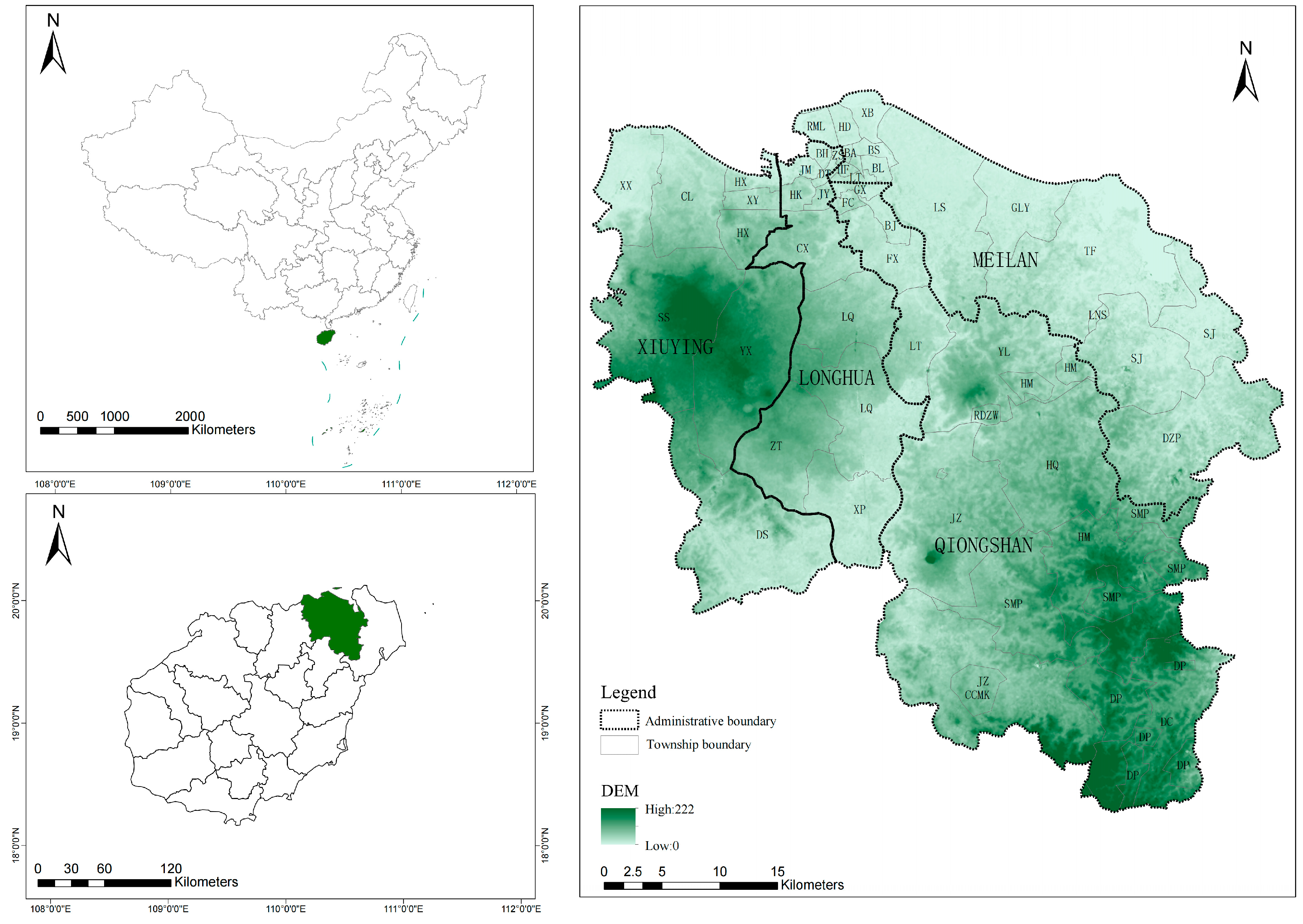
Figure 1. Study area.
Water 17 02565 g001
Figure 2. Spatial distribution of land use in Haikou 2010, 2015, 2020.
Water 17 02565 g002
Figure 3. Spatial distribution pattern of wetland landscapes in Haikou City (2010–2020).
Water 17 02565 g003
Figure 4. Expansion potential of various wetland types.
Water 17 02565 g004
Figure 5. Spatial distribution pattern of wetland landscape in Haikou under different development scenarios.
Water 17 02565 g005
Figure 6. Spatial distribution pattern of wetland landscape in Haikou under multi-objective development scenario.
Water 17 02565 g006
Table 1. Data source information.
Data TypeDataResolutionSource
Image dataLULC maps,
2010, 2015 and 2020
30 mResource and Environmental Science Data Platform
(https://www.resdc.cn/); China
Socio-economic dataPopulation100 mWorldPop (https://www.worldpop.org/); UK
GDP1 kmNational Earth System Science Data Center
(http://www.geodata.cn); China
Distance to main road OSM dataset (https://www.openstreetmap.org/)
Distance to primary road
Distance to secondary road
Distance to tertiary road
Distance to railway
Distance to highway
Distance to site
Distance to government
Climate and terrain dataAnnual average temperature China Meteorological Data (https://data.cma.cn); China
Annual average precipitation
Elevation30 mGeospatial data cloud (http://www.gscloud.cn/); China
Slope30 m
Table 2. Transfer cost matrix.
Land Use TypesPaddy FieldDry LandForestGrasslandConstruction LandBared LandLakeRiverReservoirAgricultural PondMangroveNearshore and Coastal Wetlands (Excluding Mangroves)
Paddy field111101111111
dry land111111111111
forest111111111111
grassland111111111111
construction land011111000000
bared 111111111111
Lake000101111110
River100101111111
Reservoir100101111111
Agricultural pond111111111111
Mangrove000101000011
Nearshore and Coastal Wetlands (excluding mangroves)001101111111
Table 3. Weight of neighborhood.
Dry LandForestGrasslandConstruction LandBared Land Paddy FieldLakeRiverReservoirAgricultural PondMangroveNearshore and Coastal Wetlands (Excluding Mangroves)
0.120.250.050.490.010.0900.010.010.020.010.03
Table 4. Wetland landscape area share and dynamic attitude in Haikou City, 2010–2020.
Landscape Type2010201020152015202020202010–2015 2010–2015
AreaArea PercentArea Area PercentAreaArea PercentDynamic AttitudeDynamic Attitude
km2%km2%km2%%%
Paddy field287.3363.08279.4363.25272.962.81−0.55−0.47
Lake0.970.210.970.220.980.23−0.040.26
River38.498.4538.598.7341.199.480.051.35
Reservoir31.386.8932.167.2829.226.720.5−1.83
Agricultural pond46.8610.2940.719.2137.878.72−2.62−1.39
Mangrove15.553.4113.563.0716.83.87−2.564.78
Nearshore and Coastal Wetlands (excluding mangroves)34.927.6736.388.2335.548.180.84−0.46
Total455.51100441.8100434.5100−0.6−0.33
Table 5. Haikou Wetland landscape transition probability matrix (km2) from 2010 to 2015.
20102015
Paddy FieldLakeRiverReservoirAgricultural PondMangroveNearshore and Coastal Wetlands (Excluding Mangroves)OtherTotal
Paddy field274.620.010.040.010.080.010.00412.55287.33
Lake0.010.95/////0.010.97
River0.06/37.81/0.010.040.020.5438.48
Reservoir0.01//30.540.37//0.4631.38
Agricultural pond0.12/0.31.1737.070.362.065.7546.83
Mangrove0.57/0.04/0.2112.810.92115.55
Nearshore and Coastal Wetlands (excluding mangroves)0.002/0.1/0.890.0833.020.8234.91
Other4.040.010.30.442.080.260.341816.551824.02
Total279.430.9738.5932.1640.7113.5636.371837.682279.47
Table 6. Haikou Wetland landscape transition probability matrix (km2) from 2015 to 2020.
20152020
Paddy FieldLakeRiverReservoirAgricultural PondMangroveNearshore and Coastal Wetlands (Excluding Mangroves)OtherTotal
Paddy field256.120.020.170.041.11.020.0120.95279.43
Lake0.030.93/////0.020.97
River0.26/37.02/0.020.080.011.238.59
Reservoir0.03//26.773.42//1.9332.16
Agricultural pond0.79/2.041.2129.380.071.525.740.71
Mangrove0.23/0.12/0.0212.110.150.9313.56
Nearshore and Coastal Wetlands (excluding mangroves)0.01/0.8/0.840.1433.371.2136.38
Other15.430.041.041.23.083.380.461813.061837.68
Total272.890.9841.1929.2237.8616.835.5218452279.47
Table 7. Contribution of expansion drivers for each wetland type.
Paddy FieldLakeRiverReservoirAgricultural PondMangroveNearshore and Coastal Wetlands (Excluding Mangroves)
Contribution of Driver FactorPopulation0.07 0.03 0.06 0.34 0.03 0.04 0.03
GDP0.16 /0.06 0.09 0.20 0.06 0.03
Distance to main road0.04 0.01 0.02 0.07 0.10 0.41 0.11
Distance to primary road0.04 0.00 0.05 0.03 0.03 0.01 0.04
Distance to secondary road0.05 /0.03 0.04 0.07 0.05 0.01
Distance to tertiary road0.05 /0.03 0.05 0.05 0.03 0.01
Distance to railway0.05 0.14 0.15 0.06 0.05 0.02 0.06
Distance to highway0.11 0.65 0.10 0.04 0.08 0.01 0.01
Distance to the site0.03 0.00 0.04 0.04 0.03 0.12 0.01
Distance to government0.10 0.05 0.03 0.04 0.09 0.08 0.03
Annual average temperature0.15 0.07 0.13 0.05 0.06 0.03 0.14
Annual average precipitation0.04 0.04 0.06 0.02 0.04 0.09 0.03
Elevation0.06 /0.16 0.05 0.11 0.07 0.48
Slope0.03 /0.08 0.08 0.06 0.01 0.01
Total1.00 1.00 1.00 1.00 1.00 1.00 1.00
Table 8. Wetland landscape area and dynamic attitude in Haikou under different development scenarios.
Landscape TypesBAU BAU ECECEDEC2020–2030 BAU 2020–2030 EC2020–2030 ED
Area/km2Area Percentage/%Area/km2Area Percentage/%Area/km2Area Percentage/%Dynamic Attitude/%Dynamic Attitude/%Dynamic Attitude/%
Paddy field274.5463.98271.1762.72258.4763.320.06−0.06−0.53
lake10.2310.230.990.240.120.150.11
river43.0710.0443.5810.0834.598.470.460.58−1.6
reservoir28.46.6229.226.7628.546.99−0.280.001−0.23
Agricultural ponds31.717.3934.357.9532.928.07−1.63−0.93−1.31
mangrove17.724.1317.884.1417.664.330.550.650.52
Nearshore and Coastal Wetlands (excluding mangroves)32.667.6135.178.13358.57−0.81−0.1−0.15
Total429.1100432.37100408.17100−0.12−0.05−0.61
Note: BAU. Business-As-Usual scenario; EC. Ecological Conservation Scenario; ED. Economic Development.
Table 9. Landscape area and dynamics of Haikou wetland under multi-objective development scenarios.
Landscape Types2020 Area/km22020
Area Percentage/%
MOD Area/km2MOD
Area Percentage/%
2020–2030MOD Dynamic Attitude/%
Paddy field272.962.81261.3661.17−0.42
Lake0.980.230.990.230.11
River41.199.4842.910.040.42
Reservoir29.226.7236.548.552.51
agricultural ponds37.878.7232.777.67−1.35
mangrove16.83.8717.734.150.56
Nearshore and Coastal Wetlands (excluding mangroves)35.548.18358.19−0.15
Total434.5100427.3100−0.17
Note: MOD. Multi-Objective Development Scenario.
Disclaimer/Publisher’s Note: The statements, opinions and data contained in all publications are solely those of the individual author(s) and contributor(s) and not of MDPI and/or the editor(s). MDPI and/or the editor(s) disclaim responsibility for any injury to people or property resulting from any ideas, methods, instructions or products referred to in the content.