Article

Global Diagnosis of Reservoir Filling-Up Problems Using Satellite-Derived Surface Area Time Series (2001–2023)

1
College of Geological and Surveying Engineering, Taiyuan University of Technology, Taiyuan 030024, China
2
Shanxi Hydrology and Water Resources Survey Bureau, Taiyuan 030024, China
*
Author to whom correspondence should be addressed.
Water 2025, 17(17), 2566; https://doi.org/10.3390/w17172566
Submission received: 28 July 2025 / Revised: 22 August 2025 / Accepted: 28 August 2025 / Published: 30 August 2025
(This article belongs to the Section Hydrology)

Abstract

Reservoir storage is critical for climate resilience and water security, yet many reservoirs are failing to reach their normal capacity due to intensified droughts—an underexplored global challenge. This study provides the first comprehensive global assessment of reservoir-filling dynamics, leveraging a gap-free monthly surface area time series (2001–2023) generated by a U-Net deep learning framework that fuses MODIS and Landsat data. After analyzing 6754 reservoirs worldwide, in this study, we introduce the reservoir area index (RAI) to characterize the anomalies and severity of filling problems, validated against 131 in situ storage records. The results reveal a clear wetting trend from 2001 to 2011, followed by increasing levels of underfilling after 2012, peaking during the 2021–2023 droughts. Both small and large reservoirs, especially in arid regions, show heightened vulnerability. Compared to previous altimetry-based studies limited to around 500 large reservoirs and in shorter periods after 2011, our findings uncover decadal trends and size-dependent disparities in reservoir filling. Despite some uncertainties, this dataset offers valuable insights to inform adaptive water management and supports its future refinement through improved area–volume relationships.

1. Introduction

Dams and their impounded reservoirs are critical infrastructure for regulating water supply, irrigation, hydropower, and flood mitigation [1,2,3,4]. Globally, reservoirs alter the hydrological regimes of over half the world’s large river systems, profoundly impacting river connectivity, sediment dynamics, and aquatic ecosystems [5,6]. Despite these ecological consequences, reservoirs remain essential in a changing climate, enabling water storage to buffer against droughts and reduce flood risks from increasingly extreme precipitation events [7,8]. However, emerging challenges are undermining reservoir sustainability [9]. In recent years, many major reservoirs have failed to fill up to their designed normal water storage capacity, raising alarms about declining water availability, increased water stress, and the heightened vulnerability of communities dependent on these systems [10,11].
Documented examples of large-scale underfilling are accumulating worldwide. In the western United States, Lake Powell and Lake Mead have experienced persistently low water levels since 2019 [12]. A recent investigation [13] reported that over half of the world’s large lakes and reservoirs exhibited declining water levels between 1992 and 2020, consistent with earlier results presented in Ref. [14]. In Asia, the 2022–2023 drought across the Yangtze River basin caused China’s Three Gorges Reservoir to fall short of its intended filling level for the first time in over a decade, disrupting downstream discharge levels and electricity supply [15]. Dozens of reservoirs in India and Europe similarly reported levels well below 50% of capacity during the same period [16]. A previous study [1] reported that from 2018 to 2020, reservoirs exhibited greater seasonal fluctuations compared to natural lakes. These pronounced variations can negatively affect benthic habitats and contribute to increased greenhouse gas emissions [17]. These anomalies highlight a growing global issue—the “reservoir filling-up problem”—which compromises the multiple benefits that reservoirs are expected to deliver. Yet this problem remains poorly quantified on a global scale.
However, there is still a lack of systematic quantitative research on this phenomenon on a global scale. This critical knowledge gap stems from two layers of data constraints.
(1) Scarcity of ground monitoring: Consistent observations of reservoir storage are primarily limited to developed countries, and even there, records are often difficult to obtain [18,19]. In developing countries, limited data-sharing agreements [20,21] and a lack of financial resources [22,23] make it challenging to study and routinely monitor reservoir storage levels across various regions. In China, in accordance with the Flood Control Law of 1950, more than 98,000 reservoirs and dams have been constructed, with a total water volume of about 932 km3. However, only a small number of people can access real-time data through the Ministry of Water Resources (MWR) portal, hindering basin-scale assessments [24]. Moreover, basic information on reservoirs that are located in transboundary river basins is also difficult to obtain. For example, the Mekong Delta suffers from a lack of reservoir information [25].
(2) Satellite limitations: Although altimetry missions (such as CryoSat-2 and Jason-3) provide partial coverage, their coarse footprint (about 300 m) and infrequent revisit times (about 10 days) hinder the monitoring of small reservoirs (<0.1 km3) with rugged terrain, leading to data loss. Currently, only about 15% of the world’s reservoirs (by storage capacity) can be monitored from space, with data primarily focusing on large reservoirs. Several databases offer time series data of WSE derived from altimetry for large reservoirs worldwide. For example, a recent study [26] used CryoSat-2 altimeter water-level observations to conduct the first global-scale assessment of reservoir underfilling, revealing that 93% of 525 large reservoirs worldwide experienced at least one instance of underfilling between 2010 and 2022. However, because CryoSat-2 operates on a geodetic orbit, the spatial coverage is coarse and the revisit frequency is low, making it difficult to monitor seasonal variations, short-term water shortages, and small to medium-sized reservoirs. Thus, while altimetry-based assessments are valuable, they can only provide a partial and potentially biased perspective of global reservoir behavior. Tortini et al. (2020) provide a global dataset of 347 lakes/reservoirs, including surface water area (SWA), water surface elevation (WSE), and storage change, but the results are validated at only one lake [27]. Additionally, remotely sensed datasets (e.g., lake/reservoir storage variations reported by Busker et al., 2019, or RWSC data reported by Avisse et al., 2017) are not publicly available [28,29]. A geostatistical approach has also been adopted to estimate the RWSC value with surface water area from 1985 to 2005 [30,31]. Due to its simplifications, this method shows wide confidence intervals and high uncertainties, indicating its significant limitations.
In this context, satellite-based water area observations have emerged as a valuable alternative. Surface water area, although not a direct measure of storage, strongly correlates with volume for many reservoirs with known bathymetry or stable morphologies [32,33]. Optical datasets such as MODIS and Landsat have been widely used to track long-term variations in lake and reservoir extent, and cloud computing platforms like Google Earth Engine have facilitated global-scale analyses [34,35]. However, these efforts have faced technical barriers, such as Landsat’s 16-day revisit and cloud contamination limiting temporal continuity, while MODIS’s coarse resolution (250–500 m) fails to resolve the imaging of many smaller water bodies. As a result, existing studies have predominantly focused on large reservoirs and are often from the perspectives of reservoir regulation, water balance, reservoir storage changes, and dam impacts on the downstream river flow and environment [36,37,38,39]. Still, the problem of filling up the majority of the world’s reservoirs has not been studied in detail.
Two recent advancements have paved the way to address this knowledge gap. First, a recent study [40] developed a globally consistent, monthly, gap-free surface area time series for approximately 1.4 million lakes and reservoirs from 2001 to 2023, using a U-Net deep learning framework to fuse MODIS and Landsat observations. The resulting dataset achieves high spatial and temporal fidelity, with accuracy exceeding 93%, enabling the reliable detection of seasonal filling dynamics, even for small and medium-sized reservoirs. Second, a global dataset of normal reservoir storage capacity was produced, based on the reported records from over 400 reservoirs combined with reservoir attributes, employing machine learning techniques [41,42]. In addition, daily storage time series data for more than 200 reservoirs were compiled, providing valuable ground truth for evaluating filling conditions. Together, these advancements now enable the comprehensive characterization of reservoir filling problems worldwide using satellite-derived surface area observations.
This convergence raises an essential research question: Can monthly satellite-derived surface area time series be used to diagnose reservoir filling conditions globally, across diverse climates, capacities, and types?
Previous research has yet to fully explore this potential. Most studies focus on water balance components or storage anomalies without explicitly linking surface area dynamics to reservoir filling issues. There remains no standardized diagnostic framework to quantify when and where reservoirs are not fully impounded, how often this occurs, and whether such trends are intensifying.
In this study, we address this gap by analyzing high-resolution, gap-free surface area time series from over 6700 reservoirs during the period of 2001–2023. We introduce two novel indicators—the reservoir area index (RAI) and not fully filled index (NFI)—to describe and quantify the anomalies and their frequency and severity in reservoir filling conditions. The RAI measures the deviation of monthly area from long-term climatology information, while the NFI captures the frequency of years when reservoirs fail to reach expected values. The performance of our proposed satellite-based approach is validated using 131 reservoirs for which there are in situ storage time series data (2001–2019) and corresponding normal storage capacity values. Our results provide new insights into the global patterns of reservoir vulnerability and demonstrate the potential of satellite-based surface area time series for large-scale reservoir monitoring.

2. Materials and Methods

2.1. Reservoir Dataset

We used the Global Reservoir and Dam (GRanD v1.3) database [43] as the primary source for global reservoir locations and attributes. GRanD contains over 7000 reservoirs worldwide with detailed metadata, including total storage capacity, primary use (e.g., hydropower, flood control, and irrigation), and geospatial boundaries.
From this database, we included 6754 reservoirs with polygons that were successfully matched to the satellite-derived surface water extent dataset [40]. The satellite-derived surface water extent dataset is the first global-scale, 30-meter resolution, monthly open-water area dynamics dataset for lakes and reservoirs (2001–2023). Covering approximately 1.4 million natural lakes and reservoirs (of >0.1 km2), and sourced from LakeATLAS v4.0, its key strength lies in exceptional spatiotemporal completeness: median missing area and missing lake ratios are remarkably low (1.2% and 1.8% globally; 1.3% and 1.7% basin-wide). These values are significantly lower than the current best alternative (GSW: 33.9%/59.8% globally; 40.5%/64.1% basin-wide), highlighting a major advance in data continuity [40].
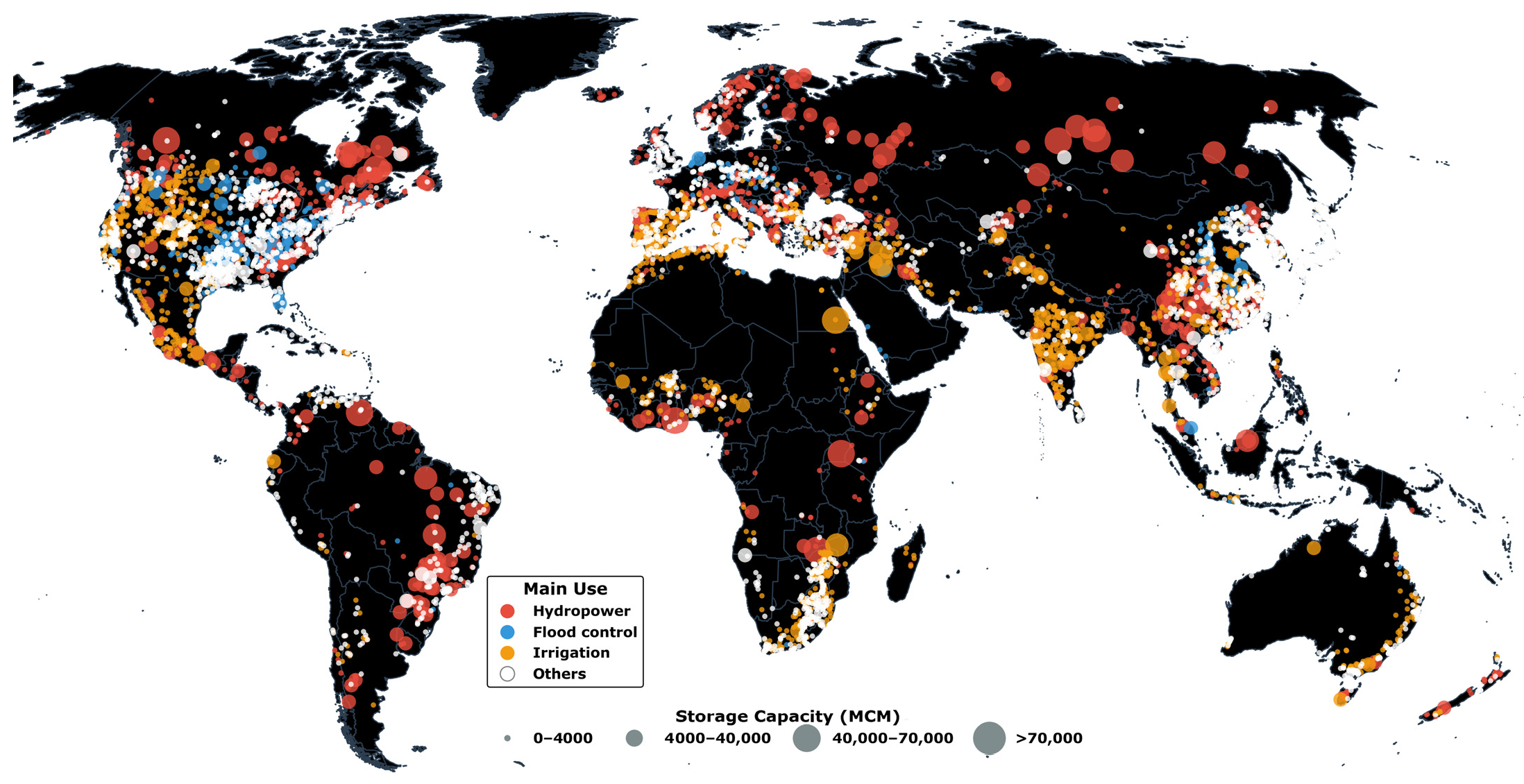
These water bodies represent the subset of reservoirs with complete, continuous monthly surface area observations from 2001 to 2023. Many of the excluded reservoirs—typically with surface areas of <0.01 km2—were omitted due to detection limitations under persistent cloud cover or coarse satellite resolution. This subset captures over 90% of global reservoir storage capacity and over 80% of total surface area, making it highly representative of the world’s major reservoirs. Thus, this dataset defines the scope of our global reservoir filling assessment. The spatial distribution, usage type, and storage capacity of these reservoirs are shown in Figure 1.

2.2. Monthly Surface Area Time Series

To track the surface water dynamics, we used the MODIS-Landsat fusion dataset developed by the authors of [40], which provides global, gap-free monthly surface water area estimates for over 1.4 million lakes and reservoirs from 2001 to 2023. This dataset was produced using a U-Net deep learning model with a spatial attention mechanism to fuse MODIS and Landsat observations. The approach achieved median users’ and producers’ accuracies of 93% and 96%, respectively, and resolves the trade-off between spatial and temporal coverage.
For each of the 6754 recorded GRanD reservoirs, we extracted a 276-month surface area time series (January 2001 to December 2023).
To assess the long-term trends, we performed a Mann–Kendall trend analysis on the surface area time series of the 6754 GRanD reservoirs. This non-parametric test allowed us to identify significant upward, downward, and stable trends in the reservoir areas from January 2001 to December 2023.

2.3. In Situ Storage Data for Validation

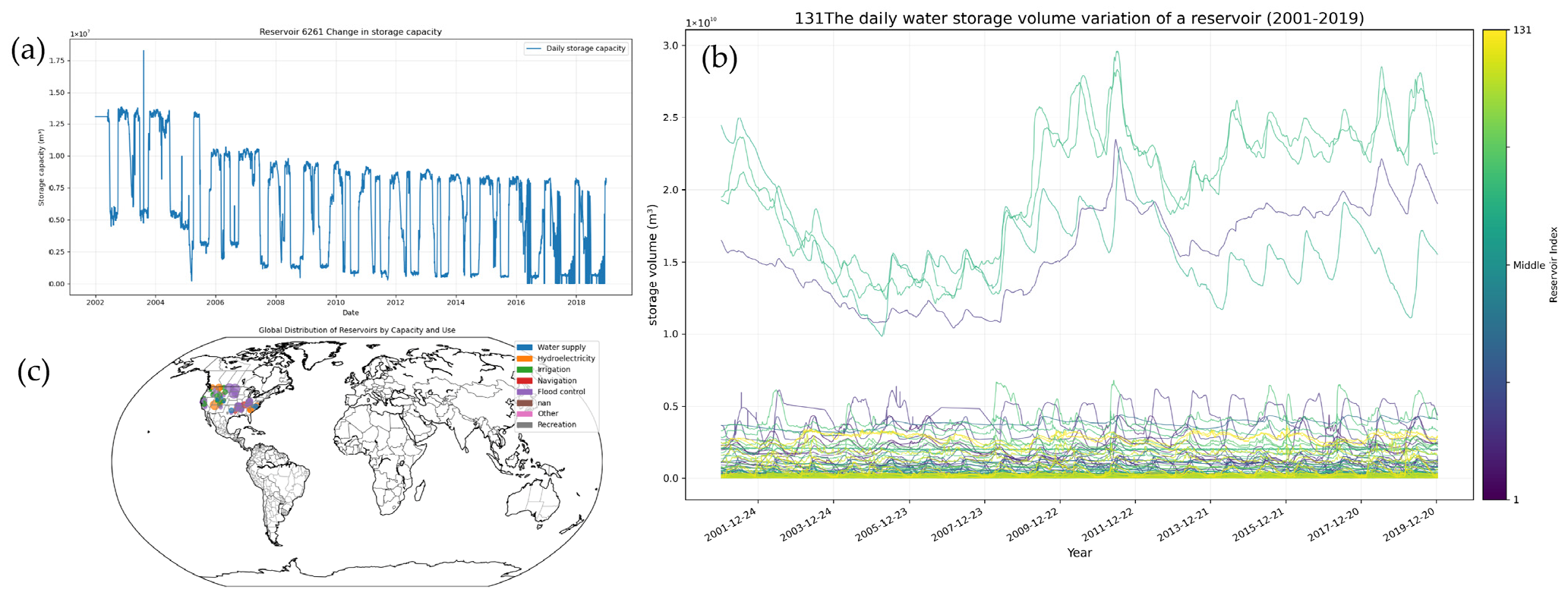
To validate the area-based indicators, we compiled daily reservoir storage records for over 600 globally distributed reservoirs, as derived from published sources [44,45]. Taking one reservoir as an example, changes in its daily reservoir storage records are shown in Figure 2a. We retained only those reservoirs with continuous daily records from 2001 to 2019, yielding a final validation set of 131 reservoirs (Figure 2b,c). The 131 reservoirs are a subset of the full set of 6754. For each reservoir, we computed the annual maximum storage for the 19-year period.
To assess the filling status, we compared observed annual maximum storage against the normal storage capacity values, obtained from Ref. [46]. That study used a machine learning model trained on >400 reservoirs with reported normal capacities and various attributes (e.g., area, elevation, dam type, and total capacity) to estimate the globally consistent normal storage capacity values. In our study, a reservoir was considered “fully filled” (RAI > 0) in a given year if its observed annual maximum storage exceeded its corresponding normal storage capacity.

2.4. Abnormal Reservoir Filling Detection

We adapted the abnormal filling detection method used in Ref. [47], replacing altimetry with satellite-derived surface area. For each reservoir and for year y, we defined the reservoir area index (RAI) as:
R A I ( y ) = A y , m a x μ δ
where A y , m a x denotes the annual maximum surface area, and μ and σ are the mean and standard deviation of all annual maxima (2001–2023). We used the Shapiro–Wilk test [48] to assess the normality of the 23-year annual maximum area series. Approximately 52% of reservoirs passed the test. For those failing the test, we applied bootstrap resampling (n = 92) to estimate robust μ and σ, accounting for skewed or outlier-prone distributions [49]. Based on the RAI, we assigned each year a categorical filling status: fully filled: R A I > 0 , moderately underfilled: 1 < R A I 0 , severely underfilled: 2 < R A I 1 , extremely underfilled: R A I 2 . We assigned each category a severity score (0 to 3).
We then computed the not fully filled index (NFI) to assess the frequency and degree of abnormal reservoir levels comprehensively. The NFI score is the sum of scores of the four categories during each year or the whole period. We defined the not fully filled index (NFI) as:
N F I = y = 2001 2023 R A I ( y )
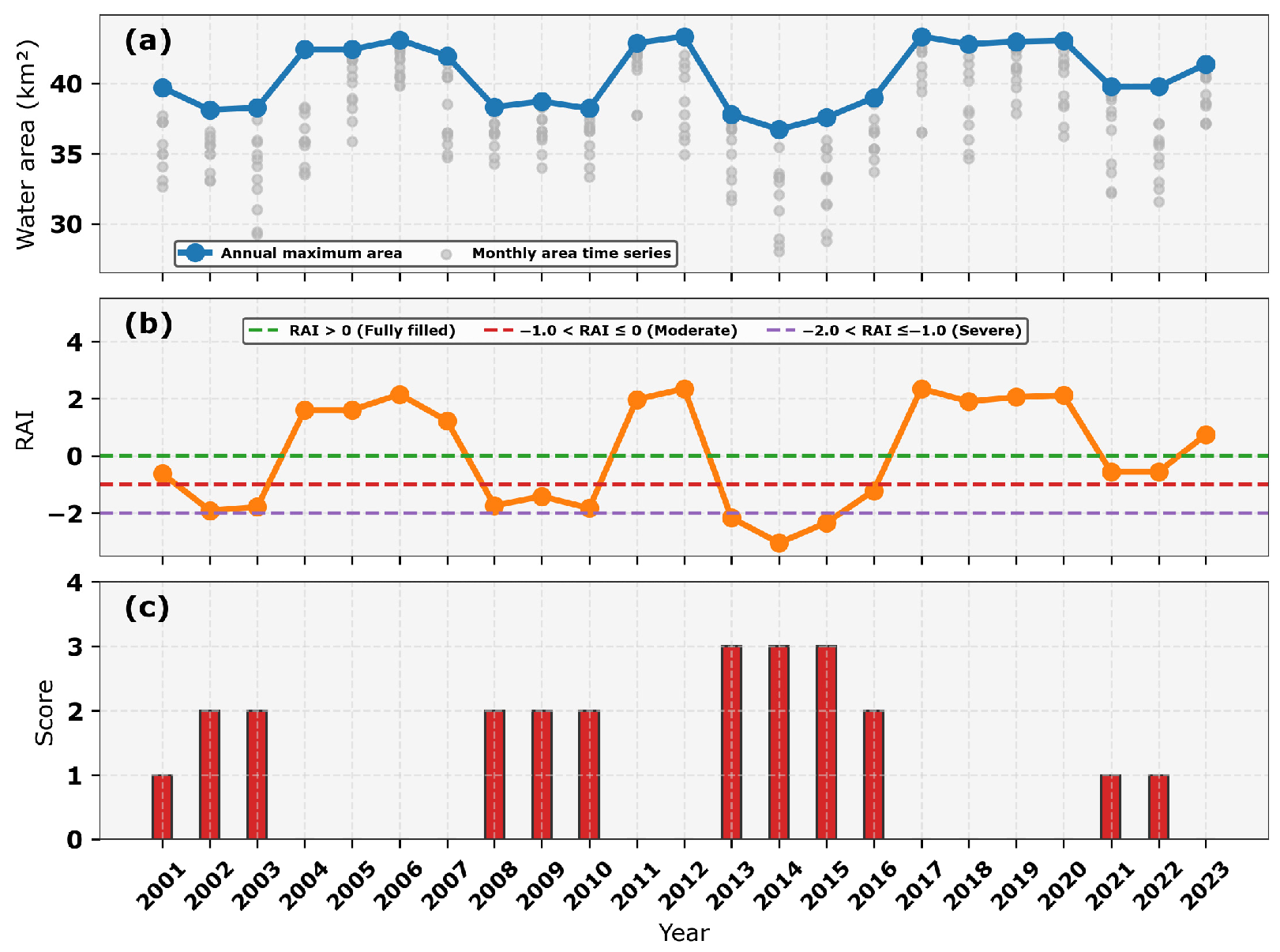
Figure 3 and Table 1 illustrate the RAI calculation and classification process for one representative reservoir (GRanD ID = 386). Panel (a) shows the original monthly area time series from 2001 to 2023, with orange dots indicating the annual maxima. Panel (b) displays the computed RAI values for each year, with dashed lines marking the classification thresholds at RAI = 0, –1, and –2. Panel (c) shows the corresponding severity scores assigned to each year, which are cumulatively summed together to produce the NFI.
In the global anomaly detection analysis (n = 6754 reservoirs), we used the RAI/NFI index based on surface area (Formulas (1) and (2)) to assess the severity of abnormal filling. These indices are designed to identify deviations from historical patterns (annual maximum areas from 2001 to 2023), but they do not directly equate to the absolute state of achieving the reservoir engineering design’s “full charge” (reaching and maintaining the normal storage level).
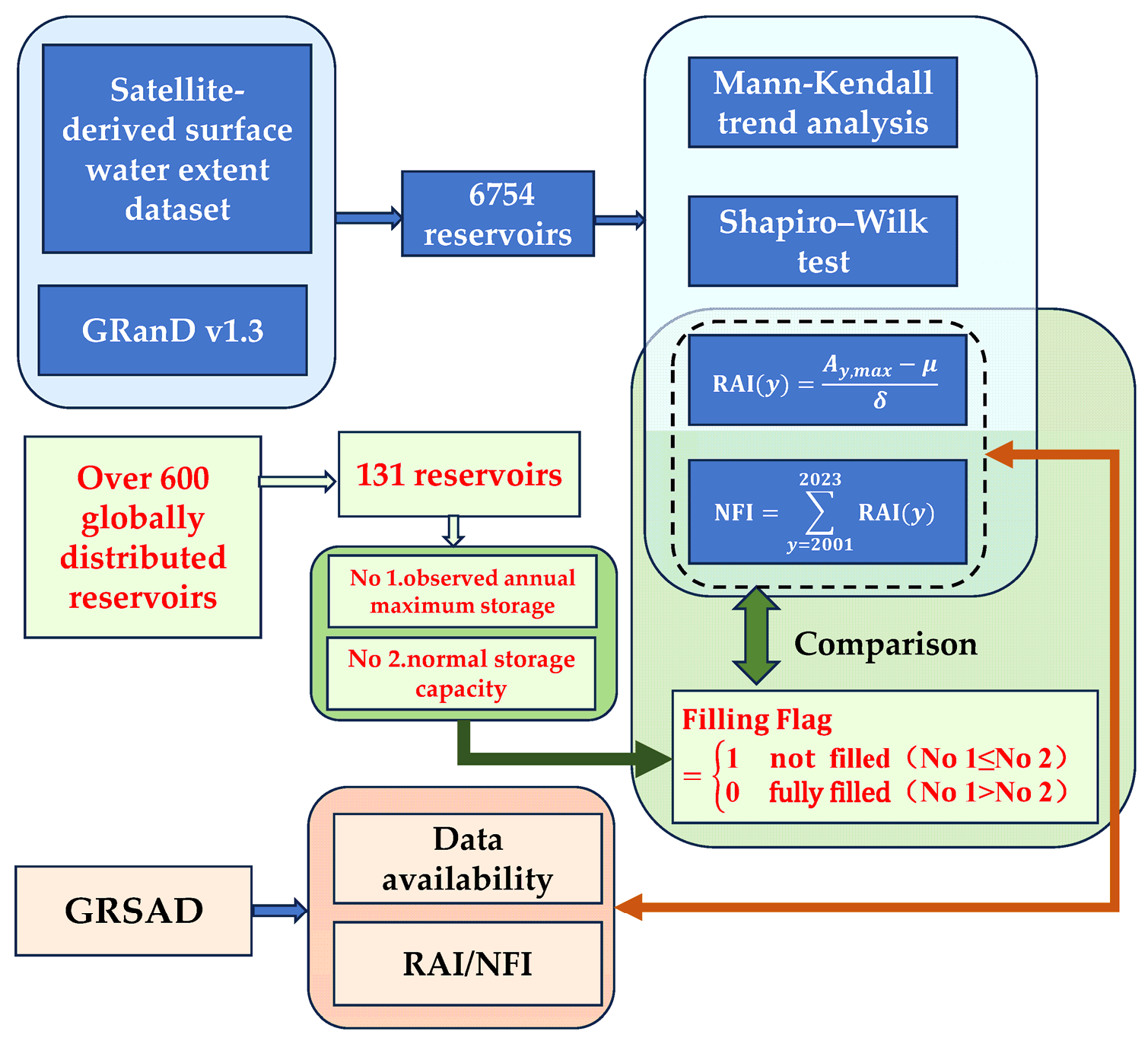
The research’s technical route is shown in Figure 4.

3. Results

3.1. Reservoir Area Assessment

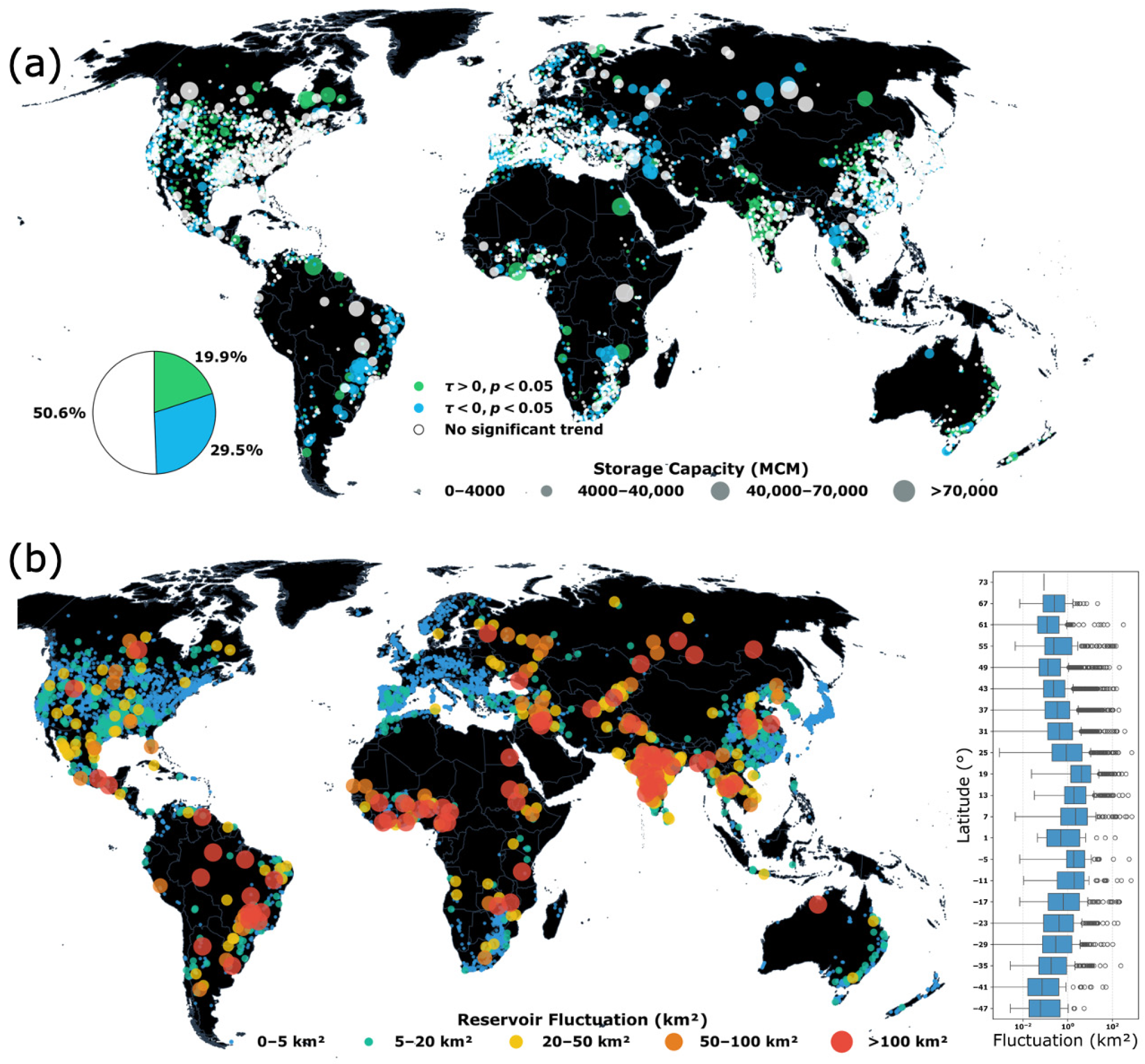
This study employs satellite-derived area data to evaluate global reservoir filling dynamics from January 2001 to December 2023. After data processing, 6754 reservoirs were analyzed (Figure 1). The calculation results of 15 reservoirs, randomly selected from these 6754 reservoirs, are presented in Table 2. The global reservoir area trends, derived from a high-quality satellite dataset, reveal a complex spatial pattern, as depicted in Figure 5a. The Mann–Kendall trend analysis indicates that 50.6% of these reservoirs exhibit stable area dynamics with no significant trend, while 19.9% show a significant upward trend (τ > 0, p < 0.05) and 29.5% display a significant downward trend (τ < 0, p < 0.05). Reservoirs with increasing trends are notably concentrated in the northern hemisphere, with dense clusters in central and eastern North America, northern Europe, and parts of East Asia, suggesting regional improvements in water retention or precipitation patterns. In contrast, downward trends are predominantly observed between 10° S and 40° S, with prominent concentrations in South America, southern Africa, and Australia, indicating potential water loss or over-extraction. Additional areas with declining trends include western North America and the Mediterranean region, reflecting localized environmental or management challenges. This variation in trends highlights the influence of climatic gradients, with northern regions potentially benefiting from increased rainfall, while southern regions may be experiencing drought or intensified agricultural demands. Furthermore, the distribution of trends underscores the need for region-specific water management strategies to address these divergent dynamics effectively.
For the mean annual reservoir area fluctuations shown in Figure 5b, a global distribution pattern emerges with significant regional variability. The map indicates that fluctuations range from less than 5 km2 in high-latitude regions, such as northern Canada and Siberia, to over 100 km2 in tropical and subtropical zones, particularly in central Africa, South America, and Southeast Asia. The latitudinal distribution boxplots reveal a clear gradient with median fluctuations increasing toward the equator, peaking around 30° S to 30° N with values exceeding 50 km2, while tapering off toward the poles, where fluctuations drop below 10 km2. This pattern suggests a strong climatic influence, with equatorial regions experiencing greater variability due to seasonal rainfall, whereas polar regions show a stability that is likely due to frozen conditions or minimal human intervention.
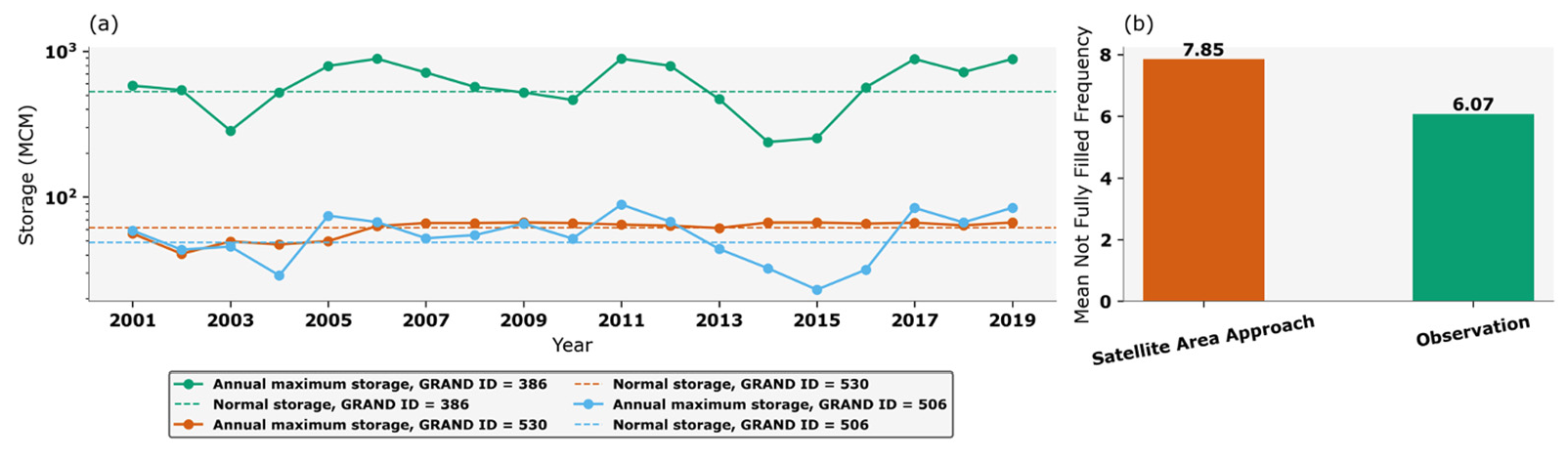
Validation of the satellite-based approach is comprehensively detailed in Figure 6 and Table 3, reinforcing the method’s efficacy in assessing reservoir filling dynamics. Figure 6a presents time series data for three exemplar reservoirs— GRanD IDs 386, 530, and 506—spanning 2001 to 2019. These time series plot the observed storage measurements against machine-learning derived normal storage capacities, revealing interannual filling variability. For each reservoir, the interannual variation of maximum storage is evident; in many of the analyzed years, the observed storage does not reach the reported normal capacity—particularly during dry years such as 2015. This highlights the usefulness of satellite monitoring for capturing spatiotemporal patterns of underfilling and potential water stress, even when normal storage values remain constant. Figure 6b summarizes this pattern across a broader sample by comparing the mean annual frequency of “not fully filled” events over 2001–2019 for 131 reservoirs. The satellite area-based approach estimates an average of 7.85 underfilled years, compared to 6.07 from the in situ observations. This moderate overestimation suggests that the satellite approach tends to be conservative. However, such a conservative bias may be advantageous in data-scarce regions, where early warnings regarding underutilization or drought-induced deficits are preferable. Together, these results support the validity and potential of the satellite-based method for large-scale reservoir monitoring, especially in regions lacking continuous ground-based observations.
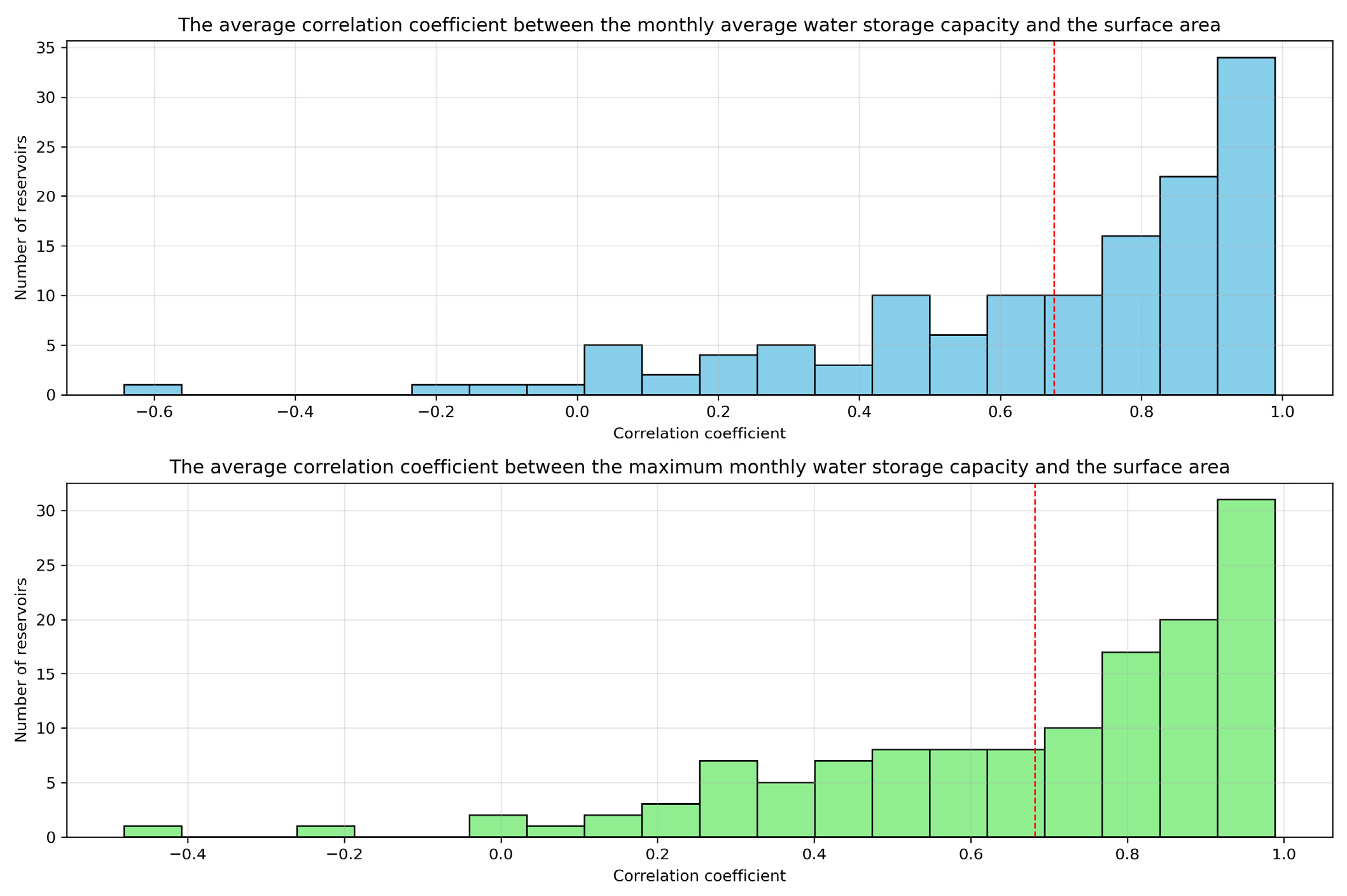
To further validate the correlation between area and water storage, we conducted a correlation analysis on the monthly changes in water storage and surface area for 131 reservoirs, yielding the results presented in Figure 7. In the validation of reservoir hydrological characteristics, we systematically evaluated the relationship between reservoir surface area, obtained from satellite remote sensing, and in situ observed water storage using data from 131 reservoirs worldwide, with field-based water storage records. The validation results convincingly support the scientific rationale of using reservoir surface area as a proxy for water storage, yielding a widespread and significant correlation. Among the 131 validated reservoirs, 124 reservoirs (94.7%) showed a statistically significant correlation (p < 0.05) between monthly average water storage and surface area. The correlation between monthly maximum water storage and surface area was even more prevalent, with 128 reservoirs (97.7%) reaching statistical significance. These results indicate that the area–storage relationship of reservoirs has global applicability.
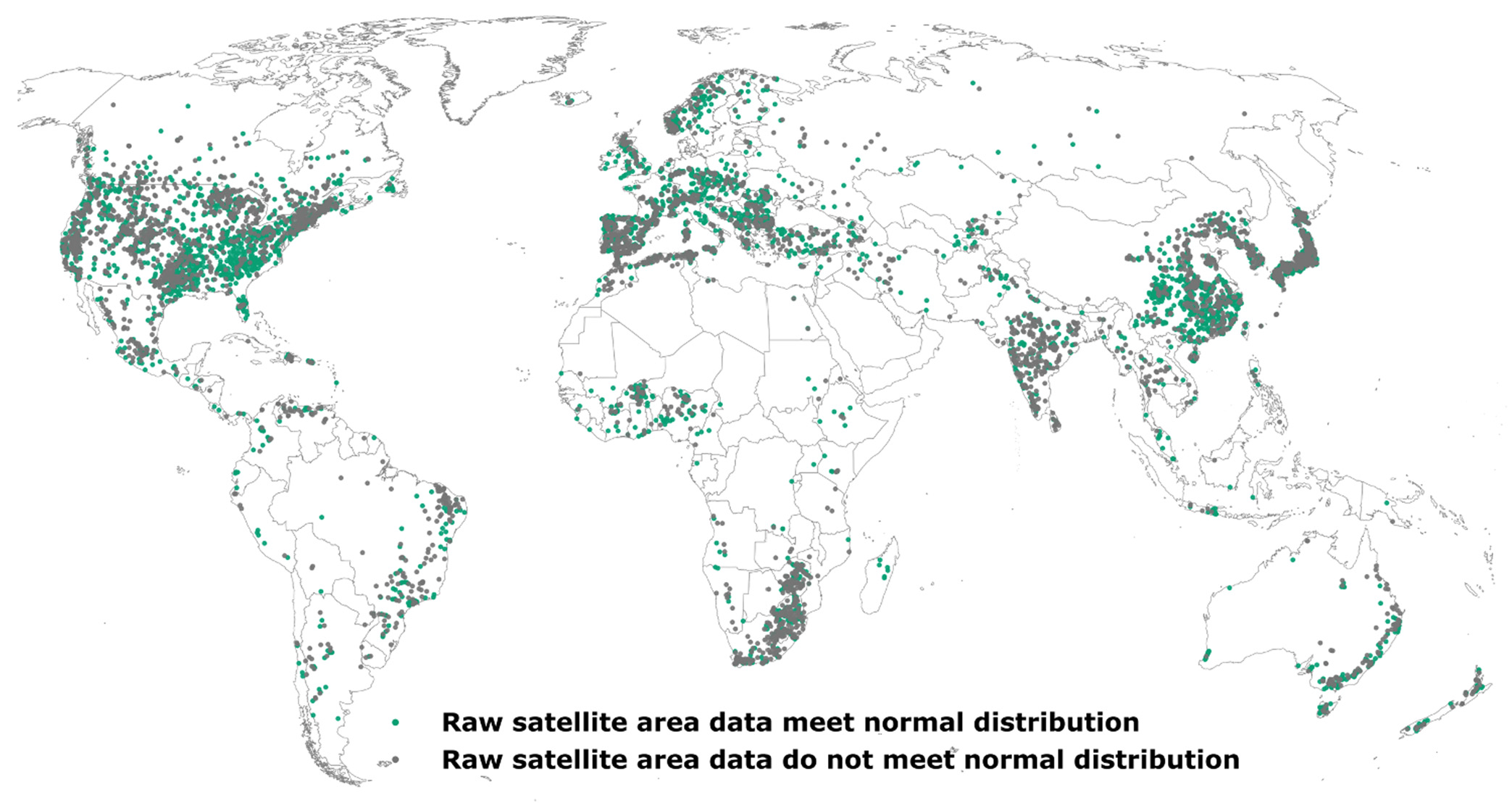
Further insights are provided by Figure 8, which maps the global distribution of reservoir area time series normality for all the studied reservoirs from 2001 to 2023, assessed using the Shapiro–Wilk test. The green dots indicate reservoirs with normal distributions, which are predominantly found in stable climatic zones such as northern Europe and parts of North America, where consistent precipitation and regulated operations likely contribute to predictable area patterns. In contrast, the gray dots mark reservoirs with non-normal distributions, which are concentrated in tropical and arid regions like central Africa, South America, and Australia, where 48% of the total dataset falls.
Overall, the satellite-area approach enhances reservoir management by detecting filling inefficiencies, which can serve as early indicators of water scarcity or mismanagement.

3.2. Abnormal Reservoir Water Area Statistics

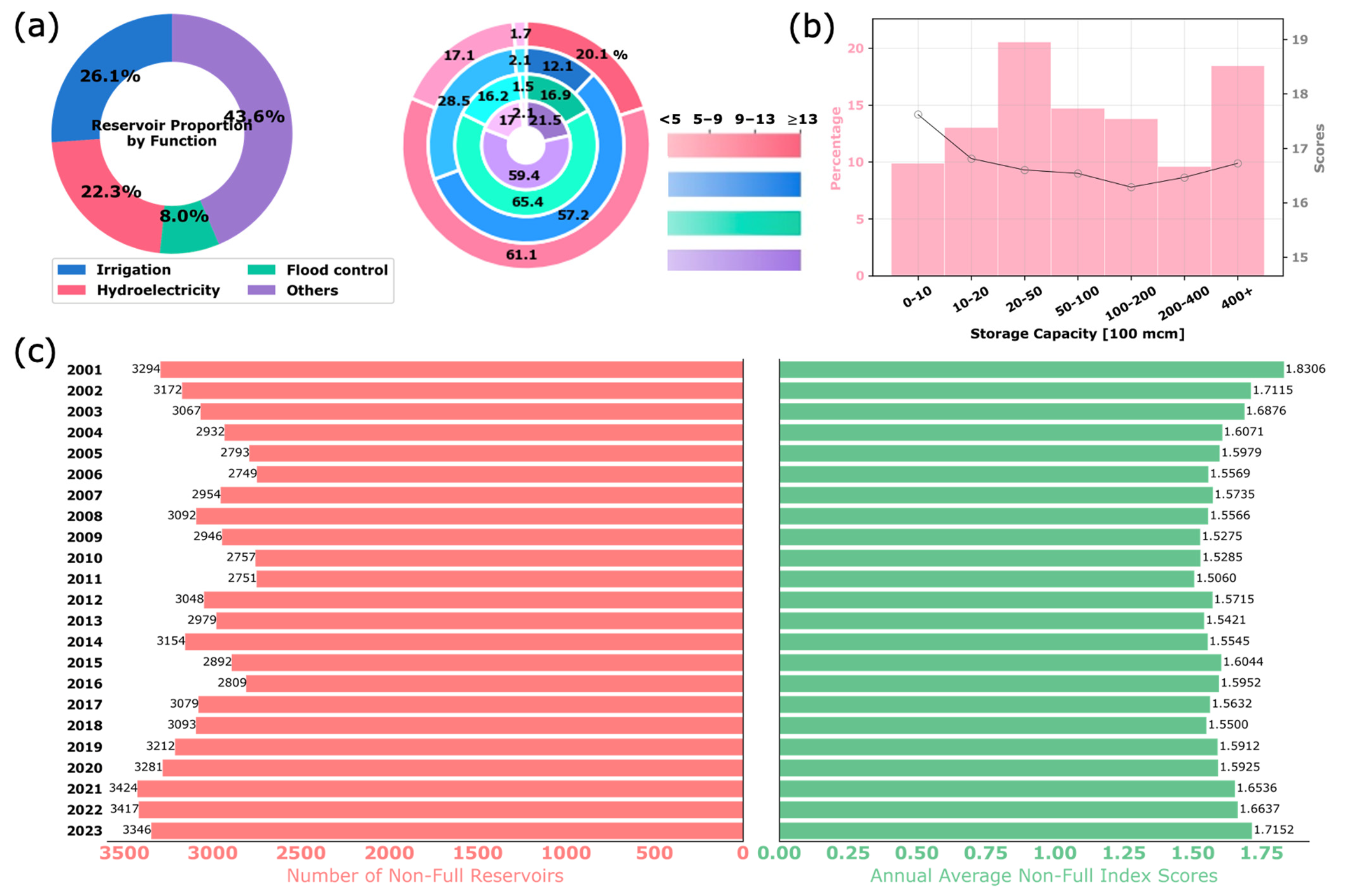
The functional distribution of the studied reservoirs examined herein provides valuable insights into their operational characteristics, with 22.3% allocated to power generation, 26.1% to irrigation, 8.0% to flood control, and 43.6% to other purposes, as illustrated in the left-hand doughnut chart of Figure 9a. This breakdown highlights the prominence of multipurpose reservoirs within the “other” category, likely encompassing recreational or navigational uses alongside a significant irrigation focus, particularly in water-scarce regions. The right portion of Figure 9a details the non-full frequency—the percentage of years from 2001 to 2023 with a zero-NFI score—across these functional groups, where a higher frequency indicates prolonged periods of incomplete filling. For hydropower reservoirs, the distribution across non-full frequency bands (<5, 5–9, 9–13, and ≥13 years) is 1.7%, 17.1%, 61.1%, and 20.1%, respectively, suggesting significant and extended underutilization, possibly due to seasonal energy demand variations or maintenance schedules that limit consistent filling. Irrigation reservoirs show a pattern of 2.1%, 28.5%, 57.2%, and 12.2%, with the low < 5% frequency potentially reflecting a need to retain water for dry seasons, though the higher bands indicate frequent non-full periods influenced by unpredictable rainfall or irrigation scheduling. Flood control reservoirs exhibit 1.5%, 16.2%, 65.4%, and 16.9%, where the high frequency, especially in the 9–13 and ≥ 13-year bands, aligns with their design to maintain empty storage capacity for flood mitigation, intentionally avoiding full storage to accommodate peak flows. Reservoirs for other purposes display 2.1%, 17.0%, 59.4%, and 21.5%, reflecting diverse operational demands that lead to prolonged non-full conditions, possibly due to mixed-use priorities or environmental constraints. The concentric ring chart, segmented by non-full frequency ranges, underscores a concentration of hydropower, irrigation, and other reservoirs in the higher-frequency bands (9–13 and ≥13 years), suggesting chronic filling inefficiencies that may heighten water scarcity risks in regions reliant on reservoirs for energy, agriculture, or multipurpose systems. This analysis indicates that reservoirs with seasonally or strategically driven purposes are particularly prone to extended non-full periods, necessitating targeted management strategies to improve storage reliability.
The relationship between reservoir storage capacity and non-full conditions is rigorously assessed in Figure 9b, which categorizes the studied reservoirs into capacity intervals (0–10, 10–20, 20–50, 50–100, 100–200, 200–400, and >400 million cubic meters). The bar chart indicates a skewed distribution, with approximately 50% of reservoirs concentrated in the 10–50 mcm range, reflecting a prevalence of mid-sized systems globally. The superimposed dotted line plots the average NFI scores—cumulative severity indicators from 2001 to 2023—ranging from 15 to 19, where higher values denote increased non-full severity. Smaller reservoirs (<10 mcm) and those exceeding 400 mcm exhibit higher scores, which may indicate either consistent utilization or physical constraints in terms of retaining surplus water.
Temporal trends in non-full reservoir dynamics from 2001 to 2023 are illustrated in Figure 9c, with the left bar chart documenting the annual count of non-full reservoirs, ranging from 2749 in 2006 to a peak of 3424 in 2021. The data reveal distinct phases: from 2001 to 2011, the number of non-full reservoirs generally decreased, suggesting a shift from drier to wetter conditions, possibly reflecting reduced drought intensity during this period. However, from 2012 to 2023, the count of non-full reservoirs increased, peaking in drought years, such as in 2014, 2021, 2022, and 2023, which findings align with documented climatic stressors like El Niño events, indicating a potential return to drier conditions. Notable exceptions, such as fluctuations in 2015 and 2016 (2809), suggest intermittent wetter years amidst this trend. The right bar chart presents the annual average scores, which rose from 1.51 in 2011 to 1.83 in 2001, contrary to a simple decline, reflecting the higher severity of non-full conditions in the early years and gradually moderating, although recent years (e.g., a value of 1.72 in 2023) show elevated scores corresponding to increased non-full counts. This overall increase in non-full reservoirs, particularly in 2022 and 2023—coinciding with historically severe droughts—may be attributed to multiple factors: the proliferation of reservoirs due to pressure from a growing population, intensified water demand, and worsening climatic aridity. The elevated non-full counts in these recent years lend credence to the reliability of this analysis, reinforcing the hypothesis of escalating drought impacts on reservoir filling capacity.
The statistical insights from Figure 6 underscore the complex drivers of abnormal water area conditions, with the temporal trends suggesting a multifaceted interplay of environmental and anthropogenic factors. The initial decline in non-full reservoirs from 2001 to 2011 may indicate either effective water management or wetter climatic phases, while the subsequent rise from 2012 to 2023, especially the pronounced peaks in 2022 and 2023, points to deteriorating conditions that are potentially exacerbated by the construction of additional reservoirs, thereby straining available water resources. The resilience of adaptive management strategies is evident in the moderation of NFI scores over time, yet the recent upsurge in non-full incidents highlights the limitations of current monitoring approaches in the face of unprecedented drought. These findings advocate for an integrated strategy, leveraging the RAI along with real-time monitoring and predictive modeling to anticipate and mitigate non-full episodes. Such an approach could enhance water resource sustainability by addressing the compounded effects of climatic variability and increasing anthropogenic demands, particularly in drought-prone regions, where the 2022–2023 trends provide a stark warning of future challenges.

3.3. Spatial and Temporal Variability of Reservoir Filling Severity

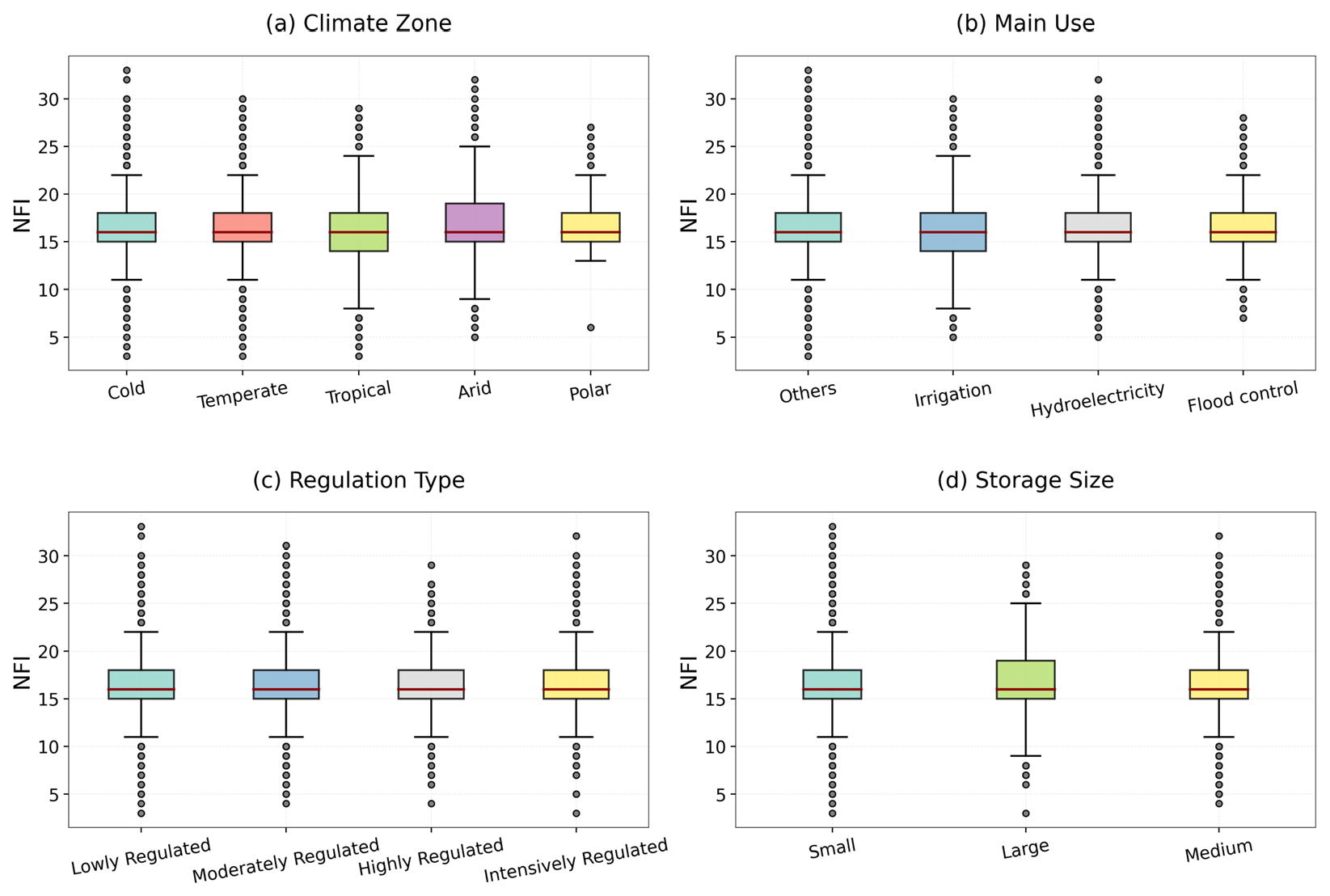
The severity of reservoir underfilling, as quantified by the NFI scores shown across the studied reservoirs, displays notable variability that is shaped by climatic, operational, and regulatory factors, as evidenced by the detailed statistical analyses. Figure 10a indicates that the median NFI scores across climate zones are relatively consistent, ranging from approximately 15 to 16, suggesting a globally uniform condition of filling difficulty. However, the variance within the boxplots reveals distinct differences: arid regions exhibit the widest interquartile range with numerous outliers extending toward higher NFI values (up to 25), reflecting severe underfilling episodes that were likely driven by limited precipitation and high evaporation rates. Tropical zones show a similar median (around 16) but with a smaller spread, potentially due to intense seasonal rainfall. Temperate regions maintain a median of 15 within a narrower range, which is indicative of more stable hydrological conditions, while cold and polar regions also hover around 15, with a narrow variance that can be attributed to frozen conditions that stabilize water availability. These variations in variance suggest that reservoirs in arid and cold climates are more susceptible to extreme filling challenges, necessitating tailored management strategies to address the heightened variability observed in these hydroclimatically stressed regions. The influence of reservoir purpose, regulation type, and storage size on filling severity is examined in Figure 10b–d, where the median NFI scores across the studied reservoirs show a consistent range of approximately 15 to 17, suggesting a broadly similar baseline of filling difficulty across these categories. The overall similarity in median NFI scores and boxplot characteristics across these factors suggests that while individual reservoirs may experience unique challenges, the aggregate filling severity is relatively uniform, highlighting the need for a holistic rather than category-specific approach to addressing underfilling issues globally.
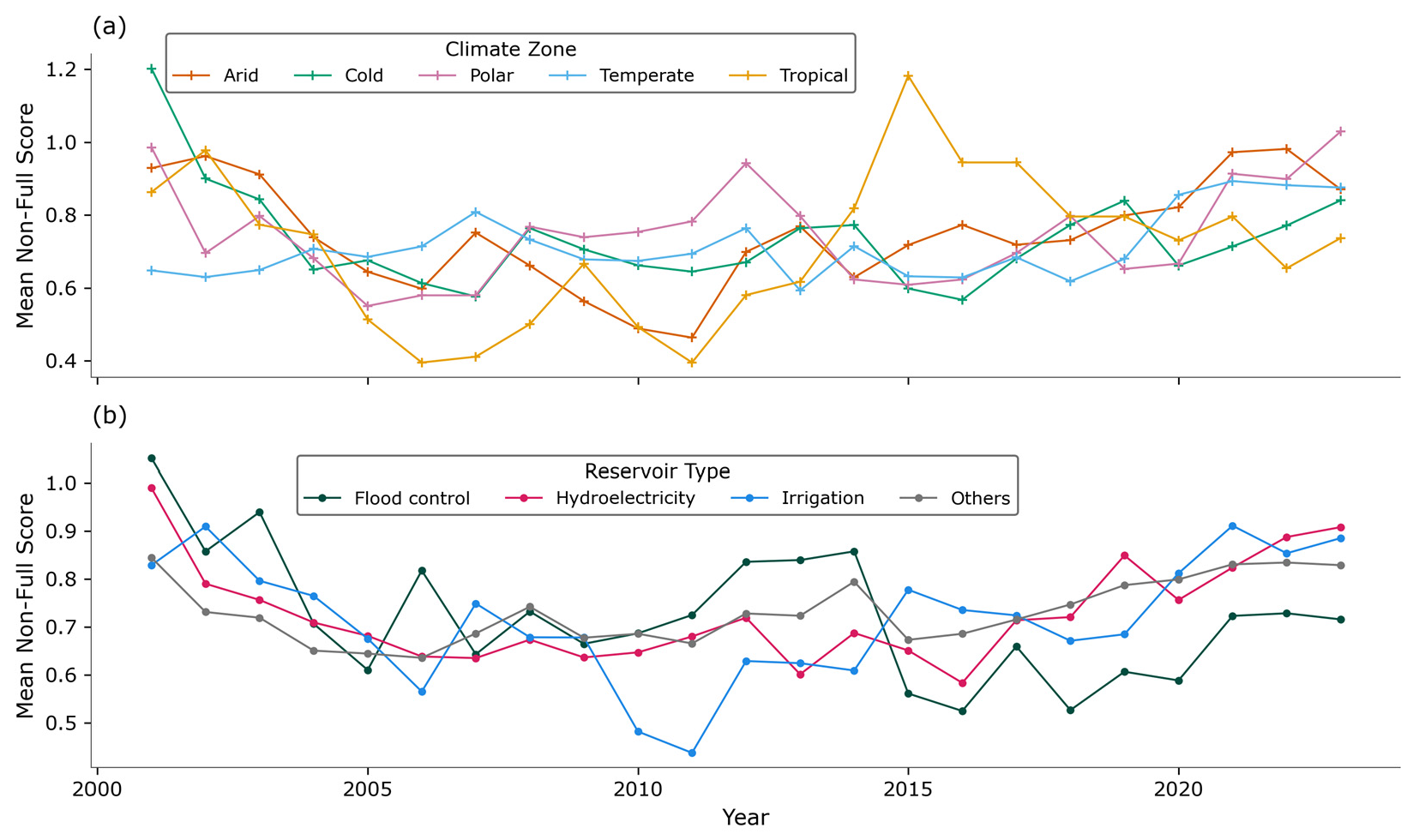
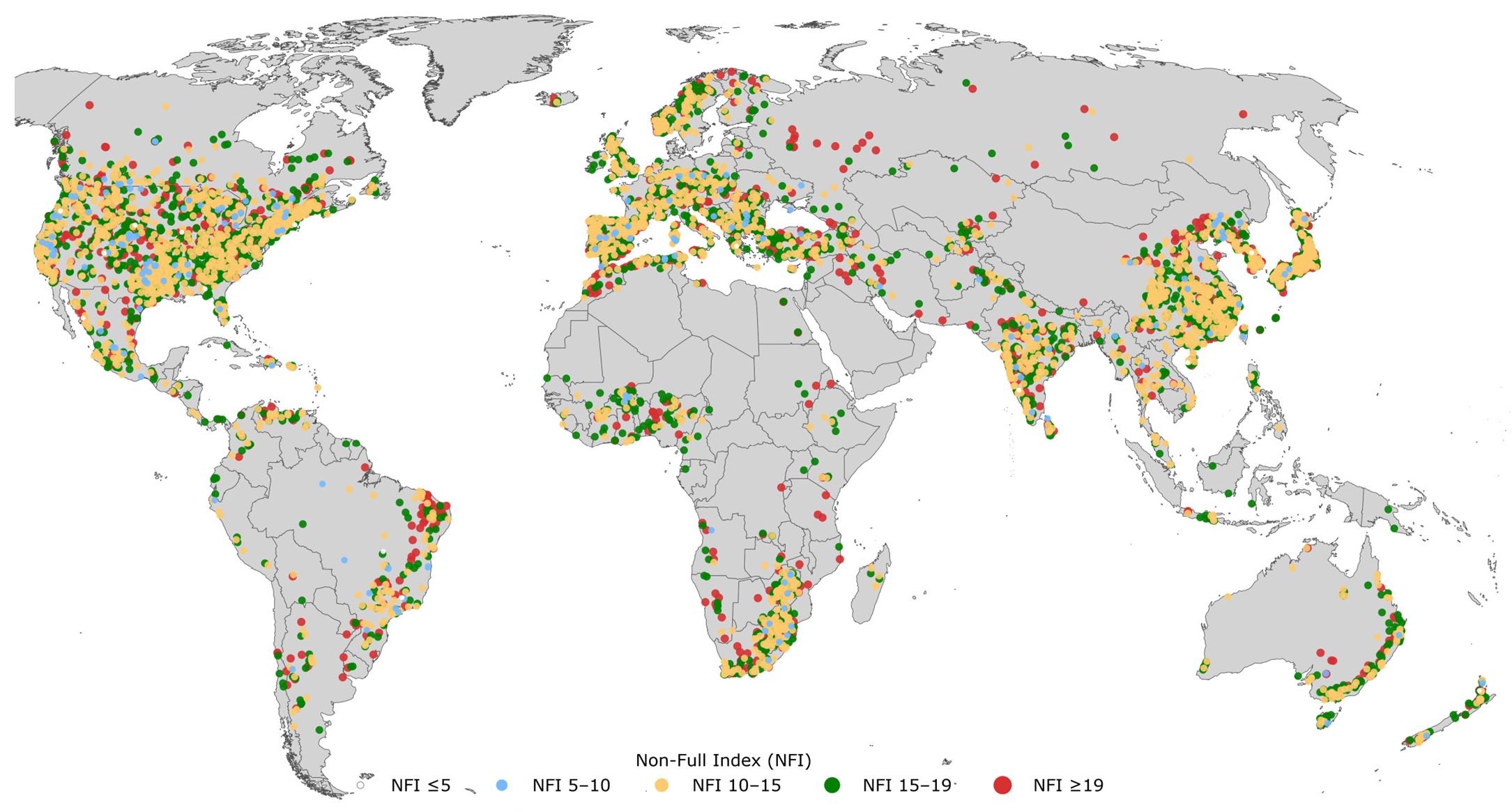
Figure 11a highlights the finding that tropical regions exhibit the most pronounced fluctuations in mean non-full scores, with a noticeable peak around 2015, followed by a general decline toward 2023, suggesting a variability that is likely driven by climate and water management practices affecting the filling consistency. Arid, temperate, cold, and polar regions show more stable trends, with mean scores hovering between 0.5 and 1.0, indicating relatively consistent filling conditions over time, although arid areas may have experienced subtle increases in recent years, possibly linked to drought persistence. Figure 11b indicates that all reservoir types—flood control, hydropower, irrigation, and others—display a general pattern of declining mean non-full scores from 2001 to around 2010, followed by a gradual increase toward 2023, reflecting an initial improvement in filling efficiency that may have been reversed due to growing water demands or climatic shifts. The overlapping trends across reservoir types suggest that no single category dominates in terms of temporal change, although the data complexity limits precise attribution. These observations underscore a broad trend of increasing filling challenges in recent years, potentially influenced by climatic variability and operational adjustments, with the tropical climate and all reservoir types showing signs of heightened instability post-2010. These temporal shifts underscore the evolving interplay of climate variability and management practices, with arid and hydropower systems showing heightened sensitivity to recent drought intensification, as evidenced by elevated NFI scores in 2022–2023. The global distribution in Figure 12 further corroborates these trends, with clusters of high NFI scores (>19) in arid regions (e.g., North Africa and the Middle East) and tropical zones (e.g., Central Africa and Southeast Asia), contrasting with lower scores (<5) in polar regions, highlighting a spatial gradient of filling severity that aligns with climatic and operational stressors.

4. Discussion

4.1. Uncertainty of Satellite Area Products for Inferring Reservoir Filling-Up Problems

This study presents a groundbreaking approach to assessing global reservoir filling-up challenges by utilizing a newly developed, gap-free monthly surface area time series from 2001 to 2023, generated through a U-Net deep learning framework that integrates MODIS and Landsat observations. Covering 6754 reservoirs with producers’ and users’ accuracies exceeding 93%, this dataset stands as the most comprehensive and high-quality satellite-derived water area product that is available globally, offering a significant advantage over traditional water-level data. Unlike water-level measurements, which are limited by sparse global coverage and rely on the availability of in situ gauges, surface area datasets enable the monitoring of a vast number of reservoirs worldwide, including those in remote or data-scarce regions. Moreover, the absence of area-storage curves for many reservoirs renders water level/storage-based assessments impractical, whereas our approach leverages surface area to capture the global extent of filling-up problems for the first time on such a large scale. This pioneering effort provides critical support for water resource decision-making, revealing a comprehensive picture of reservoir vulnerability that was previously unattainable.
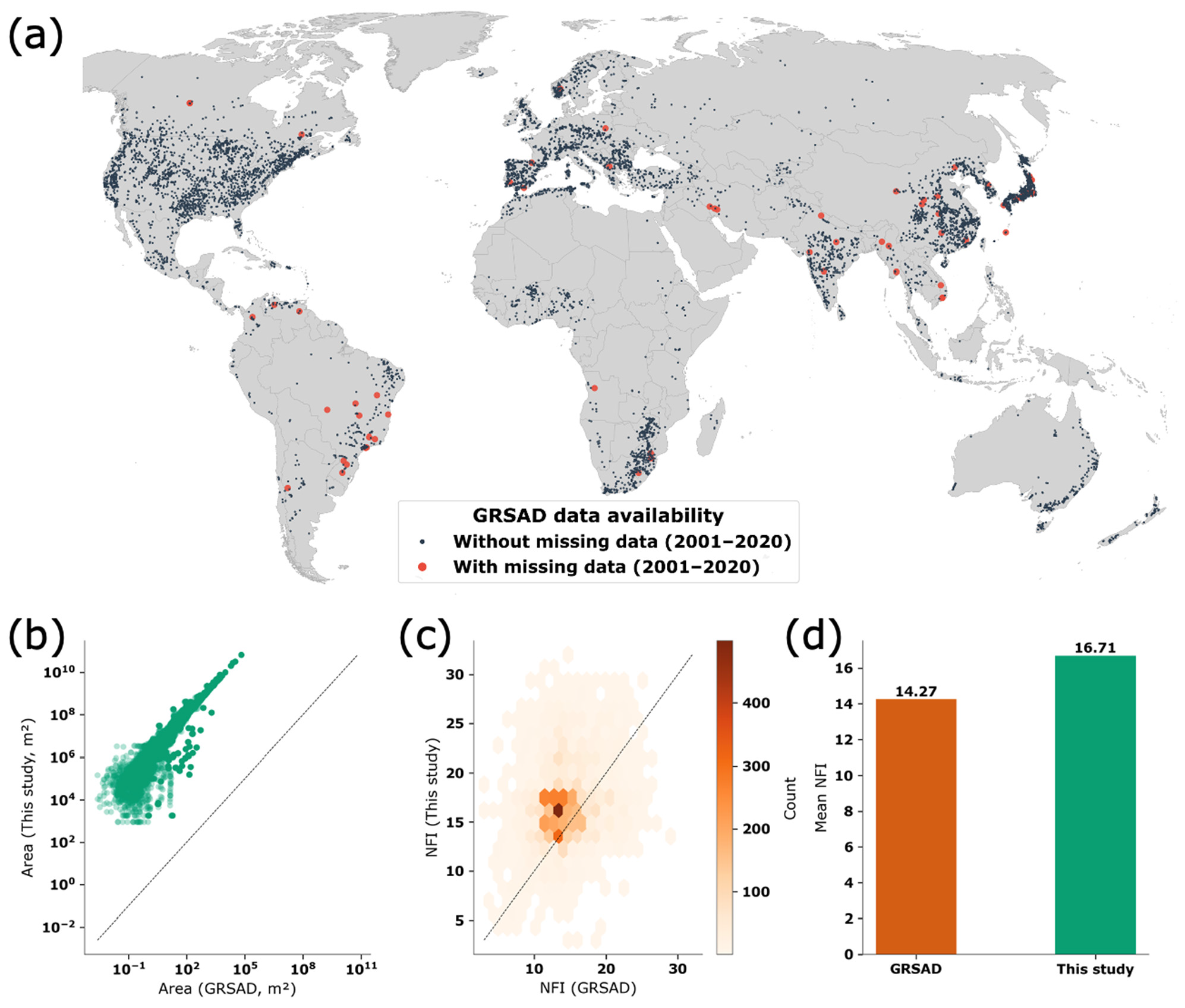
Despite these benefits, the system’s reliance on surface area as a proxy for storage introduces inherent uncertainties, particularly due to variations in reservoir bathymetry, sediment dynamics, and morphological diversity, which can affect the accuracy of volume inferences [50,51]. To address these uncertainties, we validated our method using 131 in situ storage records, establishing a robust correlation between satellite-derived areas and observed storage, thereby confirming the approach’s feasibility for detecting filling anomalies. To further enhance our analysis and assess the dataset’s reliability, we compared it with the Global Reservoir Surface Area Dataset (GRSAD) product [48], which relies on Landsat data and is susceptible to cloud-induced gaps in coverage. This comparison highlights notable differences: the new dataset records a mean NFI score of 16.7, compared to 14.3 for GRSAD, indicating greater sensitivity to underfilling events. Figure 13 illustrates these findings, with panel (a) depicting GRSAD’s data gaps from 2001 to 2020, panel (b) showing GRSAD’s underestimation of reservoir areas, and panels (c) and (d) presenting NFI distributions that underscore the new dataset’s superior resolution in terms of seasonal and interannual variations. By quantifying the uncertainties associated with reservoir area data, we found that the overall differences in filling assessments remained modest, affirming the dataset’s robustness as a tool for global reservoir monitoring, despite its indirect measurement of storage.

4.2. Comparison with Previous Studies and New Insights

This study significantly broadens the scope of previous research, most notably surpassing the limitations of Ref. [40], the CryoSat-2 altimetry study, which was confined to the period of 2011–2022 and focused on only around 500 large reservoirs, concluding that 93% experienced underfilling at least once. In contrast, our analysis encompasses a much larger dataset of 6754 reservoirs over a 23-year span from 2001 to 2023, providing a more extensive temporal and spatial perspective that captures a wider range of reservoir sizes and climatic conditions. One of the most compelling new findings is the identification of a wetting trend from 2001 to 2011, during which the number of non-full reservoirs decreased, potentially reflecting either a period of wetter climatic conditions or more effective water management practices. This trend reversed after 2012, with a pronounced increase in non-full reservoirs peaking in 2021–2023, a shift that was closely aligned with the intensified drought conditions driven by El Niño events. This cyclical pattern of wetting and drying phases, which is undetectable in the shorter and less frequent altimetry-based observations, offers a deeper understanding of long-term reservoir behavior and its responsiveness to climate variability.
The extended timeframe of this study allows for the detection of decadal-scale trends that were previously obscured by the constraints of altimetry data, such as the coarse revisit frequency and limited coverage due to geodetic orbits. The pre-2011 wetting phase suggests a period of relative hydrological stability, possibly influenced by global climate oscillations or regional water conservation initiatives, a finding that merits further investigation to discern the contributing factors. The subsequent drying trend, particularly evident in the recent drought years of 2021–2023, corroborates global reports of increasing aridity and highlights the growing vulnerability of reservoir systems. Additionally, the inclusion of smaller reservoirs, made possible by the high-resolution surface area data, uncovers filling challenges that were underrepresented in earlier studies that focused predominantly on large reservoirs. This broader inclusion reveals regional disparities in filling efficiency that were not apparent in prior analyses, such as the heightened underfilling in small- to medium-sized reservoirs that was noted in our results. Compared to previous studies, which suggested a uniform underfilling trend, our findings indicate a more nuanced pattern influenced by reservoir size, purpose, and climatic zones, enriching the global perspective on reservoir management. These insights underscore the value of satellite-derived surface area time series as a more inclusive and detailed tool that is capable of informing adaptive water resource strategies to address the evolving challenges posed by climate change.

4.3. Limitations and Future Work

While this study advances reservoir filling assessment techniques, several limitations persist. The reliance on satellite-derived surface area assumes a consistent area–volume relationship, which may be disrupted by irregular bathymetry or sediment accumulation, potentially biasing the estimates. Additionally, the validation dataset of 131 in situ storage records is geographically biased with large storage capacity, limiting its global applicability.
Future research could integrate bathymetric data or hydrodynamic models to refine the volume–area correlations, improving the method’s accuracy for complex reservoirs. Employing higher-resolution sensors, such as Sentinel-2, could enhance the detection of smaller reservoirs, expanding the dataset’s scope. Expanding in situ validation to data-scarce regions would bolster the index’s global relevance. Incorporating real-time precipitation and evaporation data could sharpen the RAI’s climatic sensitivity. Furthermore, exploring correlations with meteorological indices (e.g., SPEI) and economic conditions could provide additional context, although our current focus remains on investigating the feasibility of using satellite areal data for identifying reservoir filling issues.
The implications of this study are profound for water resource management and policy development. By providing a comprehensive, gap-free assessment of reservoir filling dynamics across 6754 reservoirs from 2001 to 2023, our findings offer a robust foundation for identifying vulnerable regions and prioritizing infrastructure investments. This dataset can inform adaptive water allocation strategies, enhance drought preparedness, and guide the design of resilient reservoir systems, particularly in data-scarce areas. The validated RAI and NFI indicators serve as actionable tools for policymakers and water managers to monitor long-term trends, mitigate water scarcity risks, and support sustainable development goals, especially in the context of increasing climatic variability [51].
Furthermore, although this study achieves spatiotemporal consistency in terms of global reservoir assessment across 6754 reservoirs, we recognize the differential impacts of reservoirs of varying scales within water resource systems. Particularly during droughts, the filling status of large reservoirs (> 100 MCM) often proves decisive for regional water security. Nevertheless, implementing a globally unified weighting scheme faces a triple challenge: (1) marked disparities exist in national standards for functional weighting—for instance, China prioritizes power generation capacity, while African nations focus more on irrigation supply; (2) the inter-basin water transfer functions of mega-reservoirs (e.g., Three Gorges or the Aswan High Dam) resist quantification through simple weights; (3) the collective impact of small reservoirs (< 1 MCM) in arid regions may surpass that of individual large reservoirs. These complexities render the construction of a global-scale weighting system an outstanding research question. Future work will concentrate on developing refined weighting models at regional scales, specifically addressing the following topics: river basin systems, incorporating reservoir cascade relationships and water allocation priorities; climate zones and assigning eco-economic composite weights based on aridity indices; functional types, and differentiating service priorities (e.g., hydropower, irrigation, and water supply). By establishing a ‘scale–function–climate’ three-dimensional weighting framework, we can more precisely evaluate the water resource implications of reservoir storage changes.

5. Conclusions

This study presents a pioneering assessment of global reservoir filling-up problems using a newly developed, gap-free monthly surface area time series from 2001 to 2023, derived from a U-Net deep learning framework integrating MODIS and Landsat observations. Analyzing 6754 reservoirs, we introduced the reservoir area index (RAI) and not fully filled index (NFI) as novel indicators, validated against 131 in situ storage records, to quantify interannual filling anomalies. The results reveal a wetting trend from 2001 to 2011, followed by a reversal post-2012, with a peak in underfilling during the 2021–2023 drought years. Spatial analysis highlights the higher NFI scores in arid regions, while both small and large-sized reservoirs exhibit heightened vulnerability. Compared with previous altimetry-based studies of shorter duration and limited coverage, this work provides new insights into decadal-scale trends and size-dependent disparities in reservoir filling performance.
These findings provide the first comprehensive global picture of reservoir filling dynamics, demonstrating the efficacy of surface area data over limited water level records, especially in regions lacking area–storage curves. This study underscores the escalating impact of climate variability and human pressures, with implications for water resource management that include enhanced drought preparedness and optimized infrastructure planning. Despite some uncertainties due to ignoring underwater bathymetric variations, the validated approach proved feasible, being supported by a modest overall difference in uncertainty quantification. Future efforts should consider area–volume relationships, incorporate high-quality area observations, and expand validation to data-scarce regions, leveraging machine learning for predictive modeling to bolster proactive strategies against worsening water scarcity.

Author Contributions

Conceptualization, J.D. and X.S.; methodology, J.D.; software, J.D.; validation, F.X., X.S. and L.T.; formal analysis, P.L.; investigation, J.D.; resources, J.D.; data curation, J.D.; writing—original draft preparation, J.D.; writing—review and editing, X.S. All authors have read and agreed to the published version of the manuscript.

Funding

This research was funded by the Research and Promotion of Water Conservancy Science and Technology in Shanxi Province (NO. 2025ZF14) and the Shanxi Province Water Conservancy Science and Technology Research and Development Service Project (NO. 2025GM18).

Data Availability Statement

The original contributions presented in this study are included in the article. Further inquiries can be directed to the corresponding author(s).

Acknowledgments

The authors have reviewed and edited the output and take full responsibility for the content of this publication.

Conflicts of Interest

The authors declare no conflicts of interest.

References

  1. Cooley, S.W.; Ryan, J.C.; Smith, L.C. Human alteration of global surface water storage variability. Nature 2021, 591, 78–81. [Google Scholar] [CrossRef] [PubMed]
  2. Intralawan, A.; Wood, D.; Frankel, R.; Costanza, R.; Kubiszewski, I. Tradeoff analysis between electricity generation and ecosystem services in the lower Mekong Basin. Ecosyst. Serv. 2018, 30, 27–35. [Google Scholar] [CrossRef]
  3. Döll, P.; Fiedler, K.; Zhang, J. Global-scale analysis of river flow alterations due to water withdrawals and reservoirs. Hydrol. Earth Syst. Sci. 2009, 13, 2413–2432. [Google Scholar] [CrossRef]
  4. Grill, G.; Lehner, B.; Thieme, M.; Geenen, B.; Tickner, D.; Antonelli, F.; Babu, S.; Borrelli, P.; Cheng, L.; Crochetiere, H.; et al. Mapping the world’s free-flowing rivers. Nature 2019, 569, 215–221. [Google Scholar] [CrossRef]
  5. Li, R.; Xiong, L.; Xiong, B.; Li, Y.; Xu, Q.; Cheng, L.; Xu, C.-Y. Investigating the downstream sediment load change by an index coupling effective rainfall information with reservoir sediment trapping capacity. J. Hydrol. 2020, 590, 125200. [Google Scholar] [CrossRef]
  6. Maavara, T.; Chen, Q.; Van Meter, K.; Brown, L.E.; Zhang, J.; Ni, J.; Zarfl, C. River dam impacts on biogeochemical cycling. Nat. Rev. Earth Environ. 2020, 1, 103–116. [Google Scholar] [CrossRef]
  7. Boulange, J.; Hanasaki, N.; Yamazaki, D.; Pokhrel, Y. Role of dams in reducing global flood exposure under climate change. Nat. Commun. 2021, 12, 417. [Google Scholar] [CrossRef] [PubMed]
  8. Wang, Y.; Li, J.; Zhang, T.; Wang, B. Changes in drought propagation under the regulation of reservoirs and water diversion. Theor. Appl. Climatol. 2019, 138, 701–711. [Google Scholar] [CrossRef]
  9. Wisser, D.; Frolking, S.; Hagen, S.; Bierkens, M.F.P. Beyond peak reservoir storage? A global estimate of declining water storage capacity in large reservoirs. Water Resour. Res. 2013, 49, 5732–5739. [Google Scholar] [CrossRef]
  10. Yasarer, L.M.W.; Sturm, B.S.M. Potential impacts of climate change on reservoir services and management approaches. Lake Reserv. Manag. 2016, 32, 13–26. [Google Scholar] [CrossRef]
  11. Di Baldassarre, G.; Wanders, N.; AghaKouchak, A.; Kuil, L.; Rangecroft, S.; Veldkamp, T.I.E.; Garcia, M.; van Oel, P.R.; Van Loon, K.B.A.F. Water shortages worsened by reservoir effects. Nat. Sustain. 2018, 1, 617–622. [Google Scholar] [CrossRef]
  12. Williams, A.P.; Cook, B.I.; Smerdon, J.E. Rapid intensification of the emerging southwestern North American megadrought in 2020–2021. Nat. Clim. Change 2022, 12, 232–234. [Google Scholar] [CrossRef]
  13. Yao, F.; Livneh, B.; Rajagopalan, B.; Wang, J.; Crétaux, J.-F.; Wada, Y.; Berge-Nguyen, M. Satellites reveal widespread decline in global lake water storage. Science 2023, 380, 743–749. [Google Scholar] [CrossRef] [PubMed]
  14. Li, Y.; Zhao, G.; Allen, G.H.; Gao, H. Diminishing storage returns of reservoir construction. Nat. Commun. 2023, 14, 3203. [Google Scholar] [CrossRef] [PubMed]
  15. Davidson, H. China drought causes Yangtze to dry up, sparking shortage of hydropower. The Guardian, 22 August 2022. Available online: https://www.theguardian.com/world/2022/aug/22/china-drought-causes-yangtze-river-to-dry-up-sparking-shortage-of-hydropower (accessed on 17 June 2025).
  16. ESA multimedia, 2022. Drought Causes Yangtze to Shrink. Available online: https://www.esa.int/ESA_Multimedia/Images/2022/08/Drought_causes_Yangtze_to_shrink (accessed on 17 June 2025).
  17. Keller, P.S.; Marcé, R.; Obrador, B.; Koschorreck, M. Global carbon budget of reservoirs is overturned by the quantification ofdrawdown areas. Nat. Geosci. 2021, 14, 402–408. [Google Scholar] [CrossRef]
  18. Meister, O.; Bader, M. 2D adaptivity for 3D problems: Parallel SPE10 reservoir simulation on dynamically adaptive prism grids. Journal of Computational Science 2015, 9, 101–106. [Google Scholar] [CrossRef]
  19. Gao, H.; Birkett, C.; Lettenmaier, D.P. Global monitoring of large reservoir storage from satellite remote sensing. Water Resour. Res. 2012, 48, W09504. [Google Scholar] [CrossRef]
  20. Mu, M.; Tang, Q.; Han, S.; Liu, X.; Cui, H. Using GRanD Database and Surface Water Data to Constrain Area–Storage Curve of Reservoirs. Water 2020, 12, 1242. [Google Scholar] [CrossRef]
  21. Alsdorf, D.E.; Rodríguez, E.; Lettenmaier, D.P. Measuring surface water from space. Rev. Geophys. 2007, 45, RG2002. [Google Scholar] [CrossRef]
  22. Hossain, F.; Katiyar, N.; Wolf, A.; Hong, Y. The emerging role of satellite rainfall data in improving the hydro-political situation of flood monitoring in the under-developed Regions of the world. Nat. Hazards 2007, 43, 199–210. [Google Scholar] [CrossRef]
  23. Solander, K.C.; Reager, J.T.; Famiglietti, J.S. How well will the Surface Water and Ocean Topography (SWOT) mission observe global reservoirs? Water Resour. Res. 2016, 52, 2123–2140. [Google Scholar] [CrossRef]
  24. Solander, K.C.; Reager, J.T.; Thomas, B.F.; David, C.H.; Famiglietti, J.S. Simulating human water regulation: The development of an optimal complexity, climate-adaptive reservoir management model for an LSM. J. Hydrometeorology 2016, 17, 725–744. [Google Scholar] [CrossRef]
  25. Bonnema, M.; Sikder, S.; Miao, Y.; Chen, X.; Hossain, F.; Pervin, I.A.; Mahbubur Rahman, S.M.; Lee, H. Understanding satellite-based monthly-to-seasonal reservoir outflow estimation as a function of hydrologic controls. Water Resour. Res. 2016, 52, 4095–4115. [Google Scholar] [CrossRef]
  26. Zhang, S.; Gao, H. Using the Digital Elevation Model (DEM) to Improve the Spatial Coverage of the MODIS Based Reservoir Monitoring Network in South Asia. Remote Sens. 2020, 12, 745. [Google Scholar] [CrossRef]
  27. Wang, Z.; Jiang, L.; Nielsen, K.; Wang, L. Reservoir filling up problems in a changing climate: Insights from CryoSat-2 altimetry. Geophys. Res. Lett. 2024, 51, e2024GL108934. [Google Scholar] [CrossRef]
  28. Tortini, R.; Noujdina, N.; Yeo, S.; Ricko, M.; Birkett, C.M.; Khandelwal, A.; Kumar, V.; Marlier, M.E.; Lettenmaier, D.P. Satellite-based remote sensing data set of global surface water storage change from 1992 to 2018. Earth Syst. Sci. Data 2020, 12, 1141–1151. [Google Scholar] [CrossRef]
  29. Busker, T.; de Roo, A.; Gelati, E.; Schwatke, C.; Adamovic, M.; Bisselink, B.; Pekel, J.-F.; Cottam, A. A global lake and reservoir volume analysis using a surface water dataset and satellite altimetry. Hydrol. Earth Syst. Sci. 2019, 23, 669–690. [Google Scholar] [CrossRef]
  30. Avisse, N.; Tilmant, A.; Müller, M.F.; Zhang, H. Moni toring small reservoirs’ storage with satellite remote sensing in inaccessible areas. Hydrol. Earth Syst. Sci. 2017, 21, 6445–6459. [Google Scholar] [CrossRef]
  31. Fang, Y.; Li, H.; Wan, W.; Zhu, S.; Wang, Z.; Hong, Y.; Wang, H. Assessment of water storage change in China’s lakes and reservoirs over the last three decades. Remote Sens. 2019, 11, 1467. [Google Scholar] [CrossRef]
  32. Shen, Y.; Liu, D.; Jiang, L.; Nielsen, K.; Yin, J.; Liu, J.; Bauer-Gottwein, P. High-resolution water level and storage variation datasets for 338 reservoirs in China during 2010–2021. Earth Syst. Sci. Data 2022, 14, 5671–5694. [Google Scholar] [CrossRef]
  33. Nielsen, K.; Andersen, O.B.; Ranndal, H. Validation of Sentinel-3A based lake level over US and Canada. Remote Sens. 2020, 12, 2835. [Google Scholar] [CrossRef]
  34. Liu, K.; Song, C.; Wang, J.; Ke, L.; Zhu, Y.; Zhu, J.; Ma, R.; Luo, Z. Remote sensing-based modeling of the bathymetry and water storage forchannel-type reservoirs worldwide. Water Resour. Res. 2020, 56, e2020WR027147. [Google Scholar] [CrossRef]
  35. Zhan, P.; Song, C.; Liu, K.; Chen, T.; Luo, S.; Fan, C. Can we estimate the lake mean depth and volume from the deepest record andauxiliary geospatial parameters? J. Hydrol. 2023, 617, 128958. [Google Scholar] [CrossRef]
  36. Pekel, J.-F.; Cottam, A.; Gorelick, N.; Belward, A.S. High-resolution mapping of global surface water and its long-term changes. Nature 2016, 540, 418–422. [Google Scholar] [CrossRef]
  37. Tourian, M.J.; Elmi, O.; Shafaghi, Y.; Behnia, S.; Saemian, P.; Schlesinger, R.; Sneeuw, N. HydroSat: Geometric quantities of the global water cycle from geodetic satellites. Earth Syst. Sci. Data 2022, 14, 2463–2486. [Google Scholar] [CrossRef]
  38. Yao, F.; Wang, J.; Wang, C.; Crétaux, J.-F. Constructing long-term high-frequency time series of global lake and reservoir areas using Landsat imagery. Remote Sens. Environ. 2019, 232, 111210. [Google Scholar] [CrossRef]
  39. Khandelwal, A.; Karpatne, A.; Ravirathinam, P.; Ghosh, R.; Wei, Z.; Dugan, H.A.; Hanson, P.C.; Kumar, V. ReaLSAT, a global dataset of reservoir and lake surface area variations. Sci. Data 2022, 9, 356. [Google Scholar] [CrossRef]
  40. Klein, I.; Mayr, S.; Gessner, U.; Hirner, A.; Kuenzer, C. Water and hydropower reservoirs: High temporal resolution time series derived from MODIS data to characterize seasonality and variability. Remote Sens. Environ. 2021, 253, 112207. [Google Scholar] [CrossRef]
  41. Zajac, Z.; Revilla-Romero, B.; Salamon, P.; Burek, P.; Hirpa, F.A.; Beck, H. The impact of lake and reservoir parameterization on global streamflow simulation. J. Hydrol. 2017, 548, 552–568. [Google Scholar] [CrossRef]
  42. Li, L.; Long, D.; Wang, Y.; Woolway, R.I. Global dominance of seasonality in shaping lake-surface-extent dynamics. Nature 2025, 642, 361–368. [Google Scholar] [CrossRef]
  43. Shen, Y.; Yamazaki, D.; Pokhrel, Y.; Zhao, G. Improving globalreservoir parameterizations byincorporating flood storage capacity data and satellite observations. Water Resour. Res. 2025, 61, e2024WR037620. [Google Scholar] [CrossRef]
  44. Steyaert, J.C.; Condon, L.E.; Turner, W.D.; Voisin, N. ResOpsUS, a dataset of historical reservoir operations in the contiguous United States. Sci. Data 2022, 9, 34. [Google Scholar] [CrossRef] [PubMed]
  45. Lehner, B.; Liermann, C.R.; Revenga, C.; Vörösmarty, C.; Fekete, B.; Crouzet, P.; Döll, P.; Endejan, M.; Frenken, K.; Magome, J.; et al. High-resolution mapping of the world’s reservoirs and dams for sustainable river-flow management. Front. Ecol. Environ. 2011, 9, 494–502. [Google Scholar] [CrossRef]
  46. Shapiro, S.S.; Wilk, M.B. An analysis of variance test for normality (Complete Samples). Biometrika 1965, 52, 591. [Google Scholar] [CrossRef]
  47. Tibshirani, R.J.; Efron, B. An Introduction to the Bootstrap; Monographs on statistics and applied probability; Chapman and Hall/CRC: New York, NY, USA, 1993; pp. 1–436. [Google Scholar]
  48. Yao, F.; Minear, J.T.; Rajagopalan, B.; Wang, C.; Yang, K.; Livneh, B. Estimating reservoir sedimentation rates and storage capacity losses using high-resolution Sentinel-2 satellite and water level data. Geophys. Res. Lett. 2023, 50, e2023GL103524. [Google Scholar] [CrossRef]
  49. Yigzaw, W.; Li, H.; Demissie, Y.; Hejazi, M.I.; Leung, L.R.; Voisin, N.; Payn, R. A new global storage-area- depth data set formodeling reservoirs in land surface and earth system models. Water Resour. Res. 2018, 54, 10372–10386. [Google Scholar] [CrossRef]
  50. Zhao, G.; Gao, H. Automatic correction of contaminated images for assessment of reservoir surface area dynamics. Geophys. Res. Lett. 2018, 45, 6092–6099. [Google Scholar] [CrossRef]
  51. Li, Z.; Xu, S.; Li, C.; Lei, J.; Tan, D.; Tang, L. Assessment of Surface Water Spatiotemporal Changes and Reservoir-Based Droughts in Small and Medium-Sized Reservoirs in China. Water 2025, 17, 1104. [Google Scholar] [CrossRef]
Figure 1. Global distribution of the 6754 reservoirs analyzed in this study, derived from the GRanD v1.3 database. Marker color indicates their primary use, and size represents total storage capacity.
Water 17 02566 g001
Figure 2. The workflow: (a) daily storage records for an example reservoir, (b) daily storage records for the 131 selected reservoirs, and (c) the spatial distribution of the 131 selected reservoirs.
Water 17 02566 g002
Figure 3. The workflow: (a) surface area time series and annual maxima, (b) yearly RAI with classification thresholds, and (c) severity score time series.
Water 17 02566 g003
Figure 4. The research’s technical route.
Water 17 02566 g004
Figure 5. Maps of (a) Mann–Kendall trend of global reservoir area time series and (b) mean annual reservoir area fluctuations, recorded globally during the period of 2001–2023, with latitudinal distribution boxplots over each 6° band illustrating reservoir fluctuations. The inset pie chart in (a) shows the proportion of trends (green for a significant upward trend with τ > 0, p < 0.05, blue for a significant downward trend with τ < 0, p < 0.05, and white for no significant trend).
Water 17 02566 g005
Figure 6. Validation. (a) Three example reservoirs with the observed storage time series and reported normal storage capacities, and (b) a comparison of the mean not fully filled frequency, derived from the satellite area-based approach and observational data for the period 2001–2019.
Water 17 02566 g006
Figure 7. The correlation analysis between the monthly water storage volume changes and the surface area of 131 reservoirs.
Water 17 02566 g007
Figure 8. Global distribution map of reservoir area time series meeting the Shapiro–Wilk normality test (green) or not meeting the test (gray) for 6754 global reservoirs during 2001–2023.
Water 17 02566 g008
Figure 9. Statistics concerning the main reservoir purpose, maximum storage capacity, and non-full index scores of the 6754 studied reservoirs. (a) The proportion of reservoirs according to main purpose (left doughnut chart) and the distribution of non-full frequency (<5, 5–9, 9–13, and ≥13 years) from 2001 to 2023 for each reservoir group (right). (b) Distribution of reservoir storage capacity (bars, left axis) and the corresponding average non-full index scores (dotted line, right axis) from 2001 to 2023. (c) The total number of non-full reservoirs (left) and average non-full index scores (right) for each year from 2001 to 2023.
Water 17 02566 g009
Figure 10. Boxplots of non-full index (NFI) scores for the studied reservoirs from 2001–2023, categorized by (a) climate zone (Cold, Temperate, Tropical, Arid, and Polar), (b) main use (Others, Irrigation, Hydroelectricity, and Flood Control), (c) regulation type (Lowly Regulated, Moderately Regulated, Highly Regulated, and Intensively Regulated), and (d) storage size (Small, Medium, and Large), illustrating the median, interquartile range, and outliers of filling severity across different reservoir characteristics.
Water 17 02566 g010
Figure 11. Temporal trends in mean non-full index (NFI) scores from 2001 to 2023, plotted by (a) climate zone (Arid, Cold, Polar, Temperate, and Tropical) and (b) reservoir type (Flood Control, Hydroelectricity, Irrigation, and Others), highlighting variations in filling severity over time and their association with climatic and operational factors.
Water 17 02566 g011
Figure 12. Global distribution map of non-full index (NFI) scores for the studied reservoirs during 2001–2023, with color-coded categories (NFI ≤ 5, 5–10, 10–15, 15–19, and ≥19) indicating the spatial patterns of filling severity and their correlations with climatic and regional influences.
Water 17 02566 g012
Figure 13. Comparison of data reliability between the new satellite area dataset and GRSAD. (a) Global distribution of GRSAD data availability (2001–2020), with missing data indicated; (b) comparison of reservoir area estimates from the new dataset and GRSAD; (c) NFI distribution; and (d) mean non-full index (NFI) scores using the new dataset and GRSAD.
Water 17 02566 g013
Table 1. The calculated results, showing examples of the Shapiro–Wilk test, RAI, and NFI.
YearArea_M2MuSigmaRAINorm_FlagScore
200139,694,50040,588,7541,259,519−0.7101
200238,114,10040,588,7541,259,519−1.9647602
200338,265,30040,588,7541,259,519−1.8447202
200442,426,90040,588,7541,259,5191.45940300
200542,426,90040,588,7541,259,5191.45940300
200643,102,80040,588,7541,259,5191.99603700
200741,965,20040,588,7541,259,5191.09283400
200838,330,10040,588,7541,259,519−1.7932702
200938,719,80040,588,7541,259,519−1.4838602
201038,214,00040,588,7541,259,519−1.8854502
201142,883,20040,588,7541,259,5191.82168400
201243,344,00040,588,7541,259,5192.18753800
201337,799,10040,588,7541,259,519−2.2148603
201436,720,00040,588,7541,259,519−3.0716103
201537,590,30040,588,7541,259,519−2.3806303
201638,972,70040,588,7541,259,519−1.2830702
201743,347,60040,588,7541,259,5192.19039600
201842,794,10040,588,7541,259,5191.75094300
201942,984,90040,588,7541,259,5191.90242900
202043,057,80040,588,7541,259,5191.96030900
202139,771,00040,588,7541,259,519−0.6492601
202239,771,00040,588,7541,259,519−0.6492601
202341,373,00040,588,7541,259,5190.62265500
Note(s): The norm flag indicates the distribution characteristics of the area data of each reservoir: 1 = normal distribution, 0 = non-normal distribution.
Table 2. The calculation results of 15 reservoirs randomly selected from a total of 6754 reservoirs.
Grand_idKendall_taup_ValueMedian_Fluctuation (km2)Pour_LongPour_LatVol_Res (MCM)
3844−0.016930.6928330.005423.559445.9047213
3881−0.269942.59 × 10−110.404125.3837344.6615516.1
26480.000530.9895860.0846−6.7218843.4768732.8
5056−0.081540.04456257.2422592.2932455.9339773,300
4448−0.156350.0001087.813836.2697937.273471150
40240.1943021.52 × 10−60.596722.0645839.14623200
4443−0.07690.0569066.00337.2405337.46811148.4
4502−0.24887.35 × 10−100.710136.88479−7.63618165
4121−0.073730.0679881.167328.69795−23.194123.6
4150−0.200337.13 × 10−70.524726.39479−25.470427.8
46200.0803630.047490.095431.04211−29.599122.9
40670.0206510.6346510.030628.38205−18.98970.5
4249−0.199998.95 × 10−70.039625.99959−29.66391.9
4264−0.008980.8249110.056726.3682−31.4073
3009−0.017570.6638640.5742−2.0283412.080642.3
Note(s):Vol_res: design reservoir capacity (MCM; 1 MCM = 106 m3).
Table 3. Data for the three example reservoirs: 386, 506, and 530.
Grand_idYearSAM(m3)VR (MCM)FFGrand_idYearSAM(m3)VR (MCM)FFGrand_idYearSAM(m3)VR (MCM)FF
3862001580,941,000881.90506200158,738,00081.20530200156,038,000102.71
3862002541,363,000881.90506200243,428,00081.21530200240,691,000102.71
3862003284,871,000881.91506200345,634,00081.21530200349,438,000102.71
386200452,2281,000881.91506200428,886,00081.21530200447,190,000102.71
3862005791,960,000881.90506200574,302,00081.20530200549,692,000102.71
3862006888,724,000881.90506200667,248,00081.20530200663,162,000102.70
3862007714,486,000881.90506200752,055,00081.20530200766,177,000102.70
3862008569,581,000881.90506200854,668,00081.20530200866,177,000102.70
3862009521,417,000881.91506200965,645,00081.20530200966,793,000102.70
3862010463,553,000881.91506201051,752,00081.20530201066,177,000102.70
3862011889,673,000881.90506201188,713,00081.20530201164,657,000102.70
3862012794,065,000881.90506201267,643,00081.20530201263,459,000102.70
3862013469,326,000881.91506201343,948,00081.21530201361,171,000102.71
3862014238,316,000881.91506201432,348,00081.21530201466,700,000102.70
3862015253,344,000881.91506201523,076,00081.21530201566,731,000102.70
3862016565,089,000881.90506201631,610,00081.21530201665,535,000102.70
3862017884,926,000881.90506201784,106,00081.20530201766,485,000102.70
3862018720,467,000881.90506201866,823,00081.20530201863,846,000102.70
3862019884,786,000881.90506201984,353,00081.20530201966,731,000102.70
Note(s): SAM: storage_annual_max, annual maximum storage (m3); VR: Vol_res, design reservoir capacity (MCM; 1 MCM = 106 m3); FF: filling flag, reservoir filling status (0: fully filled, i.e., SAM ≥ 60% of VR; 1: not fully filled).
Disclaimer/Publisher’s Note: The statements, opinions and data contained in all publications are solely those of the individual author(s) and contributor(s) and not of MDPI and/or the editor(s). MDPI and/or the editor(s) disclaim responsibility for any injury to people or property resulting from any ideas, methods, instructions or products referred to in the content.