Article

Identification of Key Metrics for Quality Assessment of Small-River Restoration Projects from Publicly Available Sources and Field Data in Wallonia


by
Martin Petitjean
1,†,
Emilie Peiffer
2,†,
Adrien Michez
2,
Pierre-Yves Gousenbourger
1,
Robin Pétrossians
3,
Geoffrey Houbrechts
3,
Charlie Guffens
3 and
Sandra Soares-Frazão
1,*
1
Institute of Mechanics, Materials and Civil Engineering, UCLouvain, 1348 Louvain-la-Neuve, Belgium
2
TERRA Teaching and Research Centre, Gembloux Agro-Bio Tech, University of Liège, 5030 Gembloux, Belgium
3
Hydrography and Fluvial Geomorphology Research Centre, UR Spheres, Department of Geography, University of Liège, 4000 Liege, Belgium
*
Author to whom correspondence should be addressed.
These authors contributed equally to this work.
Water 2025, 17(17), 2564; https://doi.org/10.3390/w17172564
Submission received: 18 July 2025 / Revised: 20 August 2025 / Accepted: 27 August 2025 / Published: 30 August 2025
(This article belongs to the Section Water Resources Management, Policy and Governance)

Abstract

Small streams often underwent engineering works conducted without special care for the hydromorphological and ecosystemic consequences. To allow small Walloon watercourses to comply with the European Water Framework Directive, renaturation is required. However, the cost of such projects is often prohibitive for small streams. Therefore, the Rivialis project aims at designing a methodology to support such works, based on a “small river quality index” that requires the collection of various data under the form of an “ID card” of the investigated river reach, allowing to obtain a synthetic overview of the key features of the study reach. Such an ID card, and ultimately the index, should include the most relevant components among existing morphological and biological indicators. To reduce the project costs, the number of field measurements to build this ID card should be limited; the data should be obtained from online and publicly available data sources or easily collected on site. In this paper, key metrics are identified from the literature. They are then determined along a reach of the Petit Bocq River with the aim of assessing those that can be obtained at a low cost from available databases and those that require more costly field investigations. The results show that combining available databases and numerical simulations allows determining a river reach ID card yielding a first set of valuable information at a low cost. Field surveys can then be limited to the verification of these values and to the collection of biological information.

Graphical Abstract

1. Introduction

1.1. Ecological Status of Rivers in Europe and Consequences

The dramatic floods of July 2021 in Belgium and Germany, of September 2024 in Eastern Europe, and of October 2024 in Spain demonstrate that extreme rain events become more and more frequent. With 224 deaths in Spain [1], 39 in Belgium [2] and more than 2.57 billion euros [3] of estimated costs in 2021, those floods also involve unprecedented damages. At the same time, droughts follow a similar trajectory [4]. These extreme weather events are a direct consequence of global warming; they are set to become even more frequent [5]. Even worse, their intensity will amplify if no structural solutions are implemented to limit them. Various solutions already exist like flood protection infrastructures [6], runoff reduction [7,8], artificial storage basins for irrigation [9], or even people being educated about risks related to climate change [10]. However, these solutions offer only a limited response, targeted from a harmful consequence of climate change to a more global problem.
For instance, the ecological status of surface water bodies remains a cause for concern in Europe [11], affecting biodiversity and the ecosystem services normally associated with rivers. Indeed, rivers provide many services: they supply drinking or irrigation water, store water during floods, are vital for biodiversity, provide a suitable place for recreational activities, and offer fishing opportunities [12]. However, important human pressures have been exerted on rivers over the years, such as urbanization, water abstraction, channelization and point source pollution (from large urban areas or factories) or diffuse pollution (from agriculture) [13]. The following pressures have a negative impact on the morphology and ecological integrity of watercourses: destruction of habitats and loss of species, excessive erosion, reduced resilience to climate change or modified river flow [14].

1.2. Are Restoration Works Relevant to Improve Ecological Status of Small Rivers?

The best possible solution once the above-mentioned problems are observed is restoration work [15,16]. Possible examples consist of removing obstacles, re-meandering, creating spawning areas or reconnecting the bed with flood plains [17]. These solutions reduce the impacts of some of the human modifications but also enable the watercourse to provide previous ecosystem services again. While major projects (impacting mainly major rivers) often benefit from substantial resources to mitigate these adverse effects of present and past anthropogenic modifications (water treatment plants, fish passes, bypass rivers), smaller projects, i.e., with limited budgets and on smaller rivers, are frequently overlooked. Small rivers considered in this paper are the ones with a catchment area between 1 and 50 km2. However, the importance of small watercourses in watersheds, both in terms of length (56% in Wallonia) and ecosystem services, is well established [12,18,19] but they also are among the most fragile parts of any river.

1.3. The Water Framework Directive

In response to this problem, the European Parliament adopted the Water Framework Directive (WFD) 2000/60/EC in 2000 [20,21]. This WFD initially required member states to assess the quality of water bodies and achieve good ecological status for all of them by 2015. Each member state was responsible for drawing up its own hydrological district management plan and quality assessment methods. Following this requirement, a variety of indicators were developed through three major components: hydromorphology [22,23,24,25], biology [26,27] and physico-chemistry [28,29].
In Belgium, and more specifically in Wallonia, the quality of rivers is assessed through five specific indicators (some of them were already used before the WFD while others were developed to comply with the WFD) and a set of chemical parameters. They are shortly detailed hereunder, as well as their advantages and limitations.
The hydromorphological component is assessed using the simplified QUALPHY method [30,31,32,33,34]. This indicator, developed in 2006 and widely used as part of the ‘Walphy’ pilot project [31], is an adaptation to Walloon watercourses of the complete QUALPHY analysis method initially developed by the Rhine–Meuse Water Agency. The aim of the Walphy project was to design a decision-making tool for hydromorphological renaturation work in the Walloon region. The tool works as follows: (i) definition of the typology in order to be able to compare it with its geomorphological reference type; (ii) division of the watercourse in homogeneous reaches based on geomorphological and anthropogenic criteria; (iii) inventory of 40 parameters characterizing the minor bed, the major bed and the banks; and then (iv) process the collected data according to a weighting distribution key depending of the typological classification. It should be noted that this method is easy to apply, although it neglects some important elements already identified in 2006 by Guyon et al. [32] The following outlines a complete analysis of quality: the hydraulic annexes linked to the river, the wetlands in the major bed which contribute to ecological quality, and the interactions between the watercourse and its major bed (lateral continuity).
The biological component [35] is based on four groups of indicators: benthic diatoms (microalgae attached to the bottom of watercourses) assessed using the specific polluo-sensitivity index (Indice de Polluosensibilité Spécifique, IPS, in French), macrophytes (aquatic plants visible) assessed using the macrophytic biological index for rivers (Indice Biologique Macrophytes en Rivière, IBMR, in French), benthic macroinvertebrates (insects, molluscs, worms) assessed using the standardized global biological index (Indice Biologique Global Normalisé, IBGN, in French) and fish using the fish biotic integrity index (Indice Biotique d’Intégrité Piscicole, IBIP, in French).
  • The first indicator (IPS) assigns scores to diatom taxa based on their sensitivity to pollution. It is efficient, easily applicable by non-experts, and a reliable measure [36] of general water quality which also provides an assessment of organic, saline and trophic pollution, as demonstrated by Prygiel and Coste in [37].
  • The purpose of the second indicator ( I B M R [38]) is to determine the trophic level of a river (its richness in nutrients such as nitrogen and phosphorus) based on an abundance coefficient K i , a stenoecity coefficient E i (the higher it is, the more demanding the macrophyte is in terms of environmental quality), and a specific coefficient C S i representative of the pollution level for each identified species i . This indicator is therefore particularly sensitive to eutrophication and organic pollution [27] but less reliable in cases of low diversity or limited cover and highly dependent on hydrological conditions and bottom visibility.
    I B M R = i = 1 n ( C S i K i E i ) i = 1 n ( K i E i )
  • The evaluation of benthic macroinvertebrates through IBGN [39] is widely used in bio-indication because benthic macroinvertebrates are relatively sedentary, subordinate to a specific substrate, and sensitive to anthropic modifications or pollution. They therefore provide an indication of the quality and diversity of the substrate, as well as the environmental conditions (physico-chemical quality of water and influence of morphological and hydraulic characteristics of the river). Macroinvertebrates are collected using a Surber sampler, and eight samples are collected according to a standardized order that favors the biogenic capacity of the substrate (habitability) and takes the flow speed into account. The invertebrates are preserved, sorted, and then identified in the laboratory. Two parameters are combined to determine the IBGN: the species richness (an indicator of diversity) and the presence of indicator families (an indicator of the level of pollution). The result is a rating out of 20 indicatives of the biological quality of the watercourse. However, this method favors the calculation of biological diversity since the samples are not collected in proportion to the surface area they occupy in the area studied.
  • Fish populations are assessed using IBIP [40,41]: a standardized electric fishing campaign is carried out on a 150 m long reach of the watercourse to determine species diversity, individual abundance, the proportion of pollution-sensitive species, and age class structure of population, enabling a score to be established and compared with a reference state. This method can be used to detect the impact of anthropogenic pressures such as pollution, obstructions to ecological continuity or hydromorphological modifications, since fish are sensitive to these elements.
These biological indicators are used to monitor the biological quality of water bodies in Wallonia but have certain disadvantages: they are difficult or costly to implement (IBGN, IBIP) or use a gross value-quality level relationship that is independent of the type of watercourse. It would therefore be necessary to define “unaltered” reference conditions to objectivize the scope for progress during renaturation work.
The physico-chemical component is assessed by monitoring various parameters at well-defined control and monitoring sites (respectively, 54 and 330 in Wallonia), with frequencies ranging from monthly to every six months [42]. Numerous parameters are analyzed: field parameters (temperature, pH, dissolved oxygen, conductivity, etc.), macropollutants (nitrogen, nitrates, phosphorus, suspended solids, etc.), and micropollutants (pesticides, heavy metals, etc.). Monitoring is carried out in the laboratory, using samples collected on site, and measurements are compared with a defined threshold for each parameter.
These quality data of rivers are then aggregated in a characterization sheet specific to each surface water body corresponding to the spatial delimitation used for the reporting required by the WFD [43,44].

1.4. Is WFD Monitoring Suited for Small Streams?

Even though a thorough WFD monitoring is already performed by the Walloon region, it only considers rivers with a catchment of at least 10 km2. This does not specifically include all the smaller rivers despite their importance in the hydrosystem [12,18,19]. Indeed, the monitoring used to establish the ecological status of a water body in the WFD is only achieved on an extremely limited length of the main watercourse in the catchment which implies that the specific characteristics of small rivers in such a catchment are lumped into larger-scale features. Overall, this indicates the need for a specific tool for small rivers.
Furthermore, the costs of any prework study for a river restoration are quite expensive [45]. In Wallonia, small rivers with a catchment area of less than 1 km2 are managed by private landowners. For catchment areas between 1 and 10 km2, they fall under the responsibility of municipalities within their own territory, while those between 10 and 50 km2 that extend across at least two municipalities are managed by the provinces.
Due to the high costs involved, municipalities and individuals cannot easily support restoration projects of small rivers, which are often postponed or abandoned.
Considering these limitations, it is crucial to develop an affordable and easy-to-use tool able to assess the global quality of small rivers (catchment between 1 and 50 km2) by analyzing the existing situation in an objective way. It is therefore necessary to adapt methods currently used to assess rivers’ quality to those of smaller size. This evaluation must be performed on small segments of rivers according to the scale at which restoration works are carried out and with as much as possible low-cost data in order to limit study costs and encourage municipalities to improve the quality of small rivers.

1.5. Actual Tools Used for River Reach Quality Assessment

Actual quality indexes are anchored on a multitude of parameters, necessitating preliminary data collection of relevant parameters. Historically, this collection was only achieved through extensive site visits. Consequently, a range of standardized protocols have been developed. For instance, CARHY-CE and ROHZA-CE in France [23,46] are used for the determination of hydromorphologic parameters whilst CABIN is employed for the Canadian aquatic biomonitoring [47]. Rapid Bioassessement Protocols (RBPs) developed by the US Environmental Protection Agency [48] are another example of field-based approach. Nevertheless, despite the fundamental importance of these field-based approaches, they are confronted with numerous challenges such as a high cost and a spatial limitation due to their time-consuming nature. In order to address some of the aforementioned limitations, the use of remote sensing has gradually emerged as a complementary solution for data collection. Some physical properties of the river, such as grain size [49,50], bathymetry [51], surface flow velocity [52,53], water temperature [54], or habitat diversity [55,56], can be remotely monitored through various techniques: aerial images, hyperspectral images, UAV, satellite, multispectral sensors, topographic lidar, bathymetric lidar, thermal imaging camera, etc. These are also used to characterize riparian vegetation [57,58,59,60,61], fish habitat [62,63,64], or aquatic vegetation [65]. In France, the SYRAH-CE protocol uses the remote approach to qualify rivers and is combined with the field approach of the protocol CARYH-CE. In Wallonia, the description of rivers through remote analysis is used to provide information about the river system and associated riparian area at the scale of river reaches of around 2 km.
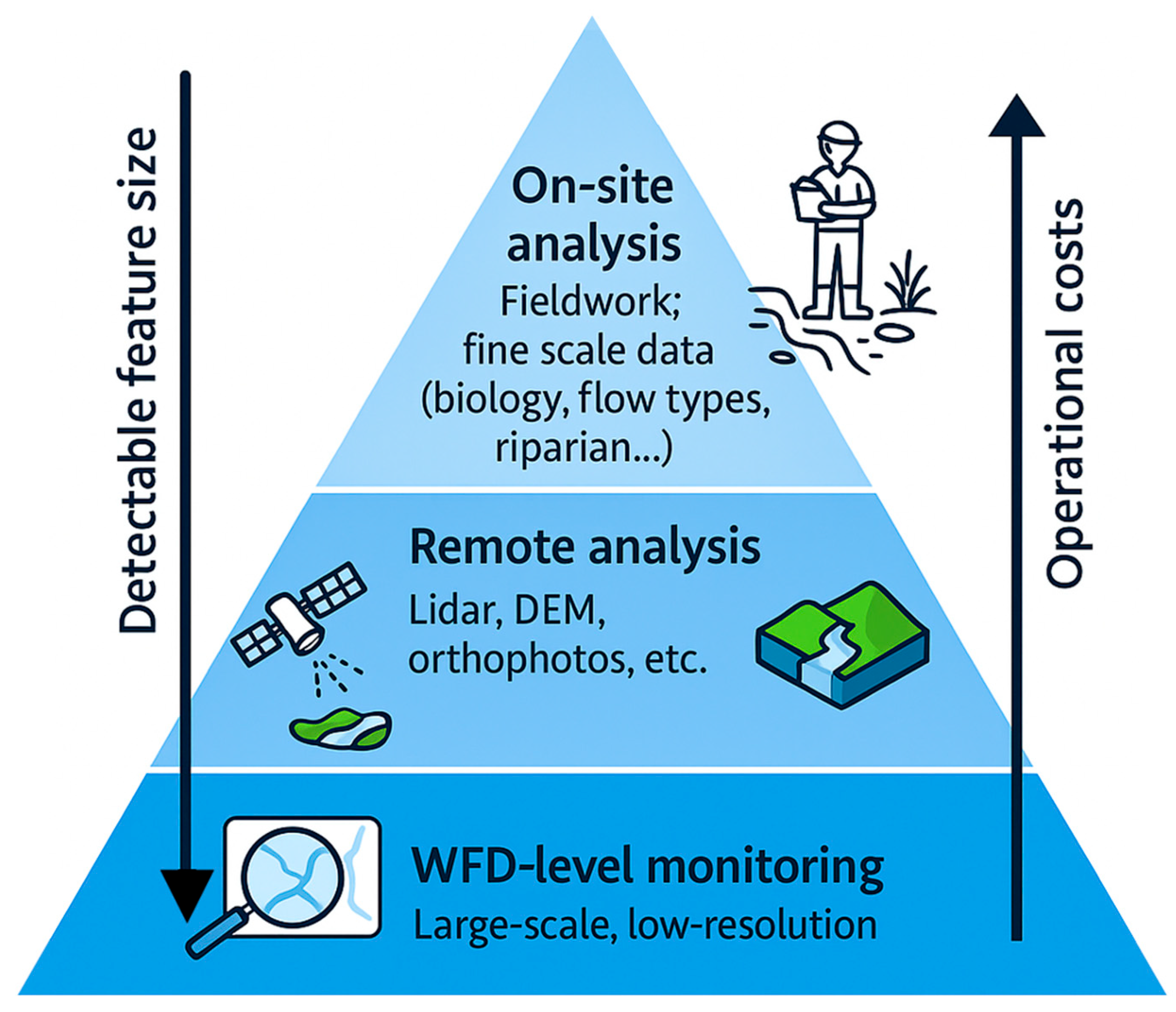
Nevertheless, the implementation of these techniques remains sporadic in the context of small rivers. Indeed, the accuracy of remote sensing methodologies are limited by the small spatial extent of small rivers, turbidity of water or overgrown vegetation [66,67]. However, Knehtl [68] concluded that field-based and remote sensing-based approaches give very similar results in a large river for hydromorphology assessment. He also showed that some small-scale characteristics are better described by field surveys (e.g., bank material and channel substrate) while large-scale characteristics (e.g., location of bars, islands, extent of backwaters) are better described by remote sensing. A combination of both approaches is hence a possible solution to allow affordable renaturation projects on small streams.

1.6. The “Rivialis” Project

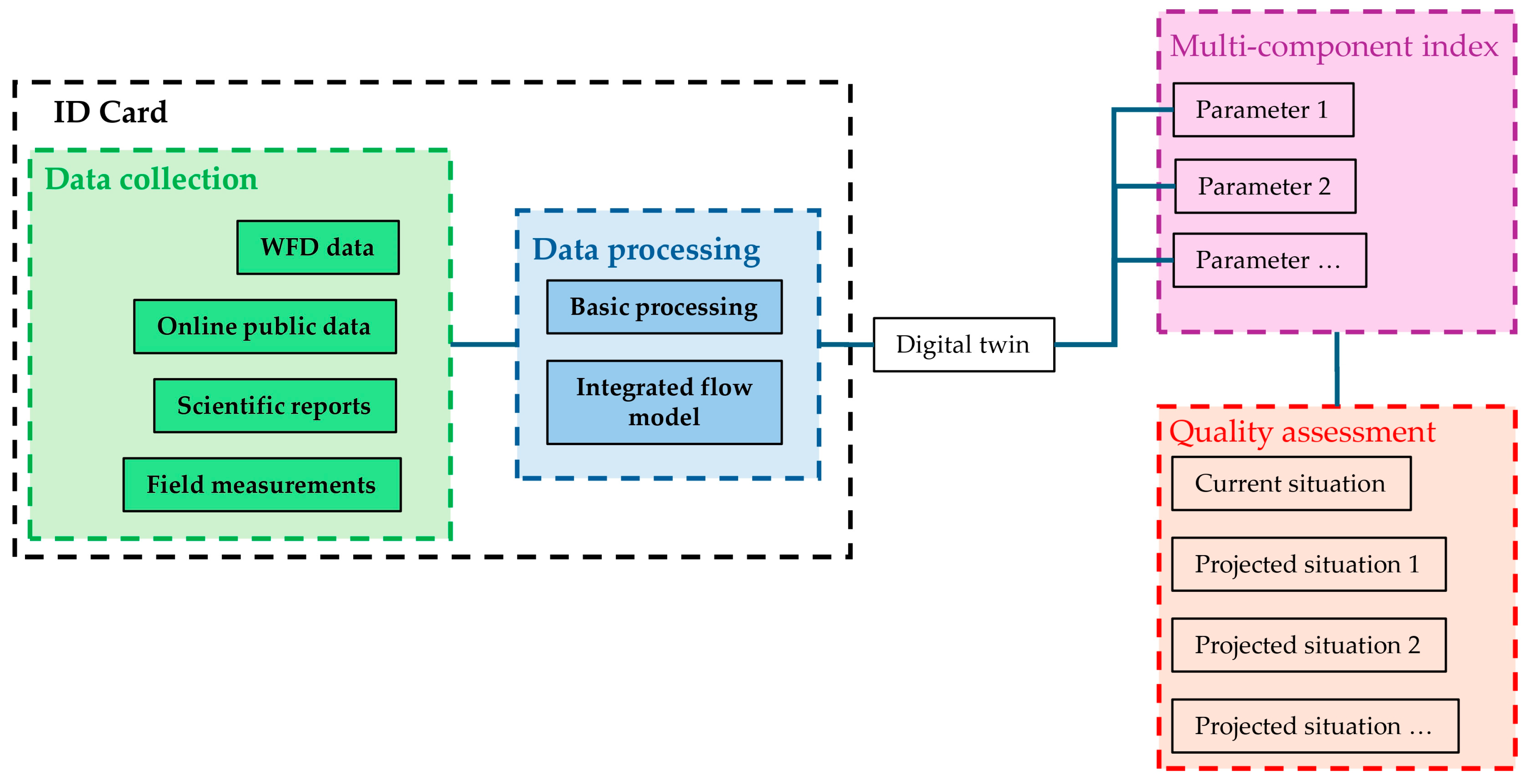
Within this context, the Rivialis scientific project started in 2023. Its final goal is to develop a simplified management tool for the renaturation of small rivers. This tool will use a digital twin approach to represent river reaches in current-state and potential future restoration scenarios. Digital twins are virtual replicas constructed from existing databases such as regional maps, data from the River Basin Management Plans, results from previous studies as well as field-collected parameters (green box of Figure 1). Altogether, that information describes a river reach identity card (ID card). This ID card could then be coupled with an integrated flow model, enabling the modeling of additional key parameters required for quality assessment (blue box of Figure 1).
According to Rivialis, a river reach quality score will be evaluated according to a new small river quality index called IPCE (Indice Petits Cours d’Eau in French). This index, still in development (purple box of Figure 1), has to be simple and rapid to determine and adapted to small water courses and their specific context. It aims to objectively characterize river quality but also identify potential improvements after various projected restoration scenarios, thereby supporting informed decision-making (red box of Figure 1).
The purpose of this paper is to present the data acquisition methodology to construct the ID card (black box in Figure 1) of the small stream to be renatured as a first step of the global methodology. A focus will be made on the cost, resolution, and quality of the data collected, depending on the scale of this collection. Therefore, data collection will be based as much as possible on publicly available data and simulations, and as little as possible on data fields measurements. To reach this goal, the following steps will be followed:
  • Identification of quality-related parameters: different existing quality indicators and metrics, previously described, have been analyzed in several categories (hydromorphology, catchment, biology, physico-chemistry, etc.) to establish the categories of parameters necessary to reach an index for small rivers (the so-called in-development IPCE). A focus has been placed on metrics that are relevant for small rivers (for instance, the number of large boats that sail daily on the river is underrated, while the number of fish living in its water is highly promoted).
  • From this list, relevant parameters are extracted that can be obtained through open-data values, numerical simulations or by minimizing expensive on-site measurements. They are selected to draw the ID card of the river reach.
  • Finally, the construction of the ID card is tested on a real river (the “Petit Bocq”, in Wallonia) to assess its efficiency for different data resolutions and its evaluation cost.
The paper is organized as follows. First, the methodology developed in the Rivialis project is introduced. The data collection procedure, simulation tool and components of the future small river quality index (IPCE) are described in order to highlight the importance of collected parameters to assess the river’s quality. Then, we present the study site located on the Petit-Bocq River where some of the selected metrics are evaluated to determine the exact needs in terms of extensive site surveys on small Walloon rivers. A The resulting ID card is presented based on data collected within the Rivialis project and on preliminary data collection within the Walphy program [31]. A discussion highlights the challenges related to data availability and reliability, representativeness, and metrics selection, before concluding on future perspectives for river quality assessment in small streams.

2. Materials and Methods

The methodology developed in the Rivialis project is based on a multi-source data acquisition framework (Figure 2), designed to combine cost-efficiency with spatial and thematic precision. Rather than relying on a single type of dataset, the approach integrates three complementary layers of information, each contributing to the construction of a detailed representation of small river reaches.
The first layer consists of public and open-access databases, such as the Water Framework Directive (WFD) records. These datasets provide a preliminary overview of river morphology, catchment characteristics, and potential anthropogenic pressures at low cost and over broad spatial coverage.
The second layer comprises a remote sensing dataset including LiDAR and Land Use Land Cover (LULC), orthophotos and other GIS data available on the Walloon Géoportail without in-depth analysis. Numerical simulations are also involved in the second layer, including hydraulic modeling and various GIS analysis provided by the DT (digital twin) infrastructure. These simulations derive added-value parameters—such as flow velocity, stream power, or inundation width—based on topo-bathymetric field survey and assumptions about flow conditions.
The third layer corresponds to field surveys, which offer high-resolution observations and ground truth for key variables, particularly those related to biological quality, sediment structure, or riparian vegetation complexity.
This section describes how these datasets were selected, combined, and applied in a pilot case study.

2.1. Available Data and Simulation Tool

As described above, the approach integrates different layers of information to increase data resolution. The initial resolution of data is the most coarse-grained, as it is derived from WFD reporting as applied to the Walloon Region. These are raw data collected by the Walloon administration on site and aggregated by surface water body (https://www.odwb.be/explore/dataset/fiches-de-caracterisation-des-masses-d-eau-de-surface/table/ (accessed on 26 June 2025)). In this database, each water body is defined as a discrete and significant element of surface water such as a lake, a reservoir, a stream, river or canal, part of a stream, river or canal, a transitional water or a stretch of coastal water [20], that is hydrologically significant, exhibits homogeneity in terms of its type and is subject to analogous pressures. Furthermore, to be considered by the Walloon Region as worth being managed, the water body must be of sufficient size whilst simultaneously not being too large for the results of monitoring to be representative (typically, the considered catchment area should be between 10 km2 and 100 km2) [69]. In this project, the focus is set on small rivers issued from catchments areas between 1 km2 and 50 km2. Therefore, the WFD data, as translated by the Walloon Region, can provide a first idea of the situation but are not sufficient. An initial refinement of the resolution can be performed using data available via the “Géoportail de la Wallonie” (https://geoportail.wallonie.be/home.html (accessed on 26 June 2025)), part of INSPIRE (Infrastructure for Spatial Information in Europe) European project. This public database contains an expandable catalog of various georeferenced data.
The second layer involves, in addition to GIS analysis, the use of a hydraulic modeling tool. This is achieved here through the WATLAB 0.4.2 environment developed at UCLouvain-iMMC (https://sites.uclouvain.be/hydraulics-group/watlab/index.html (accessed on 20 April 2025)), a simulation tool based on the two-dimensional shallow water equations and a finite volume scheme on unstructured meshes [70,71]. Shallow water equations permit to estimate the evolution in time t of the water depth h and the unit discharge q x and q y , respectively, in the x and y directions, in every cell of the mesh. Their expressions are given hereunder, with S 0 , x and S 0 , y , the components of the bed slope, while S f , x and S f , y are the components of the fiction slope (calculated using the Manning equation):
h t + q x x + q y y = 0
q x t + x q x 2 h + g h 2 2 + y q x q y h = g h S 0 , x S f , x
q y t + x q x q y h + y q y 2 h + g h 2 2 = g h S 0 , y S f , y
A morphodynamical model allows to account for bedload sediment transport by Iadding the Exner Equation (5) to the shallow-water Equations (2)–(4). Therefore, one can estimate z b , the erodible bed elevation and q s x and q s y , the components of the sediment discharge calculated using a closure formulation (6), in the present case by Meyer-Peter & Müller, where τb is the bed shear stress acting on the bed composed of grains with a representative diameter d:
z b t + 1 ϵ 0 q s x x + 1 ϵ 0 q s y y = 0 .
q s = g s 1 d 3 τ b 0.047 1.5
The WATLAB open-source modeling environment consists of parallelized computational code in C++ 20 controlled by a Python 3.11 API, which can be extended with new models according to the user’s needs.

2.2. Components of IPCE

The parameters that will constitute the IPCE are grouped into 5 components that should be available through the ID card of the considered river reach: river morphology, river dynamic, riparian zone, upstream catchment and miscellaneous. For each component, parameters and their relevance are described, as well as applicable methods to determine their value.

2.2.1. River Morphology

The first set of parameters relates to the bankfull situation, which corresponds to the moment just before the river first overflows into its major bed. These parameters (bankfull level, width, depth, and cross-section area) facilitate the determination of the specific power, which is an indicator of the river morphogenic capacity, as well as the length of the reach to be analyzed. In order to ensure that hydromorphology is adequately represented, it is necessary to analyze a minimum length of 12 to 14 times the bankfull width (Leopold and Wolman [72] showed that meander wavelength corresponds to 10 times the bankfull width).
Even though these geometrical parameters are not available on the basis of the WFD dataset, it is possible to estimate some of them with empirically established relationships in specific regions. For example, a bankfull width–catchment area relationship exists for Ardennes rivers [73]. A digital elevation model (DEM) or digital terrain model (DTM) is required to carry out a basic processing analysis. Such data is usually available for many sites, with grid resolutions ranging from 0.5 m to 30 m. If small rivers are concerned, it is important to work with a sufficiently fine resolution. In the Walloon region, a DTM is available with a 0.5 m resolution, established from red-LIDAR point cloud. However, some uncertainties exist on the bankfull water depth and cross-section area due to the limited penetration of light within water depth. To remove these, on-site bathymetric measurements are needed.
An indication of the bed slope S0 is available thanks to the typology used to classify rivers in Wallonia: small slope (<0.5‰), medium (0.5 to 7.5‰), or high slope (>7.5‰) [74]. The DTM currently available in Wallonia is not sufficiently accurate to determine the bed slope, as it is produced from a LIDAR flight in which the signal does not penetrate the water layer. Hence, only an estimate of the bed slope based on the free-surface slope at the time of the LIDAR measurements can be obtained. Consequently, bathymetric surveys are imperative to obtain precise data. Conversely, a GIS analysis of DTM or orthophotos ensures sufficient accuracy to determine the reach length Lr and sinuosity SI. These indicators of human path rectification of the river will not be improved by a field visit.

2.2.2. River and Sediments Dynamics

The dynamics of the river and the composition of its sediment bed are key parameters used to characterize the river’s capacity for self-adaptation to a change in its surrounding conditions.
The bankfull discharge and specific power are used to characterize the morphogenic capacity of the river. Again, some empirical relationships can be used to estimate these parameters from catchment area [73] but are not available throughout Wallonia. After on-site bathymetry measurements, the bankfull discharge Qb and specific power Ωb can be determined from flow simulations or using predetermined geometrical data (zb, Ab and S0) and assumption of a uniform flow (Manning).
The numerical simulations also allow the determination of hydraulic parameters such as water surface slope Sw, mean water velocity Vw, and depth hw. The behavior of the river in case of flooding should also be checked through the inundation width lx for a discharge Qx with a given return period x. It can be determined from flow simulations in the analyzed river reach conducted with the available bathymetry, as well as the water depth hw,x.
Regarding the riverbed and riverbanks parameters, site visits are usually required, even though some information can be obtained from databases (aerial photographs, soil composition map, digital elevation model, digital surface model, canopy height model, etc.). Once a grain size distribution (GSD) is known and has been determined using the Wolman pebble count method [75], it is possible to determine the bed mobility using Shields curve for example, either for a representative diameter d50 or for several sediment classes, depending on the bed material sorting σ G = d 84 / d 16 . Empirical relationships between stream power and sediment transport such as the one developed by Houbrechts et al. [76] for Ardenne rivers could also be used. A knowledge of the bed material composition combined with visual inspection of the studied reach (site visit or high-quality aerial photographs) allows for determining the Manning roughness coefficient n through empirical formulas such as n = d 50 1 / 6 / 21.1 according to Strickler or n = d 90 1 / 6 / 26 according to Meyer-Peter & Müller [77]. The clogging of the hyporheic zone, affecting fish and macro-invertebrate habitats or groundwater-river exchanges, is visually estimated through the Archambaud methodology [78].

2.2.3. Riparian Zone

The riparian zone is defined as the transition area between the aquatic and the terrestrial ecosystems. It is a linear landscape unit characterized by a specific vegetation, regularly inundated. Vegetated riparian zones provide many services to the river such contaminants filtration from upland, temperature regularization and bank stabilization [61].
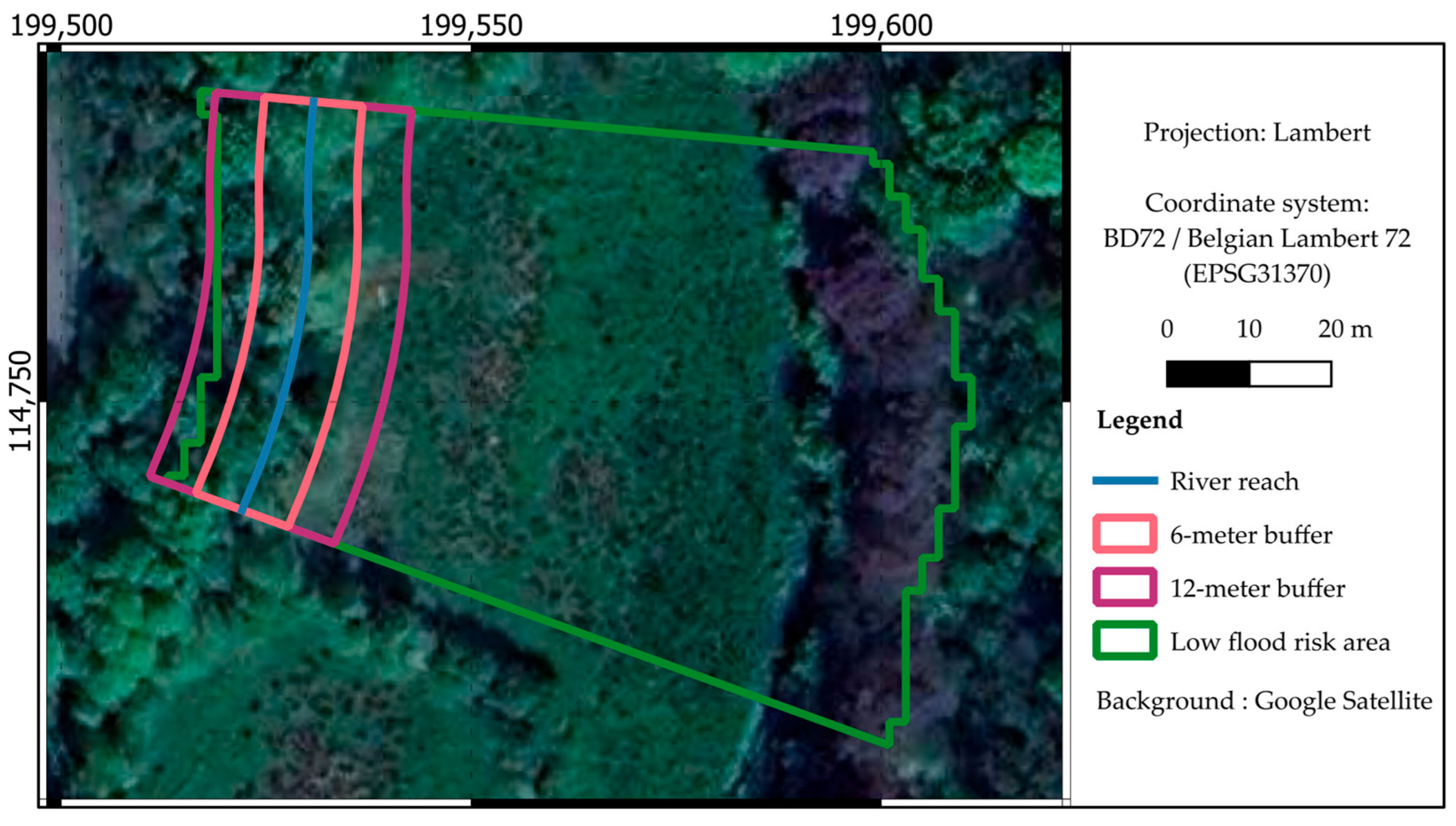
The related parameters are analyzed at three scales as presented in Figure 3. The first one corresponds to a 6 m buffer around the river. This is the width required in Wallonia for the application of the “Good Agricultural and Environmental Conditions” standard 4 which requires a buffer strip along the watercourse. The second scale is another buffer with a width of 12 m and the third one is the low flood risk area. The latter corresponds to the hydrological buffer for a flood with a 100-year return period. As a first approach, those data can be retrieved from the PARIS database (http://paris.spw.wallonie.be/portal/web/guest/accueil (accessed on 26 June 2025)) and then be calculated for the specific reach.
Firstly, the land use land cover is analyzed using a high-resolution LULC dataset (LifeWatch land cover dataset 2022 [79]), the portion of permanent vegetation in the riparian envelopes, as well as the proportion of resinous trees. Vegetation height and diversity are calculated using the median and coefficient of variation in the LiDAR digital height model (DHM) for each scale, respectively. Steam shading of the river is evaluated using the median of the hill shade of the DSM of the sunniest day (21st of June at 12:45 p.m.) for a 2 m buffer around the river.
A field survey can be performed to acquire more specific data to better describe the riparian context of the considered river reach. For those parameters, the field survey is not as extensive as others but serves as validation and complementary information. Indeed, as map of land use or DEM are produced on specific date, the field survey highlights any change between the map production date and the current state of the reach. For instance, changes in land use can be observed and reported. Complementary information includes the presence of spruce or poplar groves as well as bank tillage and traces of erosion and sediment transport from the banks. Habitat and biodiversity cannot be remotely analyzed and require field work as well.

2.2.4. Upstream Catchment

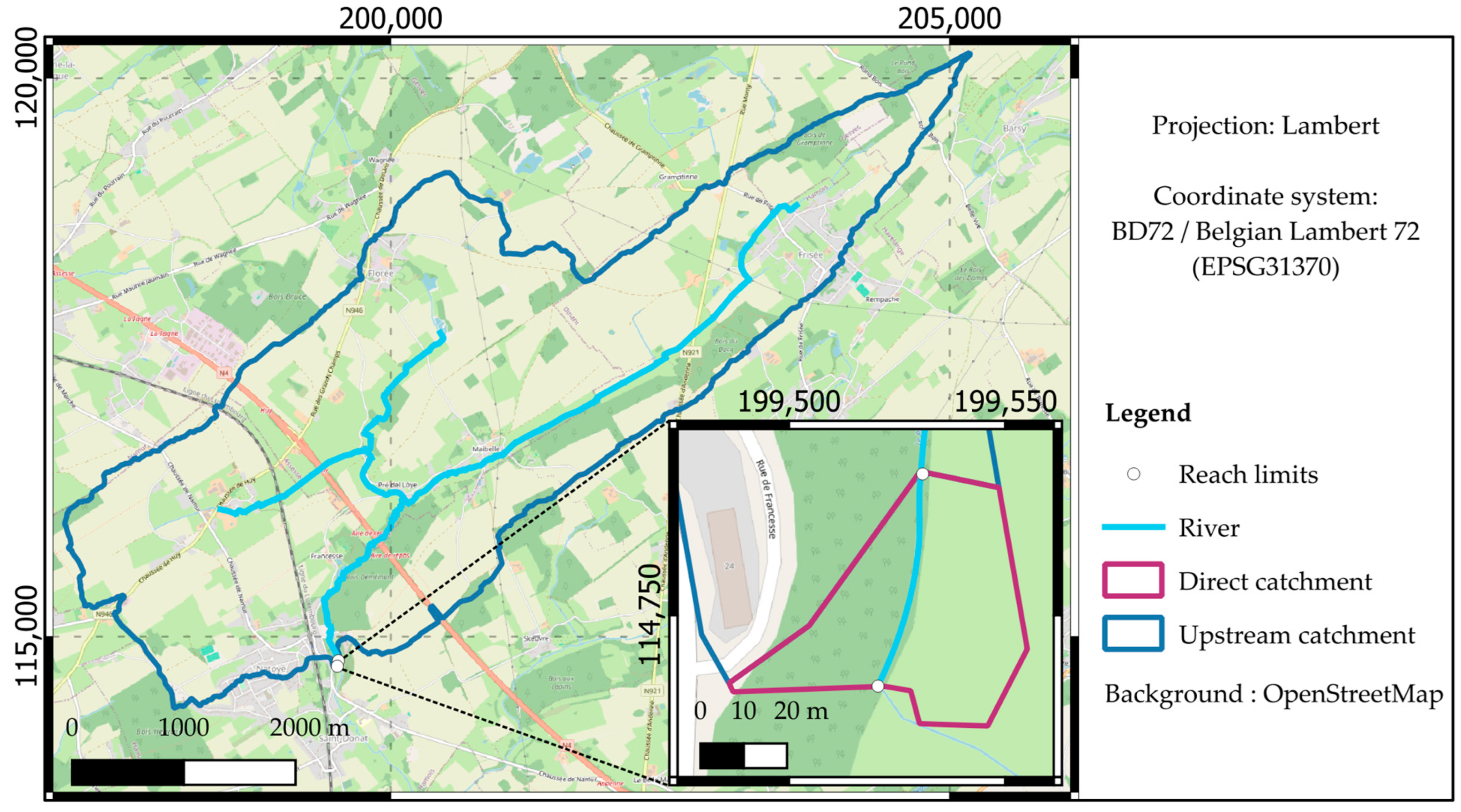
Data about the upstream catchment of the reach provides information about the pressures the river might undergo. This explains why even a river reach with good local hydromorphological parameters could not present good biological or physio-chemical parameters. A river within an urbanized catchment may be contaminated with domestic or industrial pollutants and a river with an agricultural catchment may receive sediments or chemicals such as fertilizers or pesticides. The information about the upstream catchment is split into two subcatchments: the catchment upstream of the reach and the catchment directly related to the stream (Figure 4).
In these two subcatchments, land cover is analyzed to highlight potential pressures from urban areas or agriculture, as previously mentioned. The percentages of the area of each erosion sensitivity class within the catchment are then calculated using the erosion sensitivity map (10 m resolution), available on the Walloon Geoportal (https://geoportail.wallonie.be/catalogue/c4d60ce7-b412-497b-86ff-bfa21283dc80.html (accessed on 26 June 2025)). This parameter considers only rainfall erosivity, soil erodibility, and slope length and steepness. To account for the agricultural history of the catchments, average percentage of erosion-prone crops for the last five years is calculated using the anonymous agricultural parcel maps are used (https://geoportail.wallonie.be/catalogue/f2b472d1-56b3-4053-81da-5910cc020e6a.html (accessed on 26 June 2025)).
Like for the riparian parameters, the PARIS catchments (catchment defined in action plans for river with an integrated and sector-based approach) and reach data are the first approach to estimate those parameters. The second approach consists of calculating the two subcatchments for the desired reach. As the area to cover is extensive, those parameters are analyzed only using remote data.

2.2.5. Biology

The biological component can be estimated from WFD data, keeping in mind the coarse spatial resolution of this dataset. Using high-quality imagery, it is possible to estimate the bed coverage by different types of vegetation. Coupled with results of a flow simulation (water depth and velocity), it is possible to determine the different habitat conditions offered by the river and compare them with target species. A detailed analysis can be carried out on site through visual assessment of bed vegetation (mud coverage, organic debris, roots, jam, algae) and larvae of benthic macro-invertebrates. Taxa are classified according to their sensitivity to pollution and substrate quality (Table 1), and the presence of the most sensitive taxon should be recorded.

2.2.6. Miscellaneous

A series of additional parameters are relevant for a detailed ID card of the river reach. These include, for example, the presence of obstacles to fish migration (dams, weirs) or ecological continuity. These obstacles are partially listed in WFD reports or available in a specific database of the Walloon Geoportal (i.e., Géoportail de la Wallonie). Pollution and presence of invasive species can also be tele-detected through existing data on Walloon databases, but an on-site check is necessary.
Table 2 summarizes parameters described above with regard to the analysis method and the qualitative or quantitative nature of the parameter for each component of the future IPCE. An analysis of available data in Wallonia is presented in Table 3, which highlights the redundancy of data for some parameters.

2.2.7. Study Case: Construction of a River Reach ID Card

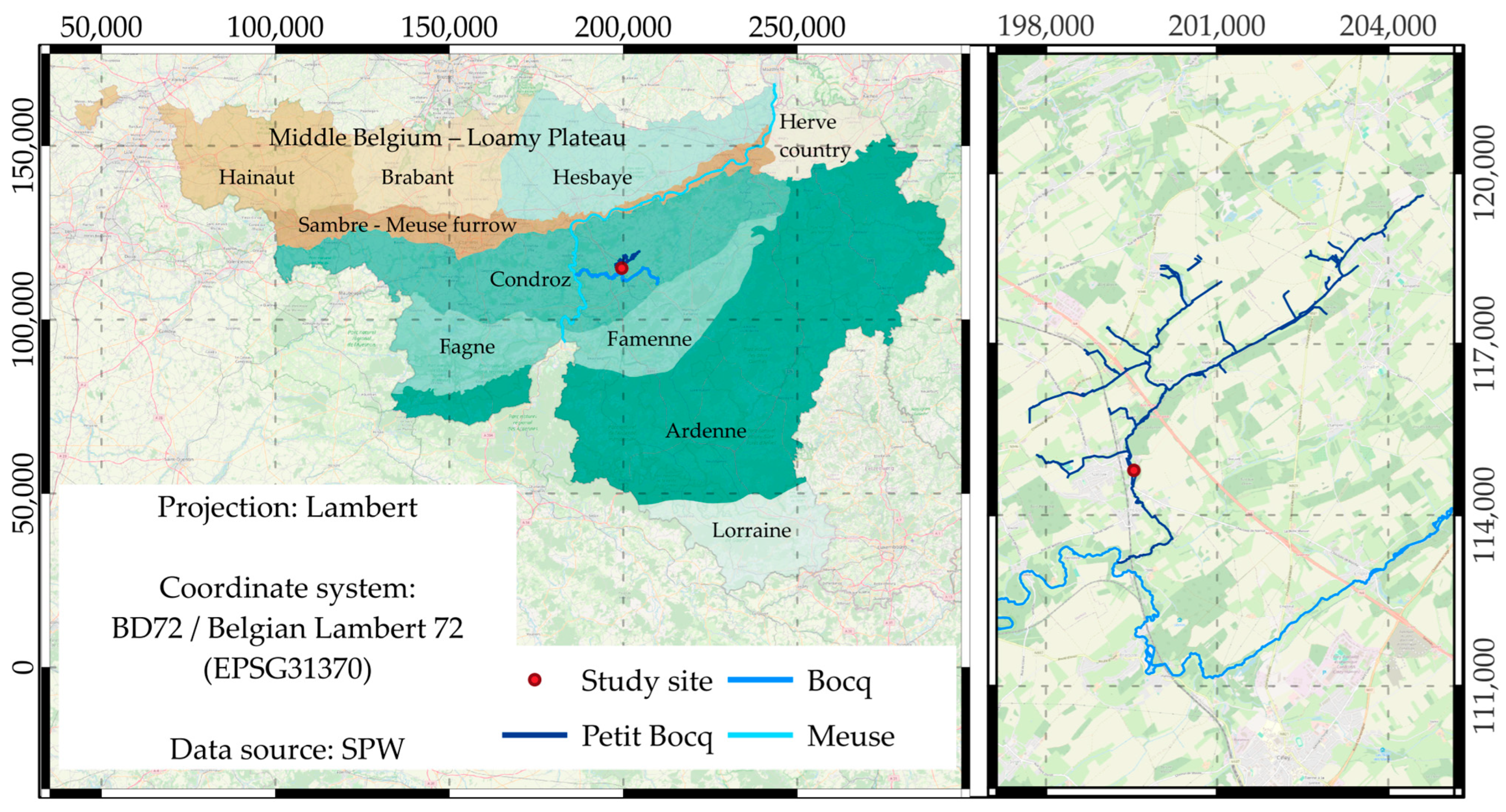
To check the usability of this methodology, the parameters identified in Table 2 are evaluated on the Petit-Bocq River in Natoye (Belgium). That way, one will be able to evaluate the potential of combining data from WFD or public databases with numerical flow simulations to enrich the parameters list, and whether supplementary data should be collected on site. This study site comprises a reach of 60 m length which has not yet undergone any restoration work, located in the Condruzian natural region at the center of Wallonia (Figure 5). The Petit-Bocq River is a tributary of the Bocq river, itself a tributary of the Meuse (upstream-Meuse subbasin) and classified as 2nd category according to the Walloon classification (which corresponds to a catchment < 50 km2). It flows in an environment dominated by crops and meadows. The site drains a catchment of 17 km2 and has a limnimetric station in its immediate vicinity (400 m downstream of the site).

3. Results

The results are firstly presented on the basis of WFD reporting for the surface water body concerned, prior to being detailed specifically for the reach studied.

3.1. WFD Characterization Sheet

The river reach is located in the surface water body MM28R (https://environnement.wallonie.be/files/eDocs%20Environnement/Milieux/Eau/DirectiveCadreEau/Data-EDL/FichesMassesEau/FichesMESu/MM28R.pdf (accessed on 26 June 2025)). It covers 148 km2 and 62 km of river, with a population density of 135 people/km2. From the data of the 2018–2019 report, the ecological status of the water body is medium with a medium score for the biological quality, a good status for the physico-chemical and hydromorphological quality. The medium result for the ecological status is due to a high nitrate concentration. Although the overall chemical quality of the water body was good, exceedances of environmental quality standards for persistent, bioaccumulative and toxic (PBT) substances in biota—namely mercury, heptachlor/heptachlor epoxide, and PBDEs—prevented its classification as having good chemical status according to WFD standards. Regarding the catchment land use, 66% of the water body surface is used for agriculture and 1069 tons of sediment were estimated to reach the outlet of the surface water body in 2019.

3.2. Remote and On-Site Analysis

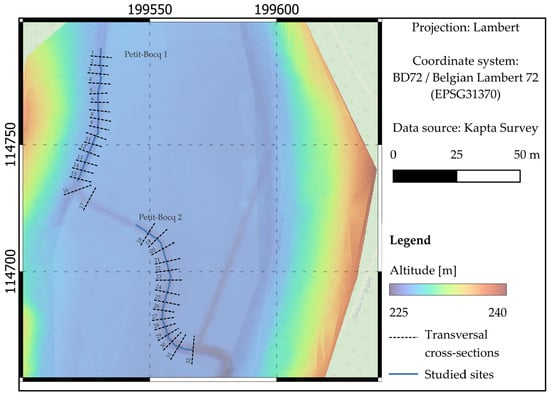
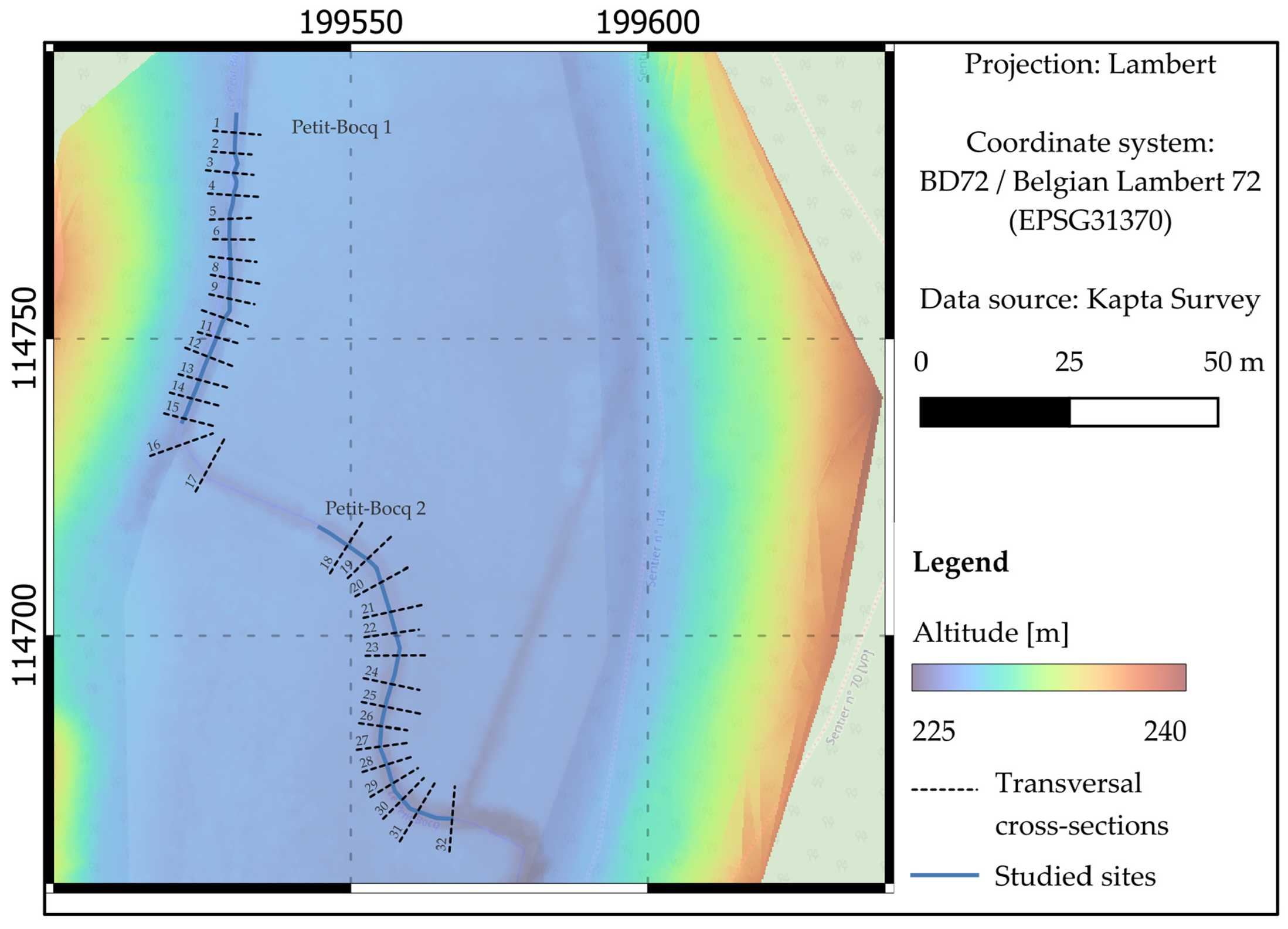
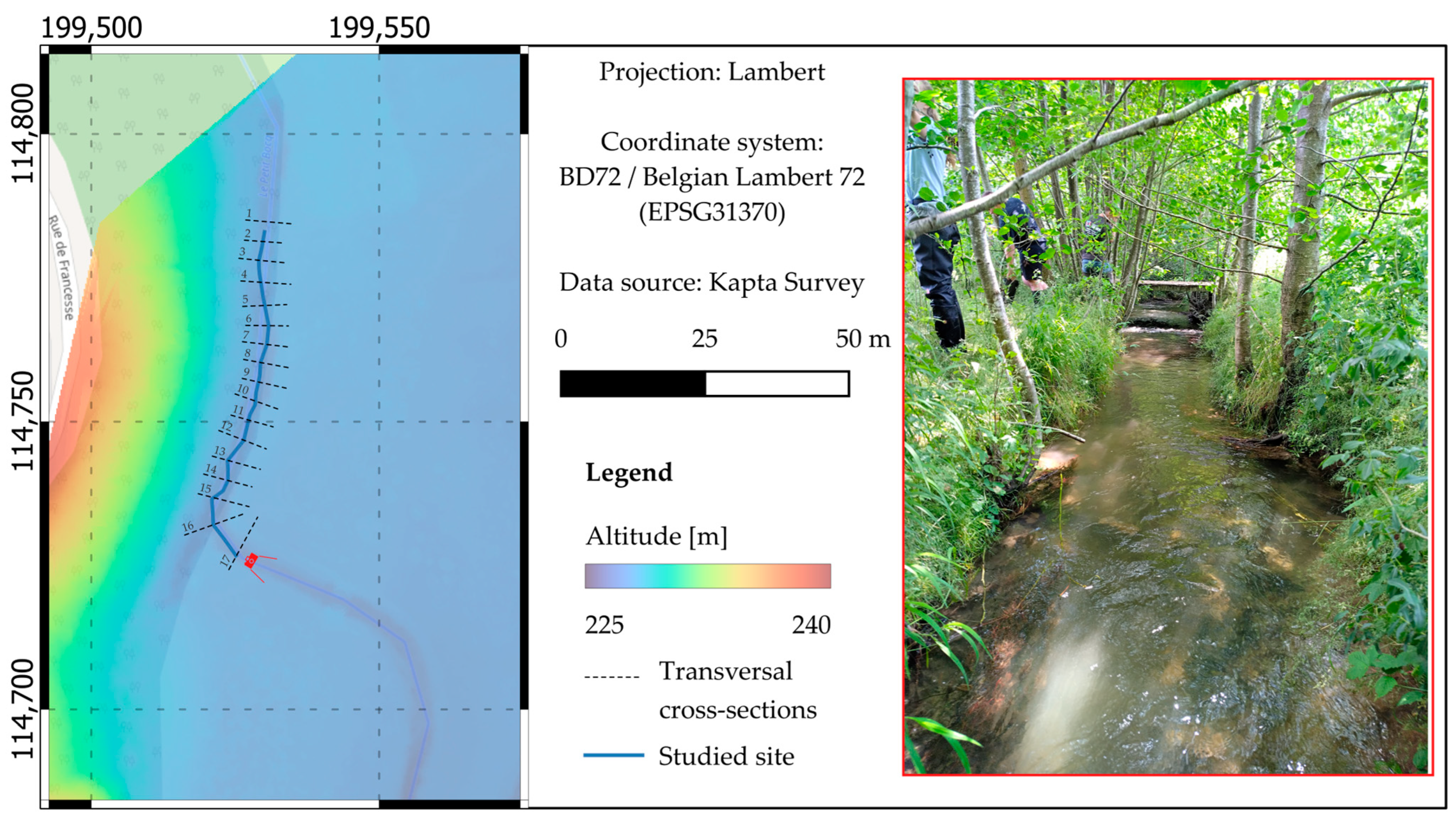
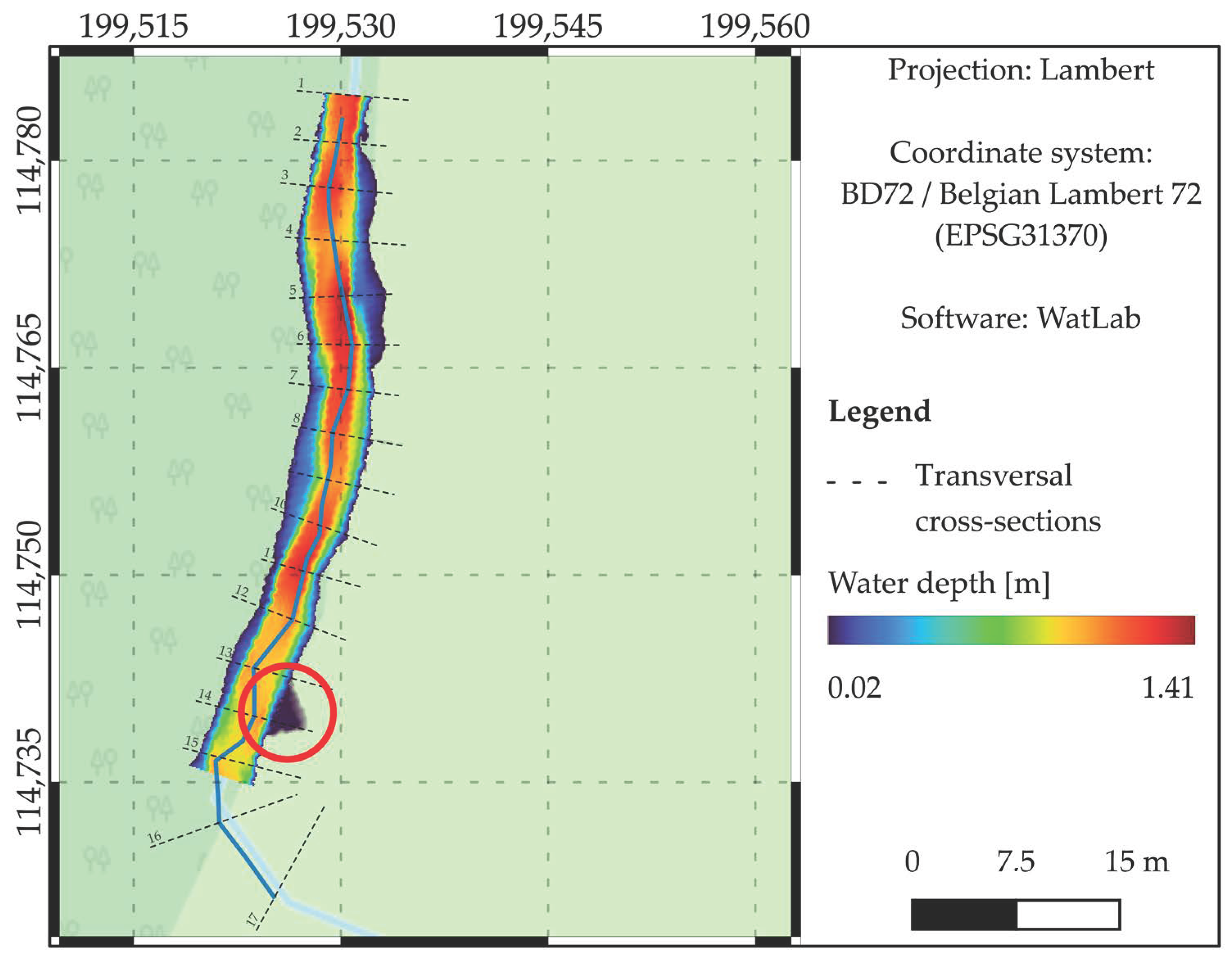
Figure 6 illustrates the studied reach, with a catchment area of 17 km2, where GIS analysis of publicly available datasets has been combined with numerical flow simulations to determine as many parameters of IPCE as possible. A UAV equipped with a LIDAR sensor was used to measure a point cloud of the surrounding area and a total of 17 cross-sections were also measured manually on-site (with an average distance between cross-sections of 3.5 m). Indeed, this appeared as necessary as the available data for the Walloon region only contains topographic data measured using LIDAR techniques. As the wavelength of the LIDAR cannot penetrate the water, the level of the topographic data at the river position corresponds to the water level at the time of the survey. Therefore, the bathymetry of the river must be acquired manually at several cross-sections (numbered from 1 to 17).
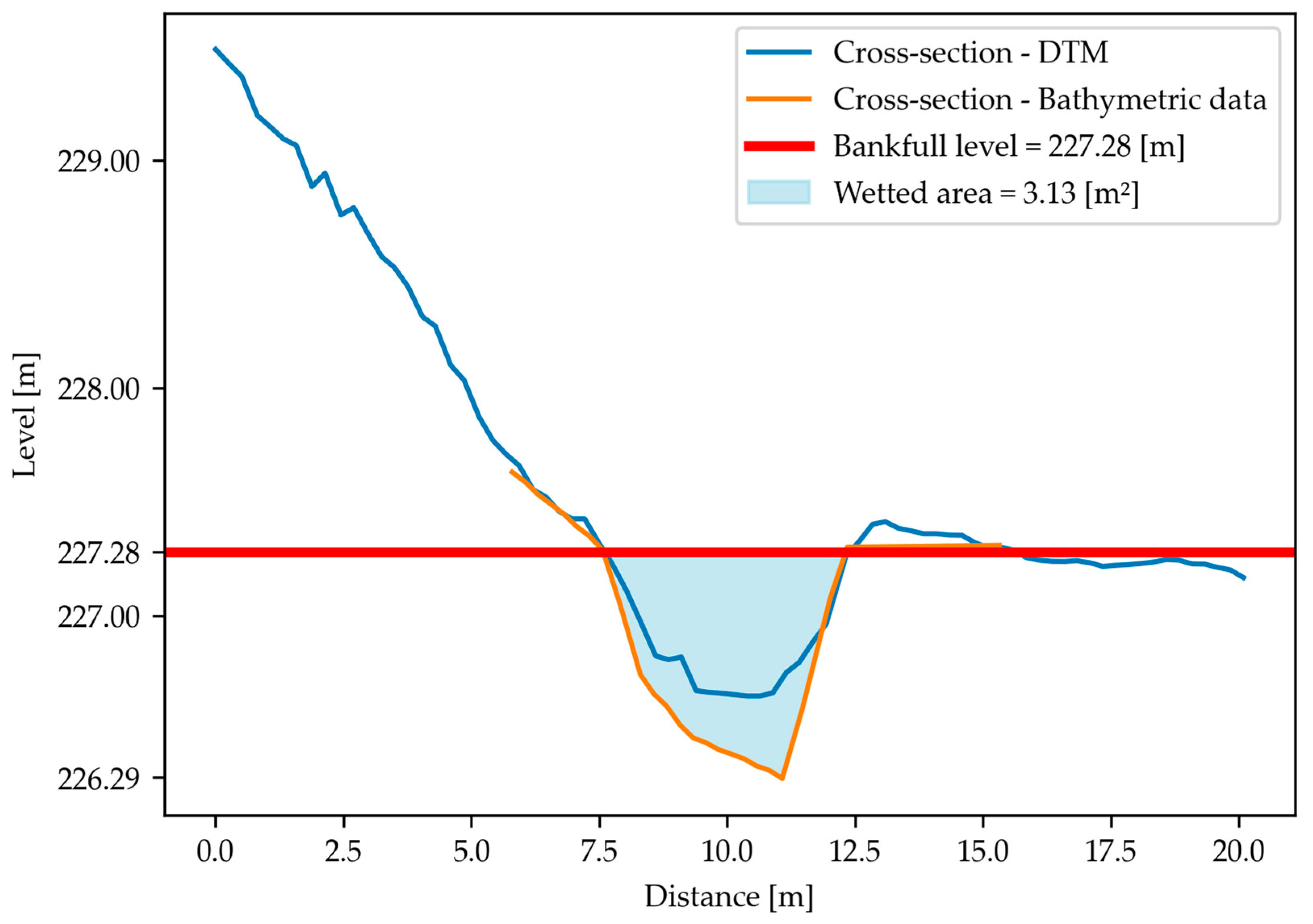
From the measured cross-sections, a hydraulic analysis was conducted, and the bankfull discharge was determined using two different methods. In the first method, uniform flows were calculated with a cross-sections equivalent to each of the known cross-sections of the studied reach, to identify the one that undergoes overflowing for the lowest discharge. This method highlighted section 14 as the limiting one with a discharge of 5.34 m3/s. As illustrated in Figure 7, there are, however, uncertainties regarding the cross-section shape. The assumption of uniform flow was used to obtain a first estimation of bankfull discharge at a very low cost from cross-section geometry analysis (combined with a slope and Manning friction coefficient assumption).
In the second method, the bankfull discharge was determined through two-dimensional numerical flow simulations conducted on the whole reach by progressive increase in the inlet discharge and identification of the first section where overflowing occurs. For these simulations, conducted on an unstructured mesh with a characteristic size of 0.25 m and proper downstream boundary condition to avoid backwater effect on the results, a Manning friction coefficient of 0.03 sm−1/3 was considered. As shown in Figure 8, the numerical simulation confirmed section 14 as the limiting one; however, the corresponding discharge is only 4 m3/s which is below the value of 5.34 m3/s calculated using the uniform flow assumption. This highlights the significant uncertainty related to the definition of the friction parameters but also the bed slope, as uniform-flow calculations require a single bed slope value while two-dimensional simulations directly use the bathymetric data.
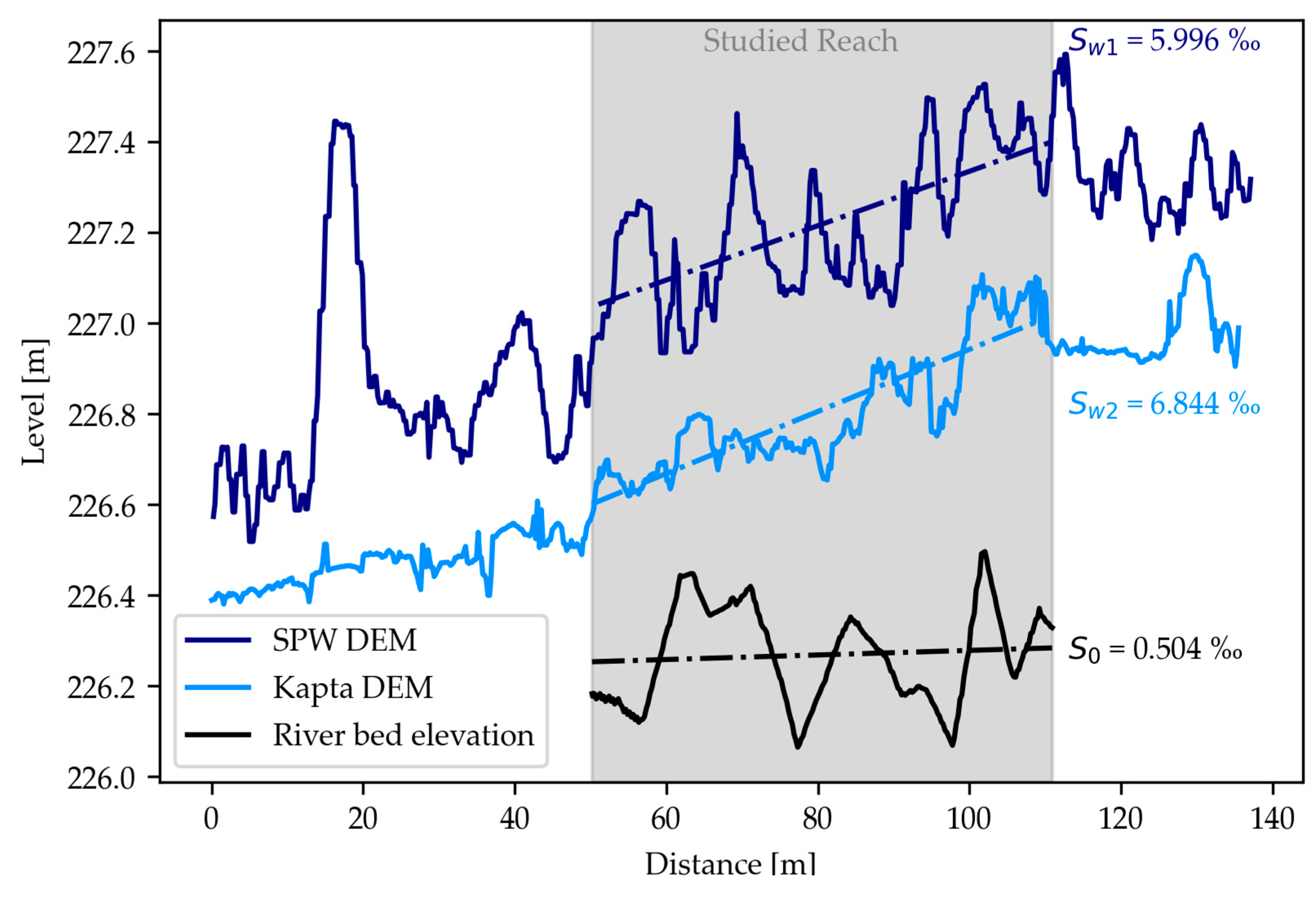
In the present case, for the bathymetric data, a digital elevation model was produced by Kapta Survey (called “Kapta DEM” in Figure 9) from the measured LIDAR point cloud obtained through UAV. With this data, the water surface slope as well as the estimated bed slope were determined on the studied reach, as illustrated in Figure 9. The differences between the slope estimates using the different methods are discussed in the next section.
Regarding the riparian zone, the Petit Bocq presents trees along the river and meadows behind the trees. The vegetation in the 6 m buffer is less varied than within the 12 m buffer. The reach is shaded at 99% and no spruce or poplar grove were registered during the site visit.
The reach is located in a low urbanized (6%) agricultural catchment (crops: 46%; meadows: 31%). The direct catchment of the studied site is composed of meadows and trees. The catchment presents an average erosion sensitivity and, for the last five years, erosion-prone crops covered around 15% of the total catchment.
For the biological section, the reach is covered by mud for 10% of its bed. Organic debris and roots were also encountered. In terms of macroinvertebrates, case-bearing caddisfly larvae from the Trichoptera Integripalpia sub-order were identified [80]. No dark points were identified.
Table 4 shows parameters collected for the two methods (remote analysis and field survey) on Petit-Bocq River.

4. Discussion

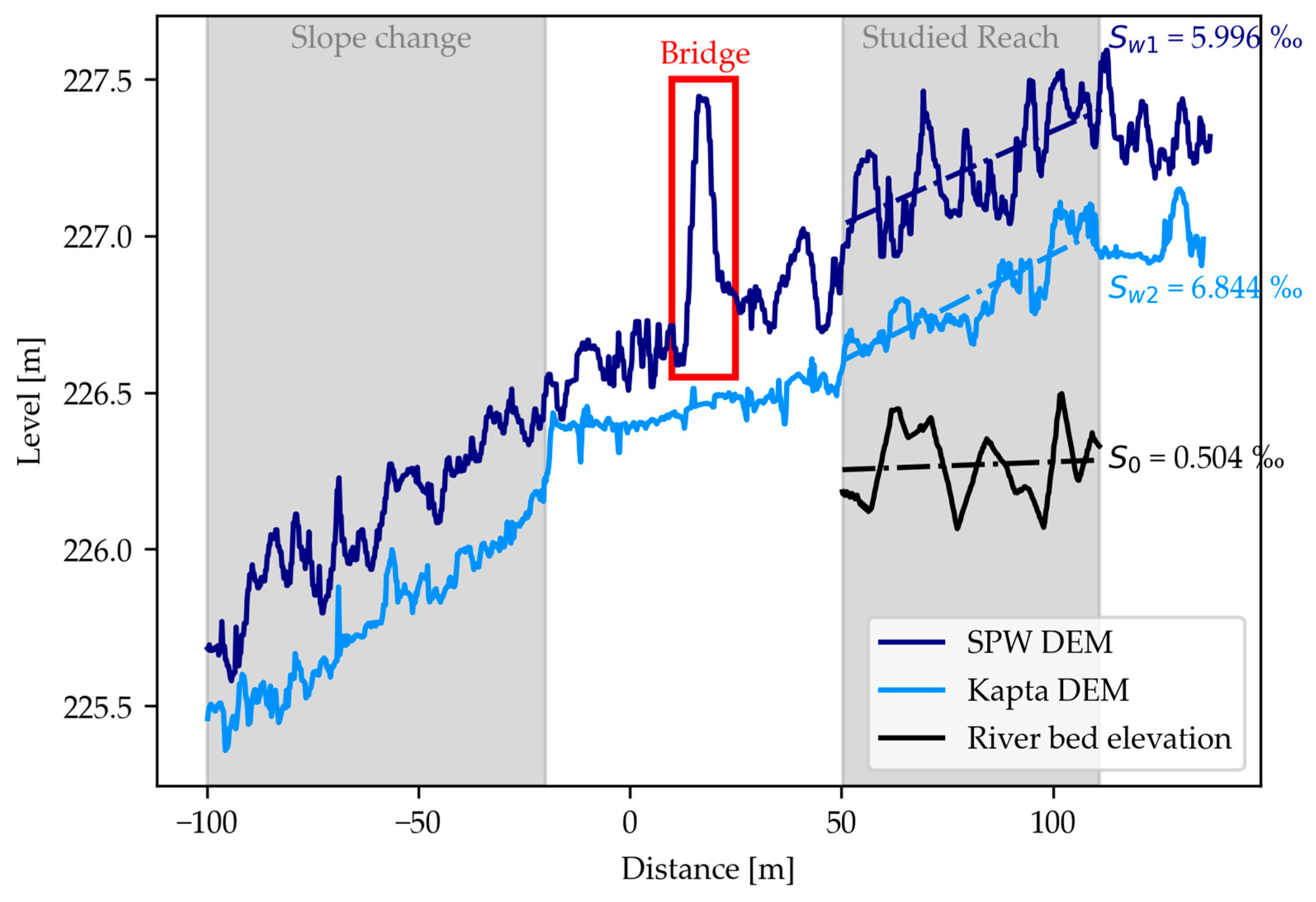
The parameters of Table 2 were estimated on the Petit Bocq River, as far as possible using available data, either from online databases or from literature reviews, and also following field works. It appears that geometric and hydraulic components can be easily described using online databases. However, although a reliable DTM was available in this region, it was necessary to manually measure cross-sections on the field to be able to accurately determine the thalweg elevation and parameters related to the river cross-section. Also, as illustrated in Figure 9, bed slope estimates can present large variations depending on the length of the considered reach, and spatial averaging is required to eliminate local irregularities. However, excessive spatial averaging could lead to errors, as illustrated in Figure 10 where a change in bed slope downstream of the study reach clearly appears. This is due to the engineering works that were carried out on this site; the downstream site is located in an artificially recreated portion of the river and despite the attempt to design it with some meanders, the bed slope presents a discontinuity, indicating that this reach is not yet in an equilibrium state. Figure 10 also illustrates an approximative difference of 0.3 m in elevation between the public DEM (“SPW DEM”) and the recent one produced as part of the Rivialis project (“Kapta DEM”). This difference is directly linked to the LIDAR technology used to produce these DEMs; the measured elevation is the surface water elevation, which varies over time. As the two DEMs were not measured at the same time, the flow conditions and the water levels were different, resulting in differences in the estimation of the bed slope. The bed slope calculated from the manual bathymetric survey appears as much smaller than the ones obtained through the LIDAR surveys, which also induces significant uncertainty with consequences on all hydraulic variables.
For these reasons, the definition of the bankfull discharge is to be taken with caution. In the present case, it was determined from uniform flow assumptions as first estimation for each of the available measured cross-sections, considering the bed slope estimated from the bathymetric survey and roughness coefficient was as described in [81]. If the flow can be assumed to be uniform, the water surface slope, which is usually much smoother than the bed profile and can be easily retrieved from a DTM, provides a reasonable estimate for the bed slope. In the present case, however, it appears that the water surface slope is larger than the estimated bed slope of 0.0054 according to [81] and the one calculated from the bathymetry, indicating an accelerating flow. Therefore, an alternative methodology was used: numerical simulations were conducted over the studied reach with a progressively increasing discharge to identify the bankfull situation from the first section where overflowing occurs. This methodology requires proper boundary conditions to avoid backwater effect on the results and determination of a realistic Manning friction coefficient. Although more accurate than the uniform flow assumption, the methodology based on numerical simulations is more time-consuming and requires the knowledge of the river bathymetry.
As previously stated, some parameters are easier to obtain through remote sensing. Indeed, riparian characteristics (height, stratification, shade, land use) are better quantified using remote data than field survey. However, for the construction of the river ID card, the on-site survey is used as a validation of the remotely acquired parameters. Indeed, as maps are produced on a certain date, changes may occur between the map creation and the on-site visit. Regarding the analysis of the catchment, remote sensing allows an analysis over time, avoiding extensive and repeated field visits. To this date, the runoff potential was estimated only using the erosion sensitivity classes defined in the Walloon public data. The estimations of the actual runoff potential and the average sediment yield of the catchment ideally require calculations based on representative precipitations, which could not be performed at this stage.
As can be deduced from Table 4, a series of identified components could not be obtained from remote analysis. This shows that an in-depth field survey is still required to evaluate several components related to the bed and banks composition. In the same way, all biological components need to be investigated or checked on site. Although those measurements are time-consuming, those components are sensitive to the river properties and are an indicator of a favorable local hydrological environment [82,83,84,85]. Monitoring those parameters can also highlight the effectiveness of the restoration [86,87].
Regarding dark points, obstacles can be detected from aerial photographs and from the DTM. Again, a field visit is useful to confirm these preliminary conclusions. As demonstrated in Figure 10, there is a bridge in the public DEM (SPW DEM) inducing a non-natural elevation, which must be manually corrected before it can be used for GIS analysis. Such artifacts can be detected through the analysis of high-resolution images, provided that the area under consideration is not completely covered by vegetation. Therefore, it is important to undertake a field visit to validate any necessary data corrections.
Finally, pollution and the presence of invasive species can also be remotely assessed from WFD reporting or public databases, but an on-site check is recommended. Sometimes it will require more than just a field visit to retrieve samples from the site and analyze them.
This preliminary evaluation of the proposed components for the construction of a river ID card shows that although much information can be collected from online databases and numerical simulations, field work is still key to assessing the state of a river reach.

5. Conclusions

This study illustrates a combined data collection from remote information, numerical simulations, and field surveys to construct a reliable ID card of a river reach allowing to estimate its quality and ecological state. Such an ID card could help with the design of renaturation projects adapted to small watercourses. Indeed, considering the cost of data collection through field surveys that can represent a significant part of the project costs for a small stream, it is important to assess which parameters or variables can be obtained using publicly and online available data.
To establish the river ID card, the first selection of parameters was made from widely used indicators. The selected parameters were applied to a small Walloon river reach for which manually collected data were also available. The application of the selected parameters to this river reach highlighted the potential but also the limitations of using only publicly available databases for a reliable evaluation of the river features. It also demonstrated the potential of combining numerical flow simulations with the available data to enrich the definition of the parameters and evaluate the uncertainty related to those that depend on the bed slope definition.
Through the selection of parameters required to construct the ID card (black box of Figure 1) of a small river reach from which a significant number can be obtained from publicly available data, this study demonstrated that the intensity of field surveys can be limited, reducing the costs associated with the design of restoration projects. The proposed methodology has the potential to be transferred to other sites, although some adjustments may be required depending on data availability or spatial resolution. Nevertheless, the key parameters selected to construct the ID card remain relevant, as they are directly related to fundamental variables needed to assess rivers regardless of their geographic location.
The ID card of a small river will be employed as an input into a digital twin of the studied small river, which will subsequently be utilized for the purpose of evaluating the efficiency of different restoration scenarios (red box in Figure 1) and determining priority areas and types of interventions.

Author Contributions

Conceptualization M.P., E.P., P.-Y.G., R.P., G.H., C.G. and S.S.-F.; methodology M.P., E.P., A.M. and P.-Y.G.; validation M.P., E.P., A.M. and P.-Y.G.; software M.P., P.-Y.G. and S.S.-F.; investigation M.P., E.P., R.P. and C.G.; formal analysis M.P., E.P. and P.-Y.G.; resources and data curation M.P., E.P., P.-Y.G., R.P. and C.G.; visualization; writing—original draft preparation M.P. and E.P.; writing—review and editing M.P., E.P., A.M., P.-Y.G. and S.S.-F.; supervision A.M., G.H. and S.S.-F.; project administration and funding acquisition A.M., P.-Y.G., G.H. and S.S.-F. All authors have read and agreed to the published version of the manuscript.

Funding

This research project was funded by the Greenwin project Rivialis (Grant C-8835) as part of the Priority Action Plan for Wallonia.

Data Availability Statement

The raw data supporting the conclusions of this article will be made available by the authors on reasonable request.

Acknowledgments

The authors would like to thank Greenwin and the Walloon region for funding this study through the RIVIALIS research project and also thank all Rivialis project partners: Kapta Survey and Stream & River for their support in the field data collection, the team at the Civil and Environmental Engineering Department of UCLouvain for their help in the realization of this study, and SkalUp for IT support. They also thank Zoé Hallard for her ideas in designing the tables.

Conflicts of Interest

The authors declare no conflicts of interest.

References

  1. Flash Floods in Spain: Joining Forces for Rapid Recovery—European Commission. Available online: https://civil-protection-humanitarian-aid.ec.europa.eu/news-stories/stories/flash-floods-spain-joining-forces-rapid-recovery_en (accessed on 19 May 2025).
  2. Dewals, B.; Erpicum, S.; Pirotton, M.; Archambeau, P. Extreme Floods in Belgium. 2021. Available online: https://henry.baw.de/items/075b0d77-3498-4386-bc1f-f33cf900bb4e (accessed on 19 May 2025).
  3. Speybroeck, B. Actualisation Relative Aux Inondations de Juillet 2021. Available online: https://press.assuralia.be/actualisation-relative-aux-inondations-de-juillet-2021 (accessed on 19 May 2025).
  4. Spinoni, J.; Vogt, J.V.; Naumann, G.; Barbosa, P.; Dosio, A. Will Drought Events Become More Frequent and Severe in Europe? Int. J. Climatol. 2018, 38, 1718–1736. [Google Scholar] [CrossRef]
  5. Brajkovic, J.; Fettweis, X.; Noël, B.; Vyver, H.V.D.; Ghilain, N.; Archambeau, P.; Pirotton, M.; Doutreloup, S. Increased Intensity and Frequency of Extreme Precipitation Events in Belgium as Simulated by the Regional Climate Model MAR. J. Hydrol. Reg. Stud. 2025, 59, 102399. [Google Scholar] [CrossRef]
  6. Kryžanowski, A.; Brilly, M.; Rusjan, S.; Schnabl, S. Review Article: Structural Flood-Protection Measures Referring to Several European Case Studies. Nat. Hazards Earth Syst. Sci. 2014, 14, 135–142. [Google Scholar] [CrossRef]
  7. Nowogoński, I. Runoff Volume Reduction Using Green Infrastructure. Land 2021, 10, 297. [Google Scholar] [CrossRef]
  8. Guillaume, B.; Michez, A.; Degré, A. Leveraging Soil Diversity to Mitigate Hydrological Extremes with Nature-Based Solutions in Productive Catchments. EGUsphere 2025, 1–36. [Google Scholar] [CrossRef]
  9. Temporary Flood Water Storage in Agricultural Areas in the Middle Tisza River Basin—Hungary. Available online: https://climate-adapt.eea.europa.eu/en/metadata/case-studies/temporary-flood-water-storage-in-agricultural-areas-in-the-middle-tisza-river-basin-hungary (accessed on 19 April 2025).
  10. Monroe, M.C.; Plate, R.R.; Oxarart, A.; Bowers, A.; Chaves, W.A. Identifying Effective Climate Change Education Strategies: A Systematic Review of the Research. Environ. Educ. Res. 2019, 25, 791–812. [Google Scholar] [CrossRef]
  11. Ecological Status of Surface Waters in Europe. Available online: https://www.eea.europa.eu/en/analysis/indicators/ecological-status-of-surface-waters (accessed on 19 April 2025).
  12. Petsch, D.K.; Cionek, V.d.M.; Thomaz, S.M.; dos Santos, N.C.L. Ecosystem Services Provided by River-Floodplain Ecosystems. Hydrobiologia 2023, 850, 2563–2584. [Google Scholar] [CrossRef]
  13. Grizzetti, B.; Pistocchi, A.; Liquete, C.; Udias, A.; Bouraoui, F.; van de Bund, W. Human Pressures and Ecological Status of European Rivers. Sci. Rep. 2017, 7, 205. [Google Scholar] [CrossRef] [PubMed]
  14. Ekka, A.; Pande, S.; Jiang, Y.; der Zaag, P. van Anthropogenic Modifications and River Ecosystem Services: A Landscape Perspective. Water 2020, 12, 2706. [Google Scholar] [CrossRef]
  15. Vermaat, J.E.; Wagtendonk, A.J.; Brouwer, R.; Sheremet, O.; Ansink, E.; Brockhoff, T.; Plug, M.; Hellsten, S.; Aroviita, J.; Tylec, L.; et al. Assessing the Societal Benefits of River Restoration Using the Ecosystem Services Approach. Hydrobiologia 2016, 769, 121–135. [Google Scholar] [CrossRef]
  16. Wohl, E.; Lane, S.N.; Wilcox, A.C. The Science and Practice of River Restoration. Water Resour. Res. 2015, 51, 5974–5997. [Google Scholar] [CrossRef]
  17. Pan, B.; Yuan, J.; Zhang, X.; Wang, Z.; Lu, J.; Yang, W.; Chen, J.; Li, Z.; Zhao, N.; Xu, M. A Review of Ecological Restoration Techniques in Fluvial Rivers. Int. J. Sediment Res. 2016, 31, 110–119. [Google Scholar] [CrossRef]
  18. Biggs, J.; von Fumetti, S.; Kelly-Quinn, M. The Importance of Small Waterbodies for Biodiversity and Ecosystem Services: Implications for Policy Makers. Hydrobiologia 2017, 793, 3–39. [Google Scholar] [CrossRef]
  19. Beilfuss, R.; Meyer, J.; Kaplan, L.; Newbold, D.; Strayer, D.; Woltemade, C.; Zedler, J.; Carpenter, Q.; Semlitsch, R.; Watzin, M.; et al. Where Rivers Are Born: The Scientific Imperative for Defending Small Streams and Wetlands; Sierra Club and American Rivers: Oakland, CA, USA, 2003. [Google Scholar]
  20. Journal Officiel. Directive Cadre sur L’eau-2000-60. 2000. Available online: https://eur-lex.europa.eu/eli/dir/2000/60/oj?locale=fr (accessed on 28 April 2025).
  21. La Directive Cadre sur l’Eau. Available online: https://eau.wallonie.be/spip.php?article1 (accessed on 14 April 2025).
  22. Gostner, W.; Schleiss, A. Fiches Sur L’aménagement et L’écologie Des Cours D’eau: Fiche 3—Indice Hydromorphologique de la Diversité; Office Fédéral de L’environnement: Bern, Switzerland, 2012. [Google Scholar]
  23. Gob, F.; Bilodeau, C.; Thommeret, N.; Belliard, J.; Albert, M.-B.; Tamisier, V.; Baudoin, J.-M.; Kreutzenberger, K. Un outil de caractérisation hydromorphologique des cours d’eau pour l’application de la DCE en France (CARHYCE). Géomorphol. Relief Process. Environ. 2014, 20, 57–72. [Google Scholar] [CrossRef]
  24. Rinaldi, M.; Surian, N.; Comiti, F.; Bussettini, M. A Method for the Assessment and Analysis of the Hydromorphological Condition of Italian Streams: The Morphological Quality Index (MQI). Geomorphology 2013, 180–181, 96–108. [Google Scholar] [CrossRef]
  25. Degiorgi, F.; Morillas, N.; Grandmottet, J.P. Méthode Standard D’analyse de la Qualité de L’habitat Aquatique à L’échelle de la Station: L’iam. 2002. Available online: https://eplanete.oieau.fr/source/methode-standard-danalyse-de-la-qualite-de-lhabitat-aquatique-lechelle-de-la-station-liam (accessed on 28 April 2025).
  26. De Pauw, N.; Vanhooren, G. Method for Biological Quality Assessment of Watercourses in Belgium. Hydrobiologia 1983, 100, 153–168. [Google Scholar] [CrossRef]
  27. Haury, J.; Peltre, M.-C.; Trémolières, M.; Barbe, J.; Thiébaut, G.; Bernez, I.; Daniel, H.; Chatenet, P.; Haan-Archipof, G.; Muller, S.; et al. A New Method to Assess Water Trophy and Organic Pollution—the Macrophyte Biological Index for Rivers (IBMR): Its Application to Different Types of River and Pollution. In Macrophytes in Aquatic Ecosystems: From Biology to Management, Proceedings of the 11th International Symposium on Aquatic Weeds (Moilets, France), European Weed Research Society; Springer: Dordrecht, The Netherlands, 2006; pp. 153–158. [Google Scholar] [CrossRef]
  28. Système D’évaluation de la Qualité de L’eau des Cours D’eau SEQ-Eau. Available online: https://bretagne-environnement.fr/notice-documentaire/systeme-evaluation-qualite-eau-cours-eau-seq-eau (accessed on 15 April 2025).
  29. Ariza Restrepo, J.L.; Rodriguez Diaz, Y.J.; Onate Barraza, H.C.; Ariza Restrepo, J.L.; Rodriguez Diaz, Y.J.; Onate Barraza, H.C. Water Quality Indices (WQI) and Contamination Indices (WPI) a Bibliographic Review. Tecnura 2023, 27, 121–140. [Google Scholar] [CrossRef]
  30. Qualphy. Available online: https://bassin-serein.fr/qualphy (accessed on 28 April 2025).
  31. Walphy - LIFE+ - Bienvenue. Available online: https://walphy.eu/xindex.php (accessed on 16 April 2025).
  32. Guyon, F.; Cogels, X.; Moy, J. Développement et Application D’une Méthodologie D’évaluation Globale de La Qualité Hydromorphologique Des Masses D’eau de Surface Définies En Région Wallonne; ULiège: Liège, Belgium, 2006. [Google Scholar]
  33. Peeters, A.; Verniers, G. Pilot Project « Walphy »: Walloon LIFE07 ENV/B/000038 Experimentation of River Restoration. 2012. Available online: https://www.walphy.eu/uploads/pdf/Walphy_project_EN.pdf (accessed on 28 April 2025).
  34. Moroșanu, G. Assessing the Physical Quality of the Coșuștea River Using the Qualphy Method. Risks Catastr. J. 2017, 20, 83–99. [Google Scholar] [CrossRef] [PubMed]
  35. Indicateurs Biologiques en Wallonie. Available online: https://etat.environnement.wallonie.be/contents/indicatorsheets/EAU%203.html# (accessed on 15 April 2025).
  36. Blanco, S. What Do Diatom Indices Indicate? Modeling the Specific Pollution Sensitivity Index. Environ. Sci. Pollut. Res. 2024, 31, 29449–29459. [Google Scholar] [CrossRef]
  37. Prygiel, J.; Coste, M. Utilisation des indices diatomiques pour la mesure de la qualité des eaux du bassin Artois-Picardie: Bilan et perspectives. Ann. Limnol. Int. J. Lim. 1993, 29, 255–267. [Google Scholar] [CrossRef]
  38. Île-de-France, D. L’indice Biologique Macrophytes en Rivière (IBMR). Available online: https://www.drieat.ile-de-france.developpement-durable.gouv.fr/l-indice-biologique-macrophytes-en-riviere-ibmr-a2090.html (accessed on 20 April 2025).
  39. Archaimbault, V.; Dumont, B. L’indice Biologique Global Normalisé (IBGN): Principes et Évolution Dans Le Cadre de La Directive Cadre Européenne Sur l’eau. Sci. Eaux Territ. 2010, 1, 36–39. [Google Scholar] [CrossRef]
  40. Djidohokpin, G.; Sossoukpe, E.; Fiogbe, E. Paramètres, Calcul et Interprétation de l’Indice Biotique d’Intégrité Piscicole (IBIP) Pour La Préservation de La Biodiversité Aquatique Africaine: Synthèse Bibliographique. Int. J. Innov. Appl. Stud. 2016, 16, 626–634. [Google Scholar]
  41. Pont, D. Bio-Indication et Peuplement Piscicole Dans Les Cours d’eau: Une Approche Fonctionnelle et Prédictive. Sci. Eaux Territ. 2010, 1, 40–45. [Google Scholar] [CrossRef]
  42. Qualité Des Eaux. Available online: https://www.issep.be/qualite-des-eaux/ (accessed on 28 April 2025).
  43. SPW Fiches Des Masses D’eau de Surface. Available online: https://environnement.wallonie.be/home/milieux/eau/etat-des-eaux/fiches-des-masses-d'eau-de-surface.html (accessed on 11 June 2025).
  44. Fiches de Caractérisation des Masses D’eau de Surface. Available online: https://www.odwb.be/explore/dataset/fiches-de-caracterisation-des-masses-d-eau-de-surface/table/ (accessed on 11 June 2025).
  45. Bernhardt, E.S.; Palmer, M.A.; Allan, J.D.; Alexander, G.; Barnas, K.; Brooks, S.; Carr, J.; Clayton, S.; Dahm, C.; Follstad-Shah, J.; et al. Synthesizing U.S. River Restoration Efforts. Science 2005, 308, 636–637. [Google Scholar] [CrossRef] [PubMed]
  46. Le Bihan, M.; Melun, G.; Cagnant, M.; Hubert, A.; Ledouble, O.; Irz, P.; Udo, H. Relevés et Observations Hydromorphologiques Sur Les Zones Amont de Cours d’eau; Office Francais de la Biodiversité: Vincennes, France, 2025; p. 64. [Google Scholar]
  47. Ministry of Environment Science & Information Branch. The Canadian Aquatic Biomonitoring Network. 2009. Available online: https://www.canada.ca/en/environment-climate-change/services/canadian-aquatic-biomonitoring-network.html (accessed on 27 June 2025).
  48. Barbour, M.T.; Gerritsen, J.; Snyder, B.D.; Stribling, J.B. Rapid Bioassessment Protocols For Use in Streams and Wadeable Rivers: Periphyton, Benthic Macroinvertebrates and Fish; U.S. Environmental Protection Agency, Office of Water: Washington DC, USA, 1999.
  49. Verdú, J.M.; Batalla, R.J.; Martínez-Casasnovas, J.A. High-Resolution Grain-Size Characterisation of Gravel Bars Using Imagery Analysis and Geo-Statistics. Geomorphology 2005, 72, 73–93. [Google Scholar] [CrossRef]
  50. Dugdale, S.J.; Carbonneau, P.E.; Campbell, D. Aerial Photosieving of Exposed Gravel Bars for the Rapid Calibration of Airborne Grain Size Maps. Earth Surf. Process. Landf. 2010, 35, 627–639. [Google Scholar] [CrossRef]
  51. Louis, R.; Zech, Y.; Joseph, A.; Gonomy, N.; Soares-Frazao, S. Flood Modeling of the June 2023 Flooding of Léogâne City by the Overflow of the Rouyonne River in Haiti. Water 2024, 16, 2594. [Google Scholar] [CrossRef]
  52. Koutalakis, P.; Zaimes, G.N. River Flow Measurements Utilizing UAV-Based Surface Velocimetry and Bathymetry Coupled with Sonar. Hydrology 2022, 9, 148. [Google Scholar] [CrossRef]
  53. Dramais, G.; Le Coz, J.; Camenen, B.; Hauet, A. Advantages of a Mobile LSPIV Method for Measuring Flood Discharges and Improving Stage—Discharge Curves. J. Hydro-Environ. Res. 2011, 5, 301–312. [Google Scholar] [CrossRef]
  54. Torgersen, C.E.; Faux, R.N.; McIntosh, B.A.; Poage, N.J.; Norton, D.J. Airborne Thermal Remote Sensing for Water Temperature Assessment in Rivers and Streams. Remote Sens. Environ. 2001, 76, 386–398. [Google Scholar] [CrossRef]
  55. Marcus, W.A.; Legleiter, C.J.; Aspinall, R.J.; Boardman, J.W.; Crabtree, R.L. High Spatial Resolution Hyperspectral Mapping of In-Stream Habitats, Depths, and Woody Debris in Mountain Streams. Geomorphology 2003, 55, 363–380. [Google Scholar] [CrossRef]
  56. Woodget, A.S.; Visser, F.; Maddock, I.P.; Carbonneau, P.E. The Accuracy and Reliability of Traditional Surface Flow Type Mapping: Is It Time for a New Method of Characterizing Physical River Habitat? River Res. Appl. 2016, 32, 1902–1914. [Google Scholar] [CrossRef]
  57. Yang, X. Integrated Use of Remote Sensing and Geographic Information Systems in Riparian Vegetation Delineation and Mapping. Int. J. Remote Sens. 2007, 28, 353–370. [Google Scholar] [CrossRef]
  58. Forzieri, G.; Moser, G.; Vivoni, E.R.; Castelli, F.; Canovaro, F. Riparian Vegetation Mapping for Hydraulic Roughness Estimation Using Very High Resolution Remote Sensing Data Fusion. J. Hydraul. Eng. 2010, 136, 855–867. [Google Scholar] [CrossRef]
  59. Michez, A.; Piégay, H.; Lisein, J.; Claessens, H.; Lejeune, P. Classification of Riparian Forest Species and Health Condition Using Multi-Temporal and Hyperspatial Imagery from Unmanned Aerial System. Environ. Monit Assess. 2016, 188, 146. [Google Scholar] [CrossRef] [PubMed]
  60. Michez, A.; Piégay, H.; Jonathan, L.; Claessens, H.; Lejeune, P. Mapping of Riparian Invasive Species with Supervised Classification of Unmanned Aerial System (UAS) Imagery. Int. J. Appl. Earth Obs. Geoinf. 2016, 44, 88–94. [Google Scholar] [CrossRef]
  61. Michez, A.; Piégay, H.; Lejeune, P.; Claessens, H. Multi-Temporal Monitoring of a Regional Riparian Buffer Network (>12,000 km) with LiDAR and Photogrammetric Point Clouds. J. Environ. Manag. 2017, 202, 424–436. [Google Scholar] [CrossRef]
  62. Dakin Kuiper, S.; Coops, N.C.; Tompalski, P.; Hinch, S.G.; Nonis, A.; White, J.C.; Hamilton, J.; Davis, D.J. Characterizing Stream Morphological Features Important for Fish Habitat Using Airborne Laser Scanning Data. Remote Sens. Environ. 2022, 272, 112948. [Google Scholar] [CrossRef]
  63. Piegay, H.; Thevenet, A.; Kondolf, G.M.; Landon, N. Physical and Human Factors Influencing Potential Fish Habitat Distribution along a Mountain River, France. Geogr. Ann. Ser. A Phys. Geogr. 2000, 82, 121–136. [Google Scholar] [CrossRef]
  64. Whited, D.C.; Kimball, J.S.; Lorang, M.S.; Stanford, J.A. Estimation of Juvenile Salmon Habitat in Pacific Rim Rivers Using Multiscalar Remote Sensing and Geospatial Analysis. River Res. Appl. 2013, 29, 135–148. [Google Scholar] [CrossRef]
  65. Flynn, K.F.; Chapra, S.C. Remote Sensing of Submerged Aquatic Vegetation in a Shallow Non-Turbid River Using an Unmanned Aerial Vehicle. Remote Sens. 2014, 6, 12815–12836. [Google Scholar] [CrossRef]
  66. Bizzi, S.; Demarchi, L.; Grabowski, R.C.; Weissteiner, C.J.; Van de Bund, W. The Use of Remote Sensing to Characterise Hydromorphological Properties of European Rivers. Aquat. Sci. 2016, 78, 57–70. [Google Scholar] [CrossRef]
  67. Zhao, D.; Lv, M.; Zou, X.; Wang, P.; Yang, T.; An, S. What Is the Minimum River Width for the Estimation of Water Clarity Using Medium-Resolution Remote Sensing Images? Water Resour. Res. 2014, 50, 3764–3775. [Google Scholar] [CrossRef]
  68. Knehtl, M.; Petkovska, V.; Urbanič, G. Is It Time to Eliminate Field Surveys from Hydromorphological Assessments of Rivers?—Comparison between a Field Survey and a Remote Sensing Approach. Ecohydrology 2018, 11, e1924. [Google Scholar] [CrossRef]
  69. European Commission (Ed.) Identification of Water Bodies: Guidance Document No 2; Office for Official Publications of the European Communities: Luxembourg, 2003; ISBN 978-92-894-5122-2. [Google Scholar]
  70. Soares-Frazão, S.; Zech, Y. HLLC Scheme with Novel Wave-Speed Estimators Appropriate for Two-Dimensional Shallow-Water Flow on Erodible Bed. Int. J. Numer. Methods Fluids 2011, 66, 1019–1036. [Google Scholar] [CrossRef]
  71. Soares-Frazão, S.; Zech, Y. Dam-Break Flow through an Idealised City. J. Hydraul. Res. 2008, 46, 648–658. [Google Scholar] [CrossRef]
  72. Leopold, L.B.; Wolman, G.M. River Meanders. GSA Bull. 1960, 71, 769–794. [Google Scholar] [CrossRef]
  73. Petit, F.; Hallot, E.; Houbrechts, G.; Mols, J. Évaluation des puissances spécifiques de rivières de moyenne et de haute Belgique. Bull. De La Société Géographique De Liège 2005, 46, 37–50. [Google Scholar]
  74. SPW Concept de Masse D’eau. Available online: https://environnement.wallonie.be/home/milieux/eau/concepts/concept-de-masse-d-eau.html (accessed on 8 July 2025).
  75. Wolman, M.G. A Method of Sampling Coarse River-Bed Material. Eos Trans. Am. Geophys. Union 1954, 35, 951–956. [Google Scholar] [CrossRef]
  76. Houbrechts, G.; Levecq, Y.; Peeters, A.; Hallot, E.; Van Campenhout, J.; Denis, A.-C.; Petit, F. Evaluation of Long-Term Bedload Virtual Velocity in Gravel-Bed Rivers (Ardenne, Belgium). Geomorphology 2015, 251, 6–19. [Google Scholar] [CrossRef]
  77. Ghaffar, A.B.A. Determination of Manning’s Flow Resistance Coefficient for Rivers in Malaysia. In Proceedings of the 1st International Conference on Managing Rivers in the 21st Century: Issues & Challenges, Penang, Malaysia, 21–23 September 2024. [Google Scholar]
  78. Archambaud, G.; Giordano, L.; Dumont, B. Description Du Substrat Minéral et Du Colmatage; Cemagref Aix-en-Provence, UR Hydrobiologie, 2005; Available online: https://www.creseb.fr/voy_content/uploads/2021/11/20220118_FDPPMA35_JournalClub.pdf (accessed on 8 July 2025).
  79. Radoux, J.; Bourdouxhe, A.; Coppée, T.; De Vroey, M.; Dufrêne, M.; Defourny, P. A Consistent Land Cover Map Time Series at 2 m Spatial Resolution—The LifeWatch 2006-2015-2018-2019 Dataset for Wallonia. Data 2023, 8, 13. [Google Scholar] [CrossRef]
  80. Holzenthal, R.W.; Thomson, R.E.; Ríos-Touma, B. Chapter 38—Order Trichoptera. In Thorp and Covich’s Freshwater Invertebrates, 4th ed.; Thorp, J.H., Rogers, D.C., Eds.; Academic Press: Boston, MA, USA, 2015; pp. 965–1002. ISBN 978-0-12-385026-3. [Google Scholar]
  81. Fraudin, C.; Castelain, L.; Peeters, A.; Carpentier, C.; De Le Court, B.; Van Campenhout, J.; Kestemont, P.; Houbrechts, G. Evaluation of the Effectiveness of Hydromorphological Restoration Work Carried out 10 Years Ago on the Bocq (Wallonia, Belgium). In Proceedings of the Colloque SHF: «Aménagements et biodiversité», Strasbourg, France, 8–10 November 2022. [Google Scholar]
  82. Wynants, M.; Hallberg, L.; Prischl, L.-A.; Livsey, J.; Bieroza, M. Trends and Purposes of European River Monitoring and Restoration. Environ. Sci. Policy 2025, 170, 104130. [Google Scholar] [CrossRef]
  83. Fabrègue, M.; Braud, A.; Bringay, S.; Grac, C.; Le Ber, F.; Levet, D.; Teisseire, M. Discriminant Temporal Patterns for Linking Physico-Chemistry and Biology in Hydro-Ecosystem Assessment. Ecol. Inform. 2014, 24, 210–221. [Google Scholar] [CrossRef]
  84. Elosegi, A.; Díez, J.; Mutz, M. Effects of Hydromorphological Integrity on Biodiversity and Functioning of River Ecosystems. Hydrobiologia 2010, 657, 199–215. [Google Scholar] [CrossRef]
  85. Thiébaut, G.; Tixier, G.; Guérold, F.; Muller, S. Comparison of Different Biological Indices for the Assessment of River Quality: Application to the Upper River Moselle (France). Hydrobiologia 2006, 570, 159–164. [Google Scholar] [CrossRef]
  86. Daumal, M.M.; van Halsema, R.; Dekkers, D.T.B.M.; Erkens, R.H.J.; Peeters, E.T.H.M. The Effects of a Large-Scale Nature-Based Solution on the Macroinvertebrate Diversity in a Gravel River in The Netherlands. Nat. Based Solut. 2025, 8, 100248. [Google Scholar] [CrossRef]
  87. Moulinec, A.; de Donnová, S.; Bojková, J.; Straka, M.; Sundermann, A. Influence of Hydro-Morphological Quality and Pollution Pressure on Macroinvertebrate Assemblages in Restored Streams. Ecol. Indic. 2025, 178, 113926. [Google Scholar] [CrossRef]
Figure 1. Flow chart of the Rivialis project. The steps described in this paper are highlighted by the colored rectangles with text in bold in the Figure.
Water 17 02564 g001
Figure 2. Data acquisition framework supporting small stream quality assessment within the IPCE approach.
Water 17 02564 g002
Figure 3. Scales for the riparian zone analysis of a reach, with an example from the Petit Bocq reach.
Water 17 02564 g003
Figure 4. Representation of the two subcatchments of the Petit Bocq reach.
Water 17 02564 g004
Figure 5. Location of Petit-Bocq River and natural regions in Wallonia.
Water 17 02564 g005
Figure 6. Location of studied site and cross-sections on Petit-Bocq.
Water 17 02564 g006
Figure 7. Determination of bankfull metrics on transversal section 14 on Petit-Bocq site.
Water 17 02564 g007
Figure 8. Numerical simulation result—water depth on Petit-Bocq site for an inflow discharge of 4 m3/s and Manning friction coefficient of 0.03 sm−1/3. The overflow in section 14 (indicated by red circle) indicates the bankfull situation.
Water 17 02564 g008
Figure 9. Determination of water surface (Sw) and bed (S0) slope on Petit-Bocq reach using linear least square regression applied to the longitudinal profile derived from the public DEM (SPW DEM) or the LIDAR UAV derived DEM (Kapta DEM) and bathymetric on-site measurements for the bed slope.
Water 17 02564 g009
Figure 10. Change in water surface slope downstream from the studied section and presence of an artifact linked to a bridge in the public DEM (SPW DEM).
Water 17 02564 g010
Table 1. Benthic macro-invertebrates and their sensitivity to water quality, evaluated from very low (−−−) to very high (+++).
Larvae TaxaSensitivity
Plecoptera, Ephemeroptera Heptageneida+++
Trichoptera Integripalpia (case-bearing caddisfly)++
Ephemeroptera (other), Ancylus+
Gammarus, Odonata, Lymnaea
Asellus, Hirudinea−−
Chironomidaea, Tubifex−−−
Table 2. Components of the river ID card.
CategoryParameterSymbol and UnitsAnalysisValue Type
FieldRemoteQuant.Qual.
River morphologyBankfull levelzb (m) ++
Bankfull widthlb (m) ++
Bankfull depthhb (m)+++
Width-to-depth ratiolb/hb (-) ++
Bankfull cross-sectionAb (m2)+++
Bed slopeS0 (-) ++
Reach lengthLr (m) +
SinuositySI (-) +
River and sediments dynamicBankfull dischargeQb (m3/s) ++
Stream powerΩb (W) ++
Water surface slopeSw (-) ++
Mean water velocityVw (m/s) + ++
Mean water depthhw (m) + + +
Inundation width for Qxlx (m) + +
Water depth for Qxhw,x (m) + +
Bank material GSD + +
Bank material texture + +
Bed material GSD + +
Sorting of bed GSDσG (-)+ +
Bed facies + +
Roughness coefficientn (sm−1/3) + ++
Clogging + +
Bed material mobility per sediment class for QbShields ++
Riparian zoneLULC% agriculture, % permanent vegetation, % impervious, % softwood ++
Vegetation height(m) ++
Vegetation diversity(%) ++
Stream shade ++
Grove (spruce or poplar)(Y/N)+ +
Erosion and sediment transport(Y/N)+ +
Bank tillage(Y/N)+ +
Upstream catchmentLULC% agriculture, % permanent vegetation, % impervious ++
Erosion sensitivity(% class area) ++
Erosion-prone crops in the last five years(% area) ++
BiologyHabitats + +
Bed vegetation(% bed area)+
Macro-invertebrates + +
MiscelaneousObstacles(Y/N) + + +
Pollution(Y/N) + + +
Invasive species(Y/N) + + +
Table 3. Available data in Wallonia. A cross indicates that the parameter can be estimated or calculated from the specified data layer.
ParameterDigital Elevation ModelDigital Surface ModelLidar Point CloudHydrographic NetworkOrthophotosFish MigrationLand CoverLand UseSoil Sensitivity to ErosionPreliminary Flood Risk AssessmentAnonymous Agricultural ParcelsGiant HogweedWatersheds of Surface Water BodiesPARIS DatabaseWalloon Soil Condition DatabaseBiological Monitoring NetworkProhibiting Livestock Access to RiverCatchment AreaRunoff Concentration Axis
Bankfull levelxxx
Bankfull widthxxx x x
Bankfull depthx x
Width-to-depth ratiox x
Bankfull cross-sectionx x
Bed slopex x
Reach lengthxxxxx
Sinuosityxxxxx
Bankfull discharge x x
Stream power x x
Water surface slopex x
Mean water velocity
Mean water depth
Inundation width for Qx x
Water depth for Qx
Bank material GSD
Bank material texture x
Bed material GSD
Sorting of bed GSD
Bed facies
Roughness coefficient x
Clogging
Bed material mobility per sediment class for Qb
LULC x xx x
Vegetation height xx x x
Vegetation diversity xx x xx x
Stream shade xx x x
Grove (spruce or poplar) x x
Erosion and sediment transport x x x
Bank tillage x
Erosion sensitivity x xxx x
Erosion-prone crops in the last five years x xx
Habitats x
Bed vegetation x x
Macro-invertebrates x
Obstaclesxxx xx
Pollution x x x
Invasive species x x
Table 4. Parameters collected on the Petit Bocq River using remote data and field measurements. NA indicates that data were not available.
CategoryParameterSymbol and UnitsRemote AnalysisField Survey
River morphologyBankfull levelzb227.28NA
Bankfull widthlb (m)4.644.58
Bankfull depthhb (m)0.990.81
Width-to-depth ratiolb/hb4.685.65
Bankfull cross-sectionAb (m2)3.132.56
Bed slopeS0 (-)0.00540.000504
Reach lengthLr (m)6060
SinuositySI (-)1.07NA
River and sediments dynamicBankfull dischargeQb (m3/s)5.34 (GIS)
4.0 (Watlab)
NA
Stream powerΩb (W)60.94 (GIS)NA
Water surface slopeSw (-)0.005996 (SPW)
0.006844 (Kapta)
NA
Mean water velocity (Q = 0.3 m3/s)V (m/s)0.607NA
Mean water depth (Q = 0.3 m3/s)hw (m)0.2560.244
Bank material GSD NA
Bank material texture NASilty clay to clay texture (unjointed coarse elements)
Bed material GSD NAd50 = 39 mm
d90 = 101 mm
Sorting of bed GSDσG(-)NA1.98
Roughness coefficientn (sm−1/3)0.03
Clogging NAMedium
Riparian zoneLULC: (% buffer area) NA
6 m buffer 99 T–1 M
12 m bufferT = Trees81 T–19 M
Low flood hazard bufferM = Meadows35 T–65 M
Vegetation height(m) NA
6 m buffer18
12 m buffer16
Low flood hazard buffer0.05
Vegetation diversity(%) NA
6 m buffer27
12 m buffer60
Low flood hazard buffer113
Stream shade(-)0.99NA
Grove (spruce or poplar)(Y/N)NANo
Erosion and sediment transport(Y/N)NAYes
Upstream catchmentLULC:(% area)
U = urban
C = crops
T = Trees
M = Meadows
NA
Upstream catchment6 U–46 C–31 M–17 T
Direct catchment56 T–44 M
Erosion sensitivity:(% class area)
VL = very low
L = low
M = medium
H = high
VH = very high
NA
Upstream catchment21 VL–54 L–9 M–6 H–7 VH–3 E
Direct catchment57 VL–14 L–24 VH–5 E
Erosion-prone crops in the last five years(% area) NA
Upstream catchment15
Direct catchment0
BiologyHabitat NAUnderbank
Root hair
Wood
Overhanging vegetation
Bed vegetation:(% bed area)NA
Mud10.53
Organic debris5.09
Roots2.88
Root hair0.81
Jams0.81
Algae0.41
Macro-invertebrate NACase-bearing caddisfly larvae
Dark pointsObstacles No obstacleNo obstacle
Pollution No pollutionAnthropic waste
Invasive species No invasive speciesNo invasive species
Disclaimer/Publisher’s Note: The statements, opinions and data contained in all publications are solely those of the individual author(s) and contributor(s) and not of MDPI and/or the editor(s). MDPI and/or the editor(s) disclaim responsibility for any injury to people or property resulting from any ideas, methods, instructions or products referred to in the content.