Abstract
Hydropower is an important element of the power system and has a positive impact both on economic development and on slowing down climate change. However, apart from the advantages, there are also disadvantages mainly related to environmental impact. The article discusses these issues and shows the problems and challenges that companies producing energy from water are currently facing, both in Africa and in Europe, especially in Poland. An important aspect discussed in the article is a new look at the installed capacity in terms of per capita and the presentation of insufficient generation capacity in African countries, and the constant problem of energy poverty. In Poland, on the other hand, attention was paid to the low production capacity resulting from the geographical location (mainly lowlands) and the occurring climatic phenomena (insufficient rainfall and the appearance of droughts).
1. Introduction
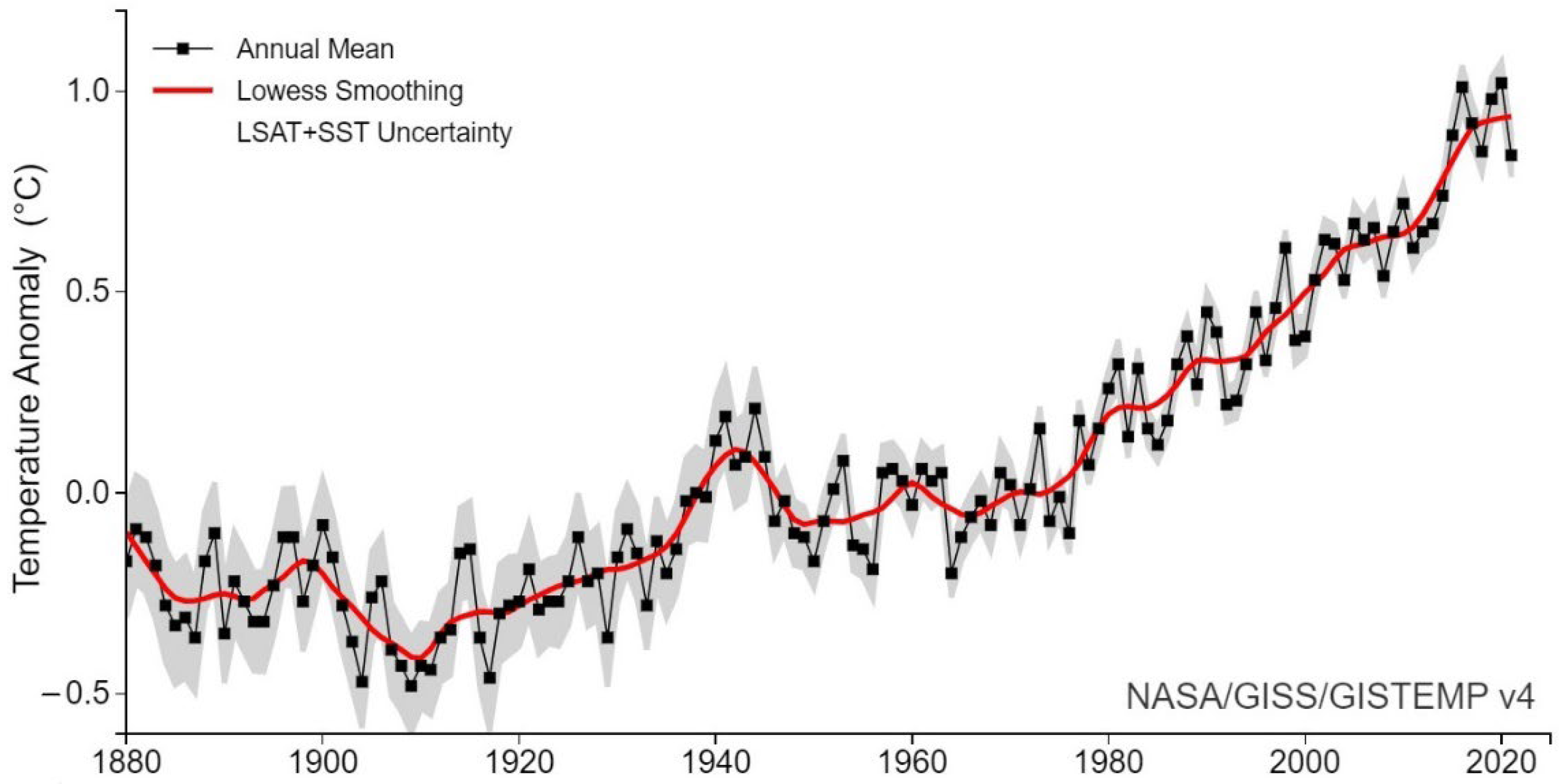
Systematically conducted observations clearly show that we are affected by the climate crisis and, at the same time, a crisis of global biodiversity is noticed [1,2]. Another crisis is associated with the biodiversity and climate crisis, namely the crisis related to the availability of water, including freshwater, and thus drinking water [3]. Rising global temperatures is one of the main causes of this problem. The increase in global temperature is presented in Figure 1.
Figure 1.
Global mean estimates in the years 1880–2020 on land and ocean data with base period 1951–1980. Source: [4].
In Figure 1, the black line with black points is the global annual mean and the red line is the 5-year lowess smooth. The grey shading represents the total (land surface air temperature and sea surface temperature) uncertainty at a 95% confidence interval.
The systematic climate warming observed for several decades is related to changes in the large-scale hydrological cycle, such as: increasing the water vapor content in the atmosphere; currently unpredictable changing climatic patterns; intensity and extreme rainfall; reduced snow cover caused by melting glaciers around the world; and changes in soil moisture and runoff [5]. A key element of climate change is the impact on the Earth’s water cycle, which continuously supplies water from the oceans to the atmosphere, to land and to rivers and lakes, and then back to our seas and oceans. Climate change increases the level of water vapor in the atmosphere and makes water availability less predictable. It should be remembered that during a flood, most of the rainwater is quickly lifted by swollen rivers to salty seas and oceans, so despite its excess, fresh water is not stored during this phenomenon [2]. The negative impact of climate change will be manifested, inter alia, in the increasing number of floods, heat waves and forest fires. Climate change is leading to more intense rainfall in some areas (e.g., current Pakistani flood-August/September 2022), while in other regions more severe dry conditions may be experienced (e.g., current California drought and fires, summer 2022) [6,7].
Climate change affects the water cycle, which in turn affects the amount, frequency and location of rainfall. Over time, it also leads to the occurrence of violent weather events [8]. Progressive climate change is disrupting existing weather patterns, leading to extreme weather events, unpredictable water availability, increasing water scarcity and the emergence of phenomena that contaminate drinking water supplies [9]. Water, in addition to supporting life functions, is also an important energy carrier and is used in the energy sector. Water and energy are some of the basic resources needed for basic functioning, improvement of living conditions and sustainable development. These two main resources, water and energy, are therefore important for the maintenance of life on earth, important for human well-being and economic activity. Producing energy from water is also crucial in trying to contain global warming.
At this point, it is worth paying attention to studies that show that water reservoirs and hydroelectric plants are also a source of greenhouse gas emissions [10,11]. However, compared to the production of energy from fossil fuels, the carbon footprint of hydro-energy is many times lower [12]. Greenhouse gases such as carbon dioxide and methane are the main emitters contributing to the increase in the greenhouse effect. Little has been said so far about damming reservoirs and hydropower plants as sources of methane emissions. CO2 and CH4 emissions arise mainly due to the decomposition of organic matter and faster turbulence processes in the dam and diffusion into the atmosphere. Methane is produced at the bottom of reservoirs where oxygen is scarce, and bacteria break down organic matter such as wood and grass that is already present or carried by water courses. [13]. In hydropower plants, large amounts of CH4 can be released from water passing through turbines and overflows because the water intakes are far below the surface where the concentration of CH4 increases rapidly with depth. [14]. Although methane breaks down relatively quickly in the atmosphere compared to carbon dioxide, it is a big problem for climatologists. Methane only stays in the atmosphere for about a decade, while CO2 persists for several centuries [13]. In order to reduce the negative environmental impact of hydroelectric power plants, various innovative engineering solutions are being developed to reduce emissions and recover CH4 from hydroelectric dams [14].
The management and development of energy-producing enterprises in the light of the observed climate and environmental changes is a challenge faced by decision-makers at the local as well as governmental levels. Enterprises in the energy sector face the challenge of adapting to legal (directives, regulations) and environmental requirements (limiting the negative impact on the climate and the environment). These enterprises will invest in innovative solutions based on renewable energy sources (solar, wind and water energy). In the surrounding landscape, not only photovoltaic installations or wind farms, but also hydropower plants appear more and more often. An advocate of water-powered power plants is the International Energy Agency (IEA), which assumes that by 2050 the power of hydroelectric power plants should be doubled. It should also be remembered that severe drought conditions in many parts of the world, including Brazil, the United States, China and Turkey, reduced global hydropower production [15]. Climate change and global warming is a global phenomenon, but its effects affect the situation of individual countries. The article analyses the links that exist between the climate, water status and energy globally in Africa and Europe, and then analyzes the same aspect in Poland.
Global warming may have an impact on the design problems of dams and hydroelectric power plants, as even a modest climate change is enough to significantly change rainfall type and hydrology, making energy production more unpredictable. Designers assume that historical hydrological variables—such as mean annual river flow, annual flow variability and seasonal distribution of river flow—are reliable guidelines for the future. However, as global warming increases, there is likely to be a significant change in seasonal and annual rainfall patterns and other factors affecting rainfall. Calculations of the amount of water to move the turbines in dams, the maximum flow that will have to pass through the passages and the rate at which the tanks fill with sediment will therefore become increasingly unreliable [16]. In hydropower, there may be a reduction in power generation from power plants due to drought. Some hydropower plants will not be running during this time due to lack of water, and many others may run with less power. Due to the occurring hydrological drought, there is a great risk of limiting the power of industrial power plants in the summer. The phenomenon of drought may also have a negative impact on other types of power plants, as in large-scale power engineering, where a significant amount of water is required in the production, purification and distribution processes [17]. Water is essential in energy as it is used for cooling in fossil fuel power plants. Power plants require cooling with water from rivers or other reservoirs in the so-called open circuit. In many countries, including Poland, there are still many power plants that draw water directly from rivers. This means that hot weather, no precipitation and low water levels may result in the necessity to close some blocks [2].
The structure of the article consists of an introduction discussing and presenting the main problems facing hydropower in terms of climate change and five detailed sections analyzing and discussing the issues of hydropower in Africa, Europe and Poland. The first section is devoted to hydropower in Africa and Europe. This section shows how the novel amount of energy produced from water is relative to the number of inhabitants of each country. In the case of Africa, insufficient energy production contributes to energy poverty. The next section deals with the hydrological situation in Poland. The hydrological situation of the country and the resulting problems facing the entire economy and individual enterprises are presented. The next three sections analyze, respectively, the possibilities of building new hydropower stations in Poland, the challenges faced by the energy and water sector in Poland, and the energy and environmental aspects of new projects related to the construction of dams.
A new approach in the conducted research is to compare the volume of energy production from water per capita. The research and analyses conducted so far take into account the volume of hydropower production in individual countries in absolute terms. This type of presentation of energy production does not reflect the actual energy demand of the population of a given country.
2. Materials and Methods
The research was carried out according to the inductive research model with the use of qualitative methods, which include, among others, desk research and observations. On the basis of the inductive research model, general conclusions were formulated based on desk research and observations of specific phenomena. The specificity of the analyzed topic made it possible to apply the above-mentioned methods and obtain consistent results. The desk research analysis performed consisted in getting acquainted with the available sources of published data and included, in particular, their compilation, mutual verification and processing. In the desk research analysis, papers from journals related to climate change, hydropower engineering and the data contained in reports of international institutions dealing with the above-mentioned topics were used. Moreover, the author relied on internet articles presenting the latest issues regarding investment plans in the field of hydropower. The observations were made personally by the author in Europe and in African countries. Two continents were selected for research and observation on which the author conducted scientific research. In Africa, research was carried out in Egypt, Ethiopia, Tunisia and Guinea-Conakry, and in Europe, research was carried out in Italy, Portugal, France, Sweden and Turkey.
3. Literature Review
Various aspects related to water, climate change and hydropower are presented in the literature review. The papers presented in the table introduce the most important issues related to the discussed problems that arise in the era of climate change. The aspect of glacier melting, climate warming in the mountains and in the lowlands, violent unforeseen weather phenomena (hurricanes, floods, droughts) and the issues of clean energy production in hydroelectric power plants in Africa and Europe were presented in individual papers included in the literature review. Table 1 presents selected papers from international journals with IF, which are of key importance for the analyzed topic.
Table 1.
Selected papers concerning climate change, water issue and hydro energy.
4. Hydro Energy in Africa and Europe
The idea of comparing two continents, Africa and Europe, is to show the problems related to hydropower and the development of this branch of the energy sector in two different economic conditions. African countries are characterized by a low gross domestic product (GDP), while European countries are characterized by a very high and average GDP index. For all of Africa, GDP amounted to USD 2,692,597 (billions) in 2021 while in Europe it was at the level of USD 23,481,228 (billions) in 2021. Thus, Africa represents poor continents and Europe represents rich continents. Summary of GDP for individual continents is presented in Table 2.
Table 2.
GDP by continents in 2020 and 2021.
4.1. Water and Electricity Situation in Africa
Population growth, urbanization, climate anomalies and global warming all cause chronic water scarcity. Africa is the continent with the longest river in the world, the Nile, and it is rich in other major rivers such as Congo, Niger, Zambezi and Ubangi-uele. At the same time, the people of Africa have huge problems with access to clean water. Water scarcity affects more than 40 percent of the world’s population and the problem will increase in the decades to come. The urban population in developing countries will increase rapidly, generating an increasing demand for water. Africa is the second-largest continent in the world with a population of over 1.3 billion people, which translates into a systematic increase in the consumption of economic goods, water and energy. Data on the energy situation show that only one in four people living in sub-Saharan Africa has access to electricity. Due to the continuous increase in energy demand, with the simultaneous lack of availability of sufficient financial resources, long-term forecasts of energy demand and supply are of key importance in Africa [32]. In sub-Saharan Africa, the rapid commissioning of large hydropower plants is progressing. It is related to business contracts that require meeting the deadlines related to their financing. Africa needs a significant increase in investment in the energy sector as Africa is currently one of the continents with the lowest level of energy investment [33].
4.2. Hydro Energy Development in Africa
Africa has a chance to be the first continent to develop its economy using renewable and efficient energy [34]. An example of the rapid development of hydropower can be Guinea-Conakry, where new hydropower projects have been developed in recent years, aimed at reducing the electricity deficit in the country and in the sub-region, and producing clean and cheap energy. The installed capacity of Guinea’s hydropower plants is 706 MW. At the same time, it should be noted that with the construction of dams, environmental problems arise due to the fact that the construction of a hydropower plant affects the surrounding natural environment. The construction of the power plant in Koukoutamba with a capacity of 294 MW is connected with destructive interference in the natural environment. The Koukoutamba hydropower infrastructure will be built in the Bafing River Valley in Middle-Bafing National Park, which is one of the last remaining conservation areas for West African chimpanzees, an endangered primate species. Building a dam will have a devastating effect on the chimpanzee population. Environmentalists estimate that up to 1500 Western chimpanzees, one-twelfth of the country’s population, will die during the construction of the Koukoutamba hydropower plant. The leader on the African continent in the production of energy in hydroelectric plants is Ethiopia, which produces over 4000 MW. The construction of the 6350 MW Grand Ethiopian Renaissance Dam is currently underway, the construction of which began in 2011 on the Nile. The power plant is to improve the country’s energy situation and turn Ethiopia into an energy giant ensuring a relatively stable electricity supply. It should be emphasized, however, that such a huge undertaking resulted in a conflict with Sudan, and especially with Egypt regarding the risk of changing the water level in the Nile [32,35]. Numerous discussions have been held between scientists and negotiators in countries affected by the project’s environmental impact since construction began in 2011, but no agreement has yet been reached. Apart from changes in the water level on the Nile, possible hydrological changes are also discussed. They can adversely affect the fauna and flora, i.e., fish, aquatic plants and biodiversity, due to the possibility of changes in water temperature, salinity and oxygen content [35]. So far, the largest hydropower plant in Africa is Cahora Bassa with a capacity of 2075 MW in Mozambique [36] and Lauca hydropower plant with a capacity of 2071 MW in Angola [37]. Table 3 shows the ten African countries with the largest installed hydroelectric power.
Table 3.
Ten African countries with the highest installed hydropower capacity (MW).
When analyzing the volume of electricity production in hydroelectric plants, it is also worth referring to the population of a given country. In the conducted analysis, the capacity per capita indicator was used. Capacity per capita is a more accurate indicator than the capacity itself for a given country. Thanks to the use of “per capita”, we can see how much energy is produced per one inhabitant of the country. Owing to this indicator, we can conclude whether the country is at risk of energy poverty. From the data in the table, we can see that the most hydropower per person is in Zambia and Angola and the least in Nigeria and Egypt.
Hydropower remains the main renewable source for energy production on the African continent with over 38 GW of installed capacity. Africa has the greatest demand for energy investment among all continents. Although hydropower is the main supplier of renewable electricity in Africa, the continent has the highest untapped water potential in the world, with just 11 percent of its use [40].
4.3. Hydro Energy Situation in Europe
Hydropower has a long history in Europe and continues to be the leading source of low-carbon and renewable electricity. Europe is steadily moving towards a cleaner energy mix with renewable hydropower sources, making an important contribution to reducing the negative impact of energy on the climate [41]. The European countries with the highest installed hydro energy capacity are presented in Table 4.
Table 4.
Ten European countries with the highest installed hydropower capacity (MW).
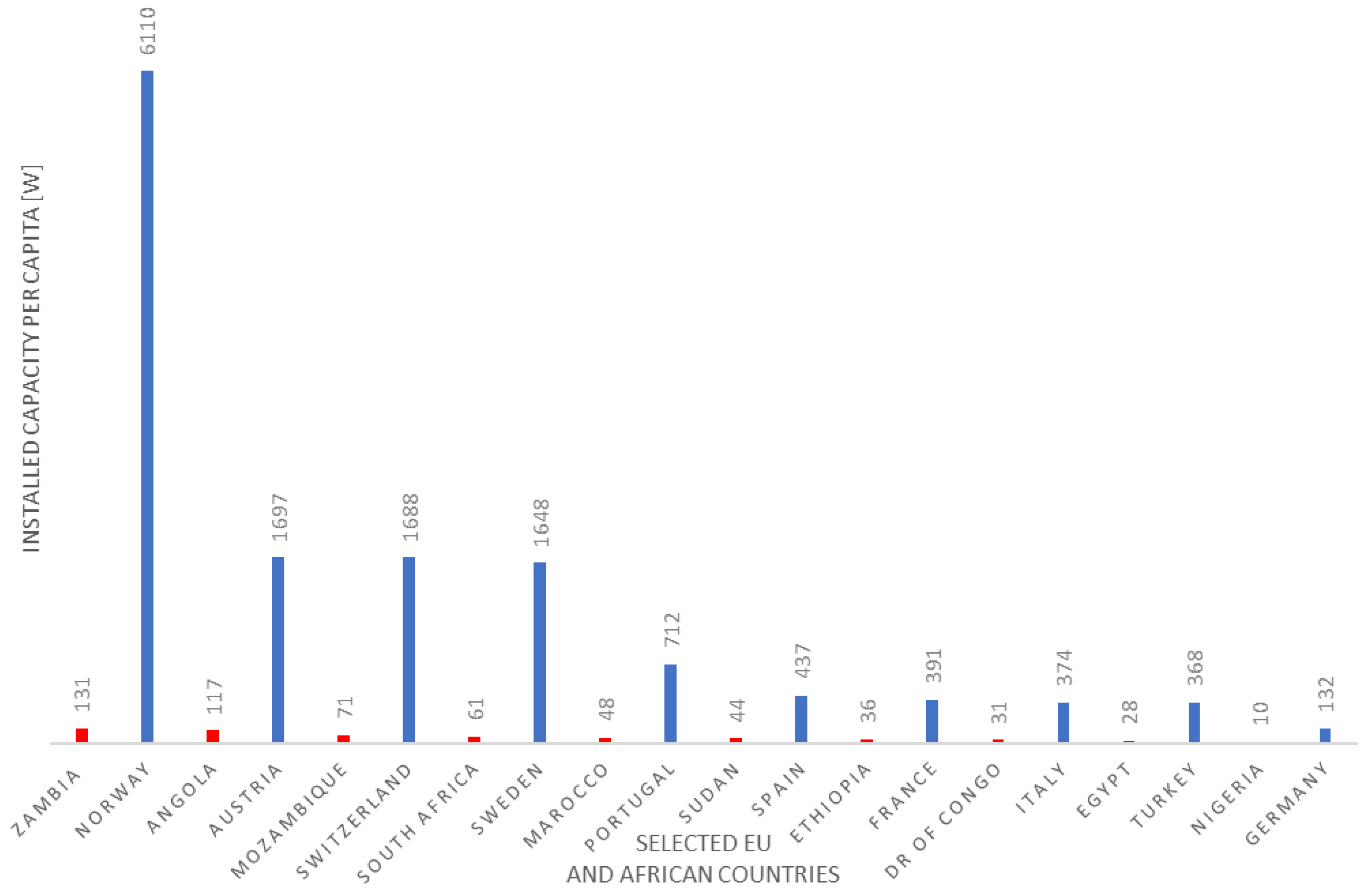
Among the 10 European countries with the highest installed capacity, in terms of per capita, Norway ranks the highest and Germany the lowest. The comparison of the installed capacity from hydropower in the countries with the highest production in Europe and Africa shows that African countries produce small amounts of this type of energy per capita compared to European countries. This means that despite large hydropower structures, this type of energy still remains in the growth phase in Africa. This comparison between European and African countries is shown in Figure 2.
Figure 2.
Comparison of the installed capacity per capita for the 10 countries with the highest hydropower production. Source: own elaboration.
Looking at the energy situation in Africa shown in Figure 2, we can clearly see that energy production is insufficient and the countries of the African continent struggle with the problem of energy poverty. Comparing the installed capacity per capita in African and European countries, it can be seen that this is an order of magnitude difference to the disadvantage of Africa. There are significant shortages in terms of energy production. According to the World Bank’s Global Tracking Framework report, 7 of the 10 countries with the most limited access to electricity are in Africa [42]. In addition to the issue of energy poverty, the aspect of providing food is important. Water and energy resources also translate into food resources. Since the Bonn conference in 2011, particular attention has been paid to the linkages and feedback that exist between the water, energy and food sectors. It was also noted that global population, economic growth and climate change will lead to increased demand for energy, water and food [43].
In that research, the Pearson correlation coefficient (r), which is the most common way to measure linear correlation, was calculated. The correlation coefficient is calculated according to the Formula (1).
where are the value of the variables and are the average values of these variables.
The result of the calculated correlation is a number between −1 and +1, which measures the strength and direction of the relationship between the two variables. In the conducted research, the correlation coefficient between the variable x = GDP and the variable y = energy efficiency was calculated, as well as the correlation coefficient between the variable x = GDP and the variable y = energy efficiency per capita. The correlation coefficient “r” of variables for Africa and Europe is presented in Table 5.
Table 5.
The correlation coefficient “r”.
In both cases presented in the table, both for Africa and Europe, the correlation coefficient r for GDP and energy efficiency variables was close to zero. This means that there is no correlation for these variables, i.e., the production of hydropower is independent of GDP. However, in a different way is the correlation coefficient r for the GDP and energy efficiency per capita. For Africa, the r index was −0.488 and for Europe it was −0.452. This means that for these variables, there is a negative correlation at a medium level, i.e., the higher the GDP of a given country, the lower the production of hydropower per capita. This fact can be explained in several ways, e.g., that countries with high GDP invest in other forms of energy than hydropower, or the impact on the low level of hydropower production results from environmental and climatic factors, or countries with high GDP will soon increase investments in hydropower.
The economies of countries that have hydroelectric power plants or intend to invest in hydropower are facing challenges and development prospects. Similarly, energy sector companies face challenges as well as having development prospects. The most important challenges and perspectives are presented in Table 6.
Table 6.
Challenges and perspectives for the economy and energy enterprises.
The hydropower challenges faced by the economy and businesses also translate into issues related to climate change. The shift from fossil fuels to renewable energy sources, including hydropower, reduces greenhouse gas emissions. If we compare the CO2 emissions generated during electricity production in power plants and combined heat and power plants on 1 kWh of energy with the production in hydroelectric plants, we have 758 g of CO2 and 24 g of CO2 per kWh, respectively. Including renewable energy in the energy mix, the amount of CO2 emissions per kWh drops to 719 g [44].
The possibility of producing electricity not only in large system power plants, but also in small hydropower plants, will allow for the implementation of the distributed energy model. Due to their specificity, hydropower plants can be located close to consumers, which reduces the distance of electricity transmission. Hydroelectric power plants also enable the improvement of the hydrological and hydrobiological balance of the surrounding areas. All these activities have a positive impact on the environment and at the same time slow down climate change.
5. Hydrological Situation in Poland—Low Water Level
The case study of Poland was chosen, because Poland is a good and clear example of the hydrological situation in Europe. It can be a representative example of the problems related to water availability and climate change affecting the current situation in Europe. In addition, Poland has limited freshwater resources, with an annual per capita availability of only 1400–1600 m3 (according to different sources), while water consumption is approximately twice the OECD average. The water deficit will be particularly important in Poland and may increase by as much as 30% in 2050 [45]. As it was mentioned, Poland has an aggregate average freshwater availability of 1400–1600 m3 per capita. It is one of the lowest values in Europe. Indeed, in large areas of Poland, water deficit is a common problem. A similar situation is also in other European countries, especially in the Mediterranean basin countries, so Poland may represent problems that arise in many European countries. Due to its geographic location and the resulting, among others, unfavorable hydrological conditions, Poland has one of the last places in Europe in terms of water resources. Poland is located in a warm temperate climate zone, constantly humid, with warm summers, in which rainfall exceeds evaporation, so theoretically, Poland should not have problems with water shortage. Meanwhile, the measurements show that the water level in the lakes is decreasing. Some of them are even disappearing (e.g., Wilczyńskie Lake and Kownackie Lake in the Gniezno Lakeland). The temporary location of Poland in the zone of contact between continental and oceanic air masses that causes rainfall shows high seasonal variability. An additional factor adversely affecting the country’s water resources are the increasingly more frequent snowless winters. The analysis of the phenomenon of water scarcity takes into account both the natural factors determining the water cycle and anthropogenic conditions related to water intake and its use. The causes of water scarcity in Poland are varied. The most important ones include: low water resources due to the natural features of the environment; changes in water resources due to fluctuations in the intensity of the water cycle; increase in water demand resulting from population growth, urbanization development, use in agriculture, raising the standard of living; water pollution which reduces the social, economic and environmental use of resources. According to the Central Statistical Office, it ranks 24th in the European Union in terms of services to one freshwater service provider. Therefore, water resources in Poland are relatively small, and additionally they are characterized by seasonal variability and area diversification [46].
In order to counteract the emerging unfavorable hydrological phenomena, both floods and droughts, retention reservoirs are built to increase water reserves. Retention reservoirs are artificial water reservoirs that enable increased water retention. This method of water storage is extremely important for the ecosystem because it increases the water supply intended for direct consumption, and its circulation in the environment is regulated and controlled. Most often they are formed on rivers by creating dams that obstruct the outflow of water. Thanks to them, water can be stored when there is an excess in order to be able to use it later in periods of drought. A list of Polish retention reservoirs is presented in Table 7.
Table 7.
Parameters of reservoirs in Poland.
Retention reservoirs in Poland are characterized by a small capacity, which in total does not exceed 6% of the annual water outflow volume from the country, which does not provide sufficient protection against periodic water excesses or deficits. In the south of Poland, in particular, the water-intensive industry and the development of demographic processes as well as specific geographic and hydrographic conditions result in water shortages. Additionally, in the southern parts of the country, there is significant variability of water flow in rivers during heavy rainfall and the movement of massive amounts of flood waters, such as rafting from mountain areas. In view of the above, it can be concluded that Poland belongs to the group of countries at risk of water deficit. For about a decade, we have been dealing with droughts in Poland every summer. However, there is a growing awareness of the water deficit and the need to take care of its resources. The water availability coefficient in Poland is 1600 m3/year/inhabitant (during droughts the indicator drops to as much as 1000 m3/year/inhabitant), while in Europe this indicator is 4500 m3/year/inhabitant and in the world 6000 m3/year/inhabitant [46]. Due to climate change, drought (meteorological, agricultural, hydrological and hydrogeological) is becoming more common in countries that appeared to be water-rich. The types of droughts occurring in Poland and their characteristics are presented in Table 8.
Table 8.
Types of drought and their characteristics.
The distribution of the groundwater table position indicator in recent years in Poland indicated a deepening process of lowering the groundwater table in many regions of Poland, which was related to meteorological conditions and groundwater fluctuations responding to them. On a national scale, this process slowed down in 2020 and the groundwater table slowly began to rebuild. The first hydrological quarter of 2022 was again marked by a decrease in the value of the indicator to a level slightly below that recorded in the same period in 2017. It is important to monitor groundwater recharge and study groundwater flow [48].
Due to the frequent lack of precipitation in recent years and the decreasing level of Polish rivers, the phenomenon of hydrological drought occurred. The storms that occurred during the summer period did not contribute to replenishing the surface and groundwater resources. Climate change is projected to go in the direction that more rainfall and greater temperature rises will occur in winter, while in spring there will be no rainfall. For the agricultural economy, it means adapting to new conditions. Severe droughts and flash floods reduce yields, which also translates into higher food prices [49]. Water shortages also have a negative impact on the energy sector, including hydropower.
6. Dams/Barrages and Hydroelectric Plants
Hydropower is undoubtedly an effective source of renewable energy, although it should be noted that opinions on hydropower are divided among scientists. Some consider hydropower as an ecological source of energy, while others see its negative impact on the environment. According to skeptics, energy production in hydroelectric plants is burdened with a high cost of environmental damage. Construction of a hydroelectric power plant destroys rivers, changes water relations (often causing droughts in nearby areas), changes the flow, and interrupts the continuity of the river, halting fish migrations, which leads to the extinction of species. In many places, it also leads to an increase in deforestation [50]. On the other hand, enthusiasts minimize the harmful effects and point to the numerous advantages of hydropower. Table 9 shows the advantages and disadvantages of hydropower.
Table 9.
Advantages and disadvantages of hydropower.
Due to the specific conditions that must be met when building a hydroelectric power plant, it is not possible to run such a power plant in any location near the existing water reservoir or river. Large hydropower plants are a relatively cheap source of energy and can quickly change the generated power depending on the demand. However, as already mentioned, their biggest disadvantage is the very limited number of locations where they can be built. Hydroelectric power plants are used to produce electricity, depending on their location, the force of gravity, water damming, or the energy of flowing water. Hydroelectric power stations make it possible to capture some of the energy from the flowing water. Due to the nature of the flow, they are usually divided into the following types:
- Run-of-river power plants without a reservoir—the amount of energy produced by them depends on the amount of water flowing in the riverbed at a given moment;
- Flow control (storage) power plants—in front of the power plant there is a water damming tank;
- Power plants where the water circulation is artificially created—by sequentially pumping water from the lower to the upper reservoir, and then its discharge through the power plant back to the lower reservoir (pumped storage plants).
7. Hydropower in Poland—New Challenges
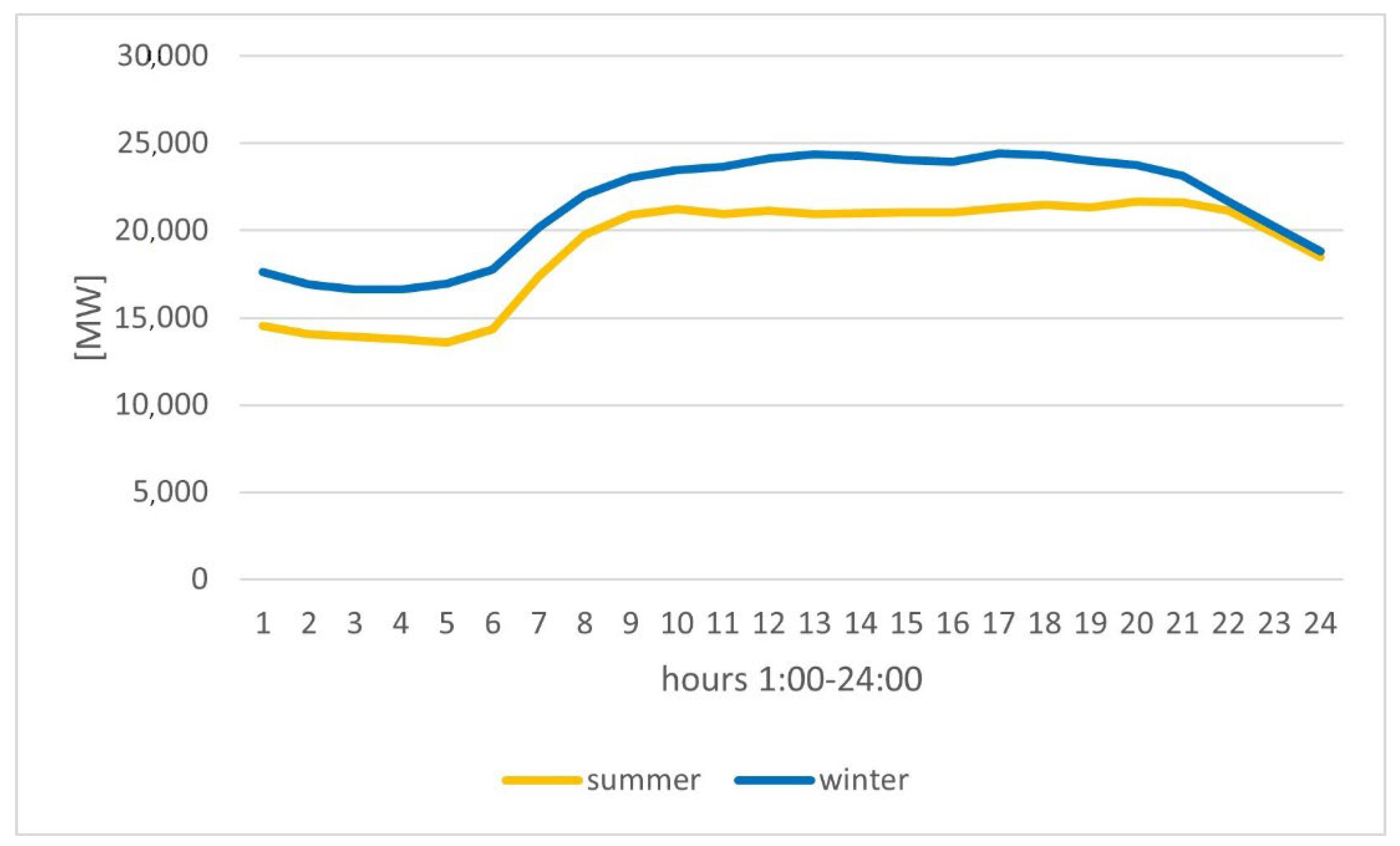
In Poland, the potential of using water for energy purposes is significantly lower than in other countries. This is due to the climatic conditions, average rainfall, and topography. The most profitable use of rivers in Poland would be cascade power plants producing peak energy when energy demand is greatest (i.e., morning and afternoon/evening hours). The daily energy demand in Poland in 2022 in the summer and winter periods is shown in Figure 3.
Figure 3.
Daily energy consumption in the summer and winter period in 2022. Source: own elaboration based on data from [53].
In addition, the construction of several hydropower plants with reservoirs with at least an annual equalization is able to improve the condition of rivers, as well as significantly protect against floods, because such reservoirs can stop a flood wave for up to 500 h (about 21 days) [54]. Poland, however, does not have enough water to enable the basic operation of the power plant; therefore, the construction of pumped storage power plants is a reasonable solution. Power plants of this type produce electricity during the day, and at night they accumulate water through pumping turbines that raise water from the lower to the upper mirror. An additional advantage is the equalization of the daily load. The best reservoirs for this type of hydroelectric power plant are lakes, which ensure the stability of the inflows to the hydroelectric power plant.
In Poland, due to the negligible use of the available hydropower potential, it is reasonable to increase the use of flowing water energy. Currently, in Poland, hydropower is responsible for approx. 1.5% of electricity production. In the long-term perspective, the development of hydropower may be influenced by the development of inland waterways and the revitalization of water dams, which are important from the point of view of watercourse regulation and rational water management (preventing floods and droughts and increasing retention). It should be noted that the operation of run-of-river plants can be regulated, albeit to a limited extent. Bearing in mind the regulatory potential of hydropower, it is also worth looking for new ways of using it, also on a small scale.
When discussing the risks associated with the construction of dams, particular attention should be paid to the protection of the natural environment [55]. In economic analyses carried out in previous years, environmental costs were not taken into account. These costs are currently valued precisely. The construction of a second barrage on the Vistula is planned to complement and support the dam in Włocławek. The dam in Włocławek, despite the installation of a fish pass, created a significant barrier to fish migration in the Vistula. After the dam was built, a strong decline in the population of anadromous species was noted. The construction of the Włocławek barrage on the Vistula led to the extinction of the Atlantic sturgeon, salmon and sea trout, and catastrophically decreased the Vietnamese population. Before the construction of the dam in Włocławek, the catch of vines, sea trout and elk was about 3000 kg per kilometer of river per year. Currently, these species are hardly caught at all. Therefore, this aspect will play a key role in the construction of new investments. The investor’s goal will be to build a damming dam, not to concrete the Vistula. The reservoir will be created only as part of a natural bed, with embankments protecting the life and property of residents of municipalities located on the Vistula River, and its function will be to reduce the effects of drought and floods, including winter floods. It is planned that the new Siarzewo dam with a capacity of 80 MW will also have a positive impact on water retention in the region and the economic and tourist development of the surrounding areas. The reservoir will be created only as part of a natural bed, with embankments protecting the life and property of residents of municipalities located on the Vistula River, and its function will be to reduce the effects of drought and floods, including winter floods. Raising the water level in the Vistula and stabilizing it will contribute to a favorable change in the water relations of the adjacent areas, particularly prone to drought. The Siarzewo Water Stage will also indirectly counteract the negative effects of the increasingly frequent droughts. The entire architectural concept will be related to the existing infrastructure, and the planned place will include many elements that fit into the landscape. The design of the threshold will ensure that the future step will not be an environmental barrier. It should be emphasized that it will allow the debris to move, and the flaps on the segment will allow for the safe passage of ice in winter periods. The barrage will help to stabilize the water level in the riverbed and in its valley in areas currently affected by drought, stopping water runoff. About 150 million m3 of water is to be collected in the reservoir of each of the stages on the Vistula River, not counting the increase in groundwater resources in the river valley, and, importantly, because they will be flow-through reservoirs, there will be constant intensive water exchange in them. By gravity, water from the reservoir will be able to supply agricultural lands located in the river valley [56].
8. The Energy Aspect of the Planned Investment
Planned investments in the field of hydropower are to support the nationwide energy system and increase the country’s energy security. According to the initial concept, a power plant with a capacity of up to 80 MW will be built in the next stage on the Vistula River, which will enable the production of electricity from a renewable source and ensure the production of electricity necessary to start up system power plants for the needs of the National Power System in the event of a so-called blackout. This investment will also allow meeting the full energy demand in the nearest region. The location of the hydroelectric power plant in the water stage results from the provisions of the law, the Water Law Act, Articles 10 and 399 [57]. It is also part of the extremely important process of increasing Poland’s energy security through the production of green energy. This will translate into an increase in the share of renewable energy sources in the country’s energy balance, while reducing CO2 emissions to the atmosphere. The power plant will produce 315 GWh of energy annually, which means almost 250 thousand tons of carbon dioxide emissions saved, 90 tons of carbon monoxide and 12 tons of particulate matter less in the atmosphere.
Other planned projects are pumped storage power plants, which will ensure greater stability of the power system. These power plants will not only support the development of renewable energy sources but will also be crucial for the security of the National Power System, as Poland learned in May 2021 during the emergency disconnection of almost the entire Bełchatów Power Plant, which produces about 20% of domestic energy, from the grid [58,59].
Therefore, the role of pumped storage power plants, as units that can ensure the stable operation of the entire power system in a situation where the energy transformation in Poland is taking place and the share of renewable energy sources increases dynamically, will be important. Pumped-storage plants offer regulatory possibilities and allow the reserve of energy resources, supplementing the energy demand and ensuring the stable development of renewable sources, as well as the development of nuclear energy in the future. Pumped-storage plants support the energy system in many aspects [60]. It is also possible to use pumped storage power plants to regulate the national energy system, unstable as a result of the diversified energy supply from Renewable Energy Sources (RES) [61].
Hydropower plants are the most flexible power plants in the energy system. It is thanks to them that you can prevent many system failures [62]. If necessary, they can immediately generate the energy necessary to stabilize the system. Further, in the event of a failure of the energy system, the so-called black-out plays a key role [63]. Thanks to them, the system can be restarted by supplying energy to excite generators in large thermal power plants. Additionally, in local energy networks, in the event of a system failure, they can supply the most critical facilities such as hospitals or sewage treatment plants.
9. Conclusions
In the studies and economic analysis concerning hydroelectric plants carried out so far, little attention has been paid to the impact of these power plants on the environment and their environmental costs have been ignored. Currently, an important aspect is the impact of the investment on the environment and people, i.e., bearing the environmental and social costs. Hydropower plants, in addition to many advantages, also have disadvantages, e.g., they degrade the local environment, and force people and animals to be displaced from their natural environment. These costs are currently carefully priced. Policymakers must consider not only the advantages but also the disadvantages, i.e., the benefits and losses of implementing hydropower installations.
Another important conclusion is drawing attention to the amount of energy produced from water installations in terms of per capita. In nominal terms, large hydropower plants make a significant contribution to the power system; however, in terms of per capita, they can show how much energy is produced per capita and whether a given country is at risk of energy poverty, especially in those countries where most of the energy comes from hydropower. European countries have an order of magnitude more per capita hydropower produced than African countries. The largest production of hydropower per capita in Europe is in Norway and amounts to 6110.2 W, while for Africa the highest production per capita is 131.1 W and it is an inhabitant of Zambia.
Hydropower can contribute to increasing the share of renewable energy sources in the energy mix and contribute to limiting climate change through the move away from fossil fuels. Hydroelectric power plants have a more beneficial effect on reducing climate warming than traditional power plants. When producing electricity in power plants and combined heat and power plants, 758 g of CO2 are produced for every 1 kWh of energy. Taking into account the energy from renewable energy sources in the energy mix, the amount of CO2 emissions for every 1 kWh drops to 719 g. On the other hand, energy production in hydroelectric plants causes CO2 emissions at the level of 24 g per 1 kWh.
The use of the energy of rivers and waters can influence the industrialization of countries through access to energy. The energy intensity of the economy requires more and more installed power in energy networks, and energy should be environmentally friendly.
10. Limitation
The research concerned two continents as representatives of continents with high and low GDP. However, in the future, it is possible to study all the continents and see if the difference in the development of hydropower is actually closely correlated with the economic development of the continents. As a case study, the hydrological and hydropower situation of Poland was analyzed, while in the extended research in the future, several countries from individual continents can be considered.
Funding
This research received no external funding.
Institutional Review Board Statement
Not applicable.
Informed Consent Statement
Not applicable.
Data Availability Statement
Not applicable.
Conflicts of Interest
The author declares no conflict of interest.
References
- Mikulčić, H.; Baleta, J.; Wang, X.; Duić, N.; Dewil, R. Sustainable development in period of climate crisis. J. Environ. Manag. 2022, 303, 114271. [Google Scholar] [CrossRef] [PubMed]
- Borowski, P.F. Nexus between water, energy, food and climate change as challenges facing the modern global, European and Polish economy. AIMS Geosci. 2020, 6, 397–421. [Google Scholar] [CrossRef]
- Polska Jest Jednym z Najuboższych w Wodę Krajów Europejskich. Available online: https://www.national-geographic.pl/artykul/polska-jest-jednym-z-najubozszych-w-wode-krajow-europejskich-pustynnieje-na-naszych-oczach (accessed on 30 September 2022).
- GISS Surface Temperature Analysis. Available online: https://data.giss.nasa.gov/gistemp/graphs_v4/ (accessed on 30 September 2022).
- Bates, B.C.; Kundzewicz, Z.W.; Wu, S.; Palutikof, J.P. (Eds.) Climate Change and Water. In Technical Paper of the Intergovernmental Panel on Climate Change; IPCC Secretariat: Geneva, Switzerland, 2008. [Google Scholar]
- State Drought Monitor. Available online: https://droughtmonitor.unl.edu/CurrentMap/StateDroughtMonitor.aspx?CA (accessed on 30 September 2022).
- Devastating Floods Pakistan. Available online: https://www.unicef.org/emergencies/devastating-floods-pakistan-2022 (accessed on 30 September 2022).
- How Climate Change Impact. Available online: https://education.nationalgeographic.org/resource/how-climate-change-impacts-water-access (accessed on 30 September 2022).
- Water and Climate Change. Available online: https://www.unicef.org/stories/water-and-climate-change-10-things-you-should-know (accessed on 30 September 2022).
- Gemechu, E.; Kumar, A. A review of how life cycle assessment has been used to assess the environmental impacts of hydropower energy. Renew. Sustain. Energy Rev. 2022, 167, 112684. [Google Scholar] [CrossRef]
- Danielsen, E.J.; Jonsson Valderrama, A. Methane and Carbon Dioxide Emissions from Three Smallscale Hydropower Stations in South of Sweden, Digitala Vetenskapliga Arkivet. 2022. Available online: https://www.diva-portal.org/smash/record.jsf?pid=diva2%3A1670113&dswid=356 (accessed on 30 September 2022).
- Scherer, L.; Pfister, S. Hydropower’s Biogenic Carbon Footprint. PLoS ONE 2016, 11, e0161947. [Google Scholar] [CrossRef]
- Hydroelectrics Dams. Available online: https://www.theguardian.com/global-development/2016/nov/14/hydroelectric-dams-emit-billion-tonnes-greenhouse-gas-methane-study-climate-change (accessed on 30 September 2022).
- Bambace, L.; Ramos, F.; Lima, I.; Rosa, R. Mitigation and recovery of methane emissions from tropical hydroelectric dams. Energy 2007, 32, 1038–1046. [Google Scholar] [CrossRef]
- Renewable Electricity. Available online: https://www.iea.org/reports/renewables-2021/renewable-electricity?mode=market®ion=World&publication=2021&product=Total (accessed on 30 September 2022).
- Raport Tamy. Available online: http://eko.org.pl/kropla/21/raport-tamy.htm (accessed on 30 September 2022).
- Park, H.; Kim, W. Water industry: Water-energy-health nexus. Environ. Sci. Pollut. Res. 2019, 26, 1013–1014. [Google Scholar] [CrossRef]
- Taylor, R.G.; Scanlon, B.; Döll, P.; Rodell, M.; Van Beek, R.; Wada, Y.; Longuevergne, L.; Leblanc, M.; Famiglietti, J.S.; Edmunds, M.; et al. Ground water and climate change. Nat. Clim. Chang. 2013, 3, 322–329. [Google Scholar] [CrossRef]
- Stringer, L.C.; Mirzabaev, A.; Benjaminsen, T.A.; Harris, R.M.; Jafari, M.; Lissner, T.K.; Stevens, N.; der Pahlen, C.T.-V. Climate change impacts on water security in global drylands. One Earth 2021, 4, 851–864. [Google Scholar] [CrossRef]
- Pepin, N.C.; Arnone, E.; Gobiet, A.; Haslinger, K.; Kotlarski, S.; Notarnicola, C.; Palazzi, E.; Seibert, P.; Serafin, S.; Schöner, W.; et al. Climate Changes and Their Elevational Patterns in the Mountains of the World. Rev. Geophys. 2022, 60, e2020RG000730. [Google Scholar] [CrossRef]
- Berga, L. The role of hydropower in climate change mitigation and adaptation: A review. Engineering 2016, 2, 313–318. [Google Scholar] [CrossRef]
- Ibrahim, I.; Hamam, Y.; Alayli, Y.; Jamiru, T.; Sadiku, E.; Kupolati, W.; Ndambuki, J.; Eze, A. A review on Africa energy supply through renewable energy production: Nigeria, Cameroon, Ghana and South Africa as a case study. Energy Strat. Rev. 2021, 38, 100740. [Google Scholar] [CrossRef]
- Diallo, T.A. Beyond the Resource Curse: Mineral Resources and Development in Guinea-Conakry. Ph.D. Thesis, Massachusetts Institute of Technology, Cambridge, MA, USA, 2015. [Google Scholar]
- Degefu, D.M.; He, W.; Zhao, J.H. Hydropower for sustainable water and energy development in Ethiopia. Sustain. Water Resour. Manag. 2015, 1, 305–314. [Google Scholar] [CrossRef]
- Salah, S.I.; Eltaweel, M.; Abeykoon, C. Towards a sustainable energy future for Egypt: A systematic review of renewable energy sources, technologies, challenges, and recommendations. Clean. Eng. Technol. 2022, 8, 100497. [Google Scholar] [CrossRef]
- Wagner, B.; Hauer, C.; Habersack, H. Current hydropower developments in Europe. Curr. Opin. Environ. Sustain. 2019, 37, 41–49. [Google Scholar] [CrossRef]
- Borowski, P.F. Digitization, digital twins, blockchain, and industry 4.0 as elements of management process in enterprises in the energy sector. Energies 2021, 14, 1885. [Google Scholar] [CrossRef]
- Rabe, M.; Streimikiene, D.; Drożdż, W.; Bilan, Y.; Kasperowicz, R. Sustainable regional energy planning: The case of hydro. Sustain. Dev. 2020, 28, 1652–1662. [Google Scholar] [CrossRef]
- Igliński, B. Hydro energy in Poland: The history, current state, potential, SWOT analysis, environmental aspects. Int. J. Energy Water Resour. 2019, 3, 61–72. [Google Scholar] [CrossRef]
- List of Continents by GDP. Available online: https://statisticstimes.com/economy/continents-by-gdp.php (accessed on 30 September 2022).
- Kałuża, T.; Hämmerling, M.; Zawadzki, P.; Czekała, W.; Kasperek, R.; Sojka, M.; Mokwa, M.; Ptak, M.; Szkudlarek, A.; Czechlowski, M.; et al. The hydropower sector in Poland: Barriers and the outlook for the future. Renew. Sustain. Energy Rev. 2022, 163, 112500. [Google Scholar] [CrossRef]
- Borowski, P.F.; Patuk, I. Environmental, social and economic factors in sustainable development with food, energy and eco-space aspect security. Present Environ. Sustain. Dev. 2021, 15, 153–169. [Google Scholar] [CrossRef]
- Borowski, P.F. Significance and directions of energy development in African countries. Energies 2021, 14, 4479. [Google Scholar] [CrossRef]
- Africa. Available online: https://www.hydropower.org/region-profiles/africa (accessed on 30 September 2022).
- Elagib, N.A.; Basheer, M. Would Africa’s largest hydropower dam have profound environmental impacts? Environ. Sci. Pollut. Res. 2021, 28, 8936–8944. [Google Scholar] [CrossRef] [PubMed]
- Isaacman, A. Cahora Bassa Dam & the Delusion of Development. Daedalus 2021, 150, 103–123. [Google Scholar]
- Hydropower Dominate Angola. Available online: https://www.power-technology.com/comment/hydropower-dominate-angola-power/ (accessed on 30 September 2022).
- Countries in Africa by Population. Available online: https://www.worldometers.info/population/countries-in-africa-by-population/ (accessed on 30 September 2022).
- GDP by Countries. Available online: https://tradingeconomics.com/ (accessed on 30 September 2022).
- New Guide on Hydropower Investment in Africa Highlights Huge Opportunities. Available online: https://www.hydropower.org/news/new-guide-on-hydropower-investment-in-africa-highlights-huge-opportunities (accessed on 30 September 2022).
- Europe. Available online: https://www.hydropower.org/region-profiles/europe (accessed on 30 September 2022).
- Global Tracking Framework. Available online: https://www.worldbank.org/en/topic/energy/publication/Global-Tracking-Framework-Report (accessed on 30 September 2022).
- Bonn 2011 Conference. Available online: https://sdgs.un.org/events/bonn-2011-conference-water-energy-and-food-security-nexus-water-resources-green-economy-6790 (accessed on 30 September 2022).
- Carbon Dioxide Emission from Electricity. Available online: https://www.world-nuclear.org/information-library/energy-and-the-environment/carbon-dioxide-emissions-from-electricity.aspx (accessed on 30 September 2022).
- Fresh Water Resources. Available online: https://www.climatechangepost.com/poland/fresh-water-resources/ (accessed on 30 September 2022).
- Susza. Available online: https://www.gov.pl/web/susza/susza (accessed on 30 September 2022).
- Zasoby Wody w Polsce. Available online: https://portalstatystyczny.pl/zasoby-wody-w-polsce/ (accessed on 30 September 2022).
- Lee, D.-H.; Kim, N.-W.; Chung, I.-M. Comparison of Groundwater Recharge between HELP Model and SWAT Model. J. Korea Water Resour. Assoc. 2010, 43, 383–391. [Google Scholar] [CrossRef][Green Version]
- Another Reason for Rising Food Prices. Available online: https://www.barrons.com/articles/another-reason-for-rising-food-prices-droughts-51634806800 (accessed on 30 September 2022).
- Hydroelektrownie Szkodzą Środowisku. Available online: https://www.wwf.pl/aktualnosci/hydroelektrownie-szkodza-srodowisku-i-naszym-finansom (accessed on 30 September 2022).
- Bagher, A.M.; Vahid, M.; Mohsen, M.; Parvin, D. Hydroelectric energy advantages and disadvantages. Am. J. Energy Sci. 2015, 2, 17. [Google Scholar]
- Mari Júnior, A.; Mari, A.G.; Cabral, A.C.; Frigo, E.P.; Santos, R.F. Advantages and disadvantages of hydropower. Acta Iguazu 2013, 2, 20–28. [Google Scholar]
- Zapotrzebowanie Mocy. Available online: https://www.pse.pl/dane-systemowe/funkcjonowanie-kse/raporty-dobowe-z-pracy-kse/zapotrzebowanie-mocy-kse (accessed on 30 September 2022).
- Niechciał, J. Energetyka wodna. In Polska Wobec Świata, Energia Gigawat; AGENT Public Relations: Kraków, Poland, 2014. [Google Scholar]
- Zheng, B.; Qin, Y.; Liu, D.; Norra, S.; Wang, S. Thematic issue: Water environment of the Three Gorges Reservoir. Environ. Earth Sci. 2017, 76, 819. [Google Scholar] [CrossRef]
- Innowacyjny Stopień Wodny Siarzewo. Available online: https://wody.gov.pl/strefa-klienta/114-nieprzypisany/1732-siarzewo-innowacyjny-stopien-wodny (accessed on 30 September 2022).
- Water Law. Available online: https://leap.unep.org/countries/pl/national-legislation/water-law-0 (accessed on 30 September 2022).
- Problemy w Elektrowni Turów. Available online: https://businessinsider.com.pl/finanse/problemy-w-elektrowni-turow-i-belchatow-co-to-oznacza-dla-pge/nky9vjq (accessed on 30 September 2022).
- Poland Czechia Fail to Mend. Available online: https://www.euractiv.com/section/energy/news/poland-czechia-fail-to-mend-divisions-over-turow-coal-mine/ (accessed on 30 September 2022).
- Ma, X.; Wu, D.; Wang, D.; Huang, B.; Desomber, K.; Fu, T.; Weimar, M. Optimizing pumped storage hydropower for multiple grid services. J. Energy Storage 2022, 51, 104440. [Google Scholar] [CrossRef]
- Ruszel, M.; Podmiotko, S. (Eds.) Bezpieczeństwo Energetyczne Polski i Europy Uwarunkowania, Wyzwania, Innowacje; IPE: Rzeszów, Poland, 2019. [Google Scholar]
- Decaix, J.; Gaspoz, A.; Hasmatuchi, V.; Dreyer, M.; Nicolet, C.; Crettenand, S.; Münch-Alligné, C. Enhanced operational flexibility of a small run-of-river hydropower plant. Water 2021, 13, 1897. [Google Scholar] [CrossRef]
- Huang, Y.; Cheng, Z.; Li, L.; Lu, S.; Zhong, J.; Zhang, Q. Smooth Switching Strategy for Hydropower Microgrid with Auxiliary Load Shedding Control. In Proceedings of the International Conference on Artificial Intelligence and Power Engineering, Xishuangbanna, China, 18–20 March 2022; Springer: Cham, Switzerland, 2022; pp. 85–96. [Google Scholar]
Publisher’s Note: MDPI stays neutral with regard to jurisdictional claims in published maps and institutional affiliations. |
© 2022 by the author. Licensee MDPI, Basel, Switzerland. This article is an open access article distributed under the terms and conditions of the Creative Commons Attribution (CC BY) license (https://creativecommons.org/licenses/by/4.0/).