1. Introduction
Residential gardens make up a large portion of the metropolitan landscape in low-density suburban cities around the world, and these spaces have the potential to make a significant positive contribution to the sustainability of urban environments, or conversely be additional sources of resource depletion and pollution [
1]. In Australia, water conservation became a major priority within the gardening industry and broader community following the drought conditions that were experienced across the country during the first decade of this century [
2]. Some initial responses to water shortages were positive, such as promoting the use of low water use plants, especially native species which also provide biodiversity benefits, or the advancement of efficient irrigation systems which minimised water wastage. However, some trends were not so positive, resulting in knock-on impacts that may not have been initially considered. For example, the extensive use of paving and other hard surfaces to replace areas that were previously irrigated or the substitution of lawn with synthetic turf. In both cases, these responses may have led to a reduction in water use, but also contribute to increased localised heating, increased stormwater runoff, as well as the use of materials with high embodied energy and an overall greater source of environmental impact. “Sustainable urban gardens” must factor in a range of environmental and human needs considerations, such as biodiversity, energy efficiency, nutrient recycling, local food production and of course water conservation [
3].
Greywater for garden irrigation at the residential scale is a simple and sensible method of water reuse, because it is produced throughout the year and particularly beneficial during severe drought when there is a ban on mains water use for garden irrigation. It can be achieved through greywater diversion devices (GDD) to enable more efficient garden watering than simple manual bucketing, through to more sophisticated greywater treatment systems that process the greywater to a level suitable for high-level uses, such as flushing toilets and washing clothes. There is a specific lack of available literature relating to GDDs and, in particular, their role in contributing to garden water demands and quantified mains water savings. Major reviews on greywater treatment technologies such as the ones by Li et al. [
4] and Ghunmi et al. [
5], which outline physical, chemical and biological treatment technologies, and by Ghaitidak and Yadav [
6] and Gross et al. [
7], which explore 22 and 33 different technologies, respectively, make no mention of GDDs. Other reviews by Pidou et al. [
8] and Gross et al. [
9], which review 64 and seven technologies, respectively, and by Pinto and Maheshwari [
10]. Toifl et al. [
11] recognise GDDs but do not elaborate on their value in contributing to mains water savings. The lack of academic inquiry into GDDs is also evidenced by well-published literature on other aspects of greywater reuse such as reuse for toilet flushing [
12,
13] and its impact on municipal wastewater flows [
14,
15].
In this paper we present three case studies where greywater production and reuse through GDD were quantitatively monitored and evaluated. The studies were in the context of developing integrated water systems to achieve sustainable mains water savings while maintaining productive gardens and creating an environment promoting biodiversity. In particular the contribution of greywater reuse to mains water saving was assessed by comparison with modelling of the production of the greywater and its reuse to irrigate the garden.
2. Materials and Methods
The following section describes the case study approach used to quantify the benefits of residential greywater reuse. The modelling exercise to estimate greywater outputs and the monitoring arrangements for all the case studies are also described.
2.1. Case Studies
Three residential garden projects, designed and built based on a multi-criteria Sustainable Urban Gardening framework [
3], were used as case studies. The framework included food production, habitat creation and climate sensitive design, amongst others. Optimisation of available water resources, including greywater to promote the conservation of mains water, was a key goal. The case studies are also presented to demonstrate how sustainable urban gardens can be successfully established and sustained in mains water constrained environments through the considered integration of lot-scale alternative water systems with appropriate landscape design [
16].
All three case study sites are located near Fremantle in Western Australia which experiences a Mediterranean winter-wet, dry summer climate and where the soil type is coarse sand typical of the Swan Coastal Plain [
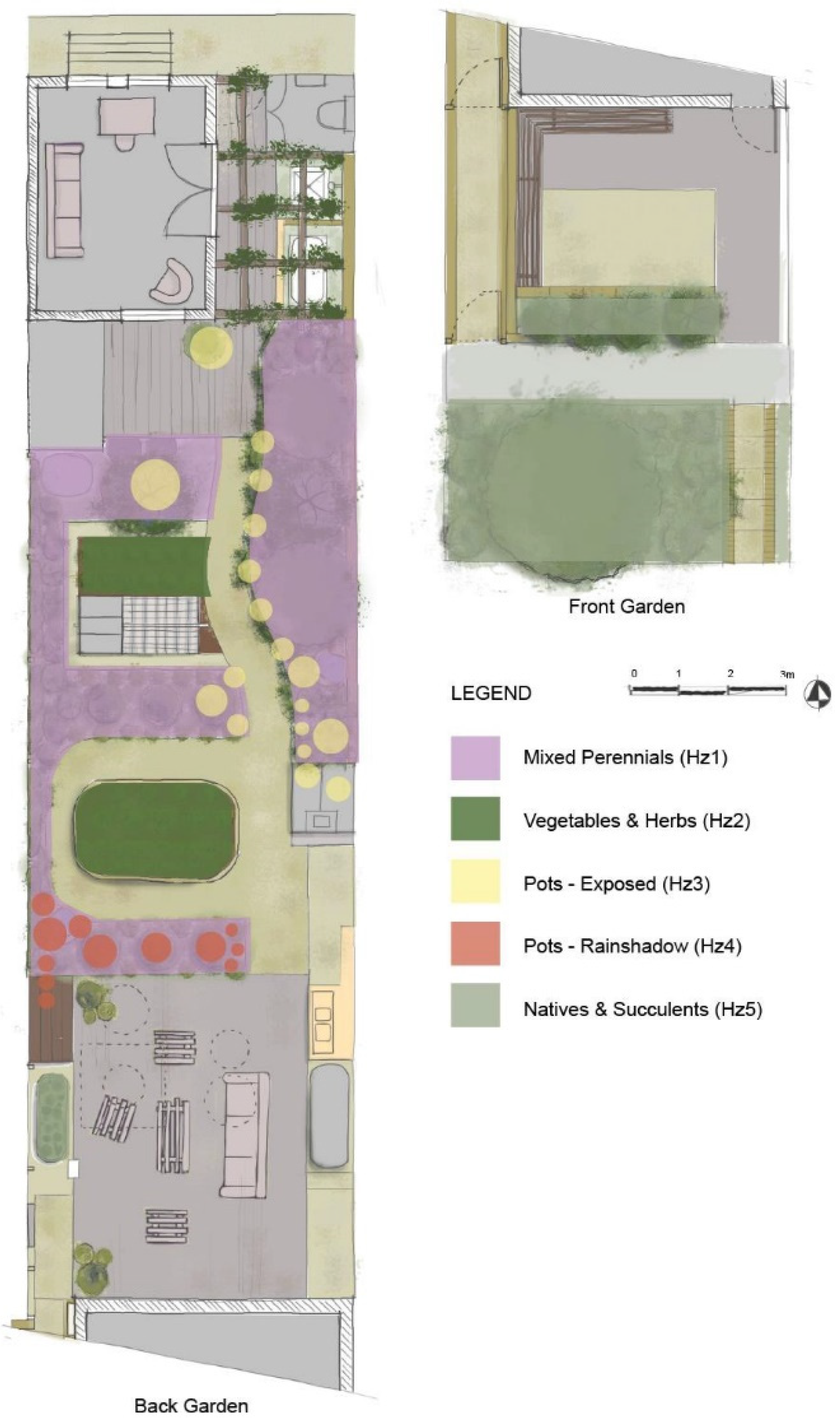
17]. They represent a range of property sizes and include varying configurations of rainwater and groundwater water utilisation. In each case, the landscape and water system design processes progress concurrently in an attempt to meet anticipated water demand volumes and establish sustainable yields. Underpinning each landscape design is the application of hydrozoning, which in its simplest form involves grouping plants together based on their common water needs to allow for efficient servicing of irrigation without over (or under) watering particular crop types. For example, in all case studies, the hydrozone supplied by greywater included a range of plant species suited to untreated greywater, including fruit trees and vines [
18]. Other hydrozones included vegetables and herbs irrigated by mains water and rainwater (CS1 and 2) or groundwater (CS3), and native vegetation which was typically unirrigated.
The greywater hydrozone and its dimensions in the different case studies are similar in makeup to typical residential gardens. Therefore, the volume of outdoor mains water displaced by greywater use in these case studies can represent typical savings that can be achieved by the use of a greywater system.
2.1.1. Case Study 1
Case Study 1 (CS1) is a two-bedroom, one-bathroom semi-detached dwelling located on a 330 m2 block in the suburb of South Fremantle. As a two-bedroom house, occupancy varied between one to three persons during the study period. The occupants were 21–30 years of age and included both males and females.
The GDD installed at CS1 was a proprietary system known as the “GRS Water Save” by Greywater Reuse Systems Pty Ltd. The system consisted of two concrete tanks, with the first tank being for collection and settlement of the greywater and the second tank being a pump out chamber. The tanks were sized to hold greywater for no more than 24 hours in line with the Department of Health (DoH) [
19] Code of Practice for the Reuse of Greywater in Western Australia, which was current at the time of installation. As newly generated greywater flows into the collection tank, the retained greywater flowed into the second tank with a submersible pressure pump being activated by a level switch once the set point was reached. The pressurised water was pushed through a coarse filter pad prior to being applied to designated garden areas via dripline irrigation in accordance with guidelines. In the event of pump failure or filter blockage, the system would direct greywater overflow to sewer.
The total cost the system including supply and install was $5500 with approximately $1500 in operation and maintenance costs estimated over a ten-year operational period. Cost figures are in Australian dollars (~ US $0.69 in June 2020).
2.1.2. Case Study 2
Case Study 2 (CS2) is a three-bedroom, one-bathroom detached dwelling located on a 600 m2 block in the suburb of White Gum Valley. As a three-bedroom house, occupancy included three persons during the study period. The occupants included 31–40 year old female, and one child aged under 2 years.
The GDD installed was a proprietary system known as the GreyFlow PS-PP (‘Pump Sump’–‘Plug and Play’) by Advanced Wastewater Systems. The GDD collected greywater via two interceptor traps containing porous spun polyethylene pads to provide coarse filtration before filling a 30 L sump which housed a 100 watt, 70 litre per minute submersible pump operated by a water level switch. When the pump-out trigger point was reached, greywater was discharged to designated garden areas via dripline irrigation in accordance with DoH [
18] guidelines. In the event of pump failure or filter blockage, the system would direct greywater overflow to sewer. The GreyFlow PS-PP also included an automated filter backflush system. At nominated pump cycles, air from a blower was directed through the filter pads to dislodge clogging material. While the blower was operating, the submersible pump discontinued so that greywater flowing across the filter pads scoured dislodged material from the pads and took it to sewer. During this process, some greywater capture was lost, but the need for manual filter cleaning was all but eliminated.
The total cost of the system including supply and installation was $2150 with approximately $1000 in operation and maintenance costs estimated over a ten-year operational period.
2.1.3. Case Study 3
The third Case Study (CS3) is a three-bedroom, two-bathroom detached dwelling located on a 700 m2 block in the suburb of Hilton. The house was built in 2013 and included dual plumbing for rainwater supply to non-potable indoor uses (toilets and washing machine) and dual plumbing for greywater collection from all greywater sources (excluding kitchen sink and dishwasher). Water efficient plumbing fixtures were installed throughout. As a three-bedroom house, occupancy was four persons during the study period. The occupants included two adults 31–40 years of age (one male and one female) and two children 1–5 years of age (one male and one female).
The GDD installed was a proprietary system known as the GreyFlow PS—Two Stage (‘Pump Sump’ with a two stage installation process) by Advanced Wastewater Systems. The system was based on the same principles of operation as the unit installed at CS2, with the difference being that the Two Stage unit was designed for installation with “slab on ground” type house construction. The greywater interceptor traps and the pump sump were installed as part of early plumbing works during construction (first stage) and pump, filter pads, blower (for backflushing), controller and drip irrigation installed during landscaping irrigation works (second stage).
The total cost of the system including supply and installation was $3800 with approximately $1000 in operation and maintenance costs estimated over a 10 year operational period.
2.2. Modelling of Greywater Volumes and Plant Water Demand
Estimated greywater volumes versus hydrozone water demand were determined during the landscape design phase using a tailored spreadsheet tool developed by Hunt et al. [
20]. This enabled any deficits to be identified so they could be factored into the property water balance, and supplementary water allowed for so plant performance did not suffer. The modelling also included estimations of irrigation demand for the other hydrozones, as well as rainwater yield. For CS3, modelling was also done to determine likely groundwater recharge rates from the site catchment to establish a sustainable groundwater yield.
Hydrozone water volume requirements were determined by estimating plant water demand (PWD) with an allowance for the efficiency of the irrigation system supplying the water to that area. PWD is estimated by allocating a nominal crop factor (i.e., amount of water that a plant transpires in relation to the daily evaporation rate) to a specific hydrozone and multiplying this by the average local daily evaporation rate (by month). The gross water requirement of a hydrozone can then be calculated by multiplying its area to the daily plant water demand with an allowance for irrigation efficiency by the given area. The method is illustrated for CS1 below.
Figure 1 shows the hydrozone plan of the garden.
Greywater (GW) volumes:
Table 1 presents the DoH [
19] estimated daily GW generation volumes, as well as what was likely to be generated using water-efficient fixtures, assuming a 49% reduction in laundry GW achieved by replacing top-loading washing machines with front loaders [
21] and a 35% reduction in bathroom GW by installing water-efficient shower and tap fixtures (from 14 L to 9 L/min and 9 L to 6 L/min, respectively) [
22].
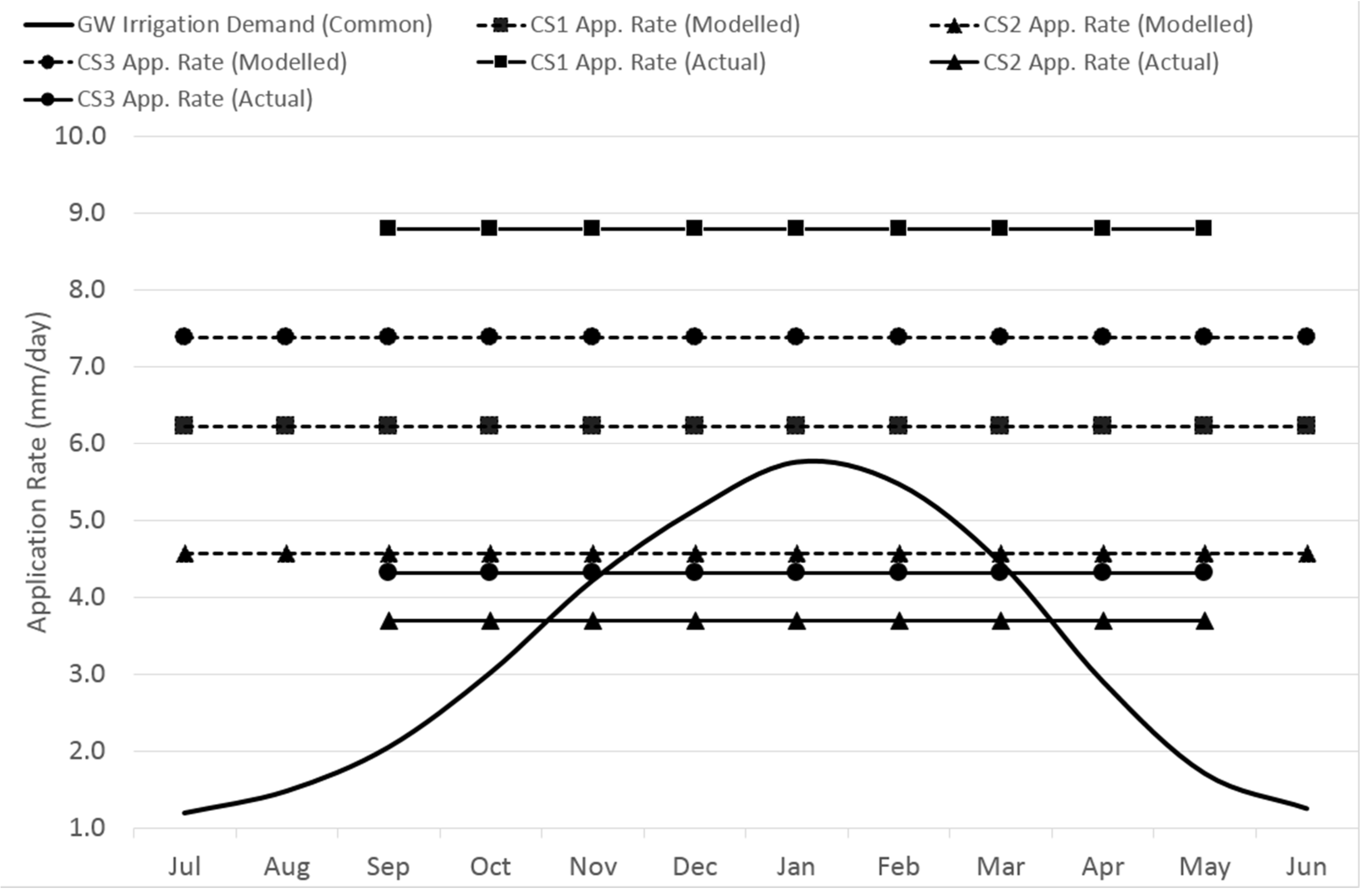
Figure 2 shows the estimated daily household generation of GW (168 L per day) as providing an irrigation application rate of 6.2 mm per day over the 27 m
2 area.
Irrigation demand:
Table 2 outlines the key information used in the modelling for all hydrozones. In using the spreadsheet tool developed by Hunt et al. [
20], the time step used is one calendar month. Rainfall input, soil water storage and other parameters are averages over the one-month period.
Table 3 presents estimated monthly irrigation demand for all hydrozones based on local evapotranspiration rates.
2.3. Monitoring Arrangements
Water use for each of the properties was observed for 12 months, beginning with CS1 from July 2010–June 2011, CS2 from January 2012–December 2012 and CS3 from November 2014–October 2015. In each case, this observation period was a minimum of 12 months from completion of the landscaping works to represent a period when each of the gardens was established.
Volumetric water use was recorded using a range of flow meters connected to data loggers to enable determination of water use by source at a daily time-step. Utility water bills were also used to account for periods of missing data and for extrapolation. Additionally, CS3 had wattage meters installed on the power circuits supplying the greywater, rainwater and bore water systems to ascertain the energy intensity of these water sources.
2.3.1. Monitoring Greywater at CS1 and CS3
The greywater volumes for CS1 and CS3 were selected from a 54 day and 84 day period respectively, when household occupancy was full and system operation was uninterrupted. The daily average was multiplied by the number of days in the nine-month period of operation. The system was switched off during the wet winter months (June–August).
2.3.2. Monitoring of Greywater at CS2
The greywater volumes were based on an estimated proportion of 62.5% of metered internal water used, given bathroom and laundry greywater makes up this portion of internal water consumption [
23].
3. Results and Discussion
3.1. Greywater Actual Volumes against Modelled Estimates
The estimated greywater hydrozone volume requirements for the three case study sites, plus the expected greywater volumes generated (expressed as an irrigation application rate) are shown in
Figure 2. CS1, 2 and 3 featured an irrigation application rate of 6.2, 4.6, and 7.4 mm/day over 27 m
2, 40 m
2 and 40 m
2, respectively (
Table 4). It can be seen from
Figure 2 that for CS2 that during the peak of summer (December to March), there was insufficient greywater volumes (as estimated by modelling) to meet estimated irrigation demand and this amount would be provided by mains water as “greywater top up” in the order of 5.9 kL. The modelled estimates of greywater volumes in
Table 4 take into account water saving appliances, shown in
Table 1, and actual occupancy, but do not take into account occupant water use behaviour.
Figure 2 also shows the actual daily household greywater volumes generated for each of the three case study sites. The monthly greywater application rate is constant throughout the year because it is an average over the month that is produced by the householders (see
Table 4). CS1, 2 and 3 show an actual irrigation application rate of 8.8, 3.7 and 4.3 mm/day, respectively. In relation to daily irrigation deficiency, these values represent a 42% increase for CS1, and a 20% and a 42% reduction for CS2 and 3 respectively compared to what was estimated by modelling, resulting in 0kL, 11.3 kL and 7.4 kL of top-up being required for CS1, CS2 and CS3, respectively, compared with the figures of 0 kL, 5.9 kL and 0 kL as originally estimated.
The higher than estimated greywater generation for CS1 can be directly attributed to occupant behaviour, where despite having water efficient fixtures, poor habits (such as long showers) resulted in greywater volumes in line with average volumes [
18]. Conversely, the lower than anticipated greywater generation in CS2 and CS3 demonstrate the impact that water-conscious behaviours can have on irrigation rates, especially during peak plant water demand, and the importance of having backup watering systems, such as the greywater top up systems described. Some losses were also likely and can be attributed to filter back flushing, but these are believed to be minimal.
The data collected would have enabled the correlation of occupant behaviour with volume of greywater produced as a function of time, and this would be a topic of a future paper.
3.2. Mains Water Savings due to Greywater Reuse
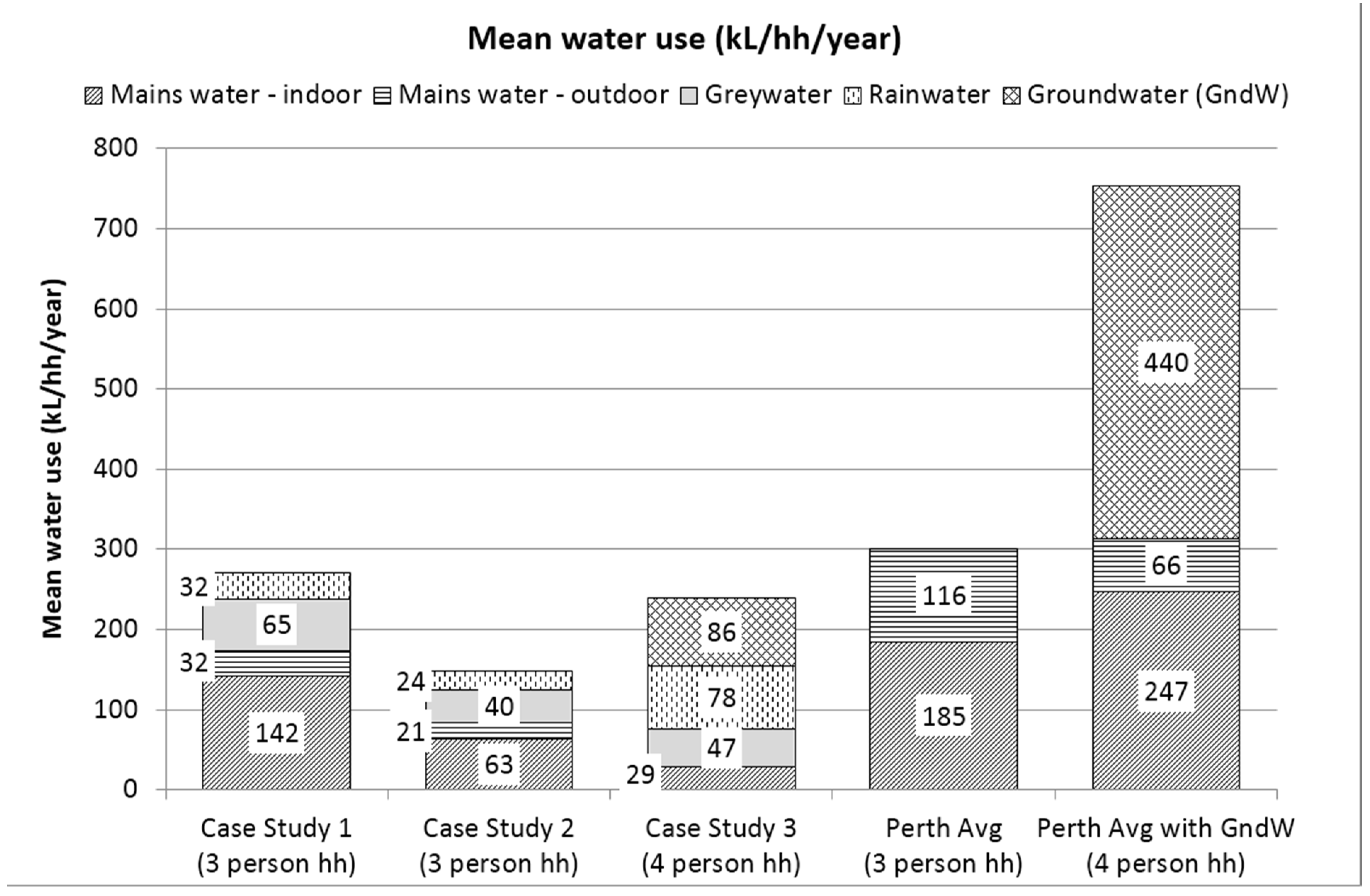
Figure 3 compares household water use by source for each of the case study sites against the Perth average (three-person household) of 186 kL for indoor use and 116 kL for outdoor use and Perth average with bore (four-person household) of 247 kL indoor water use, 66 kL for outdoor use, and 440 kL of outdoor groundwater use [
23,
24]. In comparison to these values, the total mains water use at each case study site was significantly lower, ranging from a 42% reduction at CS1 to 72% and 91% at CS2 and CS3, respectively. Note that locally drawn and untreated groundwater was only used in CS3 and used only for outdoor irrigation.
CS1 and CS2 made use of rainwater to satisfy indoor and outdoor non-potable demand, with the former harvesting 32 kL of rainwater per annum using a 3.5 kL tank with an effective roof catchment area of 200 m2, and the latter harvesting 24 kL of rainwater per annum using a 2.5 kL tank with an effective roof catchment of 80 m2. CS3 made use of 78 kL of rainwater per annum as the primary indoor water source for both potable and non-potable using an 18 kL tank with an effective roof catchment area of 200 m2. This site did not use mains water outdoors but instead made primary use of bore water. Carefully designed with sufficient permeable surfaces to allow higher stormwater infiltration into the aquifer than groundwater uptake, the bore abstracts 86 kL per annum and was complemented by greywater reuse to satisfy irrigation requirements.
Across a year, CS1, 2 and 3 applied 65 kL, 40 kL, and 47 kL of greywater per household, respectively, but, when compared to the greywater irrigation demand indicated in
Figure 2, result in 32 kL, 36 kL, and 39 kL of actual mains water substitution. To only consider greywater output volumes does not accurately represent mains water savings because greywater is often applied in excess. The comparison against greywater irrigation demands presents a method by which actual mains water substitution figures can be elicited.
The figures show that annual outdoor mains water savings of 59.1%, 53.7% and 33.1% can be attributed to greywater diversion in CS1, CS2, and CS3 respectively. It should be noted, however, that the mains water savings demonstrated by this calculation method are conservative, as the comparison assumes that the irrigation scheduling (if supplied by mains water) would have been accurately estimated and adjusted monthly with changing seasonal evapotranspiration rates. Perhaps it is more reasonable to assume that the irrigation systems would be turned on in spring and either left running at a set rate through the seasons, until being switched off come winter. Such an approach would result in higher mains water consumption and, provided the irrigation demand is met by the GDD (thus negating the need for mains water irrigation in that hydrozone), further mains water savings could be achieved.
The modelling technique used in the study can be applied to other cases, and it can be expected that in a more arid climate that up to the total volume of greywater can displace mains water used for outdoor irrigation.
3.3. Operations of the Greywater Systems
The GW systems in all case studies performed well throughout the monitoring periods with no malfunction. In general, the systems perform well if maintenance recommended by the manufacturers are followed. The maintenance involves cleaning the filter in the greywater line and flushing the drip irrigation end pipes. In CS2 and 3, the automatic filter back flushing largely eliminated the need for manual filter cleaning during regular operation other than when the system was switched back on after the winter months (June–August) when GW was not required for the garden.
3.4. Financial Assessment
A financial assessment of the greywater systems indicates a cost of
$7.45/kL based on 65kL of GW supplied in CS1,
$6.53/kL based on the 40kL of GW supplied in CS2 and
$8.03/kL based on the 43kL supplied in CS3.
Table 5 shows for CS3 how the costs are derived.
The greywater system costs did not include the dripline irrigation component as this cost would be covered in a typical business as usual irrigation installation. By considering a mains water cost of about $1.50/kL, the payback period for all of the systems well exceed their expected lifetime span of 20 years. It is clear from the financial analysis that greywater reuse at the household level is not economically viable using GDD used in the case studies. At a cluster or estate scale it could be different because only one device is needed for multiple dwellings, and this should be an area for further investigation.
3.5. Energy Consumption
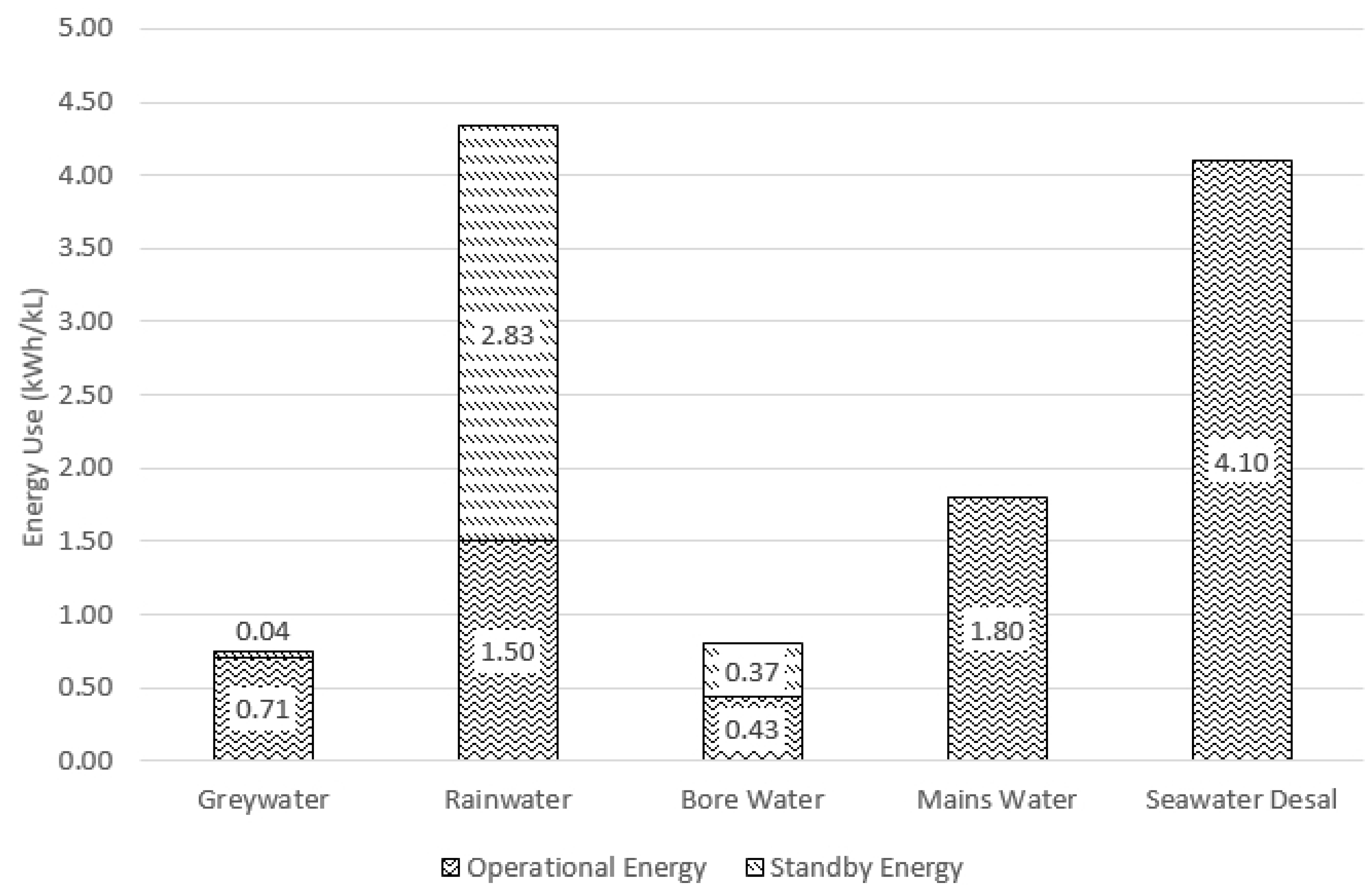
The energy consumption for the alternative water supplies at CS3 were also monitored (
Figure 4). The greywater, rainwater, and bore water system used 0.69, 4.66 and 0.79 kWh/kL, respectively, with 7%, 67% and 39% attributed to standby energy (including UV treatment for rainwater) and the remainder to operational energy, respectively. The energy cost of the mains water supplied via the Integrated Water Supply Scheme (IWSS) and seawater desalination is known to be 1.8 and 4.1 kWh/kL, respectively [
25]. The IWSS derived 17% of its water from surface water sources, 42% from groundwater sources and 41% from desalination in 2014–2015 [
25]. The energy required for desalination has been included for comparison purposes, since it is likely that only desalination could supply further water in the future.
The greywater and bore water system use 62% and 56% less energy that the mains water supplied via the IWSS. Both bore water and rainwater feature high standby energy consumption but only the rainwater system’s standby energy consumption is higher than its operational state (due to the UV lamp for disinfection remaining constantly on), leading to a comparable figure in kWh/kL to seawater desalination. The UV treatment of rainwater is not essential for use in toilet flushing and washing machines and thus energy use would be significantly lower without it.
3.6. Water Quality Considerations
Quantification of water sources and uses, including greywater, was the focus of the present study. Monitoring greywater quality is important for its impact on irrigated plants, soil and groundwater, especially in the long term, but is outside the scope of the paper. Many factors affect the magnitude and degree of impact including irrigation method, plant type, soil characteristics and distance to groundwater [
26,
27]. Our case studies followed the Code of Practice of the DoH [
18], which are conservative, and in our case, studies ensuring daily irrigation rate of below 10mm/day, the use of below ground drip irrigation, distance to groundwater greater than 1m and using perennials with no edible part in contact with the greywater.
The choice of household cleaning and other products that will end up in greywater is very important. The first author has produced a video on this particular topic that addresses this issue as well as overcoming the impacts on plants and soil [
28].
Odour was not a problem in the case studies because the GDD systems used were fully enclosed.
4. Conclusions
Despite the abundant literature available on the topic of greywater reuse, there is a lack of information on how best to integrate direct diversion-type greywater devices (GDDs) for maximum potential. The low uptake of greywater reuse in Western Australia of less than 3% of households [
29] indicates a lack of awareness of the opportunities it presents, particularly in light of permanent watering restrictions in much of the State of Western Australia, and significant water security concerns in Perth and many of the regions. Irrigation restrictions, a common mechanism to limit demand on mains water, can significantly impact garden performance and thereby impact sustainable urban gardening goals, such as food production and health and wellbeing of householders. To promote greywater reuse in Western Australia the Greywater and Wastewater Industry Group [
30] has produced a Greywater Guide to illustrate its benefits.
Lot-scale sources, such as greywater, rainwater, and groundwater, provide a relatively accessible transition to a “third-pipe” model at the residential scale. These sources have the potential to provide reliable supply at a lower energy intensity than conventional mains water supply. They are also unburdened by restrictions.
The case studies documented in this paper demonstrate that direct diversion greywater systems can play an important role in reducing mains water use, ranging from a 33% to 59% reduction in water use in residential gardens. A reduced water-energy footprint was also documented for these systems. The methodology underpinning the case studies, including careful consideration of landscape water demands and how and where the greywater should be applied, as well as ensuring backup water sources are available and top up watering systems are incorporated, is critical to their success. Notwithstanding the above, there is limited information available in the literature on the long-term impacts on soil and plant health from ongoing application of greywater, assuming suitable products and soil management practice are implemented, and it remains an important area for further research.
The influence that greywater reuse can make on the average total household water consumption is not straightforward. The case studies have demonstrated the impact that increased water efficiency can have on reducing greywater volumes, requiring other sources to fill the demand. Conversely, it has been shown how poor water-use behaviour by householders can lead to excessive greywater generation that exceeds plant water demand, which is not only wasteful, but can also lead to detrimental impact on soil and local groundwater.
Finally, there exist a number of barriers limiting the further uptake of lot-scale alternative water systems, including regulatory challenges and limitations in industry capacity, with perhaps the most obvious one being cost. It is important that a comparative cost per kilolitre value not be the only metric used to determine the viability of alternative water sources when compared to the business as usual base case. Whilst there is significant work already being done on the development of system-based approaches to capture the benefits of an integrated approach to urban water management, further work needs to be done to better account for the opportunity cost of large-scale, centralised schemes being unable to supply sufficient water for gardening purposes, and for this to be factored into the true costs of water service delivery.
Author Contributions
Conceptualization, J.B., M.A. and G.H.; Data curation, J.B.; Formal analysis, J.B., M.A. and G.H.; Funding acquisition, J.B.; Investigation, J.B., S.D. and M.A.; Methodology, J.B., S.D. and M.A.; Project administration, J.B. and S.D.; Resources, J.B.; Supervision, M.A. and G.H.; Writing—original draft, J.B. and S.D.; Writing—review and editing, J.B., M.A. and G.H. All authors have read and agreed to the published version of the manuscript.
Funding
This research received funding from Horticulture Australia Ltd (now Hort Innovation) as part of the project: NY09024 Integrated Water Systems for Sustainable Urban Landscapes; as well as funding from the Cooperative Research Centre for Low Carbon Living, an Australian Government initiative, as part of the project: RP3009 High Performance Housing–Monitoring, Evaluating and Communicating the Journey.
Acknowledgments
We are grateful to Ashwin Nayak who helped with drafting an earlier version of the paper.
Conflicts of Interest
The authors declare no conflict of interest. The funders had no role in the design of the study; in the collection, analyses, or interpretation of data; in the writing of the manuscript, or in the decision to publish the results.
References
- Beatley, T.; Newman, P. Biophilic Cities are Sustainable, Resilient Cities. Sustainability 2013, 5, 3328–3345. [Google Scholar] [CrossRef] [Scilit]
- Bureau of Meteorology. Millenium Drought. 2015. Available online: http://www.bom.gov.au/climate/updates/articles/a010-southern-rainfall-decline.html (accessed on 12 June 2020).
- Byrne, J. Small Space Organics; Hardie Grant Books: Melbourne, Australia, 2013. [Google Scholar]
- Li, F.; Wichmann, K.; Otterpohl, R. Review of the technological approaches for grey water treatment and reuses. Sci. Total Environ. 2009, 407, 3439–3449. [Google Scholar] [CrossRef] [Scilit]
- Ghunmi, L.A.; Zeeman, G.; Fayyad, M.; van Lier, J.B. Grey water treatment systems: A review. Crit. Rev. Environ. Sci. Technol. 2011, 41, 657–698. [Google Scholar] [CrossRef] [Scilit]
- Ghaitidak, D.M.; Yadav, K.D. Characteristics and treatment of greywater—A review. Environ. Sci. Pollut. Res. 2013, 20, 2795–2809. [Google Scholar] [CrossRef] [Scilit] [PubMed]
- Gross, A.; Maimon, A.; Alfiya, Y.; Friedler, E. Greywater Reuse; CRC Press: Boca Raton, FL, USA, 2015. [Google Scholar]
- Pidou, M.; Memon, F.A.; Stephenson, T.; Jefferson, B.; Jeffrey, P. Greywater recycling treatment options and applications. Proc. Inst. Civ. Eng. Eng. Sustain. 2007, 160, 119–131. [Google Scholar] [CrossRef] [Scilit]
- Gross, A.; Wiel-Shafran, A.; Bondarenko, N.; Ronen, Z. Reliability of small scale GW treatment systems and the impact of its effluent on soil properties. Int. J. Environ. Stud. 2008, 65, 11–50. [Google Scholar] [CrossRef] [Scilit]
- Pinto, U.; Maheshwari, B.L. Sustainable graywater reuse for residential landscape irrigation—A critical review. Chin. J. Popul. Resour. Environ. 2015, 13, 250–264. [Google Scholar] [CrossRef] [Scilit]
- Toifl, M.; Bulteau, G.; Diaper, C.; O’Halloran, R. Greywater recycling: Guidelines for safe adoption. In Alternative Water Supply Systems; Memon, F.A., Ward, S., Eds.; IWA Publishing: London, UK, 2015; pp. 217–240. [Google Scholar]
- Friedler, E.; Hadari, M. Economic feasibility of on-site greywater reuse in multi-storey buildings. Desalination 2006, 190, 121–234. [Google Scholar] [CrossRef] [Scilit]
- Ghisi, E.; de Oliveria, S.M. Potential for potable water savings by combining the use of rainwater and greywater in houses in southern Brazil. Build. Environ. 2007, 42, 1731–1742. [Google Scholar] [CrossRef] [Scilit]
- Friedler, E.; Hadari, M.; Penn, R. Evaluation of the effects of greywater reuse on domestic wastewater quality and quantity. Urban Water J. 2012, 9, 137–148. [Google Scholar]
- Penn, R.; Friedler, E.; Ostfeld, A. Multi-objective evolutionary optimization for greywater reuse in municipal sewer systems. Water Res. 2013, 47, 15911–15920. [Google Scholar]
- Byrne, J.J.; Anda, M.; Ho, G.E. Water sustainable house: Water auditing of 3 case studies in Perth, Western Australia. Water Pract. Technol. 2019, 14, 435–443. [Google Scholar] [CrossRef] [Scilit]
- McArthur, W.M.; Bettenay, E. The Development and Distribution of the Soils of the Swan Coastal Plain, Western Australia; Soil Publication CSIRO: Melbourne, Australia, 1974. [Google Scholar]
- Department of Health. Code of Practice for the Reuse of Greywater in Western Australia; Department of Health: Perth, Australia, 2010. [Google Scholar]
- Department of Health. Code of Practice for the Reuse of Greywater in Western Australia; Department of Health: Perth, Australia, 2005. [Google Scholar]
- Hunt, J.; Anda, M.; Ho, G. Water balance modelling of alternate water sources at the household scale. Water Sci. Technol. 2011, 63, 9873–9879. [Google Scholar] [CrossRef] [Scilit] [PubMed]
- Patterson, R.A. Water efficiency, domestic appliances and hydraulic design for on-site systems. In Proceedings of the 1st International Conference on Onsite Wastewater Treatment and Recycling, Perth, Australia, 11–13 February 2004. [Google Scholar]
- Byrne, J.; Hunt, J.; Anda, M.; Ho, G. Meeting plant water demands with greywater. In Proceedings of the Australian Water Association Onsite and Decentralised Sewerage Conference, Victoria, Australia, 12–15 October 2008. [Google Scholar]
- Water Corporation. Perth Residential Water Use Study (Prwus) 2008/2009: Final Report; Water Corporation: Perth, Australia, 2010. [Google Scholar]
- Department of Water. Operational Policy 5.17: Metropolitan Domestic Garden Bores; Department of Water: Perth, Australia, 2011. [Google Scholar]
- Water Corporation. Annual Report; Water Corporation: Perth, Australia, 2015. [Google Scholar]
- Radin Mohamed, R. Environmental Impacts of Greywater Use for Irrigation on Home Gardens. Ph.D. Thesis, Murdoch University, Perth, Australia, 2011. [Google Scholar]
- Siggins, A.; Burton, V.; Ross, C.; Lowe, H.; Horswell, J. Effects of long-term greywater disposal on soil: A case study. Sci. Total Environ. 2016, 557, 627–635. [Google Scholar] [CrossRef] [Scilit] [PubMed]
- Byrne, J. Guide to Greywater, Video. Available online: https://www.abc.net.au/gardening/factsheets/guide-to-greywater/12052898 (accessed on 5 August 2020).
- Australian Bureau of Statistics (ABS). 2013, 4602.0.55.003—Environmental Issues: Water Use and Conservation—March. 2013. Available online: http://www.abs.gov.au/ausstats/abs@.nsf/mf/4602.0.55.003?OpenDocument (accessed on 14 July 2020).
- Greywater and Wastewater Industry Group. Greywater Guide. 2019. Available online: https://www.gwig.org/the-greywater-guide-resource-pack/ (accessed on 18 June 2020).
© 2020 by the authors. Licensee MDPI, Basel, Switzerland. This article is an open access article distributed under the terms and conditions of the Creative Commons Attribution (CC BY) license (http://creativecommons.org/licenses/by/4.0/).