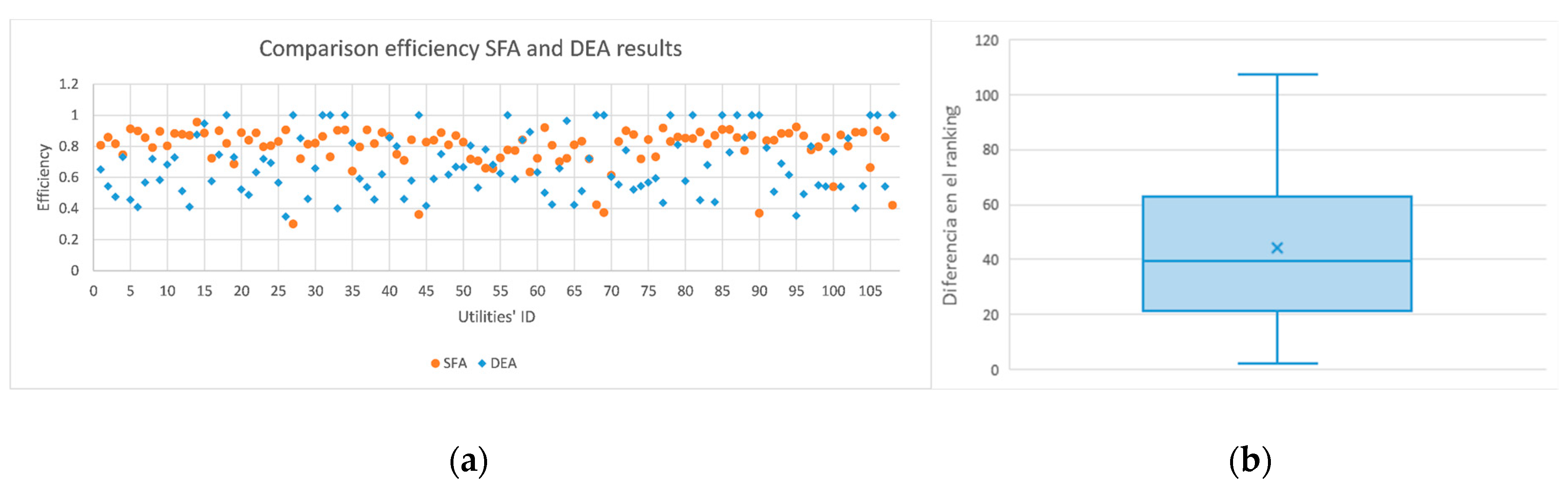
Besides the clear impact of data uncertainty on these methods, further limitations should be explored when considering their use for regulatory purposes.
4.1. Limitation of the Number of Variables
As previously stated, econometric methods are limited by the maximum number of variables they can consider. This has not been an obstacle in the applications of the methods reported in the literature, as the number of variables has always been kept within the limits, as seen in the recompilations of frontier efficiency studies from Abbot et al. [
5] and Ferro et al. [
6].
However, quality of service variables are often overlooked or simplified in these studies. This is critical, as the cost of the service and its quality are intrinsically linked [
37], with a consequent impact on efficiency. In other words, if the quality of service provided is not properly considered, a better (and more expensive) service may be considered more inefficient than a worse (but cheaper) service.
The number of quality of service variables in the water sector is higher than in other sectors (e.g., gas or electricity). This implies that more variables need to be assessed and considered when evaluating the kind of service the users are provided.
Table 4 displays a list of users’ expectations (corresponding to quality of service variables) for the gas, electricity, and water sectors. User expectations for water are based on ISO standard 24510:2007 [
11], while the rest were compiled by the authors of [
9].
Frontier efficiency methods have been traditionally used for energy and gas regulation, and were later applied to the water sector [
38]. As the number of quality of service aspects to be considered in the water sector is greater, it has to be assessed whether these models can deal with all the variables needed to fairly assess the efficiency of utilities.
In addition to the quality of the service, there are exogenous aspects outside the control of the utilities that have an impact on costs and efficiency (e.g., weather, topography, raw water quality, water sources, population density). These aspects can be estimated by SFA models as random errors, but not by DEA.
Worthington [
17] shows how, on average, the number of variables in these models is usually less than 10 (inputs and outputs or dependent and independent variables).
For DEA, there is a rule that fixes the maximum number of inputs and outputs according to the number of DMUs analyzed. This is called Cooper’s rule,
, where n is the number of DMUs, m is the number of inputs, and s is the number of outputs [
10].
This rule is a limitation for DEA models when the number of utilities assessed is low, such as the DEA model referred to in the previous section, which has 4 inputs and 2 outputs, requiring a minimum of 18 DMUs. A DEA model considering all the user expectations from ISO standard 24510, in addition to context information (topography, etc.), would require even more utilities.
As an example, let’s suppose that in addition to the 6 variables used in the previous chapter, the following inputs are considered: the infrastructure value index (IVI), as a measure of the sustainability of the infrastructure; the average pressure in domestic connections; the percentage of water quality tests passed; and the average topographic elevation of the network. Additionally, the following two explanatory variables are considered as inputs as well: customer satisfaction and type of water source. In this case, the number of minimum DMUs would increase to 36. This is not a problem in the specific dataset from the Portuguese water sector, as the number of utilities is large, but this is a limitation in areas with fewer utilities, such as the United Kingdom, the Netherlands, or Australia.
The selection of variables in the SFA is more delicate, as the dependent variable has to be expressed as a function of the independent variables. When selecting the variables, a basic descriptive analysis should always be performed in order to detect possible sources of errors in the model, such as heteroscedasticity or multi-collinearity (at least 2 variables are highly linearly related).
There is no maximum number of independent variables that should be used in a SFA model. This number depends on the degrees of freedom of the model and the number of observations (in our case, number of utilities). If there are few observations and the number of variables is high, there will not be enough degrees of freedom left and the model will not work properly.
Therefore, in both the DEA and SFA models, the number of variables admitted depends on the size of the sample. In large samples, such as the Portuguese sample used previously, the model could admit as many variables as needed, while in smaller samples (e.g., the UK) there is a limitation and most quality of service or context variables will be discarded.
However, a larger number of utilities is not the only answer to the problem, as the more variables the model has, the more likely it is to have multi-collinearity problems between those variables. Multi-collinearity is usually present in samples from the water sector [
17], and models with a larger number of variables are more likely to have this. There is evidence that if the correlation between variables is higher than 0.8, the model can be biased and results of the model can be affected, especially in SFA [
39]. Possible solutions include enlarging the sample (difficult in a regulated environment, as it would require the number of utilities assessed with the model to be increased) or reducing highly correlated variables, although in the latter case, the problem of misspecification in the model [
39] could appear, misrepresenting reality.
4.2. Other Limitations of Frontier Efficiency Methods for Regulatory Uses
As established in The Lisbon Charter [
40], any regulatory body should be based on the principle of transparency. One of the responsibilities of these bodies, according to this charter, is “providing reliable, concise, credible information that can be easily interpreted by all, covering all operators, regardless of the management system adopted for service provision.” Frontier efficiency methods may not be the best suited for regulation based on these principles. As complex methods, the average citizen does not understand the process followed to rank utilities and make regulatory decisions. As a result, users need to trust the regulatory experts and believe the process followed is the most appropriate for the task. This is not ideal, and when the regulator changes each price review method, users may question the validity of the results from previous reviews, as could be the case for OFWAT [
7,
13,
41,
42].
The selection of variables is another key part of the process (DEA is particularly sensitive to variable selection [
17]). This is not trivial, since there are many variables to select from, as previously stated. Abbot and Cohen [
5] and Ferro et al. [
6] published reviews of frontier efficiency methods applied to the water sector. An analysis of the inputs, outputs, and environmental variables of these reviews shows that there are more than 20 different variables considered in the literature as inputs, 45 as outputs, and 30 as environmental variables. The selection of variables will determine the adequacy of the model and has to be related to the sample’s context. The expertise and knowledge of the water sector is needed for proper selection of variables and to accurately model real situations. Since the results will change depending on the variables used, the variable selection may always be disputed by utilities who understand that they would be perceived as more efficient with different variables.
Finally, there are several technical decisions to be made, such as the functional form in SFA or variable and constant returns of scale in DEA [
4]. These decisions have direct impacts on the results. According to Worthington [
17], there are so many configurations in frontier efficiency models that even with the same model results can widely differ due to their configuration. Once more, this is a serious challenge in their use for regulatory purposes, as those utilities with less favorable efficiency results can argue that results are due to an unfair model that does not entirely capture the context, and could propose similar models with the same variables but different parameters, whereby the utility receives better results [
43].



 ,
, 




 4
4 −21
−21