Article

Typhoon Rainfall Forecasting by Means of Ensemble Numerical Weather Predictions with a GA-Based Integration Strategy

1
Taiwan Typhoon and Flood Research Institute, National Applied Research Laboratories, Taipei City 10093, Taiwan
2
National Applied Research Laboratories, Taipei City 10093, Taiwan
3
Department of Civil Engineering, National Chiao Tung University, Hsinchu City 30010, Taiwan
*
Author to whom correspondence should be addressed.
Atmosphere 2018, 9(11), 425; https://doi.org/10.3390/atmos9110425
Submission received: 9 October 2018 / Revised: 29 October 2018 / Accepted: 29 October 2018 / Published: 30 October 2018

Abstract

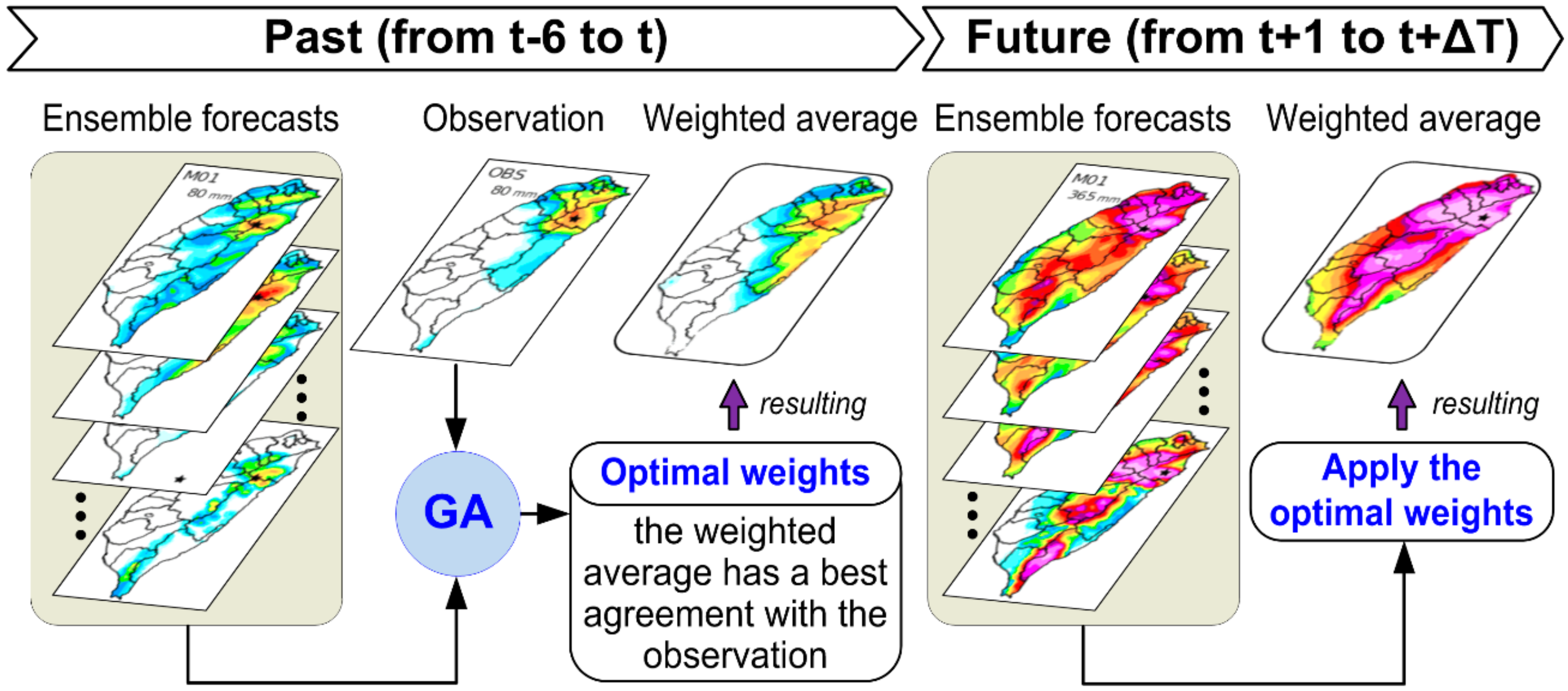
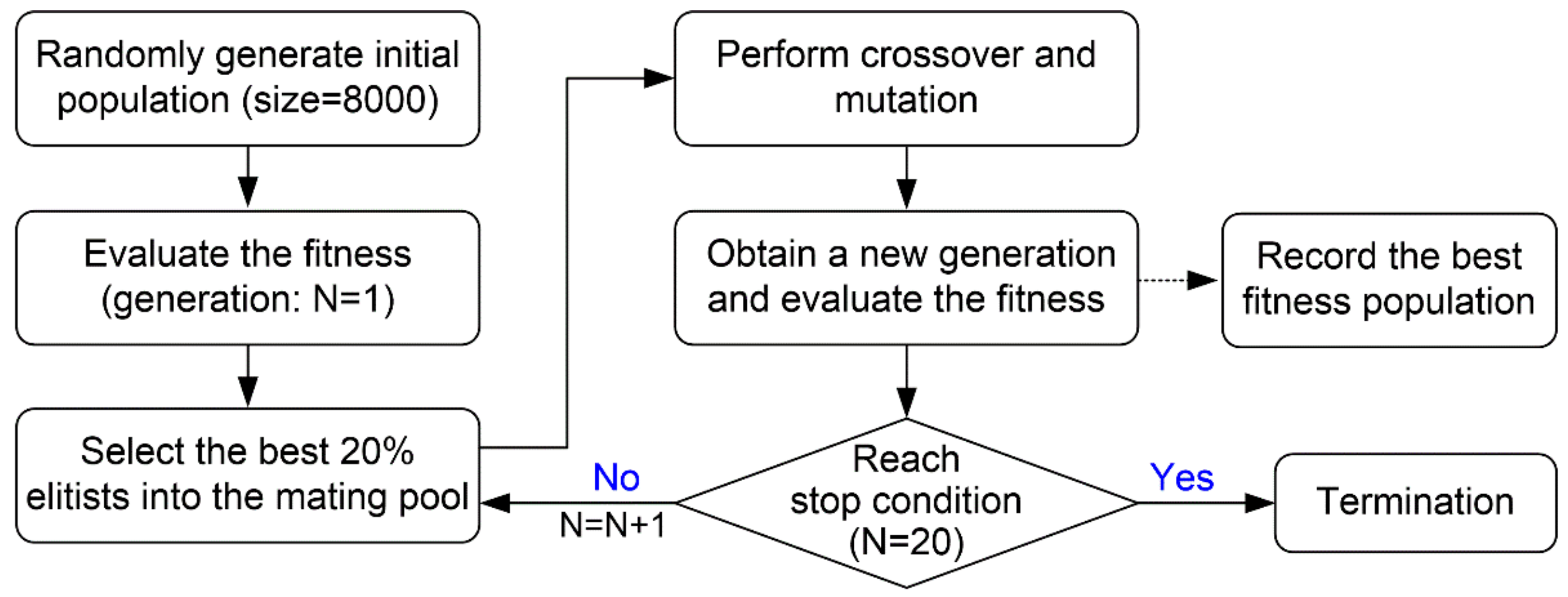
Rainfall during typhoons is one of the most important water resources in Taiwan, but heavy typhoon rainfall often leads to serious disasters and consequently results in loss of lives and property. Hence, accurate forecasts of typhoon rainfall are always required as important information for water resources management and rainfall-induced disaster warning system. In this study, a methodology is proposed for providing quantitative forecasts of 24 h cumulative rainfall during typhoons. Firstly, ensemble forecasts of typhoon rainfall are obtained from an ensemble numerical weather prediction (NWP) system. Then, an evolutionary algorithm, i.e., genetic algorithm (GA), is adopted to real-time decide the weights for optimally combining these ensemble forecasts. That is, the novelty of this proposed methodology is the effective integration of the NWP-based ensemble forecasts through an evolutionary algorithm-based strategy. An actual application is conducted to verify the forecasts resulting from the proposed methodology, namely NWP-based ensemble forecasts with a GA-based integration strategy. The results confirm that the forecasts from the proposed methodology are in good agreement with observations. Besides, the results from the GA-based strategy are more accurate as compared to those by simply averaging all ensemble forecasts. On average, the root mean square error decreases about 7%. In conclusion, more accurate typhoon rainfall forecasts are obtained by the proposed methodology, and they are expected to be useful for disaster warning system and water resources management during typhoons.
Keywords: typhoon rainfall forecasting; ensemble numerical weather predictions; GA-based integration strategy; optimal combination typhoon rainfall forecasting; ensemble numerical weather predictions; GA-based integration strategy; optimal combination