Article

Persistent Ammonia Volatilization Under Conservation Tillage and Slow-Release Fertilization

by
Shichun Zhang
1,*,
Wanqi Guo
1,
Xiaofei Liu
1,
Aizhen Liang
2,
Weiwei Chen
3,
Hongmei Zhao
1,
Xuewen Chen
2,
Jing Fu
3 and
Dandan Huang
2,*
1
Research Center for Regional Development and Environment, Northeast Institute of Geography and Agroecology, Chinese Academy of Sciences, Changchun 130102, China
2
Key Laboratory of Black Soil Conservation and Utilization, Northeast Institute of Geography and Agroecology, Chinese Academy of Sciences, Changchun 130102, China
3
Key Laboratory of Wetland Ecology, Northeast Institute of Geography and Agroecology, Chinese Academy of Sciences, Changchun 130102, China
*
Authors to whom correspondence should be addressed.
Atmosphere 2026, 17(7), 639; https://doi.org/10.3390/atmos17070639
Submission received: 18 May 2026 / Revised: 19 June 2026 / Accepted: 24 June 2026 / Published: 28 June 2026

Abstract

Ammonia (NH3) emissions from fertilized cropland are influenced by conservation tillage practices, yet the underlying mechanisms remain insufficiently understood in the black soil region of northeastern China. In this study, field observations were conducted in a maize cropland to compare NH3 volatilization under conventional tillage, no-tillage, and straw incorporating treatments following application of urea and slow-release fertilizer. Results showed that compared with conventional tillage, no-tillage-straw mulching (T1) and ridge tillage-straw mulching (T3) treatments significantly reduced soil temperature while increasing soil moisture and decreasing the estimated soil resistance to NH3 transport. These changes were accompanied by higher NH3 emission factors (EFs) in the T1 and T3 treatments, although differences in EFs among tillage treatments were not statistically significant. Compared with urea, slow-release fertilizer delayed the occurrence of peak NH3 volatilization and reduced cumulative NH3 emissions by approximately 54%. Notably, measurements under slow-release fertilizer application revealed that elevated NH3 volatilization persisted for more than 40 days after fertilization, indicating that conventional monitoring periods may underestimate cumulative NH3 losses in conservation tillage systems using slow-release fertilizers. Overall, conservation tillage substantially altered soil environmental conditions associated with NH3 volatilization, while fertilizer types strongly influenced the temporal dynamics and magnitude of NH3 emissions. These findings provide useful insights for improving NH3 emission monitoring, process understanding, and inventory estimation in conservation tillage systems.

1. Introduction

To meet the growing food demand, global nitrogen (N) fertilizer consumption has exceeded 110 Tg N a−1 and continues to increase [1]. The intensive application of N fertilizers has led to ammonia (NH3) volatilization accounting for up to 65% of nitrogen loss from croplands [2], resulting in a global nitrogen use efficiency (NUE) of only about 40% [3]. Once released into the atmosphere, NH3 contributes not only to air pollution [4,5], but also poses serious detrimental effects to sensitive ecosystems through dry and wet deposition [6]. Although not regularly regarded as a typical greenhouse gas species, NH3 was referred to as the “next CO2” because of its high global warming potential and its indirect influence on radiative forcing by participating in the formation of aerosols [7].
Ammonia in soil originates from multiple sources, including the mineralization of organic nitrogen, nitrogen fertilizer application, and ammonia oxidation-reduction processes, among which the hydrolysis of nitrogen in fertilizers is one of the primary pathways [8,9]. In soil, aqueous ammonium ions (NH4+(aq)), aqueous dissolved ammonia (NH3(aq)) and gaseous ammonia (NH3(g)) exist in a dynamic equilibrium that is regulated by NH4+ concentration, NH3 concentration, solution pH, and temperature [10,11]. Gaseous NH3 subsequently diffuses through the soil pore space to the soil surface and is emitted into the atmosphere. The volatilization flux is primarily driven by the NH3 concentration gradient between the soil surface and the overlying air [12], while being modulated by environmental factors such as soil temperature, moisture, pH, and wind speed [8]. Therefore, natural and anthropogenic factors, including climate, soil type, tillage, straw management, and fertilization practices, can alter soil properties and soil–atmosphere interface conditions, thereby regulating nitrogen transformation and NH3 volatilization.
Compared with conventional tillage, conservation tillage reduces soil disturbance and increases surface residue cover, thereby modifying soil properties and soil surface microclimate. These changes can potentially influence NH3 production, transport, and emission processes. However, only a limited number of studies have targeted conservation tillage conditions [13,14,15,16], and they have reported inconsistent conclusions regarding the effects of conservation tillage on NH3 volatilization. For example, some studies suggest that straw incorporation or deep placement of nitrogen fertilizer can reduce NH3 volatilization by decreasing soil pH or enhancing the adsorption capacity for NH4+ [13,17]. In contrast, a research reported that surface application of nitrogen fertilizer under no-tillage conditions is more prone to ammonia volatilization because of greater exposure of fertilizer-derived nitrogen at the soil surface [16]. Meta-analyses have also shown that, while no-tillage and straw incorporation can improve crop yield and nitrogen use efficiency, they may simultaneously increase NH3 emissions [18]. Collectively, these contrasting findings suggest that the impacts of conservation tillage on NH3 volatilization depend on complex interactions among soil conditions, management practices, and environmental factors.
The inconsistent conclusions largely stem from the fact that existing studies have primarily focused on the effects of individual management practices on specific nitrogen transformation processes or NH3 emissions, while lacking an integrated understanding of the pathways linking conservation tillage, changes in soil properties, nitrogen transformation, soil-atmosphere interface conditions, and net NH3 volatilization. Key quantities such as soil NH3 emission potential, NH3 compensation points, NH3 fluxes and NH3 emission factors remain difficult to quantify and predict accurately [10,19,20,21,22,23]. This limitation has become increasingly important with the incorporation of bidirectional NH3 exchange and compensation point schemes into regional air quality models (e.g., WRF-CMAQ), which have substantially improved simulations of atmospheric NH3 concentrations, deposition, and ammonium aerosol formation [24,25]. However, reliable application of these models is still hindered by the poor constraint and parameterization of key variables, particularly soil NH3 emission potential and NH3 compensation points [10,19,23,26].
Northeastern China contains one of the world’s four major black soil regions but experienced severe soil degradation due to decades of intensive cultivation. To address this issue, the Chinese government launched the Action Plan for Conservation Tillage in the Black Soil Region of Northeast China (2020–2025) in 2020 (State Council of China, 2020 [27]). Within a short period from 2020 to 2022, conservation tillage technologies were promoted and applied across more than 13 million ha (State Council of China, 2022 [28]). The widespread adoption of conservation tillage is therefore likely altering NH3 emission processes and their regional patterns by changing soil structure, microclimatic conditions, and nitrogen cycling. However, studies on NH3 emissions in Northeast China have mainly focused on emission measurements and nitrogen use efficiency under traditional tillage practices, optimized fertilization strategies, and the application of urease inhibitors [29,30,31,32,33,34,35,36,37,38,39], and the limited number of studies investigating conservation tillage have reported inconsistent results [14,32,33,40], therefore the effects of conservation tillage on NH3 emissions remain insufficiently understood. For example, Chen et al. [40] reported that maize straw mulching under no-tillage promoted the transformation of mineral nitrogen into immobilized and organic nitrogen pools, thereby improving nitrogen use efficiency and maize yield, while straw return combined with urease or nitrification inhibitors also reduced nitrogen leaching [41]. Based on a nine-year conservation tillage experiment in Lishu County in Northeast China, Zhao et al. [14] found that no-tillage and straw return significantly reduced NH3 emissions and that urease and nitrification inhibitors further enhanced the mitigation effect. In contrast, Yan et al. [33] observed no significant differences in NH3 volatilization losses among urea application, controlled-release fertilizer application, and straw return treatments in black soil maize fields. Furthermore, although conservation tillage is expected to modify soil NH3 emission potential and NH3 compensation points through its effects on soil properties and nitrogen cycling, investigations from these perspectives are still lacking in this region.
In this study, soil NH3 emissions were measured in maize cropland located in a typical conservation tillage region in Changchun, northeastern China. The objectives of the study were to: (1) characterize NH3 volatilization under different conservation tillage practices using urea and slow-release fertilizer in a comparative field experiment; (2) investigate factors associated with NH3 volatilization under conservation tillage. The findings of this study can contribute to the evaluation of the overall impact of conservation tillage practices and support the development of soil NH3 volatilization models.

2. Materials and Methods

2.1. Site Description

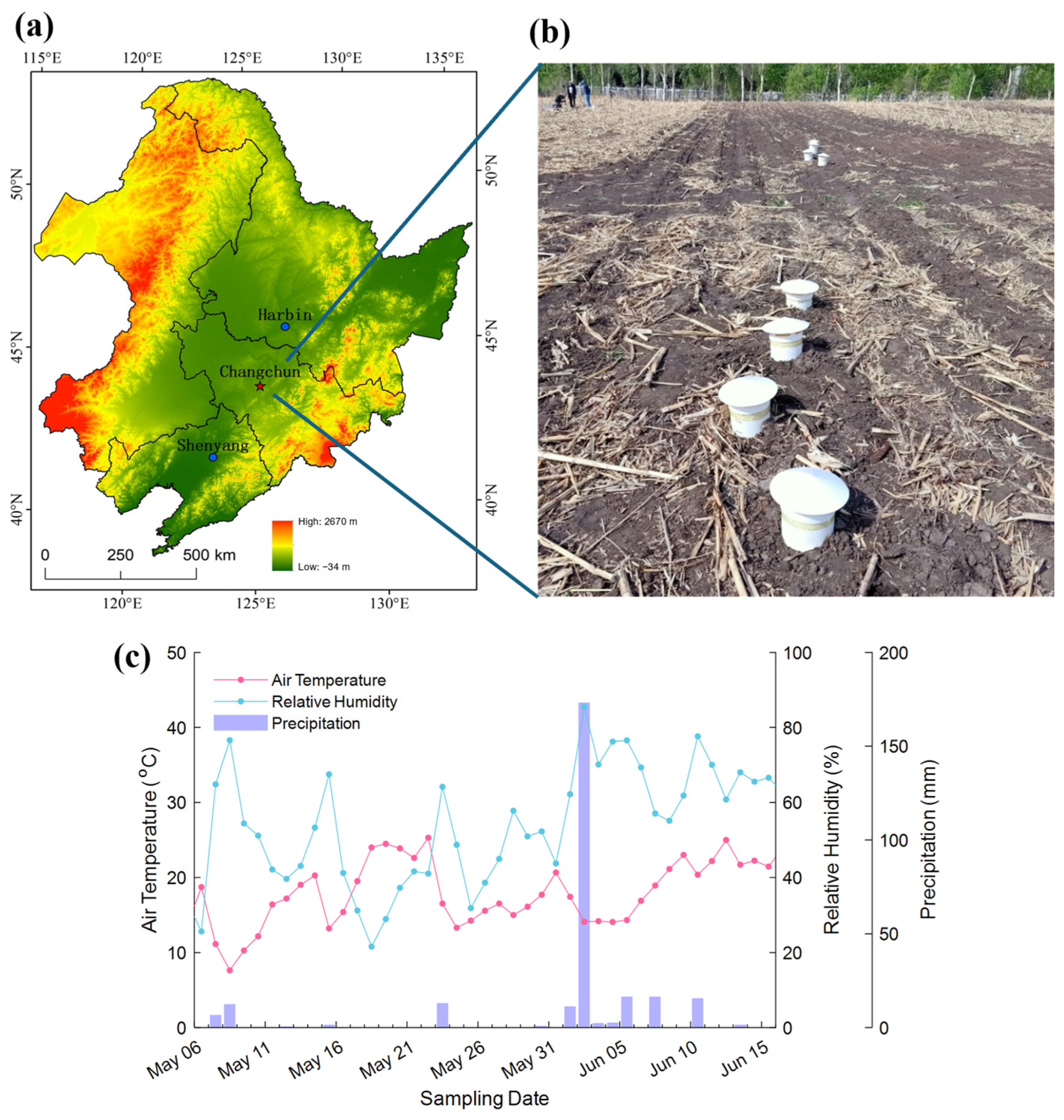
This experiment was conducted in 2021 at the Changchun Agro-Ecological Experimental Station (43°59′55″ N, 125°24′01″ E) of the Northeast Institute of Geography and Agroecology, Chinese Academy of Sciences, located in Changchun, China (Figure 1). The soil at the experimental site is classified as black soil (Mollisol). The plow layer contains organic matter content (SOC) of 17.08 g/kg, total nitrogen (TN) 1.45 g/kg, available phosphorus (AP) 17.6 mg/kg, and available K (AK) 120.1 mg/kg [42]. The site has a temperate continental monsoon climate, with an average annual precipitation of 550 mm and a mean annual temperature of 4.8 °C. Precipitation is mainly concentrated in June, July, and August.

2.2. Experimental Design and Treatments

The Changchun Agro-Ecological Experimental Station is a long-term experimental site for conservation tillage, encompassing ten treatment combinations of soil tillage, straw-mulching, and crop rotation. The experimental design follows a randomized complete block design with four replicates (i.e., four blocks). Four tillage treatments were established, including one conventional tillage treatment and three conservation tillage treatments: conventional tillage without straw incorporating (CK), no tillage with straw incorporating (T1), mouldboard plowing with straw incorporating (T2), and ridge tillage with straw incorporating (T3). All the four treatments were continuous maize cropping systems, differing only in soil tillage operations and straw-incorporating practices. These treatments were suitable for assessing differences in ammonia volatilization from fertilized soil under varying tillage systems and exploring their relationships with soil physicochemical properties.
In addition to tillage treatments, two types of fertilization, namely slow-release fertilizer and urea, were applied. A polymer-coated controlled-release compound fertilizer (25% N–8% P2O5–9% K2O) was used as basal fertilizer and deeply applied at sowing with no additional fertilization during the growing season. A no-fertilizer control treatment (N0) was set up under the conventional tillage plots to quantify background soil NH3 emissions.
Each treatment was replicated in four blocks, and the area of each plot was 5 m × 2.4 m. Detailed treatment codes and descriptions are provided in Table 1.

2.3. Measurement of Soil NH3 Volatilization

Ammonia was collected using the ventilation method proposed by [43], which is suitable for controlled experiments at plot scales (Figure 1). Two circular sponge pads, each approximately 2 cm thick and 16 cm in diameter, after being rinsed in a phosphoric acid–glycerol solution were placed inside a PVC tube (16 cm in diameter and approximately 20 cm in height). The lower sponge was positioned 5 cm above the bottom of the PVC tube, while the upper sponge was near with the top of the tube. After a predefined exposure period (e.g., 1 or 3 days), the lower sponge was removed, immediately sealed in a plastic bag, and replaced with a freshly rinsed sponge. The upper sponge was replaced every 3–7 days depending on its moisture condition. All collected sponges were transported to the laboratory and stored in 500 mL plastic bottles for subsequent analysis.
The corn was sown on 6 May and the PVC tubes for ammonia collection were mounted in the afternoon of 7 May. Collection of the sponges was carried out on 9 May, 10 May, 12 May, 17 May, 25 May, 1 June, 8 June, and 15 June, respectively. For the slow-release fertilizer treatments, three PVC tubes were deployed within each plot (subplot) to account for within-plot spatial variability, and their measurements were averaged to represent a single observation per plot. For the urea treatments, one PVC tube was deployed per plot due to field operational constraints. In all cases, four replicated blocks were established, and the plot was treated as the experimental unit for statistical analysis.
To determine the amount of ammonia absorbed by the sponge samples, 300 mL of KCl solution was added to each plastic bottle containing field-collected sponges, ensuring the sponges were fully submerged. The bottles were shaken for 1 h, then allowed to settle. Once the soil-KCl suspension clarified, a portion of the supernatant was extracted and analyzed using a flow injection analyzer (TRAACS 2000, Bran & Luebbe, Norderstedt, Germany). If analysis could not be performed within 24 h, the suspension was filtered through filter paper and the filtrate was stored in a refrigerator for later analysis.
The daily ammonia flux (Fdaily, kg N ha−1 d−1), mean flux over the growing season (Fmean, kg N ha−1 d−1), and cumulative ammonia volatilization (Fcum, kg N ha−1) were calculated using the following equations:
F d a i l y = A i × 10000 S × D i × 0.99
F m e a n = i = 1 n A i × 10000 S × 0.99 / i = 1 n D i
F c u m = i = 1 n A i × 10000 S × 0.99
where Ai is the amount of ammonia collected during the ith sampling (kg N), Di is the corresponding sampling duration (days), S is the effective cross-sectional area of the collection device (m2), and 0.99 is the ammonia recovery rate of the device [15,41].

2.4. Measurements of Soil Chemical and Physical Properties

Soil temperature and volumetric water content were measured using a Frequency Domain Reflectometry (FDR) sensor (FDS-200, Handan Development Zone Qing Yi Electronic Co., Ltd., Handan, China) during both the installation and collection of PVC tubes. Simultaneously, soil samples from a depth of 0–5 cm were collected using aluminum boxes (5 cm × 5 cm × 3 cm) to determine volumetric and gravimetric water contents by weighing the samples before and after oven-drying at 105 °C for 24 h.
Soil samples from the 0–5 cm depth across different plots were also collected to analyze ammonium (NH4+), nitrate (NO3), and cation exchange capacity (CEC) under various treatments. After sieving and thorough mixing, 10 g of soil was extracted with 100 mL of 1 mol L−1 potassium chloride (KCl) solution. The mixture was shaken at 140 rpm for 1 h and then filtered through filter paper into vials. The concentrations of NH4+, NO3, and CEC were determined using a continuous flow analyzer (AutoAnalyzer 3, Seal Analytical Inc., Mequon, WI, USA).
In addition, 5 g of sieved soil was mixed with 25 mL of deionized water, and soil pH was measured using a pH meter.

2.5. Calculation of Soil Ammonia Emission Potential, Compensation Concentration and Soil Resistance

Soil NH3 emission potential (Γs), defined as the molar ratio of dissolved ammonium ions (NH3+) to hydrogen ions (H+), serves as a direct indicator of the dynamic equilibrium between NH3 and NH4+ in the soil, thereby influencing ammonia volatilization. Based on the H+ concentration derived from soil pH and the measured NH4+ concentration, Γs was calculated as follow [44].
Γ s = NH 4 + H +
where [NH4+] and [H+] are in μmol kg soil−1.
The ammonia compensation points of soil (χc, μgm−3) can be expressed as follow [23]:
χ c = A T Γ s e x p B / T
where A and B are constants with values of 2.7457 × 10¹⁵ and 10,378, respectively, and Ts is the soil temperature (K).
Soil resistances (Rs, s m−1) were calculated as
Rs = L/D
with
L = d 1 e 1 e x p 1 w g / w s a t C w 1
D = D 0 w s a t 2 1 w r e s w s a t 2 + 3 b
where L represents the estimated dry layer path length (m) as a function of relative soil water content. D is the reduced vapor diffusivity (m2 s−1) in the soil. The thickness of the top soil layer (d1) is set to 1.75 cm. The parameter e is the base of the natural logarithm (≈2.71828), wg and wsat denote the volumetric water content and saturation volumetric water content (m3 m−3) of the top soil layer, respectively. Cw is an empirical parameter that controls the concavity of the curve and is set to 5 to produce an exponential shape. D0 is the molecular diffusion coefficient of water vapor in the atmosphere, which is fixed at 2.59 × 10⁻⁵ m2 s−1. The residual water content (wres) is set to 0.01 m3 m−3. The parameter b, representing the slope of the soil water retention curve, varies with soil texture and is assigned a value of 7.75 for silty clay loam, following Noilhan and Planton [45]. Further details can be found in Ran, et al. [46].

2.6. Statistical Analyses

Statistical analyses were performed using SPSS 26.0 (IBM Corp., Armonk, NY, USA). For the slow-release fertilizer treatments, three PVC collectors installed within each plot were treated as subsamples to account for within-plot spatial variability. Measurements from the three collectors were averaged to obtain a single plot-level value prior to statistical analysis. For the urea treatments, one PVC collector was installed per plot because the comparison between fertilizer types was not the primary objective of this study and the use of a single collector substantially reduced sampling effort and analytical costs.
In all cases, the plot (i.e., the replicate block) was considered the experimental unit, and four replicate blocks were used for each treatment. Therefore, four independent observations (n = 4) were used for statistical analyses. The no-fertilizer treatment (N0) was established only within the conventional tillage plots and served solely as a background reference; consequently, it was not included in statistical comparisons.
Because the primary objective of this study was to evaluate the effects of conservation tillage practices under each fertilizer regime, statistical analyses were conducted separately for the controlled-release fertilizer and urea treatments. One-way analysis of variance (ANOVA) was used to test differences among tillage treatments within each fertilizer type. When significant effects were detected (p < 0.05), treatment means were separated using Tukey’s honestly significant difference (HSD) test.

3. Results

3.1. Dynamics of NH3 Emission Flux and Cumulative NH3 Emissions

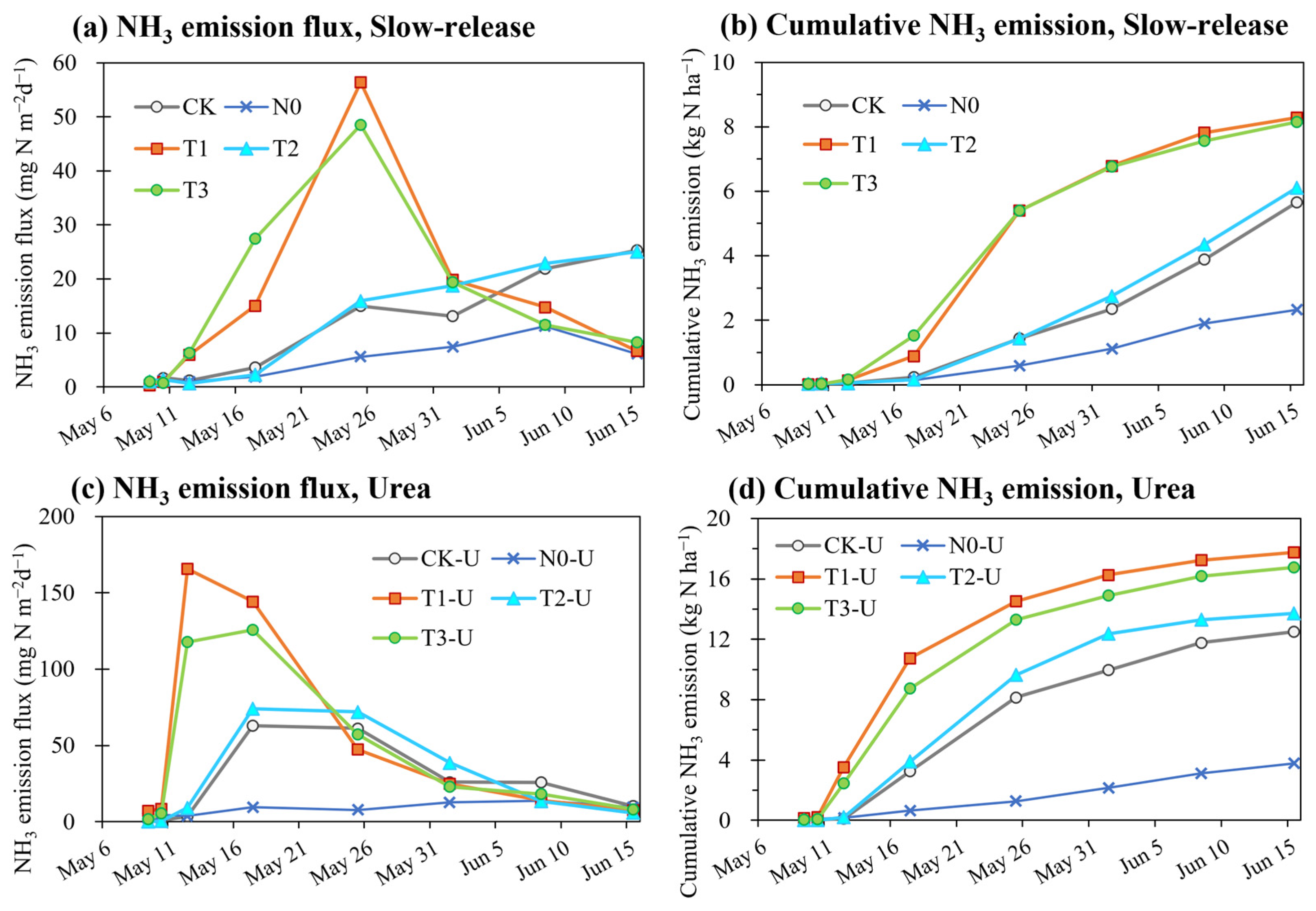
Figure 2 shows the temporal dynamics of the soil NH3 volatilization rate following the day of sowing and fertilization (6 May, denoted as d0; subsequent dates are denoted similarly). Although maize was sown as early as 6 May, the NH3 volatilization rate was nearly zero during the first two sampling dates, 9 May (d3) and 10 May (d4) (Figure 2a, c). However, from 12 to 17 May, the volatilization rate increased sharply. For the slow-release fertilizer treatments (Figure 2a), the peak volatilization rate occurred on 26 May (d20), whereas for the urea treatments (Figure 2c), the peak appeared much earlier, between 12 and 17 May. In the urea treatments (Figure 2d), cumulative NH3 emissions had largely stabilized by 15 June. In contrast, for the slow-release fertilizer treatments (Figure 2b), cumulative NH3 emissions continued to increase throughout the observation period, indicating that appreciable NH3 volatilization persisted for more than 40 days after fertilization.

3.2. Emission Factors

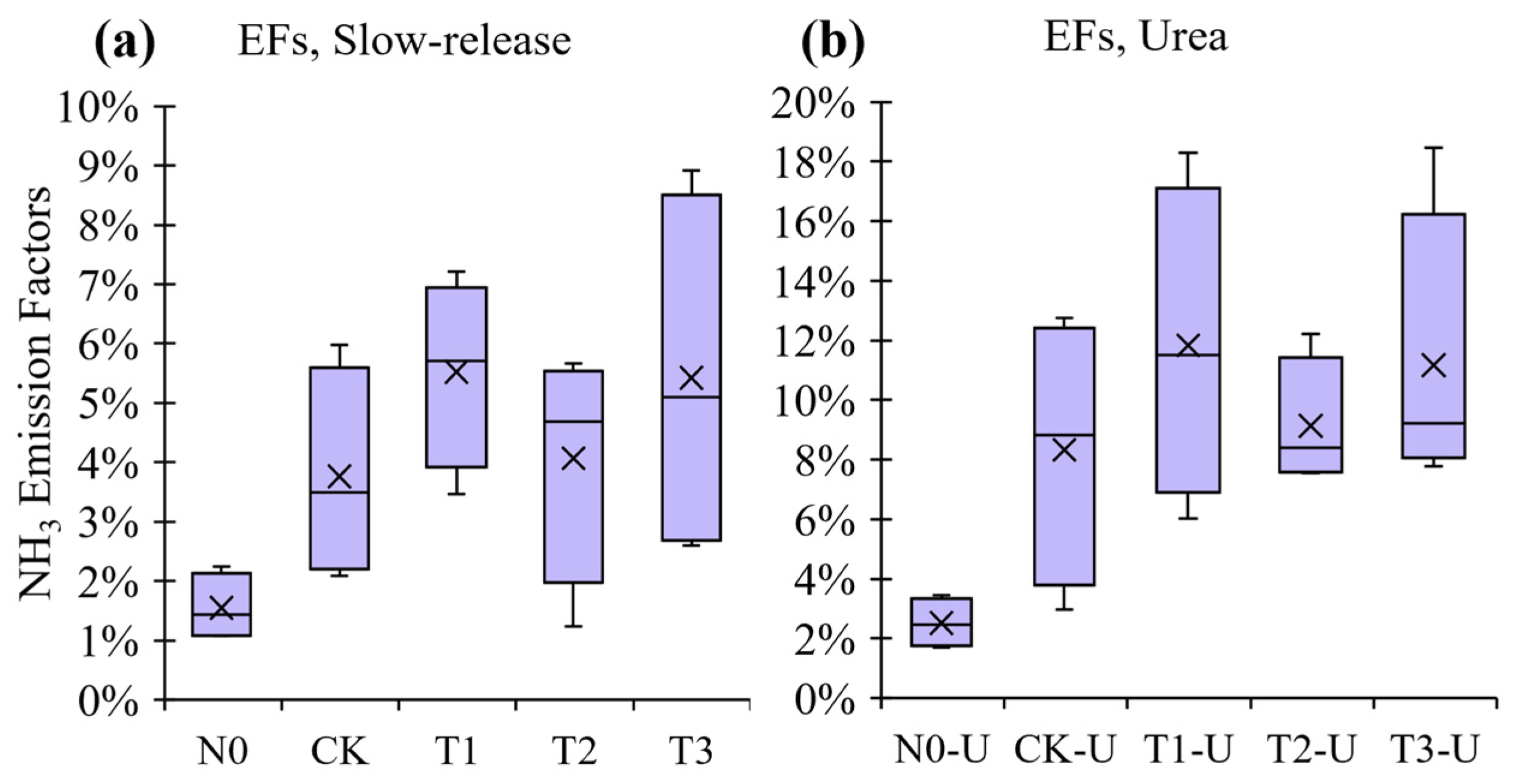
Figure 3 presents the NH3 emission factors (EFs) under different tillage practices. Under both fertilizer types, the mean EFs of the conservation tillage treatments (T1, T2, T3 and their corresponding urea treatments T1-U, T2-U, T3-U) were generally numerically higher than those of the conventional tillage treatments (CK and CK-U). In particular, for the slow-release fertilizer treatments (Figure 3a), the EFs of the no-tillage with straw incorporating (T1) and ridge tillage with straw incorporating (T3) treatments exhibited the highest mean EFs among the four tillage treatments. However, one-way ANOVA followed by Tukey’s HSD test indicated that the differences in EFs among the four major treatments (CK, T1, T2, and T3) were not statistically significant (p > 0.05). Therefore, these differences should be regarded as observed trends rather than statistically confirmed treatment effects.

4. Discussion

4.1. Factors Associated with Soil NH3 Volatilization Under Conservation Tillage

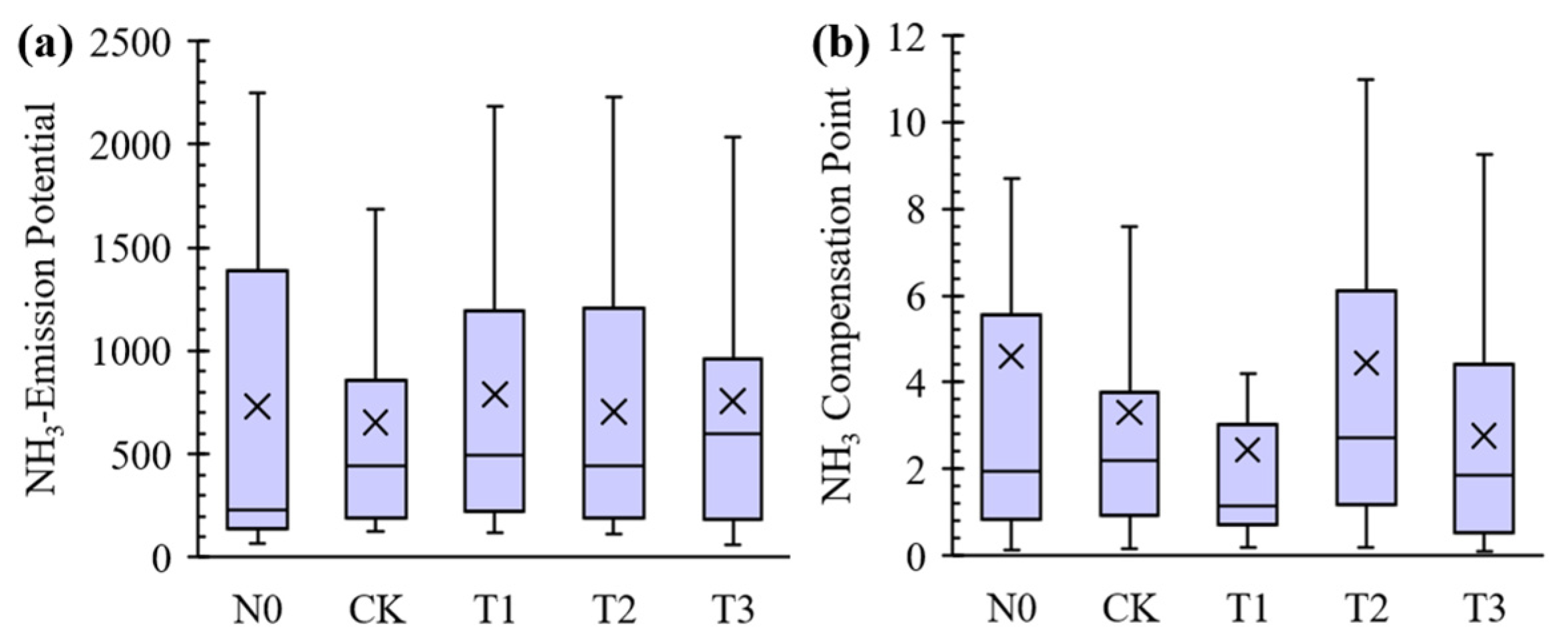
As shown in Figure 2 and Figure 3, the no tillage-straw mulching (T1) and ridge tillage-straw mulching (T3) treatments exhibited numerically higher NH3 emissions and emission factors compared to conventional (CK) and mouldboard plow-straw mulching (T2) treatments. Although these differences in emission factors were not statistically significant (Table 2), they were accompanied by relatively higher NH3 emission potentials (Figure 4a) and soil NH4+-N concentrations (Table 2 and Figure 5b), suggesting that nitrogen availability may have contributed to the observed trends.
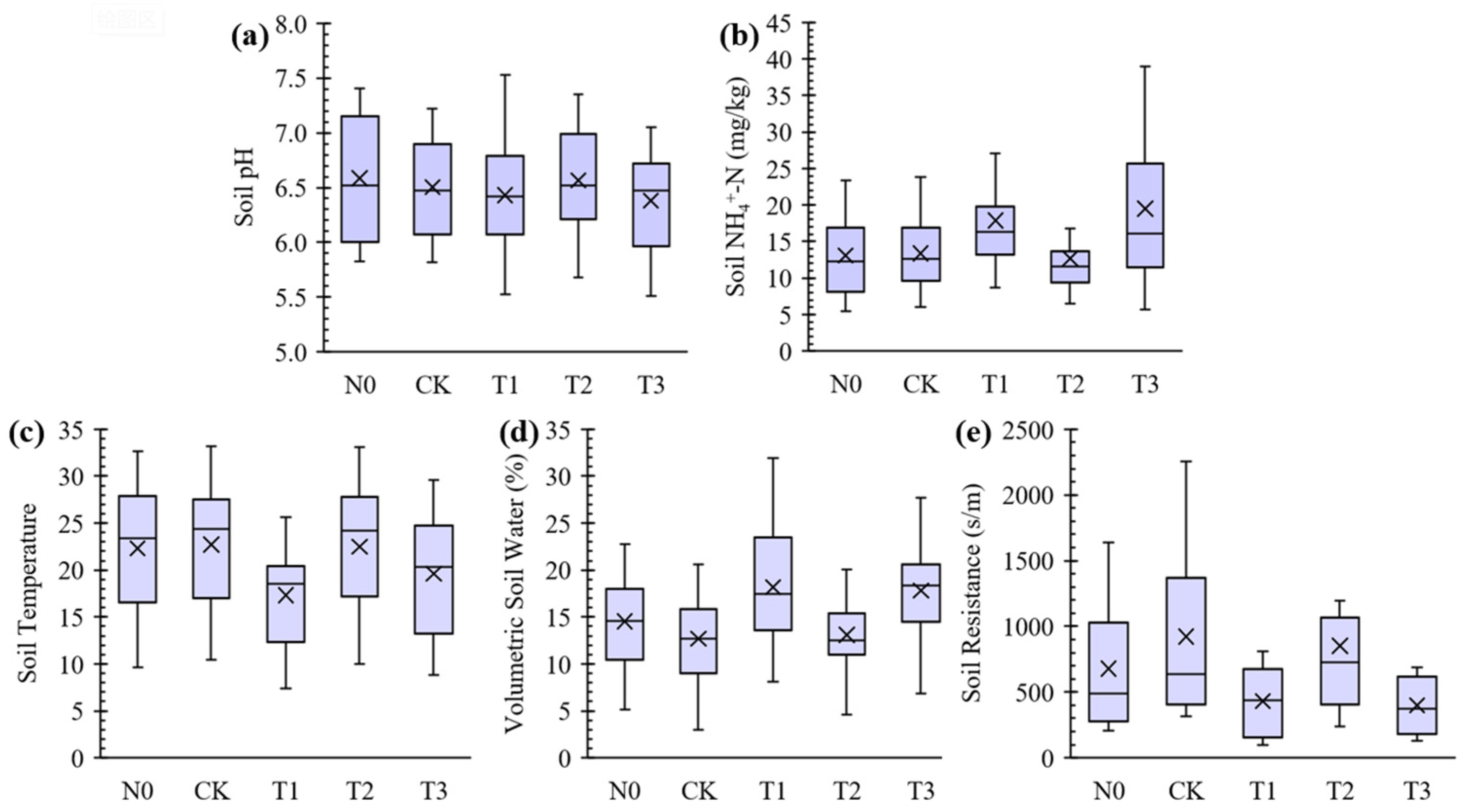
Interestingly, T1 and T3 exhibited numerically lower NH3 compensation points (Figure 4b), significantly lower soil temperatures (Figure 5c) and slightly lower pH values (Figure 5a) than those for CK and T2, conditions that would generally be expected to suppress NH3 volatilization. However, T1 and T3 treatments also showed noticeably higher soil water content (Figure 5d), and correspondingly lower soil resistance (Figure 5e). This combination suggests that enhanced gaseous transport under wetter soil conditions may have partly offset the inhibitory influences of lower temperature and pH, thereby contributing to the observed on NH3 volatilization patterns.
Overall, conservation tillage altered several soil environmental variables associated with NH3 volatilization, including soil temperature, soil moisture, soil resistance, and mineral nitrogen content (Table 2). In particular, two conservation tillage treatments (T1 and T3) exhibited soil temperatures approximately 3–5 °C lower, soil moisture contents about 5% higher, and estimated soil resistance values 53–57% lower than those under conventional tillage (CK). However, although the conservation tillage treatments generally showed a tendency of higher NH3 emission factors than conventional tillage, these differences were not statistically significant in the present study.
Several mechanisms proposed in previous studies may contribute to this pattern. First, no-till provides an undisturbed soil rhizosphere, reducing the likelihood of N fertilizer leaching into soil cracks [47], thereby retaining more N in the topsoil as a reservoir for NH3 volatilization. Second, no-tillage with straw retention markedly increased soil water content in the topsoil compared to conventional tillage [48], substantially decreasing soil resistance to NH3 volatilization. Third, no-till and/or straw-incorporating have been shown to increase urease activity by enhancing soil organic matter and providing a more stable environment for microorganisms [49,50]. Lastly, plant residues themselves may exhibit relatively high NH3 emission potentials [51]. However, these mechanisms were not directly evaluated in the present study and therefore should be regarded as possible explanations rather than definitive conclusions.
The present results further illustrate the complexity of the effects of conservation tillage on NH3 volatilization. Previous studies have reported contrasting responses of NH3 emissions to conservation tillage practices. For instance, a meta-analysis study [18] reported that conservation agriculture overally decreases NH3 emissions in maize systems, with straw-incorporating reducing emissions by 12% and no-till increasing them by only 2.4%. The mechanisms in those studies may involve higher carbonaceous substrates from straw promoting microbial assimilation of N [14], or lowered soil pH enhancing NH4+ adsorption [17]. These discrepancies likely reflect differences in site-specific conditions, such as soil properties, climatic properties, and residue management practices, and fertilizer placement methods. In the present study, conservation tillage significantly altered soil moisture, soil temperature, soil resistance, and mineral nitrogen availability, all of which are factors associated with NH3 volatilization. The results therefore support the view that the net response of NH3 emissions to conservation tillage depends on the combined influence of multiple interacting environmental and management factors, rather than on any single process alone.

4.2. Temporal Patterns of NH3 Volatilization Under Slow-Release Fertilizer and Urea Application

Marked differences were observed in the temporal patterns of NH3 volatilization between the slow-release fertilizer and urea treatments. Under the urea treatments, NH3 volatilization rates increased rapidly after fertilization and reached their maximum values (56.39 mg N m−2d−1 for T1 treatment) 5 days after sowing. In contrast, For the slow-release fertilizer treatments, the peak NH3 volatilization rates (165.62 mg N m−2d−1 for no-tillage T1 treatment) occurred much later,18 days after sowing. This indicates that the slow-release fertilizer delayed the occurrence of peak NH3 emissions and distributed nitrogen release over a longer period, resulting in a smoother the emission pattern that may better match the crop nitrogen demand.
Another notable finding was the prolonged duration of NH3 emissions under the slow-release fertilizer treatments. For the urea fertilizer treatments, the cumulative volatilization of NH3 stablized at the end of the sampling period (d40), while for the slow-release fertilizer, the cumulative NH3 emissions continued to increase, especially for the conventional (CK) and Mouldboard plow-straw mulching (T2) treatments (Figure 5). This result suggests that appreciable NH3 volatilization persisted for more than 40 days after fertilizer application under slow-release fertilizer management. Such prolonged emissions imply that monitoring programs restricted to the first three or four weeks after fertilization may underestimate cumulative NH3 losses from slow-release fertilizer systems. Therefore, longer observation periods may be necessary when quantifying NH3 emissions, developing emission inventories, or evaluating mitigation strategies involving slow-release fertilizers.
The delayed emission peak observed in this study was more pronounced than that reported in previous studies. For example, Zhao‘s research [52] showed that the peak of NH3 emission rates occurred 7 days later than conventional N fertilizers. The longer delay in the current study may related to the rain events and relatively low temperatures occurring shortly after sowing and fertilization (Figure 1), which could have slowed nitrogen release and NH3 production during the early stages of the experiment.
In addition to altering the temporal pattern of emissions, slow-release fertilizer substantially reduced cumulative NH3 losses. Our results show that the slow-release fertilizer treatment reduced as much as 54% of the accumulation NH3 emissions as compared to the urea treatments. This reduction is likely attributable to the gradual release of nitrogen from the slow-release fertilizer, which better synchronizes nitrogen supply with crop demand and thus minimizes unnecessary nitrogen losses, thereby reducing NH3 volatilization. The results here are consistent with those of other studies, for example, Zhao et al. [52] reported a reduction of 51% to 91% in accumulated NH3 emissions from slow-release fertilizer as from urea and Hu et al. [53] reported a substantially lower NH3 emission factor under subsurface application of slow-release fertilizer than under conventional fertilization practices.

4.3. Implications for Mitigating NH3 Emissions

The present study showed that conservation tillage can substantially modify soil environmental conditions associated with NH3 volatilization. Although no significant differences in emission factors were observed between conservation tillage and conventional tillage, no tillage straw-mulching treatment (T1) and ridge tillage-straw mulching (T3) showed significantly higher soil moisture, lower soil temperature, and reduced estimated soil resistance, creating conditions more favorable for NH3 volatilization. This suggests that conservation tillage may alter the relative importance of environmental controls on NH3 volatilization and should therefore be considered when developing agricultural NH3 emission inventories and mitigation strategies.
Application of slow-release fertilizer resulted in 54% lower NH3 emissions than urea and delayed the occurrence of peak emissions. These characteristics may help improve the synchronization between nitrogen release and crop nitrogen demand, thereby reducing the risk of rapid nitrogen loss following fertilization. Therefore replacement of urea with new generation of fertilizer should be recommended in order to get higher N use efficiency and lower N loss through soil volatilization and other path such as leakage. However, the prolonged NH3 emission period observed under slow-release fertilizer application also suggests that monitoring periods should be sufficiently long to capture total NH3 losses and avoid underestimation of cumulative emissions.
In addition to fertilizer type, fertilizer placement depth may represent an effective management option for mitigating NH3 volatilization. In this study, the depth of fertilizer application is 5 to 10 cm, such depth helped reduce NH3 volatilization. The research by Qiao et al. [35] also showed that NH3 volatilization rates decreases as the depth of fertilizer application increases, with NH3 loss from volatilization decreasing from 21.68% to 2.49% as the depth of N fertilization application from surface application to in-depth application at 9 cm. Collectively, these results suggest that combining slow-release fertilizers with appropriate fertilizer placement practices may provide an effective approach for reducing agricultural NH3 emissions.

4.4. Limitations and Perspectives

Although clear differences in soil environmental conditions were observed among treatments, the differences in NH3 emission factors among the treatments were not statistically significant. This may partly reflect the inherent spatial variability of field NH3 emissions and the limited number of experimental replicates. Consequently, the present results should be interpreted as evidence of treatment-related trends rather than definitive proof of treatment effects. Additional multi-site and multi-year studies with larger sample sizes would help further evaluate the impacts of conservation tillage on NH3 volatilization.
Another limitation is that NH3 were measured within the PVC collectors, whereas the soil physiochemical properties were measured using the samples collected adjacent to, rather than within, the collectors. Although these measurements likely reflected similar environmental conditions, some uncertainty remains regarding the direct correspondence between the measured soil properties and NH3 fluxes.
Besides, although long fragments (i.e., >10 cm) of returned straw were present in the field, only shorter straw pieces (i.e., <10 cm) could be covered within the PVC collectors. Therefore the whole influences of returned straw on soil NH3 volatilization may not have been fully captured. In the future, other open style measurements methods, i.e., micrometerological methods, or larger chambers, should be used to strengthen the reliability regarding the mechanisms underlying soil NH3 volatilization.
The prolonged NH3 emissions observed under the slow-release fertilizer treatments also suggest a limitation of the current monitoring period. Under the slow-release fertilizer and mouldboard plow (CK and T2), the NH3 volatilization still remained elevated after 40 days after sowing, indicating that cumulative emissions may have been underestimated. Future studies should therefore extend monitoring periods when evaluating NH3 emissions from slow-release fertilizer systems.
Furthermore, NH3 volatilization represents only one pathway of nitrogen loss. Previous studies in northeastern China have reported trade-offs between NH3 and N2O emissions under conservation tillage and straw-returning practices [32,54]. Therefore, future research should simultaneously evaluate multiple nitrogen loss pathways, including NH3 volatilization, N2O emissions, nitrate leaching, and crop nitrogen uptake, to provide a more comprehensive assessment of the environmental consequences of conservation tillage.
Finally, this study was conducted in a typical black soil (mollisol) region characterized by enrich organic matter. However, in the current study, the related variables such as SOC, soil organic matter, and soil aggregate were not measured. These factors may influence nitrogen transformation and NH3 volatilization and should be incorporated into future studies to improve understanding of the mechanisms underlying NH3 emissions under conservation tillage.

5. Conclusions

This study evaluated NH3 volatilization from fertilized soil under different conservation tillage practices and fertilizer types in a typical black soil region, northeastern China. The objectives were to characterize NH3 volatilization under conservation tillage, compare NH3 emission patterns between slow-release fertilizer and urea, and identify factors associated with NH3 volatilization.
The results showed that although NH3 emission factors under conservation tillage treatments were generally higher than those under conventional tillage, the differences among tillage treatments were not statistically significant. Nevertheless, conservation tillage significantly altered several soil environmental variables associated with NH3 volatilization. Compared with conventional tillage, the no tillage-straw mulching (T1) and ridge tillage-straw mulching treatments (T3) exhibited soil temperatures approximately 3–5 °C lower, soil moisture about 5% higher, and estimated soil resistance values 53–57% lower than those under conventional tillage (CK).
Marked differences were observed between slow-release fertilizer and urea applications. Compared with urea, slow-release fertilizer delayed the occurrence of peak NH3 volatilization and reduced cumulative NH3 emissions by approximately 54%. More importantly, appreciable NH3 volatilization persisted for more than 40 days after fertilization under the slow-release fertilizer treatments, indicating that short-term monitoring may underestimate cumulative NH3 losses from such systems.
Overall, the results suggest that both tillage practices and fertilizer type can influence soil environmental conditions and NH3 emission dynamics. The prolonged NH3 emission period observed under slow-release fertilizer application highlights the importance of extended monitoring periods when quantifying agricultural NH3 emissions. Future studies should further evaluate conservation tillage effects using larger sample sizes, longer observation periods, and more comprehensive measurements of nitrogen transformation processes and multiple nitrogen loss pathways.

Author Contributions

Conceptualization, S.Z. and A.L.; methodology, X.L. and D.H.; data interpretation, X.C. and A.L.; writing—original draft preparation, S.Z. and W.G.; writing—review and editing, W.C., A.L., J.F. and H.Z. All authors have read and agreed to the published version of the manuscript.

Funding

This research was supported by the National Natural Science Foundation of China (Grant No. 41575129), and the Jilin Provincial Natural Science Foundation of China (Grant No. 20220101156JC).

Data Availability Statement

The raw data supporting the conclusions of this article will be made available by the authors on request.

Acknowledgments

The authors thank the Changchun Agro-Ecological Experimental Station for providing the experimental fields and all the individuals involved in the experiments for their assistance.

Conflicts of Interest

The authors declare no conflict of interest.

References

  1. Griffis, T.J.; Baker, J.M. Nitrogen management and air quality in China. Nat. Food 2020, 1, 597–598. [Google Scholar] [CrossRef] [Scilit] [PubMed]
  2. Chen, X.; Cui, Z.; Fan, M.; Vitousek, P.; Zhao, M.; Ma, W.; Wang, Z.; Zhang, W.; Yan, X.; Yang, J.; et al. Producing more grain with lower environmental costs. Nature 2014, 514, 486–489. [Google Scholar] [CrossRef] [Scilit] [PubMed]
  3. Zhang, X.; Davidson, E.A.; Mauzerall, D.L.; Searchinger, T.D.; Dumas, P.; Shen, Y. Managing nitrogen for sustainable development. Nature 2015, 528, 51–59. [Google Scholar] [CrossRef] [Scilit] [PubMed]
  4. Zhuang, H.; Chan, C.K.; Fang, M.; Wexler, A.S. Formation of nitrate and non-sea-salt sulfate on coarse particles. Atmos. Environ. 1999, 33, 4223–4233. [Google Scholar] [CrossRef] [Scilit]
  5. Huang, R.-J.; Zhang, Y.; Bozzetti, C.; Ho, K.-F.; Cao, J.-J.; Han, Y.; Daellenbach, K.R.; Slowik, J.G.; Platt, S.M.; Canonaco, F. High secondary aerosol contribution to particulate pollution during haze events in China. Nature 2014, 514, 218–222. [Google Scholar] [CrossRef] [Scilit] [PubMed]
  6. Carfrae, J.; Sheppard, L.; Raven, J.; Leith, I.; Stein, W.; Crossley, A.; Theobald, M. Early effects of atmospheric ammonia deposition on Calluna vulgaris (L.) Hull growing on an ombrotrophic peat bog. Water Air Soil Pollut. Focus 2004, 4, 229–239. [Google Scholar] [CrossRef] [Scilit]
  7. Battye, W.; Aneja, V.P.; Schlesinger, W.H. Is nitrogen the next carbon? Earth’s Future 2017, 5, 894–904. [Google Scholar] [CrossRef] [Scilit]
  8. Flechard, C.R.; Massad, R.S.; Loubet, B.; Personne, E.; Simpson, D.; Bash, J.O.; Cooter, E.J.; Nemitz, E.; Sutton, M.A. Advances in understanding, models and parameterizations of biosphere-atmosphere ammonia exchange. Biogeosciences 2013, 10, 5183–5225. [Google Scholar] [CrossRef] [Scilit]
  9. Sommer, S.G.; Schjoerring, J.K.; Denmead, O. Ammonia emission from mineral fertilizers and fertilized crops. Adv. Agron. 2004, 82, 557–622. [Google Scholar] [CrossRef] [Scilit]
  10. Abeed, R.; Viatte, C.; Porter, W.C.; Evangeliou, N.; Clerbaux, C.; Clarisse, L.; Van Damme, M.; Coheur, P.-F.; Safieddine, S. A roadmap to estimating agricultural ammonia volatilization over Europe using satellite observations and simulation data. Atmos. Chem. Phys. 2023, 23, 12505–12523. [Google Scholar] [CrossRef] [Scilit]
  11. Genermont, S.; Cellier, P. A mechanistic model for estimating ammonia volatilization from slurry applied to bare soil. Agric. For. Meteorol. 1997, 88, 145–167. [Google Scholar] [CrossRef] [Scilit]
  12. Farquhar, G.D.; Firth, P.M.; Wetselaar, R.; Weir, B. On the Gaseous Exchange of Ammonia between Leaves and the Environment: Determination of the Ammonia Compensation Point. Plant Physiol. 1980, 66, 710–714. [Google Scholar] [CrossRef] [Scilit] [PubMed]
  13. Liu, T.Q.; Fan, D.J.; Zhang, X.X.; Chen, J.; Li, C.F.; Cao, C.G. Deep placement of nitrogen fertilizers reduces ammonia volatilization and increases nitrogen utilization efficiency in no-tillage paddy fields in central China. Field Crops Res. 2015, 184, 80–90. [Google Scholar] [CrossRef] [Scilit]
  14. Zhao, J.; Yuan, L.; Chen, H.; Chen, X.; He, H.; Zhang, X.; Xie, H.; Lu, C. Reduction of NH3 Emissions from Urea by Long-Term No-Tillage and Stover Mulching with Inhibitors: An Isotopic Field Study in Northeast China. Agronomy 2023, 13, 2235. [Google Scholar] [CrossRef] [Scilit]
  15. Yang, Y.; Zhou, C.; Li, N.; Han, K.; Meng, Y.; Tian, X.; Wang, L. Effects of conservation tillage practices on ammonia emissions from Loess Plateau rain-fed winter wheat fields. Atmos. Environ. 2015, 104, 59–68. [Google Scholar] [CrossRef] [Scilit]
  16. Dong, W.; Hu, C.; Chen, S.; Qin, S.; Zhang, Y. Effect of conservation tillage on ammonia volatilization from nitrogen fertilizer in winter wheat-summer maize cropping system. Sci. Agric. Sin. 2013, 46, 2278–2284. (In Chinese) [Google Scholar]
  17. Dong, W.; Hu, C.; Yuming, Z. Effect of Straws on Ammonia Volatilization on Loss from Urea. J. Hebei Agric. Sci. 2005, 9, 11–14. (In Chinese) [Google Scholar]
  18. Xu, P.; Li, G.; Houlton, B.Z.; Ma, L.; Ai, D.; Zhu, L.; Luan, B.; Zhai, S.; Hu, S.; Chen, A.; et al. Role of Organic and Conservation Agriculture in Ammonia Emissions and Crop Productivity in China. Environ. Sci. Technol. 2022, 56, 2977–2989. [Google Scholar] [CrossRef] [Scilit] [PubMed]
  19. Alnsour, N. Bi-Directional Exchange of Ammonia from Soils in Row Crop Agro-Ecosystems. Ph.D. Thesis, North Carolina State University, Raleigh, NC, USA, 2020. [Google Scholar]
  20. Jiang, R.; Yang, J.; Drury, C.F.; Grant, B.B.; Smith, W.N.; He, W.; Reynolds, D.W.; He, P. Modelling the impacts of inhibitors and fertilizer placement on maize yield and ammonia, nitrous oxide and nitrate leaching losses in southwestern Ontario, Canada. J. Clean. Prod. 2023, 384, 135511. [Google Scholar] [CrossRef] [Scilit]
  21. Zhan, X.; Adalibieke, W.; Cui, X.; Winiwarter, W.; Reis, S.; Zhang, L.; Bai, Z.; Wang, Q.; Huang, W.; Zhou, F. Improved Estimates of Ammonia Emissions from Global Croplands. Environ. Sci. Technol. 2021, 55, 1329–1338. [Google Scholar] [CrossRef] [Scilit] [PubMed]
  22. Xu, M.; Umehara, M.; Sase, H.; Matsuda, K. Ammonia fluxes over an agricultural field in growing and fallow periods using relaxed eddy accumulation. Atmos. Environ. 2022, 284, 119195. [Google Scholar] [CrossRef] [Scilit]
  23. Pleim, J.E.; Ran, L.; Appel, W.; Shephard, M.W.; Cady-Pereira, K. New Bidirectional Ammonia Flux Model in an Air Quality Model Coupled with an Agricultural Model. J. Adv. Model. Earth Syst. 2019, 11, 2934–2957. [Google Scholar] [CrossRef] [Scilit] [PubMed]
  24. Cooter, E.J.; Bash, J.O.; Walker, J.T.; Jones, M.R.; Robarge, W. Estimation of NH3 bi-directional flux from managed agricultural soils. Atmos. Environ. 2010, 44, 2107–2115. [Google Scholar] [CrossRef] [Scilit]
  25. Bash, J.O.; Cooter, E.J.; Dennis, R.L.; Walker, J.T.; Pleim, J.E. Evaluation of a regional air-quality model with bidirectional NH3 exchange coupled to an agroecosystem model. Biogeosciences 2013, 10, 1635–1645. [Google Scholar] [CrossRef] [Scilit]
  26. Davis, M.G.; Yan, K.; Murphy, J.G. Evaluating adsorption isotherm models for determining the partitioning of ammonium between soil and soil pore water in environmental soil samples. Biogeosciences 2024, 21, 5381–5392. [Google Scholar] [CrossRef] [Scilit]
  27. State Council of China. Action Plan for Conservation Tillage in the Black Soil Region of Northeast China (2020–2025). State Council of the People’s Republic of China: Beijing, China, 2020. Available online: https://www.gov.cn/zhengce/zhengceku/2020-03/18/content_5492795.htm (accessed on 19 June 2026).
  28. State Council of China. More Than 200 Million Mu-Times of Conservation Tillage Implemented in China’s Four Northeastern Provincial-Level Regions over the Past Three Years. State Council of the People’s Republic of China: Beijing, China, 2022. Available online: https://www.gov.cn/xinwen/2022-10/31/content_5722643.htm (accessed on 19 June 2026).
  29. Lan, C.; Shi, Z.; Wang, S.; Yan, L.; Gao, Q. Effects of Nitrogen Fertilizer Regulation on Nitrogen Utilization and Ammonia Volatilization from Maize Farmland in Black Soil Region of Northeast China. J. Maize Sci. 2021, 29, 118–126. (In Chinese) [Google Scholar]
  30. Liu, C.; Zheng, Y.; Liu, S.; Liu, Q.; Yan, L. Effects of biogas slurry application on nitrogen loss soil in black soil area during the autumn fallow period. J. Agro-Environ. Sci. 2021, 40, 2528–2536. (In Chinese) [Google Scholar]
  31. Zhao, X.-Z.; Zhang, S.-C.; Li, Y.; Zheng, Y.-M.; Zhao, H.-L.; Xie, L.-Y. The characteristics of soil ammonia volatilization under different fertilizer application measures in corn field of Liaohe plain. Sci. Agric. Sin. 2020, 53, 3741–3751. (In Chinese) [Google Scholar]
  32. Ma, L.; Wang, D.-L.; Han, C.-D.; Fan, L.-J.; Jin, X.-X.; Ye, X.-H.; Zou, H.-T. Effects of straw returning mode on NH3 volatilization and N2O emission of farmland in Northeast China. Res. Environ. Sci. 2020, 33, 2351–2360. (In Chinese) [Google Scholar]
  33. Yan, L.; Wang, Y.; Feng, G.; Du, X.; Liu, S.; Cao, M.; Gao, Q. Effect of different fertilization management on nitrogen loss in black soils in Northeast China. J. Agro-Environ. Sci. 2016, 35, 1816–1823. [Google Scholar]
  34. Ji, Y.-G.; Sun, J.-W.; Zhou, W.; Liang, G.-Q.; He, P.; Ma, X.-F.; Wei, D.; Wu, Y. In situ study of ammonia volatilization from black soil with maize monoculture system. J. Plant Nutr. Fertil. 2009, 15, 1044–1050. [Google Scholar]
  35. Qiao, Y.; Han, X.; Zhao, L.; Wang, S. Rsearches on ammonia volatilization loss characters of nitrogen fertilizer from black soil. J. Soil Water Conserv. 2009, 23, 198–201. [Google Scholar]
  36. Zhao, W.; Wang, H.; Yu, J.; Liao, S.; Song, L. Effects of Manure and Chemical Fertilizers Application on Nitrogen Cycling and Balance in Agricultural Ecosystem of Black Soil. J. Soil Water Conserv. 2010, 24, 155–158. (In Chinese) [Google Scholar]
  37. Han, W.; Wang, Y.; Chen, H.; Zou, C.; Gao, Q. Study on the effect of new-type fertilizer application on spring maize production and its environmental impact in black soil area. J. Soil Water Conserv. 2016, 30, 307–311. [Google Scholar]
  38. Song, Z.; Li, H.; Li, J.; Yin, C.; Wang, Y.; Shan, N.; Wang, L. Effect of controlled-release fertilizer on the yield and soil ammonia volatilization of spring maize in northeast China. J. Agro-Environ. Sci. 2018, 37, 2342–2349. [Google Scholar]
  39. Xu, Z.; Wang, Y.; Feng, G.; Yan, L.; Wang, S.; Gao, Q. Ammonia volatilization characteristics of urea ammonium nitrate solution in different soil types. J. Jilin Agric. Univ. 2018, 40, 610–616. (In Chinese) [Google Scholar]
  40. Chen, H.; Liu, Y.; Lu, L.; Yuan, L.; Jia, J.; Chen, X.; Ma, J.; Zhao, J.; Liang, C.; Xie, H.; et al. Effects of no-tillage and stover mulching on the transformation and utilization of chemical fertilizer N in Northeast China. Soil Tillage Res. 2021, 213, 105131. [Google Scholar] [CrossRef] [Scilit]
  41. Yuan, L.; Hu, Y.; Yang, M.; Lei, N.; Chen, H.; Ma, J.; Chen, X.; Xie, H.; He, H.; Zhang, X.; et al. Straw retention and inhibitor application reduce the leaching risk of mineral N in no-tillage systems of Northeast China. Plant Soil 2024, 500, 431–443. [Google Scholar] [CrossRef] [Scilit]
  42. Zhang, Y.; Gao, Y.; Zhang, Y.; Huang, D.; Chen, X.; Zhang, S.; Liang, A. Effects of Residue Return Methods on Nitrogen Mineralization and N-Cycling Functional Genes in Black Soil of Northeast China. Sci. Agric. Sin. 2025, 58, 1958–1968. (In Chinese) [Google Scholar]
  43. Wang, Z. Field in situ determination of ammonia volatilization from soil: Venting. method. Plant Nutr. Fertil. Sci. 2002, 8, 205–209. (In Chinese) [Google Scholar]
  44. Walker, J.T.; Chen, X.; Wu, Z.; Schwede, D.; Daly, R.; Djurkovic, A.; Oishi, A.C.; Edgerton, E.; Bash, J.; Knoepp, J.; et al. Atmospheric deposition of reactive nitrogen to a deciduous forest in the southern Appalachian Mountains. Biogeosciences 2023, 20, 971–995. [Google Scholar] [CrossRef] [Scilit] [PubMed]
  45. Noilhan, J.; Planton, S. A simple parameterization of land surface processes for meteorological models. Mon. Weather Rev. 1989, 117, 536–549. [Google Scholar] [CrossRef] [Scilit]
  46. Ran, L.; Pleim, J.; Gilliam, R.; Binkowski, F.S.; Hogrefe, C.; Band, L. Improved meteorology from an updated WRF/CMAQ modeling system with MODIS vegetation and albedo. J. Geophys. Res. Atmos. 2016, 121, 2393–2415. [Google Scholar] [CrossRef] [Scilit]
  47. Rochette, P.; Angers, D.A.; Chantigny, M.H.; MacDonald, J.D.; Bissonnette, N.; Bertrand, N. Ammonia volatilization following surface application of urea to tilled and no-till soils: A laboratory comparison. Soil Tillage Res. 2009, 103, 310–315. [Google Scholar] [CrossRef] [Scilit]
  48. Wang, Y.; Zou, L.; Lou, C.; Geng, X.; Zhang, S.; Chen, X.; Zhang, Y.; Huang, D.; Liang, A. No-tillage with straw retention influenced maize root growth morphology by changing soil physical properties and aggregate structure in Northeast China: A ten-year field experiment. Geoderma Reg. 2024, 38, e00840. [Google Scholar] [CrossRef] [Scilit]
  49. Wen, L.; Peng, Y.; Zhou, Y.; Cai, G.; Lin, Y.; Li, B. Effects of conservation tillage on soil enzyme activities of global cultivated land: A meta-analysis. J. Environ. Manag. 2023, 345, 118904. [Google Scholar] [CrossRef] [Scilit] [PubMed]
  50. Chen, H.; Liang, Q.; Gong, Y.; Kuzyakov, Y.; Fan, M.; Plante, A.F. Reduced tillage and increased residue retention increase enzyme activity and carbon and nitrogen concentrations in soil particle size fractions in a long-term field experiment on Loess Plateau in China. Soil Tillage Res. 2019, 194, 104296. [Google Scholar] [CrossRef] [Scilit]
  51. Sutton, M.A.; Nemitz, E.; Milford, C.; Campbell, C.; Erisman, J.W.; Hensen, A.; Cellier, P.; David, M.; Loubet, B.; Personne, E.; et al. Dynamics of ammonia exchange with cut grassland: Synthesis of results and conclusions of the GRAMINAE Integrated Experiment. Biogeosciences 2009, 6, 2907–2934. [Google Scholar] [CrossRef] [Scilit]
  52. Zhao, B.; Dong, S.; Wang, K.; Zhang, J.; Liu, P. Effects of Controlled-release Fertilizers on Summer Maize Grain Yield, Field Ammonia Volatilization and Fertilizer Nitrogen Use Efficiency. Chin. J. Appl. Ecol. 2009, 20, 2678–2684. (In Chinese) [Google Scholar]
  53. Hu, M.; Dong, W.; Wang, W.; Hu, C. The effects of deep application of nitrogen fertilization on ammonia volatilization in a winter wheat/summer maize rotation system in the North China Plain. Chin. J. Eco-Agric. 2020, 28, 1880–1889. (In Chinese) [Google Scholar]
  54. Zhang, L.; Zhang, X.; Gao, Q.; Yan, L. Nitrogen Application Effect on Maize Yield, NH3, and N2O Emissions in Northeast China by Meta-Analysis. Agronomy 2023, 13, 1479. [Google Scholar] [CrossRef] [Scilit]
Figure 1. Location of the study site (a), layout of the PVC collectors in the experimental fields (b), and the daily variations in air temperature, relative humidity and precipitation during the field campaign (c). In panel (a), the red star indicates the study site, and the blue circles denote the other two major cities in the region.
Atmosphere 17 00639 g001
Figure 2. NH3 emission flux rates for slow-release fertilizer (a) and urea (c), and cumulative NH3 emissions for slow-release fertilizer (b) and urea (d) under different treatments over the sampling period.
Atmosphere 17 00639 g002
Figure 3. NH3 emission factors under different treatments for slow-release fertilizer (a) and urea (b) applications over the sampling period. The box represents the interquartile range (IQR, 25th–75th percentiles), crosses represent arithmetic means, solid horizontal lines indicate medians, circles indicate individual non-outlier observations (inner points) displayed in the boxplots, and the whiskers extend to the most extreme observations within 1.5 × IQR.
Atmosphere 17 00639 g003
Figure 4. NH3 emission potential (a) and compensation point (b) under different treatments for slow-release fertilizer applications. The box represents the interquartile range (IQR, 25th–75th percentiles), crosses represent arithmetic means, solid horizontal lines indicate medians, and the whiskers extend to the most extreme observations within 1.5 × IQR.
Atmosphere 17 00639 g004
Figure 5. Soil pH (a), NH4+ (b), temperature (c), volumetric water content (d) and resistance (e) for slow-release fertilizer applications. The box represents the interquartile range (IQR, 25th–75th percentiles), crosses represent arithmetic means, solid horizontal lines indicate medians, and the whiskers extend to the most extreme observations within 1.5 × IQR.
Atmosphere 17 00639 g005
Table 1. Description of each treatment of the study.
TreatmentsTillage TypeSoil ManipulationStraw MulchingFertilizer Type
N0 1ConventionalMouldboard PlowResidual RemovalNo Fertilizer
CKConventionalMouldboard Plow 2Residual RemovalSlow-Release Compound
T1Conservation TillageNo-Tillage Straw MulchingSlow-Release Compound
T2Conservation TillageMouldboard Plow Straw MulchingSlow-Release Compound
T3Conservation TillageRidge TillageStraw MulchingSlow-Release Compound
CK-UConventionalMouldboard PlowResidual RemovalUrea
T1-UConservation TillageNo-Tillage Straw MulchingUrea
T2-UConservation TillageMouldboard Plow Straw MulchingUrea
T3-UConservation TillageRidge TillageStraw MulchingUrea
Note: 1 N0 treatment was in the CK plots. 2 Mouldboard Plow means approximately 20 cm deep fall moldboard plowing after maize harvest.
Table 2. The cation exchange capacity (CEC), NH4-N, NO3-N, pH values, temperature (Tsoil) and volumetric soil water content (VSW) of soils and NH3 emission factors (EFs) under different treatments. Means followed by different lowercase letters indicate significant differences (p < 0.05, Tukey’s HSD test) among tillage treatments within the same fertilizer type. Comparisons of letter groupings between the slow-release fertilizer and urea treatments are not applicable. The definitions of treatment abbreviations can be found in Table 1. Note the no-fertilizer treatment (N0) served solely as a background reference and consequently was not included in statistical comparisons.
FertilizersTreatmentsCEC
(cmol/kg)
NH4-N
(mg/kg)
NO3-N
(mg/kg)
pHTsoil
(°C)
VSW
(%)
NH3 Emission
Potential
NH3 Compensation
Points
(μg/m3)
Soil Resistances (m/s)EFs
(%)
No FertilizerN026.313.120.56.5822.314.5777.74.54679.71.6
Slow-releaseCK26.213.4 b23.86.5022.7 a12.7 c653.23.39921.9 a3.8
T126.917.9 ab29.76.4317.3 c18.2 a787.42.44430.2 b5.5
T226.412.7 b20.16.5622.5 a13.1 bc705.44.45852.9 b4.1
T326.019.5 a27.66.3819.6 b17.8 ab756.92.84399.2 b5.4
UreaCK-U26.212.5 b22.56.4922.9 a12.5 c628.8 b3.57939.6 a8.3
T1-U27.317.5 ab28.26.4217.5 c18.2 a914.9 ab2.96432.7 b11.8
T2-U26.912.0 b19.06.5122.7 a12.9 bc623.9 b3.65880.9 ab9.1
T3-U26.619.2 a26.16.3919.9 b17.6 ab1028.6 a3.39415.5 b11.2
Disclaimer/Publisher’s Note: The statements, opinions and data contained in all publications are solely those of the individual author(s) and contributor(s) and not of MDPI and/or the editor(s). MDPI and/or the editor(s) disclaim responsibility for any injury to people or property resulting from any ideas, methods, instructions or products referred to in the content.