


Abstract
With the acceleration of global climate change and urbanization, air pollution, particularly ozone pollution, has become a critical environmental issue, especially in the Beijing–Tianjin–Hebei region of China. This study investigates the spatiotemporal distribution of ozone pollution and its precursors, focusing on formaldehyde as a key indicator of volatile organic compounds. Utilizing high-resolution remote sensing data from the China High-Resolution Air Pollutants dataset and TROPOMI HCHO observations from 2013 to 2022, we employed advanced techniques such as the Kolmogorov–Zurbenko filter and high-value area identification to analyze ozone pollution trends, meteorological influences, and the spatial distribution of HCHO concentrations. Our findings reveal a significant increase in ozone concentrations across BTH, with an annual growth rate of 2.51 μg/m3, peaking during the summer months. The KZ filter decomposition highlighted that short-term and seasonal variations dominate ozone fluctuations, driven by meteorological factors such as solar radiation and temperature. Furthermore, the identification of HCHO HVAs demonstrated that urban agglomeration and expansion zones exhibit higher HCHO concentrations, with VOCs-limited zones showing the most pronounced HCHO levels. The study also introduced the PHV (Percentage Higher than Vicinity) index to quantify anomalous HCHO emissions, providing a robust tool for pinpointing pollution hotspots. Based on these insights, we propose targeted emission control strategies for key regions, including urban expansion zones in Zhangjiakou and non-urban zones in Qinhuangdao, to mitigate ozone pollution effectively. This research offers valuable scientific support for regional air quality management and the formulation of precise pollution control measures in the Beijing–Tianjin–Hebei region.
1. Introduction
With the acceleration of global climate change and urbanization, air pollution has increasingly become a critical focus of global attention [1,2]. Ozone (O3), one of the most common secondary pollutants in the atmosphere, has been primarily formed through photochemical reactions. Its pollution concentration has been influenced by meteorological factors such as temperature, humidity, and solar radiation intensity [3,4,5]. The variation in ozone concentration has been closely associated with human health and has exerted significant impacts on agricultural production and the ecological environment [6]. In China, particularly in BTH, ozone pollution has emerged as one of the primary atmospheric pollution issues. In recent years, its concentration has shown a continuous upward trend, posing a critical challenge for regional air quality management [7,8,9,10]. In recent years, the annual average ozone concentration in the region has reached 100.08 μg/m3 (2013–2022), exceeding the national secondary standard of 80 μg/m3 for ambient air quality in China (GB 3095-2026) [11]. The formation of ozone pollution is a complex process influenced by numerous meteorological factors and precursor substances, particularly volatile organic compounds (VOCs) and nitrogen oxides (NOx). VOCs serve as key precursors for ozone formation, originating from diverse sources, including industrial emissions, transportation, and agricultural activities [12,13,14]. Formaldehyde, as a typical representative of volatile organic compounds, is widely present in the atmosphere and contributes to ozone formation through photochemical reactions. Formaldehyde in the atmosphere comes from both primary emissions (e.g., industrial waste gas, vehicle exhaust) and secondary generation (photochemical oxidation of non-methane hydrocarbons), and biogenic volatile organic compounds in non-urban areas also account for about 15% of formaldehyde generation in the Beijing–Tianjin–Hebei Region [15]. Consequently, variations in formaldehyde concentration are closely linked to the development of ozone pollution.
In recent years, with advancements in satellite remote sensing technology, techniques for identifying high-concentration HCHO regions based on remote sensing data have become a vital approach in studying air pollution distribution. High-value HCHO regions (HVA, High Value Area) refer to areas with elevated HCHO concentrations, whose spatial distribution exhibits a significant correlation with the occurrence of ozone pollution. Accurate identification of these regions not only reveals the spatial distribution characteristics of VOCs but also provides critical support for tracing ozone pollution sources and formulating effective control strategies [16,17]. Therefore, research based on the identification of HVA holds significant importance for advancing the scientific understanding of air pollution. It also offers new perspectives and methodologies for urban air quality management.
BTH, as one of the most economically developed areas in China, has been confronted with severe air pollution issues. The region’s air pollution has been driven not only by industrial and vehicular emissions but also by its complex geographical and meteorological conditions [18,19]. Against this backdrop, this study aims to leverage CHAP Ozone data in conjunction with HVA identification techniques to systematically analyze the spatiotemporal distribution characteristics of ozone pollution in BTH from 2013 to 2022. It also explores the relationships between ozone pollution and meteorological factors, as well as precursor substances such as VOCs and NOx. Specifically, the research begins by examining the spatiotemporal variations in ozone pollution in the region. Based on CHAP Ozone data, it evaluates the seasonal changes in ozone pollution and its distribution across different urban types and subregions.
Secondly, the study identifies the key factors influencing ozone pollution in BTH. Using KZ filtering techniques and meteorological data analysis, it determines the primary drivers of ozone pollution, with a particular focus on the role of photochemical reactions in ozone formation [20,21,22]. Finally, based on the distribution analysis of formaldehyde anomaly zones, the study utilizes remote sensing data to identify these regions in the Beijing–Tianjin–Hebei region from 2019 to 2022. It conducts a spatial distribution analysis by integrating urban zoning categories, such as urban core areas, urban expansion zones, and non-urban areas. Additionally, the influence of Fractional NOx Reduction zoning on formaldehyde concentration distribution is explored, focusing on the regulatory effects of VOCs control zones, coordinated control zones, and NOx control zones on formaldehyde concentrations and the distribution of formaldehyde anomaly zones. High-density urban areas are then selected for further analysis using kernel density mapping of the identified formaldehyde anomaly zones. This study, through the precise identification of formaldehyde anomaly zones combined with the spatiotemporal variation characteristics of ozone pollution, uncovers the patterns of air pollution in the Beijing–Tianjin–Hebei region. The findings provide a scientific basis for subsequent source attribution and regional pollution control strategies. The results hold significant theoretical and practical value for optimizing regional air quality management and formulating more targeted pollution control measures.
2. Materials and Methods
2.1. Study Area
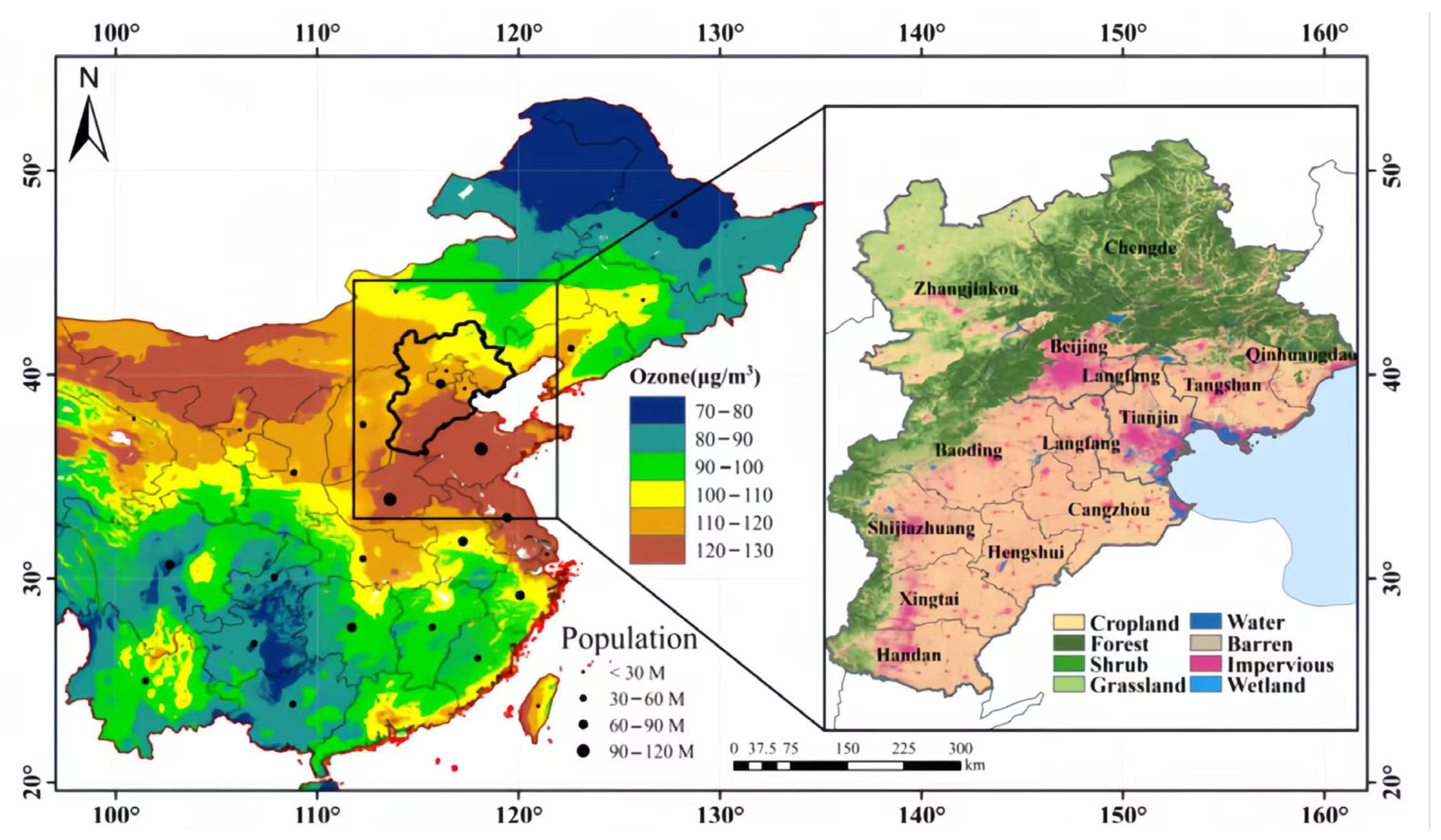
BTH, encompassing Beijing, Tianjin, and Hebei Province (Figure 1), is one of the most economically dynamic areas in northern China. According to the high-precision population geographic dataset provided by the LandScan platform of Oak Ridge National Laboratory (ORNL) in the United States, the region has a large population. Strong industrial foundation and busy traffic have had a significant impact on air quality [23]. In particular, ozone pollution has become an increasingly severe environmental issue in recent years. The region’s climatic conditions play a critical role in the formation and dispersion of ozone pollution. As a temperate monsoon climate zone with distinct seasons, the BTH region experiences hot and humid summers, which are conducive to photochemical reactions leading to ozone formation [24]. Additionally, the winter heating season, coupled with low wind speeds, exacerbates the accumulation of ozone.
Figure 1.
Overview of the study area.
Key ozone precursors in the region include NOx and VOCs emitted primarily from transportation and industrial activities. Emissions from urban and industrial areas, in particular, contribute significantly to ozone pollution. Studies have shown that ozone concentrations in the BTH region have risen in recent years, closely linked to emissions from mobile and industrial sources [25].
2.2. Data Source
2.2.1. Remote Sensing Data
This study utilized the China High-Resolution Air Pollutants (CHAP) dataset, which provides comprehensive, long-term, high-resolution records of ground-level air pollutant measurements across China. CHAP leverages big data powered by artificial intelligence, integrating ground-based measurements, remote sensing products, and atmospheric reanalysis data to capture the spatial and temporal variations in air pollution. It models pollutants such as PM2.5, NO2, and ozone with high accuracy. For ground-level ozone pollution simulation, Wei et al. (2022) [26] introduced an innovative method based on a spatiotemporal extreme random forest model within an ensemble learning framework. This approach combines ground observations, remote sensing products, and atmospheric reanalysis data, with a particular focus on solar radiation intensity and surface temperature, to estimate ozone concentrations. The method produced a high-quality dataset with complete spatial coverage (100%) and fine spatial resolution (1 km), free from cloud interference, missing values, and outliers. In terms of spatial resolution, it surpasses many existing satellite products [26]. This study utilized ground-level ozone concentration data for BTH from 2013 to 2022, combined with TROPOMI HCHO data from 2019 to 2022 to investigate the impact of HVA on ozone pollution. The ozone data were sourced from the CHAP dataset, accessible at https://zenodo.org/records/13342827 (accessed on 26 December 2024).
The CHAP dataset provides national-scale ozone measurements with a spatial resolution of 1 km × 1 km, georeferenced in the GCS_WGS_1984 coordinate system. Before analysis, data processing procedures were performed, including clipping and handling missing values, to extract a specific subset of ground-level ozone concentrations for the BTH region.
This study employed column concentration data for HCHO and NO2 obtained from the European Space Agency’s Sentinel-5 Precursor (Sentinel-5P) TROPOMI mission. Specifically, daily Level-2 products for NO2 (S5P_L2_NO2) and HCHO (S5P_L2_HCHO) were accessed via ESA’s Copernicus Open Access Hub (https://browser.dataspace.copernicus.eu/, accessed on 22 August 2024) [27]. TROPOMI offers the highest spatial resolution in atmospheric remote sensing globally, with its resolution enhanced from 7 km × 3.5 km to 5 km × 3.5 km after 7 August 2019 (http://www.tropomi.eu/mission-status, accessed on 23 August 2024). The tropospheric column concentration retrieved by TROPOMI reflects the integral concentration of pollutants in the troposphere, and its correlation with the near-surface concentration is affected by the boundary layer height (BLH)—the higher the BLH, the stronger the vertical mixing of pollutants, and the better the representativeness of the column concentration for the near-surface concentration; when the BLH is low, the column concentration is easily affected by the upper troposphere pollutants, and the deviation from the near-surface concentration increases. To ensure uniform spatial resolution and minimize errors, this study utilized the Resample tool in ArcGIS 10.8, applying the Nearest Neighbor method to standardize formaldehyde and nitrogen dioxide column concentration data to a pixel size of 1 km × 1 km. The satellite-based Differential Optical Absorption Spectroscopy (DOAS) algorithm was employed to derive tropospheric nitrogen dioxide and formaldehyde vertical column concentrations.
2.2.2. Meteorological Data
This study utilized meteorological data from the fifth-generation European Reanalysis (ERA5), accessed via the Copernicus Climate Data Store (CDS). The dataset included variables such as surface downward solar radiation, 2 m temperature, relative humidity, 10 m wind speed, and boundary layer height. Batch processing of these datasets was performed using Python 3.10 tools.
Additionally, meteorological observation data were obtained from the National Climate Data Center (NCDC) through its public FTP server: https://www.ncei.noaa.gov/data/global-hourly/access (accessed on 26 December 2024). NCDC, a component of the National Oceanic and Atmospheric Administration (NOAA), provides access to these observational records.
2.2.3. Multi-Resolution Emission Inventory for China
The Multi-resolution Emission Inventory for Climate and Air Pollution Research (MEIC) is an atmospheric emissions simulation platform developed from the Multi-resolution Emission Inventory for China. Initiated and maintained by Tsinghua University since 2010, the MEIC model aims to construct a high-resolution, multi-scale global emission inventory database for anthropogenic greenhouse gases and air pollutants. It leverages a cloud computing platform to share data products with the scientific community, providing foundational emission data to support scientific research, policy evaluation, and air quality management [28]. The dataset is accessible at http://meicmodel.org.cn (accessed on 26 December 2024).
2.3. Method
2.3.1. Analysis of Ozone Pollution Trends and Their Correlation with Meteorological Factors
This study employed the Theil–Sen slope estimation method in conjunction with the Mann–Kendall trend test [29]. The Theil–Sen estimator was utilized to quantify the magnitude of trends, while the Mann–Kendall test was applied to assess the statistical significance of those trends. Specifically: slope value between −0.0005 and 0.0005 was categorized as stable, slope greater than 0.0005 indicated an increasing trend, while a slope less than −0.0005 represented a decreasing trend; Z-value within the range of −1.96 to 1.96 was deemed statistically insignificant, whereas an absolute Z-value exceeding 1.96 indicated statistical significance.
The Kolmogorov–Zurbenko (KZ) filter was also applied in this study. This low-pass filter, based on iterative moving averages, is widely employed in studies exploring the relationship between ozone and meteorological factors. For the Beijing–Tianjin–Hebei region with monsoon-driven meteorology and complex emission structure, the autocorrelation structure and power spectrum analysis of the ozone time series show that the KZ(15,5) and KZ(365,3) filter combination has the best decomposition effect—corresponding to time truncation lengths of 33 days and 1.7 years respectively [22]. By adjusting filter parameters, the KZ filter effectively isolates variations across different temporal scales, enabling the extraction of short-term, seasonal, and long-term trend signals. Meteorological influence removal method: Based on the KZ filter decomposition results, the meteorological contribution to ozone concentration change is quantified by establishing a multiple linear regression model between ozone components (short-term/seasonal) and meteorological factors (SSRD, Tem, RH, etc.), and the residual term after regression is the ozone concentration change driven by emission sources, so as to distinguish the contributions of meteorological factors and emission sources. The primary calculation formula for the moving average is as follows:
Oi represents the original data series; i denotes the time interval; j is the moving window variable, indicating the individual time points involved in the moving average calculation; k refers to the half-width of the moving window, with the total length of the window defined as m = 2k + 1.
The final filtered result, KZ(m,p) can be obtained after multiple iterations of the moving average. Here, p represents the number of times the moving average is applied. Its filtering characteristics can be expressed by the following formula:
In the formula, N represents the maximum wavelength that can be filtered out.
The KZ filter can decompose the original time series into a superposition of short-term, seasonal, and long-term components:
O(t) = W(t) + S(t) + e(t)
The KZ filter decomposes the original time series into three components: W(t), the short-term component, which reflects variations in pollution emissions associated with synoptic-scale weather systems (wavelengths shorter than 33 days); S(t), the seasonal component, capturing seasonal fluctuation signals (wavelengths ranging from 33 days to 1.7 years); the long-term component, representing trends in pollution changes driven by climate change, policies, and economic activities (wavelengths greater than 1.7 years).
The relative contribution of the short-term, seasonal, and long-term components to the total variance of the original time series can be calculated using the following formula:
The relative contribution of each component short term, seasonal, and long term to the total variance of the original time series is calculated using the formula, where var(i(t)) represents the variance of a specific component, var(O(t)) denotes the variance of the original time series, and VE indicates the proportion of the total variance contributed by a specific component.
2.3.2. HVA Identification and Core Algorithm Improvement
Research on identifying HVA for VOCs has made significant progress internationally, especially in the preparation and application of emission inventories. High-resolution emission inventories, combined with geographic information system (GIS) and remote sensing technologies, have been used to accurately locate high-emission areas for VOCs.
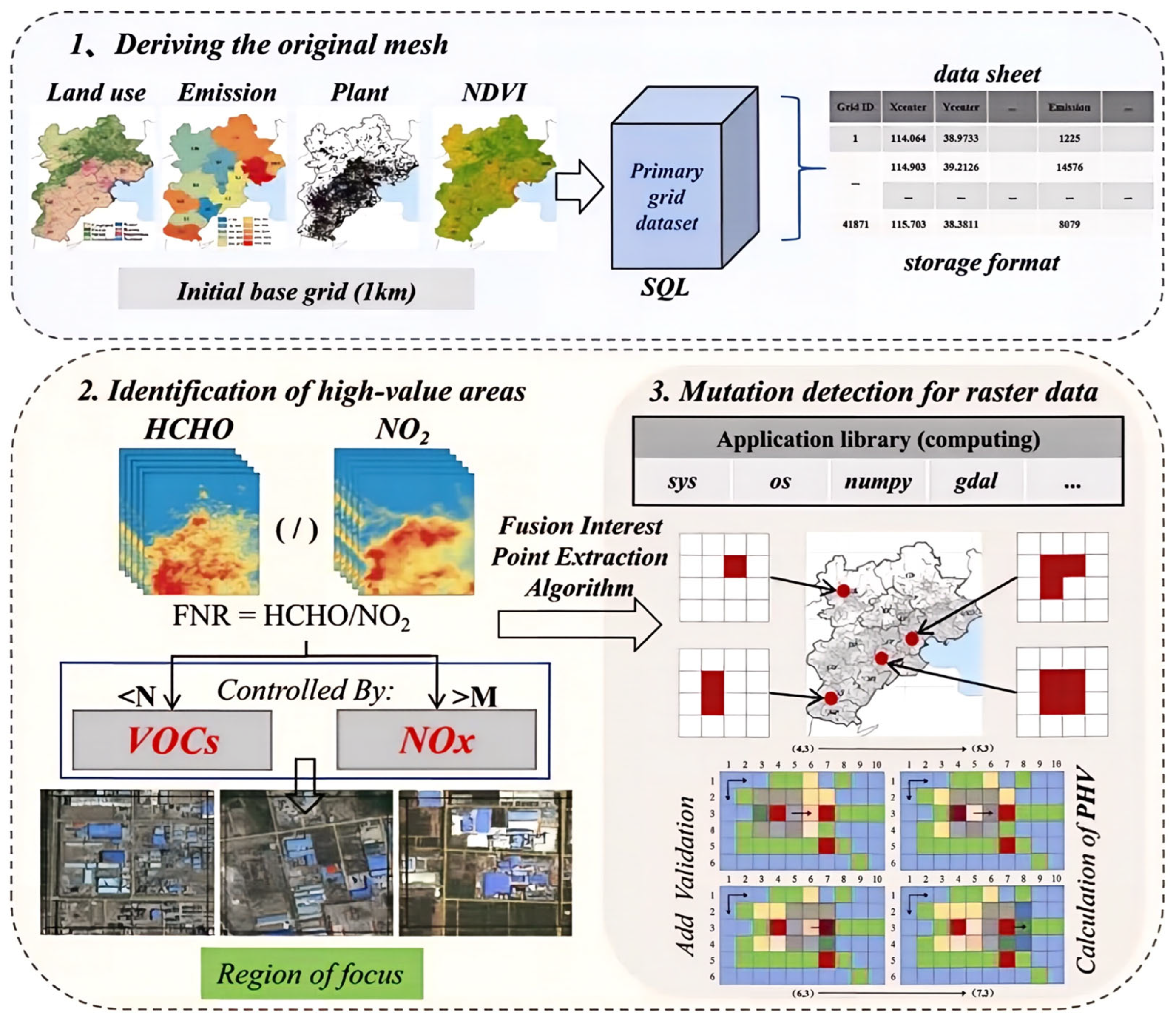
The HCHO HVA identification method is based on Python and subdivides the study area into a 0.01° × 0.01° grid (~1 km) to achieve high-resolution monitoring. Grid resolution sensitivity analysis: This study compared the identification results of 0.5 km, 1 km and 2 km grid resolutions—the 0.5 km grid has high spatial resolution but is easily affected by TROPOMI retrieval uncertainty, leading to excessive false positive anomaly zones; the 2 km grid smooths the fine spatial distribution of pollutants, leading to the loss of small-scale anomaly zones; the 1 km grid balances the retrieval uncertainty and spatial resolution, and is the optimal resolution for the Beijing–Tianjin–Hebei region. The system integrates data from land-use classifications, enterprise inventories, points of interest (POI), and NDVI environmental remote sensing to preliminarily identify pollutant emission hotspots (Figure 2). Subsequently, it employs Fractional NOx Reduction (formaldehyde/nitrogen dioxide) and pollutant concentration pixel analysis to extract anomalously high-value pixels:
In this formula, Ccenter represents the HCHO concentration in the central grid, while Cneighbor, n (n = 1, 2, …, 8) denotes the HCHO concentrations of the eight surrounding grids. A PHV value greater than 1 indicates that the concentration in the central grid is higher than the average concentration of its surrounding grids. Conversely, a PHV value less than 1 suggests that the concentration in the central grid is lower than the average concentration of its surrounding grids.
Figure 2.
Technology roadmap.
3. Results
3.1. Improved Method Accuracy Validation
Prior to this precision validation, we successfully identified multiple HVA using advanced HVA identification techniques. Building on this foundation, we incorporated mutation detection technology to further enhance the accuracy of identifying specific regions, particularly those containing factory emission sources.
The primary objective of this validation is to scientifically evaluate the effectiveness of mutation detection technology in accurately pinpointing HVA influenced by factory emissions. This is achieved by comparing the identification results obtained through traditional HVA identification techniques with those incorporating mutation detection. Through detailed matching analyses of Points of Interest (POIs) with HVAs, we aim not only to quantify the improvements in identification accuracy but also to gain deeper insights into the potential applications of mutation detection technology in monitoring complex environmental pollutants. These findings provide a robust scientific basis for future environmental management and pollution control strategies.
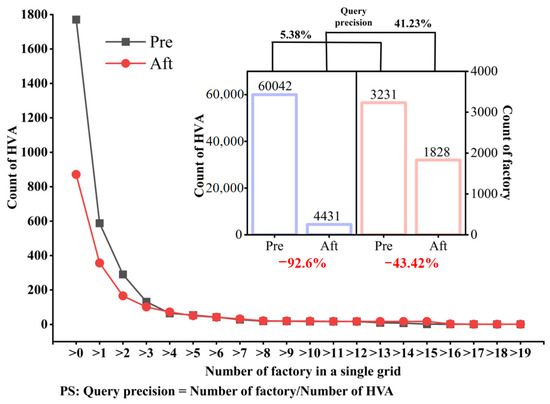
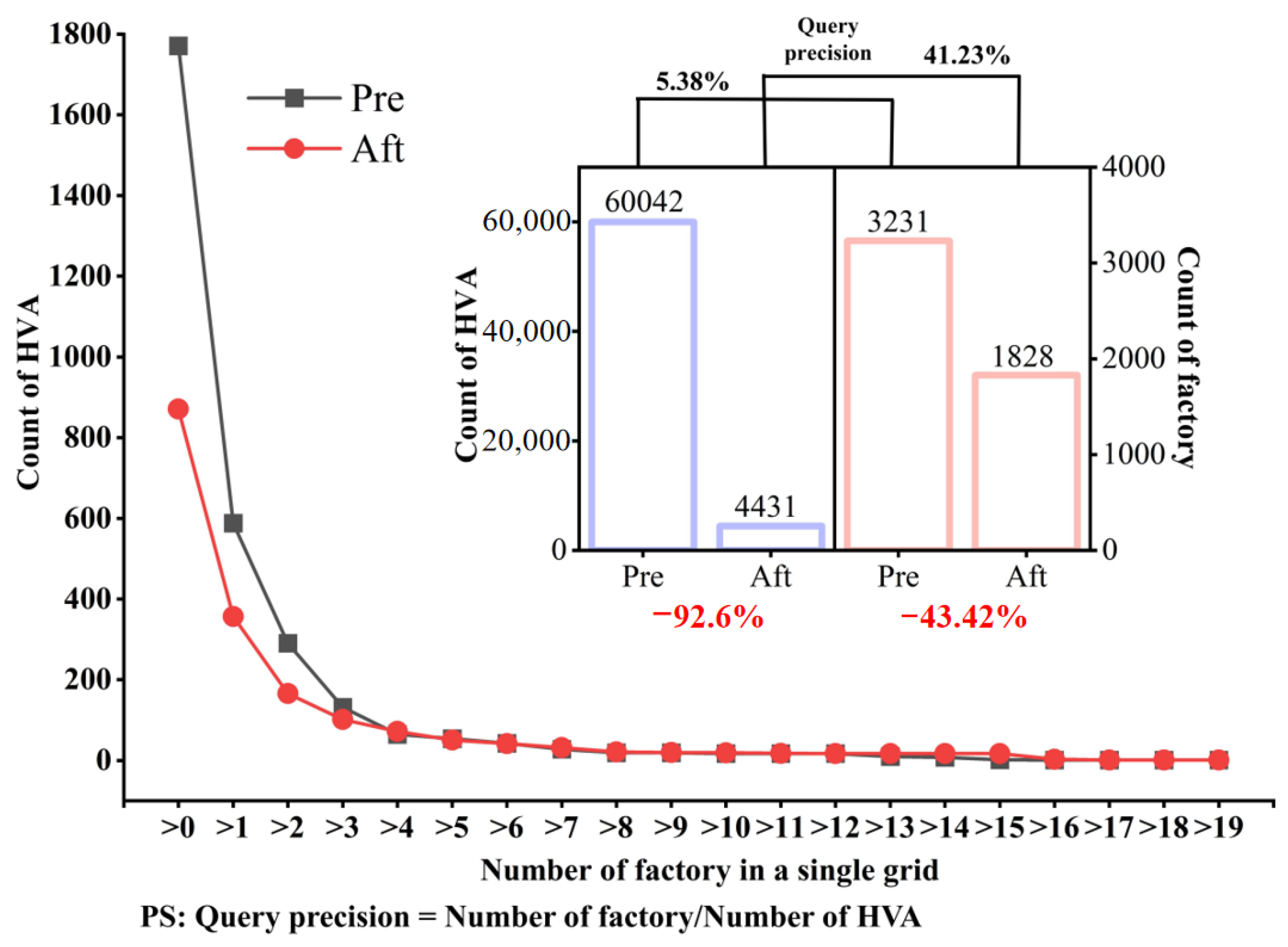
As shown in Figure 3, “Pre” represents results before the inclusion of mutation detection, while “Aft” represents results after its incorporation. The comparison reveals that the number of HVAs identified decreased significantly after incorporating mutation detection. Specifically, the total number of HVAs decreased from 60,042 (Pre) to 4431 (Aft), a reduction of 92.6%, indicating the selective optimization effect of the mutation detection technology. Additionally, the number of factories identified decreased from 3231 (Pre) to 1828 (Aft), representing a reduction of 43.42%.
Figure 3.
Comparison of accuracy with the addition of mutation detection technology.
To further evaluate identification precision, we introduced the concept of query accuracy, defined as the ratio of factory count to HVA count. The query accuracy improved from 5.38% (Pre) to 41.32% (Aft). Moreover, the average number of factories per HVA containing factories increased from 1.82 (Pre) to 2.42 (Aft). These results collectively demonstrate a substantial improvement in identification precision and highlight the effectiveness of mutation detection technology in refining HVA identification.
3.2. Overview of Ozone Pollution in BTH
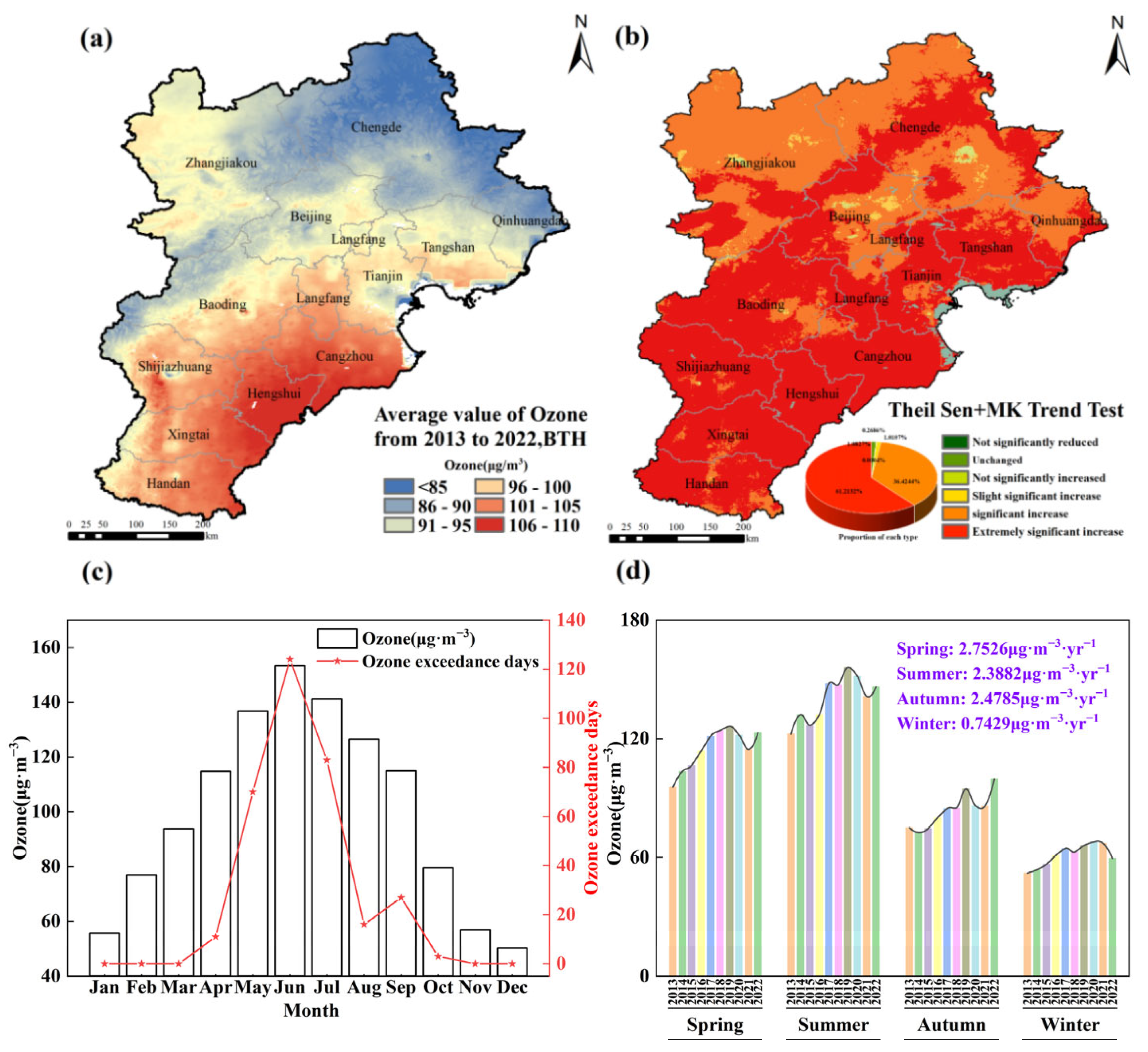
The mean near-surface ozone concentrations for 2013–2022 are shown in Figure 4a. The spatial distribution of ozone in BTH exhibits a pattern of higher concentrations in the east and south and lower concentrations in the west and north. In the northern areas, such as Zhangjiakou and Chengde, the ozone concentration was below 85 μg/m3, while southeastern regions, including Hengshui, Cangzhou, western Xingtai, and western Handan, displayed higher levels, with average concentrations exceeding 100 μg/m3.
Figure 4.
(a) Overview of near-surface ozone concentrations in BTH. (b) Ozone Trend in the Beijing-Tianjin-Hebei Region. (c) Monthly average ozone concentration and days exceeding the standard. (d) Changes in ozone concentration in different seasons from 2013 to 2022.
The results of the Theil–Sen slope estimator combined with the Mann–Kendall trend test for 2013–2022 indicate a significant increasing trend across most of the BTH region (Figure 4b). Central and southern areas experienced a highly significant rise in ozone concentrations, while northern areas showed a significant increase. Coastal regions, including Tangshan, Tianjin, and parts of Cangzhou, exhibited either a nonsignificant increase or stability.
The monthly average near-surface ozone exceedance days from 2013 to 2022 displayed an “M”-shaped bimodal pattern, peaking in July and September (Figure 4c). Ozone exceedance days primarily occurred during the summer and autumn seasons, with minimal ozone pollution observed in winter. This seasonal trend aligns with the findings of Fang et al. (2020), which identified similar seasonal characteristics in the BTH region [30]. In BTH, meteorological conditions during summer and autumn, such as high temperatures, long sunlight hours, and strong solar radiation, are conducive to ozone (O3) formation. Conversely, during spring and winter, weaker solar radiation, lower average temperatures, and frequent occurrences of southward winter monsoons create unfavorable conditions for O3 generation and accumulation.
Between 2013 and 2022, all four seasons exhibited varying degrees of increasing trends in O3 concentrations. The most pronounced growth occurred in spring, followed by autumn and summer, while winter showed the slowest increase. The average annual growth rates for the seasons were 2.7526 μg/m3/yr, 2.4785 μg/m3/yr, 2.3882 μg/m3/yr, and 0.7429 μg/m3/yr, respectively (Figure 4d).
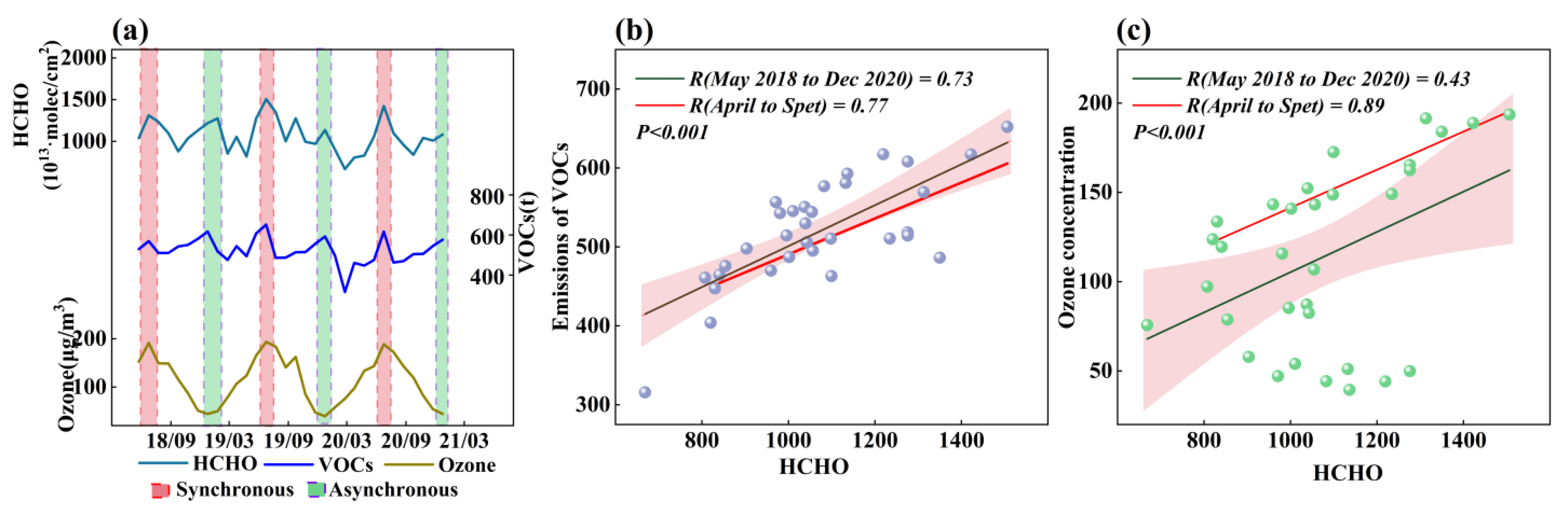
The KZ filter, as a crucial method for evaluating ozone pollution sources, relies heavily on parameter selection, which influences the filtered results and associated time scales. For example, Yao et al. (2024) utilized a combination of KZ(15,5) and KZ(365,3) filters, corresponding to time truncation lengths of 33 days and 1.7 years, respectively [22]. This filter combination demonstrated high applicability and has been widely used in trend studies of ozone and other pollutants in the United States [30], South Korea [31], and various cities in China. In this study, meteorological factors influencing O3 such as BLH, PH, RH, SP, SSRD, Tem, U10, V10, and Wind were analyzed using the KZ filter to derive the time series of different components for near-surface O3 and meteorological parameters in BTH. Among them, BLH (Boundary Layer Height) refers to the boundary layer height, which affects the vertical diffusion of pollutants; SP (Surface Pressure) represents the surface air pressure, reflecting the large-scale circulation background; RH (Relative Humidity) indicates the relative humidity, influencing atmospheric chemical processes; SSRD (Surface Solar Radiation Downwards) is the downward shortwave solar radiation, serving as the fundamental energy source driving photochemical reactions; Tem (Temperature at 2 Meters) denotes the temperature at 2 m, where high temperatures promote ozone formation. The wind field parameters include: U10 and V10, representing the zonal (east–west) and meridional (north–south) wind components at 10 m height, respectively, used to analyze the horizontal transport of pollutants; Wind, calculated from U10 and V10, characterizes the atmospheric diffusion capacity. The variance contribution of the three components accounts for over 93% of the total variance (Table 1), indicating good decomposition effect and relative independence among the components. For O3 in the BTH region, the variance contributions of the short-term component W(t), seasonal component S(t), and long-term component e(t)were 18.63%, 74.08%, and 3.33%, respectively, demonstrating the characteristic S(t) > W(t) > e(t). This suggests that fluctuations in the original O3 time series were primarily driven by short-term and seasonal components, caused by variations in pollution sources and meteorological conditions. The KZ-filtered results for meteorological parameters revealed strong seasonal signals for RH, SP, SSRD, and Tem, with seasonal components contributing 53.27% to 92.22% of the total variance, followed by short-term components (4.44% to 39.15%). For other meteorological parameters, short-term components contributed the largest proportion (57.22% to 84.79%), with seasonal components contributing 12.23% to 37.43%, and long-term trends being minimal. Additionally, the spatially resolved (0.25° × 0.25°) MEIC VOC emissions inventory [32] was used to analyze VOC emissions in the BTH region from April to September. Correlations between VOC emissions, HCHO column concentrations, and near-surface O3 concentrations were examined. As shown in Figure 5a, the results exhibited clear patterns: red boxes highlighted synchronized variations, while green boxes indicated asynchronous variations. HCHO trends showed strong consistency with VOC emissions, with all three parameters peaking in summer. This indicates that VOC emissions, as indicated by HCHO, significantly contributed to O3 pollution in the BTH region. In winter, high VOC emissions corresponded to elevated HCHO concentrations, while near-surface O3 concentrations decreased, suggesting stronger dispersion effects of meteorological factors during this season. Figure 5b illustrates the correlation between HCHO column concentrations and VOC emissions (R = 0.73), with red spheres representing April to September. During the ozone pollution season (April–September), the correlation increased to R = 0.77, further confirming HCHO column concentrations as indicators of VOC emissions. Similarly, Figure 5c shows the correlation between HCHO column concentrations and near-surface O3 concentrations (R = 0.43), which strengthened to R = 0.89 during the ozone pollution season.
Table 1.
KZ filtering results.
Figure 5.
Correlation analysis of VOCs, HCHO, and near-surface ozone. (a) Monthly changes in HCHO VOCs and Ozone. (b) Correlation analysis between HCHO and VOCs. (c) Correlation analysis between HCHO and Ozone.
3.3. Analysis of the Results of the Identification of HVA
3.3.1. Ozone Generation Sensitivity Control Areas and Urban Typing
The production of ozone is significantly influenced by VOCs and NOx, which serve as key precursors in photochemical processes. The formation of ozone follows a nonlinear relationship determined by the concentrations of these precursors. Consequently, understanding the sensitivity of ozone formation to VOCs and NOx is crucial. Previous studies have shown that in BTH, the VOCs/NOx ratio, also known as the Fractional NOx Ratio (FNR), governs the ozone formation control mechanism, with values ranging between 3.0 and 3.8. When the FNR value is below 3.0, ozone formation is predominantly VOC-limited; for values between 3.0 and 3.8, ozone production is influenced by both VOCs and NOx; and for FNR values above 3.8, ozone formation becomes NOx-limited.
In this study, the findings of Zheng et al. were utilized, which identified an FNR threshold of 3.06, with a transition range of 2.67 to 3.47. Regions with FNR values below 2.67 were classified as VOC-limited zones, those with values between 2.67 and 3.47 as transition zones, and regions with FNR values above 3.47 as NOx-limited zones [33,34]. This study calculated and mapped the ozone formation sensitivity in BTH using HCHO and NO2 column concentrations from 2019 to 2022. The findings revealed distinct spatial patterns in ozone formation sensitivity during this period. Northern areas, such as Zhangjiakou and parts of Chengde, were predominantly NOx-limited, while the region extending from northern Shijiazhuang through northern Baoding, northern Beijing, and southern Chengde exhibited VOC- or VOC-NOx co-limitation. The southern parts of the region were primarily VOC-limited.
To compare the differences in ozone formation mechanisms between urban and rural areas, the first essential step involved extracting pixels representing urban buildings and roads and creating a 1 km × 1 km grid (comprising 228,881 pixels). The proportion of urban and road pixels within each grid cell was calculated. Regions where urban and road pixels accounted for more than 50% of the grid area were classified as “urban agglomeration zones,” areas with proportions between 10% and 50% as “urban expansion zones,” and those with proportions below 10% as “non-urban areas.” The segmentation results were validated through random sampling of remote sensing images, achieving a confidence level of 96% with a confidence interval of 10%. Figure 6 illustrates the ozone formation sensitivity distribution and the classification of urban types in the BTH region from 2019 to 2022.
Figure 6.
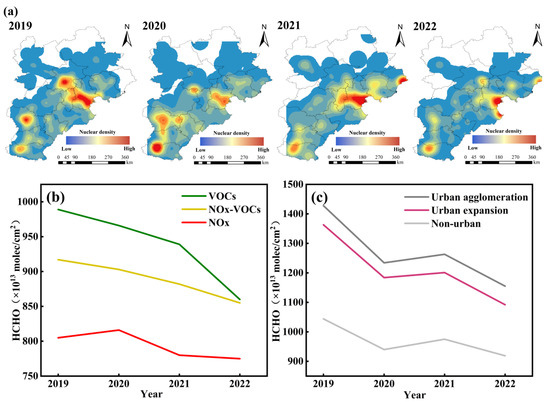
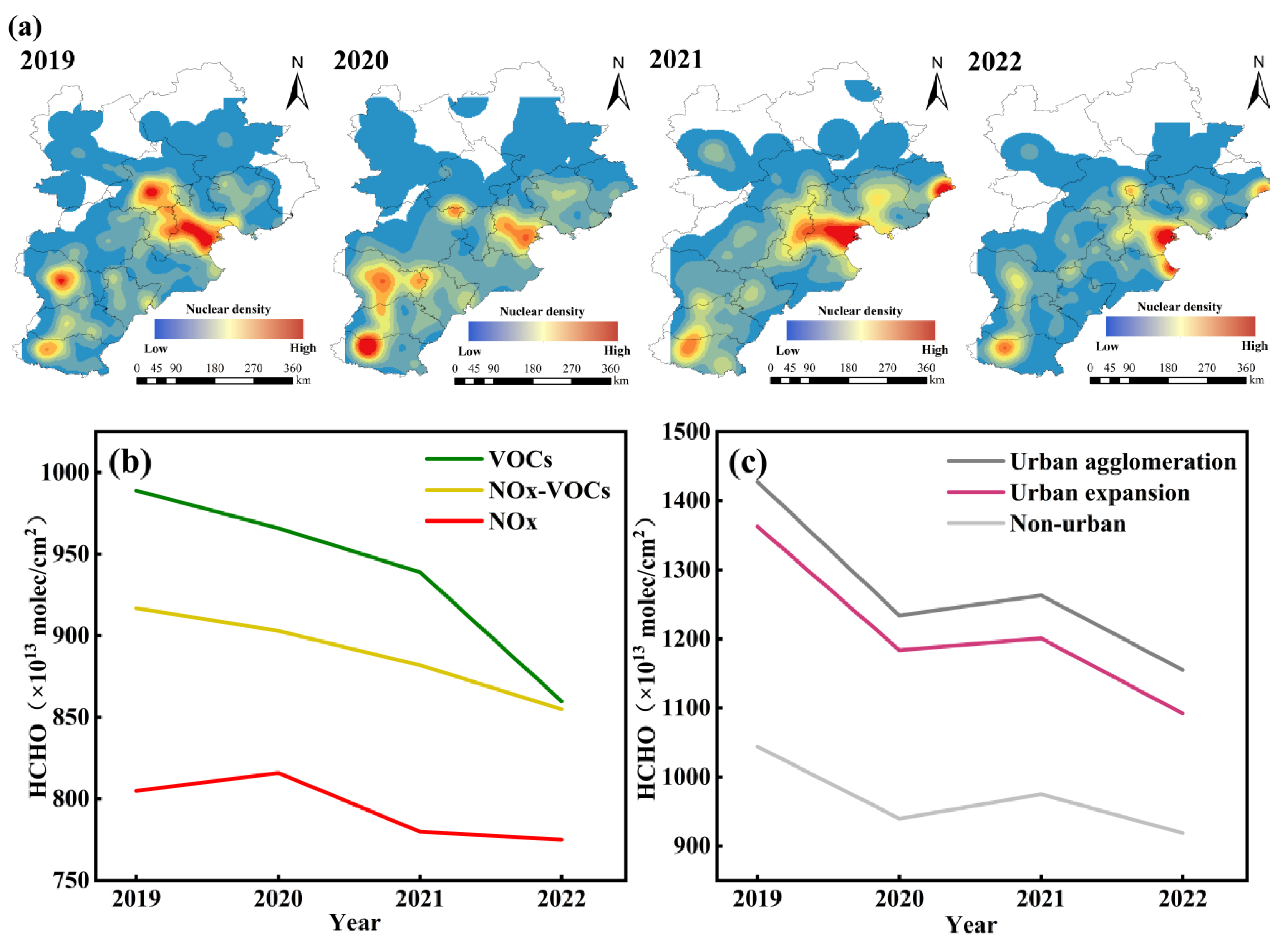
(a) Kernel density map of HCHO HVA in the BTH region and changes in the share of different zoning types. (b) VOCs, NOx VOCs, HCHO concentration changes in NOx control zone. (c) Changes in HCHO concentration in urban agglomeration, urban expansion, and non urban areas.
3.3.2. Overall Analysis
Using TROPOMI data, VOCs fixed-source HVA were identified, resulting in a total of 4431 HVA, distributed as follows: 1629 in 2019, 995 in 2020, 767 in 2021, and 1040 in 2022. Based on the locations and frequencies of these HVA, a kernel density distribution map was generated (Figure 6a). The results indicate that during 2019–2020, HVA were densely concentrated in the southern part of Beijing, central and southern Tianjin, central Shijiazhuang, and western Handan. In 2021, HVA shifted to central and southern Tianjin, eastern Langfang, and eastern Qinhuangdao. By 2022, HVA were primarily located in eastern Tianjin, eastern Qinhuangdao, and western Handan.
From the distribution of HCHO column concentrations in HVA, the concentration ranges during April–September from 2019 to 2022 were 1002–4079, 1001–4329, 1001–5605, and 1002–5049 × 1013 molec·cm−2, respectively (with a threshold lower limit set at 1000 × 1013 molec·cm−2 for identifying HVA). During the same period, the average HCHO concentrations in VOCs-controlled areas were 989, 966, 939, and 860 × 1013 molec·cm−2, respectively; in NOx-VOCs co-controlled areas, the averages were 917, 903, 882, and 855 × 1013 molec·cm−2; and in NOx-controlled areas, the averages were 805, 816, 780, and 775 × 1013 molec·cm−2. Significant differences in HCHO concentrations were observed across different ozone formation sensitivity zones, with overall concentration levels ranked as VOCs > NOx-VOCs > NOx, all showing varying degrees of decline (Figure 6b). In terms of urban types, the average HCHO concentrations in urban agglomeration areas were 1428, 1234, 1263, and 1155 × 1013 molec·cm−2, respectively; in urban expansion areas, the averages were 1363, 1184, 1201, and 1092 × 1013 molec·cm−2; and in non-urban areas, the averages were 1044, 940, 975, and 919 × 1013 molec·cm−2. Similar distinctions in HCHO concentrations were observed across different urban types, with the overall levels ranked as urban agglomeration areas > urban expansion areas > non-urban areas, all showing varying degrees of decline (Figure 6c).
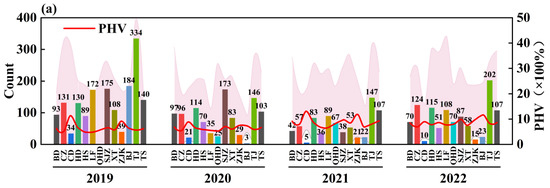
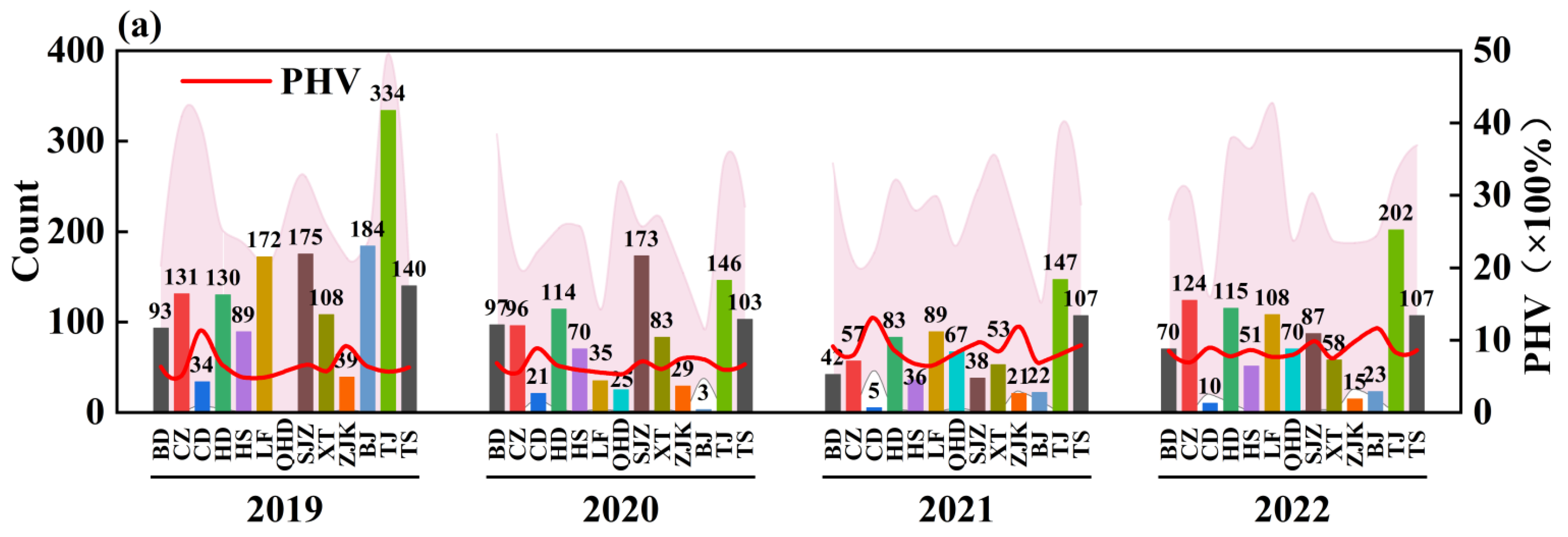
Figure 7a shows the statistics of HVA in 13 cities within BTH from 2019 to 2022. Cities located on plains and near the coast, such as Shijiazhuang, Tianjin, and Handan, exhibited a higher number of HCHO HVA. After calculating the PHV index, the PHV ranges for HVA were as follows: 4.82–11.295 (%) in 2019, 5.25–7.49 (%) in 2020, 6.71–13.06 (%) in 2021, and 6.898–11.59 (%) in 2022. From 2019 to 2021, the highest PHV values were observed in Chengde, while in 2022, the highest value occurred in Beijing. This can be attributed to Chengde’s overall low HCHO concentrations, where emissions from a single grid cell are more likely to result in abnormally high values. Despite Chengde having the highest PHV data, the average HCHO concentration in its HVA ranked second-to-last, a phenomenon also observed in Zhangjiakou. As a straightforward metric, PHV values indicate the prominence of anomalous high values within a single grid cell—the higher the value, the more pronounced the anomaly. This provides significant methodological support for accurately identifying pollutant concentration anomalies.
Figure 7.
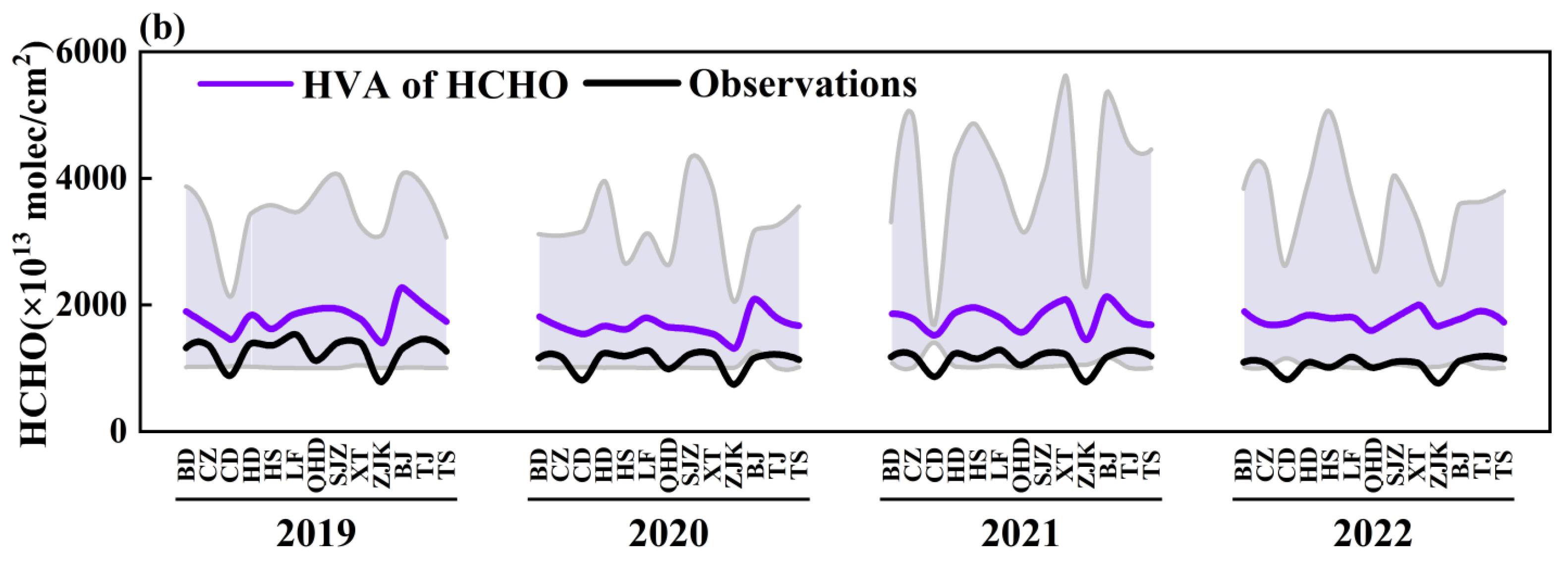
(a) Statistics of HCHO high value areas in BTH. (b) HCHO concentration in high-value areas and average concentration in the city where it is located.
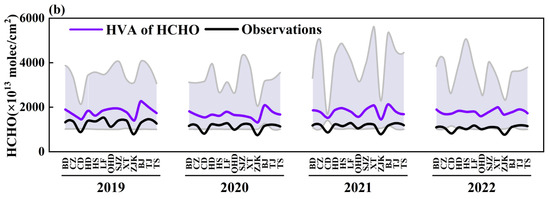
The identification of HCHO HVA does not mechanically select the grid cells with the highest values, as such points may be located in mountainous, grassland, or farmland areas. Thanks to the support of multi-source remote sensing data, including NDVI and land-use type data, it is possible to more accurately determine the impact of emissions on VOCs and, in turn, their influence on HCHO concentrations. Figure 7b compares the distribution of HCHO HVA concentrations in each city with observed urban concentrations. It is evident that the shaded areas, representing the concentration range of the HVA identification results, are significantly higher than the black line segments representing observed concentrations. Additionally, in most cities, the minimum concentration of the identified HVA exceeds the observed concentrations, further demonstrating the role of meteorological factors in pollutant transport. From 2019 to 2022, the average concentration of HCHO HVA exceeded the corresponding urban concentrations by a ratio range of 19.19–118.32%, with concentrations ranging from 261 to 954 × 1013 molec·cm−2.
3.3.3. Distribution of High Value Areas in Typical Cities
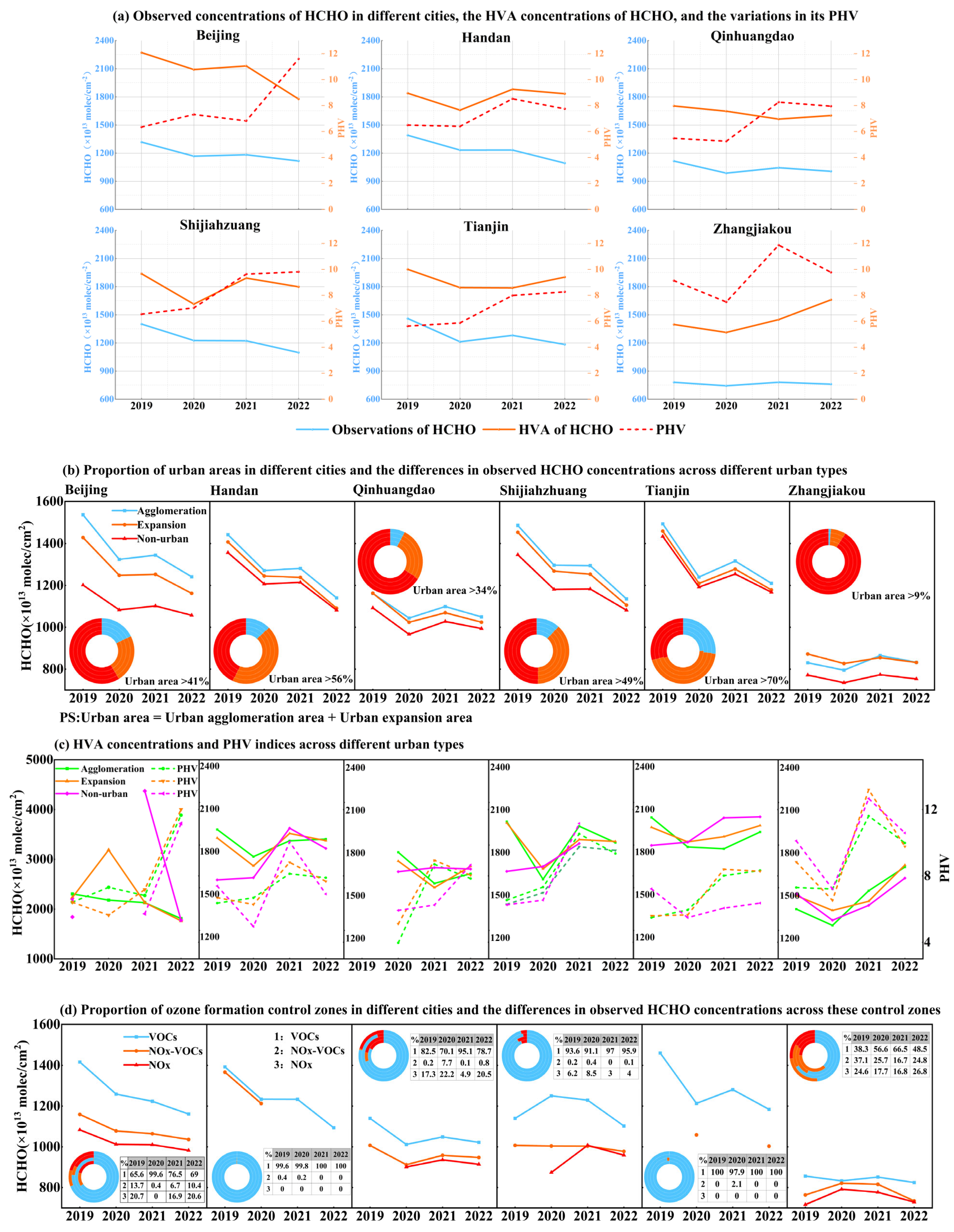
Overlaying the HVA identification results from 2019 to 2022, six representative cities with high kernel density were selected for further analysis of changes in HCHO observed concentrations, The concentration unit of HCHO in this article is molec·cm−2, which represents the total number of specific gas molecules accumulated in a vertical atmospheric column per unit area (1 square centimeter). This unit intuitively reflects the total content of gases in the vertical direction of the atmosphere and is a key physical quantity for quantifying the spatial distribution and load of trace gases. HCHO HVA concentrations, PHV, and urbanization levels. The selected cities are Zhangjiakou (ZLK), Qinhuangdao (QHD), Shijiazhuang (SJZ), Beijing (BJ), Handan (HD), and Tianjin (TJ). Figure 7 illustrates the overlaid results from 2019 to 2022. In Figure 7a, the distribution of HCHO HVA across different urban types is shown. It clearly demonstrates that the majority of HVA in the six cities are concentrated in urban agglomeration areas and urban expansion areas, with only a small portion located in non-urban areas. From the perspective of FNR, Figure 7b shows that the vast majority of HVA are found in VOCs-limited control zones, with very few appearing in transition zones or NOx-limited control zones.
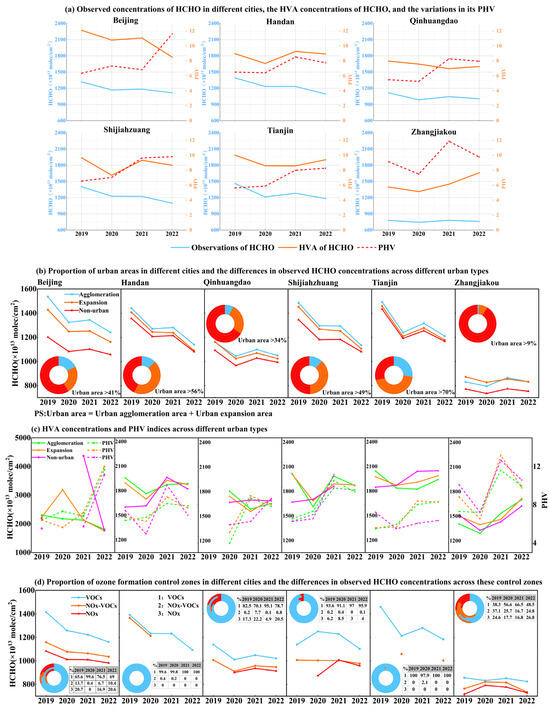
Figure 8a illustrates the temporal variations in key indicators for six cities in BTH (Beijing, Handan, Qinhuangdao, Shijiazhuang, Tianjin and Zhangjiakou) during 2019–2022. Analysis of HCHO observational concentrations revealed consistent trends across the six cities, characterized by a decrease–increase–decrease pattern over the study period. However, the concentration in Zhangjiakou was notably lower than in other cities. The red curve represents HCHO concentrations within HVAs, which exceeded the citywide average by 24.39% to 54.20%. The red dotted line represents the PHV index, with Zhangjiakou, Qinhuangdao, and Handan showing a decrease–increase–decrease trend, while Shijiazhuang and Tianjin exhibited continuous growth. In Beijing, PHV displayed an increase–decrease–increase pattern. The PHV index, reflecting the extent of anomalous point source emissions, provides critical insights for designing emission reduction strategies and identifying pollution hotspots. Figure 8b illustrates the proportion of urban areas in different cities and the variation in observed HCHO concentrations across different urban types. From the perspective of urbanization levels, Tianjin has the highest proportion of urban areas (urban agglomeration areas + urban extension areas), accounting for 70% of the entire city, followed by Handan at 56% and Shijiazhuang at 49%. Zhangjiakou has the lowest proportion at 9%. The line graph in the figure shows the changes in HCHO concentrations across different urban types in each city from 2019 to 2022. All cities exhibit varying degrees of fluctuation, with the main trend being a decrease followed by an increase and then another decrease. Observing the HCHO concentration levels in each city, it is evident that Tianjin, Handan, and Shijiazhuang have relatively higher overall concentrations, while Zhangjiakou has lower concentrations, showing a clear positive correlation with urbanization levels. This indicates that an increase in urbanization levels has a certain promoting effect on HCHO concentrations. Additionally, based on the calculated data, the HCHO concentrations in urban areas (urban agglomeration areas + urban extension areas) of all cities are higher than those in non-urban areas, with the differences being 18.58% for Beijing, 4.09% for Handan, 5.80% for Qinhuangdao, 7.41% for Shijiazhuang, 2.87% for Tianjin, and 10.59% for Zhangjiakou. This shows that the disparity in HCHO concentrations between urban and non-urban areas is highest in Beijing, followed by Zhangjiakou and Shijiazhuang, and lowest in Tianjin, indicating that Tianjin has relatively high and evenly distributed HCHO concentrations overall. Figure 8c summarizes HCHO concentrations and PHV indices in HVAs across different urbanization categories. Results indicated varying patterns: Zhangjiakou: Urban extension > urban agglomeration > non-urban (HCHO concentrations); non-urban > urban extension > urban agglomeration (PHV indices). Qinhuangdao: Non-urban > urban agglomeration > urban extension (HCHO concentrations); urban extension > non-urban > urban agglomeration (PHV indices). Shijiazhuang: Urban agglomeration > urban extension > non-urban (HCHO concentrations); urban agglomeration > urban extension > non-urban (PHV indices). Beijing: Urban extension > non-urban > urban agglomeration (HCHO concentrations); urban agglomeration > urban extension > non-urban (PHV indices). Handan: Urban agglomeration > urban extension > non-urban (HCHO concentrations); urban extension > non-urban > urban agglomeration (PHV indices). Tianjin: Non-urban > urban extension > urban agglomeration (HCHO concentrations); urban extension > urban agglomeration > non-urban (PHV indices). Figure 8d displays the HCHO column concentrations in different FNR zones. The concentrations in the VOCs-limited zones are significantly higher than those in the transition zones or NOx-limited zones, particularly in Beijing, Qinhuangdao, Shijiazhuang, and Tianjin. This aligns with policy measures aimed at reducing HCHO in VOCs-limited zones. It is noteworthy that in some years, data for NOx-limited zones or transition zones were unavailable for Shijiazhuang, Handan, and Tianjin. This is due to the unique distribution of ozone formation control zones in each city. For example, almost the entire areas of Handan and Tianjin fall within the VOCs-limited zones. Given that HVA primarily occurs in VOCs-limited zones and transition zones, no comparison of HCHO HVA concentrations was conducted. The study employed a weighted average method to assess HCHO HVA concentrations and PHV indices, ultimately identifying the following areas as key regions for HCHO emission management: the urban extension zone of Zhangjiakou, the non-urban zone of Qinhuangdao, the urban agglomeration zone of Shijiazhuang, the urban extension zone of Beijing, the urban agglomeration zone of Handan, and the non-urban zone of Tianjin. This analysis underscores the importance of integrating urbanization, FNR classification, and emission indices to effectively manage and mitigate VOC emissions and their impact on air quality.
Figure 8.
Observed HCHO concentrations, HCHO HVA concentrations, and PHV variations across different urban types and ozone formation sensitivity zones in typical cities.
4. Discussion
The formaldehyde high-value areas identified in this study provide a methodological framework for tracing VOC emission hotspots in the Beijing–Tianjin–Hebei region, yet the results are affected by inherent limitations of satellite remote sensing and research design, and the relevant conclusions can be further elaborated by combining them with similar studies. In previous research, satellite remote sensing retrieval is generally disturbed by meteorological factors such as cloud cover and dust, and this study also has the problem of spatiotemporal gaps in valid data [35,36,37]. Despite this, the study maintained reliable results with a high data capture rate and sufficient sample size on ozone exceedance days, while confirming the advantage of high-resolution data in precisely identifying pollution hotspots—consistent with the conclusion proposed by Li et al. (2021) in their TROPOMI satellite-based research on ozone precursors: “Satellite remote sensing data can effectively support regional pollution hotspot identification” [38].
This study focuses on fixed industrial emission sources and excludes areas dominated by mobile and residential sources such as the core urban areas of Beijing. Although it meets the practical needs of industrial emission control, it also causes omissions in the identification of high-value areas, which are important emission source areas of urban HCHO. Supplementary monitoring needs to be carried out by combining ground mobile monitoring, MAX-DOAS and other methods. This study retains the identification of formaldehyde high-value areas in NOx-limited zones to ensure data objectivity. The results show that the proportion of high-value areas in such zones is low and the concentration is significantly lower than that in VOCs-limited zones. which is consistent with the conclusion proposed by Tian et al. (2025) [39] that formaldehyde has limited contribution to ozone generation in NOx restricted areas, and is also consistent with the research results confirmed by Carter (2010) [40] through smoke box experiments that HCHO has a lower potential for ozone generation in high-NOx environments. This further confirms that formaldehyde control in VOCs control areas is the core of ozone governance in the Beijing Tianjin Hebei region [39,40].
This study has notable limitations: first, the time series of ozone and formaldehyde data do not match, making it impossible to analyze their long-term coupling relationship [41]; second, the primary and secondary formation of formaldehyde is not distinguished, nor is the contribution of biogenic VOCs quantified; third, the impact of regional pollutant transport on the Beijing–Tianjin–Hebei region is ignored; fourth, the verification based on enterprise POIs has false positive and false negative biases caused by incomplete data and spatial offset [42]. Future research should integrate multi-source long-time series data to conduct formaldehyde source apportionment, introduce atmospheric chemical transport models to quantify the contribution of regional transport, and optimize the identification and verification system of high-value areas, so as to provide more detailed scientific support for precise pollution control.
5. Conclusions
This study has focused on ozone pollution in BTH, investigating its sources and analyzing the distribution characteristics of ozone precursors, with a specific emphasis on HCHO as an indicator of VOCs. By identifying HCHO HVAs and examining ozone precursor distributions from various perspectives, the study offers insights and recommendations for ozone pollution control in the region. The key findings are as follows:
- Ozone pollution in the BTH region has intensified over the decade, with an annual average growth rate of 2.51 μg/m3 per year and a higher growth rate of 3.43 μg/m3 per year during the April–September period. The ten-year mean distribution exhibits a typical south-high/north-low pattern. Trend analysis indicates a consistent increase or stabilization at higher levels over the decade, with the highest growth rate observed in spring, followed by autumn, summer, and winter.
- The KZ filtering results demonstrated effective decomposition of ozone time-series components, revealing that short-term and seasonal variations dominate fluctuations in the original data. Correlation analysis between meteorological factors and ozone concentrations indicated that ozone generation in the BTH region has been strongly influenced by solar radiation and temperature, highlighting the significant role of local photochemical reactions.
- Analysis of the four-year FNR partitioning showed a consistent pattern: NOx-limited conditions in the northern region, VOCs-limited conditions in most southern areas, and a transition zone in the northern parts of Shijiazhuang, Baoding, and Beijing, extending to southern Chengde. Urban zone classifications remained relatively stable, with non-urban areas constituting the largest proportion, followed by urban aggregation zones and urban expansion zones.
- High-density HCHO regions were identified in the southern part of Beijing, central and southern Tianjin, central Shijiazhuang, western Handan, eastern Langfang, and eastern Qinhuangdao. From 2019 to 2022, the average HCHO concentration in HVAs exceeded the corresponding city averages by 19.19% to 118.32%, with concentrations ranging from 261 to 954 × 1013 molec·cm−2.
- The analysis of typical cities suggests that targeting HCHO emissions in specific areas—such as the urban expansion zone in Zhangjiakou, the non-urban zone in Qinhuangdao, the urban aggregation zone in Shijiazhuang, the urban expansion zone in Beijing, the urban aggregation zone in Handan, and the non-urban zone in Tianjin—could enhance the effectiveness of ozone pollution mitigation strategies.
Author Contributions
Conceptualization, P.M. and J.-T.D.; methodology, Z.C., H.C. and X.Y.; software, S.D. and J.Z.; validation, G.C., A.Z. and Q.Z.; formal analysis, S.D.; investigation, L.C. and R.D.; resources, W.Z.; data curation, S.D.; writing—original draft preparation, S.D.; writing—review and editing, S.D. and L.Z.; visualization, J.Z. and Y.Y. All authors have read and agreed to the published version of the manuscript.
Funding
This research was funded by the National Key R&D Program of China, grant number 2023YFC3709501.
Institutional Review Board Statement
Not applicable.
Informed Consent Statement
Not applicable.
Data Availability Statement
The original contributions presented in the study are included in the article, further inquiries can be directed to the corresponding author.
Conflicts of Interest
The funders had no role in the design of this study; in the collection, analyses, or interpretation of data; in the writing of the manuscript; or in the decision to publish the results.
References
- Wang, L.; Yang, X.; Dong, J.; Yang, Y.; Ma, P.; Zhao, W. Evolution of Surface Ozone Pollution Pattern in Eastern China and Its Relationship with Different Intensity Heatwaves. Environ. Pollut. 2023, 338, 122725. [Google Scholar] [CrossRef] [Scilit]
- Huang, J.; Pan, X.; Guo, X.; Li, G. Health Impact of China’s Air Pollution Prevention and Control Action Plan: An Analysis of National Air Quality Monitoring and Mortality Data. Lancet Planet. Health 2018, 2, e313–e323. [Google Scholar] [CrossRef] [Scilit] [PubMed]
- Gopikrishnan, G.S.; Kuttippurath, J. Four Years of National Clean Air Programme (NCAP) in Indian Cities: Assessment of the Impact on Surface Ozone during the Period 2018–2022. Sustain. Cities Soc. 2024, 101, 105207. [Google Scholar] [CrossRef] [Scilit]
- Xia, Y.; Xie, F.; Lu, X. Enhancement of Arctic Surface Ozone during the 2020–2021 Winter Associated with the Sudden Stratospheric Warming. Environ. Res. Lett. 2023, 18, 024003. [Google Scholar] [CrossRef] [Scilit]
- Zanis, P.; Akritidis, D.; Turnock, S.; Naik, V.; Szopa, S.; Georgoulias, A.K.; Bauer, S.E.; Deushi, M.; Horowitz, L.W.; Keeble, J.; et al. Climate Change Penalty and Benefit on Surface Ozone: A Global Perspective Based on CMIP6 Earth System Models. Environ. Res. Lett. 2022, 17, 024014. [Google Scholar] [CrossRef] [Scilit]
- Anagha, K.S.; Kuttippurath, J.; Sharma, M.; Cuesta, J. A Comprehensive Assessment of Yield Loss in Rice Due to Surface Ozone Pollution in India during 2005–2020: A Great Concern for Food Security. Agric. Syst. 2024, 215, 103849. [Google Scholar] [CrossRef] [Scilit]
- Chan, C.K.; Yao, X. Air Pollution in Mega Cities in China. Atmos. Environ. 2008, 42, 1–42. [Google Scholar] [CrossRef] [Scilit]
- Feng, T.; Bei, N.; Huang, R.-J.; Cao, J.; Zhang, Q.; Zhou, W.; Tie, X.; Liu, S.; Zhang, T.; Su, X.; et al. Summertime Ozone Formation in Xi’an and Surrounding Areas, China. Atmos. Chem. Phys. 2016, 16, 4323–4342. [Google Scholar] [CrossRef] [Scilit]
- Wang, M.; Zhu, T.; Zhang, J.P.; Zhang, Q.H.; Lin, W.W.; Li, Y.; Wang, Z.F. Using a Mobile Laboratory to Characterize the Distribution and Transport of Sulfur Dioxide in and around Beijing. Atmos. Chem. Phys. 2011, 11, 11631–11645. [Google Scholar] [CrossRef] [Scilit]
- Wu, J.; Li, G.; Cao, J.; Bei, N.; Wang, Y.; Feng, T.; Huang, R.; Liu, S.; Zhang, Q.; Tie, X. Contributions of Trans-Boundary Transport to Summertime Air Quality in Beijing, China. Atmos. Chem. Phys. 2017, 17, 2035–2051. [Google Scholar] [CrossRef] [Scilit]
- GB 3095-2026; Ambient Air Quality Standard. China Environmental Science Press: Beijing, China, 2026.
- Chen, X.; Gao, J.; Chen, L.; Khanna, M.; Gong, B.; Auffhammer, M. The Spatiotemporal Pattern of Surface Ozone and Its Impact on Agricultural Productivity in China. PNAS Nexus 2023, 3, pgad435. [Google Scholar] [CrossRef] [Scilit]
- Wang, M.; Li, S.; Zhu, R.; Zhang, R.; Zu, L.; Wang, Y.; Bao, X. On-Road Tailpipe Emission Characteristics and Ozone Formation Potentials of VOCs from Gasoline, Diesel and Liquefied Petroleum Gas Fueled Vehicles. Atmos. Environ. 2020, 223, 117294. [Google Scholar] [CrossRef] [Scilit]
- Zhang, R.; Lei, W.; Tie, X.; Hess, P. Industrial Emissions Cause Extreme Urban Ozone Diurnal Variability. Proc. Natl. Acad. Sci. USA 2004, 101, 6346–6350. [Google Scholar] [CrossRef] [Scilit] [PubMed]
- Liu, J.; Li, X.; Tan, Z.; Wang, W.; Yang, Y.; Zhu, Y.; Yang, S.; Song, M.; Chen, S.; Wang, H.; et al. Assessing the Ratios of Formaldehyde and Glyoxal to NO2 as Indicators of O3–NOx–VOC Sensitivity. Environ. Sci. Technol. 2021, 55, 10935–10945. [Google Scholar] [CrossRef] [Scilit] [PubMed]
- Jin, X.; Fiore, A.; Boersma, K.F.; Smedt, I.D.; Valin, L. Inferring Changes in Summertime Surface Ozone–NOx–VOC Chemistry over U.S. Urban Areas from Two Decades of Satellite and Ground-Based Observations. Environ. Sci. Technol. 2020, 54, 6518–6529. [Google Scholar] [CrossRef] [Scilit]
- Luo, Y.; Dou, K.; Fan, G.; Huang, S.; Si, F.; Zhou, H.; Wang, Y.; Pei, C.; Tang, F.; Yang, D.; et al. Vertical Distributions of Tropospheric Formaldehyde, Nitrogen Dioxide, Ozone and Aerosol in Southern China by Ground-Based MAX-DOAS and LIDAR Measurements during PRIDE-GBA 2018 Campaign. Atmos. Environ. 2020, 226, 117384. [Google Scholar] [CrossRef] [Scilit]
- Hu, F.; Xie, P.; Xu, J.; Lv, Y.; Zhang, Z.; Zheng, J.; Tian, X. Long-Term Trends of Ozone in the Yangtze River Delta, China: Spatiotemporal Impacts of Meteorological Factors, Local, and Non-Local Emissions. J. Environ. Sci. 2025, 156, 408–420. [Google Scholar] [CrossRef] [Scilit]
- Ni, J.; Jin, J.; Wang, Y.; Li, B.; Wu, Q.; Chen, Y.; Du, S.; Li, Y.; He, C. Surface Ozone in Global Cities: A Synthesis of Basic Features, Exposure Risk, and Leading Meteorological Driving Factors. Geogr. Sustain. 2024, 5, 64–76. [Google Scholar] [CrossRef] [Scilit]
- Sadeghi, B.; Ghahremanloo, M.; Mousavinezhad, S.; Lops, Y.; Pouyaei, A.; Choi, Y. Contributions of Meteorology to Ozone Variations: Application of Deep Learning and the Kolmogorov-Zurbenko Filter. Environ. Pollut. 2022, 310, 119863. [Google Scholar] [CrossRef] [Scilit]
- Wise, E.K.; Comrie, A.C. Extending the Kolmogorov–Zurbenko Filter: Application to Ozone, Particulate Matter, and Meteorological Trends. J. Air Waste Manag. Assoc. 2005, 55, 1208–1216. [Google Scholar] [CrossRef] [Scilit]
- Yao, T.; Ye, H.; Wang, Y.; Zhang, J.; Guo, J.; Li, J. Kolmogorov-Zurbenko Filter Coupled with Machine Learning to Reveal Multiple Drivers of Surface Ozone Pollution in China from 2015 to 2022. Sci. Total Environ. 2024, 949, 175093. [Google Scholar] [CrossRef] [Scilit] [PubMed]
- Wang, Z.; Li, J.; Liang, L. Spatio-Temporal Evolution of Ozone Pollution and Its Influencing Factors in the Beijing-Tianjin-Hebei Urban Agglomeration. Environ. Pollut. 2020, 256, 113419. [Google Scholar] [CrossRef] [Scilit] [PubMed]
- Lu, P.; Liu, R.; Luo, Z.; Li, S.; Wu, Y.; Hu, W.; Xue, X. Impacts of Compound Extreme Weather Events on Summer Ozone in the Beijing-Tianjin-Hebei Region. Atmos. Pollut. Res. 2024, 15, 102030. [Google Scholar] [CrossRef] [Scilit]
- Zhao, B.; Wang, P.; Ma, J.Z.; Zhu, S.; Pozzer, A.; Li, W. A High-Resolution Emission Inventory of Primary Pollutants for the Huabei Region, China. Atmos. Chem. Phys. 2012, 12, 481–501. [Google Scholar] [CrossRef] [Scilit]
- Wei, J.; Li, Z.; Li, K.; Dickerson, R.R.; Pinker, R.T.; Wang, J.; Liu, X.; Sun, L.; Xue, W.; Cribb, M. Full-Coverage Mapping and Spatiotemporal Variations of Ground-Level Ozone (O3) Pollution from 2013 to 2020 across China. Remote Sens. Environ. 2022, 270, 112775. [Google Scholar] [CrossRef] [Scilit]
- Vigouroux, C.; Langerock, B.; Bauer Aquino, C.A.; Blumenstock, T.; Cheng, Z.; De Mazière, M.; De Smedt, I.; Grutter, M.; Hannigan, J.W.; Jones, N.; et al. TROPOMI–Sentinel-5 Precursor Formaldehyde Validation Using an Extensive Network of Ground-Based Fourier-Transform Infrared Stations. Atmos. Meas. Tech. 2020, 13, 3751–3767. [Google Scholar] [CrossRef] [Scilit]
- Li, M.; Zhang, Q.; Zheng, B.; Tong, D.; Lei, Y.; Liu, F.; Hong, C.; Kang, S.; Yan, L.; Zhang, Y.; et al. Persistent Growth of Anthropogenic Non-Methane Volatile Organic Compound (NMVOC) Emissions in China during 1990–2017: Drivers, Speciation and Ozone Formation Potential. Atmos. Chem. Phys. 2019, 19, 8897–8913. [Google Scholar] [CrossRef] [Scilit]
- Tian, Y.; Wang, Y.; Han, Y.; Che, H.; Qi, X.; Xu, Y.; Chen, Y.; Long, X.; Wei, C. Spatiotemporal Characteristics of Ozone Pollution and Resultant Increased Human Health Risks in Central China. Atmosphere 2023, 14, 1591. [Google Scholar] [CrossRef] [Scilit]
- Fang, X.; Xiao, H.; Sun, H.; Liu, C.; Zhang, Z.; Xie, Y.; Liang, Y.; Wang, F. Characteristics of Ground-Level Ozone from 2015 to 2018 in BTH Area, China. Atmosphere 2020, 11, 130. [Google Scholar] [CrossRef] [Scilit]
- Ahmadi, M.; John, K. Statistical Evaluation of the Impact of Shale Gas Activities on Ozone Pollution in North Texas. Sci. Total Environ. 2015, 536, 457–467. [Google Scholar] [CrossRef] [Scilit]
- Seo, J.; Youn, D.; Kim, J.Y.; Lee, H. Extensive Spatiotemporal Analyses of Surface Ozone and Related Meteorological Variables in South Korea for the Period 1999–2010. Atmos. Chem. Phys. 2014, 14, 6395–6415. [Google Scholar] [CrossRef] [Scilit]
- Zhao, Y.; Mao, P.; Zhou, Y.; Yang, Y.; Zhang, J.; Wang, S.; Dong, Y.; Xie, F.; Yu, Y.; Li, W. Improved Provincial Emission Inventory and Speciation Profiles of Anthropogenic Non-Methane Volatile Organic Compounds: A Case Study for Jiangsu, China. Atmos. Chem. Phys. 2017, 17, 7733–7756. [Google Scholar] [CrossRef] [Scilit]
- Zheng, H.; Kong, S.; He, Y.; Song, C.; Cheng, Y.; Yao, L.; Chen, N.; Zhu, B. Enhanced Ozone Pollution in the Summer of 2022 in China: The Roles of Meteorology and Emission Variations. Atmos. Environ. 2023, 301, 119701. [Google Scholar] [CrossRef] [Scilit]
- Sun, L.; Mi, X.; Wei, J.; Wang, J.; Tian, X.; Yu, H.; Gan, P. A Cloud Detection Algorithm-Generating Method for Remote Sensing Data at Visible to Short-Wave Infrared Wavelengths. ISPRS J. Photogramm. Remote Sens. 2017, 124, 70–88. [Google Scholar] [CrossRef] [Scilit]
- Wang, Q.; Wang, L.; Wei, C.; Jin, Y.; Li, Z.; Tong, X.; Atkinson, P.M. Filling Gaps in Landsat ETM+ SLC-off Images with Sentinel-2 MSI Images. Int. J. Appl. Earth Obs. Geoinf. 2021, 101, 102365. [Google Scholar] [CrossRef] [Scilit]
- Tian, L.; Chen, L.; Zhang, P.; Bi, L. Estimating Radiative Forcing Efficiency of Dust Aerosol Based on Direct Satellite Observations: Case Studies over the Sahara and Taklimakan Desert. Atmos. Chem. Phys. 2021, 21, 11669–11687. [Google Scholar] [CrossRef] [Scilit]
- Li, M.; McDonald, B.C.; McKeen, S.A.; Eskes, H.; Levelt, P.; Francoeur, C.; Harkins, C.; He, J.; Barth, M.; Henze, D.K.; et al. Assessment of Updated Fuel-Based Emissions Inventories Over the Contiguous United States Using TROPOMI NO2 Retrievals. JGR Atmos. 2021, 126, e2021JD035484. [Google Scholar] [CrossRef] [Scilit]
- Tian, Y.; Wang, S.; Jin, X. Global Patterns and Trends in Ground-Level Ozone Chemical Formation Regimes from 1996 to 2022. Atmos. Chem. Phys. 2025, 25, 9127–9149. [Google Scholar] [CrossRef] [Scilit]
- Carter, W.P.L. Development of the SAPRC-07 Chemical Mechanism. Atmos. Environ. 2010, 44, 5324–5335. [Google Scholar] [CrossRef] [Scilit]
- Kang, Y.; Tang, G.; Li, Q.; Liu, B.; Yao, D.; Wang, Y.; Wang, Y.; Wang, Y.; Liu, W. Problems with and Improvement of HCHO/NO2 for Diagnosing Ozone Sensitivity—A Case in Beijing. Remote Sens. 2023, 15, 1982. [Google Scholar] [CrossRef] [Scilit]
- Dai, W.; Wang, R.; Zhong, H.; Li, L.; Zhang, Y.; Li, J.; Wang, Q.; Cao, J.; Ho, S.S.H.; Zhang, T.; et al. Impact of Formaldehyde on Ozone Formation in Central China: Important Role of Biogenic Emission in Forest Region. Sci. Total Environ. 2024, 949, 175182. [Google Scholar] [CrossRef] [Scilit]

Disclaimer/Publisher’s Note: The statements, opinions and data contained in all publications are solely those of the individual author(s) and contributor(s) and not of MDPI and/or the editor(s). MDPI and/or the editor(s) disclaim responsibility for any injury to people or property resulting from any ideas, methods, instructions or products referred to in the content. |
© 2026 by the authors. Licensee MDPI, Basel, Switzerland. This article is an open access article distributed under the terms and conditions of the Creative Commons Attribution (CC BY) license.