Unraveling Spatiotemporal Synergistic Features of PM2.5–O3 and Systematic Management Policy Based on Multiple Scenario-Driven Factor Analysis in the Changsha–Zhuzhou–Xiangtan Urban Agglomeration, Central China


Abstract
1. Introduction
2. Materials and Methods
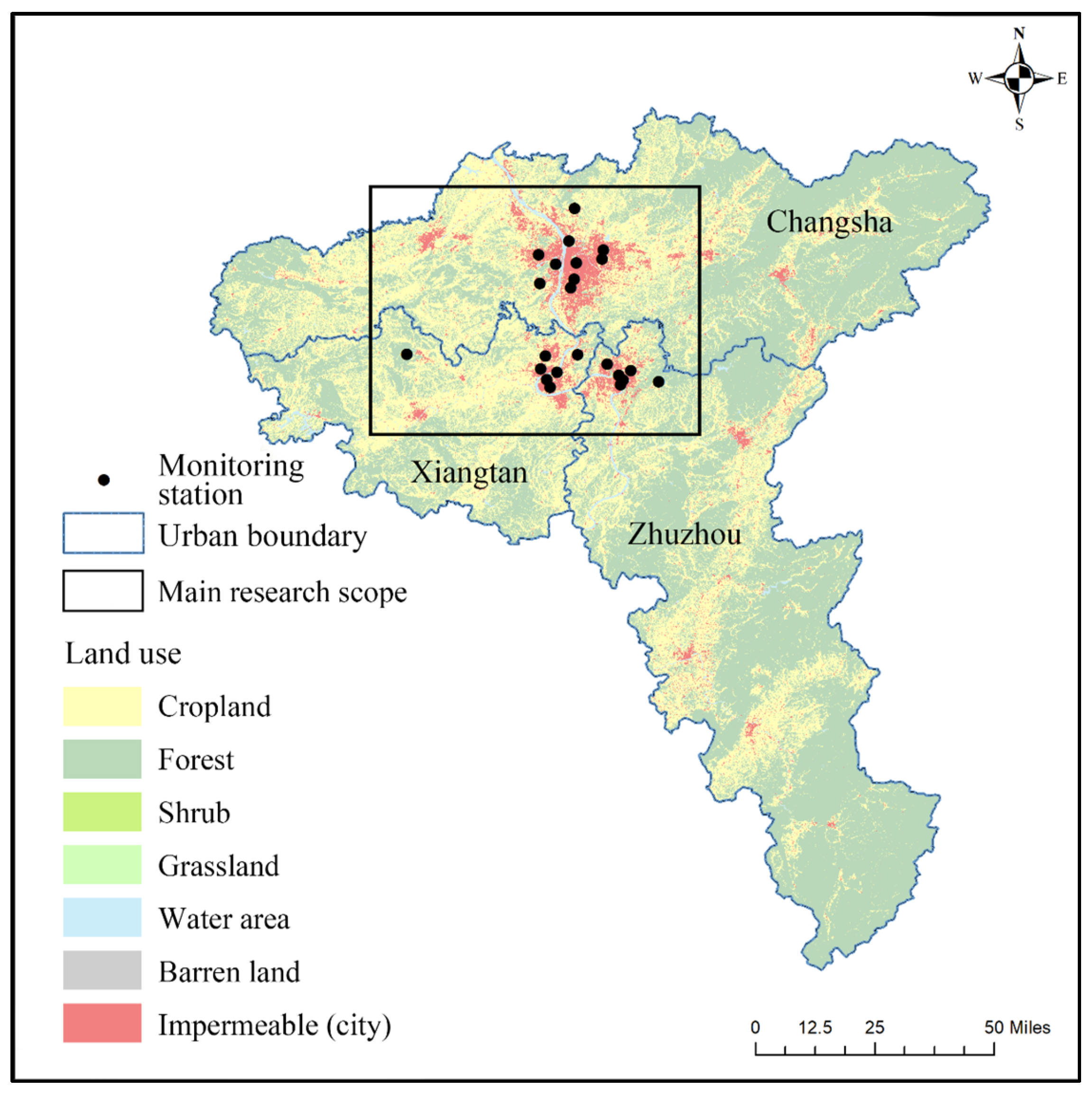
2.1. Regional Overview and Data Sources
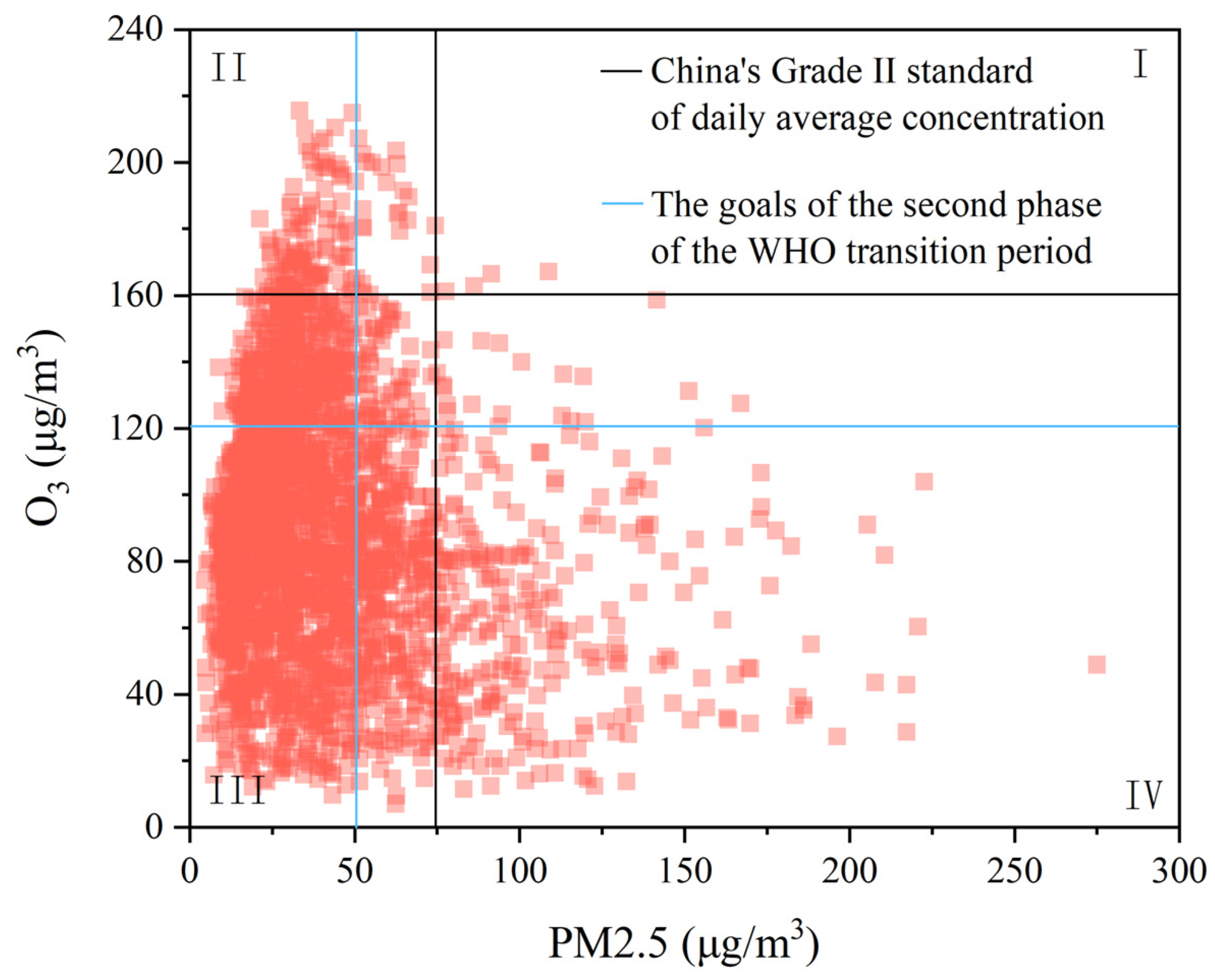
2.2. Summary of Pollutant Concentration Standards
2.3. Research Method
2.3.1. Spatial Auto-Correlation Analysis
2.3.2. PM2.5–O3 Multiple Linear Driving Model
3. Results and Discussion
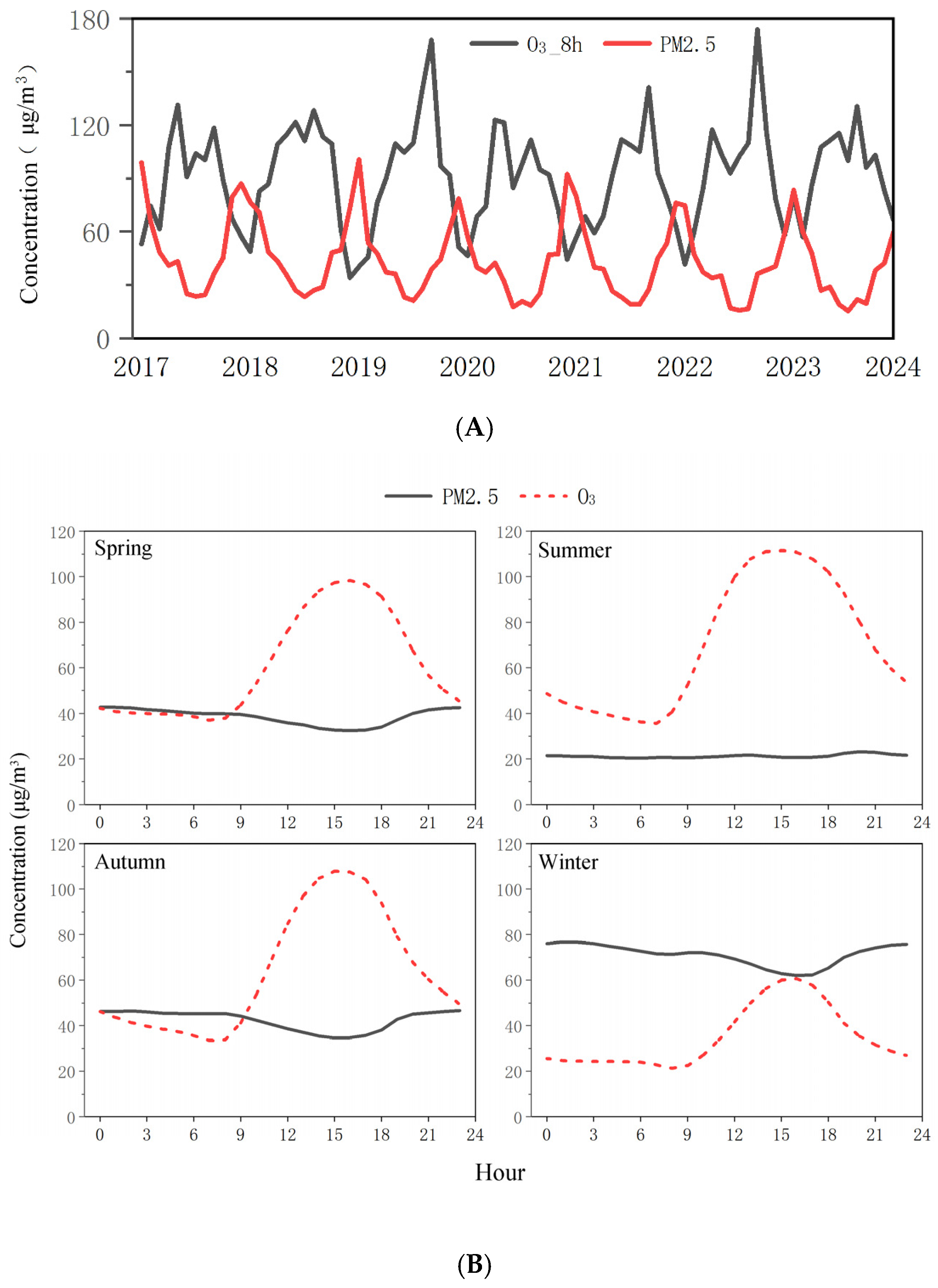
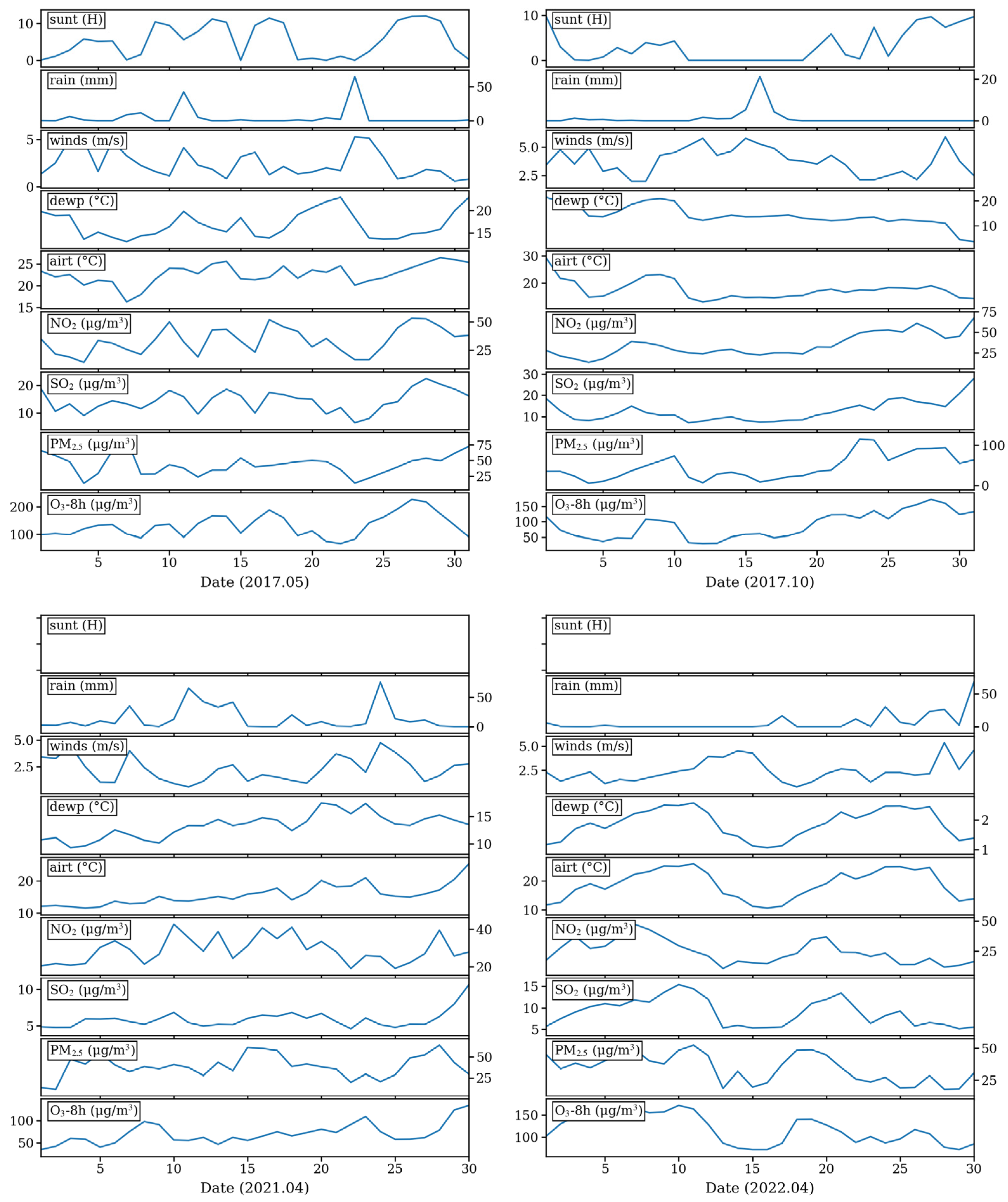
3.1. Analysis of Time Series of PM2.5–O3 Concentration
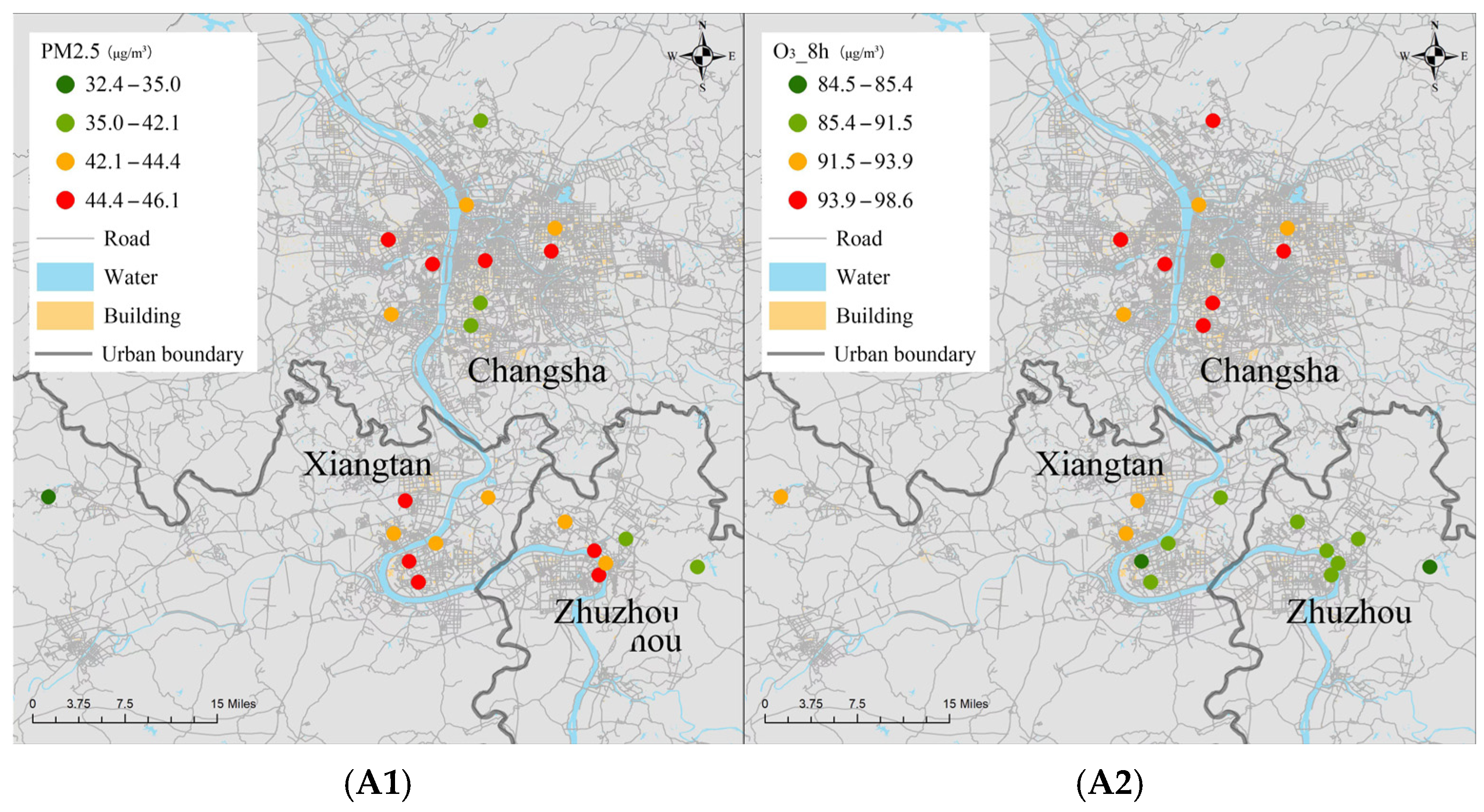
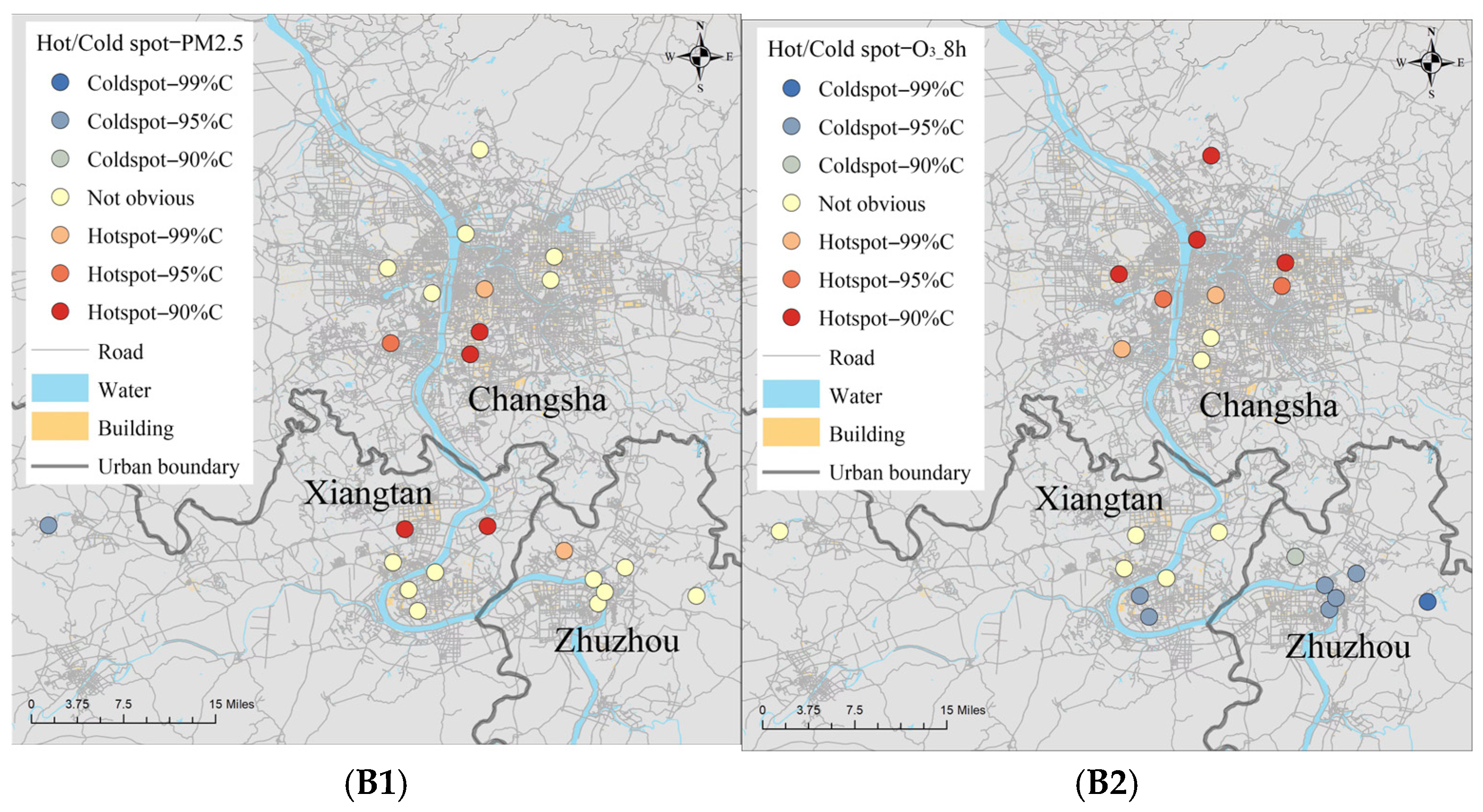
3.2. Spatial Analysis of PM2.5–O3 Concentration
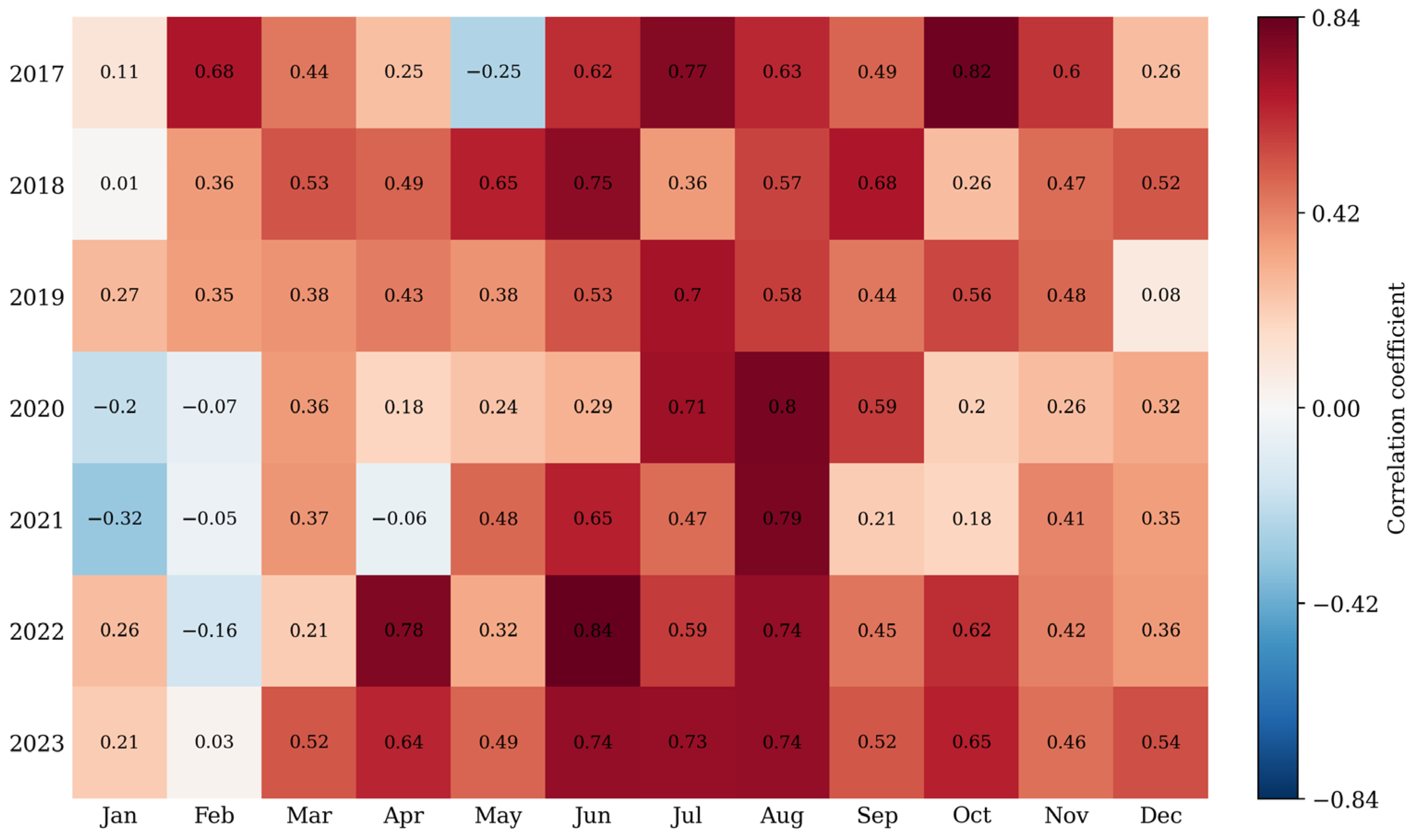
3.3. Analysis of Synergistic Changes in PM2.5–O3 Pollution
4. Conclusions and Policy Recommendations
Supplementary Materials
Author Contributions
Funding
Institutional Review Board Statement
Informed Consent Statement
Data Availability Statement
Acknowledgments
Conflicts of Interest
References
- Yu, P.; Xu, R.B.; Zhang, Y.W.; Ye, T.; Yu, W.; Chen, G.; Wen, B.; Yue, X.; Li, S.; Guo, Y. Spatiotemporal variations and inequalities in global traffic-sourced PM2.5 exposure. Environ. Int. 2024, 199, 109492. [Google Scholar] [CrossRef] [PubMed]
- Zhang, X.; Ma, Q.; Chu, W.H.; Ning, M.; Liu, X.Q.; Xiao, F.J.; Cai, N.N.; Wu, Z.J.; Yan, G. Identify the key emission sources for mitigating ozone pollution: A case study of urban area in the Yangtze River Delta region, China. Sci. Total Environ. 2023, 892, 164703. [Google Scholar] [CrossRef] [PubMed]
- Huang, Z.J.; Duan, W.J.; Qi, H.Y.; Hou, X.S. The spatiotemporal characteristics of PM2.5 and O in the Beijing-Tianjin-Hebei region and the health-based regional cooperative control strategy. China Environ. Sci. 2024, 44, 5971–5979. (In Chinese) [Google Scholar] [CrossRef]
- Zhu, J.R.; Jang, J.C.; Zhu, Y.; Dong, X.Y.; Wang, S.X.; Xing, J.; Zhao, B.; Long, S.C.; Dong, Z.X.; Zhang, B.Y. Co-benefits of wind and solar power deployments for air pollutants and carbon emissions reduction in Guangdong Province of China. Environ. Pollut. 2025, 378, 126485. [Google Scholar] [CrossRef]
- Sun, J.; Xia, F. Assessing exposure to surface ozone with mobile phone data and high-resolution concentrations: What impacts do fine-grained data have on exposure studies? Environ. Res. 2025, 281, 122002. [Google Scholar] [CrossRef]
- GB 3095–2012; Ministry of Environmental Protection of the People’s Republic of China. Ambient Air Quality Standards. China Environmental Science Press: Beijing, China, 2012.
- Xu, C.; Yi, P.; Jiang, Y.X.; Lin, X.L.; Shi, S.; Li, X.Y.; Chen, J.X.; Jiang, Y.C.; Meng, X.; Zhou, M.G. Joint effect of short-term exposure to fine particulate matter and ozone on mortality: A time series study in 272 Chinese cities. Environ. Sci. Technol. 2024, 58, 12865–12874. [Google Scholar] [CrossRef]
- Zhang, K.L.; Chu, Y.X.; Chu, W.H.; Zhang, H.; Chi, X.Y.; Li, H. The correlation between PM2.5 and O pollution in urban areas of China: Spatiotemporal variation from 2017 to 2022 and implication for synergistic prevention and control. China Environ. Sci. 2024, 44, 3004–3011. (In Chinese) [Google Scholar] [CrossRef]
- Yang, J.; Chen, X.; Li, M.C.; Yao, Q.; Lv, Q.C.; Gao, B.B.; Chen, Z.Y. The division of PM2.5-O3 composite airborne pollution across China based on spatiotemporal clustering. J. Clean. Prod. 2023, 401, 136706. [Google Scholar] [CrossRef]
- Wang, B.; Sun, M.P.; Si, L.P.; Niu, Z.R. Spatio-temporal variation of O3 concentration and exposure risk assessment in key regions of China, 2015–2021. Atmos. Pollut. Res. 2024, 15, 101941. [Google Scholar] [CrossRef]
- Chen, J.J.; Shen, H.F.; Li, T.W.; Peng, X.L.; Cheng, H.R.; Ma, C. Temporal and spatial features of the correlation between PM2.5 and O3 concentrations in China. Int. J. Environ. Res. Public Health 2019, 16, 4824. [Google Scholar] [CrossRef] [PubMed]
- Feng, T.; Bei, N.; Huang, R.J.; Cao, J.J.; Zhang, Q.; Zhou, W.J.; Tie, X.X.; Liu, S.X.; Zhang, T.; Su, X.L.; et al. Summertime ozone formation in Xi’an and surrounding areas, China. Atmos. Chem. Phys. 2016, 16, 4323–4342. [Google Scholar] [CrossRef]
- He, C.; Liu, J.H.; Zhou, Y.Q.; Zhou, J.W.; Zhang, L.; Wang, Y.F.; Liu, L.; Peng, S. Synergistic PM2.5 and O3 control to address the emerging global PM2.5-O3 compound pollution challenges. Eco-Environ. Health 2024, 3, 325–337. [Google Scholar] [CrossRef] [PubMed]
- Zhang, R.X.; Chen, Z.H.; Wu, X.Y.; Liu, Q.M.; Mai, Z.L.; Zheng, Z.Y.; Chen, Y.L.; Tao, S.; Hu, Y.T.; Zhao, S.L.; et al. Adjoint analysis of PM2.5 and O3 episodes in priority control zones in China. Environ. Sci. Ecotechnol. 2025, 27, 100612. [Google Scholar] [CrossRef] [PubMed]
- Wang, L.; Qin, K.; Zhao, B.X. Spatiotemporal variations in the association between PM2.5 and ozone in the Yangtze River Economic Belt: Impacts of meteorological and emissions factors. Atmos. Environ. 2024, 329, 120534. [Google Scholar] [CrossRef]
- Lei, K.; Wang, M.Y.; Wang, M.S.; Liu, Q.W.; Zhang, F.; Xing, M.F.; Wu, W.; Jiang, F.C.; Guo, X.M.; Han, Q.; et al. SHAP explainable PSO-CNN-BiLSTM for 6-hour prediction analysis of urban PM2.5 and O3 concentrations. Atmos. Pollut. Res. 2025, 16, 102705. [Google Scholar] [CrossRef]
- He, J.J.; Gong, S.L.; Yu, Y.; Yu, L.J.; Wu, L.; Mao, H.J.; Song, C.B.; Zhao, S.P.; Liu, H.L.; Li, X.Y.; et al. Air pollution characteristics and their relation to meteorological conditions during 2014–2015 in major Chinese cities. Environ. Pollut. 2017, 223, 484–496. [Google Scholar] [CrossRef]
- Lin, M.Y.; Horowitz, L.W.; Xie, Y.Y.; Paulot, F.; Malyshev, S.; Shevliakova, E.; Finco, A.; Gerosa, G.; Kubistin, D.; Pilegaard, K.; et al. Vegetation feedbacks during drought exacerbate ozone air pollution extremes in Europe. Nat. Clim. Change 2020, 10, 444–451. [Google Scholar] [CrossRef]
- Ou, C.H.; Li, F.; Zhang, J.D.; Hu, Y.F.; Chen, X.Y.; Kong, S.J.; Guo, J.Y.; Zhou, Y.Y. Multiple driving factors and hierarchical management of PM2.5: Evidence from Chinese central urban agglomerations using machine learning model and GTWR. Urban Clim. 2022, 46, 101327. [Google Scholar] [CrossRef]
- Dai, H.B.; Zhu, J.; Liao, H.; Li, J.; Liang, M.; Yang, Y.; Yue, X. Co-occurrence of ozone and PM2.5 pollution in the Yangtze River Delta over 2013–2019: Spatio-temporal distribution and meteorological conditions. Atmos. Res. 2021, 249, 105363. [Google Scholar] [CrossRef]
- Liu, J.Y.; Ding, W.F. Spatial and temporal distribution of PM2.5 and O3 in North China from 2011 to 2020: Patterns and influence mechanisms. Atmos. Pollut. Res. 2023, 14, 101906. [Google Scholar] [CrossRef]
- Yang, J.; Zheng, J.X.; Xu, T.T.; Wu, Y.L.; Kan, S.Y.; Shen, C.Q.; Shao, Z.J. Analysis of pollution characteristics, transport routes and potential source areas of PM2.5 and O3 in Suzhou City. Environ. Sci. 2024, 45, 6238–6247. (In Chinese) [Google Scholar] [CrossRef]
- Xu, B.; You, X.Y.; Zhou, Y.Y. The study of emission inventory on anthropogenic air pollutants and source apportionment of PM2.5 in the Changzhutan urban agglomeration, China. Atmosphere 2020, 11, 739. [Google Scholar] [CrossRef]
- Wu, F.; Wang, Z.Y. Assessing the impact of urban land expansion on ecosystem carbon storage: A case study of the Changzhutan metropolitan area, China. Ecol. Indic. 2023, 154, 110688. [Google Scholar] [CrossRef]
- Peng, H.Z.; Lou, H.C.; Liu, Y.F.; He, Q.Y.; Zhang, M.M.; Yang, Y. Spatial and temporal evolution assessment of landscape ecological resilience based on adaptive cycling in Changsha-Zhuzhou-Xiangtan urban agglomeration, China. Land 2025, 14, 709. [Google Scholar] [CrossRef]
- World Health Organization. WHO Global Air Quality Guidelines: Particulate Matter (PM2.5 and PM10), Ozone, Nitrogen Dioxide, Sulfur Dioxide and Carbon Monoxide: Executive Summary; World Health Organization: Geneva, Switzerland, 2021. [Google Scholar]
- Zhang, C.; Lv, W.; Zhang, P.; Song, J. Multidimensional spatial autocorrelation analysis and its application based on improved Moran’s I. Earth Sci. Inform. 2023, 16, 3355–3368. [Google Scholar] [CrossRef]
- Barzeghar, V.; Sarbakhsh, P.; Hassanvand, M.S.; Faridi, S.; Gholampour, A. Long-term trend of ambient air PM10, PM2.5, and O3 and their health effects in Tabriz city, Iran, during 2006–2017. Sustain. Cities Soc. 2019, 54, 101988. [Google Scholar] [CrossRef]
- Sharma, P.; Sood, S.; Mishra, S.K. Development of multiple linear regression model for biochemical oxygen demand (BOD) removal efficiency of different sewage treatment technologies in Delhi, India. Sustain. Water Resour. Manag. 2020, 6, 29. [Google Scholar] [CrossRef]
- Raju, B.B.K.; Deepa, N. Analyzing the death ratio of COVID patients using multiple logistic regression in comparison with linear regression for improving accuracy. J. Pharm. Negat. Results 2022, 13, 286–293. [Google Scholar]
- Collier, T.; Johnson, A.L.; Ruggiero, J. Technical efficiency estimation with multiple inputs and multiple outputs using regression analysis. Eur. J. Oper. Res. 2011, 208, 153–160. [Google Scholar] [CrossRef]
- Wang, L. Research on the Management of Kitchen Waste Recycling and Utilization; Tianjin University: Tianjin, China, 2009. (In Chinese) [Google Scholar]
- Xu, T.Y.; Zhang, C.X.; Liu, C.; Hu, Q.H. Variability of PM2.5 and O3 concentrations and their driving forces over Chinese megacities during 2018–2020. J. Environ. Sci. 2023, 124, 1–10. [Google Scholar] [CrossRef] [PubMed]
- Lu, Y.; Wu, Z.T.; Pang, X.B.; Wu, H.; Xing, B.; Li, J.J.; Xiang, Q.M.; Chen, J.M.; Shi, D.F. Temporal characteristics of ozone (O3) in the representative city of the Yangtze River Delta: Explanatory factors and sensitivity analysis. Int. J. Environ. Res. Public Health 2023, 20, 168. [Google Scholar] [CrossRef]
- Tao, C.L.; Zhang, Q.Z.; Huo, S.S.; Ren, Y.C.; Han, S.; Wang, Q.; Wang, W.X. PM2.5 pollution modulates the response of ozone formation to VOC emitted from various sources: Insights from machine learning. Sci. Total Environ. 2024, 916, 170009. [Google Scholar] [CrossRef] [PubMed]
- Liu, M.N.; Ma, M.L.; Liu, M.J.; Lv, Y.Q. Quantitative estimation of the impacts of precursor emissions on surface O3 and PM2.5 collaborative pollution in three typical regions of China via multi-task learning. Sustainability 2024, 16, 2475. [Google Scholar] [CrossRef]
- Cheng, Y.; Zheng, G.J.; Wei, C.; Mu, Q.; Zheng, B.; Wang, Z.B.; Gao, M.; Zhang, Q.; He, K.B.; Carmichael, G.; et al. Reactive nitrogen chemistry in aerosol water as a source of sulfate during haze events in China. Sci. Adv. 2016, 2, e1601530. [Google Scholar] [CrossRef]
- Huang, R.J.; Zhang, Y.L.; Bozzetti, C.; Ho, K.F.; Cao, J.J.; Han, Y.M.; Daellenbach, K.R.; Slowik, J.G.; Platt, S.M.; Canonaco, F.; et al. High secondary aerosol contribution to particulate pollution during haze events in China. Nature 2014, 514, 218–222. [Google Scholar] [CrossRef]
- Chen, G.J.; Ji, X.T.; Chen, J.S.; Xu, L.L.; Hu, B.Y.; Lin, Z.Y.; Fan, X.L.; Li, M.R.; Hong, Y.W.; Chen, J.F. Photochemical pollution during summertime in a coastal city of Southeast China: Ozone formation and influencing factors. Atmos. Res. 2024, 301, 107270. [Google Scholar] [CrossRef]
- Jiang, Y.Q.; Sun, Y.S.; Li, S.Y.; Yin, D.J.; Ding, D.; Dong, Z.X.; Zheng, H.T.; Zhao, B.; Wang, S.X. Differentiated regional impacts of future meteorological changes and anthropogenic emission control on PM2.5 concentrations in China. Sustain. Horiz. 2025, 16, 100151. [Google Scholar] [CrossRef]
- Ma, X.; Yin, Z.; Cao, B.; Wang, H. Meteorological influences on the co-occurrence of PM2.5 and O3 pollution in the Beijing–Tianjin–Hebei region. Environ. Res. 2023, 223, 115398. [Google Scholar]
- Huang, Q.; Li, T.S.; Zhang, T.; Fang, Y.; Gong, F.J.; Li, Y.F.; Xu, P.; Zhang, T.Q.; Yang, L.X.; Wang, W.X. Quantifying secondary organic aerosols and O3 formation drivers in North China: Comprehensive method combining random forest, positive matrix factorization, and observation-based model. J. Environ. Sci. 2026, 160, 1–12. [Google Scholar] [CrossRef]



| Pollutants | R2 | NO2 | SO2 | Airt | DPD | Windd | Winds | Rain | Sunt |
|---|---|---|---|---|---|---|---|---|---|
| O3 | 0.65 | 0.08 (0.07) | −0.39 * (0.15) | 2.48 * (0.12) | 4.47* (0.36) | 0.06 * (0.01) | −0.20 * (0.07) | 0.01 (0.04) | 2.24 * (0.29) |
| PM2.5 | 0.50 | 1.14 * (0.07) | 0.83 * (0.13) | −0.5 * (0.1) | −0.84 * (0.33) | 0.05 * (0.01) | 0.20 * (0.04) | −0.21 * (0.04) | −0.16 (0.26) |
Disclaimer/Publisher’s Note: The statements, opinions and data contained in all publications are solely those of the individual author(s) and contributor(s) and not of MDPI and/or the editor(s). MDPI and/or the editor(s) disclaim responsibility for any injury to people or property resulting from any ideas, methods, instructions or products referred to in the content. |
© 2026 by the authors. Licensee MDPI, Basel, Switzerland. This article is an open access article distributed under the terms and conditions of the Creative Commons Attribution (CC BY) license.
Share and Cite
Zhang, W.; Ou, C.; Fang, J.; Tian, M.; Guo, J.; Li, F. Unraveling Spatiotemporal Synergistic Features of PM2.5–O3 and Systematic Management Policy Based on Multiple Scenario-Driven Factor Analysis in the Changsha–Zhuzhou–Xiangtan Urban Agglomeration, Central China. Atmosphere 2026, 17, 316. https://doi.org/10.3390/atmos17030316
Zhang W, Ou C, Fang J, Tian M, Guo J, Li F. Unraveling Spatiotemporal Synergistic Features of PM2.5–O3 and Systematic Management Policy Based on Multiple Scenario-Driven Factor Analysis in the Changsha–Zhuzhou–Xiangtan Urban Agglomeration, Central China. Atmosphere. 2026; 17(3):316. https://doi.org/10.3390/atmos17030316
Chicago/Turabian StyleZhang, Wujian, Changhong Ou, Jinpeng Fang, Miao Tian, Jinyuan Guo, and Fei Li. 2026. "Unraveling Spatiotemporal Synergistic Features of PM2.5–O3 and Systematic Management Policy Based on Multiple Scenario-Driven Factor Analysis in the Changsha–Zhuzhou–Xiangtan Urban Agglomeration, Central China" Atmosphere 17, no. 3: 316. https://doi.org/10.3390/atmos17030316
APA StyleZhang, W., Ou, C., Fang, J., Tian, M., Guo, J., & Li, F. (2026). Unraveling Spatiotemporal Synergistic Features of PM2.5–O3 and Systematic Management Policy Based on Multiple Scenario-Driven Factor Analysis in the Changsha–Zhuzhou–Xiangtan Urban Agglomeration, Central China. Atmosphere, 17(3), 316. https://doi.org/10.3390/atmos17030316