Article

Kinetics of the Reaction of OH Radicals with Hydrogen Iodide Between 225 and 950 K

Institut de Combustion, Aérothermique, Réactivité et Environnement (ICARE), Centre National de la Recherche Scientifique (CNRS), 45071 Orléans, France
Atmosphere 2026, 17(3), 301; https://doi.org/10.3390/atmos17030301
Submission received: 26 February 2026 / Revised: 12 March 2026 / Accepted: 13 March 2026 / Published: 16 March 2026
(This article belongs to the Section Air Quality)

Abstract

Reaction OH + HI → I + H2O (1) is an important atmospheric process transforming inactive HI into chemically active iodine atoms. In the present work, the reaction kinetics have been studied in a discharge fast-flow reactor coupled with an electron impact ionization mass spectrometer at nearly 2 Torr total pressure of helium and over a wide temperature range, T = 225–950 K. The reaction rate constant was determined both by a relative rate method (with the OH + Br2 reaction as a reference) and by absolute measurements carried out under pseudo-first order conditions by monitoring the OH consumption kinetics in excess of hydrogen iodide. U-shaped temperature dependence was observed for the reaction rate constant, negative at low temperatures and positive at high temperatures. Recommended expression over the 225–950 K temperature range: k1 = 1.13 × 10⁻¹¹ exp(354/T) + 6.93 × 10⁻¹¹ exp(−1010/T) cm3 molecule−1 s−1 or in the form of a modified Arrhenius expression, k1 = 4.2 × 10⁻¹² × (T/298)1.36 exp(666/T) cm3 molecule−1 s−1, with a total estimated uncertainty of 15% at all temperatures. The rate constant data obtained in this study are compared with the results of previous experimental works.

1. Introduction

Hydrogen iodide (HI) is the atmospheric reservoir of iodine atoms, which are believed to initiate ozone destruction cycles both in the stratosphere [1] and troposphere [2]. The reaction of HI with OH radicals
OH + HI → H2O + I
is an important atmospheric process transforming inactive HI into chemically active iodine atoms.
The previous kinetic studies [3,4,5,6,7,8] of Reaction (1) can be divided into three groups. Early measurements [3,4] reported the reaction rate constant close to 10−11 cm3 molecule−1 s−1 at room temperature. In the next three studies [5,6,8], the reaction rate constant (k1) was found to be three times higher (≈3 × 10⁻¹¹ cm3 molecule−1 s−1). Finally, Campuzano-Jost and Crowley [7] reported the reaction rate constant that was twice as high (≈6.5 × 10⁻¹¹ cm3 molecule−1 s−1 at room temperature). The dependence of the reaction rate constant on temperature was investigated only in two studies: by Campuzano-Jost and Crowley [7] in the temperature range T = 246–353 K and by Khamaganov et al. [8] at two temperatures, 298 and 370 K.
The significant uncertainty regarding the reaction rate constant is also reflected in the divergent recommendations from different expert groups on the evaluation of kinetic data for atmospheric modeling. The current recommendation of the NASA Panel for Data Evaluation is k1 = 3 × 10⁻¹¹ cm3 molecule−1 s−1 (with an uncertainty factor of 2) at T = 298 K [9]. At the same time, IUPAC Task Group on Atmospheric Chemical Kinetic Data Evaluation recommends negative temperature dependence of k1 = 1.6 × 10⁻¹¹ exp(440/T) cm3 molecule−1 s−1 at T = 240–360 K with the value of (7.0 ± 2.1) × 10−11 cm3 molecule−1 s−1 at T = 298 K [10].
In our opinion, and as previously stated [8], the most likely reason for the discrepancy in the k1 measurements is a problem in determining the absolute concentrations of HI in the reaction zone, given that hydrogen iodide can be lost during storage of prepared mixtures and also upon its introduction into a reactor. In the present work, we report the measurements of the rate constant of Reaction (1) in an extended temperature range (T = 225–950 K) using both the absolute method (with in situ measurements of the concentration of HI directly in the reactor) and the relative rate method where knowledge of [HI] is not required for calculation of k1.
The high-temperature kinetic data from the present work are of potential interest for modeling the chemistry of hot near-source volcanic plumes, which are known to contain iodine species (HI and I) [11,12].

2. Materials and Methods

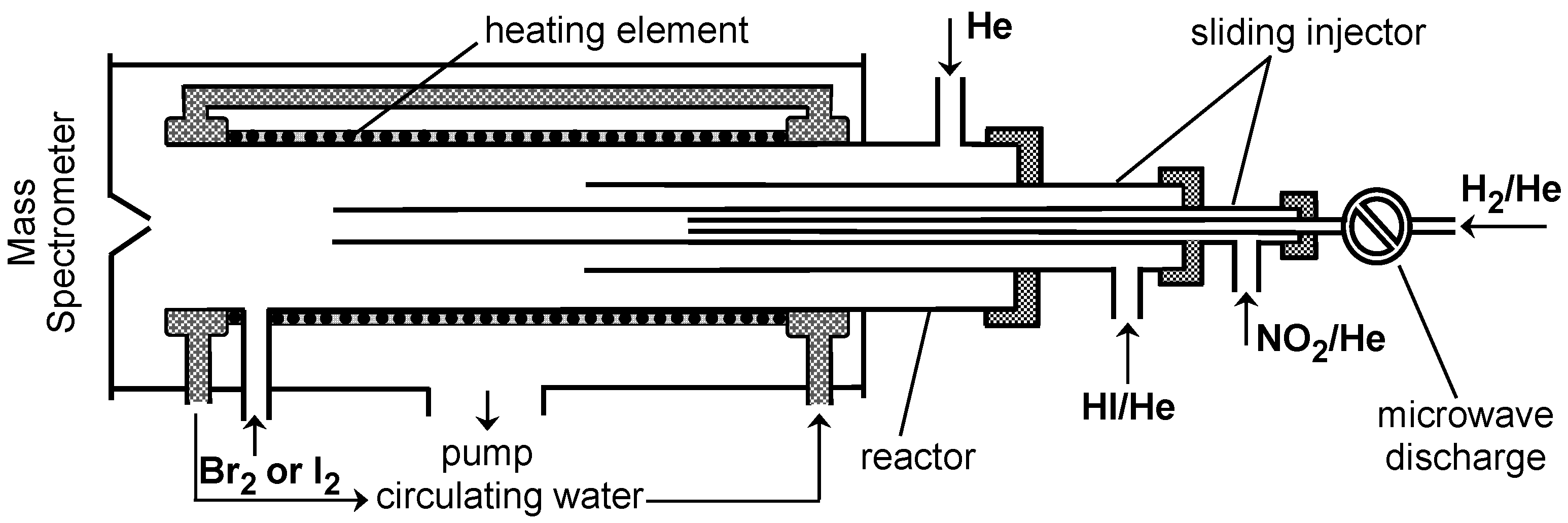
The rate constant of Reaction (1) was measured at a total pressure of 2 Torr of helium in a conventional discharge fast-flow reactor combined with a modulated molecular beam mass spectrometer (Balzers, QMG 420, Balzers Aktiengesellschaft, Liechtenstein) with electron impact ionization operating at 30 eV energy [13,14]. The chemical composition of the reactive system was monitored by sampling the gas-phase molecules from the flow reactor and detecting them by mass spectrometry. The reaction time was determined by the distance between the tip of the movable injector and the sampling cone of the mass spectrometer (Figure 1) and by the linear flow velocity in the reactor (900–3100 cm s−1). The use of two different flow reactors allowed for a wide temperature range for kinetic measurements. The low-temperature reactor, used at T = 225–340 K, consisted of a Pyrex tube (45 cm long and 2.4 cm internal diameter, coated with halocarbon wax), with a jacket for circulating a thermostated liquid (ethanol). The second flow reactor used at high temperatures (330–950 K) consisted of an electrically heated uncoated quartz tube (45 cm long and 2.5 cm i.d.) with water-cooled attachments (Figure 1) [13].
OH radicals were produced in the movable injector through the fast reaction of hydrogen atoms with NO2 ([NO2] = (2–5) × 1013 molecule cm−3)
H + NO2 → OH + NO
k2 = (1.47 ± 0.26) × 10−10 cm3 molecule−1 s−1 (T = 195–2000) [15]. Two methods were used to generate H atoms: dissociation of H2, diluted in He, in a microwave discharge, and reaction of fluorine atoms with H2:
F + H2 → H + HF
k3 = 1.24 × 10⁻¹⁰ exp(−507/T) cm3 molecule−1 s−1 (T = 220–960 K) [16]. In the latter case, fluorine atoms were generated in a microwave discharge of trace amounts of F2 in He. In order to reduce F atom reactions with a glass surface inside the microwave cavity, a ceramic (Al2O3) tube was inserted in this part of the injector. Mass spectrometric analysis showed that more than 95% of F2 was dissociated in the microwave discharge.
OH radicals were monitored at m/z = 96/98 (HOBr+) after being transformed into HOBr with an excess of Br2 ([Br2] = (4–7) × 1013 molecule cm−3), added 5 cm upstream of the sampling cone (Figure 1):
OH + Br2 → HOBr + Br
k4 = 2.16 × 10⁻¹¹ exp(207/T) cm3 molecule−1 s−1 (T = 220–950 K) [17]. The chemical conversion of OH to HOBr by an excess of Br2 was also used for the measurements of the absolute concentrations of the radicals, with the concentration of OH being determined from the fraction of Br2 consumed: [OH] = [HOBr] = Δ[Br2].
In some experiments, I2 was used instead of Br2 and the OH radicals converted to HOI in Reaction (5) were detected at m/z = 144 (HOI+):
OH + I2 → I + HOI
k5 = (2.1 ± 0.3) × 10−10 cm3 molecule−1 s−1 (T = 240–350 K) [10]. I2 was introduced into the reactor by flowing helium through a column containing iodine crystals.
Gaseous HI was prepared by drying a 57% aqueous solution on phosphorus pentoxide and purified by low-temperature distillation to remove I2 impurities. The monometrically prepared mixtures of HI in helium (2–5%) were stored in a blackened bulb at room temperature. Analysis of the mixtures by mass spectrometry showed that the content of the I2 impurity was less than 0.2%. Furthermore, no degradation of the HI was observed during several days of storage of the mixtures.
The absolute concentrations of all stable species (Br2, NO2, F2, H2, HI) in the reactor were calculated from their flow rates from monometrically prepared mixtures. For the determination of HI concentration in the reactor, two additional methods were used, which employed a chemical titration of the same concentration of H atoms successively with excess Br2, HI and I2:
H + Br2 → HBr + Br
k6 = 7.06 × 10⁻¹¹ (T/298)0.88 exp(182/T) cm3 molecule−1 s−1 (T = 220–950 K) [18],
H + HI → H2 + I
k7 = 7.4 × 10⁻¹¹ exp(−290/T) cm3 molecule−1 s−1 (T = 250–370 K) [19].
H + I2 → HI + I
k8 = 6.6 × 10⁻¹⁰ exp(−20/T) cm3 molecule−1 s−1 (T = 250–420 K) [19].
The consumed fractions of Br2 and HI in Reactions (6) and (7), respectively, and [HI] produced in Reaction (8) were monitored by mass spectrometry. First, it was observed that the concentrations of HI consumed in Reaction (7) and formed in Reaction (8) were identical to within a few percent, as would be expected given that these quantities correspond to the same consumed concentration of H atoms. Secondly, this concentration of HI could be related to the concentration of Br2, consumed in Reaction (6), which allowed the absolute calibration of HI signals using that of Br2. Absolute HI concentrations measured by this method always agreed well (within 10%) with those calculated from flow rate measurements from a flask containing the HI/He mixture. The agreement between HI concentrations calculated from the flow measurements and HI concentrations measured independently in the reactor indicated that HI losses during its storage and in the gas handling lines used for the introduction of HI into the reactor were insignificant.

3. Results

3.1. Rate Constant of Reaction (1): Absolute Measurements

In the absolute measurements, the rate constant of Reaction (1) was determined under pseudo-first order conditions by monitoring the OH decays in excess of HI. The initial concentration of OH radicals was in the range (1–3) × 1011 molecule cm−3; the ranges of HI concentrations at different temperatures are shown in Table 1.
In most experiments, OH radicals were detected as HOBr, with Br2 being added at the end of the reactor (see Section 2). However, at high reactor temperatures, a drop in the HI signal was observed upon addition of Br2. Most likely, this is due to a chain reaction:
OH + Br2 → HOBr + Br
Br + HI → HBr + I
k9 ≈ 1.0 × 10⁻¹¹ cm3 molecule−1 s−1 (T = 298 K) [20].
I + Br2 → IBr + Br
Reaction (10) is relatively slow at room temperature (k10 = 1.65 × 10⁻¹³ cm3 molecule−1 s−1 [21]); however, it can be much faster at elevated temperatures, where the only available literature data is k10 = 5.7 × 10⁻¹³ cm3 molecule−1 s−1 at T = 450 K [22]. Although the change in HI concentration in the OH detection zone did not affect the measured OH kinetics and could be taken into account when calculating the actual HI concentration in the reaction zone, we have carried out additional k1 measurements using I2 instead of Br2 and detecting OH as HOI at high temperatures (see Section 2).
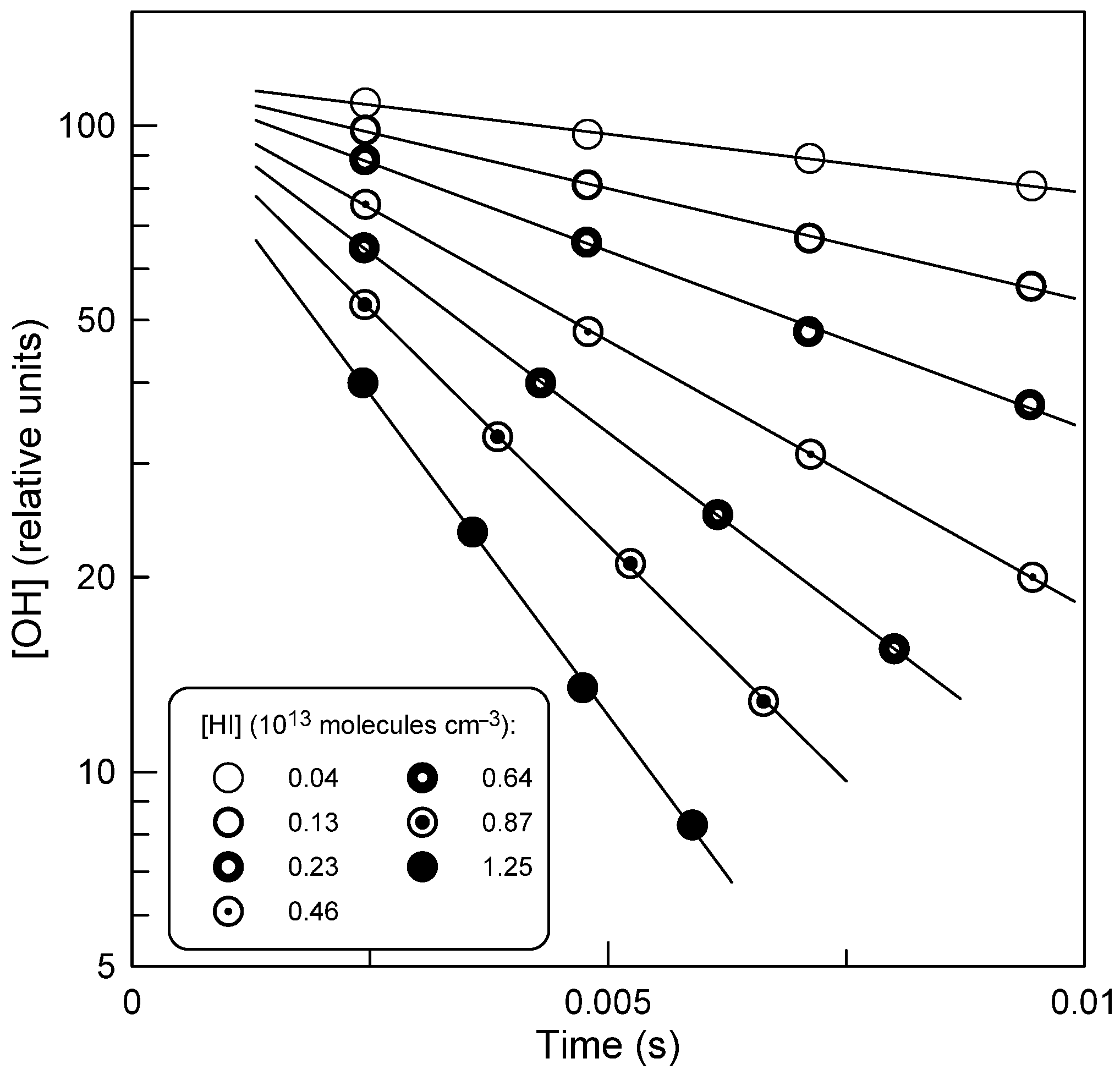
The concentrations of hydrogen iodide and OH radicals in the reactor were monitored simultaneously as a function of reaction time. The consumption of HI was found to be insignificant (less than 15%), and the mean concentration of HI along the reaction zone was used in the calculations of k1. Figure 2 displays typical examples of the OH kinetics observed in the presence of different concentrations of HI in the reactor: [OH] = [OH]0 × exp(−k1′ × t), where k1′ = k1 × [HI] + kw is the pseudo-first-order rate constant and kw represents the heterogeneous loss rate of OH radicals. The values of k1′ were determined from the slopes of the straight lines in Figure 2. All the pseudo-first-order rate constants were corrected for axial and radial diffusion of OH radicals [23] with the diffusion coefficient of OH in He calculated as D0 = 660 × (T/298)1.85 Torr cm−2 s−1 [24]. The diffusion corrections accounted for <10% of the observed k′ values.
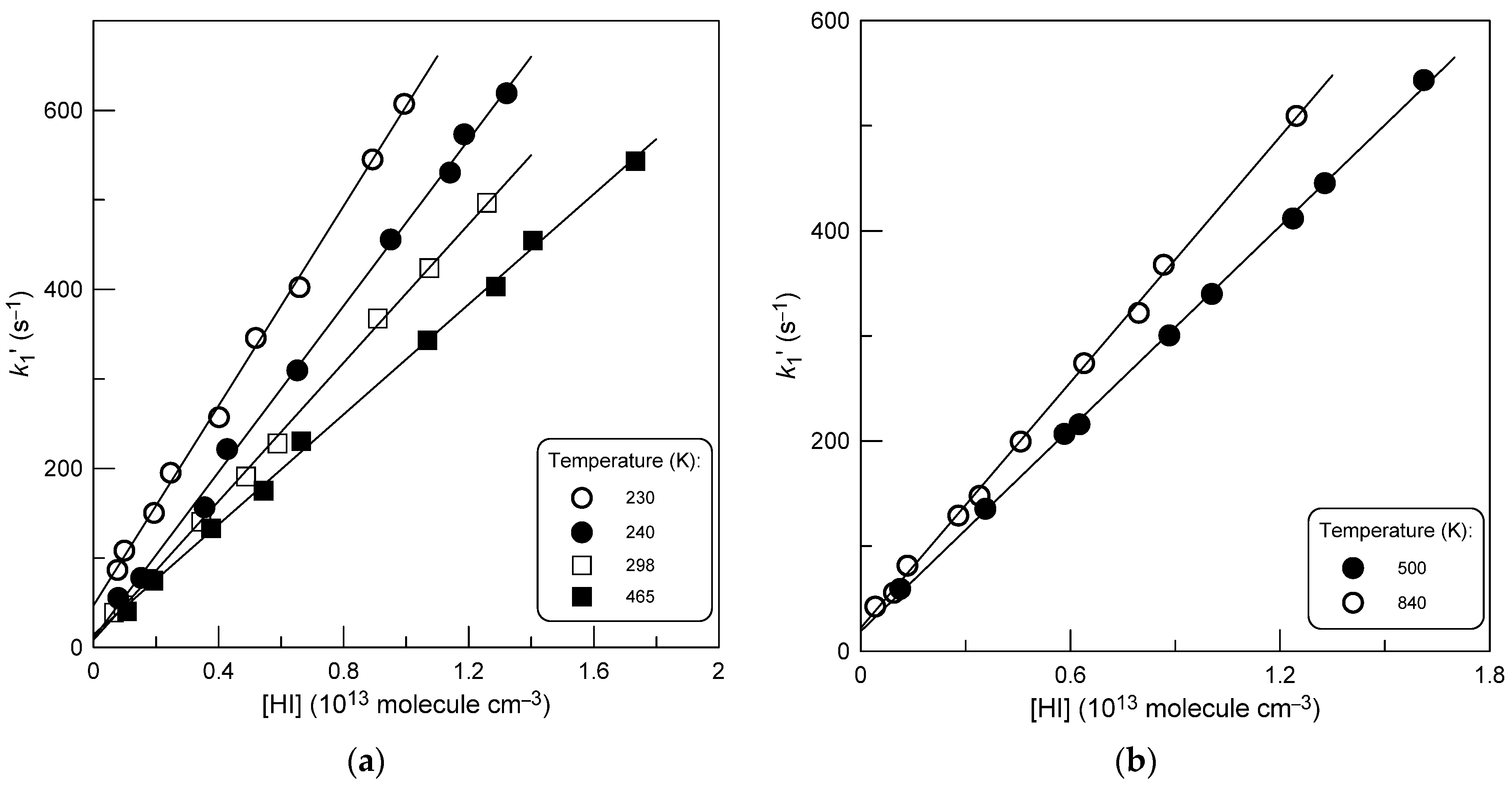
In Figure 3, the pseudo-first order rate constants, k1′ = k1 × [HI] + kw, are traced against the concentration of HI. A linear least-squares fit of the k1′ data as a function of [HI] at each temperature provides the rate constant of Reaction (1). All the results of absolute measurements of k1 are summarized in Table 1. The estimated total uncertainty on the individual measurements of k1 is approximately 15% and includes statistical error (≤3%) and those on the measurements of the flows, pressure, temperature, and absolute concentration of HI.
During the measurements at low temperatures, a phenomenon of degradation of the reactor surface was observed, which manifested itself as an increase in the rate of OH loss during the treatment of the reactor by the reaction. This effect is most likely due to contamination of the reactor surface by products of Reaction (1), as a result of the recombination of iodine atoms (in the gas phase or heterogeneous), leading to the formation of I2 and its adsorption on the reactor wall. It was observed that the presence of HF in the reaction system “stabilizes” the reactor surface, thereby reducing the rate of heterogeneous loss of OH radicals and ensuring reproducibility of measurements. For this reason, in low-temperature experiments, Reaction (3) between F-atoms and H2 was used as a source of H atoms needed for the generation of OH radicals by Reaction (2). As can be seen in Table 1, the results obtained using two sources of H atoms, as well as two methods for detecting OH radicals (HOBr vs. HOI), are in good agreement.

3.2. Rate Constant of Reaction (1): Relative Rate Measurements

Despite the apparently satisfactory results obtained for k1 at low temperatures, for more certainty we carried out relative rate measurements (RRM1), which consisted of a rapid titration of OH in the gas phase with a mixture of HI and Br2 (Reactions (1) and (4), respectively) and the measurements of HOBr yield as a function of the [HI]/[Br2] ratio:
H O B r = k 4 [ B r 2 ] k 4 B r 2 + k 1 [ HI ] + k w × [ O H ] 0 ,
or after rearrangement,
[ O H ] 0 [ H O B r ] 1 = k 1 [ H I ] k 4 B r 2 + k w k 4 [ B r 2 ]
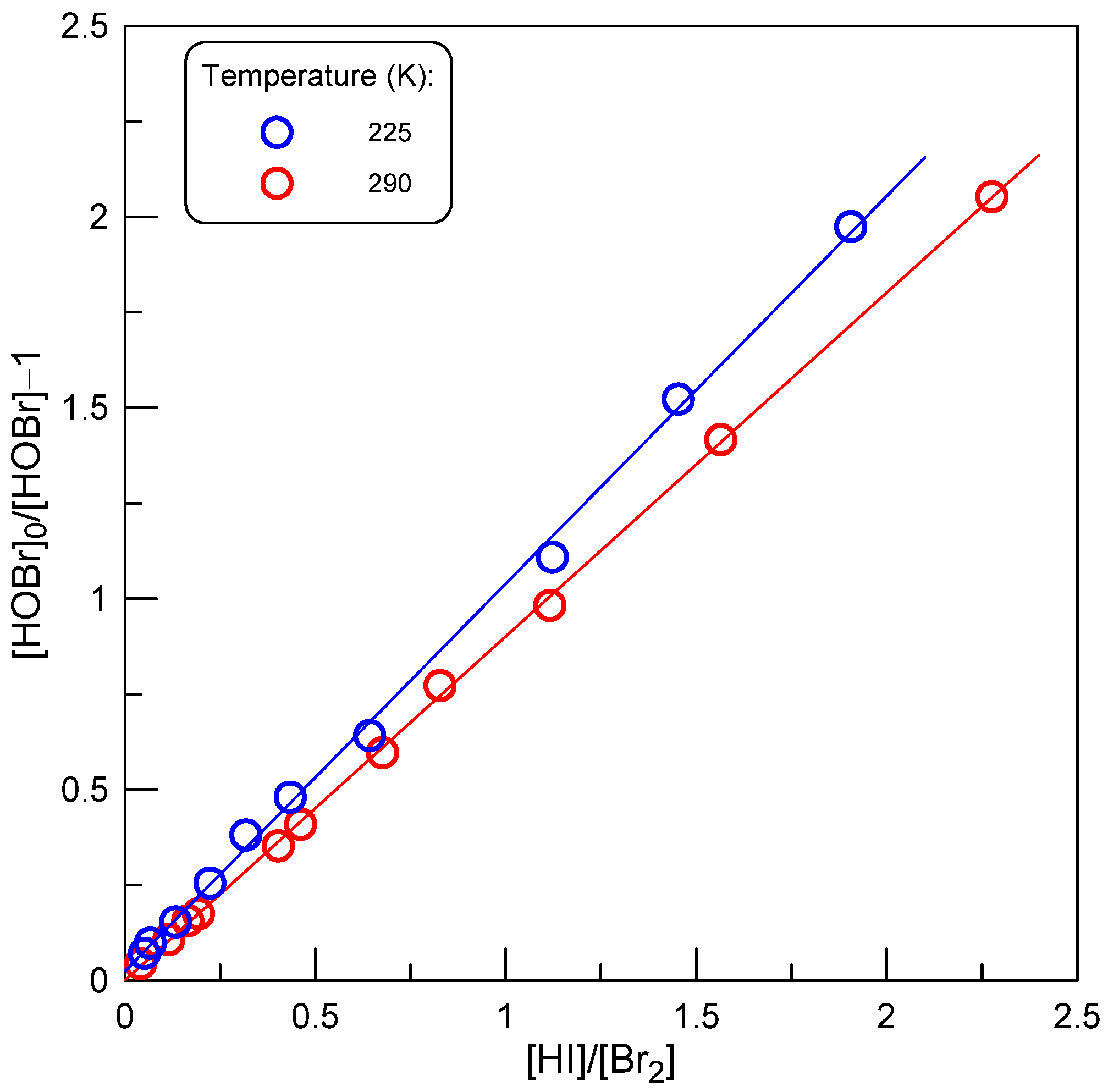
At a constant concentration of Br2, the second term in above equation is constant and k1/k4 can be determined as the slope of the linear dependence of ([OH]0/[HOBr] − 1) versus [HI]/[Br2] ratio. Initial concentration of OH was recorded as [HOBr]0 in the absence of HI in the reactor, [OH]0 = [HOBr]0 ≈ 3 × 10¹¹ molecule cm−3. Reaction time was (0.011–0.015) s. Typical examples of the experimental data are shown in Figure 4.
Final values of k1 (Table 2) were calculated with k4 = 2.16 × 10⁻¹¹ exp(207/T) cm3 molecule−1 s−1 which seems to be well established [17].
It should be noted that the relative rate method applied above does not require the measurement of absolute concentrations of OH radicals, minimizes the possible impact of secondary and heterogeneous reactions, but still relies on the measurement of [HI]. To definitively dispel any doubts about the possible influence of uncertainty in the measurement of absolute HI concentrations on current measurements of k1, we carried out additional experiments at room temperature using a “conventional” relative rate method (still with Reaction (4) as a reference), which does not require measuring the absolute concentrations of the species involved (RRM2).
The experiments consisted of the monitoring of the consumption of HI and Br2, simultaneously present in the reactor, in reactions with OH. The relative consumptions of HI and reference compound, Br2, are defined by the rate constants of their reactions with OH:
l n [ H I ] 0 [ H I ] = k 1 k 4 × l n [ B r 2 ] 0 [ B r 2 ]
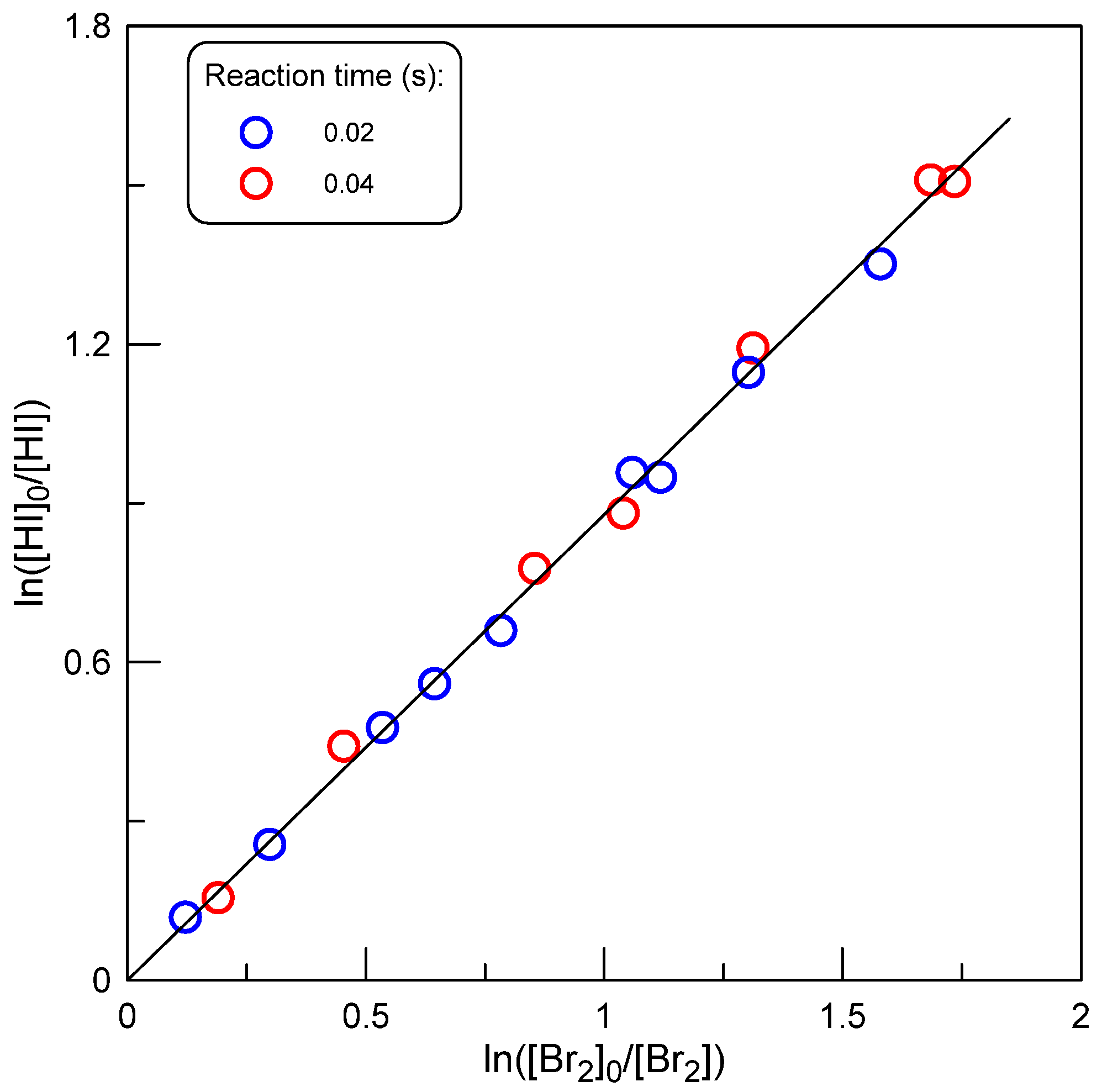
where the expressions under the logarithm are the ratios of the compound concentration in the absence of OH radicals to that in the presence of OH radicals for a given reaction time. Initial concentrations of HI and Br2 were 3 × 10¹¹ and 2 × 10¹¹ molecule cm−3, respectively, and that of OH radicals was varied, being ≤1.5 × 10¹² molecule cm−3. Resulting dependence of ln([HI]0/[HI]) on ln([Br2]0/[Br]) is shown in Figure 5.
The slope of the straight line in Figure 5 represents the k1/k4 ratio. The variations in the reaction time (as shown in Figure 5) had no impact on the results. Along with the good linearity of the data, this observation seems to indicate a negligible role of the possible secondary reactions, which could lead to additional consumption of the reactants, HI and Br2. In fact, the only secondary reaction that could influence the measurements (at room temperature) is reaction (9) of Br atoms (formed in Reaction (4)) with HI, with a rate constant of about 10−11 cm3 molecule−1 s−1 at T = 298 K [20]. However, given the relatively low concentrations of Br2 used in the experiments, its potential impact is expected to be negligible.

4. Discussion

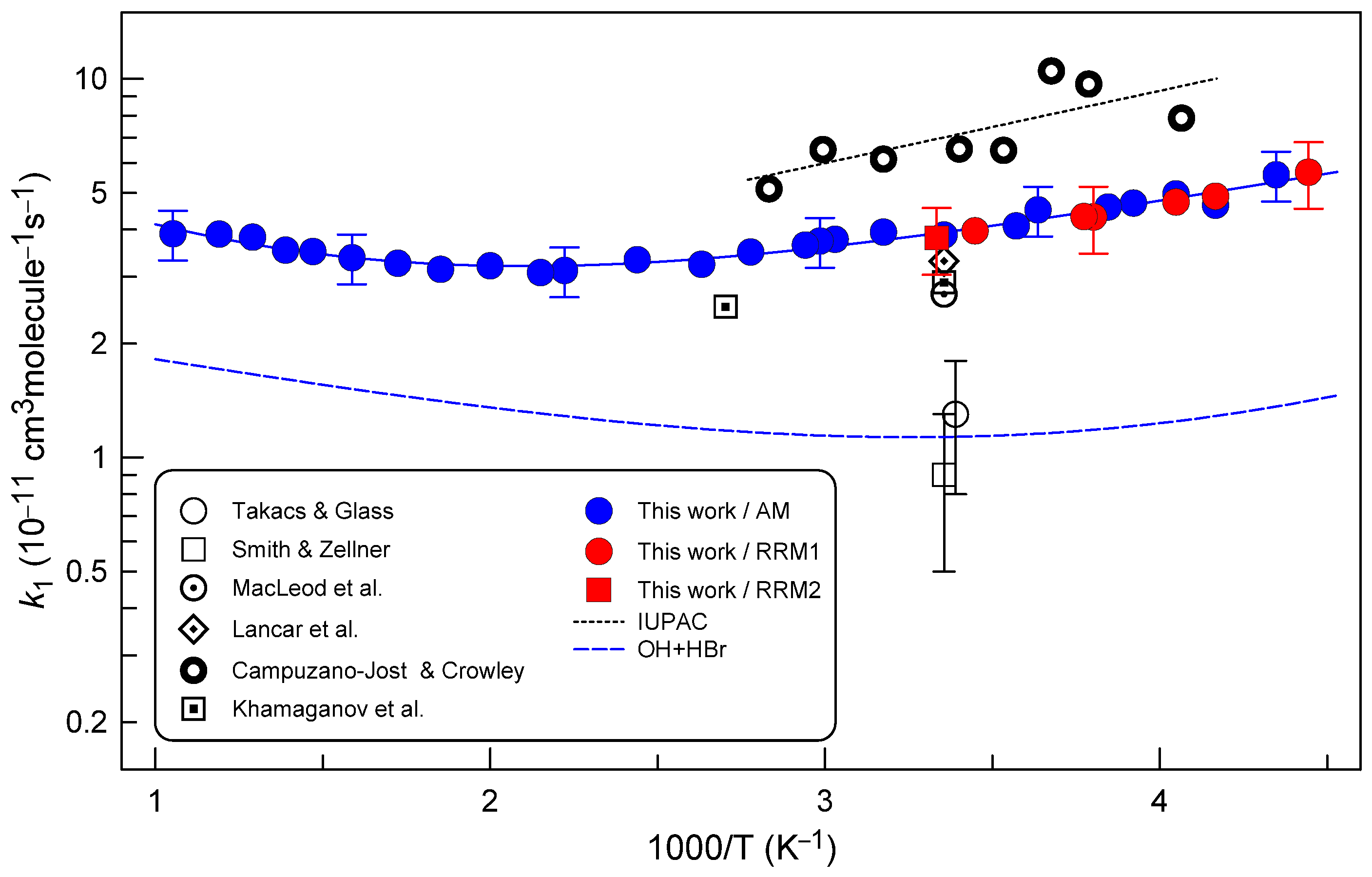
The results of the current measurements of k1 are presented in Figure 6 along with those from previous studies. The present measurements confirm the negative temperature dependence of the rate constant observed previously by Campuzano-Jost and Crowley [7] and Khamaganov et al. [8] in the temperature ranges 246–353 K and 298–370 K, respectively. As for the absolute values of k1, at room temperature, our data are somewhat higher (by a factor of 1.15–1.4) than those reported in refs. [5,6,8], although the agreement can be considered acceptable, taking into account the experimental uncertainties of the measurements. However, the difference between our measurements and those of Campuzano-Jost and Crowley [7] at room temperature is significantly greater (our data are lower by a factor of 1.6). We have difficulty establishing the reason for this important divergence and are led to agree with the authors of the most recent study of Reaction (1) [8], who analyzed the experiments of Campuzano-Jost and Crowley [7] and concluded that there is no obvious explanation for a large difference between their results and those of the references [5,6,8].
Possible reasons for the discrepancies between different measurements of k1 have been discussed in previous studies, most extensively by Campuzano-Jost and Crowley [7], and will not be repeated here. It can be noted that the main reason appears to be uncertainty regarding the concentration of HI in the reactor (directly affecting the measured value of the rate constant), associated with possible losses of HI during its storage and in the gas delivery lines used for introduction of HI into the reactor. In this regard, it is worth noting that this study is the only one in which HI was monitored and its concentration measured directly in the reaction zone. Furthermore, the results of the absolute measurements of k1 at room temperature agree well with those by the relative rate method (RRM2), which does not involve the measurement of the absolute concentration of HI.
Campuzano-Jost and Crowley [7], discussing the results of flow tube measurements by Lancar et al. [6], mentioned that the vibrationally excited OH radicals formed upon OH generation through H + NO2 reaction are not efficiently quenched by 1 Torr of He and may possibly lead to a reduction in the rate coefficient for Reaction (1). In current experiments as well, the reaction of H atoms with NO2 was used for OH generation at a total pressure of 2 Torr of He. However, the impact of the vibrationally excited OH on the measurements of k1 seems unlikely, since the excited OH(v) are rapidly deactivated in reaction with NO2 in the OH-source zone (movable injector), i.e., before entering the main reactor. The rate constant of (6.4 ± 0.3) × 10−11 cm3 molecule−1 s−1 at T = 298 K [25] was reported for OH(v) + NO2 relaxation reaction. In addition, OH(v) can also be deactivated upon collisions with the wall of the movable injector.
The present measurements, carried out over an extended temperature range, revealed a U-shaped temperature dependence of the reaction rate constant: k1 decreases with temperature at low temperatures and has a positive temperature dependence at high temperatures. The solid line in Figure 6 represents a fit of the present experimental k1 data to the sum of two exponential functions:
k1 = 1.13 × 10⁻¹¹ exp(354/T) + 6.93 × 10⁻¹¹ exp(−1010/T) cm3 molecule−1 s−1
This expression reproduces all experimental data to within 6% and can be recommended from the present work in the temperature range T = (225–950) K with an estimated systematic independent of temperature uncertainty of 15%. Alternatively, the experimental data can also be described by a modified Arrhenius expression:
k1 = 4.2 × 10⁻¹² × (T/298)1.36 exp(666/T) cm3 molecule−1 s−1
Both expressions give almost identical results for k1 in the temperature range of the study.
Interestingly, a similar temperature behavior was previously observed for the rate constant of the analogous reaction of OH radicals with HBr in the same temperature range (dashed line in Figure 6) [14]. Theoretical calculations showed that at low temperatures, the OH + HBr reaction proceeds via the formation of a collisional complex involving H atom tunneling, while at higher temperatures, it proceeds predominantly via direct H atom abstraction [26]. A similar reaction mechanism can be hypothesized for the title reaction, but its theoretical confirmation would be beneficial.

5. Conclusions

In this study, a low-pressure discharge flow reactor coupled with modulated molecular beam mass spectrometry was used to measure the rate constant (k1) of the reaction of OH radicals with hydrogen iodide, an important atmospheric process that converts the reservoir species HI into reactive iodine atoms.
As a result of absolute and relative measurements carried out in a wide temperature range from 225 to 950 K, it was found that the reaction rate constant has a U-shaped temperature dependence, that is, it decreases with temperature at low temperatures and increases at high temperatures. Recommended expression over the 225–950 K temperature range: k1 = 1.13 × 10⁻¹¹ exp(354/T) + 6.93 × 10⁻¹¹ exp(−1010/T) cm3 molecule−1 s−1 or in the form of a modified Arrhenius expression, k1 = 4.2 × 10⁻¹² × (T/298)1.36 exp(666/T) cm3 molecule−1 s−1, with a total estimated uncertainty of 15% at all temperatures.
The present kinetic measurements, realized for the first time over an extended temperature range, provide an experimental basis for theoretical developments and can be recommended for use in modeling atmospheric chemistry over a wide temperature range: from the high temperatures characteristic of hot volcanic plumes near emission sources to the lowest temperatures in the Earth’s atmosphere.

Funding

This research received no external funding.

Institutional Review Board Statement

Not applicable.

Informed Consent Statement

Not applicable.

Data Availability Statement

The original contributions presented in this study are included in the article. Further inquiries can be directed to the corresponding author.

Conflicts of Interest

The author declares no conflicts of interest.

References

  1. Solomon, S.; Garcia, R.R.; Ravishankara, A.R. On the role of iodine in ozone depletion. J. Geophys. Res. Atmos. 1994, 99, 20491–20499. [Google Scholar] [CrossRef]
  2. Saiz-Lopez, A.; Fernandez, R.P.; Ordóñez, C.; Kinnison, D.E.; Gómez Martín, J.C.; Lamarque, J.F.; Tilmes, S. Iodine chemistry in the troposphere and its effect on ozone. Atmos. Chem. Phys. 2014, 14, 13119–13143. [Google Scholar] [CrossRef]
  3. Takacs, G.A.; Glass, G.P. Reactions of hydroxyl radicals with some hydrogen halides. J. Phys. Chem. 1973, 77, 1948–1951. [Google Scholar] [CrossRef]
  4. Smith, I.W.M.; Zellner, R. Rate measurements of reactions of OH by resonance absorption. Part 3.—Reactions of OH with H2, D2 and hydrogen and deuterium halides. J. Chem. Soc. Faraday Trans. 2 Mol. Chem. Phys. 1974, 70, 1045–1056. [Google Scholar] [CrossRef]
  5. MacLeod, H.; Balestra, C.; Jourdain, J.L.; Laverdet, G.; Bras, G.L. Kinetic study of the reaction OH + HI by laser photolysis-resonance fluorescence. Int. J. Chem. Kinet. 1990, 22, 1167–1176. [Google Scholar] [CrossRef]
  6. Lancar, I.T.; Mellouki, A.; Poulet, G. Kinetics of the reactions of hydrogen iodide with hydroxyl and nitrate radicals. Chem. Phys. Lett. 1991, 177, 554–558. [Google Scholar] [CrossRef]
  7. Campuzano-Jost, P.; Crowley, J.N. Kinetics of the Reaction of OH with HI between 246 and 353 K. J. Phys. Chem. A 1999, 103, 2712–2719. [Google Scholar] [CrossRef]
  8. Khamaganov, V.G.; Orkin, V.L.; Larin, I.K. Study of the reactions of OH with HCl, HBr, and HI between 298 K and 460 K. Int. J. Chem. Kinet. 2020, 52, 852–860. [Google Scholar] [CrossRef] [PubMed]
  9. Burkholder, J.B.; Sander, S.P.; Abbatt, J.; Barker, J.R.; Cappa, C.; Crounse, J.D.; Dibble, T.S.; Huie, R.E.; Kolb, C.E.; Kurylo, M.J.; et al. Chemical Kinetics and Photochemical Data for Use in Atmospheric Studies, Evaluation No. 19, JPL Publication 19-5, Jet Propulsion Laboratory. Available online: http://jpldataeval.jpl.nasa.gov (accessed on 10 February 2026).
  10. Atkinson, R.; Baulch, D.L.; Cox, R.A.; Crowley, J.N.; Hampson, R.F.; Hynes, R.G.; Jenkin, M.E.; Rossi, M.J.; Troe, J. Evaluated kinetic and photochemical data for atmospheric chemistry: Volume III—Gas phase reactions of inorganic halogens. Atmos. Chem. Phys. 2007, 7, 981–1191. [Google Scholar] [CrossRef]
  11. Aiuppa, A.; Federico, C.; Franco, A.; Giudice, G.; Gurrieri, S.; Inguaggiato, S.; Liuzzo, M.; McGonigle, A.J.S.; Valenza, M. Emission of bromine and iodine from Mount Etna volcano. Geochem. Geophys. Geosyst. 2005, 6, Q08008. [Google Scholar] [CrossRef]
  12. Aiuppa, A.; Baker, D.R.; Webster, J.D. Halogens in volcanic systems. Chem. Geol. 2009, 263, 1–18. [Google Scholar] [CrossRef]
  13. Morin, J.; Romanias, M.N.; Bedjanian, Y. Experimental study of the reactions of OH radicals with propane, n-pentane, and n-heptane over a wide temperature range. Int. J. Chem. Kinet. 2015, 47, 629–637. [Google Scholar] [CrossRef]
  14. Bedjanian, Y. Rate Constant of the Reaction of OH Radicals with HBr over the Temperature Range 235–960 K. J. Phys. Chem. A 2021, 125, 1754–1759. [Google Scholar] [CrossRef]
  15. Su, M.C.; Kumaran, S.S.; Lim, K.P.; Michael, J.V.; Wagner, A.F.; Harding, L.B.; Fang, D.C. Rate Constants, 1100 ≤ T ≤ 2000 K, for H + NO2 → OH + NO Using Two Shock Tube Techniques: Comparison of Theory to Experiment†. J. Phys. Chem. A 2002, 106, 8261–8270. [Google Scholar] [CrossRef]
  16. Bedjanian, Y. Rate constants for the reactions of F atoms with H2 and D2 over the temperature range 220–960 K. Int. J. Chem. Kinet. 2021, 53, 527–535. [Google Scholar] [CrossRef]
  17. Bedjanian, Y. Temperature-Dependent Rate Constant for the Reaction of Hydroxyl Radical with 3-Hydroxy-3-methyl-2-butanone. J. Phys. Chem. A 2019, 123, 10446–10453. [Google Scholar] [CrossRef]
  18. Bedjanian, Y. Rate constant of H atom reaction with Br2 determined between 220 and 950 K. Chem. Phys. Lett. 2023, 825, 140616. [Google Scholar] [CrossRef]
  19. Lorenz, K.; Wagner, H.G.; Zellner, R. Rate measurements for the reactions H + I2 → HI + I and H + HI → H2 + I by Lyman-α-fluorescence. Ber. Bunsenges. Phys. Chem. 1979, 83, 556–560. [Google Scholar] [CrossRef]
  20. Manion, J.A.; Huie, R.E.; Levin, R.D.; Burgess, D.R.; Orkin, V.L.; Tsang, W.; McGivern, W.S.; Hudgens, J.W.; Knyazev, V.D.; Atkinson, D.B.; et al. NIST Chemical Kinetics Database, NIST Standard Reference Database 17, Version 7.0 (Web Version), Release 1.6.8, Data Version 2015.12, National Institute of Standards and Technology, Gaithersburg, Maryland, 20899–28320. Available online: http://kinetics.nist.gov/ (accessed on 10 February 2026).
  21. Bedjanian, Y.; Le Bras, G.; Poulet, G. Kinetic study of the reactions Br + IBr→I + Br2 and I + Br2→Br + IBr. Int. J. Chem. Kinet. 1998, 30, 933–940. [Google Scholar] [CrossRef]
  22. Velichko, A.M.; Gordon, E.B.; Nadeikin, A.A.; Nikitin, A.I.; Tal’roze, V.L. Multiphoton dissociation of CF3I molecules in the presence of Br2 and NO. High Energy Chem. 1985, 19, 138–142. [Google Scholar]
  23. Kaufman, F. Kinetics of elementary radical reactions in the gas phase. J. Phys. Chem. 1984, 19, 4909–4917. [Google Scholar] [CrossRef]
  24. Ivanov, A.V.; Trakhtenberg, S.; Bertram, A.K.; Gershenzon, Y.M.; Molina, M.J. OH, HO2, and Ozone Gaseous Diffusion Coefficients. J. Phys. Chem. A 2007, 111, 1632–1637. [Google Scholar] [CrossRef] [PubMed]
  25. D’Ottone, L.; Bauer, D.; Campuzano-Jost, P.; Fardy, M.; Hynes, A.J. Kinetic and mechanistic studies of the recombination of OH with NO2: Vibrational deactivation, isotopic scrambling and product isomer branching ratios. Faraday Discuss. 2005, 130, 111–123. [Google Scholar] [CrossRef] [PubMed]
  26. Ree, J.; Kim, Y.H.; Shin, H.K. Dependence of the Four-Atom Reaction HBr + OH → Br + H2O on Temperatures between 20 and 2000 K. J. Phys. Chem. A 2015, 119, 3147–3160. [Google Scholar] [CrossRef]
Figure 1. Diagram of high-temperature flow reactor: configuration used in the absolute measurements of the rate constant of Reaction (1).
Atmosphere 17 00301 g001
Figure 2. Example of the kinetics of OH consumption in the reaction with excess HI at T = 840 K.
Atmosphere 17 00301 g002
Figure 3. Pseudo-first order rate constant, k1′ = k1 × [HI] + kw as a function of HI concentration at different temperatures. OH radicals detected as HOBr (a) and HOI (b) (see text).
Atmosphere 17 00301 g003
Figure 4. Yield of HOBr from OH titration with Br2 + HI mixtures at T = 290 and 225 K.
Atmosphere 17 00301 g004
Figure 5. Dependence of ln([HI]0/[HI]) vs. ln([Br2]0/[Br2]) observed in the relative measurements of the rate constant of Reaction (1) at T = 300 K.
Atmosphere 17 00301 g005
Figure 6. Temperature dependence of the rate constant of the OH + HI reaction (present work and Refs. [3,4,5,6,7,8]). AM: absolute measurements; RRM1: relative rate method using OH titration with HI/Br2 mixture; RRM2: relative rate method based on relative consumption of HI and Br2 (see text); IUPAC: current recommendation of the IUPAC Task Group on Atmospheric Chemical Kinetic Data Evaluation [10]. Partially shown error bars on the present data correspond to the estimated total uncertainties of 15 and 20% for the absolute and relative rate measurements, respectively.
Atmosphere 17 00301 g006
Table 1. Absolute measurements of the rate constant of Reaction (1): experimental conditions and results.
T (K)[HI] ak1 bOH SourceOH Detection cReactor Surface d
2300.76–9.945.58F + H2 + NO2HOBrHW
2400.79–13.24.64F + H2 + NO2HOBrHW
2470.6–12.84.97F + H2 + NO2HOBrHW
2550.69–12.14.70H + NO2HOBrHW
2600.59–11.24.59F + H2 + NO2HOBrHW
2750.62–11.84.51H + NO2HOBrHW
2800.72–13.04.09F + H2 + NO2HOBrHW
2980.65–12.63.87F + H2 + NO2HOBrHW
3150.69–13.13.94F + H2 + NO2HOBrHW
3300.93–12.63.77H + NO2HOBrQ
3350.53–11.73.73H + NO2HOIQ
3400.68–14.33.64F + H2 + NO2HOBrHW
3600.65–12.83.49H + NO2HOBrQ
3800.82–13.63.24H + NO2HOBrQ
4100.59–13.13.33H + NO2HOBrQ
4500.63–15.43.12H + NO2HOBrQ
4651.07–17.33.08H + NO2HOBrQ
5001.07–16.13.21H + NO2HOIQ
5400.72–9.003.14H + NO2HOBrQ
5800.63–15.23.26H + NO2HOBrQ
6300.87–13.73.37H + NO2HOBrQ
6800.89–13.23.50H + NO2HOBrQ
7200.39–6.863.53H + NO2HOBrQ
7750.52–9.853.82H + NO2HOIQ
8400.42–12.53.89H + NO2HOIQ
9500.62–6.503.90H + NO2HOIQ
a Units of 1012 molecules cm−3. b Units of 10−11 cm3 molecule−1 s−1; statistical 2σ uncertainty is ≤3%, total estimated uncertainty is 15%. c See text for OH detection. d HW: halocarbon wax; Q: uncoated quartz.
Table 2. Relative measurements of the rate constant of Reaction (1): experimental conditions and results.
T (K)[HI] a[Br2ak1/k4 bk1 cMethod d
2250.11–4.112.231.046 ± 0.0305.67RRM1
2400.08–3.971.930.957 ± 0.0354.90RRM1
2470.14–3.991.520.948 ± 0.0254.73RRM1
2630.13–3.781.940.911 ± 0.0204.32RRM1
2650.09–3.992.030.917 ± 0.0124.33RRM1
2900.08–4.41.950.900 ± 0.0133.97RRM1
3000.030.020.878 ± 0.0263.80RRM2
a Units of 1013 molecule cm−3. b statistical 2σ uncertainty is given. c Units of 10−11 cm3 molecule−1 s−1; estimated total uncertainty is 20% and includes that on the reference reaction. d RRM1: OH titration with HI/Br2 mixture; RRM2: HI and Br2 consumption (see text).
Disclaimer/Publisher’s Note: The statements, opinions and data contained in all publications are solely those of the individual author(s) and contributor(s) and not of MDPI and/or the editor(s). MDPI and/or the editor(s) disclaim responsibility for any injury to people or property resulting from any ideas, methods, instructions or products referred to in the content.