Article

An Overlooked Sink: Quantifying the Impact of Aerosol Deposition on Building Walls with Large Eddy Simulation


by
Alexander Varentsov
1,2,3,4,*,
Evgeny Mortikov
1,4,5,
Victor Stepanenko
1,2 and
Andrey Glazunov
1,5
1
Research Computing Center, Lomonosov Moscow State University, Leninskie Gory 1, b. 4, 119234 Moscow, Russia
2
Faculty of Geography, Lomonosov Moscow State University, Leninskie Gory 1, 119991 Moscow, Russia
3
A.M. Obukhov Institute of Atmospheric Physics, Russian Academy of Sciences, Pyzhevskiy Pereulok 3, 119017 Moscow, Russia
4
Moscow Center for Fundamental and Applied Mathematics, Leninskie Gory 1, 119991 Moscow, Russia
5
G.I. Marchuk Institute of Numerical Mathematics, Russian Academy of Sciences, Gubkina 8, 119333 Moscow, Russia
*
Author to whom correspondence should be addressed.
Atmosphere 2026, 17(3), 293; https://doi.org/10.3390/atmos17030293
Submission received: 21 January 2026 / Revised: 11 March 2026 / Accepted: 12 March 2026 / Published: 14 March 2026
(This article belongs to the Section Atmospheric Techniques, Instruments, and Modeling)

Abstract

Urban air quality is influenced by the removal of particulate matter through dry deposition, yet this process is often simplified in models, potentially underestimating the role of vertical building surfaces. This study investigates the impact of aerosol deposition on building walls on PM2.5 concentrations and the deposition budget within the urban canopy. We utilized a Large Eddy Simulation model coupled with a Lagrangian Particle Transport module to simulate aerosol dispersion in randomized urban configurations corresponding to Local Climate Zones (LCZs) 4, 5, and 6. The results indicate that under the considered conditions, vertical walls can act as a primary sink for PM2.5, capturing over 70% of deposited particles downwind from sources in high-rise environments. We observed a non-linear sensitivity of airborne concentrations to wall deposition efficiency; a relatively low capture probability (10%) reduced near-surface concentrations by 25–30%. Furthermore, for fine and coarse particles (up to ~20 µm), the uncertainty in wall deposition parameterization appeared to outweigh the influence of particle physical properties on dispersion patterns. These findings suggest that neglecting wall deposition may lead to overestimation of urban pollution levels, highlighting the importance of refining particle–wall interaction parameterizations in air quality models.

1. Introduction

Urban air pollution by particulate matter (PM), particularly the fine fraction PM2.5, is an important environmental problem, posing a significant threat to public health and leading to the development of respiratory and cardiovascular diseases [1,2]. The impact of PM2.5 concentrations on mortality is especially pronounced in low- and middle-income countries where urbanization processes are most active [3]. The complexity of urban landscapes, characterized by a diversity of architectural forms and a high density of emission sources, requires the use of high-resolution models for effective air quality analysis and forecasting [4]. Addressing such challenges necessitates multi-scale approaches that connect processes from the flow around individual buildings to city-scale circulations [5,6].
With advances in numerical approaches to turbulence modeling and available computational resources, simplistic Gaussian models [7] have been superseded by computational fluid dynamics (CFD) methods, such as Large Eddy Simulation (LES). LES allows for high-fidelity modeling of complex turbulent flow structures within urban developments [8,9]. It is also widely used for real atmospheric flow simulations, yielding results consistent with observational data [10,11]. The ability of LES models to produce physically consistent, high-resolution meteorological fields allows them to be used as a benchmark for evaluating and verifying simplified models [12,13]. To describe the dynamics of aerosols, the Lagrangian Particle Transport (LPT) approach is most informative, as it tracks individual particle trajectories and explicitly accounts for their inertial properties and interactions with surfaces [10]. The combination of LES and LPT has been successfully used for modeling particle transport in complex configurations, such as real cities, for assessing the impact of stratification and building geometry on dispersion [14] or cabins of aircraft vessels [15]. For particles with a small Stokes number (less than 0.1), which includes PM2.5, a one-way coupling approach is typically used in LPT, where the feedback effect of particles on the flow is considered negligible [16].
A key process determining the lifetime of aerosols in the atmosphere is dry deposition—the removal of particles from the atmosphere upon contact with surfaces [17]. While wet deposition is the dominant removal mechanism on a global climatic scale, dry deposition plays a critical role at local scales [18]. In the urban microscale context, where the residence time of particles near sources is typically shorter than the characteristic time between precipitation events, dry deposition often becomes the governing process determining aerosol lifetime. The main mechanisms controlling this process are gravitational settling, turbulent diffusion, interception, and inertial impaction with surfaces [19]. The gravitational deposition intensity, described by the dry deposition velocity, is sensitive to particle size: for instance, the deposition velocity for 10 µm particles can be almost 100 times higher than for 1 µm particles [20]. In most Eulerian air quality models, these processes are parameterized using schemes originally developed for relatively homogeneous horizontal surfaces, such as soil or statistically uniform vegetation [21,22]. Moreover, the validity of the deposition velocity concept underlying these schemes has been recently challenged for ambient aerosols due to the complex interplay between turbulent transport and near-surface chemical transformations [23]. However, the urban environment includes multiple vertical surfaces—building walls—whose total area can be many times greater than that of horizontal surfaces.
Several studies convincingly demonstrate the significance of deposition on vertical surfaces. Theoretical models developed several decades ago described deposition on vertical walls through a complex interplay of turbulent diffusion and lift forces, highlighting the importance of surface roughness, adhesion, and electrostatic forces [24]. Wind tunnel experiments have confirmed that the complex flow structure near buildings, including separation zones and recirculation vortices, enhances particle transport to facades [25]. Field experiments using a fluorescent aerosol tracer have demonstrated the feasibility of directly measuring deposition velocities on building facades [26]. Laboratory studies have also shown that wall surface texture is a critical factor: rough and fibrous surfaces (e.g., carpet, plaster) exhibit a significantly higher particle adhesion probability compared to smooth ones [27], a finding also supported by numerical simulations of flows over rough surfaces [28]. Moreover, modeling studies for Paris have shown that for fine particles, dry deposition fluxes to vertical walls are comparable to those to horizontal roofs, as vertical gravitational settling for such particles is negligible [29].
Despite this evidence, in many contemporary air quality models, deposition on vertical walls is either ignored or parameterized simplistically. The latest advancements in urban canopy models (UCM) attempt to achieve a more detailed representation by calculating deposition on roofs, roads, and walls individually, utilizing morphological parameters of the urban landscape [29,30]. Moreover, the increase in total surface area does not linearly translate to total deposition, as complex flow regimes like skimming flow can shelter specific surfaces or, conversely, enhance impaction.
In Lagrangian models, the deposition process is described explicitly, as each particle is treated separately. The simplest approach assumes that a particle deposits irreversibly upon collision with a surface—the “perfect sink” or “trap” model [16]. More complex schemes define deposition using a critical impact velocity criterion based on the energy balance [31,32,33] or employ restitution coefficients to account for energy losses during interaction with a surface [34]. Research comparing these methods highlights that standard “trap” models often overestimate deposition rates compared to models that account for particle rebound, effectively implying a capture probability of less than 100% [32]. Furthermore, real-world surface roughness introduces significant stochasticity into the rebound angles and energies, making the interaction inherently probabilistic [34]. In our study, we adopt a probabilistic approach, parameterizing deposition with a predefined probability. This simplification allows us to systematically quantify the sensitivity of urban aerosol concentrations to the intensity of wall deposition processes and identify the critical ranges where this sink becomes dominant.
Even assuming a “perfect” description of collision and surface interaction processes, challenges remain in describing particle transport. It is known that Lagrangian models can overestimate the deposition of fine particles due to the isotropic approximation applied to near-wall turbulence, which requires the application of advanced approaches that explicitly account for the near-wall turbulence inhomogeneity and introduce drift correction terms to prevent spurious particle accumulation [35,36,37]. Thus, although the importance of both transport and interaction mechanisms is recognized, their combined quantitative impact remains a subject for further research. A significant knowledge gap persists regarding how much the uncertainty in the parameterization of wall deposition affects simulation results compared to other factors, such as the specification of the particle physical properties (size and mass).
This study aims to address these questions by quantitatively assessing both the impact of wall deposition on PM2.5 concentrations in the urban canopy and the relative contribution of vertical surfaces to the total deposition budget. To create realistic yet morphometrically distinct urban configurations, we use an approach based on the Local Climate Zone (LCZ) classification [38], which has proven effective in interpreting the relationship between urban landscape and particle pollution [39,40]. Using a series of numerical experiments based on the LES-LPT method, we systematically investigate not only the sensitivity of PM2.5 concentration fields to the deposition probability but also the partitioning of the total deposition budget among walls, roofs, and the ground, and how this budget is driven by urban morphology.

2. Materials and Methods

2.1. LES Model and Lagrangian Particle Transport Module

The primary tool for this research was the Large Eddy Simulation (LES) configuration of a microscale atmosphere model jointly developed at the Research Computing Center of Lomonosov Moscow State University and the G.I. Marchuk Institute of Numerical Mathematics of the Russian Academy of Sciences. This model is a multi-purpose platform capable of operating in LES, Direct Numerical Simulation (DNS), and Reynolds-Averaged Navier–Stokes (RANS) modes, making it a powerful tool for studying geophysical turbulent flows at various spatial scales [41,42,43,44,45,46].
The LES model solves the finite-difference approximation of the spatially filtered Navier–Stokes equations under the Boussinesq approximation to describe the dynamics of a thermally stratified, incompressible fluid. The turbulence closure is based on the Smagorinsky model, where the Smagorinsky coefficient and subgrid Prandtl and Schmidt numbers are determined using a dynamic procedure [47]. This allows for the calculation of subgrid scalar fluxes without any ad hoc empirical constants. The numerical implementation uses second-order conservative finite-difference schemes [48] on rectangular grids, a fractional-step method to ensure the incompressibility condition, and a third-order explicit Adams–Bashforth scheme for time integration.
To represent the complex urban geometry on a structured orthogonal grid without the need for boundary-fitted meshes, a discrete Cartesian masking approach is utilized, treating buildings as explicitly resolved rigid structures. The model’s architecture allows for assigning individual roughness and temperature values to surface elements, which has been successfully applied to simulate the complex dynamic and thermal impacts of urban environments in our recent studies [40,45,49]. Functionally, the LES core is part of a broader atmospheric modeling framework that includes integrated modules for RRTM radiative transfer [50,51] and cloud microphysics [46,52,53,54]. However, to strictly isolate the purely aerodynamic effects of urban morphology on turbulent airflow and particle deposition, these coupled thermodynamic, radiative, and microphysical modules were intentionally disabled, and uniform surface parameters under neutral stratification were prescribed in the present study.
For modeling aerosol transport, the LES model is coupled with a Lagrangian Particle Transport (LPT) module; hereafter, this coupled framework is referred to as the LES-LPT method. It operates in an online-coupled mode with the hydrodynamic core, gaining direct access to instantaneous three-dimensional velocity and turbulence fields “on the fly”. This approach is well suited for the urban environment, as it allows for high-precision tracking of particle trajectories within the complex and rapidly changing turbulent structures that form around buildings [10]. A detailed description of the physical parameterizations and numerical implementation used in the Lagrangian module for this study is provided below.
In the LPT module, the motion of each individual particle is governed by an equation that calculates the change in particle position over time:
d x i p = u i d t + d x i + u i s d t ,
where x i p is the particle coordinate along the i-th axis, and t is time. The terms on the right-hand side account for, respectively, advection by the resolved LES velocity ( u i ), displacement due to subgrid-scale turbulence ( d x i ), and gravitational settling ( u i s ). This formulation relies on the inertialess approximation, which is valid for particles with a Stokes number S t 1 (defined as the ratio of the particle relaxation time to the integral time scale of turbulence). For typical mineral dust density (~2650 kg/m3), this approximation holds for diameters up to hundreds of microns; thus, the particles simulated in this study ( d p 50   µ m ) fall well within the validity range.
The subgrid displacement is calculated using the Random Displacement Model (RDM) from [55,56,57]:
d x i = K s x i d t + 2 K s ξ i ,
where K s is the subgrid turbulent diffusion coefficient, and ξ i is the increment of a Wiener random process for the i-th coordinate axis (a normally distributed random variable with zero mean and variance d t ).
The first term on the right-hand side of Equation (2) represents the deterministic drift. This gradient term ensures that the Lagrangian particle dispersion maintains strict mathematical equivalence to the Eulerian diffusion equation in a field with variable diffusivity, effectively preventing spurious particle accumulation in low-turbulence regions [57]. Furthermore, to physically parameterize the near-wall turbulence anisotropy and the damping of wall-normal fluctuations, the subgrid diffusivity K s is linearly interpolated from the fluid cell center to zero at the solid boundaries (walls, roofs, and ground). Consequently, the stochastic displacement amplitude naturally vanishes upon contacting a surface. Finally, to ensure the rigorous mathematical well-posedness of the random displacement step and handle local backscatter (negative subgrid diffusivity values), the Eulerian core employs a Lagrangian Dynamic Smagorinsky Model (LDSM), which averages dynamic model coefficients along fluid trajectories to strictly limit negative viscosity. Any residual negative subgrid diffusivity values are explicitly clipped to zero ( K s 0 ).
The settling velocity is determined by the Stokes law:
u x s = u y s = 0 , u z s = g d p 2 18 μ ρ p ρ ,
where g is gravitational acceleration, d p is particle diameter, μ is the dynamic viscosity of air, ρ p is particle density, and ρ is air density.
A key feature of the module, crucial for this study, is the explicit parameterization of particle interactions with solid surfaces (ground, roofs, and building walls), which are represented in the LES model as a set of impenetrable grid cells. When a particle collides with a surface, one of two outcomes occurs: elastic bounce or deposition onto the surface. The choice is determined based on a predefined deposition probability ( P ), which can range from 0 (always elastic bounce) to 1 (always deposition). It is important to note that this parameter can be set individually for each type of simulated particle, as well as separately for horizontal ( P h ) and vertical ( P v ) surfaces. This flexibility allows for a specialized study of the sensitivity of simulation results to deposition processes on different elements of the urban geometry within a single numerical experiment.
It should be noted that in a stochastic discrete-time model, the exact frequency of particle–wall collisions inherently depends on the simulation time step. Consequently, applying a fixed deposition probability P per collision means that the absolute physical deposition rate may also be time-step dependent. However, quantitatively reproducing specific deposition velocities for real-world materials is beyond the scope of this study, as our primary focus is a comparative sensitivity analysis. Because a strictly constant time step ( d t = 0.08 s) was used across all performed simulations, this numerical time-step dependence is eliminated. This explicitly ensures that our relative comparisons of particle capture efficiency between horizontal and vertical surfaces, as well as across different urban morphologies, remain methodologically consistent.
The developed Lagrangian particle transport module has been previously verified by comparing simulation results with analytical solutions for a set of idealized problems, including the transport of particles with different sizes and densities [58,59].

2.2. Experimental Setup

To systematically study the processes of aerosol transport and deposition, urban building configurations based on the Local Climate Zone (LCZ) classification were used [38]. This approach, which has become a standard in urban meteorology, allows for the objective classification of urban areas by their key morphometric parameters (building height, packing density, and surface properties), thereby enhancing the transferability of the results to various urban contexts globally.
We adopted the methodology used in our previous study [40]. Three types of Local Climate Zones were chosen for the numerical experiments: LCZ 4 (open high-rise, 25–40 m high), LCZ 5 (open mid-rise, 10–25 m high), and LCZ 6 (open low-rise, <10 m high). These “open” types with moderate building density (building surface fraction or plane area building density of 20–40%) cover a wide range of residential areas and occupy significant land areas in modern cities [60]. Additionally, their relatively low density reduces the requirements for the spatial resolution of the model grid, making them less computationally demanding compared to compact LCZs (1, 2, 3). Although simulations were conducted for all three types, the detailed sensitivity analysis is primarily focused on LCZ 4. We selected this configuration because its greater building height and larger vertical surface area suggest a stronger potential impact of wall deposition, allowing for a more thorough examination of these effects across different height levels. The results for LCZ 5 and LCZ 6 are subsequently used for comparison and to analyze the influence of building height on the processes under investigation.
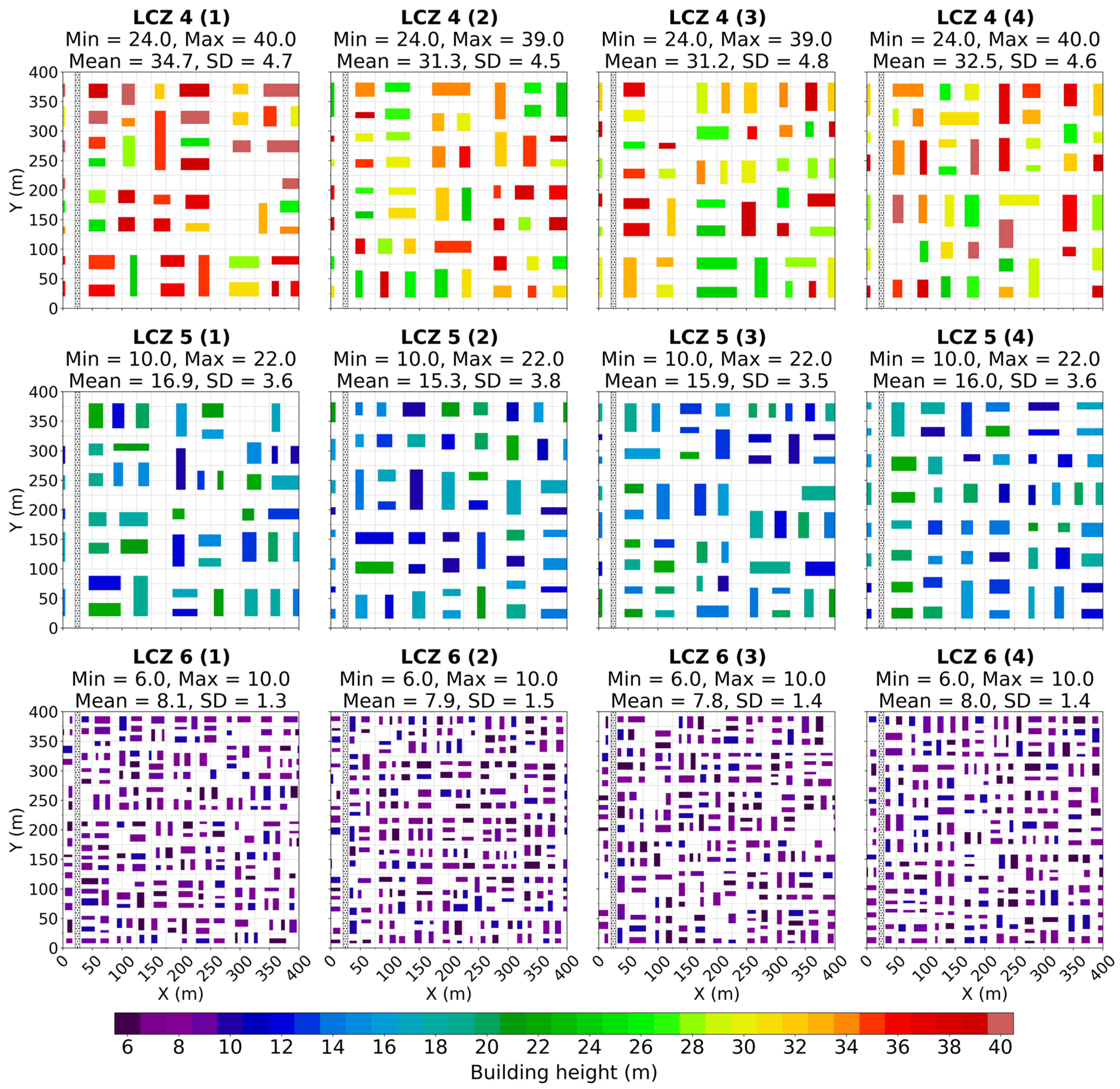
This study used randomized building geometry configurations (Figure 1). Unlike idealized regular building arrays, such configurations lack repeating structures but adhere to the general morphometric parameters of their LCZ class at the district scale. This approach allows for a better representation of the natural heterogeneity of real cities, which are characterized by variations in the height, size, and location of buildings. The building map generation procedure, described in detail in [40], involves the creation of a street network and the subsequent filling of blocks with buildings whose parameters are randomly selected within the ranges defined for the target LCZ class; for that, we used the uniform distribution. To ensure the statistical reliability of the conclusions drawn from numerical experiments, four independent realizations of the urban development map were generated for each LCZ class.
The numerical experiments were conducted to simulate the transport and deposition of aerosol particles under conditions of neutral stratification and weak background wind. The choice of such meteorological conditions allowed us to focus on the study of turbulence processes linked with the urban canopy and their role in dispersion and deposition processes, isolating them from thermal effects, which would complicate the analysis and significantly increase the number of numerical experiments. The change in the wind turning angle within the lower 160 m is negligible; therefore, we can consider this turbulent flow to be unidirectional. Consequently, in the model experiments, the external atmospheric forcing can be prescribed as a volumetric, spatially uniformly distributed force, regardless of its physical nature. Here, it was represented as an effective constant streamwise pressure gradient of −0.8 hPa per 100 km (with the Coriolis effect explicitly neglected). This uniform driving force balanced the aerodynamic drag of the urban canopy. Due to the varying morphological roughness across the different configurations, this forcing resulted in corresponding mean wind speeds in the upper part of the domain ( z 150 m) ranging from approximately 2 m/s for the high-rise LCZ 4 to roughly 3.5 m/s for the low-rise LCZ 6 setups. Periodic boundary conditions were set for all thermodynamic variables and wind speed components on the lateral boundaries of the computational domain.
The computational domain for each building configuration had dimensions of 400 m × 400 m × 161 m. A Cartesian grid with a horizontal resolution of 2 m × 2 m was used. Vertically, the resolution was 2 m in the lower 80-m layer, above which the grid step increased smoothly by 4% with each level. The total simulation period for each experiment was set to 10 h. The aerodynamic spin-up time required for the flow to adapt to the building geometry and reach a quasi-steady state was approximately 1–1.5 h. Consequently, the continuous emission of particles was initialized 2 h after the start of the simulation. To ensure that both the turbulent flow and the spatial distribution of aerosols had reached a statistically stationary state, the analyzed fields were obtained by temporal averaging of the model output over the last 4 h of the simulation (from hour 6 to hour 10).
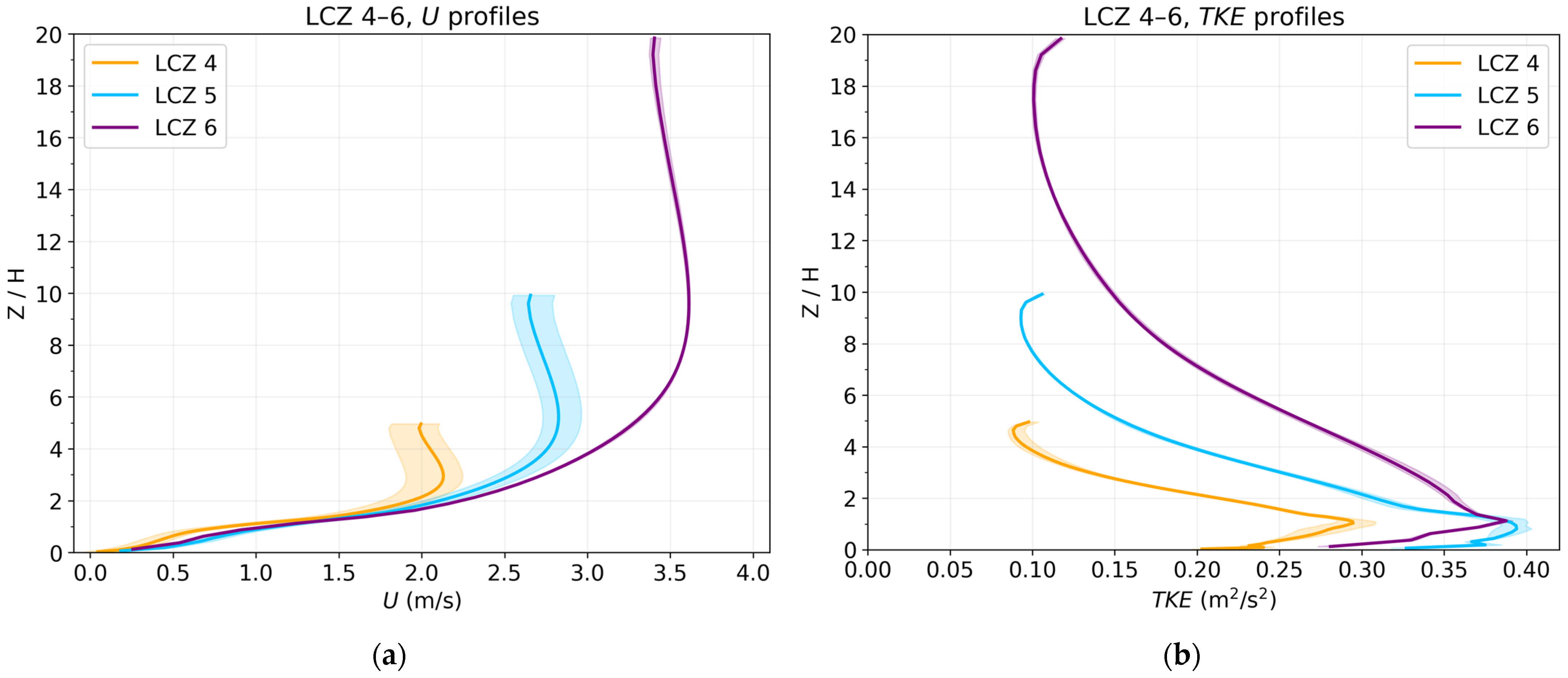
The simulated flow fields reached a quasi-steady state characteristic of the skimming flow regime, as confirmed by the analysis of vertical profiles of mean wind speed and turbulent kinetic energy (see Appendix A). These profiles demonstrate the expected shear layers at roof height and the variation in turbulence penetration depth across different LCZ types, which subsequently drives the particle dispersion and deposition processes.
In all experiments, the particle emissions originated from a long urban street, imitating the effect of vehicular traffic. In the model, this linear source was represented as a volume source located in the first upwind canyon, extending along the entire Y-axis, with a width of 8 m and a height of 4 m. The continuous emission rate was set to 2 million particles per hour for each simulated particle type, resulting in a total release of 16 million particles over the 8-hour emission period. Note that for presentation purposes, absolute values of particle concentrations and deposition counts derived from the model were scaled by a factor of 10 3 in the figures and tables below. For particles, outflow conditions were set on the western, eastern, and top boundaries of the domain. On the southern and northern boundaries, boundary conditions were periodic. The ground surface and buildings were treated as solid surfaces with which particles could interact.
Spherical particles with a diameter of 0.8 µm and a density of 1650 kg/m3 were modeled, corresponding to the typical characteristics of PM2.5 aerosols in urban conditions [61]. The main focus of the study was on varying the deposition probability of particles upon collision with surfaces. Three series of numerical experiments were conducted:
  • Detailed sensitivity study (for LCZ 4). For a comprehensive analysis of the deposition probability’s impact, 36 types of particles were simulated. The particle type was defined by setting six deposition probability values (0%, 10%, 20%, 40%, 60%, and 100%) separately for horizontal ( P h ) and vertical ( P v ) surfaces. Thus, 36 possible combinations of these probabilities were considered in the experiment.
  • Comparison of concentration sensitivity to (a) particle size and mass and (b) deposition probability. For this purpose, experiments were conducted with PM2.5 (0.8 µm, 1650 kg/m3) particles having a fixed deposition probability of 90% on horizontal surfaces ( P h ) and 0%, 10%, 50%, and 100% on vertical surfaces ( P v ). Additionally, experiments were run with 5 types of particles of different sizes and material densities: UFP (ultrafine particles, 0.05 µm diameter, 1000 kg/m3 density), PM2.5 (0.8 µm, 1650 kg/m3), PM10 (5 µm, 4000 kg/m3), tree pollen (22 µm, 800 kg/m3), and coarse dust (50 µm, 2650 kg/m3), with fixed deposition probabilities of P h = 90 % and P v = 50 % .
  • Comparative series of experiments (for LCZs 4, 5, and 6). To validate the conclusions from the first series and to assess the influence of building height on deposition processes, a series of simulations was conducted with all three LCZ types. In this series, 4 types of particles were simulated: the deposition probability on horizontal surfaces ( P h ) was fixed at 50%, while the deposition probability on vertical walls ( P v ) had values of 0%, 10%, 50%, and 100%.

3. Results and Discussion

3.1. Impact of Deposition on Spatial Particle Distribution and Vertical Profiles

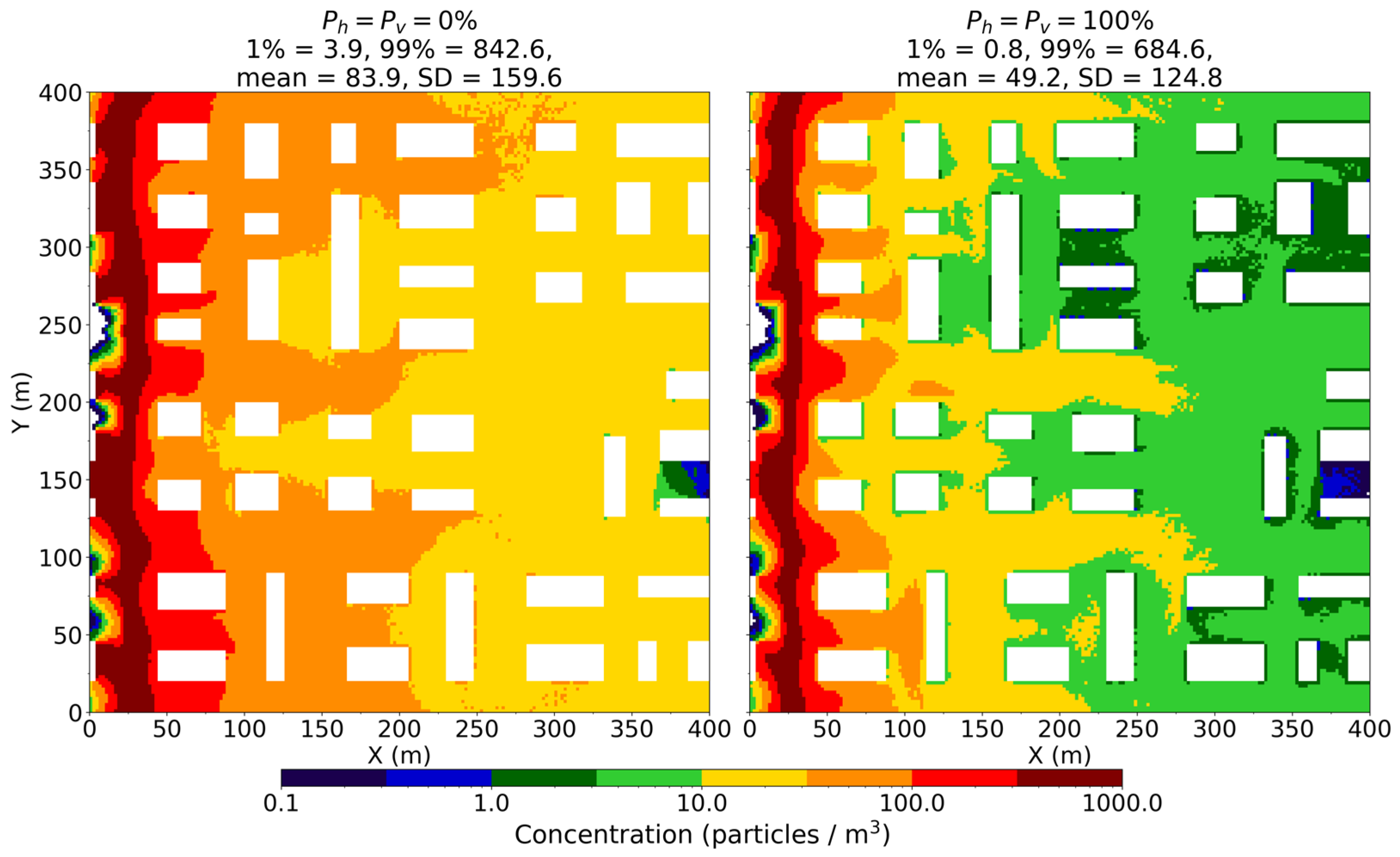
To assess the overall impact of deposition processes on aerosol distribution, two extreme scenarios for the “LCZ 4 (1)” configuration were compared: complete absence of deposition ( P h = P v = 0 % ) and 100% deposition probability upon contact with any surface ( P h = P v = 100 % ). Maps of the mean near-surface concentration (Figure 2) show that although the general pattern of particle transport and the location of major plumes are preserved, the absolute concentration values differ drastically. In the case with maximum deposition, the domain-averaged near-surface concentration decreases by a factor of 1.7 compared to the no-deposition case, and in some areas, this reduction reaches an order of magnitude. The effect is most pronounced for small concentration values (the 1st percentile decreases by a factor of 4.9), indicating effective “cleaning” of the air in areas less accessible to particles.
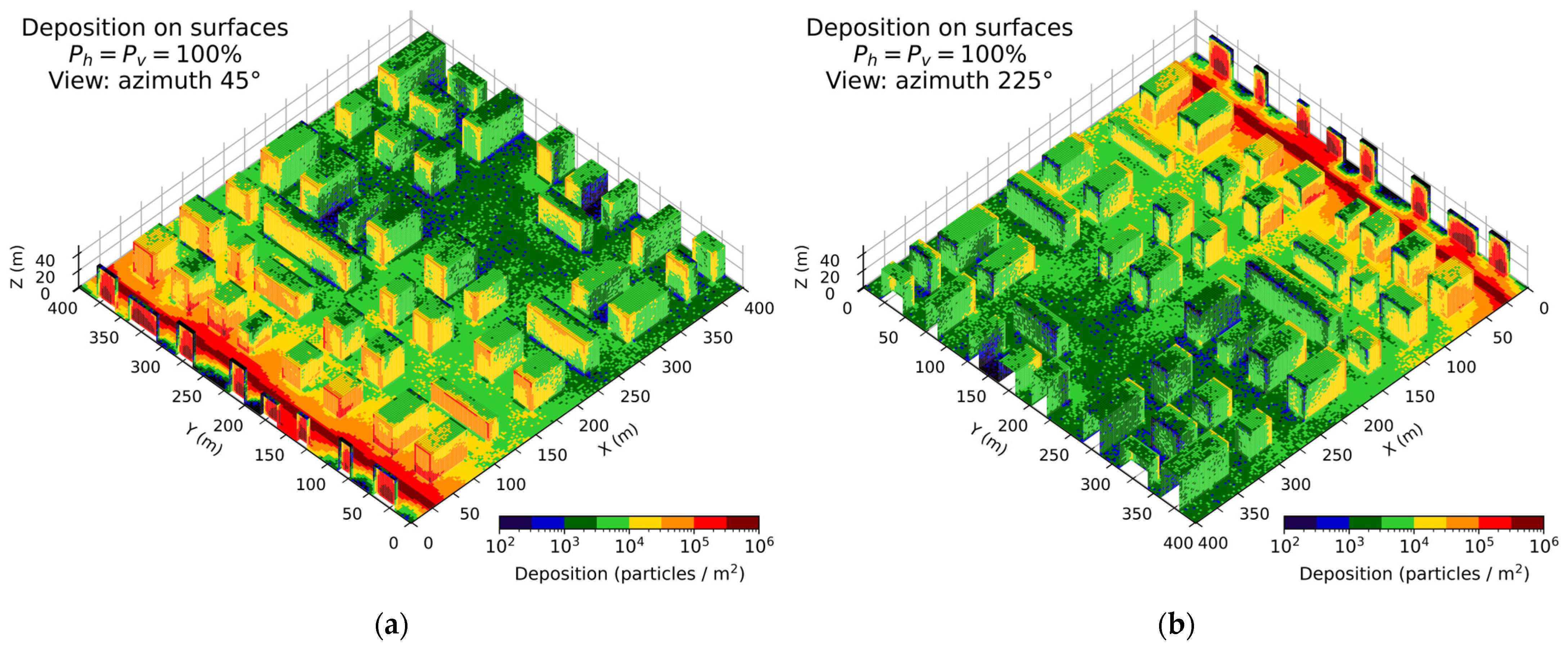
Figure 3 provides a three-dimensional visualization of the accumulated particle deposition density on surfaces for the “LCZ 4 (1)” configuration and the maximum deposition scenario. The visualization confirms that building walls, which constitute the largest surface area (52.7% of the total), and the ground surface (37.5%) are the primary aerosol sinks, accounting for 52.4% and 45.1% of the total deposited particles, respectively. In contrast, roofs, representing 9.8% of the area, contribute a minor 2.6% to the total deposition. The spatial distribution is highly heterogeneous, with the highest average densities observed on the eastern (36.8 × 10³ particles/m2) and western (32.0 × 10³ particles/m2) walls, even exceeding the deposition rate on the ground. Significantly lower deposition occurs on northern and southern walls (~14–15 × 103 particles/m2) and especially on roofs, which show the lowest average density, highlighting the critical role of local airflow patterns in the deposition process.
An analysis focused on the eastern (right) half of the domain ( 200 x 400 m), representing areas further downwind from the source, reveals a notable shift in the relative importance of different deposition sinks (Table 1). In this region, the role of vertical surfaces is even more pronounced, as walls account for 72.1% of the total particle deposition. This increased share is primarily due to a sharp decline in the relative contribution of the ground surface, which drops to just 18.1% of the total deposition. Consequently, the average deposition density on walls and even roofs becomes substantially higher than that on the ground. This highlights that as particles are transported further from the source and become more thoroughly mixed within the urban canopy, walls could become the overwhelmingly dominant deposition surface.
The high capture rate on vertical surfaces is driven by the aerodynamic behavior of fine particles within the urban canopy. For the PM2.5 aerosols, the extremely low gravitational settling velocity minimizes direct downward fallout. Treated as non-inertial passive tracers, their transport is instead governed by the spatial heterogeneity of the urban airflow. In cross-wind canyons and courtyards, recirculation vortices explicitly resolved by the hydrodynamic model actively sweep particle-laden air against building facades. Conversely, in wind-parallel streets with restricted mean lateral transport, deposition is caused by near-wall turbulent fluctuations and localized flow separation at corners. Driven by the combination of these canopy-scale flow patterns and continuous turbulent transport, and given that vertical surfaces provide a large fraction of the surface area in high-rise environments (Table 1), building walls emerge as the dominant aerosol sink.
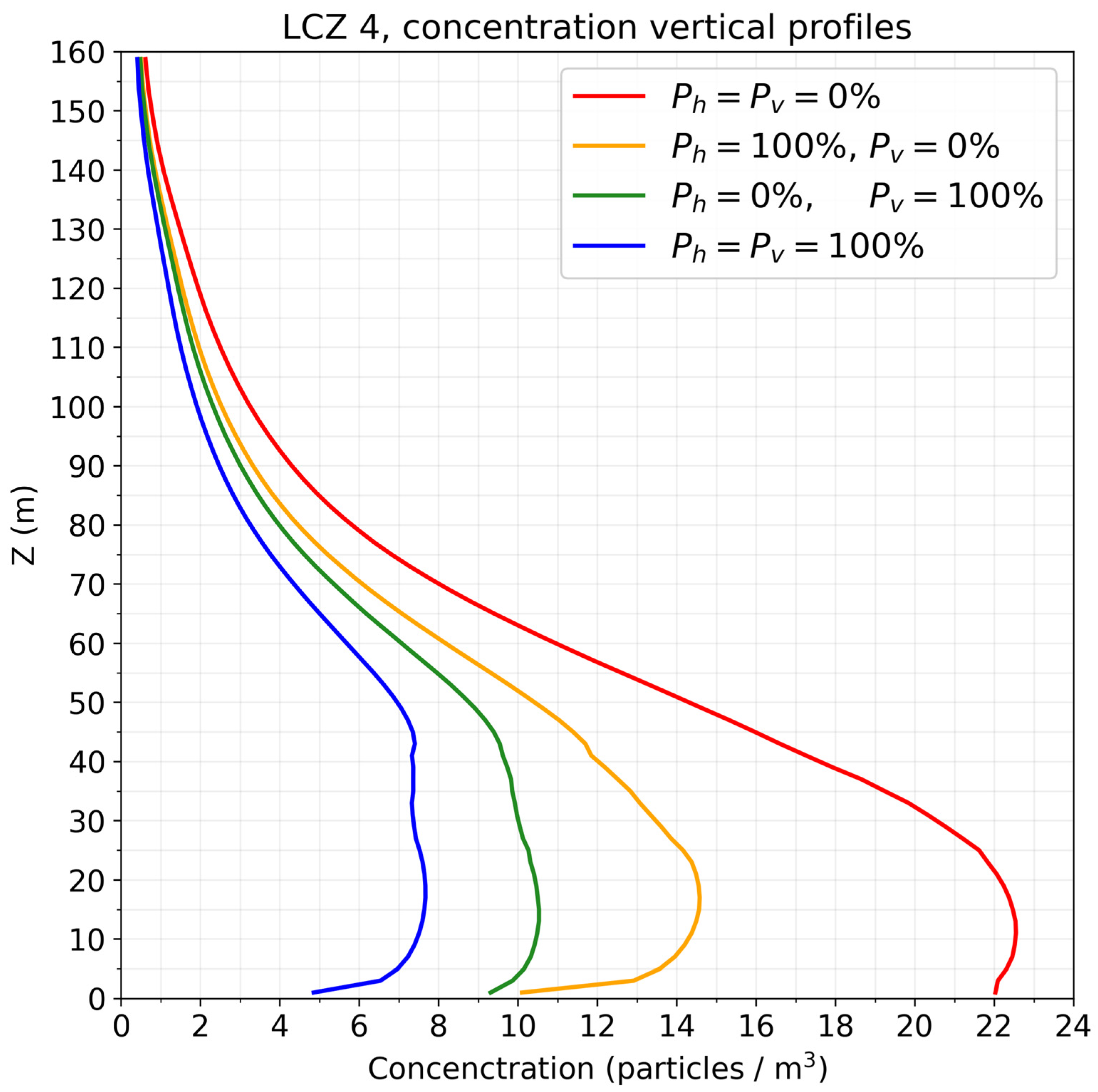
Shifting the focus to the airborne particle concentration, the vertical profiles averaged over the eastern (right) half of the domain (Figure 4) demonstrate the distinct roles of horizontal and vertical deposition. All scenarios that include deposition led to a significant reduction in concentration at all heights. Moreover, deposition on vertical walls has a stronger impact on concentrations within the urban canopy layer (below roof level) than deposition on horizontal surfaces. For instance, with P v = 100 % (and P h = 0 % ), the mean concentration in the 0–40 m layer decreases by a factor of ~2.1, whereas with P h = 100 % (and P v = 0 % ), it decreases by only ~1.5 times. This may be due to the large area of vertical surfaces and the combination of a low gravitational settling velocity and active vertical mixing. Another important effect is the change in the profile shape: accounting for wall deposition leads to a more vertically homogeneous concentration profile below roof level, which indicates intensive particle removal from all height levels within the urban canyon.

3.2. Sensitivity of Particle Concentration to Vertical and Horizontal Deposition Probabilities

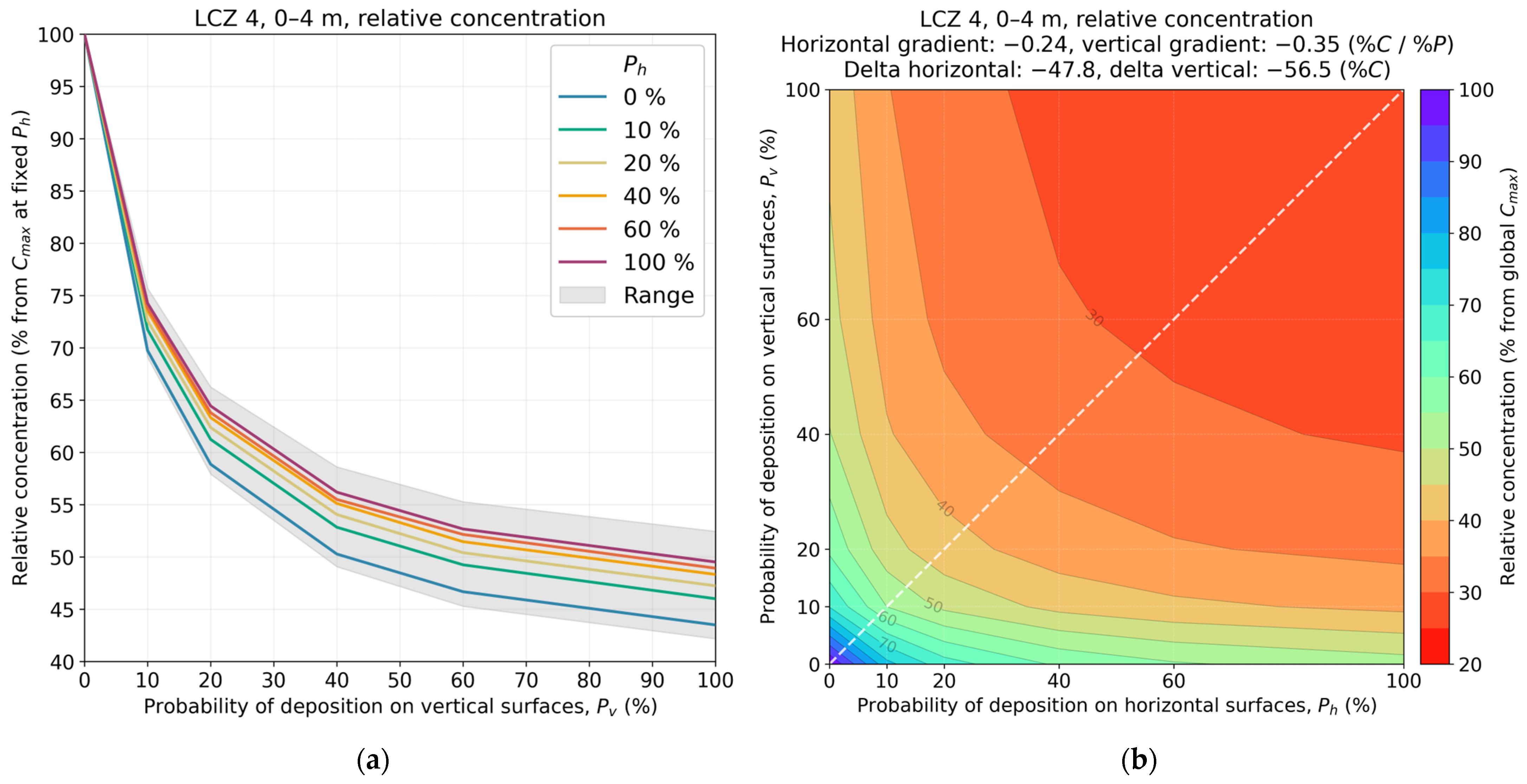
For a quantitative assessment of the impact of deposition probabilities, an analysis of all 36 scenarios for LCZ 4 was performed. Figure 5a shows the dependence of the normalized concentration on the deposition probability on vertical walls ( P v ) for various fixed values of the deposition probability on horizontal surfaces. The relationship is non-linear, closely resembling exponential decay. The sharpest decrease in concentration (by 25–30%) occurs as P v increases from 0% to 10%. With a further increase in P v to 100%, near-surface concentrations decrease by 50–55% relative to the no-wall-deposition scenario. A similar, though less pronounced, effect is observed at the roof level. This highlights that even a small probability of particles adhering to walls can significantly reduce their airborne concentration.
A direct comparison of the dependence of concentration on P v and P h confirms the prevailing role of vertical surfaces (Figure 5b). When the respective probability is varied from 0% to 100% (with zero probability for the other surface type), deposition on vertical walls reduces the near-surface concentration by 56.5%, whereas deposition on horizontal surfaces reduces it by 47.8%. A quantitative sensitivity analysis at each of the 36 points in the parameter space also shows that the concentration gradient (% of concentration/% of deposition probability) module along the P v axis is, on average, greater than that along the P h axis (0.35 vs. 0.24 for the surface level).
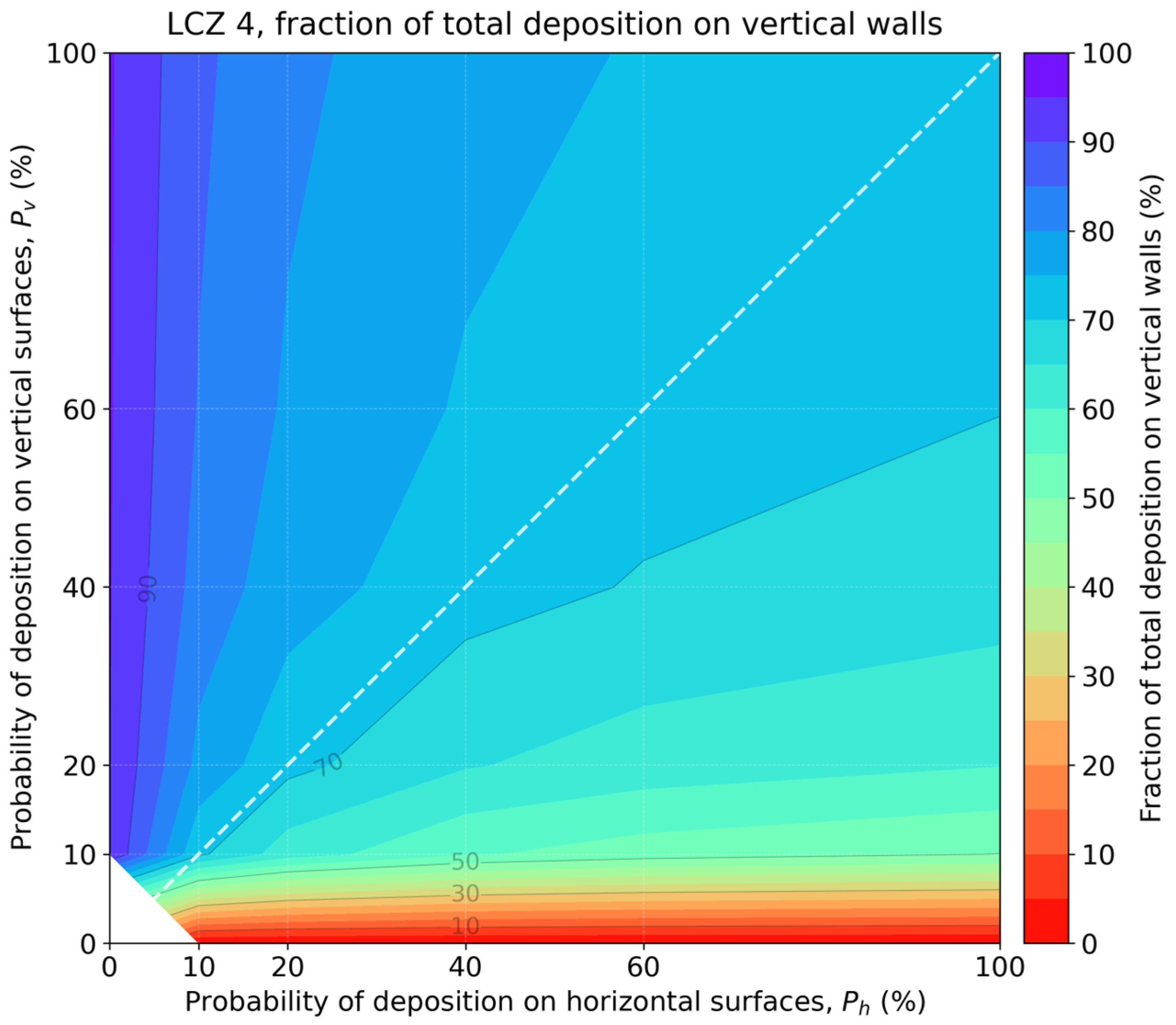
The relative contribution of vertical walls to the total deposition budget is further detailed in Figure 6. The plot clearly illustrates that the partitioning of deposition between vertical and horizontal surfaces is primarily determined by the interplay between their respective probabilities, P v and P h . An important observation is the pronounced dominance of vertical surfaces: for any given equal deposition probability ( P v = P h , shown by the dashed line), walls consistently capture over 70% of the total deposited particles. Consistent with previous findings, this relationship is highly non-linear, with the sharpest increase in the contribution from walls occurring as P v rises from 0% to 10–20%. This reinforces that even a small wall deposition probability has a disproportionately large impact, establishing walls as the dominant sink (>50% contribution) across a vast majority of the parameter space, unless P v is drastically lower than P h .

3.3. Relative Importance of Wall Deposition Compared to Particle Size and Mass

To compare the significance of the wall deposition effect with other factors affecting particle transport, an analysis of the horizontal concentration decay with distance from the source ( x s = x x s o u r c e ) was conducted. The concentration profiles were approximated by a power-law function C x s = A · x s k , where the exponent k characterizes the decay rate. For clarity, a derived metric C 2 x was used, indicating the factor by which the concentration decreases when the distance from the source doubles:
C 2 x = C x s C 2 · x s = 2 k
The concentration profile in the immediate vicinity of the source is strongly governed by local circulation patterns, especially within the first street canyon. To capture the decay trend driven by the overall urban morphology, rather than by these localized effects, the power-law function was fitted for points 25 m or more downwind from the source ( x s > 25   m , corresponding to x > 50   m ).
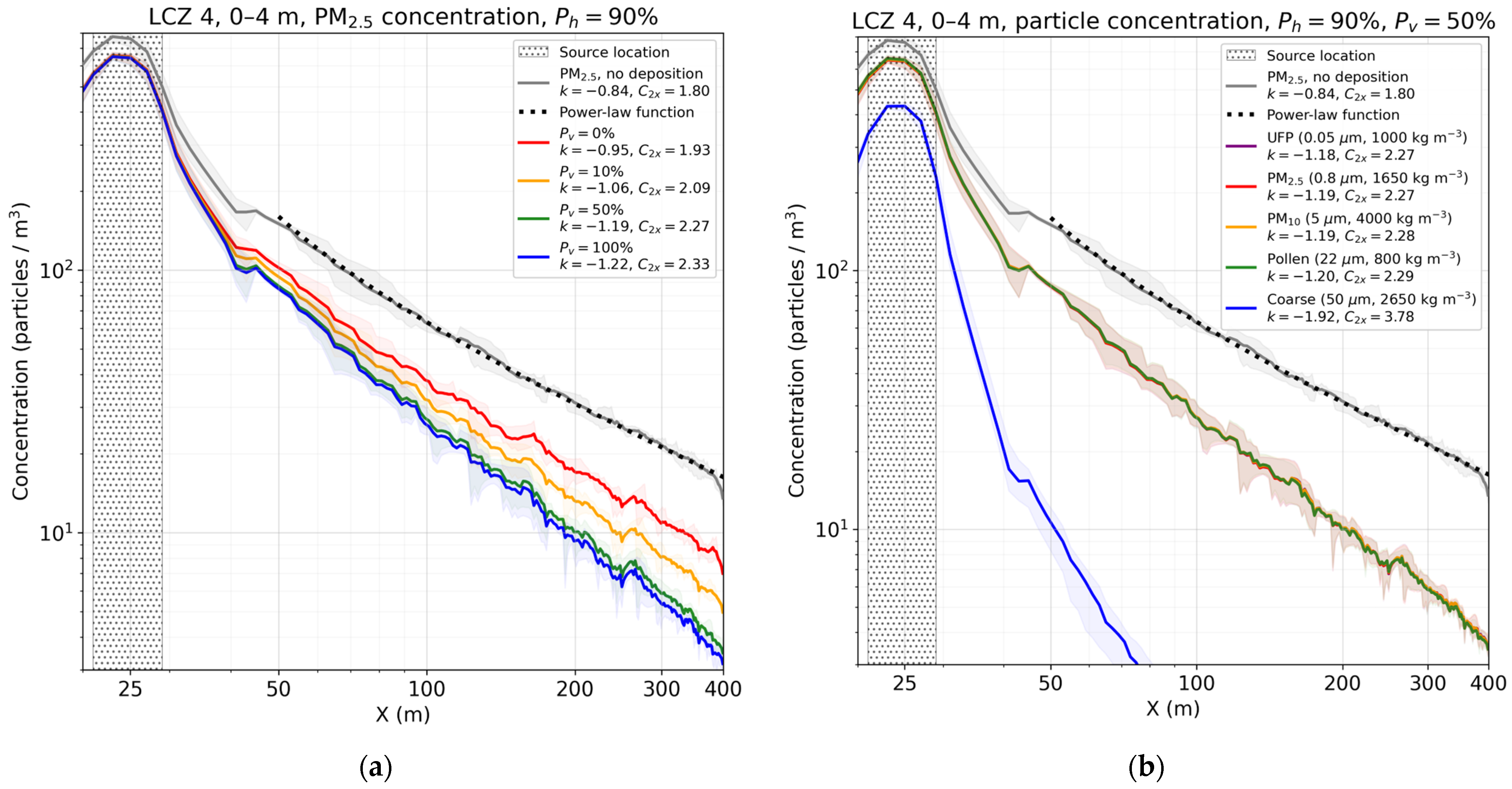
Figure 7a illustrates how wall deposition probability modifies the concentration decay. We introduced a reference case with no deposition ( P h = P v = 0 % , grey solid line) to establish the baseline dispersion regime governed solely by urban aerodynamics. For this case, the concentration decay follows a power law with an exponent k ~ 0.84 (black dotted line). This decay is noticeably slower than the theoretical value of k = 1 predicted for a crosswind line source in an open terrain turbulent boundary layer [62], where the linear vertical expansion of the plume combined with mass conservation leads to an inverse relationship between concentration and distance. This deviation suggests that the urban canopy acts as a semi-permeable barrier, where skimming flow and recirculation vortices limit the vertical expansion of the plume compared to open terrain, effectively trapping pollutants near the surface and sustaining higher concentrations downstream.
When deposition on horizontal surfaces is significant ( P h = 90 % ) while walls remain reflective ( P v = 0 % , red line), the decay rate increases, bringing the exponent closer to 1 . This apparent alignment with the classical theory is, however, coincidental: it results from the superposition of the “trapping” effect (which reduces the concentration decay rate) and surface removal (which increases it). Enabling deposition on vertical surfaces ( P v > 0 % ) introduces a significant additional sink distributed throughout the urban canopy depth. This drastically increases the decay rate beyond the baseline aerodynamic trend. Consequently, increasing P v from 0% to 10% increases C 2 x by 8%, and an increase to 100% boosts C 2 x by 21%, leading to a much steeper drop in concentration (blue line) and a shorter pollution footprint.
In contrast, with a fixed deposition probability ( P h = 90 % , P v = 50 % ), variation in particle size and density over a wide range (from 0.05 µm ultra-fine particles to 22 µm pollen, which encompasses PM2.5 and PM10 particles, and from 800 to 4000 kg/m3) has a minimal impact on the concentration decay rate (Figure 7b). The differences in C 2 x for these particle types are less than 1%. A noticeable deviation is observed only for the largest and heaviest particles (50 µm, blue line), where strong gravitational settling alters the vertical profile, concentrating the plume near the ground and enhancing interaction with surfaces. This leads to a key finding: for particles in the PM2.5 and even PM10 fractions, the uncertainty associated with the parameterization of their interaction with building walls ( P v ) was found to contribute significantly more to the simulated concentration fields than the uncertainty related to their inertial properties and gravitational settling velocity.

3.4. Effect of Wall Deposition Across Different Local Climate Zones

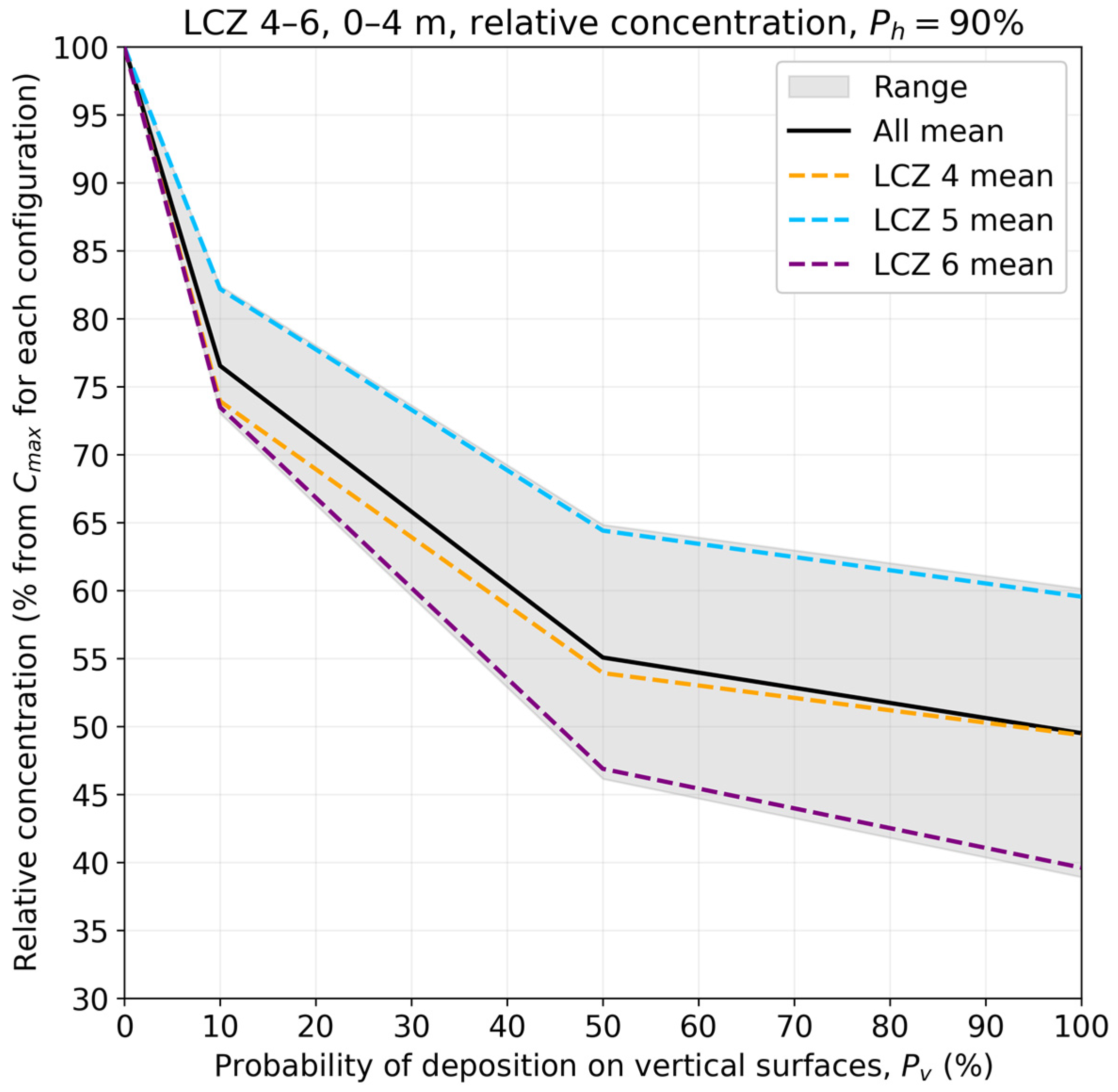
To test the robustness of the findings of the previous section, the effect of wall deposition was analyzed for mid-rise (LCZ 5) and low-rise (LCZ 6) building configurations. As shown in Figure 8, the general non-linear dependence of concentration on P v is preserved across all building types, although the magnitude of the effect varies. The strongest concentration reduction (by ~60% at P v = 100 % ) is observed for LCZ 6. This is likely because in low-rise developments with narrow and winding streets, particles have more frequent contact with building walls. The effect is least pronounced in the mid-rise LCZ 5 configuration, which may be explained by a combination of two factors: wider streets (compared to LCZ 6) reduce the probability of collision, and the insufficient building height (compared to LCZ 4) reduces the total vertical surface area and limits the effect of collisions during vertical particle mixing along tall walls. Nevertheless, even in LCZ 5, maximum wall deposition reduces the near-surface concentration by almost 40%, confirming the universality and significance of the investigated mechanism for various types of urban morphology.
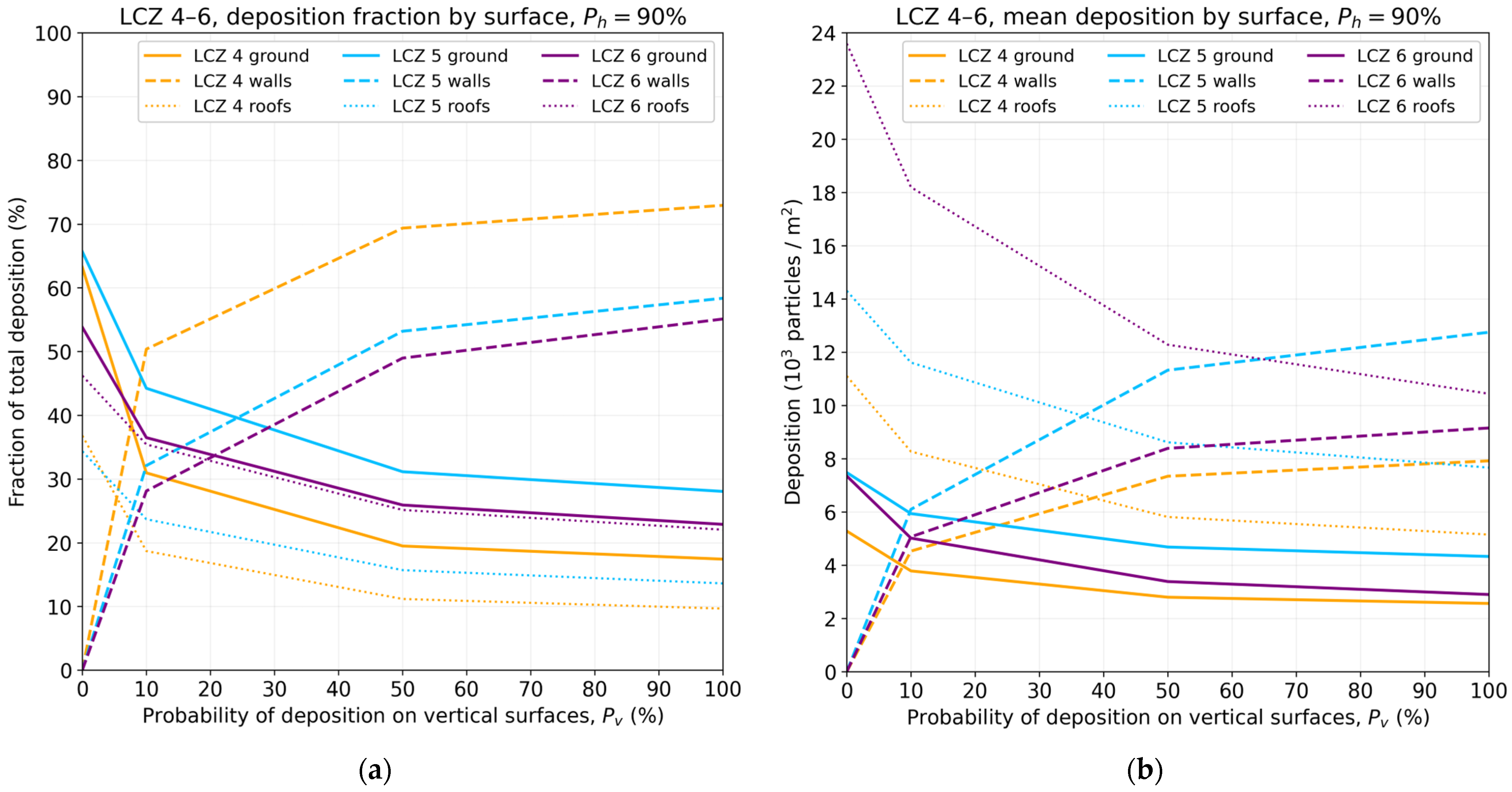
The deposition budget across different urban morphologies reveals how building geometry influences the partitioning of deposited particles (Figure 9a). The quantitative characteristics of the deposition process for the eastern half of the domain are summarized in Table 2. The contribution of vertical walls to the total deposited mass is dominant in all considered cases but varies significantly with morphology. In the high-rise LCZ 4, walls provide the largest surface area (surface area index ~1.07) and consequently capture the majority of deposited particles, acting as the primary sink. In LCZ 5 and LCZ 6, where the wall surface area is nearly half that of LCZ 4 (indices of 0.55 and 0.60, respectively), the wall contribution decreases to ~50%, though it remains higher than that of horizontal surface types, becoming equal to their sum.
Notably, in the low-rise LCZ 6, the contributions from the ground (~26%) and roofs (~25%) are almost equal (Table 2), which can be attributed to the shallow urban canopy where particles from the near-ground source are more readily mixed and transported to roof level compared to deeper canyons.
However, Figure 9b and the last column of Table 2 present a more nuanced picture when examining the deposition density (i.e., per-unit-area efficiency normalized by ground deposition). Contrary to the expectation that deep canyons might “shelter” walls, the LCZ 4 configuration exhibits the highest wall deposition density (2.6 relative to ground), slightly outperforming LCZ 5 (2.4) and LCZ 6 (2.4). This suggests that in high-rise setups, the intense turbulent mixing and vortex structures effectively transport particles to vertical surfaces despite the canyon depth.
Interestingly, roofs in the low-rise LCZ 6 show a remarkably high deposition density (3.6), which is significantly larger than in other zones (2.1 for LCZ 4 and 1.8 for LCZ 5). This indicates that, in low-rise environments, roofs are much more exposed to the sedimenting plume than in taller configurations, where roofs effectively “hide” in the wake of upstream buildings or are situated above the main pollution cloud.
These findings show an important distinction between local deposition efficiency and the overall system’s impact on concentration. The case of LCZ 6 is particularly illustrative: it combines a high deposition efficiency on roofs with a moderate wall contribution, leading to the strongest reduction in near-surface concentrations (as shown earlier in Figure 8). This observation underscores that the net effect on air quality is determined not by per-area efficiency alone, but by a complex interplay between total surface area, particle–wall interaction probabilities, and the unique airflow patterns dictated by the specific urban form.

4. Conclusions

This paper presents a systematic investigation into the impact of dry deposition of PM2.5 aerosol particles on vertical building surfaces on their concentration in the urban environment. Through a series of high-resolution numerical experiments based on the LES-LPT method and the Local Climate Zone classification, the sensitivity of concentration fields to the probability of particle deposition upon collision with walls was assessed.
The simulation results demonstrate that deposition on vertical surfaces is a significant sink for aerosols in the urban environment. Explicitly accounting for this process leads to a substantial reduction in PM2.5 concentrations throughout the urban canopy layer, with the effect of wall deposition being more pronounced than that of deposition on horizontal surfaces (ground and roofs) for the investigated LCZ 4 realizations, especially downwind from sources where they can account for over 70% of the total deposited mass. Analysis of the horizontal concentration decay showed that without deposition, the plume within the urban canopy attenuates more slowly ( C x 0.84 ) compared to the classical open-terrain theory ( C x 1 ). However, wall deposition significantly accelerates this decay, effectively shortening the plume length. It was established that the dependence of relative concentration (away from the source) on wall deposition probability is non-linear and close to an exponential decay: even a small adhesion probability (10%) can reduce near-surface concentrations by 25–30%, while at maximum probability (100%), the reduction reaches 50–55%.
One of the key findings of this work is the comparison of the significance of wall deposition with the influence of the physical properties of the particles themselves. It was shown that for a wide range of aerosols (from 0.05 µm to 22 µm), the uncertainty associated with the parameterization of their interaction with vertical surfaces contributes an order of magnitude more to the modeled concentration fields than the uncertainty due to variations in their size, inertia, and gravitational settling velocity. This result highlights that in air quality models for urban environments, the accuracy of parameterizing particle deposition processes on building surfaces may be more important than the detailed description of the properties of the particles themselves.
An analysis of different urban building types (LCZs 4, 5, and 6) confirmed the importance of the wall deposition mechanism while also revealing a complex, non-trivial relationship between urban morphology, deposition budget, and deposition efficiency. For instance, the high-rise LCZ 4 captured the largest total number of particles due to its extensive wall area while also maintaining high deposition efficiency. In contrast, the low-rise LCZ 6 exhibited exceptionally high deposition density on roofs. Crucially, neither the total capture in LCZ 4 nor the high wall efficiency corresponded to the strongest reduction in near-surface concentrations, which was observed in the low-rise LCZ 6. This demonstrates that the net impact on air quality is not a simple function of either total available surface area or local deposition efficiency, but rather a complex outcome of the airflow patterns unique to each urban form. These findings have important practical implications for air quality modeling. Ignoring or simplifying the parameterization of deposition on vertical surfaces can lead to a systematic and significant overestimation of model-predicted PM2.5 concentrations in cities, especially in dense building conditions.
Future research on this topic could be directed towards studying the influence of different meteorological conditions, particularly stable and unstable atmospheric stratification, on deposition efficiency. Furthermore, a promising direction is the development and implementation of more complex parameterizations of particle–surface interactions that would account for factors such as the roughness and material of walls, their temperature, humidity, and electrostatic properties.

Author Contributions

Conceptualization, A.V.; methodology, A.V., E.M., V.S., and A.G.; software, A.V. and E.M.; validation, A.V.; formal analysis, A.V. and A.G.; investigation, A.V.; resources, E.M. and V.S.; data curation, A.V.; writing—original draft preparation, A.V.; writing—review and editing, A.V., E.M., V.S., and A.G.; visualization, A.V.; supervision, E.M. and V.S.; project administration, E.M. and V.S.; funding acquisition, E.M. All authors have read and agreed to the published version of the manuscript.

Funding

The development of the LES model and Lagrangian particle transport module and the numerical experiments and analysis focusing on particle deposition processes were funded by the Russian Science Foundation, grant number 25-77-20011. The numerical experiments and analysis for different Local Climate Zones were supported by the Russian Ministry of Science and Higher Education, agreement number 075-15-2025-345.

Institutional Review Board Statement

Not applicable.

Informed Consent Statement

Not applicable.

Data Availability Statement

The raw data (outputs of simulations) supporting the conclusions of this article will be made available by the authors upon request. The LES-LPT model code, used for simulations, is available at https://mathmod.org/urbanles/en (accessed on 20 January 2026).

Acknowledgments

Numerical experiments were carried out using the equipment of the shared research facilities of high-performance computing (HPC) resources at Lomonosov Moscow State University.

Conflicts of Interest

The authors declare no conflicts of interest. The funders had no role in the design of the study; in the collection, analyses, or interpretation of data; in the writing of the manuscript; or in the decision to publish the results.

Abbreviations

The following abbreviations are used in this manuscript:
PMParticulate Matter
LESLarge Eddy Simulation
LPTLagrangian Particle Transport
LCZLocal Climate Zone(s)
RRTMRapid Radiative Transfer Model
RDMRandom Displacement Model
SDStandard Deviation
TKETurbulent Kinetic Energy

Appendix A

To assess the differences in flow structure between LCZ types under quasi-steady conditions, we analyzed the vertical profiles of the mean wind speed U and turbulent kinetic energy (TKE) for all building configurations. The vertical coordinate was normalized by the mean building height (H) specific to each configuration.
As shown in Figure A1, all Local Climate Zones exhibit a typical skimming flow regime with a pronounced vertical wind shear and a peak of turbulent production near the roof level ( z / H ~ 1 ). A notable distinction is observed within the urban canopy ( z / H < 1 ): The high-rise LCZ 4 configuration (orange lines) maintains significantly lower TKE levels compared to the mid-rise LCZ 5 and low-rise LCZ 6 (blue and purple lines), where higher turbulence intensities persist close to the ground.
Figure A1. Vertical profiles of mean wind speed U (a) and turbulent kinetic energy (b). The vertical coordinate was normalized by the mean building height. Lines represent the ensemble mean over 4 realizations for each LCZ type; shaded areas indicate the range between the minimum and maximum values.
Atmosphere 17 00293 g0a1

References

  1. Kampa, M.; Castanas, E. Human Health Effects of Air Pollution. Environ. Pollut. 2008, 151, 362–367. [Google Scholar] [CrossRef]
  2. Pope, C.A., III; Dockery, D.W. Health Effects of Fine Particulate Air Pollution: Lines That Connect. J. Air Waste Manag. Assoc. 2006, 56, 709–742. [Google Scholar] [CrossRef]
  3. Cohen, A.J.; Brauer, M.; Burnett, R.; Anderson, H.R.; Frostad, J.; Estep, K.; Balakrishnan, K.; Brunekreef, B.; Dandona, L.; Dandona, R.; et al. Estimates and 25-Year Trends of the Global Burden of Disease Attributable to Ambient Air Pollution: An Analysis of Data from the Global Burden of Diseases Study 2015. Lancet 2017, 389, 1907–1918. [Google Scholar] [CrossRef]
  4. Baklanov, A.; Hänninen, O.; Slørdal, L.H.; Kukkonen, J.; Bjergene, N.; Fay, B.; Finardi, S.; Hoe, S.C.; Jantunen, M.; Karppinen, A.; et al. Integrated Systems for Forecasting Urban Meteorology, Air Pollution and Population Exposure. Atmos. Chem. Phys. 2007, 7, 855–874. [Google Scholar] [CrossRef]
  5. Blocken, B. Computational Fluid Dynamics for Urban Physics: Importance, Scales, Possibilities, Limitations and Ten Tips and Tricks towards Accurate and Reliable Simulations. Build. Environ. 2015, 91, 219–245. [Google Scholar] [CrossRef]
  6. Kadaverugu, R.; Sharma, A.; Matli, C.; Biniwale, R. High Resolution Urban Air Quality Modeling by Coupling CFD and Mesoscale Models: A Review. Asia-Pac. J. Atmos. Sci. 2019, 55, 539–556. [Google Scholar] [CrossRef]
  7. Berlyand, M.E. Prediction and Regulation of Air Pollution; Springer: Dordrecht, The Netherlands, 1991; ISBN 978-94-010-5677-9. [Google Scholar]
  8. Zheng, X.; Yang, J. CFD Simulations of Wind Flow and Pollutant Dispersion in a Street Canyon with Traffic Flow: Comparison between RANS and LES. Sustain. Cities Soc. 2021, 75, 103307. [Google Scholar] [CrossRef]
  9. Owkes, M.; Homan, T.; Benson, M.; Banko, A. High Fidelity Simulations of Contaminant Dispersion in an Urban Environment with Comparison to Magnetic Resonance Imaging Measurements. Environ. Fluid Mech. 2025, 25, 5. [Google Scholar] [CrossRef]
  10. Glazunov, A.V. Numerical Simulation of Turbulence and Transport of Fine Particulate Impurities in Street Canyons. Numer. Methods Program. 2018, 19, 17–37. [Google Scholar] [CrossRef]
  11. Suiazova, V.I.; Debolskiy, A.V.; Mortikov, E.V. Modeling Turbulent Flows over a Heterogeneous Surface Using Mesoscale and Large Eddy Simulations. Russ. Meteorol. Hydrol. 2025, 50, 417–426. [Google Scholar] [CrossRef]
  12. Grylls, T.; Le Cornec, C.M.A.; Salizzoni, P.; Soulhac, L.; Stettler, M.E.J.; van Reeuwijk, M. Evaluation of an Operational Air Quality Model Using Large-Eddy Simulation. Atmos. Environ. X 2019, 3, 100041. [Google Scholar] [CrossRef]
  13. Wang, H.; Furtak-Cole, E.; Ngan, K. Fast Models for Predicting Pollutant Dispersion inside Urban Canopies. Atmosphere 2023, 14, 1337. [Google Scholar] [CrossRef]
  14. Kurppa, M.; Hellsten, A.; Auvinen, M.; Raasch, S.; Vesala, T.; Järvi, L. Ventilation and Air Quality in City Blocks Using Large-Eddy Simulation—Urban Planning Perspective. Atmosphere 2018, 9, 65. [Google Scholar] [CrossRef]
  15. Wang, M.; Lin, C.-H.; Chen, Q. Determination of Particle Deposition in Enclosed Spaces by Detached Eddy Simulation with the Lagrangian Method. Atmos. Environ. 2011, 45, 5376–5384. [Google Scholar] [CrossRef]
  16. Chahardoli, S.; Khakzand, M.; Faizi, M.; Siavashi, M. Numerical Analysis of the Effect of Roof Types and Porch on Particle Dispersion and Deposition around a Low-Rise Building. J. Build. Eng. 2022, 53, 104533. [Google Scholar] [CrossRef]
  17. Mariraj Mohan, S. An Overview of Particulate Dry Deposition: Measuring Methods, Deposition Velocity and Controlling Factors. Int. J. Environ. Sci. Technol. 2016, 13, 387–402. [Google Scholar] [CrossRef]
  18. Farmer, D.K.; Boedicker, E.K.; DeBolt, H.M. Dry Deposition of Atmospheric Aerosols: Approaches, Observations, and Mechanisms. Annu. Rev. Phys. Chem. 2021, 72, 375–397. [Google Scholar] [CrossRef] [PubMed]
  19. Johnson, A.J.; Davidson, C.I. Estimating Dry Deposition of Atmospheric Aerosols to Urban Surfaces by Rain Washoff. Atmos. Environ. 2023, 293, 119466. [Google Scholar] [CrossRef]
  20. Giardina, M.; Donateo, A.; Buffa, P.; Contini, D.; Cervone, A.; Lombardo, C.; Rocchi, F. Atmospheric Dry Deposition Processes of Particles on Urban and Suburban Surfaces: Modelling and Validation Works. Atmos. Environ. 2019, 214, 116857. [Google Scholar] [CrossRef]
  21. Zhang, L.; Gong, S.; Padro, J.; Barrie, L. A Size-Segregated Particle Dry Deposition Scheme for an Atmospheric Aerosol Module. Atmos. Environ. 2001, 35, 549–560. [Google Scholar] [CrossRef]
  22. Seinfeld, J.H.; Pandis, S.N. Atmospheric Chemistry and Physics: From Air Pollution to Climate Change; John Wiley & Sons: Hoboken, NJ, USA, 2016; ISBN 978-1-118-94740-1. [Google Scholar]
  23. Kouznetsov, R.; Sofiev, M.; Uppstu, A.; Hänninen, R. Deposition Velocity Concept Does Not Apply to Fluxes of Ambient Aerosols. EGUsphere 2025. preprint. [Google Scholar] [CrossRef]
  24. Johansen, S.T. The Deposition of Particles on Vertical Walls. Int. J. Multiph. Flow 1991, 17, 355–376. [Google Scholar] [CrossRef]
  25. Pesava, P.; Aksu, R.; Toprak, S.; Horvath, H.; Seidl, S. Dry Deposition of Particles to Building Surfaces and Soiling. Sci. Total Environ. 1999, 235, 25–35. [Google Scholar] [CrossRef]
  26. Maro, D.; Connan, O.; Flori, J.P.; Hébert, D.; Mestayer, P.; Olive, F.; Rosant, J.M.; Rozet, M.; Sini, J.F.; Solier, L. Aerosol Dry Deposition in the Urban Environment: Assessment of Deposition Velocity on Building Facades. J. Aerosol Sci. 2014, 69, 113–131. [Google Scholar] [CrossRef]
  27. Abadie, M.; Limam, K.; Allard, F. Indoor Particle Pollution: Effect of Wall Textures on Particle Deposition. Build. Environ. 2001, 36, 821–827. [Google Scholar] [CrossRef]
  28. Hong, W.; Wang, B.; Liu, Y.; Li, H. Numerical Study of the Fine Particle Deposition Behaviors on Three-Dimensional Random Rough Walls. Powder Technol. 2020, 375, 233–243. [Google Scholar] [CrossRef]
  29. Thouron, L.; Seigneur, C.; Kim, Y.; Legorgeu, C.; Roustan, Y.; Bruge, B. Simulation of Trace Metals and PAH Atmospheric Pollution over Greater Paris: Concentrations and Deposition on Urban Surfaces. Atmos. Environ. 2017, 167, 360–376. [Google Scholar] [CrossRef]
  30. Cherin, N.; Roustan, Y.; Musson-Genon, L.; Seigneur, C. Modelling Atmospheric Dry Deposition in Urban Areas Using an Urban Canopy Approach. Geosci. Model Dev. 2015, 8, 893–910. [Google Scholar] [CrossRef]
  31. Brach, R.M.; Dunn, P.F. A Mathematical Model of the Impact and Adhesion of Microsphers. Aerosol Sci. Technol. 1992, 16, 51–64. [Google Scholar] [CrossRef]
  32. Sun, K.; Lu, L.; Jiang, H. Modelling of Particle Deposition and Rebound Behaviour on Ventilation Ducting Wall Using an Improved Wall Model. Indoor Built Environ. 2011, 20, 300–312. [Google Scholar] [CrossRef]
  33. Almohammed, N.; Breuer, M. Modeling and Simulation of Particle–Wall Adhesion of Aerosol Particles in Particle-Laden Turbulent Flows. Int. J. Multiph. Flow 2016, 85, 142–156. [Google Scholar] [CrossRef]
  34. Altmeppen, J.; Sommerfeld, H.; Koch, C.; Staudacher, S. Experimental and Numerical Investigation into the Effect of Surface Roughness on Particle Rebound. Front. Mech. Eng. 2022, 8, 918708. [Google Scholar] [CrossRef]
  35. Horn, M.; Schmid, H.-J. A Comprehensive Approach in Modeling Lagrangian Particle Deposition in Turbulent Boundary Layers. Powder Technol. 2008, 186, 189–198. [Google Scholar] [CrossRef]
  36. Haghighifard, H.R.; Tavakol, M.M.; Ahmadi, G. Numerical Study of Fluid Flow and Particle Dispersion and Deposition around Two Inline Buildings. J. Wind Eng. Ind. Aerodyn. 2018, 179, 385–406. [Google Scholar] [CrossRef]
  37. Talebmoustaph, C.; Fede, P.; Simonin, O.; Pallud, M.; Maheshwari, P. Stochastic Lagrangian Wall Deposition Model for RANS Prediction of Deposition in Turbulent Gas–Solid Flows. Int. J. Multiph. Flow 2024, 178, 104900. [Google Scholar] [CrossRef]
  38. Stewart, I.D.; Oke, T.R. Local Climate Zones for Urban Temperature Studies. Bull. Am. Meteorol. Soc. 2012, 93, 1879–1900. [Google Scholar] [CrossRef]
  39. Jiang, R.; Xie, C.; Man, Z.; Afshari, A.; Che, S. LCZ Method Is More Effective than Traditional LUCC Method in Interpreting the Relationship between Urban Landscape and Atmospheric Particles. Sci. Total Environ. 2023, 869, 161677. [Google Scholar] [CrossRef]
  40. Varentsov, A.I.; Mortikov, E.V.; Glazunov, A.V.; Debolskiy, A.V.; Kuzmicheva, M.A.; Stepanenko, V.M. Large-Eddy Simulation of Aerosol Transport over Different Urban Local Climate Zones. Geogr. Environ. Sustain. 2025, 18, 68–79. [Google Scholar] [CrossRef]
  41. Mortikov, E.V.; Glazunov, A.V.; Lykosov, V.N. Numerical Study of Plane Couette Flow: Turbulence Statistics and the Structure of Pressure–Strain Correlations. Russ. J. Numer. Anal. Math. Model. 2019, 34, 119–132. [Google Scholar] [CrossRef]
  42. Debolskiy, A.V.; Mortikov, E.V.; Glazunov, A.V.; Lüpkes, C. Evaluation of Surface Layer Stability Functions and Their Extension to First Order Turbulent Closures for Weakly and Strongly Stratified Stable Boundary Layer. Bound. -Layer. Meteorol. 2023, 187, 73–93. [Google Scholar] [CrossRef]
  43. Gladskikh, D.; Ostrovsky, L.; Troitskaya, Y.; Soustova, I.; Mortikov, E. Turbulent Transport in a Stratified Shear Flow. J. Mar. Sci. Eng. 2023, 11, 136. [Google Scholar] [CrossRef]
  44. Suiazova, V.I.; Debolskiy, A.V.; Mortikov, E.V. Study of Surface Layer Characteristics in the Presence of Suspended Snow Particles Using Observational Data and Large Eddy Simulation. Izv. Atmos. Ocean. Phys. 2024, 60, 158–167. [Google Scholar] [CrossRef]
  45. Glazunov, A.; Mortikov, E.; Debolskiy, A. Studies of Vegetation Effect on Turbulence Dynamics in an Urban Canopy Layer Using Large Eddy Simulation. Urban Clim. 2025, 64, 102628. [Google Scholar] [CrossRef]
  46. Mortikov, E.V.; Gaschuk, E.M.; Debolskiy, A.V. GPU-Based Large-Eddy Simulation of Mixed-Phased Clouds. Supercomput. Front. Innov. 2026, 12, 66–87. [Google Scholar] [CrossRef]
  47. Germano, M.; Piomelli, U.; Moin, P.; Cabot, W.H. A Dynamic Subgrid-scale Eddy Viscosity Model. Phys. Fluids 1991, 3, 1760–1765. [Google Scholar] [CrossRef]
  48. Morinishi, Y.; Lund, T.S.; Vasilyev, O.V.; Moin, P. Fully Conservative Higher Order Finite Difference Schemes for Incompressible Flow. J. Comput. Phys. 1998, 143, 90–124. [Google Scholar] [CrossRef]
  49. Tarasova, M.A.; Debolskiy, A.V.; Mortikov, E.V.; Varentsov, M.I.; Glazunov, A.V.; Stepanenko, V.M. On the Parameterization of the Mean Wind Profile for Urban Canopy Models. Lobachevskii J. Math. 2024, 45, 3198–3210. [Google Scholar] [CrossRef]
  50. Pincus, R.; Mlawer, E.J.; Oreopoulos, L.; Ackerman, A.S.; Baek, S.; Brath, M.; Buehler, S.A.; Cady-Pereira, K.E.; Cole, J.N.S.; Dufresne, J.; et al. Radiative Flux and Forcing Parameterization Error in Aerosol-free Clear Skies. Geophys. Res. Lett. 2015, 42, 5485–5492. [Google Scholar] [CrossRef] [PubMed]
  51. Debolskiy, A.V.; Mortikov, E.V.; Poliukhov, A.A. Computational efficiency and adaptation of radiation transfer module within Large-eddy simulation model. Numer. Methods Program. 2025, 26, 515–533. [Google Scholar] [CrossRef]
  52. Lin, Y.-L.; Farley, R.D.; Orville, H.D. Bulk Parameterization of the Snow Field in a Cloud Model. J. Clim. Appl. Meteor. 1983, 22, 1065–1092. [Google Scholar] [CrossRef]
  53. Seifert, A.; Beheng, K.D. A Two-Moment Cloud Microphysics Parameterization for Mixed-Phase Clouds. Part 1: Model Description. Meteorol. Atmos. Phys. 2006, 92, 45–66. [Google Scholar] [CrossRef]
  54. Juliano, T.W.; Tornow, F.; Fridlind, A.M.; Ackerman, A.S.; Elsaesser, G.S.; Geerts, B.; Lackner, C.P.; Painemal, D.; Silber, I.; Ovchinnikov, M.; et al. The Cold-Air Outbreaks in the Marine Boundary Layer Experiment model-observation intercomparison project (COMBLE-MIP), Part I: Model specification, observational constraints, and preliminary findings. Geosci. Model. Dev. 2025; in review. [Google Scholar]
  55. Durbin, P.A. Stochastic Differential Equations and Turbulent Dispersion; NASA: Washington, DC, USA, 1983.
  56. Boughton, B.A.; Delaurentis, J.M.; Dunn, W.E. A Stochastic Model of Particle Dispersion in the Atmosphere. Bound.-Layer Meteorol. 1987, 40, 147–163. [Google Scholar] [CrossRef]
  57. Glazunov, A.; Rannik, Ü.; Stepanenko, V.; Lykosov, V.; Auvinen, M.; Vesala, T.; Mammarella, I. Large-Eddy Simulation and Stochastic Modeling of Lagrangian Particles for Footprint Determination in the Stable Boundary Layer. Geosci. Model Dev. 2016, 9, 2925–2949. [Google Scholar] [CrossRef]
  58. Varentsov, A.I.; Stepanenko, V.M.; Mortikov, E.V.; Konstantinov, P.I. Numerical Simulation of Particle Transport in the Urban Boundary Layer with Implications for SARS-CoV-2 Virion Distribution. IOP Conf. Ser. Earth Environ. Sci. 2020, 611, 012017. [Google Scholar] [CrossRef]
  59. Varentsov, A.I.; Imeev, O.A.; Glazunov, A.V.; Mortikov, E.V.; Stepanenko, V.M. Numerical Simulation of Particulate Matter Transport in the Atmospheric Urban Boundary Layer Using the Lagrangian Approach: Physical Problems and Parallel Implementation. Program. Comput. Soft 2023, 49, 894–905. [Google Scholar] [CrossRef]
  60. Demuzere, M.; Kittner, J.; Martilli, A.; Mills, G.; Moede, C.; Stewart, I.D.; Van Vliet, J.; Bechtel, B. A Global Map of Local Climate Zones to Support Earth System Modelling and Urban-Scale Environmental Science. Earth Syst. Sci. Data 2022, 14, 3835–3873. [Google Scholar] [CrossRef]
  61. Zwozdziak, A.; Gini, M.I.; Samek, L.; Rogula-Kozlowska, W.; Sowka, I.; Eleftheriadis, K. Implications of the Aerosol Size Distribution Modal Structure of Trace and Major Elements on Human Exposure, Inhaled Dose and Relevance to the PM2.5 and PM10 Metrics in a European Pollution Hotspot Urban Area. J. Aerosol Sci. 2017, 103, 38–52. [Google Scholar] [CrossRef]
  62. Batchelor, G.K. Diffusion from Sources in a Turbulent Boundary Layer. In Fluid Dynamics Transactions; Fiszdon, W., Ed.; Pergamon Press: Oxford, UK, 1965; Volume 2, pp. 31–40. [Google Scholar]
Figure 1. Surface height maps for the randomized building configurations corresponding to LCZ 4 (top row), LCZ 5 (middle row), and LCZ 6 (bottom row). The location of the particle source area is indicated by hatching near the left domain boundary.
Atmosphere 17 00293 g001
Figure 2. Mean near-surface particle concentration fields in the “LCZ 4 (1)” (from Figure 1) configuration for cases without deposition (left) and with maximum deposition probability (100%) on all surfaces (right).
Atmosphere 17 00293 g002
Figure 3. Three-dimensional visualization of the total number of deposited particles on surfaces for the “LCZ 4 (1)” configuration with maximum deposition probability on all surfaces. Views from the southwest, azimuth 45° (a) and northeast, azimuth 225° (b) are shown.
Atmosphere 17 00293 g003
Figure 4. Vertical profiles of mean PM2.5 particle concentration (averaged over the eastern half of the domain with “LCZ 4 (1)” surface) for different deposition probabilities on horizontal and vertical surfaces.
Atmosphere 17 00293 g004
Figure 5. Dependence of the mean concentration (normalized by the concentration calculated with P h and P v = 0 % ) away from the source (eastern half of the domain) on the particle deposition probability on walls for LCZ 4 (all LCZ 4 configurations’ average) at the surface level (a). Dependence of the mean concentration (normalized by the concentration calculated with P h = P v = 0 % ) away from the source on deposition probabilities separately for horizontal and vertical surfaces at the surface level (b). The white dashed line represents equal deposition probabilities for horizontal and vertical surfaces ( P h = P v ).
Atmosphere 17 00293 g005
Figure 6. Dependence of the mean contribution of vertical walls to total deposition away from the source (eastern half of the domain) for LCZ 4 on deposition probabilities separately for horizontal and vertical surfaces. The white dashed line represents equal deposition probabilities for horizontal and vertical surfaces ( P h = P v ).
Atmosphere 17 00293 g006
Figure 7. Horizontal profiles of mean near-surface (0–4 m) concentration for LCZ 4 (all LCZ 4 configurations’ average): particles of fixed size with varying wall deposition probability (a); particles of different sizes with fixed deposition probability (b). The power-law function (black dotted line) is given for the PM2.5 case with no deposition ( P h = P v = 0 % , grey solid line).
Atmosphere 17 00293 g007
Figure 8. Dependence of mean near-surface (0–4 m) concentration away from the source (eastern half of the domain) on the particle deposition probability on walls, averaged over LCZ realizations (Figure 1) of different LCZ types.
Atmosphere 17 00293 g008
Figure 9. Dependence of the mean contribution of different surfaces to total deposition (a) and the mean accumulated deposition density (total number of deposited particles per m2 over the entire simulation period) for different surfaces (b) on the particle deposition probability on walls, averaged over different building types. Both plots are for the eastern half of the domain.
Atmosphere 17 00293 g009
Table 1. Surface characteristics and deposition budget for the “LCZ 4 (1)” configuration and maximum deposition scenario.
ParameterEntire DomainEastern Half of the Domain
GroundRoofWallGroundRoofWall
Area,
m2
126,96433,036178,23262,18417,81690,500
Total area fraction,
%
37.59.852.736.510.453.1
Surface area index,
S s u r f a c e / S f l a t
0.790.211.110.770.231.13
Total deposition fraction,
%
45.12.652.418.19.872.1
Deposition density,
103 particles/m2
~28.3~6.2~23.4~2.5~4.7~6.8
Deposition density,
relative units
1 (reference)0.20.81 (reference)1.92.7
Table 2. Surface characteristics and deposition budget for different LCZ types with P h = 90 % and P v = 50 % .
ParameterSurface TypeLCZ 4LCZ 5LCZ 6
Total area fraction,
%
Ground37.850.449.2
Roof10.513.913.2
Wall51.735.737.6
Surface area index,
S s u r f a c e / S f l a t
Ground0.780.790.79
Roof0.220.210.21
Wall1.070.550.60
Total deposition
fraction, %
Ground19.431.125.9
Roof11.215.725.1
Wall69.453.249.0
Deposition density,
relative units
Ground1 (reference)1 (reference)1 (reference)
Roof2.11.83.6
Wall2.62.42.4
Disclaimer/Publisher’s Note: The statements, opinions and data contained in all publications are solely those of the individual author(s) and contributor(s) and not of MDPI and/or the editor(s). MDPI and/or the editor(s) disclaim responsibility for any injury to people or property resulting from any ideas, methods, instructions or products referred to in the content.