Article

Assessment of Regional Adaptation Strategies in Greece

by
Despoina Charchousi
*,
Evdoxia Christina Stathopoulou
,
Gkeralnto Kolitsi
,
Akrivi Leka
and
Maria P. Papadopoulou
Laboratory of Physical Geography and Environmental Impacts, School of Rural, Surveying and Geo-Informatics Engineering, National Technical University of Athens, 15773 Athens, Greece
*
Author to whom correspondence should be addressed.
Atmosphere 2026, 17(3), 288; https://doi.org/10.3390/atmos17030288
Submission received: 19 January 2026 / Revised: 26 February 2026 / Accepted: 10 March 2026 / Published: 12 March 2026

Abstract

Despite the institutional establishment of Regional Adaptation Action Plans (RAAPs), no systematic cross-regional assessment has examined their structure and implementation dynamics. The objective of this research is to categorize various adaptation strategies identified at the regional level within the 13 RAAPs of Greece and evaluate the current implementation status by introducing a three-pillar RAAP assessment approach including (i) typological classification of all RAAP measures (soft, development and hard), (ii) functional classification of sectoral measures applied to two indicative pilot regions (Crete and the Ionian Islands) and (iii) stakeholder insights on the implementation of regional adaptation. Each measure is assigned to its corresponding adaptation sector to enable cross-regional comparison. The implementation level is assessed through interviews with regional officials exploring criteria guiding measure selection, existing funding mechanisms and social consequences. These findings reveal the characteristics of early stage regional adaptation planning in Greece, where monitoring priorities, institutional capacity and sectoral exposure strongly shape adaptation strategies. Beyond descriptive mapping, the study introduces a structured multi-level analytical framework that offers a replicable tool for the comparative assessment of regional adaptation governance and advances research from policy-inventory approaches toward governance-oriented evaluation at the sub-national scale.

1. Introduction

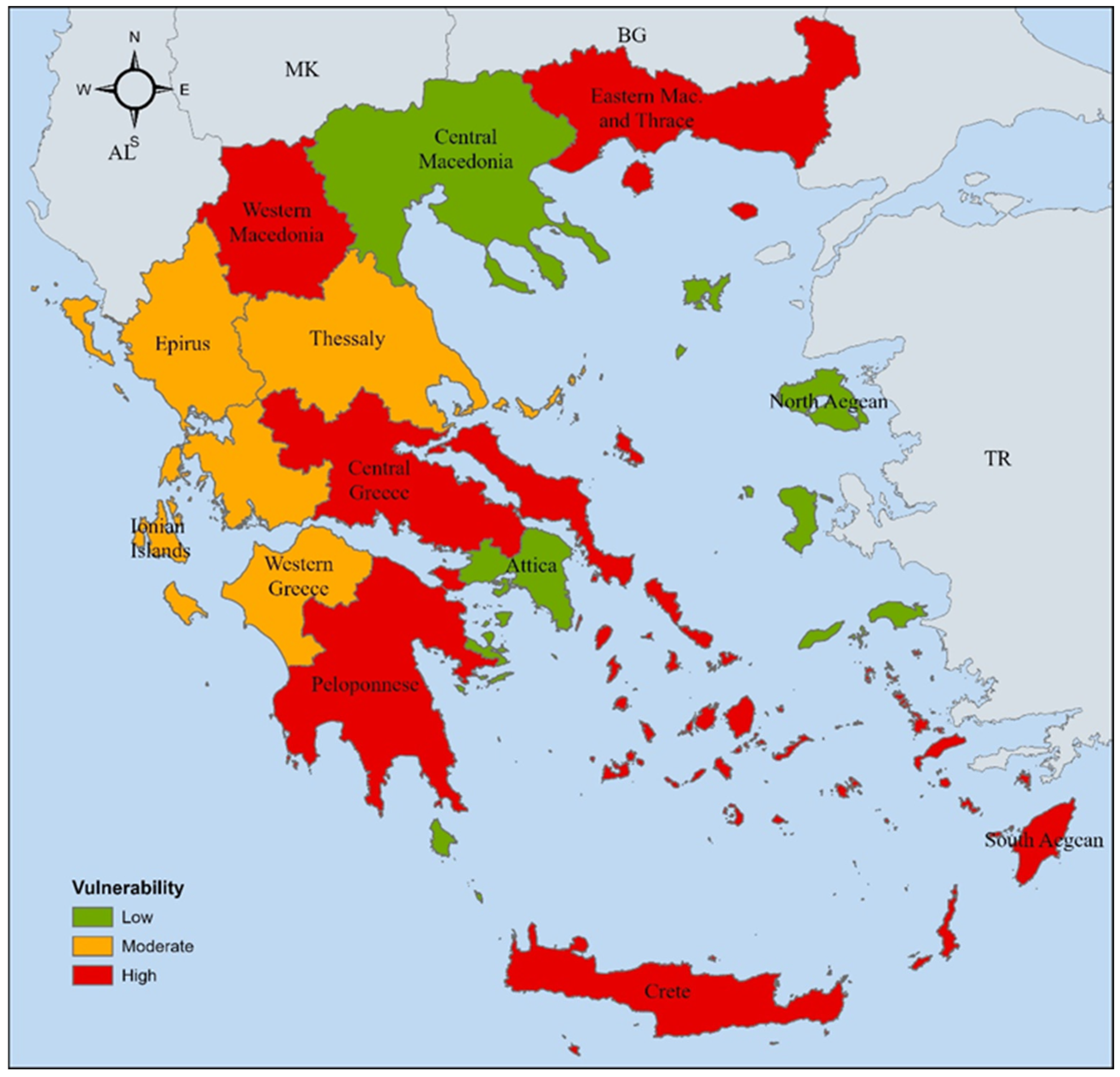
Tackling climate change relies on international agreements and robust national strategies. From a global perspective, international cooperation for the mitigation of human-induced emissions is established in the United Nations Framework Convention on Climate Change [1]. The Paris Agreement further promotes the development of national adaptation plans and resilience-enhancing actions [2], while Goal 13 of the 2030 Agenda for Sustainable Development calls for urgent changes to address the impacts of climate change [3]. At the European scale, the European Green Deal and the European Climate Law define binding targets to reduce greenhouse gas emissions, enhance CO2 removals and strengthen adaptation to the impacts of climate change [4,5]. Climate change is expected to significantly affect nations situated within the Mediterranean Basin and Southern Europe. These areas face disproportionate rises in temperature, alongside marked declines in precipitation levels and hydrological runoff, coupled with severe events [6]; strengthening adaptation planning at the national and sub-national levels becomes essential to enhance resilience and manage accelerating climate risks across Mediterranean countries. In response to the European Union’s call for integrated adaptation measures spanning the entirety of the economic and social fabric [7], the initial draft of the Greek National Adaptation Strategy (NAS) was completed in 2016 [8]. The National Adaptation Strategy (NAS) was adopted in 2016 by the Ministry of Environment and Energy and later complemented by Greece’s National Climate Law (Law 4936/2022), which established the overarching legal framework for climate neutrality and adaptation governance [9]. It includes a regional-level vulnerability assessment based on estimated total economic damage per region, taking into consideration the respective economic activities (Figure 1). According to this analysis, regions are grouped into three vulnerability classes: low, medium and high. Low vulnerability is identified in Attica, the North Aegean and Central Macedonia; moderate vulnerability in Epirus, Western Greece, Thessaly and the Ionian Islands; and high vulnerability in the remaining regions, signaling the need for targeted adaptation measures [8]. In this context, the vulnerability classes reflect the combined assessment of regional exposure, sensitivity, and expected economic damage associated with climate change impacts. “Low” vulnerability indicates relatively limited projected impacts and higher adaptive capacity; “medium” vulnerability denotes regions with moderate exposure or sectoral pressures that require enhanced preparedness; and “high” vulnerability identifies regions facing substantial climate risks, significant potential economic losses, or structural limitations in coping capacity, thus necessitating more urgent and intensive adaptation measures. The classification of the Greek regions into three vulnerability groups (low–medium–high) highlights distinct spatial and socio-economic patterns that help explain differences in climate risk and adaptive capacity. Regions identified as low vulnerability, such as Attica, the North Aegean and Central Macedonia, are generally characterized by larger population centers, more diversified economic structures, and stronger institutional capacity. Higher availability of infrastructure, administrative resources and investment mechanisms contributes to greater adaptive readiness, even when environmental pressures are present. Regions of medium vulnerability—including Epirus, Western Greece, Thessaly and the Ionian Islands—show a more balanced but less robust profile. Their economies tend to be less diversified, often relying on climate-sensitive sectors such as agriculture and tourism, while infrastructure quality and service provision may vary across regional units. At the same time, these regions host significant natural assets such as wetlands, coastal ecosystems, and mountainous areas, which can both amplify climate risk and offer opportunities for ecological adaptation pathways and Nature-based Solutions (NbSs). Conversely, high-vulnerability regions, such as Crete, tend to exhibit a combination of high exposure and structural sensitivity. They commonly include extensive coastal zones, increased drought or flood susceptibility, lower economic diversification and, in some cases, reduced administrative capacity to design or implement adaptation measures. The co-occurrence of geomorphological hazards and socio-economic fragility underscores the need for more urgent, targeted, and resource-supported adaptation strategies.
The NAS proposes indicative actions to strengthen Greece’s adaptive capacity in line with the United Nations Convention on Climate Change (UNFCCC), European policies and global best practice. Within the framework set by the EU strategy on adaptation to climate change [7,10], Greece requires that each of its thirteen regions (NUTS 2 level) mandates the formulation of a Regional Adaptation Action Plan (RAAP). These plans effectively convert the strategic direction of the NAS into localized measures targeting environmental, economic, and social domains anticipated to face substantial climate impacts. Furthermore, they evaluate local climate susceptibility and prescribe suitable adaptation initiatives tailored to the specific characteristics of each region. To date, all 13 Greek regions have prepared their initial RAAPs—eleven are formally approved and two are currently under review [11,12,13,14,15,16,17,18,19,20,21,22,23].
While regional adaptation planning could benefit from comparing adaptation strategies across governance levels, to the best of our knowledge, no comprehensive cross-regional assessment of the Greek RAAPs has been conducted to date. While the drafting and approval of the RAAPs represents a significant step towards regional adaptation planning, their implementation progress and potential similarities or differences across regions have not been systematically examined. To address this research gap, the present work undertakes a comprehensive mapping and classification of all adaptation measures included in the 13 RAAPs, grouping them into three main categories (soft, development, and hard), and identifying the adaptation sectors to which they correspond. Furthermore, to assess adaptation progress in practice, interviews were conducted with officials from the relevant departments in two representative pilot regions: (a) Crete and (b) the Ionian Islands. These regions were selected to represent different levels of climate vulnerability and socio-economic contexts. The Region of Crete is classified among the most vulnerable regions in the NAS and exemplifies a highly exposed territory with strong sensitivity to climate impacts, particularly due to its extensive coastal zones, water scarcity issues, and strong dependence on climate-sensitive sectors such as tourism and agriculture. In contrast, the Ionian Islands Region is identified as moderately vulnerable and offers a contrasting case where exposure is lower and adaptive capacities differ. The interviews explored the criteria guiding the selection of the interventions, the ranking of planned initiatives, accessible funding channels, and the anticipated socio-economic outcomes. For these two pilot regions, a detailed functional categorization of adaptation measures was also developed to better capture sector-specific adaptation needs and to inform the subsequent evaluation of the implementation process. Overall, this study aims to systematically classify and compare the adaptation measures proposed in the 13 Greek RAAPs and to examine early implementation dynamics in selected pilot regions. The analysis focuses on the structure and prioritization of adaptation planning rather than evaluating adaptation effectiveness. This approach enables a cross-regional comparison and provides a structured basis for understanding early stage regional adaptation governance.

2. Materials and Methods

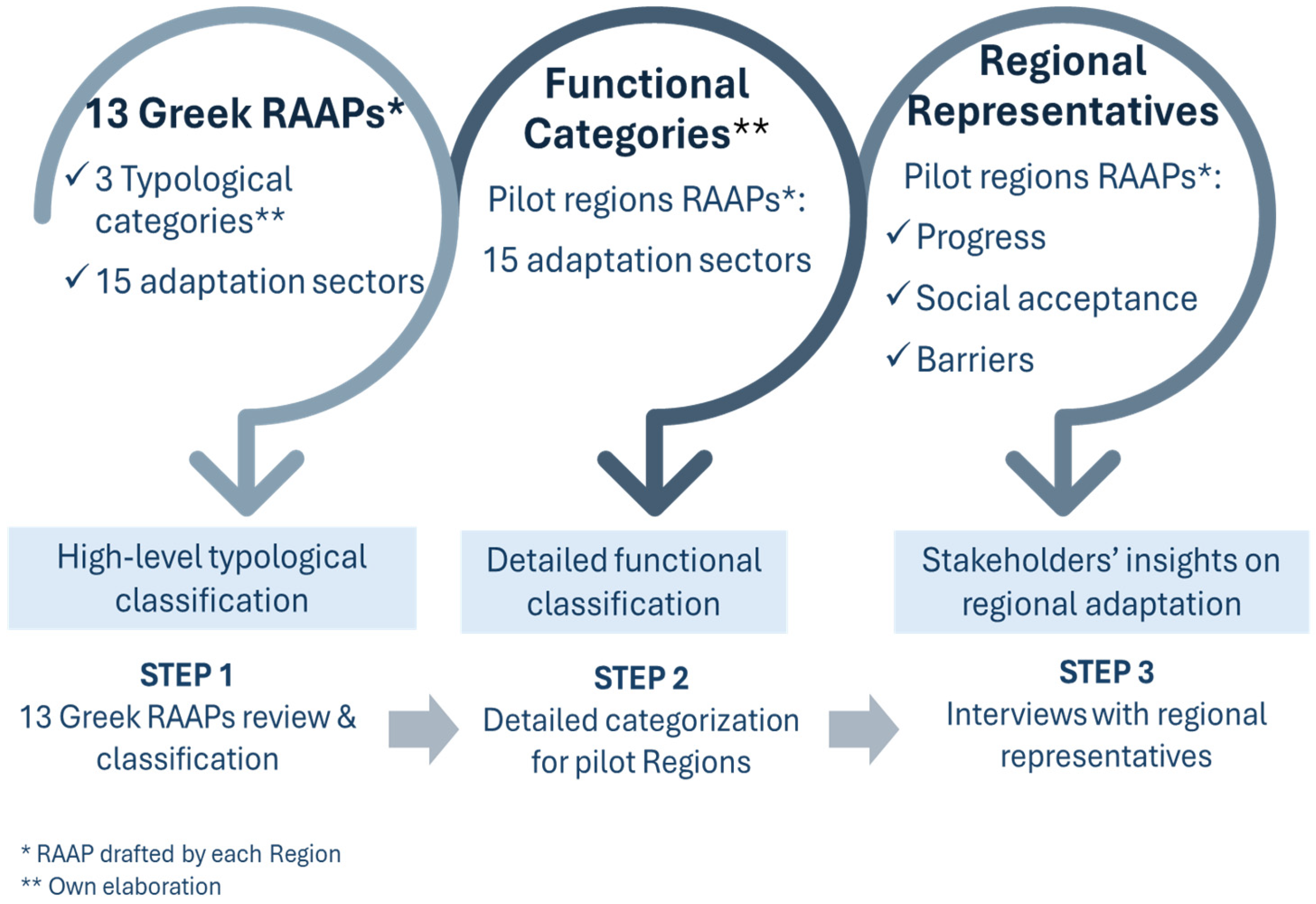
In the framework of the Greek RAAP assessment, the methodological approach adopted in the present analysis comprises three main pillars (Figure 2). In operational terms, the methodological approach followed a sequence of clearly defined steps:
Step 1: All 13 Greek RAAPs were systematically collected and reviewed, and every distinct adaptation measure was extracted and coded with basic metadata (region, sector, and brief description). Each measure was classified according to an IPCC-inspired [24] typology into soft, development or hard measures, and simultaneously assigned to one of the 15 adaptation sectors adopted in this analysis (e.g., water resources, agriculture and livestock farming, forestry, built environment, infrastructure and transport). These sectors draw upon the NAS sectoral framework, with slight modifications that are outlined in a later section. The classification of measures followed a structured qualitative interpretive procedure based on expert judgment. Each adaptation measure was read in its full textual context and interpreted according to the operational definitions of soft, development, and hard measures described in Section 2.1. Measures were assigned to categories based on their primary functional intent. Ambiguous cases were re-examined through iterative reading and discussed among the authors until consensus was reached, ensuring consistency across regions despite differences in wording and structure among RAAP documents.
Step 2: In the two pilot regions of Crete and the Ionian Islands, a more detailed functional categorization was applied, where each measure was coded into one of the predefined functional categories (FC1–FC14), capturing its main operational logic (e.g., planning and strategies, monitoring, administrative organization, economic instruments, infrastructure works, or sector-specific production practices). The functional categorization followed the same qualitative interpretive procedure described in Step 1, based on expert judgment and authors’ consensus to ensure internal consistency.
Step 3: Semi-structured interviews were conducted with key regional officials involved in RAAP elaboration and implementation into the two pilot regions, focusing on the perceived degree of implementation, barriers and enablers, and issues of social acceptance. The qualitative material from the interviews was thematically analyzed and used to interpret the quantitative findings from the classification and functional categorization.

2.1. Classification of Proposed Adaptation Measures

The IPCC’s typology of adaptation measures (i.e., structural/physical; social; and institutional) is conceptually robust and widely known [24]. However, as the IPCC’s AR5 report highlights, many adaptation measures can be classified under more than one category, creating overlaps that make this typology non-exclusive and, in practice, difficult to apply consistently [24,25]. The inherent overlap also limits the practicality of the typology for systematic classification. For this reason, in the present analysis, an alternative set of adaptation measure categories have been proposed and adopted for the 13 Greek RAAPs:
  • Soft measures: Measures aiming to influence societal conduct and refine administrative frameworks. Typical instances include public education and awareness campaigns, the fostering of social consultation, and the establishment of dedicated climate change departments within the region.
  • Development measures: Initiatives and studies intended to broaden the understanding of climate change and its impacts, as well as to explore the efficacy of adaptive responses. Common examples involve the establishment of monitoring networks, the execution of vulnerability assessments, and the formulation of management strategies.
  • Hard measures: Measures primarily centered on new infrastructure construction or the enhancement of the existing facilities (e.g., energy efficiency upgrades in public facilities), adjustments in economic operations (such as modifying farming and livestock techniques), or spatial reorganization (including the relocation of activities from high-risk coastal zones). In this category, economic policies and instruments that facilitate such structural changes are also encompassed.
Each intervention is further categorized based on the specific sector it addresses. The NAS framework delineates 15 distinct environmental, social, and economic domains for adaptation planning, ranging from agriculture, forestry, and water resources to health, tourism, and cultural heritage. However, in practice, RAAPs do not always adhere strictly to this taxonomy. For example, the plans for Eastern Macedonia and Thrace incorporate the manufacturing sector, whereas the North Aegean plan distinguishes flood protection as a standalone category, separate from general water resources. To ensure consistency in this analysis, the NAS classification was utilized with two specific adjustments. Firstly, fisheries and aquaculture were consolidated into a single category, given their joint treatment in most regional plans, thereby improving cross-regional comparability. Secondly, a distinct ‘horizontal/cross-sectoral’ category was established. This encompasses broad-spectrum initiatives (such as climate observatories) and multi-domain actions (like integrated early warning systems covering agriculture, forestry, and the built environment). These refinements ensure a more robust and uniform classification framework for the assessment of the RAAPs.

2.2. Detailed Categorization for the Two Pilot Regions

In addition to the general classification described above, a more detailed categorization of adaptation measures was developed for the two pilot regions, where interviews with local officials were conducted. This detailed functional categorization (FC) was designed to enable a more refined assessment of sector-specific adaptation needs and to support both the interview process and subsequent analysis. The functional categories identified within this framework are presented in Table 1.

2.3. Interview Process

To evaluate the implementation progress of the strategies outlined in the RAAPs, semi-structured interviews were carried out with key regional officials from the competent administrative units in the designated pilot areas: (a) the Region of Crete, representing a high-vulnerability profile, and (b) the Ionian Islands Region, which is categorized as moderately vulnerable [8]. The respondents were asked to detail the current maturity of adaptation initiatives (whether completed or under development), classify the nature of these interventions (soft, developmental, or hard), and report on the existence of any operational monitoring frameworks. Additionally, the interview explored potential hurdles related to public acceptance. Finally, in instances where no measures had been deployed, the officials were invited to suggest priority actions based on their on-the-ground experience.

3. Results

This section presents the findings of the analysis through the three-level proposed analytical approach. First, it examines the overall distribution and orientation of adaptation measures across all 13 RAAPs, providing a comparative view of sectoral and typological priorities at the national scale. Secondly, it offers a functional categorization of measures for the two pilot regions of Crete and the Ionian Islands, enabling a more granular understanding of how adaptation priorities are operationalized in different territorial and socio-economic contexts. Finally, qualitative insights from interviews with regional officials, which shed light on the practical challenges, institutional dynamics and socio-political factors that influence RAAP implementation, are integrated, providing a comprehensive picture of Greece’s regional adaptation landscape, revealing both shared structural patterns and distinct, place-specific trajectories.

3.1. Analysis of RAAP Adaptation Measures

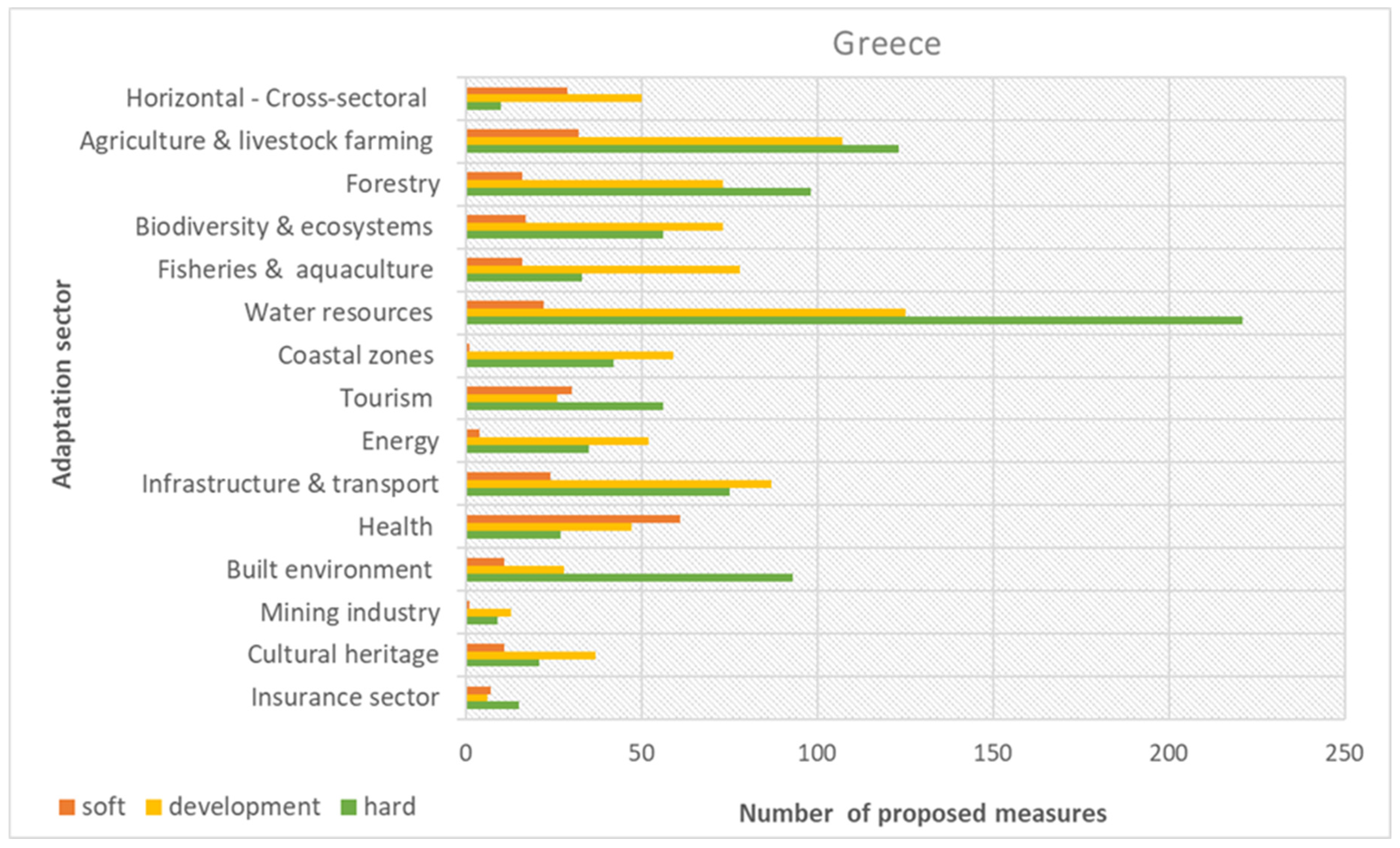
The comparative review of the 13 Greek RAAPs revealed significant variation in the number, type, and maturity level of the proposed adaptation measures across the various adaptation sectors (Figure 3, Table 2). Overall, the majority of measures fall into the development and hard categories, indicating that regional adaptation planning in Greece remains at an early stage, since both preparatory actions such as vulnerability assessment and the development of management plans, as well as intervention-oriented actions—such as infrastructure works—are still required. On the contrary, soft measures, related to raising awareness, education, and capacity building, are relatively limited, indicating that greater emphasis is placed on intervention-oriented actions. At the sectoral level, the analysis shows that water resources is the sector that requires a significant number of hard measures, such as flood protection infrastructure and the modernization of irrigation and water distribution grids, as well as the installation of water recycling facilities. Simultaneously, there is a clear necessity for supplementary developmental initiatives within this domain, particularly regarding the enhancement of observation networks (for instance, systems tracking surface discharge and water quality) and the formulation of robust strategic frameworks (such as contingency plans for drought and flood risk management). The other sectors requiring a high number of required actions are agriculture and livestock, infrastructure and transport, and forestry. Their prominence reflects their critical roles in ensuring economic resilience, food security, and the protection of both natural and built environments against the impacts of climate change.
Based on the aforementioned categorization, Table 2 presents the sectors in each region that require the greatest number of soft, development and hard measures to be adopted. The observed differences in sectoral priorities and types of required adaptation measures reflect a combination of factors, including physical exposure, sectoral structure, regional development priorities, and the extent to which climate change considerations have already been integrated into regional planning and governance processes. Indicatively, in the Region of Crete, one of the pilots selected for interviews in this study, agriculture and livestock farming require the greatest number of hard measures, as well as special/particular financial incentives/disincentives to promote the adaptation of relevant measures by key stakeholders. In the same region, the sector that requires the greatest number of development measures is water resources. Similarly, in the Ionian Islands Region, the water resources sector requires the highest number of hard measures, which is an expected finding, as the region is already experiencing pressure on freshwater availability due to aquifer salinization and seasonal tourism-related demand [26]. Conversely, the infrastructure and transport sector in the Ionian Islands Region is characterized mainly by development measures, notably vulnerability assessments and monitoring systems for ports, airports and other critical transport infrastructure. Overall, this regional differentiation highlights how adaptation priorities vary according to each region’s biophysical characteristics, socio-economic structure, and exposure to specific climate-related hazards. These findings supported the combined interpretation of the functional categorization and interview results, thereby facilitating the contextualization of the regional officials within the broader patterns observed across the 13 RAAPs.

3.2. Results Analysis in the Two Pilot Regions

The functional categorization for the Region of Crete (Table 3) reveals a significant concentration of measures within specific functional domains. In the agricultural sector, a large share of measures falls under economic instruments and incentives (n = 12) and agricultural and livestock practices (n = 7). This indicates that the agricultural sector requires not only technical and agronomic changes, but also financial support in order to enable farmers to adopt climate-resilient production practices and systems. In the forestry sector, the majority of measures involve forestry and vegetation interventions and works (n = 11), reflecting the need to manage the risk of ecosystem degradation. In the built environment sector, measures are primarily oriented towards spatial and urban planning actions (n = 7). The water resources sector exhibits the highest number of infrastructure and technical interventions (n = 8), underscoring the region’s vulnerability to water scarcity and the corresponding need for enhanced monitoring systems. Overall, relatively few actions focus on administrative organization, institutional and regulatory frameworks, and research and innovation, which may be associated with regional priorities or with previous activity already undertaken in these domains.
For the case of the Ionian Islands Region, the functional categorization of adaptation measures (Table 4) indicates that adaptation in the agriculture and livestock sector is mainly linked with agricultural and livestock practices (n = 13), followed by awareness, education and capacity building (n = 5), and economic instruments and incentives (n = 5). In the water resources sector, a considerable number of measures are related to infrastructure design/upgrading (n = 10) and monitoring impacts and measures (n = 6), highlighting the need to enhance water management, reduce losses and address seasonal water stress and pressures from salinization. The infrastructure and transport sector also includes several measures across multiple functional categories, including the design/upgrading of infrastructure (n = 8), assessment of impacts and vulnerability (n = 5), and research and innovation (n = 5). Notably, the health sector requires a high level of awareness, education and capacity-building measures (n = 11) and civil protection and preparedness actions (n = 5). This pattern reflects the priority placed on safeguarding residents and tourists from extreme weather events and climate-related risks, in a region characterized by significant seasonal population fluctuations. Overall, and similar to Crete, relatively few measures focus on institutional and regulatory frameworks, research and innovative actions, or administrative organization, suggesting that intervention-oriented actions constitute a primary priority in the Ionian Islands Region.

3.3. Findings from the Interviews

The interviews were conducted with officials from Crete’s RAAP execution task force, specifically involving representatives from both the Environment and Civil Protection Directorates. Interventions applied in Crete primarily fall under the categories of soft and hard actions. Hard measures encompass mechanisms to manage coastal erosion and flood risk and the construction of water reservoirs and dams, as well as the reorganization or limitation of operations situated in hazard-prone zones. Conversely, the Civil Protection Directorate is instrumental in executing soft measures. Aligning with its statutory mandate, this administrative body handles the distribution of critical data, the formulation of directives, and the communication of preparedness and emergency protocols. A prominent illustration of this function is the routine communication of wildfire threat levels: regional authorities utilize the Daily Fire Risk Forecast Maps, generated by the National General Secretariat for Civil Protection, to alert residents and municipalities. Furthermore, the operational impact of this Directorate is amplified by early warning networks deployed during severe climatic anomalies, thereby underscoring the critical nature of prompt information dissemination in managing climate-induced risks.
Furthermore, the Region of Crete is actively involved in numerous funding schemes, encompassing both co-funded and European Union-funded programs. A notable example among these is the ‘Regional Support Mechanism of Crete for Adaptation to Climate Change’. Beyond merely setting up a climate observatory, this initiative is designed to track the execution progress of the adaptive strategies detailed within the local RAAP. It concurrently focuses on revising risk evaluations and recalibrating the adaptation requirements for distinct sectors. A second major developmental effort involves deploying, running, and servicing an automated system for meteorological and hydrological observation. This system is exploited for logging climate fluctuations alongside water resource metrics across the island. Spearheaded by the Decentralized Administration of Crete, this network provides vital feedback to regional and municipal bodies regarding freshwater supplies, potential drought phases, and severe weather or flood hazards, thereby guaranteeing the timely deployment of necessary protective actions. This highlights the foundational role of development measures in supporting future hard interventions, particularly in water-scarce regions. Additionally, the Civil Protection Directorate has participated in targeted EU-funded adaptation initiatives, including PLIMMIRIS [27], a cross-border framework for flood risk management under climate change. Crete’s involvement in this project demonstrates its engagement in early warning, field exercise, and capacity-building approaches aligned with international adaptation governance practices.
Concerning public acceptance of the adopted adaptation strategies, Crete’s Civil Protection Directorate notes an absence of any societal hurdles thus far. In contrast, the Water Directorate within the Decentralized Administration observes that soft measures frequently lack efficacy if they are not paired with hard measures, including specific financial mechanisms designed to drive the adoption of resilience practices. More specifically, initiatives that appear to constrain the growth of the agricultural or tourism industries—both of which rely heavily on the island’s natural assets and are acutely vulnerable to climatic shifts—frequently provoke reluctance among key interest groups. These insights point out a well-documented challenge in adaptation governance: while emergency-oriented soft measures are well accepted, structural measures that affect resource use and economic activities face potential resistance.
Discussions with representatives from the Ionian Islands Region highlighted their strong expectation for the forthcoming official endorsement of their local RAAP. Securing this formal authorization will significantly streamline the rollout of designated resilience actions. Furthermore, the dialog brought attention to the critical role of the LIFE-IP AdaptInGR project (‘Boosting the implementation of adaptation policy across Greece’). This project is fundamentally designed to reinforce the execution of both the NAS and the thirteen regional plans across all administrative tiers [28]. As a key component of this initiative, a pioneering monitoring system is employed to track the susceptibility of the Ionian coastal fronts to climatic shifts. Consequently, fifty strategically chosen beach locations throughout the region are undergoing continuous observation for erosion threats, a process that allows authorities to pinpoint areas requiring urgent intervention.

4. Discussion

The assessment of the 13 Greek RAAPs reveals structural patterns that mirror broader trends in regional adaptation planning across the Mediterranean and Europe. The predominance of development and hard measures reflects not only the early stage of adaptation implementation in Greece but also wider governance conditions in which regions prioritize sectors with clearer institutional mandates and greater access to EU funding instruments. Similar patterns have been documented in European assessments showing that early stage adaptation planning often concentrates on preparatory actions—such as monitoring systems and risk assessments and infrastructure-related interventions addressing already observable climate impacts [29,30]. Although soft measures are comparatively fewer in number, they are present in all adaptation sectors, indicating that regions recognize their importance for effective and sustained adaptation. Beyond its governance dimension, the proposed classification framework has direct relevance to climate risk management. By distinguishing between soft, development and hard measures across sectors, the analysis highlights how regions prioritize responses to climate-driven hazards such as droughts, floods and extreme weather. This categorization helps reveal whether adaptation planning focuses primarily on preparedness, knowledge generation or structural protection, thereby providing an indirect indicator of the regional capacity to respond to ongoing and projected climate impacts. In this sense, the framework contributes to the broader climate discourse by linking policy design with the practical management of atmospheric and climate-related risks.
These patterns can be interpreted in relation to the vulnerability classification of the Greek regions presented in Figure 1. A broad alignment can be observed between the vulnerability classification and the distribution of adaptation measures identified in the RAAPs. Regions categorized as highly vulnerable, such as Crete, tend to emphasize a higher number of intervention-oriented measures in climate-sensitive sectors, particularly water resources and agriculture. However, the relationship is not strictly linear and should not be expected to be. The NAS provides sectoral guidance and a comparative vulnerability framework but does not prescribe region-specific measures. The detailed selection and prioritization of actions occur at the regional level through the RAAPs. Consequently, the observed distribution reflects how regions translate national strategic orientation into territorially specific planning choices shaped by local sectoral needs and governance capacity.
The sectoral differentiation observed across regions reveals variations in climate risk exposure, socio-economic needs, and degree of preparedness. The strong emphasis on water resources, agriculture and infrastructure in the RAAPs aligns with established evidence on Southern European climate vulnerabilities, particularly regarding water scarcity, droughts, extreme weather events and pressures on climate-sensitive sectors such as tourism and agriculture [31,32,33]. Differences between the two pilot regions further highlight the place-based nature of adaptation: Crete prioritizes agricultural practices and economic instruments due to the significance of primary production in its economy, whereas the Ionian Islands place greater emphasis on health-related preparedness measures, reflecting seasonal population fluctuations and tourism pressures. These findings are consistent with research underscoring that regional adaptation priorities emerge from the interplay of biophysical risk, socio-economic structure and institutional capacity [27,34].
Insights from the interviews reveal additional governance and social dynamics that shape adaptation feasibility. The reliance on EU-funded projects to support monitoring systems and early warning mechanisms is consistent with studies showing that external funding and knowledge networks play a critical role in strengthening adaptation capacity in regions with limited resources [35,36]. At the same time, variations in public acceptance between soft civil protection measures and more structural interventions reflect observations from the adaptation governance literature: measures affecting land use, water management or economic activities often face resistance, particularly in regions dependent on climate-sensitive livelihoods [37,38]. These dynamics highlight that effective RAAP implementation relies not only on technical planning but also on institutional readiness, cross-sectoral coordination and sustained stakeholder engagement. Research has repeatedly shown that adaptation success depends on embedding climate considerations into routine governance processes and ensuring that local actors perceive adaptation measures as legitimate, feasible and socially acceptable [39,40]. The patterns identified in Crete and the Ionian Islands reflect these broader governance challenges and underscore the need for systematic monitoring, institutional strengthening and social dialog to support long-term adaptation implementation.
This analysis offers the first systematic review of the 13 Greek RAAPs, but several limitations should be acknowledged. The analysis is based on the initial versions of the plans, which may not fully reflect recent policy developments or emerging climate risks. The detailed functional categorization was only applied to two pilot regions, limiting the extent to which cross-regional comparisons can be generalized. Nevertheless, the nationwide typological classification applied to all 13 RAAPs ensures a consistent basis for cross-regional comparison at the national scale. Moreover, the assessment of implementation progress relies on interviews with regional officials, which, while informative, provide qualitative insights that may be influenced by institutional perspectives. Future research should extend the functional categorization to all regions, incorporate systematic indicators to track RAAP implementation over time, and examine governance and financing arrangements that influence adaptation capacity. Further work on stakeholder engagement and social acceptance—particularly for hard measures—would help identify barriers to implementation and support more effective updates of the RAAPs.

5. Conclusions

The present study provides an initial systematic assessment of the 13 Greek RAAPs, offering a structured categorization of proposed measures and an early appraisal of implementation dynamics. The analysis shows a clear predominance of development and hard measures across regions, reflecting that adaptation planning in Greece remains focused on strengthening foundational knowledge, monitoring systems and critical infrastructure. The review of the RAAPs emphasizes the necessity not only to implement hard measures but also to continuously monitor the climate change impacts and the effectiveness of the implemented measures, particularly in the water resources sector.
The functional categorization applied to Crete and the Ionian Islands illustrates how regional adaptation priorities are shaped by local biophysical characteristics, socio-economic structures and institutional capacities. Social acceptance emerges as a critical factor for the effective adoption of the proposed adaptation measures. While soft, emergency-oriented measures tend to be well received, structural interventions affecting economic sectors or resource use may encounter resistance. Therefore, potential barriers to the social acceptance of the suggested adaptation measures should also be examined and addressed to enhance the feasibility and long-term sustainability of adaptation efforts.
Overall, the findings demonstrate that Greece’s RAAPs represent an important institutional step toward regional adaptation planning, while also offering a transferable analytical framework that can support comparative assessments and adaptation planning worldwide. Strengthening monitoring systems, enhancing regional capacity and improving social and institutional feasibility of adaptation measures will be essential not only for Greece’s future RAAP updates but also for improving adaptation governance across diverse international contexts.
Beyond providing a descriptive overview, this study introduces a structured, multi-level analytical framework that integrates typological classification, functional operationalization, and implementation insights, thereby offering a replicable tool for the comparative assessment of regional adaptation governance. In doing so, it advances the literature by moving from policy-inventory approaches toward a governance-oriented evaluation of how adaptation strategies are prioritized, operationalized, and institutionally embedded at the sub-national scale. Moreover, this framework can support other countries in identifying regional and sectoral adaptation “hot-spots,” detecting implementation delays, and revealing mismatches between vulnerability patterns and policy responses. By linking climate risk exposure with the maturity and type of adaptation measures, it provides an evidence-based basis for recalibrating funding instruments, refining prioritization mechanisms, and strengthening the strategic allocation of climate finance at the regional level.

Author Contributions

Conceptualization, D.C. and M.P.P.; methodology, D.C., A.L. and M.P.P.; formal analysis, D.C., E.C.S. and G.K.; investigation, D.C., E.C.S. and G.K.; writing—original draft preparation, D.C., A.L. and M.P.P.; writing—review and editing, D.C., G.K., A.L. and M.P.P.; visualization, D.C. and A.L.; supervision, M.P.P., project administration, M.P.P. All authors have read and agreed to the published version of the manuscript.

Funding

The present work was performed within the project “Support the upgrading of the operation of the National Network on Climate Change (Climpact)” of the General Secretariat of Research and Technology under Grant “2023ΝA11900001”.

Institutional Review Board Statement

Not applicable.

Informed Consent Statement

Not applicable.

Data Availability Statement

The data presented in this study are available on request from the corresponding author due to privacy.

Acknowledgments

Authors extend sincere appreciation to the public servants from the Region of Crete and the Ionian Islands who participated in the discussion sessions. The profound insights and practical knowledge they generously offered were fundamental to the successful realization of this study.

Conflicts of Interest

The authors declare no conflicts of interest.

Abbreviations

The following abbreviations are used in this manuscript:
RAAPRegional Adaptation Action Plan
NASNational Adaptation Strategy
UNFCCCUnited Nations Framework Convention on Climate Change
NUTSNomenclature of Territorial Units for Statistics
IPCCIntergovernmental Panel on Climate Change
EUEuropean Union

References

  1. United Nations Framework Convention on Climate Change. United Nations Framework Convention on Climate Change; United Nations: New York, NY, USA, 1992; Available online: https://unfccc.int/resource/docs/convkp/conveng.pdf (accessed on 1 December 2025).
  2. UNFCCC. Paris Agreement; United Nations Framework Convention on Climate Change: Bonn, Germany, 2015; Available online: https://unfccc.int/sites/default/files/english_paris_agreement.pdf (accessed on 1 December 2025).
  3. United Nations. Transforming Our World: The 2030 Agenda for Sustainable Development; United Nations: New York, NY, USA, 2015; Available online: https://sdgs.un.org/2030agenda (accessed on 1 December 2025).
  4. European Commission. The European Green Deal; European Commission: Brussels, Belgium, 2019; Available online: https://ec.europa.eu/info/strategy/priorities-2019-2024/european-green-deal_en (accessed on 1 December 2025).
  5. European Union. Regulation (EU) 2021/1119 of the European Parliament and of the Council of 30 June 2021 Establishing the Framework for Achieving Climate Neutrality. Off. J. Eur. Union 2021, L243, 64. [Google Scholar]
  6. Georgopoulou, E.; Mirasgedis, S.; Sarafidis, Y.; Giannakopoulos, C.; Varotsos, K.V.; Gakis, N. Climate Change Impacts on the Energy System of a Climate-Vulnerable Mediterranean Country (Greece). Atmosphere 2024, 15, 286. [Google Scholar] [CrossRef]
  7. European Commission. Guidelines on Developing Adaptation Strategies—Accompanying the Communication from the Commission to the European Parliament, the Council, the European Economic and Social Committee and the Committee of the Regions: An EU Strategy on Adaptation to Climate Change; European Commission: Brussels, Belgium, 2013; Available online: https://eur-lex.europa.eu/legal-content/EN/TXT/PDF/?uri=CELEX:52013SC0134 (accessed on 1 December 2025).
  8. Ministry of Environment and Energy. National Strategy for Climate Change Adaptation; Ministry of Environment and Energy: Athens, Greece, 2016. Available online: https://ypen.gov.gr/wp-content/uploads/legacy/Files/Klimatiki%20Allagi/Prosarmogi/20160406_ESPKA_teliko.pdf (accessed on 1 December 2025). (In Greek)
  9. Hellenic Republic. Law 4936/2022: National Climate Law—Transition to Climate Neutrality and Adaptation to Climate Change, Urgent Provisions to Address the Energy Crisis and Protect the Environment. 2022. Available online: https://climate-laws.org/document/national-climate-law-4936-2022-on-the-transition-to-climate-neutrality-and-adaptation-to-climate-change_2ff3 (accessed on 1 December 2025).
  10. European Commission. Forging a Climate-Resilient Europe: The New EU Strategy on Adaptation to Climate Change (COM(2021)82 final); European Commission: Brussels, Belgium, 2021. [Google Scholar]
  11. Attica Region. Regional Adaptation Action Plan (RAAP); Attica Region: Athens, Greece, 2022. Available online: https://www.patt.gov.gr/koinonia/perivallon/pespka/pespka_kentriki/ (accessed on 1 December 2025). (In Greek)
  12. Central Macedonia Region. Regional Adaptation Action Plan (RAAP); Central Macedonia Region: Thessaloniki, Greece, 2021. Available online: https://pkm.gov.gr/wp-content/uploads/2023/05/Paradoteo_7_PESPKA_PKM_s-1.pdf (accessed on 1 December 2025). (In Greek)
  13. Western Macedonia Region. Regional Adaptation Action Plan (RAAP); Western Macedonia Region: Kozani, Greece, 2023. Available online: https://www.pdm.gov.gr/enimerosi-politon/pespka-dytikis-makedonias/ (accessed on 1 December 2025). (In Greek)
  14. Eastern Macedonia and Thrace Region. Regional Adaptation Action Plan (RAAP); Eastern Macedonia and Thrace Region: Komotini, Greece, 2020. Available online: https://www.pamth.gov.gr/perifereiako-schedio-gia-tin-prosarmogi-stin-klimatiki-allagi-pespka-anatolikis-makedonias-thrakis/ (accessed on 1 December 2025). (In Greek)
  15. Epirus Region. Regional Adaptation Action Plan (RAAP); Epirus Region: Ioannina, Greece, 2018. Available online: https://php.gov.gr/peskpa/ (accessed on 1 December 2025). (In Greek)
  16. Thessaly Region. Regional Adaptation Action Plan (RAAP); Thessaly Region: Larissa, Greece, 2025. Available online: https://www.thessaly.gov.gr/enimerosi/paathessalias/488 (accessed on 1 December 2025). (In Greek)
  17. Ionian Islands Region. Regional Adaptation Action Plan (RAAP); Ionian Islands Region: Corfu, Greece, 2019. Available online: https://pin.gov.gr/wp-content/uploads/2019/06/Pespka-PIN.pdf (accessed on 1 December 2025). (In Greek)
  18. Western Greece Region. Regional Adaptation Action Plan (RAAP); Western Greece Region: Patras, Greece, 2020. Available online: https://www.pde.gov.gr/gr/enimerosi/diabouleuseis/item/12520-periferiakosxedioklimatikiallagi.html (accessed on 1 December 2025). (In Greek)
  19. Central Greece Region. Regional Adaptation Action Plan (RAAP); Central Greece Region: Lamia, Greece, 2021. Available online: https://pste.gov.gr/perifereiako-schedio-prosarmogis-stin-klimatiki-allagi-pespka-gia-tin-perifereia-stereas-elladas/ (accessed on 1 December 2025). (In Greek)
  20. Peloponnese Region. Regional Adaptation Action Plan (RAAP); Peloponnese Region: Tripoli, Greece, 2021. Available online: https://www.ppel.gov.gr/egkrisi-periferiakou-schediou-gia-tin-prosarmogi-stin-klimatiki-allagi/ (accessed on 1 December 2025). (In Greek)
  21. North Aegean Region. Regional Adaptation Action Plan (RAAP); North Aegean Region: Mytilene, Greece, 2022. Available online: https://www.pvaigaiou.gov.gr/dyn/userfiles/files/pdf-diavouleysh/PESPKA_BOREIO_AIGAIO.pdf (accessed on 1 December 2025). (In Greek)
  22. South Aegean Region. Regional Adaptation Action Plan (RAAP); South Aegean Region: Rhodes, Greece, 2023. Available online: https://www.pnai.gov.gr/wp-content/uploads/2023/09/%CE%A3%CE%9C%CE%A0%CE%95.pdf (accessed on 1 December 2025). (In Greek)
  23. Crete Region. Regional Adaptation Action Plan (RAAP); Crete Region: Heraklion, Greece, 2020. Available online: https://www.crete.gov.gr/perifereiako-schedio-prosarmogis-stin-klimatiki-allagi-stin-kriti/ (accessed on 1 December 2025). (In Greek)
  24. Noble, I.R.; Huq, S.; Anokhin, Y.A.; Carmin, J.; Goudou, D.; Lansigan, F.P.; Osman-Elasha, B.; Villamizar, A. Adaptation Needs and Options. In Climate Change 2014: Impacts, Adaptation, and Vulnerability. Part A: Global and Sectoral Aspects; Field, C.B., Barros, V.R., Dokken, D.J., Mach, K.J., Mastrandrea, M.D., Bilir, T.E., Chatterjee, M., Ebi, K.L., Estrada, Y.O., Genova, R.C., et al., Eds.; Cambridge University Press: Cambridge, UK; New York, NY, USA, 2014; pp. 833–868. [Google Scholar]
  25. Mimura, N.; Pulwarty, R.S.; Duc, D.M.; Elshinnawy, I.; Redsteer, M.H.; Huang, H.Q.; Nkem, J.N.; Sanchez-Rodriguez, R.A. Adaptation Planning and Implementation. In Climate Change 2014: Impacts, Adaptation, and Vulnerability. Part A: Global and Sectoral Aspects; Field, C.B., Barros, V.R., Dokken, D.J., Mach, K.J., Mastrandrea, M.D., Bilir, T.E., Chatterjee, M., Ebi, K.L., Estrada, Y.O., Genova, R.C., et al., Eds.; Cambridge University Press: Cambridge, UK; New York, NY, USA, 2014; pp. 869–898. [Google Scholar]
  26. Decentralized Administration of Peloponnese, Western Greece and the Ionian. Revision of the Strategic Plan for Drought and Water Scarcity Management in the Ionian Islands Region; Decentralized Administration of Peloponnese, Western Greece and the Ionian Islands: Patras, Greece, 2022. Available online: https://apd-depin.gov.gr/wp-content/uploads/2025/06/%CE%A3%CF%87%CE%AD%CE%B4%CE%B9%CE%BF-%CE%91%CE%BD%CF%84%CE%B9%CE%BC%CE%B5%CF%84%CF%8E%CF%80%CE%B9%CF%83%CE%B7%CF%82-%CE%9E%CE%B7%CF%81%CE%B1%CF%83%CE%AF%CE%B1%CF%82-%CE%9B%CE%B5%CE%B9%CF%88%CF%85%CE%B4%CF%81%CE%AF%CE%B1%CF%82-%CF%83%CF%84%CE%B7%CE%BD-%CE%A0%CE%B5%CF%81%CE%B9%CF%86%CE%AD%CF%81%CE%B5%CE%B9%CE%B1-%CE%99%CE%BF%CE%BD%CE%AF%CF%89%CE%BD.pdf (accessed on 1 December 2025). (In Greek)
  27. PLIMMIRIS. Joint Strategy for Flood Risk Management and Disaster Response Due to Climate Change (Interreg V-A Greece–Cyprus, 2021–2023). Available online: https://plimmiris.eu/ (accessed on 1 December 2025).
  28. LIFE-IP AdaptInGR. Boosting the Implementation of Adaptation Policy Across Greece (Project Reference LIFE17 IPC/GR/000006). Available online: https://webgate.ec.europa.eu/life/publicWebsite/project/LIFE17-IPC-GR-000006/boosting-the-implementation-of-adaptation-policy-across-greece (accessed on 1 December 2025).
  29. European Environment Agency. Trends and Outlook for Climate Action in Europe 2024; EEA: Copenhagen, Denmark, 2024. [Google Scholar]
  30. European Court of Auditors. Special Report 15/2024: The EU’s Adaptation to Climate Change—Progress Made but Insufficient Integration into Water Management and Funding Plans; Publications Office of the European Union: Luxembourg, 2024. [Google Scholar]
  31. MedECC. Climate and Environmental Change in the Mediterranean Basin—Current Situation and Risks for the Future. First Mediterranean Assessment Report (MAR1); UNEP/MAP: Marseille, France, 2020. [Google Scholar]
  32. Plan Bleu. Adapting to Climate Change in the Water Sector in the Mediterranean: Situation and Prospects; Plan Bleu Regional Activity Centre: Valbonne, France, 2011. [Google Scholar]
  33. Papadopoulou, M.P.; Charchousi, D.; Spanoudaki, K.; Karali, A.; Varotsos, K.V.; Giannakopoulos, C.; Markou, M.; Loizidou, M. Agricultural Water Vulnerability under Climate Change in Cyprus. Atmosphere 2020, 11, 648. [Google Scholar] [CrossRef]
  34. Glaas, E.; Jonsson, A.; Hjerpe, M.; Andersson-Sköld, Y. Managing climate change vulnerabilities: Formal institutions and knowledge use as determinants of adaptive capacity at the local level in Sweden. Local Environ. 2010, 15, 373–387. [Google Scholar] [CrossRef]
  35. European Commission. Funding for Climate Change Adaptation; European Commission: Brussels, Belgium, 2023; Available online: https://climate-adapt.eea.europa.eu/ (accessed on 1 December 2025).
  36. Adger, W.N.; Arnell, N.W.; Tompkins, E.L. Successful adaptation to climate change across scales. Glob. Environ. Change 2005, 15, 77–86. [Google Scholar] [CrossRef]
  37. Klein, R.J.T.; Midgley, G.F.; Preston, B.L.; Alam, M.; Berkhout, F.; Dow, K.; Shaw, M.R. Adaptation opportunities, constraints, and limits. In Climate Change 2014: Impacts, Adaptation, and Vulnerability. Part A: Global and Sectoral Aspects; Field, C.B., Barros, V.R., Dokken, D.J., Mach, K.J., Mastrandrea, M.D., Bilir, T.E., Chatterjee, M., Ebi, K.L., Estrada, Y.O., Genova, R.C., et al., Eds.; Cambridge University Press: Cambridge, UK, 2014; Chapter 16. [Google Scholar]
  38. Siders, A.R. Adaptive capacity to climate change: A synthesis of concepts and applications. WIREs Clim. Change 2019, 10, e573. [Google Scholar] [CrossRef]
  39. Runhaar, H.; Wilk, B.; Persson, Å.; Uittenbroek, C.; Wamsler, C. Mainstreaming climate adaptation: Taking stock about “what works” from empirical research worldwide. Reg. Environ. Change 2018, 18, 1201–1210. [Google Scholar] [CrossRef]
  40. Eisenack, K.; Moser, S.C.; Hoffmann, E.; Klein, R.J.T.; Oberlack, C.; Pechan, A.; Rotter, M.; Termeer, C.J.A. Explaining and overcoming barriers to climate change adaptation. Nat. Clim. Change 2014, 4, 867–872. [Google Scholar] [CrossRef]
Figure 1. Vulnerability levels of the 13 Greek regions as defined in NAS [after 8].
Atmosphere 17 00288 g001
Figure 2. Three-step methodological workflow: RAAP classification, functional categorization in pilot regions, and interviews with regional representatives.
Atmosphere 17 00288 g002
Figure 3. Categorization of adaptation measures from the 13 Greek RAAPs based on the proposed classification framework.
Atmosphere 17 00288 g003
Table 1. Functional categorization of adaptation measures and corresponding descriptions applied to the pilot regions.
Category CodeFunctional CategoryDescriptionIndicative Examples
FC1Development/Update of Management and Action PlansDesign or updating of strategic or operational plans for the prevention or the management of climate change related risks and impacts
-
Water Safety Plans
-
Coastal Zone Management Plans
FC2Monitoring of Impacts and/or MeasuresDevelopment and/or implementation of monitoring systems that allow the identification of environmental, social, or economic climate-related impacts and the effectiveness of the implemented measures
-
Installation of telemetry systems for water abstraction
-
Detection of invasive species and ecological changes
FC3Assessment of Impacts and/or VulnerabilityActions related to the identification and evaluation of vulnerability and potential impacts on sectors such as the environment, society, and infrastructure to support decision-making
-
Assessment of the effects of climate change on wetlands and other ecosystems
-
Vulnerability analysis for agricultural systems
-
Risk assessments for monuments, museums, and archeological sites
FC4Administrative OrganizationActions related to the organization and enhancement of administrative structures and processes, scoping to the effective implementation of adaptation policies
-
Establishment or enhancement of dedicated Climate Change Regional Departments
-
Creation and staffing of management bodies for protected areas
FC5Institutional and Regulatory FrameworksDevelopment, revision, or enforcement of institutional and regulatory frameworks that establish rules, standards, and procedures for climate-related risk management
-
Definition of water abstraction limits
-
Delineation of protection zones
FC6Research and InnovationScientific research to develop new tools, technologies, and methods that support adaptation, including the design and implementation of pilot projects
-
Participation in EU-funded programs
-
Design and implementation of pilot coastal protection projects
FC7Economic Instruments and IncentivesUse of economic tools and incentives to promote sustainable practices and support adaptation measures
-
Subsidies for tourism enterprises to adapt to climate change
-
Provision of financial incentives for farmers to adopt closed hydroponic systems
FC8Awareness, Education and Capacity BuildingActions related to raising awareness, training, and enhancing skills to strengthen institutional and community capacities for adaptation
-
Public awareness campaigns addressing the effects of climate change on water resources
-
Awareness campaigns to attract volunteers for reforestation activities in fire-affected areas
FC9Spatial and Urban Planning ActionsDesign, promotion, and implementation of spatial and urban planning measures and interventions aimed at mitigating climate change impacts, mainly on built environments
-
Enhancement of blue and green spaces in major urban areas
-
Urban planning regulations for areas within the 100-year flood zone to reduce exposure and enhance flood resilience
FC10Ecosystem Management and Restoration MeasuresDesign, promotion, and implementation of actions to protect, restore, and sustainably manage ecosystems to enhance resilience to environmental risks
-
Strengthening the ecological coherence of the Natura 2000 network through the design and development of ecological corridors
-
Surveillance and guarding of protected areas
FC11Design/Implementation/Upgrade of Infrastructure and ConstructionsDesigning, constructing, or upgrading infrastructure to increase resilience against climate change impacts and enhance long-term safety and functionality of critical systems
-
Design and construction of surface water storage infrastructure
-
Implementation of infrastructure works and safety measures to improve the resilience and operational safety of the road network
FC12Civil Protection and PreparednessDevelopment of emergency preparedness plans and civil protection systems to respond effectively to climate-related hazards
-
Utilization of communication technologies to enhance public awareness and deliver real-time safety instructions during extreme climate events
-
Identification and mapping of vulnerable population groups and establishment of support networks and mechanisms
FC13Forestry and Vegetation Interventions and WorksDesign and implementation of forestry and vegetation management, restoration, and protection measures to reduce climate-related hazards and enhance the resilience of forest ecosystems
-
Implementation of post-fire restoration measures in forest areas, using native genetic material
-
Application of forest management and controlled grazing practices to limit flammable understory biomass and decrease the risk and intensity of forest fires
FC14Agricultural and Livestock PracticesDesign, promotion and implementation of sustainable farming and livestock practices that reduce environmental hazards and enhance resilience to climate change impacts
-
Gradual abandonment of water-intensive crops with low economic returns
-
Use of mixed crop–livestock production systems
Table 2. Predominant adaptation sectors per region, derived from the proposed categorization framework applied to measures reported in the 13 RAAPs.
RegionMeasure Category
SoftDevelopmentHard
AtticaAgriculture & livestock farmingHealthAgriculture & livestock farming
Central GreeceHorizontal–
cross-sectoral
Agriculture & livestock farmingWater resources
PeloponneseHorizontal–
cross-sectoral
Water resourcesWater resources
CreteHealthWater resourcesAgriculture & livestock farming
Western MacedoniaHealthInfrastructure & transportWater resources
Central MacedoniaHealthForestryWater resources
Eastern Macedonia and ThraceHorizontal–
cross-sectoral
Water resourcesForestry
ThessalyInfrastructure & transportFisheries & aquacultureWater resources
North AegeanHorizontal–
cross-sectoral
Water resourcesWater resources
South AegeanHorizontal–
cross-sectoral
Water resources/Biodiversity & ecosystemsWater resources
Ionian IslandsHealthInfrastructure & transportWater resources
EpirusTourismWater resourcesAgriculture & livestock farming
Western GreeceHealthAgriculture & livestock farmingCoastal zones
Table 3. Number of adaptation measures per sector and functional category in the Region of Crete.
Adaptation SectorFunctional Measures Categorization
FC1FC2FC3FC4FC5FC6FC7FC8FC9FC10FC11FC12FC13FC14
Development/Update of
Management and Action Plans
Monitoring of Impacts and/or MeasuresAssessment of Impacts and/or VulnerabilityAdministrative OrganizationInstitutional and Regulatory FrameworksResearch and InnovationEconomic Instruments and IncentivesAwareness, Education and Capacity BuildingSpatial and Urban Planning ActionsEcosystem Management and Restoration MeasuresDesign/Implementation/
Upgrade of Infrastructure and Constructions
Civil Protection and
Preparedness
Forestry and Vegetation
Interventions and Works
Agricultural and Livestock Practices
Horizontal–cross-sectoral00030100001100
Agriculture & livestock farming 033113123003107
Forestry101001020012111
Biodiversity & ecosystems 13210101160000
Fisheries & aquaculture 14700033002000
Water resources 55202141028010
Coastal zones 12201010102000
Tourism 20000022103100
Energy00400011106000
Infrastructure & transport00530101005400
Health 02200106002300
Built environment 03101030704100
Mining industry00000000000000
Cultural heritage12100001002100
Insurance sector00000010000000
Table 4. Number of adaptation measures per sector and functional category in the Ionian Islands Region.
Adaptation SectorFunctional Measures Categorization
FC1FC2FC3FC4FC5FC6FC7FC8FC9FC10FC11FC12FC13FC14
Development/Update of Management and Action PlansMonitoring of Impacts and/or MeasuresAssessment of Impacts and/or VulnerabilityAdministrative OrganizationInstitutional and Regulatory FrameworksResearch and InnovationEconomic Instruments and IncentivesAwareness, Education and Capacity BuildingSpatial and Urban Planning ActionsEcosystem Management and Restoration MeasuresDesign/Implementation/Upgrade of Infrastructure and ConstructionsCivil Protection and
Preparedness
Forestry and Vegetation
Interventions and Works
Agricultural and Livestock Practices
Horizontal–cross-sectoral00000000000000
Agriculture &
livestock farming
022110550030013
Forestry34200101000160
Biodiversity &
ecosystems
66115211040000
Fisheries &
aquaculture
55303000000000
Water resources 361131510010002
Coastal zones 23100000001000
Tourism 11000030002000
Energy01320020100030
Infrastructure & transport13502532108200
Health 140410011000510
Built environment 20200021702000
Mining industry00000000000000
Cultural heritage12100001000100
Insurance sector01212040000000
Disclaimer/Publisher’s Note: The statements, opinions and data contained in all publications are solely those of the individual author(s) and contributor(s) and not of MDPI and/or the editor(s). MDPI and/or the editor(s) disclaim responsibility for any injury to people or property resulting from any ideas, methods, instructions or products referred to in the content.