1. Introduction
Radon, specifically
222Rn as focused in this paper, is a colorless, odorless, and naturally occurring radioactive gas. It is generated from the alpha decay of
226Ra and, owing to its relatively long half-life of approximately 3.83 days, can migrate into the atmosphere [
1]. Through various pathways, radon enters indoor environments where it, along with its short-lived decay progeny, can be inhaled into the human respiratory tract. Consequently, radon constitutes the largest contributor to public exposure from natural radiation sources, accounting for about 1.4 mSv out of a total of 3.0 mSv according to estimates by the United Nations Scientific Committee on the Effects of Atomic Radiation (UNSCEAR) [
2]. Epidemiological studies have further established that indoor radon exposure is the second leading cause of lung cancer after smoking [
3].
In China, rapid economic development over the past 30 to 40 years has led to significant improvements in public housing conditions. A considerable portion of the population now resides in high-rise buildings, where both the composition and structure of construction materials have changed. Concurrently, enhanced building airtightness has resulted in markedly lower air exchange rates throughout the year. These changes in the built environment may have altered indoor radon dynamics. Indeed, measurement studies have indicated a substantial increase in indoor radon concentrations compared to the last century, raising notable concern [
4]. Reduced ventilation rates and increased radon exhalation from building materials are considered to be the key factors contributing to this rise in contemporary radon levels. To better understand the drivers behind indoor radon exposure, it is essential to conduct source-level measurements and analysis.
Soil is recognized as the primary source of indoor radon in low-rise buildings [
5]. However, for buildings with more than three floors, the correlation between indoor radon concentrations and soil radon levels becomes insignificant, with building materials emerging as the dominant source [
6]. To assess the contribution of building materials to indoor radon levels, measurements of radon exhalation rates from these materials are necessary. Compared to laboratory-based measurements on building material samples, direct in situ measurements of radon exhalation rate from building interior walls or floors in existing buildings undoubtedly provide more relevant and valuable reference data.
The measurement of radon exhalation rate in situ primarily includes the activated carbon method (which involves subsequent gamma-ray spectrometry analysis in the laboratory) and the accumulation method [
7,
8]. The latter, consisting of an accumulation chamber coupled with a radon monitor, is more widely applied in practice today [
9,
10,
11,
12,
13,
14]. Sakoda et al. employed an RAD7 radon monitor and an accumulation chamber to measure the radon exhalation rate of two types of building walls (concrete walls and gypsum board of a cavity wall), and diurnal and monthly variations of radon exhalation rate of building interior walls were also observed. Borja Frutos found that the main source of indoor radon in the lighthouse was not the wall itself, but the internal filling of structural components.
A primary challenge in conducting in situ measurements of radon exhalation from building interior walls is leakage due to inadequate sealing at the edges of radon accumulation chambers [
15,
16]. To address this issue, Di Carlo et al. designed a specialized device for in situ measurement, aiming to mitigate measurement deviations caused by insufficient sealing [
17]. Nevertheless, this device is bulky and impractical for large-scale survey measurements.
For the accumulation method, the radon exhalation rate can be estimated from the slope derived by fitting radon concentration data over time. In controlled environments such as laboratories or fixed-point measurements where sealing conditions are well maintained, both linear and exponential fitting methods have been shown to yield consistent results [
18]. However, in the context of in situ measurements, leakage (or the leakage coefficient) poses the greatest challenge due to the complex and variable nature of building interior walls, which makes effective sealing difficult to achieve. Consequently, selecting an appropriate fitting method for in situ survey measurements becomes essential.
The aim of this study is to develop an in situ measurement method based on the accumulation method for assessing the radon exhalation rate from interior walls of existing buildings. To meet this objective, a passive radon monitor deployed inside an accumulation chamber was adopted. Furthermore, to improve calculation accuracy, a leakage compensation mechanism was investigated through both theoretical analysis and experimental validation.
2. Materials and Methods
2.1. Theoretical Analysis and Calculation Models of Accumulation Method
The widely used accumulation method is adopted in this study [
19]. It involves the placement of a chamber known as an accumulator, close at one end and open at the other, inverted on the surface of interest (building interior wall or floor). Radon concentration inside the accumulation chamber is measured at several interval during the measurement period.
During the measurement, if the convective transport of radon is neglected and only diffusion is considered, and natural ventilation is maintained to minimize the indoor radon concentration and its inflow into the accumulation chamber, a dynamic equation for the radon concentration inside the accumulation chamber can be established [
10]:
where
C: Radon concentration inside the chamber (Bq/m3);
V: Internal volume of the measurement system (V is the difference between the internal volume (Vchamber) of the accumulation chamber and the volume (Vdisplaced) of the internal components and frame of the detector excluding its internal measurement chamber, V = Vchamber − Vdisplaced, m3);
S: Surface area covered by the accumulation chamber (m2);
J: Radon exhalation rate (Bq/m2h);
λeff: the effective decay coefficient, defined as the sum of radon decay constant, back-diffusion coefficient, and leakage coefficient (/h);
Solving Equation (1) yields the equation describing the temporal variation of radon concentration in the accumulation chamber:
where C
0 is the initial radon concentration in the chamber.
Since V
displaced is small (<3 × 10
−4 m
3), compared to the V
chamber, it can be negligible. Therefore, V can be equated to V
chamber, i.e., V = S·h. Equation (2) can be transformed into
where h denotes the height of the accumulation chamber. After obtaining the parameter A by fitting the radon concentration data with Equation (3), the radon exhalation rate J can be calculated through Equation (4):
Here, the process of obtaining J from Equations (3) and (4) is clearly an exponential fitting method.
Since the height h of the accumulation chamber is fixed, its associated uncertainty can be neglected. The standard error of the radon exhalation rate J calculated using Equation (4) is
where
is the standard error of A, and
is the standard error of λ
eff, both are obtained by fitting the radon concentration data with Equation (3).
If λ
efft ≪ 1 during the measurement, Equation (3) can be further simplified to [
14]
where k is the initial slope obtained by linear fitting of the radon concentration data. The radon exhalation rate can then be calculated using this slope:
Here, from Equations (6) and (7), J can be simply calculated from linear fitting method, and which is widely used in practice.
The standard error of the radon exhalation rate J calculated using Equation (7) is
where
is the standard error of k, obtained by fitting the radon concentration with Equation (6).
As mentioned above, λ
eff, the effective decay coefficient in Equation (4), is the sum of the radon decay constant, the back-diffusion coefficient, and the leakage coefficient. The radon decay constant is a fixed value. The back-diffusion coefficient can generally be neglected when the measurement duration is relatively short, such as in 12 or 24 h measurements. However, in the context of in situ measurement surveys, leakage (or the leakage coefficient) poses the most significant challenge, primarily due to the complexity of building interior walls, and it is difficult to control. Moreover, it is a key factor in determining which fitting method should be adopted for the calculation of radon exhalation rate, applicable not only to radon exhalation from building materials but also to measurements of radon exhalation from soil. For example, when studying the influence of the insertion depth of the accumulation chamber on measurement results in soil radon exhalation rate measurements, Gutiérrez-Álvarez et al. observed that different chamber insertion depths lead to different effective decay coefficients. In their work, the calculation of the so-called linear time provides a fundamental basis for choosing between the linear method and the exponential method to calculate the radon exhalation rate [
20].
2.2. Accumulation Chamber and a Passive Radon Monitor
To meet the portability requirements for in situ measurement surveys of radon exhalation rate of building interior walls, acrylic material was chosen for manufacturing a batch of acrylic material accumulation chambers. Their diameters range from 0.2 m to 0.4 m, but the internal height is all 0.1 m.
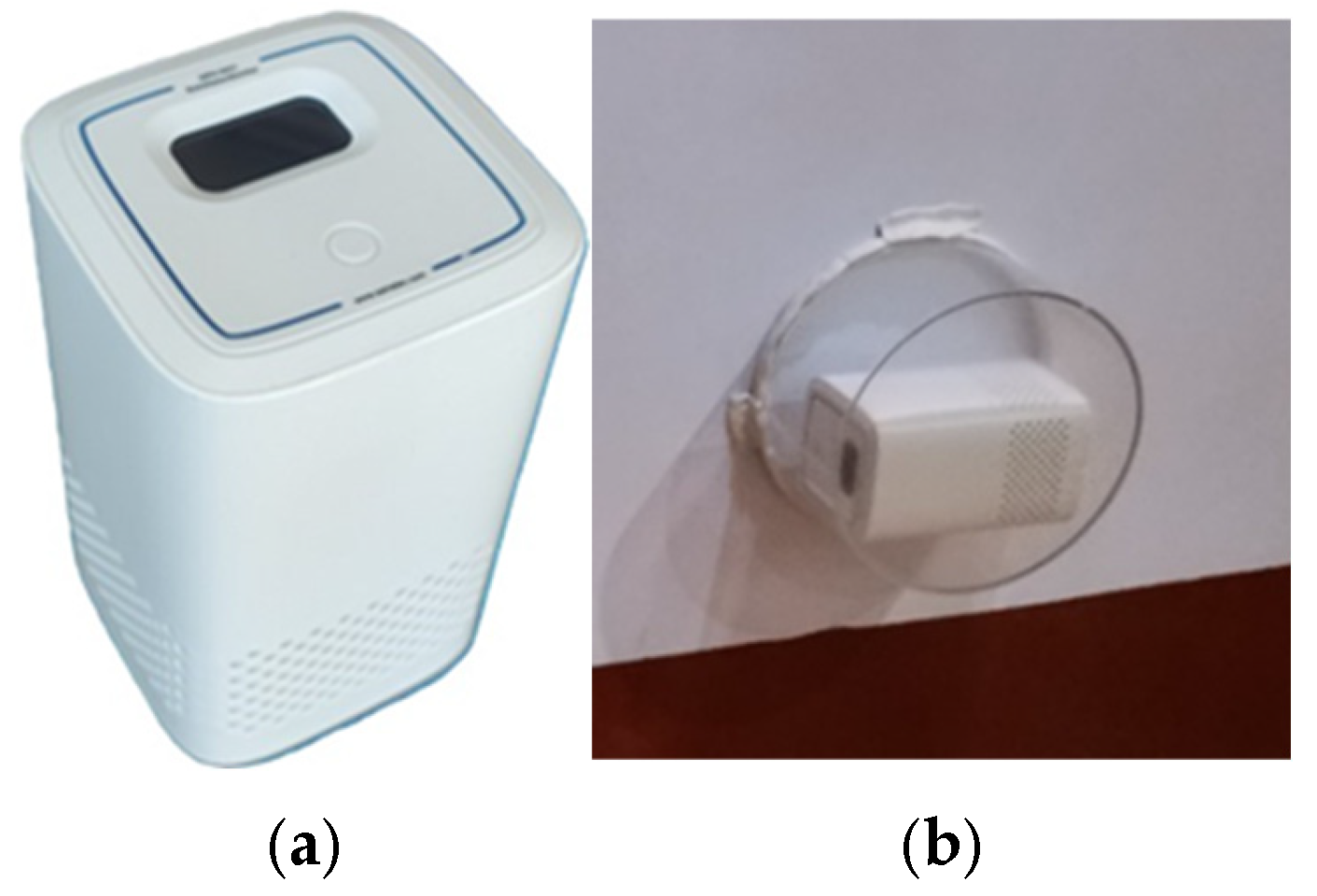
A passive and low-cost radon detector (NRH-M01, Sairatec, Beijing, China) was selected for this study. As shown in
Figure 1a, it employs passive diffusion sampling and incorporates a Si-PIN detector to measure alpha particles emitted from the decay of radon progeny (
218Po,
214Po). The detector has a measurement sensitivity of ≥0.35 cph/Bqm
−3, with dimensions of 88 × 88 × 149 mm and a weight of 0.6 kg. Radon concentration inside the chamber can be recorded hourly, and a built-in battery supports continuous operation for up to one month. Its compact design makes it suitable for radon measurement within an accumulation chamber. Additionally, before in situ measurement, all radon detectors were calibrated with a standard radon detector (AlphaGUARD DF2000, Bertin Technologies, Frankfurt am Main, Germany), which can be traceable to standard national radon concentration for quality control of radon concentration measurement.
Fixing the accumulation chamber securely onto interior wall surfaces while maintaining an effective seal posed the most significant challenge in this study. Fortunately, advancements in sealing materials provided a viable solution. A white material called Blu Tack (Bostik, Southbank, Australia) was selected for its strong adhesion and minimal residual traces on walls after use, making it suitable for the required application.
Figure 1b presents photographs of the on-site measurement scenario.
2.3. Comparison with the Activated Carbon Method
To evaluate the reliability and feasibility of the in situ 24 h measurement using the exponential fitting method developed in this study, a comparative in situ measurement was conducted at 8 locations with an adsorption-based method, specifically the activated carbon method. A charcoal adsorption canister measuring Φ88 × 40 mm and containing 70 g of activated carbon was employed [
21]. Before activated carbon is used for radon collection, it must be purified first. The basic procedure is as follows: open the carbon box, take out the screen mesh, and bake the activated carbon box at 120 °C for 7~8 h to remove residual radon in the activated carbon. The dried carbon boxes shall be promptly sealed with tape and kept ready for use. Two sealed activated carbon boxes (abbreviated as “fresh” carbon boxes) shall be reserved during the sampling period, and their data can be used as the background reference value for the sampling period. During sampling, the activated carbon boxes shall be fixed on the wall with non-marking white glue, and the sampling duration is 72 h. Since activated carbon has a strong adsorption capacity for radon, and a good seal is maintained between the activated carbon box and the wall, leakage during the sampling period can therefore be neglected. After exposure, the canisters were resealed, and the activities of
214Pb and
214Bi were measured by gamma spectrometry following a 3 h period.
2.4. Field Measurement of Radon Exhalation Rate in Real Buildings
To verify the practicality and applicability of the radon exhalation rate measurement method established in this study, and to obtain the actual radon exhalation rate in real buildings, we selected 5 buildings in Beijing and conducted 17 measurements. During the measurements, the types of building materials and wall finishing conditions were recorded in detail. After the measurements, we analyzed the differences in radon exhalation rate between different building materials (brick walls, cement walls), as well as for the same building material under different wall treatment conditions.
3. Results and Discussion
3.1. Theoretical Analysis on Fitting Method for Radon Exhalation Rate Calculation
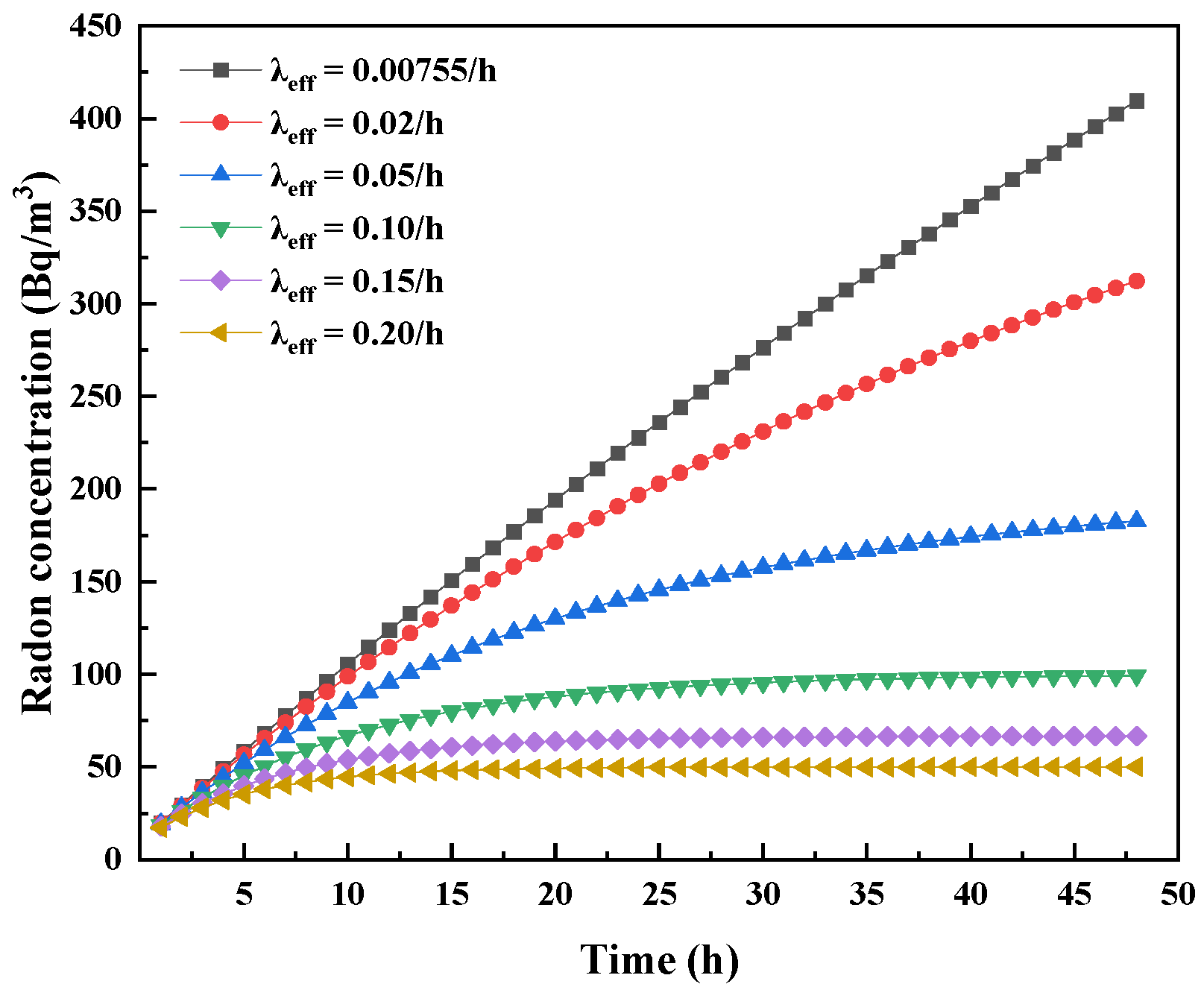
Firstly, theoretical analysis of the influence of the effective decay coefficient on linear fitting results is carried out according to Equation (3) with the assumptions that radon exhalation rate of a building interior wall was set to be 1 Bq/m
2h; the internal height of the radon accumulation chamber was 0.1 m, and the radon concentration inside the chamber was recorded at 1 h intervals; six different levels of effective decay coefficients (λ
eff) were set, with the minimum value being 0.00755/h (corresponding to no leakage and back-diffusion, considering only radon self-decay). The simulated trends of radon concentration for six curves are shown in
Figure 2.
Figure 2 shows that as the effective decay coefficient increases, the radon concentration in the chamber exhibits distinct exponential growth and reaches equilibrium more rapidly. The corresponding exhalation rates for the six sealing degrees were then derived by linearly fitting the first 12 h of concentration data, followed by quantifying the deviation of these fitted values from the preset standard (1 Bq/m
2·h). All results are compiled in
Table 1.
As shown in the table, when leakage and back-diffusion effects are minimal (i.e., conditions approaching laboratory-controlled environments), the deviation between the linear fitting results and the assumed values is less than 10%. However, as the effective decay coefficient increases, the deviation gradually enlarges. When the effective decay coefficient exceeds 0.1/h, the relative deviation exceeds 50%.
For in situ measurements, it is common for the effective decay coefficient to be greater than 0.1/h due to the complexity of building interior walls, which further highlights that the linear fitting method might cause an unacceptable big deviation in practice. The simulation results indicate that the exponential fitting method may be a suitable approach for estimating radon exhalation rate in in situ measurements due to leakage compensation.
3.2. Experimental Validation of Fitting Method and Selection of Measurement Duration
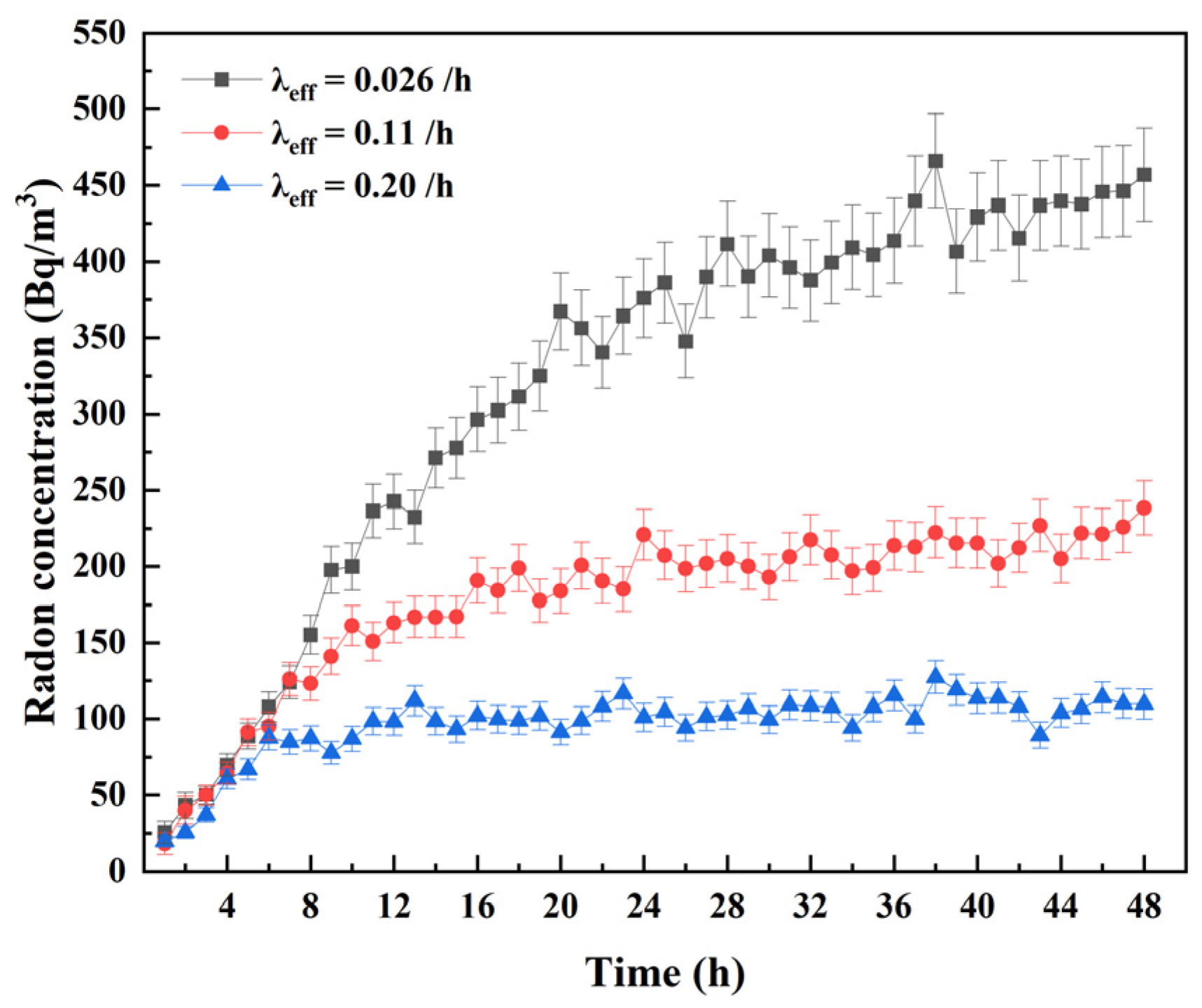
To verify the above theoretical simulation results, an in situ experiment was conducted to measure the radon exhalation rate from an interior wall surface at a fixed point under three different sealing conditions, ranging from well-sealed to poorly sealed. Each measurement lasted 48 h. The time-dependent radon concentration data inside the accumulation chamber are shown in
Figure 3. As can be observed from the figure, the temporal variation of radon concentration exhibits distinct patterns under different effective decay coefficients. A smaller effective decay coefficient corresponds to superior sealing integrity, resulting in a higher equilibrium radon concentration within the accumulation chamber and a longer time required to reach the equilibrium state. This is because the dynamic evolution of radon concentration in the accumulation chamber is governed by Equation (3). As revealed in Equation (3), parameter A represents the equilibrium radon concentration in the accumulation chamber and is inversely proportional to the effective decay coefficient. Equation (3) further contains an exponential decay term. Accordingly, the larger the effective decay coefficient, the more rapidly this exponential decay term approaches zero. In terms of the measured radon concentration data, this indicates that a larger effective decay coefficient allows the radon concentration inside the accumulation chamber to reach equilibrium at a faster rate.
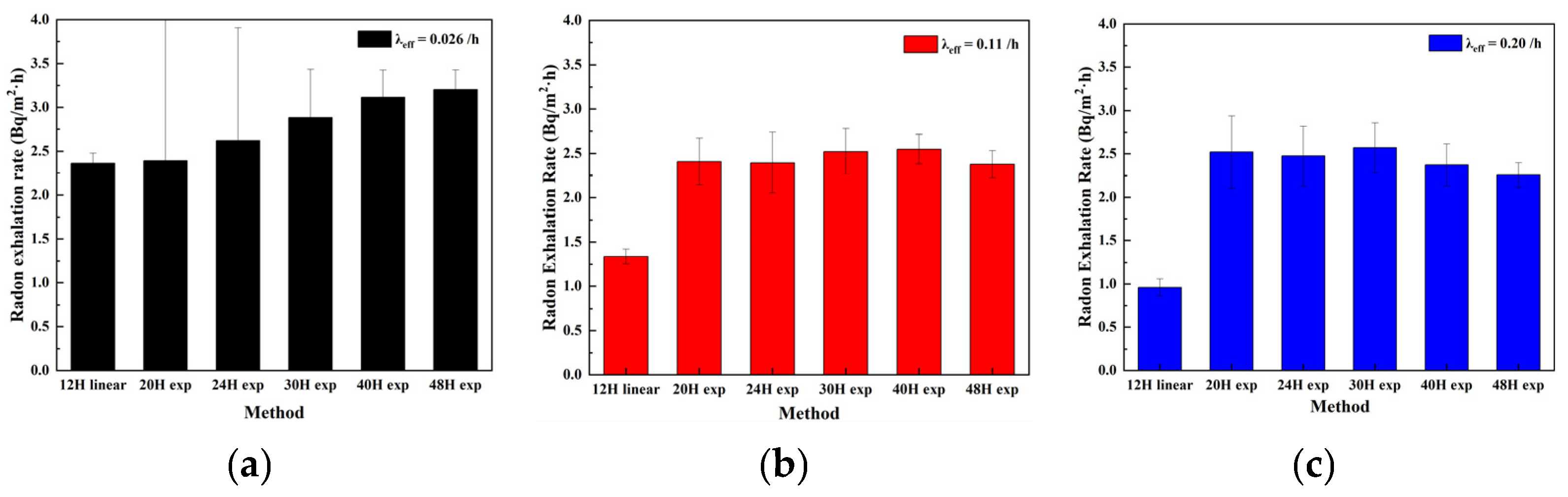
To compare the linear and exponential fitting methods and to examine the influence of measurement duration, radon exhalation rates were calculated using linear fitting methods firstly over all 12 h duration and then using exponential fitting methods over different time intervals. The results are presented in
Figure 4.
It can be seen from
Figure 4a that under a well-sealed condition, where the effective decay coefficient is relatively small, the difference between the linear and exponential fitting results is minimal, indicating good agreement between the two methods. Herein, the linear result in
Figure 4a can be taken as a reference level for the radon exhalation rate at the fixed measurement point. The results in
Figure 4a are presented in
Table 2.
It can be seen from
Figure 4a and
Table 2 that the radon exhalation rate obtained by the exponential fitting method shows a gradually increasing trend with the prolongation of the measurement time, which seems inconsistent with
Figure 4b,c. This is not a problem with the exponential fitting method itself. The possible reasons are as follows: (1) Under good sealing conditions, if the measurement time is short, the radon concentration in the accumulation chamber does not show an obvious exponential trend. Fitting with the exponential Equation (3) under such conditions will lead to large standard errors of parameters A and λ
eff, which in turn results in large standard errors in the radon exhalation rate J; (2) During long-term field measurements, the edge sealing of the accumulation chamber may weaken slightly. When the initial sealing is good, such a slight weakening could cause a relatively obvious relative change in λ
eff. Accordingly, the radon exhalation rate calculated from Equation (4) will change synchronously. However, the influence of such relative changes in sealing degree is not significant when the sealing performance is not very good, as shown in
Figure 4b,c. However, to quantitatively describe the three sealing conditions, the effective decay coefficients fitted from the 24 h measurement duration are presented in
Figure 4a–c.
As the effective decay coefficient increases due to poorer sealing conditions, as shown in
Figure 4b,c, the discrepancy between the results of the exponential fitting method and those of the linear fitting method gradually widens, with the results of the exponential method consistently higher than those of the linear method. Nevertheless, both sets of results of the exponential fitting method remain comparable with the reference level. This suggests that for more accurate measurements under conditions of significant leakage, the exponential fitting method is more appropriate.
On the other hand, regarding the choice of measurement duration,
Figure 4b,c show no significant variation in results with extended time, indicating that excessively long measurement periods are unnecessary. Therefore, a 24 h measurement duration is comprehensively adopted for our in situ survey measurements.
3.3. Comparison Results with the Activated Carbon Method
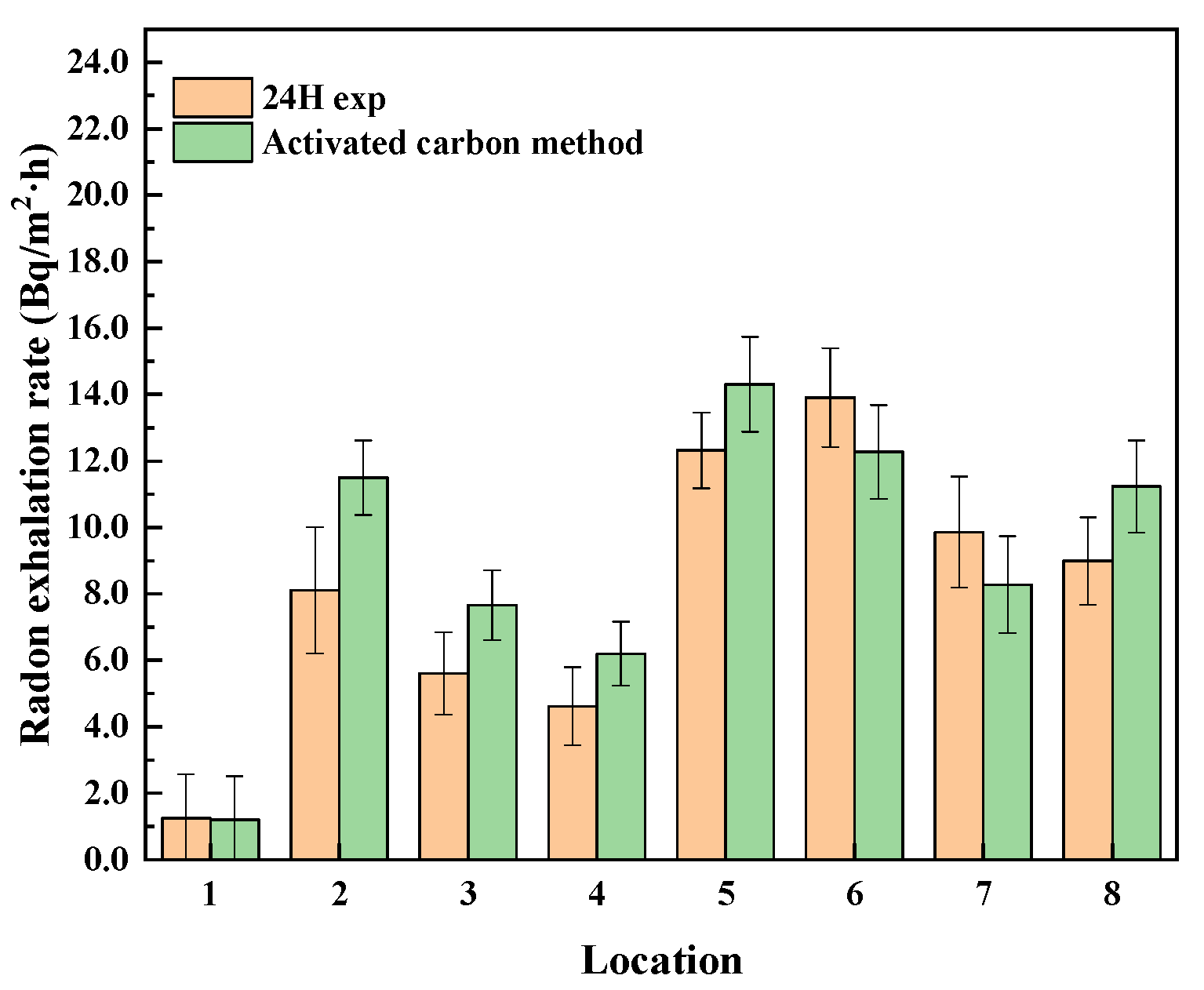
Radon exhalation rates were measured at 8 measurement points and compared with the activated carbon method. The results are presented in
Figure 5.
As shown in the figure, the measurement results of the two methods demonstrate good overall consistency, indicating the reliability and feasibility of the in situ measurement method established in this study. Among the eight measurement locations, results from one location were nearly identical. At five locations, the 24 h exponential fitting method yielded slightly lower values compared to the activated carbon method, while the opposite trend was observed at the remaining two locations. Possible reasons for the discrepancies between the two methods may include differences in radon collection mechanisms—one being based on accumulation and the other on adsorption—as well as variations in measurement duration and the heterogeneity of radon exhalation rates from building surfaces [
22].
3.4. A Small-Scale In Situ Measurement Survey on Radon Exhalation Rate of Building Materials
Using the measurement method established in this study, radon exhalation rate tests were conducted on the walls and floors of buildings in the Beijing area. The tests took into account factors such as the types of building materials and the surface treatment of interior walls. The results are summarized in
Table 3.
The data in
Table 3 appears to be a wide range, from 0.13 ± 0.11 to 28.00 ± 4.87 Bq/m
2·h, while the highest value was tested from the surface of a brick wall with cement plaster, Item 7 in the
Table 3.
In the table, items 1–4 were measured on four walls of the same room. The results show that although the effective decay coefficients (λeff) exhibited significant differences among the four walls during measurement, the calculated radon exhalation rates were relatively close. The same phenomenon can also be observed in Items 5 and 6, which are the measurement results of two walls in another room. This indicates that the method established in this study can effectively eliminate the influence of leakage during measurement.
Items 7, 8, and 9 in the
Table 3 were in the same building, with the only variable being the surface treatment of the walls. It looks like the surface treatment method of walls exerts a significant impact on the radon exhalation rate. As indicated by the data, walls finished with cement mortar exhibit a higher radon exhalation rate. In contrast, applying a layer of putty over the cement mortar can reduce the radon exhalation rate by an order of magnitude, while a single layer of wallpaper leads to a further reduction in the rate. Similar findings were also reported in the study on the radon-retardant effect of wallpaper conducted by Ruvira, B. et al. [
23].
It can also be observed from the table that there is a notable discrepancy in the radon exhalation rate between measurements taken on floor tiles alone and those conducted when the floor tile joints were covered during floor testing (Items 12 vs. Items 14, and Items 13 vs. Items 15). During the measurement, if the accumulation chamber also covers the floor tile joints, the exhalation rate will increase significantly. This finding indicates that it is essential to separately evaluate the impact of joints when conducting radon exhalation measurements on such materials. Similar results have also been reported in previous studies [
24].
4. Conclusions
In situ measurement of radon exhalation rates from building interior walls plays a pivotal role in identifying radon sources, predicting potential indoor radon concentrations, and evaluating the effectiveness of remediation strategies. It provides critical data support and lays a solid scientific foundation for achieving these objectives.
Considering the significant differences in measurement conditions, to meet the requirements for in situ measurement of radon exhalation rates from building surfaces, this study established an in situ measurement method based on the accumulation method, with consideration given to leakage compensation. The method employs a 24 h continuous measurement duration, processes the collected radon concentration data through an exponential fitting equation, and subsequently calculates the radon exhalation rate. By placing a passive radon detector inside the accumulator, the in situ measurement can be conducted at low cost and implemented simultaneously across multiple sites.
It should also be noted that although the sealing during most on-site measurements may not be satisfactory, if the edge of the accumulation chamber is well sealed during measurement, a short-time measurement combined with linear fitting may be more appropriate, as shown by the results in
Section 3.2.