Article

Impacts of Aerosol Concentration Changes on Cloud Microphysics and Convective Intensity of the Southwest Vortex: Insights from MODIS Observations and Numerical Simulations

1
Xi’an Institute for Innovative Earth Environment Research, Xi’an 710061, China
2
Xi’an Center of China Geological Survey, Xi’an 710119, China
*
Author to whom correspondence should be addressed.
Atmosphere 2026, 17(3), 259; https://doi.org/10.3390/atmos17030259
Submission received: 3 January 2026 / Revised: 7 February 2026 / Accepted: 13 February 2026 / Published: 28 February 2026
(This article belongs to the Section Atmospheric Techniques, Instruments, and Modeling)

Abstract

Aerosol–cloud interactions (ACIs) remain a long-standing uncertainty in quantifying cloud microphysical properties, convection, and precipitation. There are fewer investigations into the effects of ACIs on the southwest vortex (a mesoscale circulation with a spatial scale of 300–500 km). Satellite-retrieved MODIS data (2002–2022) reveals a decreasing trend in the June–August (JJA) seasonal mean ice droplet effective radius (DER_Ice) over the Sichuan Basin (SCB) since 2013, corresponding to China’s emission reduction efforts. Concurrently, post-2013 trends exhibit a positive shift in cloud-top height (CTH) and a negative trend in cloud-top pressure (CTP), collectively indicative of intensified convective activity. This contradicts the conventional conclusion that increased anthropogenic emissions reduce droplet effective radius (DER) and intensify convection under constant cloud water content. To address this discrepancy, we simulated the precipitation event caused by the southwest vortex (SWV) during 11–14 August 2020, under distinct initial aerosol loading (clean vs. polluted), using the fully coupled WRF-ACI-Full cloud-resolving model (incorporating sophisticated aerosol parameterizations). Results show that increased aerosols reduce basin-averaged precipitation by 0.54% and updraft speed by 0.37% in the polluted case compared to the clean case, which is negligible. These findings differ from previous studies on ACI-related cloud and precipitation responses.

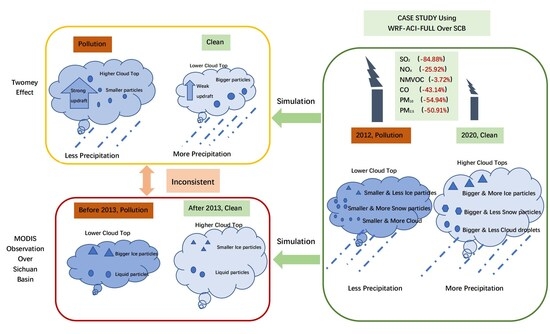
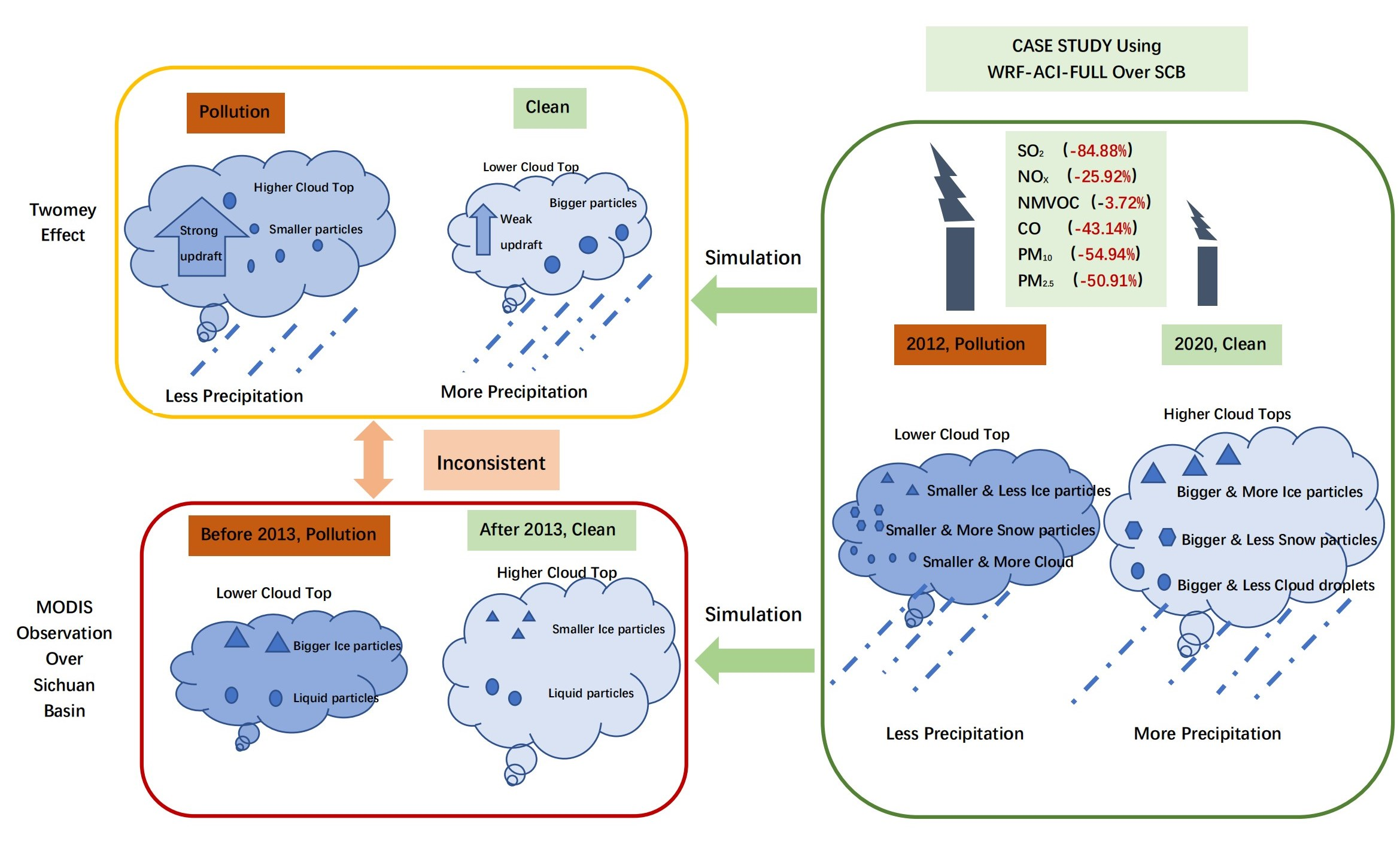
Graphical Abstract

1. Introduction

Since the preindustrial era, anthropogenic emissions have led to a dramatic increase in atmospheric aerosol concentrations [1,2], making aerosols a key driver of climate system variability. Aerosols influence climate through two primary pathways: direct effects involving the scattering and absorption of incoming solar radiation, and indirect effects wherein aerosols act as cloud condensation nuclei (CCN) or ice nuclei (IN), thereby altering cloud microphysical properties and precipitation processes [1,2,3]. The first indirect effect (Twomey effect) describes the reduction in cloud droplet size with increasing aerosol concentrations under fixed liquid water content [1,2], while the second indirect effect refers to suppressed droplet collision–coalescence, prolonged cloud lifetime, and inhibited precipitation efficiency [3,4]. These processes collectively modulate atmospheric radiation budgets, cloud persistence, and precipitation efficiency, underscoring the need for a comprehensive understanding of ACI mechanisms.
Extensive observational and modeling studies have advanced our knowledge of ACIs, particularly for shallow warm clouds and single-layer clouds. Assessments based on satellites [5,6,7] and high-payload tethered airships [8] have consistently confirmed a negative correlation between aerosol optical depth (AOD) and cloud droplet effective radius (DER) under certain conditions, in line with the Twomey effect. For example, this relationship has been observed over southeastern China [9,10], adjacent oceans [11,12,13,14,15], and the Barbados [16], with AOD < 0.3 for shallow cumulus. However, contrasting results have emerged in regions with higher aerosol loading or specific meteorological conditions: DER was found to increase with AOD over mainland eastern China [11,12,17] and the Gulf of Mexico [18] when the liquid water path was quasi-constant. These discrepancies highlight the strong dependence of ACIs on surface type (continent vs. ocean) [15,19], meteorological conditions (e.g., relative humidity, wind shear, and stability) [11,13,20], and cloud–surface coupling [21].
Aerosols also influence cloud macrophysics, with variable results across regions and aerosol regimes. For instance, volcanic aerosols from Iceland’s Holuhraun eruption increased liquid-phase cloud cover by ~10%, driving significant climate forcing [22]. A positive correlation between AOD and cloud fraction (CF) has been reported over most of East China [10,23] and East Asia [24], while a negative correlation was observed at coastal and desert sites in China when AOD < 0.3 [12]. Cloud-top pressure (CTP) and cloud-top temperature (CTT) showed insensitivity to aerosol changes over Chinese metropolitan areas [12] and the Yangtze River Delta [13], yet CTP decreases (indicating deeper clouds) with AOD over oceans [25]. Despite these advances, most studies have focused on non-precipitating shallow warm clouds or cumulus congestus [26], leaving critical gaps in our understanding of ACIs in more complex cloud systems.
Mesoscale convective systems (MCSs) are pivotal to global precipitation and hydrological cycles, covering hundreds of square kilometers and generating intense rainfall [27]. However, the impacts of aerosols on MCSs remain highly controversial. Early observational studies suggested that higher aerosol concentrations enhance MCS development, increase precipitation [28,29,30], and lift cloud-top height (CTH) [30,31] via modulation of updraft velocities, buoyancy, and latent heat release [32,33]. In contrast, recent studies have challenged these findings: Varble found no link between CCN and CTT in Oklahoma’s ARM SGP site [34], while Veals et al. and Öktem et al. reported no increase in deep convective cloud depth or a decrease in warm-phase vertical velocity with higher aerosols [35,36]. Theoretical calculations by Igel et al. further indicated that aerosols may weaken storms with warm cloud bases [37].
Numerical simulations of ACIs for MCSs have yielded similarly inconsistent results [28,38,39,40,41,42]. Previous studies using cloud-resolving models (CRMs) and global models reported suppressed raindrop collision–coalescence [4], delayed precipitation onset [40,43], intensified updrafts [28,38], enhanced precipitation accumulation [32,41], and prolonged anvil longevity [44] in polluted environments. However, subsequent studies have documented non-monotonic or weak MCS sensitivity to aerosols: Kalina et al. showed precipitation increases followed by decreases at extremely high CCN concentrations (>5000 cm−3) [45], while Marinescu et al. and Grabowski and Morrison reported inconsistent or negligible updraft responses across CRMs [46,47]. Additionally, Nishant, Sherwood, and Gryspeerdt et al. attributed apparent aerosol-induced MCS invigoration to meteorological co-variation rather than direct aerosol effects [48,49]. A critical limitation of most prior simulations is the use of fixed CCN concentration, which fails to explicitly represent aerosol activation, scavenging, and chemical interactions—key processes governing real-world ACIs [50,51].
Another significant gap is that the existing ACIs studies are primarily focused on the Yangtze River Delta [52] and Pearl River Delta [40] in China. The southwest vortex (SWV), a mesoscale circulation (300–500 km spatial scale) over the Sichuan Basin (SCB), is a major summer precipitation producer, strongly modulated by the complex topography of the Tibetan Plateau, Hengduan Mountains, and Sichuan Basin [53]. The SWV generates dense ice particles and plays a critical role in regional hydrological and energy cycles [53]. With growing anthropogenic pollution in the SCB, it has become urgent to understand how increased aerosols affect SWV-related precipitation efficiency, updraft speed, and microphysical properties. However, few studies have explicitly investigated aerosol-SWV interactions using a fully coupled model that resolves aerosol activation, microphysics, and chemistry.
To address these gaps, this study employs the fully coupled WRF-ACI-Full model with a modified Morrison two-moment microphysical scheme, which explicitly parameterizes aerosol activation based on size distribution and chemical properties, tracks CCN through dry and wet scavenging, and calculates aerosol indirect effects online. By conducting simulations of a complete SWV life cycle with varying aerosol abundances, we aim to quantify how precipitation and updraft speed respond to increased aerosol loading, and to investigate the impacts of CCN on SWV microphysical characteristics, including liquid and solid species.
This paper is organized as follows: the descriptions of MODIS data are presented in Section 2. Additionally, the WRF-ACI-Full model and experiment design are also elaborated in Section 2. Section 3 presents the results, focusing on the quantitative responses of precipitation and vertical velocity to increased aerosol loading, as well as a systematic comparison of microphysical characteristics (cloud, ice, snow, and graupel) between the simulations with varying aerosol abundances. Finally, the conclusions and discussions are summarized in Section 4.

2. Data and Methods

2.1. The Description of MODIS Data

In this study, AOD and cloud properties were derived from measurements of the Moderate Resolution Imaging Spectro-radiometer (MODIS) on-board the Aqua satellite, for the period of 2002–2022 (21 years) [54]. The reasons for selecting MODIS datasets as the primary data source are: first, MODIS data have been extensively validated and widely adopted in global atmospheric and environmental research, ensuring high data quality and comprehensive characterization of geophysical parameters; second, the Aqua satellite operates in an afternoon orbit with local overpass time of approximately 13:30, a temporal window when the atmospheric boundary layer is fully developed, and it facilitates accurate retrieval of aerosol and cloud properties. Monthly Level-3 (L3) aerosol and cloud parameters were downloaded from the official website https://ladsweb.modaps.eosdis.nasa.gov/ (accessed on 1 November 2023) with a spatial resolution of 1° × 1°. More detailed information on algorithms for the retrieval of aerosol and cloud properties is provided on the website http://modis-atmos.gsfc.nasa.gov (accessed on 1 November 2023). This study analyzed the following cloud property retrievals: cloud optical thickness (COT), cloud effective radius (CER), cloud-top height (CTH), and cloud-top pressure (CTP). Specifically, the datasets are used as follows: Cloud_Optical_Thickness_Liquid_Mean (COT_Liquid), Cloud_Optical_Thickness_Ice_Mean (COT_Ice), Cloud_Effective_Radius_Liquid_Mean_Mean (CER_Liquid), Cloud_Effective_Radius_Ice_Mean_Mean (CER_Ice), Cloud_Top_Height_Mean (CTH), and Cloud_Top_Pressure_Mean (CTP).

2.2. The Description of WRF-ACI-Full Model

In the present section, the effects of anthropogenic aerosols on a rainstorm event caused by an SWV occurring during 11–14 August 2020 in SCB were investigated using the WRF-ACI-Full model. Simulations were performed by applying a two-moment bin microphysical scheme to the cloud-resolving model developed by Li et al. [33], which has taken into account the effects of anthropogenic aerosols on cloud development and precipitation.
The aerosol module is the MOSAIC [55], which includes 41 chemical species (sulfate, nitrate, methane, carbonate, ammonium, black carbon (BC), primary organic mass (OC), and other inorganic mass (IOC)). The particle size distribution is 95 size bins between 10−8 μm and 5 μm for particulate matter formation. The major aerosol processes (e.g., aqueous-phase chemistry, aerosol scavenged by cloud droplets, and dry and wet deposition) were simulated. The chemistry model predicted atmospheric concentrations of 25 gaseous and 8 aqueous chemical species, and 7 species on the surface of ice particles.
Multi-component aerosol fields are prescribed to account for ACIs. Meanwhile, aerosol components are served as CCN in the modified Morrison two-moment cloud microphysical scheme, which predicts total number concentration and mass mixing ratio of five hydrometeor classes (cloud droplets, raindrops, ice crystals, snow, and graupel). In this model, cloud droplets are formed through the activation of CCN, and raindrops are formed through the auto-conversion of cloud droplets or the melting process of ice particles. The aerosol particles are advected, diffused, and depleted through activation by precipitable hydrometeors (i.e., nucleation). CCN can be activated under atmospheric supersaturation of 1%. In addition, because this microphysical scheme tracks CCN mass in hydrometeors, CCN at each grid can be removed by precipitation processes (i.e., wet scavenging). Therefore, the number concentration of CCN is predicted by incorporating transportation and mixing as well as nucleation and scavenging by precipitation in this coupled model.
Ice crystals are mainly formed through heterogeneous nucleation of ice nuclei (IN). Ice particles grow through deposition growth, aggregation among ice crystals, and riming of super-cooled droplets [33]. Note that ice nucleation is affected by the prescribed aerosol emissions, and thus, the role of aerosols as ice nuclei was also considered. Heavily rimed ice crystals are transformed to graupel and then fall below the freezing level, melting to raindrops. More detailed chemistry, aerosol, and cloud treatments can be found in Li et al. [33].

2.3. The Design of Experiment

To understand the response of microphysical properties to variations in aerosol concentrations, the fully coupled WRF-ACI-Full model was run at a grid spacing of 3 km with the modified two-moment microphysics scheme. The simulation domain covers the region between 25.1° N–35.7° N (north–south) and 99.8° E–113.2° E (east–west), consisting of 400 × 400 grid boxes, with 40 vertical layers extending upward to 50 hPa (Figure 1). The horizontal resolution (3 km) is known to resolve convection and updraft reasonably well [43]. The meteorological initial and lateral boundary conditions are derived from the National Center for Environmental Prediction final analysis (NCEP/FNL) dataset, which provides global coverage at a resolution of 1° and a temporal interval of 6 h. Each model run lasts 144 h, and the results in the first 48 h are discarded as the model spin-up, and the remaining 96 h of data are used for analysis. The chemical initial and boundary conditions were from the output of the MOZART module. Detailed information can be found in Li et al. [33,56,57]. The emission inventory used in this study was developed by Zhang et al. [58] and Li et al. [59] with the base year of 2012, which includes emissions from industry, power, transportation, residences, agriculture, and biomass burning.
The microphysical schemes used in the study are briefly described in Table 1.
The study area is centered on the SCB, geographically delineated by 28.5° N–32.0° N and 103.5° E–109.5° E. The SCB features a humid subtropical climate, which is strongly modulated by the Asian monsoon circulation. The SCB exhibits a distinct topographic configuration, with average elevation ranging from 250 to 600 m above sea level (Figure 1). It is surrounded by three major highlands: the Tibetan Plateau to the west, the Hengduan Mountains to the southwest, and the Yunnan-Guizhou Plateau to the south, all with elevations predominantly between 1000 and 3000 m [67]. This enclosed topographic feature of SCB acts as a “natural laboratory” for aerosol accumulation: depending on the prevailing wind direction, pollutant emissions from both the basin and surrounding areas are constrained by the surrounding highlands. This topographic constraint inhibits horizontal diffusion, thereby facilitating the accumulation of aerosols in the lower atmosphere. Such topographical advantage renders the SCB an ideal study region for quantifying the impacts of aerosols on cloud properties.
The study region encompasses numerous major urban cities characterized by high anthropogenic emissions, making it a representative hotspot for investigating ACIs under polluted conditions. In recent decades, the SCB region experienced rapid economic development, accompanied by a substantial increase in anthropogenic activities such as fossil fuel combustion (for industry, power generation, and transportation) and biomass burning (for residential energy use and agriculture) [68]. These activities have resulted in severe air pollution, with persistent high aerosol loading observed in the region. The increased aerosol concentrations provide a critical observational basis for exploring how anthropogenic aerosols modulate cloud microphysical properties.
China’s anthropogenic emissions are estimated to have declined by 84.88% for SO2, 25.92% for NOx, 3.72% for NMVOC, 43.14% for CO, 54.94% for PM10, and 50.91% for PM2.5 from 2012 to 2020 (Table 2 [69,70]). Most of these emission reductions have been achieved since 2013, when the Clean Air Action was implemented, reflecting the effectiveness of national air pollution control policies in curbing pollutant releases. Therefore, we performed simulations with two different aerosol emissions: a polluted case (POL) with 2012 emissions representing highly polluted air masses and a clean case (CLN) with 2020 emissions representing low aerosol loading. We kept all other configurations the same and differed only in the initial emission of anthropogenic aerosols. The numerical simulation is conducted with the actual aerosol concentration on 8 August 2020, calibrated by observation data. The set of sensitivity simulations was repeated with identical environmental conditions, model settings, and initialization, and the results were compared. The WRF-ACI-Full model was specifically set up to allow for a detailed investigation of the microphysical effects of aerosols and the evolution of the WSV. The comparison between the two sets of simulations would suggest the influence of aerosol loading on the microphysical process.
The half-daily precipitation data used for model evaluation are taken from gauge-based analyses, which are created by the China Meteorological Administration (CMA). They are based on the database of half-daily precipitation reports from about 2000 automatic weather stations located throughout China. Quality control procedures were applied to check these weather stations’ datasets.

3. Results

This section evaluates the response of key atmospheric variables to anthropogenic emission changes through the two sets of simulations (CLN case and POL case), focusing on basin-wide sums and spatial averages of PM2.5 concentration, surface precipitation, and condensate loading of the five hydrometeor classes. The analysis contains five parts: (1) inter-annual variability of cloud properties based on MODIS observations; (2) characterization and validation of PM2.5 spatial distributions; (3) comparative assessment of rainfall intensity under different aerosol concentrations; (4) analysis of DER, particle number concentration (PNC), and mixing ratio for liquid and solid hydrometeors to quantify ACIs; and (5) vertical velocity responses to different aerosol emissions. All simulations demonstrate good agreement with observations, confirming the reliability of the modeling framework.

3.1. Inter-Annual Variability of Cloud Properties Based on MODIS Data

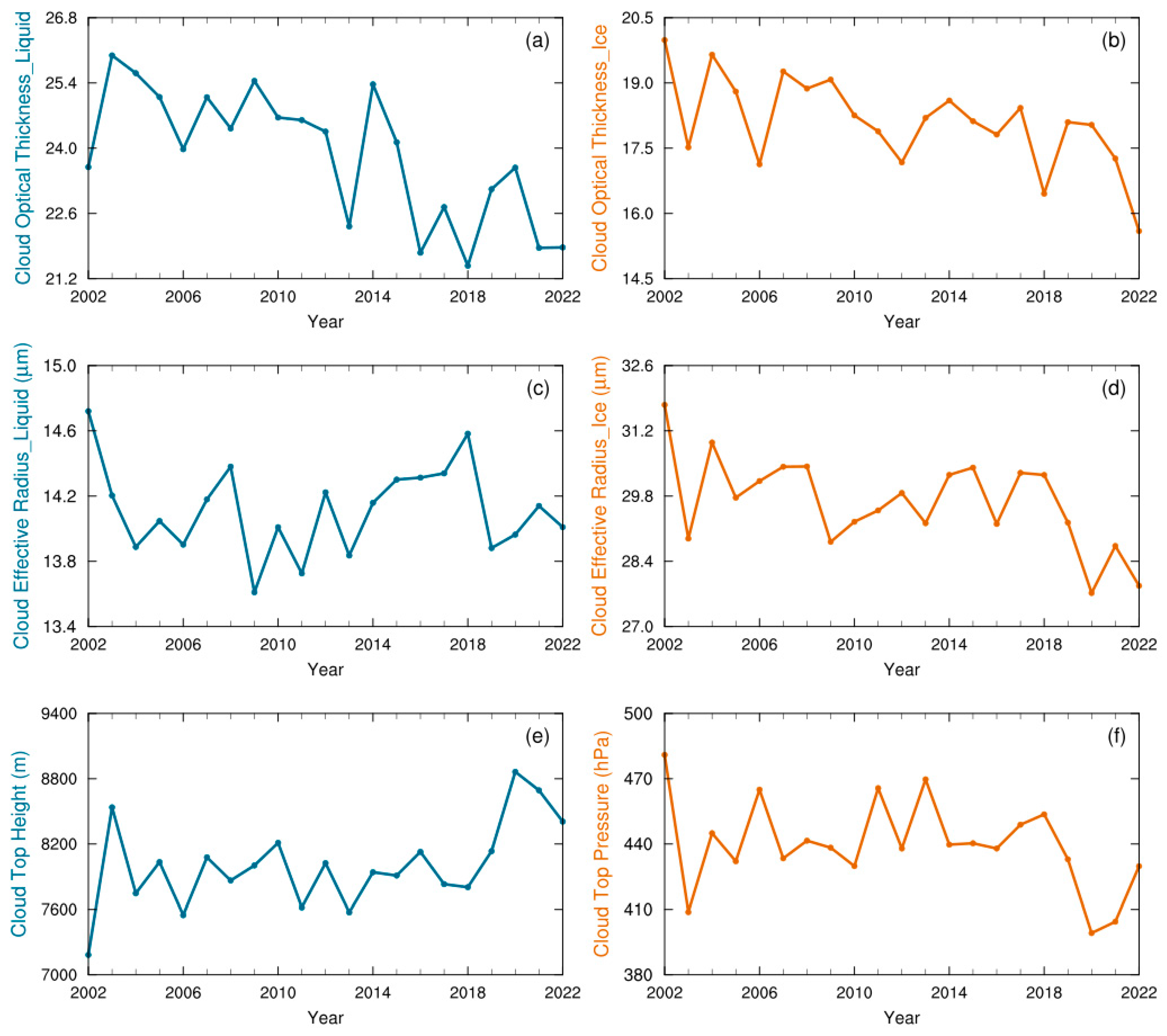
Figure 2 depicts the warm seasonal mean (JJA) cloud properties derived from MODIS data over the period of 2002–2022. Liquid cloud optical thickness (COT_Liquid) was near-constant during 2002–2010, followed by a significant decline over 2011–2022 (Figure 2a). Ice cloud optical thickness (COT_Ice) exhibits a consistent downward trend over the full 20-year period, with two abrupt reductions evident in 2006 and 2018 (Figure 2b) [71]. The seasonal mean effective radius of liquid droplets (DER_Liquid) remains nearly invariant throughout 2002–2022 (Figure 2c), whereas the effective radius of ice droplets (DER_Ice) shows a statistically significant decreasing trend of 0.4 μm yr−1 (Figure 2d), contradicting the conventional understanding that increased anthropogenic emissions generally lead to a reduction in droplet effective radius. Notably, cloud-top height (CTH) displays a positive trend since 2013 (Figure 2e), while cloud-top pressure (CTP) exhibits a corresponding negative trend over the same period (Figure 2f), indicating intensified convective activity.
Given that China implemented strict emission control policies in 2013 to mitigate air pollution, these MODIS-derived results suggest that reduced anthropogenic emissions are associated with increased DER of snow and graupel, minimal changes in DER_Liquid, and enhanced convective invigoration [72,73,74]. This observed relationship between decreased aerosol loading and enhanced convection presents contrasting results to many previous studies.

3.2. Spatial Pattern of Near-Surface PM2.5 Mass Concentration

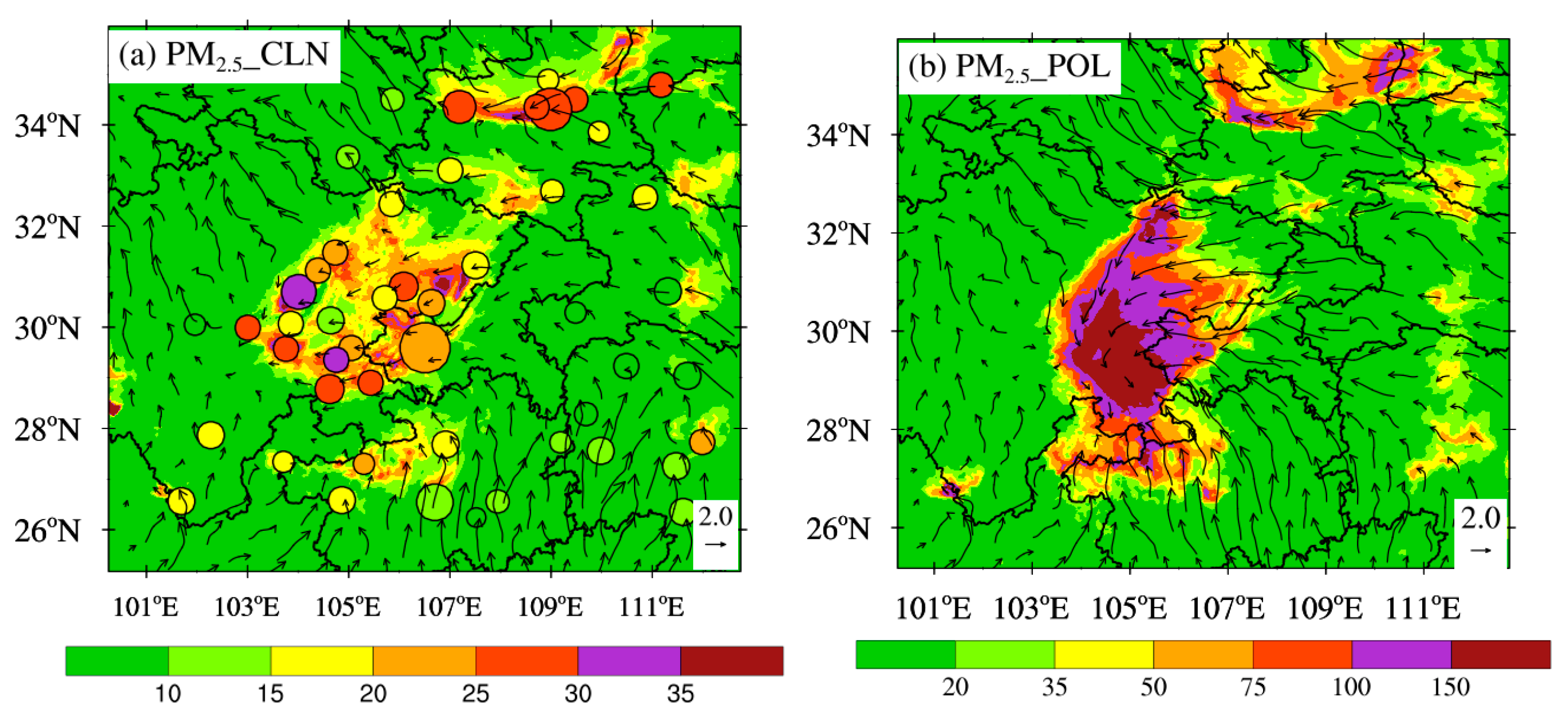
Figure 3 presents the observed and simulated spatial distributions of near-surface PM2.5 mass concentrations under two anthropogenic emission scenarios (CLN and POL), along with simulated surface wind fields over the SCB. The simulated air pollutant distributions are generally in good agreement with observations, though minor model biases remain. As shown in Figure 3a,b, the southwestern SCB is heavily polluted, while the eastern region exhibits relatively low PM2.5 levels. Pollutants are transported to the southwestern flank of the SCB via horizontal advection and trapped in this area due to local circulation patterns. In the lower troposphere over southern SCB, easterly and northeasterly winds prevail, with cyclonic circulation evident near the surface, conditions that are conducive to the accumulation of pollutants.
Under the clean (CLN) emission scenario using 2020 emissions, particulate matter pollution is markedly mitigated (Figure 3a). Both simulated and observed PM2.5 concentrations remained 20 μg m−3 across the entire SCB during the study period, demonstrating good consistency. Heavy pollution is concentrated over the western and southern SCB, where airflow convergence occurs. The highest concentration (exceeding 30 μg m−3) occurs near the Zigong monitoring station. In the northeastern part of Chongqing, simulated values are slightly lower than observations. In contrast, the POL case based on 2012 anthropogenic emissions exhibits PM2.5 levels approximately five times higher than the CLN case (Figure 3b). Near-surface pollution is exacerbated in the POL scenario, with substantial PM2.5 concentrations exceeding 150 μg m−3 over the southwestern SCB.
Overall, the model successfully captures the key features of PM2.5 spatial distribution and reproduces observed wind directions and magnitudes. The high consistency between simulations and observations confirms that the WRF-ACI-Full model reliably represents PM2.5 characteristics over the SCB, supporting its application in subsequent analyses of aerosol emission impacts on accumulated precipitation and microphysical properties.

3.3. Precipitation Responses to Aerosol Emissions

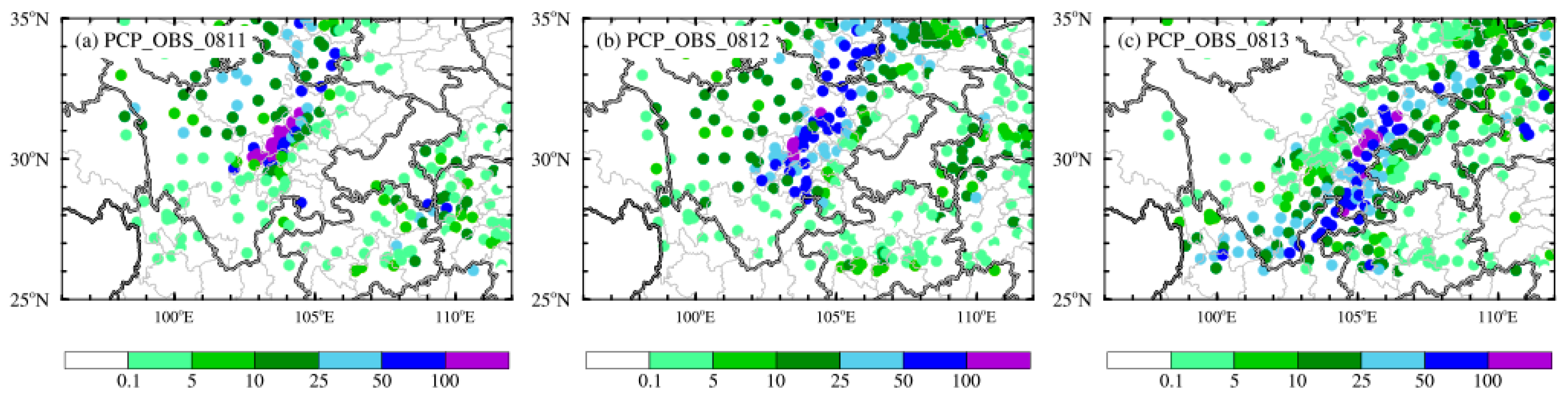
In this section, a detailed comparison between simulated and observed precipitation is presented. Figure 4 shows the 24 h accumulated surface precipitation derived from automatic rain gauges from 20:00 LST on 10 August to 20:00 LST on 13 August 2020. The SWV moves slowly eastward, triggering rainstorms along its track. On 11 August, the maximum daily accumulated precipitation reached 425.2 mm at Lushan station in western Sichuan Province. Heavy rainfall occurred over SCB between 11 and 13 August, with the precipitation belt centered at the border of Sichuan and Chongqing on 13 August.
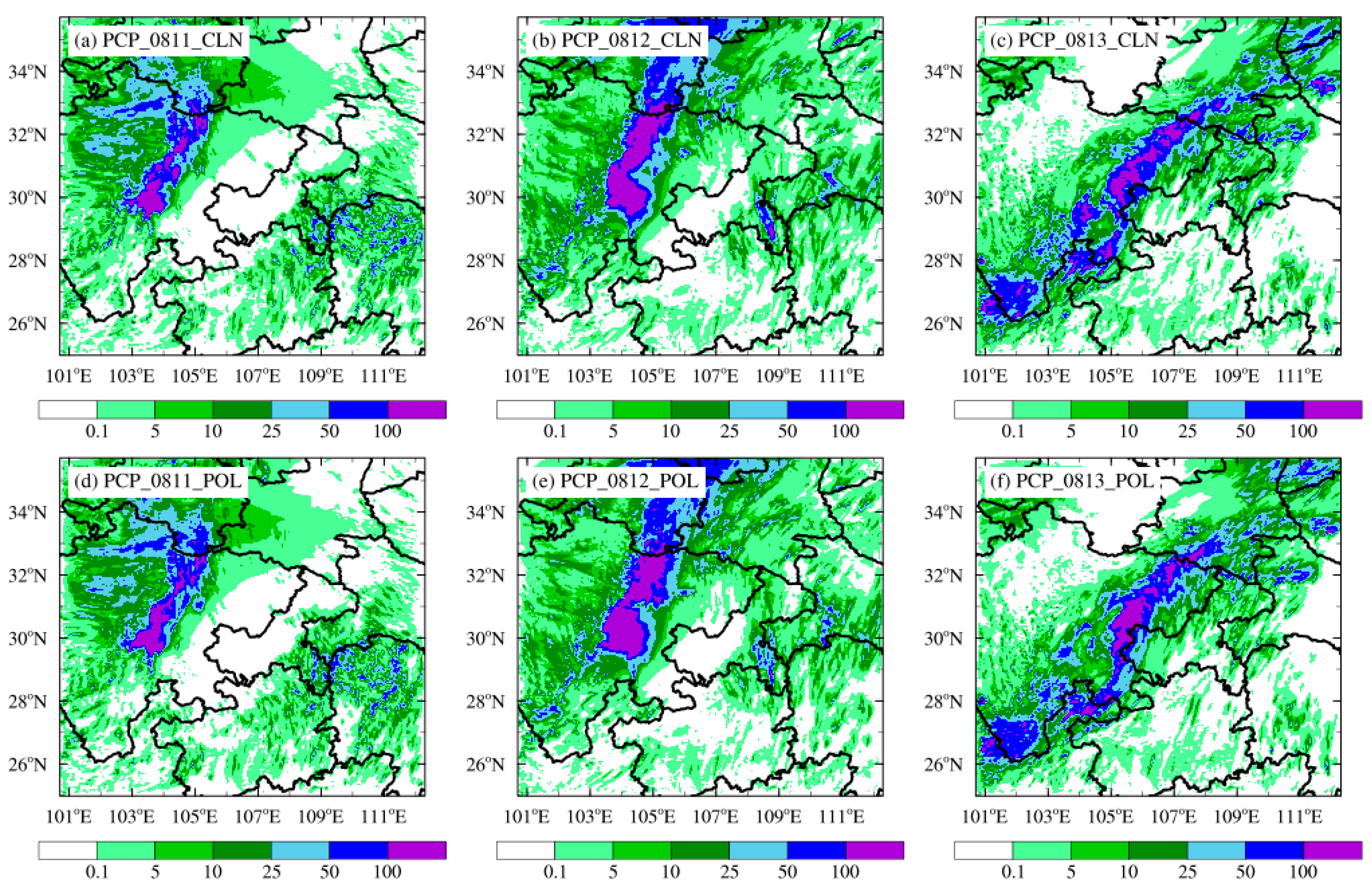
Figure 5 presents simulated daily precipitation from 11 to 13 August 2020 under the clean (CLN, 2020 emissions) and polluted (POL, 2012 emissions) scenarios. During 11–13 August, the precipitation belt extended north–south across the western part of SCB, with embedded convective centers. The spatial scale of the rain belt exceeds 300 km, displaying a larger horizontal extent than observed. Results indicate that intensive precipitation was distributed over a relatively uniform area, with a maximum exceeding 100 mm in the western SCB on 12 August (Figure 5b,e). Notably, simulated precipitation in the central SCB is slightly overestimated and northward-biased compared to observations, while precipitation in the southern SCB is underestimated (Figure 5b,e). Along the southwestern edge of Sichuan province, the model simulates heavy precipitation that is also somewhat slightly overestimated and northward-biased compared to observations (Figure 5c,f).
The spatial patterns of precipitation in the CLN and POL scenarios are generally similar. The POL scenario yields more concentrated and consistent precipitation near the Sichuan–Chongqing border region compared to the CLN case (Figure 5c,f). By incorporating both historical (2012) and current (2020) emissions inventories, the model effectively captures the location and intensity of heavy rainfall events. This consistency between simulations and observations further validates the reliability of the WRF-ACI-Full model for investigating precipitation characteristics over the SCB and supports subsequent analyses of aerosol–precipitation interactions.
Increased aerosol emissions do not significantly affect precipitation efficiency. Relative to the clean case, the polluted case exhibits a 0.54% reduction in total precipitation across the SCB.

3.4. Response of Cloud Properties to Changes in Aerosols

This section investigates the differences between the two simulation cases by analyzing basin-wide sums and spatial averages of hydrometeorological properties. All effective radii are calculated based on hourly model outputs over the SCB.

3.4.1. DER Responses to Increased Emissions

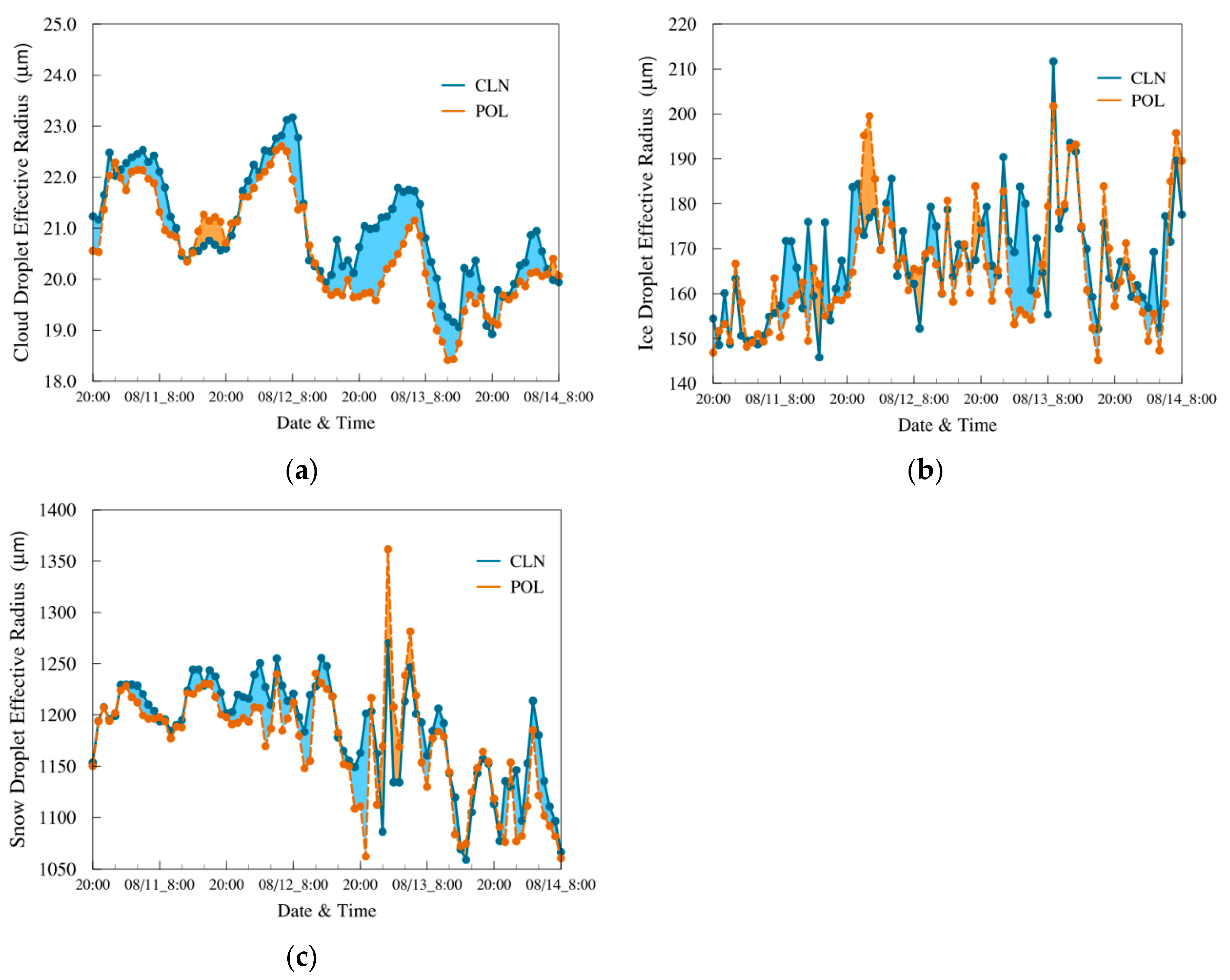
Figure 6 shows the time evolution of area-averaged DER and its difference between CLN and POL cases. Compared to the CLN scenario, increased aerosol loading in the POL simulation reduces the cloud droplet DER by 3.78% (Table 3), which is consistent with the Twomey effect. This reduction is driven by a more substantial increase in cloud droplet number concentration (+129.52%) relative to the modest increase in mixing ratio (+1.88%) (Table 4).
For frozen hydrometeors (ice, snow, and graupel particles), responses to aerosol concentration changes exhibit distinct patterns. As aerosol loading increases from clean to highly polluted conditions, the effective radius of ice crystals decreases slightly (−0.87%) in Table 3. In the POL scenario, the effective radius of snow particles is approximately 1.56% smaller than in the CLN case (Table 3). Although these relative changes are modest, the cubic relationship between effective radius and hydrometeor mass implies that they can exert substantial influences on both warm- and ice-phase microphysical processes [75,76].
Notably, model simulations indicate that intensified atmospheric pollution reduces the effective radius of ice-phase particles. In contrast, MODIS observational data reveal an increasing trend in ice particle effective radius (Figure 2d). This discrepancy between model simulations and satellite-based measurements warrants further investigation.

3.4.2. Comparisons of Particle Number Concentration (PNC) and Mixing Ratio

To investigate the indirect effects of aerosols on cloud formation through activation and auto-conversion processes, changes in particle number concentration (PNC) and water content were analyzed. Sensitivity tests indicate that decreasing aerosol emissions from 2012 to 2020 doubles the area-averaged cloud droplet number concentration (Table 4), which is consistent with the general understanding of aerosol indirect effects. Furthermore, the polluted (POL) scenario exhibits an 18.09% increase in raindrop number concentration relative to the clean case (Table 4). For ice-phase hydrometeors (ice crystals, snow, and graupel), simulated changes in basin-averaged number concentration differ substantially. The number concentration of ice crystals decreases by 1.55% in the POL scenario relative to CLN, while snow and graupel show minor increases of 0.74% and 1.01%, respectively (Table 4).
The cloud droplet mixing ratio increases by 1.88% under polluted conditions, while the raindrop mixing ratio decreases by 1.10% (Table 4). For solid hydrometeors, the mixing ratio of snow particles is approximately four times that of ice crystals, and the mixing ratio of graupel is nearly an order of magnitude larger than that of ice crystals. Compared to the clean scenario, the polluted experiment shows slight variations: a 0.25% reduction in ice crystal mixing ratio, a 3.81% increase in snow particle mixing ratio, and a 2.85% decrease in graupel mixing ratio (Table 4).

3.5. Upward Vertical Velocity Responses to Aerosol Emissions

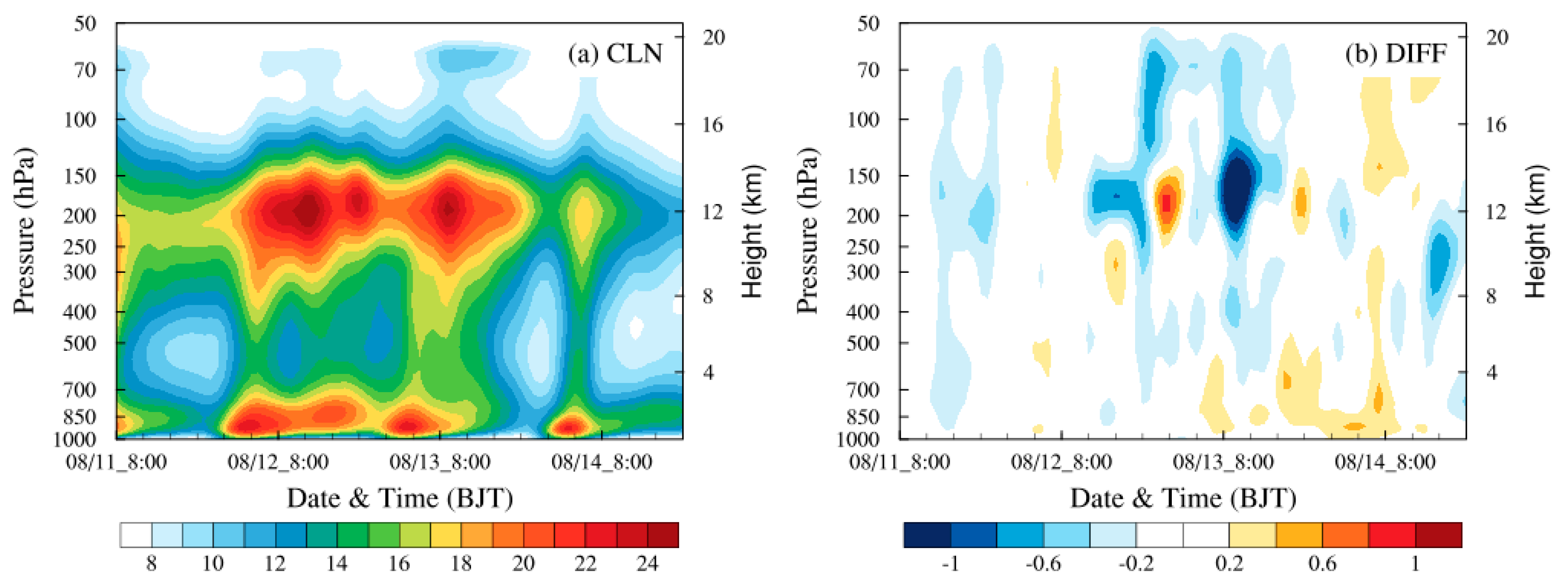
Cloud thermodynamic and microphysical processes are closely interconnected. To interpret convective responses to aerosol emissions, the temporal evolution of vertical velocity was analyzed. Figure 7 presents the vertical profiles and time evolution of convective updrafts from the model simulations. In both scenarios, vertical speeds exceeding 20 cm s−1 persist for over 24 h.
Increased aerosol emissions led to a slight reduction in vertical speed (−0.37%) in the POL case from 20:00 12 August to 00:00 13 August. A consistent finding from both simulations and MODIS observations is that atmospheric convective intensity weakens under current polluted conditions (Figure 2e,f) [77]. The temporal differences in vertical velocity spatial patterns (Figure 7b) are concentrated primarily in the upper troposphere (above 300 hPa), which may further confirm the negative impact of latent heat release during freezing that exerts a suppressing effect on updraft strength.

4. Discussion

This study highlights several critical findings that advance our understanding of ACIs over the SCB.
The observed decreasing trend in ice particle DER (MODIS data) alongside decreasing aerosol loading (post-2013) contradicts the classic Twomey effect. In contrast, our simulations produced a slight decrease in ice and snow particle size with higher aerosol concentrations, which is consistent with the Twomey effect. This discrepancy may stem from several factors: (1) Satellite retrievals of ice cloud properties, particularly effective radius, are sensitive to cloud vertical structure and underlying surface properties, which may introduce biases in trend analysis; and (2) the observed trends may be driven by changes in large-scale meteorological conditions (e.g., humidity or stability) associated with climate variability or the East Asian monsoon, rather than by aerosol changes alone. Disentangling these effects requires further investigation with integrated analysis using multiple observational constraints.
Model simulations indicate that increased aerosol concentrations have minimal impacts on total precipitation (−0.54%) and updraft speed (−0.37%). The weak sensitivity of SWV precipitation and updraft speed to aerosol changes has important implications for regional climate. It suggests that in this geographically complex region, the intrinsic dynamics of the vortex and the background meteorological environment may exert a stronger control on precipitation than anthropogenic aerosol perturbations. This finding aligns with a growing number of studies urging caution in attributing changes in convective characteristics solely to aerosols without accounting for meteorological context.
This study primarily relied on satellite remote sensing for long-term trends and model validation. Incorporating high-resolution observations from ground-based radars and aircraft campaigns for future events would provide more direct constraints on cloud microphysical and dynamical processes. These conclusions are drawn from a single SWV event. Analyzing a composite of multiple events may be necessary to establish a robust, generalized understanding.
In summary, this work advances our understanding of ACIs in a critical yet relatively understudied mesoscale system (SWV). It highlights the complexity of these interactions in topographically complex regions and calls for a more integrated, observationally constrained approach to modeling and predicting aerosol effects on deep convection and mesoscale systems.

5. Conclusions

Since 2013, China’s stringent emission control measures have significantly reduced anthropogenic air pollutant emissions. Aerosols are known to exert substantial impacts on precipitation and the associated microphysical processes. This study analyzed 21 years (2002–2022) of MODIS-derived cloud properties over the SCB and conducted high-resolution numerical simulations to investigate aerosol impacts on a SWV precipitation event. The main findings are summarized as follows.
Analysis of MODIS data reveals notable trends over the SCB during the warm season (JJA): (1) a decreasing trend in COT_Ice over the past two decades, with two abrupt reductions in 2013 and 2018; (2) a significant decreasing trend in DER_Ice, contradicting the conventional understanding that increased anthropogenic emissions reduce droplet effective radius; (3) and a post-2013 increase in CTH coupled with a decrease in CTP, indicating intensified convection. The observed relationship between decreasing aerosol loading (post-2013) and convective invigoration contrasts with conventional understanding.
To further investigate these observations, two sensitivity simulations (CLN: 2020 emissions; POL: 2012 emissions) were conducted using the fully coupled cloud-resolving WRF-ACI-Full model to explore the response of a southwest vortex (WSV) event (11–14 August 2020) to ambient aerosol concentrations. Unlike previous studies that used cloud droplet number concentration (CDNC) as a proxy for aerosol effects, this study employed online-calculated anthropogenic emissions to quantify PM2.5 spatial patterns and precipitation, followed by an analysis of cloud property changes to interpret precipitation and convective intensity variations over the SCB.
Model validation and precipitation response: The fully coupled WRF-ACI-Full model reliably captured the spatial patterns of PM2.5 and precipitation for the simulated SWV event (11–14 August 2020). Sensitivity simulations under clean (2020 emissions, CLN) and polluted (2012 emissions, POL) scenarios showed that increased aerosol loading led to a negligible reduction (0.54%) in basin-averaged precipitation.
Cloud microphysical properties: Basin-averaged cloud properties and mass content show inconsistent responses to increased aerosols. While the Twomey effect was evident for liquid clouds—with cloud droplet effective radius decreasing by 3.78% due to a substantial increase in droplet number concentration (+129.52%)—the responses of ice-phase hydrometeors were more complex. The effective radius of ice and snow particles decreased slightly (−0.87% and −1.56%, respectively). Notably, the simulated decrease in ice-particle effective radius contradicts the increasing trend observed by MODIS, highlighting a key model–observation discrepancy.
Convective intensity: Contrary to some previous studies suggesting aerosol-induced convective invigoration, our simulations indicated a slight weakening of convective intensity under polluted conditions, with a 0.37% reduction in upward vertical velocity. This finding is consistent with the observed MODIS trends (increasing CTH and decreasing CTP).
In conclusion, this study demonstrates that aerosols exert a limited influence on the precipitation, ice or snow effective radius, and convective intensity of a major mesoscale convective system (SWV) over the SCB. This finding underscores the need for caution in attributing changes in cloud properties and related variables solely to aerosol variations.

Author Contributions

Conceptualization, Y.W. (Yan Wang) and Y.W. (Yimin Wang); methodology, Y.W. (Yan Wang); software, Y.W. (Yan Wang); validation, Y.W. (Yimin Wang) and T.W.; formal analysis, Y.W. (Yan Wang); data curation, T.W.; writing—original draft preparation, Y.W. (Yan Wang); writing—review and editing, Y.W. (Yimin Wang) and T.W.; visualization, Y.W. (Yan Wang); supervision, Y.W. (Yimin Wang); project administration, Y.W. (Yan Wang) and T.W.; funding acquisition, Y.W. (Yan Wang). All authors have read and agreed to the published version of the manuscript.

Funding

This research was funded by the Natural Science Basic Research Program of Shaanxi (Program No. 2024JC-YBQN-0286).

Institutional Review Board Statement

Not applicable.

Informed Consent Statement

Not applicable.

Data Availability Statement

The MODIS data used in this study are available from the Level-1 and Atmosphere Archive & Distribution System (LAADS) Distributed Active Archive Center (DAAC) https://ladsweb.modaps.eosdis.nasa.gov/ (accessed on 1 November 2023). The NCEP/FNL data are available from the National Centers for Environmental Prediction https://rda.ucar.edu/datasets/ds083.2/ (accessed on 1 November 2023). The emission inventory data are available from Zhang et al. [58] and Li et al. [59]. Model output data and analysis scripts are available from the corresponding author upon reasonable request.

Conflicts of Interest

The authors declare no conflicts of interest.

References

  1. Twomey, S. Pollution and the planetary albedo. Atmos. Environ. 1974, 8, 1251–1256. [Google Scholar] [CrossRef]
  2. Twomey, S. The influence of pollution on the shortwave albedo of clouds. J. Atmos. Sci. 1977, 34, 1149–1152. [Google Scholar] [CrossRef]
  3. Albrecht, B.A. Aerosols, cloud microphysics, and fractional cloudiness. Science 1989, 245, 1227–1230. [Google Scholar] [CrossRef]
  4. Rosenfeld, D.; Lohmann, U.; Raga, G.B.; O’Dowd, C.D.; Kulmala, M.; Fuzzi, S.; Reissell, A.; Andreae, M.O. Flood or drought: How do aerosols affect precipitation? Science 2008, 321, 1309–1313. [Google Scholar] [CrossRef]
  5. Christensen, M.W.; Chen, Y.; Stephens, G.L. Aerosol indirect effect dictated by liquid clouds. J. Geophys. Res.-Atmos. 2016, 121, 14636–14650. [Google Scholar] [CrossRef]
  6. Marelle, L.; Myhre, G.; Thomas, J.L.; Raut, J.C. Aerosol background concentrations influence aerosol-cloud interactions as much as the choice of aerosol-cloud parameterization. Geophys. Res. Lett. 2024, 52, e2024GL111780. [Google Scholar] [CrossRef]
  7. Zipfel, L.; Andersen, H.; Grosvenor, D.P.; Cermak, J. How Cloud Droplet Number Concentration Impacts Liquid Water Path and Precipitation in Marine Stratocumulus Clouds—A Satellite-Based Analysis Using Explainable Machine Learning. Atmosphere 2024, 15, 596. [Google Scholar] [CrossRef]
  8. Qi, X.; Zhu, C.; Chen, L.; Chi, X.; Wang, J.; Niu, G.; Lai, S.; Nie, W.; Zhu, Y.; Huang, X.; et al. Aerosol-cloud interactions near cloud base deteriorating the haze pollution in East China. Geophys. Res. Lett. 2024, 51, e2024GL109975. [Google Scholar] [CrossRef]
  9. Chen, Y.C.; Wang, S.H.; Min, Q.; Sarah, L.; Lin, P.L.; Lin, N.H.; Chung, K.S.; Everette, J. Aerosol impacts on warm-cloud microphysics and drizzle in a moderately polluted environment. Atmos. Chem. Phys. 2020, 6, 4487–4502. [Google Scholar] [CrossRef]
  10. Huang, J.; Bu, L.; Kumar, K.R.; Khan, R.; Devi, N.S.M.P.L. Investigating the relationship between aerosol and cloud optical properties inferred from the MODIS sensor in recent decades over East China. Atmos. Environ. 2020, 239, 117812. [Google Scholar] [CrossRef]
  11. Jia, H.; Ma, X.; Quaas, J.; Yin, Y.; Qiu, T. Is positive correlation between cloud droplet effective radius and aerosol optical depth over land due to retrieval artifacts or real physical processes? Atmos. Chem. Phys. 2019, 19, 8879–8896. [Google Scholar] [CrossRef]
  12. Kang, N.; Kumar, K.R.; Yin, Y.; Diao, Y.; Yu, X. Correlation analysis between AOD and cloud parameters to study their relationship over china using MODIS data (2003–2013): Impact on cloud formation and climate change. Aerosol Air Qual. Res. 2015, 15, 958–973. [Google Scholar] [CrossRef]
  13. Liu, Y.; Lin, T.; Zhang, J.; Wang, F.; Huang, Y.; Wu, X.; Ye, H.; Zhang, G.; Cao, X.; de Leeuw, G. Opposite effects of aerosols and meteorological parameters on warm clouds in two contrasting regions over eastern China. Atmos. Chem. Phys. 2024, 24, 4651–4673. [Google Scholar] [CrossRef]
  14. Tang, J.; Wang, P.; Mickley, L.J.; Xia, X.; Liao, H.; Yue, X.; Sun, L.; Xia, J. Positive relationship between liquid cloud droplet effective radius and aerosol optical depth over Eastern China from satellite data. Atmos. Environ. 2014, 84, 244–253. [Google Scholar] [CrossRef]
  15. Zhao, J.; Ma, X.; Quaas, J.; Jia, H. Exploring aerosol-cloud interactions in liquid-phase clouds over eastern China and its adjacent ocean using the WRF-Chem-SBM model. Atmos. Chem. Phys. 2024, 24, 9101–9118. [Google Scholar] [CrossRef]
  16. Werner, F.; Ditas, F.; Siebert, H.; Simmel, M.; Wehner, B.; Pilewskie, P.; Schmeissner, T.; Shaw, R.A.; Hartmann, S.; Wex, H.; et al. Twomey effect observed from collocated microphysical and remote sensing measurements over shallow cumulus. J. Geophys. Res. 2014, 119, 1534–1545. [Google Scholar] [CrossRef]
  17. Ma, X.; Jia, H.; Yu, F.; Quaas, J. Opposite aerosol index-cloud droplet effective radius correlations over major industrial regions and their adjacent oceans. Geophys. Res. Lett. 2018, 45, 5771–5778. [Google Scholar] [CrossRef]
  18. Yuan, T.; Li, Z.; Zhang, R.; Fan, J. Increase of cloud droplet size with aerosol optical depth: An observation and modeling study. J. Geophys. Res. 2008, 113, D04201. [Google Scholar] [CrossRef]
  19. Torabi, S.E.; Amin, M.; Phairuang, W.; Lee, H.M.; Hata, M.; Furuuchi, M. High-Resolution Characterization of Aerosol Optical Depth and Its Correlation with Meteorological Factors in Afghanistan. Atmosphere 2024, 15, 849. [Google Scholar] [CrossRef]
  20. Li, Q.; Ge, J.; Li, Y.; Mu, Q.; Peng, N.; Su, J.; Wang, B.; Zhang, C.; Liu, B. Unraveling Aerosol and Low-Level Cloud Interactions Under Multi-Factor Constraints at the Semi-Arid Climate and Environment Observatory of Lanzhou University. Remote Sens. 2025, 17, 1533. [Google Scholar] [CrossRef]
  21. Su, T.; Li, Z.; Henao, N.R.; Luan, Q.; Yu, F. Constraining effects of aerosol-cloud interaction by accounting for coupling between cloud and land surface. Sci. Adv. 2024, 10, eadl5044. [Google Scholar] [CrossRef]
  22. Chen, Y.; Haywood, J.; Wang, Y.; Malavelle, F.; Jordan, G.; Partridge, D.; Fieldsend, J.; de Leeuw, J.; Schmidt, A.; Cho, N.; et al. Machine learning reveals climate forcing from aerosols is dominated by increased cloud cover. Nat. Geosci. 2022, 15, 609–614. [Google Scholar] [CrossRef]
  23. Li, Y.; Fan, T.; Zhao, C.; Yang, X.; Zhou, P.; Li, K. Quantifying the Long-Term MODIS Cloud Regime Dependent Relationship between Aerosol Optical Depth and Cloud Properties over China. Remote Sens. 2022, 14, 3844. [Google Scholar] [CrossRef]
  24. Khatri, P.; Yoshida, K.; Hayasaka, T. Aerosol effects on water cloud properties in different atmospheric regimes. J. Geophys. Res.-Atmos. 2023, 128, e2023JD039729. [Google Scholar] [CrossRef]
  25. Oreopoulos, L.; Cho, N.; Lee, D. Using MODIS cloud regimes to sort diagnostic signals of aerosol-cloud-precipitation interactions. J. Geophys. Res.-Atmos. 2017, 122, 5416–5440. [Google Scholar] [CrossRef]
  26. Deng, X.; Fu, S.; Xue, H. The Non-Monotonic Response of Cumulus Congestus to the Concentration of Cloud Condensation Nuclei. Atmosphere 2024, 15, 1225. [Google Scholar] [CrossRef]
  27. Schumacher, R.S.; Rasmussen, K.L. The formation, character and changing nature of mesoscale convective systems. Nat. Rev. Earth Environ. 2020, 1, 300–314. [Google Scholar] [CrossRef]
  28. Fan, J.; Rosenfeld, D.; Zhang, Y.; Giangrande, S.E.; Li, Z.; Machado, L.A.T.; Martin, S.T.; Yang, Y.; Wang, J.; Artaxo, P.; et al. Substantial convection and precipitation enhancements by ultrafine aerosol particles. Science 2018, 359, 411–418. [Google Scholar] [CrossRef]
  29. Li, Z.; Niu, F.; Fan, J.; Liu, Y.; Rosenfeld, D.; Ding, Y. Long-term impacts of aerosols on the vertical development of clouds and precipitation. Nat. Geosci. 2011, 4, 888–894. [Google Scholar] [CrossRef]
  30. Storer, R.L.; van den Heever, S.C.; L’Ecuyer, T.S. Observations of aerosol-induced convective invigoration in the tropical east Atlantic. J. Geophys. Res.-Atmos. 2014, 119, 3963–3975. [Google Scholar] [CrossRef]
  31. Konwar, M.; Maheskumar, R.S.; Kulkarni, J.R.; Freud, E.; Goswami, B.N.; Rosenfeld, D. Aerosol control on depth of warm rain in convective clouds. J. Geophys. Res. 2012, 117, D13204. [Google Scholar] [CrossRef]
  32. Khain, A.; Lynn, B. Simulation of a supercell storm in clean and dirty atmosphere using weather research and forecast model with spectral bin microphysics. J. Geophys. Res. 2009, 114, D19209. [Google Scholar] [CrossRef]
  33. Li, G.; Wang, Y.; Zhang, R. Implementation of a two-moment bulk microphysics scheme to the WRF model to investigate aerosol-cloud interaction. J. Geophys. Res.-Atmos. 2008, 113, D15211. [Google Scholar] [CrossRef]
  34. Varble, A. Erroneous attribution of deep convective invigoration to aerosol concentration. J. Atmos. Sci. 2018, 75, 1351–1368. [Google Scholar] [CrossRef]
  35. Öktem, R.; Romps, D.M.; Varble, A.C. No warm-phase invigoration of convection detected during GoAmazon. J. Atmos. Sci. 2023, 80, 2345–2364. [Google Scholar] [CrossRef]
  36. Veals, P.G.; Varble, A.C.; Russell, J.O.H.; Hardin, J.C.; Zipser, E.J. Indications of a decrease in the depth of deep convective cores with increasing aerosol concentration during the CACTI campaign. J. Atmos. Sci. 2022, 79, 705–722. [Google Scholar] [CrossRef]
  37. Igel, A.L.; van den Heever, S.C. Invigoration or enervation of convective clouds by aerosols? Geophys. Res. Lett. 2021, 48, e2021GL093804. [Google Scholar] [CrossRef]
  38. Clavner, M.; Cotton, W.R.; van den Heever, S.C.; Saleeby, S.M.; Pierce, J.R. The response of a simulated mesoscale convective system to increased aerosol pollution: Part I: Precipitation intensity, distribution, and efficiency. Atmos. Res. 2018, 199, 193–208. [Google Scholar] [CrossRef]
  39. Clavner, M.; Grasso, L.D.; Cotton, W.R.; van den Heever, S.C. The response of a simulated mesoscale convective system to increased aerosol pollution: Part II: Derecho characteristics and intensity in response to increased pollution. Atmos. Res. 2018, 199, 209–223. [Google Scholar] [CrossRef]
  40. Guo, J.; Deng, M.; Lee, S.S.; Wang, F.; Li, Z.; Zhai, P.; Liu, H.; Lv, W.; Yao, W.; Li, X. Delaying precipitation and lightning by air pollution over the pearl river delta. Part I: Observational analyses. J. Geophys. Res.-Atmos. 2016, 121, 6472–6488. [Google Scholar] [CrossRef]
  41. Kawecki, S.; Henebry, G.M.; Steiner, A.L. Effects of urban plume aerosols on a mesoscale convective system. J. Atmos. Sci. 2016, 73, 4641–4660. [Google Scholar] [CrossRef]
  42. Tao, W.K.; Li, X.; Khain, A.; Matsui, T.; Lang, S.; Simpson, J. Role of atmospheric aerosol concentration on deep convective precipitation: Cloud-resolving model simulations. J. Geophys. Res. 2007, 112, D24S18. [Google Scholar] [CrossRef]
  43. Lee, S.S.; Guo, J.; Li, Z. Delaying precipitation by air pollution over the Pearl River Delta: 2. Model simulations. J. Geophys. Res.-Atmos. 2016, 121, 11739–11760. [Google Scholar] [CrossRef]
  44. Tulet, P.; Crahan-Kaku, K.; Leriche, M.; Aouizerats, B.; Crumeyrolle, S. Mixing of dust aerosols into a mesoscale convective system. Generation, filtering and possible feedbacks on ice anvils. Atmos. Res. 2010, 96, 302–314. [Google Scholar] [CrossRef]
  45. Kalina, E.A.; Friedrich, K.; Morrison, H.; Bryan, G.H. Aerosol effects on idealized supercell thunderstorms in different environments. J. Atmos. Sci. 2014, 71, 4558–4580. [Google Scholar] [CrossRef]
  46. Grabowski, W.W.; Morrison, H. Do ultrafine cloud condensation nuclei invigorate deep convection? J. Atmos. Sci. 2020, 77, 2567–2583. [Google Scholar] [CrossRef]
  47. Marinescu, P.J.; van den Heever, S.; Heikenfeld, M.; Barrett, A.; Barthlott, C.; Hoose, C.; Fan, J.; Fridlind, A.; Matsui, T.; Miltenberger, A.; et al. Impacts of varying concentrations of cloud condensation nuclei on deep convective cloud updrafts-A multimodel assessment. J. Atmos. Sci. 2021, 78, 1147–1172. [Google Scholar] [CrossRef]
  48. Gryspeerdt, E.; Stier, P.; Grandey, B.S. Cloud fraction mediates the aerosol optical depth-cloud top height relationship. Geophys. Res. Lett. 2014, 41, 3622–3627. [Google Scholar] [CrossRef]
  49. Nishant, N.; Sherwood, S.C. A cloud-resolving model study of aerosol-cloud correlation in a pristine maritime environment. Geophys. Res. Lett. 2017, 44, 5774–5781. [Google Scholar] [CrossRef]
  50. Liu, H.; Guo, J.; Koren, I.; Altaratz, O.; Dagan, G.; Wang, Y.; Jiang, J.H.; Zhai, P.; Yung, Y.L. Non-Monotonic Aerosol Effect on Precipitation in Convective Clouds over Tropical Oceans. Sci. Rep. 2019, 9, 7809. [Google Scholar] [CrossRef]
  51. Varble, A.C.; Igel, A.L.; Morrison, H.; Grabowski, W.W.; Lebo, Z.J. Opinion: A critical evaluation of the evidence for aerosol invigoration of deep convection. Atmos. Chem. Phys. 2023, 23, 13791–13808. [Google Scholar] [CrossRef]
  52. Guo, J.; Su, T.; Li, Z.; Miao, Y.; Li, J.; Liu, H.; Xu, H.; Cribb, M.; Zhai, P. Declining frequency of summertime local-scale precipitation over eastern China from 1970 to 2010 and its potential link to aerosols. Geophys. Res. Lett. 2017, 44, 5700–5708. [Google Scholar] [CrossRef]
  53. Feng, X.; Liu, C.; Fan, G.; Liu, X.; Feng, C. Climatology and structures of southwest vortices in the NCEP climate forecast system reanalysis. J. Climate 2016, 29, 7675–7701. [Google Scholar] [CrossRef]
  54. Level-1 and Atmosphere Archive & Distribution System (LAADS). Available online: https://ladsweb.modaps.eosdis.nasa.gov/missions-and-measurements/products/CLDPROP_M3_MODIS_Aqua (accessed on 1 November 2023).
  55. Zaveri, R.A.; Easter, R.C.; Fast, J.D.; Peters, L.K. Model for Simulating Aerosol Interactions and Chemistry (MOSAIC). J. Geophys. Res. 2008, 113, D13204. [Google Scholar] [CrossRef]
  56. Li, G.; Lei, W.; Zavala, M.; Volkamer, R.; Dusanter, S.; Stevens, P.; Molina, L.T. Impacts of HONO sources on the photochemistry in Mexico City during the MCMA-2006/MILAGO Campaign. Atmos. Chem. Phys. 2010, 10, 6551–6567. [Google Scholar] [CrossRef]
  57. Li, G.; Zavala, M.; Lei, W.; Tsimpidi, A.P.; Karydis, V.A.; Pandis, S.N.; Canagaratna, M.R.; Molina, L.T. Simulations of organic aerosol concentrations in Mexico City using the WRF-CHEM model during the MCMA-2006/MILAGRO campaign. Atmos. Chem. Phys. 2011, 11, 3789–3809. [Google Scholar] [CrossRef]
  58. Zhang, Q.; Streets, D.G.; Carmichael, G.R.; He, K.B.; Huo, H.; Kannari, A.; Klimont, Z.; Park, I.S.; Reddy, S.; Fu, J.S.; et al. Asian emissions in 2006 for the NASA INTEX-B mission. Atmos. Chem. Phys. 2009, 9, 5131–5153. [Google Scholar] [CrossRef]
  59. Li, G.; Bei, N.; Cao, J.; Huang, R.; Wu, J.; Feng, T.; Wang, Y.; Liu, S.; Zhang, Q.; Tie, X.; et al. A possible path way for rapid growth of sulfate during haze days in China. Atmos. Chem. Phys. 2017, 17, 3301–3316. [Google Scholar] [CrossRef]
  60. Morrison, H.; Gettelman, A. A new two-moment bulk stratiform cloud microphysics scheme in the community atmosphere model, version 3 (CAM3). Part I: Description and numerical tests. J. Climate 2008, 21, 3642–3659. [Google Scholar] [CrossRef]
  61. Hong, S.-Y.; Noh, Y.; Dudhia, J. A New Vertical Diffusion Package with an Explicit Treatment of Entrainment Processes. Mon. Wea. Rev. 2006, 134, 2318–2341. [Google Scholar] [CrossRef]
  62. Jiménez, P.A.; Dudhia, J.; González-Rouco, J.F.; Navarro, J.; Montávez, J.P.; García-Bustamante, E. A revised scheme for the WRF surface layer formulation. Mon. Weather Rev. 2012, 140, 898–918. [Google Scholar] [CrossRef]
  63. Chen, F.; Dudhia, J. Coupling an advanced land surface-hydrology model with the Penn State-NCAR MM5 modeling system. Part I: Model implementation and sensitivity. Mon. Weather Rev. 2001, 129, 569–585. [Google Scholar] [CrossRef]
  64. Iacono, M.J.; Delamere, J.S.; Mlawer, E.J.; Shephard, M.W.; Clough, S.A.; Collins, W.D. Radiative forcing by long-lived greenhouse gases: Calculations with the AER radiative transfer models. J. Geophys. Res.-Atmos. 2008, 113. [Google Scholar] [CrossRef]
  65. Horowitz, L.W.; Walters, S.; Mauzerall, D.L.; Emmons, L.K.; Rasch, P.J.; Granier, C.; Tie, X.X.; Lamarque, J.F.; Schultz, M.G.; Tyndall, G.S.; et al. A global simulation of tropospheric ozone and related tracers: Description and evaluation of MOZART, version 2. J. Geophys. Res. 2003, 108, 4784. [Google Scholar] [CrossRef]
  66. Guenther, A.; Karl, T.; Harley, P.; Wiedinmyer, C.; Palmer, P.I.; Geron, C. Estimates of global terrestrial isoprene emissions using MEGAN (Model of Emissions of Gases and Aerosols from Nature). Atmos. Chem. Phys. 2006, 6, 3181–3210. [Google Scholar] [CrossRef]
  67. Liu, Y.; Shi, G.; Du, Y.; Lyu, M.; Zhang, W.; Yang, F. The Role of Cloud in the Transportation of Dust into Basin Area: A Case Study in Sichuan Basin, Southwesten China. Atmosphere 2022, 13, 1668. [Google Scholar] [CrossRef]
  68. Liu, L.; Chen, Y.Y.; Wu, T.; Li, H.M. The drivers of air pollution in the development of western China: The case of Sichuan province. J. Clean. Prod. 2018, 197, 1169–1176. [Google Scholar] [CrossRef]
  69. Geng, G.; Liu, Y.; Liu, Y.; Liu, S.; Cheng, J.; Yan, L.; Wu, N.; Hu, H.; Tong, D.; Zheng, B.; et al. Efficacy of China’s clean air actions to tackle PM2.5 pollution between 2013 and 2020. Nat. Geosci. 2024, 17, 987–994. [Google Scholar] [CrossRef]
  70. Zheng, B.; Tong, D.; Meng, L.; Liu, F.; Hong, C.; Geng, G.; Li, H.; Li, X.; Peng, L.; Qi, J. Trends in China’s anthropogenic emissions since 2010 as the consequence of clean air actions. Atmos. Chem. Phys. 2018, 18, 14095–14111. [Google Scholar] [CrossRef]
  71. Bellouin, N.; Quaas, J.; Gryspeerdt, E.; Kinne, S.; Stier, P.; Watson-Parris, D.; Boucher, O.; Carslaw, K.S.; Christensen, M.; Daniau, A.L.; et al. Bounding Global Aerosol Radiative Forcing of Climate Change. Rev. Geophys. 2020, 58, e2019RG000660. [Google Scholar] [CrossRef]
  72. Abbott, T.H.; Cronin, T.W. Aerosol invigoration of atmospheric convection through increases in humidity. Science 2021, 371, 83–85. [Google Scholar] [CrossRef] [PubMed]
  73. Fan, J.; Zhang, Y.; Li, Z.; Yan, H.; Prabhakaran, T.; Rosenfeld, D.; Khain, A. Unveiling Aerosol Impacts on Deep Convective Clouds: Scientific Concept, Modeling, Observational Analysis, and Future Direction. J. Geophys. Res.-Atmos. 2025, 130, e2024JD041931. [Google Scholar] [CrossRef]
  74. Amiot, C.G.; Lang, T.J.; Heever, S.C.V.D.; Ferrare, R.A.; Sy, O.O.; Carey, L.D.; Christopher, S.A.; Mecikalski, J.R.; Freeman, S.W.; Sokolowsky, G.A.; et al. Observed impacts of aerosol concentration on maritime tropical convection within constrained environments using airborne radiometer, radar, lidar, and dropsondes. Atmos. Chem. Phys. 2025, 25, 12335–12355. [Google Scholar] [CrossRef]
  75. Romps, D.M. Latent Heating Is Proportional to Droplet Radius and Not Droplet Surface Area. J. Atmos. Sci. 2025, 82, 1769–1779. [Google Scholar] [CrossRef]
  76. Lin, X.; Chen, Q.; Zou, Z.; He, Y.; Lu, C.; Shu, Z. The effects of aerosol on the growth of hydrometeors in deep convective clouds. Atmos. Res. 2025, 321, 108088. [Google Scholar] [CrossRef]
  77. Grabowski, W.W.; Morrison, H. Supersaturation, buoyancy, and deep convection dynamics. Atmos. Chem. Phys. 2021, 21, 13997–14018. [Google Scholar] [CrossRef]
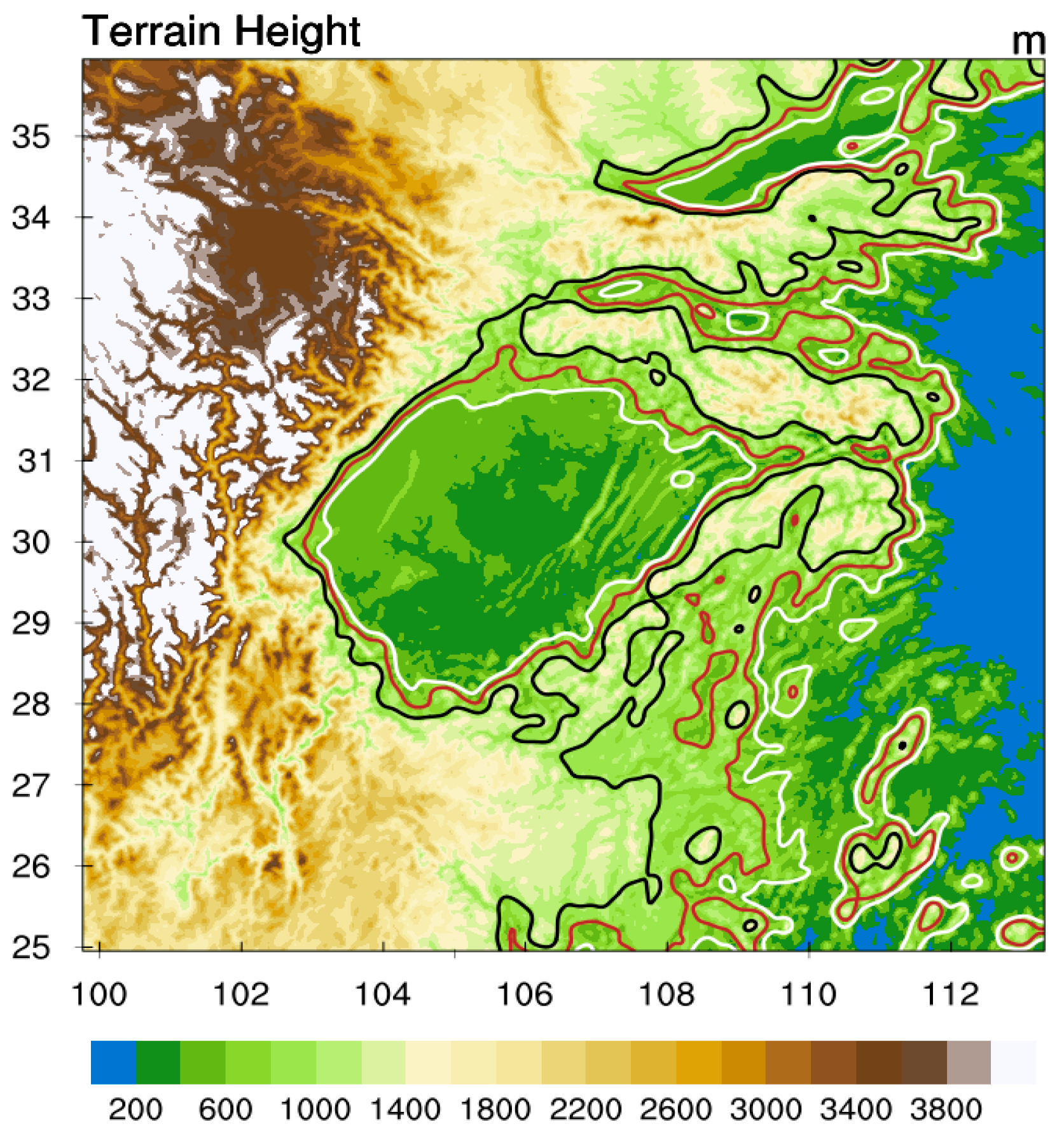
Figure 1. Terrain height of simulation domain (shading). The contours are the terrain height of 600 (white), 750 (brown), and 1000 (black). Unit: m.
Atmosphere 17 00259 g001
Figure 2. Seasonal mean (JJA) variability of various cloud properties over SCB for (a) COT_Liquid, (b) COT-Ice, (c) CER_Liquid, (d) CER-Ice, (e) CTH, and (f) CTP.
Atmosphere 17 00259 g002
Figure 3. Comparison of simulated and observed near-surface PM2.5 mass concentrations under (a) clean (CLN) and (b) polluted (POL) emission scenarios over the Sichuan Basin. Colored dots: PM2.5 observations; color contour: PM2.5 simulations; black arrows: simulated surface winds. Unit: μg m−3.
Atmosphere 17 00259 g003
Figure 4. Observed daily precipitation over the study region from 11th to 13th August in 2020. Unit: mm.
Atmosphere 17 00259 g004
Figure 5. Simulated daily precipitation from 11th to 13th August in 2020: (ac) CLN case (2020 emissions); and (df) POL case (2012 emissions). Unit: mm.
Atmosphere 17 00259 g005
Figure 6. Temporal evolution of the basin-averaged effective radius over the SCB for (a) cloud droplets, (b) ice particles, and (c) snow particles. The blue lines represent the clean (CLN) and orange lines represent the polluted (POL) scenarios. Units: μm.
Atmosphere 17 00259 g006
Figure 7. Temporal evolution of area −mean vertical profiles of updraft vertical velocity: (a) CLN case and (b) difference between POL and CLN case. Units: cm s−1.
Atmosphere 17 00259 g007
Table 1. Major physical parameterization schemes used in the WRF-ACI-Full simulations.
RegionSichuan Basin
Simulated period9 August 2020 to 14 August 2020 (UTC)
Domain center30.5° N, 106.2° E
Microphysics schemeMorrison 2-moment scheme [60]
Boundary layer schemeYSU scheme [61]
Surface layer schemeRevised MM5 Monin–Obukhov scheme [62]
Land surface schemeNoah scheme [63]
Longwave and shortwave radiation schemeRRTMG scheme [64]
Chemical initial and boundary conditionsMOZART 6 h output [65]
Anthropogenic emission inventoryDeveloped by Zhang et al. [58] and Li et al. [59], and SAPRC-99 chemical mechanism
Biogenic emission
inventory
Online MEGAN model developed by Guenther et al. [66]
Table 2. Anthropogenic emissions of air pollutants in Sichuan Basin in 2012 and 2020. (units: Tg).
SO2NOXNMVOCCOPM10PM2.5
20122.60 1.42 1.80 11.48 1.06 0.77
20200.39 1.05 1.74 6.53 0.48 0.38
2012/20206.62 1.35 1.04 1.76 2.22 2.04
Relative Change−84.88% −25.92% −3.72%−43.14% −54.94% −50.91%
Table 3. Particle effective radius (DER) and its relative changes (relative to the CLN case) during the period of 20:00 LST on 11 August to 19:00 LST on 13 August in 2020 over SCB. Unit: μm.
Hydrometeor TypeCLNPOLRelative Change
Cloud Droplet 25.8224.85−3.78%
Ice Particle94.9994.17−0.87%
Snow Particle467.85460.54−1.56%
Table 4. Particle number concentration (PNC), mixing ratio, and relative changes (relative to the CLN case) over the SCB from 20:00 LST 11 August to 19:00 LST 13 August 2020. PNC is expressed in the following units: cloud droplets (106 m−3), raindrops (102 m−3), ice particles (105 m−3), snow (103 m−3), and graupel (102 m−3). The unit of mixing ratio is g Kg−1.
Particle Number Concentration (PNC)
Cloud droplet Raindrop Ice particle Snow Graupel
CLN8.1520.084.518.9419.26
POL18.723.714.449.0019.45
Relative Change129.52%18.09%−1.55%0.74%1.01%
Mixing Ratio
Cloud dropletRaindropIce particleSnowGraupel
CLN0.273 0.1760.0510.2050.469
POL0.2790.1740.0500.2120.456
Relative Change1.88%−1.10%−0.25%3.81%−2.85%
Disclaimer/Publisher’s Note: The statements, opinions and data contained in all publications are solely those of the individual author(s) and contributor(s) and not of MDPI and/or the editor(s). MDPI and/or the editor(s) disclaim responsibility for any injury to people or property resulting from any ideas, methods, instructions or products referred to in the content.