Article

Enhanced Migratory Biological Echo Extrapolation from Weather Radar Using ISA-LSTM

1
Jiangsu Collaborative Innovation Center of Atmospheric Environment and Equipment Technology, Nanjing University of Information Science and Technology, Nanjing 210044, China
2
Meteorological Observation Center, China Meteorological Administration, Beijing 100081, China
3
National Meteorological Center, China Meteorological Administration, Beijing 100081, China
*
Author to whom correspondence should be addressed.
Atmosphere 2026, 17(3), 257; https://doi.org/10.3390/atmos17030257
Submission received: 14 January 2026 / Revised: 18 February 2026 / Accepted: 25 February 2026 / Published: 28 February 2026
(This article belongs to the Section Atmospheric Techniques, Instruments, and Modeling)

Abstract

Weather radar provides continuous, large-scale observations of aerial biological activity. However, biological echoes typically exhibit weak signals, sparse distributions, and non-stationary abrupt variations, causing existing extrapolation models to suffer from over-smoothing and loss of detail and making it difficult to capture their short-term evolution effectively. To address this issue, we propose an Integrated Self-Attention Long Short-Term Memory (ISA-LSTM) model that integrates a self-attention mechanism within the Predictive Recurrent Neural Network (PredRNN) framework. Coupled convolutional modules are introduced to enhance feature interactions between inputs and hidden states, while a spatiotemporal self-attention mechanism improves long-term dependency modeling and local detail preservation. Experiments conducted on 6000 biological echo samples from three weather radars in the Poyang Lake region demonstrate that the proposed model achieves superior extrapolation accuracy and stability compared with existing methods, maintaining a low false-alarm rate for lead times of up to 50 min. The results suggest that ISA-LSTM offers an effective deep learning approach for biological echo extrapolation, with applications in aviation safety and agricultural pest and disease early warning.

1. Introduction

Biological migration is a widespread and important natural process on Earth [1]. The migratory movements of aerial organisms such as birds and insects are closely linked to human activities: bird migration affects aviation safety, insect migration can cause crop pest and disease damage, and bat migration may facilitate epidemics in humans and livestock [2,3]. Therefore, establishing an effective model for predicting biological migration will help to protect migratory bird populations globally, provide early warnings for plant diseases and insect pests, and predict aircraft encounters with bird strikes and related industrial applications. Weather radar, with its broad coverage, high spatiotemporal resolution, and capability for continuous observation, enables intercontinental-scale monitoring of aerial biological activity and serves as an important complement to traditional methods for tracking animal migration [4]. Extrapolating the spatiotemporal evolution of biological echoes can reveal migration routes and provide refined informational support for airspace safety assessment, disaster risk alerts, and ecological process monitoring.
The principle of radar echo extrapolation is to use radar-observed echo data to determine the echo intensity distribution and the motion speed and direction of echo entities, and then apply linear or nonlinear extrapolation to forecast the radar echo state over a specified lead time [5]. Traditional radar echo extrapolation techniques mainly include cross-correlation methods [6] and optical-flow methods [7]. Both assume that the motion of radar reflectivity factors follows Lagrangian persistence, making it difficult to accurately model the generation and dissipation processes of biological echoes. Moreover, these two methods are computationally time-consuming and exhibit forecast latency, and thus cannot meet the requirements of real-time prediction [8,9].
With the advancement of artificial intelligence, deep learning has attracted substantial interest in extrapolation research. Deep learning methods can uncover complex latent relationships from large datasets and learn compact feature representation patterns, which is beneficial for fine-scale extrapolation of the future spatiotemporal evolution of biological echoes over a target region. Long Short-Term Memory (LSTM) networks are among the primary models for extracting temporal information [10]. Shi et al. combined convolution with LSTM and proposed the Convolutional LSTM (ConvLSTM) model [11], establishing an end-to-end extrapolation framework whose accuracy exceeds that of optical-flow-based approaches. Subsequently, numerous improved variants have been developed based on ConvLSTM. For example, Wang et al. [12,13] proposed the Predictive Recurrent Neural Network (PredRNN) and its enhanced version PredRNN++ to strengthen the modeling of short-term dynamic changes, and adopted larger convolutional receptive fields to capture broader spatial variation. In addition, Han et al. [14] constructed an efficient and accurate severe convection forecasting model based on U-Net. Ravuri et al. [15] proposed a deep generative model that improves prediction quality while providing probabilistic forecasts, thereby enhancing forecast value and operational utility. Compared with traditional methods, deep-learning-based echo extrapolation offers higher data utilization and improved predictive accuracy, and has achieved notable success in precipitation nowcasting. Nevertheless, unlike well-defined physical processes such as fluid flow, biological echoes are formed by the superposition of individuals with autonomous mobility. Their motion vectors arise from a nonlinear combination of the environmental wind field and the organisms’ own heading vectors [16]. In addition, biological targets typically have small radar cross sections, their spatial distribution appears as discrete clusters, and they exhibit non-stationary, abrupt changes during phases such as migratory takeoff, aggregation, and subsequent gradual dispersion. As a result, biological-echo time series are characterized by weak intensity, sparsity, and non-stationarity. Therefore, directly transferring such methods may lead to issues such as excessive smoothing of weak sparse structures and attenuation of signal intensity.
Recently, weather-radar-based methods for forecasting biological migration have gained increasing attention. Lippert et al. [16] proposed a graph convolutional network (GCN) model that can effectively handle spatiotemporal complexity. Mao et al. [17] further combined graph convolution with a gated recurrent unit (GRU) and introduced a multi-head self-attention mechanism to strengthen modeling of long-term dependencies. However, these graph-based approaches—where radar stations are treated as nodes—have been used primarily to predict regional aggregates such as total biomass or overall migration intensity. As a result, they are not well suited to practical applications that require high-resolution spatiotemporal nowcasting, such as airport bird-strike prevention and precision pest management.
To address these limitations, this study proposes an Integrated Self-Attention Long Short-Term Memory (ISA-LSTM) network to enhance the spatiotemporal modeling capability for weather-radar biological echo extrapolation. Built upon the PredRNN framework, ISA-LSTM incorporates a coupled convolutional module to strengthen feature interactions between the input state and the hidden state, thereby enhancing detail preservation, which in turn improves the stability of long-horizon extrapolation. Overall, this study provides a feasible modeling paradigm for short-term extrapolation of weak-signal, non-stationary spatiotemporal processes such as biological echoes, and can support practical applications including airport bird-strike risk assessment and early warning of migratory pest outbreaks.

2. Datasets

The data used in this study were obtained from China’s new-generation Doppler weather radar network. In China’s operational practice, the long-term accumulated weather radar archives are still dominated by single-polarization systems, and the available dual-polarization observations are relatively limited [4]. Therefore, this study uses CINRAD-SA (S-band) single-polarization weather radar base data. The main variables provided by single-polarization radar include the reflectivity factor (Z), radial velocity (V), and spectrum width (W). We selected weather radar base data from three radar sites—Jiujiang, Nanchang, and Jingdezhen—in the Poyang Lake region during 2019–2020 to construct the dataset for this study.
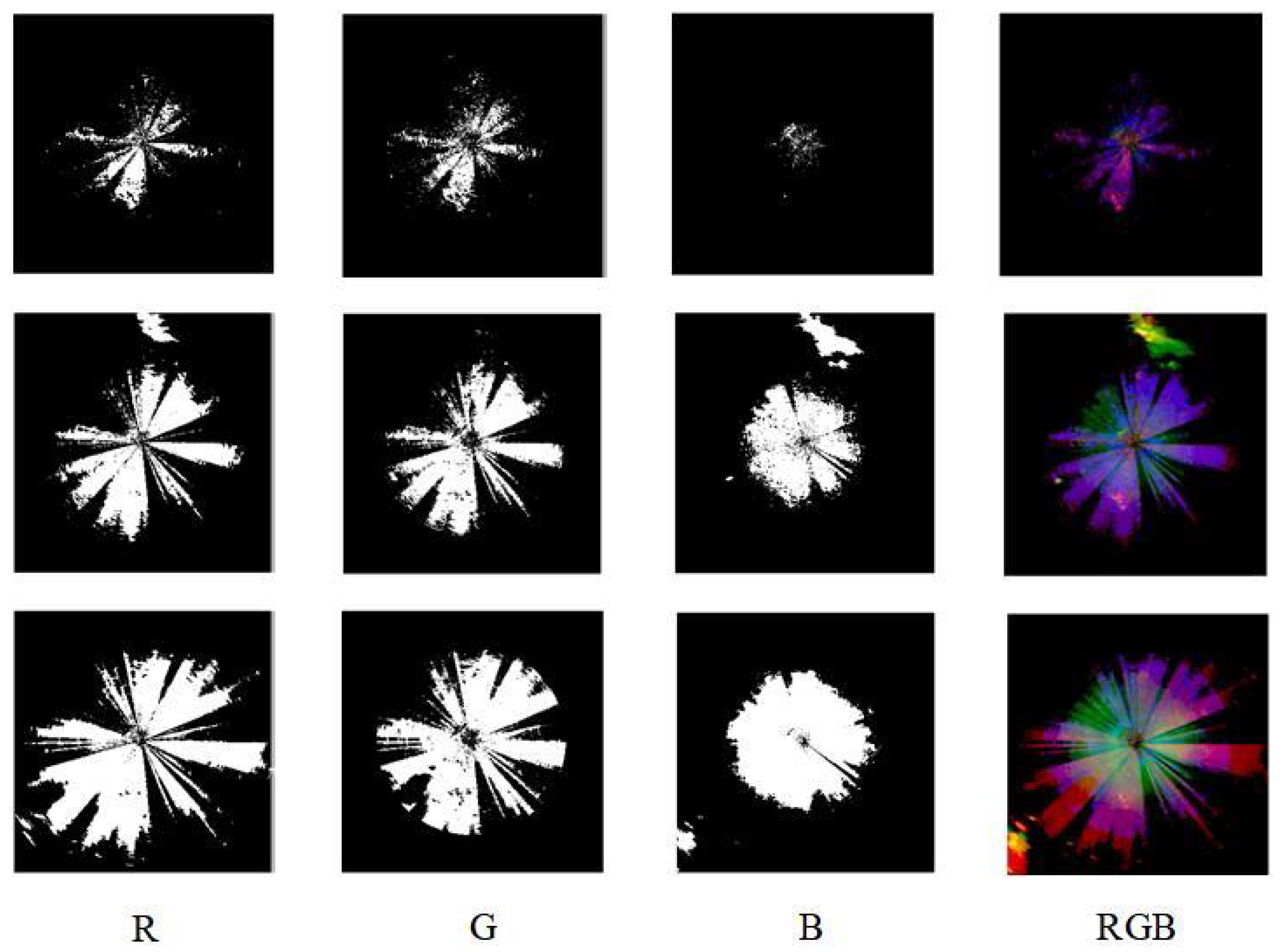
Migratory bird movements occur mainly from dusk to dawn during spring and autumn [18]. Biological migration activity typically occurs below 2 km in altitude, and the two lowest elevation angles (0.5° and 1.45°) can already cover the typical migration height range; accordingly, we use radar reflectivity at the first and second elevation angles and the spectrum width at the first elevation angle as the R, G, and B channels, respectively [19]. These variables are rendered into three-channel radar images with a resolution of 320 × 320, corresponding to a 200 km radius scan area centered at each radar site. An example of the rendered radar-echo image is shown in Figure 1.
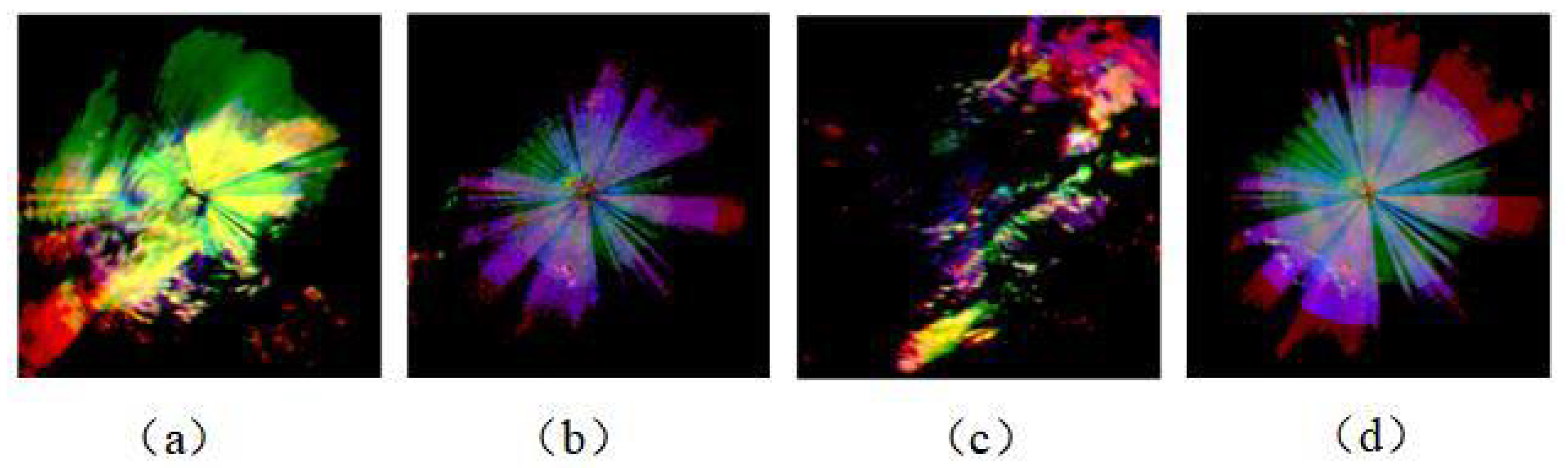
The following describes the characteristics of precipitation echoes and biological echoes in the rendered images, as well as the labeling principle. Biological echoes and precipitation echoes differ in color, texture, and structural patterns. Precipitation echoes can be detected by weather radar across all elevation angles, and their reflectivity is generally higher than that of biological echoes. Specifically, precipitation echoes typically exceed 50 dBZ, whereas biological echoes are usually below 35 dBZ [20,21,22]. In the rendered images, precipitation echoes mainly appear in the red and green channels and are characterized by bright yellow and yellow-green colors, as shown in Figure 2a. Their morphologies include irregular patterns such as stratiform-like and blocky echoes. The vertical structure of precipitation echoes is often irregular, with random distribution across different altitude layers, exhibiting high brightness, irregular shapes, and relatively coarse textures, as illustrated in Figure 2c. Moreover, precipitation echoes are strongly influenced by atmospheric motion, leading to pronounced spatiotemporal displacement. In contrast, biological targets fly at relatively low altitudes and are almost fully covered by the 0.5° elevation beam. In addition, actively flying biological groups often exhibit heterogeneous radial velocities, resulting in larger spectrum widths than those of precipitation echoes [23]. Consequently, biological echoes mainly manifest in the red and blue channels, appearing as dark red and purple, as shown in Figure 2b. The flight altitude of migratory animals is generally stable, producing a clearly layered vertical structure. Their spatial distribution is approximately circular with more homogeneous textures and smoother boundaries [24], as shown in Figure 2d. During large-scale migration events, airborne organisms can rapidly aggregate in space and time, causing abrupt increases in echo intensity. These color and structural differences between the two echo types form the reference criteria for dataset annotation. Based on the visual characteristics of biological and precipitation echoes in weather radar images, together with ecological knowledge, experienced radar interpreters manually annotated the data, and a unified quality-control procedure was implemented at each stage of the workflow [25].
For the three radar sites—Jiujiang, Nanchang, and Jingdezhen—we selected scan data from the spring (March–May) and autumn (September–November) migration seasons during 2019–2020. Following the rendering and annotation procedure described above, we ultimately obtained an experimental dataset comprising 14,000 valid radar scans. Next, we extracted biological echoes by adopting the MFF-PSPNet (Multi-Feature Fusion Pyramid Scene Parsing Network) semantic segmentation framework proposed by Chen et al. [26]. This approach uses MobileNetV2 as the backbone for feature extraction, incorporates the pyramid pooling module of PSPNet to capture multi-scale contextual information, and applies multi-feature fusion to enhance the representation of weak biological echoes. During segmentation training, we introduced Dice loss [27] to mitigate class imbalance. These designs improve segmentation accuracy under complex backgrounds, producing high-quality biological-echo masks.
Based on the extracted biological-echo images, we constructed a spatiotemporal extrapolation dataset. Each sample sequence consists of 15 consecutive frames: the first 5 frames are used as model inputs, representing 25 min of historical observations, and the remaining 10 frames serve as prediction targets (ground truth), corresponding to a 50 min forecast horizon. Using sliding-window sampling and sequence filtering, we removed sequences with missing frames and obtained 6000 valid sample sequences in total, including 4000 for training, 1000 for validation, and 1000 for testing; each sequence contains 15 consecutive frames. After obtaining the optimal model, it can be deployed in an operational setting: the most recent five radar scans are converted from base data into images, biological echoes are segmented, and biological-echo extrapolation is subsequently performed. Figure 3 illustrates the workflow for constructing the biological-echo extrapolation dataset.

3. Research Methods

This study aims to apply deep learning techniques to the extrapolation of radar-derived biological echoes in order to enhance spatiotemporal prediction accuracy in biological-migration monitoring. To this end, an Integrated Self-Attention Long Short-Term Memory (ISA-LSTM) network is developed. The model augments a conventional recurrent architecture with a coupled convolution module and dual attention mechanisms, thereby improving its capacity to characterize the spatiotemporal evolution of biological echoes.

3.1. Basic Network Structure

Biological-echo extrapolation can be formulated as a spatiotemporal sequence prediction problem. Early representative methods, such as the Convolutional Long Short-Term Memory (ConvLSTM) network, introduced convolutional operations to compensate for the limitation of fully connected LSTMs in modeling spatial structures. However, the memory update in ConvLSTM mainly relies on a single temporal memory pathway. As a result, during long-horizon extrapolation, spatial details tend to progressively decay as time advances, leading to increasingly blurred predictions and loss of spatial textures.
To overcome these limitations, Wang et al. proposed PredRNN, which preserves the conventional LSTM temporal memory while introducing a new memory state M t , forming a gated dual-memory architecture. PredRNN further designs a zigzag memory flow that alternately propagates across layers and time steps, enabling the spatial memory M t to be transmitted through different depths and across time within the network [13]. This mechanism improves the stability of long-horizon prediction and the preservation of fine-grained details. For weather-radar biological echoes, this property is practically important. Migratory biological echoes are relatively weak and spatially sparse, and they undergo rapid morphological changes during takeoff, aggregation, and dispersion, making echo structures more prone to blurring under recursive extrapolation. The dual-memory design and cross-layer communication in PredRNN help maintain the morphology and structural information of biological echoes over longer forecast lead times, thereby providing an appropriate foundational framework for subsequent improvements tailored to biological-echo characteristics.

3.2. Coupled Convolution Module

Biological echo sequences are characterized by weak intensity, sparsity, and non-stationary abrupt variations, particularly during takeoff/landing or localized aggregation–dispersion phases, when echo intensity and structure may change markedly within a short time. In a radar image sequence, the frame at the current time step X t i reflects the instantaneous spatial distribution of migrating organisms, whereas the hidden state from the previous step H t 1 i encodes the temporal evolution leading up to the current frame [11,12,13]. In PredRNN, these two representations are processed as independent inputs; this strategy cannot fully exploit contextual information. In the presence of abrupt intensification or dissipation of biological echoes, newly emerging weak echo clusters cannot be promptly injected into the propagating memory states. During multi-step recursive prediction, spatial details may also be overwhelmed by the uniform diffusion of historical information, thereby limiting extrapolation performance.
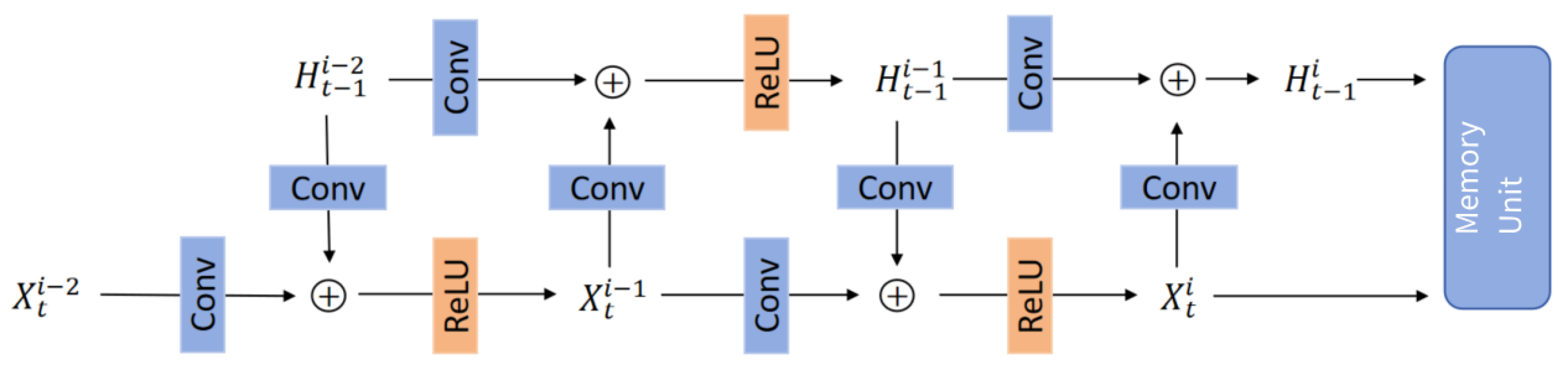
To address this issue, a coupled convolution module is introduced to achieve deeper feature-level fusion between the current input and the previous hidden state H t 1 i , making the model more sensitive to localized rapid variations and alleviating information decay and excessive smoothing during long-sequence extrapolation. As illustrated in Figure 4, each input first passes through a 3 × 3 convolution, after which the resulting feature maps are summed and passed through a ReLU activation function to generate the fused interaction state. The interaction Equations (1) and (2) are as follows:
X t i = ReLU W x x × X t i 1 + W h x × H t 1 i 1 + a
H t 1 i = ReLU W x h × X t i 1 + W h h × H t 1 i 1 + b
Among them, W is the weight matrices, and a and b are the biases. X t i and H t 1 i are the input and hidden states after interactive updates, respectively.
Through multiple coupled convolutional operations, this module enables dynamic interaction between the input and the memory state across space and time, thereby enhancing the network’s capacity to capture short-term dependencies and local structural variations. Compared with traditional independent update strategies, the coupled convolutional module improves the model’s sensitivity to localized short-term transients, reduces feature blurring and structural loss in rapidly evolving regions, and thus more accurately preserves fine-grained details in radar biological-echo extrapolation, leading to more stable predictions.

3.3. Spatiotemporal Self-Attention Mechanism

Radar-derived biological echoes are weak, sparse, and prone to abrupt structural changes, and local convolution alone is therefore insufficient to capture long-range dependencies and global dynamic patterns. This study introduces a spatiotemporal self-attention mechanism that adaptively reweights features along both the spatial and temporal dimensions. It highlights, at each time step, locally active regions that are most relevant to prediction, and emphasizes key historical temporal information during recursive forecasting, thereby capturing to some extent the evolution patterns of migratory biological-echo activity.
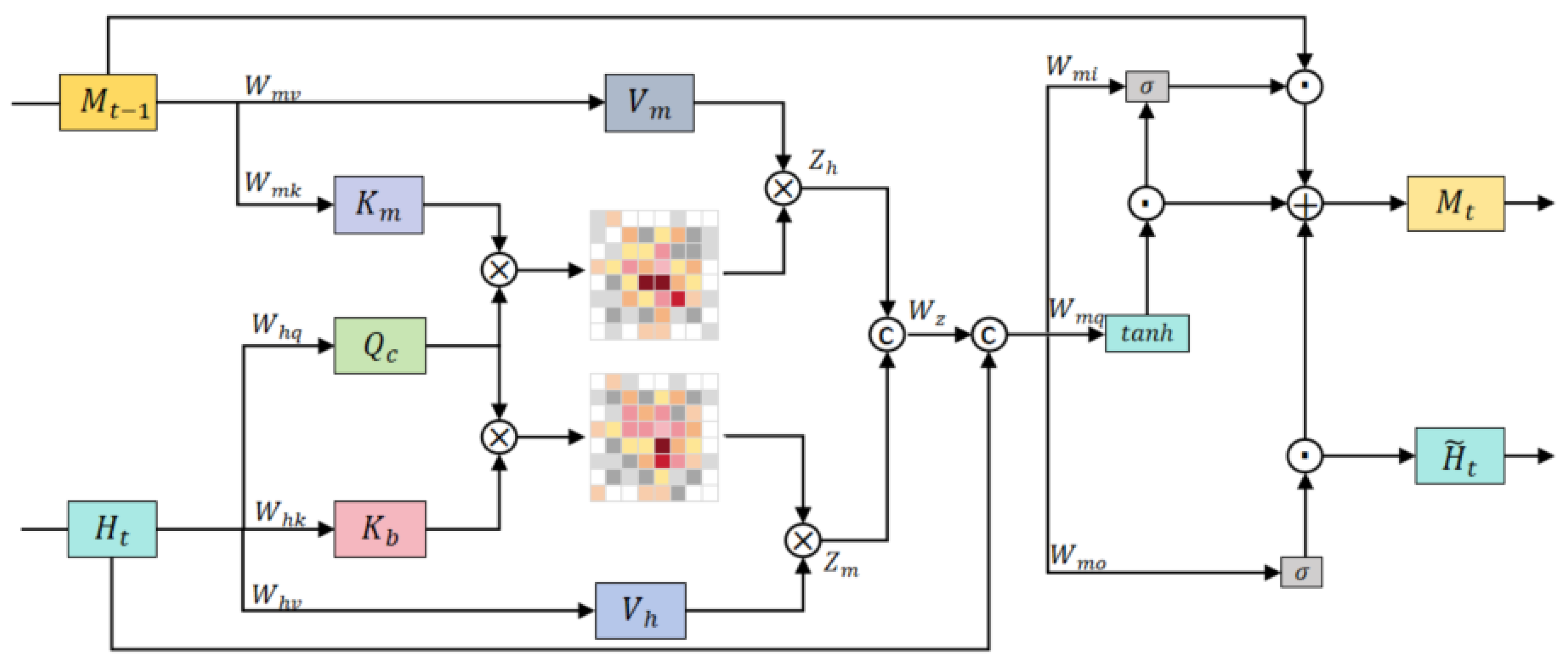
Specifically, we incorporate spatiotemporal self-attention into the PredRNN framework to enable dynamic weighting of spatiotemporal features. Because the evolution of migratory biological echoes is largely driven by organisms’ autonomous behavior and is not governed by continuous, smoothly varying physical constraints, a mechanism that dynamically attends to active regions and critical temporal cues is particularly important for biological-echo extrapolation. Concretely, the attention module dynamically allocates the feature contributions of the hidden state H t and the memory unit M t 1 , adaptively reweights historical features during sequence recursion, and injects the attention-weighted information into the updates of both the hidden and memory states, thereby compensating for the limitations of the original PredRNN.
The self-attention mechanism constructs query (Q), key (K), and value (V) matrices for hidden states and memory units for feature interaction and attention adjustment. The formula is as follows:
Q c = W h q H t
K m = W m k M t 1
K b = W h k H t
V m = W m v M t 1
V h = W h v H t
Among them, W is the weight matrix. The attention weights are obtained by Softmax normalization of the dot product of Q and K, as follows:
a h = softmax Q c × K m T
a m = softmax Q c × K b T
Then, the matrix V is dynamically weighted according to the attention weights, and the resulting weighted feature representation is as follows:
Z h = a h × V m
Z m = a m × V h
Here, Z h represents the attention weight from the hidden state to the memory unit, while Z m denotes the attention weight from the memory unit to the hidden state. The two are further fused into an integrated feature C, which is then used to update both the memory unit and the hidden state, as follows:
C = W z ( Z h + Z m )
M t = σ ( W m i × C ) × tanh ( W m q × C ) × f t × M t 1
H ˜ t = σ ( W m o × C ) × tanh ( W t )
The self-attention mechanism equips PredRNN with dynamic feature-weighting capabilities, allowing the model to focus on regions most relevant to the extrapolation task and thereby model the evolution of biological echoes more accurately while improving overall forecast performance. The self-attention module is illustrated in Figure 5. This mechanism can adaptively emphasize, at each time step, echo regions that are more informative for the current prediction, such as echo clusters and their boundaries, thereby helping preserve weak echo clusters and boundary structures in long-horizon extrapolation.

3.4. Model Fusion

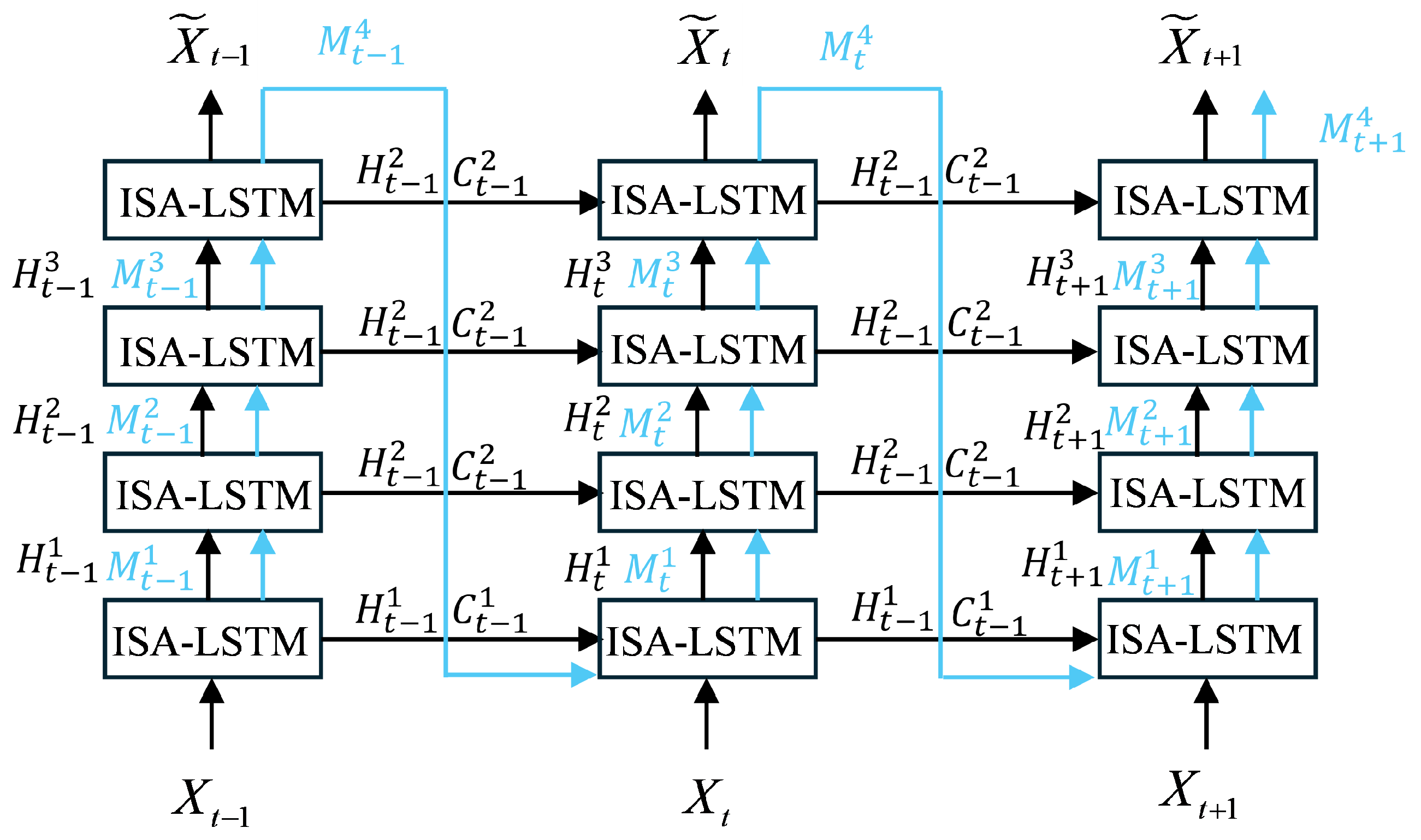
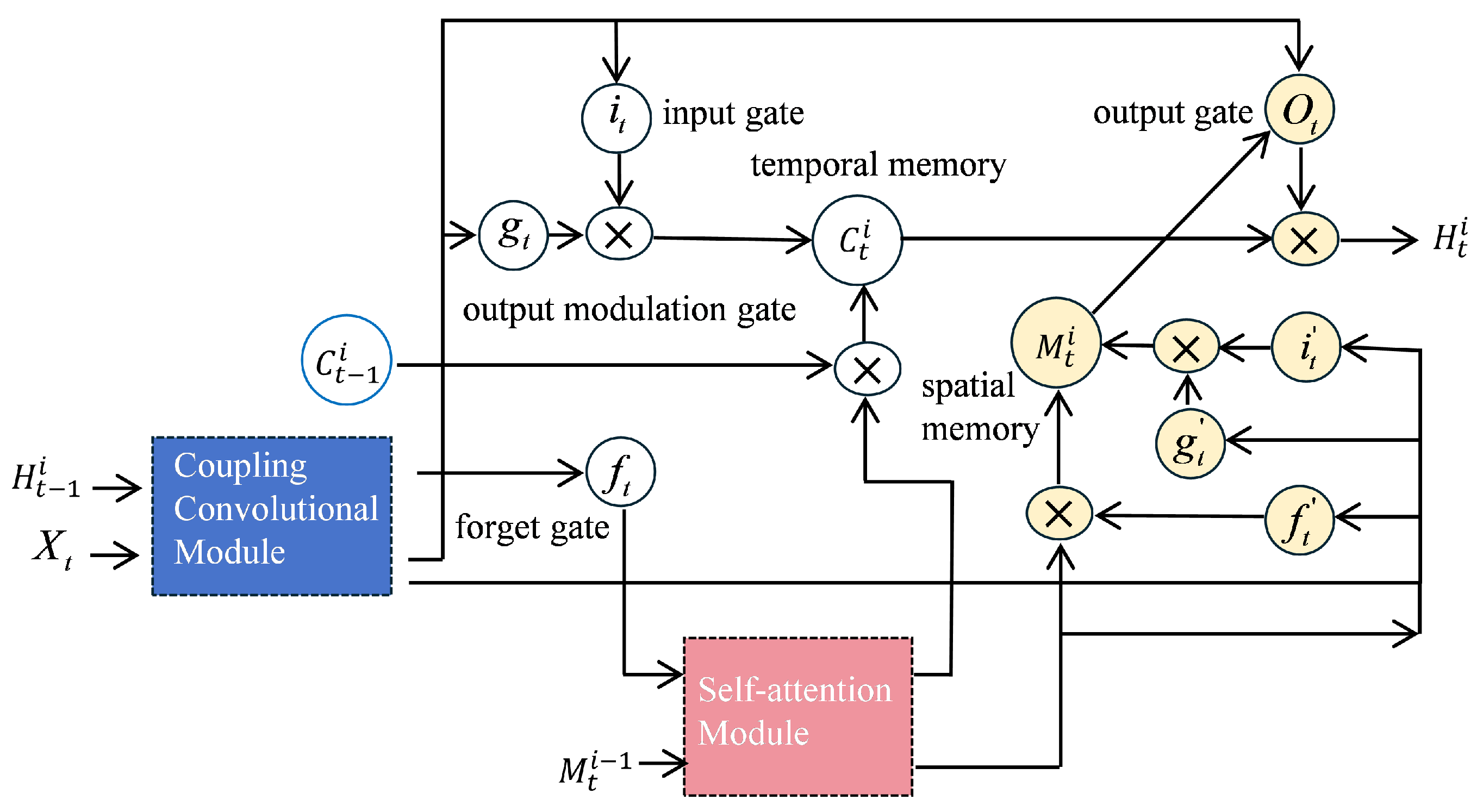
To address the challenges posed by weak, sparse echoes with abrupt structural variations—where traditional extrapolation tends to over-smooth and lose fine-scale details—and to meet the operational demand for high-resolution nowcasting to support bird-strike mitigation and precision pest control, this paper structurally integrates the “local dynamic modeling capability of coupled convolution” with the “global dependency modeling capability of spatiotemporal self-attention” on top of a PredRNN backbone, forming the ISA-LSTM unit and the stacked network shown in Figure 6 and Figure 7.
Within each unit, the coupled convolution module serves as the core component for local feature extraction. At each time step, the model applies convolution to the input data and the previous hidden state to extract spatially local features, which are then propagated to the input gate and forget gate for information filtering. This design enables the network to selectively retain historical information relevant to temporal evolution, thereby effectively capturing the spatial structure and short-term dynamics of radar echoes and mitigating the feature degradation that can occur when a conventional LSTM directly processes high-dimensional inputs. By prioritizing responsiveness to localized abrupt changes and short-term dependencies at each time step, the architecture suppresses, at a structural level, the tendency for weak echoes to be overwhelmed by “historical smoothing”.
However, the limited receptive field of convolution alone is insufficient to cover the long-range dependencies and global dynamics of biological echoes, particularly during processes such as the merging, splitting, and rapid dissipation of discrete clusters. Accordingly, ISA-LSTM introduces a spatiotemporal self-attention mechanism within the unit, mapping the hidden state and memory cell into Query–Key–Value representations and computing attention weights via Equations (3) and (14) to form an aggregated feature C, which is used to dynamically reweight memory updates. In this way, the attention mechanism injects information from critical times and regions into the updates of spatial and temporal memories, thereby reducing spurious diffusion, lowering false alarms, and preserving the continuity of echo edges and cluster structures in long-lead extrapolation.
The inter-layer feature propagation path of the model allows spatial-attention features from an upper layer to be propagated to the next layer to enable cross-layer sharing of spatiotemporal features. This mechanism substantially enhances modeling flexibility and robustness in long sequences and complex dynamic scenarios, enabling the model to more closely reflect the realistic “generation–maintenance–dissipation” evolution of biological echoes and to satisfy the requirements of high-resolution biological-echo extrapolation.
The model parameters are as follows: the Adam optimizer (Adaptive Moment Estimation) is used, with an initial learning rate of 0.001 and 80,000 iterations. The batch size is 4. After every 2000 iterations, the program evaluates model performance on the validation set to determine whether to save the optimal model. The program also uses early stopping, terminating training if performance does not improve after three consecutive validation runs. The model environment is built on an Intel i7 8-core CPU (Intel Corporation, Santa Clara, CA, USA) and an Nvidia RTX-3070Ti GPU (NVIDIA Corporation, Santa Clara, CA, USA).

4. Results

4.1. Data

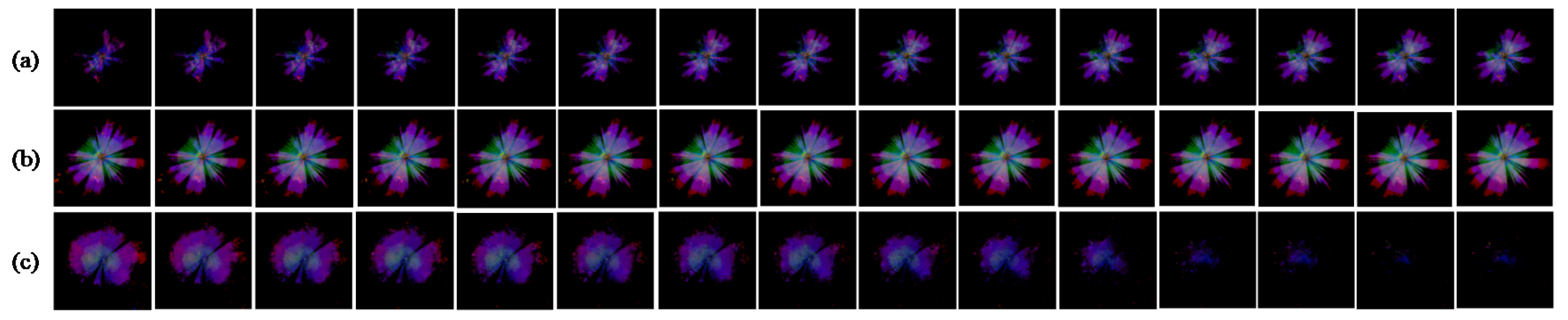
This study used continuous 2019–2020 weather-radar volume-scan data from three stations—Jiujiang, Nanchang, and Jingdezhen—in the Poyang Lake region to construct a bioecho-extrapolation dataset. The region lies within the core section of the East Asian–Australasian Flyway and is characterized by frequent migratory activity and representative spatiotemporal evolution patterns. Figure 8 visualizes three representative sample sequences from the dataset. Each row corresponds to one sample sequence, and each column denotes a 5 min time step; each sequence contains 15 frames. The images were generated by fusing three channels—reflectivity (Z) at the first and second elevation angles and spectrum width (W) at the first elevation angle—followed by biological-echo extraction. Therefore, the overall brightness of the composite RGB image is largely influenced by the intensity of the reflectivity channels: higher reflectivity appears brighter. The color reflects the relative contributions of reflectivity and spectrum width: green/yellow tones indicate stronger reflectivity, while purple/dark-red tones typically correspond to weaker reflectivity and relatively larger spectrum width. The same rendering rule is used for all composite RGB images in this paper. Because biological migration arises from groups formed by aggregating individuals, biological echoes in radar imagery typically exhibit spatiotemporal patterns of aggregation and dispersion. The three examples correspond to three typical evolution modes of biological echoes: (a) gradual emergence and aggregation over time, (b) persistent echoes that remain relatively stable, and (c) gradual attenuation and dissipation over time.

4.2. Evaluation Criteria

This section uses the commonly used evaluation indicators in the field of radar echo extrapolation, including Critical Success Index (CSI), Heidke Skill Score (HSS), Probability of Detection (POD), and False Alarm Rate (FAR). These metrics assess the model’s performance from different aspects, such as prediction accuracy, skill, error magnitude, and image similarity; the formulas are as follows [28,29,30]:
POD = TP TP + FN .
FAR = FP TP + FP .
CSI = TP TP + FP + FN .
HSS = 2 ( TP × TN FP × FN ) ( TP + FN ) ( FN + TN ) + ( TP + FP ) ( FP + TN ) .
Here, TP, FN, FP, and TN denote true positives, true negatives, false positives, and false negatives, respectively. In addition, the Mean Absolute Error (MAE) and Structural Similarity Index (SSIM) are used to assess the numerical accuracy of the predictions; the formulas are as follows [30,31,32].
MAE = 1 N i = 1 N y i y ^ i .
SSIM ( x , y ) = ( 2 μ x μ y + C 1 ) ( 2 σ x y + C 2 ) ( μ x 2 + μ y 2 + C 1 ) ( σ x 2 + σ y 2 + C 2 ) .
Among them, y i is the actual value; y ^ i is the predicted value; N is the total number of samples; μ x , μ y is the pixel mean of the two images; σ x 2 , σ y 2 is the pixel variance of the two images; σ x y is the covariance of the two images; and C 1 and C 2 are the smoothing coefficient, to prevent it from being 0.
CSI and HSS are used to assess the model’s classification skill in detecting biological echoes. CSI measures the overall accuracy of the predictions, while HSS quantifies the improvement over random chance. POD and FAR reflect the model’s detection capability and false-alarm tendency, offering insight into its operational stability. MAE evaluates the numerical deviation of the extrapolated images, and SSIM measures similarity in luminance, contrast, and structural patterns. Taken together, these metrics provide a multidimensional and objective evaluation of model performance in spatiotemporal prediction tasks.

4.3. Experimental Results

To assess the effectiveness of the ISA-LSTM model in weather-radar bioecho extrapolation, this section presents both ablation studies and comparative experiments. The ablation analysis examines the individual contributions of the coupled-convolution module and the self-attention mechanism.
Subsequently, ISA-LSTM is compared with several representative spatiotemporal prediction networks to evaluate its predictive accuracy and stability across different forecast horizons. Quantitative metrics and temporal visualizations are jointly analyzed to reveal differences among models in capturing the evolution of bioecho generation, maintenance, and dissipation.

4.3.1. ISA-LSTM Model Performance and Ablation Experiments

To quantitatively evaluate the contribution of each key module within ISA-LSTM, ablation experiments were conducted on the validation set in this section. Given that PredRNN itself is an extension of ConvLSTM, ConvLSTM was adopted as the baseline model. The I-LSTM variant incorporates the coupled convolutional module, SA-LSTM incorporates the self-attention mechanism, and ISA-LSTM integrates both components.
The experiments were performed at multiple prediction intervals (10, 20, 30, 40, and 50 min). Table 1 shows that ISA-LSTM achieves a higher POD with a lower FAR overall, and its advantage becomes more pronounced for longer forecast lead times. The key difficulty of biological echoes lies in the fact that they are weak and scattered when they first emerge, which makes them prone to missed detections, whereas during rapid dissipation, they can easily induce false alarms. After introducing the coupled convolution module, the POD and CSI of I-LSTM increase by approximately 4–6% and 15–18% relative to ConvLSTM, respectively, especially during the 10–20 min forecasting stage. This indicates that the coupled convolution module effectively mitigates information loss caused by independently processing the input and hidden states. With the additional self-attention mechanism, SA-LSTM is better at focusing the prediction on active regions, thereby maintaining higher consistency in the 30–50 min forecasts and reducing FAR by about 10–15%.
As reported in Table 2, ISA-LSTM attains the highest CSI and HSS overall, and exhibits a slower degradation as the lead time increases, suggesting more stable structural and positional alignment. ConvLSTM yields the lowest CSI and HSS, and is more prone to over-smoothing or diffusion. Compared with I-LSTM, SA-LSTM further improves CSI and HSS by 3–5%, demonstrating that the self-attention module enhances global robustness under complex backgrounds.
Table 3 further corroborates the above findings from the perspectives of error magnitude and structural preservation. In terms of overall MAE, ISA-LSTM yields lower errors and exhibits less error accumulation. In terms of overall SSIM, ISA-LSTM achieves higher scores, indicating that it better preserves the structural information of biological echoes during extrapolation. Moreover, SA-LSTM, which incorporates the attention mechanism, attains lower MAE and higher SSIM than ConvLSTM and I-LSTM, suggesting that self-attention enables more effective capture and retention of structural details.
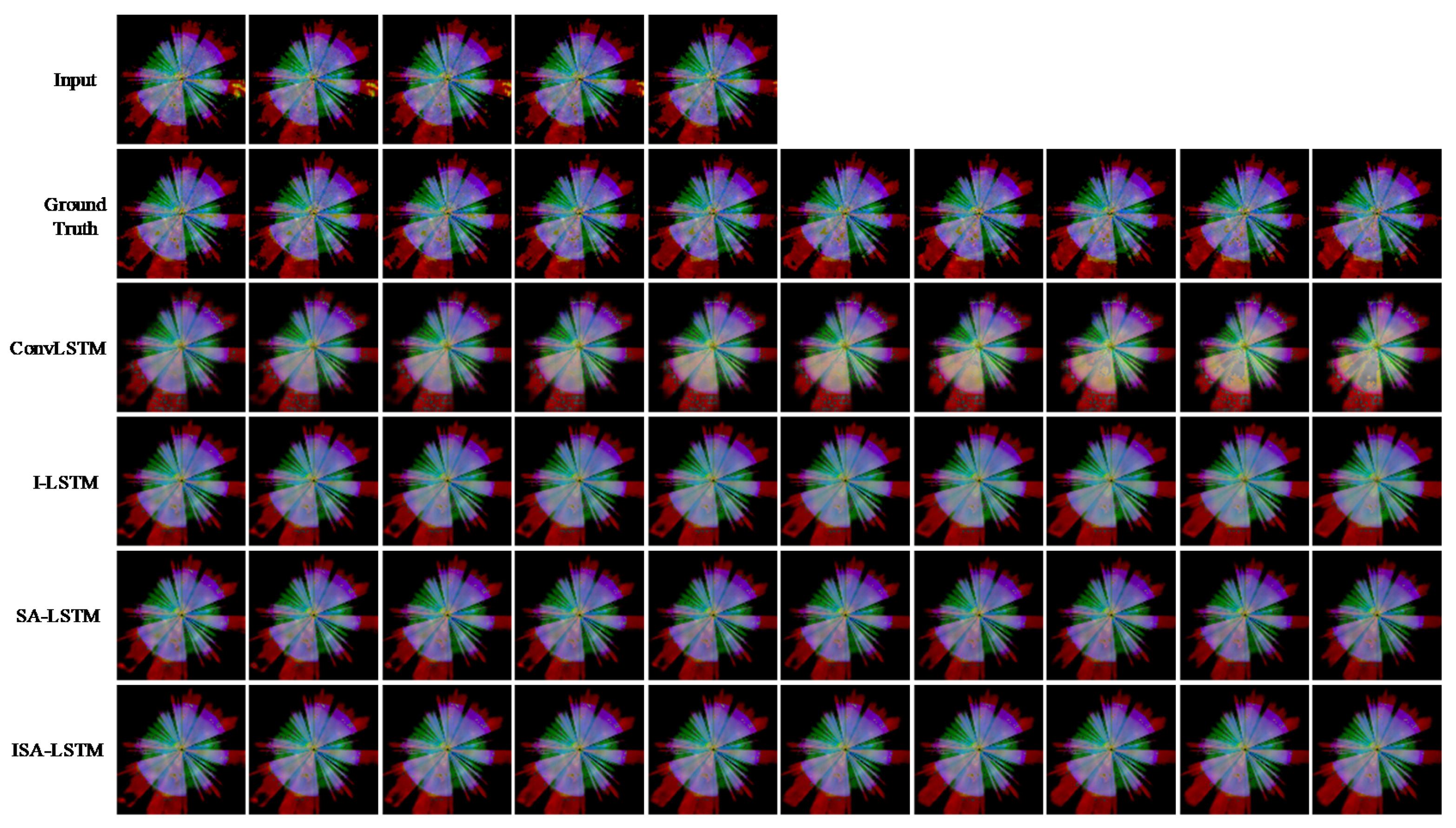
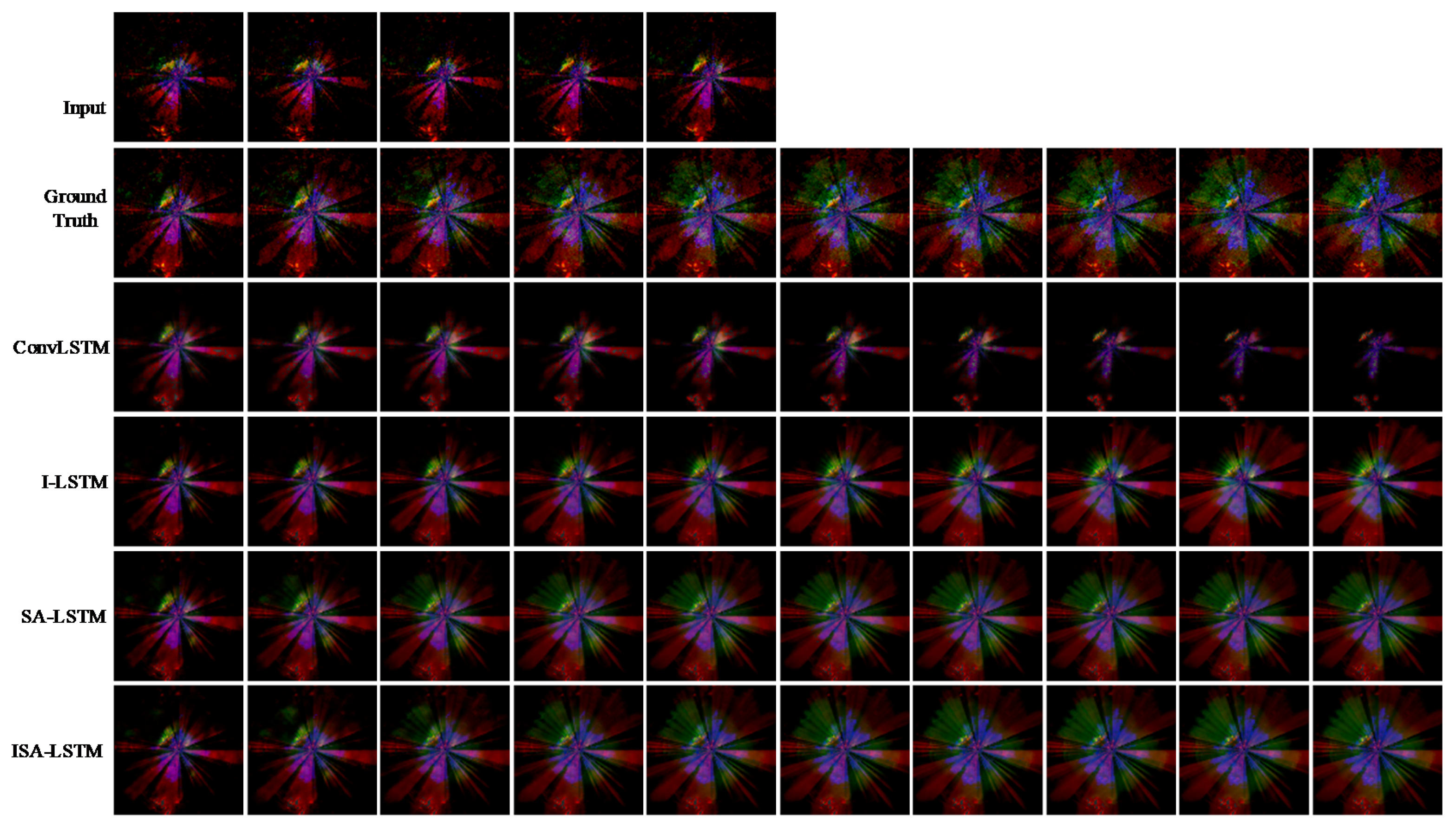
In the ablation study, further qualitative visualizations are provided in Figure 9, Figure 10 and Figure 11. The Input row shows the past five observed frames (covering the previous 25 min). The Ground Truth row and each model row show the corresponding future 10 frames (covering the next 50 min), and are aligned column-wise for direct comparison. Each model predicts the subsequent 10 frames based on the 5 five observed frames. Figure 9 presents a sequence in which biological echoes gradually emerge. In this stage, the echoes exhibit strong spatial aggregation and abrupt onset. ConvLSTM accumulates errors over time, resulting in blurred echo clusters and indistinct boundaries in later frames. I-LSTM, equipped with the coupled convolution module, responds more rapidly to echo intensification, but tends to lose fine-scale structures. After incorporating spatiotemporal self-attention, SA-LSTM and ISA-LSTM can dynamically emphasize locally active regions that contribute more to future evolution, thereby better preserving weak echo clusters and boundary structures and producing a more coherent morphological evolution from “collective takeoff” to “local aggregation”.
Figure 10 presents a qualitative comparison of time series extrapolation for a persistent biological-echo case in the ablation study. ConvLSTM is more prone to diffusion and over-smoothing in the middle to late stages. In contrast, I-LSTM, SA-LSTM, and ISA-LSTM produce evolutions that are more consistent with the ground truth. Notably, SA-LSTM and ISA-LSTM track echo clusters more stably, preserve fine-scale details more accurately, and retain boundary structures and weak-echo details more completely.
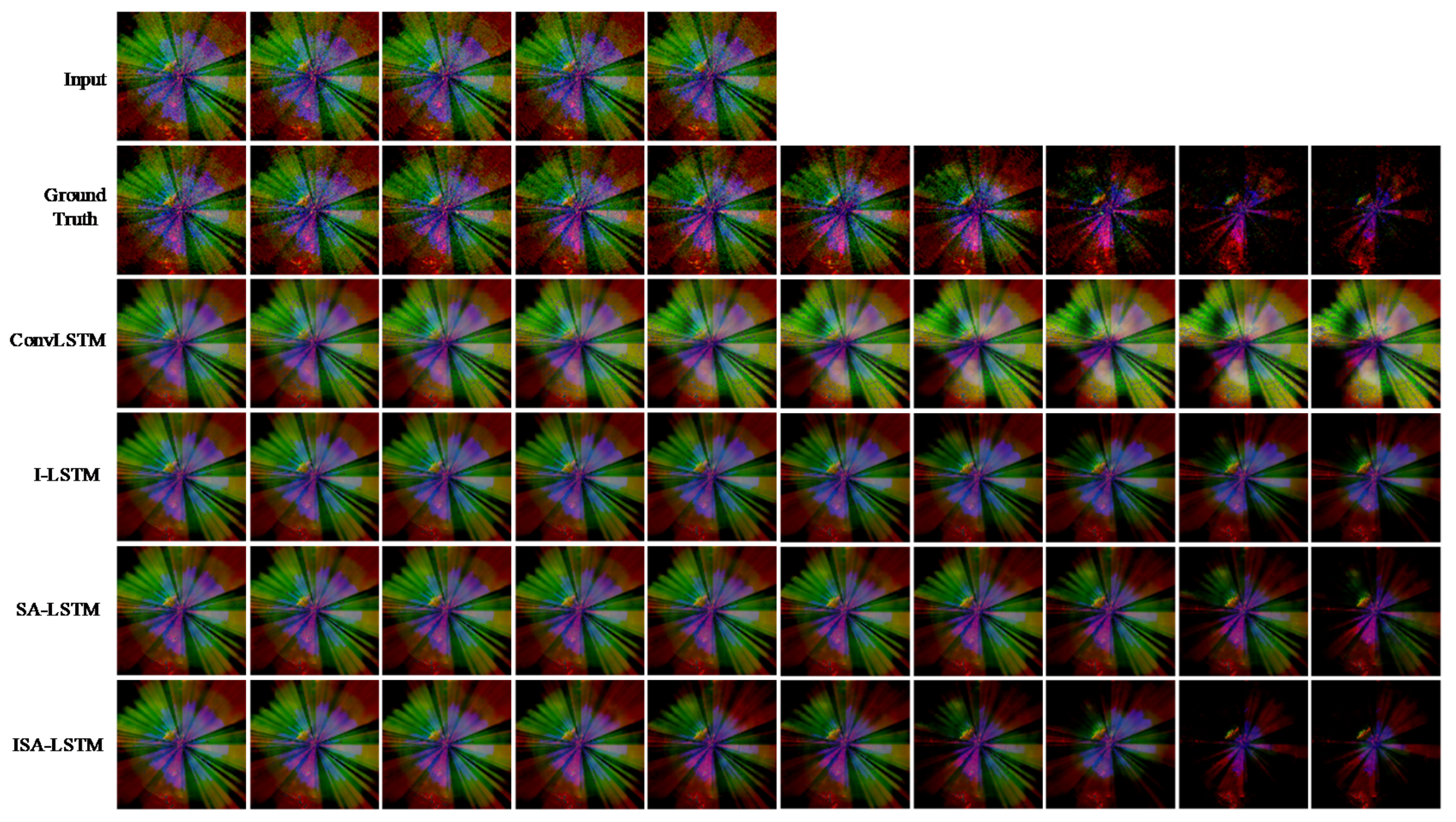
Figure 11 shows a qualitative comparison of time series extrapolation for a gradually dissipating biological-echo case in the ablation study. As can be observed, ConvLSTM and I-LSTM exhibit inferior echo tracking performance. In contrast, SA-LSTM and ISA-LSTM produce more natural dissipation patterns with fewer false alarms. In particular, ISA-LSTM more clearly reproduces the progressive fragmentation of weak echoes, the gradual break-up of boundaries, and their eventual disappearance, which better matches the behavioral characteristics of migratory organisms as they gradually disperse.
The temporal extrapolation results in the ablation study indicate that biological echoes are characterized by discrete clustering, abrupt onset, and rapid dissipation. Models that rely solely on conventional temporal propagation are prone to missing weak echo clusters during the emergence stage, producing blurred boundaries during the persistence stage, and generating false alarms during the dissipation stage. After introducing coupled convolutions, the model responds more promptly to intensity variations. With the further incorporation of spatiotemporal self-attention, the model focuses on dynamically active regions and propagates historical information in a non-uniform manner, enabling it to capture the migratory evolution patterns of biological echoes and better preserve weak echo clusters and boundary structures during extrapolation. This mechanism is particularly important for biological echoes, whose evolution is driven by organisms’ autonomous behavior and is not constrained by continuous physical dynamics. Consequently, ISA-LSTM not only achieves superior performance across standard evaluation metrics, but also better conforms to the “takeoff–aggregation–dispersion” evolutionary process of migratory organisms.

4.3.2. Comparative Experiments Between ISA-LSTM and Other Models

After determining the optimal ISA-LSTM architecture, we compared the final model with representative mainstream methods on an independent test set to objectively evaluate its performance. The mainstream sequence extrapolation models considered in this study include ConvLSTM, PredRNN [13], IPredRNN [33], CA-LSTM [34], SA-LSTM [35], and IDA-LSTM [36]. The evaluation metrics include POD, FAR, CSI, and HSS, with the corresponding results summarized in Table 4 and Table 5. Although Transformer-based architectures perform strongly in image-oriented tasks, their large parameter counts and sensitivity to training scale make them unsuitable for small-sample radar bioecho scenarios. For this reason, Transformer models were not included in the comparison.
Table 4 indicates that, as the forecast lead time increases from 10 min to 50 min, ISA-LSTM achieves the highest POD and the lowest FAR at all lead times. Its POD reaches 0.922 at 10 min and remains 0.740 at 50 min. In contrast, ConvLSTM and PredRNN yield lower POD values and are more likely to miss weak biological echoes in long-horizon forecasts. Moreover, the advantage of ISA-LSTM becomes more pronounced at longer lead times, demonstrating strong forecast stability. At 50 min, its FAR is 0.156, which is clearly lower than that of the other models.
Table 5 shows that ISA-LSTM continues to attain the best CSI and HSS. By comparison, ConvLSTM and PredRNN exhibit lower long-horizon scores, suggesting that these models are more prone to structural blurring and echo position drift during extrapolation. IDA-LSTM achieves a CSI of 0.624 at 50 min, slightly lower than the 0.630 of ISA-LSTM. IDA-LSTM obtains an HSS of 0.750 at 50 min, which is also lower than the 0.755 of ISA-LSTM. These results indicate that ISA-LSTM better preserves overall consistency under long lead times and captures long-range dependencies more effectively.
Table 6 provides an intuitive comparison in terms of numerical error measured by MAE and structural similarity measured by SSIM, further demonstrating that ISA-LSTM is more effective in stabilizing the structure and boundaries of biological echoes. It achieves the highest SSIM of 0.749, while also better capturing extrapolation changes, with MAE reduced to 0.0272. The closest competitor is IDA-LSTM, with an MAE of 0.0280 and an SSIM of 0.748. However, ISA-LSTM reduces prediction error while preserving fine details. The remaining models rank as SA-LSTM, CA-LSTM, and IPredRNN. ConvLSTM and PredRNN produce higher MAE and lower SSIM, indicating insufficient structural preservation and a greater tendency toward boundary loss and over-diffusion.
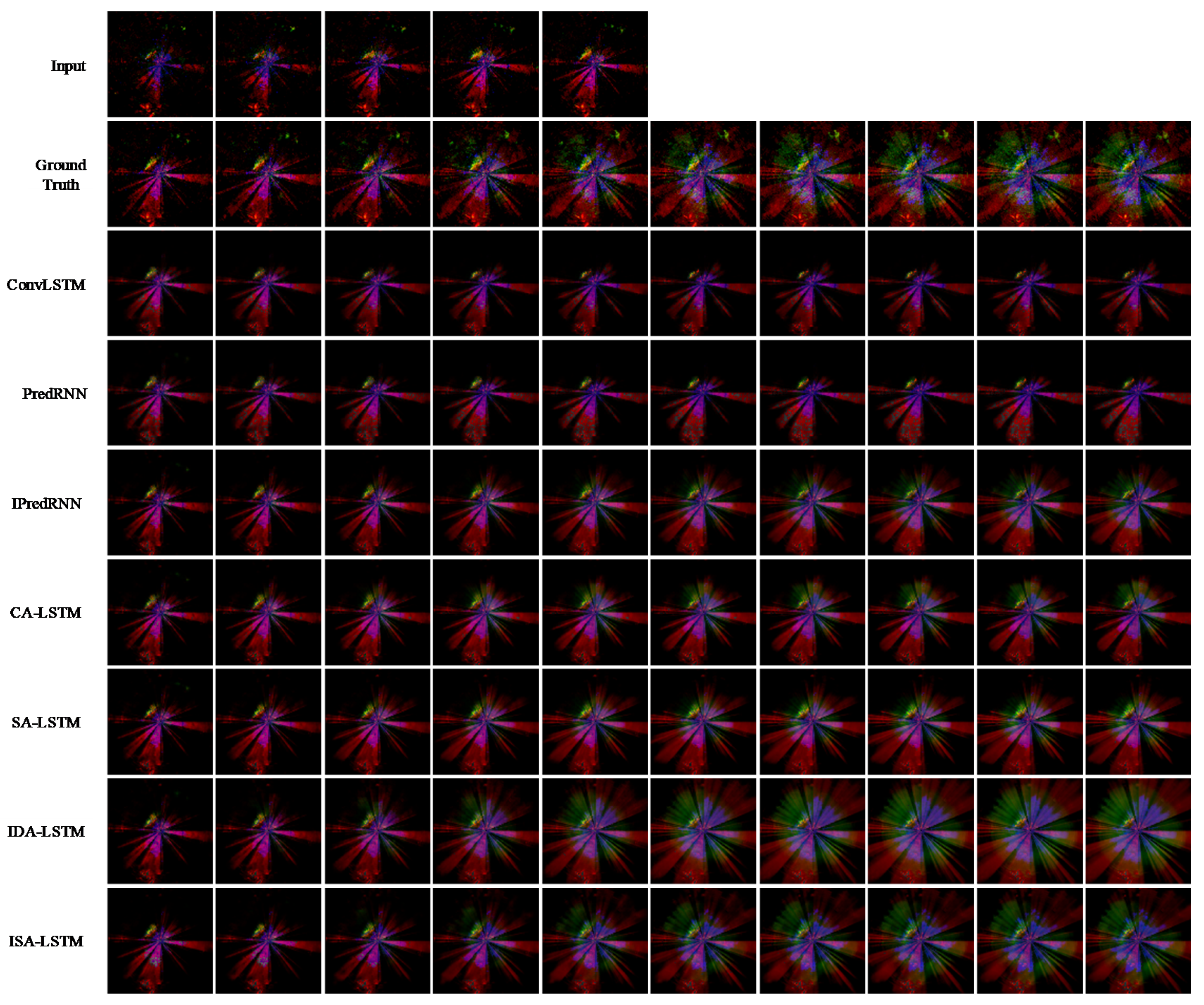
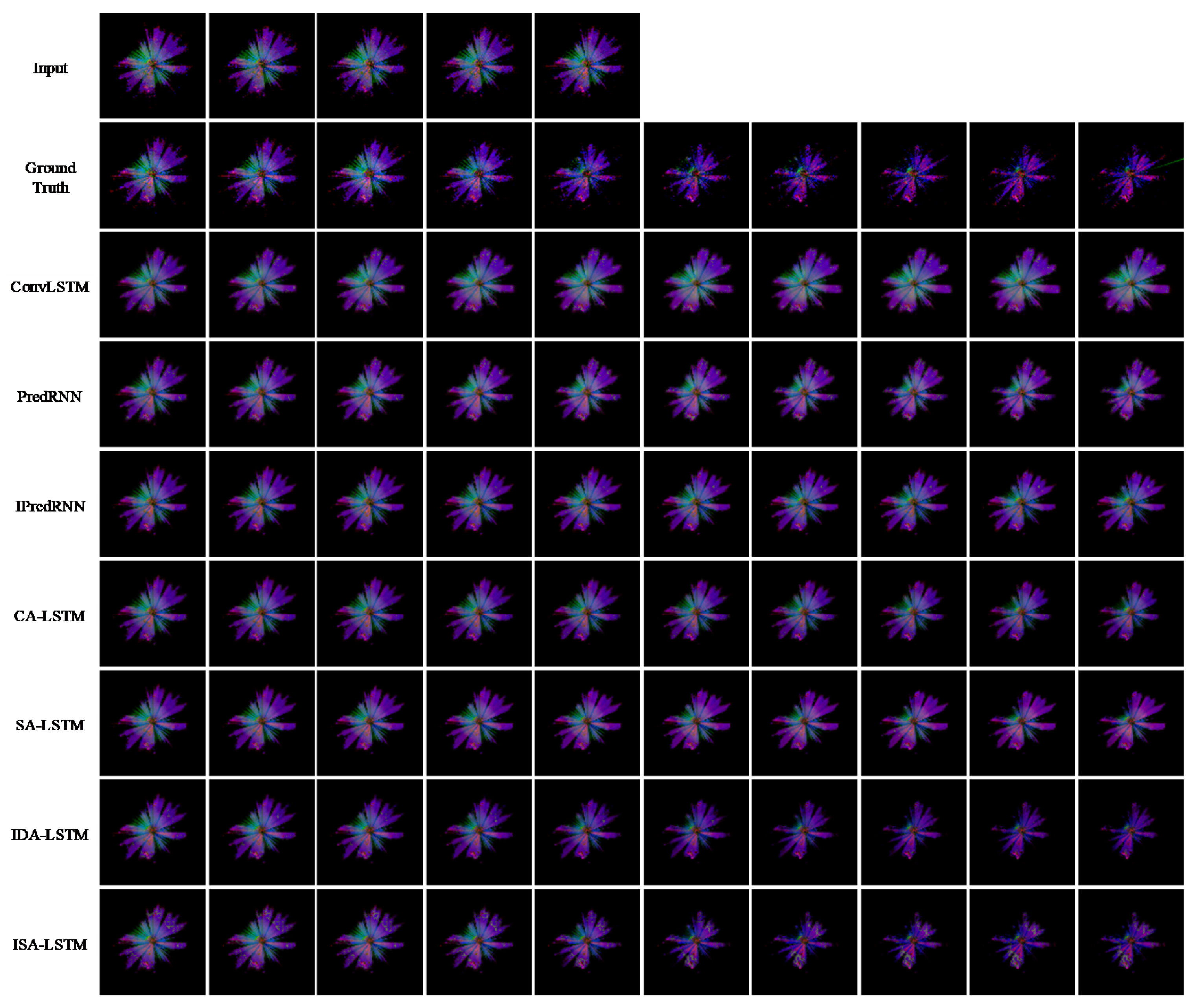
In the comparative experiments, additional qualitative visualizations are presented in Figure 12, Figure 13 and Figure 14. The Input row shows the past 5 observed frames (covering the previous 25 min). The Ground Truth row and each model row show the corresponding future 10 frames (covering the next 50 min), and are aligned column-wise for direct comparison. Each model predicts the next 10 frames based on the first 5 observed frames. Figure 12 shows a case where biological echoes gradually emerge. ConvLSTM and PredRNN deviate substantially from the ground truth. By contrast, IPredRNN, CA-LSTM, and SA-LSTM can predict the main echo body, but boundary pixels are still frequently predicted as background and fine details are not well preserved. IDA-LSTM and ISA-LSTM provide the best overall fit, yet IDA-LSTM shows a tendency toward overfitting, whereas ISA-LSTM better matches the true evolution. From a migration perspective, this stage corresponds to an abrupt intensification process characterized by collective takeoff and rapid aggregation, and ISA-LSTM more effectively focuses on regions that are becoming active, yielding predictions that are closer to the real evolution.
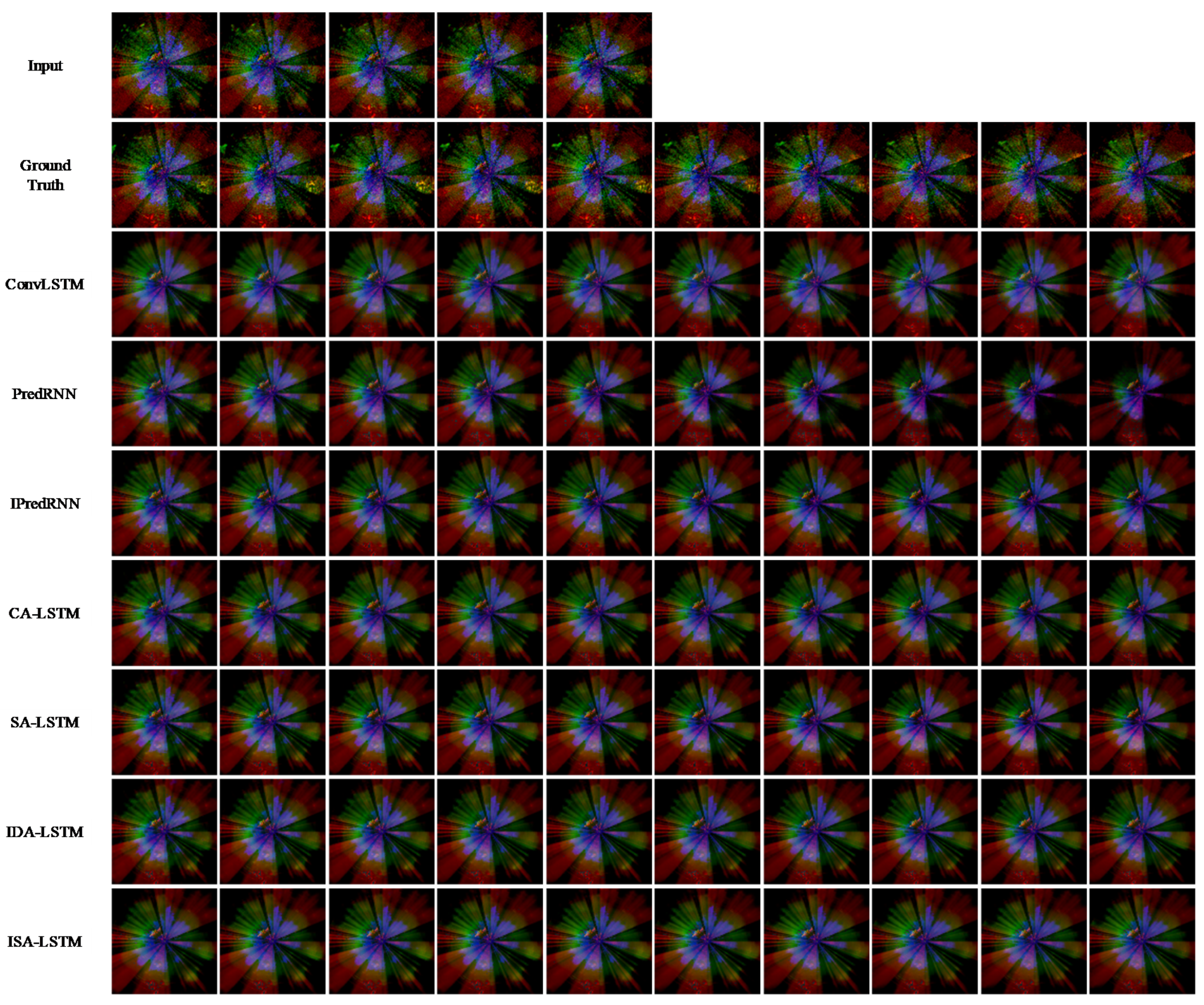
Figure 13 presents a case where biological echoes persist over time. PredRNN performs poorly and misclassifies the persistent process as gradual dissipation, whereas the other models correctly recognize that echoes are maintained. In terms of fine-scale depiction, SA-LSTM, IDA-LSTM, and ISA-LSTM are superior, particularly in fitting boundary details more closely to the ground truth. Overall, ISA-LSTM performs biological-echo extrapolation more stably.
Figure 14 shows a case where biological echoes gradually attenuate and disappear. ConvLSTM, PredRNN, IPredRNN, CA-LSTM, and SA-LSTM often predict this process as persistence or only slight weakening, which deviates markedly from the true dissipation trend. Both IDA-LSTM and ISA-LSTM correctly predict the disappearance trend. However, ISA-LSTM better matches the true dissipation timing. IDA-LSTM exhibits an obvious weakening starting from the sixth frame, whereas ISA-LSTM begins to weaken from the fourth frame, which is more consistent with the ground-truth dissipation sequence.
These comparative results demonstrate that, as the forecast lead time increases, ISA-LSTM achieves the best performance across standard evaluation metrics, while also delivering the lowest overall error and the strongest structural preservation. This is consistent with the phenomena observed in Figure 12, Figure 13 and Figure 14, indicating that ISA-LSTM better preserves weak clustered echoes and boundary details during the emergence stage, maintains morphological coherence during the persistence stage, and reduces false alarms during the dissipation stage. Overall, ISA-LSTM can identify migratory events more accurately and provides better long-horizon forecast stability.
Beyond the quantitative improvements in standard evaluation metrics, the gains of ISA-LSTM in forecast stability and false-alarm control also have important practical implications. In operational scenarios such as airport bird-strike risk mitigation and early warning for migratory pest outbreaks, excessive false alarms can substantially increase the cost of manual verification and response. The above results show that ISA-LSTM significantly reduces FAR while maintaining a high POD. The proposed model can still provide relatively reliable forecasts within a 50 min prediction horizon, supplying critical information for operational decision making and enabling airspace management agencies or agricultural emergency planning to deploy preventive measures in advance.

5. Discussion

Accurately forecasting the aerial migration of biological organisms will support the global conservation of migratory bird populations, prediction of aircraft bird-strike risk, agricultural pest and disease early warning, and related industrial applications. Weather radar offers wide coverage, high spatiotemporal resolution, and continuous observation, and it can receive echo signals reflected by aerial organisms such as birds and insects [4]. Extrapolating biological echoes can provide refined information support for airspace safety assessment, disaster risk alerts, and ecological process monitoring. Unlike well-defined physical processes such as fluid flow, biological echoes are formed by the superposition of individuals with autonomous motion. Their evolution is not solely driven by environmental flow fields. In addition, biological echoes have small radar cross sections, sparse spatial distributions, and weak signals, and they involve non-stationary abrupt changes such as migratory takeoff, aggregation, and gradual dissipation [16]. Other research methods [10,11,12,13] struggle to model the dynamic characteristics of radar biological echoes; during extrapolation, they may over-smooth weak and sparse structures and attenuate echo intensity, which leads to inaccurate or even erroneous predictions. Conducting extrapolation research for biological echoes—weak signals and sparse targets—can support further value extraction from operational radars in broader application contexts.
Biological-echo extrapolation can be regarded as a spatiotemporal sequence prediction problem. Based on PredRNN, this study proposes ISA-LSTM, which introduces coupled convolution and spatiotemporal self-attention to jointly enhance the ability to characterize the evolution patterns of biological echoes. In the Section 4, Table 1 and Table 2 show that the model with the coupled-convolution module and the spatiotemporal self-attention mechanism achieves better performance across all evaluation metrics. As discussed in Section 3.2 and Section 3.3 regarding the mechanisms of these modules, coupled convolution strengthens the interaction between input information and spatiotemporal memory states, enabling the model to more sensitively capture local short-term dynamic variations. Spatiotemporal self-attention emphasizes locally active regions and captures migration-related evolution patterns of biological echoes during extrapolation. This helps preserve echo structures and fine details in long-sequence extrapolation and improves extrapolation stability. The visual results in Figure 12, Figure 13 and Figure 14 further demonstrate that, compared with other methods, ISA-LSTM better predicts the complete process of biological echoes from emergence and persistence to dissipation, and it clearly alleviates edge blurring and structural loss, validating the effectiveness of the proposed improvements.
Overall, the proposed ISA-LSTM improves detail preservation and long-term stability of extrapolation under weak, sparse, and non-stationary biological-echo conditions. It can also capture, to some extent, the spatiotemporal evolution patterns of migratory biological echoes, indicating substantial potential for operational deployment. In the future, it is expected to provide decision support for short-term and imminent early warning of bird-strike risk around airports, dynamic management of key migration corridors, and emergency monitoring and risk warning for the prevention and control of pathogen- and disease-vector transmission. Future work should validate generalization over larger regions and more scenarios. Meanwhile, environmental information such as wind fields, temperature, and humidity can be further integrated to evaluate robustness under more complex mixed-echo conditions. It is also desirable to develop multi-source forecasting techniques for aerial ecology, thereby further improving the application value of China’s weather radar in aerial-ecology studies.

6. Conclusions

This study addresses the spatiotemporal prediction of bioechoes in weather-radar extrapolation, and proposes ISA-LSTM, a spatiotemporal forecasting model that integrates coupled convolutions with spatiotemporal self-attention. Unlike well-defined physical processes such as fluid flow, the evolution of biological echoes is jointly driven by organisms’ autonomous behavior and the ambient flow field. Moreover, biological targets typically have small radar cross sections, exhibit sparse spatial distributions, and undergo non-stationary abrupt changes during migratory takeoff, aggregation, and gradual dispersion. Consequently, biological-echo sequences are weak, sparse, and non-stationary. By incorporating a coupled convolution module into the PredRNN architecture, ISA-LSTM enhances sensitivity to localized short-term dynamics. In addition, the proposed spatiotemporal self-attention mechanism emphasizes locally active regions and critical temporal cues associated with migration, effectively alleviating feature forgetting and excessive smoothing in long-sequence extrapolation. This enables more accurate modeling of global spatiotemporal dependencies and captures, to some extent, the evolution patterns of migratory biological echoes.
Comparative experiments using radar observations from the Poyang Lake region during 2019–2020 show that ISA-LSTM maintains strong performance even for a 50 min forecast horizon, achieving a low false-alarm rate, FAR = 0.156, and a high probability of detection POD = 0.740, which demonstrates excellent stability. Visualization-based analyses further confirm that ISA-LSTM can faithfully reconstruct the full life cycle of biological echoes, including emergence, persistence, and dissipation, while substantially suppressing the edge blurring and structural loss commonly observed in other extrapolation methods.
In summary, ISA-LSTM markedly improves the stability and detail preservation of biological-echo extrapolation under weak-signal conditions and exhibits strong potential for operational deployment. The proposed approach provides up to a 50 min decision-making window for airspace management and agricultural emergency planning, facilitating the advance implementation of preventive measures. This work focuses on the specific task of extrapolating migratory biological echoes from weather radar, and its applicability to meteorological echoes such as precipitation, which are governed by continuous physical constraints, still requires validation on standard meteorological nowcasting benchmarks. Systematic generalization evaluations across tasks and datasets will be pursued in future work. We further plan to integrate multi-source environmental factors, such as wind fields and temperature, and to conduct cross-site and cross-region validation on larger-scale radar networks to assess the robustness and transferability of the proposed model for biological-echo extrapolation, thereby supporting wide-area monitoring and forecasting of biological migration.

Author Contributions

Conceptualization, D.M. and D.W.; methodology, D.M.; software, D.M.; validation, D.M., Y.L., Z.D. and C.W.; formal analysis, D.M.; investigation, D.M.; resources, D.W.; data curation, D.M.; writing—original draft preparation, D.M.; writing—review and editing, D.W., Y.L., Z.D. and C.W.; visualization, D.M. and Y.C.; supervision, D.W.; project administration, D.W. and C.W.; funding acquisition, D.W. and C.W. All authors have read and agreed to the published version of the manuscript.

Funding

This research was funded by the National Key Research and Development Program of China (grant number 2022YFD1400404) and National Natural Science Foundation of China (grant number U2433211).

Institutional Review Board Statement

Not applicable.

Informed Consent Statement

Not applicable.

Data Availability Statement

The weather radar bioecho data used in this study were provided by the Meteorological Observation Center of the China Meteorological Administration. Researchers can obtain the data by contacting the corresponding author (wudongli666@126.com) with a reasonable research request. No new datasets were generated in this study.

Acknowledgments

The authors would like to thank the Meteorological Observation Center of the China Meteorological Administration for providing the weather radar bioecho data required for this study. We also acknowledge the support from the Jiangsu Collaborative Innovation Center of Atmospheric Environment and Equipment Technology at Nanjing University of Information Science and Technology for the research platform and technical assistance. During the preparation of this manuscript, no GenAI tools were used.

Conflicts of Interest

The authors declare no conflicts of interest. The funders had no role in the design of the study; in the collection, analyses, or interpretation of data; in the writing of the manuscript; or in the decision to publish the results.

References

  1. Dingle, H. Migration: The Biology of Life on the Move; Oxford University Press: Oxford, UK, 2014. [Google Scholar]
  2. Altizer, S.; Bartel, R.; Han, B.A. Animal migration and infectious disease risk. Science 2011, 331, 296–302. [Google Scholar] [CrossRef]
  3. Lambertucci, S.A.; Shepard, E.L.C.; Wilson, R.P. Human–wildlife conflicts in a crowded airspace. Science 2015, 348, 502–504. [Google Scholar] [CrossRef]
  4. Dokter, A.M.; Liechti, F.; Stark, H. Bird migration flight altitudes studied by a network of operational weather radars. J. R. Soc. Interface 2011, 8, 30–43. [Google Scholar] [CrossRef] [PubMed]
  5. Chen, S.; Shu, T.; Zhao, H. TempEE: Temporal–spatial parallel transformer for radar echo extrapolation beyond autoregression. IEEE Trans. Geosci. Remote Sens. 2023, 61, 5108914. [Google Scholar] [CrossRef]
  6. Rinehart, R.E.; Garvey, E.T. Three-dimensional storm motion detection by conventional weather radar. Nature 1978, 273, 287–289. [Google Scholar] [CrossRef]
  7. Germann, U.; Zawadzki, I. Scale-dependence of the predictability of precipitation from continental radar images. Part I: Description of the methodology. Mon. Weather Rev. 2002, 130, 2859–2873. [Google Scholar] [CrossRef]
  8. Chen, M.; Wang, Y.; Yu, X. Improvement and Application Test of TREC Algorithm for Convective Storm Nowcast. J. Appl. Meteorol. Sci. 2007, 18, 690–701. [Google Scholar]
  9. Wang, G.; Zhao, C.; Liu, L.; Wang, H. Error Analysis of Radar Echo Extrapolation. Plateau Meteorol. 2013, 32, 874–883. [Google Scholar]
  10. Hochreiter, S.; Schmidhuber, J. Long short-term memory. Neural Comput. 1997, 9, 1735–1780. [Google Scholar] [CrossRef]
  11. Shi, X.; Chen, Z.; Wang, H.; Yeung, D.-Y.; Wong, W.-K.; Woo, W.-C. Convolutional LSTM Network: A Machine Learning Approach for Precipitation Nowcasting. In Advances in Neural Information Processing Systems 28 (NIPS 2015); Curran Associates, Inc.: Red Hook, NY, USA, 2015. [Google Scholar]
  12. Wang, Y.; Gao, Z.; Long, M.; Wang, J.; Yu, P.S. PredRNN++: Towards a Resolution of the Deep-in-Time Dilemma in Spatiotemporal Predictive Learning. In Proceedings of the 35th International Conference on Machine Learning (ICML), Stockholm, Sweden, 10–15 July 2018; Volume 80, pp. 5123–5132. [Google Scholar]
  13. Wang, Y.; Long, M.; Wang, J.; Gao, Z.; Yu, P.S. PredRNN: Recurrent Neural Networks for Predictive Learning Using Spatiotemporal LSTMs. In Advances in Neural Information Processing Systems 30 (NIPS 2017); Curran Associates, Inc.: Red Hook, NY, USA, 2017. [Google Scholar]
  14. Han, L.; Liang, H.; Chen, H.; Zhang, W.; Ge, Y. Convective precipitation nowcasting using U-Net model. IEEE Trans. Geosci. Remote Sens. 2021, 60, 4103508. [Google Scholar] [CrossRef]
  15. Ravuri, S.; Lenc, K.; Willson, M.; Kangin, D.; Lam, R.; Mirowski, P.; Fitzsimons, M.; Athanassiadou, M.; Kashem, S.; Madge, S.; et al. Skilful precipitation nowcasting using deep generative models of radar. Nature 2021, 597, 672–677. [Google Scholar] [CrossRef]
  16. Lippert, F.; Kranstauber, B.; Forré, P.D.; van Loon, E.E. Learning to predict spatiotemporal movement dynamics from weather radar networks. Methods Ecol. Evol. 2022, 13, 2811–2826. [Google Scholar] [CrossRef]
  17. Mao, H.; Hu, C.; Wang, R.; Cui, K.; Wang, S.; Kou, X.; Wu, D. Deep-learning-based flying animals migration prediction with weather radar network. IEEE Trans. Geosci. Remote Sens. 2023, 61, 5101513. [Google Scholar] [CrossRef]
  18. Cooper, N.W.; Dossman, B.C.; Berrigan, L.E.; Brown, J.M.; Brunner, A.R.; Chmura, H.E.; Cormier, D.A.; Bégin-Marchand, C.; Rodewald, A.D.; Taylor, P.D.; et al. Songbirds initiate migratory flights synchronously relative to civil dusk. Mov. Ecol. 2023, 11, 24. [Google Scholar] [CrossRef]
  19. RoyChowdhury, A.; Sheldon, D.; Maji, S.; Learned-Miller, E. Distinguishing Weather Phenomena from Bird Migration Patterns in Radar Imagery. In Proceedings of the IEEE Conference on Computer Vision and Pattern Recognition Workshops (CVPRW), Las Vegas, NV, USA, 27–30 June 2016; pp. 10–17. [Google Scholar]
  20. Ding, M.; Cui, K.; Sun, Z.; Yan, Z.; Wu, D.; Wang, C. A Study on Insect and Bird Echo Recognition Using Machine Learning-Based X-Band Dual-Polarization Weather Radar. In Proceedings of the 2024 IEEE International Conference on Signal, Information and Data Processing (ICSIDP), Zhuhai, China, 22–24 November 2024; pp. 1–5. [Google Scholar]
  21. Gauthreaux, S.A.; Belser, C.G. Displays of bird movements on the WSR-88D: Patterns and quantification. Weather Forecast. 1998, 13, 453–464. [Google Scholar] [CrossRef]
  22. Kilambi, A.; Fabry, F.; Meunier, V. A Simple and Effective Method for Separating Meteorological from Nonmeteorological Targets Using Dual-Polarization Data. J. Atmos. Ocean. Technol. 2018, 35, 1415–1424. [Google Scholar] [CrossRef]
  23. Fang, M.; Doviak, R.J.; Melnikov, V. Spectrum width measured by WSR-88D: Error sources and statistics of various weather phenomena. J. Atmos. Ocean. Technol. 2004, 21, 888–904. [Google Scholar] [CrossRef]
  24. Jatau, P.; Melnikov, V.; Yu, T.-Y. A Machine Learning Approach for Classifying Bird and Insect Radar Echoes with S-Band Polarimetric Weather Radar. J. Atmos. Ocean. Technol. 2021, 38, 1797–1812. [Google Scholar] [CrossRef]
  25. Kigli, D.; Shamir, A.; Avidan, S. How Low Can We Go? Pixel Annotation for Semantic Segmentation. arXiv 2022, arXiv:2201.10448. [Google Scholar] [CrossRef]
  26. Chen, Y.; Deng, Z.; Wu, D.; Liu, Y.; Zhang, J. Biological echo extraction of weather radar based on deep learning feature fusion. J. Nanjing Univ. Inf. Sci. Technol. 2025, 17, 538–548. [Google Scholar]
  27. Milletari, F.; Navab, N.; Ahmadi, S.-A. V-Net: Fully Convolutional Neural Networks for Volumetric Medical Image Segmentation. In Proceedings of the 2016 Fourth International Conference on 3D Vision (3DV), Stanford, CA, USA, 25–28 October 2016; pp. 565–571. [Google Scholar]
  28. Heidke, P. Berechnung des Erfolges und der Güte der Windstärkevorhersagen im Sturmwarnungsdienst. Geogr. Ann. 1926, 8, 301–349. [Google Scholar] [PubMed]
  29. Schaefer, J.T. The critical success index as an indicator of warning skill. Weather Forecast. 1990, 5, 570–575. [Google Scholar] [CrossRef]
  30. Wilks, D.S. Statistical Methods in the Atmospheric Sciences, 3rd ed.; Academic Press: San Diego, CA, USA, 2011; Volume 100. [Google Scholar]
  31. Hyndman, R.J.; Koehler, A.B. Another look at measures of forecast accuracy. Int. J. Forecast. 2006, 22, 679–688. [Google Scholar] [CrossRef]
  32. Wang, Z.; Bovik, A.C.; Sheikh, H.R.; Simoncelli, E.P. Image quality assessment: From error visibility to structural similarity. IEEE Trans. Image Process. 2004, 13, 600–612. [Google Scholar] [CrossRef]
  33. Luo, J.W.; Zou, M.Y.; Yang, H.; Chen, M.; Yang, K. Research on extrapolation of radar echo prediction sequence for rainfall prediction. Appl. Res. Comput. 2024, 41, 1138–1142. [Google Scholar]
  34. Dang, Z.; Sun, B.; Li, C.; Yuan, S.; Huang, X.; Zuo, Z. CA-LSTM: An Improved LSTM Trajectory Prediction Method Based on Infrared UAV Target Detection. Electronics 2023, 12, 4081. [Google Scholar] [CrossRef]
  35. Wang, Y.; Wang, J.; Jiang, J.; Xu, S.; Wang, J. SA-LSTM: A trajectory prediction model for complex off-road multi-agent systems considering situation awareness based on risk field. IEEE Trans. Veh. Technol. 2023, 72, 14016–14027. [Google Scholar] [CrossRef]
  36. Zhang, Z.; Jia, X.; Zhang, Z.; Cao, S. Spatiotemporal prediction model of dissolved oxygen in aquaculture integrating IDA-GRU and IIDW. Trans. Chin. Soc. Agric. Eng. 2023, 39, 161–171. [Google Scholar]
Figure 1. Radar scan rendering. We generate rendered RGB images using reflectivity (Z) and spectrum width (W). The red (R) and green (G) channels correspond to reflectivity images at the first and second elevation angles, respectively, while the blue (B) channel corresponds to the spectrum width image at the first elevation angle. Row 1 shows a weather radar data case of the Nanchang site at 06:10 UTC on 21 August 2019, Row 2 shows a weather radar data case of the Jiujiang site at 01:55 UTC on 18 April 2019, and Row 3 shows a weather radar data case of the Jingdezhen site at 21:30 UTC on 6 October 2019.
Atmosphere 17 00257 g001
Figure 2. Comparison between precipitation echoes and biological echoes. Panels (a,b) compare the color appearances of precipitation and biological echoes, whereas panels (c,d) compare their shape and texture patterns.
Atmosphere 17 00257 g002
Figure 3. Bioecho extrapolation dataset workflow. The process includes radar data acquisition, radar rendering, biological echo extraction, sequence construction, sample screening, and final dataset construction. Colors are used for visual clarity only and do not indicate different categories.
Atmosphere 17 00257 g003
Figure 4. Coupled convolution structure. This architecture strengthens the network’s capability to model abrupt local structural changes, thereby mitigating lagged responses and detail attenuation during recursive extrapolation. Colors are used for visual clarity only and do not indicate different categories.
Atmosphere 17 00257 g004
Figure 5. Self-attention module. The module constructs the query (Q), key (K), and value (V) from the hidden state and the memory unit, and computes attention weights to perform dynamically weighted feature fusion, which is then injected into the state update process. This mechanism helps improve the stability of long-horizon extrapolation for biological echoes. Colors are used for visual clarity only and do not indicate different categories.
Atmosphere 17 00257 g005
Figure 6. Architecture of the Integrated Self-Attention Long Short-Term Memory (ISA-LSTM) unit.
Atmosphere 17 00257 g006
Figure 7. Network architecture of the Integrated Self-Attention Long Short-Term Memory (ISA-LSTM).
Atmosphere 17 00257 g007
Figure 8. Representative samples from the radar-echo extrapolation dataset. (a) Nanchang site, 01:30–02:40 UTC on 7 April 019; (b) Jiujiang site, 21:00–22:10 UTC on 2 September 2019; and (c) Jingdezhen site, 05:15–06:25 UTC on 15 November 2019.
Atmosphere 17 00257 g008
Figure 9. Extrapolated comparison of time series images gradually generated by biological echoes in the ablation study. The first row shows the past 5 input frames, and the second row shows the subsequent 10 ground-truth frames. The remaining rows present the predictions of different models for the same 10 future frames, from top to bottom: ConvLSTM, I-LSTM, SA-LSTM, and ISA-LSTM.
Atmosphere 17 00257 g009
Figure 10. Extrapolated comparison of time series images of persistent bioechoes in the ablation study. The first row shows the past 5 input frames, and the second row shows the subsequent 10 ground-truth frames. The remaining rows present the predictions of different models for the same 10 future frames, from top to bottom: ConvLSTM, I-LSTM, SA-LSTM, and ISA-LSTM.
Atmosphere 17 00257 g010
Figure 11. Extrapolated comparison of time series images of gradually dissipating bioechoes in the ablation study. The first row shows the past 5 input frames, and the second row shows the subsequent 10 ground-truth frames. The remaining rows present the predictions of different models for the same 10 future frames, from top to bottom: ConvLSTM, I-LSTM, SA-LSTM, and ISA-LSTM.
Atmosphere 17 00257 g011
Figure 12. Extrapolation comparison of time series images gradually generated by biological echoes in the comparative experiment. The first row shows the past 5 input frames, and the second row shows the subsequent 10 ground-truth frames. The remaining rows present the predictions of different models for the same 10 future frames, from top to bottom: ConvLSTM, PredRNN, IPredRNN, CA-LSTM, SA-LSTM, IDA-LSTM, and ISA-LSTM.
Atmosphere 17 00257 g012
Figure 13. Extrapolated comparison of time series images of persistent bioechoes in the comparative experiment. The first row shows the past 5 input frames, and the second row shows the subsequent 10 ground-truth frames. The remaining rows present the predictions of different models for the same 10 future frames, from top to bottom: ConvLSTM, PredRNN, IPredRNN, CA-LSTM, SA-LSTM, IDA-LSTM, and ISA-LSTM.
Atmosphere 17 00257 g013
Figure 14. Extrapolated comparison of time series images of gradually dissipating bioechoes in the comparative experiment. The first row shows the past 5 input frames, and the second row shows the subsequent 10 ground-truth frames. The remaining rows present the predictions of different models for the same 10 future frames, from top to bottom: ConvLSTM, PredRNN, IPredRNN, CA-LSTM, SA-LSTM, IDA-LSTM, and ISA-LSTM.
Atmosphere 17 00257 g014
Table 1. POD and FAR comparison of ISA-LSTM model in ablation experiment.
IndexPODFAR
Model10203040501020304050
ConvLSTM0.8290.8270.8200.7940.7250.1700.2100.2780.3790.548
I-LSTM0.8770.8600.8300.7690.6270.0990.1160.1400.1860.283
SA-LSTM0.9080.8930.8730.8320.7230.0850.0990.1200.1590.229
ISA-LSTM0.9200.9030.8820.8440.7500.0800.0890.1070.1440.215
Table 2. CSI and HSS comparison of ISA-LSTM model in ablation experiment.
IndexCSIHSS
Model10203040501020304050
ConvLSTM0.7080.6770.6230.5340.3860.7580.7430.7070.6400.509
I-LSTM0.7990.7720.7320.6540.5020.8440.8300.8080.7580.642
SA-LSTM0.8370.8130.7790.7190.5950.8740.8630.8460.8090.724
ISA-LSTM0.8520.8290.7980.7390.6230.8870.8770.8610.8260.748
Table 3. Overall MAE and SSIM comparison in the ISA-LSTM in ablation experiments.
ModelMAESSIM
ConvLSTM0.0730.476
I-LSTM0.0390.651
SA-LSTM0.0320.701
ISA-LSTM0.0280.732
Table 4. POD and FAR comparison of ISA-LSTM model and other models.
IndexPODFAR
Model10203040501020304050
ConvLSTM0.8830.8560.8100.7470.6130.1760.1770.1770.2140.316
PredRNN0.8470.8280.8040.7620.6670.1360.1330.1440.1850.295
IPredRNN0.9050.8800.8530.8180.7290.1190.1120.1200.1580.236
CA-LSTM0.9020.8860.8660.8230.7020.1020.1070.1230.1560.211
SA-LSTM0.8910.8750.8490.8000.6830.0870.0950.1100.1480.215
IDA-LSTM0.9200.8990.8750.8350.7400.0930.0940.1040.1360.199
ISA-LSTM0.9220.9000.8760.8410.7400.0910.0870.0910.1120.156
Table 5. CSI and HSS comparison of ISA-LSTM model and other models.
IndexCSIHSS
Model10203040501020304050
ConvLSTM0.7420.7230.6900.6200.4780.7880.7850.7730.7280.618
PredRNN0.7470.7340.7080.6490.5210.7960.7980.7890.7540.659
IPredRNN0.8060.7920.7640.7100.5940.8470.8460.8340.8030.724
CA-LSTM0.8190.8010.7720.7130.5910.8580.8530.8400.8060.722
SA-LSTM0.8210.8010.7680.7030.5750.8620.8540.8380.7980.709
IDA-LSTM0.8410.8220.7930.7370.6240.8770.8710.8570.8250.750
ISA-LSTM0.8450.8290.8000.7440.6300.8800.8750.8700.8630.755
Table 6. Overall MAE and SSIM comparison in the ISA-LSTM comparison experiments.
ModelMAESSIM
ConvLSTM0.04550.622
PredRNN0.04200.627
IPredRNN0.03300.712
CA-LSTM0.03180.714
SA-LSTM0.03160.729
IDA-LSTM0.02800.748
ISA-LSTM0.02720.749
Disclaimer/Publisher’s Note: The statements, opinions and data contained in all publications are solely those of the individual author(s) and contributor(s) and not of MDPI and/or the editor(s). MDPI and/or the editor(s) disclaim responsibility for any injury to people or property resulting from any ideas, methods, instructions or products referred to in the content.