
Load-Dependent Efficiency and Emission Trade-Offs of n-Butanol–Diesel Blends in a Naturally Aspirated Diesel Engine


Abstract
1. Introduction
2. Experimental Setup
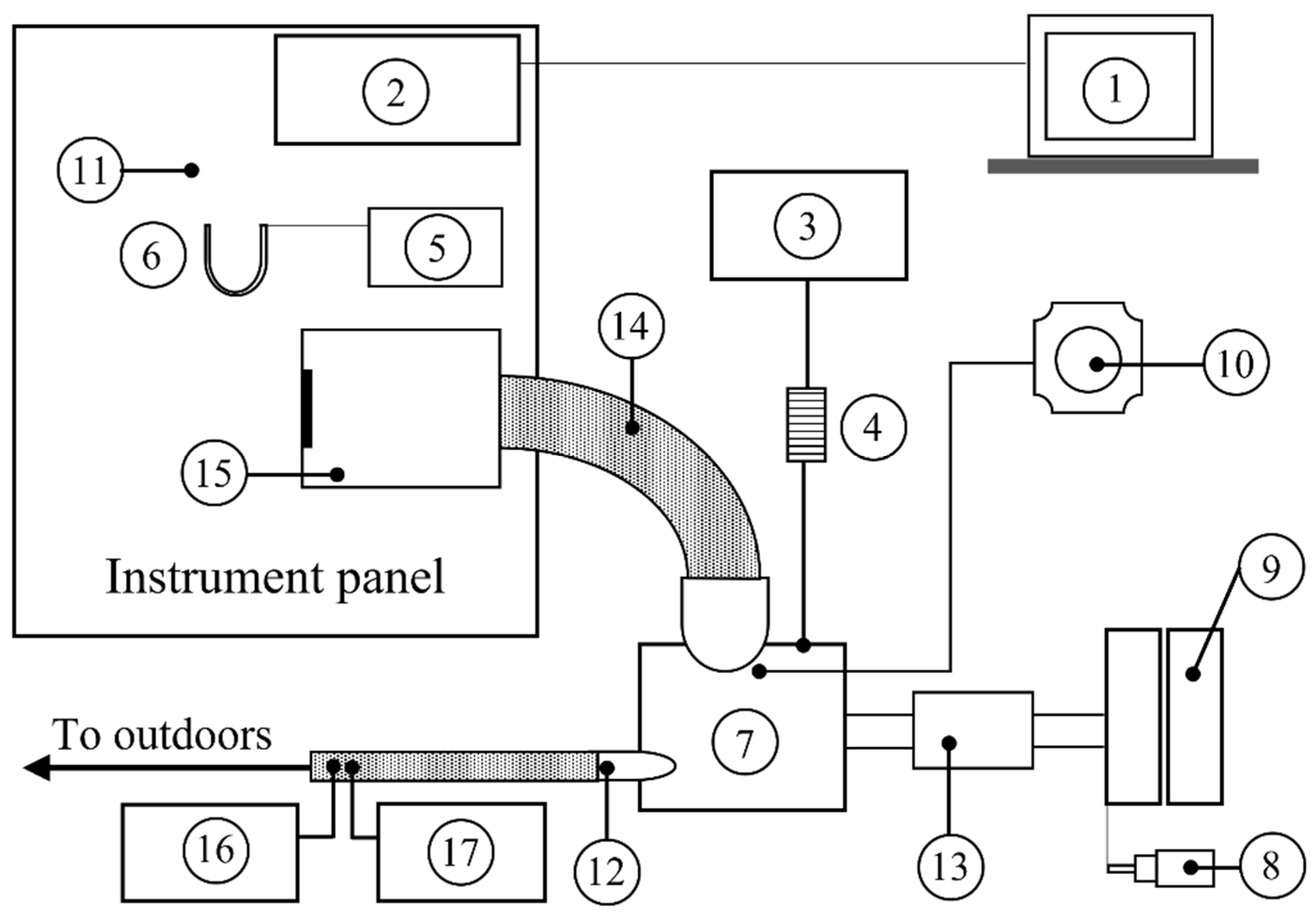
2.1. Experimental Apparatus
2.2. Test Fuels and Properties
2.3. Test Protocol and Operating Conditions
2.4. Calculation of Performance Parameters
3. Results and Discussion
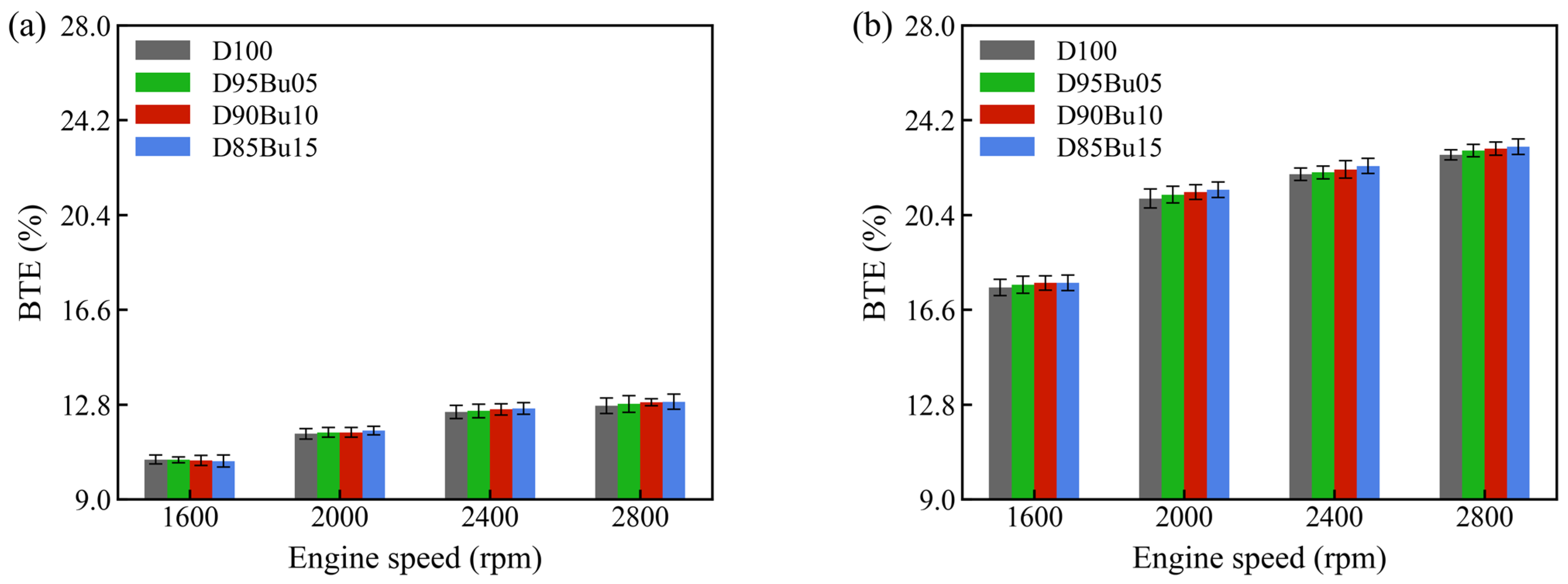
3.1. Brake Thermal Efficiency
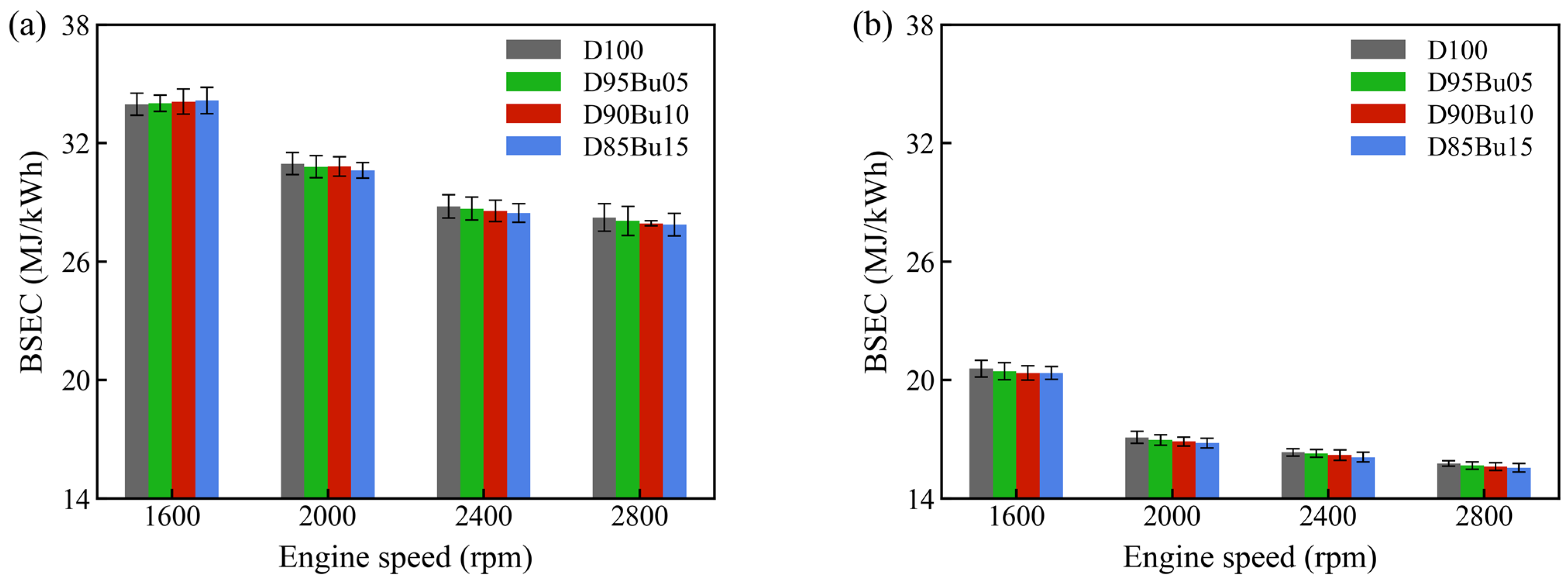
3.2. Brake-Specific Energy Consumption
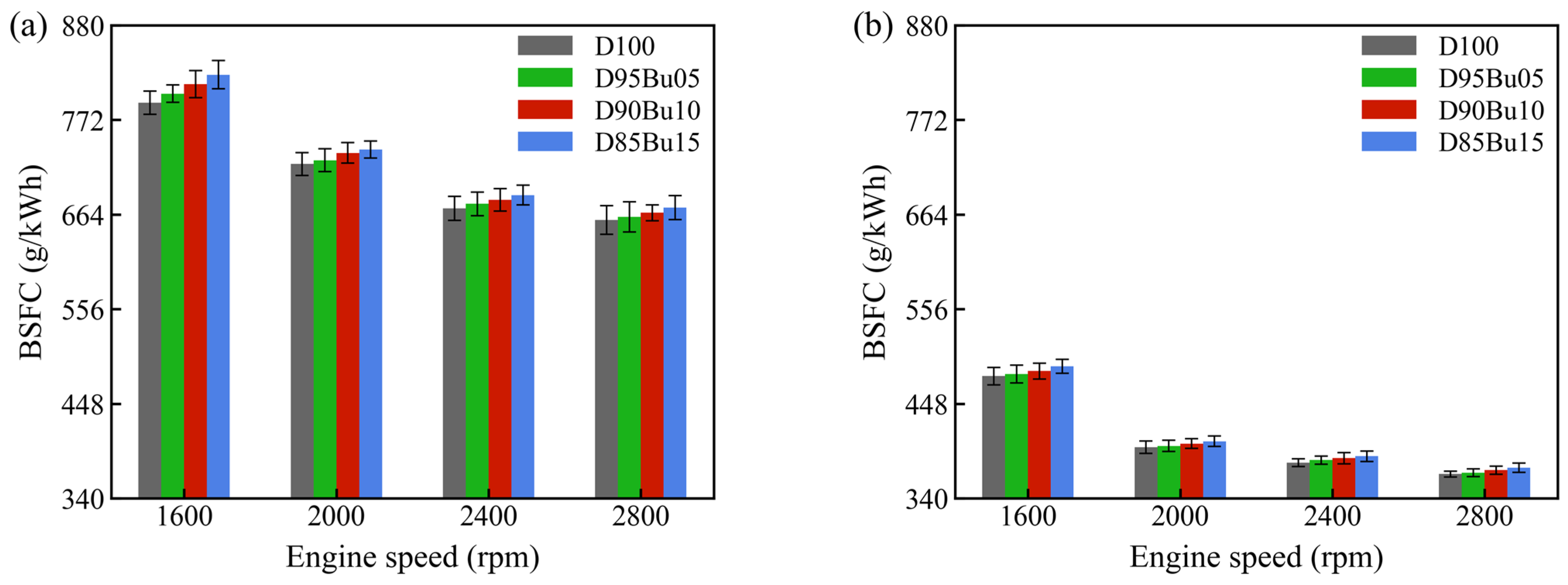
3.3. Brake-Specific Fuel Consumption
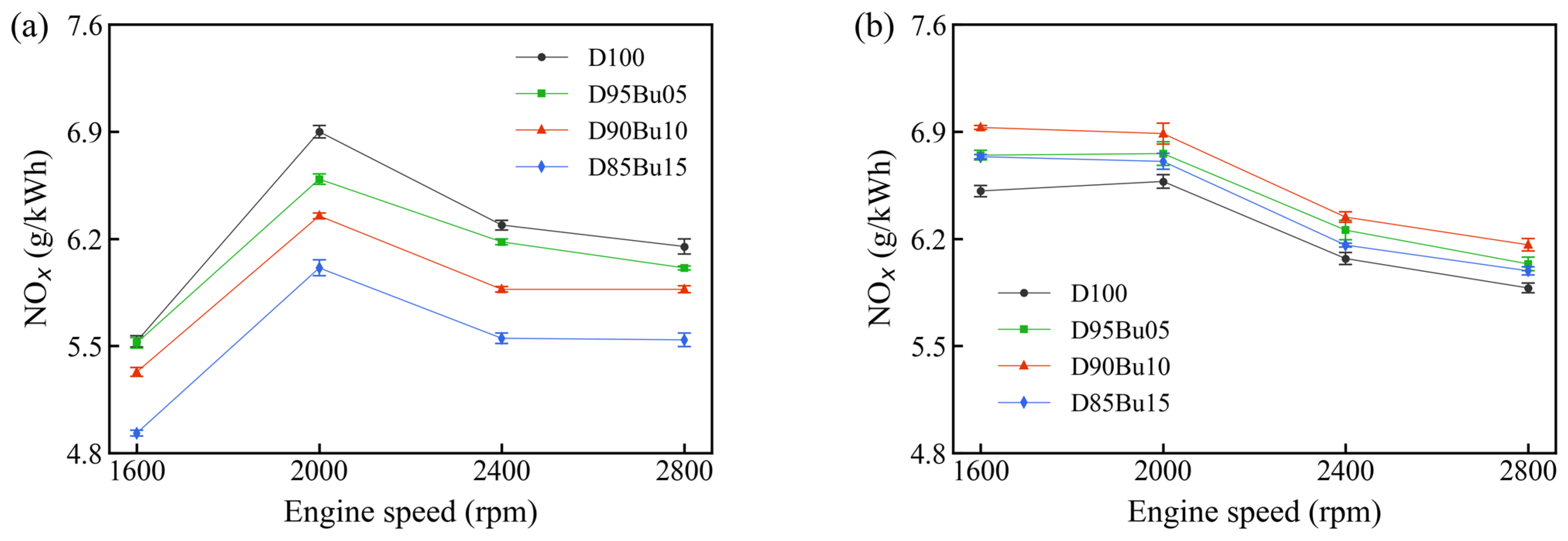
3.4. NOx Emissions
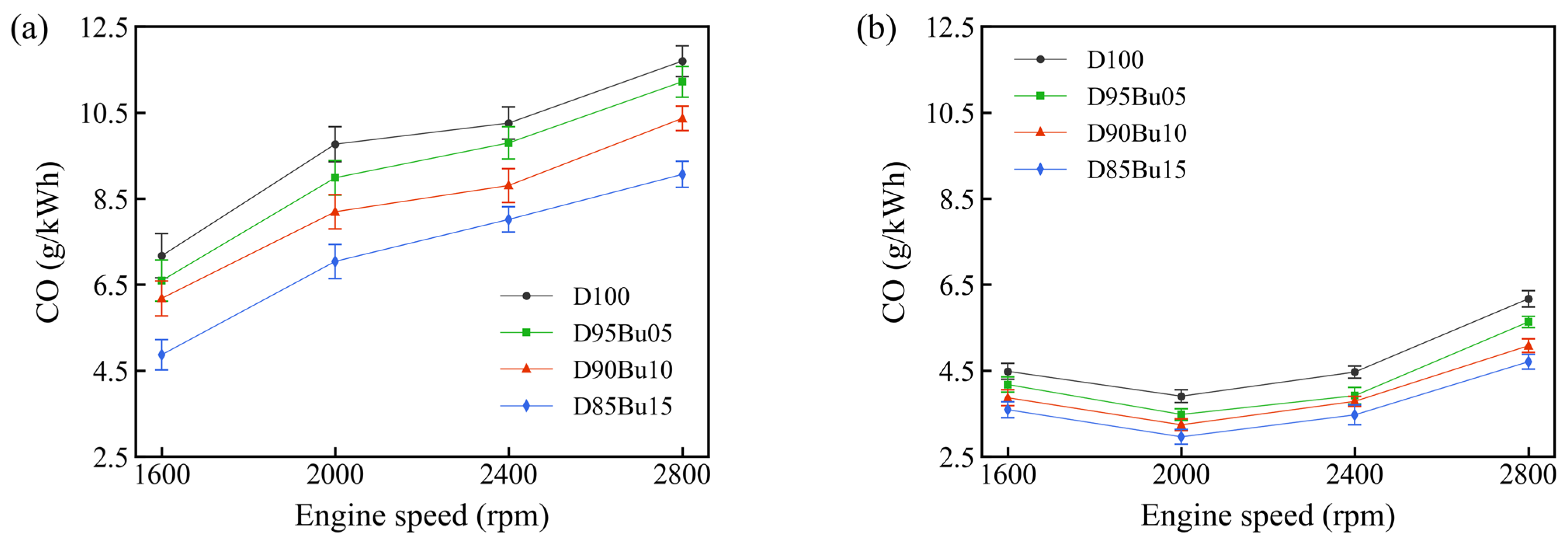
3.5. CO Emissions
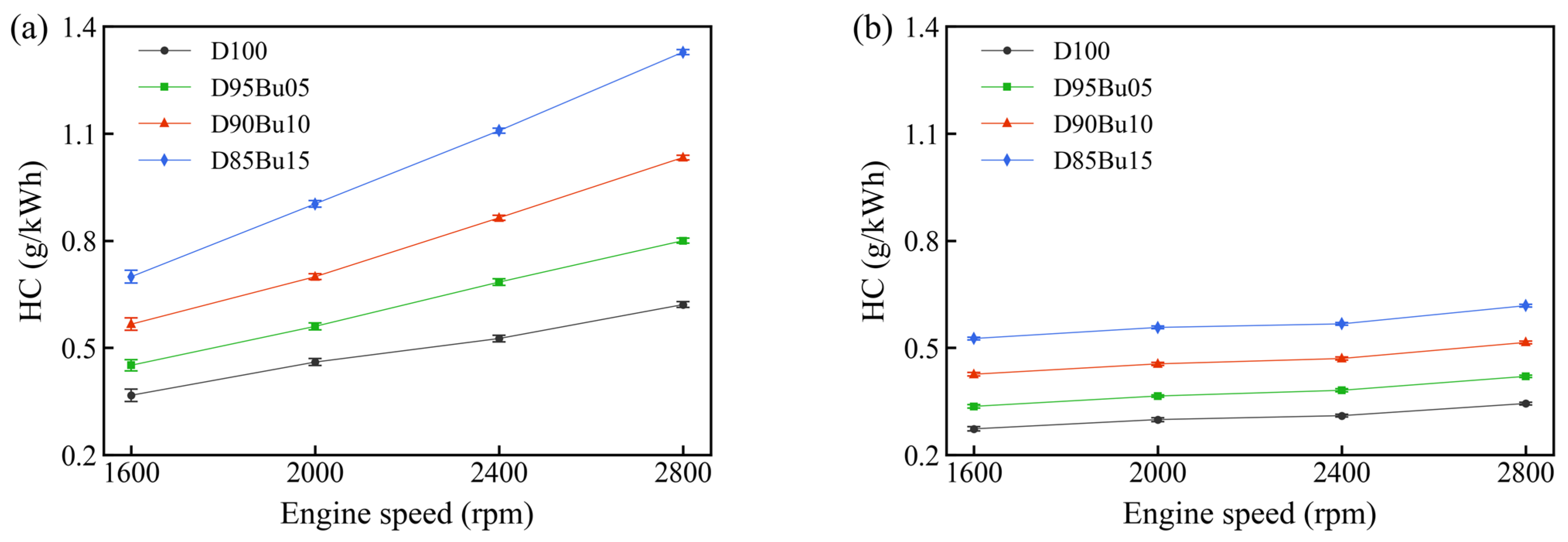
3.6. HC Emissions
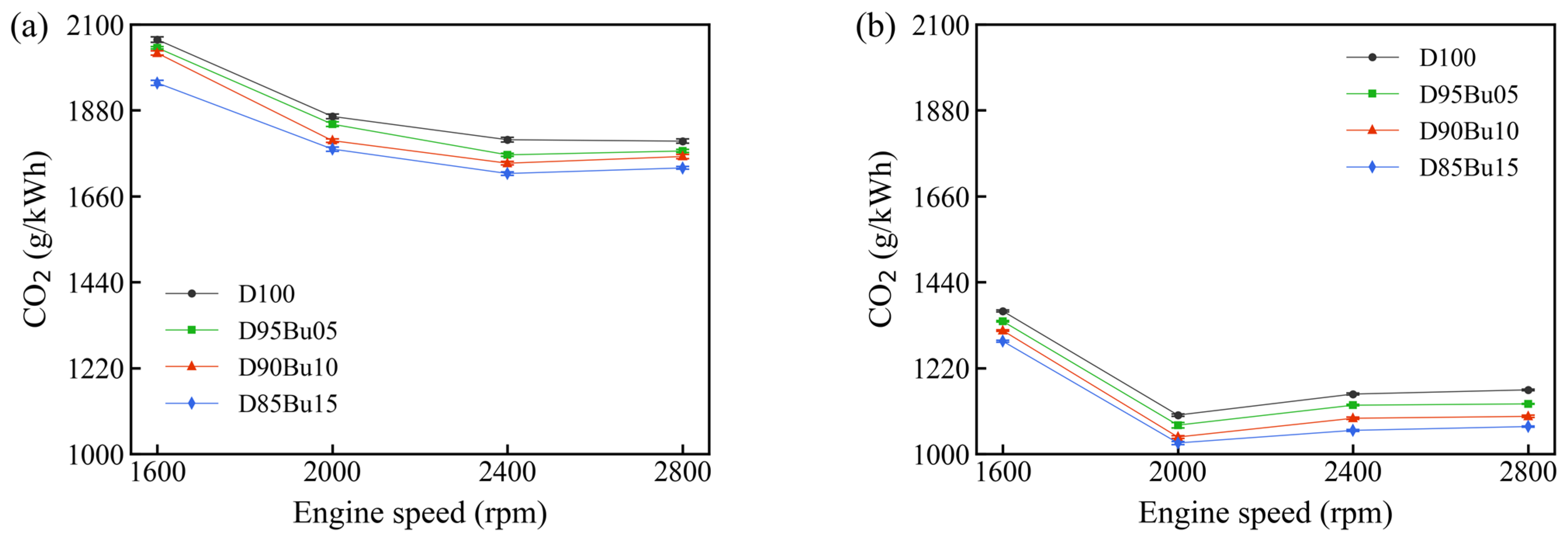
3.7. CO2 Emissions
3.8. Smoke Opacity
4. Conclusions
- Despite its lower calorific value than D100, n-butanol blending improved , particularly at high speed and load. This improvement is attributed to the oxygenated nature of n-butanol and a likely increase in the premixed combustion fraction—a behavior commonly associated with n-butanol blends—which enhances in-cylinder mixture formation and combustion. Consequently, although mass-based increased, decreased, indicating improved energy conversion efficiency.
- NOx emissions exhibited a strong dependence on engine load. At 25% low load, the charge-cooling effect induced by n-butanol’s high latent heat of vaporization dominated, resulting in reduced NOx emissions. In contrast, at 75% high load, elevated combustion temperatures offset the cooling effect, while intensified premixed combustion and increased local oxygen availability became dominant, leading to a moderate increase in NOx emissions.
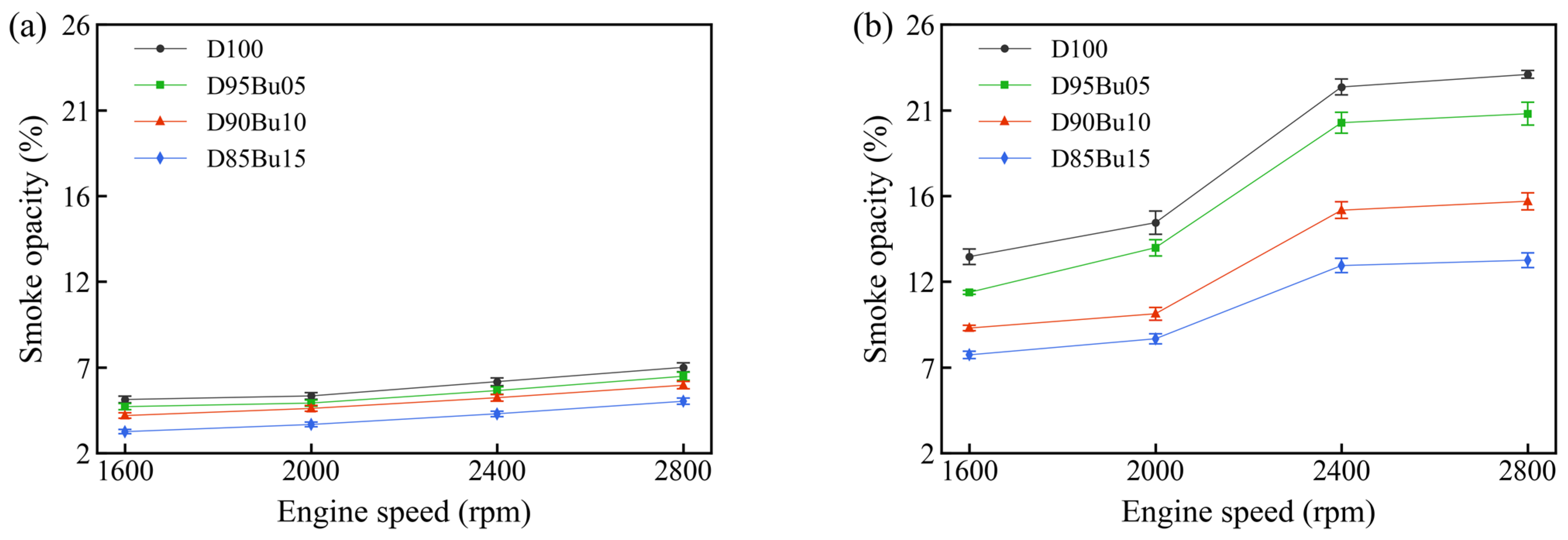
- n-Butanol blending consistently reduced smoke and GHG emissions. Smoke opacity was significantly reduced across the entire operating range due to the combined effects of fuel-borne oxygen and suppression of soot precursor formation. CO2 emissions also decreased relative to D100, primarily due to the lower C/H ratio of n-butanol, while CO emissions decreased due to enhanced oxidation reactions.
- In contrast, HC emissions increased with increasing n-butanol blending ratio under all operating conditions. This behavior is attributed to combustion characteristics often associated with n-butanol blends, including potential ignition-delay-related effects, local flame quenching, and the formation of over-lean mixtures. Accordingly, future work should focus on tailoring established mitigation strategies—such as after-treatment and combustion control—to this specific mechanically injected platform. To support this optimization, further studies will incorporate in-cylinder pressure analysis to quantitatively assess combustion phasing and ignition delay, together with detailed PM morphology analysis to clarify particulate formation mechanisms. These efforts will enable a more precise quantitative evaluation of the trade-offs among combustion efficiency, NOx, HC, and smoke emissions for n-butanol blends.
Author Contributions
Funding
Institutional Review Board Statement
Informed Consent Statement
Data Availability Statement
Acknowledgments
Conflicts of Interest
Abbreviations
| Air-fuel ratio | |
| Brake-specific energy consumption | |
| Brake-specific fuel consumption | |
| Brake thermal efficiency | |
| CFD | Computational fluid dynamics |
| CI | Confidence interval |
| CN | Cetane number |
| CO | Carbon monoxide |
| CO2 | Carbon dioxide |
| DI | Direct injection |
| DOC | Diesel oxidation catalyst |
| DPF | Diesel particulate filter |
| ECU | Electronic control unit |
| EGT | Exhaust gas temperature |
| GHG | Greenhouse gas |
| HC | Hydrocarbon |
| IDI | Indirect injection |
| IEA | International Energy Agency |
| IMO | International Maritime Organization |
| Lower heating value | |
| LTC | Low temperature combustion |
| NOx | Nitrogen oxides |
| PAH | Polycyclic aromatic hydrocarbon |
| PM | Particulate matter |
| RCCI | Reactivity controlled compression ignition |
| SCR | Selective catalytic reduction |
References
- IEA. Net Zero by 2050. 2021. Available online: https://www.iea.org/reports/net-zero-by-2050 (accessed on 16 December 2025).
- IMO. Resolution MEPC.377(80), 2023 IMO Strategy on Reduction of GHG Emissions from Ships; International Maritime Organization: London, UK, 2023. [Google Scholar]
- Dornoff, J.; Rodríguez, F. Euro 7: The New Emission Standard for Light-and Heavy-Duty Vehicles in the European Union; International Council on Clean Transportation: Washington, DC, USA, 2024. [Google Scholar]
- Zou, Y.; Xiao, L. DOC Study on the Effects of Catalyst Active Component Loading and Carrier Properties on the Catalytic Conversion Efficiency of Key Gaseous Pollutants. Sustainability 2025, 17, 6354. [Google Scholar] [CrossRef]
- Guan, B.; Zhan, R.; Lin, H.; Huang, Z. Review of the state-of-the-art of exhaust particulate filter technology in internal combustion engines. J. Environ. Manag. 2015, 154, 225–258. [Google Scholar] [CrossRef]
- Kim, H.J.; Jo, S.; Kwon, S.; Lee, J.-T.; Park, S. NOx emission analysis according to after-treatment devices (SCR, LNT + SCR, SDPF), and control strategies in Euro-6 light-duty diesel vehicles. Fuel 2022, 310, 122297. [Google Scholar] [CrossRef]
- Kumar, B.R.; Saravanan, S. Use of higher alcohol biofuels in diesel engines: A review. Renew. Sustain. Energy Rev. 2016, 60, 84–115. [Google Scholar] [CrossRef]
- Mahla, S.K.; Goga, G.; Cho, H.M.; Dhir, A.; Chauhan, B.S. Separate effect of biodiesel, n-butanol, and biogas on performance and emission characteristics of diesel engine: A review. Biomass Convers. Biorefin. 2023, 13, 447–469. [Google Scholar] [CrossRef]
- Singh, R.; Kumar, R. Insights into the influence of n-butanol with neat biodiesel and biodiesel-diesel blends on diesel engine characteristics: Review. Int. J. Energy Res. 2021, 46, 5446–5467. [Google Scholar] [CrossRef]
- Jamrozik, A.; Tutak, W.; Grab-Rogaliński, K. Combustion Stability, Performance and Emission Characteristics of a CI Engine Fueled with Diesel/n-Butanol Blends. Energies 2021, 14, 2817. [Google Scholar] [CrossRef]
- Zhang, Q.; Yang, C.; Li, Y. Effects of Ethanol, n-Butanol, and n-Pentanol Addition to Diesel Fuel on Combustion and Emission Characteristics in a Common-Rail Diesel Engine with Exhaust-Gas Recirculation. J. Energy Eng. 2021, 147, 04020086. [Google Scholar] [CrossRef]
- Warsita, I.W.; Lim, O. n-Butanol dilution effects on diesel sprays atomization: A macro to micro-scale analysis in a constant volume chamber. Fuel 2026, 408, 137467. [Google Scholar] [CrossRef]
- Zhou, F.; Yan, R.; Li, G.; Han, W. Experimental study on the effects of n-butanol and n-propanol on the spray and combustion characteristics of diesel/biodiesel blends in a constant volume combustion chamber. Renew. Energy 2024, 235, 121374. [Google Scholar] [CrossRef]
- Algayyim, S.J.M.; Wandel, A.P.; Yusaf, T.; Al-Lwayzy, S.; Hamawand, I. Impact of butanol-acetone mixture as a fuel additive on diesel engine performance and emissions. Fuel 2018, 227, 118–126. [Google Scholar] [CrossRef]
- Singh, R.; Singh, S.; Kumar, M. Impact of n-butanol as an additive with eucalyptus biodiesel-diesel blends on the performance and emission parameters of the diesel engine. Fuel 2020, 277, 118178. [Google Scholar] [CrossRef]
- Ma, Q.; Qiu, Y.; Zhang, Q.; Chen, Z. The practical application value of n-butanol in a heavy-duty engine: Energy-exergy-emission-environmental cost (4E) and sustainability analysis. Energy 2025, 334, 137626. [Google Scholar] [CrossRef]
- Yesilyurt, M.K.; Eryilmaz, T.; Arslan, M. A comparative analysis of the engine performance, exhaust emissions and combustion behaviors of a compression ignition engine fuelled with biodiesel/diesel/1-butanol (C4 alcohol) and biodiesel/diesel/n-pentanol (C5 alcohol) fuel blends. Energy 2018, 165, 1332–1351. [Google Scholar] [CrossRef]
- Tipanluisa, L.; Fonseca, N.; Casanova, J.; López, J.-M. Effect of n-butanol/diesel blends on performance and emissions of a heavy-duty diesel engine tested under the World Harmonised Steady-State cycle. Fuel 2021, 302, 121204. [Google Scholar] [CrossRef]
- Yu, S.; Cao, C.; Lv, W. Combustion and emission characteristics investigation of a marine diesel engine powered by diesel/biodiesel/n-butanol blends. Energy Sci. Eng. 2022, 10, 3317–3330. [Google Scholar] [CrossRef]
- Yilmaz, N.; Vigil, F.M.; Atmanli, A.; Donaldson, B. Detailed Analysis of PAH Formation, Toxicity and Regulated Pollutants in a Diesel Engine Running on Diesel Blends with n-Propanol, n-Butanol and n-Pentanol. Energies 2022, 15, 6487. [Google Scholar] [CrossRef]
- Prasad, K.S.; Rao, S.S.; Raju, V.R.K. Performance and emission characteristics of a DI-CI engine operated with n-butanol/diesel blends. Energy Sources Part A Recovery Util. Environ. Eff. 2024, 46, 1419–1430. [Google Scholar]
- Xiao, H.; Guo, F.; Li, S.; Wang, R.; Yang, X. Combustion performance and emission characteristics of a diesel engine burning biodiesel blended with n-butanol. Fuel 2019, 258, 115887. [Google Scholar] [CrossRef]
- Gao, S.; Ye, Y.; Tan, D.; Jia, G.; Zhang, B.; Liu, H.; Li, D.; Zhang, J.; Zhong, W.; Zhang, Z. Improvements of performance and emission characteristics of a diesel engine fueled with diesel/PODE3/n-butanol blended fuels by RSM-NSGA III in plateau environment. Process Saf. Environ. Prot. 2024, 185, 184–210. [Google Scholar] [CrossRef]
- Kim, K.H.; Choi, B.; Park, S.; Kim, E.; Chiaramonti, D. Emission characteristics of compression ignition (CI) engine using diesel blended with hydrated butanol. Fuel 2019, 257, 116037. [Google Scholar] [CrossRef]
- Ma, W.; Gao, S.; Liu, H.; Li, D. The improvements of a diesel engine fueled with renewable and sustainable diesel/n-butanol/polyoxymethylene dimethyl ethers blended fuels at high altitudes. Energy 2024, 289, 130060. [Google Scholar] [CrossRef]
- Zhu, Y.; Chen, Z.; Liu, J. Emission, efficiency, and influence in a diesel n-butanol dual-injection engine. Energy Convers. Manag. 2014, 87, 385–391. [Google Scholar] [CrossRef]
- Zhang, T.; Munch, K.; Denbratt, I. An Experimental Study on the Use of Butanol or Octanol Blends in a Heavy Duty Diesel Engine. SAE Int. J. Fuels Lubr. 2015, 8, 610–621. [Google Scholar] [CrossRef]
- Kumar, B.R.; Saravanan, S. Effects of iso-butanol/diesel and n-pentanol/diesel blends on performance and emissions of a DI diesel engine under premixed LTC (low temperature combustion) mode. Fuel 2016, 170, 49–59. [Google Scholar] [CrossRef]
- Han, J.; Bao, H.; Somers, L.M.T. Experimental investigation of reactivity controlled compression ignition with n-butanol/n-heptane in a heavy-duty diesel engine. Appl. Energy 2021, 282, 116164. [Google Scholar] [CrossRef]
- Pan, M.; Wang, Y.; Qian, W.; Wu, C.; Huang, H.; Li, H.; Zhou, X. Experimental and numerical study on flow, combustion and emission characteristics of CI engine fueled with n-butanol/diesel blends under post-injection strategy. Fuel 2021, 292, 120267. [Google Scholar] [CrossRef]
- Chen, K.; Huang, H.; Guo, X.; Zheng, Q.; Tian, S.; Li, J.; Liu, Q. Study of methanol-added diesel/n-butanol blends combined with different injections for improving pollution emissions from diesel engines. Fuel 2025, 399, 135701. [Google Scholar] [CrossRef]
- Tian, Z.; Feng, X.; Wang, Y.; Zhen, X.; Li, X. Comparative analysis of combustion and emission characteristics of diesel/alcohol dual-fuel in a pressure-difference controlled same needle injector system with synergistic EGR optimization. Energy 2025, 337, 138663. [Google Scholar] [CrossRef]
- Behera, B.N.; Hotta, T.K. Impact of exhaust gas recirculation on the performance, emission, and combustion features of a diesel engine using diesel, n-butanol, and waste cooking vegetable oil blends. Environ. Prog. Sustain. Energy 2025, e70138. [Google Scholar] [CrossRef]
- Li, M.; Li, C.; Wei, Z.; Zhang, Q.; Rao, Z. Numerical study on the combustion and emission characteristics of a direct injection natural gas engine ignited by diesel/n-butanol blends. Appl. Therm. Eng. 2023, 226, 120333. [Google Scholar] [CrossRef]
- Xie, M.; Wang, Y.; Bai, Y. Impact mechanism of double injection on the combustion and emission characteristics of n-butanol/diesel dual fuel direct injection engine. Sustain. Energy Technol. Assess. 2024, 68, 103861. [Google Scholar] [CrossRef]
- Shao, K.; Cao, T.; Wu, H.; Huang, B. Numerical Simulation to Study the Effect of Oxygenated Fuels on the Combustion and Emission Characteristics of Engines. ACS Omega 2025, 10, 56364–56377. [Google Scholar] [CrossRef]
- Saleh, H.E. Performance and emissions characteristics of direct injection diesel engine fueled by diesel-jojoba oil-butanol blends with hydrogen peroxide. Fuel 2021, 285, 119048. [Google Scholar] [CrossRef]
- Yilmaz, N.; Vigil, F.M.; Benalil, K.; Davis, S.M.; Calva, A. Effect of biodiesel-butanol fuel blends on emissions and performance characteristics of a diesel engine. Fuel 2014, 135, 46–50. [Google Scholar] [CrossRef]
- Kim, D.; Yang, J.; Kwon, J. Performance and Emission Characteristics of n-Pentanol–Diesel Blends in a Single-Cylinder CI Engine. Energies 2025, 18, 5083. [Google Scholar] [CrossRef]
- Yang, M.; Wang, Z.; Guo, S.; Xin, X.; Qi, T.; Lei, T.; Yan, X. Effects of fuel properties on combustion and emissions of a direct injection diesel engine fueled with n-butanol-diesel blends. J. Renew. Sustain. Energy 2017, 9, 013105. [Google Scholar] [CrossRef]



| Parameter | Specifications |
|---|---|
| Model | MITSUKI MIT-178F |
| Number of cylinders | 1 |
| Bore | 78 mm |
| Stroke | 62.5 mm |
| Cylinder volume | 305 cm3 |
| Compression ratio | 21:1 |
| Rated power | 5.22 kW @ 3000 rpm |
| Injection type | Direct injection |
| Intake system | Naturally aspirated |
| Cooling system | Air-cooled |
| Ignition | Compression ignition |
| Type of loading | Eddy current dynamometer |
| Emissions | Range | Accuracy | Uncertainty (%) |
|---|---|---|---|
| NOx | 0–5000 ppm | ±15 ppm | ±3.6 |
| CO | 0–10% | ±0.02% | ±3.4 |
| HC | 0–9999 ppm | ±20 ppm | ±3.6 |
| CO2 | 0–20% | ±0.06% | ±3.8 |
| Smoke opacity | 0–100% | ±1% | ±7.2 |
| Properties | Diesel | n-Butanol |
|---|---|---|
| Lower heating value (MJ/kg) | 43.2 | 33.1 |
| Latent heat of vaporization (MJ/kg) | 0.27 | 0.58 |
| Cetane number | 51 | 17 |
| Self-ignition temperature (°C) | 177 | 345 |
| Density (kg/m3) | 840 | 814 |
| Kinematic viscosity at 40 °C (mm2/s) | 3.75 | 2.69 |
| Stoichiometric * | 14.97 | 11.16 |
| Oxygen (wt.%) | 0 | 21.6 |
| Engine Load (%) | Engine Speed (rpm) | D100 | D95Bu05 | D90Bu10 | D85Bu15 |
|---|---|---|---|---|---|
| 25 | 1600 | 1.98 | 2.02 | 2.03 | 1.97 |
| 2000 | 2.08 | 2.08 | 2.07 | 2.08 | |
| 2400 | 1.97 | 1.97 | 1.98 | 1.98 | |
| 2800 | 1.91 | 1.93 | 1.93 | 1.94 | |
| 75 | 1600 | 1.13 | 1.13 | 1.13 | 1.13 |
| 2000 | 1.25 | 1.25 | 1.24 | 1.24 | |
| 2400 | 1.17 | 1.16 | 1.15 | 1.14 | |
| 2800 | 1.15 | 1.14 | 1.13 | 1.13 |
| Engine Load (%) | Engine Speed (rpm) | D100 (°C) | D95Bu05 (°C) | D90Bu10 (°C) | D85Bu15 (°C) |
|---|---|---|---|---|---|
| 25 | 1600 | 141 | 147 | 150 | 154 |
| 2000 | 166 | 166 | 169 | 172 | |
| 2400 | 181 | 181 | 184 | 187 | |
| 2800 | 197 | 198 | 200 | 205 | |
| 75 | 1600 | 335 | 339 | 344 | 352 |
| 2000 | 362 | 370 | 372 | 382 | |
| 2400 | 385 | 395 | 398 | 411 | |
| 2800 | 394 | 413 | 420 | 436 |
Disclaimer/Publisher’s Note: The statements, opinions and data contained in all publications are solely those of the individual author(s) and contributor(s) and not of MDPI and/or the editor(s). MDPI and/or the editor(s) disclaim responsibility for any injury to people or property resulting from any ideas, methods, instructions or products referred to in the content. |
© 2026 by the authors. Licensee MDPI, Basel, Switzerland. This article is an open access article distributed under the terms and conditions of the Creative Commons Attribution (CC BY) license.
Share and Cite
Kwon, J.; Kang, C.; Ahn, J. Load-Dependent Efficiency and Emission Trade-Offs of n-Butanol–Diesel Blends in a Naturally Aspirated Diesel Engine. Atmosphere 2026, 17, 182. https://doi.org/10.3390/atmos17020182
Kwon J, Kang C, Ahn J. Load-Dependent Efficiency and Emission Trade-Offs of n-Butanol–Diesel Blends in a Naturally Aspirated Diesel Engine. Atmosphere. 2026; 17(2):182. https://doi.org/10.3390/atmos17020182
Chicago/Turabian StyleKwon, Jaesung, Chanwoo Kang, and Jongkap Ahn. 2026. "Load-Dependent Efficiency and Emission Trade-Offs of n-Butanol–Diesel Blends in a Naturally Aspirated Diesel Engine" Atmosphere 17, no. 2: 182. https://doi.org/10.3390/atmos17020182
APA StyleKwon, J., Kang, C., & Ahn, J. (2026). Load-Dependent Efficiency and Emission Trade-Offs of n-Butanol–Diesel Blends in a Naturally Aspirated Diesel Engine. Atmosphere, 17(2), 182. https://doi.org/10.3390/atmos17020182