
First Major Eruption of Solar Cycle 25: Impacts of the 3 July 2021 X1.59 Solar Flare on the Ionosphere and Primary Cosmic Rays

 ,
,  ,
,  , , , and
Abstract
1. Introduction
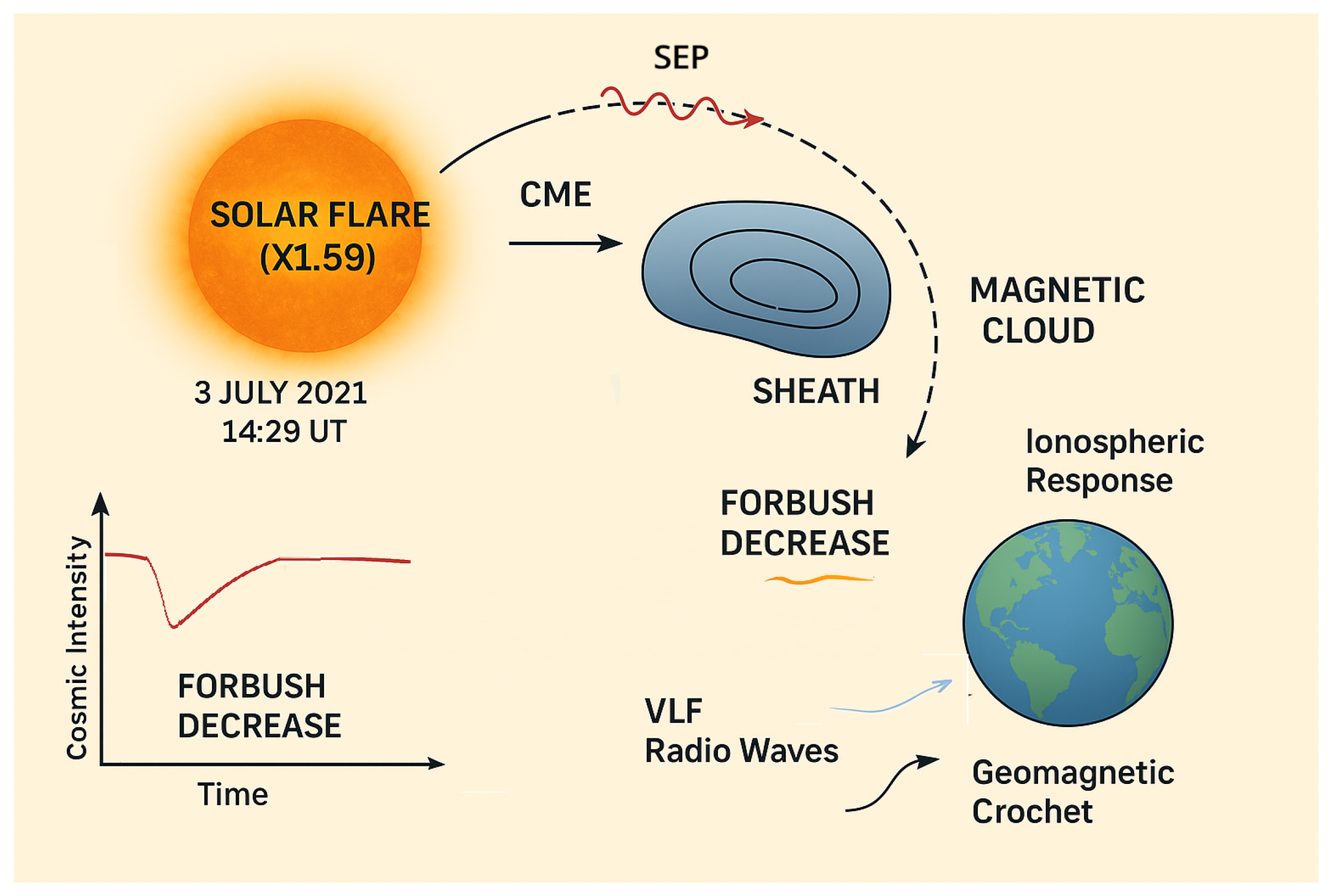
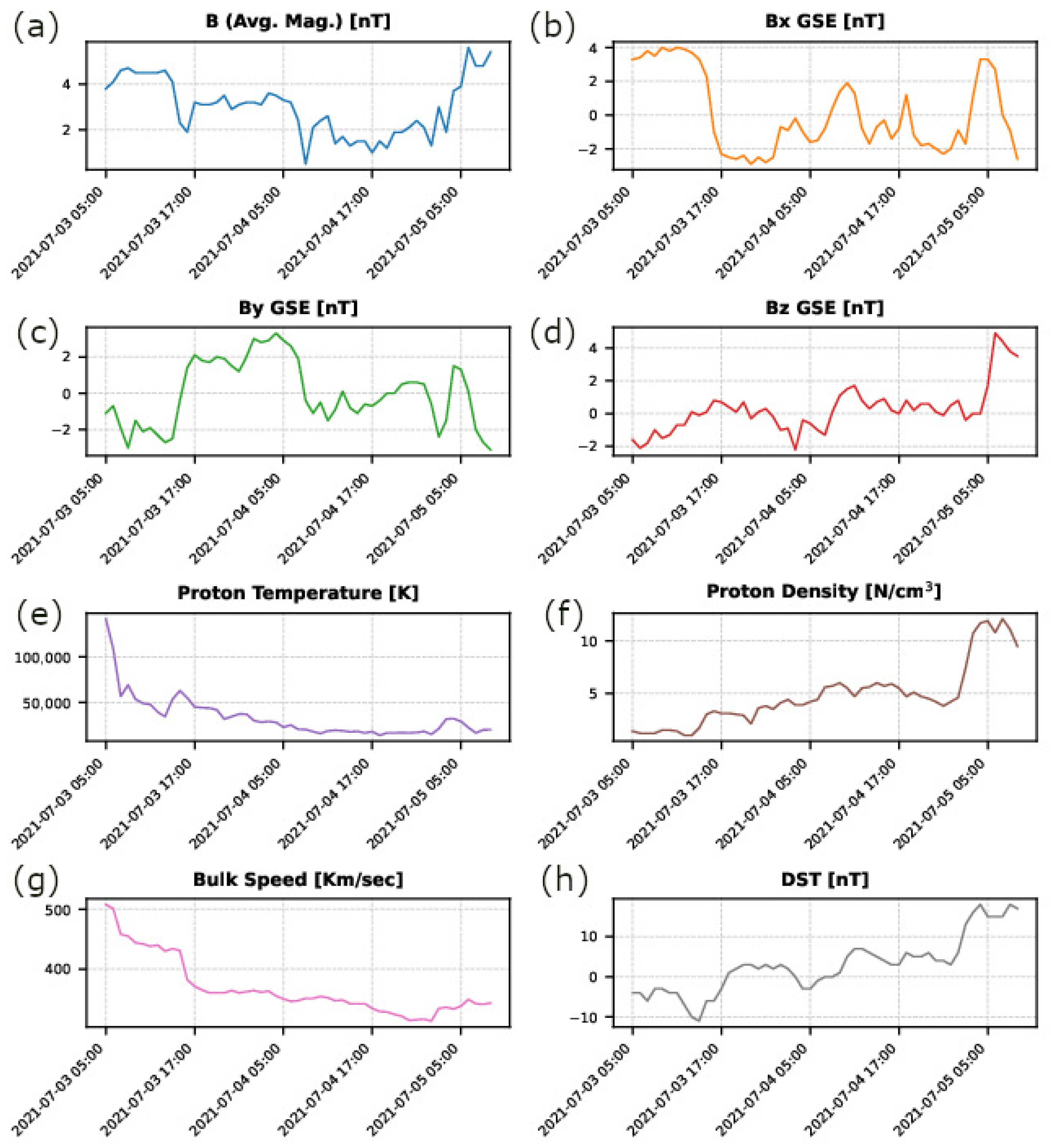
- The CME (with its magnetic cloud and sheath) travels through interplanetary space, disturbs the interplanetary magnetic field, and acts as a barrier to galactic cosmic rays.
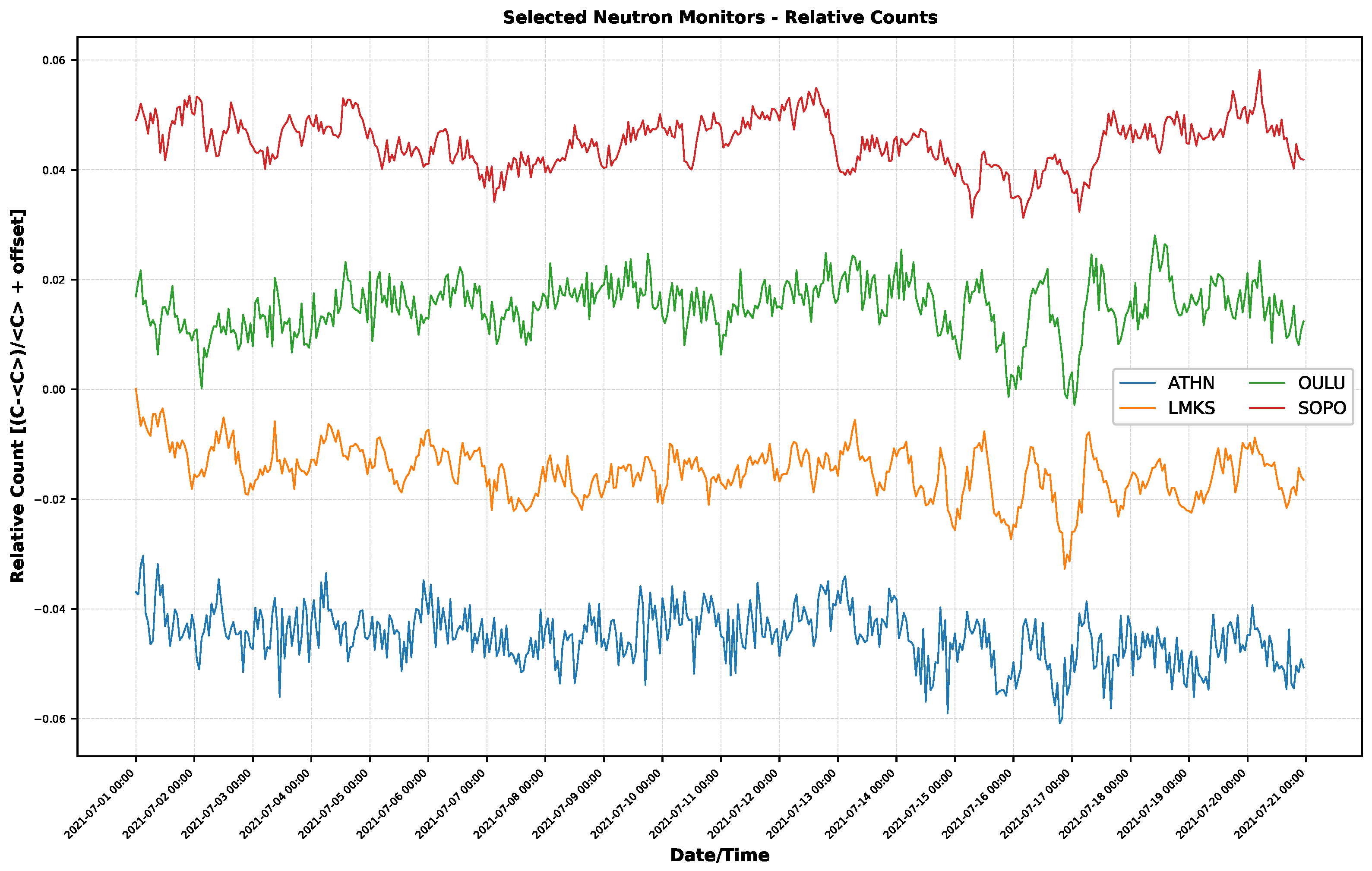
- This suppression of cosmic-ray influx leads to a noticeable drop in cosmic-ray intensity at the Earth, known as a Forbush decrease.
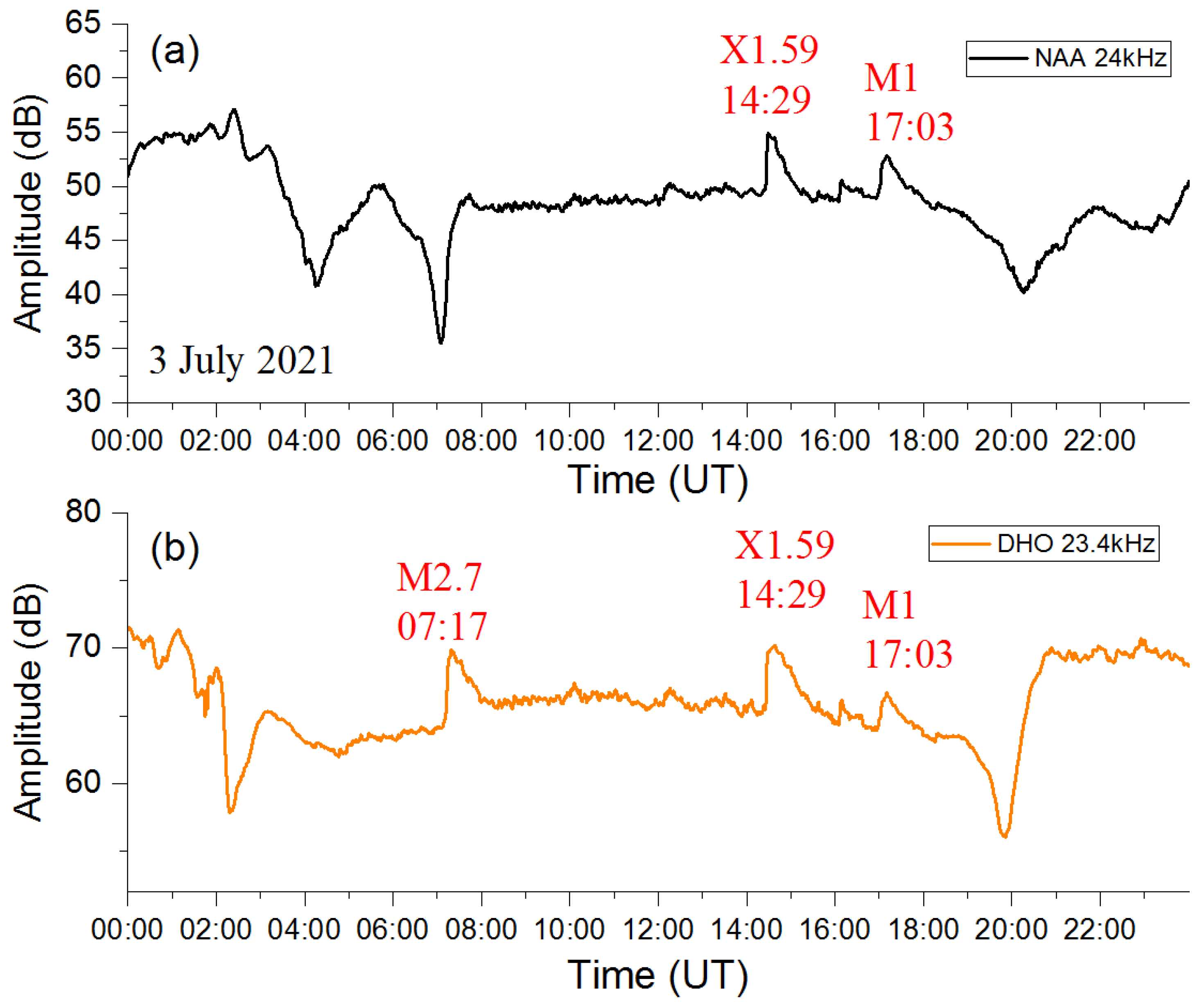
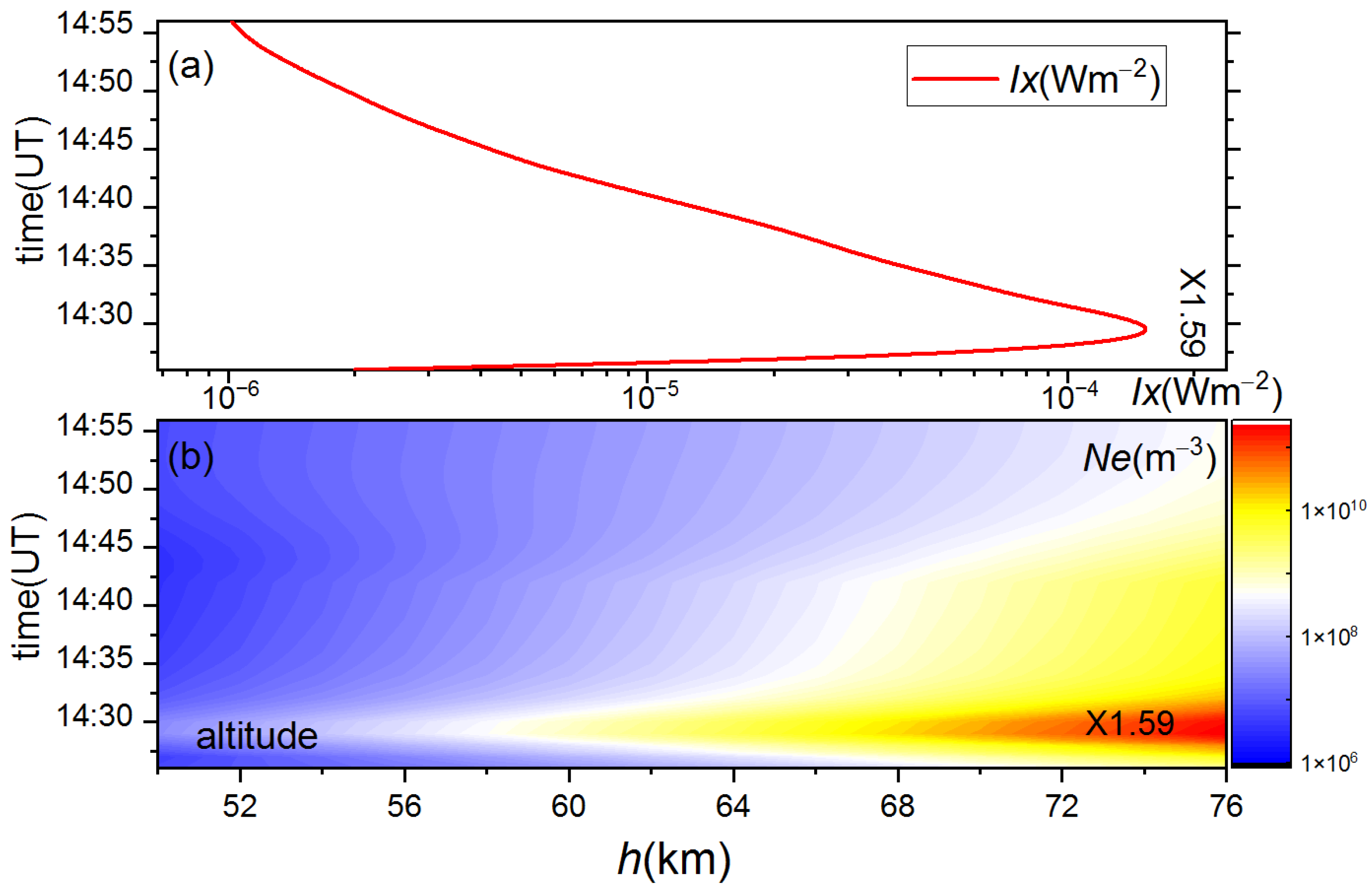
- Enhanced X-ray and EUV radiation from the flare produces rapid ionization in the lower ionosphere (especially the D-region), modifying electron densities, conductivity, and the propagation of VLF radio waves.
- During the flare’s impulsive phase, sudden increases in ionospheric currents may induce a short-lived geomagnetic perturbation at the Earth’s surface, known as a geomagnetic crochet.
2. Materials and Methods
3. Results and Discussion
3.1. Ionosphere
3.2. Solar Wind Data
3.3. Cosmic Rays
4. Conclusions and Perspectives
Author Contributions
Funding
Institutional Review Board Statement
Informed Consent Statement
Data Availability Statement
Acknowledgments
Conflicts of Interest
References
- Waterfall, C.O.G.; Dalla, S.; Raukunen, O.; Heynderickx, D.; Jiggens, P.; Vainio, R. High Energy Solar Particle Events and Their Relationship to Associated Flare, CME and GLE Parameters. Space Weather 2023, 21, e2022SW003334. [Google Scholar] [CrossRef]
- Tsurutani, B.T.; Gonzalez, W.D. The Interplanetary causes of magnetic storms: A review. J. Geophys. Res. 1997, 98, 77–89. [Google Scholar] [CrossRef]
- Hargreaves, J.K. The Solar-Terrestrial Environment; Cambridge University Press: Cambridge, UK, 1992. [Google Scholar]
- Lanzerotti, L.J. Space Weather Effects on Communications. In Proceedings of the Space Storms and Space Weather Hazards; Daglis, I.A., Ed.; Springer: Berlin/Heidelberg, Germany, 2001; p. 313. [Google Scholar]
- Cid, C.; Palacios, J.; Saiz, E.; Guerrero, A.; Cerrato, Y. On extreme geomagnetic storms. J. Space Weather Space Clim. 2014, 4, A28. [Google Scholar] [CrossRef]
- Miteva, R.; Samwel, S.W.; Tkatchova, S. Space Weather Effects on Satellites. Astronomy 2023, 2, 165–179. [Google Scholar] [CrossRef]
- Ishii, M.; Berdermann, J.; Forte, B.; Hapgood, M.; Bisi, M.M.; Romano, V. Space weather impact on radio communication and navigation. Adv. Space Res. 2024. [Google Scholar] [CrossRef]
- McRae, W.M.; Thomson, N.R. Solar flare induced ionospheric D-region enhancements from VLF phase and amplitude observations. J. Atmos. Sol.-Terr. Phys. 2004, 66, 77–87. [Google Scholar] [CrossRef]
- Thomson, N. Experimental daytime VLF ionospheric parameters. J. Atmos. Terr. Phys. 1993, 55, 173–184. [Google Scholar] [CrossRef]
- Thomson, N.R.; Rodger, C.J.; Clilverd, M.A. Daytime D region parameters from long-path VLF phase and amplitude. J. Geophys. Res. Space Phys. 2011, 116, A11. [Google Scholar] [CrossRef]
- Pandey, U.; Singh, B.; Singh, O.P.; Saraswat, V.K. Solar flare induced ionospheric D-region perturbation as observed at a low latitude station Agra, India. Astrophys. Space Sci. 2015, 357, 35. [Google Scholar] [CrossRef]
- Sripathi, S.; Balachandran, N.; Veenadhari, B.; Singh, R.; Emperumal, K. Response of the equatorial and low-latitude ionosphere to an intense X-class solar flare (X7/2B) as observed on 09 August 2011. J. Geophys. Res. Space Phys. 2013, 118, 2648–2659. [Google Scholar] [CrossRef]
- Grubor, D.; Šulić, D.; Žigman, V. Classification of X-ray solar flares regarding their effects on the lower ionosphere electron density profile. Ann. Geophys. 2008, 26, 1731–1740. [Google Scholar] [CrossRef]
- Bekker, S. Assessment of Vertical Redistribution of Electron Density in Ionosphere During an X-Class Solar Flare Using GNSS Data. Atmosphere 2025, 16, 825. [Google Scholar] [CrossRef]
- Wait, J.R.; Spies, K.P. Characteristics of the Earth–Ionosphere Waveguide for VLF Radio Waves; Technical Report Technical Note 300; National Bureau of Standards: Gaithersburg, MD, USA, 1964. [Google Scholar]
- Kelley, M.C. The Earth’s Ionosphere: Plasma Physics and Electrodynamics, 2nd ed.; Academic Press: Cambridge, MA, USA, 2009. [Google Scholar]
- Grubor, D.; Šulić, D.; Žigman, V. Influence of Solar X-ray Flares on the Earth-Ionosphere Waveguide. Serbian Astron. J. 2005, 171, 29–35. [Google Scholar] [CrossRef]
- Thomson, N.R.; Clilverd, M.A.; Rodger, C.J. Midlatitude ionospheric D region: Height, sharpness, and solar zenith angle. J. Geophys. Res. 2017, 122, 8933–8946. [Google Scholar] [CrossRef]
- Thomson, N.R.; Clilverd, M.A.; Rodger, C.J. Ionospheric D Region: VLF-Measured Electron Densities Compared With Rocket-Based FIRI-2018 Model. J. Geophys. Res. 2022, 127, e2022JA030977. [Google Scholar] [CrossRef]
- Srećković, V.A.; Dimitrijević, M.S.; Mijić, Z.R. Data in Astrophysics and Geophysics: Novel Research and Applications. Data 2024, 9, 32. [Google Scholar] [CrossRef]
- Thomson, N.R.; Clilverd, M.A.; Rodger, C.J. Ionospheric D Region: Characteristics Near Dawn and Dusk. J. Geophys. Res. 2025, 130, e2024JA033610. [Google Scholar] [CrossRef]
- Raulin, J.P.; Abe Pacini, A.; Kaufmann, P.; Correia, E.; Aparecida, G.; Martinez, M. On the detectability of solar X-ray flares using very low frequency sudden phase anomalies. J. Atmos. Sol.-Terr. Phys. 2006, 68, 1029–1035. [Google Scholar] [CrossRef]
- Todoroki, Y.; Maekawa, S.; Yamauchi, T.; Horie, T.; Hayakawa, M. Solar flare induced D region perturbation in the ionosphere, as revealed from a short-distance VLF propagation path. Geophys. Res. Lett. 2007, 34, L03103. [Google Scholar] [CrossRef]
- Kumar, A.; Kumar, S. Solar flare effects on D-region ionosphere using VLF measurements during low- and high-solar activity phases of solar cycle 24. Earth Planets Space 2018, 70, 29. [Google Scholar] [CrossRef]
- Rastogi, R.G.; Kaushika, N.D.; Trivedi, N.B. Solar flare crochet and sudden commencement in H within the equatorial electrojet region. J. Atmos. Terr. Phys. 1965, 27, 663–668. [Google Scholar] [CrossRef]
- Broumandan, A.; Tremblay, I.; Kennedy, S. Impact of Solar Cycle 25 on GNSS Measurements: Analysis of Ionospheric Scintillation and Positioning Challenges. Eng. Proc. 2025, 88, 21. [Google Scholar] [CrossRef]
- Tsurutani, B.T.; Verkhoglyadova, O.P.; Mannucci, A.J.; Lakhina, G.S.; Li, G.; Zank, G.P. A brief review of “solar flare effects” on the ionosphere. Radio Sci. 2009, 44, RS0A17. [Google Scholar] [CrossRef]
- Huang, L.; Qi, Z.; Shi, S.; Chen, Y.; Zhao, F.; Wang, X.; Zhu, F.; Li, X.; Feng, P. Study on the Impact of C-Class Solar Flares on Low-Frequency Signal Propagation and Ionospheric Disturbances. Atmosphere 2025, 16, 154. [Google Scholar] [CrossRef]
- Yashiro, S.; Gopalswamy, N. Statistical relationship between solar flares and CMEs. Proc. IAU Symp. 2009, 257, 233–243. [Google Scholar] [CrossRef]
- Richardson, I.G.; Cane, H.V. Near-Earth interplanetary coronal mass ejections and their geomagnetic effects. Sol. Phys. 2010, 264, 189–237. [Google Scholar] [CrossRef]
- Forbush, S.E. On the Effects in Cosmic-Ray Intensity Observed During the Recent Magnetic Storm. Phys. Rev. 1937, 51, 1108–1109. [Google Scholar] [CrossRef]
- Cane, H.V. Coronal Mass Ejections and Forbush Decreases. Space Sci. Rev. 2000, 93, 55–77. [Google Scholar] [CrossRef]
- Ahluwalia, H.S. Solar Wind Modulation of Galactic Cosmic Rays. In AGU Fall Meeting Abstracts, Proceedings of the AGU Fall Meeting Abstracts, San Francisco, CA, USA, 6–10 December 2002; SH11A–0377; AGU: Washington, DC, USA, 2022. [Google Scholar]
- Belov, A.; Shlyk, N.; Abunina, M.; Belova, E.; Abunin, A.; Papaioannou, A. Solar Energetic Particle Events and Forbush Decreases Driven by the Same Solar Sources. Universe 2022, 8, 403. [Google Scholar] [CrossRef]
- Riley, P. On the probability of occurrence of extreme space weather events. Space Weather 2012, 10, S02012. [Google Scholar] [CrossRef]
- Srećković, V.A. New Challenges in Exploring Solar Radiation: Influence, Consequences, Diagnostics, Prediction. Appl. Sci. 2023, 13, 4126. [Google Scholar] [CrossRef]
- Eastwood, J.; Biffis, E.; Hapgood, M.; Green, L.; Bisi, M.; Bentley, R.; Wicks, R.; McKinnell, L.A.; Gibbs, M.; Burnett, C. The economic impact of space weather: Where do we stand? Risk Anal. 2017, 37, 206–218. [Google Scholar] [CrossRef]
- Zolesi, B.; Cander, L. Ionospheric Prediction and Forecasting; Springer: Berlin/Heidelberg, Germany, 2014. [Google Scholar] [CrossRef]
- Savić, M.; Veselinović, N.; Dragić, A.; Maletić, D.; Joković, D.; Udovičić, V.; Banjanac, R.; Knežević, D. New insights from cross-correlation studies between solar activity indices and cosmic-ray flux during Forbush decrease events. Adv. Space Res. 2023, 71, 2006–2016. [Google Scholar] [CrossRef]
- Curto, J.J.; Gaya-Piqué, L.R. Geoeffectiveness of solar flares in magnetic crochet (sfe) production: II—Dependence on the detection method. J. Atmos. Sol.-Terr. Phys. 2009, 71, 1705–1710. [Google Scholar] [CrossRef]
- Dodson, H.W.; Hedeman, E.R. Crochet-Associated Flares. Astrophys. J. 1958, 128, 636. [Google Scholar] [CrossRef]
- Pintér, Š. Geomagnetic crochets of solar flares observed in Hurbanovo. Bull. Astron. Institutes Czechoslov. 1967, 18, 274. [Google Scholar]
- Richmond, A.D.; Venkateswaran, S.V. Geomagnetic Crochets and Associated Ionospheric Current Systems. Radio Sci. 1971, 6, 139–164. [Google Scholar] [CrossRef]
- CDAW. Lasco CME Catalog and Major SEP Event List. Available online: https://cdaw.gsfc.nasa.gov/ (accessed on 10 November 2025).
- Reames, D.V. The Two Sources of Solar Energetic Particles. Space Sci. Rev. 2013, 175, 53–92. [Google Scholar] [CrossRef]
- Oljira, A. A study of Solar Flares and Geomagnetic Storms Impact on Total Electron Content Over High-Latitude Region During July- November 2021: The Case of Tromso Station. Adv. Space Res. 2023, 72, 3868–3881. [Google Scholar] [CrossRef]
- Rao, S.S.; Srivastava, N.; Chakraborty, M.; Kumar, S.; Chakrabarty, D. Observations of Geomagnetic Crochet at High-Latitudes Due To X1.5 Class Solar Flare on 3 July 2021. Space Weather 2024, 22, e2023SW003719. [Google Scholar] [CrossRef]
- López-Urias, C.; Vazquez-Becerra, G.E.; Nayak, K.; López-Montes, R. Analysis of Ionospheric Disturbances during X-Class Solar Flares (2021–2022) Using GNSS Data and Wavelet Analysis. Remote Sens. 2023, 15, 4626. [Google Scholar] [CrossRef]
- Fagundes, P.R.; Pillat, V.G.; Tardelli, A.; Muella, M.T.A.H. Pole-to-Pole Ionospheric Disturbances Due to Solar Flares During Low Solar Activity. J. Geophys. Res. Space Phys. 2024, 129, e2024JA032597. [Google Scholar] [CrossRef]
- Srećković, V.A.; Kolarski, A.; Langović, M.; Arnaut, F.; Jevremović, S.; Mijić, Z.R. The strongest solar flares of Solar Cycle 25 and their subionospheric impact: Data and modeling. Contrib. Astron. Obs. Skaln. Pleso 2025, 55, 88–94. [Google Scholar] [CrossRef]
- Spaceweather.com. X1.5-class Solar Flare and Radio Blackout. 3 July 2021. Available online: https://www.spaceweather.com (accessed on 12 February 2025).
- NOAA Space Weather Prediction Center. R3 Strong Radio Blackout Event Summary. 3 July 2021. GOES XRS Event Archive. Available online: https://www.swpc.noaa.gov (accessed on 12 February 2025).
- NASA SDO and NOAA GOES Missions. SDO/AIA Imagery and GOES X-Ray Flux Data for the 3 July 2021 X1.59 Solar Flare. Event Data Set. Available online: https://sdo.gsfc.nasa.gov/ (accessed on 12 February 2025).
- GSFC NASA. OMNIWeb Plus Service. Available online: https://omniweb.gsfc.nasa.gov/ (accessed on 10 November 2025).
- Torsti, J.; Valtonen, E.; Lumme, M.; Peltonen, P.; Eronen, T.; Louhola, M.; Riihonen, E.; Schultz, G.; Teittinen, M.; Ahola, K.; et al. Energetic particle experiment ERNE. Sol. Phys. 1995, 162, 505–531. [Google Scholar] [CrossRef]
- Paassilta, M.; Raukunen, O.; Vainio, R.; Valtonen, E.; Papaioannou, A.; Siipola, R.; Riihonen, E.; Dierckxsens, M.; Crosby, N.; Malandraki, O.; et al. Catalogue of 55–80 MeV solar proton events extending through solar cycles 23 and 24. J. Space Weather Space Clim. 2017, 7, A14. [Google Scholar] [CrossRef]
- King, J.H.; Papitashvili, N.E. Solar wind spatial scales in and comparisons of hourly Wind and ACE plasma and magnetic field data. J. Geophys. Res. Space Phys. 2005, 110, A02104. [Google Scholar] [CrossRef]
- Yashiro, S.; Gopalswamy, N.; Michalek, G.; St. Cyr, O.C.; Plunkett, S.P.; Rich, N.B.; Howard, R.A. A catalog of white light coronal mass ejections observed by the SOHO spacecraft. J. Geophys. Res. Space Phys. 2004, 109, A07105. [Google Scholar] [CrossRef]
- Richardson, I.; Cane, H. Near-Earth Interplanetary Coronal Mass Ejections Since January 1996. Available online: https://ui.adsabs.harvard.edu/abs/2024harv.data..124R/abstract (accessed on 10 November 2024).
- Šulić, D.M.; Srećković, V.A.; Mihajlov, A.A. A study of VLF signals variations associated with the changes of ionization level in the D-region in consequence of solar conditions. Adv. Space Res. 2016, 57, 1029–1043. [Google Scholar] [CrossRef]
- Srećković, V.A.; Šulić, D.M.; Ignjatović, L.; Vujčić, V. Low Ionosphere under Influence of Strong Solar Radiation: Diagnostics and Modeling. Appl. Sci. 2021, 11, 7194. [Google Scholar] [CrossRef]
- Šulić, D.M.; Srećković, V.A. A Comparative Study of Measured Amplitude and Phase Perturbations of VLF and LF Radio Signals Induced by Solar Flares. Serbian Astron. J. 2014, 188, 45–54. [Google Scholar] [CrossRef]
- Nina, A.; Simić, S.; Srećković, V.A.; Popović, L.Č. Detection of short-term response of the low ionosphere on gamma ray bursts. Geophys. Res. Lett. 2015, 42, 8250–8261. [Google Scholar] [CrossRef]
- Srećković, V.A.; Šulić, D.M.; Vujčić, V.; Jevremović, D.; Vyklyuk, Y. The effects of solar activity: Electrons in the terrestrial lower ionosphere. J. Geogr. Inst. Jovan Cvijic SASA 2017, 67, 221–233. [Google Scholar] [CrossRef]
- Kolarski, A.; Srećković, V.A.; Mijić, Z.R. Monitoring solar activity during 23/24 solar cycle minimum through VLF radio signals. Contrib. Astron. Obs. Skaln. Pleso 2022, 52, 105–115. [Google Scholar] [CrossRef]
- Kolarski, A.; Veselinović, N.; Srećković, V.A.; Mijić, Z.; Savić, M.; Dragić, A. Impacts of Extreme Space Weather Events on September 6th, 2017 on Ionosphere and Primary Cosmic Rays. Remote Sens. 2023, 15, 1403. [Google Scholar] [CrossRef]
- Nina, A.; Čadež, V.M.; Popović, L.Č.; Srećković, V.A. Diagnostics of plasma in the ionospheric D-region: Detection and study of different ionospheric disturbance types. Eur. Phys. J. D 2017, 71, 189. [Google Scholar] [CrossRef]
- Žigman, V.; Grubor, D.; Šulić, D. D-region electron density evaluated from VLF amplitude time delay during X-ray solar flares. J. Atmos. Sol.-Terr. Phys. 2007, 69, 775–792. [Google Scholar] [CrossRef]
- Žigman, V.; Dominique, M.; Grubor, D.; Rodger, C.J.; Clilverd, M.A. Lower-ionosphere electron density and effective recombination coefficients from multi-instrument space observations and ground VLF measurements during solar flares. J. Atmos. Sol.-Terr. Phys. 2023, 247, 106074. [Google Scholar] [CrossRef]
- Srećković, V.A.; Šulić, D.M.; Vujčić, V.; Mijić, Z.R.; Ignjatović, L.M. Novel Modelling Approach for Obtaining the Parameters of Low Ionosphere under Extreme Radiation in X-Spectral Range. Appl. Sci. 2021, 11, 11574. [Google Scholar] [CrossRef]
- Hayes, L.A.; O’Hara, O.S.D.; Murray, S.A.; Gallagher, P.T. Solar Flare Effects on the Earth’s Lower Ionosphere. Sol. Phys. 2021, 296, 157. [Google Scholar] [CrossRef]
- Barta, V.; Natras, R.; Srećković, V.; Koronczay, D.; Schmidt, M.; Šulic, D. Multi-instrumental investigation of the solar flares impact on the ionosphere on 05–06 December 2006. Front. Environ. Sci. 2022, 10, 904335. [Google Scholar] [CrossRef]
- Kolarski, A.; Srećković, V.A.; Mijić, Z.R. Response of the Earth’s Lower Ionosphere to Solar Flares and Lightning-Induced Electron Precipitation Events by Analysis of VLF Signals: Similarities and Differences. Appl. Sci. 2022, 12, 582. [Google Scholar] [CrossRef]
- Logachev, Y.; Kecskeméty, K.; Zeldovich, M.A. Energy Spectra of low-Flux Protons in the Inner Heliosphere under Quiet Solar Conditions. Sol. Phys. 2002, 208, 141–166. [Google Scholar] [CrossRef]
- Kecskeméty, K.; Logachev, Y.I.; Zeldovich, M.A.; Kóta, J. Modulation of the Galactic Low-energy Proton Spectrum in the Inner Heliosphere. Astrophys. J. 2011, 738, 173. [Google Scholar] [CrossRef]
- Mottl, D.A.; Nymmik, R.A.; Sladkova, A.I. Energy spectra of high-energy SEP event protons derived from statistical analysis of experimental data on a large set of events. AIP Conf. Proc. 2001, 552, 1191–1196. [Google Scholar] [CrossRef]
- Ellison, D.C.; Ramaty, R. Shock acceleration of electrons and ions in solar flares. Astrophys. J. 1985, 298, 400–408. [Google Scholar] [CrossRef]
- Nymmik, R.A. Inflections (knees) in wide-range spectra of solar energetic protons and heavy ions: Their form, parameters, and regularities. Bull. Russ. Acad. Sci. Phys. 2011, 75, 761–763. [Google Scholar] [CrossRef]
- Miroshnichenko, L.; Nymmik, R. Extreme fluxes in solar energetic particle events: Methodological and physical limitations. Radiat. Meas. 2014, 61, 6–15. [Google Scholar] [CrossRef]
- Savić, M.; Veselinović, N.; Maričić, D.; Šterc, F.; Banjanac, R.; Travar, M.; Dragić, A. Further Study of the Relationship between Transient Effects in Energetic Proton and Cosmic Ray Fluxes Induced by Coronal Mass Ejections. Universe 2024, 10, 283. [Google Scholar] [CrossRef]
- Vainio, R.; Valtonen, E.; Heber, B.; Malandraki, O.E.; Papaioannou, A.; Klein, K.L.; Afanasiev, A.; Agueda, N.; Aurass, H.; Battarbee, M.; et al. The first SEPServer event catalogue 68-MeV solar proton events observed at 1 AU in 1996–2010. J. Space Weather Space Clim. 2013, 3, A12. [Google Scholar] [CrossRef]
- Christian-Albrechts-Universität zu Kiel. NMDB: The Neutron Monitor Database. Available online: https://www.re3data.org/repository/r3d100012328 (accessed on 22 September 2025).




Disclaimer/Publisher’s Note: The statements, opinions and data contained in all publications are solely those of the individual author(s) and contributor(s) and not of MDPI and/or the editor(s). MDPI and/or the editor(s) disclaim responsibility for any injury to people or property resulting from any ideas, methods, instructions or products referred to in the content. |
© 2026 by the authors. Licensee MDPI, Basel, Switzerland. This article is an open access article distributed under the terms and conditions of the Creative Commons Attribution (CC BY) license.
Share and Cite
Srećković, V.A.; Veselinović, N.; Kolarski, A.; Savić, M.; Medić, Ž.; Langović, M.; Arnaut, F. First Major Eruption of Solar Cycle 25: Impacts of the 3 July 2021 X1.59 Solar Flare on the Ionosphere and Primary Cosmic Rays. Atmosphere 2026, 17, 180. https://doi.org/10.3390/atmos17020180
Srećković VA, Veselinović N, Kolarski A, Savić M, Medić Ž, Langović M, Arnaut F. First Major Eruption of Solar Cycle 25: Impacts of the 3 July 2021 X1.59 Solar Flare on the Ionosphere and Primary Cosmic Rays. Atmosphere. 2026; 17(2):180. https://doi.org/10.3390/atmos17020180
Chicago/Turabian StyleSrećković, Vladimir A., Nikola Veselinović, Aleksandra Kolarski, Mihailo Savić, Žarko Medić, Milica Langović, and Filip Arnaut. 2026. "First Major Eruption of Solar Cycle 25: Impacts of the 3 July 2021 X1.59 Solar Flare on the Ionosphere and Primary Cosmic Rays" Atmosphere 17, no. 2: 180. https://doi.org/10.3390/atmos17020180
APA StyleSrećković, V. A., Veselinović, N., Kolarski, A., Savić, M., Medić, Ž., Langović, M., & Arnaut, F. (2026). First Major Eruption of Solar Cycle 25: Impacts of the 3 July 2021 X1.59 Solar Flare on the Ionosphere and Primary Cosmic Rays. Atmosphere, 17(2), 180. https://doi.org/10.3390/atmos17020180