The Capabilities of WRF in Simulating Extreme Rainfall over the Mahalapye District of Botswana

 , , , and
Abstract
1. Introduction
2. Materials and Methods
2.1. Study Area
2.2. Source of Data
2.3. Numerical Study Design
2.4. Model Evaluation Statistics
- r = Pearson’s correlation coefficient;
- = WRF-simulated rainfall value;
- = observed rainfall value (from BDMS gauges);
- = mean of simulated and observed rainfall, respectively;
- n = total number of observations (stations or time steps).
- Hits = Number of times the event was correctly predicted;
- Misses = Number of times the event occurred but was not predicted.
Haversine Formula
- d = great-circle distance between two points (km);
- r = Earth’s mean radius (approximately 6371 km);
- = latitudes of the two points (in radians);
- = longitudes of the two points (in radians);
- ;
- .
- = interpolated precipitation at the station (mm);
- = precipitation value at the model grid point (mm);
- = weight assigned to the grid point;
- = haversine distance between the station and the grid point (km);
- n = number of nearest grid points used ().
3. Results and Discussion
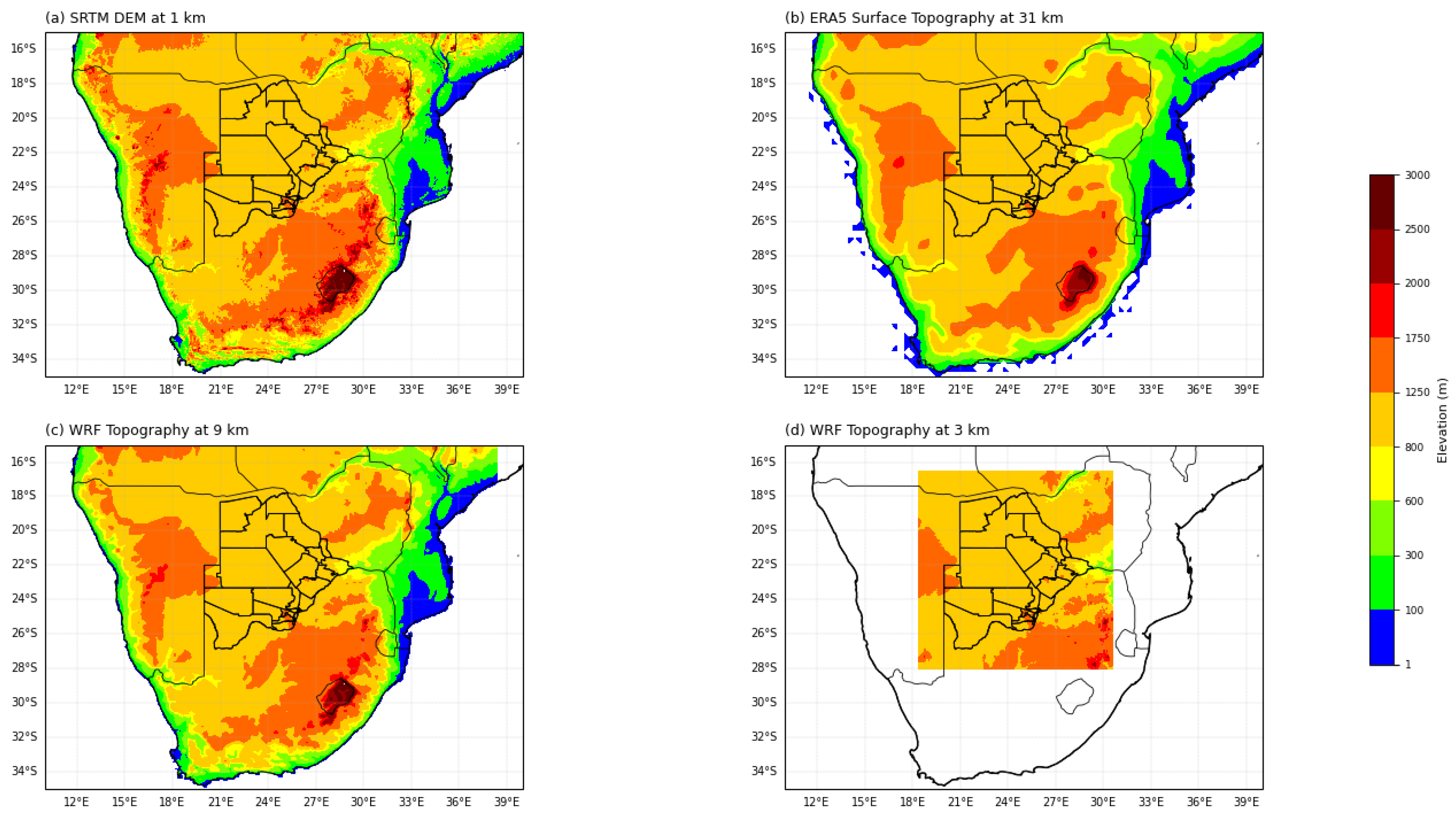
3.1. Interaction of Topography with Synoptic Systems
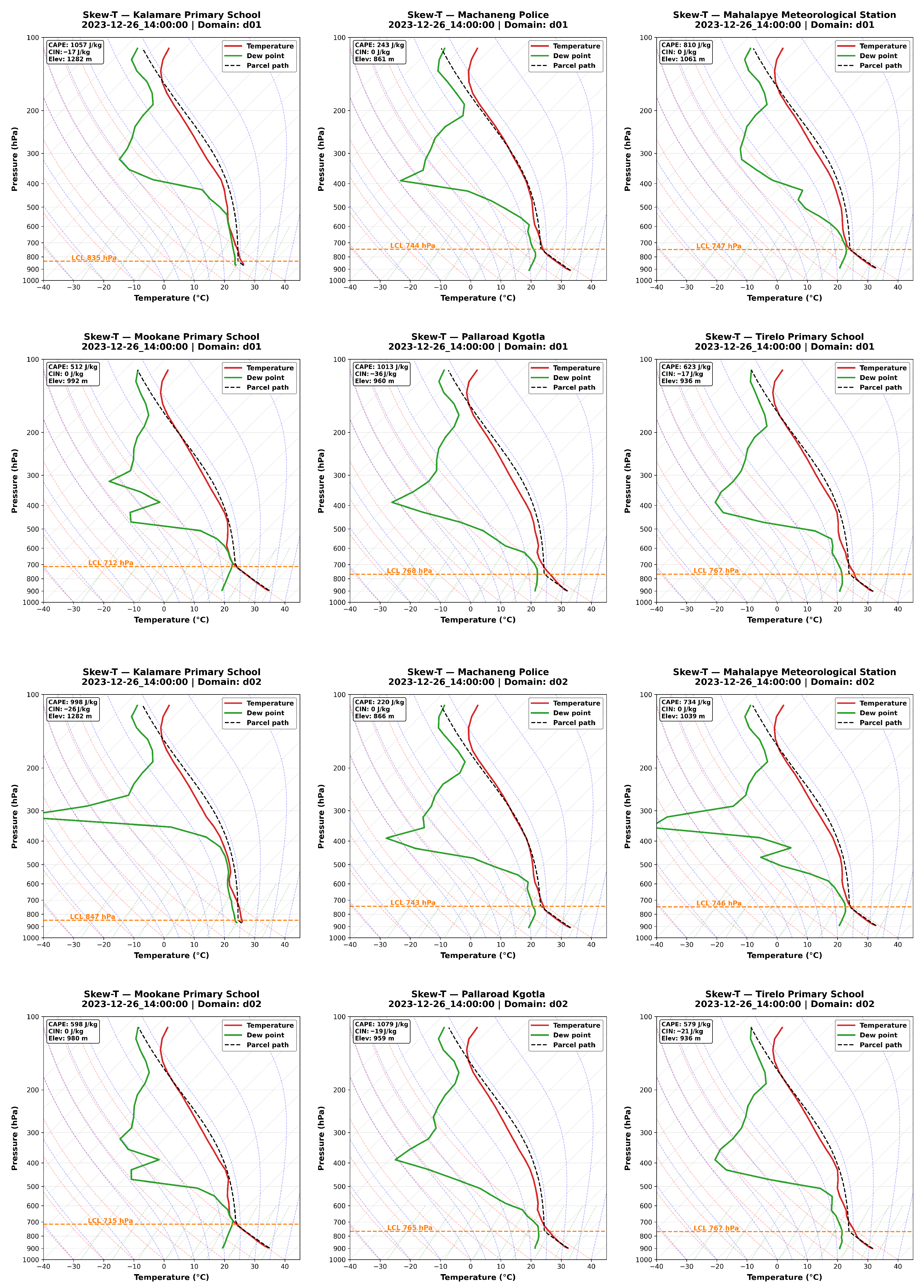
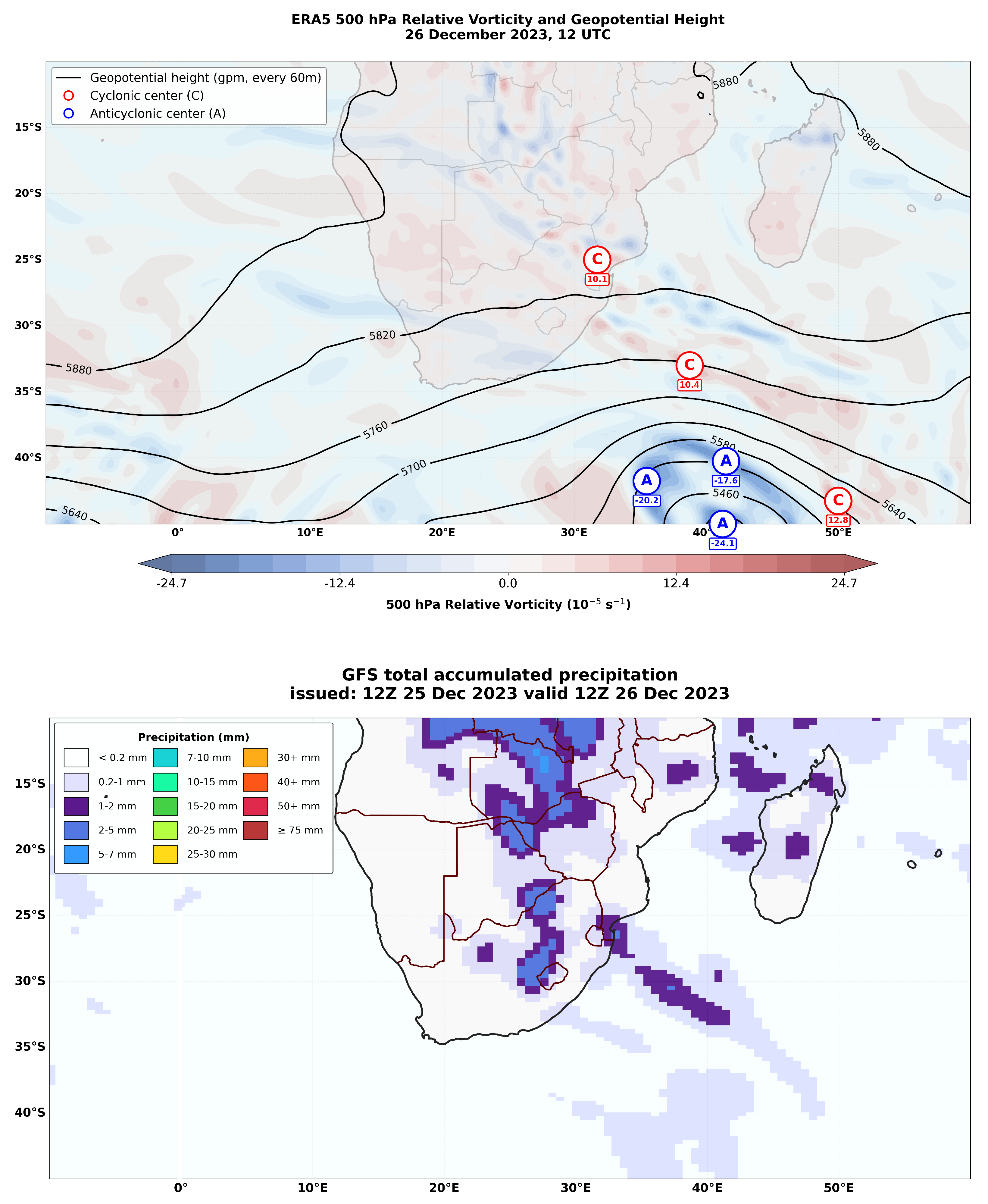
3.2. Synoptic-Scale Conditions Prevailing on the Day of the Event: 26 December 2023
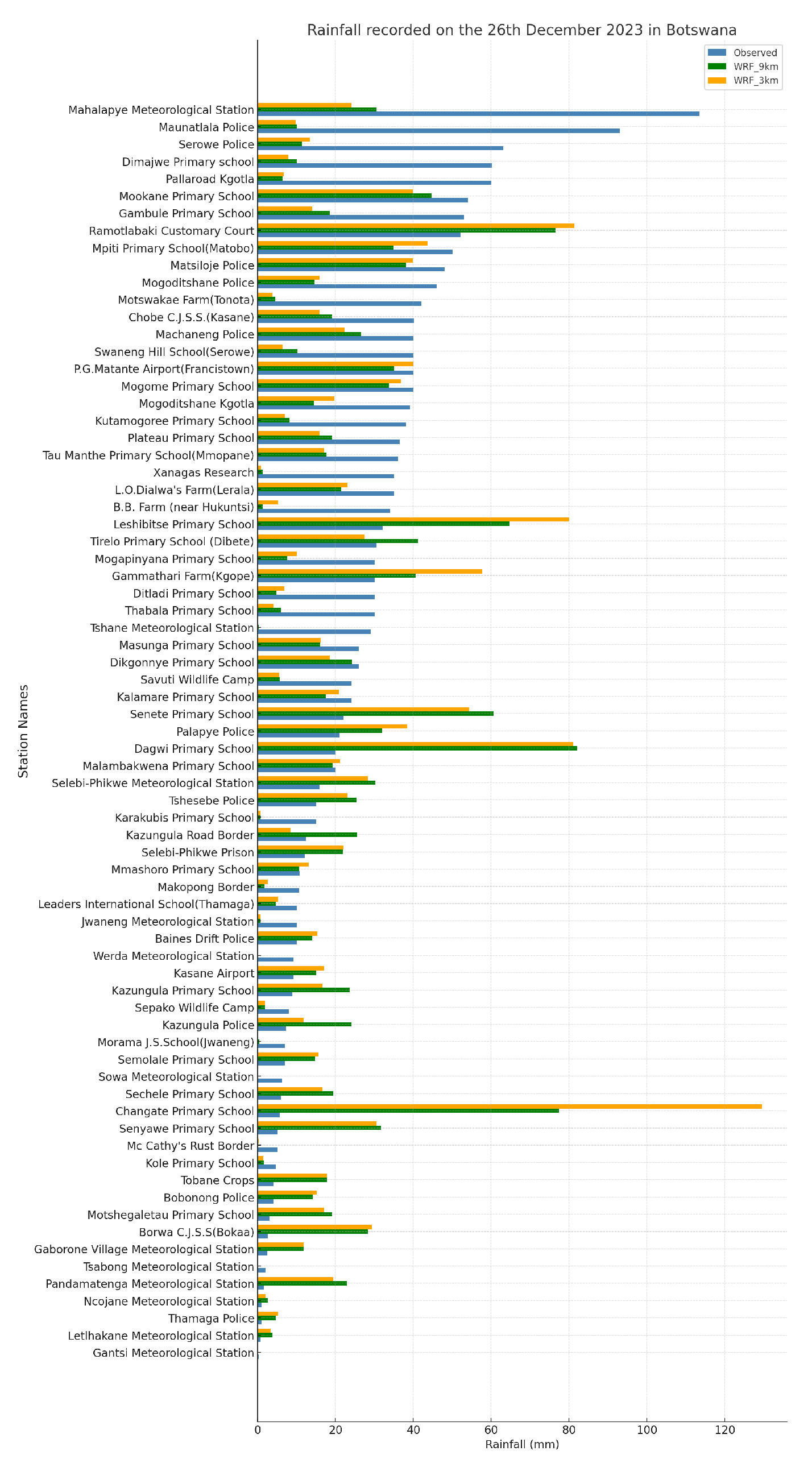
3.3. Observed Precipitation from DMS
3.4. WRF Evaluation
4. Conclusions
Author Contributions
Funding
Institutional Review Board Statement
Data Availability Statement
Acknowledgments
Conflicts of Interest
Appendix A

References
- McPhillips, L.E.; Chang, H.; Chester, M.V.; Depietri, Y.; Friedman, E.; Grimm, N.B.; Kominoski, J.S.; McPhearson, T.; Méndez-Lázaro, P.; Rosi, E.J.; et al. Defining extreme events: A cross-disciplinary review. Earth’s Future 2018, 6, 441–455. [Google Scholar] [CrossRef]
- Batisani, N.; Yarnal, B. Rainfall variability and trends in semi-arid Botswana: Implications for climate change adaptation policy. Appl. Geogr. 2010, 30, 483–489. [Google Scholar] [CrossRef]
- Statistics Botswana. Botswana Environment Statistics: Natural and Technological Disasters Digest 2019; Statistics Botswana: Gaborone, Botswana, 2020; Available online: https://www.statsbots.org.bw/sites/default/files/publications/Botswana%20Environment%20Statistics%20%20Natural%20and%20Technological%20Disasters%20Digest%202019%202%20%281%29.pdf (accessed on 14 March 2024).
- Mmopelwa, G.; Moalafhi, D.B.; Hambira, W.L.; Dhliwayo, M.; Motau, A. The impact of flooding on the community: A case of Gweta and Zoroga Villages, Botswana. Afr. J. Clim. Change Resour. Sustain. 2023, 2, 132–152. [Google Scholar] [CrossRef]
- Motsholapheko, M.R.; Kgathi, D.L.; Vanderpost, C. Rural livelihoods and household adaptation to extreme flooding in the Okavango Delta, Botswana. Phys. Chem. Earth Parts A/B/C 2011, 36, 984–995. [Google Scholar] [CrossRef]
- Tsheko, R. Rainfall reliability, drought and flood vulnerability in Botswana. Water SA 2003, 29, 389–392. [Google Scholar] [CrossRef]
- Moses, O. Weather systems influencing Botswana rainfall: The case of 9 December 2018 storm in Mahalapye, Botswana. Model. Earth Syst. Environ. 2019, 5, 1473–1480. [Google Scholar] [CrossRef]
- Aravind, A.; Srinivas, C.V.; Hegde, M.N.; Seshadri, H.; Mohapatra, D.K. Impact of land surface processes on the simulation of sea breeze circulation and tritium dispersion over the Kaiga complex terrain region near west coast of India using the Weather Research and Forecasting (WRF) model. Atmos. Environ. X 2022, 13, 100149. [Google Scholar] [CrossRef]
- Giorgi, F. Simulation of regional climate using a limited area model nested in a general circulation model. J. Clim. 1990, 3, 941–963. [Google Scholar] [CrossRef]
- Maisha, T.R. The Influence of Topography and Model Grid Resolution on Extreme Weather Forecasts over South Africa. Ph.D. Thesis, University of Pretoria, Pretoria, South Africa, 2014. Available online: https://repository.up.ac.za/items/f2a082b4-d119-4f27-83f7-557c4b8b2e3c (accessed on 12 January 2024).
- Reason, C.J.C.; Landman, W.; Tennant, W. Seasonal to decadal prediction of southern African climate and its links with variability of the Atlantic Ocean. Bull. Am. Meteorol. Soc. 2006, 87, 941–956. [Google Scholar] [CrossRef]
- Giorgi, F. Regional climate modeling: Status and perspectives. J. Phys. IV (Proc.) 2006, 139, 101–118. [Google Scholar] [CrossRef]
- Kgatuke, M.M.; Landman, W.A.; Beraki, A.; Mbedzi, M.P. The internal variability of the RegCM3 over South Africa. Int. J. Climatol. J. R. Meteorol. Soc. 2008, 28, 505–520. [Google Scholar] [CrossRef]
- Feser, F.; Rockel, B.; von Storch, H.; Winterfeldt, J.; Zahn, M. Regional climate models add value to global model data: A review and selected examples. Bull. Am. Meteorol. Soc. 2011, 92, 1181–1192. [Google Scholar] [CrossRef]
- Xu, Z.; Han, Y.; Yang, Z. Dynamical downscaling of regional climate: A review of methods and limitations. Sci. China Earth Sci. 2019, 62, 365–375. [Google Scholar] [CrossRef]
- Rummukainen, M. State-of-the-art with regional climate models. Wiley Interdiscip. Rev. Clim. Change 2010, 1, 82–96. [Google Scholar] [CrossRef]
- Wang, Y.; Leung, L.R.; McGregor, J.L.; Lee, D.K.; Wang, W.C.; Ding, Y.; Kimura, F. Regional climate modeling: Progress, challenges, and prospects. J. Meteorol. Soc. Jpn. Ser. II 2004, 82, 1599–1628. [Google Scholar] [CrossRef]
- Skamarock, W.C.; Klemp, J.B.; Dudhia, J.; Gill, D.O.; Liu, Z.; Berner, J.; Wang, W.; Powers, J.G.; Duda, M.G.; Barker, D.M.; et al. A Description of the Advanced Research WRF Version 4; NCAR Technical Note NCAR/TN-556+STR; National Center for Atmospheric Research: Boulder, CO, USA, 2019; Available online: https://www.researchgate.net/publication/396492764_A_Description_of_the_Advanced_Research_WRF_Model_Version_4_NCAR_TECHNICAL_NOTES_A_Description_of_the_Advanced_Research_WRF_Model_Version_49 (accessed on 20 December 2023).
- Ratna, S.B.; Ratnam, J.V.; Behera, S.K.; Rautenbach, C.J.d.W.; Ndarana, T.; Takahashi, K.; Yamagata, T. Performance assessment of three convective parameterization schemes in WRF for downscaling summer rainfall over South Africa. Clim. Dyn. 2014, 42, 2931–2953. [Google Scholar] [CrossRef]
- Mazzoglio, P.; Parodi, A.; Parodi, A. Detecting Extreme Rainfall Events Using the WRF-ERDS Workflow: The 15 July 2020 Palermo Case Study. Water 2022, 14, 86. [Google Scholar] [CrossRef]
- Bafitlhile, T.M.; Oladele, A.S. Modeling Extreme Flood Events for Palapye, Botswana. BIE J. Eng. Appl. Sci. 2015, 6, 54–60. [Google Scholar]
- Chawla, I.; Osuri, K.K.; Mujumdar, P.P.; Niyogi, D. Assessment of the Weather Research and Forecasting (WRF) model for simulation of extreme rainfall events in the upper Ganga Basin. Hydrol. Earth Syst. Sci. 2018, 22, 1095–1117. [Google Scholar] [CrossRef]
- Sun, B.-Y.; Bi, X.-Q. Validation for a tropical belt version of WRF: Sensitivity tests on radiation and cumulus convection parameterizations. Atmos. Ocean. Sci. Lett. 2019, 12, 192–200. [Google Scholar] [CrossRef]
- Meroni, A.N.; Oundo, K.A.; Muita, R.; Bopape, M.-J.; Maisha, T.R.; Lagasio, M.; Parodi, A.; Venuti, G. Sensitivity of some African heavy rainfall events to microphysics and planetary boundary layer schemes: Impacts on localised storms. Q. J. R. Meteorol. Soc. 2021, 147, 2448–2468. [Google Scholar] [CrossRef]
- Mofokeng, P.S. Study of the Influence of Gust Fronts and Topographical Features in the Development of Severe Thunderstorms Across South Africa. Master’s Thesis, University of the Witwatersrand, Johannesburg, South Africa, 2024. Available online: https://wiredspace.wits.ac.za/items/acb2a5b0-244b-4caf-b8e6-af395ba35723 (accessed on 26 April 2025).
- Maisha, T.; Mulovhedzi, P.T.; Rambuwani, G.T.; Makgati, L.N.; Barnes, M.; Lekoloane, L.; Engelbrecht, F.A.; Ndarana, T.; Mbokodo, I.L.; Xulu, N.G.; et al. The Development of a Locally Based Weather and Climate Model in Southern Africa; Water Research Commission: Pretoria, South Africa, 2025; pp. 1–197. Available online: https://www.wrc.org.za/wp-content/uploads/mdocs/3181%20final.pdf (accessed on 26 April 2025).
- Molongwane, C.; Bopape, M.-J.M.; Fridlind, A.; Motshegwa, T.; Matsui, T.; Phaduli, E.; Sehurutshi, B.; Maisha, R. Sensitivity of Botswana Ex-Tropical Cyclone Dineo rainfall simulations to cloud microphysics scheme. AAS Open Res. 2020, 3, 30. [Google Scholar] [CrossRef]
- Mathafeni, T.P.; Osupile, O.; Maripe, K. Hazard Early Warning Systems in Botswana: A Social Work Perspective. Int. J. Health Med. Inf. 2015, 4, 9–22. [Google Scholar]
- Statistics Botswana. Botswana Population and Housing Census 2022; Government of Botswana Publications; Botswana Bureau of Statistics: Gaborone, Botswana, 2022; Available online: https://www.statsbots.org.bw/sites/default/files/2022%20Population%20and%20Housing%20Census%20Preliminary%20Results.pdf (accessed on 13 February 2024).
- Kumar, P.; Kishtawal, C.M.; Pal, P.K. Impact of ECMWF, NCEP, and NCMRWF global model analysis on the WRF model forecast over Indian Region. Theor. Appl. Climatol. 2017, 127, 143–151. [Google Scholar] [CrossRef]
- Taszarek, M.; Pilguj, N.; Orlikowski, J.; Surowiecki, A.; Walczakiewicz, S.; Pilorz, W.; Piasecki, K.; Pajurek, Ł.; Półrolniczak, M. Derecho evolving from a mesocyclone—A study of 11 August 2017 severe weather outbreak in Poland: Event analysis and high-resolution simulation. Mon. Weather. Rev. 2019, 147, 2283–2306. [Google Scholar] [CrossRef]
- Figurski, M.J.; Nykiel, G.; Jaczewski, A.; Bałdysz, Z.; Wdowikowski, M. The impact of initial and boundary conditions on severe weather event simulations using a high-resolution WRF model. Case study of the derecho event in Poland on 11 August 2017. Meteorol. Hydrol. Water Manag. Res. Oper. Appl. 2022, 10, 60–87. [Google Scholar] [CrossRef]
- Nkoni, G.; Mphale, K.; Mbangiwa, N.; Samuel, S.; Molosiwa, R. Use of multivariate techniques to regionalize rainfall patterns in semiarid Botswana. Discov. Environ. 2024, 2, 77. [Google Scholar] [CrossRef]
- Alemaw, B.F.; Chaoka, R.T. Regionalization of rainfall intensity-duration-frequency (IDF) curves in Botswana. J. Water Resour. Prot. 2016, 8, 1128. [Google Scholar] [CrossRef][Green Version]
- Akinyemi, F.O. Climate change and variability in semiarid Palapye, Eastern Botswana: An assessment from smallholder farmers’ perspective. Weather Clim. Soc. 2017, 9, 349–365. [Google Scholar] [CrossRef]
- Matenge, R.G.; Parida, B.P.; Letshwenyo, M.W.; Ditalelo, G. Impact of climate variability on rainfall characteristics in the semi-arid Shashe Catchment (Botswana) from 1981–2050. Earth 2023, 4, 398–441. [Google Scholar] [CrossRef]
- Hersbach, H.; Bell, B.; Berrisford, P.; Hirahara, S.; Horányi, A.; Muñoz-Sabater, J.; Nicolas, J.; Peubey, C.; Radu, R.; Schepers, D.; et al. The ERA5 Global Reanalysis. Q. J. R. Meteorol. Soc. 2020, 146, 1999–2049. [Google Scholar] [CrossRef]
- Mbokodo, I.L.; Burger, R.P.; Fridlind, A.; Ndarana, T.; Maisha, R.; Chikoore, H.; Bopape, M.-J.M. Assessing the Performance of the WRF Model in Simulating Squall Line Processes over the South African Highveld. Atmosphere 2025, 16, 1055. [Google Scholar] [CrossRef]
- Bopape, M.-J.M.; Engelbrecht, F.A.; Maisha, R.; Chikoore, H.; Ndarana, T.; Lekoloane, L.; Thatcher, M.; Mulovhedzi, P.T.; Rambuwani, G.T.; Barnes, M.A.; et al. Rainfall Simulations of High-Impact Weather in South Africa with the Conformal Cubic Atmospheric Model (CCAM). Atmosphere 2022, 13, 1987. [Google Scholar] [CrossRef]
- Dee, D.P.; Uppala, S.M.; Simmons, A.J.; Berrisford, P.; Poli, P.; Kobayashi, S.; Andrae, U.; Balmaseda, M.A.; Balsamo, G.; Bauer, P.; et al. The ERA-Interim Reanalysis: Configuration and Performance of the Data Assimilation System. Q. J. R. Meteorol. Soc. 2011, 137, 553–597. [Google Scholar] [CrossRef]
- Steinkopf, J.; Engelbrecht, F. Verification of ERA5 and ERA-Interim Precipitation over Africa at Intra-Annual and Interannual Timescales. Atmos. Res. 2022, 280, 106427. [Google Scholar] [CrossRef]
- Wang, W. WRF: More Runtime Options. In WRF Tutorial 2017; UNSW Sydney: Kensington, NSW, Australia, 2017; Volume 46, Available online: https://www2.mmm.ucar.edu/wrf/wrf_tutorial_linked_files/Other_Runtime_Options.pdf (accessed on 20 December 2024).
- Iacono, M.J.; Delamere, J.S.; Mlawer, E.J.; Shephard, M.W.; Clough, S.A.; Collins, W.D. Radiative forcing by long-lived greenhouse gases: Calculations with the AER radiative transfer models. J. Geophys. Res. Atmos. 2008, 113, D13. [Google Scholar] [CrossRef]
- Hong, S.-Y.; Noh, Y.; Dudhia, J. A new vertical diffusion package with an explicit treatment of entrainment processes. Mon. Weather Rev. 2006, 134, 2318–2341. [Google Scholar] [CrossRef]
- Tewari, M. Implementation and Verification of the Unified NOAH Land Surface Model in the WRF Model. 2004. Available online: https://ral.ucar.edu/projects/wrf (accessed on 18 May 2024).
- Zhang, C.; Wang, Y. Projected future changes of tropical cyclone activity over the western North and South Pacific in a 20-km-mesh regional climate model. J. Clim. 2017, 30, 5923–5941. [Google Scholar] [CrossRef]
- Oyegbile, O.; Chan, A.; Ooi, M.; Anwar, P.; Mohamed, A.A.; Li, L. Evaluation of WRF model performance with different microphysics schemes for extreme rainfall prediction in Lagos, Nigeria: Implications for urban flood risk management. Bull. Atmos. Sci. Technol. 2024, 5, 19. [Google Scholar] [CrossRef]
- Chai, T.; Draxler, R.R. Root mean square error (RMSE) or mean absolute error (MAE)?—Arguments against avoiding RMSE in the literature. Geosci. Model Dev. 2014, 7, 1247–1250. [Google Scholar] [CrossRef]
- Moriasi, D.; Arnold, J.; Van Liew, M.; Bingner, R.; Harmel, R.D.; Veith, T. Model Evaluation Guidelines for Systematic Quantification of Accuracy in Watershed Simulations. Trans. ASABE 2007, 50, 885–900. [Google Scholar] [CrossRef]
- Legates, D.R.; McCabe, G.J. Evaluating the use of “goodness-of-fit” measures in hydrologic and hydroclimatic model validation. Water Resour. Res. 1999, 35, 233–241. [Google Scholar] [CrossRef]
- Wilks, D.S. Statistical Methods in the Atmospheric Sciences, 3rd ed.; International Geophysics Series; Academic Press: Oxford, UK, 2011; Volume 100, Available online: https://sunandclimate.wordpress.com/wp-content/uploads/2009/05/statistical-methods-in-the-atmospheric-sciences-0127519661.pdf (accessed on 22 December 2025).
- Gupta, H.; Kling, H.; Yilmaz, K.; Martinez, G. Decomposition of the Mean Squared Error and NSE Performance Criteria: Implications for Improving Hydrological Modelling. J. Hydrol. 2009, 377, 80–91. [Google Scholar] [CrossRef]
- Mass, C.F.; Ovens, D.; Westrick, K.; Colle, B.A. Does Increasing Horizontal Resolution Produce More Skillful Forecasts? The Results of Two Years of Real-Time Numerical Weather Prediction over the Pacific Northwest. Bull. Am. Meteorol. Soc. 2002, 83, 407–430. [Google Scholar] [CrossRef]
- Jiménez, P.; Dudhia, J. Improving the Representation of Resolved and Unresolved Topographic Effects on Surface Wind in the WRF Model. J. Appl. Meteorol. Climatol. 2012, 51, 300–316. [Google Scholar] [CrossRef]
- Shepard, D. A two-dimensional interpolation function for irregularly-spaced data. In Proceedings of the 23rd ACM National Conference, New York, NY, USA, 27–29 August 1968; pp. 517–524. [Google Scholar] [CrossRef]
- Farr, T.G.; Rosen, P.A.; Caro, E.; Crippen, R.; Duren, R.; Hensley, S.; Kobrick, M.; Paller, M.; Rodriguez, E.; Roth, L.; et al. The Shuttle Radar Topography Mission (SRTM). Rev. Geophys. 2007, 45, RG2004. [Google Scholar] [CrossRef]
- Lehner, B.; Verdin, K.; Jarvis, A. New global hydrography derived from spaceborne elevation data. Eos Trans. Am. Geophys. Union 2008, 89, 93–94. [Google Scholar] [CrossRef]
- McSweeney, C.F.; Jones, R.G.; Lee, R.W.; Rowell, D.P. Selecting CMIP5 GCMs for Downscaling over Multiple Regions. Clim. Dyn. 2015, 44, 3237–3260. [Google Scholar] [CrossRef]
- Dyson, L.L.; Van Heerden, J.; Sumner, P.D. A Baseline Climatology of Sounding-Derived Parameters Associated with Heavy Rainfall over Gauteng, South Africa. Int. J. Climatol. 2015, 35, 1162–1174. [Google Scholar] [CrossRef]
- Van Schalkwyk, L.; Blamey, R.C.; Dyson, L.L.; Reason, C.J.C. A Climatology of Drylines in the Interior of Subtropical southern Africa. J. Clim. 2022, 35, 6411–6430. [Google Scholar] [CrossRef]
- Blamey, R.C.; Reason, C.J.C. Mesoscale Convective Complexes over southern Africa. J. Clim. 2012, 25, 753–766. [Google Scholar] [CrossRef][Green Version]
- Crétat, J.; Pohl, B.; Richard, Y.; Drobinski, P. Uncertainties in simulating regional climate of southern Africa: Sensitivity to physical parameterizations using WRF. Clim. Dyn. 2012, 38, 613–634. [Google Scholar] [CrossRef]
- Engelbrecht, F.A.; McGregor, J.L.; Engelbrecht, C.J. Dynamics of the Conformal-Cubic Atmospheric Model projected climate-change signal over southern Africa. Int. J. Climatol. 2009, 29, 1013–1033. [Google Scholar] [CrossRef]






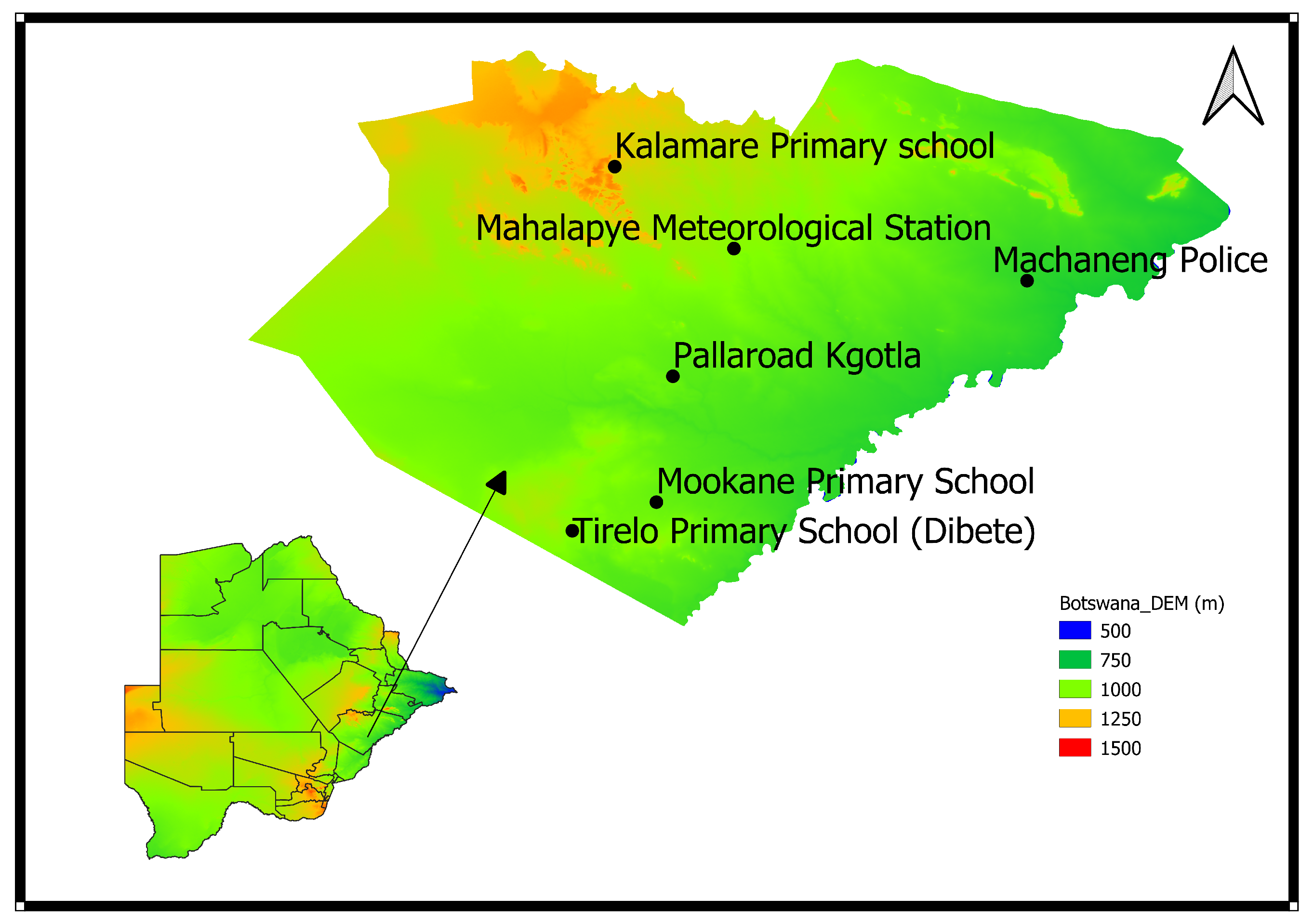
| Station Name | Lat | Lon | Altitude (m) |
|---|---|---|---|
| Mahalapye Meteorological Station | S | E | 1017 |
| Mookane Primary School | S | E | 951 |
| Tirelo Primary School | S | E | 957 |
| Kalamare Primary School | S | E | 1074 |
| Machaneng Police | S | E | 888 |
| Pallaroad Kgotla | S | E | 1002 |
| Model Options | Specifications |
|---|---|
| Model type | Non-hydrostatic |
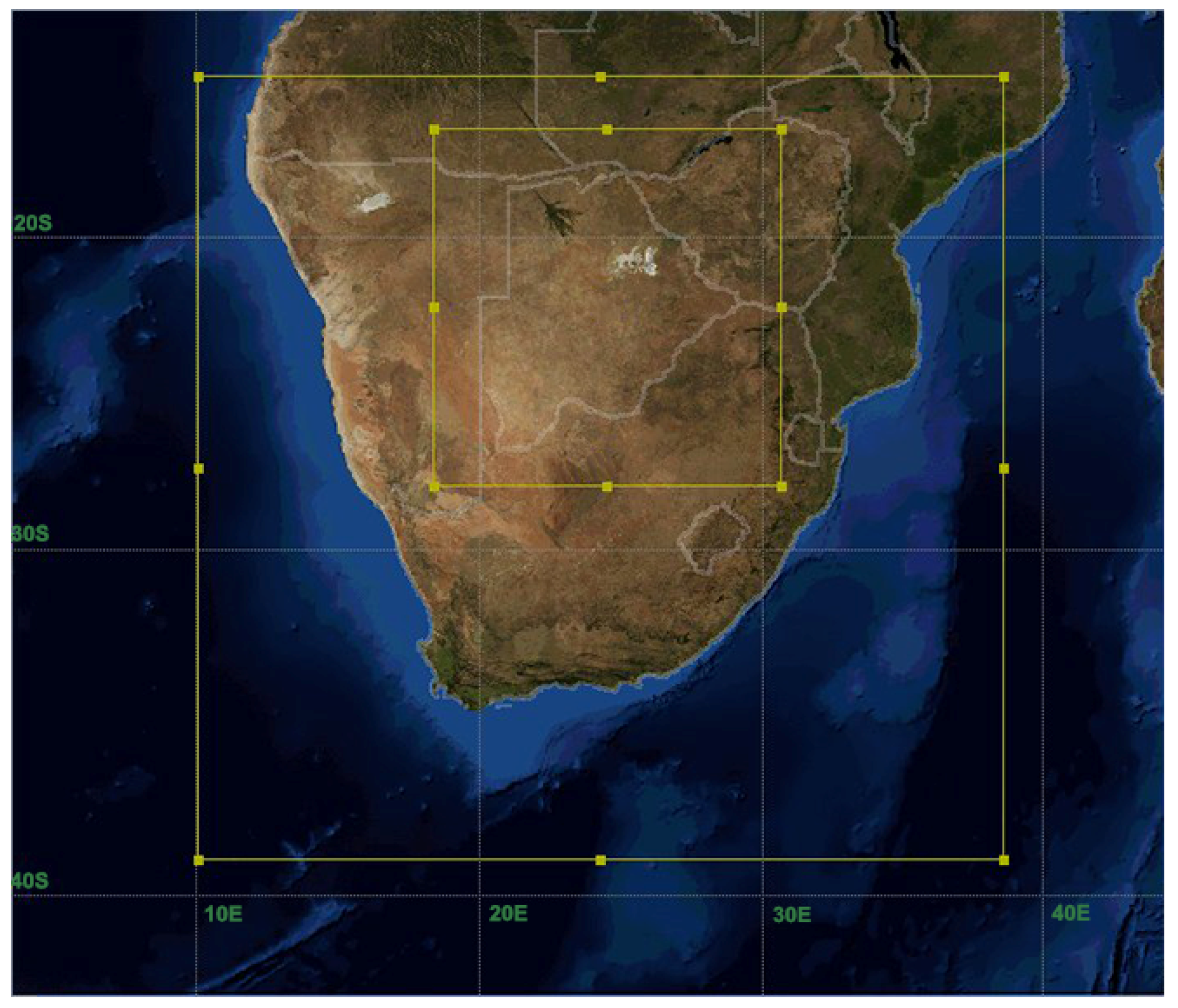
| Domains | two (2) (with a two-way nested domains) |
| Grid resolution (spacing) | parent domain 1: 9 km × 9 km; (312 × 301 grid) |
| nested domain 2: 3 km × 3 km; (403 × 412 grid) | |
| Map projection | Mercator |
| Initial conditions | NCEP GFS (3-h interval) |
| PBL Schemes | YSU scheme |
| Cumulus schemes | A newer Tiedtke scheme |
| Microphysics schemes | WSM 6-class graupel scheme |
| Shortwave radiation scheme | RRTMG scheme |
| Longwave radiation scheme | RRTMG scheme |
| Land surface model | Unified Noah land surface model |
| Scheme | Description |
|---|---|
| RRTM | Rapid Radiative Transfer Model used to improve radiative transfer calculations during the WRF run; developed by [43]. |
| YSU | Yonsei University planetary boundary layer scheme introduced by [44]; represents boundary layer processes. |
| Noah LSM | Unified Noah land surface model used to capture land surface interactions; developed by [45]. |
| New Tiedtke | Updated cumulus scheme by [46], used in cumulus convection representation. |
| WSM6 | Weather Research and Forecasting Single-Moment 6-class microphysics scheme developed by [44]; provides detailed microphysical processes. |
| Model | RMSE (mm) | PBIAS (%) | KGE | r | POD (1 mm) |
|---|---|---|---|---|---|
| WRF_3 km | 43.529 | −56.10 | −0.356 | −0.038 | 1.000 |
| WRF_9 km | 41.197 | −48.22 | −0.225 | 0.020 | 1.000 |
Disclaimer/Publisher’s Note: The statements, opinions and data contained in all publications are solely those of the individual author(s) and contributor(s) and not of MDPI and/or the editor(s). MDPI and/or the editor(s) disclaim responsibility for any injury to people or property resulting from any ideas, methods, instructions or products referred to in the content. |
© 2026 by the authors. Licensee MDPI, Basel, Switzerland. This article is an open access article distributed under the terms and conditions of the Creative Commons Attribution (CC BY) license.
Share and Cite
Monaka, K.C.; Mphale, K.; Maisha, T.R.; Wiston, M.; Ramaphane, G. The Capabilities of WRF in Simulating Extreme Rainfall over the Mahalapye District of Botswana. Atmosphere 2026, 17, 135. https://doi.org/10.3390/atmos17020135
Monaka KC, Mphale K, Maisha TR, Wiston M, Ramaphane G. The Capabilities of WRF in Simulating Extreme Rainfall over the Mahalapye District of Botswana. Atmosphere. 2026; 17(2):135. https://doi.org/10.3390/atmos17020135
Chicago/Turabian StyleMonaka, Khumo Cecil, Kgakgamatso Mphale, Thizwilondi Robert Maisha, Modise Wiston, and Galebonwe Ramaphane. 2026. "The Capabilities of WRF in Simulating Extreme Rainfall over the Mahalapye District of Botswana" Atmosphere 17, no. 2: 135. https://doi.org/10.3390/atmos17020135
APA StyleMonaka, K. C., Mphale, K., Maisha, T. R., Wiston, M., & Ramaphane, G. (2026). The Capabilities of WRF in Simulating Extreme Rainfall over the Mahalapye District of Botswana. Atmosphere, 17(2), 135. https://doi.org/10.3390/atmos17020135