
Article

The Role of Nocturnal Low-Level Jets on Persistent Floating Dust over the Tarim Basin
1
Key Laboratory for Semi-Arid Climate Change of the Ministry of Education, College of Atmospheric Sciences, Lanzhou University, Lanzhou 730000, China
2
Laboratory of Climate Resource Development and Disaster Prevention in Gansu Province, College of Atmospheric Sciences, Lanzhou University, Lanzhou 730000, China
3
College of Atmospheric Sciences, Lanzhou University, Lanzhou 730000, China
4
North Sky-Dome Information Technology (Xi’an) Co., Ltd., Xi’an 710100, China
5
Xi’an Electronic Engineering Research Institute, Xi’an 710100, China
6
Key Laboratory of Arid Climatic Change and Reducing Disaster of Gansu Province, Institute of Arid Meteorology, CMA, Lanzhou 730020, China
7
Key Laboratory of Climatic Change and Disaster Reduction of CMA, Lanzhou 730020, China
*
Author to whom correspondence should be addressed.
Atmosphere 2026, 17(2), 134; https://doi.org/10.3390/atmos17020134
Submission received: 14 November 2025 / Revised: 6 January 2026 / Accepted: 24 January 2026 / Published: 26 January 2026
(This article belongs to the Section Aerosols)

Abstract

As the most frequent dust event in the Tarim Basin (TB), persistent floating dust significantly impacts the regional weather and climate. Long-term analysis (2015–2024) showed that the occurrence of persistent floating dust is significantly associated with the presence of the nocturnal low-level jet (NLLJ). To investigate this potential linkage, the Weather Research and Forecasting model with Chemistry (WRF-Chem) was used to simulate the persistent floating dust event accompanied by the NLLJ in the TB from 29 to 31 July 2006. Results indicated that a typical NLLJ occurred during the event, with an easterly jet core (>12 m/s) near 850-hPa facilitating the westward dust transport and accumulation within the TB, as well as strong convergence and vertical uplift on its front side elevating the dust layer height (DLH). Quantification showed that the NLLJ enhanced dust column concentrations (mean maximum > 100 mg/m2) and DLH (mean maximum > 300 m) over the central and western TB, and the cumulative maximum increase in dust emissions exceeded 200 mg/m2, in the NLLJ region. Furthermore, nocturnal dust radiative forcing intensified the NLLJ by up to 1 m/s, thereby establishing a positive feedback mechanism. These results reveal the crucial role of the NLLJ in persistent floating dust events and enrich our understanding of such events in the TB.

1. Introduction

Mineral dust is one of the major atmospheric aerosols, contributing more than half of the total global aerosol burden [1,2,3]. Dust aerosols have a critical impact on weather and climate through the direct effects on solar and thermal radiation, as well as the indirect effects on cloud and precipitation processes [4,5]. In addition, dust aerosols can affect global carbon cycling [6], glacier mass balance [7], marine phytoplankton blooms [8], and even public health [9]. The Tibetan Plateau (TP) lies within the dust belt of the Northern Hemisphere, with an average elevation of about 4 km, and is termed the ‘Asian Water Tower’ as it forms the headwaters of numerous major Asian rivers [10,11]. Dust aerosols from Asian and North African source regions can be transported to the TP [12,13,14,15,16]. These dust particles not only modulate the local climate and environmental system over the TP but are also vertically lifted by the TP thermal pumping effect for further downwind dispersal, ultimately exerting global-scale influences [17,18]. Thus, the TP, with its high mountain topography, amplifies the regional and even global climate effects of dust aerosols. Therefore, exploring the spatiotemporal variations and transport characteristics of dust aerosols around the TP is of great significance for understanding the climatic, environmental, and ecological impacts of dust aerosols.
The Tarim Basin (TB) is surrounded on three sides by high terrain exceeding 3 km in elevation. The southern TB is adjacent to the TP; the western and northern sides are bordered by the Pamir Plateau and the Tianshan Mountains, respectively, while the eastern side forms a dustpan-shaped opening. The Taklimakan Desert (TD), located in the center of the TB, is the second-largest mobile desert in the world and the primary contributor of airborne dust over the TP [19,20]. The floating dust phenomenon frequently occurs over the TB due to the influence of the complex terrain and the deep atmospheric boundary layer [21,22,23]. Notably, floating dust days account for about 60% of the total dust days in the southern TB, often lasting for 7–10 days and forming a persistent floating dust layer [24]. The dust layer height (DLH) is a key factor in determining whether dust is transported to the TP. Once these floating dust layers are uplifted to high altitudes, they can be transported toward the TP by the westerly jet and northerly winds [25]. Thus, studying the uplift process and maintenance mechanism of persistent floating dust in the TB is essential for understanding the transport of dust toward the TP. Current research on the maintenance mechanisms of floating dust weather over the TB primarily focuses on three key factors: conditions favorable for uplift (vertical circulation and thermally unstable stratification), conditions unfavorable for deposition (stable near-surface stratification), and dust source replenishment (strong low-level winds) [21,26,27,28]. Nevertheless, the understanding of the spatiotemporal evolution and maintenance mechanism of the persistent floating dust layer on a daily scale in the TB remains limited.
Low-level jets (LLJs) generally refer to rapidly moving air currents with wind speeds exceeding a certain threshold in the boundary layer or lower troposphere [29]. LLJs represent a ubiquitous atmospheric phenomenon with a global distribution, particularly prevalent in tropical and subtropical regions where they serve as key mechanisms for large-scale material transport [30]. The strong vertical wind shear associated with LLJs not only efficiently initiates deep convection, enhancing moisture convergence [31,32], but also generates turbulent bursts that profoundly affect the vertical mixing of air pollutants, thereby significantly influencing pollutant transport dynamics [33,34,35]. In addition, LLJs are identified as a key driver of dust emissions over the source region [36,37,38]. Research on the elevated aerosol layer over southeastern peninsular India indicated that the persistent LLJ serves as a primary dynamic mechanism, wherein the strong vertical wind shear between the LLJ and the tropical easterly jet restricts the vertical uplift of aerosols, thereby promoting the formation and maintenance of the elevated aerosol layer [39]. Nocturnal low-level jets (NLLJs) occur frequently in the TB, manifesting as easterly winds that typically emerge in the evening and dissipate by morning, with peak wind speeds between 00:00 and 03:00 local time [40]. Existing studies on NLLJs and dust activities in the TB have predominantly examined their characteristics, formation mechanisms, and impacts on dust emissions [40,41]. Su et al. [42] revealed that NLLJs contribute significantly to the development of the deep convective boundary layer in the TB by restricting energy and mass exchange with the lower atmosphere. This process not only supplies key material and energy inputs to sustain boundary layer development but also establishes the dynamical basis for its subsequent evolution [43]. However, the modulation of NLLJs in persistent floating dust and their vertical distribution remains unexplored.
To sum up, a potential linkage between the TB NLLJs and persistent floating dust events, as well as the role of the former on the latter, remains unclear. To investigate this linkage, we first revealed long-term statistical analysis and further examined a typical persistent dust event over the TB from 29 to 31 July 2006 using the Weather Research and Forecasting model coupled with Chemistry (WRF-Chem). The event was identified as a persistent floating dust layer based on Cloud-Aerosol Lidar and Infrared Pathfinder Satellite Observations (CALIPSO), and the presence of an NLLJ was confirmed using ERA5 reanalysis wind data. Section 2 describes the model configuration and datasets used in this study. Section 3 presents characteristics of the persistent floating dust event in the TB, the case overview, model evaluation, and analysis of NLLJ impacts. The discussion and conclusion are provided in Section 4.

2. Materials and Methods

2.1. Satellite Observation Datasets

The Cloud-Aerosol Lidar with Orthogonal Polarization (CALIOP) is a dual-channel lidar operating at 532 nm and 1064 nm wavelengths, mounted on the CALIPSO satellite launched by NASA and the French National Centre for Space Research (CNES) [44]. In this study, the Vertical Feature Mask (VFM) and total attenuated backscatter coefficient data at 532 nm (version 4.51, https://asdc.larc.nasa.gov/project/CALIPSO, accessed on 17 October 2025) were used to show the distribution of dust aerosols over the TB from 29 to 31 July 2006 (a CALIPSO-verified persistent floating dust event, see Section 3.1 for details).
The Moderate Resolution Imaging Spectroradiometer (MODIS) is an important sensor carried on the Terra and Aqua satellites launched by the National Aeronautics and Space Administration (NASA) [45]. It can repeatedly observe Earth’s surface every 1–2 days in 36 bands. MODIS observations provide data products on land surface cover, clouds, aerosols, and water vapor. In this study, the MOD08_D3 aerosol product (https://ladsweb.modaps.eosdis.nasa.gov/missions-and-measurements/products/MOD08_D3/, accessed on 22 February 2024) was used to evaluate the simulated spatial distribution of aerosol optical depth (AOD) at 550 nm.

2.2. Ground-Based Observation Datasets

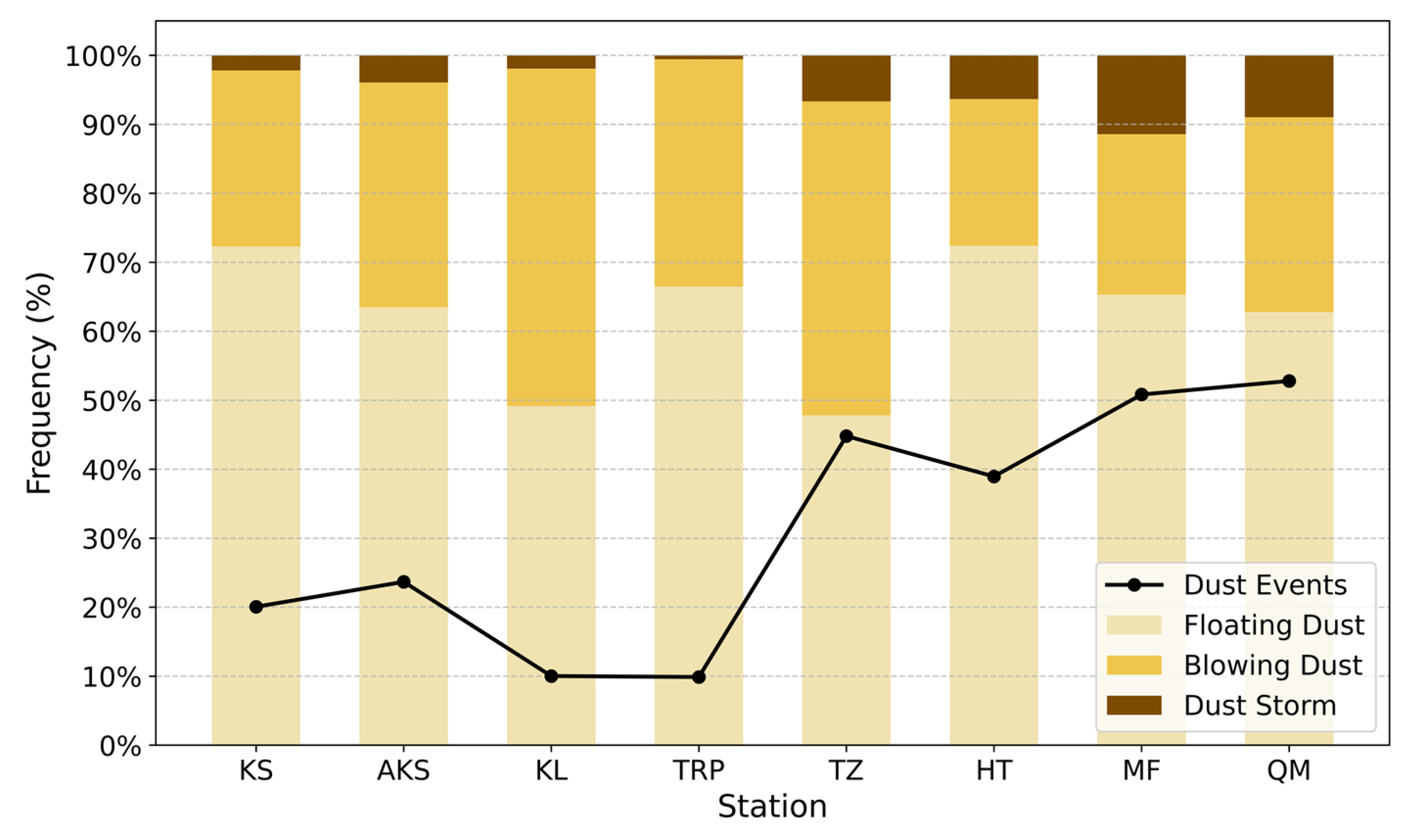
The ground-based observations used in this study include weather phenomena and 2 m temperature data provided by the China Meteorological Administration (https://data.cma.cn/, accessed on 15 October 2025). Since 1951, daily variations of basic meteorological elements have been recorded in a dataset from 699 weather stations across China. Eight stations located near the TB were selected to statistically analyze the frequency of dust events over the ten-year period from 2015 to 2024: Kashgar (KS), Aksu (AKS), Korla (KL), Turpan (TRP), Tazhong (TZ), Hotan (HT), Minfeng (MF), and Qiemo (QM), with their locations shown in Figure 1. Additionally, the observed 2 m temperature at these stations was compared with simulation results. Since the dust weather phenomena data are recorded on a daily basis, for Figure 2, we defined one dust event frequency as a day with recorded dust weather occurrence. Moreover, regarding the frequency of different types of dust events: If a dust storm is recorded, the day is classified as a dust storm event. If blowing dust is recorded (without a dust storm), the day is classified as a blowing dust event. If only floating dust is recorded, the day is classified as a floating dust event. This classification is applied to facilitate the statistical analysis of dust occurrence frequency.

2.3. Other Datasets

ERA5 is a global high-resolution atmospheric reanalysis dataset produced using 4D-Var data assimilation and model forecasts in CY41R2 of the European Centre for Medium-Range Weather Forecasts (ECMWF) Integrated Forecasting System (IFS) [46]. It provides global climate and weather data with a spatial resolution of 0.25° × 0.25° and a temporal resolution of 1 h, covering the period from January 1940 to the present and continuously updated in near real time [43]. In this study, geopotential, temperature, u- and v-components of wind, mean sea-level pressure, and related variables were used to analyze synoptic conditions. Additionally, the ERA5 data were also employed to drive the WRF-Chem model.
The second Modern-Era Retrospective Analysis for Research and Applications (MERRA-2) is the most recent reanalysis data produced by the NASA Global Modeling and Assimilation Office using the GEOS data assimilation system [47]. It provides hourly precision data with a spatial resolution of 0.625° × 0.5° [43]. In this study, The DUCMASS product was utilized to investigate the characteristics of dust distribution over the TB from 2015 to 2024.
In addition, the Solar Calculator (https://gml.noaa.gov/grad/solcalc/, accessed on 26 September 2025) developed by the National Oceanic and Atmospheric Administration (NOAA) is based on the equations in Astronomical Algorithms [48] to calculate sunrise, sunset times, and solar positions, and was used to calculate the start times of day and night in this study. It shows that during the simulation period, the sunrise time in the study area (with 39° N, 80° E as the reference point) was approximately 00:00 UTC, and the sunset time was roughly around 14:00 UTC. Therefore, the period from 00:00 to 13:00 UTC is defined as daytime, and 14:00 to 23:00 UTC is defined as nighttime in this study.

2.4. Model Description and Experimental Setup

In this study, version 4.1.5 of the WRF-Chem model [49] was used to simulate the persistent floating dust event. The simulation lasted for 9 days, starting at 00:00 UTC on 24 July, with the first two days used as the spin-up period. The simulation area is shown in Figure 1 (Lambert projection) using a single-layer nested grid with a horizontal resolution of 20 km and grid dimensions of 200 × 200. The vertical direction of the model is set to 36 levels, with the top level having a pressure of 50-hPa. The Carbon-Bond Mechanism version Z (CBMZ) chemical mechanism [50] and the Model for Simulating Aerosol Interactions and Chemistry (MOSAIC [51]) with 8 sectional aerosol bins were used for chemical process simulation, while the Goddard Global Ozone Chemistry Aerosol Radiation and Transport (GOCART) [52] dust emission scheme within the MOSAIC aerosol module was used for dust emissions. The physical parameterization schemes are key to ensuring that the WRF-Chem simulations are close to reality. The Morrison two-moment microphysics scheme [53], Rapid Radiative Transfer Model for GCMs (RRTMG) longwave and shortwave radiation scheme [54], Unified Noah land surface model [55], Mellor Yamada Nakanishi Niino Level 2.5 (MYNN2.5) planetary boundary layer (PBL) scheme [56], and Kain–Fritsch cumulus scheme [57] were used in this study.
To investigate the role of the NLLJ during a dust event, four parallel experiments were designed in this study. Here, the NLLJ is defined as a wind profile within the layer below 600-hPa that meets the following criteria: the maximum wind speed must exceed 6 m s−1, and the wind speed must decrease by at least 3 m s−1 from the height of the wind maximum to that of the wind minimum. The definition used in this study is primarily based on the methodologies and conclusions established in previous work by Ge et al. [40] and Du et al. [58], which ensures the “nose-shaped” structure characteristic of NLLJs. To filter out the NLLJ, we only processed the “nose-shaped” structure part of the wind profiles from ERA5 data between 28 and 30 July 2006 (14:00–03:00 UTC each day) that met the defined criteria by smoothing, while keeping other parts of these wind profiles unchanged. The resulting dataset, designated as the “NO-NLLJ”, was used as the meteorological input for the experiments. Since the WRF-Chem, when horizontal wind nudging is enabled, nudges the simulated wind toward the background field (input data) according to the specified nudging coefficient and height settings, using the “NO-NLLJ” as the input data can produce the expected outcome of a weakened or absent nocturnal low-level jet in the experimental results. Additionally, an experiment with disabled dust radiative feedback was designed, implemented by turning off the coupling feedback process in the aerosol–radiation scheme. Given that the study area is located in a desert and only dust aerosol emissions are considered in the model, the differences between this experiment and the control experiment can directly characterize the radiative forcing effect of dust aerosols, thereby investigating the radiative forcing effect of dust and its influence on meteorological conditions. This method is widely employed in studies of dust radiative effects [59,60]. The experimental configurations were as follows: EXP1 was the control simulation, EXP2 filtered out the NLLJ, EXP3 served as the blank control for EXP2, and EXP4 disabled the dust radiative feedback. The specific settings are detailed in Table 1. Apart from these configurations, all other experimental settings remained consistent across the simulations.

2.5. Dust Radiative Forcing Computation

Dust radiative forcing (DRF) refers to the impact of dust on the Earth’s atmospheric radiative energy balance due to its radiative properties. In this study, the difference in net radiative flux (NRF) between exp1 and exp2 is used to quantify dust radiative forcing, with the specific calculation formulas at the top of the atmosphere (TOA), in the atmosphere (ATM), and at the surface (SURF) as follows:
N R F T O A = I R F T O A I R F T O A ,
N R F S U R F = I R F S U R F I R F S U R F ,
N R F A T M = N R F T O A N R F S U R F ,
D R F T O A = N R F T O A e x p 1 N R F T O A e x p 4 ,
D R F A T M = N R F A T M e x p 1 N R F A T M e x p 4 ,
D R F S U R F = N R F S U R F e x p 1 N R F S U R F e x p 4 ,
Here, IRF indicates the instantaneous radiative flux. All radiative fluxes are defined as the sum of shortwave and longwave radiative fluxes, and the arrows indicate the direction of flux transport.

2.6. Chi-Square

The chi-square test, proposed by Pearson in 1900 [61], primarily determines whether a statistical association exists between two categorical variables by quantifying the degree of deviation between observed frequencies and expected frequencies under the assumption of independence. The test statistic is calculated as:
χ 2 = ( O E ) 2 E
where χ2 represents the chi-square value, O denotes the observed frequency, and E is the expected frequency under the null hypothesis of independence [62]. This study employed a chi-square test of independence (df = 1) to determine the statistical association between the occurrence of persistent floating dust events and the presence of the NLLJs. The null hypothesis (H0) assumed no association between NLLJ occurrence and persistent floating dust events, while the alternative hypothesis (H1) posited a significant association, with a significance level of α = 0.05 (χ2 critical value = 3.84). If p < 0.05, we reject the H0 and conclude that there is a statistically significant association between NLLJ occurrence and persistent floating dust events.

3. Results

3.1. Statistics of Dust Events over the Tarim Basin from 2015 to 2024

Figure 2 shows the frequency of dust events observed by ground stations near the TB from 2015 to 2024. The frequencies of dust events at the KS, AKS, KL, TRP, TZ, HT, MF, and QM stations were 20.07 %, 23.68 %, 10.02 %, 9.88 %, 44.81 %, 38.95 %, 50.83%, and 52.81%, respectively, revealing a notably higher frequency of dust events in the southern part of the basin compared with the northern part. Dust events are primarily classified into three types: dust storms, blowing dust, and floating dust, typically distinguished by prevailing visibility and particulate matter concentration. Statistical results of dust event categories showed that floating dust was the most frequent type, with the lowest frequency being 47.83% at the TZ station and the highest frequency reaching 72.38% at the HT station.
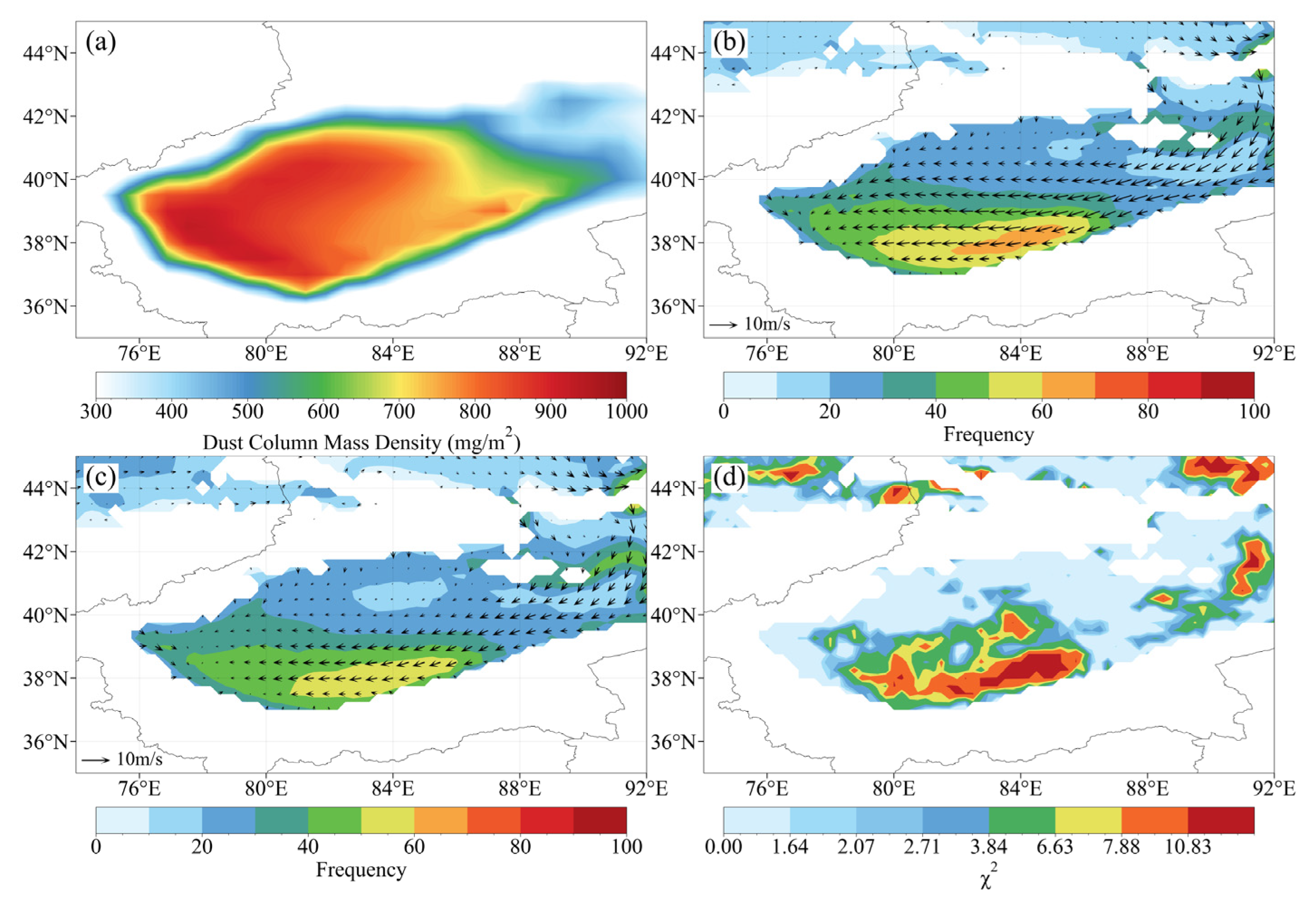
Based on the high frequency of floating dust events, a persistent floating dust event at a single station is defined as the observation of floating dust on three consecutive days. A TB persistent floating dust event is defined as such events occurring at two or more stations simultaneously. As shown in Figure 3a, the average dust column mass density results for persistent floating dust events in the TB from 2015 to 2024 reveal a distinct “C”-shaped distribution of dust within the basin. This distribution pattern was partially attributed to the NLLJ in the work of Song et al. [43]. The statistical results of NLLJ occurrence during persistent floating dust events in the TB from 2015 to 2024 indicate that over 50% of the basin area experienced NLLJ frequencies exceeding 30%, with a maximum frequency of 64% observed in the southern part of the basin (Figure 3b). This frequency is significantly higher than that on other days, which shows a maximum of only 57% (Figure 3c). Meanwhile, the averaged 850-hPa wind field, which is near the core height of the NLLJs, reveals a predominant easterly wind pattern in both figures. Notably, the wind intensity is significantly stronger during the persistent floating dust events shown in Figure 3b than on the other days (Figure 3c). Moreover, in regions where NLLJs frequently occur, chi-square values exceed the critical threshold of 3.84 (Figure 3d), which indicates a statistically significant association between persistent floating dust events and NLLJ activity. This statistical relationship suggests a potential linkage between persistent floating dust events and the NLLJ in the TB. Therefore, this study examines a typical case to elucidate this connection.

3.2. Typical Persistent Floating Dust Event from 29 to 31 July 2006

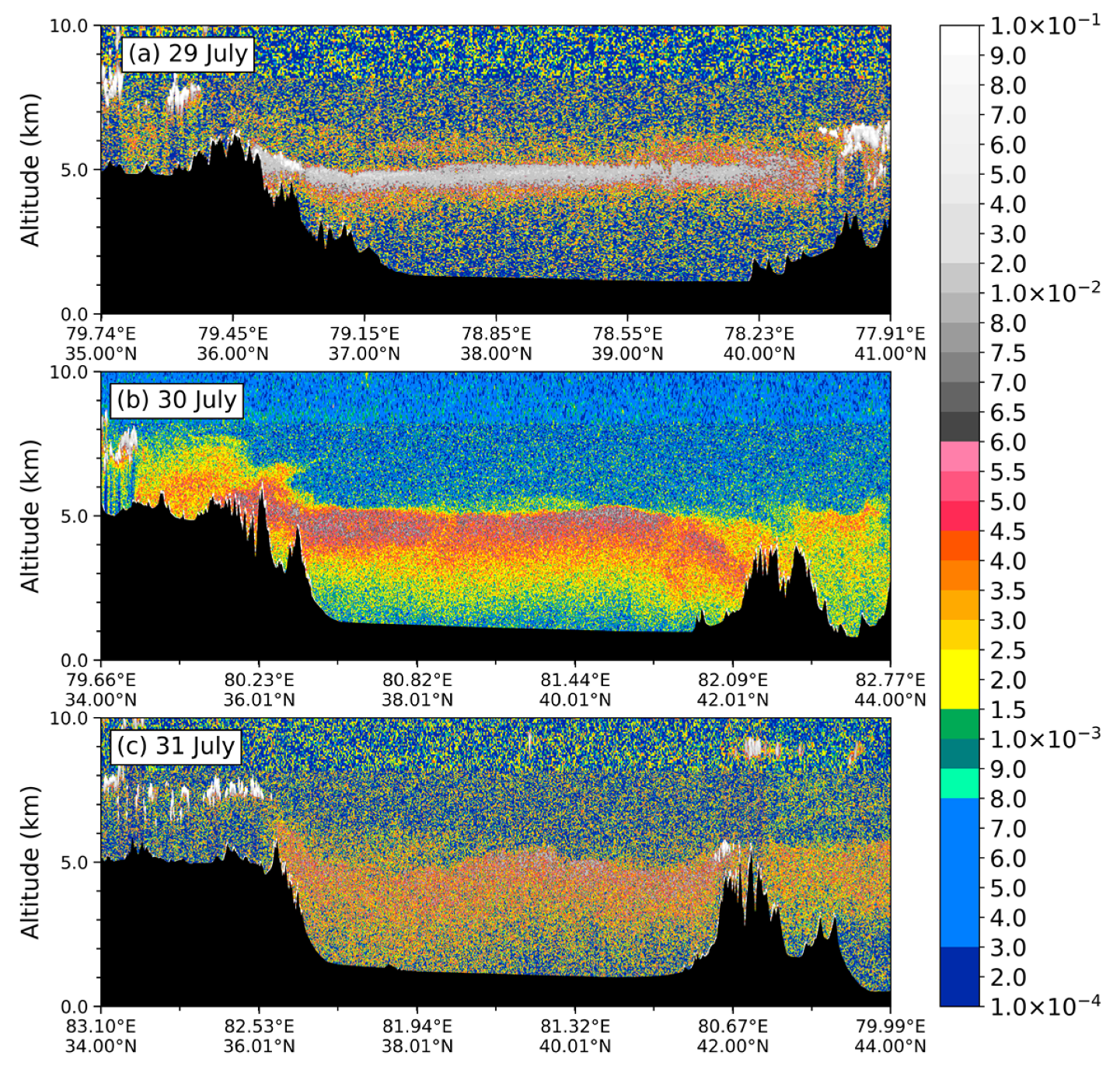
An intense dust event that occurred during 26 to 31 July 2006 is selected in this study. During the dust event, a strong cold frontal system passage and massive dust emissions occurred on 26 and 27 July. As shown in Figure 4 and Figure S1, the heavy and persistent floating dust layers were continuously observed by the CALIPSO satellite in the following days. Some previous studies have demonstrated the characteristics of this dust event. For instance, Huang et al. [63] reported that the maximum daily mean radiative heating rate reached 5.5 K day−1 at 5 km on 29 July and pointed out that dust aerosols had a significant impact on the radiative energy budget and atmospheric circulation over the TB region. During this event, the floating dust layers were thick enough to result in the misidentification of dust as clouds in the CALIOP VFM products. Zhou et al. [64] developed a simple method based on the relationship between the layer-integrated attenuated backscatter coefficient and the layer-integrated depolarization ratio to supplement the current discrimination algorithm. This dust event also showed substantial regional climate impacts. Chen et al. [65] reported that the dust could be meridionally transported to the TP under the thermal effect of the TP and the weakening of the East Asian westerly winds using the WRF-Chem simulations and revealed that the maximum heating rate reached 0.11 K day−1 at about 7 km over the TP. Integrating these previous findings with CALIPSO observations, we find that persistent floating dust processes (as shown in Figure 4 and Figure S1) remained over the TB region following the end of the dust storm, with evident dust transport toward both the TP and the Tianshan Mountains. In addition, after examining all CALIOP observations from 2006 to 2023 over the TB region, it was found that this dust case was the only one where the dust layer covered the entire satellite orbits from north (Tianshan Mountains) to south (TP), and the top height and concentration of the dust layer were the most uniform in the horizontal distribution. Based on the analysis, this case can be identified as an ideal representative event of persistent floating dust in the TB. During this dust case, the upper part of thick dust layer completely attenuated the spaceborne lidar beam, preventing lidar from capturing the evolution in the lower part of the dust layer. Therefore, we cannot directly determine how such a large-scale dust layer evolves internally. As we know, many factors influence the vertical distribution of dust aerosols over desert regions, especially dynamical mechanisms [66]. Therefore, based on these considerations, this case deeply attracted our attention.
The outbreak of dust storms in the TB is primarily influenced by cold air activity [67]. The invasion of cold air masses converges with warm air over the TB, enhancing atmospheric baroclinicity and promoting the downward transfer of upper-level momentum, which consequently generates strong surface winds and dust emissions [68]. This process typically manifests as a cold front, and multidirectional cold air invasions may lead to more intense dust emissions [69]. As shown in Figure S2a, on 26 July, a closed cold-core low at 500-hPa was located over Siberia southward, allowing cold air to affect the TB. Under the influence of strong easterly winds at 850-hPa (Figure S3a), the temperature dropped in the northern part of the basin, while the southern part retained relatively high temperatures. Strong surface winds facilitated dust emissions in the TB. On 27 July (Figure S2b), two cold air masses over Siberia merged, and the intensified cold advection enabled the cold air to further invade and completely dominate the basin. The strengthened easterly advection at low level formed a strong convergence zone in the eastern part of the basin (Figure S3b), favoring dust uplift. Increased surface pressure, decreased temperature, and enhanced wind speed (Figure S4b) led to further dust emissions. From 28 to 30 July (Figure S3c–e), the upper-level low-pressure system no longer affected the TB. The accumulation of cold air in the basin resulted in a gradual takeover by a low-level cold high-pressure system (Figure S3c–e). Surface temperatures rose, pressure increased, and wind speeds decreased (Figure S3c–e). The relatively stable atmospheric conditions favored the persistence of floating dust weather. On 31 July, the basin was primarily influenced by a closed high-pressure system at 500-hPa (Figure S2f). At the low level and the surface (Figures S3f and S4f), the cold high-pressure system weakened and moved northward, accompanied by substantial warming in the basin.

3.3. Evaluation of Model Simulation

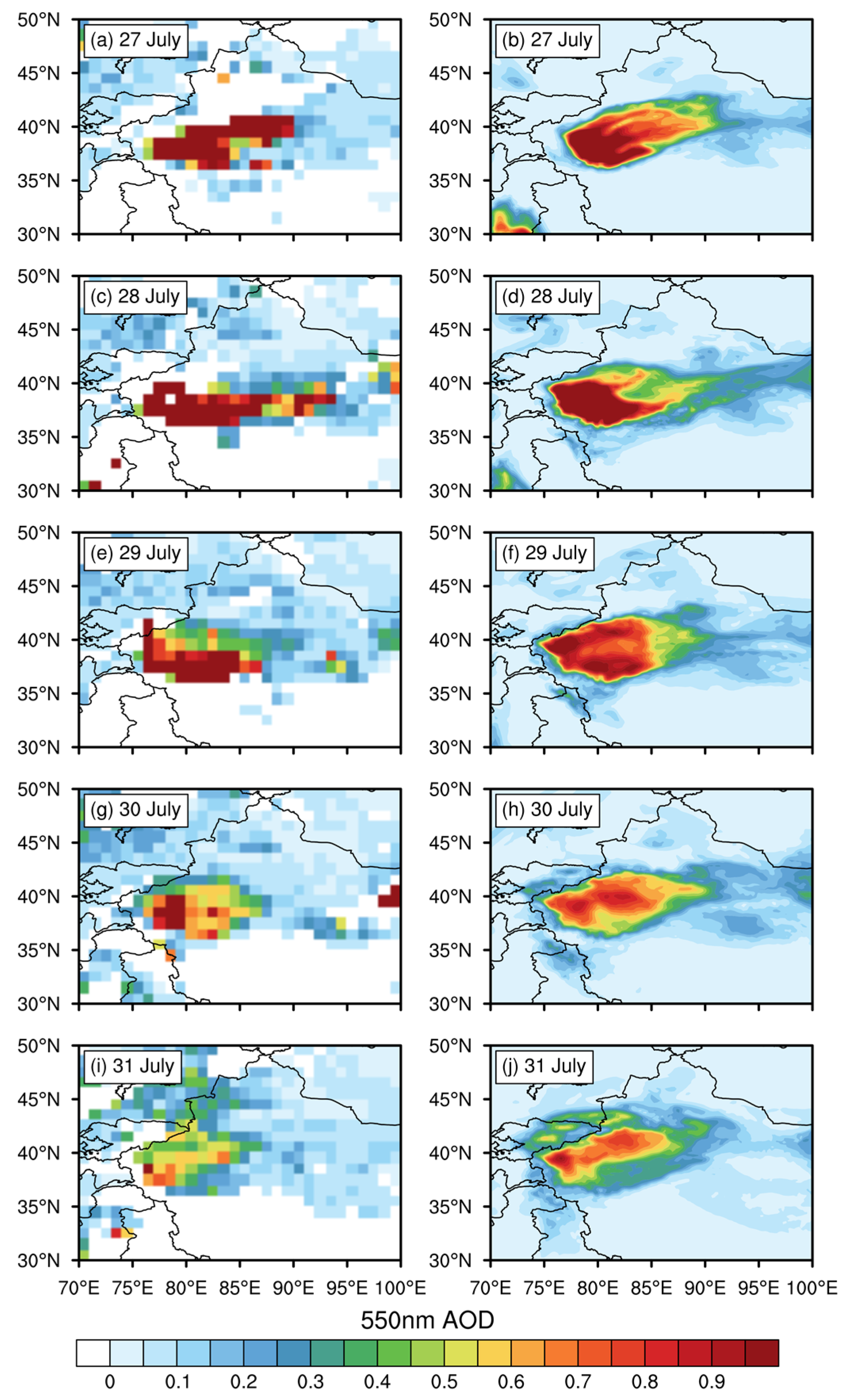
MODIS observations provide atmospheric aerosol property products from the Dark Target (DT) and Deep Blue (DB) algorithms. The MODIS DB AOD performs well in desert areas [70] and is extensively used in desert regions with scarce observation stations to validate aerosol simulation accuracy [20,65]. As shown in Figure 5, the high AOD at 550 nm from the MODIS was mainly distributed in the TB and its surrounding areas during the simulation period, roughly consistent with the dust emissions and outward transport in the basin. The high AOD in the TB was most widespread from 27 to 28 July (Figure 5a–d). In the following days (Figure 5e–h), the coverage area of the high AOD decreased, and the highest AOD concentrated finally in the western part of the basin on 31 July (Figure 5i,j). These results are consistent with the prevailing easterly winds in the basin. In general, the distribution and trend of the AOD simulated by the WRF-Chem near the border crossing time are consistent with the MODIS AOD. The spatial differences between the two can be explained by their fundamentally different temporal representations: The MODIS AOD is a composite image built from multiple overpasses, whereas the WRF-Chem results only represent the situation at one moment. The simulation results can compensate for the shortcomings of satellite observations in representing daily variations and spatial gaps.
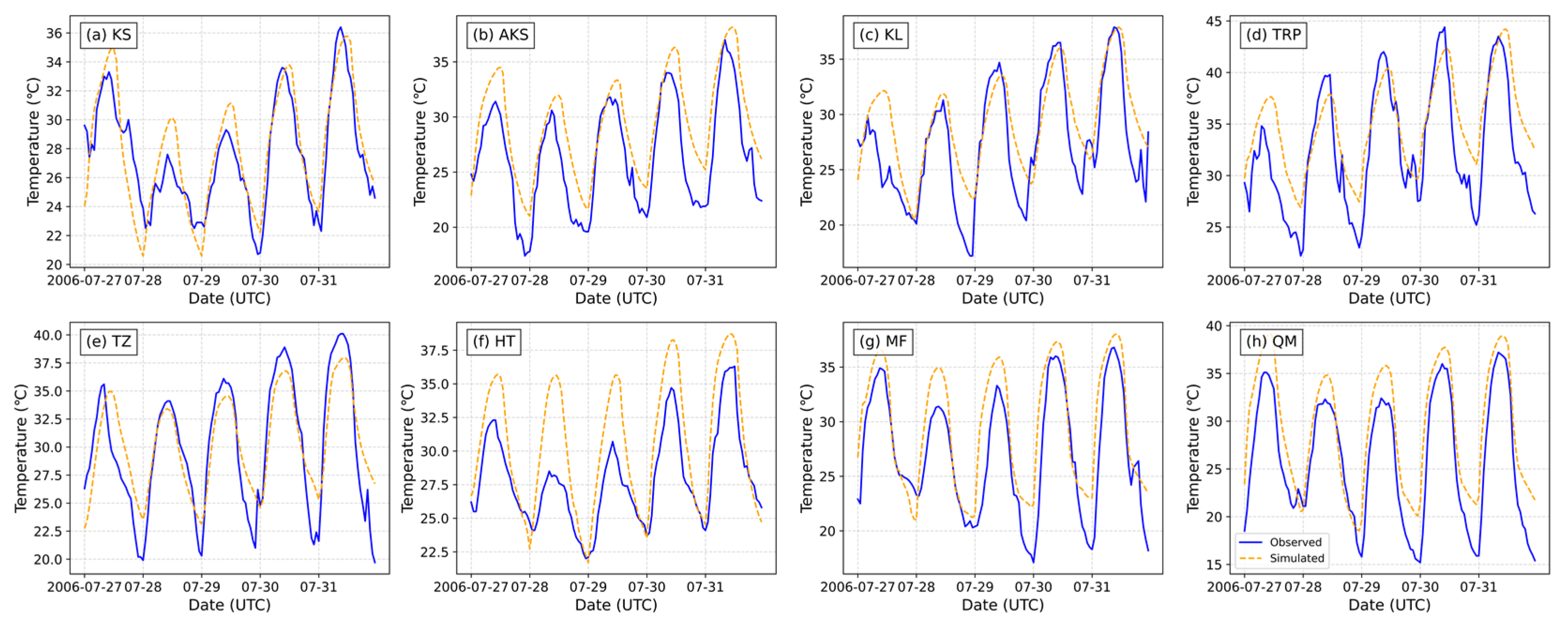
Thermodynamic conditions are key factors influencing dust emissions and uplift. Here, 2 m temperature is used as a representative variable to further evaluate model performance. As shown in Figure 6, the WRF-Chem model captured the diurnal variation of 2 m temperature effectively and exhibited consistent trends with observations. The coefficient of determination (R2) exceeded 0.7 at all stations, with the QM station showing the highest correlation (R2 = 0.9). The KS station exhibited the smallest deviation, with a root mean square error (RMSE) of 1.98 °C, while the maximum RMSE of 3.92 °C was observed at the QM station. The complex terrain and heterogeneous land surface of the desert region pose challenges for simulation. Overall, however, the WRF-Chem model demonstrates a satisfactory capability in capturing the temporal variations over the TB area.

3.4. The Mechanism of Persistent Floating Dust

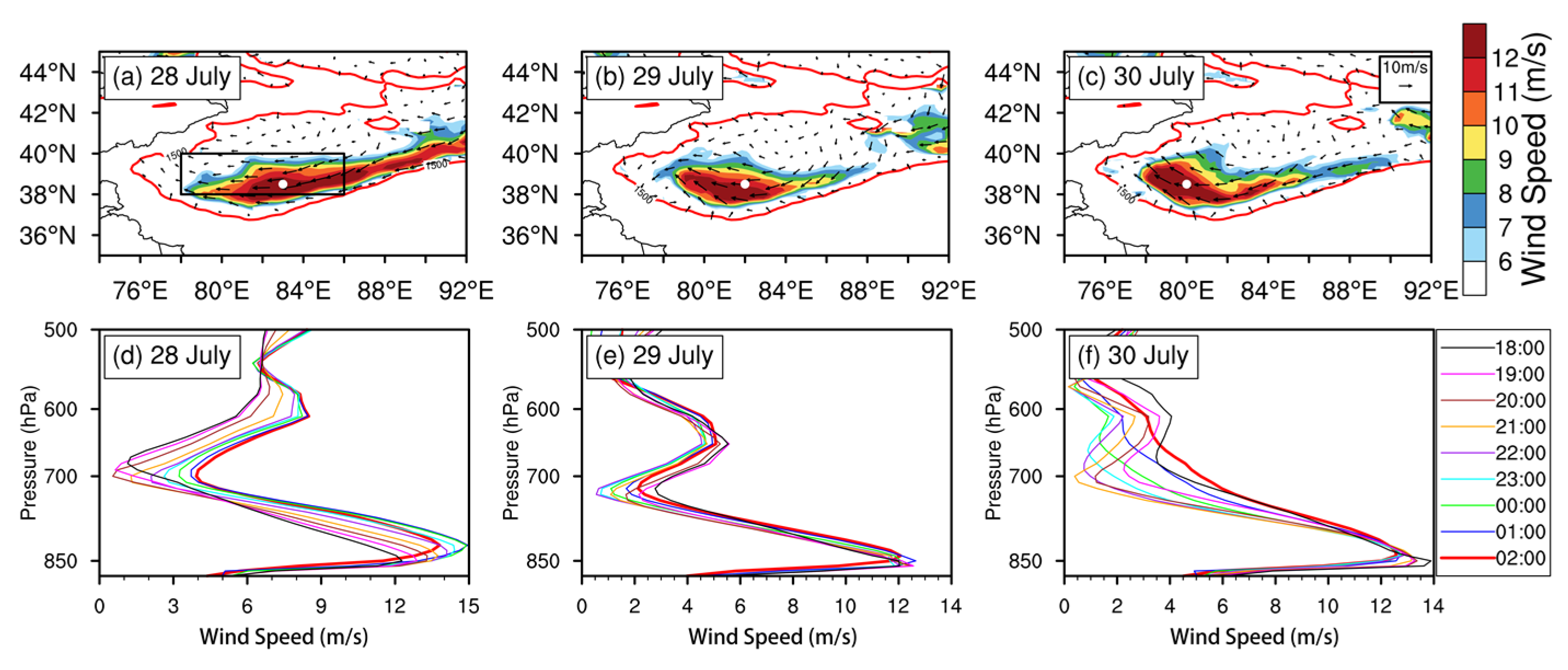
The cessation of cold air intrusion into the TB, as observed in the synoptic evolution and supported by previous research [65], indicated that the dust storm event gradually subsided after 28 July. Existing studies have focused on analyzing the causes of dust storms over the TB, while the subsequent processes after the cold front passes are seldom noted. Although the dust life cycle eventually dissipates within a few hours to several days, its longer duration can lead to more prolonged dusty conditions, regional impacts, and higher risks of health issues [71,72]. As shown in Figure 7a–c, a strong wind zone at 20:00 UTC (02:00 local time) was identified near 850-hPa over the TB after 28 July, with core wind speeds exceeding 12 m/s displaying easterly components. A representative central point was selected to construct vertical profiles of nocturnal horizontal wind speed (Figure 7d–f), revealing a characteristic “nose-shaped” structure. Below 600-hPa, the maximum wind speeds at the core of the wind zone all exceeded 12 m/s, with minimum speeds occurring above the maximum wind layer, and showing speed differences exceeding 3 m/s. These characteristics conform to the identification criteria of the NLLJ recommended by Du et al. [58]. Therefore, these observations confirm the presence of a classic NLLJ at 850-hPa over the desert during 28 to 30 July. The NLLJ is crucial in dust events [73,74]. Therefore, we investigated the role of the NLLJ in the persistent floating dust event from 28 to 30 July based on simulation.
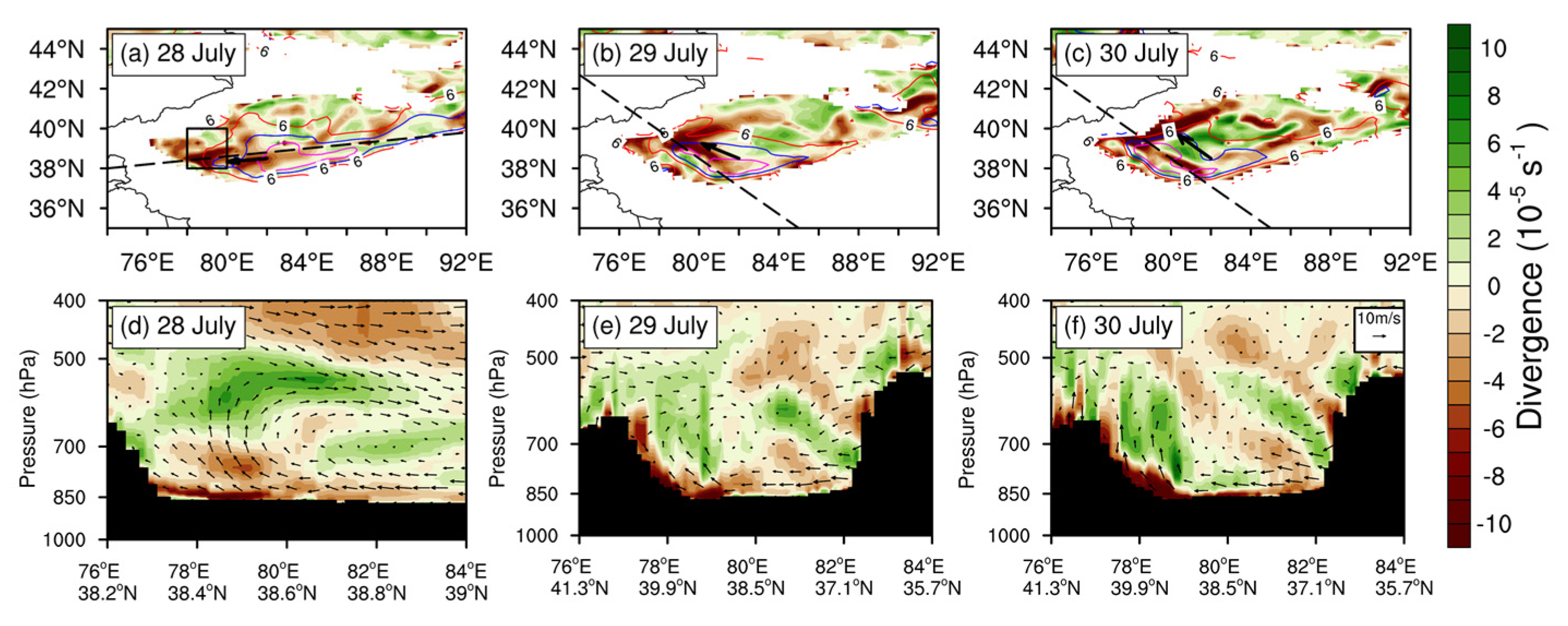
As mentioned earlier, NLLJs affect dust emissions over the TB, while convergence and divergence variations in the wind field can affect the transport and distribution of momentum and substances in the atmosphere. The upward airflow generated by convergence is one of the main driving forces for the vertical transport of dust [16,75,76,77]. To further explore the role of NLLJs in dust spatiotemporal evolution, the divergence distribution at 850-hPa is shown in Figure 8a–c, with persistent convergence zones on the left flank and exit region of the NLLJ at 22:00 UTC during 28 to 30 July (Figure 8a–c). The high core wind speeds of the NLLJ decrease laterally, generating cyclonic wind shear on the left side (relative to the flow direction) and anticyclonic shear on the right side, resulting in left-side convergence and right-side divergence. Throughout this period, the NLLJ maintained a dominant easterly flow, with terrain effects creating a distinct exit region in the western basin where airflow accumulation produced strong convergence. Along the dominant flow direction (black dashed line in Figure 8a–c), the cross-section shows divergence fields and vector plots of zonal and vertical winds in Figure 8d–f. It can be seen that a significant convergence zone formed ahead of the NLLJ, where intense upward motion, driven by mass continuity, resulted in pronounced upper-level divergence. This strong ascent exhibited a considerable vertical extent, reaching up to 500-hPa on 28 July. The structure of low-level convergence and upper-level divergence that formed ahead of the NLLJ provided favorable dust-uplift conditions for the maintenance of the persistent floating dust event.
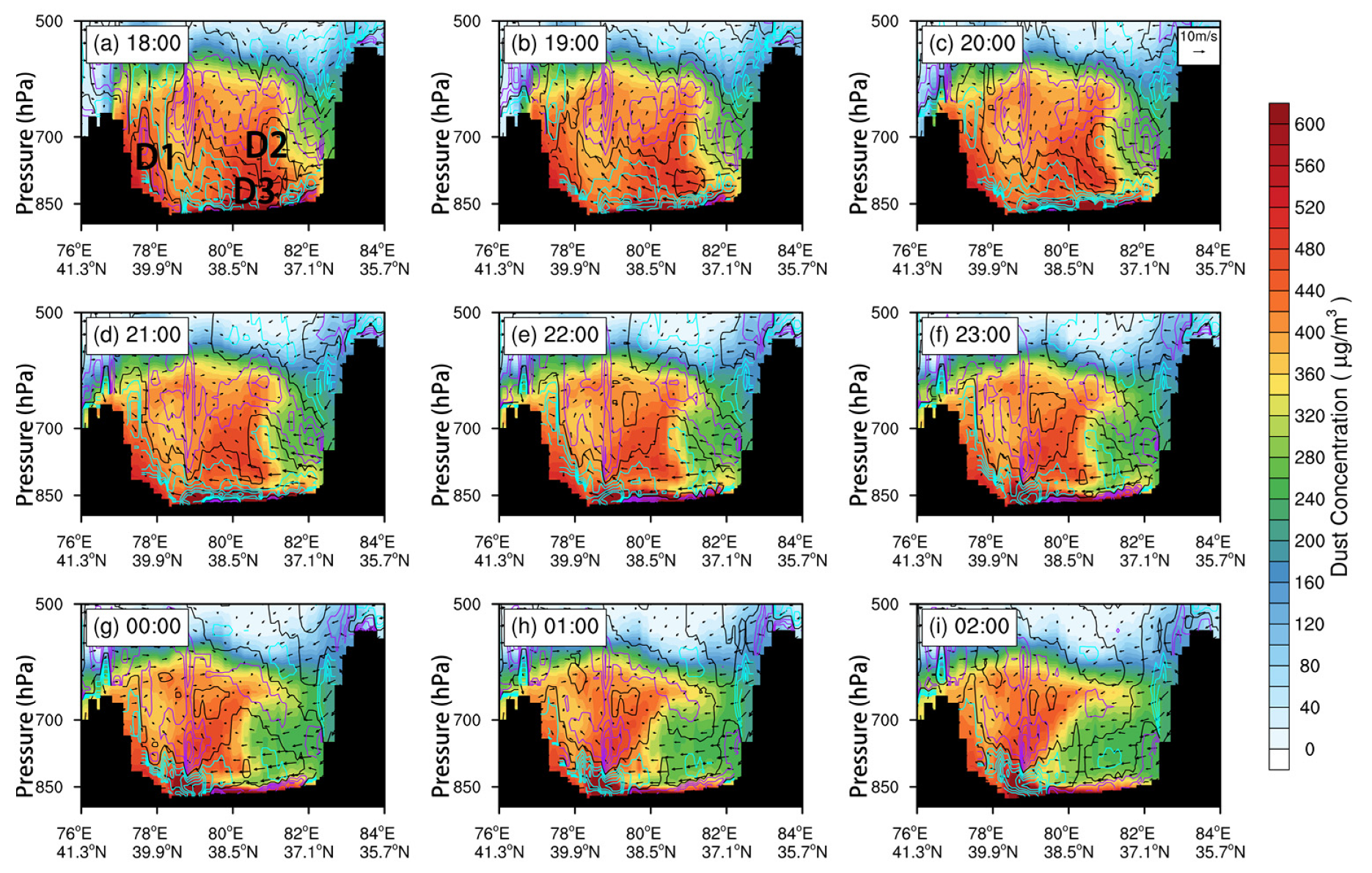
To further view the evolution of dust concentration when NLLJs exist, the hourly vertical cross-sections of dust concentration, divergence, and zonal circulation from 18:00 UTC on 29 July to 02:00 UTC on 30 July are shown in Figure 9. At 18:00 UTC (Figure 9a), the vertical cross-section revealed two distinct dust plumes within the basin: D1 along the southern flank of the Tianshan Mountains and D2 in the southwestern basin. The dust layer exhibited a well-defined top near 500-hPa, coinciding with a pronounced vertical divergence structure featuring low-level convergence (near 850-hPa) and high-level divergence (700–500-hPa) centered near 80° E. This dynamical configuration supported persistent updrafts extending to approximately 700-hPa (Figure 9a). With the development of NLLJs, the vertical structure of divergence and significant updrafts are strengthened and pushed northwestward toward the exit region. D1 moved northward toward the Tianshan Mountains to transport dust, and the top of the dust layer descended. At the same time, D2 expanded northwestward, and there was no significant change in the height of the dust layer top. In Figure 9a, a high-concentration dust cluster (D3, dust concentration ≥ 600 μg/m3) was discovered near the ground. The established southeasterly low-level flow facilitated continuous dust transport from D3 to the exit region (Figure 9e), serving as the primary source for D1’s northward transport and as a sustaining mechanism for D2 through supplying dust particles.
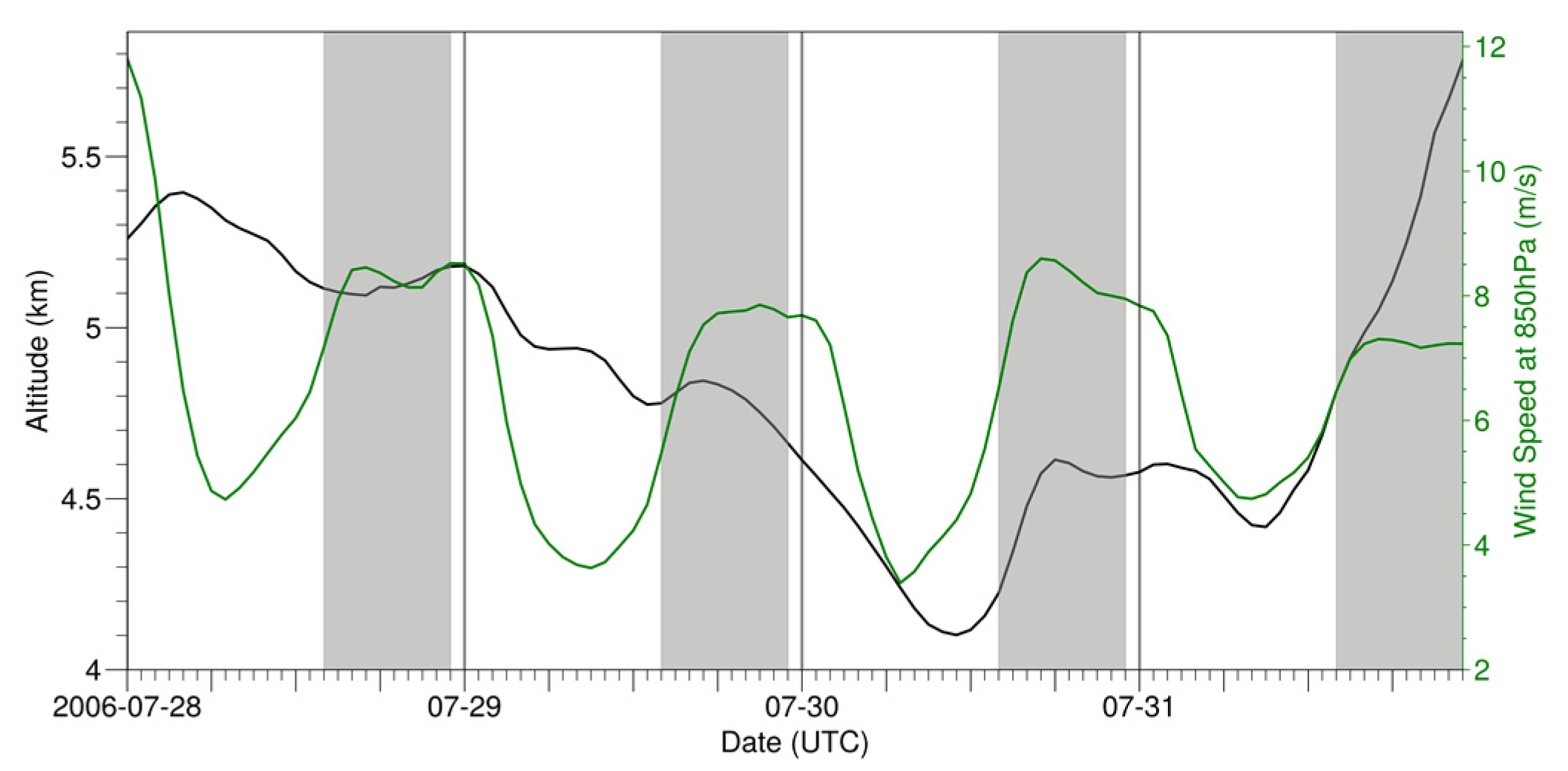
To explore the role of the NLLJ in this particular persistent floating dust event, an analysis of the diurnal variation in DLH and NLLJ core wind speed was conducted. DLH serves as a key indicator of the intensity of dynamic lifting during dust events. Here, the DLH over the exit region of the NLLJ (black rectangular domain in Figure 8a) was defined as the altitude containing 90% of the total dust column concentration (DCC) from the ground surface. As shown in Figure 10, the jet core intensity exhibited a distinct diurnal pattern characterized by lower daytime and higher nighttime values, with nocturnal speeds exceeding 6 m/s. During the persistent floating dust event, the DLH showed an overall decreasing trend due to subsidence and outward transport of dust from the TB, yet remained consistently above 4 km. The observed nocturnal increase in DLH exhibited a distinct lag behind the temporal evolution of the NLLJ core intensity, further confirming the active role of the NLLJ in sustaining the floating dust layer.
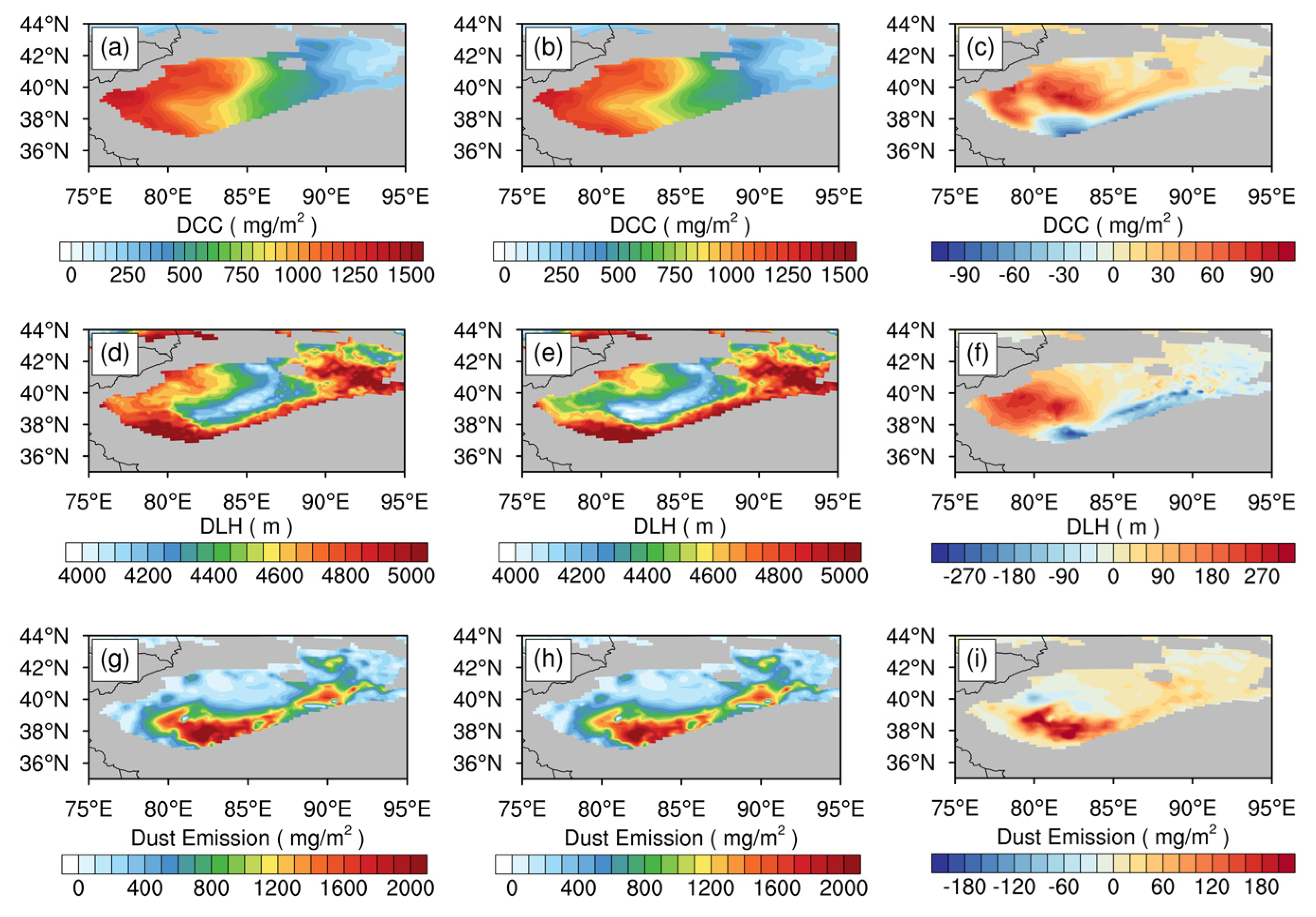
Further, the differences in DCC, DLH, and dust emissions under NLLJ and NO-NLLJ conditions were analyzed to quantitatively demonstrate the role of the NLLJ. The NLLJ filtering effect in EXP2 is presented in Figure S5. Although jet cores exceeding 6 m/s persist, both the intensity and spatial extent of the NLLJ show significant suppression compared with Figure 7. Therefore, the differences between EXP3 and EXP2 can be employed to quantify the contribution of the NLLJ during persistent floating dust events. Consistent with Figure 3a, the DCC during the studied event also exhibited a “C”-shaped distribution (Figure 11a). Although a similar pattern was observed under NO-NLLJ conditions, the differences induced by the NLLJ within the TB were substantial. The NLLJ demonstrated a positive effect on DCC across most of the basin, particularly in the central basin and the NLLJ exit region, where differences exceeded 100 mg/m2. This pattern highlighted the role of the NLLJ in intra-basin dust transport and the significant convergence ahead of the jet. The highest DLH values were located over the southern basin, exceeding 5000 m. However, the largest differences were observed ahead of the NLLJ, with a maximum difference greater than 300 m, highlighting the crucial role of the uplift mechanism in maintaining the dust lifting height. Also, the NLLJ significantly influenced dust emissions. In areas largely overlapping with the NLLJ region, it induced a maximum dust emission exceeding 200 mg/m2. This impact has been confirmed in previous studies to be associated with increased surface winds resulting from the breakdown and downward transport of momentum of the NLLJ after sunrise [41].
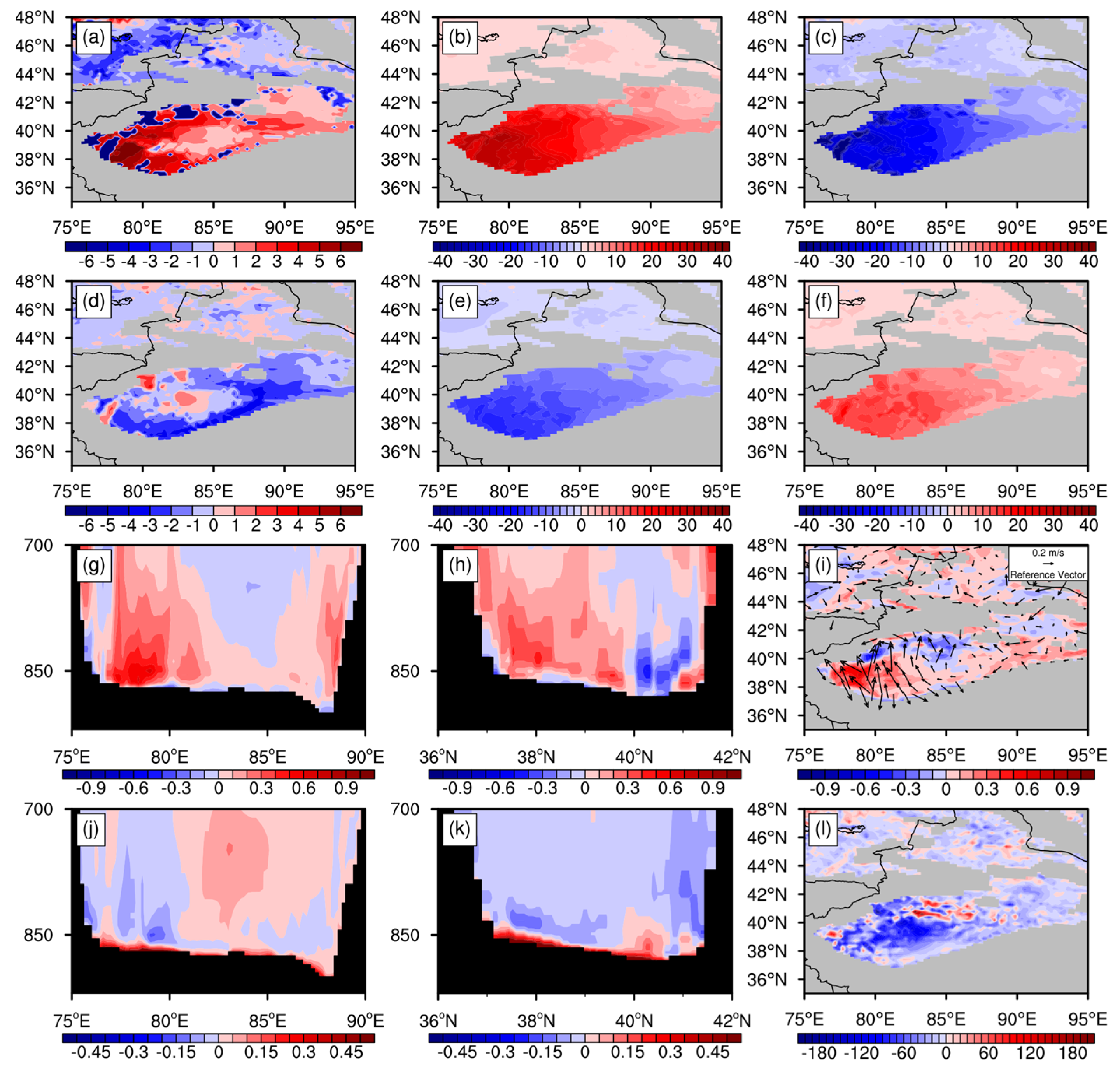
Furthermore, the influence of persistent floating dust on the low-level jet was also noted. The net DRF at the TOA was positive during daytime and predominantly negative at night, suggesting that it may amplify the diurnal temperature amplitude in the TB (Figure 12a,d). Due to the strong scattering and absorption of solar shortwave radiation by dust in the atmosphere, the radiative forcing in the atmosphere over the TB during daytime was positive (Figure 12b), with a maximum exceeding 40 W/m2, leading to heating within the dust-laden atmospheric layer. Meanwhile, the reduction in downward shortwave radiation reaching the surface resulted in negative radiative forcing at the TB surface (Figure 12c), with the maximum intensity exceeding −40 W/m2, causing surface cooling. Under nighttime conditions, as shown in Figure 12g,h, the DRF lead to a noticeable increase in low-level wind speeds over the central, western, and southern parts of the basin; a similar result was reported by Chen et al. [78] in their case study of 6 April 2018 over the TB. The maximum wind enhancement occurred around 850-hPa. Figure 12i further shows that the spatial pattern of 850-hPa horizontal wind speed increase corresponded well with that in Figure 12g,h, with a maximum increment reaching 1 m/s. These findings demonstrate that DRF acted to strengthen the NLLJ, both in terms of its core intensity and the associated vertical wind shear. The enhanced NLLJ, in turn, provided dynamic support and dust sources for maintaining floating dust, thereby forming positive feedback between persistent floating dust and the NLLJ.
The impact of DRF on the NLLJ is complex, particularly over topographically intricate regions such as the TB. In this study, we attempt to interpret this phenomenon from the perspectives of temperature changes and PBL depth. Under nighttime conditions, when surface longwave radiation dominates the atmospheric energy exchange, dust absorbs and reemits longwave radiation [79], which slows the cooling rate or even generates heating within the dust layer and near the surface, particularly ahead of the NLLJ where the NLLJ led to significant dust accumulation and uplift; this heating effect was most pronounced at the same altitude (Figure 12j,k). The strengthened temperature contrast further enhanced the NLLJ. Heinold et al. [80], in their study of the Bodélé Depression, also reached a similar conclusion: DRF enhances baroclinicity, which in turn strengthens the NLLJ. Figure 12l illustrates that under the influence of DRF, the PBL becomes shallower. This thinning may alter the vertical distribution of momentum, thereby enhancing wind speeds near the core of the NLLJ. Here, we only provide a preliminary discussion of the potential mechanisms involved. Unraveling the underlying physical processes remains challenging and calls for further targeted investigation.

4. Discussion and Conclusions

This study aims to analyze the role of the NLLJ in persistent floating dust events. Through long-term analysis of dust events in the TB from 2015 to 2024, this study found that the frequency of floating dust events in the TB can reach up to 72.38%. Furthermore, the combination of the high occurrence frequency of the NLLJ on persistent floating dust days and their statistically significant association indicates a potential physical linkage between them. To investigate this linkage, this study employed a validated WRF-Chem simulation to analyze a persistent floating dust event in the TB captured by CALIPSO from 29 to 31 July 2006. During the nights of 28 to 30 July, a distinct NLLJ was consistently observed, with its core located near 850-hPa, exhibiting easterly winds and maximum wind speeds exceeding 12 m/s. Driven by this easterly jet, a strong convergence zone developed ahead of the NLLJ, leading to significant dust accumulation. The associated intense upward motion maintained the DLH above 4 km throughout the event. During this event, the NLLJ induced a distribution pattern of DCC with maximum increases exceeding 100 mg/m2 in the central and western TB. Over the same region, it exerted a positive forcing on the DLH with a maximum enhancement over 300 m. Concurrently, dust emissions in the NLLJ region increased by more than 200 mg/m2. Furthermore, due to the control of dust distribution by the NLLJ, the resulting dust radiative effects led to an intensification of the jet itself, with the enhancement exceeding 1 m/s at 850-hPa. This study confirms the existence of a positive feedback mechanism between NLLJs and persistent floating dust events.
Given that the event exhibits consistent characteristics with long-lasting persistent floating dust episodes, the analysis of this typical case can be considered representative of the NLLJ’s influence. Also, the promoting effect of dust weather on the development of low-level jets has also been demonstrated in previous studies [81,82]. Therefore, long-term simulation analysis is necessary to further quantitatively assess the contribution of this positive feedback mechanism. While this study confirms the active role of the NLLJ in maintaining persistent floating dust events, it should be acknowledged that topography likely serves as the dominant factor sustaining the characteristic dust distribution and elevated DLH. The fundamental role of topography in shaping these features has been demonstrated in a previous study [83]. Meanwhile, as existing methods cannot fully eliminate the influence of the NLLJ on surface wind, the actual impact of NLLJs on persistent dust events is likely more significant. This necessitates further research to identify solutions.
Addressing the high-frequency persistent floating dust events in the TB, which significantly impact atmospheric dynamic stability and regional climate change [84,85], this study investigates and quantifies the role of the NLLJ in a typical persistent floating dust event. The identified positive feedback mechanism can provide valuable support for operational forecasting of both floating dust weather and NLLJ variations. Moreover, existing studies have shown that dust exerts a promoting effect on hail occurrence [86,87], and the western region in the TB has a relatively dense population and experiences the highest frequency of hail events within the basin. The substantial accumulation and vertical uplift of dust not only pose health risks but may also present potential opportunities for weather modification operation over this region.

Supplementary Materials

The following supporting information can be downloaded at: https://www.mdpi.com/article/10.3390/atmos17020134/s1, Figure S1: Vertical cross-sections of CALIOP VFM from 29 to 31 July 2006, with specific timestamps annotated in Figure 1; Figure S2: The 500-hPa synoptic situation at 12:00 UTC from 26 to 31 July, with white contours indicating geopotential height (unit: dagpm), color-filled contours representing air temperature (unit: °C), and solid black lines representing national boundaries; Figure S3: The 850-hPa synoptic situation over the TB at 12:00 UTC from 26 to 31 July, with white contours indicating geopotential height (unit: dagpm), color-filled contours representing air temperature (unit: °C), vector arrows representing horizontal winds, and solid black lines representing national boundaries; Figure S4: Sea-level pressure field over the Tarim Basin (TB) and Tibetan Plateau (TP) region at 12:00 UTC from 26 to 31 July, with white contours indicating pressure (unit: hPa), color-filled contours representing the temperature at 2 m (unit: °C), vector arrows representing horizontal winds at 10 m, and solid black lines representing national and provincial boundaries; Figure S5: Spatial distribution (a–c) of wind speed (color contours, unit: m/s) and wind vectors at 850-hPa (20:00 UTC) with 1500 m terrain heights in red contour lines, and vertical profiles of horizontal wind speed (d–f) at the black point in (a–c) from 18:00 UTC to 02:00 UTC (next day) from 28 to 30 July. All data are derived from EXP2.

Author Contributions

Conceptualization, Y.W. and T.Z.; methodology, Y.W. and T.Z.; software, Y.W.; validation, Y.W.; formal analysis, Y.W., T.Z., J.W., L.W., and C.G.; investigation, Y.W., T.Z., Y.G., and X.L.; resources, T.Z. and R.C.; data curation, Y.W., D.W., and Z.L.; writing—original draft preparation, Y.W.; writing—review and editing, Y.W., T.Z., X.L., D.W., and X.S.; visualization, Y.W. and X.S.; supervision, T.Z.; project administration, T.Z.; funding acquisition, T.Z. All authors have read and agreed to the published version of the manuscript.

Funding

This research was funded by the National Science Foundation of China (42475078), the Gansu Science and Technology Major Program (24ZDWA006), and the Gansu Provincial Science and Technology Program (23JRRA1032), China ‘111’ Project (B25040).

Institutional Review Board Statement

Not applicable.

Informed Consent Statement

Not applicable.

Data Availability Statement

The WRF-Chem code is available from https://www2.mmm.ucar.edu/wrf/users/download/get_source.html (accessed on 4 January 2023). The ground-based observations dataset can be found at https://data.cma.cn/ (accessed on 15 October 2025). The MODIS observations are openly available at https://ladsweb.modaps.eosdis.nasa.gov/missions-and-measurements/products/MOD08_D3/ (accessed on 22 February 2024), and the CALIPSO dataset can be found at https://asdc.larc.nasa.gov/project/CALIPSO (accessed on 17 October 2025). The ERA5 dataset can be found at https://cds.climate.copernicus.eu (accessed on 18 June 2025), and the MERRA-2 dataset can be found at https://disc.gsfc.nasa.gov/datasets/M2T1NXAER_5.12.4/summary?keywords=M2T1NXAER (accessed on 15 October 2025). In addition, the NOAA Solar Calculator can be used at https://gml.noaa.gov/grad/solcalc/ (accessed on 26 September 2025). The WRF-Chem simulation outputs generated in this study are available from the corresponding author upon reasonable request.

Acknowledgments

We appreciate NASA for providing the MODIS observations, CALIPSO observations, and the MERRA-2 dataset; C3S (Copernicus Climate Change Service) for providing the ERA5 products; and the China Meteorological Administration for providing the station observation data. We acknowledge the WRF-Chem development community for maintaining and updating the program. The computing resources and the related technical support used for this work have been provided by the Supercomputing Center of Lanzhou University and its staff (https://scc.lzu.edu.cn/). We also acknowledge all the anonymous reviewers for their insightful and valuable comments.

Conflicts of Interest

Author Rui Chen was employed by the company North Sky-Dome Information Technology (Xi’an) Co., Ltd. The remaining authors declare that the research was conducted in the absence of any commercial or financial relationships that could be construed as a potential conflict of interest.

Abbreviations

The following abbreviations are used in this manuscript:
TBTarim Basin
CALIPSOCloud-Aerosol Lidar and Infrared Pathfinder Satellite Observations
NLLJnocturnal low-level jet
WRF-ChemWeather Research and Forecasting model with Chemistry
DLHdust layer height
TPTibetan Plateau
LLJsLow-level jets
MODISModerate Resolution Imaging Spectroradiometer
NASANational Aeronautics and Space Administration
AODaerosol optical depth
CALIOPCloud-Aerosol Lidar with Orthogonal Polarization
CNESFrench National Centre for Space Research
KSKashgar
AKSAksu
KLKorla
TRPTurpan
TZTazhong
HTHotan
MFMinfeng
QMQiemo
ECMWFEuropean Centre for Medium-Range Weather Forecasts
IFSIntegrated Forecasting System
MERRA-2The second Modern-Era Retrospective Analysis for Research and Applications
NOAANational Oceanic and Atmospheric Administration
CBMZCarbon-Bond Mechanism version Z
MOSAICModel for Simulating Aerosol Interactions and Chemistry
RRTMGRapid Radiative Transfer Model for GCMs
MYNN2.5Mellor Yamada Nakanishi Niino Level 2.5
PBLplanetary boundary layer
EXP1, 2, 3, 4Experiment 1, 2, 3, 4
DRFdust radiative forcing
NRFnet radiative flux
TOAtop of the atmosphere
ATMatmosphere
SURFsurface
IRFinstantaneous radiative flux
DTDark Target
DBDeep Blue
DCCdust column concentration

Appendix A

Table 1 Annotations:
1. Name: Experiment identifier.
2. Input_data: Dataset used for initial and boundary conditions.
3. if_no_pbl_nudging_uv: Logical switch controlling whether to disable nudging of horizontal wind components (u, v) within the planetary boundary layer (PBL).
 1: No nudging of u/v winds in the PBL. PBL winds are determined solely by model dynamics and PBL parameterization.
 0: Nudge u/v winds in the PBL toward the background field (input_data) according to the specified nudging coefficient and height settings.
4. guv: Nudging coefficient for horizontal wind components (u, v) in grid nudging (unit: s−1). Controls the strength of nudging: larger values enforce faster adjustment of model winds toward the background field.
5. aer_ra_feedback: Switch controlling whether aerosol radiative effects are activated in the model.
 1: On; 0: Off.

References

  1. Andreae, M.O.; Charlson, R.J.; Bruynseels, F.; Storms, H.; Van Grieken, R.; Maenhaut, W. Internal Mixture of Sea Salt, Silicates, and Excess Sulfate in Marine Aerosols. Science 1986, 232, 1620–1623. [Google Scholar] [CrossRef]
  2. Huang, J.; Wang, T.; Wang, W.; Li, Z.; Yan, H. Climate effects of dust aerosols over East Asian arid and semiarid regions. J. Geophys. Res. Atmos. 2014, 119, 11398–11416. [Google Scholar] [CrossRef]
  3. Middleton, N.J. Desert dust hazards: A global review. Aeolian Res. 2017, 24, 53–63. [Google Scholar] [CrossRef]
  4. Knippertz, P.; Todd, M.C. Mineral dust aerosols over the Sahara: Meteorological controls on emission and transport and implications for modeling. Rev. Geophys. 2012, 50, RG1007. [Google Scholar] [CrossRef]
  5. Mahowald, N.; Albani, S.; Kok, J.F.; Engelstaeder, S.; Scanza, R.; Ward, D.S.; Flanner, M.G. The size distribution of desert dust aerosols and its impact on the Earth system. Aeolian Res. 2014, 15, 53–71. [Google Scholar] [CrossRef]
  6. Schepanski, K. Transport of Mineral Dust and Its Impact on Climate. Geosciences 2018, 8, 151. [Google Scholar] [CrossRef]
  7. Wittmann, M.; Groot Zwaaftink, C.D.; Steffensen Schmidt, L.; Guðmundsson, S.; Pálsson, F.; Arnalds, O.; Björnsson, H.; Thorsteinsson, T.; Stohl, A. Impact of dust deposition on the albedo of Vatnajökull ice cap, Iceland. TC 2017, 11, 741–754. [Google Scholar] [CrossRef]
  8. Bali, K.; Mishra, A.K.; Singh, S.; Chandra, S.; Lehahn, Y. Impact of dust storm on phytoplankton bloom over the Arabian Sea: A case study during March 2012. Environ. Sci. Pollut. Res. 2019, 26, 11940–11950. [Google Scholar] [CrossRef]
  9. Wiggs, G.F.S.; O’Hara, S.L.; Wegerdt, J.; Van Der Meer, J.; Small, I.; Hubbard, R. The dynamics and characteristics of aeolian dust in dryland Central Asia: Possible impacts on human exposure and respiratory health in the Aral Sea basin. Geogr. J. 2003, 169, 142–157. [Google Scholar] [CrossRef]
  10. Viviroli, D.; Dürr, H.H.; Messerli, B.; Meybeck, M.; Weingartner, R. Mountains of the world, water towers for humanity: Typology, mapping, and global significance. Water Resour. Res. 2007, 43, W07447. [Google Scholar] [CrossRef]
  11. Immerzeel, W.W.; van Beek, L.P.H.; Bierkens, M.F.P. Climate Change Will Affect the Asian Water Towers. Science 2010, 328, 1382–1385. [Google Scholar] [CrossRef]
  12. Han, Y.; Wang, T.; Tan, R.; Tang, J.; Wang, C.; He, S.; Dong, Y.; Huang, Z.; Bi, J. CALIOP-Based Quantification of Central Asian Dust Transport. Remote Sens. 2022, 14, 1416. [Google Scholar] [CrossRef]
  13. Hu, Z.; Huang, J.; Zhao, C.; Jin, Q.; Ma, Y.; Yang, B. Modeling dust sources, transport, and radiative effects at different altitudes over the Tibetan Plateau. Atmos. Chem. Phys. 2020, 20, 1507–1529. [Google Scholar] [CrossRef]
  14. Jia, R.; Liu, Y.; Chen, B.; Zhang, Z.; Huang, J. Source and transportation of summer dust over the Tibetan Plateau. Atmos. Environ. 2015, 123, 210–219. [Google Scholar] [CrossRef]
  15. Mao, R.; Hu, Z.; Zhao, C.; Gong, D.-Y.; Guo, D.; Wu, G. The source contributions to the dust over the Tibetan Plateau: A modelling analysis. Atmos. Environ. 2019, 214, 116859. [Google Scholar] [CrossRef]
  16. Wang, T.; Tang, J.; Sun, M.; Liu, X.; Huang, Y.; Huang, J.; Han, Y.; Cheng, Y.; Huang, Z.; Li, J. Identifying a transport mechanism of dust aerosols over South Asia to the Tibetan Plateau: A case study. Sci. Total Environ. 2021, 758, 143714. [Google Scholar] [CrossRef]
  17. Cao, J.; Chen, S. The Tibetan Plateau as dust aerosol transit station in middle troposphere over northern East Asia: A case study. Atmos. Res. 2022, 280, 106416. [Google Scholar] [CrossRef]
  18. Huang, J.; Zhou, X.; Wu, G.; Xu, X.; Zhao, Q.; Liu, Y.; Duan, A.; Xie, Y.; Ma, Y.; Zhao, P.; et al. Global Climate Impacts of Land-Surface and Atmospheric Processes Over the Tibetan Plateau. Rev. Geophys. 2023, 61, e2022RG000771. [Google Scholar] [CrossRef]
  19. Tang, J.; Wang, T.; Han, Y.; Zhang, X.; Tan, R.; Dong, Y.; He, S.; Abdullaev, S.F.; Amonov, M.O. Dominating Remote Source and Its Potential Contribution of Airborne Dust Over the Tibetan Plateau. Geophys. Res. Lett. 2024, 51, e2024GL111178. [Google Scholar] [CrossRef]
  20. Yuan, T.; Chen, S.; Huang, J.; Wu, D.; Lu, H.; Zhang, G.; Ma, X.; Chen, Z.; Luo, Y.; Ma, X. Influence of Dynamic and Thermal Forcing on the Meridional Transport of Taklimakan Desert Dust in Spring and Summer. J. Clim. 2019, 32, 749–767. [Google Scholar] [CrossRef]
  21. Meng, L.; Zhao, T.; He, Q.; Yang, X.; Mamtimin, A.; Wang, M.; Pan, H.; Huo, W.; Yang, F.; Zhou, C. Dust Radiative Effect Characteristics during a Typical Springtime Dust Storm with Persistent Floating Dust in the Tarim Basin, Northwest China. Remote Sens. 2022, 14, 1167. [Google Scholar] [CrossRef]
  22. Zhou, C.; Liu, Y.; He, Q.; Zhong, X.; Zhu, Q.; Yang, F.; Huo, W.; Mamtimin, A.; Yang, X.; Wang, Y.; et al. Dust Characteristics Observed by Unmanned Aerial Vehicle over the Taklimakan Desert. Remote Sens. 2022, 14, 990. [Google Scholar] [CrossRef]
  23. Han, B.; Zhou, T.; Zhou, X.; Fang, S.; Huang, J.; He, Q.; Huang, Z.; Wang, M. A New Algorithm of Atmospheric Boundary Layer Height Determined from Polarization Lidar. Remote Sens. 2022, 14, 5436. [Google Scholar] [CrossRef]
  24. Zhou, C.; Yang, X.; Liu, Y.; Zhu, Q.; Xie, Y.; Yang, F.; Ali, M.; Huo, W.; He, Q.; Meng, L. Terrain effects of the Tibetan Plateau on dust aerosol distribution over the Tarim Basin, China. Atmos. Res. 2024, 298, 107143. [Google Scholar] [CrossRef]
  25. Zhang, X.; Wang, T.; Wang, S.; Jiao, Y.; Tang, J.; Li, J.; Yang, F.; Amonov, M.O.; Abdullaev, S.F. Conducive circulation patterns and transport mechanisms for spring dust from Taklimakan Desert to the Tibetan Plateau. Environ. Int. 2025, 197, 109356. [Google Scholar] [CrossRef]
  26. Li, H.; Ma, Y.; Yao, M.; Xie, X.; Wang, M. Relationship between the Spring Float Dust over the Tarim River Basin and the Subtropical Westerly Jet Stream. Desert. Oasis Meteor. 2025, 19, 1–14. (In Chinese) [Google Scholar] [CrossRef]
  27. Qiu, H.; Zhou, C.; Yang, F.; Ma, K.; Ye, X.; Zhou, X. Analysis of a typical regional sand-dust event over the eastern Tarim Basin. J. Meteor. Environ. 2018, 34, 19–27. (In Chinese) [Google Scholar] [CrossRef]
  28. Zibibula, R.; Zibibula, A.; Hu, S.; Aiheti, M.; Yang, H. Analysis on the characteristics of floating dust weather and the causes of one heavy pollution weather in kashgar. Desert. Oasis Meteor. 2021, 15, 69–74. (In Chinese) [Google Scholar] [CrossRef]
  29. Liu, H.; He, M.; Wang, B.; Zhang, Q. Advances in low-level jet research and future prospects. J. Meteorol. Res. 2014, 28, 57–75. [Google Scholar] [CrossRef]
  30. Rife, D.L.; Pinto, J.O.; Monaghan, A.J.; Davis, C.A.; Hannan, J.R. Global Distribution and Characteristics of Diurnally Varying Low-Level Jets. J. Clim. 2010, 23, 5041–5064. [Google Scholar] [CrossRef]
  31. Monaghan, A.J.; Rife, D.L.; Pinto, J.O.; Davis, C.A.; Hannan, J.R. Global Precipitation Extremes Associated with Diurnally Varying Low-Level Jets. J. Clim. 2010, 23, 5065–5084. [Google Scholar] [CrossRef]
  32. Varuolo-Clarke, A.M.; Williams, A.P.; Smerdon, J.E.; Ting, M.; Bishop, D.A. Influence of the South American Low-Level Jet on the Austral Summer Precipitation Trend in Southeastern South America. Geophys. Res. Lett. 2022, 49, e2021GL096409. [Google Scholar] [CrossRef]
  33. Caputi, D.J.; Faloona, I.; Trousdell, J.; Smoot, J.; Falk, N.; Conley, S. Residual layer ozone, mixing, and the nocturnal jet in California’s San Joaquin Valley. Atmos. Chem. Phys. 2019, 19, 4721–4740. [Google Scholar] [CrossRef]
  34. Wei, W.; Zhang, H.; Zhang, X.; Che, H. Low-level jets and their implications on air pollution: A review. Front. Environ. Sci. 2023, 10, 1082623. [Google Scholar] [CrossRef]
  35. Zong, L.; Yang, Y.; Xia, H.; Yuan, J.; Guo, M. Elucidating the Impacts of Various Atmospheric Ventilation Conditions on Local and Transboundary Ozone Pollution Patterns: A Case Study of Beijing, China. J. Geophys. Res. Atmos. 2023, 128, e2023JD039141. [Google Scholar] [CrossRef]
  36. Clements, M.; Washington, R. Atmospheric Controls on Mineral Dust Emission From the Etosha Pan, Namibia: Observations From the CLARIFY-2016 Field Campaign. J. Geophys. Res. Atmos. 2021, 126, e2021JD034746. [Google Scholar] [CrossRef]
  37. Fiedler, S.; Kaplan, M.L.; Knippertz, P. The importance of Harmattan surges for the emission of North African dust aerosol. Geophys. Res. Lett. 2015, 42, 9495–9504. [Google Scholar] [CrossRef]
  38. Fiedler, S.; Schepanski, K.; Heinold, B.; Knippertz, P.; Tegen, I. Climatology of nocturnal low-level jets over North Africa and implications for modeling mineral dust emission. J. Geophys. Res. Atmos. 2013, 118, 6100–6121. [Google Scholar] [CrossRef]
  39. Ratnam, M.V.; Prasad, P.; Roja Raman, M.; Ravikiran, V.; Bhaskara Rao, S.V.; Krishna Murthy, B.V.; Jayaraman, A. Role of dynamics on the formation and maintenance of the elevated aerosol layer during monsoon season over south-east peninsular India. Atmos. Environ. 2018, 188, 43–49. [Google Scholar] [CrossRef]
  40. Ge, J.M.; Liu, H.; Huang, J.; Fu, Q. Taklimakan Desert nocturnal low-level jet: Climatology and dust activity. Atmos. Chem. Phys. 2016, 16, 7773–7783. [Google Scholar] [CrossRef]
  41. Han, Z.; Ge, J.; Chen, X.; Hu, X.; Yang, X.; Du, J. Dust Activities Induced by Nocturnal Low-Level Jet Over the Taklimakan Desert From WRF-Chem Simulation. J. Geophys. Res. Atmos. 2022, 127, e2021JD036114. [Google Scholar] [CrossRef]
  42. Su, L.; Lu, C.; Yuan, J.; Wang, X.; He, Q.; Xia, H. Measurement report: The promotion of the low-level jet and thermal effects on the development of the deep convective boundary layer at the southern edge of the Taklimakan Desert. Atmos. Chem. Phys. 2024, 24, 10947–10963. [Google Scholar] [CrossRef]
  43. Song, X.; Zhou, T.; Wang, Y.; Li, X.; Wu, D.; Gu, Y.; Lin, Z.; Abdullaev, S.F.; Amonov, M.O. Spatiotemporal evolution of dust over Tarim Basin under continuous clear-sky. Atmos. Res. 2024, 312, 107764. [Google Scholar] [CrossRef]
  44. Winker, D.M.; Vaughan, M.A.; Omar, A.; Hu, Y.; Powell, K.A.; Liu, Z.; Hunt, W.H.; Young, S.A. Overview of the CALIPSO Mission and CALIOP Data Processing Algorithms. J. Atmos. Ocean. Technol. 2009, 26, 2310–2323. [Google Scholar] [CrossRef]
  45. Remer, L.A.; Kaufman, Y.J.; Tanré, D.; Mattoo, S.; Chu, D.A.; Martins, J.V.; Li, R.R.; Ichoku, C.; Levy, R.C.; Kleidman, R.G.; et al. The MODIS Aerosol Algorithm, Products, and Validation. J. Meteorolog. Res. 2005, 62, 947–973. [Google Scholar] [CrossRef]
  46. Hersbach, H.; Bell, B.; Berrisford, P.; Hirahara, S.; Horányi, A.; Muñoz-Sabater, J.; Nicolas, J.; Peubey, C.; Radu, R.; Schepers, D.; et al. The ERA5 global reanalysis. Q. J. R. Meteorol. Soc. 2020, 146, 1999–2049. [Google Scholar] [CrossRef]
  47. Gelaro, R.; McCarty, W.; Suárez, M.J.; Todling, R.; Molod, A.; Takacs, L.; Randles, C.A.; Darmenov, A.; Bosilovich, M.G.; Reichle, R.; et al. The Modern-Era Retrospective Analysis for Research and Applications, Version 2 (MERRA-2). J. Clim. 2017, 30, 5419–5454. [Google Scholar] [CrossRef]
  48. Meeus, J.H. Astronomical Algorithms; Willmann-Bell, Incorporated: Richmond, VA, USA, 1991. [Google Scholar]
  49. Grell, G.A.; Peckham, S.E.; Schmitz, R.; McKeen, S.A.; Frost, G.; Skamarock, W.C.; Eder, B. Fully coupled “online” chemistry within the WRF model. Atmos. Environ. 2005, 39, 6957–6975. [Google Scholar] [CrossRef]
  50. Zaveri, R.A.; Peters, L.K. A new lumped structure photochemical mechanism for large-scale applications. J. Geophys. Res. Atmos. 1999, 104, 30387–30415. [Google Scholar] [CrossRef]
  51. Zaveri, R.A.; Easter, R.C.; Fast, J.D.; Peters, L.K. Model for Simulating Aerosol Interactions and Chemistry (MOSAIC). J. Geophys. Res. Atmos. 2008, 113, D13204. [Google Scholar] [CrossRef]
  52. Ginoux, P.; Chin, M.; Tegen, I.; Prospero, J.M.; Holben, B.; Dubovik, O.; Lin, S.-J. Sources and distributions of dust aerosols simulated with the GOCART model. J. Geophys. Res. Atmos. 2001, 106, 20255–20273. [Google Scholar] [CrossRef]
  53. Morrison, H.; Curry, J.A.; Khvorostyanov, V.I. A New Double-Moment Microphysics Parameterization for Application in Cloud and Climate Models. Part I: Description. J. Atmos. Sci. 2005, 62, 1665–1677. [Google Scholar] [CrossRef]
  54. Zhao, C.; Liu, X.; Ruby Leung, L.; Hagos, S. Radiative impact of mineral dust on monsoon precipitation variability over West Africa. Atmos. Chem. Phys. 2011, 11, 1879–1893. [Google Scholar] [CrossRef]
  55. Chen, F.; Dudhia, J. Coupling an Advanced Land Surface–Hydrology Model with the Penn State–NCAR MM5 Modeling System. Part I: Model Implementation and Sensitivity. Mon. Weather Rev. 2001, 129, 569–585. [Google Scholar] [CrossRef]
  56. Nakanishi, M.; Niino, H. An Improved Mellor–Yamada Level-3 Model with Condensation Physics: Its Design and Verification. Bound.-Layer Meteorol. 2004, 112, 1–31. [Google Scholar] [CrossRef]
  57. Ma, L.-M.; Tan, Z.-M. Improving the behavior of the cumulus parameterization for tropical cyclone prediction: Convection trigger. Atmos. Res. 2009, 92, 190–211. [Google Scholar] [CrossRef]
  58. Du, Y.; Zhang, Q.; Chen, Y.-l.; Zhao, Y.; Wang, X. Numerical Simulations of Spatial Distributions and Diurnal Variations of Low-Level Jets in China during Early Summer. J. Clim. 2014, 27, 5747–5767. [Google Scholar] [CrossRef]
  59. Liu, L.; Huang, X.; Ding, A.; Fu, C. Dust-induced radiative feedbacks in north China: A dust storm episode modeling study using WRF-Chem. Atmos. Environ. 2016, 129, 43–54. [Google Scholar] [CrossRef]
  60. Saidou Chaibou, A.A.; Ma, X.; Sha, T. Dust radiative forcing and its impact on surface energy budget over West Africa. Sci. Rep. 2020, 10, 12236. [Google Scholar] [CrossRef]
  61. Pearson, K.X. On the criterion that a given system of deviations from the probable in the case of a correlated system of variables is such that it can be reasonably supposed to have arisen from random sampling. Lond. Edinb. Dublin Philos. Mag. J. Sci. 1900, 50, 157–175. [Google Scholar] [CrossRef]
  62. Sulistiyono, H.; Yasa, I.W.; Setiawan, E.; Ahyadi, H.; Supardi, S.; Bajsair, H. The Modification of Chi-Square Tests for the Identification of Rainfall and River Flow Data Distribution. Civ. Eng. Archit. 2023, 11, 1306–1323. [Google Scholar] [CrossRef]
  63. Huang, J.; Fu, Q.; Su, J.; Tang, Q.; Minnis, P.; Hu, Y.; Yi, Y.; Zhao, Q. Taklimakan dust aerosol radiative heating derived from CALIPSO observations using the Fu-Liou radiation model with CERES constraints. Atmos. Chem. Phys. 2009, 9, 4011–4021. [Google Scholar] [CrossRef]
  64. Zhou, T.; Huang, J.; Huang, Z.; Liu, J.; Wang, W.; Lin, L. The depolarization-attenuated backscatter relationship for dust plumes. Opt. Express 2013, 21, 15195–15204. [Google Scholar] [CrossRef] [PubMed]
  65. Chen, S.; Huang, J.; Zhao, C.; Qian, Y.; Leung, L.R.; Yang, B. Modeling the transport and radiative forcing of Taklimakan dust over the Tibetan Plateau: A case study in the summer of 2006. J. Geophys. Res. Atmos. 2013, 118, 797–812. [Google Scholar] [CrossRef]
  66. Zhou, X.; Zhou, T.; Fang, S.; Han, B.; He, Q. Investigation of the Vertical Distribution Characteristics and Microphysical Properties of Summer Mineral Dust Masses over the Taklimakan Desert Using an Unmanned Aerial Vehicle. Remote Sens. 2023, 15, 3556. [Google Scholar] [CrossRef]
  67. Wang, N.; Chen, J.; Zhang, Y.; Xu, Y.; Yu, W. The Spatiotemporal Characteristics and Driving Factors of Dust Emissions in East Asia (2000–2021). Remote Sens. 2023, 15, 410. [Google Scholar] [CrossRef]
  68. Chen, S.; Huang, J.; Li, J.; Jia, R.; Jiang, N.; Kang, L.; Ma, X.; Xie, T. Comparison of dust emissions, transport, and deposition between the Taklimakan Desert and Gobi Desert from 2007 to 2011. Sci. China Earth Sci. 2017, 60, 1338–1355. [Google Scholar] [CrossRef]
  69. Yumimoto, K.; Kajino, M.; Tanaka, T.Y.; Uno, I. Dust Vortex in the Taklimakan Desert by Himawari-8 High Frequency and Resolution Observation. Sci. Rep. 2019, 9, 1209. [Google Scholar] [CrossRef]
  70. Hsu, N.C.; Jeong, M.-J.; Bettenhausen, C.; Sayer, A.M.; Hansell, R.; Seftor, C.S.; Huang, J.; Tsay, S.-C. Enhanced Deep Blue aerosol retrieval algorithm: The second generation. J. Geophys. Res. Atmos. 2013, 118, 9296–9315. [Google Scholar] [CrossRef]
  71. Ding, R.; Li, J.; Wang, S.; Ren, F. Decadal change of the spring dust storm in northwest China and the associated atmospheric circulation. Geophys. Res. Lett. 2005, 32, L02808. [Google Scholar] [CrossRef]
  72. Thalib, L.; Al-Taiar, A. Dust storms and the risk of asthma admissions to hospitals in Kuwait. Sci. Total Environ. 2012, 433, 347–351. [Google Scholar] [CrossRef]
  73. Allen, C.J.T.; Washington, R.; Engelstaedter, S. Dust emission and transport mechanisms in the central Sahara: Fennec ground-based observations from Bordj Badji Mokhtar, June 2011. J. Geophys. Res. Atmos. 2013, 118, 6212–6232. [Google Scholar] [CrossRef]
  74. Parno, R.; Meshkatee, A.-H.; Mobarak Hassan, E.; Hamzeh, N.H.; Chel Gee Ooi, M.; Habibi, M. Investigating the Role of the Low-Level Jet in Two Winters Severe Dust Rising in Southwest Iran. Atmosphere 2024, 15, 400. [Google Scholar] [CrossRef]
  75. Bukowski, J.; van den Heever, S.C. Convective distribution of dust over the Arabian Peninsula: The impact of model resolution. Atmos. Chem. Phys. 2020, 20, 2967–2986. [Google Scholar] [CrossRef]
  76. Haarig, M.; Ansmann, A.; Althausen, D.; Klepel, A.; Groß, S.; Freudenthaler, V.; Toledano, C.; Mamouri, R.E.; Farrell, D.A.; Prescod, D.A.; et al. Triple-wavelength depolarization-ratio profiling of Saharan dust over Barbados during SALTRACE in 2013 and 2014. Atmos. Chem. Phys. 2017, 17, 10767–10794. [Google Scholar] [CrossRef]
  77. Meng, L.; Yang, X.; Zhao, T.; He, Q.; Lu, H.; Mamtimin, A.; Huo, W.; Yang, F.; Liu, C. Modeling study on three-dimensional distribution of dust aerosols during a dust storm over the Tarim Basin, Northwest China. Atmos. Res. 2019, 218, 285–295. [Google Scholar] [CrossRef]
  78. Chen, Y.; An, J.; Qu, Y.; Xie, F.; Ma, S. Dust radiation effect on the weather and dust transport over the Taklimakan Desert, China. Atmos. Res. 2023, 284, 106600. [Google Scholar] [CrossRef]
  79. Rémy, S.; Benedetti, A.; Bozzo, A.; Haiden, T.; Jones, L.; Razinger, M.; Flemming, J.; Engelen, R.J.; Peuch, V.H.; Thepaut, J.N. Feedbacks of dust and boundary layer meteorology during a dust storm in the eastern Mediterranean. Atmos. Chem. Phys. 2015, 15, 12909–12933. [Google Scholar] [CrossRef]
  80. Heinold, B.; Tegen, I.; Schepanski, K.; Hellmuth, O. Dust radiative feedback on Saharan boundary layer dynamics and dust mobilization. Geophys. Res. Lett. 2008, 35, L20817. [Google Scholar] [CrossRef]
  81. Alizadeh Choobari, O.; Zawar-Reza, P.; Sturman, A. Low level jet intensification by mineral dust aerosols. Ann. Geophys. 2013, 31, 625–632. [Google Scholar] [CrossRef]
  82. Zhang, J.; Wang, M.; He, Q.; Pan, H.; Meng, L.; Wang, Y. Variation characteristics of nocturnal low-level jet in summer over the hinterland of Taklimakan Desert. J. Desert Res. 2020, 40, 89–100. (In Chinese) [Google Scholar] [CrossRef]
  83. Fan, J.; Shang, Y.; Chen, Q.; Wang, S.; Zhang, X.; Zhang, L.; Zhang, Y.; Xu, X.; Jiang, P. Investigation of the “dust reservoir effect” of the Tarim Basin using WRF-GOCART model. Arab. J. Geosci. 2020, 13, 214. [Google Scholar] [CrossRef]
  84. Zhou, C.; Liu, Y.; Zhu, Q.; He, Q.; Zhao, T.; Yang, F.; Huo, W.; Yang, X.; Mamtimin, A. In situ observation of warm atmospheric layer and the heat contribution of suspended dust over the Tarim Basin. Atmos. Chem. Phys. 2022, 22, 5195–5207. [Google Scholar] [CrossRef]
  85. He, Q.; Zhao, J. The studies on the distribution of floating dusts in the Tarim Basin and its effects on environment. J. Desert Res. 1997, 17, 119–126. (In Chinese) [Google Scholar]
  86. Chen, Q.; Yin, Y.; Jiang, H.; Chu, Z.; Xue, L.; Shi, R.; Zhang, X.; Chen, J. The Roles of Mineral Dust as Cloud Condensation Nuclei and Ice Nuclei During the Evolution of a Hail Storm. J. Geophys. Res. Atmos. 2019, 124, 14262–14284. [Google Scholar] [CrossRef]
  87. Brennan, K.P.; Wilhelm, L. Saharan dust linked to European hail events. Atmos. Chem. Phys. 2025, 25, 10823–10836. [Google Scholar] [CrossRef]
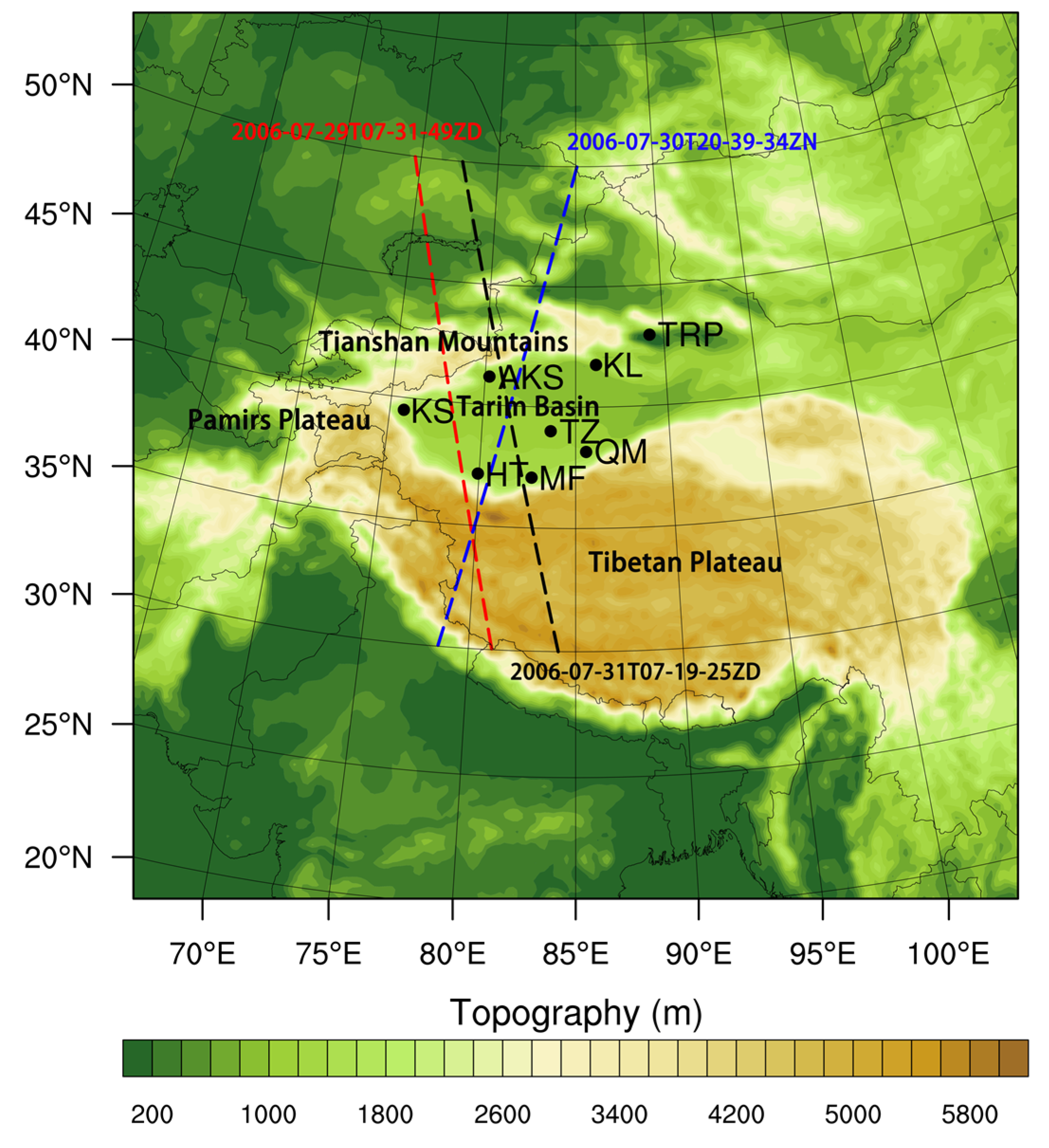
Figure 1. Modeling area and topography (unit: m) distribution. The black dots denote the distribution of surface observation stations. The dashed lines indicate the orbits of the CALIPSO satellite: red, 07:31:49 UTC on 29 July; blue, 20:39:34 UTC on 30 July; and black, 07:19:25 UTC on 31 July.
Atmosphere 17 00134 g001
Figure 2. Frequency of dust events and dust event types (including dust storms, blowing dust, and floating dust) observed at ground stations near the TB from 2015 to 2024.
Atmosphere 17 00134 g002
Figure 3. Spatial distribution over the Tarim Basin (TB) from 2015 to 2024: (a) dust column mass density (color contours, unit: mg/m2) during persistent floating dust events; (b) 20:00 UTC NLLJ occurrence frequency (color contours, unit: %) and 850-hPa average wind field (vector arrows) on the day preceding the persistent floating dust events; (c) same as (b) but for all days excluding the pre-dust-event days in (b); and (d) χ2 statistic for the relationship between persistent floating dust events and NLLJ presence.
Atmosphere 17 00134 g003
Figure 4. Vertical cross-sections of CALIOP total attenuated backscatter coefficient at 532 nm wavelength (unit: km−1sr−1) from 29 to 31 July 2006, with specific timestamps annotated in Figure 1.
Atmosphere 17 00134 g004
Figure 5. Spatial distribution of AOD at 550 nm from satellite retrievals of MODIS observations on Terra (a,c,e,g,i) and WRF-Chem simulations at 05:00 UTC (b,d,f,h,j) over the TB and surrounding areas from 27 to 31 July.
Atmosphere 17 00134 g005
Figure 6. Observed (indicated by the blue line) and simulated (indicated by the orange line) hourly 2 m temperature (unit: °C) from 27 to 31 July at eight stations: (a) KS, (b) AKS, (c) KL, (d) TRP, (e) TZ, (f) HT, (g) MF, and (h) QM.
Atmosphere 17 00134 g006
Figure 7. Spatial distribution (ac) of wind speed (color contours, unit: m/s) and wind vectors at 850-hPa (20:00 UTC) with 1500 m terrain heights in red contour lines, and vertical profiles of horizontal wind speed (df) at the white point in (ac) from 18:00 UTC to 02:00 UTC (next day) from 28 to 30 July. In figure (a), the black box (78° E~86° E, 38° N~40° N) indicates the NLLJ region.
Atmosphere 17 00134 g007
Figure 8. Spatial distribution (ac) of divergence (color contours, unit: 10−5 s−1), wind speed (contours, red: 6 m/s, blue: 9 m/s, magenta: 12 m/s), and dominant wind direction (black arrows) at 850-hPa (22:00 UTC), and vertical cross-sections (df) of divergence (color contours, unit: 10−5 s−1) and zonal circulation (vector arrows) along the black dashed line in figure (a) from 28 to 30 July, with basin topography marked with black color. The black box (about 78° E~80° E, 38° N~40° N) indicates the NLLJ exit region.
Atmosphere 17 00134 g008
Figure 9. Vertical cross-section evolution of dust concentration (color contours, unit: μg/m3), divergence (contours, cyan for negative values, black for zero, and purple for positive values), and zonal circulation (vector arrows) along the black dashed line in Figure 8a from 18:00 UTC on 29 July to 02:00 UTC on 30 July with the basin topography marked in black.
Atmosphere 17 00134 g009
Figure 10. Time series of the area-averaged dust layer height (DLH) (black, unit: km) over the exit region of the NLLJ (black box in Figure 8a) and the area-averaged horizontal wind speed at 850-hPa (green, unit: m/s) in the NLLJ region (black box in Figure 7a). The shaded area represents the period from 14:00 to 23:00 UTC.
Atmosphere 17 00134 g010
Figure 11. Spatial distribution of and differences (c,f,i) in DCC ((a,b), unit: mg/m2), DLH ((d,f), unit: m), and dust emissions ((g,h), unit: mg/m2) under NLLJ ((a,d,g), data from EXP3) and NO-NLLJ ((b,e,h), data from EXP2) conditions. DCC and DLH represent averages, while dust emissions represent the accumulated sum from 29 to 31 July 2006. The differences were derived by subtracting the results of EXP2 from those of EXP3.
Atmosphere 17 00134 g011
Figure 12. The mean DRF ((af), unit: W/m2) and the mean difference of meteorological factors (gl) between EXP1 (with dust feedback) and EXP4 (without dust feedback) from 28 to 30 July 2006. (a,d) at the TOA, (b,e) in the ATM, and (c,f) at the SURF during daytime (ac) and nighttime (df). Vertical cross-sections of mean wind ((g,h), unit: m/s) and temperature ((j,k), unit: °C) at night along 39° N (g,j) and 80° E (h,k). (i) Spatial distribution of mean wind speed at 850-hPa at nighttime (unit: m/s). (l) Spatial distribution of mean PBL height at nighttime (unit: m/s).
Atmosphere 17 00134 g012
Table 1. Configuration of the four experimental sets.
NameInput Dataif_no_pbl_nudging_uvguvaer_ra_feedback
EXP1ERA51-1
EXP2NO-NLLJ00.00051
EXP3ERA500.00051
EXP4ERA51-0
Note: Detailed information is provided in Appendix A.
Disclaimer/Publisher’s Note: The statements, opinions and data contained in all publications are solely those of the individual author(s) and contributor(s) and not of MDPI and/or the editor(s). MDPI and/or the editor(s) disclaim responsibility for any injury to people or property resulting from any ideas, methods, instructions or products referred to in the content.