
Article

Evaluation of Extreme Precipitation over East China in CMIP6 Models

Key Laboratory of Ecosystem Carbon Source and Sink, China Meteorological Administration (ECSS-CMA), Wuxi University, Wuxi 214105, China
*
Author to whom correspondence should be addressed.
Atmosphere 2026, 17(2), 136; https://doi.org/10.3390/atmos17020136
Submission received: 31 December 2025 / Revised: 24 January 2026 / Accepted: 24 January 2026 / Published: 27 January 2026
(This article belongs to the Section Climatology)

Abstract

Based on precipitation extremes calculated from high-resolution daily observational data in East China during 1961–2014, the performance of 34 climate models from phase 6 of the Coupled Model Intercomparison Project (CMIP6) are assessed in terms of climatology and interannual variability. Four extreme precipitation indices, including the total precipitation (Prcptot), the total precipitation for events exceeding the 95th percentile (R95p), and the maximum of 1-day (Rx1day) and 5-day (Rx5day) precipitation, are analyzed. Results show that the CMIP6 models demonstrate good performances in reproducing the climatological spatial distribution and interannual variability of precipitation extremes, with the best from Prcptot. Based on an integrated assessment of the above two factors, the models that perform relatively well for all four extreme precipitation indices are GFDL-CM4, MIROC6, EC-Earth3-Veg, EC-Earth3, and EC-Earth3-CC. Furthermore, the optimal multi-model ensemble (A-MME) constructed from a selection of the most skillful models shows improved behavior compared to the all-model ensemble. The wet (dry) biases over the northern (southern) region of East China are all decreased. This may benefit from the improvement that A-MME can reproduce well the characteristics of moisture and vertical velocity.

1. Introduction

The global mean surface temperature (GMST) has warmed by about 0.99 (0.84 to 1.10) °C relative to pre-industrial levels [1]. Global warming exacerbates the occurrences of extreme weather events, including increases severity, frequency, and duration of precipitation extremes [2,3,4], resulting in huge losses for society, the economy, and natural ecosystems [1,5,6]. Eastern China is especially sensitive and vulnerable to precipitation extremes, due to its unique geographical location and topography, with a dense population and intensive agricultural production. Assessing and investigating such events is therefore crucial for developing adaptive strategies to mitigate extreme precipitation risks over these regions.
Global climate models (GCMs) are important tools for understanding the climate system, reproducing its past evolution and mechanisms, and predicting and projecting its future changes. There are certain inadequacies in their ability to simulate the climate of East Asia [7,8,9,10] due to the complexity of the global climate system and the stability of climate models (such as the inadequate representation of key processes, the parameterizations for physical processes, and the methods for numerically solving the dynamical equations). Therefore, prior to employing climate models in research, it is necessary to evaluate their simulation skills to guide model improvement and identify sources of uncertainty in the outputs. The Coupled Model Intercomparison Project (CMIP) was established as a platform for international climate model data sharing and evaluation and has played a significant role in advancing global climate models and promoting the international sharing of data resources [11]. In the past few years, many studies have shown that the CMIP phase 3 (CMIP3) and CMIP phase 5 (CMIP5) global climate models show reasonable performance in capturing the spatial distributions of surface precipitation in China, where precipitation increases from the northwest to the southeast [12]. Compared with CMIP3, the CMIP5 performances were improved for temperature while there was little change for precipitation [13]. Some common biases, such as underestimations of precipitation in the coastal areas of South China and overestimations in North China and the Tibetan Plateau, are also present in the CMIP5 simulations [5,12,13,14,15,16,17,18].
Recently, CMIP phase 6 (CMIP6) was the last great effort of the international community for climate modeling. CMIP6 models feature higher spatial resolution and more complete physical and biogeochemical processes relative to their previous phases [19]. Some studies have begun to evaluate the simulation ability of precipitation in China using CMIP6 data [2,7,8,20,21,22] and show consistent improvement from CMIP5 to CMIP6 in the simulation of mean precipitation and extreme precipitation events. For example, a smaller spread is observed among CMIP6 models and a weaker underestimation of the southeast-northwest precipitation gradient [2,7]. Our previous research has shown that, compared with CMIP5, the CMIP6 multi-model ensemble (MME) mean shows improvements in the simulation of climate indices over China, particularly for extreme precipitation indices. The pervasive dry biases over southern China in CMIP5-MME are significantly mitigated in CMIP6-MME [5]. However, there remains a clear need for more granular analysis at a finer regional scale. In addition, several previous studies [8,22] were based on a relatively small ensemble of CMIP6 models, and there has been no in-depth study on the possible causes why the simulated performance are different among CMIP6 models.
Based on these premises, the primary objective of this study is to reveal the ability of 34 CMIP6 climate models in simulating precipitation extremes over East China and the causes for its good or poor performance in simulation. The key questions that we address are as follows. (1) How well do the CMIP6 models capture extreme precipitation over East China? (2) What drives the performance discrepancies among different models? Therefore, it is crucial to not only assess the performance of CMIP6 historical simulations in capturing extreme precipitation events over East China but also to clarify the physical mechanisms behind them. Addressing these topics will aid in advancing the accuracy of climate simulations and projections [23].

2. Data and Methods

2.1. Data

We use the high-resolution (0.25° × 0.25°) daily gridded observed dataset, CN05.1, to provide daily precipitation. It was provided by the National Climate Center of China Meteorological Administration, based on a network of 2416 stations with an uneven spatial distribution across China [24]. This dataset has been widely used in studies on climate change over China [4,25,26]. It covers the period from 1961 to the most recent day. The simulated daily precipitation from 34 CMIP6 models (Table 1) is used in this study. To ensure consistency, we analyzed only the first historical realization of each model and used a common period of 1961–2014 for both model outputs and observations. All extreme precipitation indices from different models and observations were first calculated on their native grids. Then, a bilinear interpolation scheme regridded them to a common 1° × 1° grid for consistent comparison. All the calculations and plots were accomplished using the NCL 6.5.0 (http://www.ncl.ucar.edu/, accessed on 23 January 2026).
Monthly vertical velocity (W), zonal (U), and meridional (V) wind, together with specific humidity (Q), were also used in our study to search the possible reasons for the discrepancies in simulated East China precipitation between Group A and Group C models. ERA5 reanalysis data (0.25° resolution) served as the observational reference over the common period of 1961–2014. The dataset is available from https://cds.climate.copernicus.eu/datasets/reanalysis-era5-pressure-levels-monthly-means?tab=overview, accessed on 12 October 2025. All models and ERA5 were regridded to a common 2.5° × 2.5° grid for intercomparison.

2.2. Climate Indices

In this paper, we use four extreme precipitation indices, including the annual total amount of precipitation (Prcptot), the annual total precipitation for events exceeding the 95th percentile (R95p), and the maximum of 1-day (Rx1day) and 5-day (Rx5day) precipitation defined by the Expert Team on Climate Change Detection and Indices [27]. More detailed information is shown in Table 2. These indices are widely used in climate change studies as representative metrics of model performance [8,28].

2.3. Evaluation Method

2.3.1. Taylor Diagram

Taylor diagram and Taylor skill score (TSS) [8,29] are used to evaluate the overall skill in reproducing the spatial pattern of the present-day climate indices. The Taylor diagram concisely summarizes model performance by combining three key statistics: the pattern correlation coefficient (PCC), the centered root-mean-square error (RMSE), and the ratio of spatial standard deviations (RSD). The similarity between simulations and observations is quantified by their correlation and the amplitude of variability. Thus, a perfect simulation is defined by a centered RMSE of 0 and both PCC and RSD values of 1. The TSS is a combined measure and calculated as follows:
T S S = 4 ( 1 + R ) 2 ( σ s o σ s m σ s m σ s o ) 2 ( 1 + R 0 ) 2
where R is the PCC between the simulation and observation; R0 is the maximum PCC attainable (0.999 here); and σsm and σso are the standard deviations (SDs) of the simulated and observed spatial patterns, respectively. The score ranges from 0 to 1, with 1 representing a perfect match and 0 representing the worst possible performance.

2.3.2. Interannual Variability Skill Score

The method for quantifying the interannual variability skill score (IVS) is the same as employed in Chen et al. [30]:
    I V S = ( σ t o σ t m σ t m σ t o ) 2
where σtm and σto represent the interannual standard deviations of the model simulations and observations, respectively. Thus, a lower IVS value indicates better simulation performance.

3. Results

3.1. Climatology Evolution

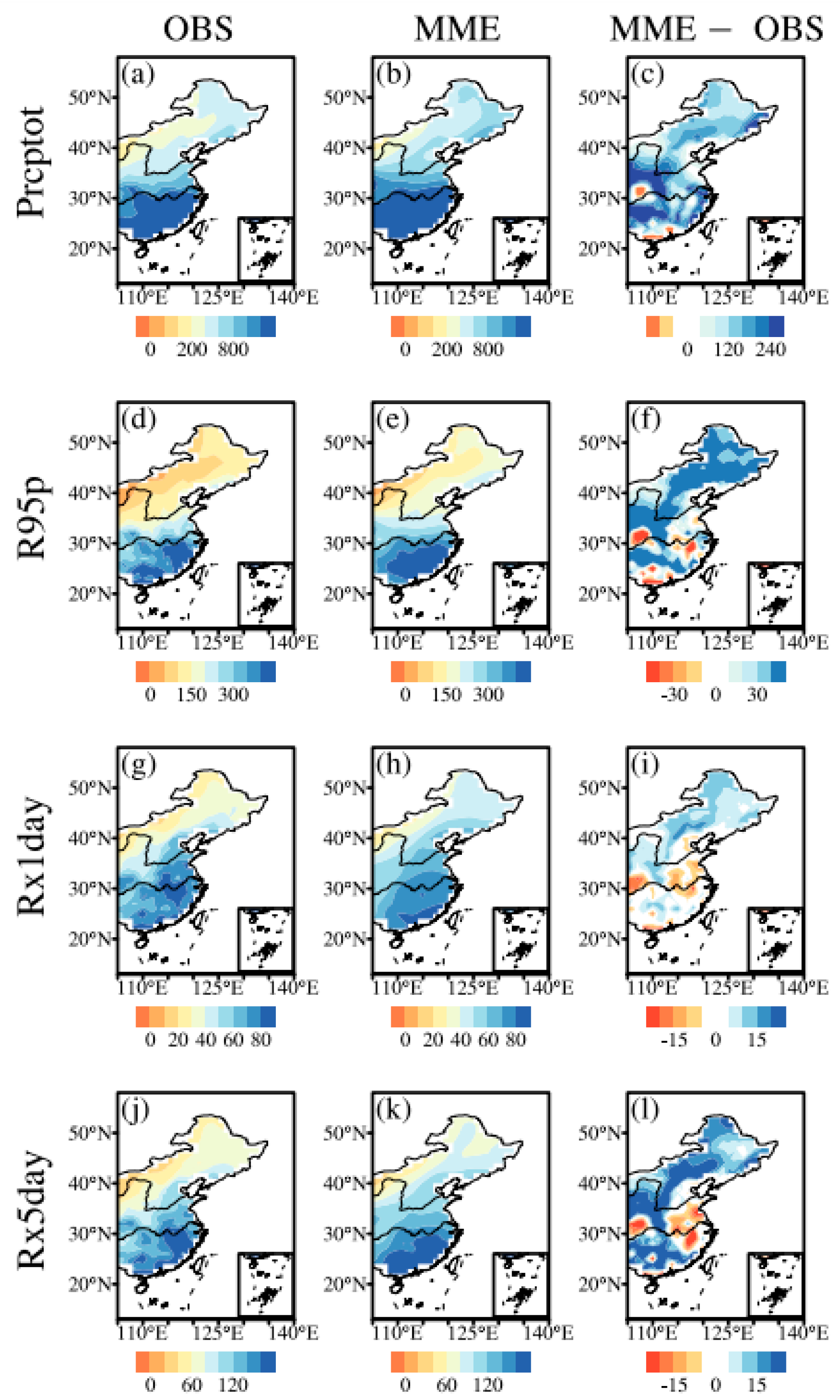
To assess model performance in simulating extreme precipitation over East China, Figure 1 shows the climatological spatial distributions of four indices from observations, the ensemble simulation of all models (MME), and their biases, respectively. For observed precipitation (Figure 1a,d,g,j) extremes, the gradient of decreasing precipitation from the southern coast to northern areas is successfully reproduced by the MME simulation (Figure 1b,e,h,k). But MME still has overall wet biases, which has also been reported for the CMIP3 and CMIP5 simulations [12,13]. The largest wet bias is located over the central part (around 35° N) of East China for total precipitation (Prcptot, Figure 1c) and maximum of 5-day precipitation (Rx5day, Figure 1l), except the northern part of East China for heavy precipitation (R95p, Figure 1f). It should be noted that the simulated indices show dry biases in the Yangtze River Basin.
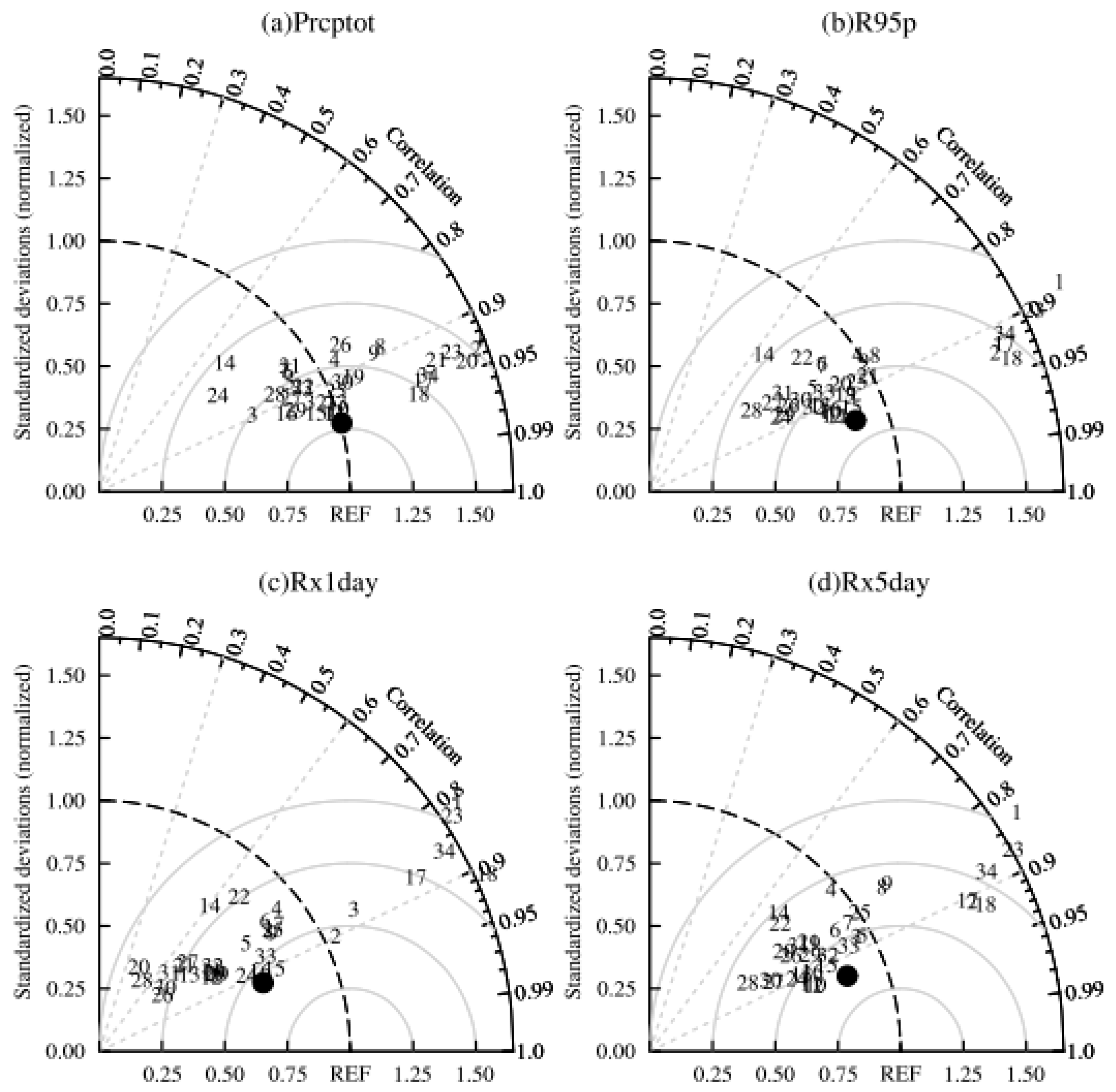
To further evaluate model performance, the spatial patterns of precipitation indices are assessed using Taylor diagrams and the Taylor skill score (TSS). Figure 2 shows the Taylor diagrams for the 34 CMIP6 models and the ensemble simulation of all models (MME) against observations. The PCCs predominantly range from 0.8 to 0.95 (all statistically significant), while centered RMSEs are mainly between 0.25 and 0.75. It indicates that the coupled models have a certain capability in simulating the spatial distribution of these indices. In addition, the ratios of variances mostly lie between 0.5 and 1.0 for R95p and Rx5day, and between 0.25 and 1.0 for Rx1day, indicating that the simulated spatial variation is smaller than the observation of these indices. But for Prcptot, the RSDs are larger than 1.0 for half of models. MME performs better than individual models, characterized by a higher PCC and a lower RMSE.
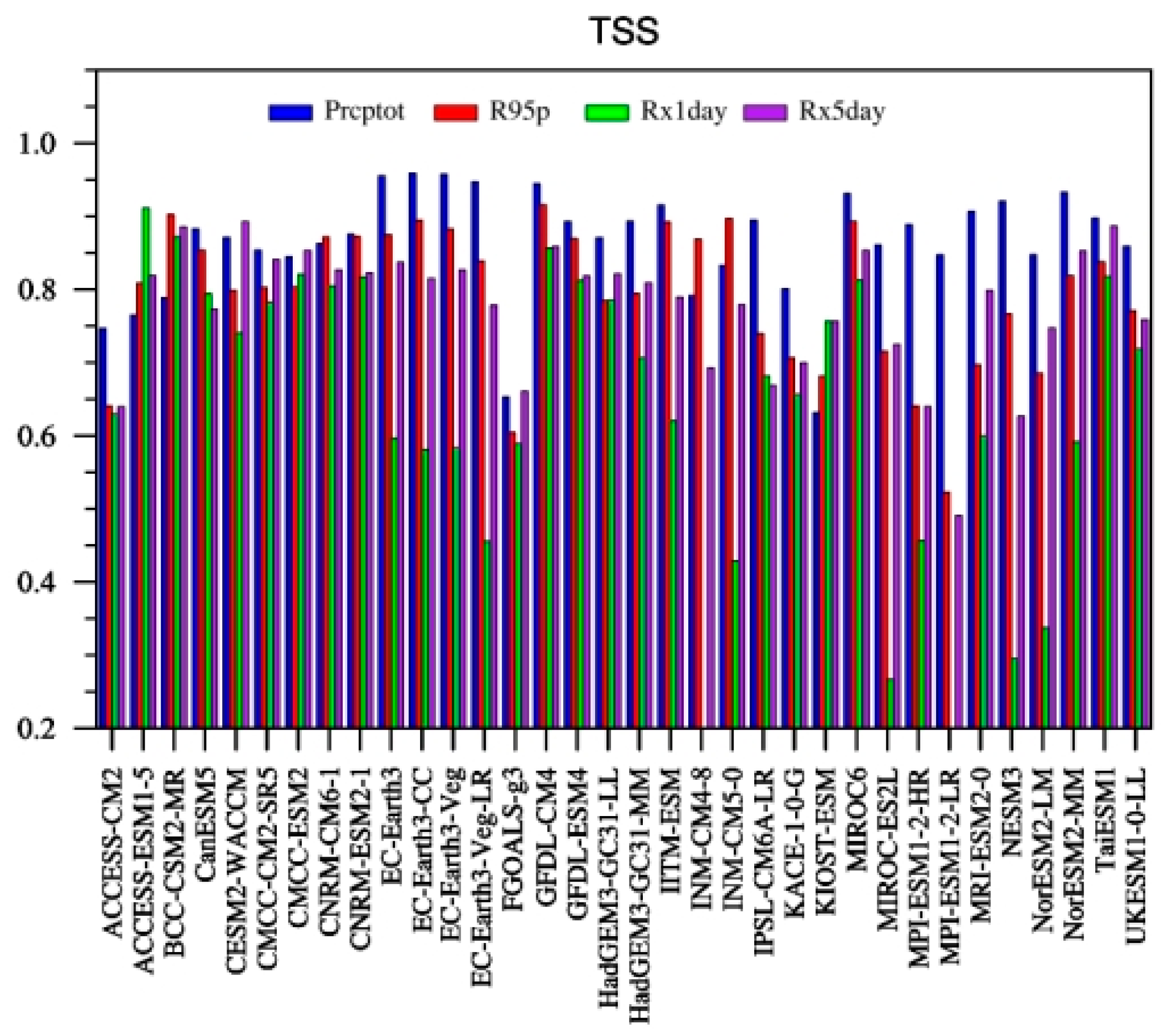
Figure 3 and Table 3 give the TSSs of models for four precipitation indices in East China. For Prcpotot, the TSS values are above 0.75 for all models except for FGOALS-g3 and KIOST-ESM, which show values of 0.65 and 0.63. This suggests that the CMIP6 models can reasonably reproduce the observed climatology of total precipitation. For R95p and Rx5day, the TSS values are smaller, with values above 0.7 for most models. But for Rx1day, the TSS values are above 0.7 for only half of the models. In some models, such as MPI-ESM1-2-LR, INM-CM4-8, MIROC-ES2L and NESM3, the TSS values are below 0.3. This indicates that the models show slightly inferior simulation ability to reproduce the spatial pattern of Rx1day than other indices. It should be noted that for some models, such as GFDL-CM4 and MIROC6, their TSS values are quite high, with values larger than 0.85 for all indices. Generally speaking, CMIP6 models exhibit good capabilities in simulating the spatial distribution of precipitation indices but have large intermodel spread. The five best models in simulating the spatial pattern are GFDL-CM4, MIROC6, TaiESM1, BCC-CSM2-MR, and EC-Earth3.

3.2. Interannual Variability Evolution

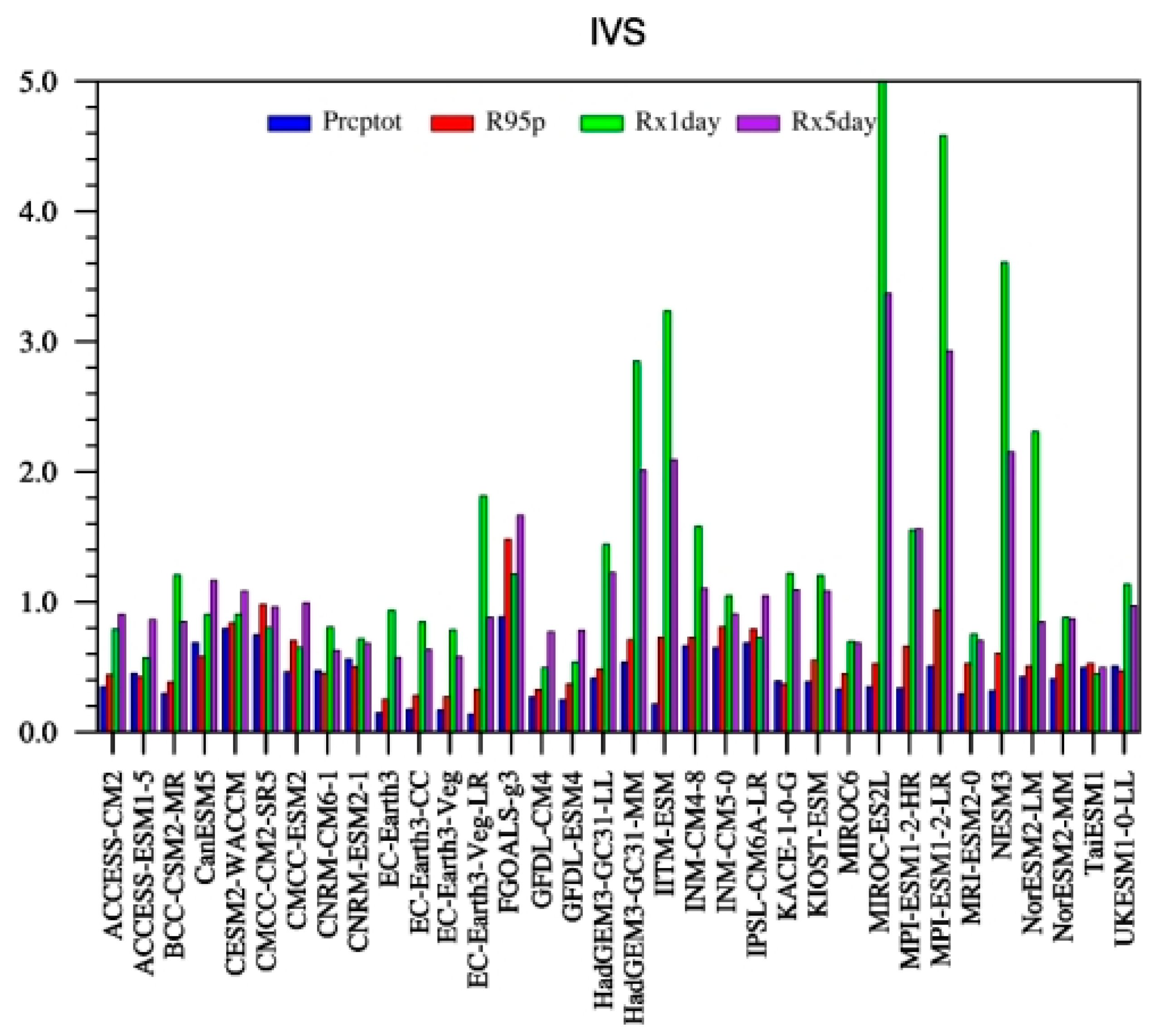
The ability to simulate temporal variation is also a crucial aspect of model performance [5,8]. Here, the IVS was employed to assess the similarity in interannual variability between the modeled and observed indices. Figure 4 and Table 3 present the IVSs for the four precipitation indices over East China, based on values that were first calculated at each grid cell and then spatially averaged. For Prcptot and R95p, IVS values are below 1.0, indicating that the CMIP6 ensemble can reasonably reproduce the observed interannual variability of these indices. But for Rx1day and Rx5day, the IVS values are much larger, with values above 1.0 for one-third of the models. Moreover, the IVS values for Rx1day span a wide range (0.4–7.5), far exceeding those of the other indices. In some models, such as MIROC-ES2L and MPI-ESM1-2-LR, the IVS values are above 4.5. This result reveals considerable inter-model discrepancies and a limited skill in simulating the interannual variability of Rx1day. Considering all precipitation indices as a whole, EC-Earth3-Veg, GFDL-CM4, EC-Earth3, EC-Earth3-CC, and GFDL-ESM4 are the five best models in simulating the interannual variability. Note that the five models also fall into the top models with good performance in spatial pattern as mentioned above. This implies that model skill is reflected both in the fidelity of the spatial pattern and in the representation of its interannual variability.

3.3. Overall Model Ordering

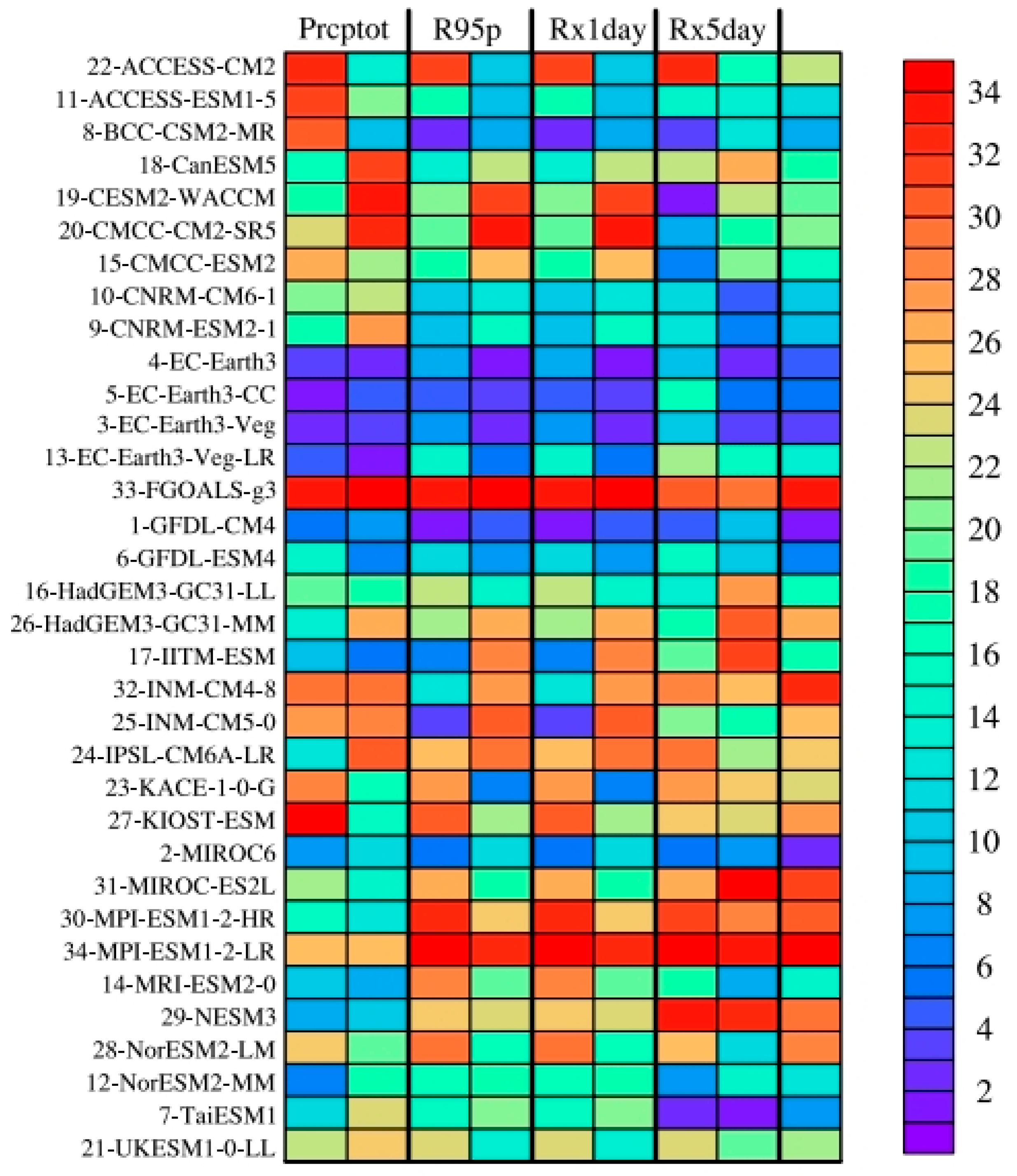
Due to discrepancies in model rankings based on TSS and IVS, a comprehensive assessment of the models is conducted in Figure 5 and Table 1. This Figure depicts the integrated performance of the individual models. A lower rank value corresponds to better model performance; however, the rank of a given model can vary across different metrics and indices. For example, the best model is EC-Earth3-Veg (GFDL-CM4) for IVS (TSS). Considering the comprehensive performance for both TSS and IVS, the best model in 34 models is GFDL-CM4, followed by MIROC6 and EC-Earth3-Veg. The fourth and fifth ranked models are EC-Earth3 and EC-Earth3-CC. The relatively lowest-ranked five models are MPI-ESM1-2-LR, FGOALS-g3, INM-CM4-8, MIROC-ES2L, and MPI-ESM1-2-HR. It can be seen that the models with better performance have higher resolution, which is consistent with the previous finding that increasing the resolution of the model may contribute to improve the performance of model simulations [7,31,32].

3.4. Comparison of Different Ensemble Simulations

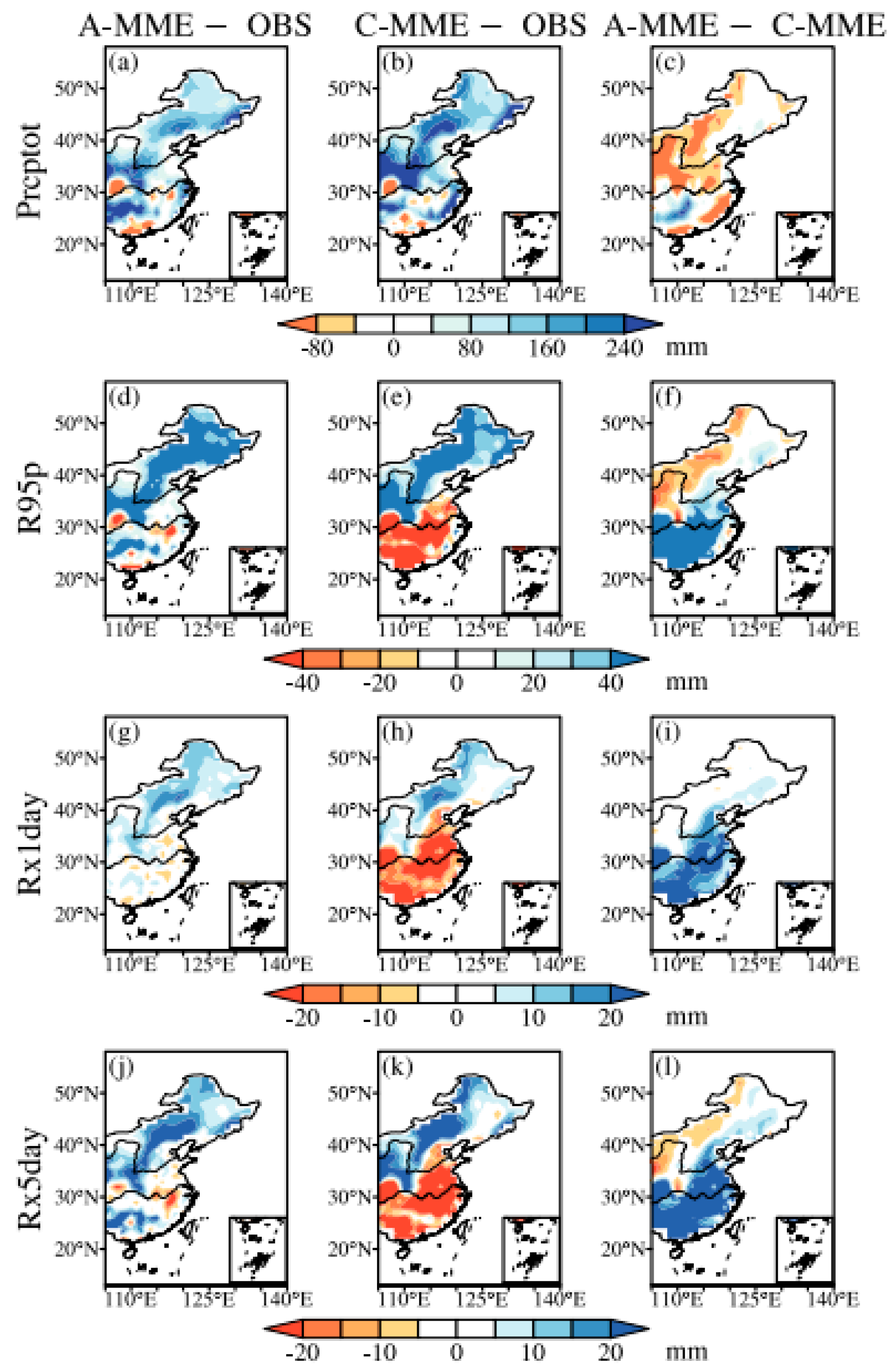
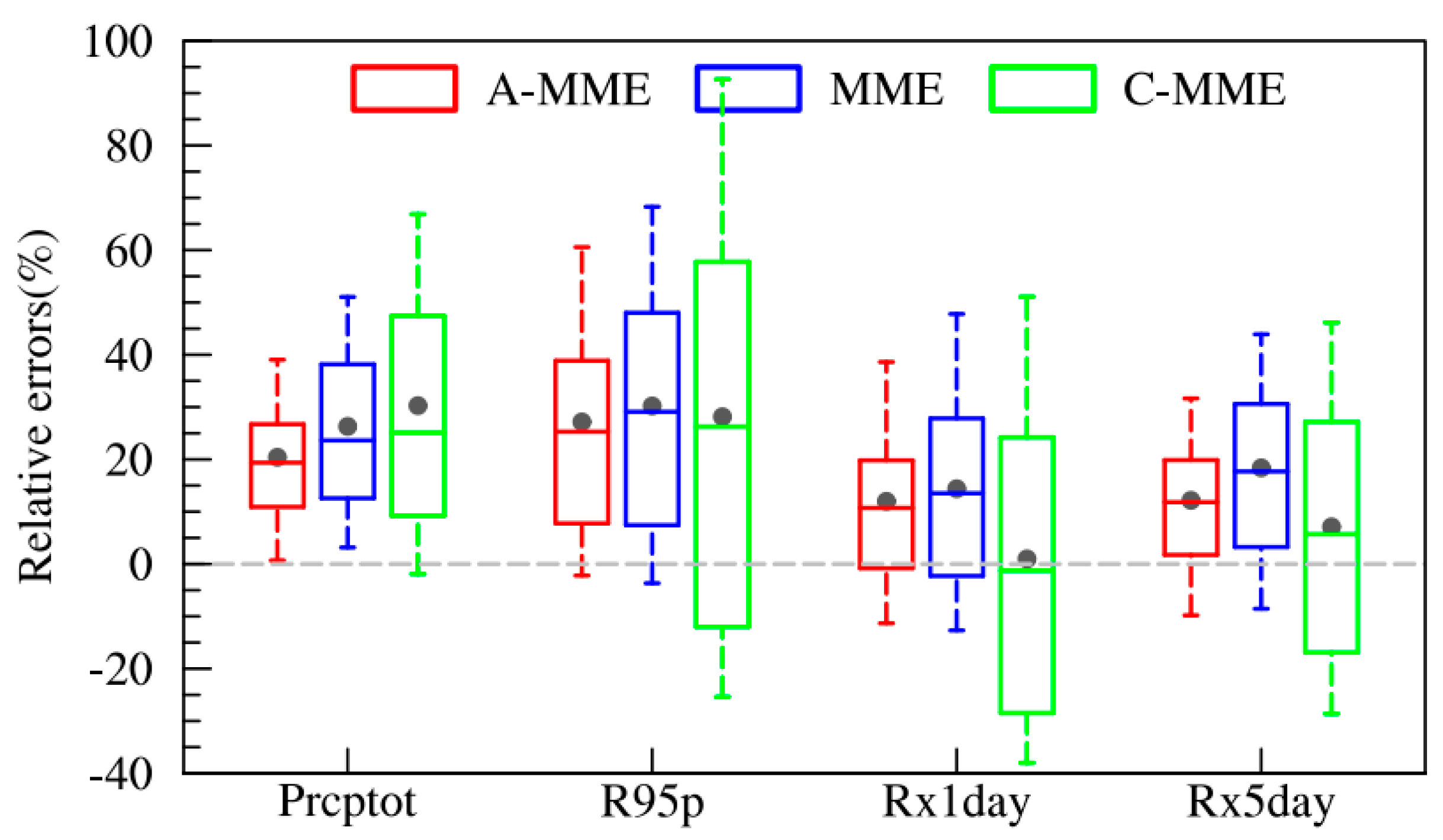
Based on the overall rankings of the 34 models, we divided them into three groups (see Table 1 for details). The top third (12 models) form Group A, demonstrating the best performance. The middle third (10 models) constitute Group B with medium skill, while the bottom third (12 models) form Group C, showing the poorest performance. Figure 6 presents the spatial distributions of the simulation biases from the Group A model ensemble (hereafter A-MME), Group C model ensemble (hereafter C-MME), and their difference for four precipitation indices. For Prcptot, the wet biases present in the MME simulation (Figure 1c) are reduced in the A-MME simulation (Figure 6a) yet amplified in the C-MME simulation (Figure 6b). When regionally averaged over East China, the percentage-based wet bias declines from 30% in the C-MME simulation to 26% in MME and further to 20% in A-MME (Figure 7). The simulation of Prcptot shows notable improvement in A-MME compared to MME and C-MME. It is evidenced by a median bias near zero, along with shorter whiskers and a markedly smaller interquartile range.
For other indices, A-MME also outperforms both MME and C-MME in capturing spatial patterns. MME has its own deficiency, which is confirmed by the fact that there are wet biases in rare rainfall regions (northern of East China) and dry biases in the Yangtze River Basin (Figure 1), which has been revealed by previous studies [8]. For example, R95p is overestimated by up to 50 mm over northern China, while it is underestimated by as much as 40 mm over the Yangtze River Basin. For A-MME, the wet bias in northern China and dry bias in the Yangtze River Basin is significantly reduced (Figure 6d,g,j). But for C-MME, the wet bias in northern China and dry bias in southern China is significantly increased (Figure 6e,h,k). The underestimation of R95P and Rx1day over south China can reach 40 mm and 20 mm, respectively. Moreover, for the extreme precipitation indices (R95p, Rx1day, and Rx5day), A-MME exhibits reduced variability across East China compared to MME and C-MME, as indicated by a narrower interquartile range (box) and shorter whiskers (10th–90th percentiles).
Overall, A-MME shows improved performance for all extreme precipitation indices, reducing both southern dry and northern wet biases across East China compared to MME and C-MME. This enhanced performance is likely attributable, in part, to the superior model resolution and more refined representation of physical and chemical processes in the Group A models.

3.5. The Possible Causes of Different Simulated Performance

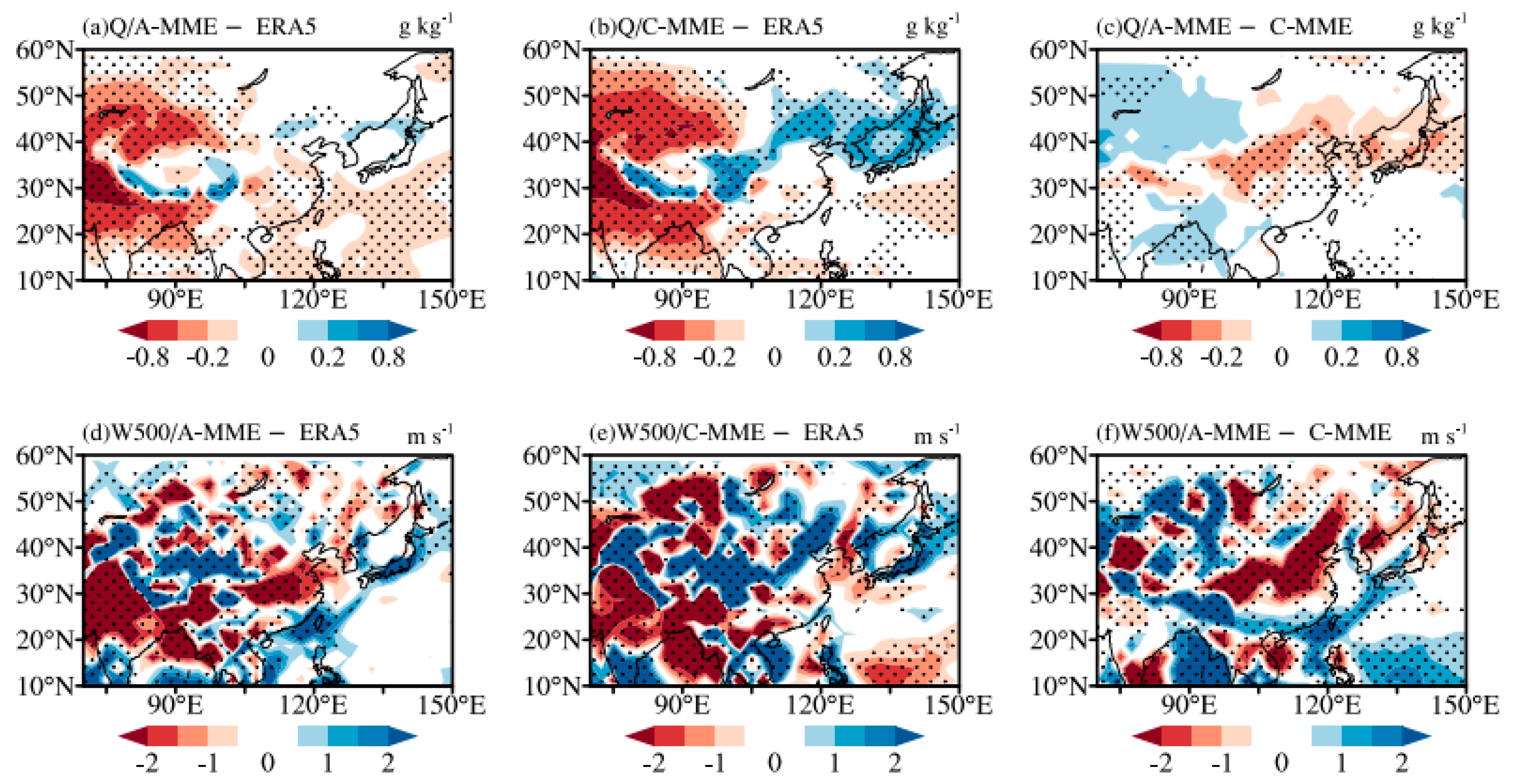
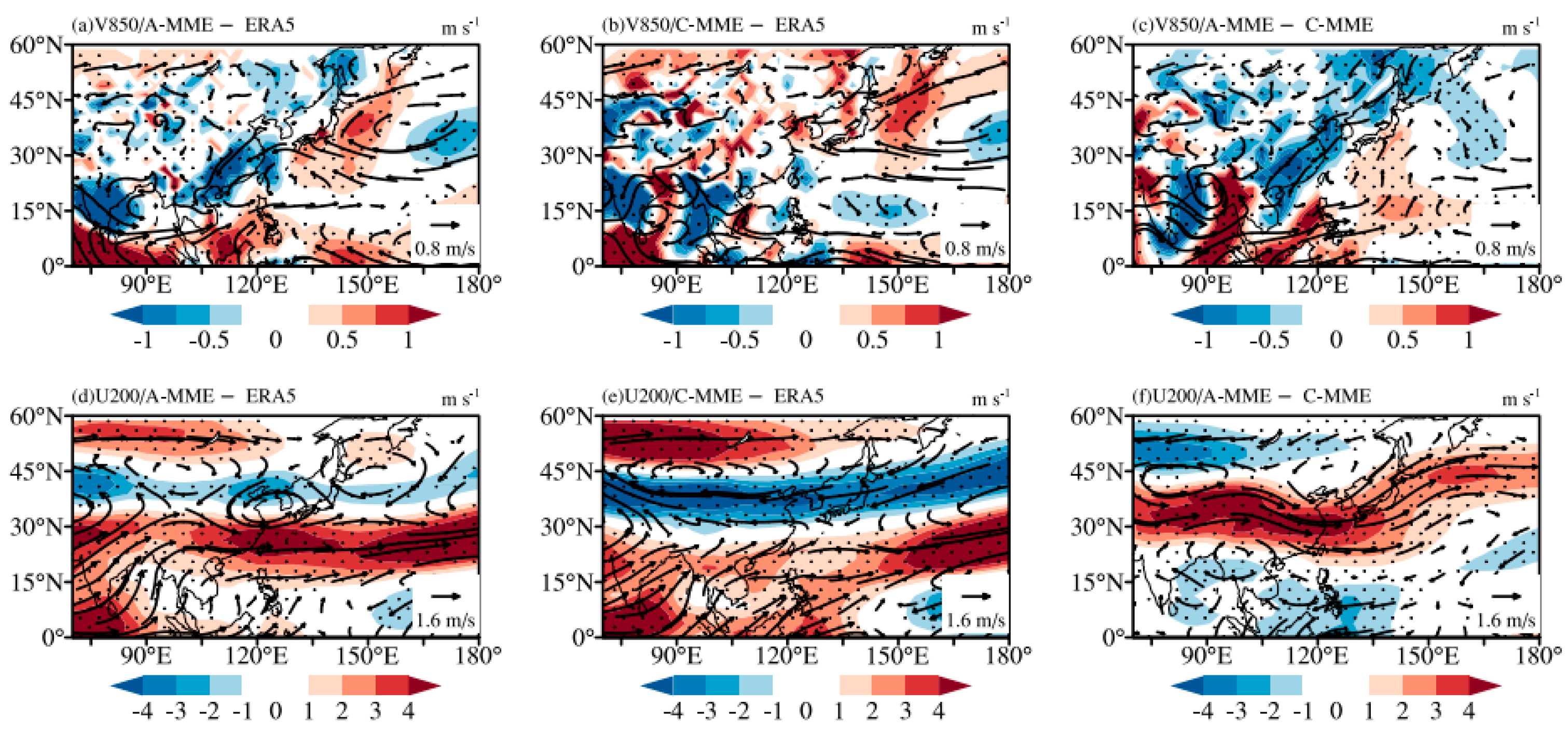
To investigate the possible causes of the simulated performance discrepancy, the atmospheric circulations produced by the Group A and C ensembles are systematically compared with ERA5 reanalysis. Considering the fact that June–August (JJA) is the main season for precipitation occurrence over East China, Figure 8 shows massweighted average specific humidity from 1000 to 100 hPa and vertical velocity at 500 hPa between the two group model ensembles and ERA5. The overestimate of specific humidity (Figure 8b) and ascending motion (Figure 8e) over the north in C-MME is obvious, while the biases are improved in A-MME (Figure 8a,d). There are dry biases and weak ascent over south China both in C-MME and A-MME, and the bias is smaller in A-MME. Previous studies indicate that the East Asian summer monsoon is a key driver of extreme precipitation events across the Asian monsoon region [33,34,35]. At 850 hPa, there are clearly northerly wind anomalies, together with anomalous cyclonic circulation over southern East China in A-MME (Figure 9a), which means a underestimation of the western Pacific subtropical high. There are weak east wind anomalies around 35° N–45° N at 200 hPa in A-MME (Figure 9d). But the east wind anomalies are much larger in C-MME (Figure 9d), which indicates a much weak jet stream over the upper level. The configuration of the upper and lower circulation patterns implies that the East Asian summer monsoon is underestimated in A-MME but overestimated in C-MME. It results in the decrease in wet biases over north and dry biases over southern East China in A-MME.
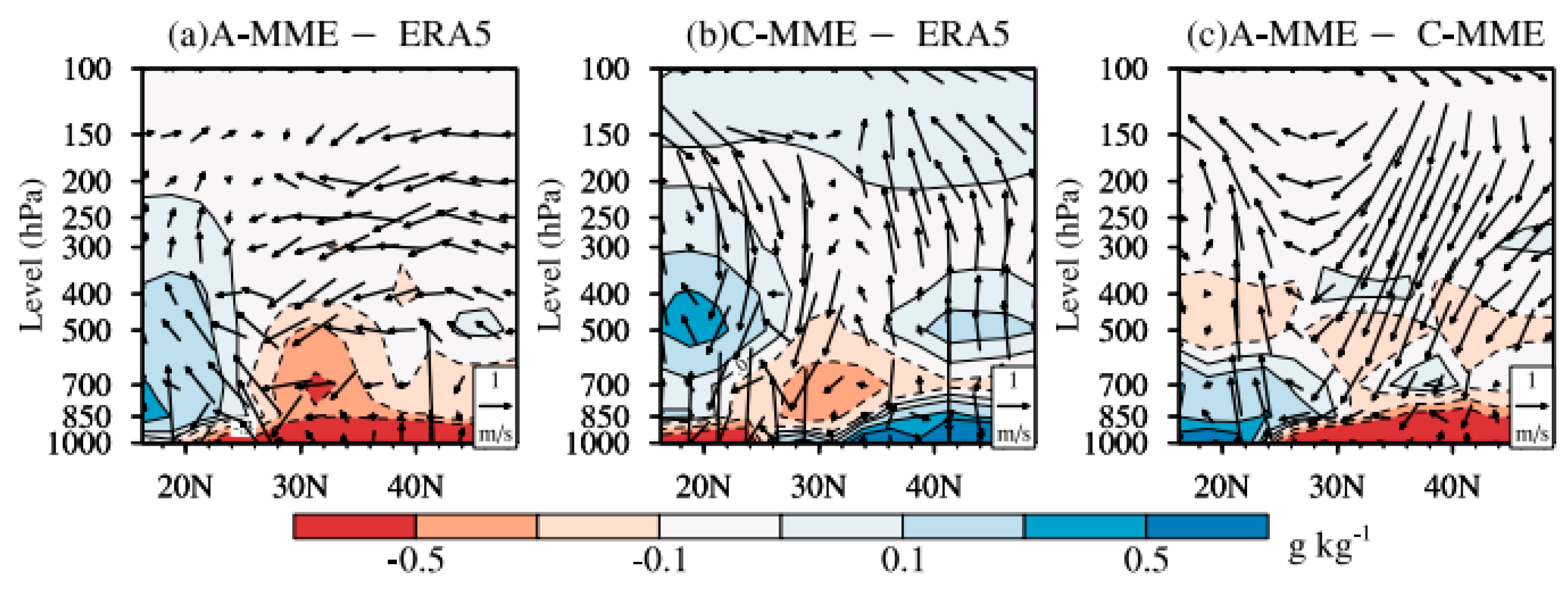
Figure 10 further presents the difference in zonally averaged (105° E–123° E) meridional circulation and specific humidity (shaded) for the summer season. Compared with ERA5, C-MME presents a strong ascent around 40° N (Figure 10b). C-MME also simulates abundant water vapor over northern China, corresponding to a substantial wet bias in that region (Figure 6b,e,k). But C-MME presents strong descent and less water vapor over 20° N–30° N; thus, a pronounced dry bias is present in that region (Figure 6e,h,k). For A-MME (Figure 10a), compared with ERA5, there are no obvious ascent or descent anomalies, but there is less water vapor. Thus, the bias over East China is reduced in the A-MME simulation (Figure 6a,g). Furthermore, compared with C-MME, A-MME presents a stronger ascent south of 30° N and a stronger descent north of 30° N. It also shows more water vapor in the south and less water vapor in the north (Figure 10c). Hence, the reduced dry (wet) biases in southern (northern) East China under A-MME result from the stronger ascent (descent) accompanied by more (less) moisture over the region. In summary, better simulations of the thermodynamic conditions related to water vapor and the dynamic conditions related to vertical velocity are the keys to the superior performance of A-MME.

4. Discussion

The performance of the latest CMIP6 models in simulating precipitation extremes over East China was evaluated through a quantitative intercomparison with a gridded daily observation dataset. Relative to its previous phases, key enhancements in CMIP6 models include increased spatial resolution, more complete physical and biogeochemical processes, and refined parameterization schemes [11,19]. We found that CMIP6 models have good abilities to reproduce the temporal and spatial characteristics of precipitation extremes. These results are broadly consistent with those reported previously [8,10]. Wet (dry) biases still exist in the north (south) of East China, which are tightly related to the overestimation (underestimation) of water vapor and stronger ascent over there. It shows similar findings to Jiang et al. [5] and Lin et al. [36].
This study provides a valuable reference for assessing the capabilities of various CMIP6 models in simulating precipitation extremes over East China. By identifying the reasons for model performance disparities through systematic evaluation, our work provides useful insights for improving climate models and assessing regional climate impacts in China. The underlying causes of simulation biases can also be studied further in depth. Some studies show that the East Asian summer monsoon is recognized as a major component of the global climate system and exerts dominant control over precipitation patterns, including extremes, in the Asian monsoon region [33,34,35,37]. Tropical and subtropical sea temperatures [38], the Western Pacific Subtropical High [39,40], the South Asian High [40], and the westerly jet stream [41,42], etc., all contribute to the East Asian summer monsoon and may affect the simulations of precipitation extremes.
Despite improvements in the resolution of some CMIP6 models [11] and greater ensemble diversity compared to earlier phases, a considerable spread in model results remains apparent. Accurately representing key physical processes remains a challenge for current global climate models. These shortcomings may be addressed through statistical and dynamical downscaling [43,44,45] using the best models for extreme precipitation, such as those identified in this study. In addition, each model can be assigned with a weighting factor according to its performance in simulating the spatial pattern and interannual variability. Assigning different weights to models can provide a more precise projection of future extreme precipitation changes [46]. Thus, more sophisticated ensemble methods are needed to explore the advantage of the ensemble and mitigate individual model weaknesses, thereby reducing uncertainty and enhancing the reliability of future projections [23,47,48,49].

5. Conclusions

This study evaluates the performance of CMIP6 historical experiments in simulating extreme precipitation indices defined by the ETCCDI. A quantitative evaluation of all 34 models was conducted for the period 1961–2014. Their performance in simulating extreme precipitation indices over East China was ranked according to metrics capturing both spatial patterns and temporal variability. We used some commonly used skill-score methods, such as the Taylor diagram and TSS representing the spatial pattern and IVS representing the interannual variability. The potential causes of the variations in model performance are examined. The main findings of our study can be summarized as follows:
(1) The CMIP6 models show a good ability to reproduce extreme precipitation characteristics over East China, both in terms of spatial patterns and interannual variability. The models show different skill levels in simulating various precipitation extremes, with the best for Prcptot and the worst for Rx1day.
(2) The performance of individual models in simulating precipitation extremes varies considerably. GFDL-CM4, MIROC6, EC-Earth3-Veg, EC-Earth3, and EC-Earth3-CC are identified as the top five models for capturing both the spatial patterns and temporal variability of extremes over East China. The relatively worst five models are MPI-ESM1-2-LR, FGOALS-g3, INM-CM4-8, MIROC-ES2L, and MPI-ESM1-2-HR.
(3) MME still has wet biases for extreme precipitation indices in the North and dry biases in the South of East China. A-MME shows a significant reduction in the wet bias over northern China, with the mean error for Prcptot decreasing by 20%. A-MME also accurately simulates extreme precipitation indices over southern China. The wet (dry) biases over the North (South) of East China are tightly related to the overestimation (underestimation) of water vapor and stronger ascent over these regions. A-MME can reproduce the moisture and vertical velocity relatively well, which thus shows a simultaneous improvement over East China.

Author Contributions

Conceptualization, H.Z.; methodology, H.Z.; software, H.Z., and J.Y.; validation, H.Z., and J.Y.; formal analysis, J.Y.; investigation, J.Y.; resources, H.Z.; data curation, H.Z., and J.Y.; writing—original draft preparation, H.Z.; writing—review and editing, H.Z. and J.Y.; visualization, H.Z., and J.Y.; supervision, H.Z.; project administration, H.Z.; funding acquisition, H.Z. All authors have read and agreed to the published version of the manuscript.

Funding

This research was funded by the National Natural Science Foundation of China (42505169), the Basic Research Program of Jiangsu (BK20240317), the Wuxi University Research Start-up Fund for Introduced Talents (2024r041).

Institutional Review Board Statement

Not applicable.

Informed Consent Statement

Not applicable.

Data Availability Statement

All the datasets used in this study are from open-source platforms available via https://esgf-node.llnl.gov/projects/esgf-llnl (accessed on 12 October 2025) for the CMIP6 models.

Acknowledgments

The authors appreciate the data sources for freely providing the data used in this study.

Conflicts of Interest

The authors declare no conflicts of interest.

References

  1. IPCC. Summary for Policymakers. In Climate Change 2021: The Physical Science Basis. Contribution of Working Group I to the Sixth Assessment Report of the Intergovernmental Panel on Climate Change; Cambridge University Press: Cambridge, UK; New York, NY, USA, 2021; pp. 3–32. [Google Scholar]
  2. Chen, H.; Sun, J.; Lin, W.; Xu, H. Comparison of CMIP6 and CMIP5 models in simulating climate extremes. Sci. Bull. 2020, 65, 1415–1418. [Google Scholar] [CrossRef]
  3. Kim, Y.; Min, S.; Zhang, X.; Sillmann, J.; Sandstad. Evaluation of the CMIP6 multi-model ensemble for climate extreme indices. Weather. Clim. Extrem. 2020, 29, 100269. [Google Scholar] [CrossRef]
  4. Zhu, H.; Jiang, Z.; Li, L. Projection of climate extremes in China, an incremental exercise from CMIP5 to CMIP6. Sci. Bull. 2021, 66, 2528–2537. [Google Scholar] [CrossRef] [PubMed]
  5. Jiang, Z.; Li, W.; Xu, J.; Li, L. Extreme precipitation indices over China in CMIP5 models, part I: Model evaluation. J. Clim. 2015, 28, 8603–8617. [Google Scholar] [CrossRef]
  6. Amato, R.; Steptoe, H.; Buonomo, E.; Jones, R. High-resolution history: Downscaling China’s climate from the 20CRv2c reanalysis. J. Appl. Meteorol. Climatol. 2019, 58, 2141–2157. [Google Scholar] [CrossRef]
  7. Jiang, D.; Hu, D.; Tian, Z.; Lang, X. Differences between CMIP6 and CMIP5 models in simulating climate over China and the East Asian monsoon. Adv. Atmos. Sci. 2020, 37, 1102–1118. [Google Scholar] [CrossRef]
  8. Zhu, H.; Jiang, Z.; Li, J.; Li, W.; Sun, C.; Li, L. Does CMIP6 inspire more confidence in simulating climate extremes over China? Adv. Atmos. Sci. 2020, 37, 1119–1132. [Google Scholar] [CrossRef]
  9. Yang, X.; Zhou, B.; Xu, Y.; Han, Z. CMIP6 evaluation and projection of temperature and precipitation over China. Adv. Atmos. Sci. 2021, 38, 817–830. [Google Scholar] [CrossRef]
  10. Dong, T.; Dong, W. Evaluation of extreme precipitation over Asia in CMIP6 models. Clim. Dyn. 2021, 57, 1751–1769. [Google Scholar] [CrossRef]
  11. Zhou, T.; Zou, L.; Chen, X. Commentary on the Coupled Model Intercomparison Project Phase 6 (CMIP6). Adv. Clim. Change Res. 2019, 15, 445–456. (In Chinese) [Google Scholar]
  12. Jiang, Z.; Song, J.; Li, L.; Chen, W.; Wang, Z.; Wang, J. Extreme climate events in China: IPCC-AR4 model evaluation and projection. Clim. Change 2012, 110, 385–401. [Google Scholar]
  13. Jiang, D.; Tian, Z.; Lang, X. Reliability of climate models for China through the IPCC Third to Fifth Assessment Reports. Int. J. Climatol. 2016, 36, 1114–1133. [Google Scholar]
  14. Ou, T.; Chen, D.; Linderholm, H.; Jeong, J. Evaluation of global climate models in simulating extreme precipitation in China. Tellus A Dyn. Meteorol. Oceanogr. 2013, 65, 19799. [Google Scholar] [CrossRef]
  15. Chen, X.; Xu, Y.; Xu, C.; Yao, Y. Assessment of precipitation simulations in China by CMIP5 multi-models. Adv. Clim. Change Res. 2014, 10, 217–225, (In Chinese with English abstract). [Google Scholar]
  16. Chen, H.; Sun, J. Robustness of precipitation projections in China: Comparison between CMIP5 and CMIP3 models. Atmos. Ocean. Sci. Lett. 2014, 7, 67–73. [Google Scholar]
  17. Chen, H.; Sun, J. Assessing model performance of climate extremes in China: An intercomparison between CMIP5 and CMIP3. Clim. Change 2015, 129, 197–211. [Google Scholar] [CrossRef]
  18. Chen, L.; Frauenfeld, O. A comprehensive evaluation of precipitation simulations over China based on CMIP5 multimodel ensemble projections. J. Geophys. Res. Atmos. 2014, 119, 5767–5786. [Google Scholar] [CrossRef]
  19. Eyring, V.; Bony, S.; Meehl, G.; Senior, C.; Stevens, B.; Stouffer, R.; Taylor, K. Overview of the Coupled Model Intercomparison Project Phase 6 (CMIP6) experimental design and organization. Geosci. Model Dev. 2016, 9, 1937–1958. [Google Scholar] [CrossRef]
  20. Ha, K.; Moon, S.; Timmermann, A.; Kim, D. Future changes of summer monsoon characteristics and evaporative demand over Asia in CMIP6 simulations. Geophys. Res. Lett. 2020, 47, e2020GL087492. [Google Scholar] [CrossRef]
  21. Nie, S.; Fu, S.; Cao, W.; Jia, X. Comparison of monthly air and land surface temperature extremes simulated using CMIP5 and CMIP6 versions of the Beijing Climate Center climate model. Theor. Appl. Climatol. 2020, 140, 487–502. [Google Scholar] [CrossRef]
  22. Xin, X.; Wu, T.; Zhang, J.; Yao, J.; Fang, Y. Comparison of CMIP6 and CMIP5 simulations of precipitation in China and the East Asian summer monsoon. Int. J. Climatol. 2020, 40, 6423–6440. [Google Scholar] [CrossRef]
  23. Srivastava, A.; Grotjahn, R.; Ullrich, P. Evaluation of historical CMIP6 model simulations of extreme precipitation over contiguous US regions. Weather. Clim. Extrem. 2020, 29, 100268. [Google Scholar] [CrossRef]
  24. Wu, J.; Gao, X. A gridded daily observation dataset over China region and comparison with the other datasets. Chin. J. Geophys. 2013, 56, 1102–1111, (In Chinese with English abstract). [Google Scholar]
  25. Dong, S.; Xu, Y.; Zhou, B.; Shi, Y. Assessment of indices of temperature extremes simulated by multiple CMIP5 models over China. Adv. Atmos. Sci. 2015, 32, 1077–1091. [Google Scholar] [CrossRef]
  26. Zhu, H.; Jiang, Z.; Li, L.; Li, W.; Jiang, S.; Zhou, P.; Zhao, W.; Li, T. Intercomparison of multi-model ensemble-processing strategies within a consistent framework for climate projection in China. Sci. China Earth Sci. 2023, 66, 2125–2141. [Google Scholar] [CrossRef]
  27. Zhang, X.; Alexander, L.; Hegerl, G.; Jones, P.; Tank, A.; Peterson, T.; Trewin, B.; Zwiers, F. Indices for monitoring changes in extremes based on daily temperature and precipitation data. Wiley Interdiscip. Rev. Clim. Change 2011, 2, 851–870. [Google Scholar] [CrossRef]
  28. Zhou, B.; Wen, Q.; Xu, Y.; Song, L.; Zhang, X. Projected changes in temperature and precipitation extremes in China by the CMIP5 multimodel ensembles. J. Clim. 2014, 27, 6591–6611. [Google Scholar] [CrossRef]
  29. Taylor, K. Summarizing multiple aspects of model performance in a single diagram. J. Geophys. Res. Atmos. 2001, 106, 7183–7192. [Google Scholar] [CrossRef]
  30. Chen, W.; Jiang, Z.; Li, L. Probabilistic projections of climate change over China under the SRES A1B scenario using 28 AOGCMs. J. Clim. 2011, 24, 4741–4756. [Google Scholar] [CrossRef]
  31. Yao, J.; Zhou, T.; Guo, Z.; Chen, X.; Zou, L.; Sun, Y. Improved performance of high-resolution atmospheric models in simulating the East Asian summer monsoon rain belt. J. Clim. 2017, 30, 8825–8840. [Google Scholar] [CrossRef]
  32. Bador, M.; Boé, J.; Terray, L.; Alexander, L.; Baker, A.; Bellucci, A.; Haarsma, R.; Koenigk, T.; Moine, M.; Lohmann, K.; et al. Impact of higher spatial atmospheric resolution on precipitation extremes over land in Global Climate Models. J. Geophys. Res. 2020, 125, e2019JD032184. [Google Scholar] [CrossRef]
  33. Jiang, T.; Kundzewicz, Z. Changes in monthly precipitation and flood hazard in the Yangtze River Basin, China. Int. J. Climatol. 2008, 28, 1471–1481. [Google Scholar] [CrossRef]
  34. Senviratne, S. Changes in climate extremes and their impacts on the natural physical environment. In IPCC Special Report on Extremes; Cambridge University Press: Cambridge, UK, 2012; pp. 109–230. [Google Scholar]
  35. Sui, Y.; Jiang, D.; Tian, Z. Latest update of the climatology and changes in the seasonal distribution of precipitation over China. Theor. Appl. Climatol. 2013, 113, 599–610. [Google Scholar] [CrossRef]
  36. Lin, L.; Gettelman, A.; Xu, Y.; Wu, C.; Wang, Z.; Rosenbloom, N.; Bates, S.; Dong, W. CAM6 simulation of mean and extreme precipitation over Asia: Sensitivity to upgraded physical parameterizations and higher horizontal resolution. Geosci. Model Dev. 2019, 12, 3773–3793. [Google Scholar] [CrossRef]
  37. Ding, Y.; Chan, J. The East Asian summer monsoon: An overview. Meteorol. Atmos. Phys. 2005, 89, 117–142. [Google Scholar]
  38. Li, G.; Xie, S.; He, C.; Chen, Z. Western Pacifc emergent constraint lowers projected increase in Indian summer monsoon rainfall. Nat. Clim. Change 2017, 7, 708–712. [Google Scholar] [CrossRef]
  39. Chen, X.; Zhou, T.; Wu, P.; Guo, Z.; Wang, M. Emergent constraints on future projections of the western North Pacific Subtropical High. Nat. Commun. 2020, 11, 2802. [Google Scholar] [CrossRef]
  40. Zhao, C.; Jiang, Z.; Sun, X.; Li, W.; Li, L. How well do climate models simulate regional atmospheric circulation over East Asia? Int. J. Climatol. 2020, 40, 220–234. [Google Scholar] [CrossRef]
  41. Zhou, S.; Huang, P.; Huang, G.; Hu, K. Leading source and constraint on the systematic spread of the changes in East Asian and western North Pacific summer monsoon. Environ. Res. Lett. 2019, 14, 124059. [Google Scholar] [CrossRef]
  42. Lin, L.; Hu, C.; Wang, B.; Wu, R.; Wu, Z.; Yang, S.; Cai, W.; Li, P.; Xiong, X.; Chen, D. Atlantic origin of the increasing Asian westerly jet interannual variability. Nat Commun. 2024, 15, 2155. [Google Scholar] [CrossRef] [PubMed]
  43. Guo, L.; Jiang, Z.; Ding, M.; Chen, W.; Li, L. Downscaling and projection of summer rainfall in Eastern China using a nonhomogeneous hidden Markov model. Int. J. Climatol. 2018, 39, 1319–1330. [Google Scholar] [CrossRef]
  44. Li, M.; Jiang, Z.; Zhou, P.; Treut, H.; Li, L. Projection and possible causes of summer precipitation in eastern China using self-organizing map. Clim. Dyn. 2020, 54, 2815–2830. [Google Scholar] [CrossRef]
  45. Hall, A.; Rahimi, S.; Norris, J.; Ban, N.; Siler, N.; Leung, L.; Ullrich, P.; Reed, K.; Prein, A.; Qian, Y. An Evaluation of Dynamical Downscaling Methods Used to Project Regional Climate Change. J. Geophys. Res. Atmos. 2024, 129, e2023JD040591. [Google Scholar] [CrossRef]
  46. Knutti, R. 2010: The end of model democracy? An editorial comment. Clim. Change 2010, 102, 395–404. [Google Scholar] [CrossRef]
  47. Knutti, R.; Sedláček, J.; Sanderson, B.; Lorenz, R.; Fischer, E.; Eyring, V. A climate model projection weighting scheme accounting for performance and interdependence. Geophys. Res. Lett. 2017, 44, 1909–1918. [Google Scholar] [CrossRef]
  48. Li, T.; Jiang, Z.; Zhao, L.; Li, L. Multi-model ensemble projection of precipitation changes over China under global warming of 1.5 and 2 °C with consideration of model performance and independence. J. Meteorol. Res. 2021, 35, 184–197. [Google Scholar] [CrossRef]
  49. Zhu, H.; Jiang, Z.; Li, L.; Li, W.; Jiang, S. Improve the projection of East China summer precipitation with emergent constraints. npj Clim. Atmos. Sci. 2024, 7, 298. [Google Scholar] [CrossRef]
Figure 1. Spatial distributions of (a,d,g,j) observed precipitation indices, (b,e,h,k) MME-simulated precipitation indices, and (c,f,i,l) MME simulation biases from the observation (MME minus observation) for the period 1961–2014 (units: mm). The panels from top to bottom are for Prcptot (ac), R95p (df), Rx1day (gi), and Rx5day (jl), respectively. Note that the scales of color bars are different.
Atmosphere 17 00136 g001
Figure 2. Taylor diagrams of (a) Prcptot, (b) R95p, (c) Rx1day, and (d) Rx5day over East China for the period 1961–2014. The black dot in each panel represents MME.
Atmosphere 17 00136 g002
Figure 3. Model skill scores of TSS for the four precipitation indices over East China. The closer the TSS value is to 1, the higher the model’s skill.
Atmosphere 17 00136 g003
Figure 4. Model skill scores of IVS for the four precipitation indices over East China. The closer the IVS values are to 0, the greater the model’s skill.
Atmosphere 17 00136 g004
Figure 5. Portrait diagram of the rankings of model performance for four precipitation indices. The color bar indicates model rankings, where a lower number corresponds to better performance. The rankings for TSS and IVS are shown by the left and right columns in each group, respectively. The rightmost column shows the average rankings of the models. The numbers preceding the models’ names listed on the left represent their average rankings.
Atmosphere 17 00136 g005
Figure 6. Spatial distributions of (a,d,g,j) A-MME, (b,e,h,k) C-MME simulation biases (simulation minus observation) and (c,f,i,l) their difference (A-MME minus C-MME) for precipitation indices (units: mm). The panels from top to bottom side are for Prcptot (ac), R95p (df), Rx1day (gi), and Rx5day (jl), respectively. Note that the scales of color bars are different.
Atmosphere 17 00136 g006
Figure 7. Relative errors of the A-MME, MME, and C-MME simulations for extreme precipitation indices in East China. The upper and lower limits of the box indicate the 75th and 25th percentile values, the horizontal line in the box indicates the ensemble median, the whiskers show the error range of the ensemble, and the black dots show the ensemble mean values.
Atmosphere 17 00136 g007
Figure 8. Differences in (ac) tropospheric mass-weighted average specific humidity (1000–100 hPa, units: g kg−1) and (df) vertical velocity at 500 hPa (units: m s−1) during the historical summer (JJA, 1961–2014). From left to right are A-MME minus ERA5, C-MME minus ERA5, and A-MME minus C-MME. The dotted areas indicate those grids with statistically significant differences at the 95% level.
Atmosphere 17 00136 g008
Figure 9. Differences in (ac) meridional wind (shading, units: m s−1) and winds (vectors, units: m s−1) at 850 hPa, and (df) zonal wind (shading, units: m s−1) and winds (vectors, units: m s−1) at 200 hPa during the historical summer (JJA, 1961–2014). From left to right are A-MME minus ERA5, C-MME minus ERA5, and A-MME minus C-MME. The dotted areas indicate those grids with statistically significant differences at the 95% level.
Atmosphere 17 00136 g009
Figure 10. Differences in meridional overturning circulation (vectors, units: m s−1) and specific humidity (shading, units: g kg−1, increase in blue, decrease in red) zonally averaged within 105° E–123° E for during the historical summer (JJA, 1961–2014). From left to right are (a) A-MME minus ERA5, (b) C-MME minus ERA5, and (c) A-MME minus C-MME.
Atmosphere 17 00136 g010
Table 1. Numbers, names, ranking, groups, and the atmospheric resolutions of 34 CMIP6 models.
NumberNameRankGroupAtmospheric Resolution (lat × lon)
1ACCESS-CM222B1.25° × 1.875°
2ACCESS-ESM1-511A1.25° × 1.875°
3BCC-CSM2-MR8A1.125° × 1.125°
4CanESM518B2.8° × 2.8°
5CESM2-WACCM19B0.9375° × 1.25°
6CMCC-CM2-SR520B0.9375° × 1.25°
7CMCC-ESM215B0.9375° × 1.25°
8CNRM-CM6-110A1.4° × 1.4°
9CNRM-ESM2-19A1.4° × 1.4°
10EC-Earth34A0.7° × 0.7°
11EC-Earth3-CC5A0.7° × 0.7°
12EC-Earth3-Veg3A0.7° × 0.7°
13EC-Earth3-Veg-LR13B1.125° × 1.125°
14FGOALS-g333C2.25° × 2°
15GFDL-CM41A1° × 1.25°
16GFDL-ESM46A1° × 1.25°
17HadGEM3-GC31-LL16B1.25° × 1.875°
18HadGEM3-GC31-MM26C0.56° × 0.83°
19IITM-ESM17B1.9° × 1.875°
20INM-CM4-832C1.5° × 2°
21INM-CM5-025C1.5° × 2°
22IPSL-CM6A-LR24C1.26° × 2.5°
23KACE-1-0-G23C1.25° × 1.875°
24KIOST-ESM27C1.875° × 1.875°
25MIROC62A1.4° × 1.4°
26MIROC-ES2L31C2.8° × 2.8°
27MPI-ESM-1-2-HR30C0.9375° × 0.9375°
28MPI-ESM-1-2-LR34C1.875° × 1.875°
29MRI-ESM2-014B1.125° × 1.125°
30NESM329C1.875° × 1.875°
31NorESM2-LM28C1.875° × 2.5°
32NorESM2-MM12A0.94° × 1.25°
33TaiESM17A0.9375° × 1.25°
34UKESM1-0-LL21B1.25° × 1.875°
Table 2. Names, abbreviations, definitions, and units of extreme precipitation indices used in this study.
NameAbbreviationDefinitionUnits
Total precipitationPrcptotAnnual total precipitation in wet days (RR ≥ 1 mm)mm
Heavy precipitationR95pAnnual total precipitation from days > 95th percentilemm
Max 1-day precipitation amountRx1dayAnnual maximum 1-day precipitationmm
Max 5-day precipitation amountRx5dayAnnual maximum consecutive 5-day precipitationmm
Table 3. Names, TSS, and IVS scores of 34 CMIP6 models.
NameTSSIVS
PrcptotR95PRx1dayRx5dayPrcptotR95PRx1dayRx5day
ACCESS-CM20.750.640.630.640.350.440.790.9
ACCESS-ESM1-50.770.810.910.820.450.420.570.87
BCC-CSM2-MR0.790.900.870.890.300.391.210.85
CanESM50.880.850.790.770.690.580.901.17
CESM2-WACCM0.870.800.740.890.800.840.911.08
CMCC-CM2-SR50.850.800.780.840.750.980.810.96
CMCC-ESM20.840.800.820.850.460.700.650.99
CNRM-CM6-10.860.870.800.830.470.450.810.63
CNRM-ESM2-10.880.870.820.820.560.500.720.68
EC-Earth30.960.870.600.840.140.250.930.57
EC-Earth3-CC0.960.890.580.820.180.280.850.63
EC-Earth3-Veg0.960.880.580.830.170.270.790.58
EC-Earth3-Veg-LR0.950.840.460.780.140.331.810.88
FGOALS-g30.650.600.590.660.891.481.221.67
GFDL-CM40.940.920.860.860.270.320.500.77
GFDL-ESM40.890.870.810.820.250.370.540.78
HadGEM3-GC31-LL0.870.780.790.820.410.491.441.23
HadGEM3-GC31-MM0.890.790.710.810.540.712.852.01
IITM-ESM0.920.890.620.790.220.733.232.09
INM-CM4-80.790.870.200.690.660.731.581.10
INM-CM5-00.830.900.430.780.650.811.050.91
IPSL-CM6A-LR0.890.740.680.670.690.790.731.04
KACE-1-0-G0.800.710.660.700.390.371.221.09
KIOST-ESM0.630.680.760.760.390.551.201.08
MIROC60.930.890.810.850.330.450.700.69
MIROC-ES2L0.860.720.270.720.350.527.453.37
MPI-ESM-1-2-HR0.890.640.460.640.340.661.553.37
MPI-ESM-1-2-LR0.850.520.190.490.510.944.581.56
MRI-ESM2-00.910.700.600.800.300.530.750.70
NESM30.920.770.300.630.320.613.612.15
NorESM2-LM0.850.690.340.750.420.512.310.85
NorESM2-MM0.930.820.590.850.410.520.880.87
TaiESM10.900.840.820.890.500.530.450.50
UKESM1-0-LL0.860.770.720.760.510.471.130.97
Disclaimer/Publisher’s Note: The statements, opinions and data contained in all publications are solely those of the individual author(s) and contributor(s) and not of MDPI and/or the editor(s). MDPI and/or the editor(s) disclaim responsibility for any injury to people or property resulting from any ideas, methods, instructions or products referred to in the content.