Sub-Seasonal Rainfall Variability and Atmospheric Dynamics During East African Long-Rain


Abstract
1. Introduction
2. Materials and Methods
2.1. Data Source
- (a)
- The Climate Hazards Group Infrared Precipitation with Station data (CHIRPS) version 2 provides precipitation estimates combining thermal infrared and microwave satellite observations with station data. The dataset is available for 50° S to 50° N globally at a horizontal resolution of 0.05° × 0.05° and at daily intervals, covering the period 1981–present [11]. CHIRPS data has been used for various purposes in Africa, for drought and hydrological monitoring, and for early warning on food security by the FEWS NET (Famine Early Warning Systems Network), among others. Given our research objectives of examining sub-seasonal and interannual rainfall variability and consecutive wet days, this study utilizes CHIRPS.
- (b)
- The Gridded Satellite (GRIDSAT-B1) dataset provides infrared brightness temperature (Tb) measurements created by merging observations from multiple geostationary satellites, including GOES (Geostationary Operational Environmental Satellite), Meteosat, GMS (Geostationary Meteorological Satellite), and MTSAT (Multi-functional Transport Satellite) series. The dataset was constructed based on the International Satellite Cloud Climatology Project (ISCCP) version B1 data, which archives observations from international geostationary satellites at approximately 10 km resolution at 3-h intervals [12]. The dataset has a spatial resolution of approximately 0.07° and is available at a 3-h time interval, covering the period 1980–present [12].
- (c)
- The ECMWF ERA5 reanalysis dataset provides comprehensive atmospheric, land surface, and ocean data from 1979 to the present (e.g., [13]). The data have a spatial resolution of 0.25° × 0.25° and a temporal resolution of 1 h. Dynamic and thermodynamics variables are obtained from ERA5. It is to be noted that ERA5 has some limitations in estimating wind over the mountain chains and associated valleys [13]. However, it provides reasonable estimates on the long-term spatio-temporal scale (more details in Section 3).
2.2. Methodology
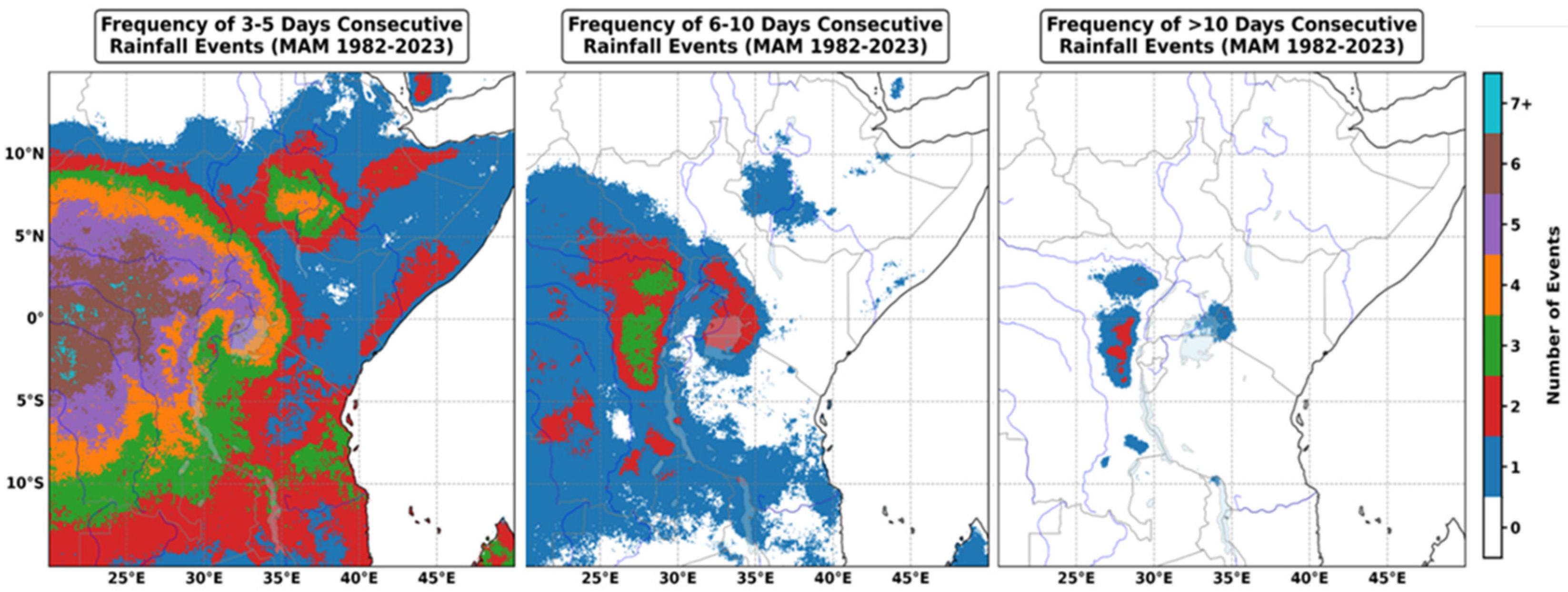
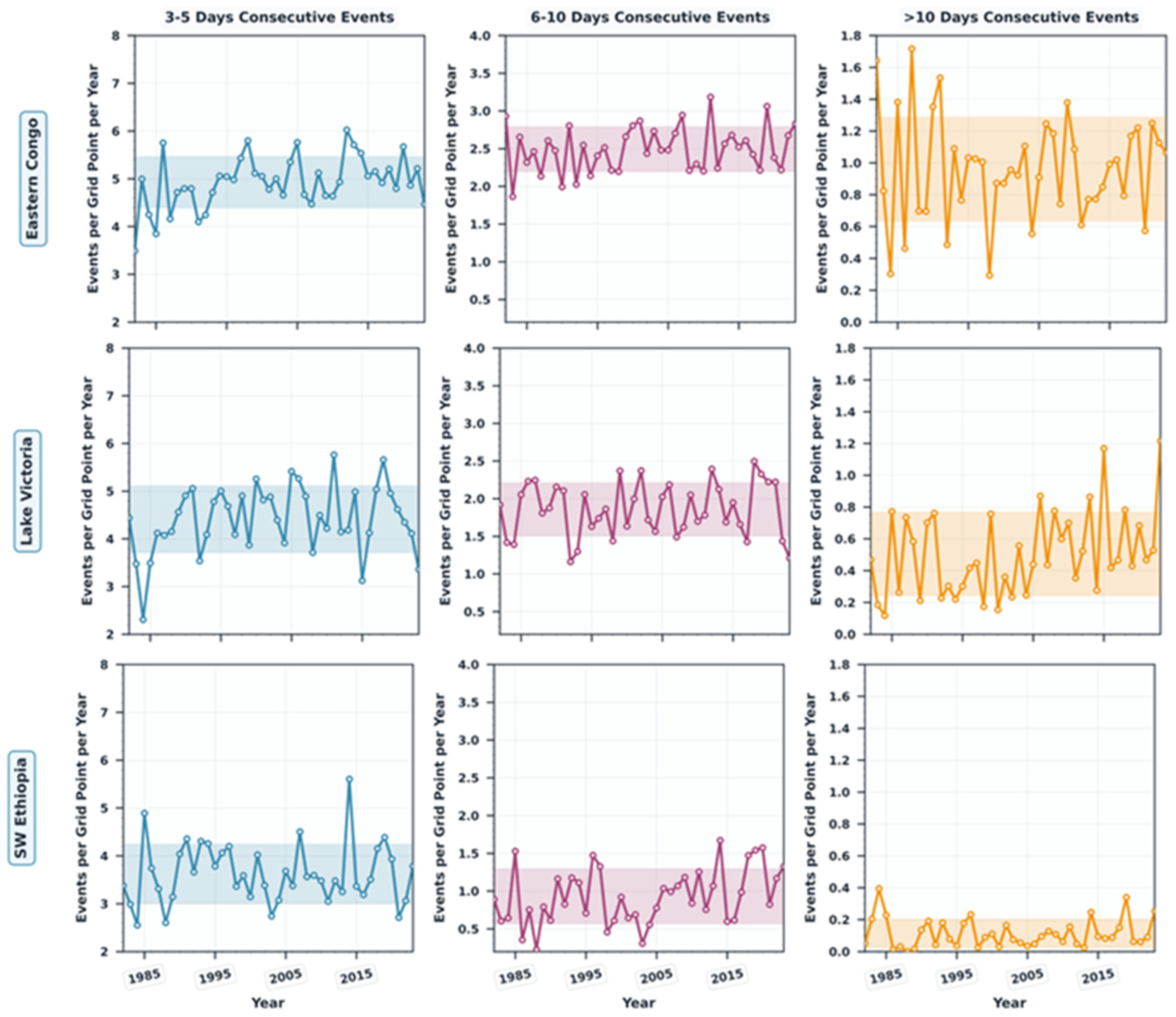
- Short duration: 3–5 consecutive wet days;
- Medium duration: 6–10 consecutive wet days;
- Long duration: >10 consecutive wet days.
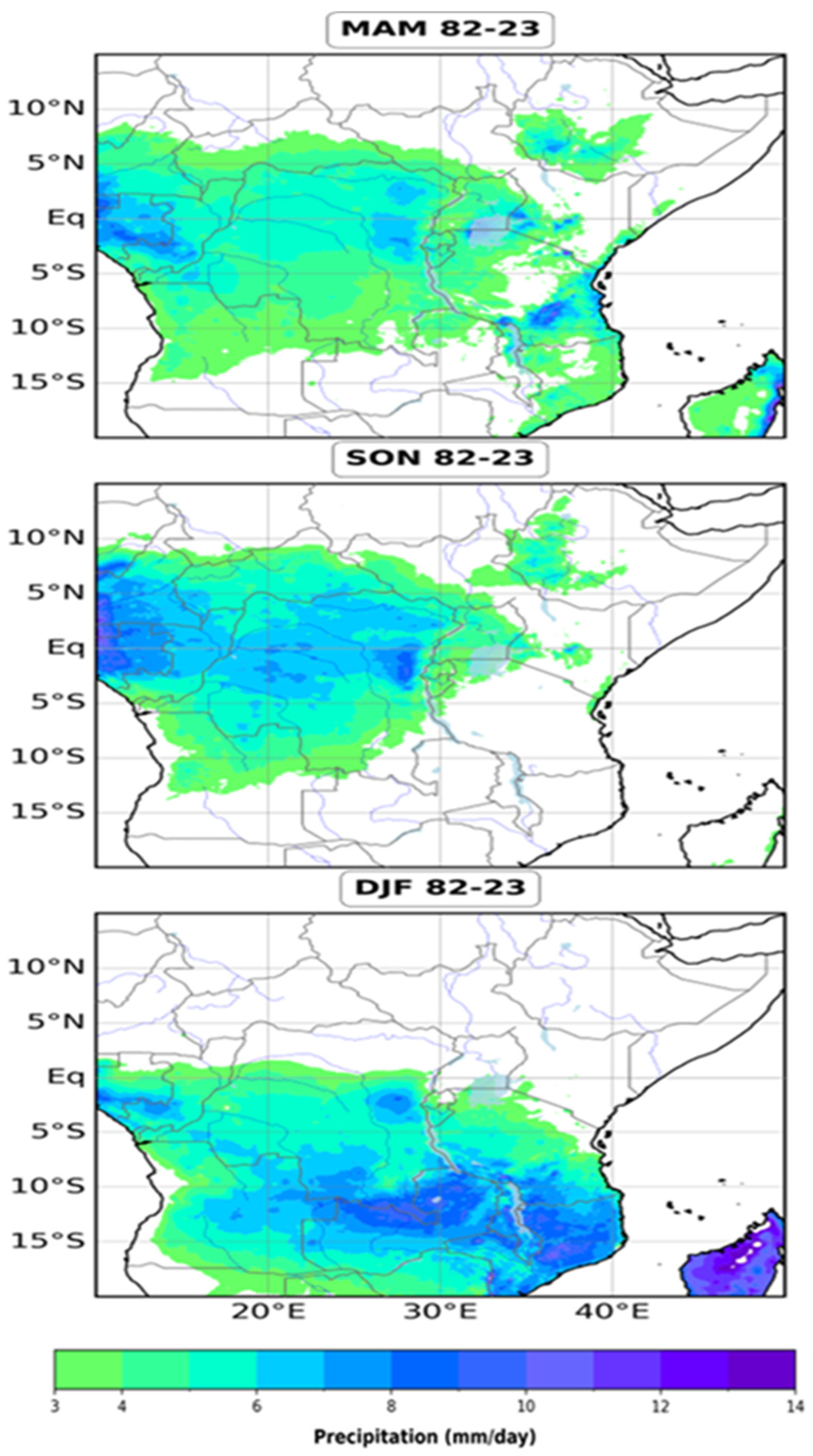
3. Climatological Background
4. Results and Discussion
4.1. Wet and Dry Days
4.2. Spatial and Temporal Variability of Consecutive Wet Days
4.3. Temporal Variability of Consecutive Wet Days
4.4. Rainfall Contribution from Consecutive Events
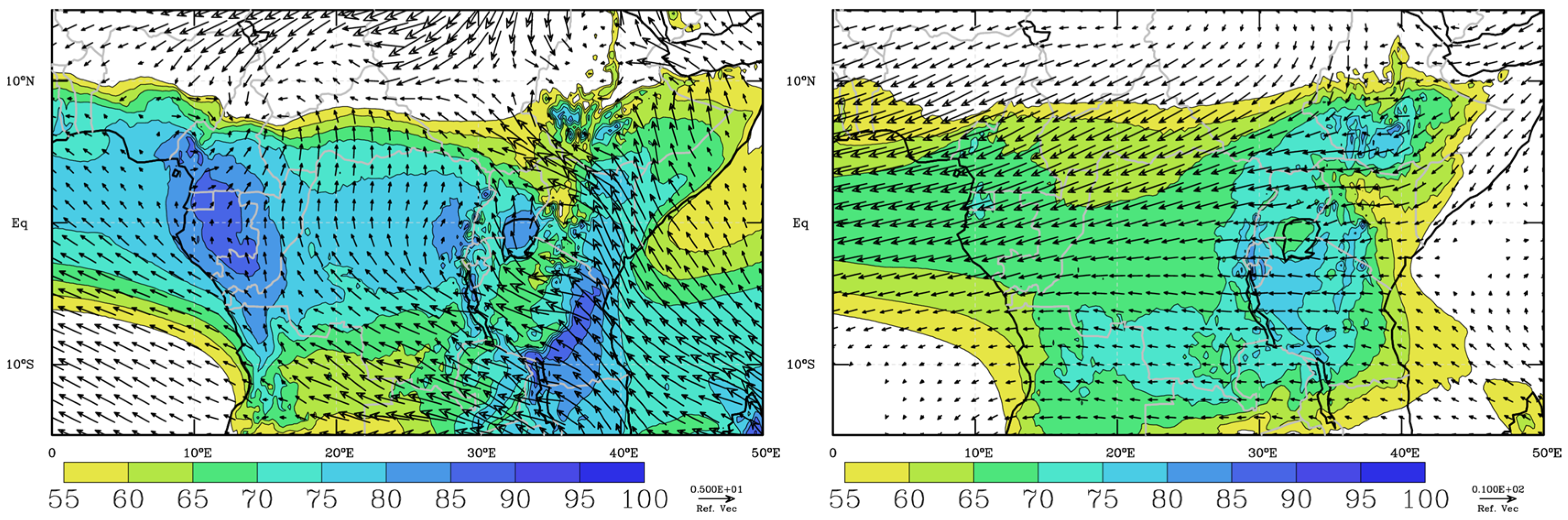
4.5. Composite Analysis of Convective Activity
5. Summary and Final Remarks
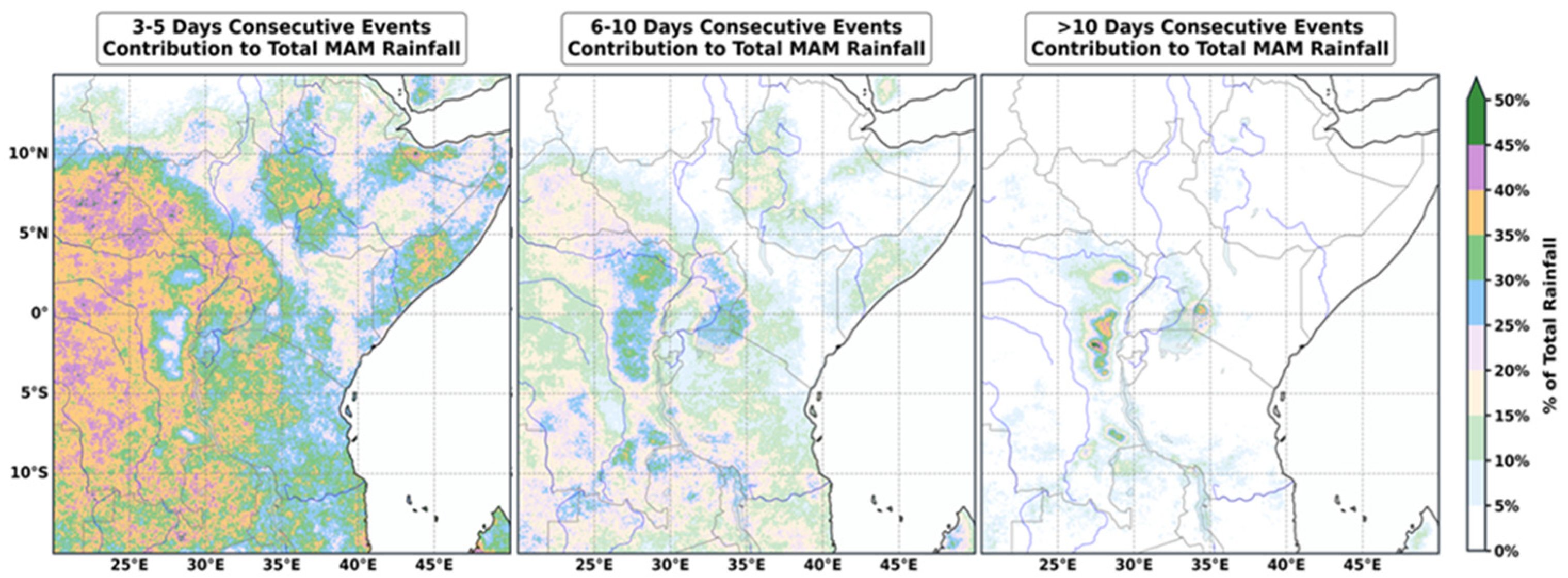
- Substantial contribution to seasonal totals: Consecutive wet day events (≥3 days) contribute 43% of total MAM rainfall across East Africa on average, ranging from near 0% in arid regions to 93% in areas of maximum organization. Short-duration events provide the largest contribution (29% domain average, affecting 94% of the region), medium-duration events contribute 12% on average (up to 42% locally), and long-duration events, though spatially restricted, contribute up to 52% in optimal locations.
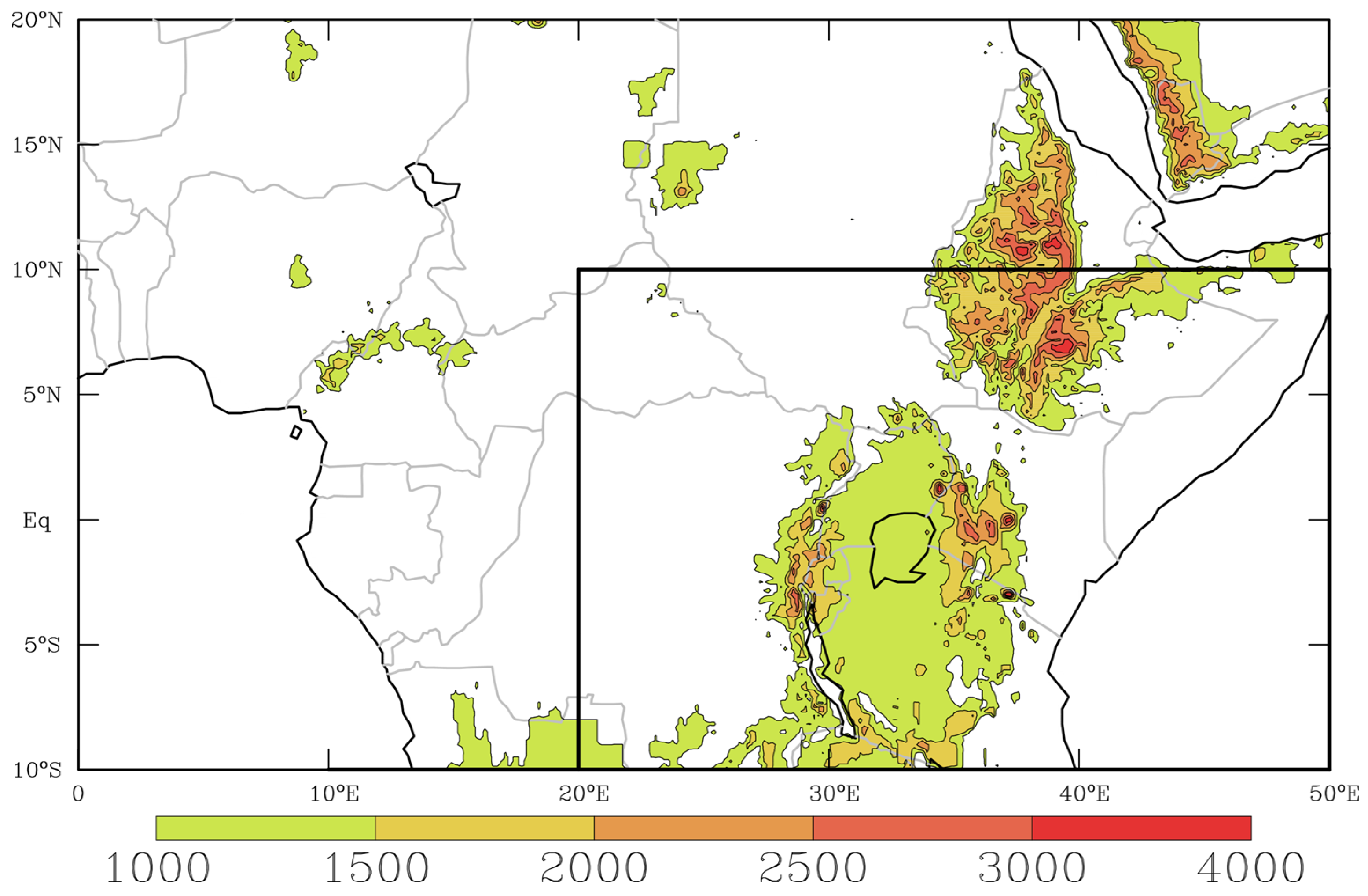
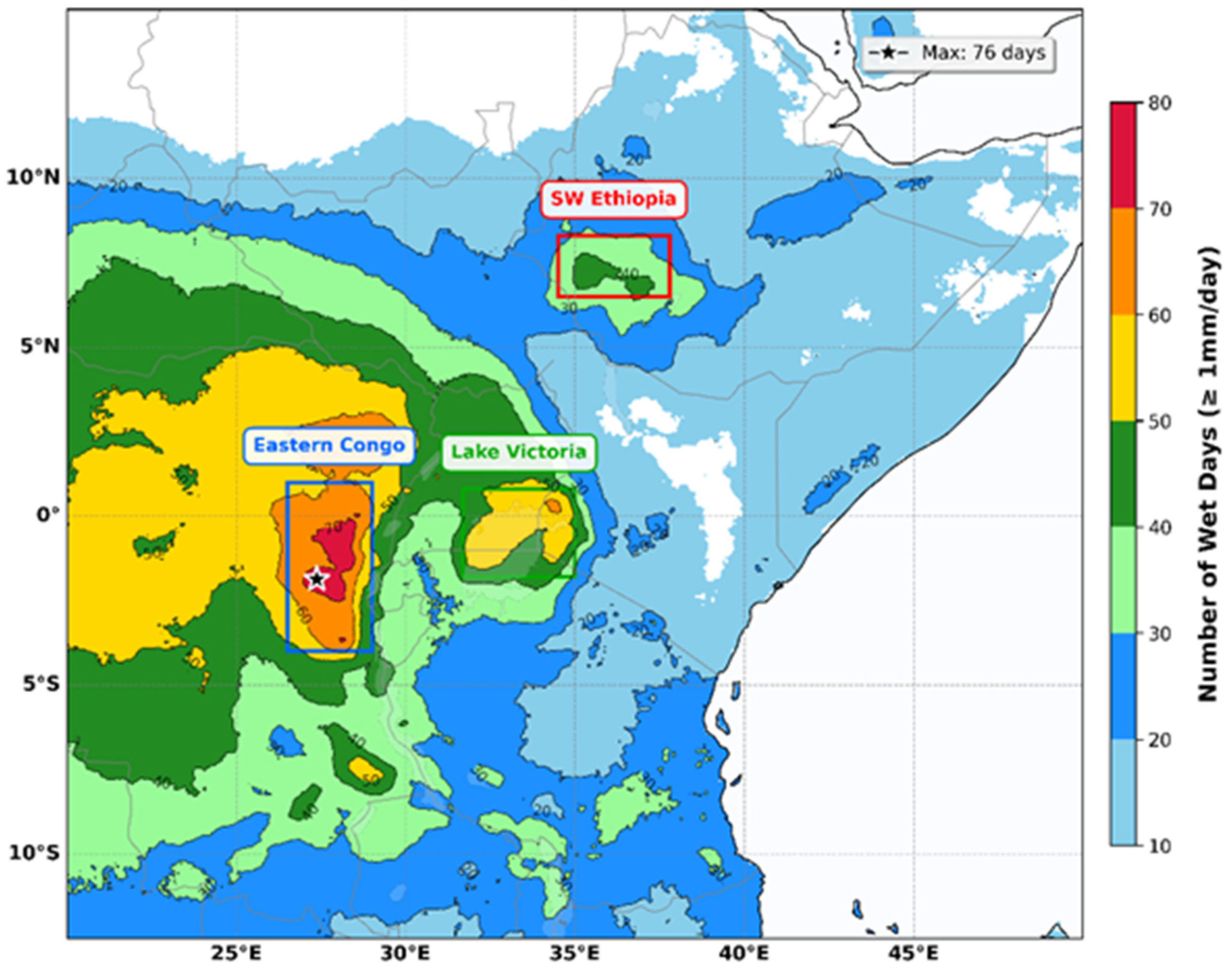
- Spatial heterogeneity in rainfall organization: Consecutive wet days exhibit distinct regional patterns, with enhanced frequencies over complex topography (Eastern Congo, Ethiopian Highlands) and around Lake Victoria. Long-duration events (>10 days) concentrate in equatorial regions with significant elevation gradients, while short-duration events are more uniformly distributed across the domain.
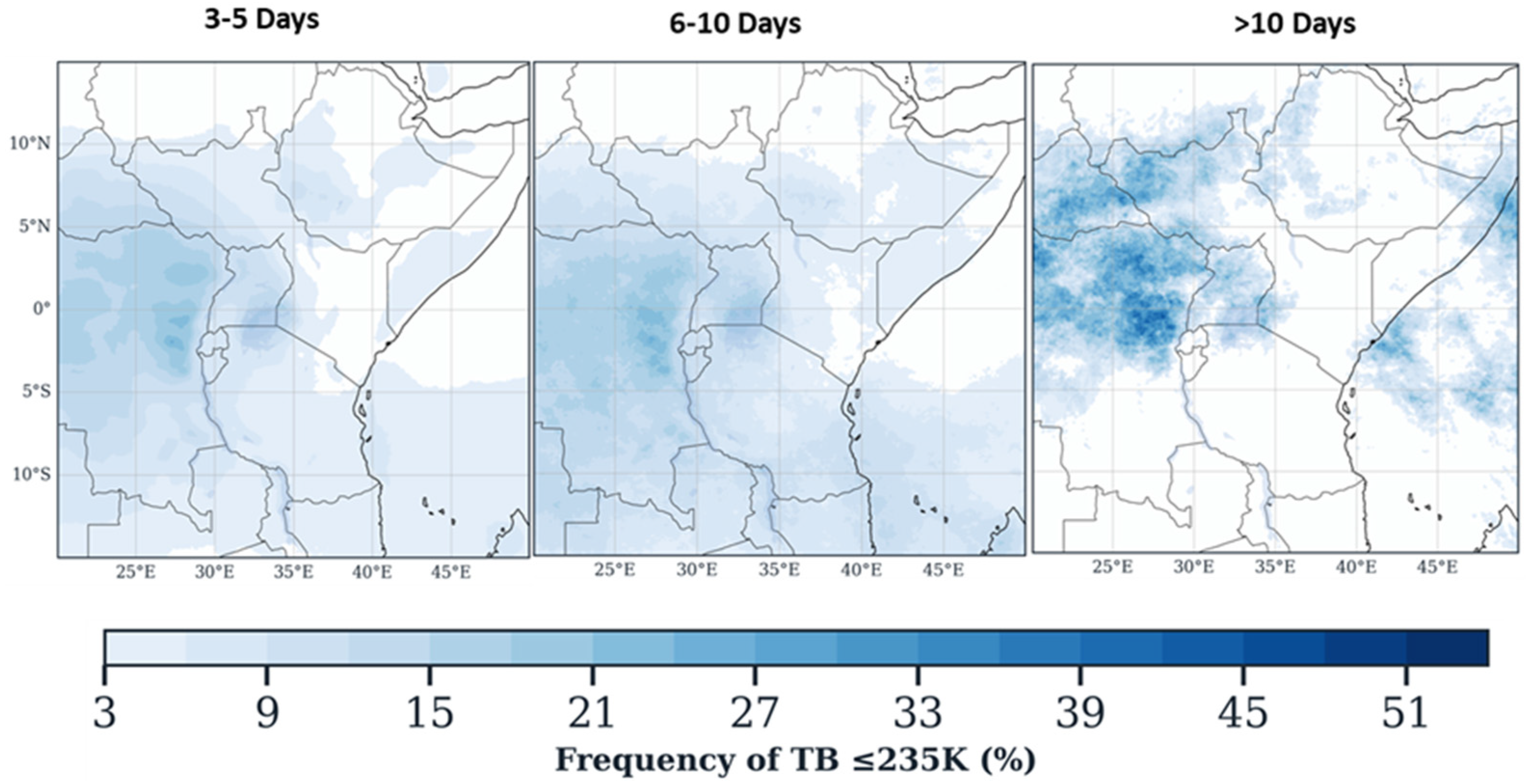
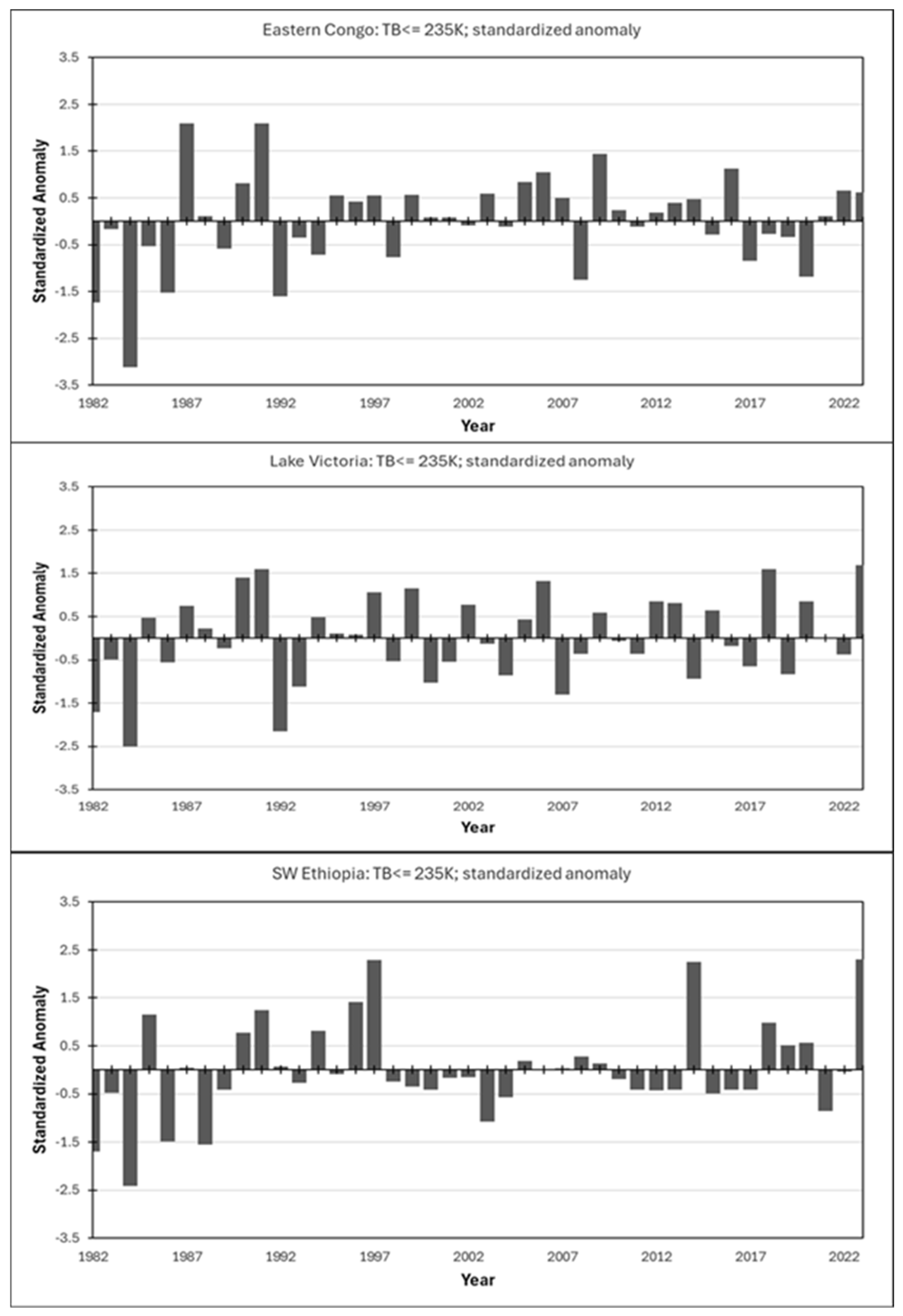
- Relationship between convective organization and rainfall variability: Analysis of brightness temperature (Tb ≤ 235 K) reveals that Eastern Congo exhibits the highest frequency convective variability (standardized anomalies from −3.0 to +2.5 K), yet shows the lowest relative rainfall variability among three core regions, indicating a buffered regime with high precipitation efficiency. SW Ethiopia demonstrates the strongest coupling between convective activity and rainfall variability, confirming a threshold-dependent precipitation regime.
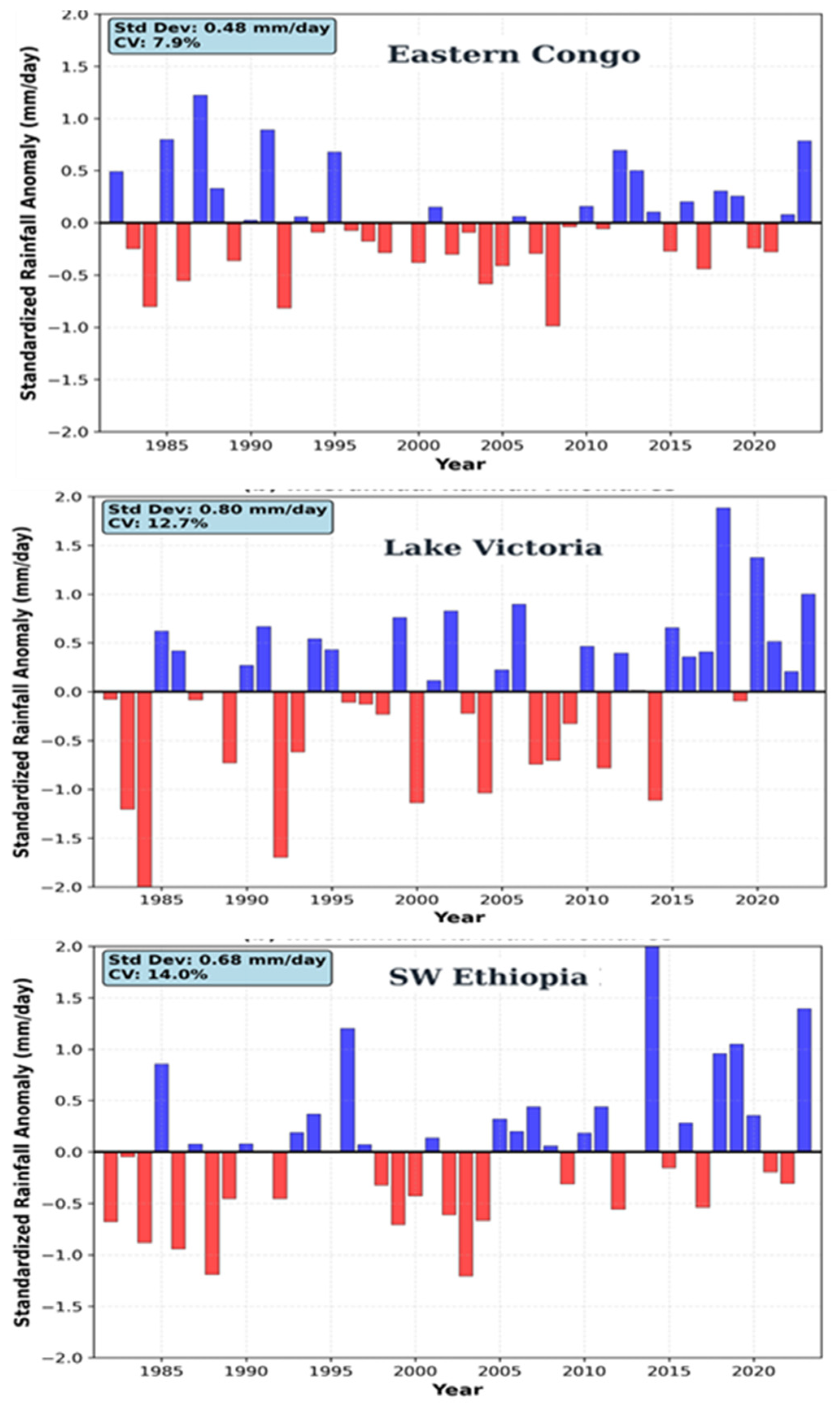
- Increasing interannual variability: Recent decades (particularly 2015–2020) show elevated year-to-year variability in both event frequencies and convective organization across all regions, with coordinated positive anomalies suggesting fundamental shifts in regional atmospheric dynamics.
Author Contributions
Funding
Institutional Review Board Statement
Informed Consent Statement
Data Availability Statement
Acknowledgments
Conflicts of Interest
References
- Nicholson, S.E. Climate and climatic variability of rainfall over eastern Africa. Rev. Geophys. 2017, 55, 590–635. [Google Scholar] [CrossRef]
- Rowell, D.P.; Booth, B.B.B.; Nicholson, S.E.; Good, P. Reconciling Past and Future Rainfall Trends over East Africa. J. Clim. 2015, 28, 9768–9788. [Google Scholar] [CrossRef]
- Liebmann, B.; Hoerling, M.P.; Funk, C.; Bladé, I.; Dole, R.M.; Allured, D.; Quan, X.; Pegion, P.; Eischeid, J.K. Understanding recent eastern Horn of Africa rainfall variability and change. J. Clim. 2014, 27, 8630–8645. [Google Scholar] [CrossRef]
- Yang, W.; Seager, R.; Cane, M.A.; Lyon, B. The annual cycle of East African precipitation. J. Clim. 2015, 28, 2385–2404. [Google Scholar] [CrossRef]
- Ogwang, B.A.; Chen, H.; Li, X.; Gao, C. The influence of topography on East African October to December climate: Sensitivity experiments with RegCM4. Adv. Meteorol. 2014, 2014, 143917. [Google Scholar] [CrossRef]
- Camberlin, P. Climate of Eastern Africa. In Oxford Research Encyclopedia of Climate Science; Oxford University Press: Oxford, UK, 2018. [Google Scholar]
- Kilavi, M.; MacLeod, D.; Ambani, M.; Robbins, J.; Dankers, R.; Graham, R.; Titley, H.; Salih, A.A.; Todd, M.C. Extreme rainfall and flooding over central Kenya including Nairobi city during the long-rains season 2018: Causes, predictability, and potential for early warning and actions. Atmosphere 2018, 9, 472. [Google Scholar] [CrossRef]
- Nicholson, S.E. An analysis of recent rainfall conditions in eastern Africa. Int. J. Climatol. 2016, 36, 526–532. [Google Scholar] [CrossRef]
- Borhara, K.; Pokharel, B.; Bean, B.; Deng, L.; Wang, S.S. On Tanzania’s precipitation climatology, variability, and future projection. Climate 2020, 8, 34. [Google Scholar] [CrossRef]
- Haile, G.G.; Tang, Q.; Hosseini-Moghari, S.; Liu, X.; Gebremicael, T.G.; Leng, G.; Kebede, A.; Xu, X.; Yun, X. Projected impacts of climate change on drought patterns over East Africa. Earth Future 2020, 8, e2020EF001502. [Google Scholar]
- Funk, C.; Peterson, P.; Landsfeld, M.; Pedreros, D.; Verdin, J.; Shukla, S.; Husak, G.; Rowland, J.; Harrison, L.; Hoell, A. The climate hazards infrared precipitation with stations—A new environmental record for monitoring extremes. Sci. Data 2015, 2, 1–21. [Google Scholar] [CrossRef]
- Knapp, K.R.; Ansari, S.; Bain, C.L.; Bourassa, M.A.; Dickinson, M.J.; Funk, C.; Helms, C.N.; Hennon, C.C.; Holmes, C.D.; Huffman, G.J. Globally gridded satellite observations for climate studies. Bull. Am. Meteorol. Soc. 2011, 92, 893–907. [Google Scholar] [CrossRef]
- Hersbach, H.; Bell, B.; Berrisford, P.; Biavati, G.; Horányi, A.; Muñoz Sabater, J.; Nicolas, J.; Peubey, C.; Radu, R.; Rozum, I.; et al. ERA5 Hourly Data on Pressure Levels from 1940 to Present; Copernicus Climate Change Service (C3S) Climate Data Store (CDS); European Centre for Medium-Range Weather Forecasts: Reading, UK, 2023. [Google Scholar] [CrossRef]
- World Meteorological Organization. Guide to Climatological Practices (WMO-No. 100), 3rd ed.; WMO: Geneva, Switzerland, 2018; ISBN 978-92-63-10100-6. [Google Scholar]
- Arkin, P.A.; Meisner, B.N. The relationship between large-scale convective rainfall and cold cloud over the western hemisphere during 1982–84. Mon. Weather. Rev. 1987, 115, 51–74. [Google Scholar] [CrossRef]
- Machado, L.T.; Desbois, M.; Duvel, J. Structural characteristics of deep convective systems over tropical Africa and the Atlantic Ocean. Mon. Weather Rev. 1992, 120, 392–406. [Google Scholar] [CrossRef]
- Tissier, A.; Legras, B. Convective sources of trajectories traversing the tropical tropopause layer. Atmos. Chem. Phys. 2016, 16, 3383–3398. [Google Scholar] [CrossRef]
- Taylor, C.M.; Fink, A.H.; Klein, C.; Parker, D.J.; Guichard, F.; Harris, P.P.; Knapp, K.R. Earlier seasonal onset of intense mesoscale convective systems in the Congo Basin since 1999. Geophys. Res. Lett. 2018, 45, 13,458–13,467. [Google Scholar] [CrossRef]
- Kinuthia, J.H.; Asnani, G.C. A newly found jet in North Kenya (Turkana Channel). Mon. Weather Rev. 1982, 110, 1722–1728. [Google Scholar]
- Munday, C.; Engelstaedter, S.; Ouma, G.; Ogutu, G.; Olago, D.; Ong’ech, D.; Lees, T.; Wanguba, B.; Nkatha, R.; Ogolla, C. Observations of the Turkana jet and the east African dry tropics: The RIFTJet field campaign. Bull. Am. Meteorol. Soc. 2022, 103, E1828–E1842. [Google Scholar] [CrossRef]
- Vizy, E.K.; Cook, K.H. Interannual variability of East African rainfall: Role of seasonal transitions of the low-level cross-equatorial flow. Clim. Dyn. 2020, 54, 4563–4587. [Google Scholar] [CrossRef]
- Finney, D.L.; Marsham, J.H.; Walker, D.P.; Birch, C.E.; Woodhams, B.J.; Jackson, L.S.; Hardy, S. The effect of westerlies on East African rainfall and the associated role of tropical cyclones and the Madden–Julian Oscillation. Q. J. R. Meteorol. Soc. 2020, 146, 647–664. [Google Scholar] [CrossRef]
- Segele, Z.T.; Lamb, P.J.; Leslie, L.M. Large-scale atmospheric circulation and global sea surface temperature associations with Horn of Africa June–September rainfall. Int. J. Climatol. A J. R. Meteorol. Soc. 2009, 29, 1075–1100. [Google Scholar] [CrossRef]
- Hastenrath, S.; Polzin, D.; Mutai, C. Circulation mechanisms of Kenya rainfall anomalies. J. Clim. 2011, 24, 404–412. [Google Scholar] [CrossRef]
- Pohl, B.; Camberlin, P. Influence of the Madden–Julian oscillation on East African rainfall: II. March–May season extremes and interannual variability. Q. J. R. Meteorol. Soc. A J. Atmos. Sci. Appl. Meteorol. Phys. Oceanogr. 2006, 132, 2541–2558. [Google Scholar]
- Vellinga, M.; Milton, S. Drivers of interannual variability of the East African ‘Long Rains’. Q. J. R. Meteorol. Soc. 2018, 144, 861–876. [Google Scholar] [CrossRef]
- Panthou, G.; Lebel, T.; Vischel, T.; Quantin, G.; Sane, Y.; Ba, A.; Ndiaye, O.; Diongue-Niang, A.; Diopkane, M. Rainfall intensification in tropical semi-arid regions: The Sahelian case. Environ. Res. Lett. 2018, 13, 064013. [Google Scholar] [CrossRef]
- Cornforth, R.J.; Hoskins, B.J.; Thorncroft, C.D. The impact of moist processes on the African easterly jet–African easterly wave system. Q. J. R. Meteorol. Soc. A J. Atmos. Sci. Appl. Meteorol. Phys. Oceanogr. 2009, 135, 894–913. [Google Scholar] [CrossRef]
- Fink, A.H.; Reiner, A. Spatiotemporal variability of the relation between African easterly waves and West African squall lines in 1998 and 1999. J. Geophys. Res. Atmos. 2003, 108, D11. [Google Scholar] [CrossRef]
- Taylor, C.M.; Belušić, D.; Guichard, F.; Parker, D.J.; Vischel, T.; Bock, O.; Harris, P.P.; Janicot, S.; Klein, C.; Panthou, G. Frequency of extreme Sahelian storms tripled since 1982 in satellite observations. Nature 2017, 544, 475–478. [Google Scholar] [CrossRef]
- Anyah, R.O.; Semazzi, F.H.M. Variability of East African rainfall based on multiyear Regcm3 simulations. Int. J. Climatol. 2006, 27, 357. [Google Scholar] [CrossRef]
- Washington, R.; James, R.; Pearce, H.; Pokam, W.M. Congo Basin rainfall climatology: Can we believe the climate models? Philos. Trans. R. Soc. B Biol. Sci. 2013, 368, 20120296. [Google Scholar] [CrossRef]
- Dezfuli, A. Climate of Western and Central Equatorial Africa. In Oxford Research Encyclopedia of Climate Science; Oxford University Press: Oxford, UK, 2017. [Google Scholar]
- Jackson, B.; Nicholson, S.E.; Klotter, D. Mesoscale convective systems over western equatorial Africa and their relationship to large-scale circulation. Mon. Weather Rev. 2009, 137, 1272–1294. [Google Scholar] [CrossRef]
- Anyah, R.O.; Semazzi, F. Simulation of the sensitivity of Lake Victoria basin climate to lake surface temperatures. Theor. Appl. Climatol. 2004, 79, 55–69. [Google Scholar] [CrossRef]
- Camberlin, P. Nile Basin Climates. In The Nile: Origin, Environments, Limnology and Human Use; Springer: Berlin/Heidelberg, Germany, 2009; pp. 307–333. [Google Scholar]
- Diro, G.T.; Black, E.; Grimes, D. Seasonal forecasting of Ethiopian spring rains. Meteorol. Appl. A J. Forecast. Pract. Appl. Train. Tech. Model. 2008, 15, 73–83. [Google Scholar]
- Jury, M.R. Climate influences on Vaal River flow. Water SA 2016, 42, 232–242. [Google Scholar] [CrossRef][Green Version]
- Mekonnen, A.; Thorncroft, C.D. On mechanisms that determine synoptic time scale convection over East Africa. Int. J. Climatol. 2016, 36, 4045–4057. [Google Scholar] [CrossRef]
- Crook, J.; Morris, F.; Fitzpatrick, R.G.J.; Peatman, S.C.; Schwendike, J.; Stein, T.H.; Birch, C.E.; Hardy, S.; Yang, G. Impact of the Madden–Julian oscillation and equatorial waves on tracked mesoscale convective systems over southeast Asia. Q. J. R. Meteorol. Soc. 2024, 150, 1724–1751. [Google Scholar] [CrossRef]
- Vizy, E.K.; Cook, K.H. Distribution of extreme rainfall events and their environmental controls in the West African Sahel and Soudan. Clim. Dyn. 2022, 59, 997–1026. [Google Scholar] [CrossRef]
- Hartman, A.T. Tracking mesoscale convective systems in central equatorial Africa. Int. J. Climatol. 2021, 41, 469–482. [Google Scholar] [CrossRef]
- Laing, A.G.; Carbone, R.E.; Levizzani, V. Cycles and propagation of deep convection over equatorial Africa. Mon. Weather Rev. 2011, 139, 2832–2853. [Google Scholar]
- Cook, K.H.; Vizy, E.K. Hydrodynamics of regional and seasonal variations in Congo Basin precipitation. Clim. Dyn. 2022, 59, 1775–1797. [Google Scholar] [CrossRef]
- Anyah, R.O.; Semazzi, F.H.; Xie, L. Simulated physical mechanisms associated with climate variability over Lake Victoria basin in East Africa. Mon. Weather Rev. 2006, 134, 3588–3609. [Google Scholar]
- Rohli, R.V.; Vega, A.J.; Henderson, K.G. Africa and Adjacent Ocean Environments. In Atmospheric and Oceanic Circulation: An Explanation of Earth’s Climate Patterns; Springer: Berlin/Heidelberg, Germany, 2024; pp. 363–390. [Google Scholar]
- Wainwright, C.M.; Marsham, J.H.; Keane, R.J.; Rowell, D.P.; Finney, D.L.; Black, E.; Allan, R.P. ‘Eastern African Paradox’ rainfall decline due to shorter not less intense Long Rains. npj Clim. Atmos. Sci. 2019, 2, 34. [Google Scholar] [CrossRef]
- Oratungye, K.J.; Oludhe, C.; Manene, M.M.; Komutunga, E. A multivariate analysis approach in determining potential hotspots of seasonal rainfall change over Uganda. Int. J. Stat. Appl. Math. 2016, 2, 31–41. [Google Scholar]
- Bedasa, Y.; Deksisa, K. Food insecurity in East Africa: An integrated strategy to address climate change impact and violence conflict. J. Agric. Food Res. 2024, 15, 100978. [Google Scholar] [CrossRef]
- Chang’a, L.B.; Kijazi, A.L.; Mafuru, K.B.; Nying’uro, P.A.; Ssemujju, M.; Deus, B.; Kondowe, A.L.; Yonah, I.B.; Ngwali, M.; Kisama, S.Y. Understanding the evolution and socio-economic impacts of the extreme rainfall events in March–May 2017 to 2020 in East Africa. Atmos. Clim. Sci. 2020, 10, 553. [Google Scholar] [CrossRef]
- Devi, S. Climate change driving east Africa towards famine. Lancet 2022, 400, 150–151. [Google Scholar] [CrossRef]
- Mekonnen, A.; Rossow, W.B. The Interaction Between Deep Convection and Easterly Waves over Tropical North Africa: A Weather State Perspective. J. Clim. 2011, 24, 4276–4294. [Google Scholar] [CrossRef]
- Mekonnen, A.; Rossow, W.B. The Interaction between Deep Convection and Easterly Wave Activity over Africa: Convective Transitions and Mechanisms. Mon. Wea. Rev. 2018, 146, 1945–1961. [Google Scholar] [CrossRef]
- Rossow, W.B.; Mekonnen, A.; Pearl, C.; Goncalves, W. Tropical Precipitation Extremes. J. Clim. 2013, 26, 1457–1466. [Google Scholar] [CrossRef][Green Version]
- Fink, A.H.; Vincent, D.G.; Ermert, V. Rainfall types in the West African Sudanian zone during the summer monsoon 2002. Mon. Weather. Rev. 2006, 134, 2143–2164. [Google Scholar] [CrossRef]
- Mathon, V.; Laurent, H.; Lebel, T. Mesoscale convective system rainfall in the Sahel. J. Appl. Meteorol. 2002, 41, 1081–1092. [Google Scholar] [CrossRef]
- Wenhaji Ndomeni, C.; Cattani, E.; Merino, A.; Levizzani, V. An observational study of the variability of East African rainfall with respect to sea surface temperature and soil moisture. Q. J. R. Meteorol. Soc. 2018, 144, 384–404. [Google Scholar] [CrossRef]
- Saji, N.H.; Goswami, B.N.; Vinayachandran, P.N.; Yamagata, T. A dipole mode in the tropical Indian Ocean. Nature 1999, 401, 360–363. [Google Scholar] [CrossRef] [PubMed]
- Webster, P.J.; Moore, A.M.; Loschnigg, J.P. Coupled ocean-atmosphere dynamics in the Indian Ocean during 1997–1998. Nature 1999, 401, 356–360. [Google Scholar] [CrossRef] [PubMed]




Disclaimer/Publisher’s Note: The statements, opinions and data contained in all publications are solely those of the individual author(s) and contributor(s) and not of MDPI and/or the editor(s). MDPI and/or the editor(s) disclaim responsibility for any injury to people or property resulting from any ideas, methods, instructions or products referred to in the content. |
© 2026 by the authors. Licensee MDPI, Basel, Switzerland. This article is an open access article distributed under the terms and conditions of the Creative Commons Attribution (CC BY) license.
Share and Cite
Afolayan, S.; Mekonnen, A. Sub-Seasonal Rainfall Variability and Atmospheric Dynamics During East African Long-Rain. Atmosphere 2026, 17, 85. https://doi.org/10.3390/atmos17010085
Afolayan S, Mekonnen A. Sub-Seasonal Rainfall Variability and Atmospheric Dynamics During East African Long-Rain. Atmosphere. 2026; 17(1):85. https://doi.org/10.3390/atmos17010085
Chicago/Turabian StyleAfolayan, Stella, and Ademe Mekonnen. 2026. "Sub-Seasonal Rainfall Variability and Atmospheric Dynamics During East African Long-Rain" Atmosphere 17, no. 1: 85. https://doi.org/10.3390/atmos17010085
APA StyleAfolayan, S., & Mekonnen, A. (2026). Sub-Seasonal Rainfall Variability and Atmospheric Dynamics During East African Long-Rain. Atmosphere, 17(1), 85. https://doi.org/10.3390/atmos17010085