Article

Meteorological and Air Quality Effects on Bioaerosol Detection Using WIBS-NEO and IBAC-2 in Dublin City


by
Emma Markey
1,
Jerry Hourihane Clancy
1,*,
Moisés Martínez-Bracero
1,2,
José María Maya-Manzano
3,4,
Raúl Pecero-Casimiro
3,
Eoin Joseph McGillicuddy
4,
Gavin Sewell
4,
Roland Sarda-Estève
5,
Andrés M. Vélez-Pereira
6 and
David J. O’Connor
1
1
School of Chemical Sciences, Dublin City University, D09 E432 Dublin, Ireland
2
Department of Botany, Ecology and Plant Physiology, Agrifood Campus of International Excellence CeiA3, University of Cordoba, Rabanales Campus, Celestino Mutis Building, 14071 Córdoba, Spain
3
Department of Plant Biology, Ecology and Earth Science, Faculty of Science, University of Extremadura, 06006 Badajoz, Spain
4
School of Chemical and Pharmaceutical Sciences, Technological University Dublin, D07 H6K8 Dublin, Ireland
5
Laboratoire des Sciences du Climat et de l’Environnement (LSCE), CNRS-CEA-UVSQ, 91191 Saint-Aubin, France
6
Departamento de Ingeniería Mecánica, Facultad de Ingeniería, Universidad de Tarapacá, 18 de Septiembre 2222, Arica 1000000, Chile
*
Author to whom correspondence should be addressed.
Atmosphere 2026, 17(1), 86; https://doi.org/10.3390/atmos17010086
Submission received: 13 November 2025 / Revised: 7 January 2026 / Accepted: 12 January 2026 / Published: 15 January 2026
(This article belongs to the Section Aerosols)

Abstract

This study evaluates the performance of two real-time fluorescence-based bioaerosol sensors, the WIBS-NEO and IBAC-2, operating in urban Dublin, Ireland, and assesses the influence of different meteorological and pollution parameters on their outputs. This was done by comparing particle sensor data to meteorological variables and air quality metrics. Over the 41-day campaign, Urticaceae pollen and Cladosporium spores were the dominant bioaerosols recorded, comprising 78% and 66% of total pollen and fungal spore concentrations, respectively. Correlation analyses revealed several significant variables: fluorescent BC-type particles (>8 μm) detected by WIBS-NEO strongly correlated with pollen concentrations (r = 0.84 after excluding high-wind days). For fungal spores, PM10 and grass minimum temperature were the most significant parameters related to variability. Anthropogenic pollutants, particularly NOX and combustion-related aerosols, were found to correlate with fluorescence signals, especially for smaller particles (<2 μm), underscoring urban detection challenges. Wind trajectory analysis identified the likely source of Urticaceae pollen as northerly green spaces (e.g., Phoenix Park), while Cladosporium spores showed multidirectional transport. Multiple linear regression (MLR) analysis achieved strong correlation ( R 2 = 0.82 for pollen, 0.78 for fungal spores), highlighting the value of incorporating multiple environmental variables to investigate the complex relationships between urban environmental conditions and bioaerosol sensor outputs. Both instruments exhibited operational limitations under the study conditions. The WIBS-NEO outperformed the IBAC-2 in biological discrimination due to its multi-channel single particle fluorescence capabilities. However, operational limitations emerged during higher wind speeds, comparable to moderate breezes (>16.6 km/h), which affected sampling comparability when compared with traditional methods. This study investigates how meteorological conditions and air quality influence bioaerosol detection in an urban environment. The use of MLR techniques to examine the complex relationships between environmental variables and fluorescent sensor outputs may help inform future bioaerosol modelling efforts.

1. Introduction

Bioaerosols, encompassing pollen, fungal spores, bacteria, and other primary biological aerosol particles (PBAPs), are ubiquitous in the atmosphere and play critical roles in air quality, human health, and climate systems [1,2]. Fungal spores, among the most abundant PBAPs, exhibit significant seasonal and diurnal variability influenced by temperature, humidity, and wind dynamics [3,4]. Their capacity for long-range transport, exemplified by Cladosporium clouds migrating over 1000 km across the North Sea, underscores their ecological and climatic relevance [5]. As ice nuclei (IN) and cloud condensation nuclei (CCN), fungal spores contribute to precipitation processes, particularly at temperatures above −20 °C where non-biological aerosols lose efficacy [6,7]. Similarly, pollen grains, ranging from 10–100 µm, are key allergenic agents and contributors to bioaerosol loads. Urban environments exacerbate their health impacts, as pollutants like NOX and ozone fragment pollen into sub-pollen particles (SPPs < 5 µm), enhancing allergen penetration into respiratory pathways [8,9]. In Ireland, respiratory conditions such as asthma affect 890,000 individuals (16.5% of the population), with healthcare costs exceeding EUR 470 million annually [10].
While traditional bioaerosol monitoring methods (e.g., Hirst-type samplers) are well standardised, they are constrained by low temporal resolution and labour-intensive analysis [11,12]. Recent advancements in real-time sensors such as the Wideband Integrated Bioaerosol Sensor (WIBS) and Instantaneous Biological Analyzer and Collector (IBAC) offer rapid, fluorescence-based detection of PBAPs. The WIBS-NEO employs UV-induced fluorescence (280/370 nm excitation) to classify particles by size, shape, and biological content [13], while the IBAC-2 combines aerodynamic sizing with fluorescence lifetime analysis for enhanced discrimination [14]. However, their performance in urban settings, particularly under variable meteorological and pollution regimes, remains understudied.
Previous studies in Dublin identified discrepancies between traditional and real-time PBAP measurements but did not systematically evaluate the environmental factors driving these differences [9]. These gaps hinder the use of such real-time sensors for monitoring urban bioaerosol concentrations and limits their application under diverse environmental conditions. The novelty of this study lies in further investigating these discrepancies and in exploring how meteorology and air quality influence bioaerosol detection. To address these challenges, this study has two main objectives: (i) to assess how environmental conditions affect the performance of WIBS-NEO and IBAC-2 in an urban coastal setting and (ii) to investigate the degree to which anthropogenic aerosols interfere with the fluorescence-based detection of these bioaerosol sensors, given the urban nature of the site.
Furthermore, by examining the interactions between bioaerosols, weather, and pollution, this study advances understanding of PBAP roles in regional precipitation processes and long-range transport mechanisms [6,7], while highlighting the potential impact of anthropogenic interferences on fluorescence-based monitoring in atmospherically complex urban environments. Building on previous studies of the WIBS in Ireland, [15,16,17,18], this work extends knowledge of instrument performance under real-world urban conditions.

2. Materials and Methods

2.1. Sampling Site and Period

The study was conducted in Dublin, Ireland, over a 41-day period from 7 August to 16 September 2019. This period was chosen to coincide with the peak season for fungal spore and pollen activity, ensuring a robust dataset for bioaerosol analysis. The sampling site was located on the rooftop of the former TU Dublin Kevin Street building (approximately 20 m high), an urban site with minimal obstructions to air flow due to the absence of taller surrounding structures. This ensures that consistent and representative bioaerosol measurements were taken. The site is part of a coastal metropolitan region with a population density of 4811/km2, making it an ideal location for studying urban bioaerosol dynamics.

2.2. Instrumentation

2.2.1. WIBS-NEO (Wideband Integrated Bioaerosol Sensor)

The WIBS-NEO is a real-time bioaerosol sensor that uses light-induced fluorescence (LIF) to categorize airborne biological particles based on their size, shape, and fluorescence characteristics. A full instrument description is provided in Markey et al., 2024 [19] and a summary is provided here. The instrument detects particles in three excitation bands— 280 nm, 370 nm, and 405 nm—and classifies them into fluorescent aerosol particles (FAPs) using a multi-channel fluorescence detection system.
The WIBS-NEO operates by drawing ambient air into an optical chamber at a flow rate of 0.3 L/min, where particles are irradiated by a 635 nm laser for size and shape determination. Fluorescence is then triggered by Xenon flash lamps at 280 nm and 370 nm, with emissions detected in the 310–400 nm (FL1) and 420–650 nm (FL2) ranges. This allows for the classification of particles into categories such as A, B, C, AB, AC, BC, and ABC, based on their fluorescence signatures [20]. The WIBS-NEO was operational at the Dublin site for the entire 41-day campaign, providing high-resolution data on bioaerosol concentrations and types. The ABC band was also split into ABC1 and ABC2, as will be described in the main body of the paper.

2.2.2. IBAC-2 (Instantaneous Bioaerosol Analyzer and Collector)

The IBAC-2 is a laser-induced fluorescence (LIF) system optimized for the detection of bacterial bioaerosols but also capable of detecting pollen and fungal spores [21,22]. Unlike the WIBS-NEO, the IBAC-2 lacks multi-channel fluorescence differentiation, which limits its ability to distinguish between different bioaerosol types. The device uses a 405 nm laser as an excitation source and detects fluorescence in the 450–600 nm range. Particles are drawn into the device at a rate of 3.8 L/min, and their size and concentration are measured based on light scatter.

2.2.3. Hirst-Type Sampler

The Hirst-type sampler is a traditional volumetric spore trap used for the collection and microscopic analysis of pollen and fungal spores. The sampler operates on the principle of volumetric impaction, drawing air at a rate of 10 L/min (mimicking the human respiratory system) through a 14 × 2 mm inlet. Particles are impacted onto a silicone-coated tape attached to a rotating drum, which completes one full rotation in 7 days. The tape is then removed, cut into daily segments, and mounted on microscope slides for analysis. The Hirst sampler was used to validate the real-time data from the WIBS-NEO and IBAC-2, serving as a widely used reference for bioaerosol concentrations and types.

2.3. Meteorological and Air Quality Data

Meteorological data was obtained from the Met Éireann website [23]. Dublin weather data was obtained from the weather station at Dublin Airport (53°21′49″ N, 06°20′59″ W); this site is approximately 9.5 km north of the Hirst sampler. The available parameters were mean temperature [°C] (Tmed), maximum temperature [°C] (Tmax) and minimum temperature [°C] (Tmin), grass minimum temperature [°C], 2 cm above the ground (Gmin), mean 10 cm soil temperature [°C] (Soil), precipitation amount [mm] (Rain), mean cbl pressure [hPa] (Pres), mean wind speed [kt] (Wind_s) and wind direction at max 10 min mean [deg] (Wind_d), global radiation [J/cm2] (G_rad), sunshine duration [hours] (Day_L), potential evapotranspiration [mm] (Pe), evaporation [mm] (Evap), and relative humidity [%] (Rh).
Open access air quality and anthropogenic pollution data (all in the unit µg/m3) including NOX, NO, NO2, SO2, CO, PM2.5, and PM10 was collected at nearby sampling sites at Winetavern Street and Rathmines (PM2.5 only) and are presented as daily average concentrations. The Winetavern Street sampling site is situated less than 1 km from the sampling site, while the Rathmines site is located 1.6 km away. The air quality data collected from these sites was obtained from the Environmental Protection Agency SAFER open data website [24].

2.4. Geographical Origin of Airborne Bioaerosols and FAPs

The geographical origin of both ambient bioaerosols and WIBS particles observed at the Dublin sampling location was analysed using wind data. Coupling the ambient concentrations of bioaerosols/WIBS particles with wind data makes it possible to estimate the geographical origins of the particles reaching the site. A source receptor approach was used to determine the geographical origin of airborne pollen, spores, and FAPs observed in Dublin. Non-parametric Wind Regression (NWR) was applied to the data using the software package ZeFir-v3.7 [25].

2.5. Data Analysis

Correlation Analysis

The normal distribution of the WIBS, IBAC, Hirst, and meteorological/pollution daily data was tested using the Shapiro–Wilk test. The results of this showed that most daily data did not follow a normal distribution. A Spearman correlation test was selected to calculate the degree and the correlation between selected variables using the nortest [26] and corrplot [27] packages within R version 4.5.1 [28]. The results were used to infer the potential influence of weather and pollution on bioaerosol/FAP concentration, production, and dispersal.

3. Results

3.1. Overview of Bioaerosol Concentrations

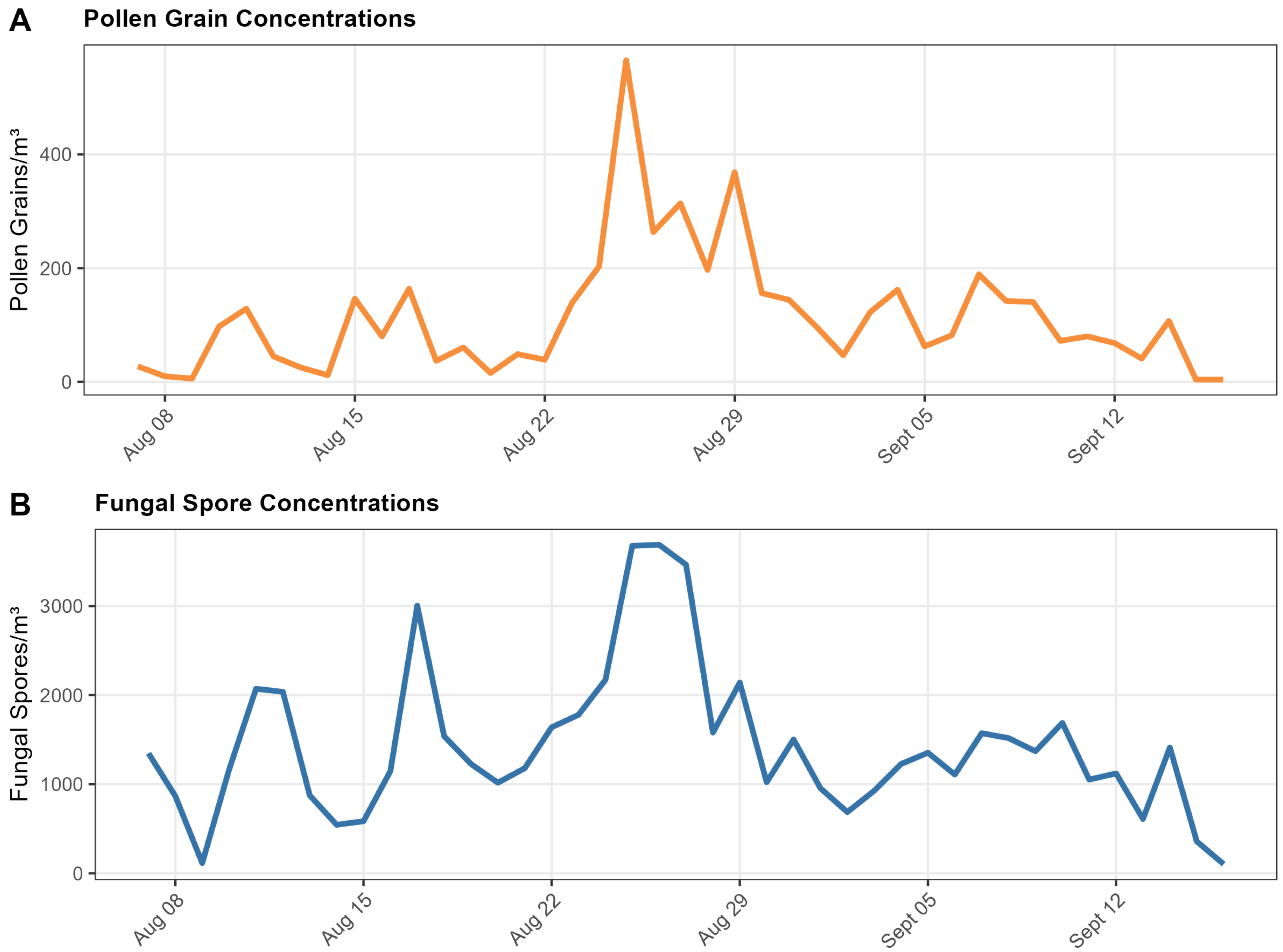
Over the course of the monitoring campaign, the ambient pollen concentrations recorded at the Dublin site were largely dominated by Urticaceae pollen, which represented 78% of the pollen identified. There were some small concentrations of Poaceae pollen also recorded, representing only 11% of the pollen encountered. This is to be expected and is indicative of that time of the year when the grass pollen season is ending/finished and herbaceous pollen closes out the remainder of the annual pollen season. From examination of these temporal trends, it can be seen that the highest daily concentration was recorded on the 25 August due to the presence of elevated ambient Urticaceae concentrations.
A second peak was witnessed again on the 29th of August, followed by a series of more minor peaks on the 4th, 7th, and finally on the 14th of September. Several early peaks were also observed on the 11th, 15th, and 17th of August. The majority of these peaks were seen to be largely driven by Urticaceae pollen. In comparison, the highest daily concentration of Poaceae recorded was seen on the 15th of August. Following this, the overall trend in Poaceae pollen concentration lessened, coinciding with the declining pollen season.
The most commonly identified single spore type throughout the study period was Cladosporium, which comprised 66.3% of all fungal spores counted during the study period. Of the identified fungal spores, ascospores made up 13.9%, basidiospores 7.8%, Alternaria 4.7%, and “other spores” made up 7.3%. Over a three-day period, a single, significant peak in the number of spores was seen, with two distinct “troughs” in low concentrations occurring five days before and five days following the peak.
The three peak days of the campaign, the 25th to the 27th of August, were also the peaks of most spore types, apart from ascospores. Since it made up the vast majority of all fungal spores, as shown in Figure 1, Cladosporium drove the concentration of total spores throughout the duration of the campaign. The first week of the research was a notable exception to this since there was some increase in the overall fungal spore concentrations at a period when Cladosporium concentrations themselves remained low. This rise in spore concentrations occurred as a result of substantial ascospore concentration increases at this time, as well as increases in the overall number of “other” spores, with this peak being seen on August 12th. More in-depth breakdowns of the bioaerosol compositions during the campaign can be seen in a previous publication [22].

3.2. Overview of WIBS Particle Trends

Ambient particles were concurrently recorded by the WIBS-NEO instrument, with a full breakdown of particle composition available in the previous publication [22].
To investigate the contributing factors influencing the FAP fraction of WIBS particles, FAPs were subdivided into distinct categories based on their fluorescence characteristics in each of the three channels (FL1, FL2, FL3) [20]. The contributions to each classification are summarised in Table 1. B-type particles were found to be the most abundant, followed by BC and ABC particle classes; together, these three classes represent over 70% of FAPs witnessed. A, C, and AB particles were present in lower quantities, while AC-type particles contributed negligibly to observed FAPs.
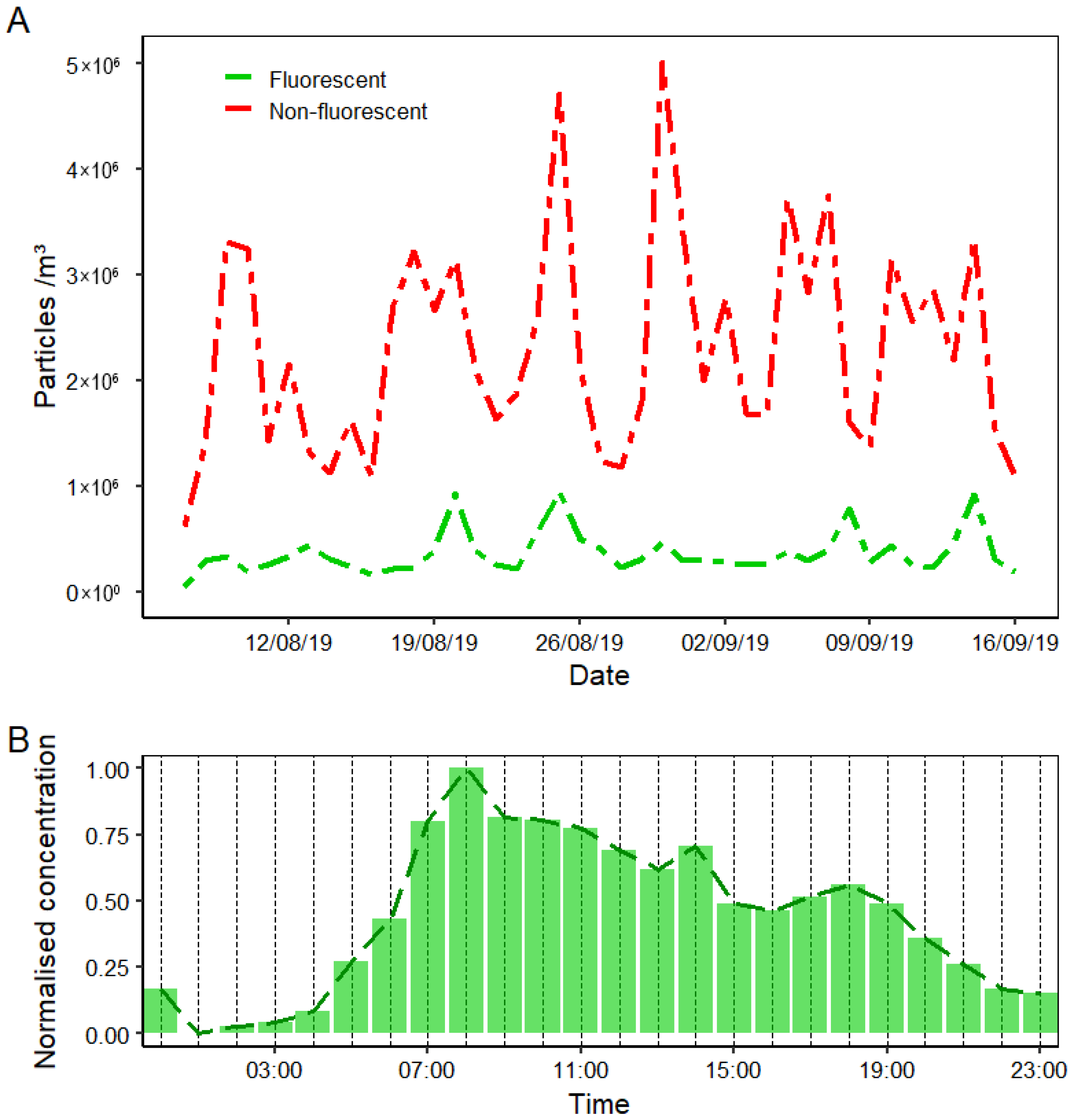
A time-series of the distribution of fluorescent versus non-fluorescent particles is shown in Figure 2. Although the fluorescent particles are considerably outnumbered by non-fluorescent particles, there are two distinct FAP peak periods observed. The first of these occurred on the 20th of August followed by the highest peak on the 25th of August. Two more successive peak periods were also witnessed on the 8th and 14th of September. Although these peaks are representative of all FAPs recorded by the WIBS-NEO at all size ranges, the peaks on the 25th of August and 14th of September do coincide with high pollen/Urticaceae concentrations, and high fungal spore (Cladosporium, Alternaria, and basidiospore) concentrations. A more detailed analysis was conducted to assess the contribution of FAPs to bioaerosol classes as described previously [22]. Diurnal distributions of total FAPs were also investigated (Figure 2B) and it was found that FAP concentrations peaked in the morning at 8:00, with two less intense peak periods also found at 14:00 and 18:00.
One of the most notable observations from the WIBS particle analysis emerged when examining the particle size distributions of each WIBS particle type across different fluorescence intensities. To date, no WIBS device has reported a bimodal distribution in previous campaigns or studies. A detailed breakdown of this bimodal pattern is presented in Figure S1 in the Supplementary Materials. To explore this further, the ABC fluorescence intensity distribution was divided into two distinct datasets, designated ABC 1 and ABC 2 for the first and second modes, respectively. ABC 1 exhibited slightly lower fluorescence in FL1, whereas ABC 2 showed higher FL1 fluorescence. Subsequent analysis revealed that each mode correlated significantly with different bioaerosol types; for example, basidiospores were positively associated with ABC 1 and negatively with ABC 2. Based on these distinctions, the two modes were retained as separate parameters for further analysis.

3.3. Overview of IBAC Particle Trends

Ambient particles were also recorded by the IBAC-2 instrument, with a detailed breakdown of particle characteristics recorded during the 41-day monitoring campaign summarized in Table 2. To investigate the factors influencing the ambient particle distribution, particles are subdivided into distinct size categories: small particles (0.7–1.5 μm) and large particles (1.5–10 μm). Overall, small particles constituted approximately 87% of the total particle count, while large particles accounted for about 13%.
The fluorescent fractions, derived from the corresponding fluorescent channel, revealed that fluorescent small particles contributed less than 1% of the small particle count, whereas fluorescent large particles comprised nearly 15% of the large particle fraction. These findings indicate that, although large particles are less abundant overall, they are relatively higher in fluorescent content compared to their smaller counterparts. An important caveat is that larger particles are more likely to rise above the threshold of fluorescence due to their size, given no normalisation is used in the sampling process.
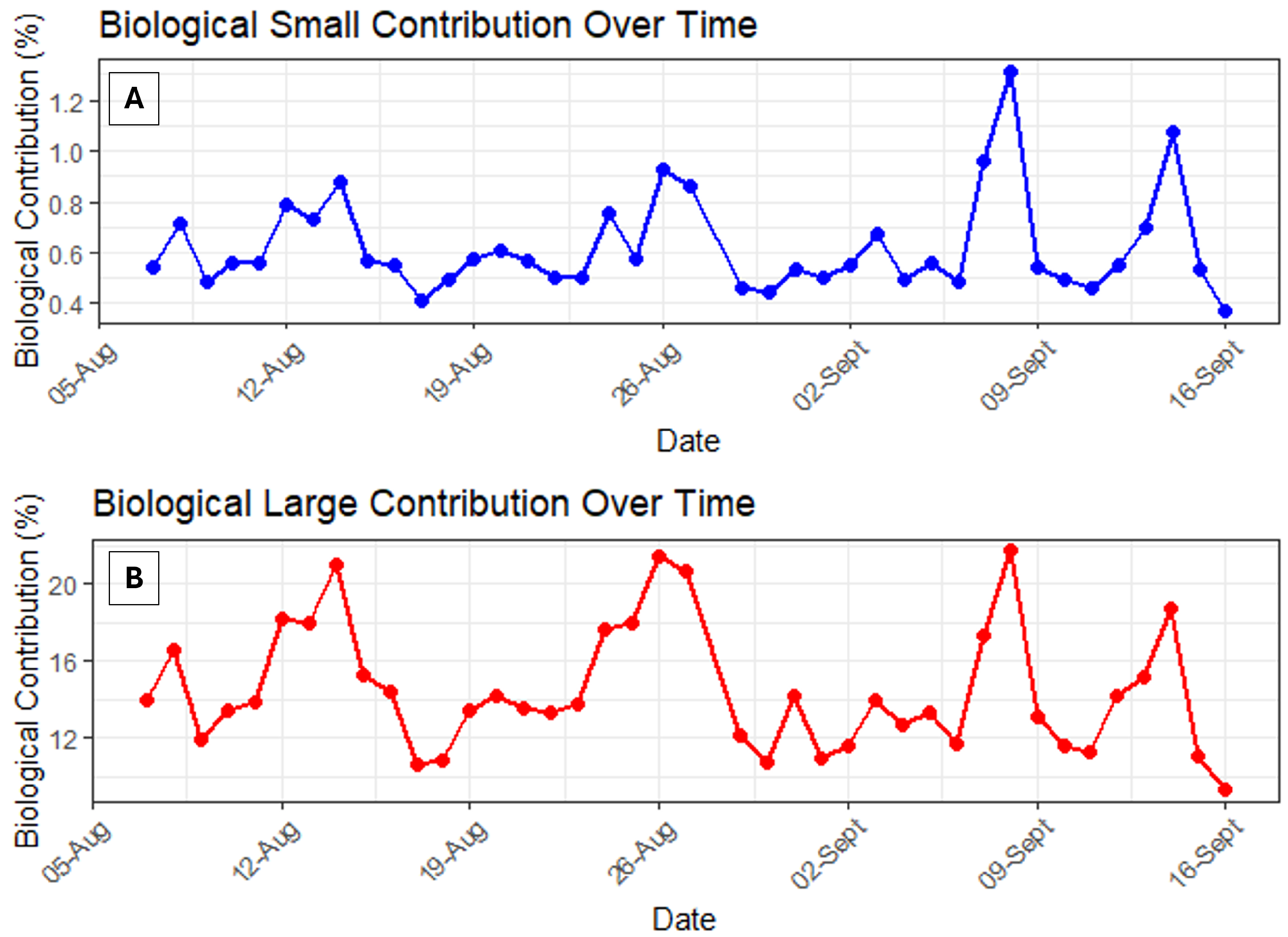
Figure 3 shows the contribution of fluorescent particles to the IBAC particle total over the course of the monitoring campaign. When compared with daily fluorescent concentrations (Figure 1), the effect on fluorescent concentrations can be seen, with peaks in pollen and fungal spores aligning with some peaks in IBAC fluorescent concentrations. This correlation diverges in the second half of the monitoring campaign, with changes in IBAC fluorescent particle contributions not reflected in increases in bioaerosol concentrations. This likely indicates that the divergence may instead be driven by decreases in particles from other sources, such as anthropogenic particles and pollutants.
This discovery aligns well with the time-series of WIBS aerosol particles (Figure 2), which shows a substantial decrease in non-fluorescent particles in the first week of September, aligning with the increase in contribution seen in both the WIBS and the IBAC devices.

3.4. Correlation Analysis Between Meteorological Parameters/Air Quality and WIBS Particles

To assess the influence varying meteorological and air quality parameters have on the detection of FAPs, Spearman’s rank correlation analysis was carried out, the results of which are shown in Table 3. The analysis of WIBS classes includes all particle sizes classified at the 3 σ threshold.
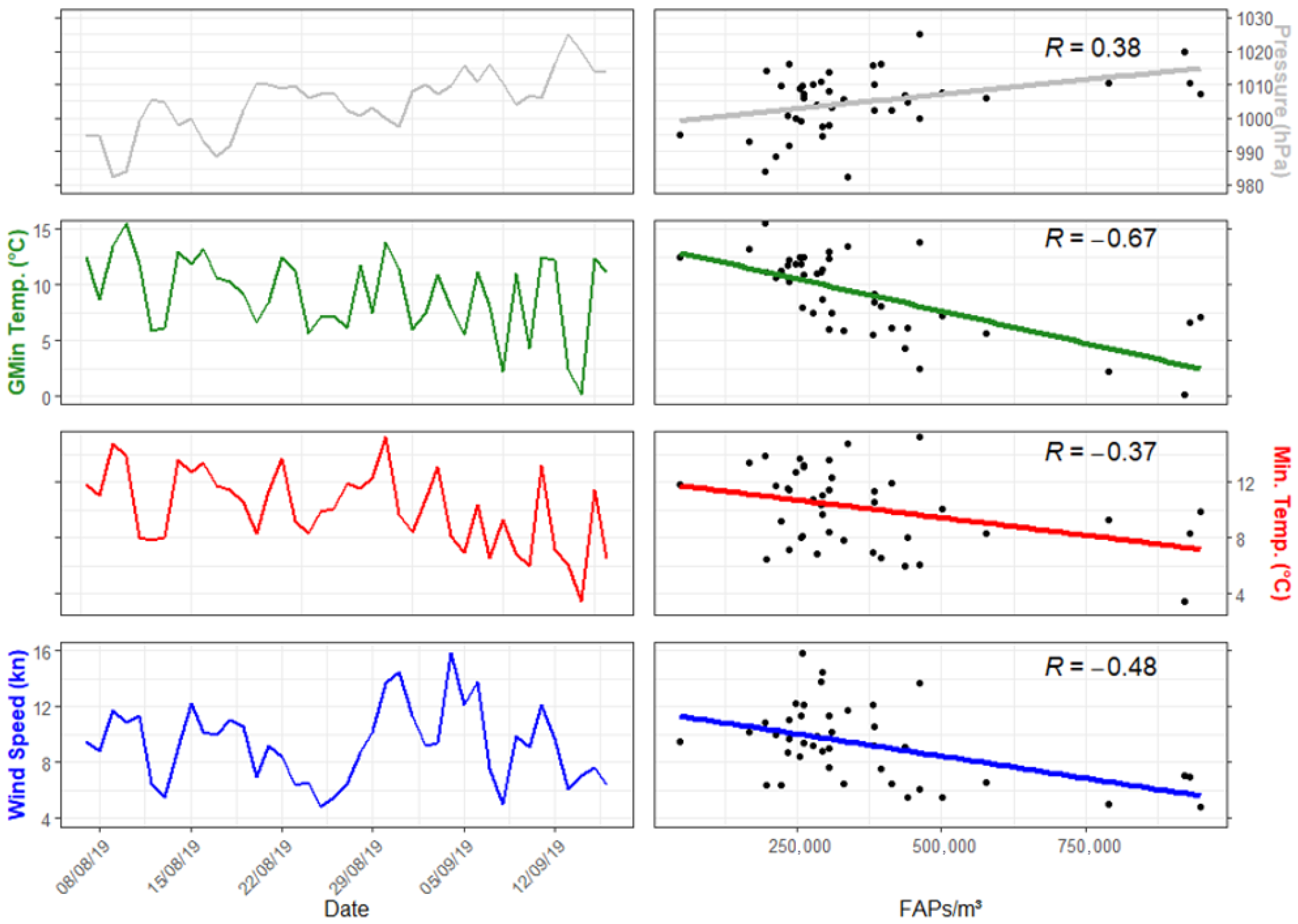
It was observed that the majority of WIBS FAP classes exhibited very similar and consistent correlations with several of the meteorological parameters. Significant negative correlation with minimum temperature, grass minimum temperature, and wind speed was recorded for B, C, AB, AC, BC, ABC 1, and total fluorescent particles (FL). ABC 2, by contrast, showed no significant association with grass-minimum temperature and no significant association with wind speed. Daily trends and regression of such parameters are shown in Figure 4. Although the current analysis extends down to small FAPs, several of these observed correlations remained, even at higher FAP size ranges. It was seen that even BC particles > 8 µm maintained a significant negative association with wind speed and grass minimum temperature. Days with wind speeds greater than 16.6 km/h led to the highest deviations between WIBS and Hirst sampling methods for all pollen types. This wind speed is the equivalent to a moderate breeze, highlighting the possible environmental limitations of the WIBS in comparison to traditional methods. Upon removal of these days from the analysis (resulting 18-day dataset), the Pearson correlation coefficient (r) between BC particles and Total/Urticaceae pollen increases from 0.73 to 0.84.
In comparison, few significant correlations were observed for non-fluorescent (NF) particles recorded by the WIBS. Correlation analysis with meteorological and air quality parameters was also extended to ambient pollen and spore concentrations (Table S2). However, few significant correlations were found apart from the expected positive correlation with temperature and sun parameters, followed by negative associations with rain and relative humidity for pollen, and positive correlation with grass minimum temperature for spores. Individually, ascospores correlated significantly with carbon monoxide (CO) and sulfur dioxide (SO2) concentrations, while Cladosporium correlated with particulate matter parameters (PM2.5 and PM10), indicating that fungal spores can contribute meaningfully to the composition of urban particulate matter.
To investigate the possibility of anthropogenic interferences, due to the urban location of the sampling site, correlation analysis was extended to locally sourced anthropogenic and air quality parameters. The majority of FAP classes showed significant correlation with almost all pollution parameters (NOX, NO, NO2, SO2, CO, PM2.5, and PM10). Although it was expected that the ambient particle concentrations recorded by the WIBS would correlate well with PM2.5 and PM10, as the WIBS samples particles within these size classes, a comparably high correlation was also seen for NOX. NOX showed strong correlations to FL1-type particles, particularly AB-type particles (r = 0.64 at 3 σ with no size filtering applied). Increasing fluorescent thresholds to 9 σ , could not remove this association with FL1-type particles, suggesting that bioaerosols were not the only component of the FAPs detected and that some contribution from anthropogenic or other non-biological particles was likely.
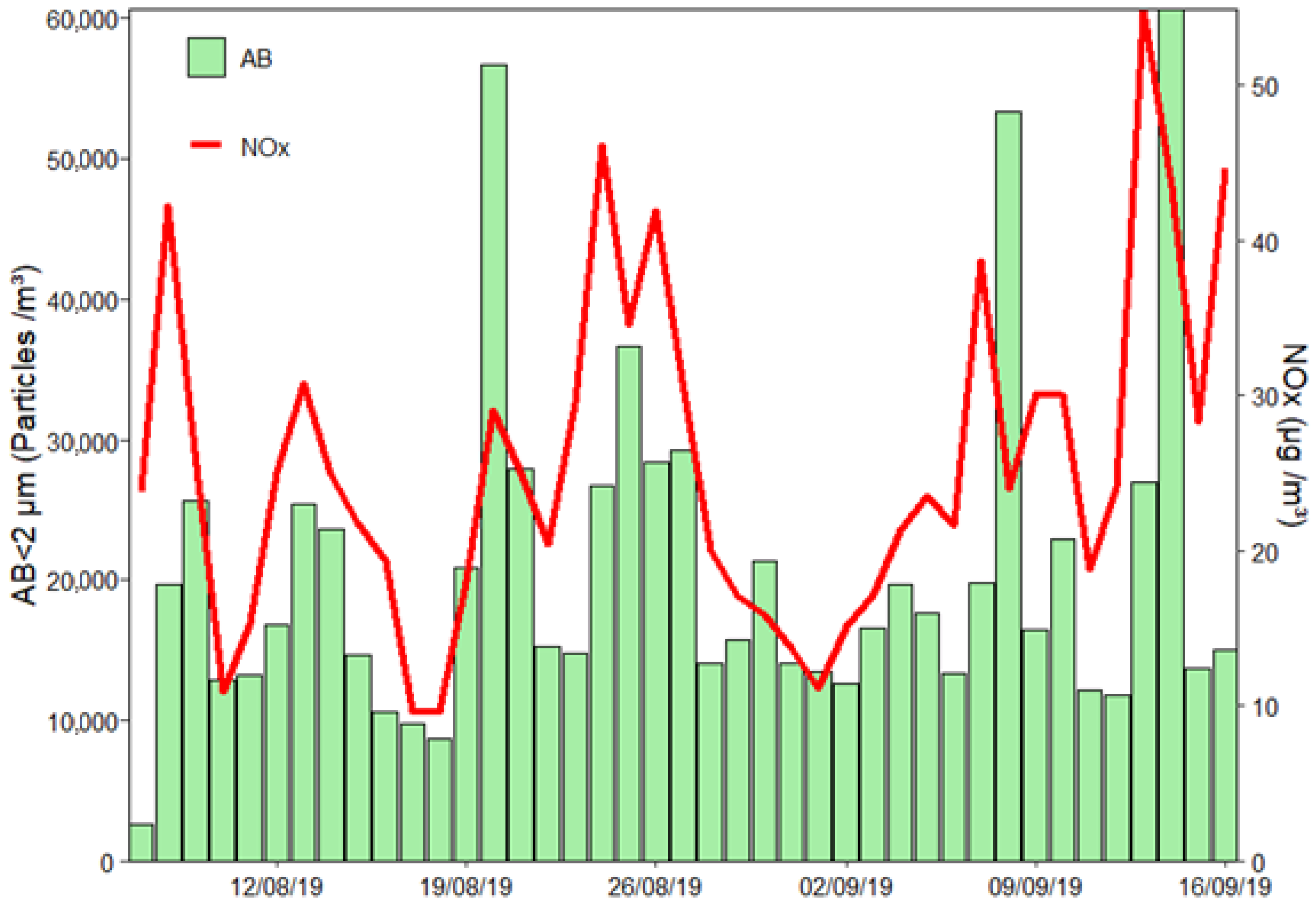
Correlation analysis to meteorology was also extended to these air quality parameters and it was found that NOX and its constituents mimicked the correlations seen for FAPs. NOX concentrations exhibited similar negative correlations with minimum temperature and wind speed, as well as the positive correlation with pressure, that were seen earlier for FAPs. However, the influence of these anthropogenic sources on WIBS FAPs decreased significantly with increasing particle size. It was found that WIBS FAPs less than 2 μm in size had the highest correlations with these gaseous pollutants. High r (spearman) coefficients of between 0.6–0.7 were observed for NOX with AB-, AC- and ABC-type particles at this size range. AB particles illustrate the strongest correlation with NOX (at sizes less than 2 μm) and are presented in Figure 5, below.
The correlation between NOX and AB-type particles yields an r = 0.7. It can be seen that increases in AB particle concentration are often seen to correspond to increased NOX concentrations. It is unlikely that these FAPs directly correspond to NOX itself, as it is a gaseous pollutant and more probably corresponds to combustion-related particulates and/or secondary organic aerosols (SOAs), related to the formation and reactivity of NOX.
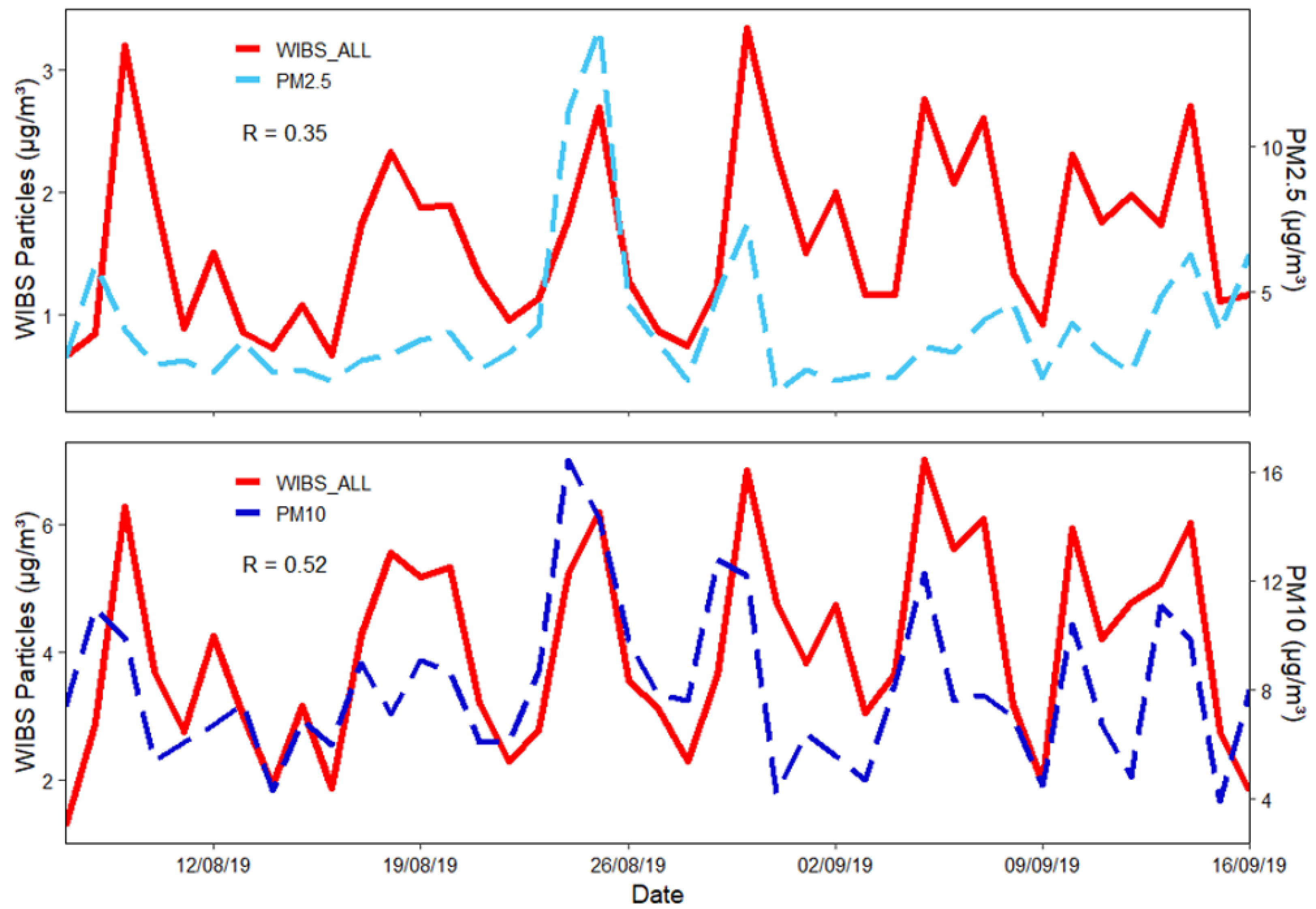
Given the presence of significant positive correlations between PM2.5 and PM10 readings with WIBS FAPs and considering the ability of the WIBS to measure the sizes of the particles sampled, it was decided to conduct a more comprehensive assessment of the suitability of the WIBS as a monitoring tool for PM2.5 and PM10. To do this, a mass density conversion was applied to all individual particles detected by the WIBS; this included fluorescent particles and non-fluorescent particles. For comparison to PM10, WIBS particles were filtered to those that have size measurements less than 10 μm, whereas for PM2.5 comparisons a filter of <2.5 μm was applied. A conversion was required to compare the concentrations sampled by the WIBS (particles/ m 3 ) to PM mass readings (µg/ m 3 ), the volume of the particle was determined from its size reading, and unit density (1 g/ cm 3 ) was then applied to find the approximate mass of each particle. Once converted, the mass reading of the WIBS particles can be compared to the PM2.5 and PM10 readings as shown in Figure 6.
The mass of extracted WIBS particles seemed to follow the general trends of the PM2.5 and PM10 readings. Improved results were noted for PM10 over PM2.5. One considerable point of inflexion between the comparison of ambient PM readings and WIBS particle masses is the notable reduction in mass seen for the WIBS readings; however, this is likely explained by inaccurate unit density values used as well as the differing heights of the samplers. Whereas the WIBS was situated at roof-level, PM readings were taken 1–2 km away, closer to ground level. In addition, the WIBS is capable of detecting particles as small as 0.5 μm in size, while the PM10 and PM2.5 monitoring devices can record particles smaller than this. As a result, the WIBS mass conversions for PM2.5 and PM10 can be considered incomplete measurements due to the absence of these smaller particles.

3.5. Correlation Analysis Between Meteorological Parameters/Air Quality and IBAC Particles

Similarly to the WIBS analysis, to assess the influence varying meteorological and air quality parameters have on the detection of FAPs, Spearman’s rank correlation analysis was carried out for the various IBAC particle categories. The results of this study are outlined in Table S2, seen in Supplementary Materials.
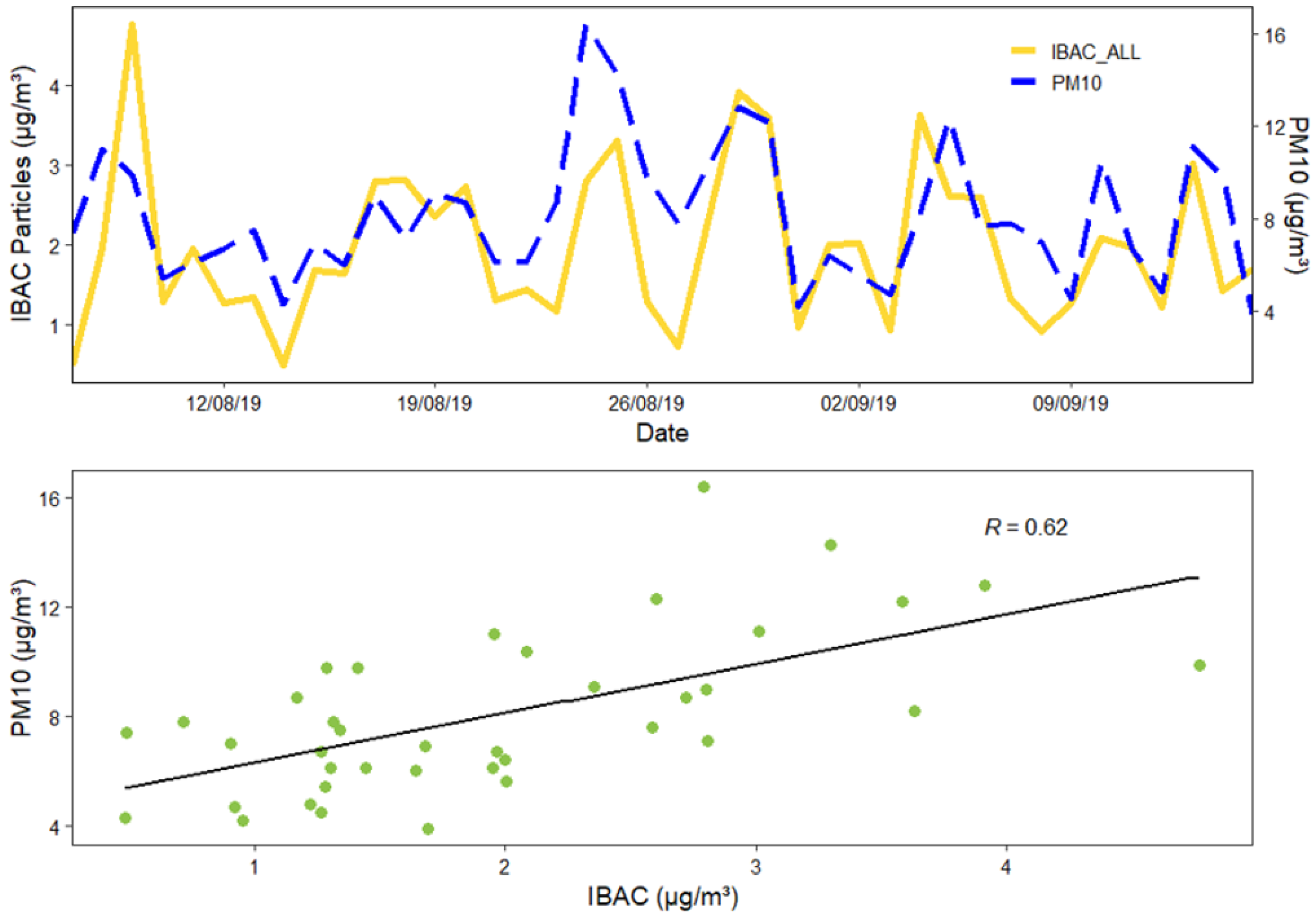
Correlation analysis of IBAC concentrations and meteorological parameters revealed several key findings. Small and large airborne particles exhibited significant positive correlations with wind speed (Small: 0.34, Large: 0.36) and particulate matter (both for PM10 and PM2.5). Due to the distinctive size fractions recorded by the IBAC, total IBAC particle concentrations (small and large) were compared to PM10 concentrations, which should encompass the entire size range of particles recorded by the IBAC. A strong similarity is observed between the two, as shown in Figure 7, yielding a correlation coefficient of 0.62. Fluorescent components showed contrasting behaviour, with small and large bioaerosols displaying strong negative correlations with grass minimum temperature (small: −0.38, large: −0.35) and significant positive associations with PM10 and PM2.5).
Non-biological particles showed weaker meteorological correlations overall, with no significant temperature or humidity correlations during this campaign. Pressure and solar radiation did not significantly correlate with any particle type, while NOX as a pollutant showed no meaningful associations. These patterns highlight that while general particulate pollution and meteorological conditions significantly influence total particle concentrations, bioaerosols in particular exhibit unique sensitivity to ground-level temperature conditions.
Building on the correlation analysis in the main text, multiple linear regression (MLR) was used to assess the combined effects of WIBS/IBAC data, meteorological variables, and pollutant levels on bioaerosol concentrations, with results provided in the Supplementary Materials due to the short campaign and limited predictive reproducibility. These include Table S1, which outlines MLR models of analysed bioaerosols, along with results from tests for multicollinearity (VIF) and autocorrelation (DW test).

3.6. Geographical Origin of Ambient Pollen, Fungal Spore, and FAP Concentrations

The influence of wind plays an important role in the dispersion and transport for a vast array of bioaerosols [29,30]. To explore the potential geographical origins of the bioaerosol types and WIBS-FAPs observed during the campaign, ZeFir source–receptor models were applied. The resulting wind-rose plots provide important information on the spatial origins of the pollen/fungal spores and FAPs investigated. Comparing the inferred sources of bioaerosol concentrations from the Hirst with those of FAPs recorded by the WIBS allows identification of common or distinct source regions, and may offer insight into their potential associations.
The resulting wind-rose plots provide important information on the spatial origins of the pollen/fungal spores and FAPs investigated. This modelling method has been applied previously to different bioaerosols, particularly pollen [31,32,33]; however, it has yet to be applied to FAPs determined by the WIBS.
Wind data collected during the sampling period indicate that prevailing winds predominantly originated from the southwest, with speeds reaching up to 15 km/h.
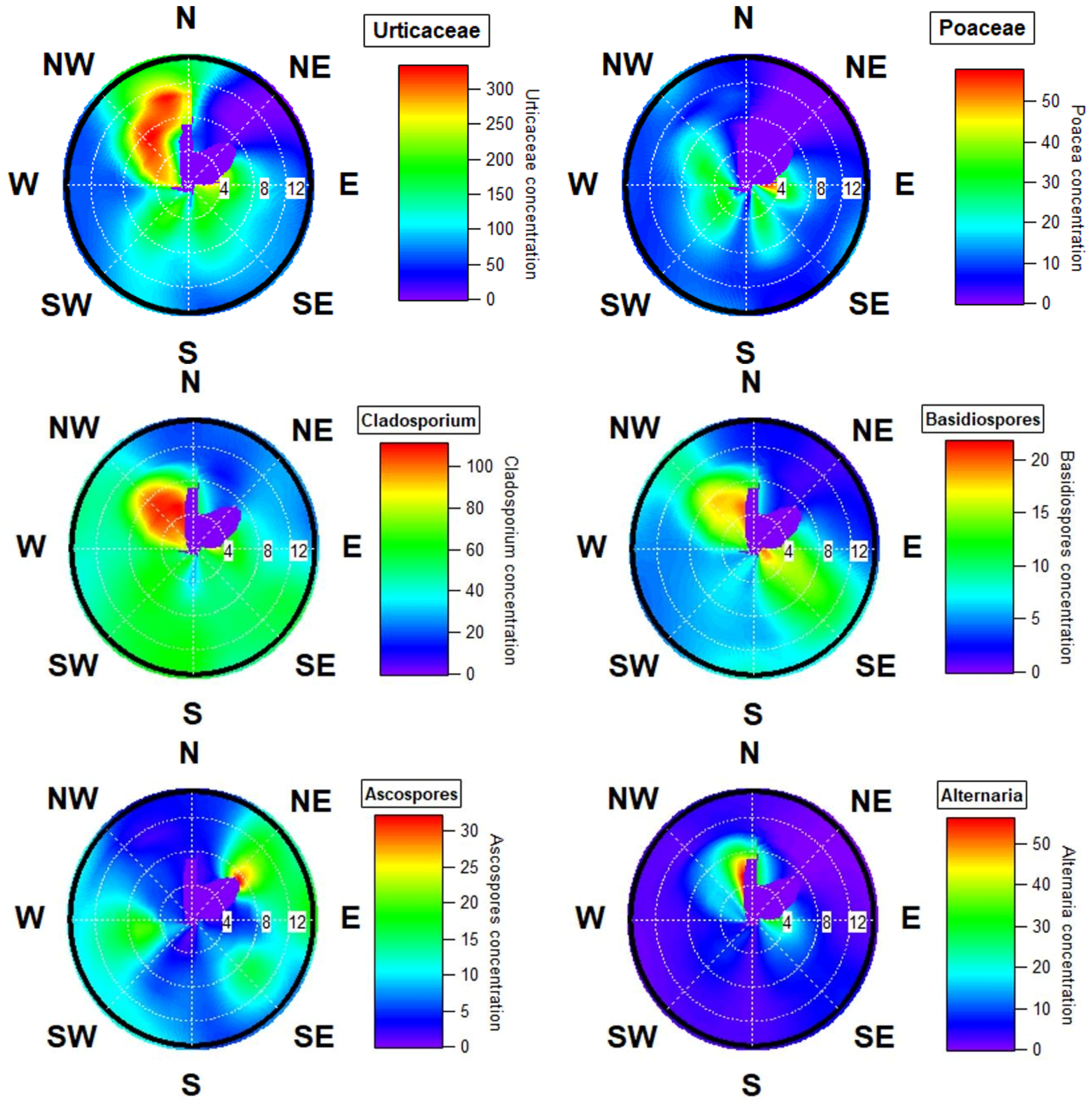
To gain a greater insight into the origin of important (allergenic) pollen and fungal spore types, the NWR model was applied to Urticaceae and Poaceae pollen data along with Basidiospore, Cladosporium, Alternaria, and ascospore fungal data as summarised in Figure 8.
The geographical origin of Urticaceae pollen, which represented the vast majority of pollen sampled, does not correspond with the main wind direction. Urticaceae pollen mainly originated from the north-northwest at speeds of up to and exceeding 12 km/h. The origin of Poaceae pollen can best be described as multidirectional, which is likely due to a variety of sources. It was noted that higher concentrations of Poaceae originated from the East at more moderate wind speeds less than 8 km/h. Several weaker regimes that originated from the south, southwest, northwest, and easterly/southeasterly also accounted for Poaceae concentrations. Although it could be expected that Urticaceae pollen would exhibit similar multidirectional behaviour, the high wind speeds associated with Urticaceae pollen originating from the north sector could be indicative of longer range transport. It is possible that high concentrations of Urticaceae pollen were transported from the many sources north of the city such as the Phoenix Park (Figure S3) whereas high concentrations of Poaceae pollen originated from closer sources from the east such as St. Stephen’s green, which is located to the east of the sampling site.
For the fungal spores, Basidiospores, Cladosporium, and Alternaria, all follow similar patterns of having a northwesterly dominant origin, with a bias towards originating from lower wind speeds of 4 to 8 km/h, and a smaller concentration originating from the southeast, at very low wind speeds.
As these spores comprise the majority of all spores counted, their similar geographical origins will influence any results from a total combined fungal spore chart. Ascospores have a different primary geographical origin to the other common spores identified, with no or very low concentrations of spores originating from the northwest, and the majority of spores originating from the northeast. Another ascospore concentration originates from the west/southwest. This indicates that some ascospores originate in the same direction as the prevailing wind, or directly opposite to the prevailing wind, whereas Basidiospores, Cladosporium, and Alternaria have a separate and distinct predominant geographical source. Given the size ranges of fungal spores, they can travel much further than pollen spores in the same weather conditions. Their small size and light weight also allow other factors such as heat from intense sunlight or smoke from biomass burning to assist in airborne dispersal [34]. As a result, potential sources of these spores cannot be assigned to specific locations and green-sites around the city with any degree of certainty.
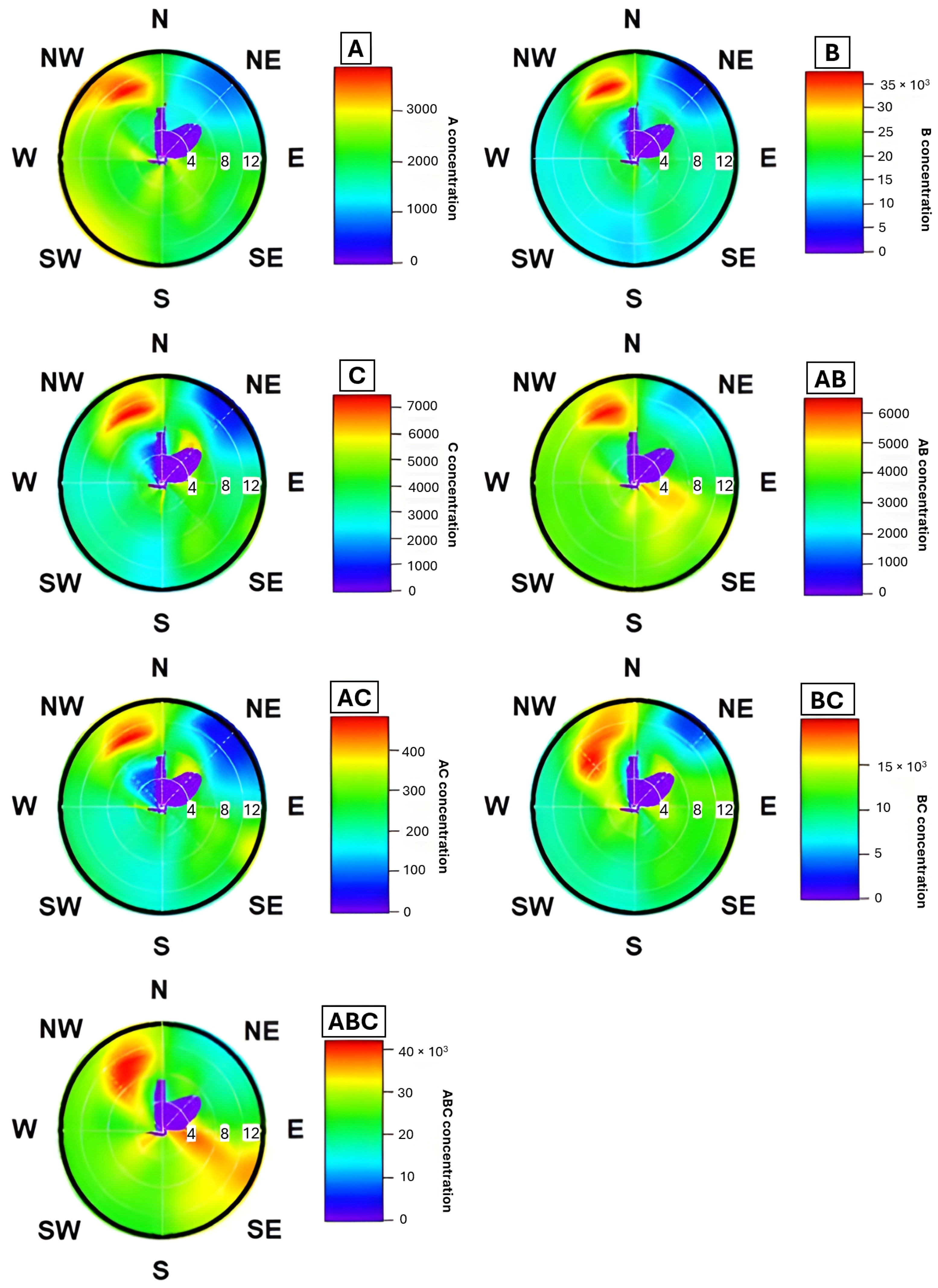
The same NWR analysis was also carried out for the 7 WIBS particle categories as shown in Figure 9. Particles less than 2 µm were removed from the analysis to exclude smaller interfering particles that cannot be observed by optical methods such as the Hirst.
The origin of the different FAP classes was seen to be more multidirectional due to likelihood of multiple sources for each fraction. Most showed a considerable association with the northwest sector and a poor association with the northeast sector. High concentrations of many of the FAPs originated from a range of multidirectional sources, with the strongest being from the northwest at high wind speeds, but it should be noted that AB and ABC also showed strong association with wind originating from the southeast sector. Due to the poor correlation observed between A, AB, and ABC particle types and both pollen and fungal spore concentrations, combined with their suspected association with anthropogenic aerosols, it is likely that these particle classes do not primarily represent the PBAPs monitored in this study. However, further source apportionment or chemical characterisation would be required to confirm this attribution.
Similarly, both C and AC particles had high concentrations originating from the north at winds greater than 8 km/h with a second, weaker regime originating from the southeast. B-type particles also displayed a strong northern origin; however, they showed little correlation with pollen grains or fungal spores, suggesting a potential anthropogenic origin. In contrast, AC-type particles exhibited relatively poor ambient concentrations throughout the campaign [35,36,37]. However, BC particles originated mostly from the north, which mimics the strong behaviour witnessed for Urticaceae pollen and Cladosporium spores.

4. Discussion

This study presents a comprehensive evaluation of the WIBS-NEO and IBAC-2 real-time bioaerosol detection systems in an urban Irish environment, with a focus on assessing potential interferences that may affect bioaerosol detection. By considering both meteorological and anthropogenic variables, this study improves the understanding of environmental influences on sensor outputs and aids in improving bioaerosol monitoring methods [1,2].

4.1. Summary of Hirst, WIBS, and IBAC Comparison

The campaign was conducted over a 41-day period during the main fungal and pollen season in Dublin which was domiated by Urticaceae pollen and Cladosporium spores, is typical for the sampling period, and consistent with previous studies [9,22]. A more detailed discussion of these trends and comparisons is presented in a preceding study [22], a summary of which is provided below.
To provide an initial assessment of the ability of the WIBS-NEO and IBAC-2 instruments to detect and identify different types of bioaerosols, their measurements were compared with pollen and spore concentrations measure by the Hirst volumetric trap. The WIBS-NEO demonstrated moderate correlations with Hirst-measured pollen and fungal spores, particularly for BC-type particles and Urticaceae ( R 2 = 0.5), while the IBAC-2 showed only moderate agreement with the WIBS and poor agreement with the Hirst. However, notable discrepancies were observed between instruments, highlighting the need for further investigation into how meteorology and air quality influence bioaerosol detection.
By systematically examining the effects of meteorology, wind, and urban air pollutants on real-time measurements, this work aims to clarify both the potential and limitations of instruments such as WIBS-NEO and IBAC-2. However, as a result of the relatively short sampling period, one limitation of the study is the lack of numerous strong peak days, resulting in a lot of the correlation being driven by a singularly strong peak period in the middle of the campaign.

4.2. Influence of Meteorological Parameters on Hirst-Measured Bioaerosol Concentrations and Geographical Origin

Notable positive correlations were observed between pollen concentrations and temperature, while negative correlations were found with rain and relative humidity. The positive influence of temperature on pollen release has been extensively documented in the literature [38,39,40,41,42,43]. Similarly, the well-established trend of decreasing pollen concentrations with increasing relative humidity and rainfall is largely attributed to particle deposition, washout effects, and the inhibition of anthesis [44,45,46,47,48]. However, a more detailed analysis of the interactions between meteorological parameters and airborne pollen concentrations in Dublin has previously highlighted variations observed at stages of the pollen season and across different sampling years [9].
The campaign highlighted distinct behaviours among dominant fungal spore types. Cladosporium (66% of spores) showed negative correlations with grass minimum temperature and rainfall, consistent with its warm-weather dispersal via dry spore release mechanisms [3,49]. In contrast, ascospores showed a positive correlation with rainfall, reflecting their moisture-triggered release from decaying vegetation during wet events [5,32].
Rainfall was a key driver of fungal spore release, especially for ascospores, which are known as “wet spores.” However, the relationship between rainfall and ascospore concentrations was not immediate. A cross-correlation analysis revealed a lag of 2–3 days between rainfall events and peak ascospore concentrations (r = 0.64 at a 3-day lag). This delay is likely due to the time required for fungal growth and spore maturation following precipitation [50].
The geographical origin analysis, facilitated by wind trajectory models [31], revealed distinct source patterns: Urticaceae pollen predominantly originated from northerly winds, likely transported from green spaces, potentially such as the Phoenix Park [29]. Similarly, Cladosporium and Alternaria predominantly originated from northerly winds over vegetated areas (e.g., Phoenix Park), while ascospores arrived via easterly maritime air masses [31,33]. Fungal spores exhibited a greater contribution from multidirectional sources, reflecting their capacity for long-range transport [30,49]. These findings align with prior studies on fungal spore mobility [5,34] but contrast with pollen’s more localized dispersal [29], underscoring the need for spatially resolved monitoring in urban settings. This distinction between pollen and fungal spore sources highlights the importance of considering both local and regional factors when monitoring bioaerosols in urban environments. While pollen concentrations are heavily influenced by wind patterns, fungal spores are more dependent on local environmental conditions, such as humidity and temperature.

4.3. Influence of Meteorology and Air Quality on Fluorescence-Based Bioaerosol Measurements

Meteorological conditions such as strong wind speeds have been seen to inhibit the ability of the WIBS to successfully sample pollen [51]. Spearman correlation analysis between WIBS FAPs and meteorological parameters showed a notable negative correlation with wind speeds, further corroborating this finding. As a result, the sampling efficiency of the WIBS is likely to be greatly inhibited by wind speeds. This was found to be true even with larger particle sizes associated with BC-type particles, meaning that improved results were observed when days of moderate wind speed were removed from the analysis. Elevated wind speeds (>16.6 km/h) exacerbated discrepancies between real-time and Hirst sampler data [11,52], likely due to particle resuspension and differing instrument sampling efficiencies and flowrates.
A notable positive correlation was also observed for FAPs detected by the WIBS with pressure. Such trends with pressure have been extensively documented in previous studies for myriad pollen and fungal spore types [53,54], which potentially indicates a degree of contribution by bioaerosols to the FAP fraction. A notable negative correlation between temperature and grass minimum temperature during this period could well be indicative of declining pollen concentrations. One reason for this decline in FAPs may also be related to the significant correlation seen between grass minimum temperature, rain, and wind speed, which are drivers for the transport and deposition of certain bioaerosols [55,56,57,58]. For instance, strong negative correlations with grass minimum temperature and wind speed, aligning with known spore dispersal mechanisms inhibited by ground-level cooling and turbulence [5,34]. Conversely, particulate matter such as PM10 and PM2.5 showed robust positive associations with both non-biological particles and biological WIBS particle fractions [8,9], emphasizing the urban environment’s role in affecting aerosol interactions [35,36,37].
The potential geographical origins of the different WIBS fluorescent aerosol particle (FAP) classes were also examined using ZeFir models. Most FAP classes showed a strong northerly origin, again suggesting sources associated with local green spaces. However, the influence of multidirectional sources was also evident. The northwesterly transport profile observed for BC-type particles closely resembled that of Urticaceae pollen, possibly indicating shared source regions and further supporting the proposed link between BC particles and Urticaceae pollen [22]. The strong linkage between WIBS-NEO BC particles and Urticaceae pollen (r = 0.84 without days with wind speed > 16.6 km/h) could indicate the potential for real-time instruments to supplement traditional methods in allergy forecasting [22,59]. However, this correlation was largely driven by a single elevated peak day (25th August), indicating that additional extended monitoring and analysis are needed to confirm these relationships.
The IBAC-2 instrument, while optimized for bacterial detection, demonstrated unique challenges and insights in urban bioaerosol monitoring. However its size detection capabilities revealed that large particles (>1.5 μm) contained a significantly higher proportion of biological material (14.7% vs. 0.6% for small particles), overlapping with known size ranges of fungal spores (2–20 μm) and pollen grains (10–100 μm) [2,22]. Correlation analysis showed that fluorescent large particles exhibited strong negative associations with grass minimum temperature and positive correlations with PM10, suggesting sensitivity to both thermal inhibition of spore release and co-transport with coarse particulate matter [56,58]. Further relationships with anthropogenic pollution for WIBS and IBAC particles are explored in the following section.
Notably, IBAC-2 biological particle trends diverged from traditional Hirst sampler data during high-wind periods (>16.6 km/h), mirroring WIBS-NEO performance limitations [60]. This underscores a critical operational constraint: low flow rates (3.8 L/min vs. Hirst’s 10 L/min) may inadequately sample rapidly advected bioaerosols under turbulent conditions [11,14]. Additionally, the IBAC device struggled at times to differentiate between fluorescent particles and water, resulting in inaccurate readings during rainfall events.

4.4. Further Assessment of Anthropogenic Influences on Fluorescence-Based Bioaerosol Measurements

The FAPs monitored by the WIBS were heavily dominated by B-type particles (43%). Although B-type particles are possibly representative of some biogenic sources [61], it is more commonly linked to anthropogenic sources and other interfering particles [35,36,37]. These findings further support the indication of anthropogenic interference in the dataset. Notably, previous studies have warned that atmospheric samples dominated by B-type fluorescent particles should be interpreted with caution, as they may be influenced by non-biological interferents [62].
Although the emission channels of the WIBS are selected for the specific detection of biomarkers present in bioaerosols, several studies have highlighted potential interferents that can also contribute to the fluorescence signals in these channels [61]. Traditionally, the effects of potentially interfering aerosols can be reduced by increasing the initial fluorescent threshold—from 3 σ to 6 σ and 9 σ . Increasing the fluorescent threshold in this manner has been shown to significantly reduce the interference from non-biological aerosols but not significantly affect the relative fraction of bioaerosols detected by the WIBS [61]. Interfering particles linked to the anthropogenic emissions of NOX, CO, and SO2 were also observed during this campaign and are discussed below.
Since the WIBS measures the intrinsic fluorescence of a particle, it can detect other particles that are not biological in nature. Considering the urban location of the sampling site, the likelihood of chemical interferents is higher than for previous Irish WIBS campaigns which were mainly conducted in less atmospherically diverse environments. Strong correlations were observed between FAPs and anthropogenic pollutants, especially NOX, indicating contributions from non-biological sources and highlighting the uncertainty of WIBS measurements in urban environments, as well as the need for more selective detection methods. NOX was the more prevalent of these pollutants recorded during the sampling period. The negative correlations between NOX, minimum temperature, and wind speed as well as the positive correlation with pressure have been noted previously [63,64], including in a study from 1998 conducted in Dublin [65].
NOX is strongly associated with the production of SOAs and can be used as a proxy for particulate emissions from both car exhausts and homes/industries. The general diurnal trend witnessed for total FAPs sampled by the WIBS (Figure 2B) initially illustrated comparable trends to NO2 emissions recorded for the same year, with peak periods directly coinciding with increasing NO2 concentrations seen between 7:00 and 8:00 [66]. Following further analysis, a strong correlation was seen for NOX and FL1-type particles. Previous studies using LIF techniques have shown similar trends for combustion-type particles [67,68]. A study by Miyakawa et al. [67] showed that the detection of fluorescent aerosols, which possess similar temporal trends to NOX, indicates the presence of PAHs or their derivatives. These particles were shown to interfere with the selective detection of PBAP using UV-LIF methods, even at larger particle size ranges [67]. However, increasing the fluorescence threshold and size filter was found to reduce the association between the WIBS FAPs and these suspected combustion-related particles. Although these chemical interferences correlated well with WIBS FAPs at sizes smaller than 2 µm, some chemical interferences such as soil, dust, and soot particles can been found to produce aerosols of up to 10 µm in size [35]. These particles could potentially interfere with the observed BC FAPs, representing peaks that were not accounted for from comparison with aerobiological data. As a result, it can be inferred that the collected FAPs are representative of both ambient bioaerosol and anthropogenic aerosol concentrations with the current method being unable to fully discern the two.
Only a limited number of research studies have explored the WIBS characterisation of known anthropogenic aerosols. In a specific investigation conducted by Savage et al., 2017 [61], various non-biological samples were examined. The study found that soot-type particles primarily displayed A-type fluorescence, while smoke-type samples were predominantly categorised as B-type particles [61]. The observed strong correlation observed for AB-type particles and combustion-related pollution such as NOX suggests that some FAPs sampled during the campaign exhibit resemblances to the smoke and soot particles generated during wood burning similar to the findings previously discussed by Savage et al., 2017 [61].
Another analogous study conducted by [68] investigated the impact of combustion-related particles on the real-time detection of fluorescent aerosols using the WIBS-NEO. It was found that when using LIF instruments like the WIBS near polluted sites such as busy city centres, which are influenced by combustion particles such as black carbon, fluorescent measurements experience heavy interference from these anthropogenic aerosols. Substantial contributions to the FL1 channel were found for combustion-related particles. Therefore, the correlation witnessed here in Dublin between AB particles and combustion-related sources further support previous results that some FAPs originate from anthropogenic/combustions processes [36,67,68]. Other interfering aerosols not compared to the WIBS in this study due to the absence of co-located monitoring data such as mineral dust, HULIS-like compounds, and other SOAs have also been shown to possess fluorescence and could also be contributing to fluorescent fractions of the sampled WIBS particles [36,61,69].
These findings indicate the potential use of the WIBS as a general air quality monitor that can broadly detect anthropogenic and biological aerosols. To further extend this possibility to PM monitoring, a density conversion was applied to all WIBS particles (fluorescent and non-fluorescent) and filtered for particles less than 2.5 μm and 10 μm for comparison with PM2.5 and PM10 measurements. The results correlated reasonably well with PM10 and PM2.5 despite the differences in sampling heights and size fractions sampled by the WIBS. The WIBS underestimated the mass of PM readings, likely because PM concentrations fall with height, and because of the instrument’s collection efficiency, mirroring earlier findings that PM levels drop as sampling height increases [70,71]. In this scenario, the influence of meteorological and air quality factors on the performance of the WIBS has highlighted the potential of using the WIBS or future iterations as robust air quality monitoring tools. The expected future improvements in terms of the quality and quantity of meteorological and air quality datasets could enable the identification and of both biological and anthropogenic particles.
Improved seperation between bioaerosol classes and other interferences could be achieved with the inclusion of additional fluorescent channels such as those previously suggested, for the detection of chlorophyll [60,72,73]. Although pollen grains lack the presence of chloroplasts, several studies have shown that chlorophyll fluorescence can be observed when examining the autofluorescence and fluorescent lifetimes of grass and other herbaceous pollen taxa [60,72,73]. Chlorophyll in these pollen grains can exist in the form of freely bound chlorophyll bound to the pollen cell wall or bound to flavoproteins [60,73].
Detecting chlorophyll and other plant-specific fluorophores can help distinguish pollen from fungal spores, which do not contain chlorophyll. This approach was demonstrated with a modified WIBS-4 (WIBS-4+) deployed in Saclay, France, where two additional detection bands (FL4 and FL5) targeting chlorophyll-a emission (670 nm) improved differentiation between tree (R2 = 0.8), herbaceous (R2 = 0.6), and grass (R2 = 0.4) pollen, as well as fungal spores (R2 = 0.8) [59]. However, despite these improvements, extended analysis showed that the modified WIBS FAPs remained correlated with combustion-related anthropogenic pollutants, indicating their potential use as real-time air quality monitors [19].
The IBAC-2’s single fluorescence channel (450–600 nm) proved vulnerable to urban or anthropogenic interferents. The IBAC-2’s limited fluorescence discrimination capability restricted its effectiveness in differentiating bioaerosol types [14] which is a limitation less apparent in the WIBS-NEO’s multi-channel fluorescence system [13,20]. Strong correlations between IBAC biological counts and PM2.5 mirrored WIBS-NEO trends and suggest combustion-related aerosols (e.g., NOX) are responsible [36,68], echoing a Tokyo study where black carbon particles produced false-positive fluorescent signals in LIF instruments [67]. The IBAC-2 cannot resolve chlorophyll fluorescence, thereby limiting its ability to discriminate pollen from combustion particles [60,73].
In summary, this campaign advances urban bioaerosol research by bridging gaps between real-time detection and environmental drivers [1,74]. The findings not only enhance Ireland’s sparse bioaerosol dataset [10,52] but also provide insights into the influencing factors behind urban bioaerosol concentrations, thus informing public health advisories and climate legislation [2,6].

5. Conclusions

This study further investigates the possible limitations conducting a real-time bioaerosol monitoring campaign, using fluorescent sensors, within an urban setting. The WIBS-NEO and IBAC-2 were deployed from 7 August 2019 to 16 September 2019 to assess the potential to identify and detect atmospheric concentrations in a relatively complex ambient environment. Although a good correlation was observed previously for ambient pollen and fungal spore concentrations, the presence of other interferences was apparent with deviations in WIBS FAP trends indicating the presence of other interfering particles. This analysis shows that the WIBS-NEO is not exclusively capable of differentiating pollen and spores from these interferences. While incorporating additional specific fluorescent detection bands could significantly enhance bioaerosol discrimination, interferences may persist. Moreover, meteorological and air-quality data revealed that certain weather conditions strongly influence FAP sampling, some of which closely resemble the signals generated by combustion interferences. The impact of wind speed on the ability of the WIBS to detect some particles was also observed, increasing wind speed was shown to negatively impact the sampling efficiency of the WIBS. This was true for all particle sizes, although negative correlations with wind speed were also observed for relatively larger particles. This highlights a potential environmental limitation of the WIBS—especially in areas known to be affected by stronger wind regimes. With regard to potentially interfering non-biological interferences, notable correlations with combustion-related sources were observed. Although these findings could forewarn users against future urban deployment of the WIBS due to the apparent influence of anthropogenic emissions, this might also indicate the possibility of the WIBS extending its applications to general aerosol monitoring (bioaerosol and other). However, further testing is required to fully evaluate the true potential of the WIBS to act as an overall air quality monitoring device.
The IBAC-2 device did not demonstrate the same potential as the WIBS, with no significant correlations found between the IBAC-2 device and any bioaerosol type. IBAC-2 parameters were consistently dropped from all MLR constructions, owing in part to its inability to differentiate between fluorescent particles and water droplets. This was evidenced by the observations that on the peak day of IBAC concentration output (9th of August), there was a period of extremely heavy rainfall, showing that at least in this study, the instrument was not a strong indicator of bioaerosol values, and needs further analysis in different conditions.

Supplementary Materials

The following supporting information can be downloaded at: https://www.mdpi.com/article/10.3390/atmos17010086/s1, Figure S1. Bimodal distribution of the WIBS-NEO ABC fluorescence channel, illustrating two distinct fluorescence populations; the separation between modes is used to support the fluorescence thresholding applied in this study; Table S1. Multiple linear regression (MLR) models for the analysed bioaerosols, showing the minimum WIBS particle-size threshold used (µm), the selected predictor variables included in each final model, model fit statistics (R2 and adjusted R2), and diagnostic statistics for multicollinearity (maximum variance inflation factor, VIF) and residual autocorrelation (Durbin–Watson statistic and associated p-value); Table S2. Spearman’s rank correlation coefficients ( ρ ) between daily IBAC particle-class counts (Small Particles, Large Particles, Small Fluorescent, Large Fluorescent) and meteorological/air-quality parameters; Table S3. Spearman’s rank correlation coefficients ( ρ ) between meteorological/air-quality parameters and daily pollen and fungal spore concentrations (Pollen Total, Urticaceae, Poaceae, Cladosporium, Basidiospores, Ascospores, Alternaria, Others, Total) [8,9,19,22,24,26,35,36,37,51,59,67,68,74].

Author Contributions

Conceptualization, D.J.O., J.H.C., E.M. and J.M.M.-M.; methodology, J.M.M.-M., E.M. and J.H.C.; software, E.M. and J.H.C.; validation, D.J.O., E.J.M. and G.S.; formal analysis, E.M. and J.H.C.; investigation, M.M.-B., E.M. and J.H.C.; resources, R.S.-E., J.M.M.-M. and D.J.O.; data curation, M.M.-B., J.M.M.-M., R.P.-C., E.M. and J.H.C.; writing—original draft preparation, E.M. and J.H.C.; writing—review and editing, J.H.C., E.M., D.J.O., E.J.M., A.M.V.-P. and G.S.; visualisation, E.M. and J.H.C.; supervision, D.J.O. and M.M.-B.; project administration, D.J.O.; funding acquisition, D.J.O., J.M.M.-M. and R.S.-E. All authors have read and agreed to the published version of the manuscript.

Funding

This research was funded by the Environmental Protection Agency of Ireland under the projects: Pollen Monitoring and Modelling (POMMEL), grant number 2017-CCRP-FS.35, and Fungal mOnitoring NeTwork ANd Algorithm (FONTANA), grant number 2018-CCRP-MS.53. E.M. acknowledges support from the Irish Research/EPA, grant number GOIPG/2019/4195. J.H.C. acknowledges support from the Irish Research/EPA, grant number GOIPG/2021/464.

Institutional Review Board Statement

Not applicable.

Informed Consent Statement

Not applicable.

Data Availability Statement

Data will be made available on request. Data is not publicly available, as it is still being used as part of ongoing, unpublished research projects.

Acknowledgments

The authors would like to acknowledge and thank Droplet Measurement Technologies (DMT), Longmont, CO, USA for provision of the WIBS-NEO real-time monitoring device.

Conflicts of Interest

The authors declare no conflicts of interest. The funders had no role in the design of the study; in the collection, analyses, or interpretation of the data; in the writing of the manuscript; or in the decision to publish the results.

References

  1. D’Amato, G.; Cecchi, L.; Bonini, S.; Nunes, C.; Annesi-Maesano, I.; Behrendt, H.; Liccardi, G.; Popov, T.; van Cauwenberge, P. Allergenic pollen and pollen allergy in Europe. Allergy 2007, 62, 976–990. [Google Scholar] [CrossRef] [PubMed]
  2. Després, V.; Huffman, J.; Burrows, S.M.; Hoose, C.; Safatov, A.; Buryak, G.; Fröhlich-Nowoisky, J.; Elbert, W.; Andreae, M.; Pöschl, U.; et al. Primary biological aerosol particles in the atmosphere: A review. Tellus Chem. Phys. Meteorol. 2012, 64, 15598. [Google Scholar] [CrossRef]
  3. Grinn-Gofroń, A.; Bosiacka, B.; Bednarz, A.; Wolski, T. A comparative study of hourly and daily relationships between selected meteorological parameters and airborne fungal spore composition. Aerobiologia 2018, 34, 45–54. [Google Scholar] [CrossRef] [PubMed]
  4. Martínez-Bracero, M.; Vélez-Pereira, A.M.; Markey, E.; Clancy, J.H.; Sarda-Estève, R.; O’Connor, D.J. Comparative Analysis of Grass Pollen Dynamics in Urban and Rural Ireland: Identifying Key Sources and Optimizing Prediction Models. Atmosphere 2024, 15, 1198. [Google Scholar] [CrossRef]
  5. Carlile, M.J.; Watkinson, S.C.; Gooday, G.W. 4-Spores, Dormancy and Dispersal. In The Fungi, 2nd ed.; Carlile, M.J., Watkinson, S.C., Gooday, G.W., Eds.; Academic Press: London, UK, 2001; pp. 185–243. [Google Scholar] [CrossRef]
  6. Phillips, V.T.J.; Andronache, C.; Christner, B.; Morris, C.E.; Sands, D.C.; Bansemer, A.; Lauer, A.; McNaughton, C.; Seman, C. Potential impacts from biological aerosols on ensembles of continental clouds simulated numerically. Biogeosciences 2009, 6, 987–1014. [Google Scholar] [CrossRef]
  7. Pratt, A.K.; DeMott, A.P.; French, A.J.; Wang, A.Z.; WestPhal, A.D.; Heymsfield, A.A.J.; Twohy, A.C.; Prenni, A.A.; Prather, A.K. In-situ detection of biological particles in cloud ice-crystals. Nat. Geosci. 2009, 2, 398–401. [Google Scholar] [CrossRef]
  8. Mampage, C.B.A.; Hughes, D.D.; Jones, L.M.; Metwali, N.; Thorne, P.S.; Stone, E.A. Characterization of sub-pollen particles in size-resolved atmospheric aerosol using chemical tracers. Atmos. Environ. X 2022, 15, 100177. [Google Scholar] [CrossRef]
  9. Markey, E.; Clancy, J.H.; Martínez-Bracero, M.; Maya-Manzano, J.M.; Smith, M.; Skjøth, C.; Dowding, P.; Sarda-Estève, R.; Baisnée, D.; Donnelly, A.; et al. A comprehensive aerobiological study of the airborne pollen in the Irish environment. Aerobiologia 2022, 38, 343–366. [Google Scholar] [CrossRef]
  10. Asthma Society of Ireland. Asthma Facts & Figures. Annual Report 2019. Available online: https://www.asthma.ie/wp-content/uploads/2025/04/ASI-Annual-Report-2019_FINAL.pdf (accessed on 10 January 2026).
  11. Buters, J.T.M.; Antunes, C.; Galveias, A.; Bergmann, K.C.; Thibaudon, M.; Galán, C.; Schmidt-Weber, C.; Oteros, J. Pollen and spore monitoring in the world. Clin. Transl. Allergy 2018, 8, 9. [Google Scholar] [CrossRef]
  12. Martínez-Bracero, M.; Markey, E.; Clancy, J.H.; Sodeau, J.; O’Connor, D.J. First Long-Time Airborne Fungal Spores Study in Dublin, Ireland (1978–1980). Atmosphere 2022, 13, 313. [Google Scholar] [CrossRef]
  13. Healy, D.A.; O’Connor, D.J.; Burke, A.M.; Sodeau, J.R. A laboratory assessment of the Waveband Integrated Bioaerosol Sensor (WIBS-4) using individual samples of pollen and fungal spore material. Atmos. Environ. 2012, 60, 534–543. [Google Scholar] [CrossRef]
  14. Santarpia, J.L.; Pan, Y.L.; Hill, S.C.; Baker, N.; Cottrell, B.; McKee, L.; Ratnesar-Shumate, S.; Pinnick, R.G. Changes in fluorescence spectra of bioaerosols exposed to ozone in a laboratory reaction chamber to simulate atmospheric aging. Opt. Express 2012, 20, 29867–29881. [Google Scholar] [CrossRef] [PubMed]
  15. O’Connor, D.J.; Daly, S.M.; Sodeau, J.R. On-line monitoring of airborne bioaerosols released from a composting/green waste site. Waste Manag. 2015, 42, 23–30. [Google Scholar] [CrossRef] [PubMed]
  16. O’Connor, D.J.; Healy, D.A.; Sodeau, J.R. The on-line detection of biological particle emissions from selected agricultural materials using the WIBS-4 (Waveband Integrated Bioaerosol Sensor) technique. Atmos. Environ. 2013, 80, 415–425. [Google Scholar] [CrossRef]
  17. O’Connor, D.J.; Healy, D.A.; Sodeau, J.R. A 1-month online monitoring campaign of ambient fungal spore concentrations in the harbour region of Cork, Ireland. Aerobiologia 2015, 31, 295–314. [Google Scholar] [CrossRef]
  18. Healy, D.A.; Huffman, J.A.; O’Connor, D.J.; Pöhlker, C.; Pöschl, U.; Sodeau, J.R. Ambient measurements of biological aerosol particles near Killarney, Ireland: A comparison between real-time fluorescence and microscopy techniques. Atmos. Chem. Phys. 2014, 14, 8055–8069. [Google Scholar] [CrossRef]
  19. Markey, E.; Hourihane Clancy, J.; Martínez-Bracero, M.; Sarda-Estève, R.; Baisnée, D.; McGillicuddy, E.J.; Sewell, G.; Skjøth, C.A.; O’Connor, D.J. Spectroscopic detection of bioaerosols with the wibs-4+: Anthropogenic and meteorological impacts. Sci. Total Environ. 2024, 943, 173649. [Google Scholar] [CrossRef]
  20. Perring, A.E.; Schwarz, J.P.; Baumgardner, D.; Hernandez, M.T.; Spracklen, D.V.; Heald, C.L.; Gao, R.S.; Kok, G.; McMeeking, G.R.; McQuaid, J.B.; et al. Airborne observations of regional variation in fluorescent aerosol across the United States. J. Geophys. Res. Atmos. 2015, 120, 1153–1170. [Google Scholar] [CrossRef]
  21. Martinez-Bracero, M.; Markey, E.; Clancy, J.H.; McGillicuddy, E.J.; Sewell, G.; O’Connor, D.J. Airborne Fungal Spore Review, New Advances and Automatisation. Atmosphere 2022, 13, 308. [Google Scholar] [CrossRef]
  22. Clancy, J.H.; Markey, E.; Martínez-Bracero, M.; Maya-Manzano, J.M.; McGillicuddy, E.J.; Sewell, G.; Sarda-Estève, R.; Baisnée, D.; Vélez-Pereira, A.M.; Davis, G.; et al. Comparative Analysis of Real-Time Fluorescence-Based Spectroscopic Instruments: Bioaerosol Detection in the Urban Environment of Dublin City, Ireland. Atmosphere 2025, 16, 275. [Google Scholar] [CrossRef]
  23. Historical Data-Met Éireann-The Irish Meteorological Service. Available online: https://www.met.ie/climate/available-data/historical-data (accessed on 10 January 2026).
  24. Environmental Protection Agency (EPA). Reports & SAFER-Data; Environmental Protection Agency, Ireland (EPA): Johnstown Castle Estate, Co. Wexford, Ireland, 2025.
  25. Petit, J.E.; Favez, O.; Albinet, A.; Canonaco, F. A user-friendly tool for comprehensive evaluation of the geographical origins of atmospheric pollution: Wind and trajectory analyses. Environ. Model. Softw. 2017, 88, 183–187. [Google Scholar] [CrossRef]
  26. Gross, J.; Ligges, U. nortest: Tests for Normality. 2015. Available online: https://cran.r-project.org/web/packages/nortest/nortest.pdf (accessed on 10 January 2026).
  27. Wei, T.; Simko, V.; Levy, M.; Xie, Y.; Jin, Y.; Zemla, J.; Freidank, M.; Cai, J.; Protivinsky, T. corrplot: Visualization of a Correlation Matrix. 2021. Available online: https://cran.r-project.org/web/packages/corrplot/corrplot.pdf (accessed on 10 January 2026).
  28. R: A Language and Environment for Statistical Computing; R Foundation for Statistical Computing: Vienna, Austria, 2025; Available online: https://www.R-project.org/ (accessed on 10 January 2026).
  29. Dowding, P. Wind Pollination Mechanisms and Aerobiology. In International Review of Cytology; Bourne, G.H., Jeon, K.W., Friedlander, M., Eds.; Academic Press: Cambridge, MA, USA, 1987; Volume 107, pp. 421–437. [Google Scholar] [CrossRef]
  30. Hirst, J.M.; Stedman, O.J.; Hurst, G.W. Long-distance Spore Transport: Vertical Sections of Spore Clouds over the Sea. Microbiology 1967, 48, 357–377. [Google Scholar] [CrossRef]
  31. Sarda Estève, R.; Baisnée, D.; Guinot, B.; Petit, J.E.; Sodeau, J.; O’Connor, D.; Besancenot, J.P.; Thibaudon, M.; Gros, V. Temporal Variability and Geographical Origins of Airborne Pollen Grains Concentrations from 2015 to 2018 at Saclay, France. Remote Sens. 2018, 10, 1932. [Google Scholar] [CrossRef]
  32. Sarda-Estève, R.; Baisnée, D.; Guinot, B.; Sodeau, J.; O’Connor, D.; Belmonte, J.; Besancenot, J.P.; Petit, J.E.; Thibaudon, M.; Oliver, G.; et al. Variability and Geographical Origin of Five Years Airborne Fungal Spore Concentrations Measured at Saclay, France from 2014 to 2018. Remote Sens. 2019, 11, 1671. [Google Scholar] [CrossRef]
  33. Sarda-Estève, R.; Baisnée, D.; Guinot, B.; Mainelis, G.; Sodeau, J.; O’Connor, D.; Besancenot, J.P.; Thibaudon, M.; Monteiro, S.; Petit, J.E.; et al. Atmospheric Biodetection Part I: Study of Airborne Bacterial Concentrations from January 2018 to May 2020 at Saclay, France. Int. J. Environ. Res. Public Health 2020, 17, 6292. [Google Scholar] [CrossRef]
  34. Mims, S.A.; Mims, F.M. Fungal spores are transported long distances in smoke from biomass fires. Atmos. Environ. 2004, 38, 651–655. [Google Scholar] [CrossRef]
  35. Gabey, A.M.; Stanley, W.R.; Gallagher, M.W.; Kaye, P.H. The fluorescence properties of aerosol larger than 0.8 μm in urban and tropical rainforest locations. Atmos. Chem. Phys. 2011, 11, 5491–5504. [Google Scholar] [CrossRef]
  36. Toprak, E.; Schnaiter, M. Fluorescent biological aerosol particles measured with the Waveband Integrated Bioaerosol Sensor WIBS-4: Laboratory tests combined with a one year field study. Atmos. Chem. Phys. 2013, 13, 225–243. [Google Scholar] [CrossRef]
  37. Twohy, C.H.; McMeeking, G.R.; DeMott, P.J.; McCluskey, C.S.; Hill, T.C.J.; Burrows, S.M.; Kulkarni, G.R.; Tanarhte, M.; Kafle, D.N.; Toohey, D.W. Abundance of fluorescent biological aerosol particles at temperatures conducive to the formation of mixed-phase and cirrus clouds. Atmos. Chem. Phys. 2016, 16, 8205–8225. [Google Scholar] [CrossRef]
  38. Norris-Hill, J. The influence of ambient temperature on the abundance of Poaceae pollen. Aerobiologia 1997, 13, 91–97. [Google Scholar] [CrossRef]
  39. Frenguelli, G.; Spieksma, F.T.M.; Bricchi, E.; Romano, B.; Mincigrucci, G.; Nikkels, A.H.; Dankaart, W.; Ferranti, F. The influence of air temperature on the starting dates of the pollen season of alnus and populus. Grana 1991, 30, 196–200. [Google Scholar] [CrossRef]
  40. Emberlin, J.; Savage, M.; Jones, S. Annual variations in grass pollen seasons in London 1961–1990: Trends and forecast models. Clin. Exp. Allergy 1993, 23, 911–918. [Google Scholar] [CrossRef] [PubMed]
  41. Khwarahm, N.; Dash, J.; Atkinson, P.M.; Newnham, R.M.; Skjøth, C.A.; Adams-Groom, B.; Caulton, E.; Head, K. Exploring the spatio-temporal relationship between two key aeroallergens and meteorological variables in the United Kingdom. Int. J. Biometeorol. 2014, 58, 529–545. [Google Scholar] [CrossRef] [PubMed]
  42. Aboulaich, N.; Achmakh, L.; Bouziane, H.; Trigo, M.M.; Recio, M.; Kadiri, M.; Cabezudo, B.; Riadi, H.; Kazzaz, M. Effect of meteorological parameters on Poaceae pollen in the atmosphere of Tetouan (NW Morocco). Int. J. Biometeorol. 2013, 57, 197–205. [Google Scholar] [CrossRef]
  43. Helfman-Hertzog, I.; Carmen, G.; Estelle, L.; Haim, K.; Hefer, T. Comparison of airborne Cupressaceae, Quercus and Poaceae pollen between Tulsa (Oklahoma) and Córdoba (Spain). Grana 2023, 62, 172–191. [Google Scholar] [CrossRef]
  44. Janati, A.; Bouziane, H.; del Mar Trigo, M.; Kadiri, M.; Kazzaz, M. Poaceae pollen in the atmosphere of Tetouan (NW Morocco): Effect of meteorological parameters and forecast of daily pollen concentration. Aerobiologia 2017, 33, 517–528. [Google Scholar] [CrossRef]
  45. Puc, M.; Puc, M.I. Allergenic airborne grass pollen in Szczecin, Poland. Ann. Agric. Environ. Med. Aaem 2004, 11, 237–244. [Google Scholar]
  46. Kluska, K.; Piotrowicz, K.; Kasprzyk, I. The impact of rainfall on the diurnal patterns of atmospheric pollen concentrations. Agric. For. Meteorol. 2020, 291, 108042. [Google Scholar] [CrossRef]
  47. Bruffaerts, N.; De Smedt, T.; Delcloo, A.; Simons, K.; Hoebeke, L.; Verstraeten, C.; Van Nieuwenhuyse, A.; Packeu, A.; Hendrickx, M. Comparative long-term trend analysis of daily weather conditions with daily pollen concentrations in Brussels, Belgium. Int. J. Biometeorol. 2018, 62, 483–491. [Google Scholar] [CrossRef]
  48. Ribeiro, H.; Cunha, M.; Abreu, I. Airborne pollen concentration in the region of Braga, Portugal, and its relationship with meteorological parameters. Aerobiologia 2003, 19, 21–27. [Google Scholar] [CrossRef]
  49. Olsen, Y.; Skjøth, C.A.; Hertel, O.; Rasmussen, K.; Sigsgaard, T.; Gosewinkel, U. Airborne Cladosporium and Alternaria spore concentrations through 26 years in Copenhagen, Denmark. Aerobiologia 2020, 36, 141–157. [Google Scholar] [CrossRef]
  50. Mondal, S.N.; Gottwald, T.R.; Timmer, L.W. Environmental Factors Affecting the Release and Dispersal of Ascospores of Mycosphaerella citri. Phytopathology® 2003, 93, 1031–1036. [Google Scholar] [CrossRef] [PubMed]
  51. O’Connor, D.J.; Healy, D.A.; Hellebust, S.; Buters, J.T.M.; Sodeau, J.R. Using the WIBS-4 (Waveband Integrated Bioaerosol Sensor) Technique for the On-Line Detection of Pollen Grains. Aerosol Sci. Technol. 2014, 48, 341–349. [Google Scholar] [CrossRef]
  52. McDonald, M.S.; O’Driscoll, B.J. Aerobiological studies based in Galway. A comparison of pollen and spore counts over two seasons of widely differing weather conditions. Clin. Allergy 1980, 10, 211–215. [Google Scholar] [CrossRef] [PubMed]
  53. Kruczek, A.; Puc, M.; Wolski, T. Airborne pollen from allergenic herbaceous plants in urban and rural areas of Western Pomerania, NW Poland. Grana 2017, 56, 71–80. [Google Scholar] [CrossRef]
  54. O’Connor, D.J.; Sadyś, M.; Skjøth, C.A.; Healy, D.A.; Kennedy, R.; Sodeau, J.R. Atmospheric concentrations of Alternaria, Cladosporium, Ganoderma and Didymella spores monitored in Cork (Ireland) and Worcester (England) during the summer of 2010. Aerobiologia 2014, 30, 397–411. [Google Scholar] [CrossRef]
  55. Brągoszewska, E.; Pastuszka, J.S. Influence of meteorological factors on the level and characteristics of culturable bacteria in the air in Gliwice, Upper Silesia (Poland). Aerobiologia 2018, 34, 241–255. [Google Scholar] [CrossRef]
  56. Davies, R.R.; Smith, L.P. Weather and the grass pollen content of the air. Clin. Exp. Allergy 1974, 4, 95–108. [Google Scholar] [CrossRef]
  57. Hart, M.L.; Wentworth, J.E.; Bailey, J.P. The effects of trap height and weather variables on recorded pollen concentration at leicester. Grana 1994, 33, 100–103. [Google Scholar] [CrossRef]
  58. Oliveira, M.; Ribeiro, H.; Delgado, J.L.; Abreu, I. The effects of meteorological factors on airborne fungal spore concentration in two areas differing in urbanisation level. Int. J. Biometeorol. 2009, 53, 61–73. [Google Scholar] [CrossRef]
  59. Markey, E.; Hourihane Clancy, J.; Martínez-Bracero, M.; Neeson, F.; Sarda-Estève, R.; Baisnée, D.; McGillicuddy, E.J.; Sewell, G.; O’Connor, D.J. A Modified Spectroscopic Approach for the Real-Time Detection of Pollen and Fungal Spores at a Semi-Urban Site Using the WIBS-4+, Part I. Sensors 2022, 22, 8747. [Google Scholar] [CrossRef] [PubMed]
  60. O’Connor, D.J.; Lovera, P.; Iacopino, D.; O’Riordan, A.; Healy, D.A.; Sodeau, J.R. Using spectral analysis and fluorescence lifetimes to discriminate between grass and tree pollen for aerobiological applications. Anal. Methods 2014, 6, 1633–1639. [Google Scholar] [CrossRef]
  61. Savage, N.J.; Krentz, C.E.; Könemann, T.; Han, T.T.; Mainelis, G.; Pöhlker, C.; Huffman, J.A. Systematic characterization and fluorescence threshold strategies for the wideband integrated bioaerosol sensor (WIBS) using size-resolved biological and interfering particles. Atmos. Meas. Tech. 2017, 10, 4279–4302. [Google Scholar] [CrossRef]
  62. Hernandez, M.; Perring, A.E.; McCabe, K.; Kok, G.; Granger, G.; Baumgardner, D. Chamber catalogues of optical and fluorescent signatures distinguish bioaerosol classes. Atmos. Meas. Tech. 2016, 9, 3283–3292. [Google Scholar] [CrossRef]
  63. Arain, M.A.; Blair, R.; Finkelstein, N.; Brook, J.; Jerrett, M. Meteorological influences on the spatial and temporal variability of NO2 in Toronto and Hamilton. Can. Geogr. Géographies Can. 2009, 53, 165–190. [Google Scholar] [CrossRef]
  64. Harkey, M.; Holloway, T.; Oberman, J.; Scotty, E. An evaluation of CMAQ NO2 using observed chemistry-meteorology correlations. J. Geophys. Res. Atmos. 2015, 120, 11775–11797. [Google Scholar] [CrossRef]
  65. Delaney, C.; Dowding, P. The Relationship between Extreme Nitrogen Oxide (NOx) Concentrations in Dublin’s Atmosphere and Meteorological Conditions. Environ. Monit. Assess. 1998, 52, 159–172. [Google Scholar] [CrossRef]
  66. Perillo, H.A.; Broderick, B.M.; Gill, L.W.; McNabola, A.; Kumar, P.; Gallagher, J. Spatiotemporal representativeness of air pollution monitoring in Dublin, Ireland. Sci. Total Environ. 2022, 827, 154299. [Google Scholar] [CrossRef]
  67. Miyakawa, T.; Kanaya, Y.; Taketani, F.; Tabaru, M.; Sugimoto, N.; Ozawa, Y.; Takegawa, N. Ground-based measurement of fluorescent aerosol particles in Tokyo in the spring of 2013: Potential impacts of nonbiological materials on autofluorescence measurements of airborne particles. J. Geophys. Res. Atmos. 2015, 120, 1171–1185. [Google Scholar] [CrossRef]
  68. Yu, X.; Wang, Z.; Zhang, M.; Kuhn, U.; Xie, Z.; Cheng, Y.; Pöschl, U.; Su, H. Ambient measurement of fluorescent aerosol particles with a WIBS in the Yangtze River Delta of China: Potential impacts of combustion-related aerosol particles. Atmos. Chem. Phys. 2016, 16, 11337–11348. [Google Scholar] [CrossRef]
  69. Pöhlker, C.; Huffman, J.A.; Pöschl, U. Autofluorescence of atmospheric bioaerosols – fluorescent biomolecules and potential interferences. Atmos. Meas. Tech. 2012, 5, 37–71. [Google Scholar] [CrossRef]
  70. Ding, G.; Chan, C.; Gao, Z.; Yao, W.; Li, Y.S.; Cheng, X.; Meng, Z.; Yu, H.; Wong, K.; Wang, S.; et al. Vertical structures of PM10 and PM2.5 and their dynamical character in low atmosphere in Beijing urban areas. Sci. China Ser. Earth Sci. 2005, 48, 38–54. [Google Scholar] [CrossRef]
  71. Yadav, A.; Sahoo, S.; Kumar, A.; Pandey, G.; Malaviya, M. Spatial and Temporal Variation of Particulate Matter with Height in Residential and Sand Mining Areas in Ganjam district of Odisha, India. Int. Res. J. Environ. Sci. 2013, 2, 19–24. [Google Scholar]
  72. O’Connor, D.J.; Iacopino, D.; Healy, D.A.; O’Sullivan, D.; Sodeau, J.R. The intrinsic fluorescence spectra of selected pollen and fungal spores. Atmos. Environ. 2011, 45, 6451–6458. [Google Scholar] [CrossRef]
  73. Pöhlker, C.; Huffman, J.A.; Förster, J.D.; Pöschl, U. Autofluorescence of atmospheric bioaerosols: Spectral fingerprints and taxonomic trends of pollen. Atmos. Meas. Tech. 2013, 6, 3369–3392. [Google Scholar] [CrossRef]
  74. Filho, D.B.F.; Júnior, J.A.S.; Rocha, E.C. What is R2 all about? Leviathan 2011, 16, 60–68. [Google Scholar] [CrossRef]
Figure 1. Daily concentrations of total airborne pollen (A) and fungal spores (B) during the sampling campaign. Further species breakdown is available in a previous study [22].
Atmosphere 17 00086 g001
Figure 2. (A) Time series of ambient aerosol particles detected by the WIBS-NEO during the monitoring campaign, and (B) normalised diurnal distribution of total FAPs.
Atmosphere 17 00086 g002
Figure 3. Fluorescent particle contributions from the IBAC-2, using the internal IBAC system terminology, where fluorescent particles are labelled “Biological”. Top panel (A): small fluorescent particles as a percentage of total small particles. Bottom panel (B): large fluorescent particles as a percentage of total large particles.
Atmosphere 17 00086 g003
Figure 4. Daily trends in total WIBS FAPs and selected meteorological parameters.
Atmosphere 17 00086 g004
Figure 5. NOX and AB particle (<2 µm) time-series analysis.
Atmosphere 17 00086 g005
Figure 6. Comparison of WIBS particle masses with PM2.5 and PM10 measurements.
Atmosphere 17 00086 g006
Figure 7. Comparison of IBAC particles with PM10 measurement time series, and correlation analysis. (note: the WIBS was used as a psuedo “particle sizer” to approximate the average particle sizes for the IBAC plot).
Atmosphere 17 00086 g007
Figure 8. Origin of Urticaceae and Poaceae pollen, and Basidiospore, Cladosporium, Ascospore, and Alternaria fungal spores in Dublin. The colour grid represents the estimated concentration (Particle/ m 3 ) for any wind speed and wind direction. The gridlines represent a wind speed scale in kilometres per hour (4 km/h, 8 km/h, 12 km/h, 16 km/h).
Atmosphere 17 00086 g008
Figure 9. Origin of WIBS particles in Dublin. The colour grid represents the estimated concentration (WIBS particles/ m 3 ) for any wind speed and wind direction.
Atmosphere 17 00086 g009
Table 1. WIBS particle distribution (% of total FAPs) using Perring nomenclature.
Particle Class% Contribution
B43%
BC15%
ABC14%
A11%
C9%
AB7%
AC<0.5%
Table 2. IBAC-2 particle distribution (% of total particles).
Particle CategoryCount (Summed)Percentage of Total
Small Particles2,285,830,10387.08%
Large Particles339,115,20612.92%
Fluorescent Small13,924,089 0.61% of Small Particles
Fluorescent Large49,871,975 14.71% of Large Particles
Table 3. Spearman’s rank correlation coefficients between daily WIBS Particle concentrations and daily meteorological/air quality parameters, including parameters with significant values.
ABCABACBCABC 1ABC 2FLNF
Tmed−0.23−0.29−0.36 *−0.19−0.36 *−0.23−0.17−0.18−0.27−0.18
Tmin−0.29−0.33 *−0.43 **−0.29 *−0.47 **−0.28 *−0.27−0.21−0.33 *−0.14
Gmin−0.48 **−0.66 **−0.67 **−0.61 **−0.61 **−0.57 **−0.46 **−0.21−0.66 **−0.17
Pres0.320.4 *0.45 **0.39 *0.4 **0.28 *0.26−0.150.36 *0.17
Wind_s−0.19−0.39 **−0.24 *−0.48 **−0.43 **−0.51 **−0.31−0.18−0.4 **0.23
PM2.50.52 **0.52 **0.55 **0.54 **0.65 **0.49 **0.65 **0.010.58 **0.25 **
PM100.60 **0.43 **0.49 **0.49 *0.56 **0.43 *0.41 *0.040.48 **0.34 **
NOX0.37 *0.42 *0.29 **0.64 **0.59 **0.53 **0.63 **0.070.49 **−0.12
NO0.37 *0.38 *0.27 **0.64 **0.56 **0.53 **0.60 **0.100.44 **−0.11
NO20.320.37 *0.25 *0.58 *0.54 **0.49 *0.61 **0.060.45 *−0.14
CO0.37 *0.41 **0.37 **0.44 *0.41 **0.140.42 **−0.40 *0.39 **0.09
SO20.37 *0.41 **0.37 **0.44 *0.41 **0.140.42 **−0.40 *0.39 **0.09
Bold text is used only for headings/variable names (no statistical meaning). * significance at the 95% level, ** significance at the 99% level.
Disclaimer/Publisher’s Note: The statements, opinions and data contained in all publications are solely those of the individual author(s) and contributor(s) and not of MDPI and/or the editor(s). MDPI and/or the editor(s) disclaim responsibility for any injury to people or property resulting from any ideas, methods, instructions or products referred to in the content.