


Abstract
Greece’s National Climate Law, enacted under L. 4936, mandates the development of Municipal Emission Reduction Plans (MERPs) by local authorities. Publicly available MERP procurement data contains valuable information that can be utilized to provide an overview and insights into MERP procurement and development. The main objective of this study is to perform a comparative analysis of Greek MERP procurement data and identify patterns in the contract cost estimation of mitigation action plans in Greek municipalities. For this purpose, MERP procurement data was collected from the official procurement register, KIMDIS, and subsequently analyzed through a bivariate approach comparing the collected data with selected independent variables. The results are stratified by population range and official municipal classification to enable comparison between different sizes and types of municipalities. The results indicate that a total of 44% of municipalities in Greece procured their MERP, with significant delays in adherence to official deadlines and only after the MERP became a prerequisite for funding-related matters. Additionally, the procurement process was highly characterized by single bidding. Average contract duration ranged from 110 to 220 days, with an average contract value between EUR 18,000 and EUR 33,000. The difference between tender budget and contract value averaged between 0 and 5%.
1. Introduction
According to the IPCC Special Report published in 2018 on the impacts of global warming of 1.5 °C above pre-industrial levels, “Climate-related risks to health, livelihoods, food security, water supply, human security, and economic growth are projected to increase with global warming of 1.5 °C and increase further with 2 °C.” Human activity, through past and ongoing emissions, has already contributed to an increase of around 1 °C, and if global warming keeps increasing at the same rate, it will likely reach 1.5 °C between 2030 and 2050. Furthermore, to limit global warming to 1.5 °C, substantial emission reductions are required in major sectors, such as transport and buildings [1]. Three years before the release of the IPCC Special Report, 195 out of 198 countries had already signed the Paris Agreement, a legally binding international treaty on climate change. Article 4 of the Paris Agreement introduces nationally determined contributions, that is, commitments that parties are required to undertake in order to reduce their absolute emissions [2]. However, the treaty does not define specific emission reduction targets, and more importantly, not every provision of the agreement creates a legal obligation [3]. With the policies implemented as of 2019, only a 60% reduction in emissions (compared to 1990) is expected to be achieved by 2050. The European Commission unveiled the European Green Deal in December 2019, striving for an ambitious emission reduction target of at least 50% by 2030 (compared to 1990) [4]. The European Green Deal was realized in 2021 through the European Climate Law, which sets an emission reduction target of at least 55% by 2030 compared to 1990 levels. In the same year, the Commission proposed the Fit for 55 package, which includes updates for the Renewable Energy Directive and the Energy Efficiency Directive [5]. In contrast to the Paris Agreement, the European Climate Law constitutes a collective EU obligation and additionally establishes a specific emission reduction target [6].
On a national level, European member states are required under the Regulation (EU)2018/1999 to develop and maintain National Energy and Climate Plans (NECPs) [7]. Through these NECPs, EU countries will outline how they will tackle the five dimensions of the Energy Union: (i) decarbonization, (ii) energy efficiency, (iii) energy security, (iv) internal energy market, and (v) research, innovation, and competitiveness [7]. Greece’s first NECP was ratified in 2019 with Government Gazette Issue B 4893/2019 [8], and the revised NECP was ratified in 2024 with Government Gazette Issue B 6983/2024 [9]. The first NECP envisioned an emission reduction of 43% in 2030 compared to 1990, while the revised NECP increases this target to 58%, surpassing the EU target by 3% [10].
Greece’s National Climate Law was ratified in 2022 with L. 4936 [11]. The National Climate Law (hereinafter referred to as L. 4936/2022) aims to establish a coherent framework to improve adaptive capacity and climate resilience in Greece and ensure a gradual transition to a climate-neutral society by 2050, in an environmentally sustainable, socially equitable, and economically efficient manner. The law takes into account the NECP and sets midterm climate (emission reduction) targets for 2030 and 2040, equal to 55% and 80%, respectively. The mitigation and adaptation strategies developed in L. 4936/2022 address all levels of governance and economic sectors. Notably, Article 16 introduces the so-called Municipal Emission Reduction Plans (MERPs). The article requires each local authority (municipality) in Greece to develop a MERP and prepare yearly technical progress reports on the implementation progress of the plan. The main pillar of the MERP is the detailed accounting of energy consumption and accompanying emission inventory of GHG sources and sinks owned or controlled by the municipality and its legal entities. Furthermore, the MERP sets minimum emission reduction targets for the years 2025 and 2030, equal to 10% and 30%, respectively, compared to 2019.
The mandatory development of MERPs under Article 16 marks the first instance of a cohesive strategy addressing climate change mitigation at the local level in Greece. Although L. 4936/2022 has been in effect since 2022, and the deadline for municipalities to draft their MERPs was set for 31 March 2023, existing literature on Greece’s National Climate Law remains limited, and to the authors’ best knowledge, this study presents the first overview of MERPs in Greece.
The implementation of the European Climate Law is a fairly recent development; however, mitigation action plans have been introduced by municipalities well before its enactment [12], as is the case for Sustainable Energy Action Plans (SEAPs) and Sustainable Energy and Climate Action Plans (SECAPs) in the framework of the Covenant of Mayors initiative [13]. Reckien et al. assessed local climate plans from 885 cities across 28 EU countries. The results indicate that a significant portion of the studied cities (586 out of 885, around 66.2%) have developed a mitigation plan. Furthermore, cities with national climate legislation that mandates the development of local climate plans are almost twice as likely to develop a mitigation plan as those without (63.7% vs. 37.2%). When considering cities without national climate legislation, those that participate in international urban climate networks, such as the Covenant of Mayors initiative, are slightly more likely to develop mitigation action plans than those who do not (40.9% vs. 36.6%). Besides national climate legislation and international urban climate networks, city size can also influence the development of local climate plans [14]. In the exemplary case of Denmark, 97 out of 98 municipalities have joined the voluntary DK2020 initiative, committing to develop a C40-approved climate action plan compatible with the Paris Agreement. By February 2024, 96 municipalities had prepared their climate action plan. The majority of municipalities (89) have committed to reducing their emissions by at least 70% by 2030 compared to the 1990 level [15]. In contrast, a report published in 2023 by the International Bank of Reconstruction and Development highlighted the lack of capacity and data of municipalities in Greece to proceed with the development of MERPs [16].
The contracting of MERPs in Greece is carried out through public procurement by municipalities (contracting authorities) with external consultants (economic operators) in accordance with L. 4412/2016 [17] and later amendments. Key public procurement documents, such as contract notices, contract awards, and contracts, are published in the Central Electronic Register of Public Procurement (KIMDIS). public tenders (i.e., contract notices above the direct award threshold) are carried out through the National Electronic Public Procurement System (ESIDIS). The public documents published in KIMDIS and ESIDIS provide valuable information that can be utilized to assess the progress of MERP development in Greece.
As far as the authors are aware, no scholarly studies have yet utilized public procurement data in combination with official complementary materials to provide an overview of the MERP landscape (policy framework, procurement patterns, implementation) of a specific country. The aim of this study is to apply a data-driven approach to public procurement data of MERPs and provide insights into the characteristics and dynamics of MERP procurement, including cost structures and implementation timelines.
2. Materials and Methods
2.1. Overview of the Regulatory Framework and Complementary Materials
As previously discussed in the introduction (see Section 1), MERPs were introduced with Article 16 of Greece’s National Climate Law (L. 4936/2022) on 27 May 2022. The provisions of Article 16 can be summarized as follows:
2.1.1. Preparation, Submission, and Revision of the MERP
Municipalities must prepare their MERP by 31 March 2023. As of 1 January 2024, the drafting of the MERP and its revisions constitute a prerequisite for the evaluation of proposals submitted by the municipality for the implementation of programs funded through financial instruments in the field of energy efficiency and climate change.
The implementation progress of the MERP is monitored on a yearly basis through a technical progress report, which is prepared no later than 31 March of the following year by the municipal energy manager as defined in the Joint Ministerial Decision No. D6/B/14826/17.6.2008 of the Ministers of Interior, Economy and Finance, and Development. Additionally, the MERP must be updated at least every five years.
The MERPs and their technical progress reports are published on a publicly available electronic database implemented and operated by the National Environment and Climate Change Agency (NECCA).
2.1.2. Alignment with Other Strategic Frameworks
The MERP must be compatible with the objectives and policies of the NECP and must take into consideration the municipal Building Energy Renovation Plan (BERP) as introduced with Article 7 of L. 4342/2015 [18,19].
2.1.3. Technical and Methodological Framework of the MERP
The MERP must include a detailed account of energy consumption and an emission inventory for the baseline year 2019 for greenhouse gas sources and sinks owned or controlled by the municipality and its legal entities. This includes stationary sources (municipality buildings), mobile sources (municipal fleet), emissions from electricity consumption (for buildings, street lighting, water supply, and sewage plants, as well as various other facilities), process emissions, and fugitive emissions (for example, from unintentional refrigerant leaks and sewage plants). The emission inventory must be verified by an officially recognized (in accordance with Government Gazette Issue B 1897/2016 [20]) verifier, and subsequently, the MERP must be approved by decision of the Municipal Committee.
The MERP sets an emission reduction target of 10% and 30% for the years 2025 and 2030, respectively, compared to the baseline year 2019. For this purpose, the MERP must investigate, identify, and systematically prioritize the necessary emission reduction measures and actions. The calculation of the carbon footprint is performed in accordance with the 2006 IPCC Guidelines for National Greenhouse Gas Inventories and their refinements.
The implementation of Article 16 was further expanded upon with various Supplementary Materials throughout the years. Government Gazette Issue B 4145 [21], published on 23 June 2023, contains additional provisions that define in more detail the specifications and contents of the MERP. Notably, Article 3 stipulates the use of the Official MERP Guide released on the website of the Ministry of Environment and Energy for the calculation of the carbon footprint. In November 2023, the Ministry of Environment and Energy published on its official website a spreadsheet-based calculation tool (Report Template) and an accompanying instruction manual for the calculation of GHG emissions according to the ISO 14064-1 Standard, intended to support municipalities in calculating their emission inventories for the MERP [22].
Contrary to the provisions of the National Climate Law, for the calculation of the emission inventories of 2019 and 2022, an official communication from the Department of Climate Change in the Ministry of Environment and Energy mandates the use of emission factors published on the official website of the Ministry of Environment and Energy [23]. The emission factors for 2019 and 2022 were published in December 2023, while the emission factors for 2023 and 2024 were published in September 2024 and June 2025, respectively.
Revised versions of the Official MERP Guide and Report Template were released on the official website of the Ministry of Environment and Energy in March 2024 and September 2025, respectively. Article 136 of L. 5106/2024 (Government Gazette Issue A 63) [24] revises the date on which the MERP becomes a prerequisite for funding-related matters from 1 January 2024 to 1 January 2025.
2.2. MERP Public Procurement Data
Public procurement data and documents, specifically requests, invitations/contract notices, assignments, contracts, and payment orders, are published on KIMDIS. However, not every document of the procurement process is publicly available. E.g., the preliminary (internal) study prepared by the municipality, the technical description, or other documents that go into greater detail about the subject of the contract are not published on KIMDIS (with the exception of contract notices above the direct award threshold, in which case these documents are published on ESIDIS). Nonetheless, the contract notices and especially the contracts contain substantial information that can be utilized to provide useful insights related to the procurement process.
For this purpose, contracts and contract notices concerning MERP development were collected from the KIMDIS database by employing a keyword search approach for documents uploaded starting from the date of publication of L. 4936/2022 until 14 August 2025. The documents were examined, and after reviewing all available information, the most relevant parameters were selected on the basis of their significance in the procurement process. A summary of the selected parameters and further details are outlined in Table 1.
Table 1.
MERP procurement data extracted from KIMDIS (Note: KIMDIS = Central Electronic Register of Public Procurement, MERP = Municipal Emission Reduction Plan, BERP = Building Energy Renovation Plan).
2.3. Data Processing
The main objective of this study is to perform a comparative analysis of Greek MERP procurement data and identify patterns in the contract cost estimation of mitigation action plans in Greek municipalities. With this in mind, it is imperative to select an appropriate independent variable to perform the comparison. Various population, socioeconomic, and government financial variables have been utilized when investigating the financial management of local governments [25]. The municipal population size is (for the case of Greece) the most straightforward and accessible population variable and has been taken from the 2021 Population and Housing Census of the Hellenic Statistical Authority (ELSTAT) [26]. Economic indicators, such as GDP, are not freely available per municipality. They are only available at a quasi-NUTS 3 level (there are 52 statistical NUTS 3 regions in Greece, while ELSTAT reports the per capita GDP for 57 individual regions, of which 47 are identical to the NUTS 3 regions). The remaining 5 NUTS 3 regions are split into 10 distinct regions in the ELSTAT per capita GDP report. For this reason, the current study does not investigate this or related economic variables.
On the other hand, as municipalities differ drastically in size, it is important to compare the MERP contracts and contract notices of municipalities with a similar scale. For this purpose, we employed two approaches: in the first approach, municipalities are clustered on the basis of the official municipal classification established with Article 2 of L. 4555 (Government Gazette Issue A 133/2018 [27]). This classification divides the municipalities into six groups based on various factors such as geomorphological characteristics, economic activity, degree of urbanization, and integration into wider urban complexes. These categories are being taken into account when determining, among other things, financial support in the form of the Central Independent Resources subsidy funded by the Ministry of Interior (government financial variable). The second approach clusters the municipal populations (population variable) into equal-frequency bins, with the number of bins determined by the first approach (i.e., six population ranges) in order to ensure comparable results.
Two additional important variables that affect the tender budget/contract value are the person-days required to draft the MERP and the cost per person-day. The person-days data are taken from the contract or contract notice, where available, in the form of person-days or person-months. In the case of cost per person-days, some contracts prescribe different costs for the project manager and the team members. Therefore, the cost per person-day is calculated from the contract value and the noted person-days. Generally, this data is usually not included in the contract/contract notice but rather only in the technical study (which is a prerequisite for the start of the tender process), but not mandatory to be made public.
The data extracted from the contracts and contract notices was entered into a spreadsheet in a structured format for further processing. The data processing was conducted in Python 3.11.0 with extensive utilization of the pandas library (version 1.5.3), while the visualizations were created with the matplotlib (version 3.6.3) and seaborn (version 0.13.2) libraries.
The comparative analysis follows a simple bivariate approach, comparing the available MERP data, as presented in Table 1, with the selected independent variables, mainly population, population ranges, and municipal classification. This is performed through elementary operations such as grouping and applying aggregations. The relationship between the financial management indicator, the population, the population ranges, and the municipal classification was examined in a similar manner. In the case of the tender budget, contract value, and contract duration, the Pearson correlation coefficient was employed to analyze the relationship between their values and the population.
2.4. Municipal Classification and Population Distribution
The official municipal classification mentioned above was introduced in 2018, utilizing data from the 2011 Population and Housing Census. As the Central Independent Resources subsidy provided by the Ministry of Interior is determined by this classification, it is important to reclassify the municipalities based on the 2021 Population and Housing Census according to the official criteria:
- Municipalities of Metropolitan Centers:
All municipalities of the Regional Units of Central Athens, North Athens, South Athens, West Athens, and Piraeus, as well as the municipalities of Thessaloniki, Ampelokipi-Menemeni, Kalamaria, Kordelio-Evosmos, Neapoli-Sykies, Pavlos Melas, and Pilea-Hortiatis.
- 2.
- Large Mainland Municipalities and Capital Prefecture Municipalities:
All mainland municipalities and municipalities of the Region of Crete and the Regional Unit of Evia, with a resident population above 25,000. Additionally, mainland and island municipalities serve as prefecture capitals.
- 3.
- Middle Mainland Municipalities:
All mainland municipalities and municipalities of the Region of Crete and the Regional Unit of Evia with a resident population between 10,000 and 25,000.
- 4.
- Small Continental and Small Mountain Municipalities:
All mainland municipalities and municipalities of the Region of Crete with a resident population below 10,000.
- 5.
- Large and Medium Island Municipalities:
All island municipalities with a resident population above 3500.
- 6.
- Small Island Municipalities:
All island municipalities with a resident population below 3500.
Throughout the document, the categories are referred to by an abbreviation, as outlined in Table 2.
Table 2.
Abbreviation of the official municipal classification.
To ease the comparison between municipal classification and population size, the resident population is divided into six population ranges, equal to the number of categories. The population can be binned into equal-width or equal-frequency bins, depending on the distribution of the population. To reduce the effect of skewness, both options are examined, and the optimal binning is selected. The lower and upper bounds of the bins are
The above classification and binning tasks are applied to the 332 municipalities of Greece established with L. 4555/2018, also known as the “Kleisthenis Programme I,” utilizing the resident population of the 2021 Population and Housing Census.
3. Results
3.1. Municipal Classification and Population Distribution Results
The results of the updated municipal classification and population distributions are presented in Table 3. The table shows that the number of municipalities is unevenly distributed across the six categories, ranging from a share of 7.83% to 27.11%. The equal-frequency population ranges display, as expected, an even distribution of municipalities.
Table 3.
Updated municipal classification and population distribution results (Note: Metro = Municipalities of Metropolitan Centers, Cont-L = Large Mainland Municipalities and Capital Prefecture Municipalities, Cont-M = Middle Mainland Municipalities, Cont-S = Small Continental and Small Mountain Municipalities, Isl-L/M = Large and Medium Island Municipalities, Isl-S = Small Island Municipalities).
A comparison between the categories and the equal-frequency population ranges is presented in Table 4. It can be seen that the first category (Metro) shares the most municipalities with the largest population range (56,862–643,452), which declines as the population range decreases. Similarly, the second category (Cont-L) shares the most municipalities with the second largest population range (29,505–56,862). A similar trend, i.e., categories that follow share the most municipalities with gradually lower population ranges, continues in the next categories.
Table 4.
Contingency table of categories and population ranges in terms of the number of municipalities.
3.2. Contract Notices Results
From the KIMDIS database, a total of 146 instances of MERP development were identified, representing 43.98% of all municipalities. Among these 146, 6 (about 4.11%) constitute program contracts, that is, collaboration between public entities (e.g., a municipality and a municipally owned corporation, a non-profit organization established by municipalities, or similar entities), while the other 140 (95.89%) are intended as contracts with private companies. As program contracts present a special type of contract, the data sample is small, and available data is limited, so subsequent analysis of contract notices focuses on contracts with private companies.
The subject matter of the MERP contracts is not limited to drafting solely the MERP but can also include other services, such as drafting of the BERP, monitoring, or verification of the carbon footprint of the MERP. Of course, this may lead to an increase in the contract value or duration of the contract. For this reason, a distinction between contracts and their provided services must be made. An examination of the contract notices resulted in the identification of 9 distinct subject matters that included the drafting of the MERP. As shown in Table 5, the majority of the contract notices (113 out of 140, around 80.71%) involve only the drafting of the MERP.
Table 5.
Breakdown of contract notices and their provided services (Note: SECAP = Sustainable Energy and Climate Action Plan).
A breakdown of municipalities, per municipal category and population range, that have published a contract notice related to the drafting of the MERP is shown in Table 6. As indicated by the results, the highest share of published contract notices is encountered in large and medium-sized island municipalities (57.69%), with large mainland municipalities and capital prefecture municipalities not far behind (55.56%), while the lowest percentage is encountered in small islands (25.00%). Similar conclusions can be made for the case of the population range, where the highest share (52.73%) is encountered in the population range of 29,505–56,862, which corresponds to the large mainland category (“Cont-L”), and the smallest share is encountered in the lowest population range (“141–5297”), equal to 28.57%.
Table 6.
Breakdown of municipalities that have published contract notices related to the drafting of MERPs, per municipal category and population range.
The timeline of key dates (National Climate Law publish date, Official MERP guide publish date, various deadlines, etc.) and the number of contract notices published during these intervals are presented in Table 7. As indicated in the table, the majority of contract notices (42.14%) were published after the second funding-related deadline (1 January 2025), while another significant portion (37.86%) was published before the second funding-related deadline but after the announcement of the extension of the first funding-related deadline (1 May 2024). Only 10 municipalities (7.14%) had published a contract notice before the MERP drafting deadline set for 31 March 2023.
Table 7.
Timeline of key dates for contract notices.
As already stated above, the subject of the contract notices, i.e., the range of provided services, may affect the tender budget (by extension also the contract value) and contract duration. Therefore, it is important to make a distinction between these contracts during the data processing to obtain accurate and meaningful results. The contract notices intended solely for the drafting of the MERP are the only type of contract notices with a significant number of entries. For this reason, only the 113 contract notices of this type are utilized for the processing of the tender budget and contract duration data. The results (central tendency and dispersion of tender budget) per municipal category and population range are presented in Table 8 and Table 9. Comparing both cases, similar general trends can be observed. In both municipal categories and population ranges, the top three entries exhibit the highest mean tender budget, while the bottom three entries exhibit the lowest mean tender budget. The mean tender budget ranges from around EUR 18,000.00 for municipalities of small islands and of the lowest population range to around EUR 33,000.00 for municipalities of metropolitan centers and of the highest population range, while the remaining entries vary within this range. Notably, the maximum tender budget in all entries is equal to the direct award limit (EUR 37,200.00), regardless of population size or municipal category. Considering that municipalities of the same municipal category can vary significantly in population size (see Table 4), it is reasonable to expect that municipal categories exhibit a greater tender budget range (with the assumption that tender budget is correlated to population size), i.e., the difference between the minimum and maximum value. However, this stays true only for the categories “Cont-L” and “Cont-M” (corresponding to the population ranges “29,505–56,862” and “17,681–29,505”), whereas the opposite is observed for the categories “Cont-S” and “Isl-L/M” (corresponding to population ranges “11,352–17,681” and “5297–11,352”).
Table 8.
Central tendency and dispersion of tender budget of contract notices solely for the drafting of the MERP, per municipal category.
Table 9.
Central tendency and dispersion of tender budget of contract notices solely for the drafting of the MERP, per population range.
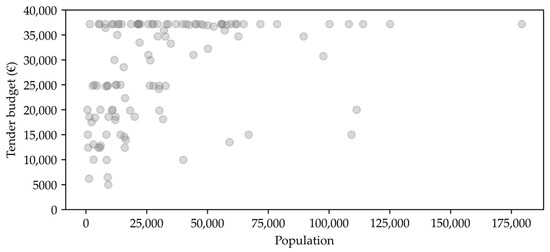
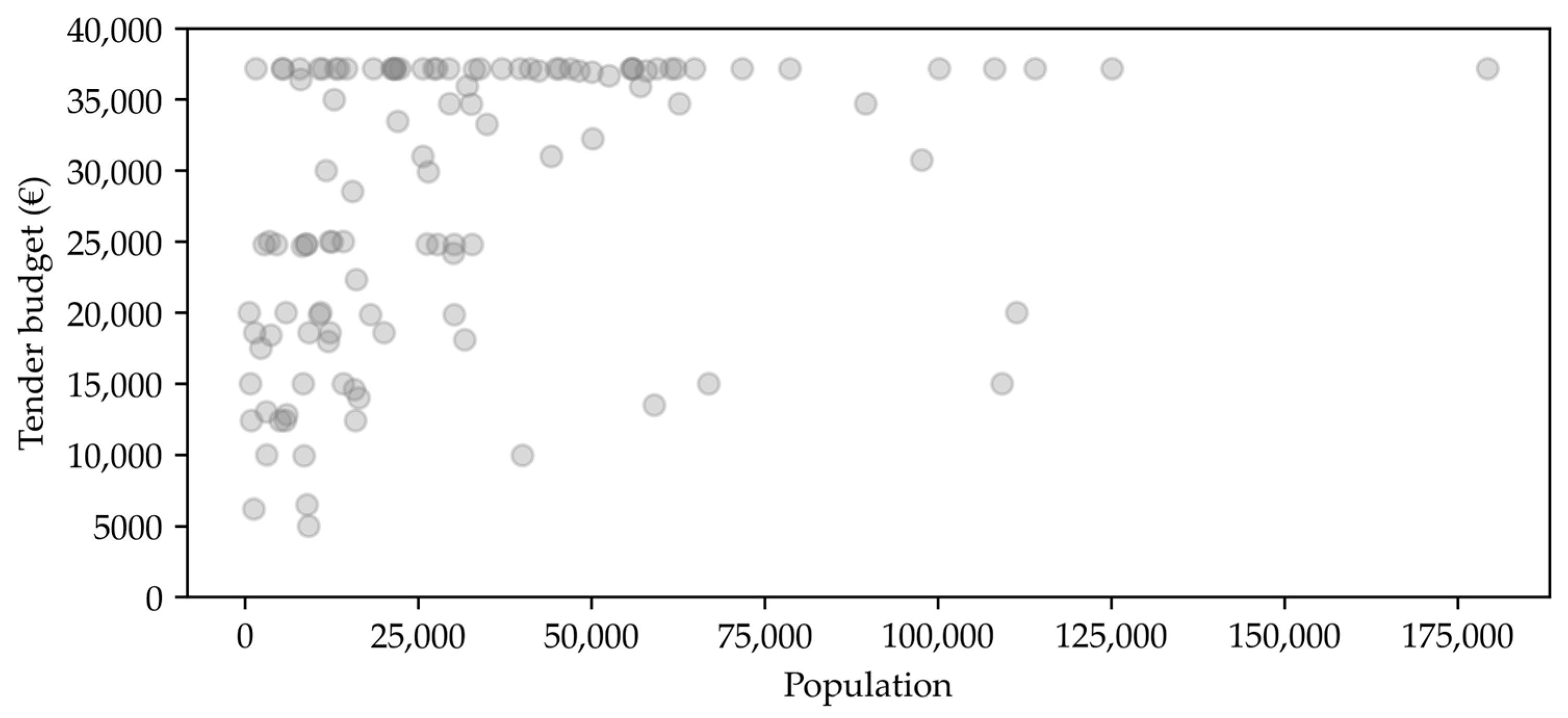
A scatter plot of the tender budget from the 113 contract notices in relation to the corresponding municipal population is presented in Figure 1. The Pearson correlation coefficient is equal to 0.38, with a corresponding p-value below 0.05, indicating a medium correlation and high statistical significance. The same conclusion does not hold per category/population range. In the case of the category, only the “Metro” category displays statistical significance (<0.05, with a Pearson correlation coefficient of 0.74), whereas in the case of the population range, only the second largest population range (“29,505–56,862”) displays statistical significance (<0.05, with a Pearson correlation coefficient of 0.01).
Figure 1.
Scatter plot of tender budget and population of 113 municipalities/contract notices solely for the drafting of the MERP.
In the 113 contract notices, the number of invited bidders ranges from one to three, except for a single case where the municipality invites any interested entity. In the remaining 112 contract notices, 97 invite only one bidder, 6 invite two bidders, and 9 invite three bidders. The results are presented in detail in Table 10. On all levels, the most common approach for municipalities is to invite only one bidder, with a share ranging from 75% to 100%. The invitations of two bidders range from 0% to a maximum of 25%, whereas the invitations of three bidders range from 0% to 15.38%. While in both cases the last entry (small islands for the municipal categories and 141–5297 for the population ranges) exhibits the highest percentage of single bidding, the difference between the other entries is not significant.
Table 10.
Number of invited bidders of 112 contract notices solely for the drafting of the MERP, per municipal category and population range.
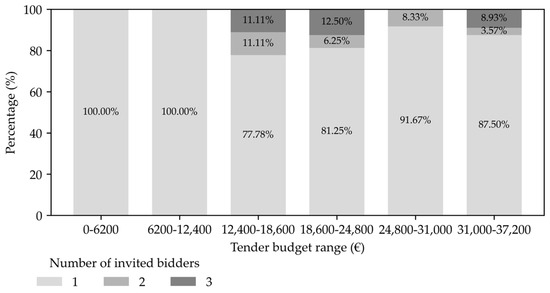
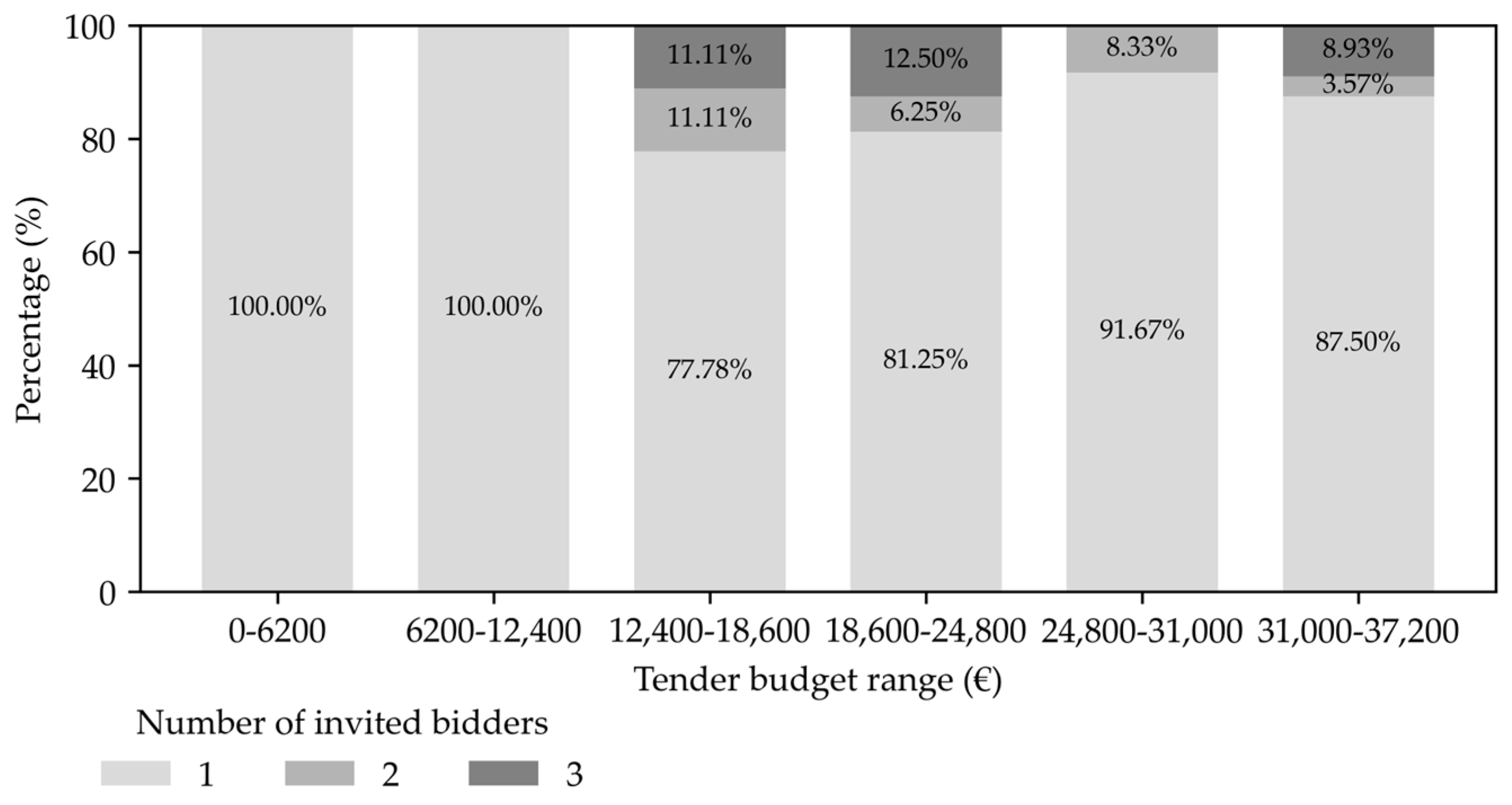
A more interesting aspect arises when the share of invited bidders is contrasted with the tender budget range, as depicted in Figure 2. When the tender budget is divided into equal-width bins (in this case, into six bins, similar to the municipal categories and population range), it can be observed that the lowest tender budgets have a 100% share of single bidding, whereas for higher tender budgets, the share ranges from 76.47% to 91.67%.
Figure 2.
Share of invited bidders for 112 contract notices solely for the drafting of the MERP per tender budget range.
3.3. Contract Results
The search of the KIMDIS database yielded 134 contracts related to MERP development, all of them linked to the contract notices of the Section 3.2, which represent 40.36% of all municipalities in Greece. According to the processed contracts and contract notices, three contracts were procured through competition, with an average number of days between publication of the contract notice and signing of the contract being 140. On the other hand, the remaining 131 contracts were procured through direct award with an average notice-to-signing period of 18 days. The 134 contracts include all types of provided services. Focusing only on the contracts solely for the drafting of the MERP (107 contracts), the average notice-to-signing period slightly increases to 19 days.
The contractor to whom the contract is awarded may be a natural or legal person. Based on the 107 contracts, around 94,4% of contractors are legal persons, and only 5,6% are natural persons. Detailed results per municipal category and population range are presented in Table 11.
Table 11.
Breakdown of the legal form of the contractors awarded a contract solely for the drafting of the MERP, per municipal category and population range.
The contract durations of the 107 contracts range from 9 days to 364 days, with an average duration of 167 days. Detailed results per municipal category and population range are presented in Table 12. As might be expected, municipalities with the lowest population (small island municipalities and municipalities with a population range of “141–5297”) exhibit the lowest mean contract duration. While municipalities of metropolitan centers have the longest contract duration, the same is not true for the highest population range.
Table 12.
Contract duration breakdown of contracts solely for the drafting of the MERP, per municipal category and per population range.
Out of the original 134 contracts, only one contract does not specify an end date or duration. Table 13 presents the period in which the remaining 133 contracts end. As can be seen, only 2.26% of the total 133 contracts are completed before the initial MERP drafting deadline, while the majority (68.42%) are completed after the second funding-related deadline.
Table 13.
Timeline of completed MERP contracts.
The central tendency and dispersion of the contract values of the 107 contracts solely for the drafting of the MERP are presented in Table 14 per municipal category and in Table 15 per population range. The contract values display similar results to those of the tender budgets discussed in Section 3.2 (Contract Notices Results). The percentage difference between the contract values and the tender budgets is presented in Table 16. The results indicate that in both cases, category and population range, at least one municipality does not offer a discount on the tender budget, resulting in an identical contract value and tender budget. On the other hand, the maximum discount observed is around 50% and occurs for large municipalities (category “Metro” and “Cont-L,” and population range “29,505–56,862”). More importantly, the average discount is in the range of 0.21–5,42% for the categories and 0.39–4.73% for the population ranges. The smallest municipalities, i.e., those in the “Isl-S” and “5297–11,352” bins, display the lowest contract discount.
Table 14.
Central tendency and dispersion of contract value of contracts solely for the drafting of the MERP, per municipal category.
Table 15.
Central tendency and dispersion of contract value solely for the drafting of the MERP, per population range.
Table 16.
Percentage difference in contract values and tender budget, per municipal category and per population range.
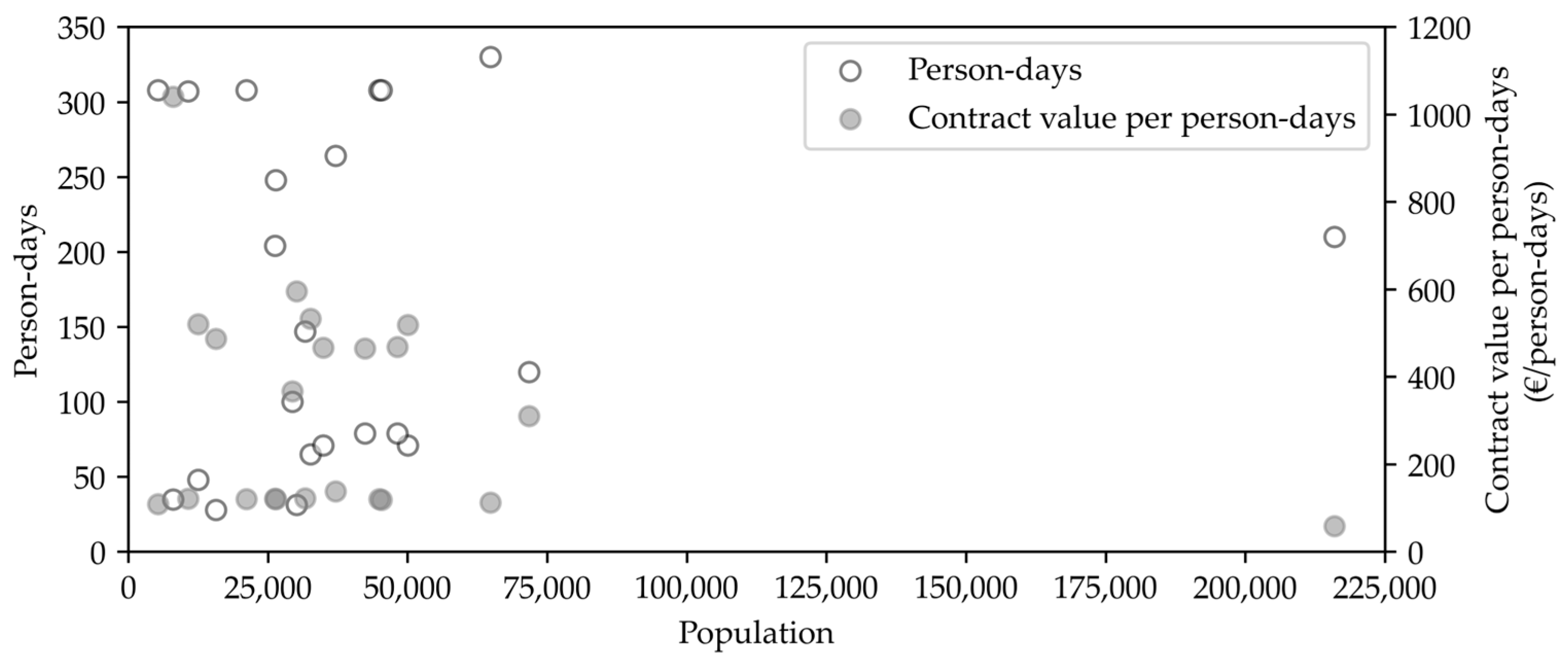
The person-days and contract value per person-day results are presented in Figure 3. As indicated in the figure, the estimated amount of person-days required to draft the MERP ranges from around 30 person-days to 330 person-days. More importantly, the number of person-days does not seem to depend on the population of the municipality, as there are instances where municipalities with a resident population of 50,000 require fewer person-days than municipalities with less than 25,000 resident population.
Figure 3.
Scatter plot of person-days and contract value per person-day for contracts solely for the drafting of the MERP.
The contract value per person-days shows two distinct zones (and one outlier). Most contracts have either a contract value per person-day of around EUR 100–130/person-day or EUR 300–600/person-day.
4. Discussion
Public procurement data constitutes an important source of information that can help drive not only future policy decisions but also improve current practices, especially in regard to the tender process, including, but not limited to, estimation of contract value, contract duration, and transparency.
An important factor in the path of achieving a climate-neutral society lies in the efficient distribution of available resources, including financial ones. For countries with limited financial resources, it is in their best interest to reduce inefficient expenditure. For a significant number of countries, the development of mitigation action plans, such as MERPs, is not just a voluntary commitment but also enforced by national and supranational laws, such as the European Climate Law.
The development of Greece’s National Climate Law and the resulting obligation to develop MERPs place a burden on the already financially strained municipalities in Greece. For this reason, it is imperative for municipalities to rely on data-driven insights that act as a guiding point for informed decisions during the procurement of services. In this regard, neither the National Climate Law nor related official material provides guidance on this topic.
Based on this lack of a national pricing framework, it is assumed that municipalities also lack the institutional capacity to address this issue without external expertise. Evidence of this shortcoming is reflected in the results and conclusions obtained from this study.
With this in mind, the first major milestone to enable this comparative analysis is the existence of a publicly accessible procurement database and a well-structured organization of data that enables efficient and thorough lookup of requested data. An essential function of this database is the search function for a specific piece of text and the lookup of special fields, such as unique identifiers, Common Procurement Vocabulary (CPV), and filters for tender budget/contract value, date, etc. The Greek Public Procurement System (KIMDIS) contains these functions; however, there are several obstacles in this regard. First, the search function applies only to the title that was manually typed into the required field. This has significant consequences when this title is non-descriptive or exceeds a certain number of characters, resulting in a cut-off of the keyword. Both instances apply to the current study. For example, the keyword “MERP” has been in the latter half of an exceedingly long title, which required the search for other identifiable indicators. Additionally, a large number of CPV codes have been used to characterize the MERP contracts, resulting in missed MERP contracts when solely relying on CPV coding. Another important factor, which especially affects the collection of consumption data for the emission inventory of the MERP, is the use of a single CPV for different fuel data, i.e., one CPV for contracts related to the supply of gasoline and diesel.
Secondly, for contracts under the direct award threshold, not every related document is publicly available. In the case of MERP procurement in Greece, the majority of contracts are designed as direct awards. As a consequence, the technical study, the document that describes in detail the technical aspects of the contract, is not publicly accessible. In the current study, this has a relatively low impact, as the only significant missing parameter is the methodology for estimating remuneration (i.e., person-days, person-months, etc.).
The data collection process involved the identification of all available and useful data from the contracts and contract notices, namely unique publication IDs (that act as unique identifiers), monetary data, such as tender budget and contract value, as well as certain dates (contract duration, day of signing), info on the invited bidders/awarded contractor, and other miscellaneous data.
The data processing involved first the processing of the contract notices and then the contracts. A major aspect of the methodology is the binning of the data according to two different approaches. First, according to official municipal classification, which is one factor that determines government subsidy to the municipality, which in turn can be used to fund the procurement of the MERP. For this reason, this stratification was thought to be a valid criterion to compare different municipalities. On the other hand, these classifications are only partly representative of the population size. For this reason, the second approach focuses on specific population ranges. The population size affects the income of the municipality (through municipal fees) and increases the MERP development difficulty (because the municipality owns more assets to serve the population).
Another important factor that affects the tender budget/contract value, and which was accounted for, is the provided service of the contract, that is, what additional services must be completed in conjunction with the MERP.
Of the total collected data set, which includes around 50% of all municipalities, 81% concerns only the development of MERP, meaning that a large amount of data can and was utilized in the process. However, even with those additional services, the upper limit remains EUR 37,200 (the direct award limit); this may indicate that contracts that focus only on the MERP are less efficient, monetarily speaking, than the other contracts.
The results from the contract notices indicate that the lowest population municipalities have the lowest rate of MERP procurement. In the case of the categories, the category with the least share (“Isl-S”) has less than half the share of the category with the highest share (“Cont-L”). While this displays a dramatic difference between the municipalities, the mechanism behind this outcome is difficult to assess. On one hand, municipalities with low populations receive less funding and municipal fees, while on the other hand, they also own fewer assets/greenhouse gas sources, resulting in lower MERP data collection and processing effort.
An investigation into the deadlines related to the contract notices and contracts revealed significant delays, resulting, among others, in missed funding-related deadlines. This may be attributed to a variety of factors. For instance, in contrast to another article of the National Climate Law, the law does not stipulate fines for missed deadlines. Additionally, the funding-related deadlines do not apply to all types of funding. Therefore, municipalities do not have incentives to complete the MERP by a certain date.
Regarding the tender budget, as expected, with the assumption that a higher population results in increased resources and, in turn, more complex MERPs, the municipalities in the highest population range exhibit the highest tender budgets. This is substantiated by the Pearson correlation coefficient being positive and having a medium correlation while being statistically significant. Considering that MERP procurement usually involves direct awarding, the upper limit of EUR 37,200 is also expected.
With respect to the number of invited bidders, in all instances, municipalities are most likely to invite a single bidder to the procurement process. This is a rather curious event, as most direct award contracts are awarded based on the lowest bid. Inviting more than one bidder would increase the offered discount and, in turn, lower the contract value. However, the findings of this study did not align with this reasoning. Additionally, an analysis of the single-bidder phenomenon would require additional data regarding the collaboration (past and present) between the municipalities and potential bidders. Through this analysis, it would be possible to ascertain the extent to which municipalities are informed about qualified collaborators. This would be possible with current data from KIMDIS, as one special field in the search is the Tax Identification Number (TIN) of the awardee. Additionally, data from the GEMI Public Records (the General Commercial Registry of Greece), which contain public data of companies subject to GEMI, can be utilized to determine if bidders are located and active in the wider region of the municipality. However, these investigations would require the collection and processing of data beyond the scope of the MERP contracts. An aspect that has not been investigated in this study is the market concentration related to MERP procurement. The market concentration in the Greek public procurement market is well-documented [28] and the single-bidder phenomenon might suggest this behavior.
The processing of the contract data resulted in insights regarding the legal form of the contractors awarded the contract. According to the data, the majority of contractors were legal persons (around 94.4%). Considering the few data points of the natural persons, it is not possible to conclude whether specific municipality types/population ranges prefer to collaborate with legal or natural persons. A possible explanation is that the development of the MERP is a very specific niche and that municipalities have not collaborated in the past with those entities. At the same time, legal persons may employ a variety of experienced professionals, and based on the single-bidder phenomenon explained above, this may be the reason that they are more inclined to engage with reputable organizations.
Regarding the notice-to-signing period of around 3 weeks, this is a typical duration for direct award procurement. As municipalities prefer to continue working with competent collaborators, it is reasonable to assume that they keep collaborating on other contracts, maintaining a relationship, and inquiring before the announcement of the contract notice. Additionally, single-bidder procurement, such as is the case with MERP contracts, has less administrative burden.
Interestingly, municipal population does not seem to significantly influence contract duration. This may be attributed to multiple factors. For one, contract duration is set at conventional intervals, e.g., 6 and 9 months, instead of estimating the time required to collect and analyze the data. The above findings may suggest that a timeframe of 6–9 months is adequate for the development of the MERP regardless of population size. An outlier (a municipality in the population range “11,352–17,681), with a contract duration of 9 days, was identified in the data. This duration is considerably lower than even the second shortest duration (40 days). Assuming the absence of procurement improprieties, this implies that under certain circumstances, e.g., fully digitalized services and preparatory data collection, a contractor could potentially develop the MERP in the aforementioned period.
As discussed above, municipalities tend to delay the development of the MERP well after the specified deadlines. In the case of completed MERP contracts, the majority of municipalities developed their MERP after the last funding-related deadline ended. This can be attributed to the fact that municipalities intended to apply for funding during the year 2025, and one of the prerequisites of the application was to have developed the MERP. Before this deadline, municipalities had no incentive to begin the tendering process. Complementary to this, public procurement in Greece is well documented to pose significant challenges and risks [29], which may explain a municipality’s hesitance to begin the procurement process.
Similar to the results of the tender budget analysis, municipalities with lower populations tend to procure the MERP at a lower contract value than municipalities with higher populations. The explanation for this, as already mentioned, is that less populous municipalities own fewer assets/greenhouse gas sources, and therefore their MERP requires less effort to draft. It is difficult, however, to provide an explanation for the contract value to be at the direct award threshold for municipalities with a low population size. Ultimately, in the absence of competing bidders, single bidders do not have to offer a discount to be awarded the contract. In this case, the maximum initial tender budget is solely determined by the municipality.
With regard to the percentage difference in contract value and tender budget, in every category/population range, at least one municipality has awarded a MERP without a discount in comparison with the initial tender budget. The maximum percentage difference displays large fluctuations between category/population range, and the average percentage difference has low fluctuations (0–5%). The mechanism for this, however, is not clear.
An interesting conclusion regarding the estimation of the contract value can be made using the person-days and remuneration data. The EUR 300–600/person-days zone described in the Section 3 shares similarities with the values prescribed in the Ministerial Decision “Regulation on Estimated Remuneration for Studies and Provision of Technical and other related Scientific Services” of the Minister of Infrastructure and Transport (Government Gazette Issue B 2519/2017). According to this Regulation, the Remuneration for engineers or similar scientists is calculated by multiplying a basic daily rate (EUR 300 for up to 10 years of experience, EUR 450 for 10 to 20 years of experience, and EUR 600 for over 20 years of experience), by a coefficient that is revised on a yearly basis. Therefore, even if not explicitly stated in the contract or contract notice, some municipalities are utilizing this daily rate to estimate the contract value. On the other hand, there are multiple contracts that utilize a different rate (around EUR 100–130/person-days) without providing proper justification.
Consequently, assuming municipalities adhere to the official daily remuneration rate, the only variable that determines the contract value is the estimated person-days required to develop the MERP. As the MERP is predominantly an emission inventory (the action plan detailing emission mitigation initiatives is not assessed or verified), the required person-days depend mainly on the effort to collect, analyze, and document the emission inventories. This in turn requires a comprehensive inventory of all property, plant, and equipment (PPE), a detailed record of all energy consumption (fuel and electricity), as well as an assessment of non-energy related emissions (process and fugitive). The most beneficial change a municipality can pursue to aid the development of the MERP is the full digitization of its operations, so that all related activity data that must be collected is available on demand from the maintained databases. Due to the amount of data this would produce, the data collection would benefit from adherence to open data principles [30].
As already mentioned above, the data processing involved mainly contracts that are solely for the drafting of the MERP. Some of these contracts have a contract cost that approaches the direct award limit. At the same time, MERP contracts that include other services (such as the BERP or a monitoring report) are estimated lower than the upper limit. This suggests that MEPR contracts that include other services are more cost-effective. However, this is inconsistent with the observation that larger contracts tend to exhibit higher inefficiencies [31].
A cost–benefit analysis was carried out by the Carbon Track and Trace project [32] revealing that about two-thirds of municipal emission inventories are outsourced to external consultants and that, on average, an emission inventory is priced at EUR 12,500. In the present study, it is difficult to estimate the municipalities that do not rely on external expertise in drafting the MERP. Based on identified contract notices and the total number of municipalities, the share of municipalities that outsource the MERP development is at least 44%. Considering the significant delay that the current contract notices showcase, a large number of municipalities are expected to seek out external expertise for their MERPs in the future. According to the results from the current study, MERPs are procured from as low as EUR 5000, with an average of EUR 18,000 for small municipalities and up to EUR 33,000 for large municipalities. If not for the action plan that the MERP includes, the above findings imply that MERP procurement in Greece is not as cost-effective as procurement in other countries.
The integrity and quality of the MERP are evaluated at two levels. First, as previously noted in Section 2.1, the emission inventory must be verified by an accredited verification body to ensure it has been prepared according to the 2006 IPCC Guidelines for National Greenhouse Gas Inventories and its Refineries. Secondly, the MERP must be approved by a decision of the Municipal Committee. The verification process certifies the completeness and scientific rigor of the emission inventory, while the municipal approval confirms the MERP’s adherence to the official guidelines and specifications.
Following the verification and municipal approval, the MERP is formally submitted to the Climate Action and Sustainability Portal of NECCA by both uploading the required files (the MERP document and the spreadsheet tool for the calculation of the emission inventory) and manually inputting aggregated results (e.g., yearly energy consumption per sector). The submission is carefully reviewed by NECCA; however, this is performed as a safeguard for human error during the manual data entry and not on the quality and contents of the MERP. Conclusively, there is no national-level quality assurance of the MERP and its contents, and the accountability rests solely on the municipalities and the carbon footprint verifiers.
5. Conclusions
Driven by the urgency of climate change, supranational laws have shaped how nations are responding to the ongoing transition to a climate-neutral society. As a result, Greece’s National Climate Law imposes an obligation on municipalities to develop Municipal Emission Reduction Plans, placing a burden on already financially strained municipalities. To combat this, it is imperative for municipalities to rely on data-driven insights and improve certain aspects of public procurement. Motivated by this, the main objective of this study is to perform a comparative analysis of Greek MERP procurement data and identify patterns in the contract cost estimation of mitigation action plans in Greece. It is expected that such an analysis will reveal inefficiencies in the MERP procurement process and highlight a lack of national guidance and standardized processes.
Based on data collected from the official Greek public procurement register KIMDIS, three years after the enactment of the National Climate Law, a total of 44% of municipalities have relied on external expertise and initiated the procurement of a MERP contract. Out of these, a share of 80% concerns only the development of the MERP, while the rest include additional services (e.g., monitoring reports or other action plans). The results revealed significant delays when it comes to MERP development and adherence to official deadlines. Most notably, only 0.75% of all municipalities developed their MERP before the drafting deadline, and 90.22% developed their MERP after the MERP became a prerequisite for funding-related matters. The procurement process was highly characterized by single bidding, averaging 86.6% across identified MERP contracts. Additionally, 94,4% of all awardees were legal persons.
The average contract duration ranged from 110 to 220 days, depending on stratification (municipal classification and population range). The analysis indicated that municipalities with lower populations generally procure the MERP at a lower contract value, ranging on average from EUR 18,000 to EUR 33,000. However, in all stratification groups, regardless of population size, there were instances of MERP procurement at the direct award threshold. A comparison between tender budget and contract value revealed only a small difference, averaging between 0 and 5%, likely due to the single-bidder phenomenon. Conversely, MERP contracts that included additional services were also procurement under the direct award threshold, indicating that procuring only the MERP might not be as cost-effective. Lastly, the estimated person-days required to develop the MERP did not depend on population size, and the corresponding contract value per person-day partly shared similarities with the official daily remuneration rate.
The processing of public procurement data is an interesting topic with significant applications to data-driven decision-making. The limitation of the current study lies inherently in the data-gathering process, including availability and data parsing. Contracts and contract notices only provide a limited amount of data, which does not reveal the true extent of the data that municipalities possess (and hence contribute to decision-making). Additionally, the current dataset involved only 140 municipalities of a single country. This limited data also restricts the use of advanced methods and techniques to develop models. An important continuation of the present work includes the integration of new data, and more importantly, data related to MERP development, such as monitoring and verification. As MERP monitoring reports and the verification of the emission inventory are also procured, mostly separately, from the MERPs, the same methodologies developed herein could be applied to those contracts and contract notices. Overarching, the same principles could also be applied to international procurement databases and compare the respective results.
Author Contributions
Conceptualization, D.B., G.M.S. and D.A.K.; methodology, D.B. and N.C.P.; software, D.B.; validation, G.M.S., P.L.Z. and N.C.P.; formal analysis, D.B. and D.T.; investigation, D.B., D.T. and S.Y.; resources, D.A.K. and S.Y.; data curation, D.B. and D.T.; writing—original draft preparation, D.B.; writing—review and editing, D.B. and G.M.S.; visualization, D.B. and N.C.P.; supervision, P.L.Z.; project administration, S.Y. All authors have read and agreed to the published version of the manuscript.
Funding
This research received no external funding.
Institutional Review Board Statement
Not applicable.
Informed Consent Statement
Not applicable.
Data Availability Statement
The original data presented in the study are openly available in GitHub at https://github.com/dbakirtzis/merp_procurement_data (accessed on 7 November 2025).
Conflicts of Interest
Authors Dimitris Bakirtzis, Dimitrios Tziritas, and Panagiotis L. Zervas were employed by the company MES Energy S.A. The remaining authors declare that the research was conducted in the absence of any commercial or financial relationships that could be construed as a potential conflict of interest.
Abbreviations
The following abbreviations are used in this manuscript:
| BERP | Building Energy Renovation Plan |
| ELSTAT | Hellenic Statistical Authority |
| ESIDIS | National Electronic Public Procurement System |
| EU | European Union |
| KIMDIS | Central Electronic Register of Public Procurement |
| MERP | Municipal Emission Reduction Plan |
| NECCA | National Environment and Climate Change Agency |
| NECP | National Energy and Climate Plan |
| SEAP | Sustainable Energy Action Plan |
| SECAP | Sustainable Energy and Climate Action Plan |
References
- IPPC. Global Warming of 1.5 °C: IPCC Special Report on Impacts of Global Warming of 1.5 °C Above Pre-Industrial Levels in Context of Strengthening Response to Climate Change, Sustainable Development, and Efforts to Eradicate Poverty, 1st ed.; Cambridge University Press: Cambridge, UK, 2022; ISBN 978-1-009-15794-0. [Google Scholar]
- UN/Office of Legal Affairs. United Nations Office of Legal Affairs Treaty Series 3156 (English/French Edition); United Nations: New York, NY, USA, 2023; ISBN 978-92-1-980091-5. [Google Scholar]
- Bodansky, D. The Legal Character of the Paris Agreement. Rev. Eur. Comp. Int. Environ. 2016, 25, 142–150. [Google Scholar] [CrossRef] [Scilit]
- European Commission. The European Green Deal; European Commission: Brussels, Belgium, 2019. [Google Scholar]
- European Commission. “Fit for 55”: Delivering the EU’s 2030 Climate Target on the Way to Climate Neutrality; European Commission: Brussels, Belgium, 2021. [Google Scholar]
- European Parliament and the Council of the European Union. Regulation (EU) 2021/1119 of the European Parliament and of the Council of 30 June 2021 Establishing the Framework for Achieving Climate Neutrality and Amending Regulations (EC) No 401/2009 and (EU) 2018/1999 (European Climate Law). Off. J. Eur. Union 2021, 1–17. [Google Scholar]
- European Parliament and the Council of the European Union. Regulation (EU) 2018/1999 of the European Parliament and of the Council of 11 December 2018 on the Governance of the Energy Union and Climate Action, amending Regulations (EC) No 663/2009 and (EC) No 715/2009 of the European Parliament and of the Council, Directives 94/22/EC, 98/70/EC, 2009/31/EC, 2009/73/EC, 2010/31/EU, 2012/27/EU and 2013/30/EU of the European Parliament and of the Council, Council Directives 2009/119/EC and (EU) 2015/652 and repealing Regulation (EU) No 525/2013 of the European Parliament and of the Council (Text with EEA relevance.). Off. J. Eur. Union 2018, 1–77. [Google Scholar]
- Government of Greece. Government of Greece Government Gazette Issue B, No. 4893; Decision No. 4: Ratification of the National Energy and Climate Plan (NECP); Government of Greece: Athens, Greece, 2019. [Google Scholar]
- Government of Greece. Government of Greece Government Gazette Issue B, No. 6983; Decision No. 3: Ratification of the National Energy and Climate Plan (NECP); Government of Greece: Athens, Greece, 2024. [Google Scholar]
- Sofia, Y.; Katsaprakakis, D.; Sakkas, N.; Condaxakis, C.; Karapidakis, E.; Syntichakis, S.; Stavrakakis, G.M. The Role of Energy Communities in the Achievement of a Region’s Energy Goals: The Case of a Southeast Mediterranean Region. Energies 2025, 18, 1327. [Google Scholar] [CrossRef] [Scilit]
- Government of Greece. Government of Greece Government Gazette Issue A, No. 105; Law No. 4936: National Climate Law—Transition to Climate Neutrality and Adaptation to Climate Change, Urgent Provisions for Addressing the Energy Crisis and Protecting the Environment; Government of Greece: Athens, Greece, 2022. [Google Scholar]
- Sofia, Y.; Sakkas, N.; Vailakis, N.; Nistikaki, A. Environmental Sustainability and Regional Competitiveness: Innovative Steps by a Local Public Authority towards Energy Saving. J. Energy Power Eng. 2019, 13, 149–161. [Google Scholar] [CrossRef] [Scilit]
- Covenant of Mayors Office. EU Covenant of Mayors—Official Website. Available online: https://eu-mayors.ec.europa.eu/en/resources/reporting (accessed on 20 December 2025).
- Reckien, D.; Salvia, M.; Heidrich, O.; Church, J.M.; Pietrapertosa, F.; De Gregorio-Hurtado, S.; D’Alonzo, V.; Foley, A.; Simoes, S.G.; Krkoška Lorencová, E.; et al. How Are Cities Planning to Respond to Climate Change? Assessment of Local Climate Plans from 885 Cities in the EU-28. J. Clean. Prod. 2018, 191, 207–219. [Google Scholar] [CrossRef] [Scilit]
- Ea Energianalyse; CONCITO. Analysis of the Emissions Reduction Contribution of Danish Municipalities towards Meeting the 70% Target by 2030; CONCITO: Copenhagen, Denmark, 2024. [Google Scholar]
- International Bank of Reconstruction and Development. Greece Sustainable Cities and Regions Through Integrated Territorial Investments Technical Facility; The World Bank: Washington, DC, USA, 2023. [Google Scholar]
- Government of Greece. Government of Greece Government Gazette Issue A, No. 147; Law No. 4412: Public Contracts for Works, Supplies, and Services (Transposition of Directives 2014/24/EU and 2014/25/EU); Government of Greece: Athens, Greece, 2016. [Google Scholar]
- Stavrakakis, G.M.; Bakirtzis, D.; Drakaki, K.-K.; Yfanti, S.; Katsaprakakis, D.A.; Braimakis, K.; Langouranis, P.; Terzis, K.; Zervas, P.L. Application of the Typology Approach for Energy Renovation Planning of Public Buildings’ Stocks at the Local Level: A Case Study in Greece. Energies 2024, 17, 689. [Google Scholar] [CrossRef] [Scilit]
- Government of Greece. Government of Greece Government Gazette Issue A, No. 143; Law No. 4342: Pension Arrangements, Transposition into Greek Law of Directive 2012/27/EU of the European Parliament and of the Council of 25 October 2012 “on Energy Efficiency, Amending Directives 2009/125/EC and 2010/30/EU and Repealing Directives 2004/8/EC and 2006/32/EC”, as Amended by Council Directive 2013/12/EU of 13 May 2013 “Adapting Directive 2012/27/EU of the European Parliament and of the Council on Energy Efficiency, by Reason of the Accession of the Republic of Croatia” and Other Provisions; Government of Greece: Athens, Greece, 2015. [Google Scholar]
- Government of Greece. Government of Greece Government Gazette Issue B, No. 1897; Decision No. F.01.2/56790/DPP 1828: Regulatory Framework for Conformity Assessment Bodies Operating in Fields of Union Harmonization Legislation and/or in Fields of Purely National Technical Industrial Legislation Falling Within the Scope of Competence of the General Secretariat for Industry; Government of Greece: Athens, Greece, 2016. [Google Scholar]
- Government of Greece. Government of Greece Government Gazette Issue B, No. 4145; Decision No. 1: Determination of Specifications and Content of the Municipal Emissions Reduction Plan (MERP) of Article 16 of National Climate Law 4936/2022 (A’ 105); Government of Greece: Athens, Greece, 2023. [Google Scholar]
- Implementation of the National Climate Law. Available online: https://ypen.gov.gr/perivallon/klimatiki-allagi/ethnikos-klimatikos-nomos/efarmogi-ethnikou-klimatikou-nomou/ (accessed on 20 December 2025).
- Varelidis, P.; MERP. Calculation of the Carbon Footprint Based on Article 16 of the National Climate Law; MERP: Kifissia, Greece, 2023. [Google Scholar]
- Government of Greece. Government of Greece Government Gazette Issue A, No. 63; Law No. 5106: Provisions for Addressing the Multi-Level Impacts of Climate Change in the Sectors of: a) Water Management, b) Forest Management and Protection, c) Urban Resilience and Policy, d) Combating Unauthorized Construction, e) Energy Security and Other Urgent Provisions; Government of Greece: Athens, Greece, 2024. [Google Scholar]
- Navarro-Galera, A.; Lara-Rubio, J.; Buendía-Carrillo, D.; Rayo-Cantón, S. What Can Increase the Default Risk in Local Governments? Int. Rev. Adm. Sci. 2017, 83, 397–419. [Google Scholar] [CrossRef] [Scilit]
- Hellenic Statistical Authority Resident Population. Available online: https://www.statistics.gr/2021-census-res-pop-results (accessed on 20 December 2025).
- Government of Greece. Government of Greece Government Gazette Issue A, No. 133; Law No. 4555: Reform of the institutional framework of Local Government—Deepening of Democracy—Strengthening Participation—Improvement of the Economic and Developmental Operation of Local Government Organizations [‘KLEISTHENIS I’ Programme]—Provisions for the Modernization of the Organizational and Operational Framework of Solid Waste Management Agencies (FODSA)—Provisions for the More Effective, Faster and Uniform Exercise of Competences Regarding the Granting of Citizenship and Naturalization—Other Provisions Within the Competence of the Ministry of the Interior and Other Provisions; Government of Greece: Athens, Greece, 2018. [Google Scholar]
- Pliatsidis, A.C. Correction: Analyzing Concentration in the Greek Public Procurement Market: A Network Theory Approach. J. Ind. Bus. Econ. 2024, 51, 1119–1120. [Google Scholar] [CrossRef] [Scilit]
- Paraskeva, S.; Tsoulfas, G.T. Mitigating Risks in Public Procurement. J. Public Procure. 2025, 25, 140–176. [Google Scholar] [CrossRef] [Scilit]
- Sakkas, N.; Yfanti, S. Open Data or Open Access? The Case of Building Data. Acad. Lett. 2021, 3629. [Google Scholar] [CrossRef] [Scilit]
- Caserta, M.; Ferrante, L.; Ferrara, P.L.; Fontana, S. Too Big to Be Efficient? The Role of Size in Public Procurement Performance. Econ. Anal. Policy 2025, 86, 2049–2069. [Google Scholar] [CrossRef] [Scilit]
- Carbon Track and Trace (CTT) project Cost-Benefit Survey Carried out on Municipal Emission Inventories. ICLEI Newsletter. Available online: https://iclei-europe.org/news?Cost-benefit_survey_carried_out_on_municipal_emission_inventories_&newsID=a07dba7b (accessed on 20 December 2025).

Disclaimer/Publisher’s Note: The statements, opinions and data contained in all publications are solely those of the individual author(s) and contributor(s) and not of MDPI and/or the editor(s). MDPI and/or the editor(s) disclaim responsibility for any injury to people or property resulting from any ideas, methods, instructions or products referred to in the content. |
© 2026 by the authors. Licensee MDPI, Basel, Switzerland. This article is an open access article distributed under the terms and conditions of the Creative Commons Attribution (CC BY) license.