Next Article in Journal
Characterization of the Response of Negative Air Ions Released by Green Tree Species to Humidity Using an Open Top Chamber
Previous Article in Journal
Overview of the Municipal Emission Reduction Plan Landscape in Greece in Terms of Policy Framework and Procurement Patterns
error_outline You can access the new MDPI.com website here. Explore and share your feedback with us.
 
 
Article

Fluid Flow and Pollutant Dispersion in Naturally Ventilated Traffic Tunnels

1
School of Civil Engineering and Architecture, Wuhan University of Technology, Wuhan 430070, China
2
School of Safety Science and Engineering, Nanjing University of Science and Technology, Nanjing 210094, China
3
School of Computer and Information Science, Chongqing Normal University, Chongqing 401331, China
4
Sanya Science and Education Innovation Park, Wuhan University of Technology, Sanya 572024, China
*
Authors to whom correspondence should be addressed.
Atmosphere 2026, 17(1), 66; https://doi.org/10.3390/atmos17010066
Submission received: 17 November 2025 / Revised: 29 December 2025 / Accepted: 29 December 2025 / Published: 4 January 2026
(This article belongs to the Section Air Quality)

Abstract

With the rapid expansion of urban areas, short naturally ventilated traffic tunnels (NVTTs) have become prevalent in modern cities. However, their enclosed design and inadequate ventilation often lead to the accumulation of vehicle emissions, especially during peak traffic periods, which poses significant threats to public health. Previous studies have shown that airflow in such tunnels is caused by ambient crosswinds (ACWs), which contribute to the dilution of pollutants. Based on this, a geometrical model including traffic tunnels belonging to a complex traffic system of the Second Ring Road in Wuhan City was established, followed by a mathematical model describing the fluid flow and pollutant transformation. The current flow characters and pollutant dispersion mechanism of CO and NOX were analyzed. Among them, the number and speeds of vehicles are measured to calculate the strength of the pollutant source. Then, the data was set as the initial contaminant source strength in Ansys Fluent 14.0 to compute the pollutant dispersion of the whole domain. The results indicate the following: (1) The airflow direction inside the tunnel varies with changes in ambient wind direction and wind speed. Specifically, variations in ambient wind direction result in changes in airflow direction in both tunnels. In contrast, changes in wind speed do not affect the airflow direction in both tunnels; only in the downstream tunnel does the airflow direction change with increasing westward wind speed. By comparison, in the upstream tunnel, the airflow direction remains unchanged regardless of the westward wind speed; (2) Pollutant accumulates along the downstream airflow in both the tunnels; (3) The mass fraction level of contaminate stratification differs along the tunnels. The pollutant tends to form y-component layering near the upwind opening and x-component stratification at the downwind opening of the two tunnels.

1. Introduction

Tunnels have been increasingly constructed in China’s expanding cities to alleviate traffic congestion. Among them, naturally ventilated traffic tunnels (NVTTs) account for a significant proportion of urban tunnel infrastructure. These tunnels are typically short in length (less than 500 m, according to relevant specifications) and lack mechanical ventilation systems. Airflow in NVTTs is primarily driven by two mechanisms: ambient crosswinds (ACWs), which create pressure differentials across tunnel openings, and traffic-produced turbulence (TPT), which generates a piston effect that facilitates the movement of air and pollutants through the tunnel.
Vehicle emissions are widely recognized as a major contributor to global warming [1] and one of the most significant sources of urban air pollution [2,3,4], directly leading to various diseases harmful to public health [5,6]. Nevertheless, conventional fuel-powered vehicles cannot be fully replaced in the short term [7,8]. In June 2021, according to the Chinese government, China’s number of vehicles reached 384 million, with the highest historical growth rate of 32.33% (compared to the year 2020) [9], indicating that urban traffic will continue to face mounting challenges, including severe traffic congestion [10,11]. Undoubtedly, jams in this kind of tunnel create barriers to the transportation of pollutant due to the enclosed geometry on all sides except the openings. Furthermore, jams hinder motor movement, leading to a lack of piston effects caused by TPT in tunnels. Under such conditions, engines often remain in idle mode, during which pollutant emissions are typically higher [12,13,14,15].
In mechanically ventilated tunnels, pollutants are mainly diluted by fans and traffic-produced turbulence (TPT) [16,17,18]. Dong et al. [19] noted that when vehicle speeds drop below 10 km/h, additional ventilation is necessary due to insufficient piston effects. Li et al. [20] found that traffic flow alone provides only 32.5% of the airflow required to dilute emissions. Studies have shown that pollutant concentrations are highest in tunnel middles and lowest near exits, with up to tenfold differences [21,22,23]. Simulations by Bari and Naser [24] demonstrated how jet fans enhance ventilation, while Chen et al. [17] conducted experimental studies and numerical simulations on the three-dimensional turbulent flow within underwater tunnels and the diffusion of gas pollutants. The research indicated that the piston effect caused by vehicles contributed approximately 9–23% to the dilution of gaseous pollutants, with the dilution efficiency reaching 23–74% depending on the ventilation conditions. The authors of [25] examined the impact of environmental crosswinds on pollutant distribution in Wuhan’s Second Ring Road tunnels, focusing on tunnel exits and surrounding areas, and considering only CO emissions.
In the aforementioned tunnel study, the impacts of traffic conditions and mechanical ventilation on the diffusion of vehicle emissions were analyzed; however, the influence of external wind conditions on the pollutant dispersion mechanism inside the tunnel was not considered. In contrast, pollutant dispersion in naturally ventilated traffic tunnels (NVTTs) relies on ambient crosswinds (ACWs) and TPT, both of which are subject to variability. ACW is a natural factor, while TPT depends on traffic conditions and exhibits more regular patterns. In modern cities, NVTTs—especially those located within inner urban rings—often experience prolonged traffic congestion during rush hours, rendering TPT ineffective in diluting pollutants. Such conditions inevitably lead to higher pollutant concentrations in NVTTs, exposing occupants to elevated health risks. Although the construction of NVTTs involves careful consideration of factors such as traffic flow, geological conditions, and integration with the surrounding environment [26], public health concerns are rarely included in the decision-making process.
This study establishes a double-bore naturally ventilated traffic tunnel (NVTT) as part of a complex three-dimensional urban traffic system. The primary objective is to investigate the airflow patterns, pollutant dispersion characteristics of CO and NOx, and the transport mechanisms during rush hours under varying ambient crosswind (ACW) conditions. Traffic flow rates through the tunnels are measured to estimate vehicle emissions, which serve as input data for the simulation.

2. Problem Formulation and Solution Procedures

2.1. Physical Model

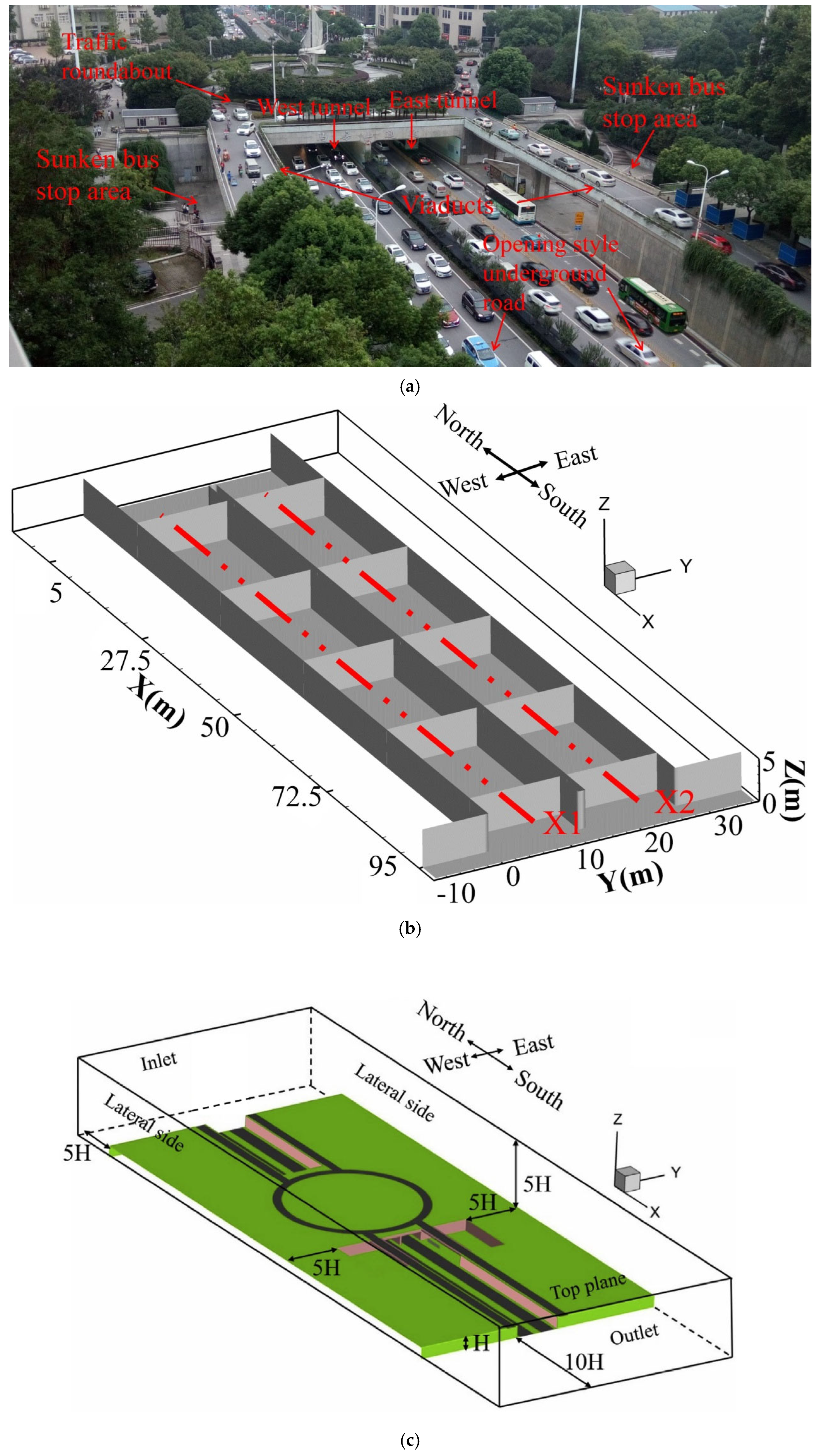
The model developed in this study is based on the actual traffic system between the East and West Campuses of Wuhan University of Technology in Wuhan, China. To account for the influence of surrounding structures on tunnel airflow, a full-scale three-dimensional (3D) model of the entire traffic system was constructed (Figure 1). This complex system comprises a traffic roundabout, viaducts, a sunken bus stop, auxiliary roads, and a pair of naturally ventilated traffic tunnels (NVTTs), which serve as the primary focus of this research.
The double-bore NVTTs are located beneath the viaducts and connect to an open-style underground road to the north and a sunken bus stop area to the south. The tunnels consist of two separate channels designated for opposing traffic directions. Each tunnel is 100 m long (north-south), 13 m wide (west-east), and 5 m high, separated by a 1 m thick partition wall. The coordinate origin is set at the north entrance of the west tunnel. Apart from the two openings at each end, the tunnels are fully enclosed.
Figure 1b provides a detailed north-south cross-sectional view of the tunnels. The red lines X1 and X2 represent the central traffic routes of the westbound and eastbound tunnels, respectively. Ten cross-sections within the tunnels are defined as virtual planes for subsequent analysis. Note that the labels on the X-axis in the figure correspond to the actual coordinate values of these cross-sections and are not conventional axis markers. Other components of the system, such as the roundabout and viaducts, are not discussed in detail as they are not central to the scope of this study. Figure 1c illustrates the schematic of the computational domain for the tunnel, in which the inlet, outlet, and lateral boundaries are defined [25]. The height of the traffic tunnel is denoted as H , with H = 7 m . According to the study of Solazzo et al. [27], the distance between the traffic structure and the computational boundary is set to 5 H in order to eliminate the influence of the velocity inlet on the flow-field distribution.

2.2. Mathematical Model and Calculation Process

Due to the complexity of the traffic system structure, the RNG k- ε model [28] is considered the most suitable approach for this simulation [29], compared with LES [30] and the standard k- ε model [31]. While LES provides higher accuracy, it incurs substantially greater computational costs [32,33]. The standard k- ε model, on the other hand, tends to perform poorly at high Reynolds numbers [34]. The RNG k- ε model incorporates corrections to turbulent viscosity and accounts for the effects of swirling flows, making it more appropriate for complex flow domains such as this one [35]. Overall, the RNG k- ε model provides a balanced choice in terms of accuracy and computational efficiency [35,36], given the high mesh density required in this study (discussed later). The governing equations are as follows:
Mass equation:
ρ u i x i = 0
Navier–Stokes equation:
( ρ u i ) t + ( ρ u i u j ) x j = ρ f i p x i + x j ( μ u i x j ) ρ u i u j ¯ x j
In Equation (2), the average Reynolds stress u i u j ¯ can be obtained from the following equation:
u i u j ¯ = v t u i x j + u j x i
The kinetic energy κ equation is as follows:
ρ κ t + ρ κ u i x i = x j α κ μ e f f κ x j + G k + ρ ε
The turbulence dissipation rate ε equation is as follows:
ρ ε t + ρ ε u i x i = x j α ε μ e f f ε x j + C 1 ε ε κ G κ C 2 ε ρ ε 2 κ
Herein, we have to show several formulas and consistent values to explain corresponding physical symbols:
μ e f f = μ + μ t
μ t = ρ C μ = κ 2 ε
C 1 ε = C 1 ε η 1 η / η 0 1 + β η 3
Furthermore, the constant values used in Equations (4)–(8) were, respectively,   C μ = 0.0845, α κ = α ε = 1.39, C 1 ε = 1.42, and C 2 ε = 1.68.
The energy equation is as follows:
( ρ c p T ) t + ( ρ c p u j T ) x j = x j λ T x j + τ i j + u i x j + β T p t + u j p x j
The pollutant transportation equation is as follows:
ρ c s t + ρ u i c s x i = x D s ( ρ c s ) x i + q s
where β is a value depending on temperature. During the course of the study of this problem, the temperature difference can be ignored, and so β could be considered as constant: β = 0.012.
The equations mentioned above would be solved by Ansys Fluent 14.0, a popular business CFD software(Fluent 15.0), using the finite volume method. At the same time, the max residual errors of these equations were controlled to less than 1 × 10⁻⁵. The dispersion of motion equation is selected as SIMPLE algorithm. The results were stable when calculation was completed.

2.3. Boundary Conditions and Domain

According to Solazzo et al. [27], the development of turbulence at the domain’s inlet, top, and lateral boundaries has minimal impact on the flow field around the primary research object, provided that these boundaries are placed at a distance equal to or greater than five times the height of the surrounding buildings. Additionally, the outlet boundary should be set at a distance no less than ten times the building height when applying an outflow condition. The types of boundary conditions used are summarized in Table 1. In this study, five approaching wind directions (ACW) are considered, θ = 0°, 45°, 90°, 135°, and 180°, where θ denotes the angle between the wind direction and the positive X-axis. For example, θ = 0° corresponds to a north wind. The other directions follow the same convention but are not described in detail.
In this study, the assumption of a constant approaching wind speed (ACW) is considered reasonable. Based on more than 50 years of meteorological data from Wuhan, the prevailing wind direction in the city is predominantly from the northeast, and the near-ground wind speed typically ranges from 0.2 to 3.3 m/s. Chen Cheng and Meng Dan [37] reported that the wind speed remains approximately constant at a height of about 10 m above the ground, with minimal variation above this level. Moreover, variations in wind conditions at heights higher than this have a negligible influence on the flow field within the computational domain. Therefore, for the street-canyon-scale flow and pollutant dispersion investigated in this study, the assumption of a constant approaching wind speed is deemed appropriate. The use of symmetry boundary conditions, as listed in Table 1, is fully consistent with the domain setup, as supported by Solazzo et al. [27]. Regarding the outlet boundary, the pressure outlet condition is adopted instead of the outflow type. This choice not only allows for a shorter computational domain but also improves result accuracy when the distance from the domain outlet to the obstacle is less than or equal to 10 times the obstacle height.

2.4. Estimation of Pollutant Source Strength

2.4.1. Pollutant Source Type

In this study, carbon monoxide (CO) and nitrogen oxides (NOx) were selected as representative vehicle exhaust gases to investigate the distribution of gaseous pollutants, as they are the primary harmful emissions from petrol and diesel vehicles [38,39]. The pollutant sources were positioned along various traffic components, including the NVVTs, traffic roundabouts, viaducts, auxiliary roads, and the open sections of the underground road. These sources were modeled as volume sources, with the specific emission rates to be detailed in a later section.

2.4.2. Measure of Traffic Flow Rate

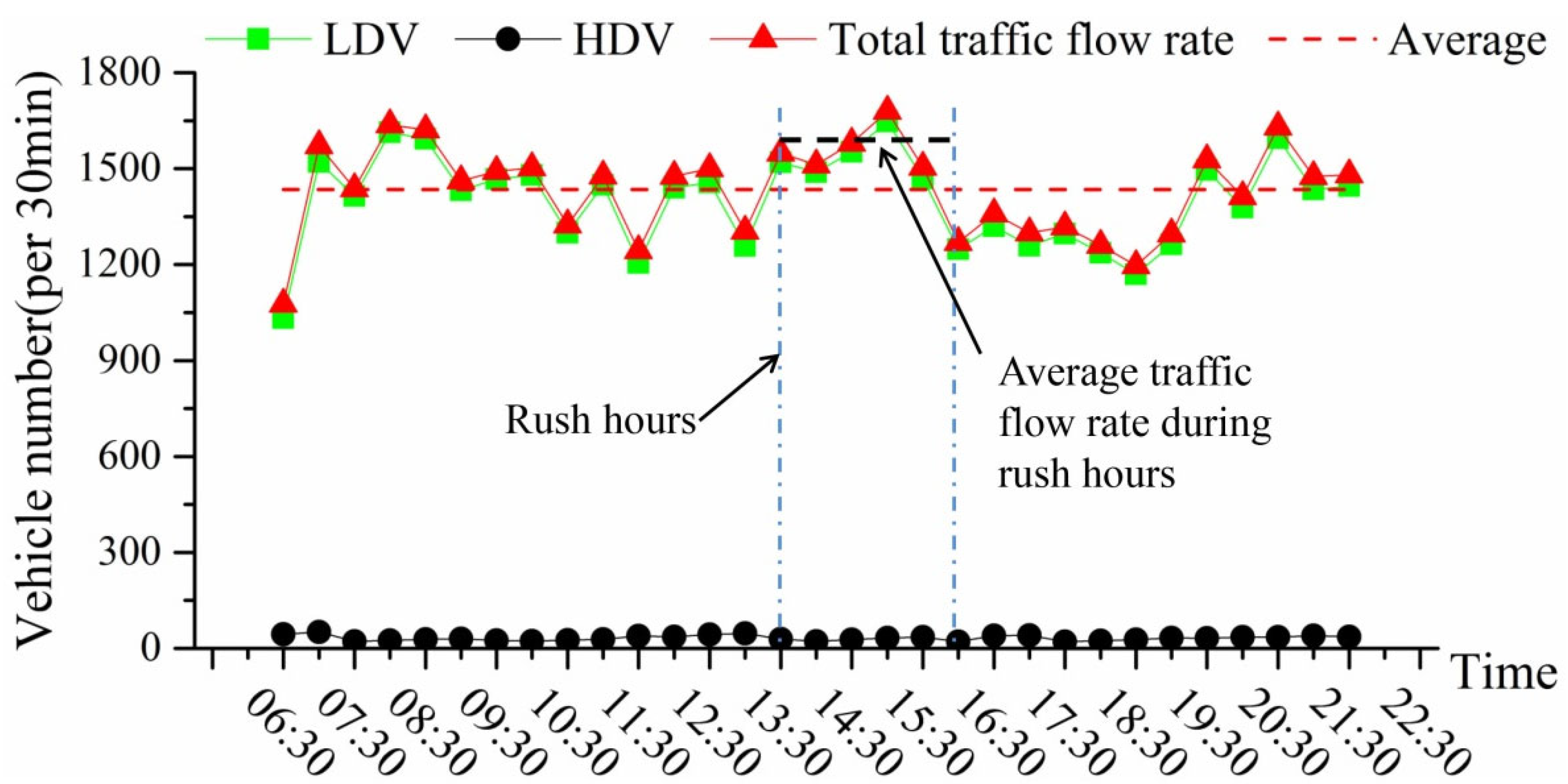
Traffic flow rates through the tunnels were monitored using two video cameras installed at the southern tunnel entrances. The footage was replayed on a computer to facilitate vehicle counting. Vehicles were categorized into two types: light-duty vehicles (LDVs) and heavy-duty vehicles (HDVs). Figure 2 presents the average traffic volume over three representative weekdays, with vehicle counts recorded every 30 min.
The plot indicates that LDV traffic fluctuated significantly, with peak volumes occurring between 13:30 and 15:30, rather than during the conventional morning or evening rush hours. In contrast, HDV traffic—comprising mostly diesel buses—exhibited a more stable pattern. This is likely because the Second Ring Road, located in the central area of Wuhan, is mainly served by buses operating on fixed schedules set by the public transportation authority.
The average traffic flow was found to be 1435 vehicles per half hour, with LDVs accounting for 97.8% and HDVs only 2.2%. Although emissions differ between petrol and diesel vehicles [40,41,42], the small proportion of HDVs suggests their emissions can be reasonably approximated by those of petrol vehicles. The red triangular plot in Figure 2 represents the total vehicle count, with the average traffic flow during rush hours reaching 1580 vehicles per half hour. This time window was therefore selected for subsequent analysis.
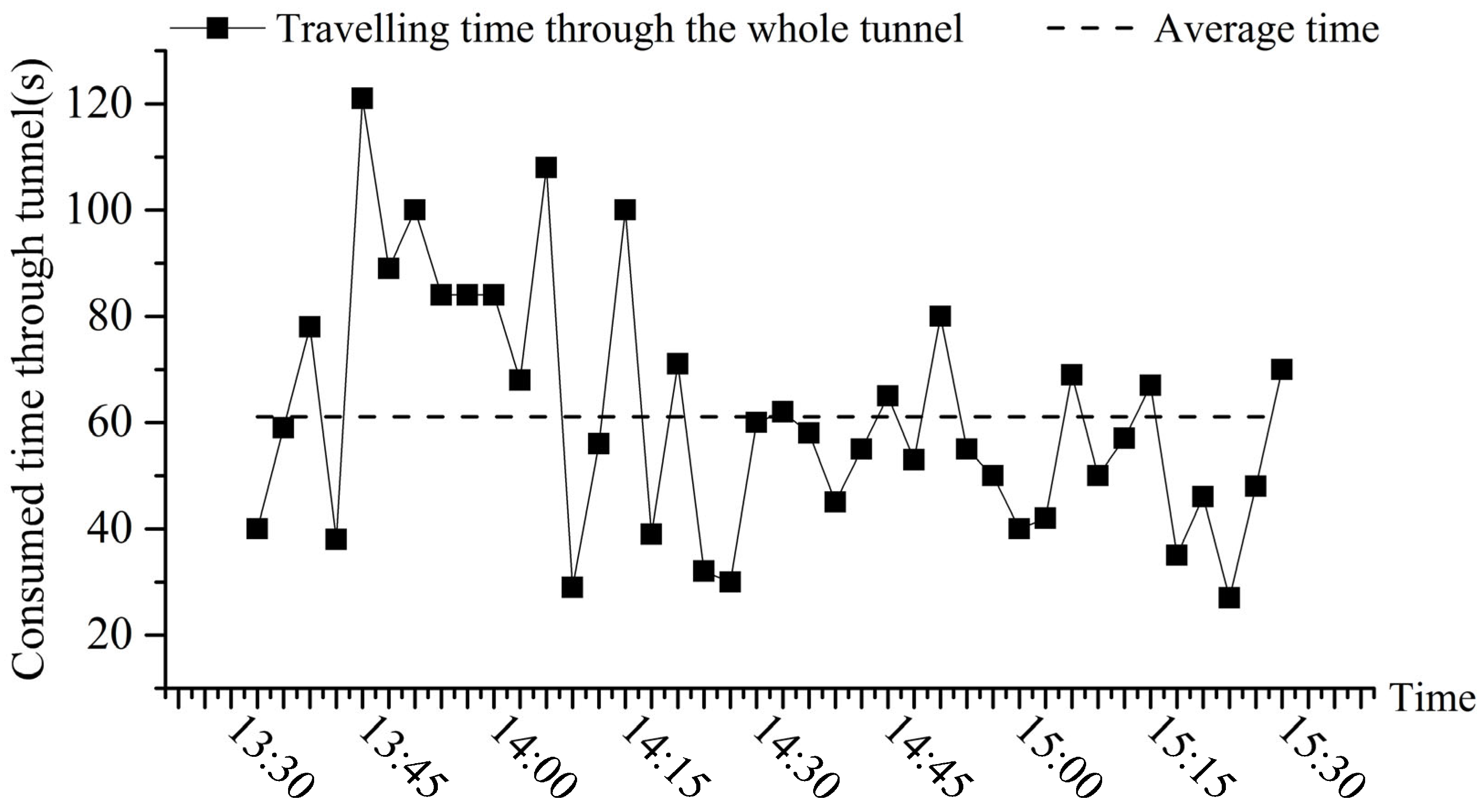
Every 3 min, a vehicle entering the tunnel is randomly selected to follow its time taken through the whole channel by the manual method. The data is then recorded and we plotted it in Figure 3. The dash line is the average time a car needed.
The plot showed that vehicles required a long time to traverse the tunnel, indicating extremely low travel speeds. During rush hours, vehicles repeatedly alternated between idling, stopping, and creeping forward. Under such conditions, the turbulence generated by vehicle movement was weak and highly intermittent, contributing negligibly to the overall airflow field inside the tunnel. Therefore, neglecting vehicle-induced turbulence was both reasonable and necessary for establishing the aerodynamic assumptions of the present study.

2.4.3. Pollutant Source Strength ( k g / ( m 3 · s ) )

According to Jimenez-Palacios [43], a mathematical model regarding the vehicle emission factor is carried out, Vehicle-Specific Power (VSP). The Vehicle-Specific Power (VSP) can realistically reflect the relationship between vehicle operating conditions and pollutant emissions. However, for the same VSP value, emissions exhibit significant variability. To reduce this scatter and facilitate emission analysis and prediction based on VSP, we divided VSP into discrete intervals (Bin) and calculated the mean emission rate (g/s) within each Bin as the representative emission rate.
Specifically, when analyzing the variation in pollutant emission rates with respect to VSP, the range of power per unit mass from −20–20 kW/t was divided into 18 bins with 2.5 kW/t increments (data beyond the range are assigned to the boundary bins). The mean emission rate for each Bin was then calculated. Using the collected emission data, we predicted vehicle emissions under different driving states based on VSP. The emission factor ( E F s ) for pollutant s over a road segment during a given period is calculated using the VSP-Bin emission rates and the corresponding frequency distribution within each bin, as shown in Equation (11):
E F s = m E R S m × D m v
where E F s is the emission factor of pollutant s (g/m) over a road segment during a given period, E R s m is the emission rate of pollutant s in Bin m (g/s), D m is the frequency of Bin m, and υ is the average speed over the road segment (m/s). According to Xu Junfang [44], the range of E R s m was obtained, with values of 0–0.05 g/s for CO and 0–0.005 g/s for NOx. To reduce model complexity and computational cost, a single-Bin approach was adopted ( D m = 1 ), using representative emission rates within the above ranges, and the corresponding emission rates were used: 0.02 g/s for CO and 1.09 × 10⁻⁴ g/s for NOx.
After obtaining emission factors for different pollutants, the per-second vehicle emission factor in the tunnel during congestion was calculated using Equation (12):
q s ( t ) = E F s ( t ) × N ( t ) A × 1000
where E F s represents the emission factor over a road segment during a given period (g/m), and N is the number of vehicles passing through the tunnel per second (s−1). A is the cross-sectional area of the tunnel ( m 2 ). Dividing this by the vertical cross-sectional area of the tunnel yields the volumetric emission factor within the tunnel, q s ( t ) . From the above description, it can be recognized as 2.43 × 10⁻⁶  k g / ( m 3 · s ) for CO pollutant source strength and 2.31 × 10⁻⁸  k g / ( m 3 · s ) for NOX pollutant source strength, which is used as the initial simulation value when computation is being conducted.

2.5. Mesh Skills and Verification

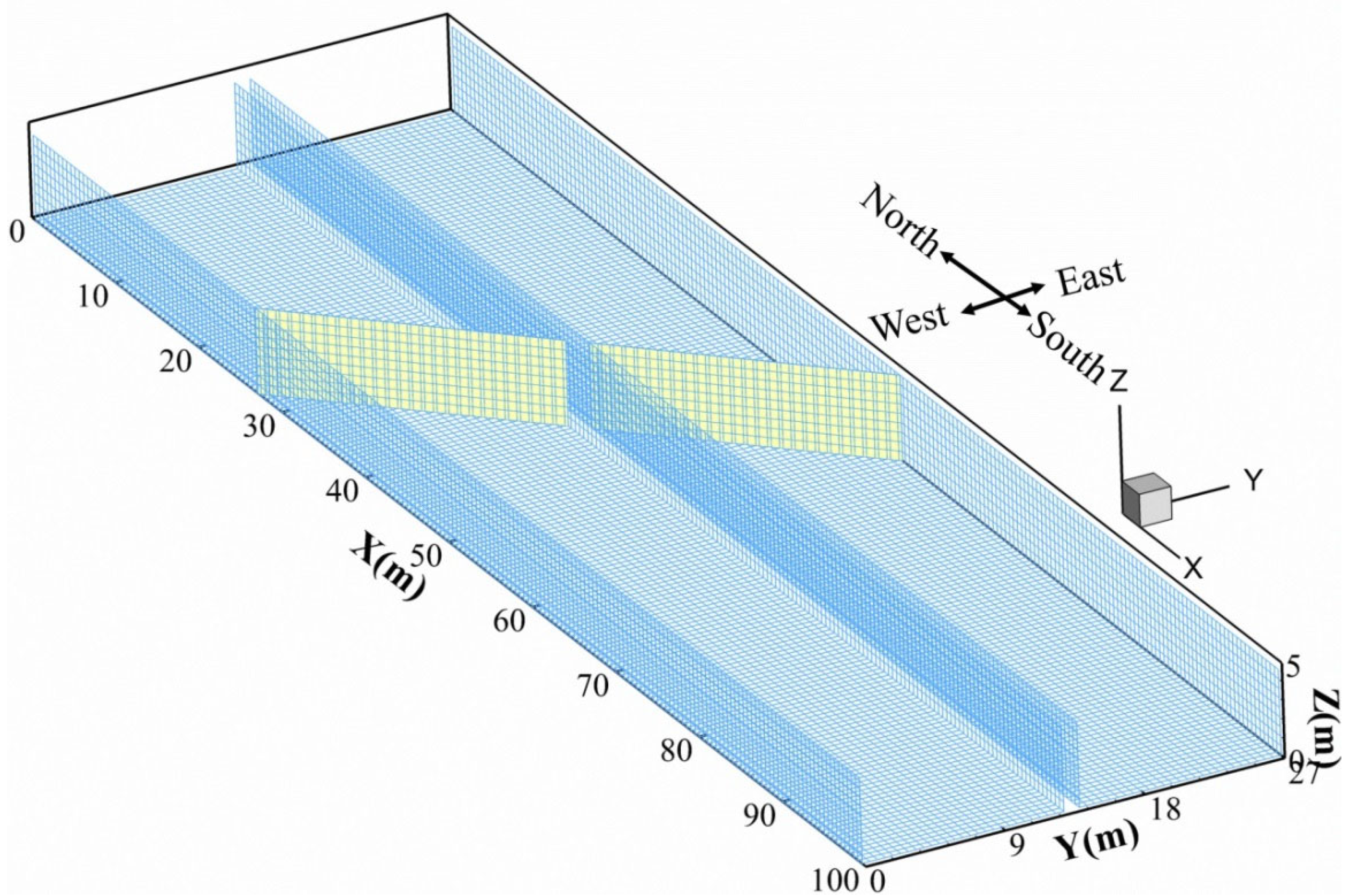
Given the high accuracy, fast generation, and simple data structure associated with structural grids [45,46], structured meshing was applied throughout the entire computational domain. As the NVVTs are the primary focus of this study, a highly refined mesh was established in this region [47]. The two tunnels were discretized using a large number of hexahedral elements (Figure 4), and bevel slices are provided to better illustrate the internal mesh structure. Considering the strong turbulence, grid spacing along the inlet and outlet zones—especially near the center of the model—was arranged sparsely but with a uniform stretching ratio. Similar meshing strategies were adopted for other simulation cases under different ACW directions.
Thanks to the appropriate grid arrangement, the simulation produced stable and reliable results. During the computation, the average velocity at one of the tunnel openings was continuously monitored and found to remain stable by the end of the simulation. Additionally, the residual errors, as previously mentioned, met the convergence criteria. Therefore, the results are considered credible.
To further validate the reliability of the simulation, a grid independence test was conducted using three different mesh densities for the domain, as summarized in Table 2. The table presents the variations in monitored parameters, such as velocity, across different mesh resolutions. Only minor fluctuations were observed, indicating that the solution is insensitive to mesh size. Taking into account both accuracy and computational efficiency, the mesh with 7,021,280 cells was selected for the final simulations, with an average speed of 0.974 m/s, and the corresponding results were used for analysis in this study.

3. Results and Discussion

3.1. Influence of Wind Direction

The influence of ACW directions on flow and pollutant dispersion in NVVTs under the same wind velocity ACW = 2.5 m/s was discussed. Existing studies have found that there has been a dramatical change in pollutant level in the object zone with the change in ACW directions [25,48]. Hence, it is necessary to investigate NVVTs’ features under different ACW directions.
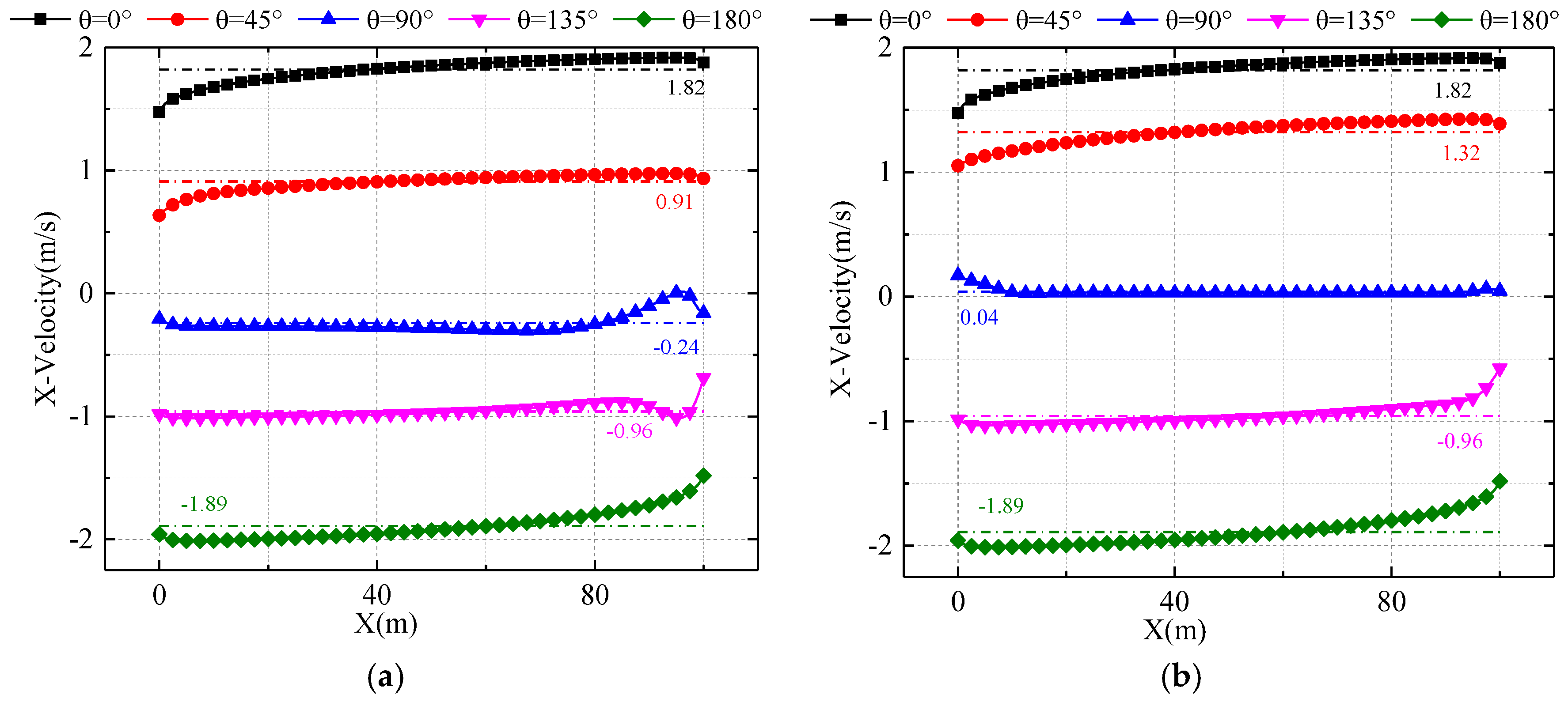
Figure 5 presents the X-component of velocity within the NVVTs. The dash-dot lines represent the mean velocity levels for each corresponding ACW direction, indicated by the same color. Clearly, the X-direction velocity serves as the primary driving force for pollutant transport out of the tunnels, as airflow in the Y- and Z-directions is significantly constrained by the surrounding tunnel walls and ceiling. Therefore, analyzing the x-component of velocity is particularly important, as it directly influences both the concentration levels and transport pathways of the pollutants.
It is evident that, overall, the airflow velocity inside the tunnels is positively correlated with the x-component of the approaching wind (ACW). Although negative values occasionally appear—indicating airflow from south to north (negative X-direction)—the absolute values of velocity remain relatively high. If the five ACW directions are categorized into three groups based on the absolute value of their x-component, ACW = 0° and ACW = 180° fall into the highest category, ACW = 45° and ACW = 135° into the middle, and ACW = 90° into the lowest. Correspondingly, the pollutant levels within the NVVTs can be anticipated to be lowest under ACW directions in the top category, as stronger longitudinal airflow facilitates pollutant dispersion. In contrast, ACW = 90°, with the weakest x-component, is expected to result in the highest pollutant concentrations due to reduced ventilation efficiency.
A clear feature can be observed by comparing Figure 5a,b: in both tunnels, the velocity profiles under ACW = 0° and ACW = 180° show nearly identical trends, including their mean values. This similarity arises from the geometric symmetry of the model along the X-axis when the ACW direction is aligned with it. Minor differences appear near the tunnel openings. When ACW = 180°, airflow encounters the sunken bus stop area at the southern end of the domain and is forced to enter the tunnel and then rise toward the upper region. Under ACW = 0°, the airflow follows a similar path; however, due to the wider volume of the bus stop area in the south—compared to the narrower opening-style underground road in the north—the southern configuration allows for slightly higher airflow velocity. This difference in the adjacent geometries at the tunnel inlets accounts for the increased velocity observed under ACW = 180°.
Another notable observation is found in the cases of ACW = 45° and ACW = 135°, where both positive and negative values of the x-component velocity are present. For ACW = 45°, the velocity along line X2 is slightly higher than that along X1. This can be explained by the interaction between the ACW direction and the physical geometry of the domain. Since ACW = 45° forms an acute angle with the positive X-axis, airflow is deflected upon reaching the eastern side wall—perpendicular to the northern underground road—and is then guided along the wall’s surface before entering the east tunnel. This redirection enhances the inflow into the east tunnel compared to the west tunnel, resulting in higher velocities. In contrast, under ACW = 135°, this effect does not occur because the southern opening geometry lacks a corresponding deflective structure, thereby leading to a more balanced distribution of airflow between the two tunnels.
It is worth noting that under ACW = 90°, the X-velocity along both X1 and X2 lines exhibits both positive and negative values. Specifically, the average velocity on the X1 line is negative, while it is positive on the X2 line, indicating that airflow within the two tunnels moves in opposite directions. Additionally, the relatively lower absolute velocity on the X2 line suggests poorer ventilation performance in the downstream tunnel, implying that pollutant removal is more difficult in that region. Furthermore, a gentle velocity peak appears on the X1 line near the southern opening of the west tunnel. This can be attributed to the formation of vortices in the tunnel entrance region—a well-known phenomenon—as the airflow near tunnel openings is highly complex [49]. The X1 line intersects the vortex zone, resulting in a localized velocity increase. Overall, the flow patterns inside the tunnels under ACW = 90° are notably varied and complex. A more detailed analysis of this case will be provided in the following sections.
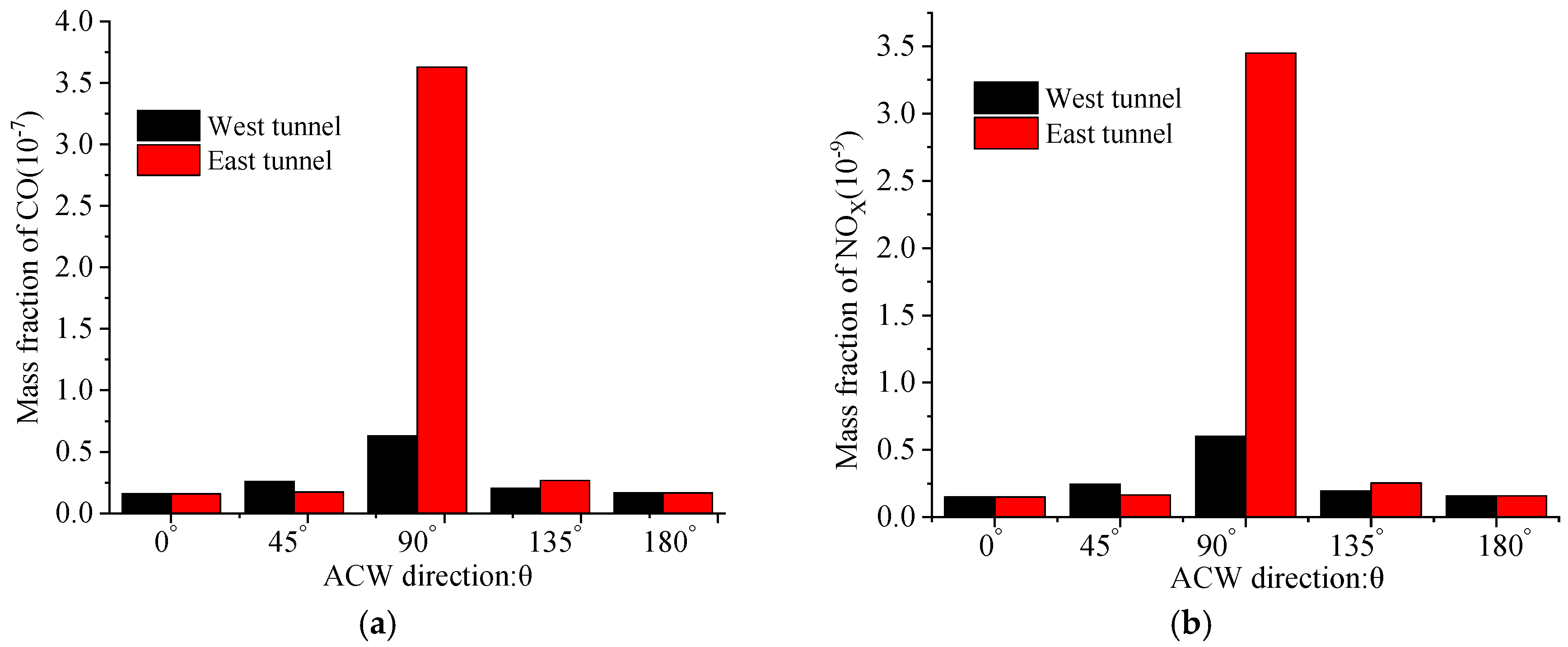
The histogram in Figure 6 shows the average concentrations of CO and NOx across the entire double-hole tunnel system. Overall, both pollutants exhibit similar variation trends under different ACW directions. In particular, the highest pollutant levels in both the east and west tunnels occur when the ACW is perpendicular to the tunnel axis, which confirms earlier predictions. The pollutant concentration in the east tunnel is over one order of magnitude higher than in the west tunnel, due to the poor ventilation caused by the interaction between ACW direction and tunnel geometry. For ACW = 0° and ACW = 180°, both CO and NOx levels in the two tunnels are nearly equal and lowest among all cases, again due to favorable ventilation. In the cases of ACW = 45° and ACW = 135°, slight differences exist, and the relative pollutant levels in the two tunnels are reversed. In summary, ACWs parallel to the tunnels provide the strongest ventilation force, resulting in up to a 21.8-fold reduction in CO concentration in the east tunnel and a 3-fold reduction in the west tunnel, with similar trends for NOx.

3.2. Influence of Wind Velocity

Previous research has indicated that wind speed has a great influence on contamination level, especially in mechanically ventilated tunnels with all fans on or off. In fact, NVTT has similar characters, whereas the reasons for the airflow driving force are different. In this way, ACW direction is fixed as θ = 90° and as a west wind; specific features and origins of velocity and pollutant dispersion will be exhibited in detail under four different ACW velocities.
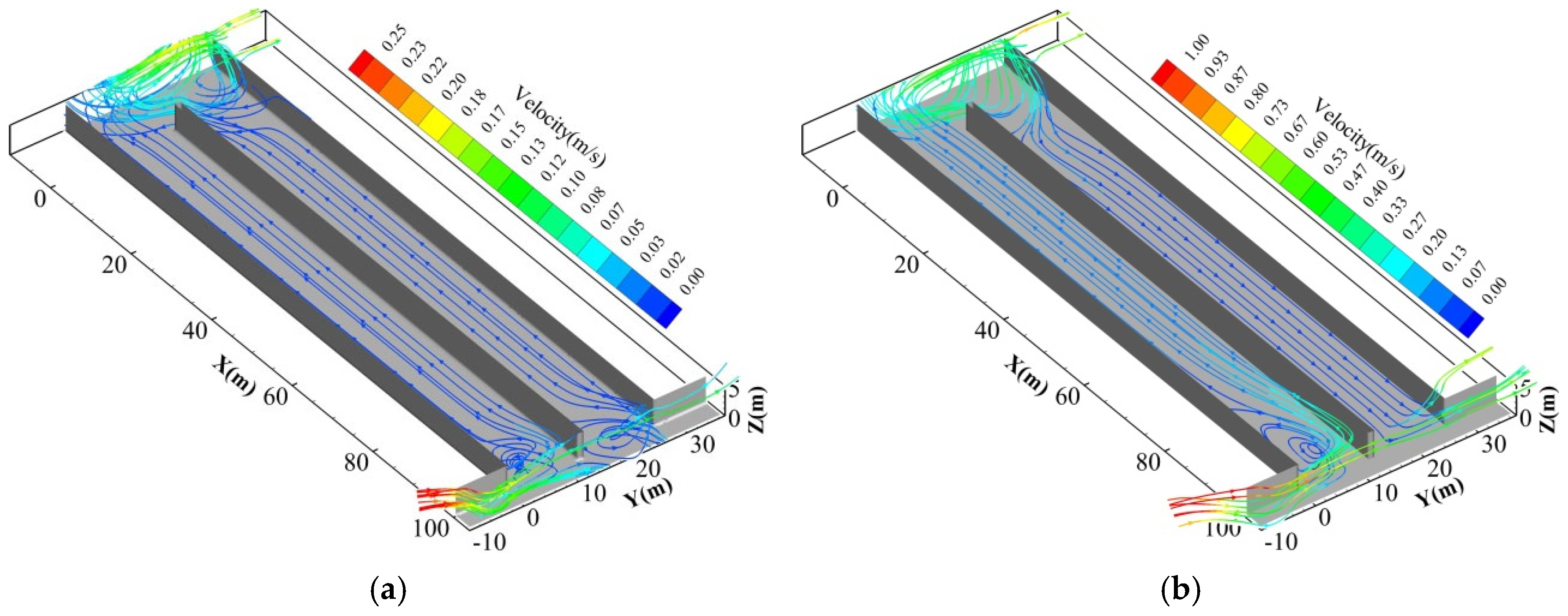
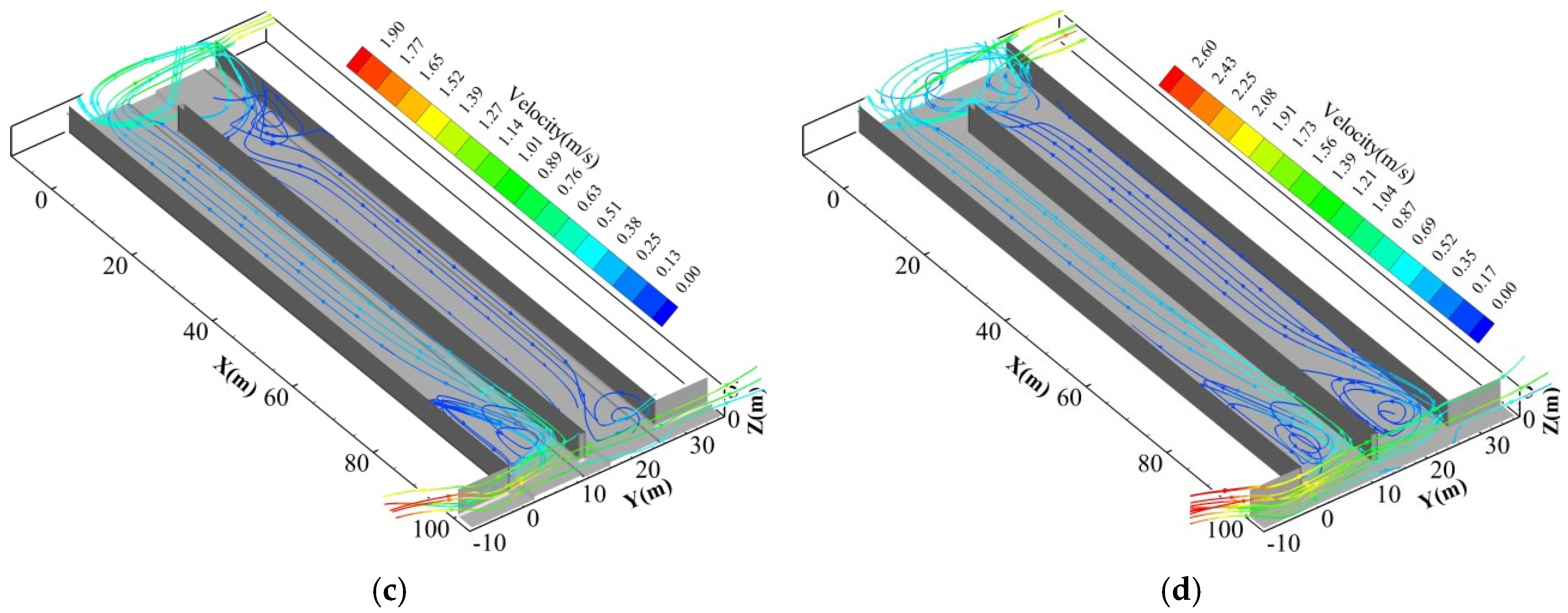
Figure 7 shows the streamlines within the two tunnels. Vortices appear near the tunnel openings, with one or two forming in each tunnel depending on the ACW velocity. A vortex is also observed outside the north opening area. Due to the different geometric features of the adjacent zones on the south and north sides of the NVVT, the vortex structures vary noticeably. Overall, the incoming airflow from the sunken bus stop area turns sharply and forms counterclockwise circulation in the west tunnel, moving from south to north. Notably, in the west tunnel, the airflow consistently moves from south to north regardless of the ACW velocity. In contrast, the flow direction in the east tunnel changes with wind speed: it flows from south to north when ACW = 0.5 m/s and 3.5 m/s, but reverses under the other two conditions.
Regardless of the ACW velocity, a counterclockwise vortex consistently forms near the south exit of the west tunnel. The vortex axis is nearly vertical to the ground, and both its intensity and influence area increase with higher ACW velocities. This vortex is mainly generated by the deflection of the westward airflow outside the tunnel near its southern opening, where it circulates into the tunnel and moves northward along its length, eventually forming a secondary vortex near the north end with a horizontal axis. In contrast, the vortex structure in the east tunnel differs significantly. First, vortices do not always appear. Second, the number varies: the west tunnel consistently exhibits a single vortex, whereas the east tunnel may exhibit none, one, or even two vortices depending on the ACW velocity. Despite these differences, all observed vortices share a common feature—their counterclockwise rotation.
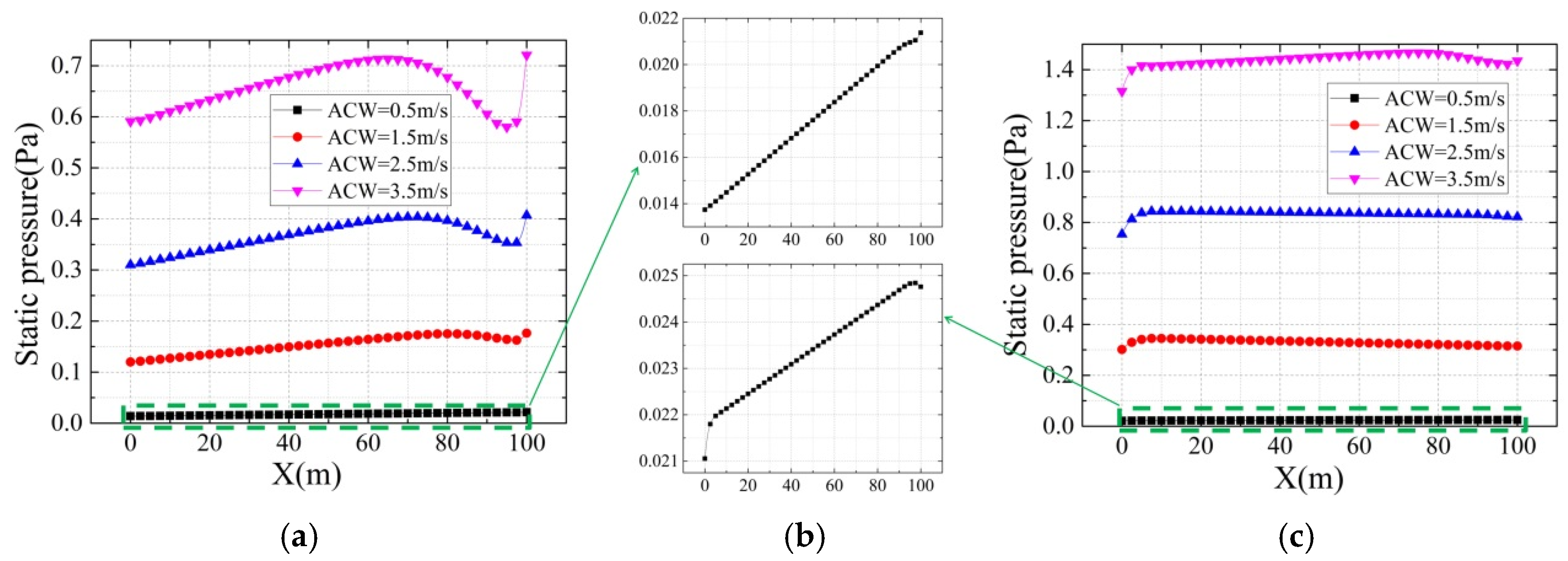
These flow structures are critical, as changes in wind direction have a significant impact on pollutant dispersion. To better understand the underlying flow mechanisms, the static pressure distributions along lines X1 and X2 are analyzed and presented in Figure 8.
Figure 8 presents the static pressure curves along lines X1 and X2, reflecting the pressure distribution within the tunnels. Figure 8b is a partial enlargement of Figure 8a,c, highlighting subtle pressure variations. Overall, higher ACW velocities lead to increased static pressure. In Figure 8a, all four curves show a general increase in pressure along the positive X-axis, which drives airflow toward the north. The pressure fluctuations observed near the south exit of the west tunnel are caused by the vortex, where sharp pressure gradients occur [50]. Stronger vortices influence a larger surrounding area, leading to more pronounced fluctuations at higher ACW speeds. In Figure 8c, the four curves exhibit inconsistent trends, indicating that the airflow direction in the east tunnel changes with ACW velocity. At ACW = 0.5 m/s and 3.5 m/s, the pressure decreases from south to north, inducing northward flow. In contrast, the other two ACW conditions result in increasing pressure toward the north, causing southward flow. These pressure differences in both tunnels stem from the asymmetrical geometry of the areas adjacent to the tunnel openings in the NVVT system.
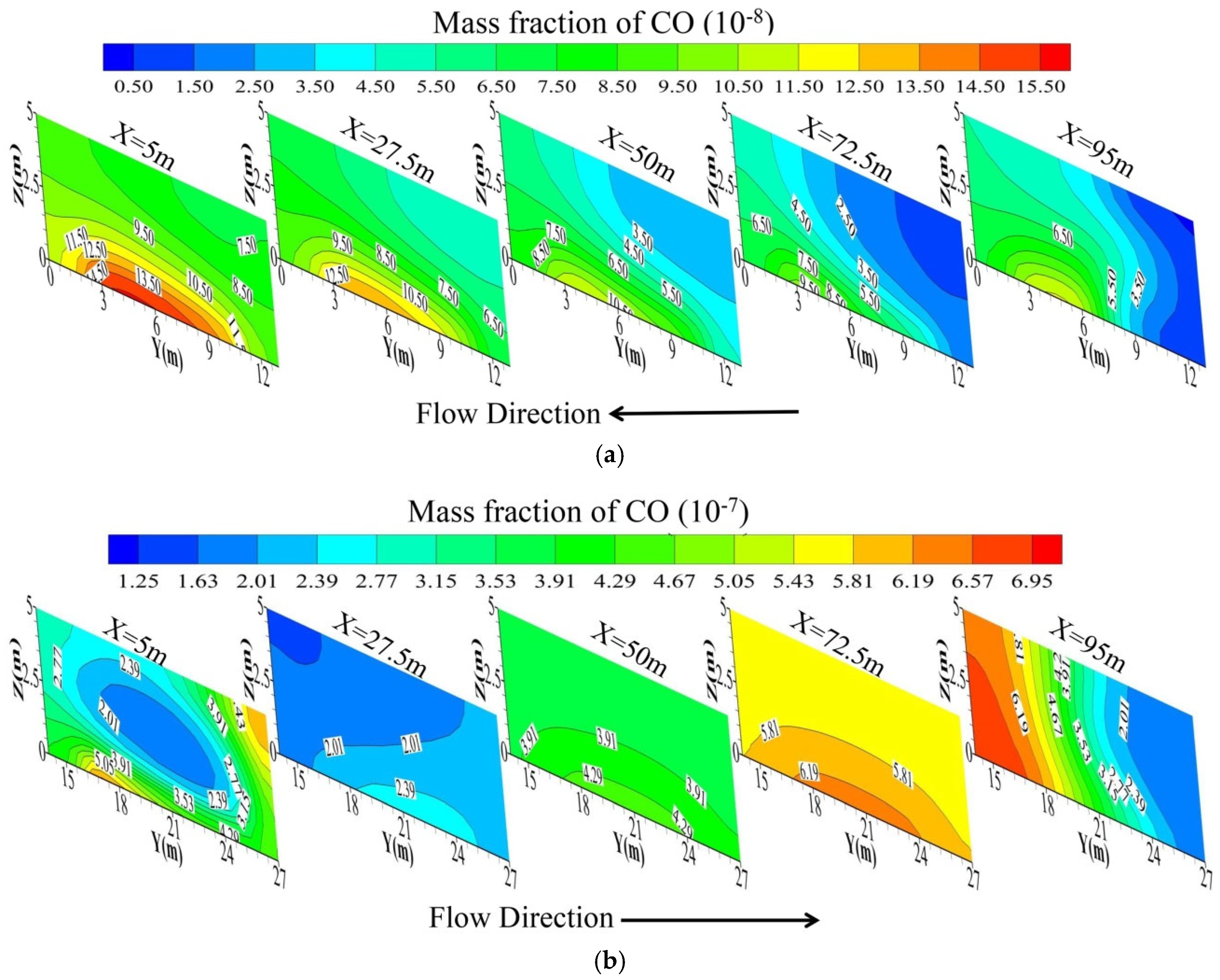
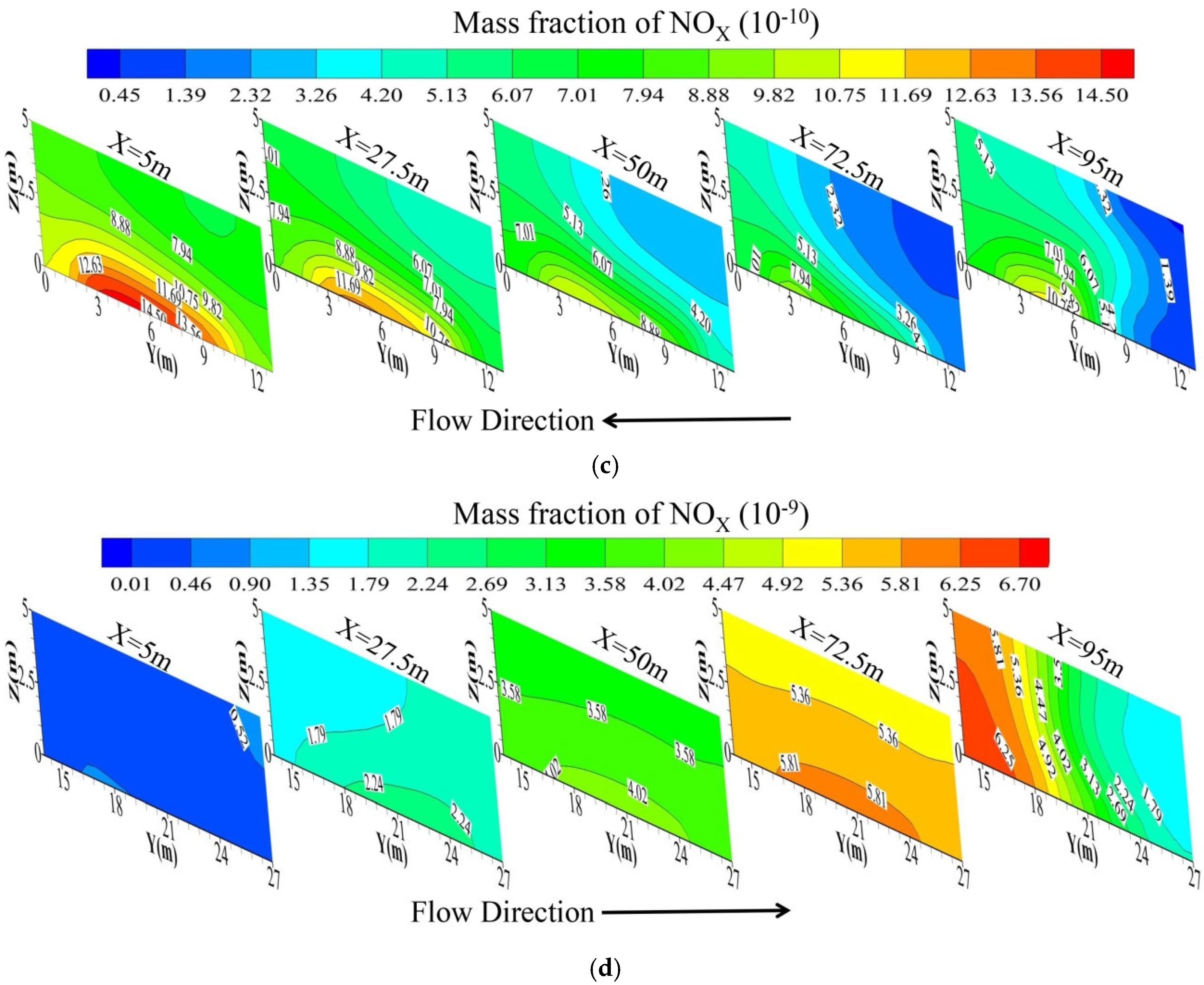
Figure 9 shows the contours of CO and NOx concentrations on a series of planes parallel and perpendicular to the X-axis within both tunnels under ACW = 90°. The color legend for CO indicates that the mass fraction in the east tunnel is over one order of magnitude higher than that in the west tunnel—a trend similarly observed for NOx, though with different classification scales. This pattern is consistent with the results shown in Figure 6 for both pollutants. All subfigures reveal that high pollutant concentrations, whether CO or NOx, are primarily concentrated near the tunnel floor, which corresponds to the roadway where vehicle exhaust is emitted. This distribution aligns with the volume source settings in the model along the tunnel length.
In the west tunnel, near the inlet zone at X = 95 m, pollutant dispersion exhibits both x-component and y-component stratification, particularly near the east wall. As shown in Figure 7, the vortex outside the north opening plays a key role in forming this vertical layering pattern. However, as the airflow moves downstream, much of the vertical stratification gradually transforms into x-component layers. The deeper the airflow penetrates, the more pronounced this transformation becomes. In contrast, the stratification pattern in the east tunnel displays distinct characteristics. At X = 5 m, near the entrance, the layering is notably complex, with a sunken, oval-shaped concentration zone forming as the airflow enters the tunnel. As the flow progresses to the midsection (X = 27.5 m, X = 50 m, and X = 72.5 m), x-component stratification becomes dominant. When the airflow reaches the south opening at X = 95 m, the influence of the vortices both outside and inside the tunnel (see Figure 7c) leads to a predominantly vertical stratification pattern.
Another noteworthy phenomenon regarding CO and NOx concentrations is their accumulation along the downwind direction of the tunnel. For instance, in the west tunnel where airflow moves from south to north, the average mass fractions of CO and NOx on the X = 95 m plane are 5.09 × 10⁻⁸ and 4.85 × 10⁻¹⁰, respectively. In contrast, at X = 5 m, these values increase to 1.01 × 10⁻⁷ and 9.60 × 10⁻¹⁰, approximately twice as high. This accumulation is mainly attributed to the flow characteristics. Fresh air entering the tunnel from the outside initially dilutes the vehicle exhaust effectively. However, as the air continues to move downstream, it gradually absorbs CO and NOx, leading to higher pollutant concentrations further inside the tunnel. This distribution is clearly reflected in the corresponding figures, as indicated by the color gradients in the legends.

4. Conclusions

In this study, the effects of different approaching cross wind (ACW) directions and velocities on airflow and pollutant dispersion within the NVVTs were systematically analyzed. The following conclusions were drawn from our analysis.
(1)
The direction of the approaching wind (ACW) had a significant impact on both airflow characteristics and pollutant distribution. Among all tested cases, ACW = 0° and 180° produced the largest x-component of velocity, followed by ACW = 45° and 135°, while ACW = 90° resulted in the weakest x-component airflow.
(2)
The x-component of ACW drove the airflow through the tunnels, determining both pollutant concentrations and migration directions. Pollutant accumulation was most pronounced under ACW = 90°, with CO and NOx concentrations increasing by factors of approximately 3 and 21.8 in the west and east tunnels, respectively, compared to the cases with ACW = 0° or 180°.
(3)
Higher ACW velocities led to increased static pressure. In the west tunnel, the airflow consistently moved from south to north regardless of ACW speed. In contrast, the airflow direction in the east tunnel varied with ACW velocity, flowing northward at 0.5 m/s and 3.5 m/s and reversing at other speeds.

Author Contributions

Conceptualization, C.C.; methodology, C.C.; software, C.C.; validation, C.C. and X.Y. (Xinyi Yang); formal analysis, C.C. and X.Y. (Xinyi Yang); investigation, X.Y. (Xinyi Yang), X.Y. (Xitong Yuan), T.S. and T.M.; resources, T.M.; data curation, X.Y. (Xinyi Yang), X.Y. (Xitong Yuan) and T.M.; writing—original draft preparation, C.C.; writing—review and editing, T.S., W.L. (Wenyu Li), W.L. (Wenting Lin) and T.M.; visualization, X.Y. (Xitong Yuan); supervision, W.L. (Wenyu Li), W.L. (Wenting Lin) and T.M. All authors have read and agreed to the published version of the manuscript.

Funding

This research was funded by “Study on pollutant dispersion and multi-field coupling mechanisms in complex urban street canyon environments” (National Natural Science Foundation of China, No. 51778511).

Institutional Review Board Statement

Not applicable.

Informed Consent Statement

Not applicable.

Data Availability Statement

The data presented in this study are available on request from the corresponding author. The data are not publicly available due to privacy.

Acknowledgments

The authors would like to appreciate the junior researchers that are former and current members of our team; thanks for their guidance and help.

Conflicts of Interest

The authors declare that they have no known competing financial interests or personal relationships that could have appeared to influence the work reported in this paper.

Nomenclature

Latin symbols
u j average   flow   rate ,   m / s
u j pulse   value   of   flow   velocity ,   m / s
c s volume   concentration   of   the   component   S ,   k g / m 3
D s diffusion coefficient of the component S
q s the   mass   of   component   S   produced   per   unit   volume   and   time ,   k g / ( m 3 · s )
T temperature ,   K
f i mass   stress ,   N / k g
P pressure ,   P a
t time ,   s
G k shear   force   generation   item ,   N
E F i exhaust factor
A area ,   m 2
q i ( t ) source   strength   of   pollutant   i ,   k g / ( m 3 · s )
μ t turbulence viscosity coefficient
Greek symbols
ρ fluid   density ,   k g / m 3
μ kinematic   viscosity ,   ( N · s ) / m 2
κ kinetic   energy ,   J
ε turbulence dissipation rate
u i u j ¯ average   Reynolds   stress ,   N / m 2
λ thermal   conductivity ,   W / ( m · K )
β volume   expansion   coefficient   K 1
Subscripts
effeffective value
sthe sth contaminate
gragradient
mThe frequency distribution in the mth VSP-Bin

References

  1. d’Orey, P.M.; Ferreira, M. ITS for Sustainable Mobility: A Survey on Applications and Impact Assessment Tools. IEEE Trans. Intell. Transp. Syst. 2014, 15, 477–493. [Google Scholar] [CrossRef]
  2. Boikos, C.; Ioannidis, G.; Rapkos, N.; Tsegas, G.; Katsis, P.; Ntziachristos, L. Estimating daily road traffic pollution in Hong Kong using CFD modelling: Validation and application. Build. Environ. 2025, 267, 112168. [Google Scholar] [CrossRef]
  3. Chen, J.; Wang, W.; Zhang, J.; Liu, H.; Ren, L.; Liu, X.; Zhang, W.; Wang, X. Characteristics of gaseous pollutants near a main traffic line in Beijing and its influencing factors. Atmos. Res. 2009, 94, 470–480. [Google Scholar] [CrossRef]
  4. Holnicki, P.; Nahorski, Z.; Kałuszko, A. Impact of Vehicle Fleet Modernization on the Traffic-Originated Air Pollution in an Urban Area—A Case Study. Atmosphere 2021, 12, 1581. [Google Scholar] [CrossRef]
  5. Shima, M. Epidemiological studies on the health impact of air pollution in Japan: Their contribution to the improvement of ambient air quality. Environ. Health Prev. Med. 2025, 30, 30. [Google Scholar] [CrossRef] [PubMed]
  6. Delfino, R.J.; Wu, J.; Tjoa, T.; Gullesserian, S.K.; Nickerson, B.; Gillen, D.L. Asthma morbidity and ambient air pollution: Effect modification by residential traffic-related air pollution. Epidemiology 2014, 25, 48–57. [Google Scholar] [CrossRef] [PubMed]
  7. Peterson, S.B.; Michalek, J.J. Cost-effectiveness of plug-in hybrid electric vehicle battery capacity and charging infrastructure investment for reducing US gasoline consumption. Energy Policy 2013, 52, 429–438. [Google Scholar] [CrossRef]
  8. Cairns, S. Accessing Cars: Different Ownership and Use Choices; Car Sharing; RAC Foundation: London, UK, 2011. [Google Scholar]
  9. Wang, P.; Zhang, R.; Sun, S.; Gao, M.; Zheng, B.; Zhang, D.; Zhang, Y.; Carmichael, G.R.; Zhang, H. Aggravated air pollution and health burden due to traffic congestion in urban China. Atmos. Chem. Phys. 2023, 23, 2983–2996. [Google Scholar] [CrossRef]
  10. Lee, H.-W.; Popkov, V.; Kim, D. Two-way traffic flow: Exactly solvable model of traffic jam. J. Phys. A Gen. Phys. 1997, 30, 8497. [Google Scholar] [CrossRef]
  11. Long, J.; Gao, Z.; Zhao, X.; Lian, A.; Orenstein, P. Urban Traffic Jam Simulation Based on the Cell Transmission Model. Netw. Spat. Econ. 2011, 11, 43–64. [Google Scholar] [CrossRef]
  12. Shi, J. Analysis and Comprehensive Evaluation on Traffic Pollution at Urban Road Intersection. Ph.D. Thesis, Jilin University, Changchun, China, 2012. [Google Scholar]
  13. Cao, X.; Yao, Z.; Shen, X.; Ye, Y.; Jiang, X. On-road emission characteristics of VOCs from light-duty gasoline vehicles in Beijing, China. Atmos. Environ. 2015, 124, 146–155. [Google Scholar] [CrossRef]
  14. Kota, S.H.; Zhang, H.; Chen, G.; Schade, G.W.; Ying, Q. Evaluation of on-road vehicle CO and NO x National Emission Inventories using an urban-scale source-oriented air quality model. Atmos. Environ. 2014, 85, 99–108. [Google Scholar] [CrossRef]
  15. Pu, Y.; Yang, C.; Liu, H.; Chen, Z.; Chen, A. Impact of license plate restriction policy on emission reduction in Hangzhou using a bottom-up approach. Transp. Res. Part D Transp. Environ. 2015, 34, 281–292. [Google Scholar] [CrossRef]
  16. Chung, C.Y.; Chung, P.L. A Numerical and Experimental Study of Pollutant Dispersion in a Traffic Tunnel. Environ. Monit. Assess. 2007, 130, 289. [Google Scholar] [CrossRef]
  17. Chen, K.S.; Chung, C.Y.; Wang, S.W. Measurement and three-dimensional modeling of airflow and pollutant dispersion in an undersea traffic tunnel. J. Air Waste Manag. Assoc. 2002, 52, 349. [Google Scholar] [CrossRef]
  18. Matbouli, Y.T.; Husain, T. Air Pollution Dispersion in Traffic Tunnels: A Case Study of SOUK SAGHEER Traffic Tunnel, Makkah, Saudi Arabia. In Proceedings of the Air and Waste Management Association 2010, 103rd Conference and Exhibition, Calgary, AB, Canada, 22–25 June 2010; pp. 263–269. [Google Scholar]
  19. Dong, J.; Tao, Y.; Xiao, Y.; Tu, J. Numerical simulation of pollutant dispersion in urban roadway tunnels. J. Comput. Multiph. Flows 2017, 9, 26–31. [Google Scholar] [CrossRef]
  20. Li, Q.; Chen, C.; Deng, Y.; Li, J.; Xie, G.; Li, Y.; Hu, Q. Influence of traffic force on pollutant dispersion of CO, NO and particle matter (PM 2.5) measured in an urban tunnel in Changsha, China. Tunn. Undergr. Space Technol. Inc. Trenchless Technol. Res. 2015, 49, 400–407. [Google Scholar] [CrossRef]
  21. Li, H.C.; Chen, K.S.; Lai, C.H.; Wang, H.K. Measurements of Gaseous Pollutant Concentrations in the Hsuehshan Traffic Tunnel of Northern Taiwan. Aerosol Air Qual. Res. 2011, 11, 776–782. [Google Scholar] [CrossRef]
  22. Kristensson, A.; Johansson, C.; Westerholm, R.; Swietlicki, E.; Gidhagen, L.; Wideqvist, U.; Vesely, V. Real-world traffic emission factors of gases and particles measured in a road tunnel in Stockholm, Sweden. Atmos. Environ. 2004, 38, 657–673. [Google Scholar] [CrossRef]
  23. Colberg, C.A.; Tona, B.; Catone, G.; Sangiorgio, C.; Stahel, W.A.; Sturm, P.; Staehelin, J. Statistical analysis of the vehicle pollutant emissions derived from several European road tunnel studies. Atmos. Environ. 2005, 39, 2499–2511. [Google Scholar] [CrossRef]
  24. Bari, S.; Naser, J. Simulation of airflow and pollution levels caused by severe traffic jam in a road tunnel. Tunn. Undergr. Space Technol. 2010, 25, 70–77. [Google Scholar] [CrossRef]
  25. Dou, H.; Ming, T.; Li, Z.; Peng, C.; Zhang, C.; Fu, X. Numerical simulation of pollutant dispersion characteristics in a three-dimensional urban traffic system. Atmos. Pollut. Res. 2018, 9, 735–746. [Google Scholar] [CrossRef]
  26. Wei, L.X.; Liu, F.; Chen, Y.P. Actuality and Prospects of Construction Techniques of Urban Traffic Tunnels in Guangzhou. Tunn. Constr. 2007, 27, 4–8. [Google Scholar]
  27. Solazzo, E.; Cai, X.; Vardoulakis, S. Modelling wind flow and vehicle-induced turbulence in urban streets. Atmos. Environ. 2008, 42, 4918–4931. [Google Scholar] [CrossRef]
  28. Kim, J. A numerical study of the effects of ambient wind direction on flow and dispersion in urban street canyons using the RNG k?? turbulence model. Atmos. Environ. 2004, 38, 3039–3048. [Google Scholar] [CrossRef]
  29. Vidanapathirana, M.; Perera, N.; Emmanuel, R.; Coorey, S. Air pollutant dispersion around high-rise building cluster forms: The case of Port City, Colombo, Sri Lanka. Environ. Sci. Pollut. Res. Int. 2023, 30, 94166–94184. [Google Scholar] [CrossRef]
  30. Zheng, X.; Yang, J. Impact of moving traffic on pollutant transport in street canyons under perpendicular winds: A CFD analysis using large-eddy simulations. Sustain. Cities Soc. 2022, 82, 103911. [Google Scholar] [CrossRef]
  31. Gromke, C.; Buccolieri, R.; Di Sabatino, S.; Ruck, B. Dispersion study in a street canyon with tree planting by means of wind tunnel and numerical investigations—Evaluation of CFD data with experimental data. Atmos. Environ. 2008, 42, 8640–8650. [Google Scholar] [CrossRef]
  32. Zheng, X.; Yang, J. CFD simulations of wind flow and pollutant dispersion in a street canyon with traffic flow: Comparison between RANS and LES. Sustain. Cities Soc. 2021, 75, 103307. [Google Scholar] [CrossRef]
  33. Ahmadi, M.; Mirjalily, S.A.A.; Oloomi, S.A.A. Simulation of pollutant dispersion in urban street canyons using hybrid rans-les method with two-phase model. Comput. Fluids 2020, 210, 104676. [Google Scholar] [CrossRef]
  34. Wei, Q.; Chen, H.; Ma, Z. Numerical Simulation of Flow Around Airfoil with Non-Linear RANS Model. In Proceedings of the ASME/JSME/KSME 2015 Joint Fluids Engineering Conference, Seoul, Republic of Korea, 26–31 July 2015. [Google Scholar]
  35. Zhong, J.; Cai, X.M.; Bloss, W.J. Coupling dynamics and chemistry in the air pollution modelling of street canyons: A review. Environ. Pollut. 2016, 214, 690–704. [Google Scholar] [CrossRef] [PubMed]
  36. Shi, T.; Ming, T.; Wu, Y.; Peng, C.; Fang, Y.; de_Richter, R. The effect of exhaust emissions from a group of moving vehicles on pollutant dispersion in the street canyons. Build. Environ. 2020, 181, 107120. [Google Scholar] [CrossRef]
  37. Chen, C. Analysis of variation of wind speed at low-altitude in Wuhan from 1958 to 2013. Resoures Environ. Yangtze Bassize 2015, 24, 30–37. [Google Scholar]
  38. Li, X.; Li, G.; Pang, S.S.; Yang, X.; Tian, J. Signal timing of intersections using integrated optimization of traffic quality, emissions and fuel consumption: A note. Transp. Res. Part D 2004, 9, 401–407. [Google Scholar] [CrossRef]
  39. Mensink, C.; Nys, J.D.V.I. An urban transport emission model for the Antwerp area. Atmos Environ. Atmos. Environ. 2000, 34, 4595–4602. [Google Scholar] [CrossRef]
  40. Alves, C.A.; Barbosa, C.; Rocha, S.; Calvo, A.; Nunes, T.; Cerqueira, M.; Pio, C.; Karanasiou, A.; Querol, X. Elements and polycyclic aromatic hydrocarbons in exhaust particles emitted by light-duty vehicles. Environ. Sci. Pollut. Res. 2015, 22, 11526–11542. [Google Scholar] [CrossRef] [PubMed]
  41. Jafari, A.J. A Comparison of Major Pollutants Emission from Petrol and Diesel Car Exhaust. Avicenna J. Clin. Med. 2003, 9, 43–49. [Google Scholar]
  42. Greenwood, S.J.; Coxon, J.E.; Biddulph, T.; Bennett, J. An investigation to determine the exhaust particulate size distributions for diesel, petrol, and compressed natural gas fuelled vehicles. SAE Trans. 1996, 105, 640–646. [Google Scholar]
  43. Jiménez-Palacios, J.L. Understanding and Quantifying Motor Vehicle Emissions with Vehicle Specific Power and TILDAS Remote Sensing. Ph.D. Thesis, Massachusetts Institute of Technology, Cambridge, MA, USA, 1999. [Google Scholar]
  44. Xu, J. Emission Factor Model Database of Light-Duty Vehicles. Master’s Thesis, Wuhan University of Technology, Wuhan, China, 2009. [Google Scholar]
  45. Yu, J.; Xiao, J.; Zhu, Z. Parallel multi-grid algorithm and its performance of fluent software. J. Wuhan Univ. Technol. 2009, 33, 133–136. [Google Scholar]
  46. Ansys Inc. Ansys Fluent Tutorial Guide; Ansys Inc.: Canonsburg, PA, USA, 2012. [Google Scholar]
  47. Zhao, Y.; Wang, P.; Ma, L.; Zhang, J. Prediction of pollutants dispersion patterns around two adjacent urban road tunnels. J. Dispers. Sci. Technol. 2018, 40, 82–93. [Google Scholar] [CrossRef]
  48. Zhang, G. Research on the Diffusion of Pollutantaround the Double Road Tunnel Portal. Master’s Thesis, Tianjin University, Tianjin, China, 2012. [Google Scholar]
  49. Wen, Y.H.; Xie, Y.L.; Ning-Jun, L.I. 3-D numerical analysis of the flow pattern in the opening area of extra-long highway tunnel. J. Chongqing Jiaotong Univ. 2006, 25, 32–36. [Google Scholar]
  50. Marshall, J.S. The effect of axial pressure gradient on axisymmetrical and helical vortex waves. Phys. Fluids A Fluid Dyn. 1993, 5, 588–599. [Google Scholar] [CrossRef]
Figure 1. Real view and physical model: (a) the real view of 3D traffic system that consists of these structures: traffic roundabout, viaducts, sunken bus stop, traffic associate road, opening-style underground road, and NVVTs. (b) The entire computational domain and the target research structure, including the reference lines X1 and X2, and the designated object planes. (c) Diagram of the calculation domain [25].
Atmosphere 17 00066 g001
Figure 2. Vehicle numbers through the tunnels every 30 min.
Atmosphere 17 00066 g002
Figure 3. Time vehicles needed to travel the whole tunnel during rush hours.
Atmosphere 17 00066 g003
Figure 4. Grid type and distribution inside the two tunnels.
Atmosphere 17 00066 g004
Figure 5. Curve of X-Velocity on X1 and X2 lines: (a) X1 line; (b) X2 line.
Atmosphere 17 00066 g005
Figure 6. Average mass fraction of CO and NOX of the whole east and west tunnel: (a) mass fraction of CO; (b) mass fraction of NOX.
Atmosphere 17 00066 g006
Figure 7. Streamlines in NVVTs under different ACW velocities: (a) ACW = 0.5 m/s; (b) ACW = 1.5 m/s; (c) ACW = 2.5 m/s; (d) ACW = 3.5 m/s.
Atmosphere 17 00066 g007aAtmosphere 17 00066 g007b
Figure 8. Plots of static pressure changes on X1 and X2 lines: (a) X1 line; (b) partially enlarged view of the case of ACW = 0.5 m/s in west and east tunnels, respectively; (c) X2 line.
Atmosphere 17 00066 g008
Figure 9. Pollutant dispersion on the planes perpendicular to the X-axis in NVTTs: (a) CO dispersion in west tunnel; (b) CO dispersion in east tunnel; (c) NOX dispersion in west tunnel; (d) NOX dispersion in east tunnel.
Atmosphere 17 00066 g009aAtmosphere 17 00066 g009b
Table 1. Boundary conditions of the domain.
PositionTypeCondition
EntranceVelocity inlet V i n = const;
ExitPressure outletGauge pressure = 0 Pa
Top sideSymmetry V g r a = 0 Normal to the surface
Lateral sides
Table 2. Grid independence verification results.
ItemGrid Quantity and Its Rate of Change (Compared with 7,021,280)
5,628,7647,723,4088,936,275
Mean velocity9.69 × 10−1 m/s−0.51%9.47 × 10−1 m/s−2.77%9.88 × 10−1 m/s+1.44%
Disclaimer/Publisher’s Note: The statements, opinions and data contained in all publications are solely those of the individual author(s) and contributor(s) and not of MDPI and/or the editor(s). MDPI and/or the editor(s) disclaim responsibility for any injury to people or property resulting from any ideas, methods, instructions or products referred to in the content.