Review

The Asymmetry of the El Niño–Southern Oscillation: Characteristics, Mechanisms, and Implications for a Changing Climate

by
Jin Liang
1,*,
De-Zheng Sun
2,
Biao Jin
1,
Yifei Yang
1,
Cuijiao Chu
3 and
Minjia Tan
1
1
Ocean College, Jiangsu University of Science and Technology, Zhenjiang 212100, China
2
Nanjing–Helsinki Institute in Atmospheric and Earth System Sciences, Nanjing University—Suzhou Campus, Suzhou 215163, China
3
Jiangsu Environmental Monitoring Center, Nanjing 210019, China
*
Author to whom correspondence should be addressed.
Atmosphere 2025, 16(9), 1071; https://doi.org/10.3390/atmos16091071
Submission received: 9 August 2025 / Revised: 7 September 2025 / Accepted: 10 September 2025 / Published: 11 September 2025

Abstract

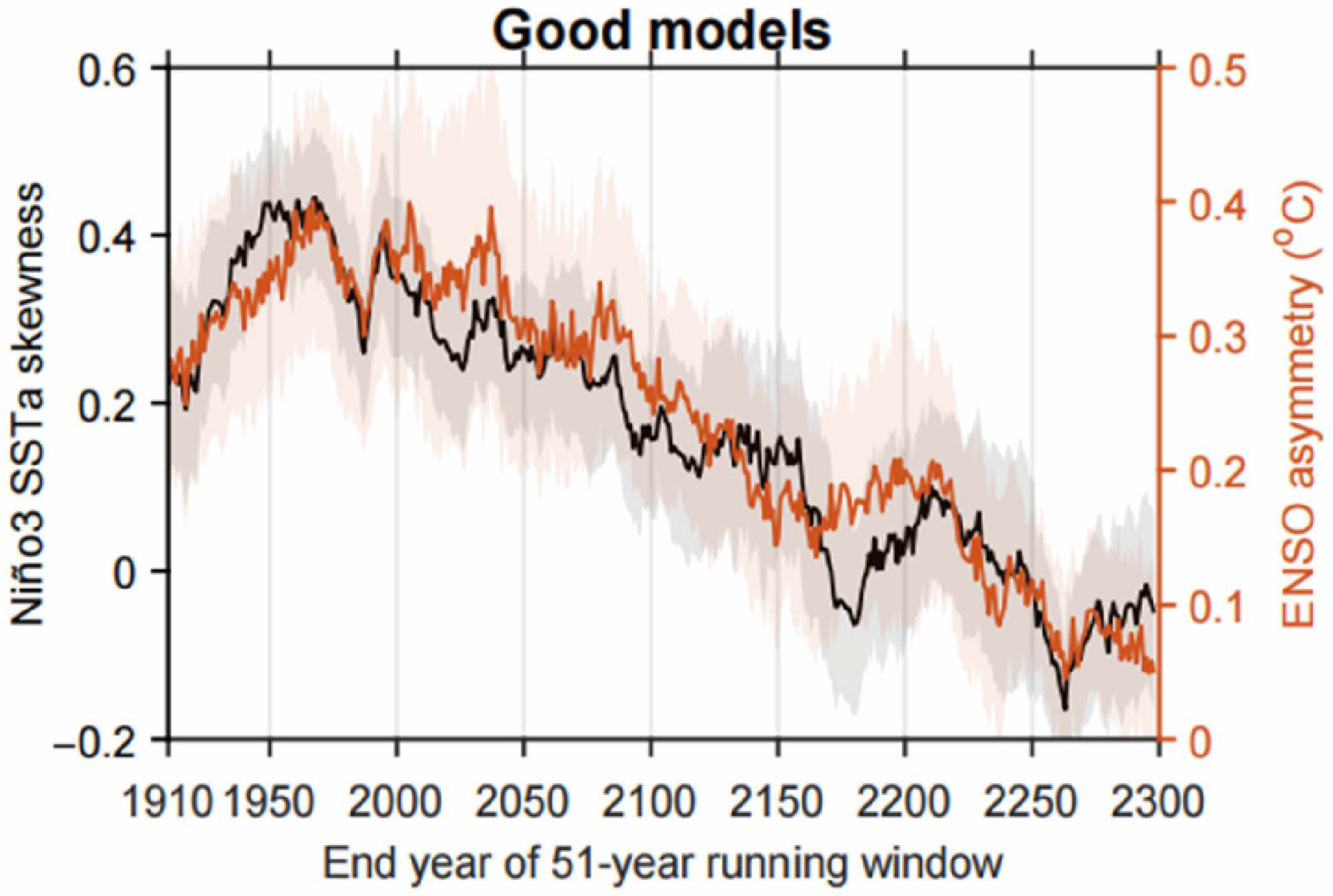
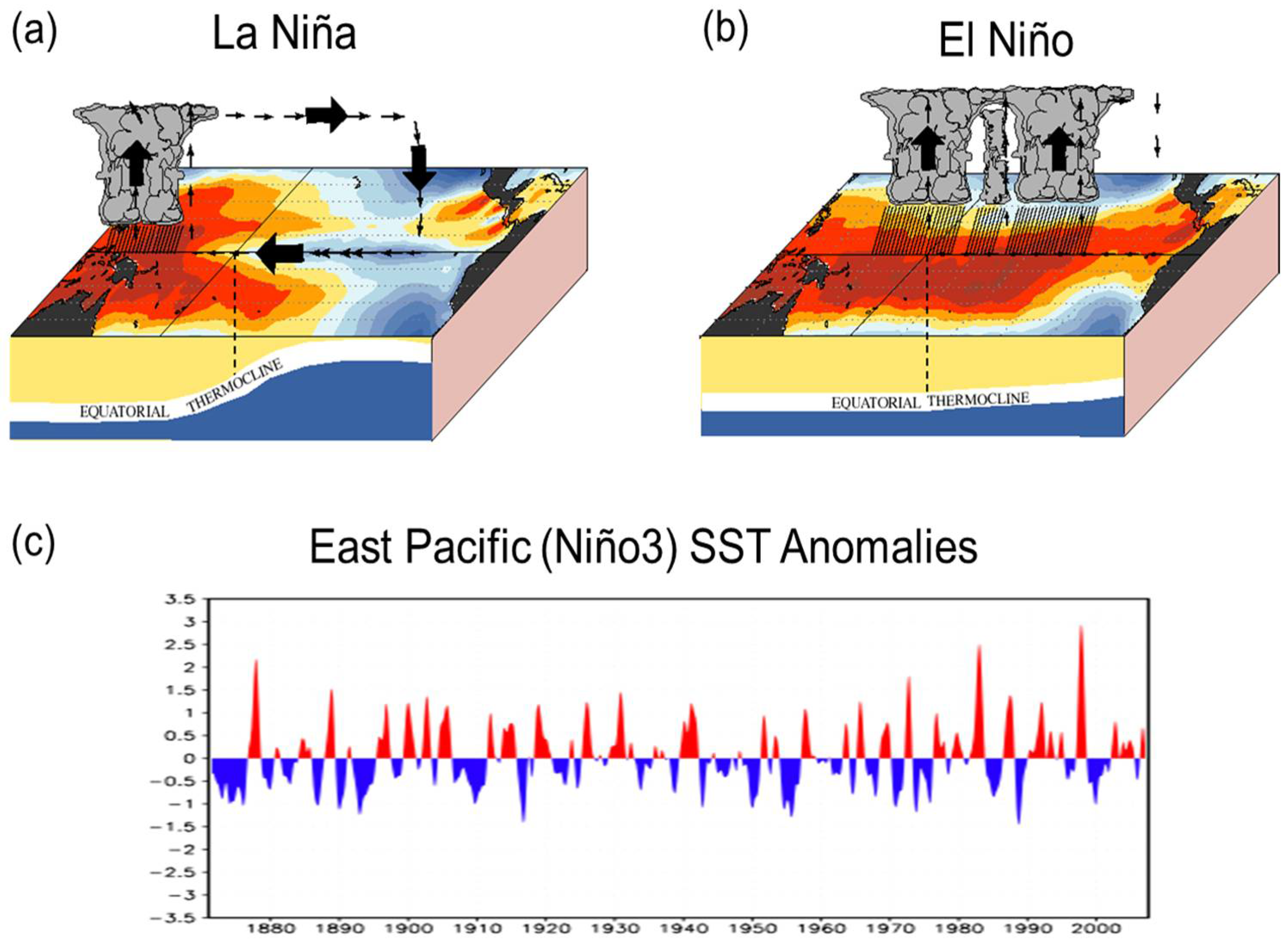
The El Niño–Southern Oscillation (ENSO) is inherently asymmetric, a primary characteristic where its warm phase (El Niño) and cold phase (La Niña) differ in amplitude, spatial pattern, and temporal evolution. This review synthesizes over two decades of research to provide a comprehensive overview of ENSO asymmetry. It systematically examines the observed manifestations, evaluates the competing physical mechanisms, and analyzes the ongoing challenges in climate modeling. The key findings in the literature indicate that this asymmetry is driven by complex interactions of nonlinear processes, where atmospheric mechanisms such as state-dependent westerly wind bursts and threshold responses of deep convection are now considered dominant driving factors, which are subsequently amplified and modulated by oceanic feedback. The main challenge in this field is that most of the current state-of-the-art climate models underestimate ENSO asymmetry, which is related to mean-state bias and brings uncertainty to future predictions. Furthermore, a key finding from recent projection studies is that while the asymmetry in ENSO’s sea surface temperature is expected to weaken in a warmer climate, the asymmetry of its global rainfall impacts may paradoxically be amplified. Future research should focus on balanced improvements in ocean and atmospheric model components, development of new diagnostic tools to clarify the roles of different feedbacks, or establishment of a framework that clearly links asymmetry to the full spectrum of ENSO diversity. By consolidating the current state of knowledge and highlighting key unresolved questions, this work provides an essential roadmap to improve the prediction and projection of Earth’s most far-reaching mode of climate variability.
Keywords: ENSO asymmetry; nonlinear dynamics; ENSO diversity; climate models; climate change ENSO asymmetry; nonlinear dynamics; ENSO diversity; climate models; climate change