Article

Spatiotemporal Variability of Greenhouse Gas Concentrations at the WMO/GAW Observational Sites in Korea


1
Department of Earth Environmental & Space Sciences, Chungnam National University, Daejeon 34134, Republic of Korea
2
Research Institute of Natural Sciences, Chungnam National University, Daejeon 34134, Republic of Korea
3
Global Atmospheric Watch and Research Division, National Institute of Meteorological Sciences, Seogwipo 63667, Republic of Korea
*
Author to whom correspondence should be addressed.
Atmosphere 2025, 16(12), 1352; https://doi.org/10.3390/atmos16121352
Submission received: 5 October 2025 / Revised: 15 November 2025 / Accepted: 26 November 2025 / Published: 28 November 2025
(This article belongs to the Special Issue Advances in Greenhouse Gas Emissions from Agroecosystems)

Abstract

Atmospheric greenhouse gases (GHGs) affect Earth’s radiation balance and are the primary drivers of climate change. This study analyzed the spatiotemporal variability of carbon dioxide (CO2), methane (CH4), and nitrous oxide (N2O) at domestic World Meteorological Organization/Global Atmosphere Watch (WMO/GAW) sites located at Anmyeondo (AMY), Jeju Gosan, and Ulleungdo, examining the local influences on GHG variations and comparing the relationships between gases. Long-term records from the AMY site were used to investigate temporal changes in CO2–CH4. The results showed that short-term variations were influenced by local emissions, sink processes, and anthropogenic signals, whereas medium-to-long-term variations displayed clear seasonality driven by vegetation and meteorological changes, with continuously increasing trends. The sites strongly reflected the effects of nearby point sources, and the ∆CO2–∆CH4 relationships revealed site-specific spatiotemporal differences. At AMY, 46–49% of top-quartile CO2, CH4, and N2O enhancements occurred under easterly winds from nearby industrial and agricultural sources, whereas 14–16% under northwesterly flow indicated episodic transport from eastern China, highlighting the site’s combined exposure to domestic and foreign emissions. The observed strengthening long-term ∆CO2–∆CH4 correlation may be related to continuously increasing emissions in East Asia. However, uncertainties remain, owing to changes resulting from the 2012 instrument replacement and calibration scale. Overall, this study provides baseline insights into domestic GHG variability and offers fundamental information for understanding East Asian emissions and supporting climate policy.

1. Introduction

Atmospheric greenhouse gas (GHG) concentrations have increased significantly since the industrial revolution, with current concentrations reaching unprecedented levels over the past 800,000 years [1]. The representative GHGs are carbon dioxide (CO2), methane (CH4), and nitrous oxide (N2O), whose background concentrations in the atmosphere have increased by approximately 160%, 47%, and 22%, respectively, relative to pre-industrial levels [2]. Elevated GHG concentrations are the major drivers of global climate change, and their correlation with the increase in extreme weather events has been demonstrated in numerous studies [3,4]. The 100-year global warming potentials of CH4 and N2O are approximately 28–265 times greater than those of CO2, thereby necessitating precise observations and analyses despite their relatively small atmospheric abundances. Accurate monitoring and analysis of these major GHGs enables the tracking of their concentration variations and the identification of their sources and sinks, laying the foundation for a climate crisis response. In line with the declaration of carbon neutrality by 2050 in Korea, the government announced the 2025 Carbon Neutrality Promotion Strategy and is currently establishing both a GHG reduction roadmap and a national master plan. To establish and evaluate such policies effectively, securing high-quality GHG observational data and conducting fundamental research on domestic GHG variations are essential.
Unlike air pollutants, GHGs are characterized by long atmospheric lifetimes. For example, the lifetime of CO2 ranges from several centuries to several thousand years, whereas N2O and CH4 persist in the atmosphere for approximately 109 and 11.8 y, respectively [5]. In contrast, the average lifetime of air pollutants such as NO2 is approximately 2–8 h, although under certain conditions it can remain for several weeks, whereas tropospheric O3 can persist in the atmosphere for several months [6,7]. Air pollutants have attracted public attention because they directly affect human health, causing respiratory and cardiovascular diseases in addition to their climatic impacts, such as radiative forcing. Accordingly, previous studies have focused on their short-term variability [8,9,10]. In contrast, owing to their long atmospheric lifetimes and the difficulty in perceiving short-term warming effects, GHG research has primarily focused on long-term observational data collection and trend analysis [11,12,13]. Such long timescale studies emphasize the separation of background concentrations based on high-temporal-resolution GHG observations and discuss observational data reliability and seasonal and trend variations.
In recent years, discussions on GHGs and climate crises from a long-term perspective have expanded beyond atmospheric concentration variations to include source attributes and emission variability. For example, Tohjima et al. [14,15] re-estimated emissions from East Asian countries by combining long-term GHG observations from Hateruma Island with a Lagrangian back-trajectory model. Kenea et al. [16] analyzed the ratio of CO2 to CH4 using long-term observations from the Anmyeondo (AMY) site in Korea to investigate the CH4 emission trends in East Asia. Kim et al. [17] traced the major CO2 source regions in Korea by applying a Lagrangian back-trajectory model to domestic CO2 and CO observations. Nevertheless, comprehensive analyses of GHG variability and basic statistical evaluations of site-specific characteristics based on long-term domestic observations are limited, despite such studies being essential prerequisites for future research on GHG source attribution and emission variability.
Long-term, stable observational data are crucial for investigating GHG variability. Accordingly, the Korea Meteorological Administration (KMA) participated in the Global Atmosphere Watch (GAW) program of the World Meteorological Organization (WMO) and established and operated a high-precision GHG monitoring network. The domestic WMO/GAW stations in AMY, Jeju Gosan (GSN), and Ulleungdo (ULD) have been measuring 34 atmospheric constituents, including GHGs, since the late 2000s with the introduction of cavity ring-down spectroscopy instruments. As Korea is located downwind of the major GHG emission regions in East Asia, it is geographically sensitive to both local emission sources and long-range transport [18]. Therefore, long-term observational data from domestic WMO/GAW stations can provide key information regarding GHGs in East Asia.
This study examined the variability of CO2, CH4, and N2O concentrations across multiple temporal scales based on observational data from the Korean WMO/GAW stations, interpreting the factors influencing these concentration variations at a regional scale. In addition, seasonal and long-term variations in the relationships and correlations between GHGs were analyzed to comprehensively characterize the spatiotemporal variability of GHGs in Korea.
To achieve this, this study separated the reginal background concentrations and synoptic-scale variations (SSV) of the major GHGs using observational data from the three domestic WMO/GAW stations from 2018 to 2023, and conducted subsequent analyses based on these results. Section 2 describes the general information of the observation sites as well as the preprocessing and analytical methods applied to the data. In Section 3.1, the daily, weekly, seasonal, and long-term variations in each GHG are analyzed to determine their variability across multiple temporal scales. Section 3.2 investigates the influence of regional emission sources on the greenhouse gas concentrations recorded at the monitoring sites by analyzing the concentration distributions with respect to wind direction and speed and the relationships and correlations among the GHGs.

2. Data and Methods

2.1. Observation Sites

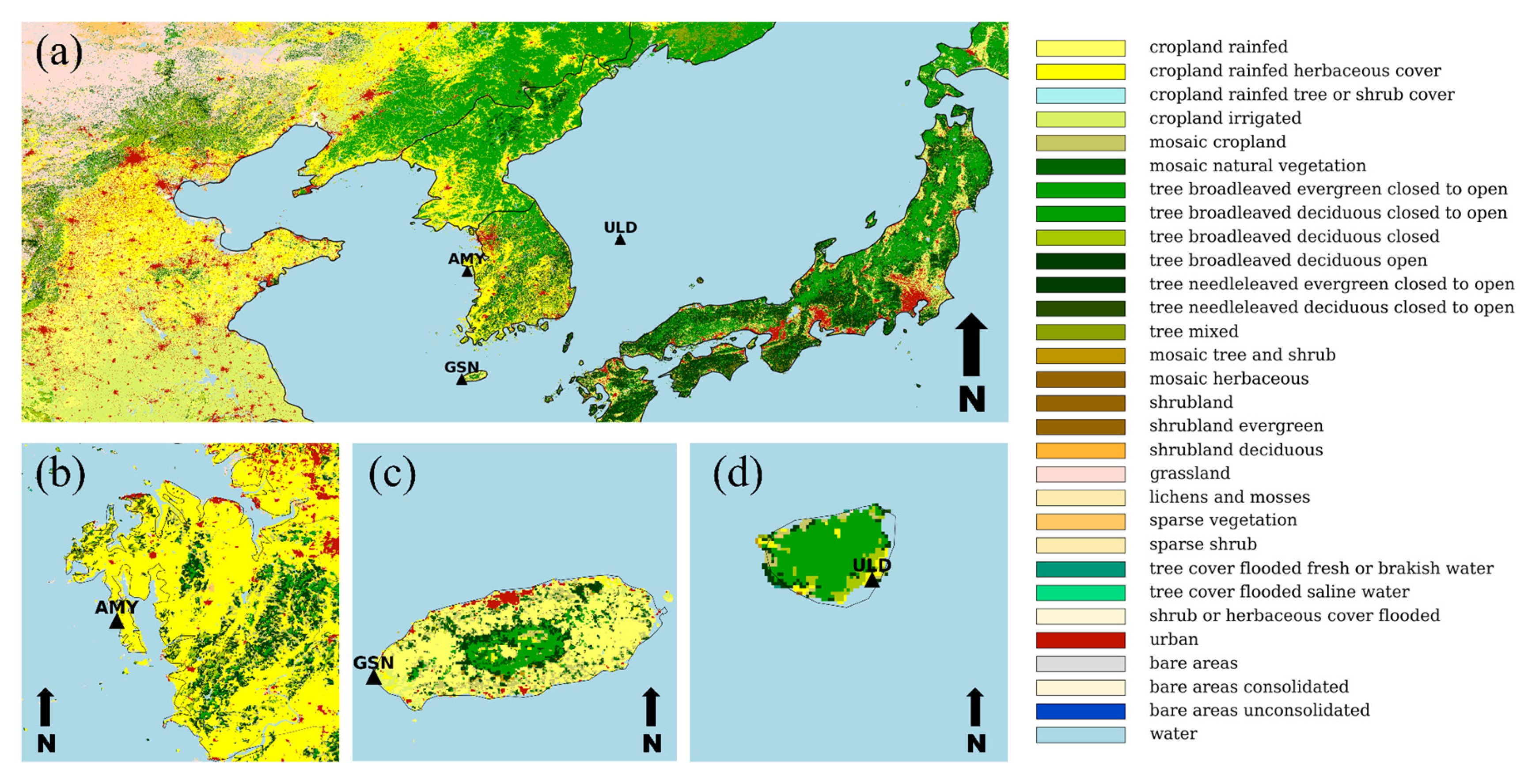
Figure 1 shows the locations of the Korean WMO/GAW observatories and their surrounding environments. Table 1 summarizes the site characteristics and the observational instrumentation implemented at each station.
The AMY station has continuously monitored various atmospheric constituents including GHGs, air pollutants, and ozone, since the late 1990s. It is located approximately 130 km southwest of the Seoul metropolitan area and 30 km south of the Taean Peninsula, making it the westernmost background air-monitoring site in Korea. Within a 50 km radius from the station are the second-largest rice paddy area and the largest livestock farming complex in the country. Additionally, within 35 km of the northeast and southeast are the largest coal- and heavy-oil-fired power plants in the country, respectively. The largest LNG power plant in Korea is situated approximately 100 km northeast, and semiconductor and related industries are distributed within 100 km. The major crops in Anmyeondo include rice, sweet potatoes, and onions. In summer, the region is characterized by active marine tourism and leisure activities. The west and south sides of the station are open to the sea, with extensive tidal flats and pine forests distributed along the coastline.
The GSN station has conducted long-term atmospheric constituent monitoring since 2012. It is located on the western side of Jeju Island. The Suwolbong area, where the observatory is situated, has been designated as a UNESCO Global Geopark and is characterized by coastal cliffs that expose volcanic deposits. The surrounding region is dominated by tourism and livestock farming, particularly horses and pigs, and includes the largest plain in Jeju, where potatoes, garlic, and onions are the main crops. The observatory is open to the sea from southwest to northwest, with cliffs composed of volcanic basalt. The East China Sea lies south of the site and connects with the Yellow Sea to the west.
The ULD station has also been conducting observations since 2012. It is located in the eastern Sea of Korea, in the eastern part of Ulleungdo, approximately 155 km off the Korean Peninsula. Industrial cities centered on the steel, chemical, and petrochemical industries, as well as two large natural gas power plants, are located approximately 200–250 km along the southeastern coastline of the peninsula. Ulleungdo, a steeply sloped volcanic island with an area of 72 km2, was formed from a large stratovolcano. At 984 m above sea level, its highest peak lies northwest of the observatory, and mountains ranging from 500 to 960 m in elevation are located within 5 km to the north and southeast. Because of these geographical characteristics, the observatory is influenced by updrafts from the southwest and downdrafts from the northeast. Approximately 200 m southwest of the observatory is a small brick factory, which used to have a waste incineration plant that was relocated to the northern part of the island after December 2016. For this reason, previous studies have excluded data from the analysis prior to 2017. Both fisheries and agriculture are active in Ulleungdo, although no farms are present in the southern part of the island. A small port and village are located 810 m northeast of the observatory.
An automatic weather station was installed near the sampling inlet at AMY, whereas automatic weather stations were installed approximately 10 m above the observatories at GSN and ULD, separated from the sampling inlet, to continuously monitor meteorological parameters such as wind direction and wind speed in real time.

2.2. Observation Datasets

For this study, hourly wind speed and direction data and hourly and daily GHG concentration data provided by the World Data Centre for Greenhouse Gases were obtained from AMY, GSN, and ULD and utilized after preprocessing.

2.2.1. GHG Mole Fraction

Each domestic WMO/GAW observatory generates GHG observation data every 5 s (L0 data), which are averaged hourly after automatic and manual flagging processes (L1 data). These data are subsequently validated by station operators through comparisons with long-term observation records, flask sampling, and other observatories at similar latitudes, and finalized as L2 hourly data. L3 data, defined as daily background concentrations, were derived using a statistical method with the application of an NIMS filter [19]. The National Institute of Meteorological Sciences (NIMS) filter estimates background concentrations by considering the variability during background periods using the hourly standard deviation (HS), differences in consecutive values (CD), data selected based on HS and CD, and differences from the 30 d moving median (MD) of the data.
Only calibrated and quality-screened data based on instrument calibration history and maintenance logs were used as inputs for CO2 and CH4. At AMY, CO2 observations were made using NDIR from 1999 to 2011 with three-point calibrations every three hours, followed by CRDS measurements since 2012 with four-point calibrations performed at approximately two-week intervals. Similar calibration transitions and schedules were applied to GSN and ULD, and data that could have been affected by maintenance events were removed through flagging. Based on the selected data, the hourly mean concentrations (HA) and HS were calculated, and only the HA values that satisfied the HS threshold were retained. Subsequently, the HA values were further screened using CD thresholds, and the final background candidate data were determined when the deviation from the MD was within a certain multiple of the MD standard deviation (e.g., 1.3 for CO2 and 1.8 for CH4). Concentration recalibration was performed for N2O using standard gases at regular intervals, and data suspected of being affected by maintenance activities were removed with reference to equipment logs. In addition, if the difference between consecutive observations exceeded station-specific thresholds, the corresponding segment of the time series was discarded (approximately 30% of the data, on average). Daily mean values were calculated when at least six valid hourly data points were available.
The procedure for deriving the L3 daily background concentration data from the L2 hourly data is as follows:
Step   ( 1 )   H S t A ,
Step   ( 2 )   H A t H A t 1 B   o r   H A t H A t + 1 B ,
Step   ( 3 )   H A t 30 d   m o v i n g   m e d i a n   o f   H A C ,
where t denotes time, H A represents the 1 h average value of the CO2 concentration, and A , B , and C indicate the threshold values of HS, CD, and MD, respectively. In Step (3), when calculating the 30 d MD, the center of the window is at time t .

2.2.2. Background Selection

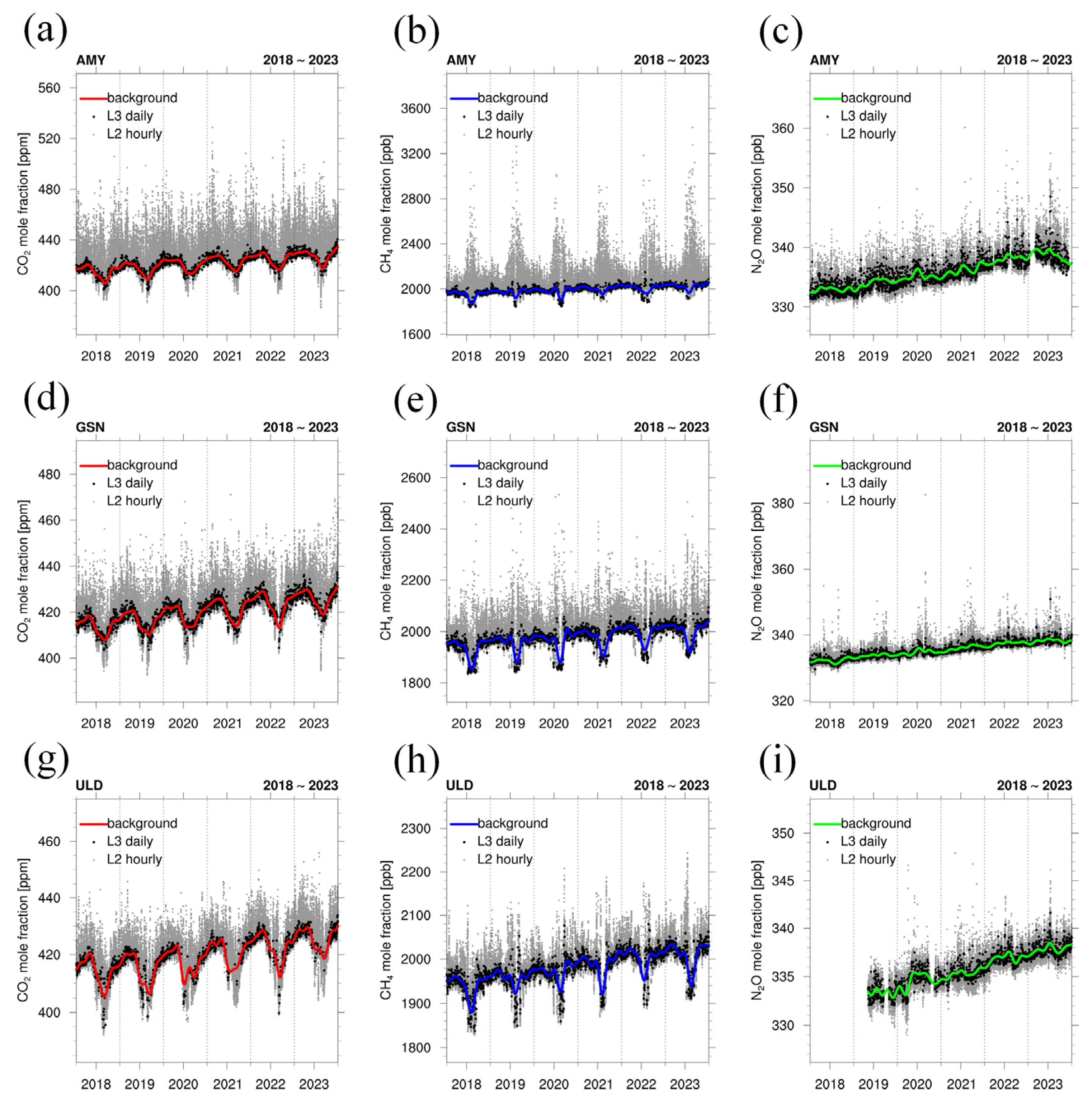
Figure 2 shows the L2 hourly data, L3 daily data, and final selected background concentrations as a time series. The L2 hourly and L3 daily background concentration data for CO2, CH4, and N2O at the three stations included long-term trends, non-sinusoidal seasonal cycles, and SSVs, reflecting their influence over timescales of several hours to several weeks. Therefore, to analyze quantified GHG variability, background concentrations must be separated from short-term variations through additional filtering, and their variability must be analyzed independently across multiple temporal scales. In this study, the curve-fitting method of Thoning et al. [20] was applied to separate short-term variations from the L3 daily background concentrations determined by the NIMS filter [20]. This method is useful for decomposing GHG concentration time series into long-term trends, seasonal cycles, and short-term variations on the order of days to weeks.
The curve-fitting method first selects daily mean values under reliable background concentration conditions. Then, using the following equation, the entire time series is transformed into the frequency domain using a fast Fourier transform:
f t = a 0 + a 1 t + a 2 t 2 + a k 1 t k 1 + n = 1 n h c n [ sin 2 n π t + φ n ] ,
where f t represents the time series concentration data, a 0 , a 1 a k 1 are the coefficients of the k -order polynomial that describes the long-term trend, and c n and φ n denote the amplitude and phase of the n -th harmonic component, respectively. This function incorporates multiple harmonic terms to separate non-sinusoidal seasonal variations, and captures the variability occurring over timescales longer than a year. To process this function in the frequency domain, a fast Fourier transform and low-pass filter were applied to remove high-frequency noise after transforming the time-domain data into the frequency domain. The low-pass filter is expressed as follows:
H f = e x p [ ln 2 ( f f c ) 6 ] ,
where H f denotes the filter response at frequency f and f c is the cutoff frequency. In this study, to remove short-term variations, the filter cutoff was set to (80 d/cycle)−1, reflecting a 2–3 month uniform atmospheric mixing period in the Northern Hemisphere [21]. To isolate only the long-term trend, the filter cutoff was set to (667 d/cycle)−1. Finally, the smoothed curve derived from the NIMS filter and curve fitting was interpolated to an hourly resolution using spline interpolation to estimate background concentrations. Curve fitting was performed using Python 3.12.2 software provided by the Curve Fitting Methods of the NOAA Global Monitoring Laboratory, and spline interpolation and additional analyses were conducted using the NCL language.

2.2.3. Enhancement Calculation

GHGs are emitted into the atmosphere from various anthropogenic and natural sources. Depending on the type of gas, they persist in the atmosphere for periods ranging from several decades to several centuries and continuously accumulate. Simultaneously, GHGs are removed through various sinks such as absorption by marine and terrestrial ecosystems and chemical reactions in the atmosphere. For example, CO2 is primarily emitted from fossil fuels and industrial processes, with ocean and terrestrial ecosystems serving as the main sinks. CH4 is mainly emitted from fossil fuels, agriculture, and wastewater and removed through reactions with atmospheric OH radicals. N2O is mainly emitted from agriculture, industry, and biomass burning and is characterized by its destruction in the stratosphere by ultraviolet radiation [22,23]. Because of the source and sink characteristics of GHGs, SSVs must be quantified by removing long-term trends and seasonal variability to understand GHG transport over relatively short timescales. Accordingly, as expressed in Equation (6), the SSVs were derived by subtracting the smoothed curve from the L2 hourly data and defined as enhancements:
G H G = G H G o b s G H G b g ,
where G H G represents the SSVs of GHGs with background concentrations removed, which is defined as enhancement; G H G o b s denotes the L2 hourly data values; and G H G b g represents the background concentrations.

2.3. Correlation Analysis

In this study, regression analyses were conducted between the enhancements of two gases to analyze the interrelationships between the GHGs at each observatory, and their slopes and correlation coefficients were examined.

2.3.1. Slope Analysis

To examine the relationships among GHG enhancements in domestic observatories, an appropriate statistical analysis method must be used to represent such relationships. Therefore, the enhancements for the entire analysis period, derived using the method described in Section 2.2.3, were first divided into 24 h windows. For each window, a scatter plot between CO2 and CH4 was drawn, and regression analysis was performed. This regression analysis was then performed continuously over the analysis period by shifting the 24 h window forward in 1 h increments. In cases where the absolute value of the Pearson correlation coefficient within a window was <0.8, the number of available data points was five or fewer, or the standard deviation of either gas was within 0.1 ppm, the regression results were considered statistically insignificant and excluded from the analysis [14]. The slope between the two GHGs obtained from each window was then averaged monthly, and this monthly mean slope was assumed to represent the slope for that month and used in the analysis.

2.3.2. Correlation Coefficient Calculation

The Pearson correlation coefficient (R) was used to analyze the correlations between the variations in the enhancement of the two GHGs. The R values were calculated within each window following the methodology described in Section 2.3.1. Compared to a statistical approach that simply calculates a single correlation coefficient over the entire period, this method is less affected by intermittent enhancement events, thereby allowing for a more robust correlation analysis. Accordingly, the annual distributions of the R values calculated for each window were examined to investigate long-term changes in the correlations between GHG enhancements.

3. Results

3.1. Temporal Variation

In this section, variations and trends in GHGs are analyzed across multiple temporal scales based on background concentrations and enhancements. Diurnal and weekly concentration variations were examined at relatively short timescales, and seasonal variations and long-term trends were analyzed at medium-to long-term timescales.

3.1.1. Diurnal Cycle

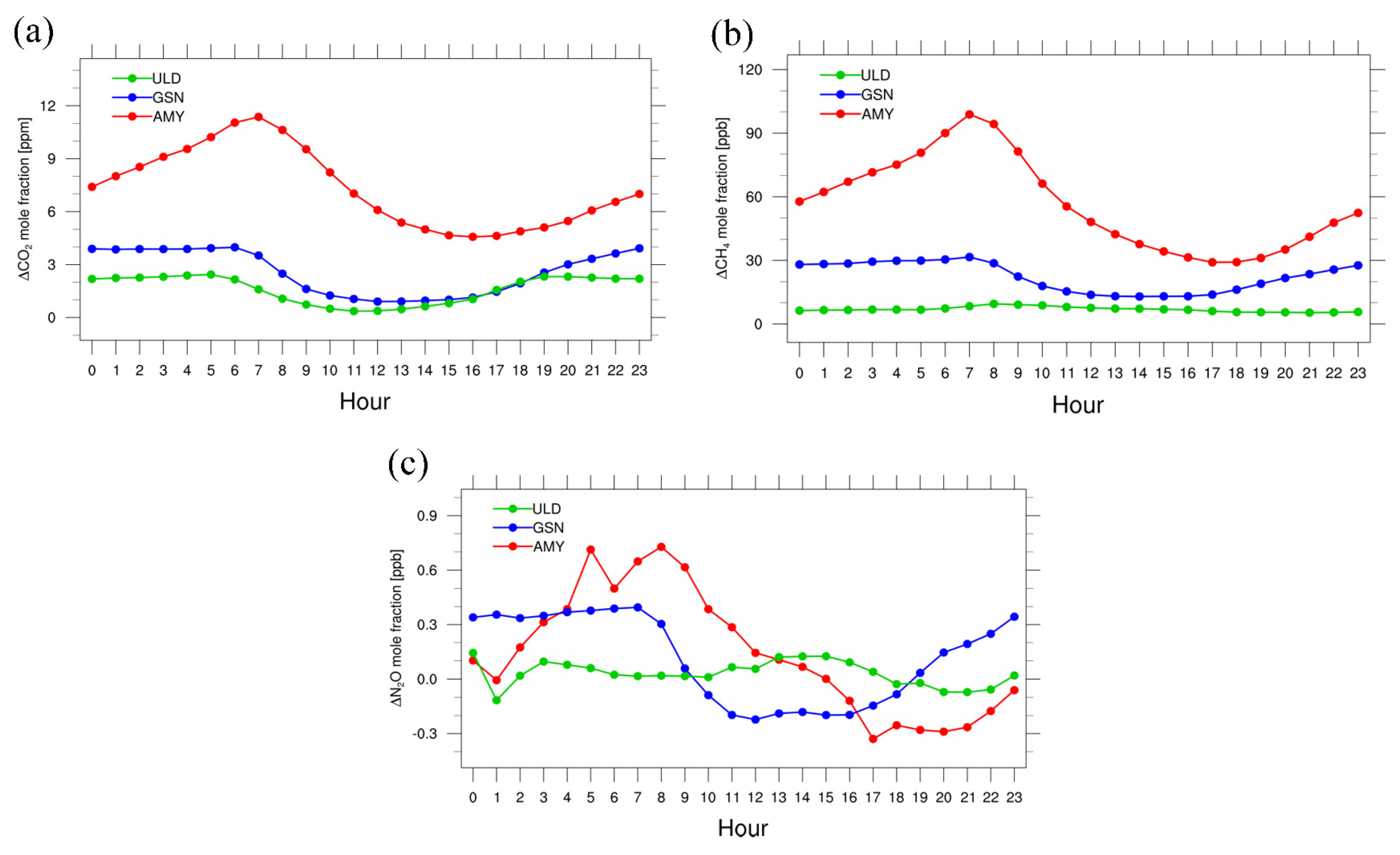
Figure 3 shows the average diurnal cycle of GHG enhancements with background concentrations removed at the three domestic WMO/GAW sites.
At AMY, all three GHGs exhibited relatively distinct diurnal cycles, reaching a maximum between 07:00 and 08:00, gradually decreasing to a minimum between 16:00 and 17:00, and subsequently increasing again. GSN showed less pronounced diurnal variation than AMY, but all three GHGs exhibited periodicity characterized by lower concentrations during daytime hours. In contrast, almost no diurnal variation was observed at ULD, with only CO2 showing a slight periodicity similar to that at GSN. During the analysis period, the diurnal amplitudes of CO2, CH4, and N2O were 6.8 ppm, 69.8 ppb, and 1.1 ppb, respectively, at AMY and 3.1 ppm, 18.6 ppb, and 0.6 ppb, respectively, at GSN, showing smaller amplitudes. At ULD, the diurnal amplitude of CO2 was approximately 2.1 ppm, the smallest among the three sites. In addition, the daily mean enhancements at AMY, GSN, and ULD were 7.33, 2.58, and 1.6 ppm for CO2, respectively; 56.68, 22.24, and 6.91 ppb for CH4, respectively; and 0.14, 0.11, and 0.03 ppb for N2O, respectively. The amplitude of the diurnal cycle and daily mean concentrations of the enhancements followed the order of AMY > GSN > ULD.
Such diurnal cycles may be attributable to various meteorological and biological factors, including changes in the planetary boundary layer (PBL) height, diurnal circulation such as mountain-valley winds and land–sea breezes, photosynthetic activity regulated by solar radiation and temperature, and vertical mixing processes in the atmosphere [24,25,26,27]. In general, during the daytime, surface solar heating leads to high PBL conditions, which lower near-surface GHG concentrations. At night, surface cooling establishes a stable PBL, leading to GHG accumulation near the surface and increased concentrations. This continuous cycle was observed at AMY and GSN, where the concentrations of the three GHGs decreased during the daytime when the PBL height increased and increased again at night when the PBL stabilized. In particular, CO2 decreased during the day and increased at night owing to the effects of photosynthesis and respiration, which intensify in summer when vegetation activity is more pronounced. Such vegetation effects are likely reflected in the diurnal variations in CO2 at all three sites. Additionally, because AMY and GSN are located in coastal regions, they are influenced by both vegetation activity and land–sea breeze circulation. Consequently, the prevalence of sea breezes during the daytime can further enhance the decrease in concentrations, whereas the development of nighttime land breezes can reinforce the tendency of increasing concentrations. In contrast, ULD is located at a high elevation and surrounded by complex mountainous terrain. Therefore, diurnal variations in the PBL height have a relatively small influence on GHG concentration changes, and the impact of the surrounding GHG emission sources is weaker. Owing to these locational characteristics, the diurnal cycles of the three GHGs at ULD were less evident than those at the other sites.

3.1.2. Weekly Variation

Weekly variations can be interpreted as indicators of anthropogenic emissions assuming that natural mechanisms do not cause significant GHG variability on weekly timescales [28]. Therefore, by comparing and analyzing the weekly variation characteristics based on long-term GHG observations, such variations can be linked to anthropogenic activities and utilized as meaningful statistical information.
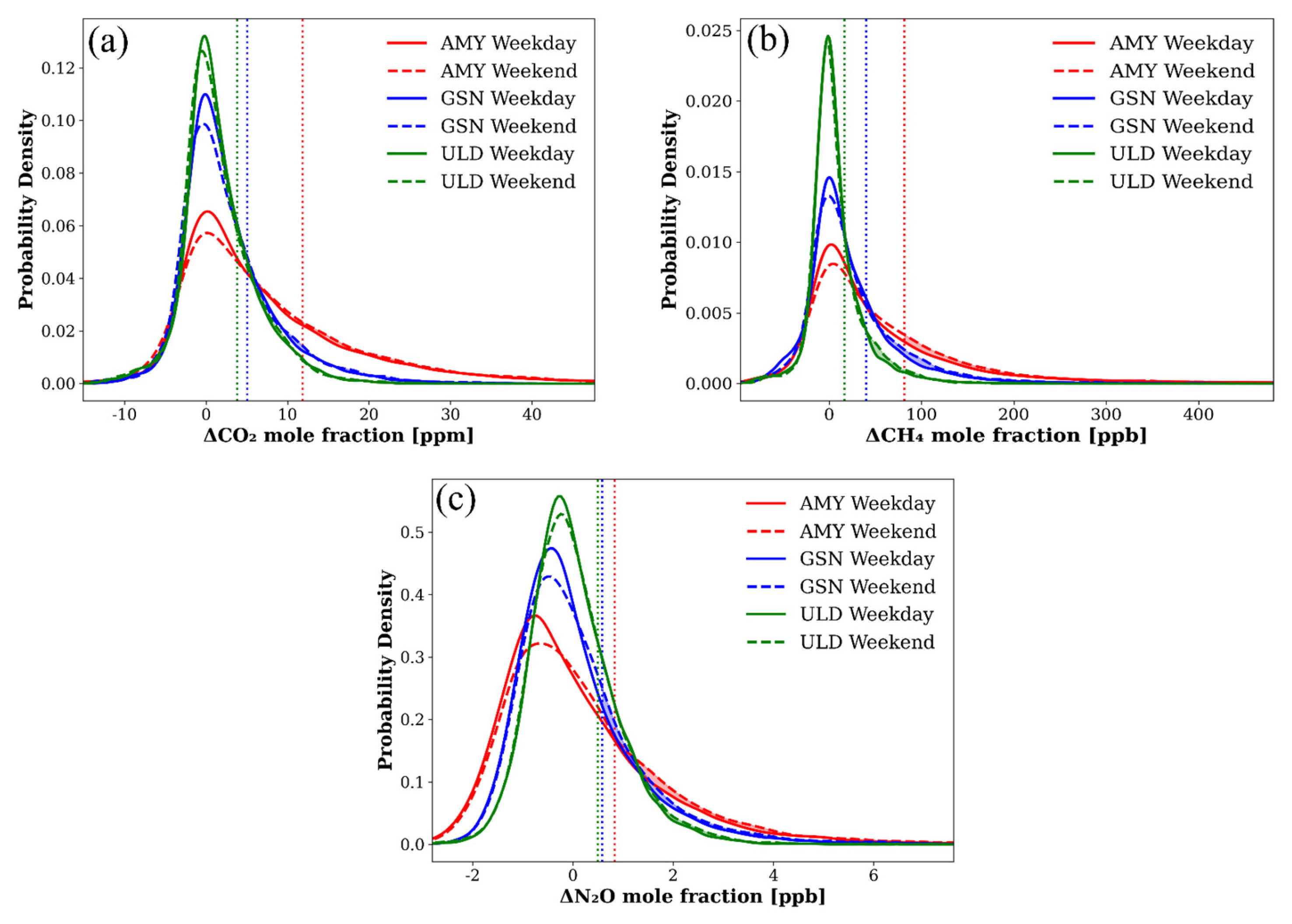
Figure 4 compares the concentration distributions of CO2, CH4, and N2O on weekdays and weekends at each site using probability density functions (PDF). The thresholds for the top 25% of high-concentration cases were in the order AMY > GSN > ULD, and the standard deviations of the weekday and weekend enhancement distributions followed the same order. The integrated area ( A d i f f ), where the probability density of weekend enhancements exceeded that of weekdays in the high-concentration cases, followed the order of AMY > GSN > ULD. This indicates that AMY had the highest background GHG concentrations and the largest variability among the three sites. Additionally, A d i f f was consistently positive, implying that high-concentration cases occurred more frequently on weekends than on weekdays. Furthermore, although the PDF maxima on weekdays and weekends differed slightly depending on the site and gas species, the weekend mean enhancements were higher than those on weekdays, except for CO2 at GSN and ULD, showing a pattern consistent with the tendency of high-concentration events to occur more frequently on weekends than on weekdays. Table 2 presents the main statistical values related to weekly variations.
The results of the comparative analysis of the weekly variation characteristics among the three observatories were identified based on GHG enhancement, differences in site-specific characteristics, and differences in enhancement distributions between weekdays and weekends. Among the three sites, AMY is located closest to large-scale anthropogenic GHG emission sources in Korea, such as the Seoul metropolitan area, and is affected by airflows from the west originating from major industrial complexes in eastern China. Therefore, it exhibited the highest background concentrations among the three sites, and its enhancement variability was also the largest, owing to the influence of transported emissions from surrounding sources. In addition, the greater number of high-concentration events occurring on weekends than on weekdays at all three sites can be considered as a meaningful indicator of the differences in GHG emission characteristics between weekdays and weekends attributed to anthropogenic activities. However, other statistical indicators such as PDF maxima and mean enhancements did not exhibit consistent differences between weekdays and weekends, suggesting that further research is required to elucidate these weekly variation characteristics.
When the weekly variations in the analyzed GHGs were compared with the weekly cycles of air pollutants, the variability in GHGs could not be regarded as distinct. For example, representative air pollutants such as particulate matter, ozone, nitrogen dioxide, and sulfur dioxide exhibit clear weekday–weekend cycles in major domestic cities, including Seoul, Busan, Incheon, and Daegu [29]. In contrast, the analyzed GHGs did not show distinct weekday–weekend concentration variability cycles, likely owing to their significantly longer atmospheric lifetimes compared to those of air pollutants. Because of their long lifetimes, GHGs accumulate in the atmosphere over extended periods, thereby increasing the influence of background concentrations. Consequently, their variability, such as weekly variation, becomes more evident over the long term rather than over the short term. Differences in the locational characteristics of air pollutants and GHG monitoring networks may also contribute to such discrepancies in weekly cycles. Although air pollutant monitoring networks are typically situated near major emission sources, such as large cities, the WMO/GAW background monitoring stations are located in relatively clean areas, making it difficult for the short-term emission characteristics of GHG sources to be reflected in the observations.

3.1.3. Seasonal Cycle

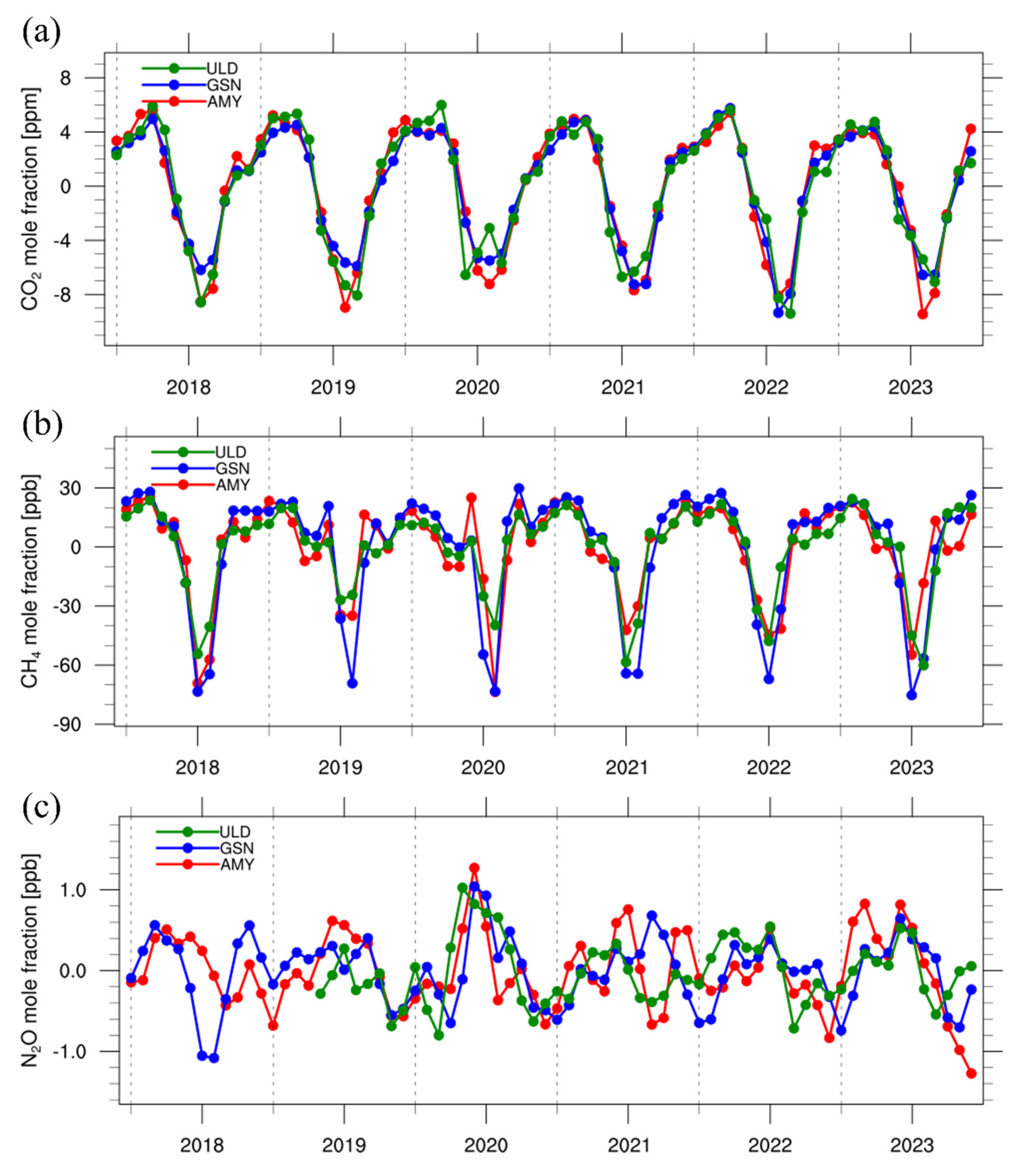
Figure 5 shows the monthly mean seasonal variations in GHGs during the analysis period, with short-term enhancements and long-term trends removed.
CO2 concentrations decreased during summer, when vegetative activity was the most, and then increased until the following spring, showing a clear seasonal cycle. The increase from late autumn to early spring may be partially attributed to enhanced decomposition of leaf litter and other organic matter following leaf fall, which releases CO2 into the atmosphere during periods of reduced photosynthetic uptake. This seasonality appears to occur primarily because approximately 45% of the CO2 emitted into the atmosphere is absorbed by terrestrial and oceanic ecosystems, leading to concentration changes in response to seasonal variations in vegetation activity [30]. The seasonal amplitudes at each site were in the order AMY (13.38 ppm) > ULD (13.13 ppm) > GSN (11.57 ppm), mainly because of differences in the summer minimum values. The mean summer minimum values were –8.32, –6.79, and –7.73 ppm at AMY, GSN, and ULD, respectively. With the exception of 2021 and 2022, GSN showed a smaller concentration decrease in summer than that at the other sites, whereas AMY exhibited the largest decrease in summer, except for 2018 and 2022. This suggests that AMY most strongly reflects the influence of natural sinks, whereas this influence is relatively weak at GSN.
The seasonal variation of CH4 was similar to that of CO2 but exhibited relatively sharp concentration changes during summer. The seasonality of CH4 background concentrations can be attributed to various factors, including interactions with OH radicals and soils, emission changes from crops and livestock, and seasonal shifts in major source regions [31,32]. In addition, domestic observatories are strongly influenced by seasonal climatic conditions, such as hot, humid summers under the influence of the North Pacific High and cold, dry winters under the influence of the Siberian High. Such distinct seasonal variations in temperature and humidity induce changes in the atmospheric OH radical concentrations, thereby affecting the degree of CH4 oxidation. In particular, the reduced PBL height during winter due to stable atmospheric conditions likely contributed to the increase in CH4 concentrations during this season. The mean seasonal amplitudes of CH4 were 97.27, 76.77, and 69.16 ppb at GSN, AMY, and ULD, respectively; these differences were mainly due to variations in the summer minimum values. The mean minimum values at AMY, GSN, and ULD were –53.21, –70.46, and –47.9 ppb, respectively, with GSN showing the lowest summer CH4 concentrations. This may be attributed to the large-scale monsoonal low-pressure systems influencing the Jeju region in summer, generating updrafts that contribute to CH4 decreases [33]. Additionally, AMY may have been affected by increased CH4 emissions from the surrounding rice paddies in summer, whereas ULD exhibited relatively smaller seasonal amplitudes owing to its high elevation and mountainous terrain.
The seasonal amplitudes of N2O were relatively small, with values of 1.51, 1.33, and 1.17 ppb at AMY, GSN, and ULD, respectively; however, the concentrations exhibited a seasonal variation characterized by an increase in summer and decrease in winter [34]. In particular, a bimodal seasonal cycle with a single trough similar to the seasonal variations observed at the Waliguan, Lampedusa, and Niwot Ridge-Tvan observatories, but with opposite summer and winter seasonality, was observed [11]. This seasonality in N2O is likely due to the seasonal variability in microbial nitrification and denitrification reactions in soils. Soil microbial processes account for approximately 70% of the global N2O emissions, and emission levels vary depending on changes in temperature and soil moisture [35]. Accordingly, the hot and humid summer climate in Korea is likely to increase soil N2O emissions, contributing to an increase in summer background concentrations. However, in high-latitude regions, stratosphere-to-troposphere transport has also been reported as a cause of lower N2O concentrations during summer [36]. Nevertheless, because N2O is present at significantly lower concentrations in the atmosphere than CO2 and CH4, the error ratio in estimating its background concentrations can be higher, and seasonality can be observed with an extremely small amplitude. Therefore, more detailed region-specific studies of trace GHGs are required.

3.1.4. Long-Term Trend

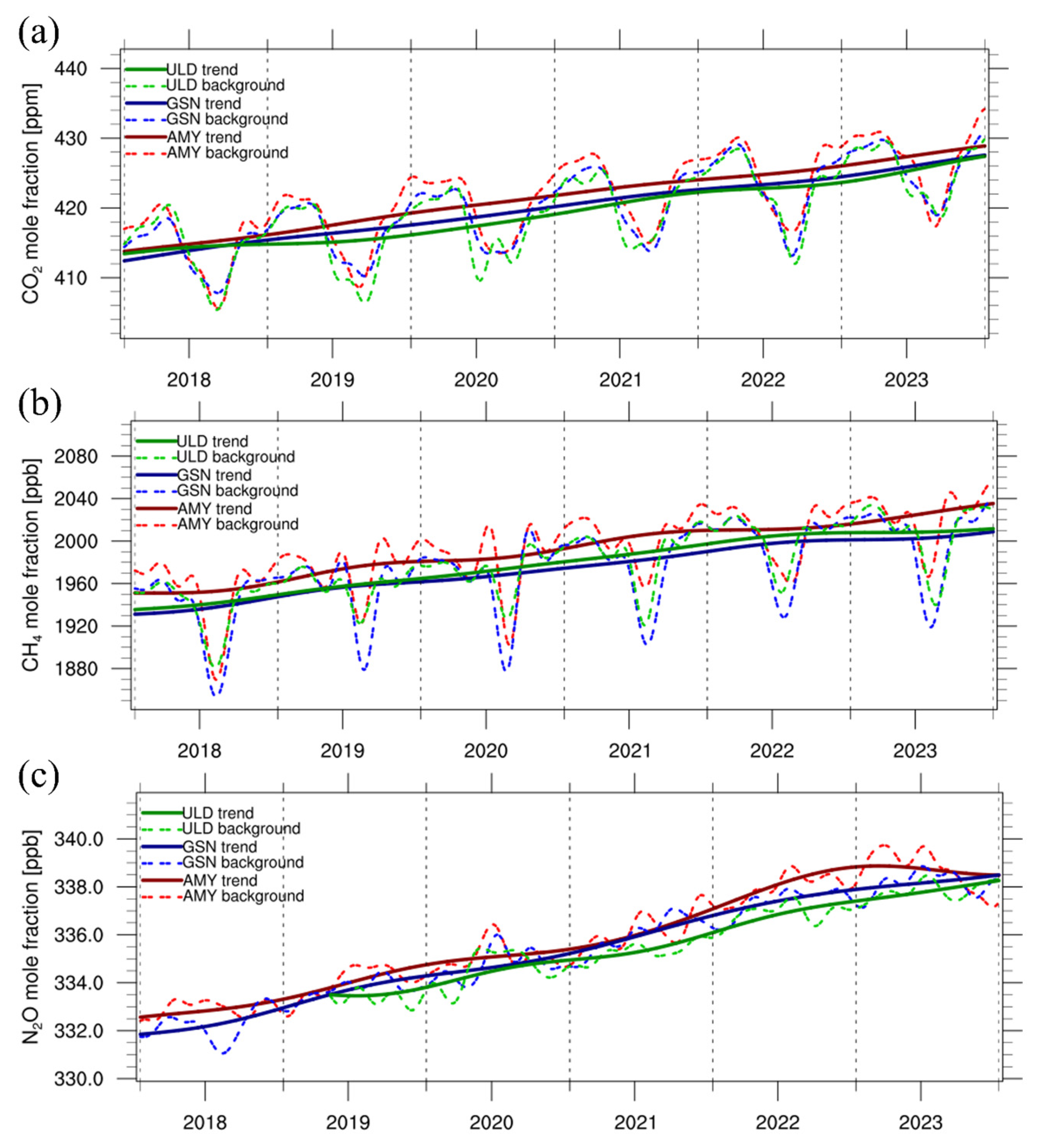
Figure 6 shows the long-term GHG trends over the six-year study period. However, for ULD, N2O observations only began in May 2019; therefore, the trend was analyzed from that date onward. The growth rates of each GHG by site are summarized in Table 3.
The global mean CO2 growth rate during 2013–2022 was 2.4 ppm y−1, which was most similar to the rate at GSN, whereas the mean growth rate over the Koran Peninsula during the same period was 2.5 ppm y−1, closely corresponding to that observed at AMY [37]. In particular, the growth rates at AMY and GSN during 2021–2022 were 1.93 and 1.97 ppm y−1, respectively, showing a sharp slowdown compared with those in other years. This may have been influenced by the La Niña events that occurred during that period, which is consistent with the global CO2 growth rate also exhibiting a declining trend owing to La Niña [12]. Therefore, the El Niño–Southern Oscillation is one of the major drivers affecting the long-term trend of CO2, along with changes in vegetation activity and GHG emissions.
The recent mean annual growth rates of CH4 were 14.79 ± 4.66 ppb y−1 at AMY, 13.58 ± 4.41 ppb y−1 at GSN, and 13.53 ± 4.69 ppb y−1 at ULD. The global CH4 growth rate increased from an average of approximately 5 ppb y−1 during 2009–2012 to approximately 10 ppb y−1 during 2013–2022, whereas the growth rates observed in Korea over the past six years showed even stronger increases [38]. In particular, the 2018–2019 growth rates at AMY (19.87 ppb y−1), GSN (18.62 ppb y−1), and ULD (16.47 ppb y−1) were the highest values during the analysis period. This was likely influenced by meteorological conditions, such as El Niño, which led to warmer and more humid atmospheric conditions, thereby enhancing CH4 emissions from agricultural activities [39]. In addition, continuous agricultural activity in East Asia, Africa, and North America, which increases soil microbial activity, may have also contributed to long-term trends in CH4 [1].
For N2O, the recent mean annual growth rates were 1.17 ± 0.45 ppb y−1 at AMY, 1.18 ± 0.27 ppb y−1 at GSN, and 1.10 ± 0.31 ppb y−1 at ULD. Over the past decade, its growth rate remained at approximately 1.1 ppb y−1. For comparison, the global mean N2O growth rate in 2024 was approximately 1.0 ppb y−1, indicating that the domestic trends are consistent with the global increases. In particular, the 2022–2023 growth rates in AMY and GSN were lower than the mean growth rate, which may have been influenced by the El Niño conditions during that year. N2O fluxes have been shown to decrease during El Niño events and exhibit the opposite tendency during La Niña events [40]. Therefore, the long-term trend of N2O, which is similar to those of CO2 and CH4, may also have been affected by the El Niño–Southern Oscillation. However, compared with other GHGs, the long-term observation network for N2O in Korea remains insufficient. Thus, further expansion of the monitoring network and acquisition of high-quality data are necessary for more in-depth analysis in the future.

3.2. Site-Specific Characteristics of GHGs Variations

In this section, the characteristic variations in GHG concentrations at the domestic WMO/GAW observatories are comparatively analyzed. Based on wind direction and speed measurements at each site, the distributions of GHG enhancements were examined to determine the influence of local emission sources, and the relationships between the variations in major GHGs, specifically CO2 and CH4, were investigated. In addition, at the AMY site, where long-term observational data were available, long-term variations in the correlation between CO2 and CH4 were analyzed.

3.2.1. Local Influences on GHG Concentration

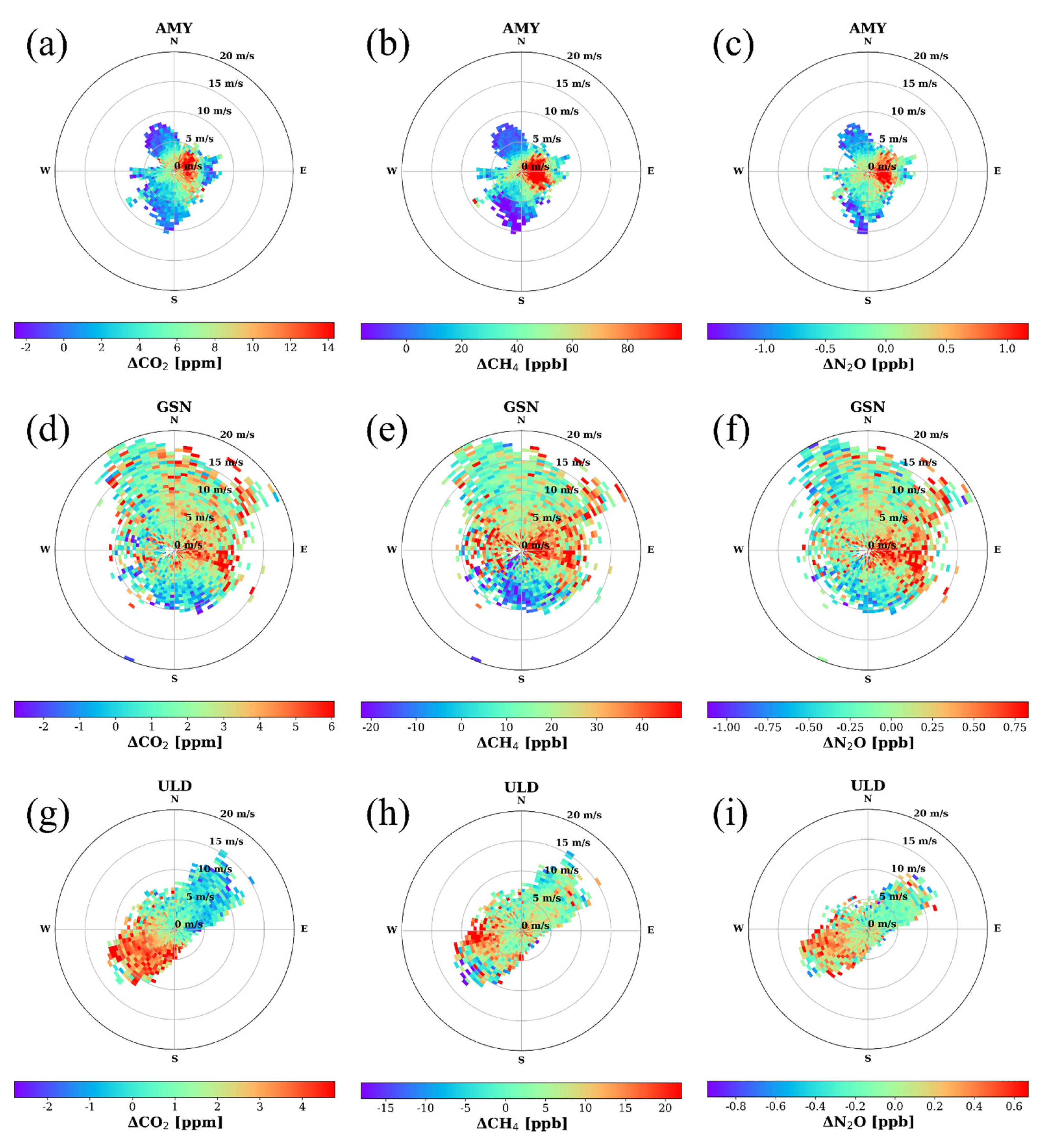
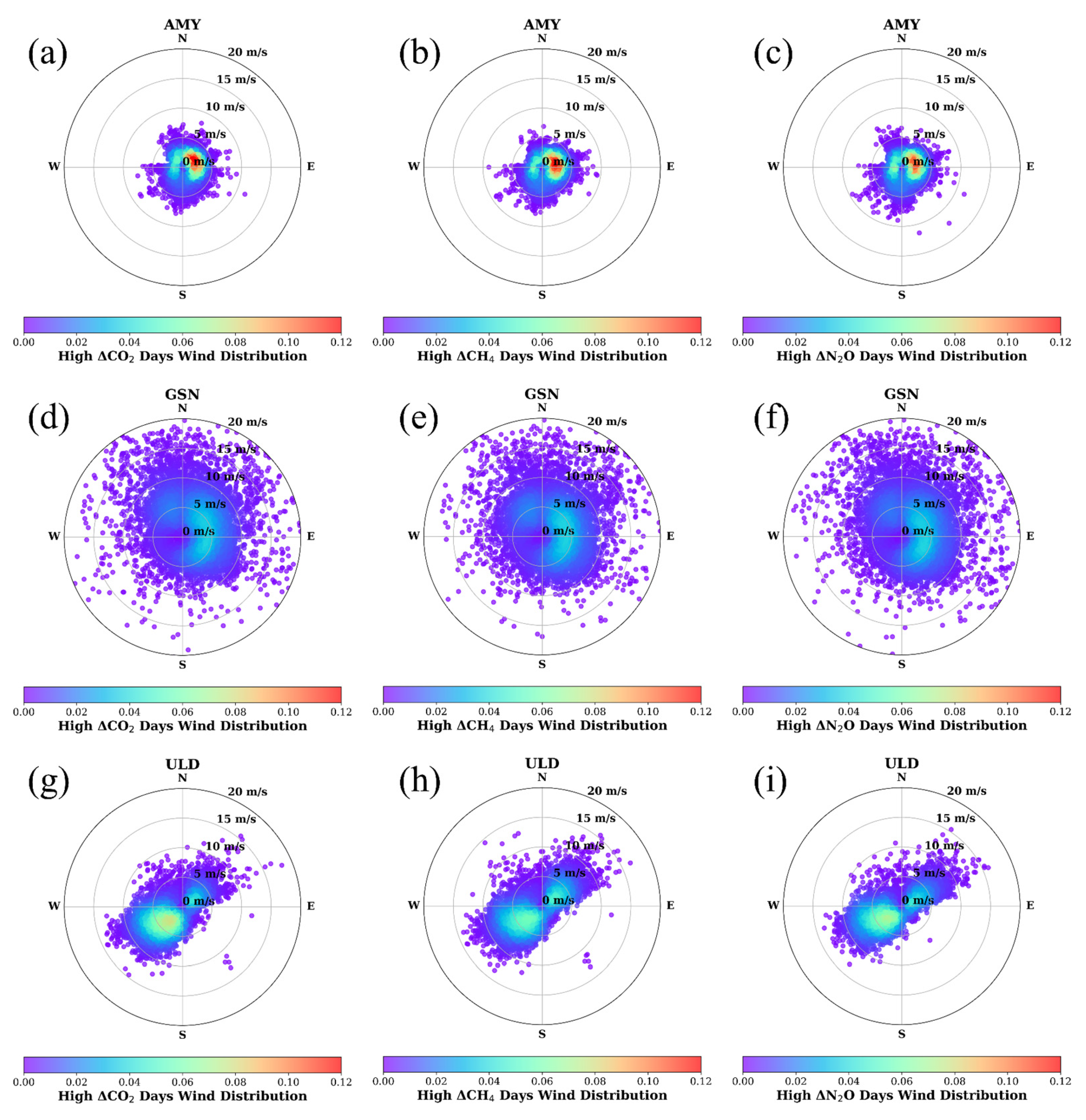
To elucidate the local influences on GHG concentration variations, the wind direction, wind speed, and enhancement variability were analyzed. Atmospheric GHGs are continuously transported by wind, making wind direction and speed important factors in understanding short-term concentration variations. Located near the western coastline of the Korean Peninsula, AMY is strongly influenced by land–sea breezes, with prevailing winds from the east and west. In addition, seasonal monsoons strengthen northeasterly and northwesterly winds in winter, whereas southwesterly winds prevail in summer. Wind speeds were within 5 m s−1, making AMY the site with the weakest winds among the three domestic observatories. At GSN, which is located on the northwestern coast of Jeju Island, northerly and northeasterly winds dominate in winter, whereas primarily southwesterly winds are observed in summer. Wind speeds typically range from 2 to 10 m s−1, but strong winds exceeding 20 m s−1 have occasionally been recorded, resulting in relatively higher average wind speeds than at the other sites. ULD is influenced by mountainous terrain to the northwest, leading to strong mountain–valley wind effects with prevailing northeasterly and southwesterly winds. Consequently, southwesterly winds are stronger in winter, and northeasterly winds are stronger in summer, with wind speeds below 10 m s−1. Figure 7 presents the average distribution of GHG enhancements according to wind direction and speed at each site. Figure 8 shows the distribution of wind direction and speed when high GHG concentrations were observed.
At AMY, all three GHGs showed high enhancements, primarily under easterly winds with speeds below 5 m s−1. This pattern is quantitatively supported by the fact that 46–49% of the top 25% high-concentration events for CO2, CH4, and N2O occurred under an east-northeast (30–120°) flow, whereas only approximately 14–16% were associated with west-northwesterly winds. The dominant easterly component suggests a strong influence from the large power generation and semiconductor industrial complexes located northeast and southeast of the station. In addition, the relatively high CH4 and N2O enhancements are likely linked to agricultural and livestock activities in nearby inland areas. Notably, a smaller but meaningful portion of high-concentration events also occurred under northwesterly winds, consistent with the long-range transport of industrial plumes from eastern China, particularly during winter when the northwesterly flow intensifies. Therefore, AMY is influenced by both major domestic emission sources and pollutants transported over long distances from abroad. Furthermore, the similar enhancement behavior among the three GHGs indicates that they may be affected by common emission sources, underscoring the importance of evaluating source contributions from an integrated cross-species perspective.
Similarly, at GSN, all three GHGs exhibited highly enhanced concentrations, mainly under easterly and northeasterly winds, which accounted for approximately 19–25% of the high-concentration events. However, high-concentration cases also appeared under northwesterly winds (9–10%), implying contributions from inland Korean regions, Jeju Island emission sources, and cross-border transport from China. The broad distribution of wind direction and speed at this island station indicates a wide variety of potential source regions, reinforcing the need for further source attribution analyses.
At ULD, high CO2, CH4, and N2O distributions occurred predominantly under southwesterly winds, which accounted for 33–42% of high-concentration cases, particularly strong for CO2. This reflects the combined influence of emissions from industrial cities along the eastern coast of Korea and local industrial sources, including a small brick factory located near the site.
Across all stations, the similar directional patterns of CO2, CH4, and N2O indicate that the gases share common major point sources, such as industrial complexes. However, each gas is also affected by sector-specific sources, such as CH4 from livestock and wastewater facilities, N2O from agricultural soils and fertilizer use, and CO2 from energy and industrial combustion. Therefore, a detailed sectoral separation and upwind source region classification are necessary to resolve the relative contributions of local and transported GHG emissions to each observatory more accurately.

3.2.2. Relationships Between GHG Variations

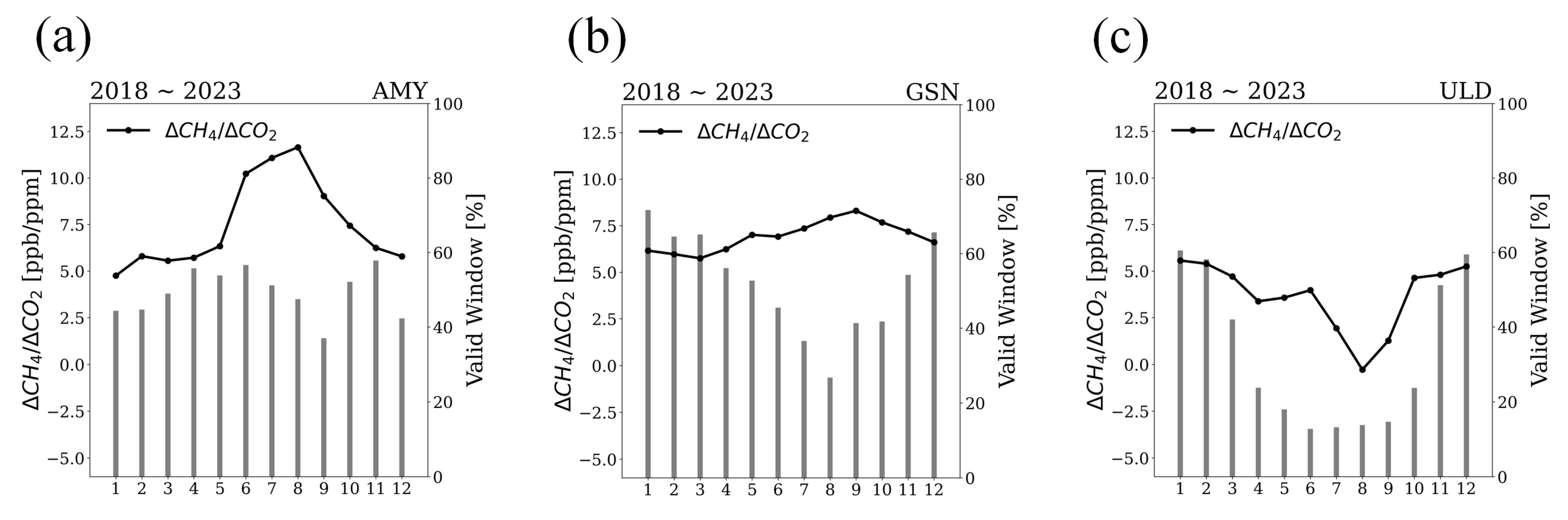
The relationships between variations in different GHG concentrations have been analyzed in several studies, and these can be indirectly used to diagnose the potential sources and sinks of each gas [41,42]. Ratio analyses of GHGs at domestic WMO/GAW sites are meaningful as fundamental statistical data for future studies on source attribution and emission source and sink characteristics of GHGs in Korea. Figure 9 shows the monthly mean slopes of CH4/ CO2 at each observatory, calculated using the window analysis method described in Section 2.3.1. The accompanying histograms represent the proportion of windows with statistically significant values among all windows for each month. These were used to calculate the monthly mean slope, which indicates the strength of the relationship between the concentration variations in the two gases.
During November–March, the mean CH4/ CO2 slopes were 5.85, 6.38, and 5.04 ppb ppm−1 at AMY, GSN, and ULD, respectively, with standard deviations of 3.21, 2.96, and 1.93 ppb ppm−1, indicating relatively stable ratios in winter. This stability is likely due to reduced vegetation activity during winter, when enhancements in CO2 and CH4 are primarily influenced by anthropogenic emissions. In contrast, during June–August, the slopes were 10.98, 7.40, and 1.87 ppb ppm−1 at AMY, GSN, and ULD, respectively, showing considerable site-to-site differences. The standard deviations were also substantially higher than in winter, at 5.08, 5.68, and 4.98 ppb ppm−1, respectively. In particular, at GSN and ULD, the proportion of windows with statistically significant values decreased sharply in the summer. These seasonal characteristics are likely due to a decline in the correlation between the two gases as vegetation activity increases in the summer. However, at AMY, the relationship between the enhancements of the two gases remained relatively strong throughout the year without pronounced seasonal differences. This implies that, compared to the other sites, AMY is more strongly influenced by major anthropogenic GHG emission sources, both domestic and foreign, such as large industrial complexes. In particular, at AMY, CO2 tended to decrease and CH4 tended to increase during summer. Consequently, the CH4/ CO2 slope showed a sharp increase in summer, suggesting seasonal changes in either the major source regions of GHGs or emission levels associated with anthropogenic activities. Nevertheless, for a more quantitative assessment, future studies should apply Lagrangian particle dispersion models to analyze seasonal variations in source regions and emission levels more precisely.
The interrelationships between GHGs, analyzed based on the slopes between their enhancements, suggest that the major influencing factors may differ depending on the locational characteristics of each site; thus, their variations may also differ. The relationship between CO2 and CH4 revealed clear site-specific seasonal differences. This analysis also implies that AMY is more strongly influenced by anthropogenic emission sources than the other observatories. Therefore, to analyze GHG concentration data at AMY, the impact of anthropogenic emissions must be estimated more clearly, and with the future expansion of high-precision trace GHG observation networks, the variability characteristics are expected to be identified more clearly.

3.2.3. Long-Term Changes in Correlations at AMY

AMY is the longest-operating WMO/GAW monitoring station in Korea and has continuously produced observational data on various GHGs, including CO2 and CH4, since 1999. Because of the characteristics of GHGs, their long-term trends and variations must be clarified. As a site with long-term observational records, AMY provides a critical scientific basis for studies on GHG variability in Korea. In particular, CO2 and CH4 are representative GHGs whose atmospheric concentrations are continuously increasing owing to human activities, and correlation-based studies between these two gases have been conducted [14,16]. According to these studies, variations in their concentrations exhibited significant correlations that strengthened during periods when the influence of vegetative activity was reduced. Under the common assumption that both gases have high emissions in regions with concentrated human activities, strong correlations can be used as indicators of anthropogenic emissions. Therefore, this study analyzed the long-term correlations between CO2 and CH4 enhancement variations using observational data from AMY covering 2001–2023.
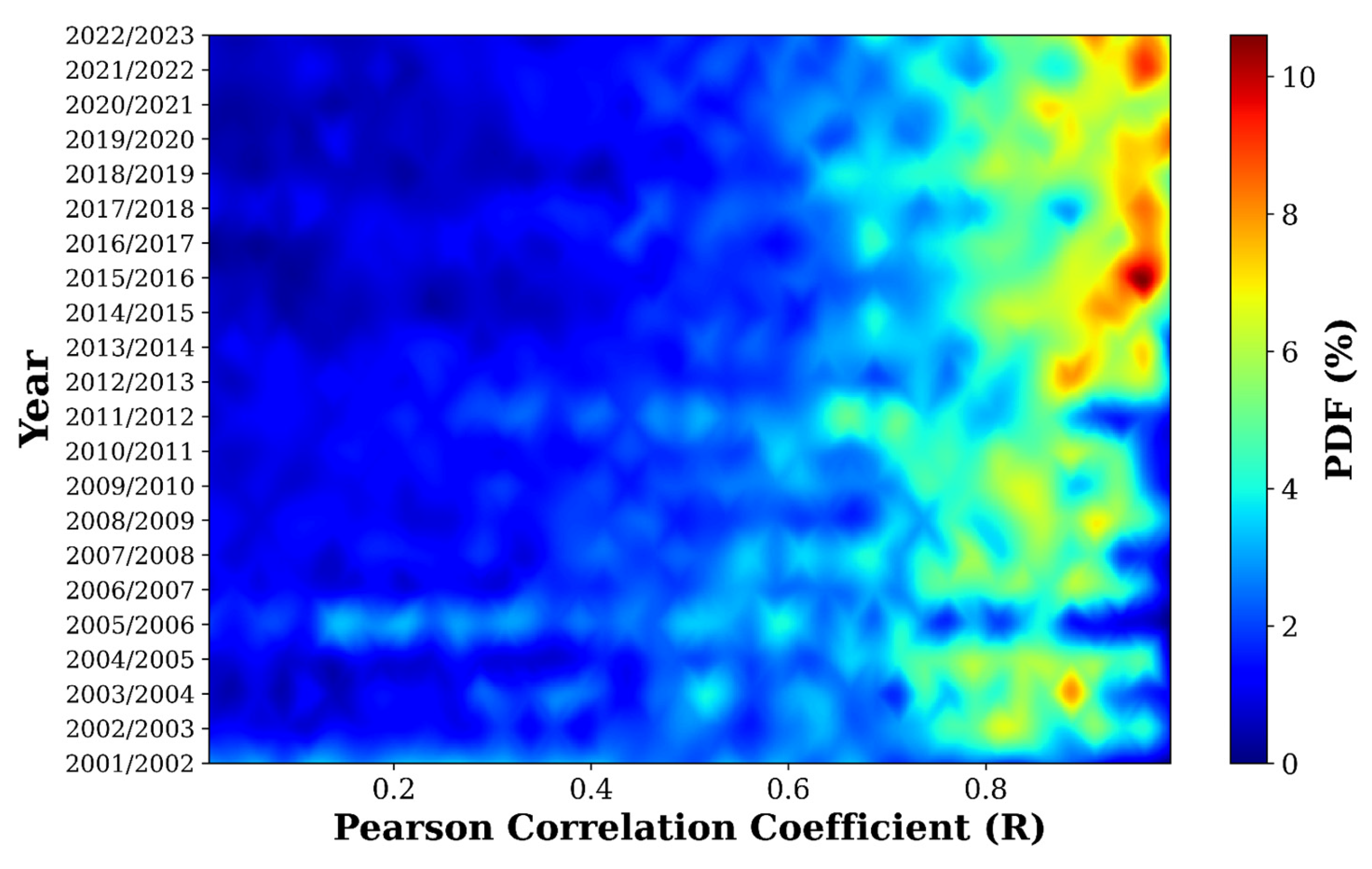
Figure 10 shows the distribution of wintertime R values between CO2 and CH4, calculated for each window following the method in Section 2.3.2 and presented by year using PDFs. Two consecutive years represented the winter period, from November of the previous year to March of the following year. To minimize the effect of vegetation, only correlations during these winter periods were used for statistical analysis. Over the 22 winters from November 2001 to March 2023, the correlation between CO2 and CH4 variations showed a continuous strengthening trend. In particular, since the winter of 2011/2012, the correlation has strengthened sharply, likely owing to the replacement of the CO2 analyzer at AMY in 2012. That year, the CO2 measurement system at AMY was changed from Non-Dispersive Infrared Spectroscopy to Cavity Ring-Down Spectroscopy, and the calibration scale was switched from the previous KRISS scale to the WMO X2007 scale. Such instrument replacements and scale changes can induce biases when interpreting long-term GHG concentration variations and must, therefore, be considered in data analysis. Thus, operating observatories and processing data consistently are essential for long-term, stable GHG monitoring and analysis. In addition, the strengthening of correlations between CO2 and CH4 is likely related to the increasing GHG emissions in East Asia. Throughout the analysis period, approximately 38.6% of the data were distributed in the region with R ≥ 0.8, whereas this proportion increased to approximately 45.5% after the instrument replacement. In particular, during the post-replacement period, the proportion of data with R ≥ 0.8 increased at a rate of 0.41% y−1, whereas the proportion with R ≥ 0.9 increased at 0.49% y−1. These results indicated a strengthening of the correlation between the two gases. Therefore, this strengthening of the correlations is likely associated with increasing trends in CO2 and CH4 emissions in East Asia owing to human activities. Furthermore, over the entire analysis period, the proportions of data distributed in the regions with R ≥ 0.8 and R ≥ 0.9 showed increasing trends of 1.36% y−1 and 1.13% y−1, respectively. However, because these trends also reflect the effect of instrument replacement, caution is required when interpreting them as being directly linked to increases in the actual correlation. Hence, the future acquisition of more consistent long-term observational data will further advance such correlation analyses between these GHGs.

4. Discussion

Atmospheric concentrations of GHGs have continuously increased owing to human activities, leading to various challenges associated with the greenhouse effect. Accordingly, numerous studies have been conducted to analyze long-term trends in GHGs and trace their origins. However, research based on domestic WMO/GAW station data that analyzes GHG variability across multiple temporal scales and investigates site-specific characteristics remains limited. Therefore, this study conducted a basic statistical analysis of three major GHGs (CO2, CH4, and N2O) using observational data collected over six years (2018–2023) from three domestic WMO/GAW observatories. First, background concentrations and short-term variations (i.e., SSVs) were separated from the hourly observational data at each site, allowing us to examine GHG variations across different temporal scales. Furthermore, to identify the characteristic GHG variations at each observatory, we investigated the local influences on concentration changes and, focusing on intergas relationships, comparatively analyzed the seasonal variations in the concentration ratios between the two GHGs at each site. In particular, using long-term observational records available at AMY, the long-term changes in the correlations between CO2 and CH4 concentration variations were examined.
The analysis of relatively short timescales, such as diurnal and weekly variations, revealed several characteristic fluctuations; however, their magnitudes were small and, in certain cases, the variability was not clearly distinguishable. This is likely because owing to the long atmospheric lifetimes of GHGs, background concentrations exert a strong influence, making short-term variability less apparent. In addition, although the effects of anthropogenic point sources can be relatively strong on short timescales, such influences may not have been reflected well because background monitoring stations are typically located in relatively clean regions. Nevertheless, several notable short-term variations were observed, such as the diurnal cycles of GHGs in AMY and GSN, which likely reflected the diurnal effects of vegetation activity, land–sea breezes, and PBL height variations. Furthermore, at all three sites, high-concentration events occurred more frequently on weekends than on weekdays, with the largest variations observed at AMY, which is located closest to the anthropogenic emission sources. These results suggest that short-term variations in GHGs can serve as indicators for capturing the signals of anthropogenic activities, together with the influence of local emissions and sink processes.
At medium- to long-term timescales, seasonality and long-term trends were analyzed based on the derived background concentrations. Each GHG exhibited seasonal variation; in particular, both CO2 and CH4 concentrations decreased during summer. This was likely influenced by changes in PBL height associated with seasonal differences in atmospheric stability. CO2 may have been strongly affected by enhanced vegetation activity in spring and summer, whereas the CH4 decrease may have been driven by increased reactions with OH radicals at higher summer temperatures, indicating the contribution of gas-specific factors. In contrast, N2O exhibited relatively small seasonal amplitudes, but showed a unique bimodal pattern characterized by summer increases and winter decreases, which can be attributed to seasonal changes in the extent of microbial nitrification in soils. Additionally, differences in the magnitude of variability across the three sites were observed, likely reflecting the site-specific influences of local emission sources and meteorological factors. Over the past six years, the long-term trends of CO2, CH4, and N2O showed higher growth rates in the order of AMY > GSN > ULD. Although the increasing trends at the three sites were broadly consistent with global trends, CH4 exhibited somewhat higher growth rates than the global mean. Notably, during the La Niña period of 2021–2022, the CO2 growth rates decreased sharply, whereas during the El Niño period of 2018–2019, the CH4 growth rates increased markedly, showing variations consistent with global trends. The growth rate of N2O in 2023, when El Niño occurred, was lower than the mean growth rate. These interannual variations are closely related to the influence of the El Niño–Southern Oscillation on terrestrial and wetland carbon fluxes. During El Niño events, reduced precipitation and elevated temperatures in tropical regions suppress photosynthetic uptake and enhance heterotrophic respiration, leading to increased CO2 release from vegetation and soil [43]. El Niño conditions have also been shown to stimulate CH4 emissions from wetlands by altering soil moisture dynamics and microbial activity [44]. Conversely, La Niña conditions enhance vegetation productivity and carbon uptake, resulting in lower CO2 growth rates. Therefore, the El Niño–Southern Oscillation-driven modulation of biospheric carbon exchange and wetland CH4 production likely contributed to the interannual variability observed in GHG growth rates at the three Korean WMO/GAW stations. However, because long-term observation networks for trace GHGs are still insufficient in Korea, further in-depth analyses are required.
Based on the wind speed and direction data used for the analysis of local influences on GHG concentration variations, each observatory strongly reflected the impact of nearby large point sources, such as industrial complexes. In particular, AMY reflected not only the influence of major domestic emission sources but also long-range transport from industrial complexes in eastern China. However, because the characteristic emission sources differ among individual GHGs, more detailed analyses are required in the future. In addition, an analysis of the seasonal variability in the relationship between CO2 and CH4 based on concentration ratios revealed regional and seasonal differences associated with changes in vegetation activity throughout the year. At AMY, increases in CH4 during summer and the influence of vegetation affected the relationship between the two gases. Anthropogenic emission sources were more strongly reflected at AMY across all seasons than at the other sites. Therefore, AMY is considered a key observatory for diagnosing changes in the major source regions of GHGs, as well as emission fluctuations from these regions in response to seasonal airflow variations. More detailed analyses using atmospheric transport models are necessary in the future. Finally, considering both the locational characteristics of AMY and the availability of the longest observational records in Korea, the long-term variability in the CO2–CH4 correlation, which can serve as an indicator for diagnosing anthropogenic emissions, was analyzed. It showed a continuous strengthening trend, with a sharp increase observed around 2012. This is likely related to the replacement of the CO2 analyzer and change in the calibration scale at AMY in 2012, whereas the strengthening trend observed thereafter is likely associated with increasing CO2 and CH4 emissions from human activities in East Asia. This apparent shift around 2012 coincides with the replacement of the CO2 analyzer and the associated calibration-scale change at AMY, and previous intercomparison studies indicate that the transition from NDIR to CRDS systems can introduce an instrument-dependent bias of roughly 0.14 ppm [45,46]. Such offsets may have contributed to the abrupt increase in correlation observed during that year; however, because the CO2–CH4 relationship is determined by the co-variability between the two gases rather than their absolute mole fractions, the precise influence of this instrument change on the long-term correlation structure remains uncertain and warrants further targeted evaluation. Even with this consideration, the distinct and sustained strengthening of the correlation beginning around 2012 is difficult to attribute solely to instrumental effects and is more plausibly explained by the strengthening influence of common emission sources across East Asia.
The basic statistical analyses of GHG concentration variability at domestic WMO/GAW sites derived in this study provide essential baseline information for understanding the GHG emissions and distribution characteristics in East Asia. These results are expected to be useful for GHG emission estimations and policy support in response to climate crises. However, because of the nature of GHGs, long-term and stable observations are required. Thus, the acquisition of more reliable data necessitates the consistent use and regular maintenance of instruments. In particular, for trace GHGs, such as N2O, the domestic long-term observation network remains insufficient, and its expansion along with the accumulation of high-quality data will enable more comprehensive analyses. Furthermore, if studies based on Lagrangian transport models are conducted in parallel, the observed concentration variations can be further resolved, thereby contributing to source attribution and determination of GHG emission characteristics.

5. Conclusions

This study analyzed the variability in atmospheric CO2, CH4, and N2O from 2018 to 2023 at three domestic WMO/GAW observation sites, examining site characteristics, local emission influences, the CO2–CH4 relationship, and long-term correlations at AMY. At short timescales, the variability was small, owing to the long atmospheric lifetimes of GHGs, although vegetation activity, land–sea breezes, and PBL changes were partially reflected. Across all sites, high-concentration events occurred more frequently on weekends, suggesting differences in anthropogenic emissions between weekdays and weekends. AMY, located closest to major domestic sources and influenced by long-range transport from eastern China, showed the highest background concentrations and largest variability. At medium-to-long-term scales, CO2 and CH4 showed summer decreases linked to vegetation uptake and OH radical reactions, respectively. N2O displayed smaller seasonal amplitudes but a distinctive bimodal pattern. The growth rates followed the order of AMY > GSN > ULD, with CH4 increasing faster than the global trends, suggesting East Asian contributions. Large-scale climate drivers such as El Niño and La Niña further modulate CO2 and CH4 growth rates. Wind and transport analyses confirmed the sensitivity at AMY to both local and regional sources, whereas the CO2 CH4 ratios highlighted seasonal vegetation effects and anthropogenic signals. The long-term analysis revealed that the correlations between the two gases strengthened markedly after the 2012 instrument and calibration changes, with the subsequent trend likely linked to increasing East Asian emissions. This study provides a foundation for understanding the GHG variability in Korea and highlights the importance of stable long-term monitoring combined with transport modeling. In particular, the observed CO2–CH4 correlations and seasonal emission patterns can serve as key indicators for evaluating the effectiveness of mitigation policies, validating national GHG inventories, and establishing Monitoring, Reporting, and Verification systems. By linking observational evidence with emission dynamics, the results of this study can contribute to the development of data-driven strategies for emissions reduction and policy implementation. Unlike previous studies that primarily examined each GHG separately, this study provides additional value by jointly analyzing multiple GHGs and their interrelationships, thereby enhancing our understanding of the shared and distinct drivers underlying GHG variability in Korea. Notably, the AMY case underscores the critical importance of consistent instrumentation and continuous observations. Therefore, to address the limitations of domestic observation networks, it is anticipated that enhanced maintenance stability, along with the expansion and establishment of additional GHG monitoring stations across the country, will be essential for future progress.

Author Contributions

Conceptualization, H.Y.S., J.K. and Y.G.L.; Data curation, H.Y.S. and Y.G.L.; Formal analysis, H.Y.S., J.K. and Y.G.L.; Funding acquisition, Y.G.L.; Investigation, H.Y.S. and Y.G.L.; Methodology, H.Y.S., J.K. and Y.G.L.; Project administration, D.S., S.K., S.L. and Y.G.L.; Resources, D.S., S.K., S.L. and Y.G.L.; Software, H.Y.S.; Supervision, Y.G.L.; Validation, H.Y.S.; Visualization, H.Y.S.; Writing—original draft, H.Y.S.; Writing—review and editing, J.K., D.S., S.K., S.L. and Y.G.L. All authors have read and agreed to the published version of the manuscript.

Funding

This work was funded by the Korea Meteorological Administration Research and Development Program “Developing Technology for Integrated Climate Change Monitoring and Analysis” under Grant No. KMA2018-00324 and the Ministry of Education of the Republic of Korea and the National Research Foundation of Korea (NRF-2020S1A5A2A03043565).

Institutional Review Board Statement

Not applicable.

Informed Consent Statement

Not applicable.

Data Availability Statement

The raw data supporting the conclusions of this article will be made available by the authors on request.

Conflicts of Interest

The authors declare no conflicts of interest.

Abbreviations

The following abbreviations are used in this manuscript:
GHGGreenhouse gas
CO2Carbon dioxide
CH4Methane
N2ONitrous oxide
KMAKorea Meteorological Administration
GAWGlobal Atmosphere Watch
WMOWorld Meteorological Organization
AMYAnmyeondo
GSNJeju Gosan
ULDUlleungdo
SSVSynoptic-scale variations
PBLPlanetary boundary layer
PDFprobability density function

References

  1. Lee, H.; Calvin, K.; Dasgupta, D.; Krinner, G.; Mukherji, A.; Thorne, P.; Trisos, C.; Romero, J.; Aldunce, P.; Barret, K. IPCC, 2023: Climate change 2023: Synthesis report, summary for policymakers. In Contribution of Working Groups I, II and III to the Sixth Assessment Report of the Intergovernmental Panel on Climate Change; Lee, H., Romero, J., Eds.; IPCC: Geneva, Switzerland, 2023. [Google Scholar]
  2. Reading, M.J.; Maher, D.T.; Santos, I.R.; Jeffrey, L.C.; Cyronak, T.J.; McMahon, A.; Tait, D.R. Spatial distribution of CO2, CH4, and N2O in the Great Barrier Reef revealed through high resolution sampling and isotopic analysis. Geophys. Res. Lett. 2021, 48, e2021GL092534. [Google Scholar] [CrossRef]
  3. Paciorek, C.J.; Stone, D.A.; Wehner, M.F. Quantifying statistical uncertainty in the attribution of human influence on severe weather. Weather Clim. Extrem. 2018, 20, 69–80. [Google Scholar] [CrossRef]
  4. Scott, P.; Allen, M.; Christidis, N.; Dole, R.; Hoerling, M.; Huntingford, C.; Pall, P.; Perlwitz, J.; Stone, D. Attribution of weather and climate-related extreme events. In Climate Science for Serving Society: Research, Modelling and Prediction Priorities; Asrar, G.R., Hurrell, J.W., Eds.; Springer: Berlin/Heidelberg, Germany, 2013; pp. 307–337. [Google Scholar]
  5. Smith, C.; Nicholls, Z.R.; Armour, K.; Collins, W.; Forster, P.; Meinshausen, M.; Palmer, M.D.; Watanabe, M. The earth’s energy budget, climate feedbacks, and climate sensitivity supplementary material. Clim. Chang. 2021, 1850–2005. [Google Scholar]
  6. Prather, M.J.; Zhu, X. Lifetimes and timescales of tropospheric ozone. Elem. Sci. Anth. 2024, 12, 00112. [Google Scholar] [CrossRef]
  7. Lange, K.; Richter, A.; Burrows, J.P. Variability of nitrogen oxide emission fluxes and lifetimes estimated from Sentinel-5P TROPOMI observations. Atmos. Chem. Phys. 2022, 22, 2745–2767. [Google Scholar] [CrossRef]
  8. Wang, T.; Xue, L.; Brimblecombe, P.; Lam, Y.F.; Li, L.; Zhang, L. Ozone pollution in China: A review of concentrations, meteorological influences, chemical precursors, and effects. Sci. Total Environ. 2017, 575, 1582–1596. [Google Scholar] [CrossRef]
  9. Park, H.-J.; Woo, K.-S.; Chung, E.-K.; Kang, T.-S.; Kim, G.-B.; Yu, S.-D.; Son, B.-S. A Time-series study of ambient air pollution in relation to daily mortality count in Yeosu. J. Environ. Impact Assess. 2015, 24, 66–77. [Google Scholar] [CrossRef]
  10. Dockery, D.W.; Stone, P.H. Cardiovascular risks from fine particulate air pollution. N. Engl. J. Med. 2007, 356, 511–513. [Google Scholar] [CrossRef]
  11. Wei, Y.; Yang, X.; Jia, Y.; Han, H.; Tang, C. Study of atmospheric CH4, CO2 and N2O at Waliguan WMO/GAW global station: Time series trend, seasonal variation, and attribution analysis association with meteorological factors. Atmos. Environ. 2025, 343, 120994. [Google Scholar] [CrossRef]
  12. Lee, H.; Seo, W.; Li, S.; Lee, S.; Kenea, S.T.; Joo, S. Measurement report: Atmospheric CH4 at regional stations of the Korea Meteorological Administration–Global Atmosphere Watch Programme: Measurement, characteristics, and long-term changes of its drivers. Atmos. Chem. Phys. 2023, 23, 7141–7159. [Google Scholar] [CrossRef]
  13. Lee, H.; Han, S.-O.; Ryoo, S.-B.; Lee, J.-S.; Lee, G.-W. The measurement of atmospheric CO2 at KMA GAW regional stations, its characteristics, and comparisons with other East Asian sites. Atmos. Chem. Phys. 2019, 19, 2149–2163. [Google Scholar] [CrossRef]
  14. Tohjima, Y.; Kubo, M.; Minejima, C.; Mukai, H.; Tanimoto, H.; Ganshin, A.; Maksyutov, S.; Katsumata, K.; Machida, T.; Kita, K. Temporal changes in the emissions of CH4 and CO from China estimated from CH4/CO2 and CO/CO2 correlations observed at Hateruma Island. Atmos. Chem. Phys. 2014, 14, 1663–1677. [Google Scholar] [CrossRef]
  15. Tohjima, Y.; Mukai, H.; Hashimoto, S.; Patra, P. Increasing synoptic scale variability in atmospheric CO2 at Hateruma Island associated with increasing East-Asian emissions. Atmos. Chem. Phys. 2010, 10, 453–462. [Google Scholar] [CrossRef]
  16. Kenea, S.T.; Lee, H.; Patra, P.K.; Li, S.; Labzovskii, L.D.; Joo, S. Long-term changes in CH4 emissions: Comparing ΔCH4/ΔCO2 ratios between observation and proved model in East Asia (2010–2020). Atmos. Environ. 2023, 293, 119437. [Google Scholar] [CrossRef]
  17. Kim, J.; Jang, J.-A.; Oh, Y.-S.; Lee, H.; Joo, S.; Kim, S.; Boo, K.-O.; Lee, Y.G. Anthropogenic carbon dioxide origin tracing study in Anmyeon-do, South Korea: Based on STILT-footprint and emissions data. Sci. Total Environ. 2023, 894, 164677. [Google Scholar] [CrossRef] [PubMed]
  18. Shim, C.; Han, J.; Henze, D.K.; Yoon, T. Identifying local anthropogenic CO2 emissions with satellite retrievals: A case study in South Korea. Int. J. Remote Sens. 2019, 40, 1011–1029. [Google Scholar] [CrossRef]
  19. Seo, W.; Lee, H.; Kim, Y.-H. Revision of 22-year records of atmospheric baseline CO2 in South Korea: Application of the WMO X2019 CO2 scale and a new baseline selection method (NIMS Filter). Atmosphere 2021, 31, 593–606. [Google Scholar]
  20. Thoning, K.W.; Tans, P.P.; Komhyr, W.D. Atmospheric carbon dioxide at Mauna Loa Observatory: 2. Analysis of the NOAA GMCC data, 1974–1985. J. Geophys. Res. Atmos. 1989, 94, 8549–8565. [Google Scholar] [CrossRef]
  21. Czeplak, G.; Junge, C. Studies of interhemispheric exchange in the troposphere by a diffusion model. In Advances in Geophysics; Elsevier: Amsterdam, The Netherlands, 1975; Volume 18, pp. 57–72. [Google Scholar]
  22. Tian, H.; Xu, R.; Canadell, J.G.; Thompson, R.L.; Winiwarter, W.; Suntharalingam, P.; Davidson, E.A.; Ciais, P.; Jackson, R.B.; Janssens-Maenhout, G. A comprehensive quantification of global nitrous oxide sources and sinks. Nature 2020, 586, 248–256. [Google Scholar] [CrossRef]
  23. Saunois, M.; Stavert, A.R.; Poulter, B.; Bousquet, P.; Canadell, J.G.; Jackson, R.B.; Raymond, P.A.; Dlugokencky, E.J.; Houweling, S.; Patra, P.K. The global methane budget 2000–2017. Earth Syst. Sci. Data Discuss. 2019, 12, 1561–1623. [Google Scholar] [CrossRef]
  24. Higuchi, K.; Worthy, D.; Chan, D.; Shashkov, A. Regional source/sink impact on the diurnal, seasonal and inter-annual variations in atmospheric CO2 at a boreal forest site in Canada. Tellus B Chem. Phys. Meteorol. 2003, 55, 115–125. [Google Scholar] [CrossRef]
  25. Guo, M.; Fang, S.; Liu, S.; Liang, M.; Wu, H.; Yang, L.; Li, Z.; Liu, P.; Zhang, F. Comparison of atmospheric CO2, CH4, and CO at two stations in the Tibetan Plateau of China. Earth Space Sci. 2020, 7, e2019EA001051. [Google Scholar] [CrossRef]
  26. Gulyaev, E.; Antonov, K.; Markelov, Y.; Poddubny, V.; Shchelkanov, A.; Iurkov, I. Short-term effect of COVID-19 lockdowns on atmospheric CO2, CH4 and PM2.5 concentrations in urban environment. Int. J. Environ. Sci. Technol. 2023, 20, 4737–4748. [Google Scholar] [CrossRef] [PubMed]
  27. Chan, D.; Ishizawa, M.; Higuchi, K.; Maksyutov, S.; Chen, J. Seasonal CO2 rectifier effect and large-scale extratropical atmospheric transport. J. Geophys. Res. Atmos. 2008, 113, D17309. [Google Scholar] [CrossRef]
  28. D’Amico, F.; Ammoscato, I.; Gullì, D.; Avolio, E.; Lo Feudo, T.; De Pino, M.; Cristofanelli, P.; Malacaria, L.; Parise, D.; Sinopoli, S. Integrated analysis of methane cycles and trends at the WMO/GAW station of Lamezia Terme (Calabria, Southern Italy). Atmosphere 2024, 15, 946. [Google Scholar] [CrossRef]
  29. Lee, T.; Go, S.; Lee, Y.G.; Park, S.S.; Park, J.; Koo, J.-H. Temporal variability of surface air pollutants in megacities of South Korea. Front. Environ. Sci. 2022, 10, 915531. [Google Scholar] [CrossRef]
  30. Le Quéré, C.; Moriarty, R.; Andrew, R.M.; Canadell, J.G.; Sitch, S.; Korsbakken, J.I.; Friedlingstein, P.; Peters, G.P.; Andres, R.J.; Boden, T.A. Global carbon budget 2015. Earth Syst. Sci. Data 2015, 7, 349–396. [Google Scholar] [CrossRef]
  31. Liu, G.; Peng, S.; Lin, X.; Ciais, P.; Li, X.; Xi, Y.; Lu, Z.; Chang, J.; Saunois, M.; Wu, Y. Recent slowdown of anthropogenic methane emissions in China driven by stabilized coal production. Environ. Sci. Technol. Lett. 2021, 8, 739–746. [Google Scholar] [CrossRef]
  32. Fang, S.X.; Zhou, L.X.; Masarie, K.A.; Xu, L.; Rella, C.W. Study of atmospheric CH4 mole fractions at three WMO/GAW stations in China. J. Geophys. Res. Atmos. 2013, 118, 4874–4886. [Google Scholar] [CrossRef]
  33. Li, S.; Park, S.; Lee, J.-Y.; Ha, K.-J.; Park, M.-K.; Jo, C.; Oh, H.; Mühle, J.; Kim, K.-R.; Montzka, S. Chemical evidence of inter-hemispheric air mass intrusion into the Northern Hemisphere mid-latitudes. Sci. Rep. 2018, 8, 4669. [Google Scholar] [CrossRef]
  34. Ju, O.-J.; Cha, J.-S.; Lee, D.-W.; Kim, Y.-M.; Lee, J.-Y.; Park, I.-S. Analysis of variation characteristics of greenhouse gases in the background atmosphere measured at Gosan, Jeju. J. Korean Soc. Atmos. Environ. 2007, 23, 487–497. [Google Scholar] [CrossRef]
  35. Jiang, K.; Pan, Z.; Pan, F.; Teuling, A.J.; Han, G.; An, P.; Chen, X.; Wang, J.; Song, Y.; Cheng, L. Combined influence of soil moisture and atmospheric humidity on land surface temperature under different climatic background. Iscience 2023, 26, 106837. [Google Scholar] [CrossRef]
  36. Ishijima, K.; Nakazawa, T.; Aoki, S. Variations of atmospheric nitrous oxide concentration in the northern and western Pacific. Tellus B Chem. Phys. Meteorol. 2009, 61, 408–415. [Google Scholar] [CrossRef]
  37. Joo, S.; Lee, S.; Lee, S.; Oh, Y.; Shin, D.; Jeong, S.; Seo, W.; Kenea, S.T.; Kim, S. Achievements and Future Prospects of Greenhouse Gas Research for Climate Change Monitoring in Korea. J. Korean Soc. Atmos. Environ. 2025, 41, 281–320. [Google Scholar] [CrossRef]
  38. Ak-Bhd, M. WMO Greenhouse Gas Bulletin; World Meteorological Organization: Geneva, Switzerland, 2021. [Google Scholar]
  39. Kenea, S.T.; Lee, H.; Joo, S.; Li, S.; Labzovskii, L.D.; Chung, C.-Y.; Kim, Y.-H. Interannual variability of atmospheric CH4 and its driver over South Korea captured by integrated data in 2019. Remote Sens. 2021, 13, 2266. [Google Scholar] [CrossRef]
  40. Thompson, R.L.; Stohl, A.; Zhou, L.X.; Dlugokencky, E.; Fukuyama, Y.; Tohjima, Y.; Kim, S.Y.; Lee, H.; Nisbet, E.G.; Fisher, R.E. Methane emissions in East Asia for 2000–2011 estimated using an atmospheric Bayesian inversion. J. Geophys. Res. Atmos. 2015, 120, 4352–4369. [Google Scholar] [CrossRef]
  41. Mahata, K.S.; Panday, A.K.; Rupakheti, M.; Singh, A.; Naja, M.; Lawrence, M.G. Seasonal and diurnal variations in methane and carbon dioxide in the Kathmandu Valley in the foothills of the central Himalayas. Atmos. Chem. Phys. 2017, 17, 12573–12596. [Google Scholar] [CrossRef]
  42. Chandra, N.; Lal, S.; Venkataramani, S.; Patra, P.K.; Sheel, V. Temporal variations of atmospheric CO2 and CO at Ahmedabad in western India. Atmos. Chem. Phys. 2016, 16, 6153–6173. [Google Scholar] [CrossRef]
  43. Liu, J.; Bowman, K.W.; Schimel, D.S.; Parazoo, N.C.; Jiang, Z.; Lee, M.; Bloom, A.A.; Wunch, D.; Frankenberg, C.; Sun, Y. Contrasting carbon cycle responses of the tropical continents to the 2015–2016 El Niño. Science 2017, 358, eaam5690. [Google Scholar] [CrossRef]
  44. Pandey, S.; Houweling, S.; Krol, M.; Aben, I.; Monteil, G.; Nechita-Banda, N.; Dlugokencky, E.J.; Detmers, R.; Hasekamp, O.; Xu, X. Enhanced methane emissions from tropical wetlands during the 2011 La Niña. Sci. Rep. 2017, 7, 45759. [Google Scholar] [CrossRef]
  45. Chen, H.; Winderlich, J.; Gerbig, C.; Hoefer, A.; Rella, C.; Crosson, E.; Van Pelt, A.; Steinbach, J.; Kolle, O.; Beck, V. High-accuracy continuous airborne measurements of greenhouse gases (CO2 and CH4) using the cavity ring-down spectroscopy (CRDS) technique. Atmos. Meas. Tech. 2010, 3, 375–386. [Google Scholar] [CrossRef]
  46. Zellweger, C.; Emmenegger, L.; Firdaus, M.; Hatakka, J.; Heimann, M.; Kozlova, E.; Spain, T.G.; Steinbacher, M.; van der Schoot, M.V.; Buchmann, B. Assessment of recent advances in measurement techniques for atmospheric carbon dioxide and methane observations. Atmos. Meas. Tech. 2016, 9, 4737–4757. [Google Scholar] [CrossRef]
Figure 1. (a) Locations of the World Meteorological Organization/Global Atmosphere Watch (WMO/GAW) observation sites in Korea along with land-cover types over East Asia. (b) Anmyeondo (AMY), (c) Jeju Gosan (GSN), and (d) Ulleungdo (ULD).
Atmosphere 16 01352 g001
Figure 2. Time series of the CO2, CH4, and N2O mole fractions at (ac) AMY, (df) GSN, and (gi) ULD. Gray dots represent L2 hourly measurements, black dots indicate L3 daily averages, and solid colored lines denote background concentrations.
Atmosphere 16 01352 g002
Figure 3. Mean diurnal variations in hourly averaged mole fractions of (a) ∆CO2, (b) ∆CH4, and (c) ∆N2O.
Atmosphere 16 01352 g003
Figure 4. Probability density functions (PDF) of enhancements in (a) ∆CO2, (b) ∆CH4, and (c) ∆N2O mole fractions for weekdays and weekends. Solid and dashed lines represent weekday and weekend distributions, respectively. Dotted vertical lines indicate the 75th percentile mole fraction at each site. Shaded areas denote regions above the 75th percentile, where weekend distributions exceed weekday distributions.
Atmosphere 16 01352 g004
Figure 5. Monthly mean seasonal variations in (a) CO2, (b) CH4 and (c) N2O mole fractions after trend removal.
Atmosphere 16 01352 g005
Figure 6. Long-term trends in (a) CO2, (b) CH4, and (c) N2O mole fractions. Solid lines denote the long-term trends without enhancements and seasonal variations, and dotted lines indicate background concentrations.
Atmosphere 16 01352 g006
Figure 7. Spatial distributions of CO2, CH4, and N2O with respect to wind direction and speed at (ac) AMY, (df) GSN, and (gi) ULD, where radial distance indicates wind speed and color denotes enhancement magnitude.
Atmosphere 16 01352 g007
Figure 8. Spatial distributions of high-concentration events for CO2, CH4, and N2O with respect to wind direction and speed at (ac) AMY, (df) GSN, and (gi) ULD, where radial distance indicates wind speed and color denotes event intensity.
Atmosphere 16 01352 g008
Figure 9. Averaged seasonal variations of ∆CH4/∆CO2 slopes at (a) AMY, (b) GSN, and (c) ULD, where the gray histograms represent the proportion of valid windows used in the monthly slope calculations.
Atmosphere 16 01352 g009
Figure 10. Long-term changes in the PDF of the ∆CO2–∆CH4 correlation coefficient at AMY. Each two-year period corresponds to a consecutive winter season from November to March of the following year. Colors indicate the PDFs of correlation coefficient distributions for each winter season.
Atmosphere 16 01352 g010
Table 1. Summary of basic information and measurement instruments at the observation sites.
SitesCoordinatesElevationObservation Start YearGas SpeciesMeasurement Instruments
AMY36.53° N 126.32° E47 m1998CO2Non-Dispersive Infrared Gas Analyzers (1999–2011),
Cavity Ring-Down Spectroscopy (2012–present)
CH4Gas Chromatography-Flame Ionization Detector (1999–2015),
Cavity Ring-Down Spectroscopy (2016–present)
NO2Gas Chromatograph-Electron Capture Detector (1999–2022),
Integrated cavity output spectroscopy (2023–present)
GSN33.29° N 126.16° E71 m1990CO2Flask (1990–2003),
Non-Dispersive Infrared Gas Analyzers (2009–2013),
Cavity Ring-Down Spectroscopy (2014–present)
CH4Flask (1990–2003),
Cavity Ring-Down Spectroscopy (2015–present)
NO2Gas Chromatograph-Electron Capture Detector (2010–present)
ULD37.48° N 130.90° E220.9 m1990CO2Cavity Ring-Down Spectroscopy (2012–present)
CH4Cavity Ring-Down Spectroscopy (2012–present)
NO2Gas Chromatograph-Electron Capture Detector (2012–present)
Table 2. Statistical summary of weekday and weekend distributions of GHG mole fraction enhancements. q 75 represents the 75th percentile of the full distribution. μ w d and μ w e are the weekday and weekend means, respectively, with σ w d and σ w e indicating their corresponding associated standard deviations. x p e a k W D and x p e a k W E indicate the peak mole fractions of the PDFs for weekday and weekend data, respectively. A d i f f represents the integrated area where weekend distributions exceed weekday distributions above q 75 .
Gas
Species
Siteq75 μ w d μ w e σ w d σ w e x p e a k W D x p e a k W E A d i f f
CO2 [ppm]AMY11.860.140.1410.9311.827.137.810.0197
GSN5.05−0.09−0.345.616.052.642.610.0104
ULD3.81−0.21−0.504.504.571.641.570.0073
CH4 [ppb]AMY81.532.054.25100.6399.9654.6961.220.0397
GSN39.900.14−0.6550.3153.4021.3425.050.0317
ULD16.44−1.22−2.1729.0729.216.737.310.0202
N2O [ppb]AMY0.83−0.76−0.661.621.760.090.260.0338
GSN0.58−0.43−0.491.371.570.080.190.0294
ULD0.50−0.27−0.230.900.940.020.050.0104
Table 3. Annual growth rates of long-term trends for GHG mole fractions at each site.
Gas
Species
Site20192020202120222023AVG
CO2 [ppm y−1]AMY2.772.822.471.932.542.51
GSN2.492.352.671.972.562.41
ULD0.962.293.232.102.592.23
CH4 [ppb y−1]AMY19.8711.2218.988.1213.7814.79
GSN18.6211.2414.3115.636.0813.58
ULD16.4714.6616.0915.784.6413.53
N2O [ppb y−1]AMY1.171.041.031.990.601.17
GSN1.430.991.301.420.771.18
ULD 0.930.911.460.971.10
Disclaimer/Publisher’s Note: The statements, opinions and data contained in all publications are solely those of the individual author(s) and contributor(s) and not of MDPI and/or the editor(s). MDPI and/or the editor(s) disclaim responsibility for any injury to people or property resulting from any ideas, methods, instructions or products referred to in the content.