Article

Assessment of Accuracy of COSMIC and KOMPSAT GNSS Radio Occultation Temperature and Pressure Measurements over the Philippines

by
Karl Philippe A. Descalzo
1 and
Ernest P. Macalalad
1,2,*
1
Department of Physics, School of Foundational Studies and Education, Mapua University, Intramuros, Manila 1002, Philippines
2
Interdisciplinary Space Missions Development Division, Space Science Missions Bureau, Philippine Space Agency, 29th Floor, Cyber One Building, 11 Eastwood Ave., Bagumbayan, Quezon City 1109, Philippines
*
Author to whom correspondence should be addressed.
Atmosphere 2025, 16(11), 1285; https://doi.org/10.3390/atmos16111285
Submission received: 18 June 2025 / Revised: 8 August 2025 / Accepted: 18 August 2025 / Published: 11 November 2025

Abstract

Radio occultation (RO) is a technique used for measuring planetary atmosphere properties by orbiting satellites, like temperature, pressure, and water vapor. Typically using Global Navigation Satellite System (GNSS) signals, this technique is often assessed with atmospheric properties measured by radiosonde (RS) stations around the world. The aim of this study is to assess the radio occultation temperature and pressure profiles from the Constellation Observing System for Meteorology, Ionosphere and Climate 2 (COSMIC-2) and Korean Multi-purpose Satellite 5 (KOMPSAT-5) satellites using data from collocated radiosonde stations over the Philippines. Their deviations are analyzed using their mean and standard deviations. COSMIC-2 and KOMPSAT-5 temperature and pressure from the atmPrf product are in good agreement with radiosondes above 5–10 km, where moisture is negligible. COSMIC-2 has good agreement with radiosonde stations in 2020. KOMPSAT-5 has good agreement with radiosonde stations in 2019–2020. For both satellites, the deviations are larger within the lower troposphere, compared to heights above ~5–10 km. For both years, KOMPSAT-5 deviations are higher during the summer season until 10 km. For COSMIC-2, deviations are higher during the summer and autumn seasons. The quality of these results shows COSMIC and KOMPSAT as possible high-quality applications for weather prediction. In addition to providing comparable high-precision data, radio occultation can provide more dense coverage of areas without radiosondes.

1. Introduction

Radiosondes have been profiling the lower atmosphere on a daily or twice-daily basis at stations around the globe since the 1940s. During its 1 or 2 h ascent from the ground into the stratosphere, a radiosonde transmits its measurements to a ground receiving station. These measurements include altitude profiles of atmospheric pressure, temperature, dewpoint depression, and geopotential height [1]. As such, these are useful for recording upper-air atmospheric conditions each day. This is used for weather forecasting, which is crucial to several applications such as in disaster risk and management, agriculture and aviation safety, among others. However, radiosondes are limited to the locations of the ground stations they are launched. Therefore, they cannot record profiles that are in other places, such as the ocean and remote locations. Radiosondes also have specific times as to when they are to be released from their respective stations, usually at 00:00 and 12:00 UTC.
The Global Navigation Satellite Systems (GNSS), such as GPS, GLONASS, Galileo, etc., provide a new opportunity to measure these weather parameters using a technique called radio occultation (RO). GNSS RO is a remote sensing technique that allows the Earth’s weather parameters to be obtained through GNSS signals received by low-earth orbit (LEO) satellites. When the radio signals pass through the atmosphere, their paths are bent, and their signals are delayed. Profiles retrieved from these signals include refractivity, bending angle, pressure, temperature, and water vapor in the atmosphere, and electron density within the ionosphere. This technique improves on many limitations of the RS capabilities, such as a 24 h runtime and complete global coverage of the data, including bodies of water [2].
The Constellation Observing System for Meteorology, Ionosphere and Climate (COSMIC) is an example that utilizes this technique. This program started in 2006 with COSMIC-1, following the success of the GPS/MET experiment in 1995 to 1997. The experiment provided real-time soundings of the atmosphere and ionosphere with high accuracy, as proven by the initial results provided by Kursinski (2013), Kursinski et al. (1996), and Ware et al. (1996) using GPS [2,3,4]. In all cases, they observed that the GPS soundings yielded high accuracy measurements of atmospheric properties, with several obstacles in the technique including the passing of the signal through the lower troposphere, and the explanation of biases found within this region. COSMIC-1 is followed by the launch of COSMIC-2 in June 2019, continuing the mission of COSMIC from 2020 to present time [5]. COSMIC-2 offers improvement over its predecessor, as found by the SNR values found in Ho et al. (2020), and tracks both GPS and GLONASS signals [6]. This was also proven by Qiu et al. (2023), where COSMIC-2’s higher SNR was an advantage over COSMIC-1 and Spire, which contributed to its penetration depth and signal tracking [7]. In their study, Spire tracked signals from GLONASS, Galileo, and GPS [7]. They observed that there were more GPS-RO events compared to GLONASS and Galileo for Spire, but the RO data had similar retrieval qualities when compared with radiosondes and the ERA-5 satellite [7]. Similarly, Schreiner et al. (2020) made observations on the initial results of COSMIC-2, noting that the SNR gives the opportunity for deeper penetration of the troposphere, and observation of the atmospheric boundary layer depth [8]. Using over 100,000 profiles of refractivity and bending angle from COSMIC-2, they found in their comparisons that other datasets like radiosondes and MERRA-2 have small biases from 2 to 40 km, showing high precision. In terms of errors, COSMIC-2 is comparable with radiosondes in the stratosphere [8]. On the other hand, the Korean Multi-purpose Satellite (KOMPSAT, 1999–2020) mission uses Synthetic Aperture Radar (SAR)-capable imaging satellites for different Earth observation applications. But aside from this, it also has a GNSS-RO payload that is used as its secondary mission.
The upper air temperature is an important weather parameter because it contributes to different factors like wind speed and direction, types of weather like rain and snow, as well as humidity. Analysis of this parameter can contribute to aviation safety, such as ensuring the safety of the aircraft’s performance, as well as the awareness of how optimal the conditions are in the atmosphere for the aircraft to make its journey. Upper air pressure is also an important weather parameter, as it usually indicates the type of weather that can form within an area. For example, a high-pressure area would result in a normal weather system with no precipitation, while a low-pressure area would result in a weather system with a gradual increase in precipitation and winds that can lead into rainfall, storms, and cyclones (typhoons in the West Pacific Ocean, and hurricanes in the East Pacific Ocean and Atlantic Oceans).
As of the present time, there have been no known studies of comparisons between COSMIC data, KOMPSAT data and upper-air radiosonde data in the Philippines, although there are several studies that compare COSMIC data with radiosonde in other countries. As of today, the only known study that implements COSMIC data in the Philippines is a monthly observation of cold-point tropopause temperature and height during 2008, with the use of COSMIC-1 GPS Radio Occultation profiles. In addition, the Philippines is prone to weather hazards such as tropical cyclones, and the country is located at the northwestern part of the Pacific. Yumul et al. (2010) noted that approximately 20 tropical cyclones enter the Philippine Area of Responsibility (PAR) every year, with 25 entering the country in 2004 [9]. Cinco et al. (2016) showed the high frequency of tropical cyclones (TCs) that enter and cross the Philippine Area of Responsibility (PAR) from 1951 to 2013, showing the high risk that tropical cyclones pose on the Philippines [10]. From 1950 to 2004, Lyon and Camargo (2008) observed that the frequency of TCs in the Philippines during this period peaked during July and October, with their study also showing the occurrences of above and below average rainfall during this period around the country during the El Nino and La Nina periods of July to December [11]. This gave us the opportunity to test the accuracy of the recent COSMIC-2 satellite that was released in June of 2019. The same applies for KOMPSAT-5, although it was released in August of 2013. Examples of studies that implemented the assessment of GNSS data with radiosonde data include Ho et al. (2020), Fan et al. (2015), and Zhang et al. (2007), along with other studies that will be mentioned in this study [6,12,13]. In this study, the dry temperature and pressure profiles derived from COSMIC-2 and KOMPSAT-5 are assessed using profiles from radiosondes. Comparative analysis of their seasonal and annual variations is performed to test in their accuracy within the Philippine region.

2. Data and Method

2.1. Radiosonde

Temperature and pressure profiles from radiosonde data are obtained from the University of Wyoming (https://weather.uwyo.edu/upperair/sounding_legacy.html (accessed on 5 October 2023)) and Integrated Global Radiosonde Archive (IGRA) (https://www.ncei.noaa.gov/products/weather-balloon/integrated-global-radiosonde-archive (accessed on 5 October 2023)), which provide atmospheric data for different radiosonde stations globally. Figure 1 below shows the location of radiosonde stations around the Philippines. These stations record atmospheric sounding data up to around 27 km with respect to mean sea level altitude. This study will compare available data from any of these stations with the data measured from COSMIC-2 and KOMPSAT-5 around the Philippines.

2.2. COSMIC-2 and KOMPSAT-5

COSMIC-2 and KOMPSAT-5 dry temperature and pressure profiles are obtained from the University Corporation for Atmospheric Research (UCAR) website (https://www.cosmic.ucar.edu/ (accessed on 28 August 2023)). This study makes use of the atmPrf product and atmospheric data without moisture. Studies such as Fan et al. (2015) and Wickert et al. (2001) make use of the atmPrf product for their assessment with radiosonde data [12,14]. For this study, COSMIC-2 data are collected for the entirety of 2020, while KOMPSAT-5 data are collected for the period from 2019 to 2020.
Fan et al. (2015) noted that the product does not include relative humidity and is reliable at and above the tropopause altitude [12]. However, the tropopause altitude is different for all countries around the world, depending on their geographical location. Near the equator, like the Philippines, the altitude of the tropopause is around 15 km. Eugenio and Macalalad (2021) determined the cold-point tropopause temperature and altitude of the Philippines using COSMIC-1 radio occultation data in 2008 [15]. In their study, they found that the monthly cold-point tropopause temperature and altitude range in the Philippines is between 16 and 18 km in 2008, reaching its lowest height and highest temperature during August [15]. In the case of Fan et al. (2015), the atmPrf data deviate more from the radiosonde sounding data within the lower troposphere due to the moisture in this region [12]. Such a case was also observed in Wickert et al. (2001) with the initial results observed from the CHAMP satellite [14]. Like those from COSMIC-2, the atmPrf data from CHAMP deviate more from the radiosonde data within the lower troposphere (0–5 km), indicating their tropopause altitude is at ~8 km.

2.3. Collocation and Evaluation of RO Points with Radiosonde Profiles

COSMIC-2 normally provides around 5000 soundings each day with its six satellites, with a horizontal spatial resolution of about 200 km and a vertical resolution of about 0.5 km. Fan et al. (2015) stated that COSMIC-2 data for the atmPrf product are provided from 0 to 60 km on a 100 m grid [12]. On the other hand, KOMPSAT-5 generated up to 500 soundings per day globally, with varying horizontal and vertical resolutions depending on the satellite’s three observation modes. For high resolution, the horizontal and vertical resolutions are about 1 m and 5 km, respectively. The standard mode gives a horizontal and vertical resolution of 3 m and 30 km, and the wideswath mode gives a horizontal and vertical resolution of 20 m and 100 km.
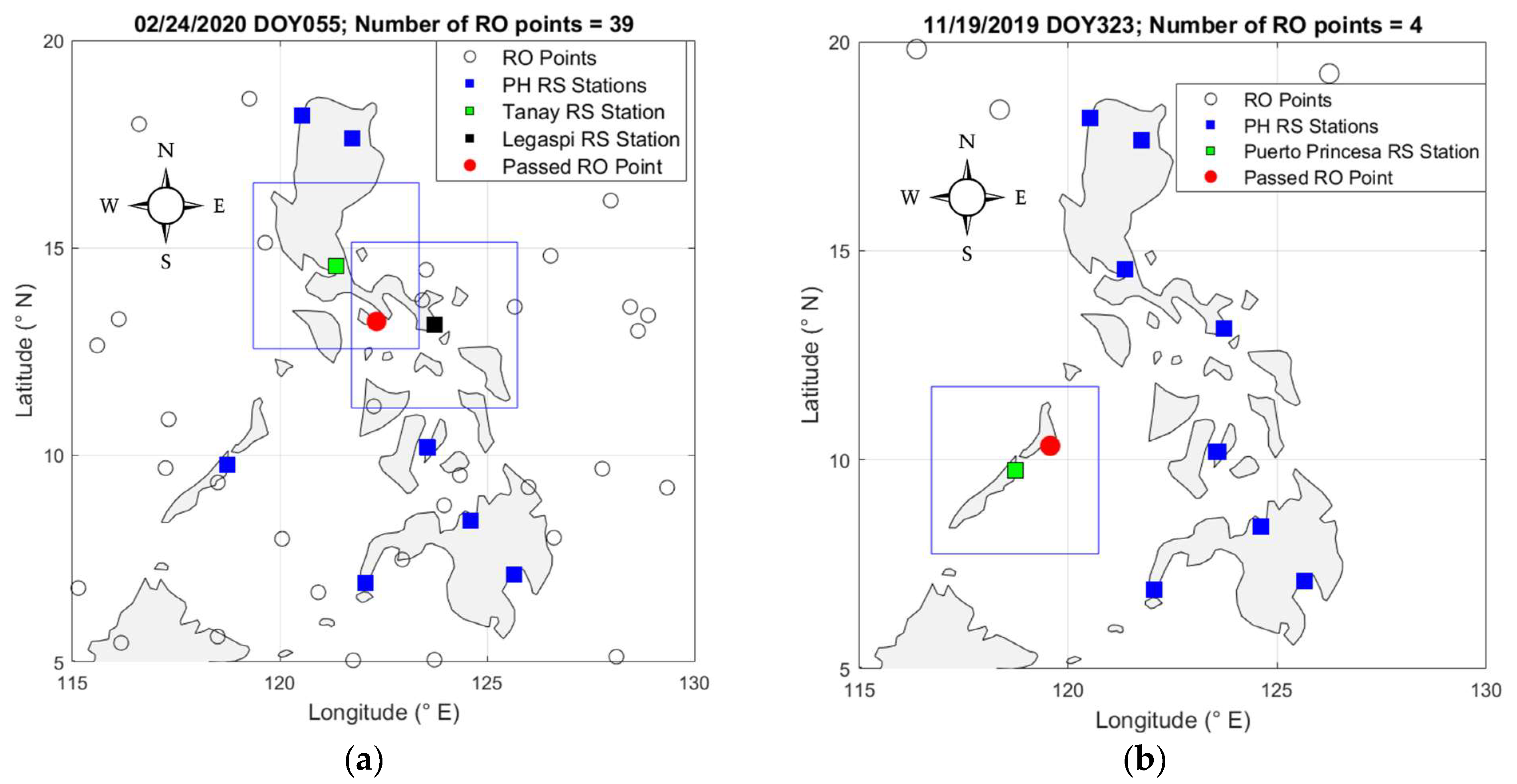
To assess the accuracy of the radio occultation (RO) data, radiosonde data are collocated based on a spatial distance of ±2° in latitude–longitude coordinates between the measured RO point and the radiosonde (RS) station, and a time gap of ±2 h UTC from recorded times. In the case of the Philippines, 00:00 and 12:00 UTC are 8:00 a.m. and 8:00 p.m. local time, respectively. The pair with the closest spatial collocation is then chosen for each day, given that there is at least one collocated pair. Figure 2 below shows an example of a collocation between a radiosonde station and a recorded RO point for COSMIC-2 and KOMPSAT-5. These collocated points will be used as a basis for the discussion of the results in this study. The comparison between RS and RO data is performed by interpolation of the RS data based on the 100 m grid of the satellite data.
The temperature and pressure derived from RO measurement are compared with radiosonde profiles using the evaluation method presented in Fan et al. (2015) [12]. Here, the temperature and pressure deviation, mean and standard deviation are calculated. This involves the comparison of the individual height profiles of a radiosonde with a satellite for a single day. Once the mean and standard deviation results are obtained, they are averaged over all heights, and plotted with respect to mean sea level altitude. This gives an idea of the height region where the highest deviations occur, as well as the cold and warm biases of the radiosonde and the satellite. Finally, to analyze the error of the mean deviations of temperature and pressure between satellite and radiosonde profiles, the standard error of the mean (SEM) is used.

2.4. Seasonal Variation

This study will base the seasonal changes in temperature and pressure on the temperate climate season (spring, summer, autumn, and winter). Here, the 71 pairs of matching data between KOMPSAT and radiosonde from 2019 to 2020 are divided according to the four seasons, along with the 233 pairs of matching data between COSMIC-2 and radiosonde for 2020.
Table 1 below shows each season and the distribution of matching data between KOMPSAT-5, COSMIC-2 and radiosondes. Table 1 The winter season consists of the months December, January and February. The spring season consists of March, April and May. The summer season consists of June, July and August. Finally, the autumn season consists of September, October and November. After obtaining the results, they are averaged and compared alongside each other and the average deviations of the entire year.

3. Results and Discussion

3.1. COSMIC Versus Radiosonde Comparison

3.1.1. COSMIC v. Radiosonde Temperature

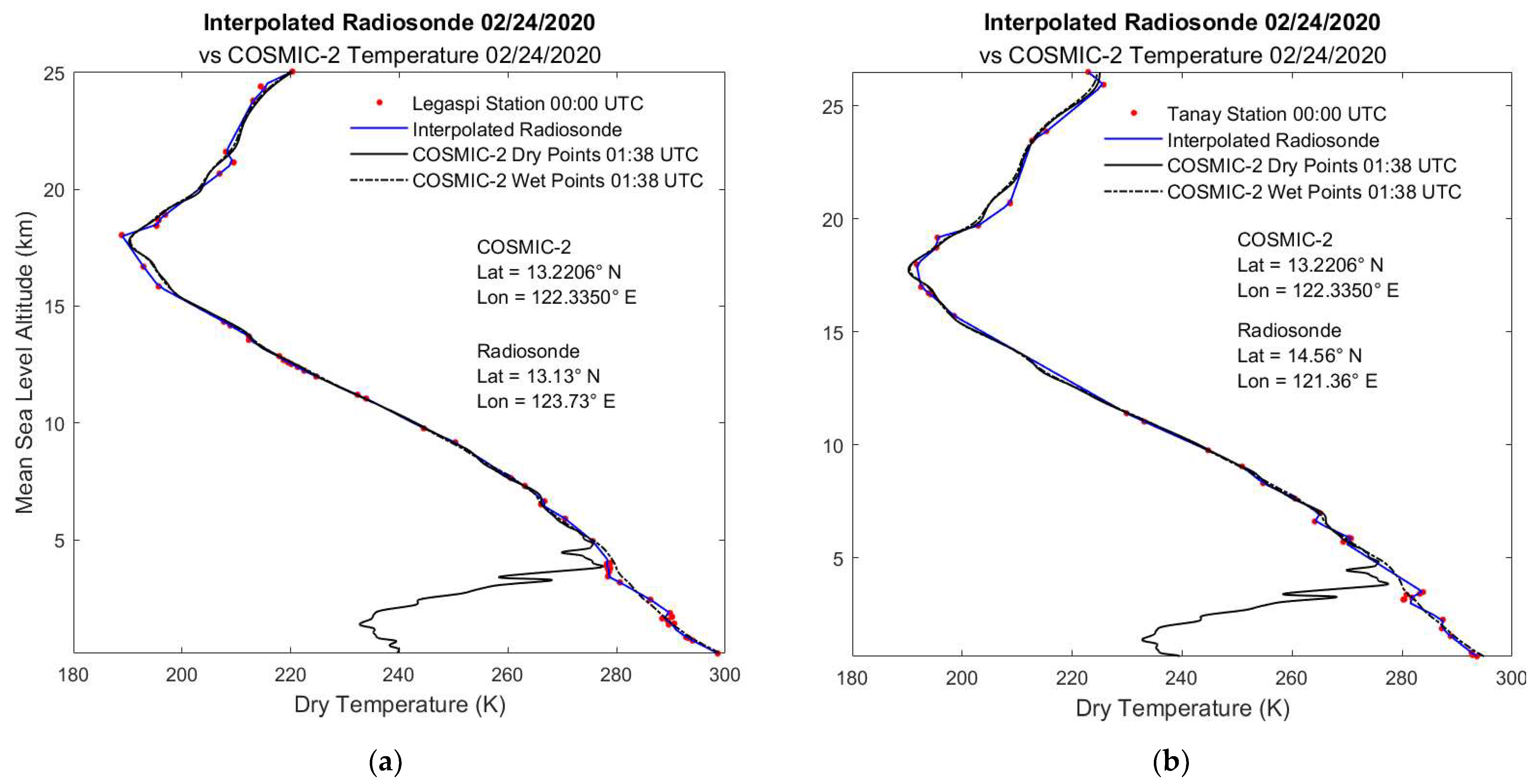
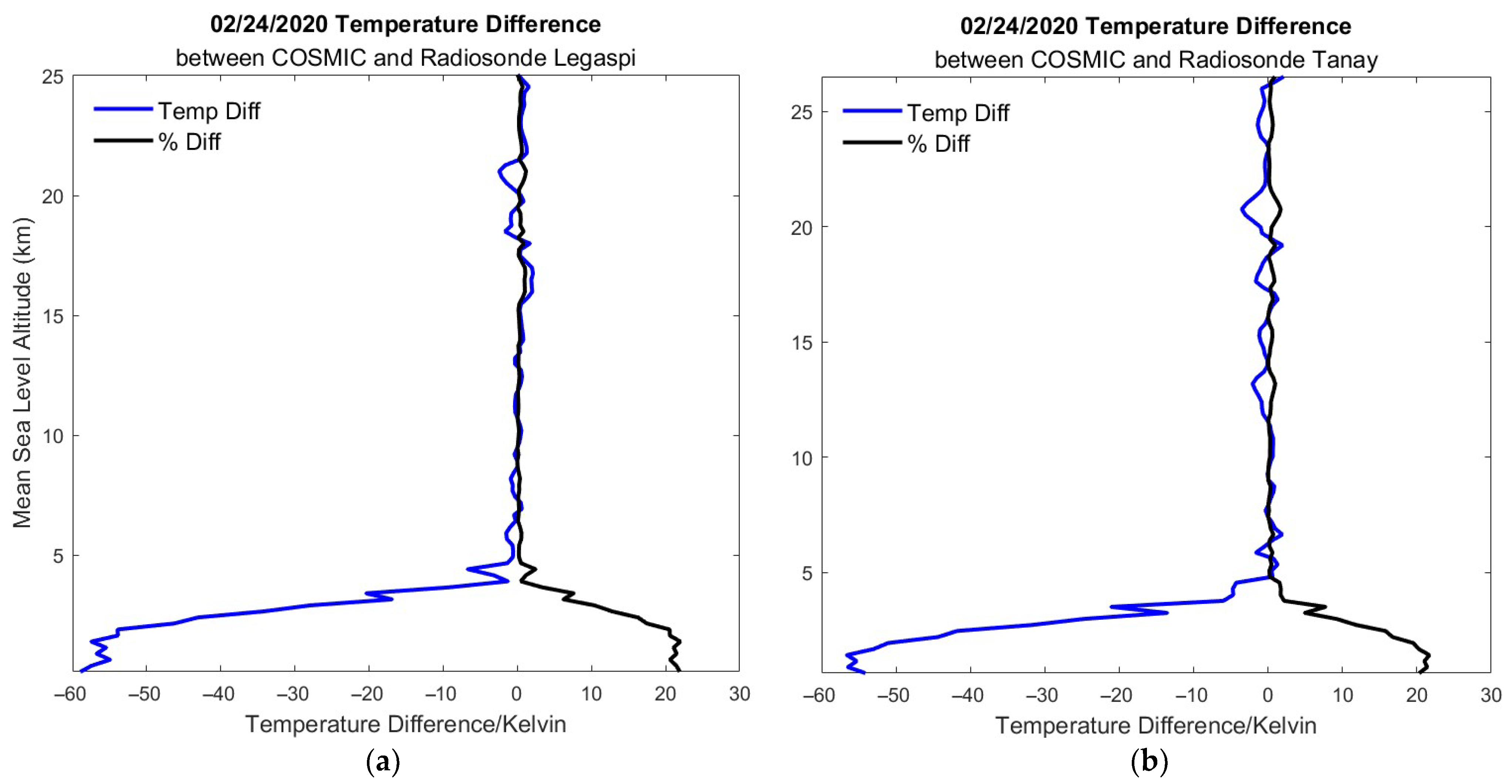
Figure 3 shows the individual comparison of vertical profiles of temperature between COSMIC-2 and interpolated radiosonde data from the Legaspi and Tanay stations for 24 February 2020. The latitude–longitude coordinates of the radiosonde station and the radio occultation occurrence are shown in the graph, which satisfy the mis-time and mis-distance parameters. As seen in Figure 3a,b, the vertical profiles of dry atmPrf COSMIC and radiosonde are close to each other at varying heights above 5 km. Below 5 km in the troposphere region, the dry atmPrf temperature profiles from COSMIC differ from the radiosonde between 10 and 60 K, showing the general region where this type of profile is not reliable for temperature measurements due to moisture.
Superimposed in the plot is the temperature line from the wetPf2 product, which shows similar measurements with the radiosonde stations for the entire height range. As shown in Figure 4a, the highest temperature differences between COSMIC and the Legaspi radiosonde station is recorded between 0 and 5 km, with a difference range of ~−6 to −60 K. On the other hand, in Figure 4b, the high temperature difference between COSMIC and the Tanay station reaches a range of ~−6 to ~55 K at the height range of 0 to ~4 km. This is also due to the height range being within the troposphere region and the moisture of the atmospheric layer conflicting with the satellite profiles for no moisture. For subsequent heights, as shown in Figure 3a, the profiles generally agree with each other, showing that the dry atmPrf profiles agree with radiosondes above the troposphere. Chen et al. (2021) show temperature deviations between their RO wetPf2 profiles from FS7 and radiosonde profiles of less than 0.5 °C within the troposphere region from October 2019 to March 2020, which contrasts those from Ho et al. (2020) and Fan et al. (2015), which show larger deviations from the atmPrf profiles within the troposphere compared to the stratosphere [6,12,16]. However, Fan et al. (2015) [12] show even less deviation compared to the observations found in this study. In addition to this, the lowest points of the temperature lines are consistent with those observed by Eugenio and Macalalad (2021), showing that the cold-point tropopause height lies within ~17 km in the Philippines [15].
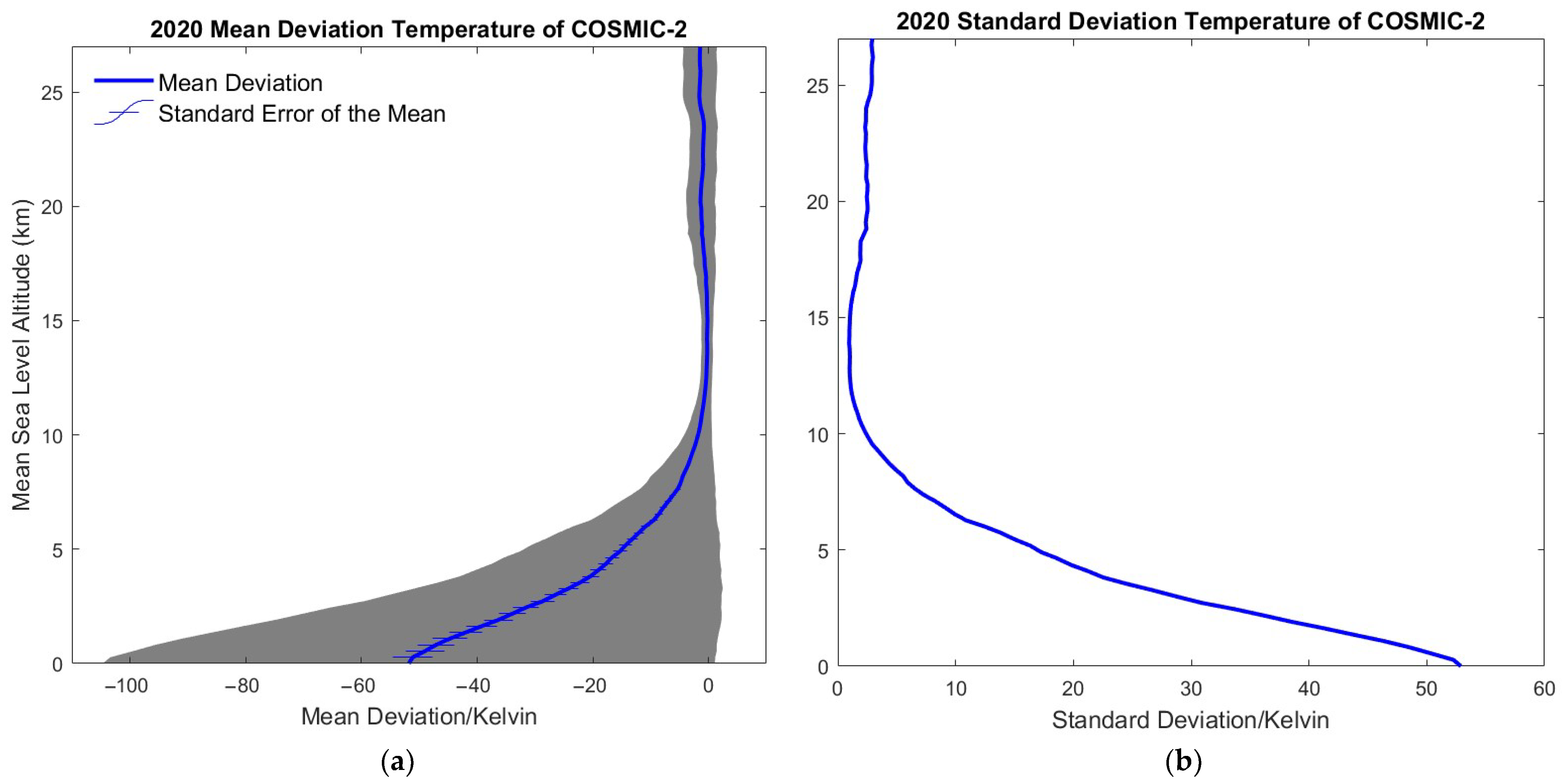
Figure 5 shows the statistical comparison between the radiosonde and COSMIC-2 data for January to April 2020. In Figure 5a, it is shown that the mean deviation is generally small above 10 km, reaching larger values at the lowest heights from 0 to ~10 km, before generally decreasing until 27 km. This shows that COSMIC atmPrf profiles are more ideal above 10 km for comparison in the Philippines, where the moisture of the troposphere does not conflict with the dry measurements. Figure 5b shows the standard deviation is generally higher than the mean, reaching between 20 K and ~53 K below 5 km. This was also proven by the first CHAMP results found by Wickert et al. (2001), where they compare the dry temperature results from CHAMP with those in ECMWF and NCEP [14]. Their study also showed large deviations below 5 km in comparison between the two datasets on 11 February 2001. They concluded that this is due to the significant presence of water vapor within this height region [14]. However, the differences in their results do not reach the larger values shown here, and their statistical comparison only covers the period from 19 to 21 April 2001, from 5 to 25 km. In heights above ~17–18 km, or the stratosphere, the differences may be explained by an observation made by several studies like Von Rohden et al. (2022), Randel and Wu (2006), and He et al. (2009) [17,18,19]. In their results, they found that the radiosonde sensors are affected by solar radiation in the stratosphere, therefore demonstrating a warmer bias compared to the satellite profiles during the day. While the signal of the satellite is bent due to the density of the layers that can affect the accuracy of measurement, the radiosonde sensors are directly affected by UV radiation from the sun [17,18,19].

3.1.2. COSMIC v. Radiosonde Pressure

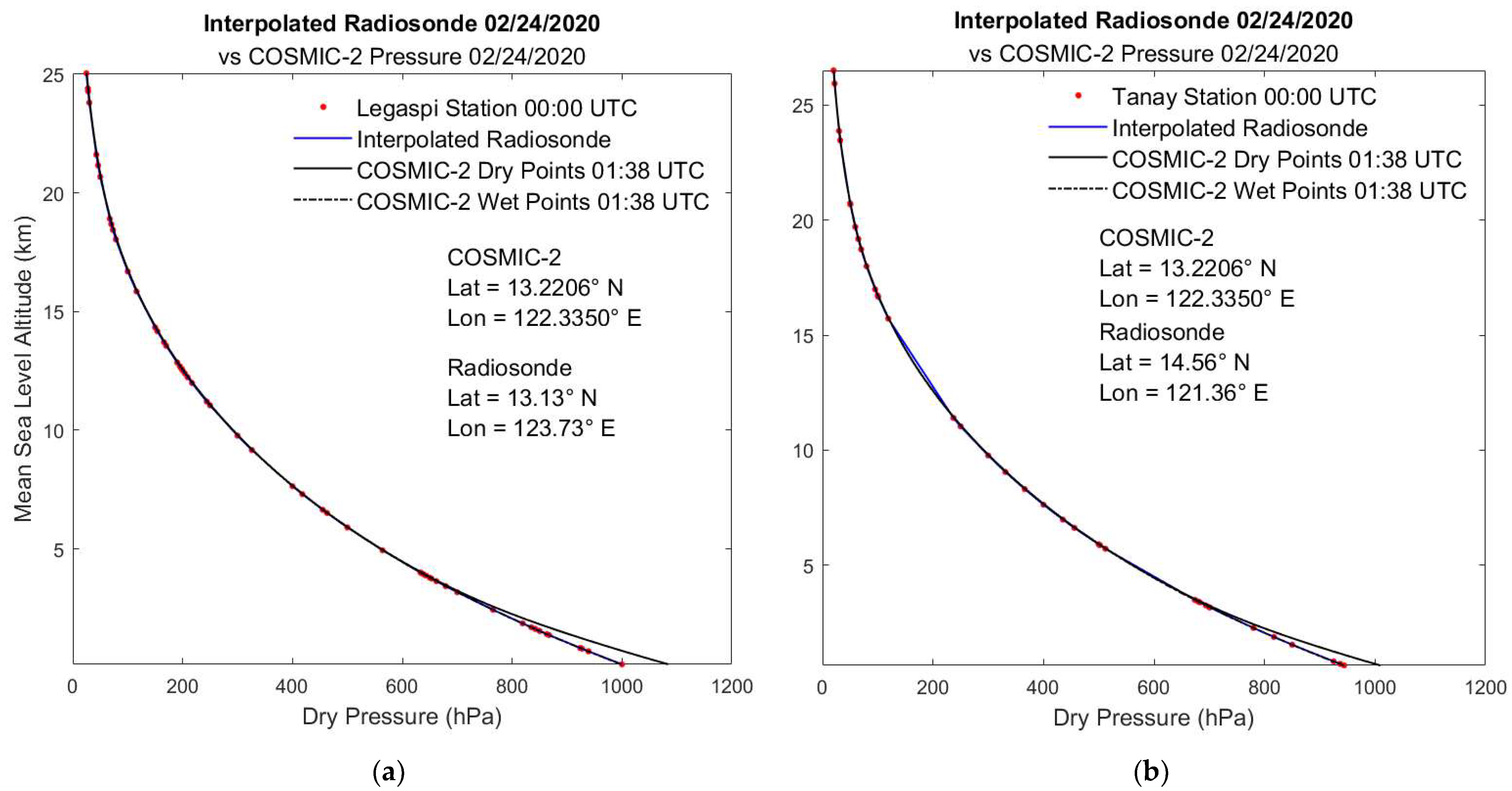
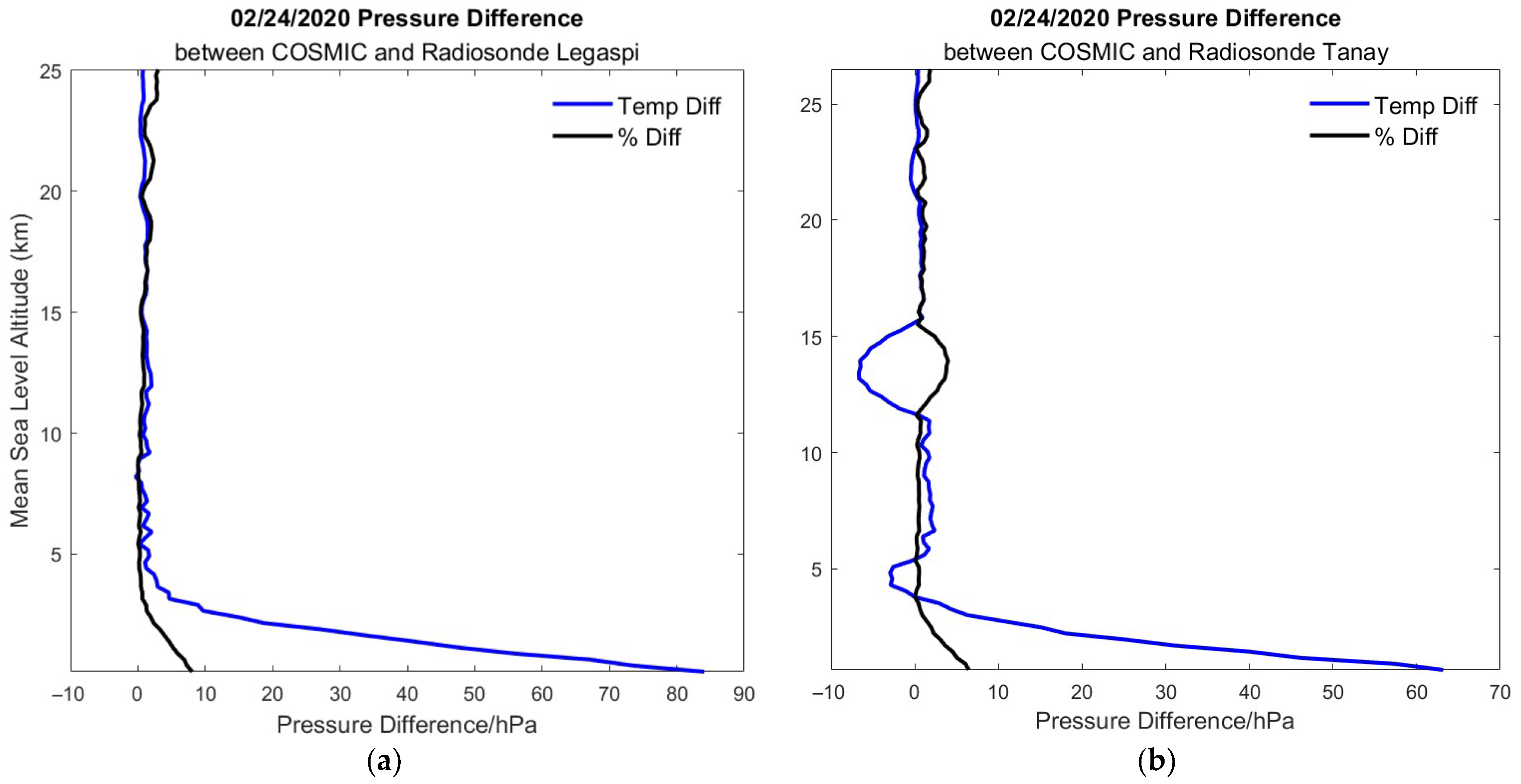
Figure 6 and Figure 7 show the individual comparison of vertical profiles of pressure between COSMIC-2 and the interpolated radiosonde data from Legaspi and Tanay for 24 February 2020. Figure 6a,b show almost identical pressure values between the two datasets, regardless of the amount of mistime and mis-distance, although there are gaps in the range of 0 to ~3 km for the dry pressure. Figure 7a shows the pressure difference to be generally less than 3 hPa at most heights above ~3.6 km, and 20–60 hPa in the lower heights. Figure 7b shows the pressure difference to be generally below ~6.3 hPa at most heights above 3 km, reaching ~10 to 63 hPa in the lower heights. Zhang et al. (2007) [13] shows a similar behavior with the water vapor comparison between GPS RO and radiosonde stations in Australia, noting that water vapor effects are negligible in the upper tropopause and stratosphere.
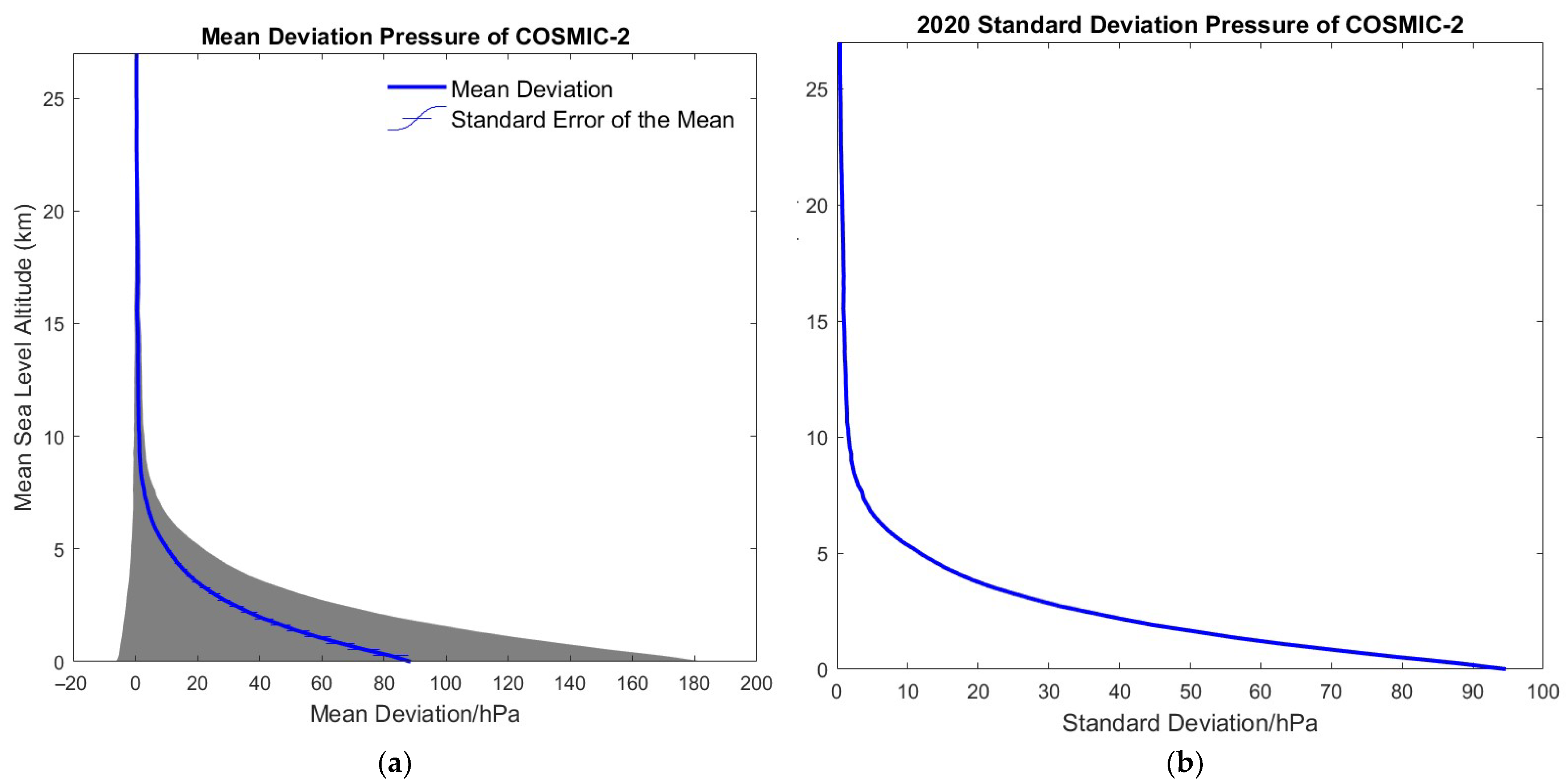
Figure 8 shows the statistical comparison of vertical pressure profiles between COSMIC-2 and radiosonde for the entirety of 2020. Figure 8a shows the mean deviation is generally small above 10 km, i.e., generally below 1.5 hPa, while it reaches higher values below this altitude. Figure 8b shows the standard deviation peak of ~95 hPa at the lowest height, gradually decreasing as it approaches higher altitude levels. All these show that the behavior between dry pressure and pressure with respect to moisture is consistent in the troposphere, like those of the temperature measurements. Zhang et al. (2011) [20] show a similar behavior with the water vapor comparison between GPS RO and radiosonde stations in Australia, noting that water vapor effects are negligible in the upper tropopause and stratosphere.

3.2. KOMPSAT Versus Radiosonde Comparison

3.2.1. KOMPSAT v. Radiosonde Temperature

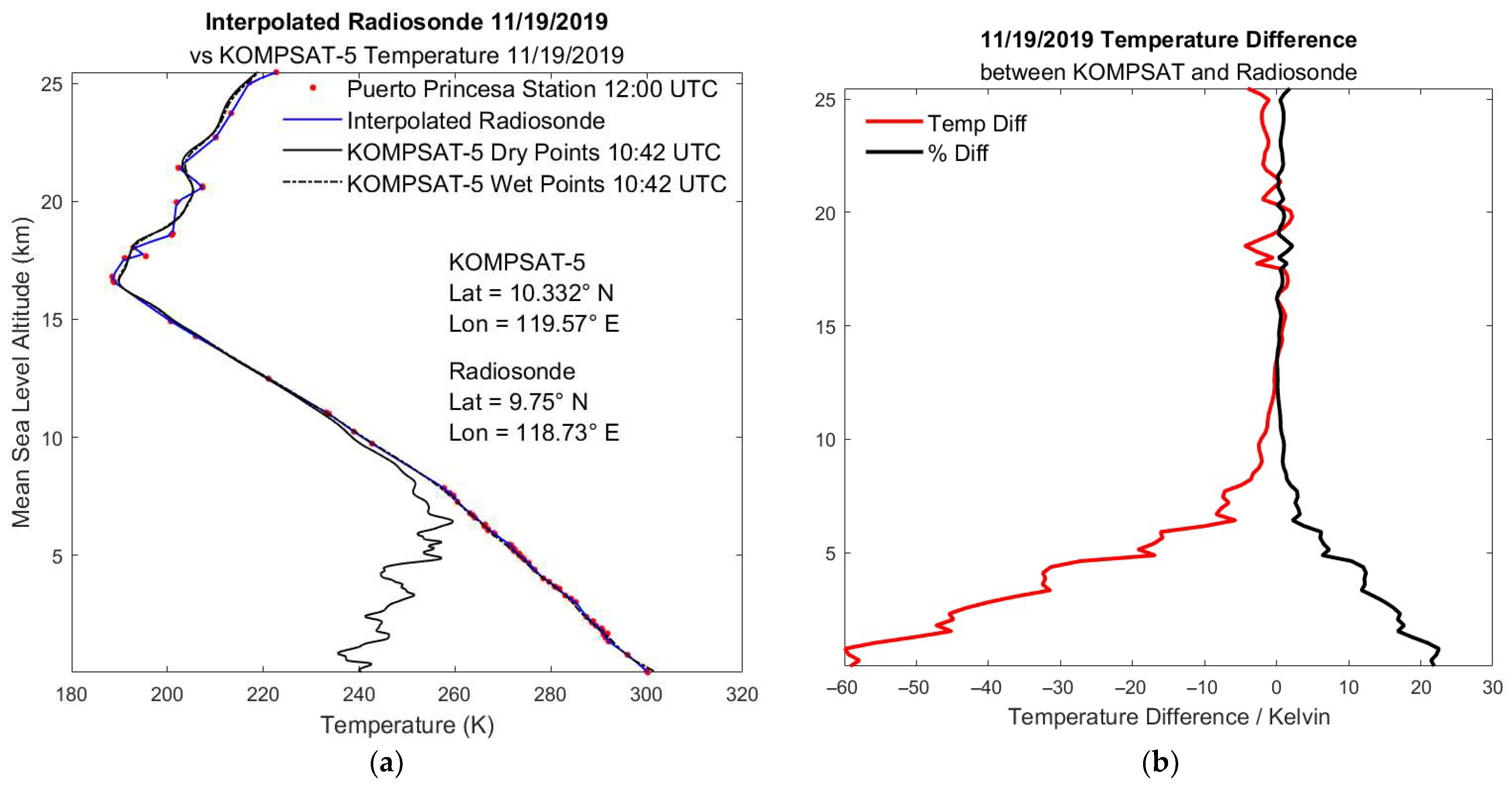
Figure 9 shows the individual comparison of vertical profiles of temperature between KOMPSAT-5 and interpolated radiosonde data from the Puerto Princesa station for 19 November 2019. Figure 9a shows a general disagreement between the lower heights below 10 km for the dry temperature, and general agreement for the wet temperature in the entire height range. The gap between datasets becomes tighter the higher we go up in altitude, showing consistent behavior like those of COSMIC-2. Figure 9b shows the temperature difference reaches ~−4.3 K at ~18.5 km, and −4 K above 25 km, which are the highest differences within the stratosphere, and a range of −20 to −60 K from 0 to 5 km in the troposphere, meaning there was a high amount of moisture in this region during this day.
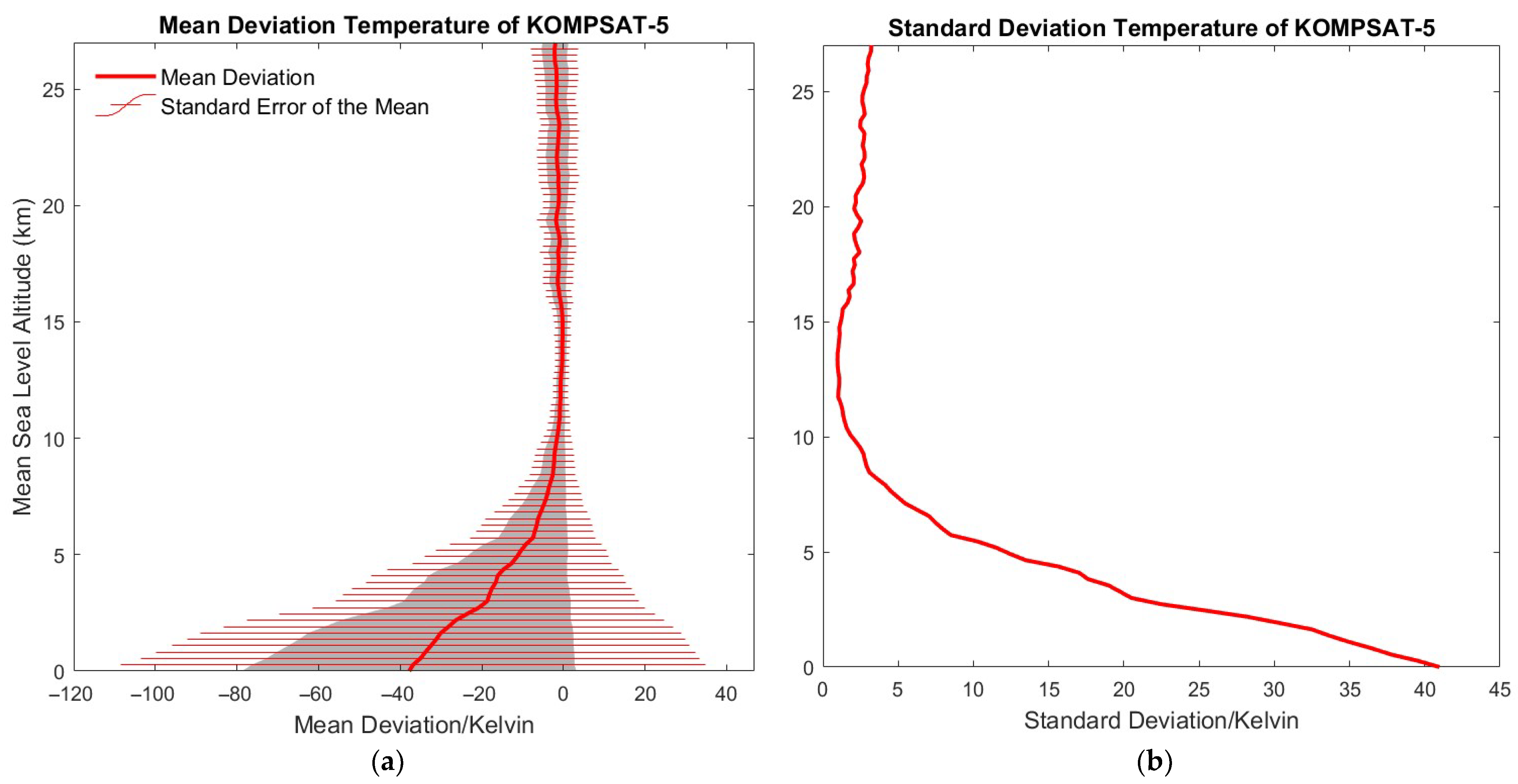
Figure 10 shows the statistical comparison between KOMPSAT-5 and radiosonde data for 2019 to 2020. Figure 10a shows the mean deviation generally reaches higher values, usually measured below 10 km, which is consistent with the deviations measured between radiosonde and COSMIC-2. Figure 10b shows the standard deviation between KOMPSAT-5 and radiosonde data, with a peak of 40 K at the lowest height, and a generally decreasing standard deviation with altitude. Like COSMIC-2, KOMPSAT-5 profiles tend to have different starting heights, therefore this may be a contributing factor to the variations in the troposphere. Zhang et al. (2011) yielded results that were observed to have small differences between GPS RO and radiosonde when the collocation parameter criteria are tight [20]. Sun et al. (2010) also observed similar behavior with the statistical differences with respect to the tightness of the collocation parameters, and that the standard deviation generally increases for every increase in the mismatch of collocation time and distance [21]. However, they noted that there are insignificant differences in the results, even in the larger spatial and temporal criteria between GPS RO and radiosondes, but greater differences are still expected within the looser collocation criteria.

3.2.2. KOMPSAT v. Radiosonde Pressure

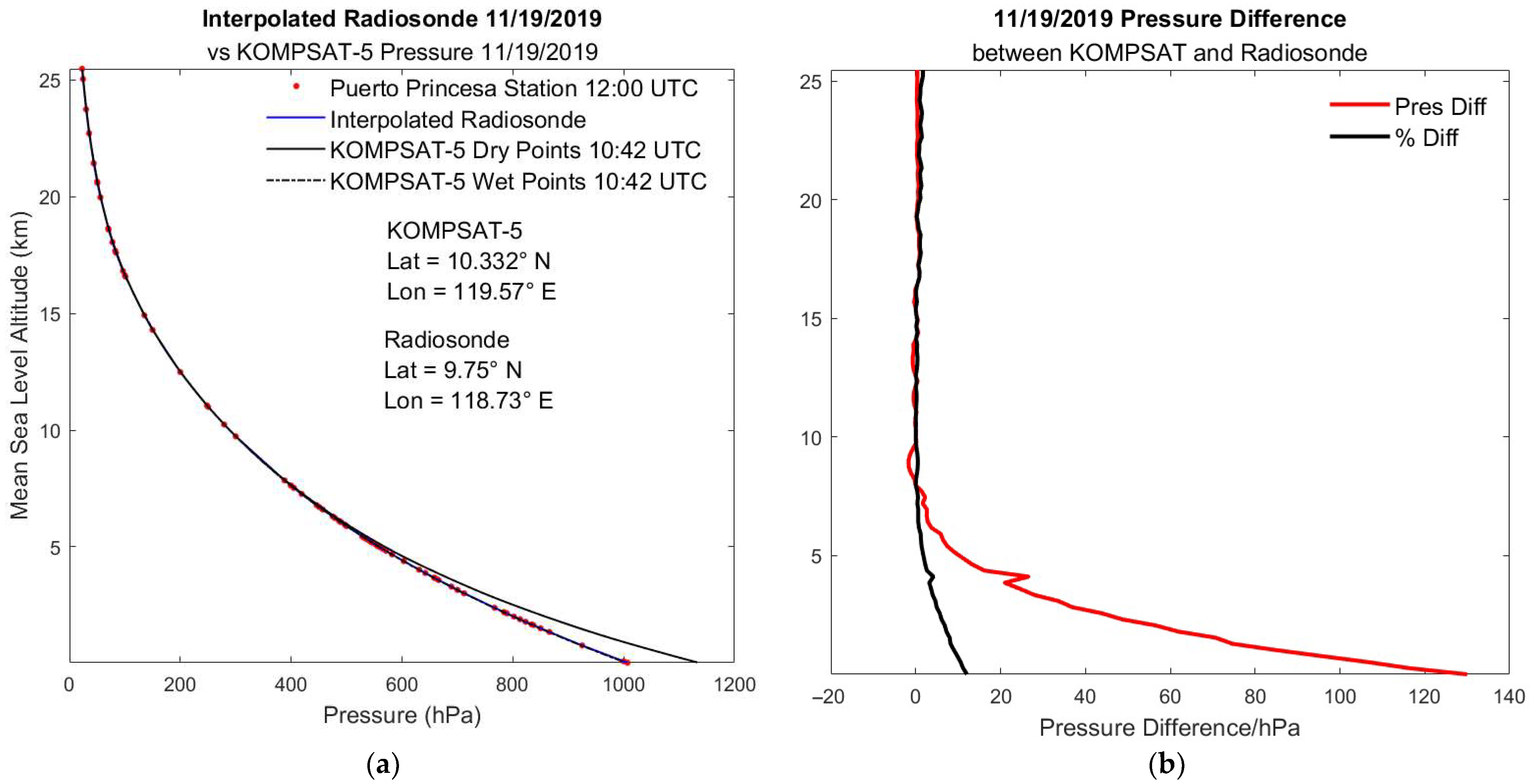
Figure 11 shows the individual comparison of vertical profiles of pressure between KOMPSAT-5 and the interpolated radiosonde data from Laoag for 19 November 2019. Figure 11a shows an almost identical distribution of pressure values above 5 km, unlike the temperature measurements, even with the amount of mistime. Figure 11b shows the pressure difference reaches a range of ~10 to 130 hPa from 0 to 5 km, showing general disagreement within this altitude range, while showing smaller differences in subsequent heights. As with the temperature differences in previous figures, this is most likely due to the time difference, which is 1.18 h, combined with a small amount of mis-distance in both latitude and longitude coordinates.
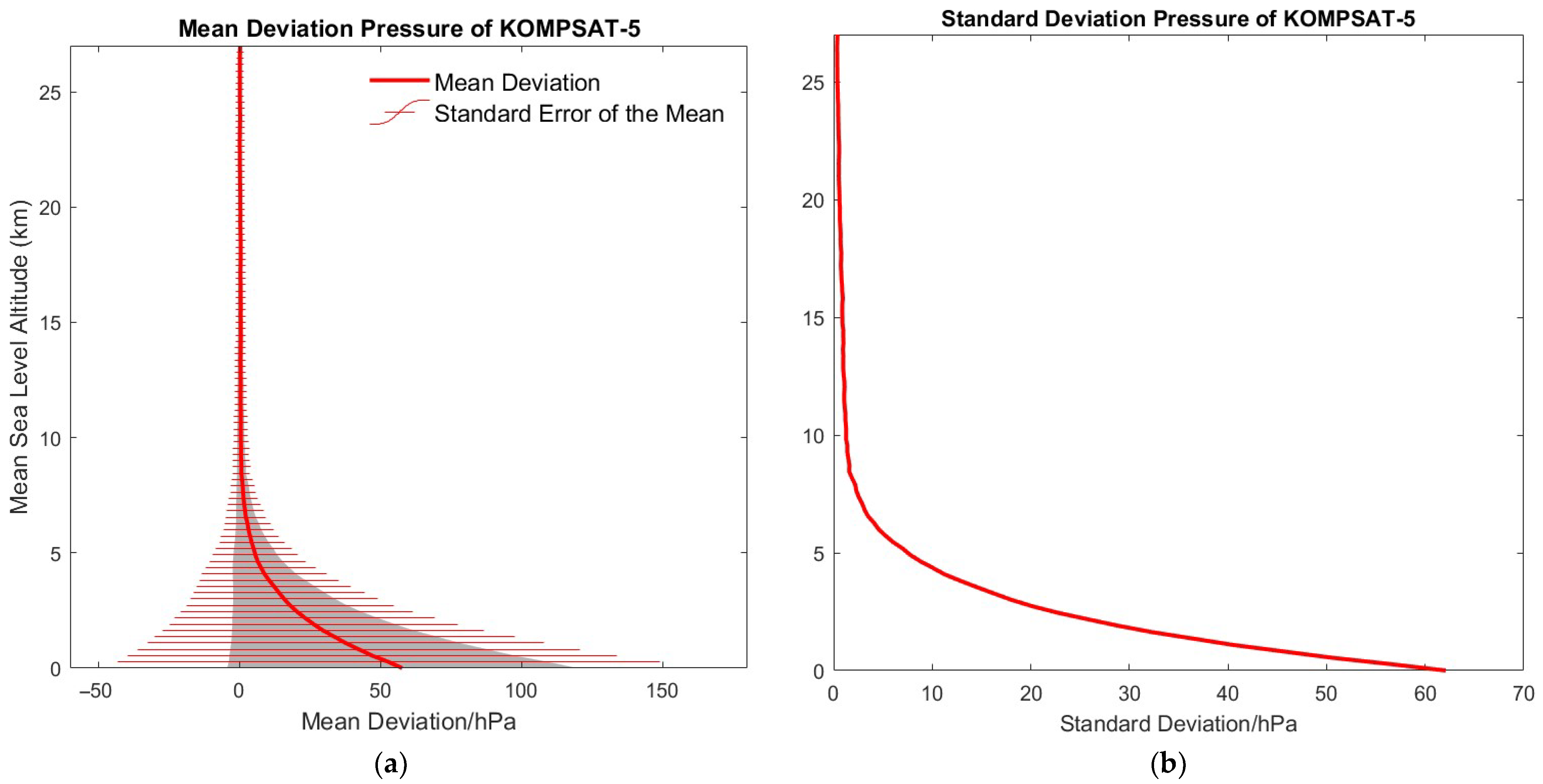
Figure 12a shows a generally small mean deviation for all vertical profiles above 5 km and Figure 12b shows the standard deviation to generally decrease as the altitude increases, with high deviation recorded at heights below 5 km. This shows consistent behavior that is like those between COSMIC-2 and radiosondes.

3.3. Seasonal Comparison

3.3.1. COSMIC v. Radiosonde

Temperature
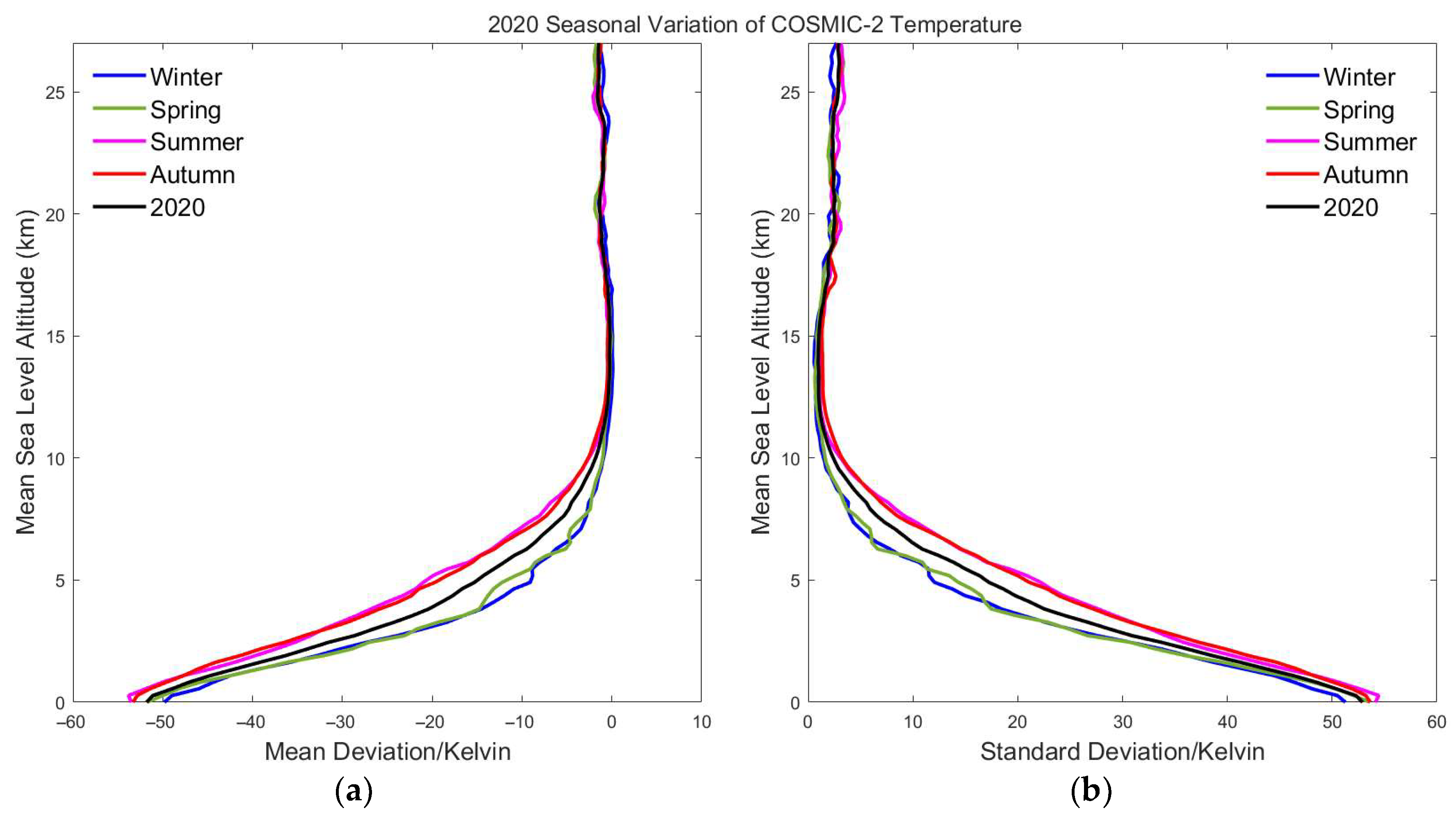
Figure 13 shows the statistical results between COSMIC-2 temperature deviation and radiosonde temperature deviation, during each season of 2020. Figure 13a shows the mean temperature deviation to be generally between −50 and 0 K in all seasons of 2020, with the summer and autumn season having larger mean temperature deviations from 0 to ~12 km, or the troposphere region. This could be attributed to the warm biases of the radiosonde temperature measurements from solar radiation, which can cause higher deviations between the two datasets at this height range. The summer and autumn season falls under the wet season of the Philippines, which covers the period from June to November. As such, there would be more moisture that conflicts with the dry temperature measurements during these seasons. The mean temperature deviation for 2020 peaks between −50 and ~−15 K at the height range of 0–5 km. In subsequent heights above 10 km, the mean temperature deviations are generally >~−1.7 K, which is the upper troposphere region where the satellite profiles start to agree more with the radiosonde profiles.
Figure 13b shows that the standard deviation is larger during the autumn season as well from 0 to 10 km, reaching a peak range of ~53 to 20 K at the range of 0–5 km. This means that the amount of deviation between the two usually varies in the summer and autumn season during this year, or during the wet season of the Philippines. In the case of the other two seasons, they have smaller deviations from 0 to 5 km, showing more consistent deviations than those during summer. Nevertheless, this shows that COSMIC atmPrf profiles are more suitable above the troposphere, where there is negligible moisture, and it confirms that the height ranges up until ~17 km in the troposphere to tropopause in the Philippines.
Pressure
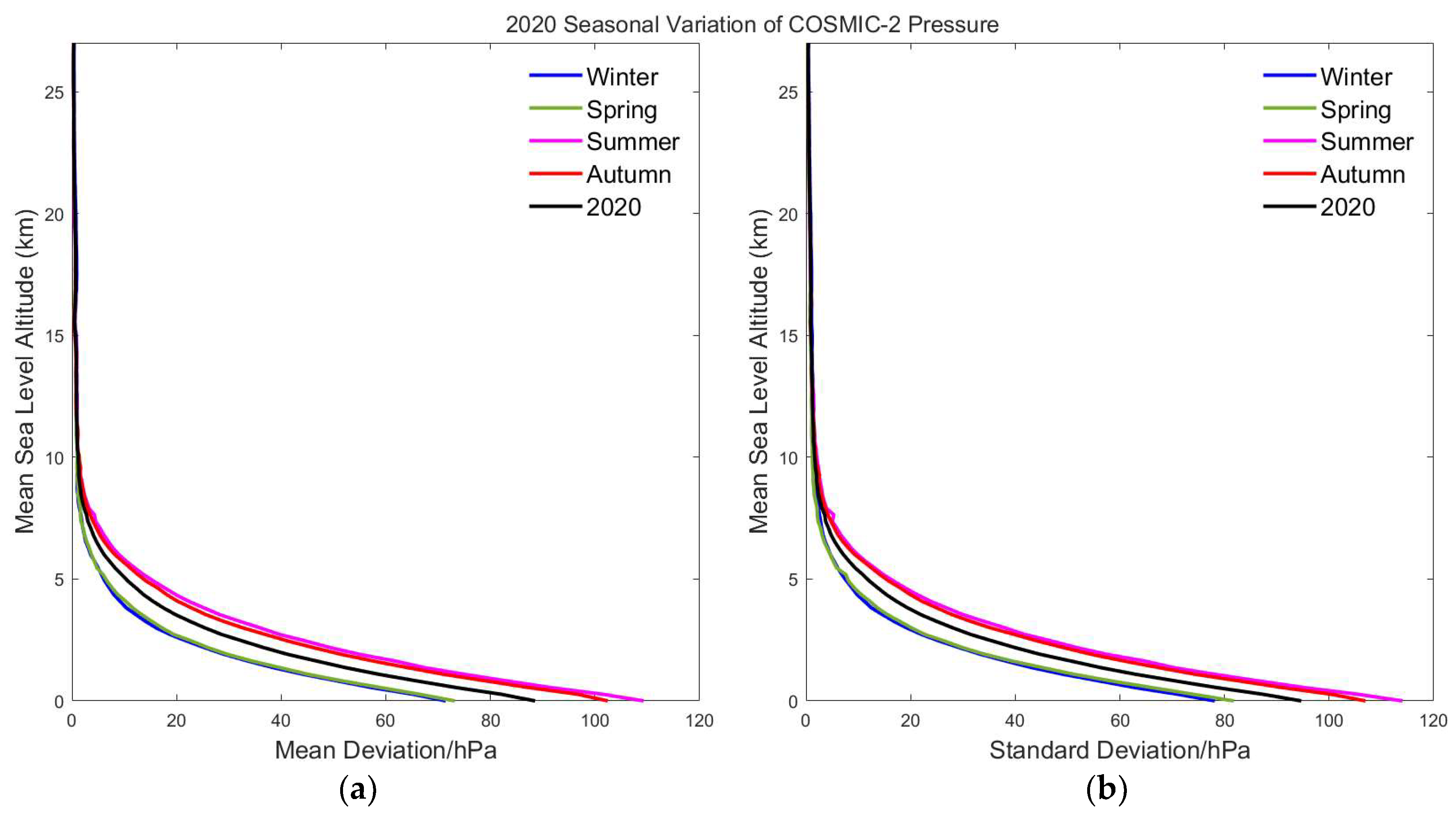
Figure 14 shows the seasonal difference of pressure mean deviation between COSMIC-2 and radiosonde. Figure 14a shows the seasonal mean deviations to be large from 0 to 5 km, and generally <10 hPa above 5 km. Figure 14b shows the standard deviations to be also generally <10 hPa at heights above 5 km, although in both figures, summer and autumn usually have the highest mean and standard deviation values compared to other seasons in the lower troposphere, with a range of ~14 hPa to >100 hPa from 0 to 5 km. This may be due to the amount of mis-time and/or mis-distance between most of the profiles for these seasons, the warm biases of the temperature measurements from radiosonde devices in the stratosphere, and the deviations being higher during the wet season. Nevertheless, it shows good agreement between the atmPrf profiles and the radiosonde measurements in the upper troposphere to stratosphere like the temperature measurements, making this height range the more ideal range to assess dry pressure profiles from the atmPrf product. Additionally, the summer and autumn period of 2020 experienced many tropical cyclones for the whole year, with a total of 22 TCs, and both seasons having a total of 10 TCs each, according to the annual report for 2020 from the Philippine Atmospheric, Geophysical and Astronomical Services Administration (PAGASA).

3.3.2. KOMPSAT v. Radiosonde

Temperature
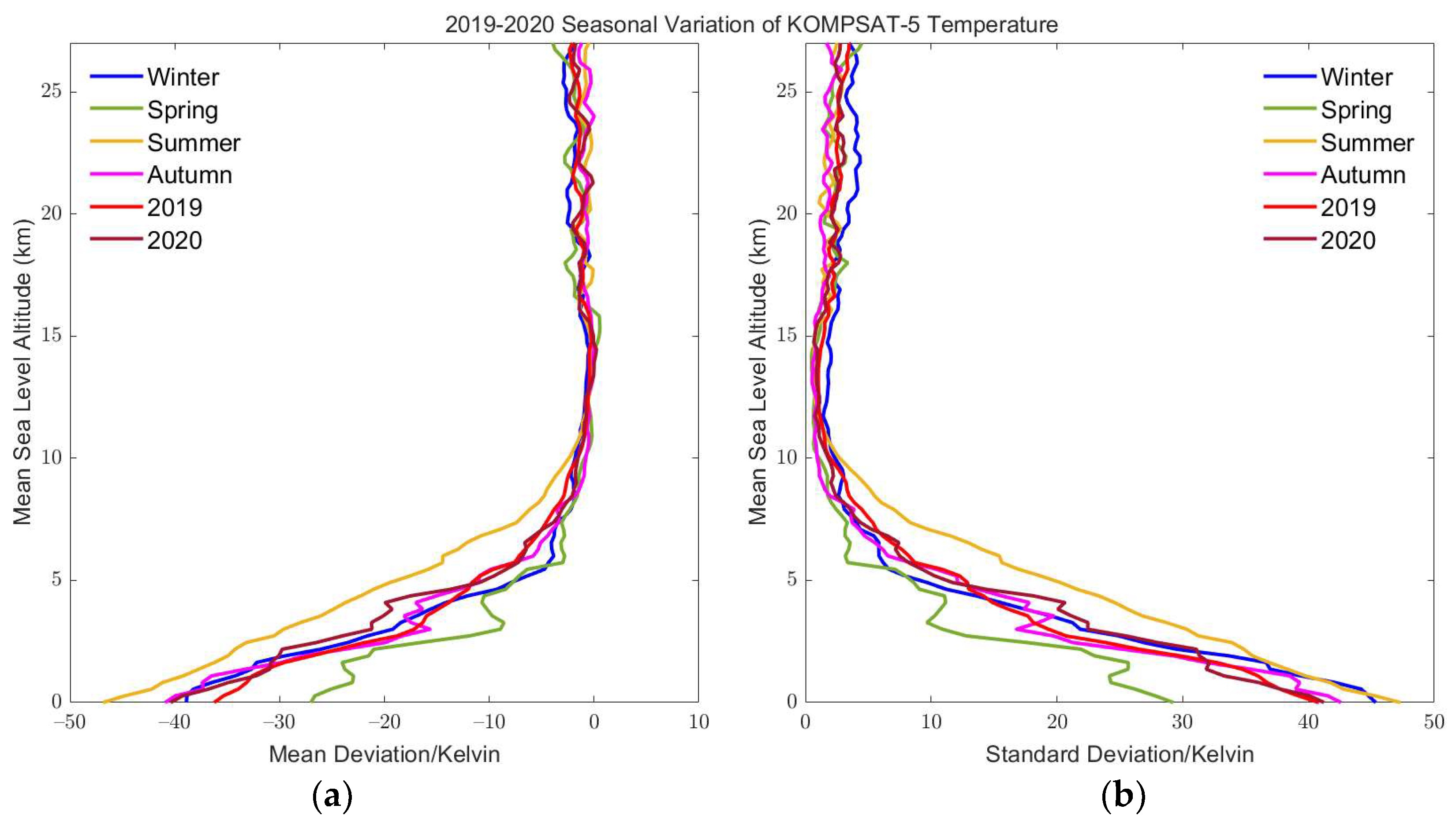
Figure 15 shows the statistical results between KOMPSAT-5 temperature deviation and radiosonde temperature deviation. Figure 15a shows the mean temperature deviation to be generally between ~−10 and −50 K in all seasons of 2019 from 0 to 5 km, reaching almost identical deviations in ~12 to 13 km, with the summer season having larger mean temperature deviations from 0 to 10 km. Again, the summer season falls under the wet season of the Philippines. The mean temperature deviation for 2019 peaks between −10 and ~−35 K at the height range of 0–5 km, while the mean temperature deviation for 2020 reaches a peak of range of ~−10 to −40 K at the height range of 0–5 km. In subsequent heights above 10 km, the mean temperature deviations are generally >−2 K. Figure 15b shows that the standard deviation is larger during the summer season as well from 0 to 10 km, reaching a peak of 2.5 to ~47 K at this range. Like the mean temperature deviation, the temperature standard deviations start to converge in varying heights above 10 km, confirming this region as the upper troposphere in the Philippines. In both cases, the winter season has higher temperature deviations than the other seasons in most of the altitude within the lower stratosphere, possibly caused by the warm biases of the radiosonde measurements and the winter season falling under the country’s dry season.
Pressure
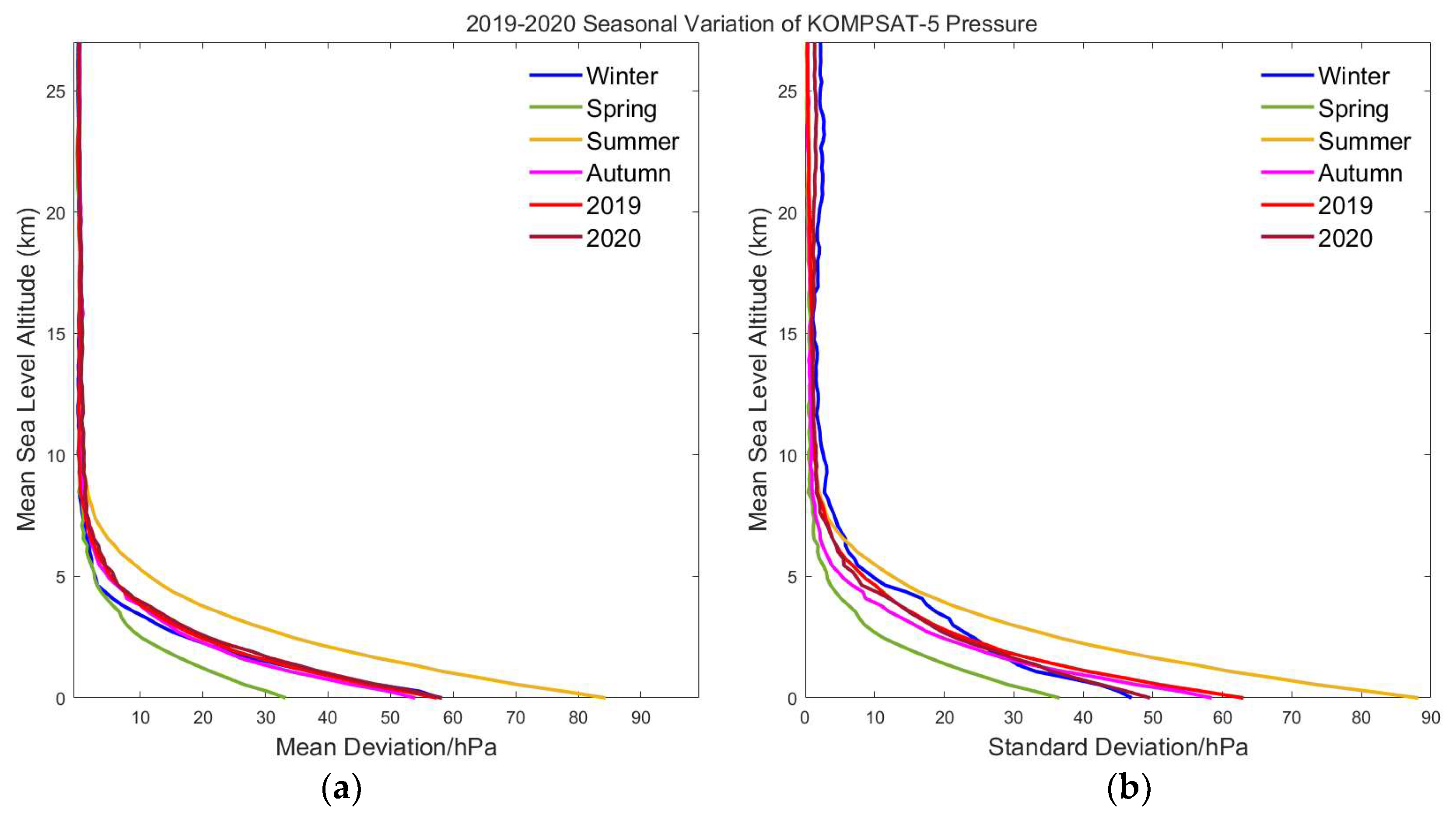
Figure 16 shows the seasonal difference of pressure mean deviation between COSMIC-2 and radiosonde. Figure 16a shows the seasonal mean deviations to be large from 0 to 5 km, and generally <10 hPa above 5 km. Figure 16b shows the standard deviations to be also generally <10 hPa at heights above 5 km, although in both figures, summer and autumn usually have the highest mean and standard deviation values compared to other seasons in the lower troposphere, with a range of ~14 hPa to >100 hPa from 0 to 5 km. This may be due to the amount of mis-time and/or mis-distance between most of the profiles for these seasons, or the warm biases of the temperature measurements from radiosonde devices in the stratosphere, and the deviations being higher during the wet season. Nevertheless, it shows good agreement between the atmPrf profiles and the radiosonde measurements in the upper troposphere to stratosphere like the temperature measurements, making this height range the more ideal range to assess dry pressure profiles from the atmPrf product.

4. Conclusions

Based on the results shown previously, this study concludes that the dry temperature and pressure profiles measured by COSMIC-2 and KOMPSAT-5 generally agree with the temperature and pressure profiles measured by different radiosonde stations around the Philippines, usually above 5–10 km for the temperature profiles and for the pressure profiles. They both maintain high precision that does not decrease with altitude, compared to radiosondes. This shows that atmPrf profiles are generally more suited for assessment starting from the upper troposphere, where the moisture factor of the atmosphere can conflict with the dry measurements.
From 2019 to 2020, KOMPSAT-5 shows good agreement with the radiosonde stations, regardless of its flaw with the lack of paired samples for the two years. The mean deviation of temperature between the two remains generally negative from 0 to 27 km, with the standard deviation generally decreasing up to 10 km, where it remains <~3.5 K for subsequent heights. For both years, the summer season usually has the higher mean deviation of temperature compared to other seasons until 10 km. While the summer season has the highest number of pairs compared to the other seasons for the two years, the deviations may have been caused by the looser collocation difference between the two datasets within this period. The mean deviation and standard deviation of pressure between the two datasets generally decrease for the entire height range, and are generally <7 hPa above 5 km. Like the temperature deviations, the pressure deviations are generally higher for most of the lower heights, though the mean deviation peaks until ~8–9 km, and the standard deviation peaks until ~5–6 km. The summer season falls under the country’s wet season, which can explain the moisture bias in the troposphere.
COSMIC-2 has good agreement with radiosonde stations during 2020, and its main advantage is having many RO points measured in the Philippines for each day, although it is not guaranteed that an RS–RO pair will have a tight spatial and/or temporal difference based on the parameters for both satellites. The mean deviation of temperature between the two datasets is generally negative for the entire height range. The mean and standard deviation decreases up to 10 km, where the standard deviation increases and decreases to 27 km. The mean deviation of temperature is generally higher during the summer and autumn season until ~11 km, compared to the other seasons, and the standard deviation is generally higher in those two seasons as well compared to the other seasons, peaking at a range of ~3–54 K from 0 to 10 km. The mean and standard deviation of pressure between the two datasets generally decrease within the entire height assessment range; however, in the lower troposphere from 0 to 10 km, the summer and autumn seasons have generally higher deviation than the other two seasons, reaching values between ~1.3 and 109 hPa for the mean deviation, and ~2 and 114 hPa for the standard deviation. Like the temperature deviations, there is less deviation above 5 km, preferably above 10 km where the moisture can be neglected in the measurements. In both cases, the summer and autumn seasons fall under the country’s wet season, which can explain the amount of moisture bias in the troposphere. Additionally, the deviations may be explained by the number of tropical cyclones that occurred in the Philippines, as a total of 20 out of 22 occurred from June to November of 2020. This shows consistency with previous studies that have tackled assessment of different satellites with radiosondes, regardless of the differences in tropopause heights.

Author Contributions

Conceptualization, K.P.A.D. and E.P.M.; methodology, K.P.A.D.; software, K.P.A.D. and E.P.M.; validation, K.P.A.D. and E.P.M.; formal analysis, K.P.A.D.; investigation, K.P.A.D. and E.P.M.; resources, K.P.A.D. and E.P.M.; data curation, K.P.A.D.; writing—original draft preparation, K.P.A.D.; writing—review and editing, K.P.A.D. and E.P.M.; visualization, K.P.A.D.; supervision, E.P.M.; project administration, K.P.A.D. and E.P.M.; funding acquisition, K.P.A.D. and E.P.M. All authors have read and agreed to the published version of the manuscript.

Funding

This research received no external funding.

Institutional Review Board Statement

Not applicable.

Informed Consent Statement

Not applicable.

Data Availability Statement

Data are contained within the article.

Acknowledgments

The extracted data from COSMIC-2 and KOMPSAT-5 were obtained from the COSMIC Data Analysis and Archive Center (CDAAC) of the University Corporation for Atmospheric Research (UCAR) website (https://data.cosmic.ucar.edu/gnss-ro/ (accessed on 28 August 2023)). The radiosonde data were provided by the Integrated Global Radiosonde Archive (IGRA) (https://www.ncei.noaa.gov/products/weather-balloon/integrated-global-radiosonde-archive (accessed on 3 October 2023)). The researcher would like to acknowledge the contributions of these websites to this study.

Conflicts of Interest

The authors declare no conflicts of interest. Author Ernest P. Macalalad was employed by the company Philippine Space Agency. The remaining authors declare that the research was conducted in the absence of any commercial or financial relationships that could be construed as a potential conflict of interest.

Abbreviations

The following abbreviations are used in this manuscript:
GNSSGlobal Navigational Satellite System
RORadio Occultation
LEOLow-Earth Orbit
COSMICThe Constellation Observing System for Meteorology, Ionosphere and Climate
KOMPSATKorean Multi-Purpose Satellite

References

  1. Durre, I.; Vose, R.S.; Wuertz, D.B. Overview of the Integrated Global Radiosonde Archive. J. Clim. 2006, 19, 53–68. [Google Scholar] [CrossRef]
  2. Kursinski, E.R. The GPS Radio Occultation Concept: Theoretical Performance and Initial Results. Bachelor’s Thesis, California Institute of Technology, Pasadena, CA, USA, 2013. [Google Scholar] [CrossRef]
  3. Kursinski, E.R.; Hajj, G.A.; Bertiger, W.I.; Leroy, S.S.; Meehan, T.K.; Romans, L.J.; Schofield, J.T.; McCleese, D.J.; Melbourne, W.G.; Thornton, C.L.; et al. Initial results of radio occultation observations of Earth’s atmosphere using the global positioning system. Science 1996, 271, 1107–1110. [Google Scholar] [CrossRef]
  4. Ware, R.; Rocken, C.; Solheim, F.; Exner, M.; Schreiner, W.; Anthes, R.; Feng, D.; Herman, B.; Gorbunov, M.; Sokolovskiy, S.; et al. GPS Sounding of the Atmosphere from Low Earth Orbit: Preliminary Results. Bull. Am. Meteorol. Soc. 1996, 77, 19–40. [Google Scholar] [CrossRef]
  5. Chang, H.; Lee, J.; Yoon, H.; Morton, Y.J.; Saltman, A. Performance Assessment of Radio Occultation Data from GeoOptics by Comparing with COSMIC Data. Earth Planets Space 2022, 74, 108. [Google Scholar] [CrossRef]
  6. Ho, S.-P.; Zhou, X.; Shao, X.; Zhang, B.; Adhikari, L.; Kireev, S.; He, Y.; Yoe, J.G.; Xia-Serafino, W.; Lynch, E. Initial assessment of the COSMIC-2/FORMOSAT-7 neutral atmosphere data quality in NESDIS/STAR using in situ and satellite data. Remote Sens. 2020, 12, 4099. [Google Scholar] [CrossRef]
  7. Qiu, C.; Wang, X.; Zhou, K.; Zhang, J.; Chen, Y.; Li, H.; Liu, D.; Yuan, H. Comparative Assessment of SpIRE and COSMIC-2 Radio Occultation Data Quality. Remote Sens. 2023, 15, 5082. [Google Scholar] [CrossRef]
  8. Schreiner, W.S.; Weiss, J.P.; Anthes, R.A.; Braun, J.; Chu, V.; Fong, J.; Hunt, D.; Kuo, Y.-H.; Meehan, T.; Serafino, W.; et al. COSMIC-2 Radio Occultation Constellation: First Results. Geophys. Res. Lett. 2020, 47, e2019GL086841. [Google Scholar] [CrossRef]
  9. Yumul, G.P.; Cruz, N.A.; Servando, N.T.; Dimalanta, C.B. Extreme weather events and related disasters in the Philippines, 2004–2008: A sign of what climate change will mean? Disasters 2010, 35, 362–382. [Google Scholar] [CrossRef] [PubMed]
  10. Cinco, T.A.; de Guzman, R.G.; Ortiz, A.M.D.; Delfino, R.J.P.; Lasco, R.D.; Hilario, F.D.; Juanillo, E.L.; Barba, R.; Ares, E.D. Observed trends and impacts of tropical cyclones in the Philippines. Int. J. Climatol. 2016, 36, 4638–4650. [Google Scholar] [CrossRef]
  11. Lyon, B.; Camargo, S.J. The seasonally-varying influence of ENSO on rainfall and tropical cyclone activity in the Philippines. Clim. Dyn. 2008, 32, 125–141. [Google Scholar] [CrossRef]
  12. Fan, Z.Q.; Sheng, Z.; Shi, H.Q.; Yi, X.; Jiang, Y.; Zhu, E.Z. Comparative Assessment of COSMIC Radio Occultation Data and TIMED/SABER Satellite Data over China. J. Appl. Meteorol. Climatol. 2015, 54, 1931–1943. [Google Scholar] [CrossRef]
  13. Zhang, K.; Biadeglgne, B.; Wu, F. A Comparison of Atmospheric Temperature and Moisture Profiles Derived from GPS Radio Occultation and Radiosonde in Australia. IEICE Tech. Rep. 2007, 107, 7–12. Available online: https://cir.nii.ac.jp/crid/1520009408590533632 (accessed on 15 January 2024).
  14. Wickert, J.; Reigber, C.; Beyerle, G.; König, R.; Marquardt, C.; Schmidt, T.; Grunwaldt, L.; Galas, R.; Meehan, T.K.; Melbourne, W.G.; et al. Atmosphere Sounding by GPS Radio Occultation: First Results from CHAMP. Geophys. Res. Lett. 2001, 28, 3263–3266. [Google Scholar] [CrossRef]
  15. Eugenio, R.G.; Macalalad, E.P. Monthly Observations of Cold-Point Tropopause Temperature and Height for 2008 in the Philippines Using COSMIC GPS Radio Occultations. J. Phys. Conf. Ser. 2021, 1936, 012019. [Google Scholar] [CrossRef]
  16. Chen, S.-Y.; Liu, C.-Y.; Huang, C.-Y.; Hsu, S.-C.; Li, H.-W.; Lin, P.-H.; Cheng, J.-P.; Huang, C.-Y. An Analysis Study of FORMOSAT-7/COSMIC-2 Radio Occultation Data in the Troposphere. Remote Sens. 2021, 13, 717. [Google Scholar] [CrossRef]
  17. von Rohden, C.; Sommer, M.; Naebert, T.; Motuz, V.; Dirksen, R.J. Laboratory Characterisation of the Radiation Temperature Error of Radiosondes and Its Application to the GRUAN Data Processing for the Vaisala RS41. Atmos. Meas. Tech. 2022, 15, 383–405. [Google Scholar] [CrossRef]
  18. Randel, W.J.; Wu, F. Biases in Stratospheric and Tropospheric Temperature Trends Derived from Historical Radiosonde Data. J. Clim. 2006, 19, 2094–2104. [Google Scholar] [CrossRef]
  19. He, W.; Ho, S.; Chen, H.; Zhou, X.; Hunt, D.; Kuo, Y. Assessment of Radiosonde Temperature Measurements in the Upper Troposphere and Lower Stratosphere Using COSMIC Radio Occultation Data. Geophys. Res. Lett. 2009, 36, 2009GL038712. [Google Scholar] [CrossRef]
  20. Zhang, K.; Fu, E.; Silcock, D.; Wang, Y.; Kuleshov, Y. An Investigation of Atmospheric Temperature Profiles in the Australian Region Using Collocated GPS Radio Occultation and Radiosonde Data. Atmos. Meas. Tech. 2011, 4, 2087–2092. [Google Scholar] [CrossRef]
  21. Sun, B.; Reale, A.; Seidel, D.J.; Hunt, D.C. Comparing Radiosonde and COSMIC Atmospheric Profile Data to Quantify Differences among Radiosonde Types and the Effects of Imperfect Collocation on Comparison Statistics. J. Geophys. Res. Atmos. 2010, 115, 2010JD014457. [Google Scholar] [CrossRef]
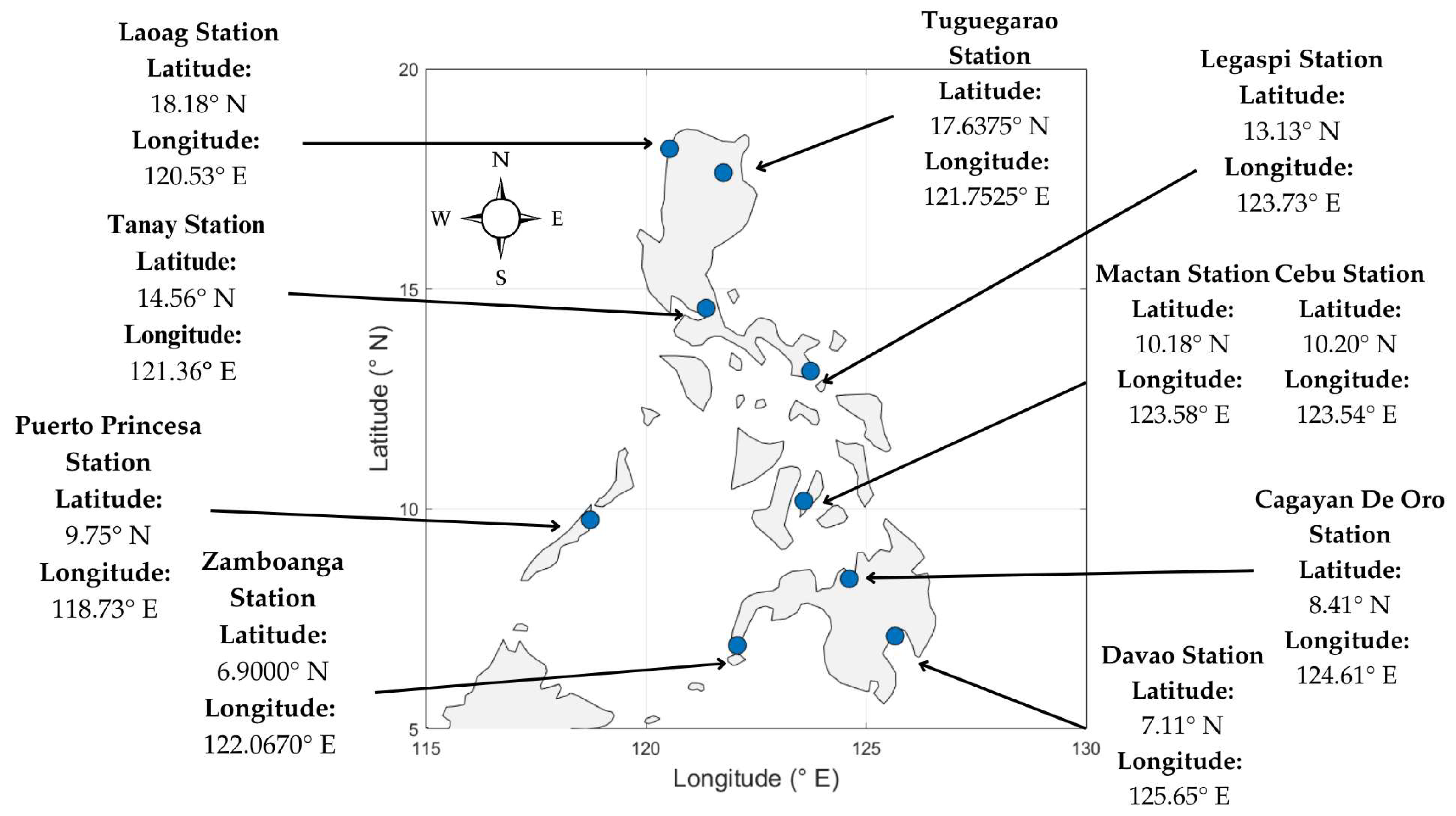
Figure 1. Locations of radiosonde stations around the Philippines.
Atmosphere 16 01285 g001
Figure 2. Sample map of radio occultations from (a) COSMIC-2 and (b) KOMPSAT-5. The large blue squares represent the 2° × 2° spatial grid around the RS station, marked by the green and black square.
Atmosphere 16 01285 g002
Figure 3. COSMIC-2 temperature versus interpolated radiosonde temperature for (a) Legaspi station; and (b) Tanay station on 24 February 2020 at around 00:00 UTC.
Atmosphere 16 01285 g003
Figure 4. Temperature difference between COSMIC-2 and radiosonde for (a) Legaspi station and (b) Tanay station on 24 February 2020 at around 00:00 UTC.
Atmosphere 16 01285 g004
Figure 5. (a) Temperature mean deviation between COSMIC-2 and radiosonde, and (b) standard deviation between COSMIC-2 and radiosonde for 2020. The edges of the shaded region represent the difference and sum between the mean deviation and standard deviation of the temperature profiles. The SEM is superimposed on the mean deviation.
Atmosphere 16 01285 g005
Figure 6. COSMIC-2 pressure versus interpolated radiosonde pressure for (a) Legaspi station and (b) Tanay station on 24 February 2020 at around 00:00 UTC.
Atmosphere 16 01285 g006
Figure 7. Pressure difference between COSMIC-2 and radiosonde for (a) Legaspi station and (b) Tanay station on 24 February 2020, at around 00:00 UTC.
Atmosphere 16 01285 g007
Figure 8. (a) Pressure mean deviation between COSMIC-2 and radiosonde and (b) standard deviation between COSMIC-2 and radiosonde for 2020. The edges of the shaded region represent the difference and sum between the mean deviation and standard deviation of the pressure profiles. The SEM is superimposed on the mean deviation.
Atmosphere 16 01285 g008
Figure 9. (a) KOMPSAT-5 temperature versus interpolated radiosonde temperature, and (b) temperature difference between KOMPSAT-5 and Radiosonde for 19 November 2019. The measurements from radiosonde are subtracted from the measurements from KOMPSAT-5.
Atmosphere 16 01285 g009
Figure 10. (a) Temperature mean deviation between KOMPSAT-5 and radiosonde, and (b) standard deviation between KOMPSAT-5 and radiosonde for 2019. The shaded area is the region between the sum and difference of the mean and standard deviation. The SEM is superimposed on the mean deviation.
Atmosphere 16 01285 g010
Figure 11. (a) KOMPSAT-5 pressure versus interpolated radiosonde pressure, and (b) pressure difference between KOMPSAT-5 and radiosonde for 19 November 2019. The measurements from radiosonde are subtracted from the measurements from KOMPSAT-5.
Atmosphere 16 01285 g011
Figure 12. (a) Pressure mean deviation between KOMPSAT-5 and radiosonde, and (b) standard deviation between KOMPSAT-5 and radiosonde for 2019. The shaded area is the region between the sum and difference of the mean and standard deviation. The SEM is superimposed on the mean deviation as an error bar.
Atmosphere 16 01285 g012
Figure 13. Seasonal variation of (a) mean deviation, and (b) standard deviation between COSMIC and radiosonde temperature profiles for 2020.
Atmosphere 16 01285 g013
Figure 14. Seasonal variation of (a) mean deviation, and (b) standard deviation between COSMIC and radiosonde pressure profiles for 2020.
Atmosphere 16 01285 g014
Figure 15. Seasonal variation of (a) mean deviation, and (b) standard deviation between KOMPSAT and radiosonde temperature profiles for 2019–2020.
Atmosphere 16 01285 g015
Figure 16. Seasonal variation of (a) mean deviation, and (b) standard deviation between KOMPSAT and radiosonde pressure profiles for 2019–2020.
Atmosphere 16 01285 g016
Table 1. Matching Data between KOMPSAT-5/COSMIC-2 and Radiosondes from 2019 to 2020, according to season.
SeasonWinterSpringSummerAutumn
Month DivisionD, J, FM, A, MJ, J, AS, O, N
Matching Pairs (KOMPSAT-5, 2019–2020)13132322
Matching Pairs (COSMIC-2, 2020)54446273
Disclaimer/Publisher’s Note: The statements, opinions and data contained in all publications are solely those of the individual author(s) and contributor(s) and not of MDPI and/or the editor(s). MDPI and/or the editor(s) disclaim responsibility for any injury to people or property resulting from any ideas, methods, instructions or products referred to in the content.