
Article

Dimensionality Reduction by Similarity Distance-Based Hypergraph Embedding

1
Southern Marine Science and Engineering Guangdong Laboratory (Guangzhou), Guangzhou 511458, China
2
Science and Technology on Integrated Information System Laboratory, Institute of Software, Chinese Academy of Sciences, Beijing 100190, China
3
China Academy of Information and Communications Technology, Beijing 100191, China
*
Author to whom correspondence should be addressed.
Atmosphere 2022, 13(9), 1449; https://doi.org/10.3390/atmos13091449
Submission received: 30 June 2022 / Revised: 30 August 2022 / Accepted: 2 September 2022 / Published: 7 September 2022
(This article belongs to the Special Issue Climate Modeling and Dynamics)

Abstract

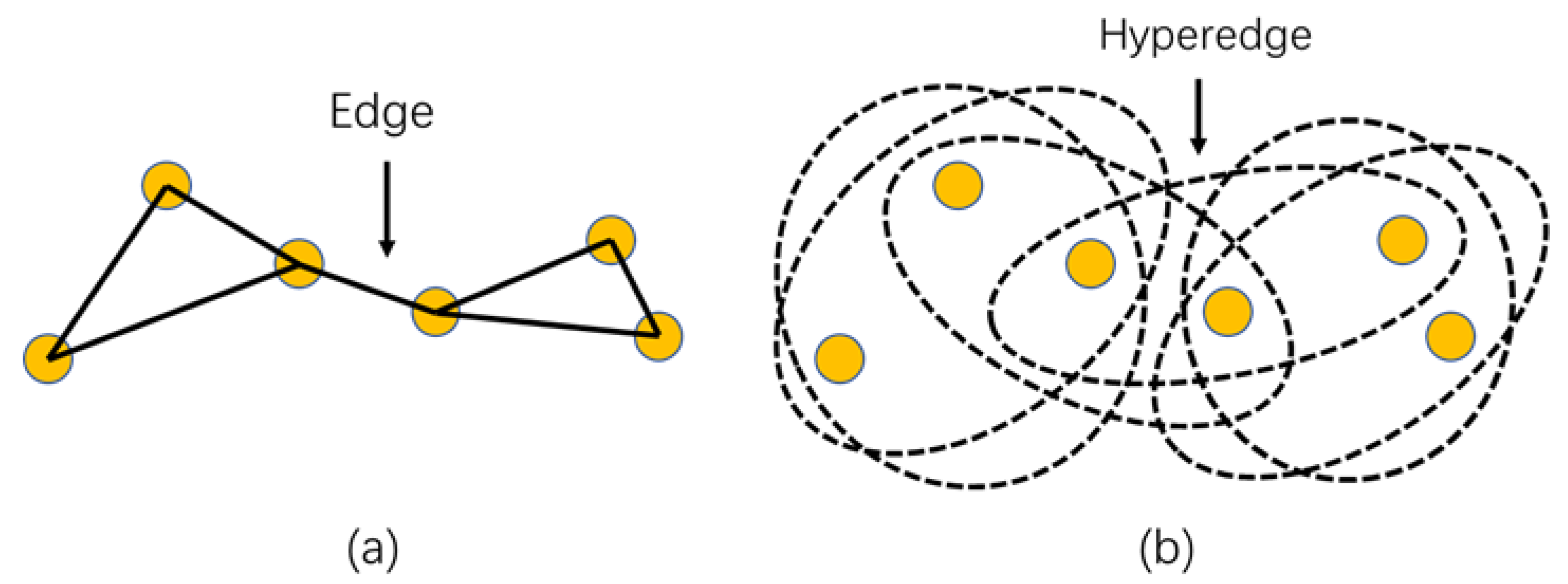
Dimensionality reduction (DR) is an essential pre-processing step for hyperspectral image processing and analysis. However, the complex relationship among several sample clusters, which reveals more intrinsic information about samples but cannot be reflected through a simple graph or Euclidean distance, is worth paying attention to. For this purpose, we propose a novel similarity distance-based hypergraph embedding method (SDHE) for hyperspectral images DR. Unlike conventional graph embedding-based methods that only consider the affinity between two samples, SDHE takes advantage of hypergraph embedding to describe the complex sample relationships in high order. Besides, we propose a novel similarity distance instead of Euclidean distance to measure the affinity between samples for the reason that the similarity distance not only discovers the complicated geometrical structure information but also makes use of the local distribution information. Finally, based on the similarity distance, SDHE aims to find the optimal projection that can preserve the local distribution information of sample sets in a low-dimensional subspace. The experimental results in three hyperspectral image data sets demonstrate that our SDHE acquires more efficient performance than other state-of-the-art DR methods, which improve by at least 2% on average.
Keywords: dimensionality reduction; hypergraph embedding; unsupervised; hyperspectral remote sensing dimensionality reduction; hypergraph embedding; unsupervised; hyperspectral remote sensing