

Viral Biomarkers in Chronic HBeAg Negative HBV Infection

Abstract
1. Introduction
2. Viral Biomarkers
2.1. Serology
2.1.1. Antigen and Antibody Detection
2.1.2. Hepatitis B Surface Antigen Quantification
2.1.3. Hepatitis B Early Antigen Quantification
2.1.4. Hepatitis B Core Related Antigen Quantification
2.2. Molecular Markers (Nucleic Acid Testing)
2.2.1. Hepatitis B Virus Deoxyribonucleic Acid
2.2.2. Hepatitis B Virus Genotype
2.2.3. Hepatitis B Virus Ribonucleic Acid
3. Clinical Significance of Viral Biomarkers in HBeAg(-) Infection
3.1. Biomarkers for the Diagnosis of Chronic HBeAg Negative Hepatitis B Virus Infection
3.2. Biomarkers for the Identification of the Inactive Carrier State
3.3. Biomarkers for the Prediction of Spontaneous HBsAg Clearance
3.4. Treatment Monitoring
3.4.1. Predictive Biomarkers for the Response to Pegylated-Interferon
3.4.2. Predictive Biomarkers for Functional Cure with Nucleos(t)ide Analog Treatment
3.4.3. Predictive Biomarkers for Discontinuation of Nucleos(t)ide Analogs
3.5. Hepatocellular Carcinoma
3.6. Future Therapies and Viral Biomarkers
4. Conclusions
Funding
Conflicts of Interest
References
- World Health Organization (WHO). Global Hepatitis Report. 2017. Available online: www.who.int/hepatitis/publications/global-hepatitis-report2017 (accessed on 1 August 2018).
- Villar, L.M.; Cruz, H.M.; Barbosa, J.R.; Bezerra, C.S.; Portilho, M.M.; Scalioni, L.P. Update on hepatitis B and C virus diagnosis. World J. Virol. 2015, 4, 323–342. [Google Scholar] [CrossRef] [Scilit] [PubMed]
- Osiowy, C.; Coffin, C.; Andonov, A. Review of Laboratory Tests used in Monitoring Hepatitis B Response to Pegylated Interferon and Nucleos(t)ide Analog Therapy. Curr. Treat. Options Infect. Dis. 2016, 8, 177–193. [Google Scholar] [CrossRef] [Scilit] [PubMed]
- Song, J.E.; Kim, D.Y. Diagnosis of hepatitis B. Ann. Transl. Med. 2016, 4, 338. [Google Scholar] [CrossRef] [Scilit] [PubMed]
- Blumberg, B.S.; Alter, H.J.; Visnich, S. A “new” antigen in leukemia sera. JAMA 1965, 191, 541–546. [Google Scholar] [CrossRef] [Scilit] [PubMed]
- Dienes, H.P.; Gerlich, W.H.; Worsdorfer, M.; Gerken, G.; Bianchi, L.; Hess, G.; Meyer Zum Büschenfelde, K.-H. Hepatic expression patterns of the large and middle hepatitis B virus surface proteins in viremic and nonviremic chronic hepatitis B. Gastroenterology 1990, 98, 1017–1023. [Google Scholar] [CrossRef] [Scilit]
- Shinkai, N.; Matsuura, K.; Sugauchi, F.; Watanabe, T.; Murakami, S.; Iio, E.; Ogawa, S.; Nojiri, S.; Joh, T.; Tanaka, Y. Application of a newly developed high-sensitivity HBsAg chemiluminescent enzyme immunoassay for hepatitis B patients with HBsAg seroclearance. J. Clin. Microbiol. 2013, 51, 3484–3491. [Google Scholar] [CrossRef] [Scilit] [PubMed]
- Sommese, L.; Sabia, C.; Paolillo, R.; Parente, D.; Capuano, M.; Iannone, C.; Cavalca, F.; Schiano, C.; Vasco, M.; De Pascale, M.R.; et al. Screening tests for hepatitis B virus, hepatitis C virus, and human immunodeficiency virus in blood donors: Evaluation of two chemiluminescent immunoassay systems. Scand. J. Infect. Dis. 2014, 46, 660–664. [Google Scholar] [CrossRef] [Scilit] [PubMed]
- Chu, F.Y.; Su, F.H.; Cheng, S.H.; Lin, Y.S.; Li, C.Y.; Chien, C.C.; Lin, Y.C.; Chiang, S.Y. Hepatitis B surface antigen confirmatory testing for diagnosis of hepatitis B virus infection in Taiwan. J. Med. Virol. 2011, 83, 1514–1521. [Google Scholar] [CrossRef] [Scilit] [PubMed]
- Van Helden, J.; Cornely, C.; Dati, F.; Levy, H.R.; Bal, T.; Seeger, M.; Wright, T.; Baker, L. Performance evaluation of the ADVIA Centaur anti-HBe and HBeAg assays. J. Clin. Virol. 2008, 43, 169–175. [Google Scholar] [CrossRef] [Scilit] [PubMed]
- Feng, S.; Wei, B.; Rao, C.; Wang, T.; Xiao, Y.; Tao, C.; Wang, L. Clinical evaluation of the newly developed HISCL-5000 analyzer on detection of hepatitis B virus markers in West China hospital. Clin. Lab. 2016, 62, 1053–1060. [Google Scholar] [CrossRef] [Scilit] [PubMed]
- Choi, S.J.; Park, Y.; Lee, E.Y.; Kim, S.; Kim, H.S. Performance evaluation of LUMIPULSE G1200 autoimmunoanalyzer for the detection of serum hepatitis B virus markers. J. Clin. Lab. Anal. 2013, 27, 204–206. [Google Scholar] [CrossRef] [Scilit] [PubMed]
- Xu, W.Z.; Li, Y.; Wu, Q.; Wang, M.; Wu, Z. Brief communication: Comparison the diagnostic performance of four HBsAg ELISA kits. J. Clin. Lab. Anal. 2013, 27, 294–296. [Google Scholar]
- Xu, L.; Yu, Z.; Fan, W.; Wang, X.; Xie, M.; Xu, Y.; Hu, L.; Li, Y. Negative interference in serum HBsAg ELISA from rheumatoid factors. PLoS ONE 2013, 8, e80620. [Google Scholar] [CrossRef] [Scilit] [PubMed]
- Xu, W.; Li, Y.; Wang, M.; Gu, J. Comparison of two immunoassays for determining hepatitis B virus serum markers. Clin. Chem. Lab. Med. 2011, 50, 153–157. [Google Scholar] [CrossRef] [Scilit] [PubMed]
- Pai, N.P.; Dhurat, R.; Potter, M.; Behlim, T.; Landry, G.; Vadnais, C.; Rodrigues, C.; Joseph, L.; Shetty, A. Will a quadruple multiplexed point-of-care screening strategy for HIV-related co-infections be feasible and impact detection of new co-infections in at-risk populations? Results from cross-sectional studies. BMJ Open 2014, 4, e005040. [Google Scholar] [CrossRef] [Scilit] [PubMed]
- Bottero, J.; Boyd, A.; Gozlan, J.; Lemoine, M.; Carrat, F.; Collignon, A.; Boo, N.; Dhotte, P.; Varsat, B.; Muller, G.; et al. Performance of rapid tests for detection of HBsAg and anti-HBsAb in a large cohort, France. J. Hepatol. 2013, 58, 473–478. [Google Scholar] [CrossRef] [Scilit] [PubMed]
- Perrillo, R.; Campbell, C.; Wellinghoff, W.; Gelb, L. The relationship of hepatitis B e antigen, DNA polymerase activity, and titer of hepatitis B surface antigen with ongoing liver injury in chronic hepatitis B virus infection. Am. J. Gastroenterol. 1982, 77, 445–449. [Google Scholar] [PubMed]
- Liao, C.C.; Hsu, C.W.; Gu, P.W.; Yeh, C.T.; Lin, S.M.; Chiu, C.T. Comparison of the elecsys HBsAg II assay and the architect assay for quantification of hepatitis B surface antigen in chronic hepatitis B patients. Biomed. J. 2015, 38, 250–256. [Google Scholar] [PubMed]
- Yang, R.; Song, G.; Guan, W.; Wang, Q.; Liu, Y.; Wei, L. The Lumipulse G HBsAg-Quant assay for screening and quantification of the hepatitis B surface antigen. J. Virol. Methods 2016, 228, 39–47. [Google Scholar] [CrossRef] [Scilit] [PubMed]
- Hadziyannis, E.; Hadziyannis, S.J. Hepatitis B surface antigen quantification in chronic hepatitis B and its clinical utility. Expert Rev. Gastroenterol. Hepatol. 2014, 8, 185–195. [Google Scholar] [CrossRef] [Scilit] [PubMed]
- Maylin, S.; Boyd, A.; Martinot-Peignoux, M.; Delaugerre, C.; Bagnard, G.; Lapalus, M.; Zoulim, F.; Lavocat, F.; Marcellin, P.; Simon, F.; et al. Quantification of hepatitis B e antigen between Elecsys HBeAg and Architect HBeAg assays among patients infected with hepatitis B virus. J. Clin. Virol. 2013, 56, 306–311. [Google Scholar] [CrossRef] [Scilit] [PubMed]
- Fried, M.W.; Piratvisuth, T.; Lau, G.K.; Marcellin, P.; Chow, W.C.; Cooksley, G.; Luo, K.X.; Paik, S.W.; Liaw, Y.F.; Button, P.; et al. HBeAg and hepatitis B virus DNA as outcome predictors during therapy with peginterferon alfa-2a for HBeAg-positive chronic hepatitis B. Hepatology 2008, 47, 428–434. [Google Scholar] [CrossRef] [Scilit] [PubMed]
- Ma, H.; Yang, R.F.; Wei, L. Quantitative serum HBsAg and HBeAg are strong predictors of sustained HBeAg seroconversion to pegylated interferon alfa-2b in HBeAg-positive patients. J. Gastroenterol. Hepatol 2010, 25, 1498–1506. [Google Scholar] [CrossRef] [Scilit] [PubMed]
- Zhang, X.; Lin, S.M.; Ye, F.; Chen, T.Y.; Liu, M.; Chen, Y.R.; Zheng, S.Q.; Zhao, Y.R.; Zhang, S.L. An early decrease in serum HBeAg titre is a strong predictor of virological response to entecavir in HBeAg-positive patients. J. Viral Hepat. 2011, 18, e184–e190. [Google Scholar] [CrossRef] [Scilit] [PubMed]
- Buster, E.H.; Flink, H.J.; Cakaloglu, Y.; Simon, K.; Trojan, J.; Tabak, F.; So, T.M.; Feinman, S.V.; Mach, T.; Akarca, U.S.; et al. Sustained HBeAg and HBsAg loss after long-term follow-up of HBeAg-positive patients treated with peginterferon alpha-2b. Gastroenterology 2008, 135, 459–467. [Google Scholar] [CrossRef] [Scilit] [PubMed]
- Wursthorn, K.; Zacher, B.J.; Jaroszewicz, J.; Darnedde, M.; Manns, M.; Wedemeyer, H. Development of a protocol for the quantitative determination of HBeAg using the Elecsys(R) HBeAg immunoassay. J. Viral Hepat. 2011, 18, e179–e183. [Google Scholar] [CrossRef] [Scilit] [PubMed]
- Rokuhara, A.; Tanaka, E.; Matsumoto, A.; Kimura, T.; Yamaura, T.; Orii, K.; Sun, X.; Yagi, S.; Maki, N.; Kiyosawa, K. Clinical evaluation of a new enzyme immunoassay for hepatitis B virus core-related antigen; a marker distinct from viral DNA for monitoring lamivudine treatment. J. Viral Hepat. 2003, 10, 324–330. [Google Scholar] [CrossRef] [Scilit] [PubMed]
- Wong, D.K.; Tanaka, Y.; Lai, C.L.; Mizokami, M.; Fung, J.; Yuen, M.F. Hepatitis B virus core-related antigens as markers for monitoring chronic hepatitis B infection. J. Clin. Microbiol. 2007, 45, 3942–3947. [Google Scholar] [CrossRef] [Scilit] [PubMed]
- Maasoumy, B.; Wiegand, S.B.; Jaroszewicz, J.; Bremer, B.; Lehmann, P.; Deterding, K.; Taranta, A.; Manns, M.P.; Wedemeyer, H.; Glebe, D.; et al. Hepatitis B core-related antigen (HBcrAg) levels in the natural history of hepatitis B virus infection in a large European cohort predominantly infected with genotypes A and D. Clin. Microbiol. Infect. 2015, 21, 606–610. [Google Scholar] [CrossRef] [Scilit] [PubMed]
- Seto, W.K.; Wong, D.K.; Fung, J.; Huang, F.Y.; Liu, K.S.; Lai, C.L.; Yuen, M.F. Linearized hepatitis B surface antigen and hepatitis B core-related antigen in the natural history of chronic hepatitis B. Clin. Microbiol Infect. 2014, 20, 1173–1180. [Google Scholar] [CrossRef] [Scilit] [PubMed]
- Suzuki, F.; Miyakoshi, H.; Kobayashi, M.; Kumada, H. Correlation between serum hepatitis B virus core-related antigen and intrahepatic covalently closed circular DNA in chronic hepatitis B patients. J. Med. Virol. 2009, 81, 27–33. [Google Scholar] [CrossRef] [Scilit] [PubMed]
- Lok, A.S.; Hadziyannis, S.J.; Weller, I.V.; Karvountzis, M.G.; Monjardino, J.; Karayiannis, P.; Montano, L.; Thomas, H.C. Contribution of low level HBV replication to continuing inflammatory activity in patients with anti-HBe positive chronic hepatitis B virus infection. Gut 1984, 25, 1283–1287. [Google Scholar] [CrossRef] [Scilit] [PubMed]
- Karayiannis, P.; Fowler, M.J.; Lok, A.S.; Greenfield, C.; Monjardino, J.; Thomas, H.C. Detection of serum HBV-DNA by molecular hybridisation. Correlation with HBeAg/anti-HBe status, racial origin, liver histology and hepatocellular carcinoma. J. Hepatol. 1985, 1, 99–106. [Google Scholar] [CrossRef] [Scilit]
- Chu, C.M.; Karayiannis, P.; Fowler, M.J.; Monjardino, J.; Liaw, Y.F.; Thomas, H.C. Natural history of chronic hepatitis B virus infection in Taiwan: Studies of hepatitis B virus DNA in serum. Hepatology 1985, 5, 431–434. [Google Scholar] [CrossRef] [Scilit] [PubMed]
- Kim, H.; Hur, M.; Bae, E.; Lee, K.A.; Lee, W.I. Performance evaluation of cobas HBV real-time PCR assay on Roche cobas 4800 System in comparison with COBAS AmpliPrep/COBAS TaqMan HBV Test. Clin. Chem. Lab. Med. 2018, 56, 1133–1139. [Google Scholar] [CrossRef] [Scilit] [PubMed]
- Morris, C.J.; Hill, M.; de Medina, M.; Herman, C.; Cloherty, G.A.; Martin, P. Comparison of detection and quantification of HBV DNA in chronic HBeAg negative and positive patients by Abbott RealTime HBV and Roche Cobas TaqMan HBV assays. J. Virol. Methods 2013, 193, 391–393. [Google Scholar] [CrossRef] [Scilit] [PubMed]
- Peeling, R.W.; Boeras, D.I.; Marinucci, F.; Easterbrook, P. The future of viral hepatitis testing: Innovations in testing technologies and approaches. BMC Infect. Dis. 2017, 17, 699. [Google Scholar] [CrossRef] [Scilit] [PubMed]
- Terrault, N.A.; Bzowej, N.H.; Chang, K.M.; Hwang, J.P.; Jonas, M.M.; Murad, M.H. AASLD guidelines for treatment of chronic hepatitis B. Hepatology 2016, 63, 261–283. [Google Scholar] [CrossRef] [Scilit] [PubMed]
- European Association for the Study of the Liver. EASL 2017 Clinical Practice Guidelines on the management of hepatitis B virus infection. J. Hepatol. 2017, 67, 370–398. [Google Scholar] [CrossRef] [Scilit] [PubMed]
- Liu, C.; Chang, L.; Jia, T.; Guo, F.; Zhang, L.; Ji, H.; Zhao, J.; Wang, L. Real-time PCR assays for hepatitis B virus DNA quantification may require two different targets. Virol. J. 2017, 14, 94. [Google Scholar] [CrossRef] [Scilit] [PubMed]
- Lange, B.; Roberts, T.; Cohn, J.; Greenman, J.; Camp, J.; Ishizaki, A.; Messac, L.; Tuaillon, E.; van de Perre, P.; Pichler, C.; et al. Diagnostic accuracy of detection and quantification of HBV-DNA and HCV-RNA using dried blood spot (DBS) samples—A systematic review and meta-analysis. BMC Infect. Dis. 2017, 17, 693. [Google Scholar] [CrossRef] [Scilit] [PubMed]
- Portilho, M.M.; Mendonca, A.C.D.F.; Bezerra, C.S.; do Espirito-Santo, M.P.; de Paula, V.S.; Nabuco, L.C.; Villela-Nogueira, C.A.; Lewis-Ximenez, L.L.; Lampe, E.; Villar, L.M. Usefulness of in-house real time PCR for HBV DNA quantification in serum and oral fluid samples. J. Virol. Methods 2018, 256, 100–106. [Google Scholar] [CrossRef] [Scilit] [PubMed]
- Portilho, M.M.; Martins, P.P.; Lampe, E.; Villar, L.M. A comparison of molecular methods for hepatitis B virus (HBV) DNA detection from oral fluid samples. J. Med. Microbiol. 2012, 61, 844–851. [Google Scholar] [CrossRef] [Scilit] [PubMed]
- Heiberg, I.L.; Hoegh, M.; Ladelund, S.; Niesters, H.G.; Hogh, B. Hepatitis B virus DNA in saliva from children with chronic hepatitis B infection: Implications for saliva as a potential mode of horizontal transmission. Pediatr. Infect. Dis. J. 2010, 29, 465–467. [Google Scholar] [CrossRef] [Scilit] [PubMed]
- Van der Eijk, A.A.; Niesters, H.G.; Hansen, B.E.; Pas, S.D.; Richardus, J.H.; Mostert, M.; Janssen, H.L.; Schalm, S.W.; de Man, R.A. Paired, quantitative measurements of hepatitis B virus DNA in saliva, urine and serum of chronic hepatitis B patients. Eur. J. Gastroenterol. Hepatol. 2005, 17, 1173–1179. [Google Scholar] [CrossRef] [Scilit] [PubMed]
- Huang, J.T.; Yang, Y.; Hu, Y.M.; Liu, X.H.; Liao, M.Y.; Morgan, R.; Yuan, E.F.; Li, X.; Liu, S.M. A Highly Sensitive and Robust Method for Hepatitis B Virus Covalently Closed Circular DNA Detection in Single Cells and Serum. J. Mol. Diagn. 2018, 20, 334–343. [Google Scholar] [CrossRef] [Scilit] [PubMed]
- Zhang, Z.H.; Wu, C.C.; Chen, X.W.; Li, X.; Li, J.; Lu, M.J. Genetic variation of hepatitis B virus and its significance for pathogenesis. World J. Gastroenterol. 2016, 22, 126–144. [Google Scholar] [CrossRef] [Scilit] [PubMed]
- Schaefer, S. Hepatitis B virus taxonomy and hepatitis B virus genotypes. World J. Gastroenterol. 2007, 13, 14–21. [Google Scholar] [CrossRef] [Scilit] [PubMed]
- Guirgis, B.S.; Abbas, R.O.; Azzazy, H.M. Hepatitis B virus genotyping: Current methods and clinical implications. Int. J. Infect. Dis. 2010, 14, e941–e953. [Google Scholar] [CrossRef] [Scilit] [PubMed]
- Osiowy, C.; Giles, E. Evaluation of the INNO-LiPA HBV genotyping assay for determination of hepatitis B virus genotype. J. Clin. Microbiol. 2003, 41, 5473–5477. [Google Scholar] [CrossRef] [Scilit] [PubMed]
- Carman, W.F.; Jacyna, M.R.; Hadziyannis, S.; Karayiannis, P.; McGarvey, M.J.; Makris, A.; Thomas, H.C. Mutation preventing formation of hepatitis B e antigen in patients with chronic hepatitis B infection. Lancet 1989, 2, 588–591. [Google Scholar] [CrossRef] [Scilit]
- Lindh, M.; Andersson, A.S.; Gusdal, A. Genotypes, nt 1858 variants, and geographic origin of hepatitis B virus--large-scale analysis using a new genotyping method. J. Infect. Dis. 1997, 175, 1285–1293. [Google Scholar] [CrossRef] [Scilit] [PubMed]
- Basaras, M.; Arrese, E.; Blanco, S.; Arroyo, L.S.; Ruiz, P.; Cisterna, R. Comparison of INNO-LIPA and TRUGENE assays for genotyping and drug-resistance mutations in chronic hepatitis B virus infection. Intervirology 2013, 56, 190–194. [Google Scholar] [CrossRef] [Scilit] [PubMed]
- Hatakeyama, T.; Noguchi, C.; Hiraga, N.; Mori, N.; Tsuge, M.; Imamura, M.; Takahashi, S.; Kawakami, Y.; Fujimoto, Y.; Ochi, H.; et al. Serum HBV RNA is a predictor of early emergence of the YMDD mutant in patients treated with lamivudine. Hepatology 2007, 45, 1179–1186. [Google Scholar] [CrossRef] [Scilit] [PubMed]
- Tsuge, M.; Murakami, E.; Imamura, M.; Abe, H.; Miki, D.; Hiraga, N.; Takahashi, S.; Ochi, H.; Nelson, H.C.; Ginba, H.; et al. Serum HBV RNA and HBeAg are useful markers for the safe discontinuation of nucleotide analog treatments in chronic hepatitis B patients. J. Gastroenterol. 2013, 48, 1188–1204. [Google Scholar] [CrossRef] [Scilit] [PubMed]
- Huang, Y.W.; Takahashi, S.; Tsuge, M.; Chen, C.L.; Wang, T.C.; Abe, H.; Hu, J.T.; Chen, D.S.; Yang, S.S.; Chayama, K.; et al. On-treatment low serum HBV RNA level predicts initial virological response in chronic hepatitis B patients receiving nucleoside analog therapy. Antivir. Ther. 2015, 20, 369–375. [Google Scholar] [CrossRef] [Scilit] [PubMed]
- Van Bommel, F.; van Bömmel, A.; Krauel, A.; Wat, C.; Pavlovic, V.; Yang, L.; Deichsel, D.; Berg, T.; Bohm, S. Serum HBV RNA as a Predictor of Peginterferon Alfa-2a (40KD) Response in Patients with HBeAg-Positive Chronic Hepatitis B. J. Infect. Dis. 2018, 218, 1066–1074. [Google Scholar] [CrossRef] [Scilit] [PubMed]
- Rokuhara, A.; Matsumoto, A.; Tanaka, E.; Umemura, T.; Yoshizawa, K.; Kimura, T.; Maki, N.; Kiyosawa, K. Hepatitis B virus RNA is measurable in serum and can be a new marker for monitoring lamivudine therapy. J. Gastroenterol. 2006, 41, 785–790. [Google Scholar] [CrossRef] [Scilit] [PubMed]
- Kock, J.; Theilmann, L.; Galle, P.; Schlicht, H.J. Hepatitis B virus nucleic acids associated with human peripheral blood mononuclear cells do not originate from replicating virus. Hepatology 1996, 23, 405–413. [Google Scholar] [PubMed]
- Su, Q.; Wang, S.F.; Chang, T.E.; Breitkreutz, R.; Hennig, H.; Takegoshi, K.; Edler, L.; Schroder, C.H. Circulating hepatitis B virus nucleic acids in chronic infection : Representation of differently polyadenylated viral transcripts during progression to nonreplicative stages. Clin. Cancer Res. 2001, 7, 2005–2015. [Google Scholar] [PubMed]
- Jansen, L.; Kootstra, N.A.; van Dort, K.A.; Takkenberg, R.B.; Reesink, H.W.; Zaaijer, H.L. Hepatitis B Virus Pregenomic RNA Is Present in Virions in Plasma and Is Associated With a Response to Pegylated Interferon Alfa-2a and Nucleos(t)ide Analogs. J. Infect. Dis. 2016, 213, 224–232. [Google Scholar] [CrossRef] [Scilit] [PubMed]
- Wang, J.; Shen, T.; Huang, X.; Kumar, G.R.; Chen, X.; Zeng, Z.; Zhang, R.; Chen, R.; Li, T.; Zhang, T.; et al. Serum hepatitis B virus RNA is encapsidated pregenome RNA that may be associated with persistence of viral infection and rebound. J. Hepatol. 2016, 65, 700–710. [Google Scholar] [CrossRef] [Scilit] [PubMed]
- Zhang, W.; Hacker, H.J.; Tokus, M.; Bock, T.; Schroder, C.H. Patterns of circulating hepatitis B virus serum nucleic acids during lamivudine therapy. J. Med. Virol. 2003, 71, 24–30. [Google Scholar] [CrossRef] [Scilit] [PubMed]
- Van Bommel, F.; Bartens, A.; Mysickova, A.; Hofmann, J.; Kruger, D.H.; Berg, T.; Edelmann, A. Serum hepatitis B virus RNA levels as an early predictor of hepatitis B envelope antigen seroconversion during treatment with polymerase inhibitors. Hepatology 2015, 61, 66–76. [Google Scholar] [CrossRef] [Scilit] [PubMed]
- Lam, A.M.; Ren, S.; Espiritu, C.; Kelly, M.; Lau, V.; Zheng, L.; Hartman, G.D.; Flores, O.A.; Klumpp, K. Hepatitis B Virus Capsid Assembly Modulators, but Not Nucleoside Analogs, Inhibit the Production of Extracellular Pregenomic RNA and Spliced RNA Variants. Antimicrob. Agents Chemother. 2017, 61, e00680-17. [Google Scholar] [CrossRef] [Scilit] [PubMed]
- Niu, C.; Livingston, C.M.; Li, L.; Beran, R.K.; Daffis, S.; Ramakrishnan, D.; Burdette, D.; Peiser, L.; Salas, E.; Ramos, H.; et al. The Smc5/6 Complex Restricts HBV when Localized to ND10 without Inducing an Innate Immune Response and Is Counteracted by the HBV X Protein Shortly after Infection. PLoS ONE 2017, 12, e0169648. [Google Scholar] [CrossRef] [Scilit] [PubMed]
- Castillo, I.; Rodriguez-Inigo, E.; Lopez-Alcorocho, J.M.; Bartolome, J.; Pardo, M.; Carreno, V. Comparative study on the clinical and virological characteristics among patients with single occult hepatitis B virus (HBV), single occult hepatitis C virus (HCV) and occult HBV and HCV dual infection. J. Med. Virol. 2007, 79, 236–241. [Google Scholar] [CrossRef] [Scilit] [PubMed]
- Gonzalez, R.; Torres, P.; Castro, E.; Barbolla, L.; Candotti, D.; Koppelman, M.; Zaaijer, H.L.; Lelie, N.; Allain, J.P.; Echevarria, J.M. Efficacy of hepatitis B virus (HBV) DNA screening and characterization of acute and occult HBV infections among blood donors from Madrid, Spain. Transfusion 2010, 50, 221–230. [Google Scholar] [CrossRef] [Scilit] [PubMed]
- Izmirli, S.; Celik, D.G.; Yuksel, P.; Saribas, S.; Aslan, M.; Ergin, S.; Bahar, H.; Sen, S.; Cakal, B.; Oner, A.; et al. The detection of occult HBV infection in patients with HBsAg negative pattern by real-time PCR method. Transfus. Apher. Sci. 2012, 47, 283–287. [Google Scholar] [CrossRef] [Scilit] [PubMed]
- Raimondo, G.; Caccamo, G.; Filomia, R.; Pollicino, T. Occult HBV infection. Semin. Immunopathol. 2013, 35, 39–52. [Google Scholar] [CrossRef] [Scilit] [PubMed]
- Ponde, R.A. Molecular mechanisms underlying HBsAg negativity in occult HBV infection. Eur. J. Clin. Microbiol. Infect. Dis. 2015, 34, 1709–1731. [Google Scholar] [CrossRef] [Scilit] [PubMed]
- Coppola, N.; Onorato, L.; Iodice, V.; Starace, M.; Minichini, C.; Farella, N.; Liorre, G.; Filippini, P.; Sagnelli, E.; de Stefano, G. Occult HBV infection in HCC and cirrhotic tissue of HBsAg-negative patients: A virological and clinical study. Oncotarget 2016, 7, 62706–62714. [Google Scholar] [CrossRef] [Scilit] [PubMed]
- Koutsianas, C.; Thomas, K.; Vassilopoulos, D. Hepatitis B Reactivation in Rheumatic Diseases: Screening and Prevention. Rheum. Dis. Clin. N. Am. 2017, 43, 133–149. [Google Scholar] [CrossRef] [Scilit] [PubMed]
- Calabrese, L.H.; Zein, N.N.; Vassilopoulos, D. Hepatitis B virus (HBV) reactivation with immunosuppressive therapy in rheumatic diseases: Assessment and preventive strategies. Ann. Rheum. Dis. 2006, 65, 983–989. [Google Scholar] [CrossRef] [Scilit] [PubMed]
- Terrault, N.A.; Lok, A.S.F.; McMahon, B.J.; Chang, K.M.; Hwang, J.P.; Jonas, M.M.; Brown, R.S., Jr.; Bzowej, N.H.; Wong, J.B. Update on prevention, diagnosis, and treatment of chronic hepatitis B: AASLD 2018 hepatitis B guidance. Hepatology 2018, 67, 1560–1599. [Google Scholar] [CrossRef] [Scilit] [PubMed]
- Jaroszewicz, J.; Calle, S.B.; Wursthorn, K.; Deterding, K.; Schlue, J.; Raupach, R.; Flisiak, R.; Bock, C.T.; Manns, M.P.; Wedemeyer, H.; et al. Hepatitis B surface antigen (HBsAg) levels in the natural history of hepatitis B virus (HBV)-infection: A European perspective. J. Hepatol. 2010, 52, 514–522. [Google Scholar] [CrossRef] [Scilit] [PubMed]
- Nguyen, T.; Thompson, A.J.; Bowden, S.; Croagh, C.; Bell, S.; Desmond, P.V.; Levy, M.; Locarnini, S.A. Hepatitis B surface antigen levels during the natural history of chronic hepatitis B: A perspective on Asia. J. Hepatol. 2010, 52, 508–513. [Google Scholar] [CrossRef] [Scilit] [PubMed]
- Brunetto, M.R.; Oliveri, F.; Colombatto, P.; Moriconi, F.; Ciccorossi, P.; Coco, B.; Romagnoli, V.; Cherubini, B.; Moscato, G.; Maina, A.M.; et al. Hepatitis B surface antigen serum levels help to distinguish active from inactive hepatitis B virus genotype D carriers. Gastroenterology 2010, 139, 483–490. [Google Scholar] [CrossRef] [Scilit] [PubMed]
- Tseng, T.C.; Liu, C.J.; Yang, H.C.; Su, T.H.; Wang, C.C.; Chen, C.L.; Kuo, S.F.; Liu, C.H.; Chen, P.J.; Chen, D.S.; et al. Determinants of spontaneous surface antigen loss in hepatitis B e antigen-negative patients with a low viral load. Hepatology 2012, 55, 68–76. [Google Scholar] [CrossRef] [Scilit] [PubMed]
- Liu, J.; Yang, H.I.; Lee, M.H.; Jen, C.L.; Batrla-Utermann, R.; Lu, S.N.; Wang, L.Y.; You, S.L.; Chen, C.J. Serum Levels of Hepatitis B Surface Antigen and DNA Can Predict Inactive Carriers With Low Risk of Disease Progression. Hepatology 2016, 64, 381–389. [Google Scholar] [CrossRef] [Scilit] [PubMed]
- Sali, S.; Sharafi, H.; Alavian, S.H.; Alavian, S.M.; Etesam, F.; Salimi, S.; Merza, M.A.; Keshvari, M. Can serum level of HBsAg differentiate HBeAg-negative chronic hepatitis B from inactive carrier state? Diagn. Microbiol. Infect. Dis. 2015, 82, 114–119. [Google Scholar] [CrossRef] [Scilit] [PubMed]
- Brouwer, W.P.; Chan, H.L.; Brunetto, M.R.; Martinot-Peignoux, M.; Arends, P.; Cornberg, M.; Cherubini, B.; Thompson, A.J.; Liaw, Y.F.; Marcellin, P.; et al. Repeated Measurements of Hepatitis B Surface Antigen Identify Carriers of Inactive HBV During Long-term Follow-up. Clin. Gastroenterol. Hepatol. 2016, 14, 1481–1489. [Google Scholar] [CrossRef] [Scilit] [PubMed]
- Maimone, S.; Caccamo, G.; Squadrito, G.; Alibrandi, A.; Saffioti, F.; Spinella, R.; Raffa, G.; Pollicino, T.; Raimondo, G. A combination of different diagnostic tools allows identification of inactive hepatitis B virus carriers at a single time point evaluation. Liver Int. 2017, 37, 362–368. [Google Scholar] [CrossRef] [Scilit] [PubMed]
- Riveiro-Barciela, M.; Bes, M.; Rodriguez-Frias, F.; Tabernero, D.; Ruiz, A.; Casillas, R.; Vidal-Gonzalez, J.; Homs, M.; Nieto, L.; Sauleda, S.; et al. Serum hepatitis B core-related antigen is more accurate than hepatitis B surface antigen to identify inactive carriers, regardless of hepatitis B virus genotype. Clin. Microbiol. Infect. 2017, 23, 860–867. [Google Scholar] [CrossRef] [Scilit] [PubMed]
- Oliveri, F.; Surace, L.; Cavallone, D.; Colombatto, P.; Ricco, G.; Salvati, N.; Coco, B.; Romagnoli, V.; Gattai, R.; Salvati, A.; et al. Long-term outcome of inactive and active, low viraemic HBeAg-negative-hepatitis B virus infection: Benign course towards HBsAg clearance. Liver Int. 2017, 37, 1622–1631. [Google Scholar] [CrossRef] [Scilit] [PubMed]
- Van Campenhout, M.J.H.; van, B.F.; Pfefferkorn, M.; Fischer, J.; Deichsel, D.; Boonstra, A.; van Vuuren, A.J.; Berg, T.; Hansen, B.E.; Janssen, H.L.A. Host and viral factors associated with serum hepatitis B virus RNA levels among patients in need for treatment. Hepatology 2018, 68, 839–847. [Google Scholar] [CrossRef] [Scilit] [PubMed]
- Wang, J.; Yu, Y.; Li, G.; Shen, C.; Li, J.; Chen, S.; Zhang, X.; Zhu, M.; Zheng, J.; Song, Z.; et al. Natural history of serum HBV-RNA in chronic HBV infection. J. Viral Hepat. 2018, 25, 1038–1047. [Google Scholar] [CrossRef] [Scilit] [PubMed]
- Wang, J.; Du, M.; Huang, H.; Chen, R.; Niu, J.; Jiang, J.; Zhuang, H.; Lu, F. Reply to: “Serum HBV pgRNA as a clinical marker for cccDNA activity”: Consistent loss of serum HBV RNA might predict the “para-functional cure” of chronic hepatitis B. J. Hepatol. 2017, 66, 462–463. [Google Scholar] [CrossRef] [Scilit] [PubMed]
- Huang, H.; Wang, J.; Li, W.; Chen, R.; Chen, X.; Zhang, F.; Xu, D.; Lu, F. Serum HBV DNA plus RNA shows superiority in reflecting the activity of intrahepatic cccDNA in treatment-naive HBV-infected individuals. J. Clin. Virol. 2018, 99–100, 71–78. [Google Scholar] [CrossRef] [Scilit] [PubMed]
- Chu, C.M.; Liaw, Y.F. HBsAg seroclearance in asymptomatic carriers of high endemic areas: Appreciably high rates during a long-term follow-up. Hepatology 2007, 45, 1187–1192. [Google Scholar] [CrossRef] [Scilit] [PubMed]
- Liu, J.; Yang, H.I.; Lee, M.H.; Lu, S.N.; Jen, C.L.; Wang, L.Y.; You, S.L.; Iloeje, U.H.; Chen, C.J. Incidence and determinants of spontaneous hepatitis B surface antigen seroclearance: A community-based follow-up study. Gastroenterology 2010, 139, 474–482. [Google Scholar] [CrossRef] [Scilit] [PubMed]
- Tseng, T.C.; Liu, C.J.; Su, T.H.; Wang, C.C.; Chen, C.L.; Chen, P.J.; Chen, D.S.; Kao, J.H. Serum hepatitis B surface antigen levels predict surface antigen loss in hepatitis B e antigen seroconverters. Gastroenterology 2011, 141, 517–525. [Google Scholar] [CrossRef] [Scilit] [PubMed]
- Chan, H.L.; Wong, G.L.; Tse, C.H.; Chan, H.Y.; Wong, V.W. Viral determinants of hepatitis B surface antigen seroclearance in hepatitis B e antigen-negative chronic hepatitis B patients. J. Infect. Dis. 2011, 204, 408–414. [Google Scholar] [CrossRef] [Scilit] [PubMed]
- Seto, W.K.; Wong, D.K.; Fung, J.; Hung, I.F.; Fong, D.Y.; Yuen, J.C.; Tong, T.; Lai, C.L.; Yuen, M.F. A large case-control study on the predictability of hepatitis B surface antigen levels three years before hepatitis B surface antigen seroclearance. Hepatology 2012, 56, 812–819. [Google Scholar] [CrossRef] [Scilit] [PubMed]
- Han, Z.G.; Qie, Z.H.; Qiao, W.Z. HBsAg spontaneous seroclearance in a cohort of HBeAg-seronegative patients with chronic hepatitis B virus infection. J. Med. Virol. 2016, 88, 79–85. [Google Scholar] [CrossRef] [Scilit] [PubMed]
- Liu, J.; Lee, M.H.; Batrla-Utermann, R.; Jen, C.L.; Iloeje, U.H.; Lu, S.N.; Wang, L.Y.; You, S.L.; Hsiao, C.K.; Yang, H.I.; et al. A predictive scoring system for the seroclearance of HBsAg in HBeAg-seronegative chronic hepatitis B patients with genotype B or C infection. J. Hepatol. 2013, 58, 853–860. [Google Scholar] [CrossRef] [Scilit] [PubMed]
- Yang, H.C.; Kao, J.H. Persistence of hepatitis B virus covalently closed circular DNA in hepatocytes: Molecular mechanisms and clinical significance. Emerg. Microbes Infect. 2014, 3, e64. [Google Scholar] [CrossRef] [Scilit] [PubMed]
- Nassal, M. HBV cccDNA: Viral persistence reservoir and key obstacle for a cure of chronic hepatitis B. Gut 2015, 64, 1972–1984. [Google Scholar] [CrossRef] [Scilit] [PubMed]
- Fung, J.; Lai, C.L.; Seto, W.K.; Yuen, M.F. Nucleoside/nucleotide analogs in the treatment of chronic hepatitis B. J. Antimicrob. Chemother. 2011, 66, 2715–2725. [Google Scholar] [CrossRef] [Scilit] [PubMed]
- Huang, Y.W.; Chayama, K.; Tsuge, M.; Takahashi, S.; Hatakeyama, T.; Abe, H.; Hu, J.T.; Liu, C.J.; Lai, M.Y.; Chen, D.S.; et al. Differential effects of interferon and lamivudine on serum HBV RNA inhibition in patients with chronic hepatitis B. Antivir. Ther. 2010, 15, 177–184. [Google Scholar] [CrossRef] [Scilit] [PubMed]
- Bottecchia, M.; Barcaiu, H.S.; Lewis-Ximenez, L.L.; da Silva EMouta Junior de Moraes, M.T. Monitoring the emergence of HBV resistance mutations by HBV-RNA pyrosequencing. Braz. J. Infect. Dis. 2016, 20, 216–217. [Google Scholar] [CrossRef] [Scilit] [PubMed]
- Wang, J.; Yu, Y.; Li, G.; Shen, C.; Meng, Z.; Zheng, J.; Jia, Y.; Chen, S.; Zhang, X.; Zhu, M.; et al. Relationship between serum HBV-RNA levels and intrahepatic viral as well as histologic activity markers in entecavir-treated patients. J. Hepatol. 2018, 68, 16–24. [Google Scholar] [CrossRef] [Scilit] [PubMed]
- Bonino, F.; Marcellin, P.; Lau, G.K.; Hadziyannis, S.; Jin, R.; Piratvisuth, T.; Germanidis, G.; Yurdaydin, C.; Diago, M.; Gurel, S.; et al. Predicting response to peginterferon alpha-2a, lamivudine and the two combined for HBeAg-negative chronic hepatitis B. Gut 2007, 56, 699–705. [Google Scholar] [CrossRef] [Scilit] [PubMed]
- Manesis, E.K.; Hadziyannis, E.S.; Angelopoulou, O.P.; Hadziyannis, S.J. Prediction of treatment-related HBsAg loss in HBeAG-negative chronic hepatitis B: A clue from serum HBsAg levels. Antivir. Ther. 2007, 12, 73–82. [Google Scholar] [PubMed]
- Wang, Y.C.; Yang, S.S.; Su, C.W.; Wang, Y.J.; Lee, K.C.; Huo, T.I.; .Lin, H.C.; Huang, Y.H. Predictors of response to pegylated interferon in chronic hepatitis B: A real-world hospital-based analysis. Sci. Rep. 2016, 6, 29605. [Google Scholar] [CrossRef] [Scilit] [PubMed]
- Rijckborst, V.; Hansen, B.E.; Cakaloglu, Y.; Ferenci, P.; Tabak, F.; Akdogan, M.; Simon, K.; Akarca, U.S.; Flisiak, R.; Verhey, E.; et al. Early on-treatment prediction of response to peginterferon alfa-2a for HBeAg-negative chronic hepatitis B using HBsAg and HBV DNA levels. Hepatology 2010, 52, 454–461. [Google Scholar] [CrossRef] [Scilit] [PubMed]
- Rijckborst, V.; Hansen, B.E.; Ferenci, P.; Brunetto, M.R.; Tabak, F.; Cakaloglu, Y.; Lanza, A.G.; Messina, V.; Iannacone, C.; Massetto, B. Validation of a stopping rule at week 12 using HBsAg and HBV DNA for HBeAg-negative patients treated with peginterferon alfa-2a. J. Hepatol. 2012, 56, 1006–1011. [Google Scholar] [CrossRef] [Scilit] [PubMed]
- Boglione, L.; Cusato, J.; Cariti, G.; Di Perri, G.; D’Avolio, A. Role of HBsAg decline in patients with chronic hepatitis B HBeAg-negative and E genotype treated with pegylated-interferon. Antivir. Res. 2016, 136, 32–36. [Google Scholar] [CrossRef] [Scilit] [PubMed]
- Goulis, I.; Karatapanis, S.; Akriviadis, E.; Deutsch, M.; Dalekos, G.N.; Raptopoulou-Gigi, M.; Mimidis, K.; Germanidis, G.; Drakoulis, C.; Triantos, C.; et al. On-treatment prediction of sustained response to peginterferon alfa-2a for HBeAg-negative chronic hepatitis B patients. Liver Int. 2015, 35, 1540–1548. [Google Scholar] [CrossRef] [Scilit] [PubMed]
- Chevaliez, S.; Hezode, C.; Bahrami, S.; Grare, M.; Pawlotsky, J.M. Long-term hepatitis B surface antigen (HBsAg) kinetics during nucleoside/nucleotide analog therapy: Finite treatment duration unlikely. J. Hepatol. 2013, 58, 676–683. [Google Scholar] [CrossRef] [Scilit] [PubMed]
- Zoutendijk, R.; Hansen, B.E.; van Vuuren, A.J.; Boucher, C.A.; Janssen, H.L. Serum HBsAg decline during long-term potent nucleos(t)ide analog therapy for chronic hepatitis B and prediction of HBsAg loss. J. Infect. Dis. 2011, 204, 415–418. [Google Scholar] [CrossRef] [Scilit] [PubMed]
- Hosaka, T.; Suzuki, F.; Kobayashi, M.; Seko, Y.; Kawamura, Y.; Sezaki, H.; Akuta, N.; Suzuki, Y.; Saitoh, S.; Arase, Y.; et al. Clearance of hepatitis B surface antigen during long-term nucleot(s)ide analog treatment in chronic hepatitis B: Results from a nine-year longitudinal study. J. Gastroenterol. 2013, 48, 930–941. [Google Scholar] [CrossRef] [Scilit] [PubMed]
- Seto, W.K.; Wong, D.K.; Fung, J.; Huang, F.Y.; Lai, C.L.; Yuen, M.F. Reduction of hepatitis B surface antigen levels and hepatitis B surface antigen seroclearance in chronic hepatitis B patients receiving 10 years of nucleoside analog therapy. Hepatology 2013, 58, 923–931. [Google Scholar] [CrossRef] [Scilit] [PubMed]
- Chen, C.H.; Chiu, Y.C.; Lu, S.N.; Lee, C.M.; Wang, J.H.; Hu, T.H.; Hung, C.H. Serum hepatitis B surface antigen levels predict treatment response to nucleos(t)ide analogs. World J. Gastroenterol. 2014, 20, 7686–7695. [Google Scholar] [CrossRef] [Scilit] [PubMed]
- Jaroszewicz, J.; Ho, H.; Markova, A.; Deterding, K.; Wursthorn, K.; Schulz, S.; Bock, C.T.; Tillmann, H.L.; Manns, M.P.; Wedemeyer, H.; et al. Hepatitis B surface antigen (HBsAg) decrease and serum interferon-inducible protein-10 levels as predictive markers for HBsAg loss during treatment with nucleoside/nucleotide analogs. Antivir. Ther. 2011, 16, 915–924. [Google Scholar] [CrossRef] [Scilit] [PubMed]
- Broquetas, T.; Garcia-Retortillo, M.; Hernandez, J.J.; Puigvehi, M.; Canete, N.; Coll, S.; Cabrero, B.; Gimenez, M.D.; Sola, R.; Carrion, J.A. Quantification of HBsAg to predict low levels and seroclearance in HBeAg-negative patients receiving nucleos(t)ide analogs. PLoS ONE 2017, 12, e0188303. [Google Scholar] [CrossRef] [Scilit] [PubMed]
- Liaw, Y.F.; Kao, J.H.; Piratvisuth, T.; Chan, H.L.; Chien, R.N.; Liu, C.J.; Gane, E.; Locarnini, S.; Lim, S.G.; Han, K.H.; et al. Asian-Pacific consensus statement on the management of chronic hepatitis B: A 2012 update. Hepatol. Int. 2012, 6, 531–561. [Google Scholar] [CrossRef] [Scilit] [PubMed]
- Liaw, Y.F.; Leung, N.; Kao, J.H.; Piratvisuth, T.; Gane, E.; Han, K.H.; Guan, R.; Lau, G.K.; Locarnini, S. Asian-Pacific consensus statement on the management of chronic hepatitis B: A 2008 update. Hepatol. Int. 2008, 2, 263–283. [Google Scholar] [CrossRef] [Scilit] [PubMed]
- Hadziyannis, S.J.; Sevastianos, V.; Rapti, I.; Vassilopoulos, D.; Hadziyannis, E. Sustained responses and loss of HBsAg in HBeAg-negative patients with chronic hepatitis B who stop long-term treatment with adefovir. Gastroenterology 2012, 143, 629–636. [Google Scholar] [CrossRef] [Scilit] [PubMed]
- Berg, T.; Simon, K.G.; Mauss, S.; Schott, E.; Heyne, R.; Klass, D.M.; Eisenbach, C.; Welzel, T.M.; Zachoval, R.; Felten, G.; et al. Long-term response after stopping tenofovir disoproxil fumarate in non-cirrhotic HBeAg-negative patients—FINITE study. J. Hepatol. 2017, 67, 918–924. [Google Scholar] [CrossRef] [Scilit] [PubMed]
- Jeng, W.J.; Chen, Y.C.; Chien, R.N.; Sheen, I.S.; Liaw, Y.F. Incidence and predictors of hepatitis B surface antigen seroclearance after cessation of nucleos(t)ide analog therapy in hepatitis B e antigen-negative chronic hepatitis B. Hepatology 2018, 68, 425–434. [Google Scholar] [CrossRef] [Scilit] [PubMed]
- Akbar, S.M.; Horiike, N.; Chen, S.; Michitaka, K.; Abe, M.; Hiasa, Y.; Matsuura, B.; Onji, M. Mechanism of restoration of immune responses of patients with chronic hepatitis B during lamivudine therapy: Increased antigen processing and presentation by dendritic cells. J. Viral Hepat. 2011, 18, 200–205. [Google Scholar] [CrossRef] [Scilit] [PubMed]
- Ferrari, C. HBV and the immune response. Liver Int. 2015, 35 (Suppl. 1), 121–128. [Google Scholar] [CrossRef] [Scilit] [PubMed]
- Chen, C.H.; Lu, S.N.; Hung, C.H.; Wang, J.H.; Hu, T.H.; Changchien, C.S.; Lee, C.M. The role of hepatitis B surface antigen quantification in predicting HBsAg loss and HBV relapse after discontinuation of lamivudine treatment. J. Hepatol. 2014, 61, 515–522. [Google Scholar] [CrossRef] [Scilit] [PubMed]
- Liaw, Y.F.; Jeng, W.J.; Chang, M.L. HBsAg Kinetics in Retreatment Decision for Off-Therapy Hepatitis B Flare in HBeAg-Negative Patients. Gastroenterology 2018, 154, 2280–2281. [Google Scholar] [CrossRef] [Scilit] [PubMed]
- Guardiola, A.A.; Gomez, R.R.; Romero, G.M.; Gomez Moreno, A.Z.; Garcia, V.A.; Sanchez, S.R.; Gomez, H.C.; Andres Esteban, E.M. Characteristics and course of chronic hepatitis B e antigen-negative infection. Gastroenterol. Hepatol. 2017, 40, 59–69. [Google Scholar] [CrossRef] [Scilit]
- Thiele, M.; Gluud, L.L.; Fialla, A.D.; Dahl, E.K.; Krag, A. Large variations in risk of hepatocellular carcinoma and mortality in treatment naive hepatitis B patients: Systematic review with meta-analyses. PLoS ONE 2014, 9, e107177. [Google Scholar] [CrossRef] [Scilit] [PubMed]
- Kim, J.H.; Sinn, D.H.; Kang, W.; Gwak, G.Y.; Paik, Y.H.; Choi, M.S.; Lee, J.H.; Koh, K.C.; Paik, S.W. Low-level viremia and the increased risk of hepatocellular carcinoma in patients receiving entecavir treatment. Hepatology 2017, 66, 335–343. [Google Scholar] [CrossRef] [Scilit] [PubMed]
- Fu, S.; Li, N.; Zhou, P.C.; Huang, Y.; Zhou, R.R.; Fan, X.G. Detection of HBV DNA and antigens in HBsAg-positive patients with primary hepatocellular carcinoma. Clin. Res. Hepatol. Gastroenterol. 2017, 41, 415–423. [Google Scholar] [CrossRef] [Scilit] [PubMed]
- Osawa, M.; Akuta, N.; Suzuki, F.; Fujiyama, S.; Kawamura, Y.; Sezaki, H.; Hosaka, T.; Kobayashi, M.; Kobayashi, M.; Saitoh, S.; et al. Prognosis and predictors of hepatocellular carcinoma in elderly patients infected with hepatitis B virus. J. Med. Virol. 2017, 89, 2144–2148. [Google Scholar] [CrossRef] [Scilit] [PubMed]
- Lee, M.H.; Yang, H.I.; Liu, J.; Batrla-Utermann, R.; Jen, C.L.; Iloeje, U.H.; Lu, S.N.; You, S.L.; Wang, L.Y.; Chen, C.J. Prediction models of long-term cirrhosis and hepatocellular carcinoma risk in chronic hepatitis B patients: Risk scores integrating host and virus profiles. Hepatology 2013, 58, 546–554. [Google Scholar] [CrossRef] [Scilit] [PubMed]
- Tseng, T.C.; Liu, C.J.; Yang, H.C.; Su, T.H.; Wang, C.C.; Chen, C.L.; Kuo, S.F.; Liu, C.H.; Chen, P.J.; Chen, D.S.; et al. High levels of hepatitis B surface antigen increase risk of hepatocellular carcinoma in patients with low HBV load. Gastroenterology 2012, 142, 1140–1149. [Google Scholar] [CrossRef] [Scilit] [PubMed]
- Qu, L.S.; Liu, J.X.; Zhang, H.F.; Zhu, J.; Lu, C.H. Effect of serum hepatitis B surface antigen levels on predicting the clinical outcomes of chronic hepatitis B infection: A meta-analysis. Hepatol. Res 2015, 45, 1004–1013. [Google Scholar] [CrossRef] [Scilit] [PubMed]
- Tada, T.; Kumada, T.; Toyoda, H.; Kiriyama, S.; Tanikawa, M.; Hisanaga, Y.; Kanamori, A.; Kitabatake, S.; Yama, T.; Tanaka, J. HBcrAg predicts hepatocellular carcinoma development: An analysis using time-dependent receiver operating characteristics. J. Hepatol. 2016, 65, 48–56. [Google Scholar] [CrossRef] [Scilit] [PubMed]
- Cheung, K.S.; Seto, W.K.; Wong, D.K.; Lai, C.L.; Yuen, M.F. Relationship between HBsAg, HBcrAg and hepatocellular carcinoma in patients with undetectable HBV DNA under nucleos(t)ide therapy. J. Viral Hepat. 2017, 24, 654–661. [Google Scholar] [CrossRef] [Scilit] [PubMed]
- Soriano, V.; Barreiro, P.; Benitez, L.; Pena, J.M.; de Mendoza, C. New antivirals for the treatment of chronic hepatitis B. Expert Opin. Investig. Drugs 2017, 26, 843–851. [Google Scholar] [CrossRef] [Scilit] [PubMed]
- Liang, T.J.; Block, T.M.; McMahon, B.J.; Ghany, M.G.; Urban, S.; Guo, J.T.; Locarnini, S.; Zoulim, F.; Chang, K.M.; Lok, A.S. Present and future therapies of hepatitis B: From discovery to cure. Hepatology 2015, 62, 1893–1908. [Google Scholar] [CrossRef] [Scilit] [PubMed]
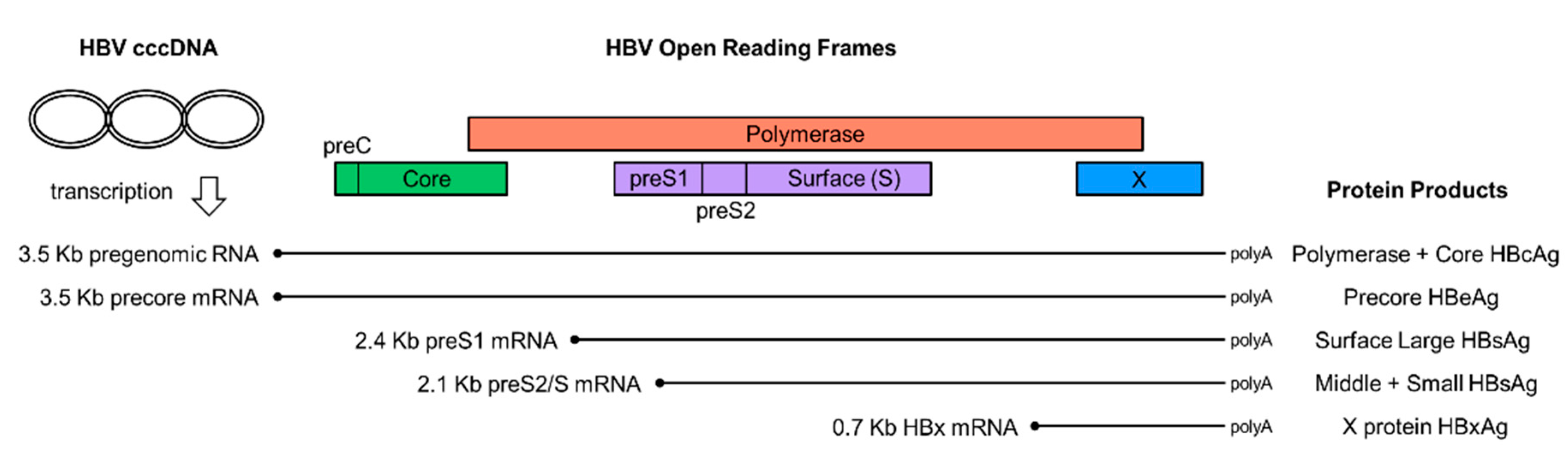
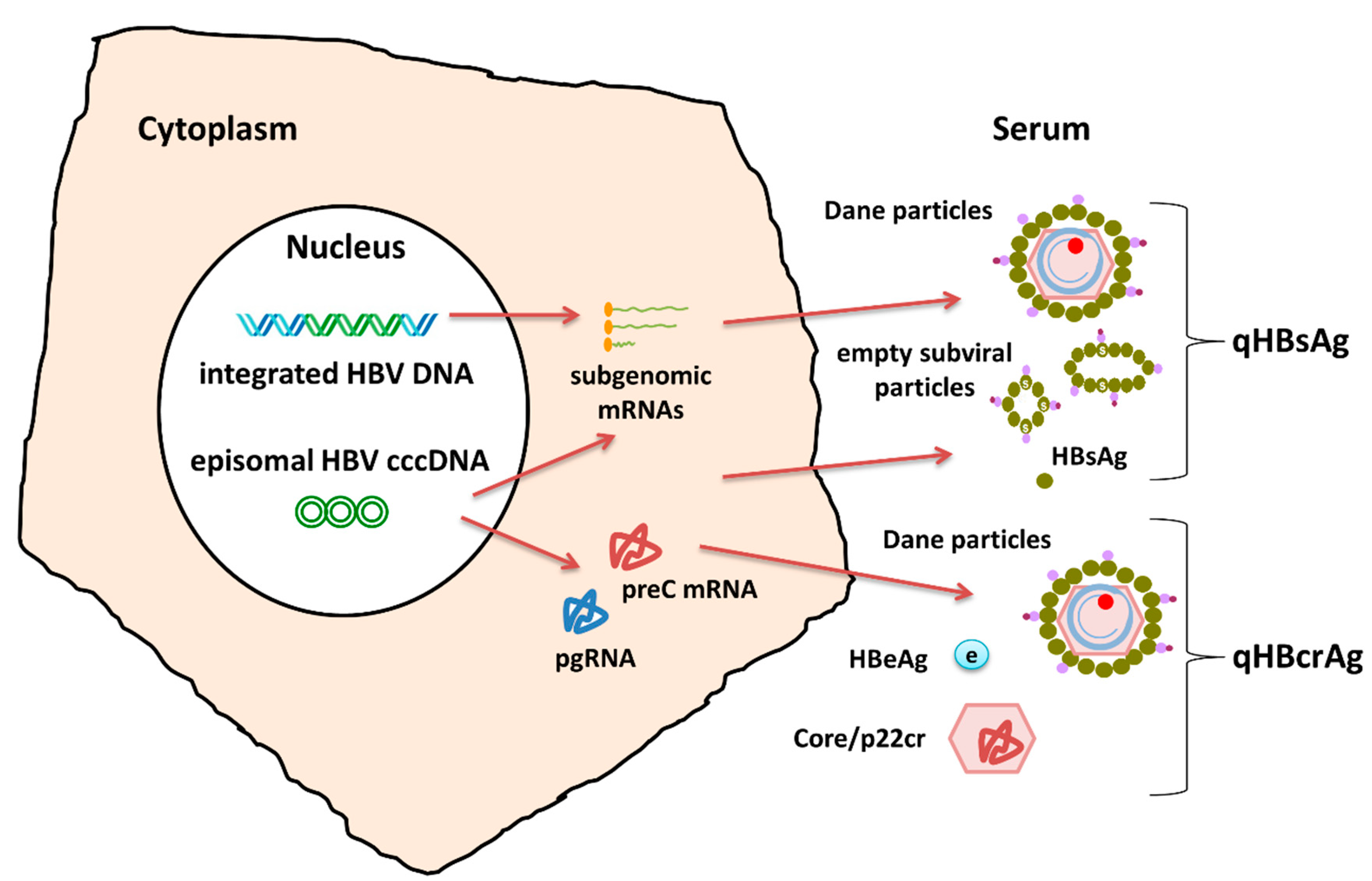

| HBsAg | Total Anti-HBc | IgM Anti-HBc | Anti-HBs | Interpretation |
|---|---|---|---|---|
| - | - | - | - | No HBV infection—susceptible |
| - | - | - | + 1 | HBV immune—vaccinated |
| - | + | - | + | Past HBV infection |
| + | + | + | - | Acute HBV infection |
| + | + | - | - | Chronic HBV infection |
| - | + | - | - | Inconclusive 2 |
| HBV DNA | Comment | |
|---|---|---|
| Primary non-response | Drop < 1 log10 IU/mL | Treatment week 12 |
| Partial virological response | Detectable and drop > 1 log10 IU/mL) | Treatment week 24 (Low GB NA) or 48 (High GB NA) |
| Complete virological response | Undetectable | Treatment week 48 |
| Viral breakthrough 1 | Increase >1 log10 IU/mL compared to nadir achieved during treatment, or detectable > 100 IU/mL when previously undetectable | Confirmed in 2 measurements 1 month apart |
| Functional cure 2 | Undetectable and HBsAg negative | Anti-HBs +/- |
© 2018 by the authors. Licensee MDPI, Basel, Switzerland. This article is an open access article distributed under the terms and conditions of the Creative Commons Attribution (CC BY) license (http://creativecommons.org/licenses/by/4.0/).
Share and Cite
Hadziyannis, E.; Laras, A. Viral Biomarkers in Chronic HBeAg Negative HBV Infection. Genes 2018, 9, 469. https://doi.org/10.3390/genes9100469
Hadziyannis E, Laras A. Viral Biomarkers in Chronic HBeAg Negative HBV Infection. Genes. 2018; 9(10):469. https://doi.org/10.3390/genes9100469
Chicago/Turabian StyleHadziyannis, Emilia, and Andreas Laras. 2018. "Viral Biomarkers in Chronic HBeAg Negative HBV Infection" Genes 9, no. 10: 469. https://doi.org/10.3390/genes9100469
APA StyleHadziyannis, E., & Laras, A. (2018). Viral Biomarkers in Chronic HBeAg Negative HBV Infection. Genes, 9(10), 469. https://doi.org/10.3390/genes9100469

