Composition and Function of Gut Microbiome: From Basic Omics to Precision Medicine

 , ,
, , 
Abstract
1. Introduction
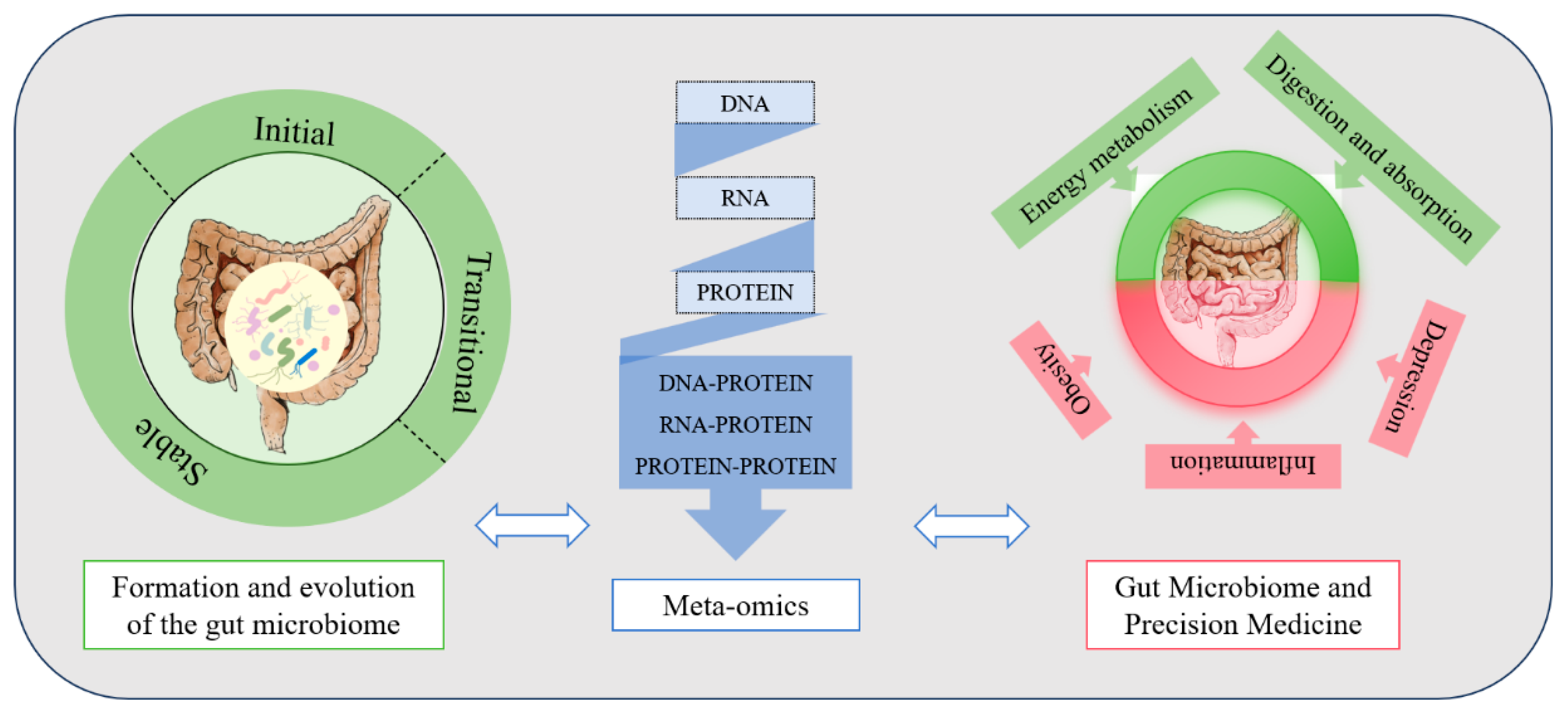
- The Link to Health and Disease: The gut microbiome plays a dual role, participating in essential host functions such as nutrient metabolism, immune regulation, and neuro-signaling while also being intimately linked to the pathogenesis of a wide range of conditions [11,12,13,14,15], including obesity, type 2 diabetes mellitus (T2DM), inflammatory bowel disease (IBD), autoimmune diseases, and certain neuropsychiatric disorders (such as depression and Alzheimer’s disease) [16,17,18,19].
- Technology-Driven Research Revolution: The rapid advancement of techniques, including 16S rRNA sequencing, metagenomics, metatranscriptomics, and multi-omics, has revolutionized our understanding of the gut microbiome. It allows us to conduct in-depth research into the complexity of the gut microbiome from multiple perspectives, including its composition, function, and dynamic changes [20,21,22,23].
- Research Value of Host–Microbe Interactions: The gut microbiome engages in dynamic interactions with the host’s genes and immune system through its metabolic products (such as SCFAs and toxins) [24,25,26]. This interactive network offers new insights into the molecular mechanisms underlying disease and may serve as a potential therapeutic target for treating diseases.
2. Formation, Evolution, and Function of the Gut Microbiome
2.1. Initial Establishment
2.2. Compositional Characteristics
2.3. Core Functions—“Hidden Organs” from Metabolism to Immunity
2.3.1. Nutrition Energy Metabolism
- ①
- Carbohydrate metabolism: The primary sources of energy and nutrients available to the human gut microbiota are carbohydrates derived from both the host and dietary intake. On the one hand, the gut microbiota converts digestible carbohydrates into glucose and other forms of monosaccharides through the action of small intestinal hydrolases. On the other hand, indigestible carbohydrates are transported to the colon by fermentation with bacteria such as Clostridium, Bacteroides, and Prevotella. The primary products of colonic fermentation are SCFAs, including acetic acid that enters the bloodstream, participates in systemic metabolism, and serves as a precursor for cholesterol and fatty acid synthesis [55]. Propionic acid is primarily absorbed by the liver; it inhibits cholesterol synthesis and serves as a substrate for gluconeogenesis, thereby aiding in the regulation of blood glucose levels and appetite [55]. Butyric acid is the primary energy source for colonic epithelial cells. It maintains the integrity of the intestinal barrier, possesses anti-inflammatory properties, and helps prevent colorectal cancer. SCFAs not only provide energy to intestinal cells but also act as signaling molecules that affect metabolic health, immune regulation, and appetite control [56,57].
- ②
- Lipid metabolism: The gut microbiome influences host lipid metabolism through multiple mechanisms. The gut microbiome possesses the capacity to regulate dietary lipid composition, digestion, and absorption and can modify intestinal lipoprotein formation. Lactobacillus, Enterococcus, Clostridium, and Proteobacteria in the gut can reduce glycerol to 1,3-propylene glycol. The gut microbiome can regulate fat storage by inhibiting adenosine monophosphate kinase (AMPK) and fasting-induced adipose factor (FIAF) [58,59].
- ③
- Protein and amino acid metabolism: The gut microbiome, on the one hand, secretes proteases that hydrolyze proteins into oligopeptides and amino acids; on the other hand, they produce various metabolic by-products through fermentation, for example, SCFAs, sulfides, aromatic compounds, polyamines, etc. Microbial protein metabolism is a double-edged sword, and its equilibrium is crucial for gut health. Protein glycolysis products involved in intestinal flora have a wide range of effects on intestinal homeostasis, the immune barrier, and inflammation within the body [60,61,62].
2.3.2. Immunological Education and Homeostasis
- ①
- Development of the immune system: The gut microbiome serves as a crucial stimulus for the development of the neonatal intestinal immune system [63,64]. Through their interaction with intestinal epithelial cells, they promote the maturation of gut-associated lymphoid tissue and induce the differentiation and balance of immune cells [65].
- ②
- Immune cell regulation—T cell differentiation and modulation: Within mesenteric lymph nodes, naive T cells differentiate into Th1, Th2, Th17, or regulatory T cells, influencing cytokine secretion to maintain local intestinal and systemic immune homeostasis [66]. For instance, filamentous bacteria can induce Th17 cell differentiation, whilst polysaccharide A produced by Bacteroides fragilis stimulates regulatory T cell (Treg) differentiation, counteracting Th17 and Th1 cell responses [67,68]. B cell antibody production: The gut microbiome can influence B cell class switching and secretion, stimulating B cells in gut-associated lymphoid tissue to produce IgA [69]. The gut microbiome and its metabolites can influence the migration and cross-reactivity of immune cells. For example, Proteobacteria, as a keystone species, can promote the migration of innate lymphoid cells (ILC2s and ILC3s) from the gut to the lungs and participate in the maintenance of airway mucosal immunity [70].
- ③
- Maintaining intestinal barrier function: The gut microbiome interacts with intestinal epithelial cells to promote the expression of tight junction proteins, thereby reinforcing the tight junctions between epithelial cells and forming a physical barrier [71]. The gut microbiome can also produce antimicrobial substances that inhibit the colonization and proliferation of potentially harmful microorganisms, thereby safeguarding the stability of the intestinal microenvironment [72,73].
- ④
- The role of metabolites in immune regulation: SCFAs comprise one of the primary metabolites produced by anaerobic bacteria during the fermentation of dietary fiber and resistant starch. SCFAs can regulate the function of immune cells by directly or indirectly inhibiting histone deacetylases (HDACs). For example, sodium butyrate reduces the secretion of TNF-α in human peripheral blood mononuclear cells (PBMCs) following LPS induction and inhibits NF-κB activity within PBMCs in vitro [74]. The gut microbiome can also metabolize tryptophan to produce indole and its derivatives, among other immunologically active metabolites. These metabolites regulate immune cell function by activating the aryl hydrocarbon receptor (AHR) [75].
2.3.3. Neuroendocrine Regulation
- ①
- Bidirectional communication mechanism of the gut–brain axis: i. Microbe-derived metabolites (such as SCFAs and neurotransmitter precursors) enter the circulatory system, crossing the blood–brain barrier to influence the central nervous system [76]. ii. Immune signaling: The gut microbiome activates immune cells, regulating neuroinflammation and neurodevelopment through cytokine secretion [77]. iii. Hormonal circulation: Enteric endocrine cells release hormones (such as serotonin) in response to microbial cues, which are transported via the bloodstream to the brain to regulate mood and cognition [78]. iv. Neural pathways: Gut microbiome-induced signals, such as vagal transmission to the central nervous system, establish direct neural connections [79].
- ②
- Profound effects on neurodevelopment: i. Critical developmental window: The colonization of the gut microbiome during the perinatal period is crucial for brain immune and neural development. The gut microbiome may influence hippocampal volume, myelination, and behavior-dependent changes [80,81]. ii. Neurotransmitter synthesis: Lactobacillus and Bifidobacterium can synthesize gamma-aminobutyric acid (GABA, the brain’s primary inhibitory neurotransmitter); Candida, Escherichia coli, and Enterococcus produce serotonin (involved in mood regulation). A study revealed that another bacterial metabolite, succinate, has a protective effect on dopaminergic neurons in the substantia nigra [82]. iii. Microglial function: The gut microbiome modulates microglial maturation via dendritic cells, thereby influencing neuroinflammatory responses.
- ③
- Regulation of emotions and behavior: i. Mood-related neurotransmitter: Approximately 95% of serotonin (5-hydroxytryptamine) is produced by chromaffin cells in the intestinal mucosa, where it participates in the regulation of mood and cognition. The gut microbiome influences serotonin synthesis through tryptophan metabolism; for instance, Bifidobacterium infantis increases plasma tryptophan levels, thereby promoting central serotonin transmission [83]. ii. Association of behavioral phenotypes: Preclinical studies indicate that gut microbiome dysbiosis is closely associated with neuropsychiatric disorders such as anxiety, depression, and autism spectrum disorder (ASD) [84]. For example, a depressed mood and anxiety are common in patients with postinfectious irritable bowel syndrome (IBS) [85].
3. Meta-Omics Reveals the Interaction Between the Gut Microbiome and the Host
3.1. Functional Analysis of Meta-Omics
3.2. Microbiome–Host Gene Interactions
3.3. Bidirectional Regulation Is Associated with Diseases

| Items | Diseases | Microbiome | Metabolites | Reference |
|---|---|---|---|---|
| Metabolic System | Obesity | Christensenellaceae⬇ | -- | [102] |
| g_Oscillibacter⬆ | Caproate⬆ | [103] | ||
| c_Betaproteobacteria, f_Sutterellaceae, g_Enterobacter, and s_Bacteroides_vulgatus⬇ | Isobutyrate⬇ | [103] | ||
| T2DM | Desulfovibrio piger, Peptostreptococcus | -- | [104] | |
| -- | IPA⬇ | [105] | ||
| hyperlipidemia | Lactobacillus gasseri RW2014⬇ | bile acids⬇ | [106] | |
| CVD | Roseburia intestinalis⬇ | -- | [107] | |
| -- | TMAO⬆ | [108] | ||
| MASLD | Bifidobacterium bifidum⬇ | IAA⬇ | [109] | |
| Immune System | MS | Eubacterium hallii, Butyricoccaceae, Blautia⬇ | SCFA⬇ | [110] |
| RA | Escherichia | Ricinoleic acid, Xanthurenic acid, Quinoline-2,8-diol ⬇ | [111] | |
| T1D | Butyrate-producing bacteria⬇ | Butyrate⬇ | [112] |
4. Application
4.1. In Vitro Model
4.2. In Vivo Model
4.3. Advanced Computing Technology
5. Gut Microbiome and Precision Medicine
Author Contributions
Funding
Institutional Review Board Statement
Informed Consent Statement
Data Availability Statement
Conflicts of Interest
Abbreviations
| ATAC-Seq | Assay for transposase-accessible chromatin by sequencing |
| CAR-NK | Chimeric antigen receptor natural killer cell |
| CFU | Colony-forming unit |
| CRISPR | Clustered regularly interspaced short palindromic repeats |
| CVD | Cardiovascular disease |
| IAA | Indole-3-acetic acid |
| IgA | Immunoglobulin A |
| IL-22 | Interleukin-22 |
| ILC2s | Group 2 innate lymphoid cells |
| ILC3s | Group 3 innate lymphoid cells |
| IPA | Indole-3-propionic acid |
| LPS | Lipopolysaccharide |
| MASLD | Metabolic dysfunction-associated steatotic liver disease |
| MS | Multiple sclerosis |
| MWAS | Metabolome-wide association study |
| NF-κB | Nuclear factor-kappa B |
| RA | Rheumatoid arthritis |
| SCFAs | Short-chain fatty acids |
| T1D | Type 1 diabetes |
| TH1 | T helper cell 1 |
| TH2 | T helper cell 2 |
| TH17 | T helper cell 17 |
| TLR | Toll-like receptor |
| TMAO | Trimethylamine N-oxide |
| TNF-α | Tumor necrosis factor-alpha |
| UDCA | Ursodeoxycholic acid |
| 3-HPP | 3-(3-hydroxyphenyl) propionic acid |
References
- Peñalver Bernabé, B.; Cralle, L.; Gilbert, J.A. Systems Biology of the Human Microbiome. Curr. Opin. Biotechnol. 2018, 51, 146–153. [Google Scholar] [CrossRef]
- Schmidt, T.S.B.; Raes, J.; Bork, P. The Human Gut Microbiome: From Association to Modulation. Cell 2018, 172, 1198–1215. [Google Scholar] [CrossRef]
- Ley, R.E.; Lozupone, C.A.; Hamady, M.; Knight, R.; Gordon, J.I. Worlds within Worlds: Evolution of the Vertebrate Gut Microbiota. Nat. Rev. Microbiol. 2008, 6, 776–788. [Google Scholar] [CrossRef]
- Kim, G.; Bae, J.; Kim, M.J.; Kwon, H.; Park, G.; Kim, S.-J.; Choe, Y.H.; Kim, J.; Park, S.-H.; Choe, B.-H.; et al. Delayed Establishment of Gut Microbiota in Infants Delivered by Cesarean Section. Front. Microbiol. 2020, 11, 2099. [Google Scholar] [CrossRef]
- Mitchell, C.M.; Mazzoni, C.; Hogstrom, L.; Bryant, A.; Bergerat, A.; Cher, A.; Pochan, S.; Herman, P.; Carrigan, M.; Sharp, K.; et al. Delivery Mode Affects Stability of Early Infant Gut Microbiota. Cell Rep. Med. 2020, 1, 100156. [Google Scholar] [CrossRef]
- Wu, S.; Ren, L.; Li, J.; Shen, X.; Zhou, Q.; Miao, Z.; Jia, W.; He, F.; Cheng, R. Breastfeeding Might Partially Contribute to Gut Microbiota Construction and Stabilization of Propionate Metabolism in Cesarean-Section Infants. Eur. J. Nutr. 2022, 62, 615–631. [Google Scholar] [CrossRef]
- Liu, Y.; Ma, J.; Zhu, B.; Liu, F.; Qin, S.; Lv, N.; Feng, Y.; Wang, S.; Yang, H. A Health-Promoting Role of Exclusive Breastfeeding on Infants through Restoring Delivery Mode-Induced Gut Microbiota Perturbations. Front. Microbiol. 2023, 14, 1163269. [Google Scholar] [CrossRef]
- Lin, D.; Peters, B.; Sinha, R.; Goedert, J.J.; Hayes, R.; Ahn, J. Association of Dietary Fiber Intake and Gut Microbiota in Healthy Adults. J. Clin. Oncol. 2017, 35, 1569. [Google Scholar] [CrossRef]
- Basolo, A.; Hohenadel, M.; Ang, Q.Y.; Piaggi, P.; Heinitz, S.; Walter, M.; Walter, P.; Parrington, S.; Trinidad, D.D.; Von Schwartzenberg, R.J.; et al. Effects of Underfeeding and Oral Vancomycin on Gut Microbiome and Nutrient Absorption in Humans. Nat. Med. 2020, 26, 589–598. [Google Scholar] [CrossRef] [PubMed]
- Parizadeh, M.; Arrieta, M.-C. The Global Human Gut Microbiome: Genes, Lifestyles, and Diet. Trends Mol. Med. 2023, 29, 789–801. [Google Scholar] [CrossRef] [PubMed]
- Xiao, W.; Su, J.; Gao, X.; Yang, H.; Weng, R.; Ni, W.; Gu, Y. The Microbiota-Gut-Brain Axis Participates in Chronic Cerebral Hypoperfusion by Disrupting the Metabolism of Short-Chain Fatty Acids. Microbiome 2022, 10, 62. [Google Scholar] [CrossRef]
- Ni, Y.; Tong, Q.; Xu, M.; Gu, J.; Ye, H. Gut Microbiota-Induced Modulation of the Central Nervous System Function in Parkinson’s Disease Through the Gut-Brain Axis and Short-Chain Fatty Acids. Mol. Neurobiol. 2025, 62, 2480–2492. [Google Scholar] [CrossRef] [PubMed]
- Buey, B.; Forcén, A.; Grasa, L.; Layunta, E.; Mesonero, J.E.; Latorre, E. Gut Microbiota-Derived Short-Chain Fatty Acids: Novel Regulators of Intestinal Serotonin Transporter. Life 2023, 13, 1085. [Google Scholar] [CrossRef]
- Portincasa, P.; Bonfrate, L.; Vacca, M.; De Angelis, M.; Farella, I.; Lanza, E.; Khalil, M.; Wang, D.Q.-H.; Sperandio, M.; Di Ciaula, A. Gut Microbiota and Short Chain Fatty Acids: Implications in Glucose Homeostasis. Int. J. Mol. Sci. 2022, 23, 1105. [Google Scholar] [CrossRef] [PubMed]
- Zhang, N.; Gou, Y.; Liang, S.; Chen, N.; Liu, Y.; He, Q.; Zhang, J. Dysbiosis of Gut Microbiota Promotes Hepatocellular Carcinoma Progression by Regulating the Immune Response. J. Immunol. Res. 2021, 2021, 4973589. [Google Scholar] [CrossRef] [PubMed]
- Yan, M.; Zhang, S.-X.; Gao, C.; Zheng, X.-B.; Shang, L.; Yin, X.-F.; Zhang, M.-M.; Wang, J.; Cheng, T.; Lai, N.; et al. THU0201 Analysis of Gut Microbiota Diversity in Patients with Rheumatoid Arthritis and Beneficial Effects of Probiotics on Intestinal Flora. Ann. Rheum. Dis. 2019, 78, 379. [Google Scholar] [CrossRef]
- Li, Z.; Lai, J.; Zhang, P.; Ding, J.; Jiang, J.; Liu, C.; Huang, H.; Zhen, H.; Xi, C.; Sun, Y.; et al. Multi-Omics Analyses of Serum Metabolome, Gut Microbiome and Brain Function Reveal Dysregulated Microbiota-Gut-Brain Axis in Bipolar Depression. Mol. Psychiatry 2022, 27, 4123–4135. [Google Scholar] [CrossRef]
- Jia, M.; Fan, Y.; Ma, Q.; Yang, D.; Wang, Y.; He, X.; Zhao, B.; Zhan, X.; Qi, Z.; Ren, Y.; et al. Gut Microbiota Dysbiosis Promotes Cognitive Impairment via Bile Acid Metabolism in Major Depressive Disorder. Transl. Psychiatry 2024, 14, 503. [Google Scholar] [CrossRef]
- Pan, R.-Y.; Zhang, J.; Wang, J.; Wang, Y.; Li, Z.; Liao, Y.; Liao, Y.; Zhang, C.; Liu, Z.; Song, L.; et al. Intermittent Fasting Protects against Alzheimer’s Disease in Mice by Altering Metabolism through Remodeling of the Gut Microbiota. Nat. Aging 2022, 2, 1024–1039. [Google Scholar] [CrossRef]
- Ricaurte, D.; Huang, Y.; Sheth, R.U.; Gelsinger, D.R.; Kaufman, A.; Wang, H.H. High-Throughput Transcriptomics of 409 Bacteria–Drug Pairs Reveals Drivers of Gut Microbiota Perturbation. Nat. Microbiol. 2024, 9, 561–575. [Google Scholar] [CrossRef]
- Li, C.; Stražar, M.; Mohamed, A.M.T.; Pacheco, J.A.; Walker, R.L.; Lebar, T.; Zhao, S.; Lockart, J.; Dame, A.; Thurimella, K.; et al. Gut Microbiome and Metabolome Profiling in Framingham Heart Study Reveals Cholesterol-Metabolizing Bacteria. Cell 2024, 187, 1834–1852.e19. [Google Scholar] [CrossRef] [PubMed]
- Lai, Y.; Tang, W.; Luo, X.; Zheng, H.; Zhang, Y.; Wang, M.; Yu, G.; Yang, M. Gut Microbiome and Metabolome to Discover Pathogenic Bacteria and Probiotics in Ankylosing Spondylitis. Front. Immunol. 2024, 15, 1369116. [Google Scholar] [CrossRef]
- Huang, N.; Wei, Y.; Liu, M.; Yang, Z.; Yuan, K.; Chen, J.; Wu, Z.; Zheng, F.; Lei, K.; He, M. Dachaihu Decoction Ameliorates Septic Intestinal Injury via Modulating the Gut Microbiota and Glutathione Metabolism as Revealed by Multi-Omics. J. Ethnopharmacol. 2023, 312, 116505. [Google Scholar] [CrossRef]
- Zhu, Y.; Xu, Y.; Wang, X.; Rao, L.; Yan, X.; Gao, R.; Shen, T.; Zhou, Y.; Kong, C.; Zhou, L. Probiotic Cocktail Alleviates Intestinal Inflammation Through Improving Gut Microbiota and Metabolites in Colitis Mice. Front. Cell. Infect. Microbiol. 2022, 12, 886061. [Google Scholar] [CrossRef]
- Song, X.; Sun, X.; Oh, S.F.; Wu, M.; Zhang, Y.; Zheng, W.; Geva-Zatorsky, N.; Jupp, R.; Mathis, D.; Benoist, C.; et al. Microbial Bile Acid Metabolites Modulate Gut RORγ+ Regulatory T Cell Homeostasis. Nature 2020, 577, 410–415. [Google Scholar] [CrossRef]
- Chen, H.; Zhang, F.; Li, R.; Liu, Y.; Wang, X.; Zhang, X.; Xu, C.; Li, Y.; Guo, Y.; Yao, Q. Berberine Regulates Fecal Metabolites to Ameliorate 5-Fluorouracil Induced Intestinal Mucositis through Modulating Gut Microbiota. Biomed. Pharmacother. 2020, 124, 109829. [Google Scholar] [CrossRef] [PubMed]
- Pannaraj, P.S.; Li, F.; Cerini, C.; Bender, J.M.; Yang, S.; Rollie, A.; Adisetiyo, H.; Zabih, S.; Lincez, P.J.; Bittinger, K.; et al. Association Between Breast Milk Bacterial Communities and Establishment and Development of the Infant Gut Microbiome. JAMA Pediatr. 2017, 171, 647–654. [Google Scholar] [CrossRef]
- Dizzell, S.; Stearns, J.C.; Li, J.; Van Best, N.; Bervoets, L.; Mommers, M.; Penders, J.; Morrison, K.M.; Hutton, E.K.; on behalf of the GI-MDH Consortium Partners. Investigating Colonization Patterns of the Infant Gut Microbiome during the Introduction of Solid Food and Weaning from Breastmilk: A Cohort Study Protocol. PLoS ONE 2021, 16, e0248924. [Google Scholar] [CrossRef] [PubMed]
- Plaza-Diaz, J.; Bernal, M.J.; Schutte, S.; Chenoll, E.; Genovés, S.; Codoñer, F.M.; Gil, A.; Sanchez-Siles, L.M. Effects of Whole-Grain and Sugar Content in Infant Cereals on Gut Microbiota at Weaning: A Randomized Trial. Nutrients 2021, 13, 1496. [Google Scholar] [CrossRef]
- Differding, M.K.; Doyon, M.; Bouchard, L.; Perron, P.; Guérin, R.; Asselin, C.; Massé, E.; Hivert, M.; Mueller, N.T. Potential Interaction between Timing of Infant Complementary Feeding and Breastfeeding Duration in Determination of Early Childhood Gut Microbiota Composition and BMI. Pediatr. Obes. 2020, 15, e12642. [Google Scholar] [CrossRef]
- Duvallet, C.; Gibbons, S.M.; Gurry, T.; Irizarry, R.A.; Alm, E.J. Meta-Analysis of Gut Microbiome Studies Identifies Disease-Specific and Shared Responses. Nat. Commun. 2017, 8, 1784. [Google Scholar] [CrossRef]
- Beller, L.; Deboutte, W.; Falony, G.; Vieira-Silva, S.; Tito, R.Y.; Valles-Colomer, M.; Rymenans, L.; Jansen, D.; Van Espen, L.; Papadaki, M.I.; et al. Successional Stages in Infant Gut Microbiota Maturation. mBio 2021, 12, e01857-21. [Google Scholar] [CrossRef]
- Prince, A.L.; Ma, J.; Kannan, P.S.; Alvarez, M.; Gisslen, T.; Harris, R.A.; Sweeney, E.L.; Knox, C.L.; Lambers, D.S.; Jobe, A.H.; et al. The Placental Membrane Microbiome Is Altered among Subjects with Spontaneous Preterm Birth with and without Chorioamnionitis. Am. J. Obstet. Gynecol. 2016, 214, 627.e1–627.e16. [Google Scholar] [CrossRef]
- Gerli, M.F.M.; Calà, G.; Beesley, M.A.; Sina, B.; Tullie, L.; Panariello, F.; Michielin, F.; Yunyan, K.S.; Davidson, J.R.; Russo, F.M.; et al. Single Cell-Guided Prenatal Derivation of Primary Epithelial Organoids from the Human Amniotic and Tracheal Fluids. Nat. Med. 2024, 30, 875–887. [Google Scholar] [CrossRef]
- Feehily, C.; O’Neill, I.J.; Walsh, C.J.; Moore, R.L.; Killeen, S.L.; Geraghty, A.A.; Lawton, E.M.; Byrne, D.; Sanchez-Gallardo, R.; Nori, S.R.C.; et al. Detailed Mapping of Bifidobacterium Strain Transmission from Mother to Infant via a Dual Culture-Based and Metagenomic Approach. Nat. Commun. 2023, 14, 3015. [Google Scholar] [CrossRef] [PubMed]
- Shao, Y.; Forster, S.C.; Tsaliki, E.; Vervier, K.; Strang, A.; Simpson, N.; Kumar, N.; Stares, M.D.; Rodger, A.; Brocklehurst, P.; et al. Stunted Microbiota and Opportunistic Pathogen Colonization in Caesarean-Section Birth. Nature 2019, 574, 117–121. [Google Scholar] [CrossRef] [PubMed]
- Caprara, G.L.; Von Ameln Lovison, O.; Martins, A.F.; Bernardi, J.R.; Goldani, M.Z. Characterization of Newborn Gut Microbiota According to the Pre-Gestational Maternal Nutritional Status and Delivery Mode. Arch. Gynecol. Obstet. 2024, 310, 2889–2898. [Google Scholar] [CrossRef]
- Wang, K.; Xia, X.; Sun, L.; Wang, H.; Li, Q.; Yang, Z.; Ren, J. Microbial Diversity and Correlation between Breast Milk and the Infant Gut. Foods 2023, 12, 1740. [Google Scholar] [CrossRef] [PubMed]
- Schultz, M.; Göttl, C.; Young, R.J.; Iwen, P.; Vanderhoof, J.A. Administration of Oral Probiotic Bacteria to Pregnant Women Causes Temporary Infantile Colonization. J. Pediatr. Gastroenterol. Nutr. 2004, 38, 293–297. [Google Scholar]
- Bäckhed, F.; Roswall, J.; Peng, Y.; Feng, Q.; Jia, H.; Kovatcheva-Datchary, P.; Li, Y.; Xia, Y.; Xie, H.; Zhong, H.; et al. Dynamics and Stabilization of the Human Gut Microbiome during the First Year of Life. Cell Host Microbe 2015, 17, 852. [Google Scholar] [CrossRef]
- Koenig, J.E.; Spor, A.; Scalfone, N.; Fricker, A.D.; Stombaugh, J.; Knight, R.; Angenent, L.T.; Ley, R.E. Succession of Microbial Consortia in the Developing Infant Gut Microbiome. Proc. Natl. Acad. Sci. USA 2011, 108, 4578–4585. [Google Scholar] [CrossRef]
- Derrien, M.; Alvarez, A.-S.; De Vos, W.M. The Gut Microbiota in the First Decade of Life. Trends Microbiol. 2019, 27, 997–1010. [Google Scholar] [CrossRef] [PubMed]
- Grech, A.; Collins, C.E.; Holmes, A.; Lal, R.; Duncanson, K.; Taylor, R.; Gordon, A. Maternal Exposures and the Infant Gut Microbiome: A Systematic Review with Meta-Analysis. Gut Microbes 2021, 13, 1897210. [Google Scholar] [CrossRef]
- Roswall, J.; Olsson, L.M.; Kovatcheva-Datchary, P.; Nilsson, S.; Tremaroli, V.; Simon, M.-C.; Kiilerich, P.; Akrami, R.; Krämer, M.; Uhlén, M.; et al. Developmental Trajectory of the Healthy Human Gut Microbiota during the First 5 Years of Life. Cell Host Microbe 2021, 29, 765–776.e3. [Google Scholar] [CrossRef]
- Hollister, E.B.; Riehle, K.; Luna, R.A.; Weidler, E.M.; Rubio-Gonzales, M.; Mistretta, T.-A.; Raza, S.; Doddapaneni, H.V.; Metcalf, G.A.; Muzny, D.M.; et al. Structure and Function of the Healthy Pre-Adolescent Pediatric Gut Microbiome. Microbiome 2015, 3, 36. [Google Scholar] [CrossRef]
- Martino, C.; Dilmore, A.H.; Burcham, Z.M.; Metcalf, J.L.; Jeste, D.; Knight, R. Microbiota Succession throughout Life from the Cradle to the Grave. Nat. Rev. Microbiol. 2022, 20, 707–720. [Google Scholar] [CrossRef] [PubMed]
- Yilmaz, B.; Macpherson, A.J. Delving the Depths of ‘Terra Incognita’ in the Human Intestine—the Small Intestinal Microbiota. Nat. Rev. Gastroenterol. Hepatol. 2025, 22, 71–81. [Google Scholar] [CrossRef]
- Valencia, S.; Zuluaga, M.; Florian Pérez, M.C.; Montoya-Quintero, K.F.; Candamil-Cortés, M.S.; Robledo, S. Human Gut Microbiome: A Connecting Organ Between Nutrition, Metabolism, and Health. Int. J. Mol. Sci. 2025, 26, 4112. [Google Scholar] [CrossRef]
- Singh, R.; Chandrashekharappa, S.; Bodduluri, S.R.; Baby, B.V.; Hegde, B.; Kotla, N.G.; Hiwale, A.A.; Saiyed, T.; Patel, P.; Vijay-Kumar, M.; et al. Enhancement of the Gut Barrier Integrity by a Microbial Metabolite through the Nrf2 Pathway. Nat. Commun. 2019, 10, 89. [Google Scholar] [CrossRef]
- Liu, H.; Xiong, X.; Zhu, W.; Wang, S.; Huang, W.; Zhu, G.; Xu, H.; Yang, L. Gut Microbial Metabolites in Cancer Immunomodulation. Mol. Cancer 2025, 25, 8. [Google Scholar] [CrossRef] [PubMed]
- Barbu, A.C.; Stoleru, S.; Zugravu, A.; Poenaru, E.; Dragomir, A.; Costescu, M.; Aurelian, S.M.; Shhab, Y.; Stoleru, C.M.; Coman, O.A.; et al. Dopamine and the Gut Microbiota: Interactions Within the Microbiota–Gut–Brain Axis and Therapeutic Perspectives. Int. J. Mol. Sci. 2025, 27, 271. [Google Scholar] [CrossRef]
- Strandwitz, P.; Kim, K.H.; Terekhova, D.; Liu, J.K.; Sharma, A.; Levering, J.; McDonald, D.; Dietrich, D.; Ramadhar, T.R.; Lekbua, A.; et al. GABA-Modulating Bacteria of the Human Gut Microbiota. Nat. Microbiol. 2018, 4, 396–403. [Google Scholar] [CrossRef]
- Liu, Y.; Wang, H.; Gui, S.; Zeng, B.; Pu, J.; Zheng, P.; Zeng, L.; Luo, Y.; Wu, Y.; Zhou, C.; et al. Proteomics Analysis of the Gut–Brain Axis in a Gut Microbiota-Dysbiosis Model of Depression. Transl. Psychiatry 2021, 11, 568. [Google Scholar] [CrossRef] [PubMed]
- Aho, V.T.E.; Houser, M.C.; Pereira, P.A.B.; Chang, J.; Rudi, K.; Paulin, L.; Hertzberg, V.; Auvinen, P.; Tansey, M.G.; Scheperjans, F. Relationships of Gut Microbiota, Short-Chain Fatty Acids, Inflammation, and the Gut Barrier in Parkinson’s Disease. Mol. Neurodegener. 2021, 16, 6. [Google Scholar] [CrossRef]
- Zhang, Q.; Guan, G.; Liu, J.; Hu, W.; Jin, P. Gut Microbiota Dysbiosis and Decreased Levels of Acetic and Propionic Acid Participate in Glucocorticoid-Induced Glycolipid Metabolism Disorder. mBio 2024, 15, e02943-23. [Google Scholar] [CrossRef] [PubMed]
- Li, Y.; Huang, Y.; Liang, H.; Wang, W.; Li, B.; Liu, T.; Huang, Y.; Zhang, Z.; Qin, Y.; Zhou, X.; et al. The Roles and Applications of Short-Chain Fatty Acids Derived from Microbial Fermentation of Dietary Fibers in Human Cancer. Front. Nutr. 2023, 10, 1243390. [Google Scholar] [CrossRef] [PubMed]
- Su, S.-H.; Wu, Y.-F.; Lin, Q.; Zhang, L.; Wang, D.-P.; Hai, J. Fecal Microbiota Transplantation and Replenishment of Short-Chain Fatty Acids Protect against Chronic Cerebral Hypoperfusion-Induced Colonic Dysfunction by Regulating Gut Microbiota, Differentiation of Th17 Cells, and Mitochondrial Energy Metabolism. J. Neuroinflam. 2022, 19, 313. [Google Scholar] [CrossRef]
- Wei, B.; Peng, Z.; Xiao, M.; Huang, T.; Yang, S.; Liu, K.; Wu, M.; Zheng, W.; Xie, M.; Xiong, T. Modulation of the Microbiome–Fat–Liver Axis by Lactic Acid Bacteria: A Potential Alleviated Role in High-Fat-Diet-Induced Obese Mice. J. Agric. Food Chem. 2023, 71, 10361–10374. [Google Scholar] [CrossRef]
- Wang, Z.; Sun, Y.; Han, Y.; Chen, X.; Gong, P.; Zhai, P.; Yao, W.; Ba, Q.; Wang, H. Eucommia Bark/Leaf Extract Improves HFD-Induced Lipid Metabolism Disorders via Targeting Gut Microbiota to Activate the Fiaf-LPL Gut-Liver Axis and SCFAs-GPR43 Gut-Fat Axis. Phytomedicine 2023, 110, 154652. [Google Scholar] [CrossRef]
- Yao, C.K.; Muir, J.G.; Gibson, P.R. Review Article: Insights into Colonic Protein Fermentation, Its Modulation and Potential Health Implications. Aliment. Pharmacol. Ther. 2016, 43, 181–196. [Google Scholar] [CrossRef]
- Yang, W.; Yu, T.; Huang, X.; Bilotta, A.J.; Xu, L.; Lu, Y.; Sun, J.; Pan, F.; Zhou, J.; Zhang, W.; et al. Intestinal Microbiota-Derived Short-Chain Fatty Acids Regulation of Immune Cell IL-22 Production and Gut Immunity. Nat. Commun. 2020, 11, 4457. [Google Scholar] [CrossRef]
- Jackson, R.; Yao, T.; Bulut, N.; Cantu-Jungles, T.M.; Hamaker, B.R. Protein Combined with Certain Dietary Fibers Increases Butyrate Production in Gut Microbiota Fermentation. Food Funct. 2024, 15, 3186–3198. [Google Scholar] [CrossRef]
- Ge, Y.; Gong, M.; Colliou, N.; Zadeh, M.; Li, J.; Jones, D.P.; Li, S.; Mohamadzadeh, M. Neonatal Intestinal Immune Regulation by the Commensal Bacterium, P. UF1. Mucosal Immunol. 2019, 12, 434–444. [Google Scholar] [CrossRef]
- Torow, N.; Hornef, M.W. The Neonatal Window of Opportunity: Setting the Stage for Life-Long Host-Microbial Interaction and Immune Homeostasis. J. Immunol. 2017, 198, 557–563. [Google Scholar] [CrossRef]
- Torow, N.; Marsland, B.J.; Hornef, M.W.; Gollwitzer, E.S. Neonatal Mucosal Immunology. Mucosal Immunol. 2017, 10, 5–17. [Google Scholar] [CrossRef] [PubMed]
- Ma, L.; Zhao, X.; Liu, T.; Wang, Y.; Wang, J.; Kong, L.; Zhao, Q.; Chen, Y.; Chen, L.; Zhang, H. Xuanfei Baidu Decoction Attenuates Intestinal Disorders by Modulating NF-κB Pathway, Regulating T Cell Immunity and Improving Intestinal Flora. Phytomedicine 2022, 101, 154100. [Google Scholar] [CrossRef] [PubMed]
- Wang, Y.; Yin, Y.; Chen, X.; Zhao, Y.; Wu, Y.; Li, Y.; Wang, X.; Chen, H.; Xiang, C. Induction of Intestinal Th17 Cells by Flagellins From Segmented Filamentous Bacteria. Front. Immunol. 2019, 10, 2750. [Google Scholar] [CrossRef] [PubMed]
- Geis, A.; Dejea, C.; Fan, H.; Wu, X.; Wu, S.; Huso, D.; Sears, C.; Housseau, F.; Pardoll, D. Enterotoxigenic Bacteroides fragilis Induces Oncogenic Regulatory T Cells (TUM9P.1000). J. Immunol. 2015, 194, 210.2. [Google Scholar] [CrossRef]
- Ceglia, S.; Berthelette, A.; Howley, K.; Li, Y.; Mortzfeld, B.; Bhattarai, S.K.; Yiew, N.K.H.; Xu, Y.; Brink, R.; Cyster, J.G.; et al. An Epithelial Cell-Derived Metabolite Tunes Immunoglobulin A Secretion by Gut-Resident Plasma Cells. Nat. Immunol. 2023, 24, 531–544. [Google Scholar] [CrossRef]
- Bai, X.; Fu, R.; Liu, Y.; Deng, J.; Fei, Q.; Duan, Z.; Zhu, C.; Fan, D. Ginsenoside Rk3 Modulates Gut Microbiota and Regulates Immune Response of Group 3 Innate Lymphoid Cells to against Colorectal Tumorigenesis. J. Pharm. Anal. 2024, 14, 259–275. [Google Scholar] [CrossRef]
- Chen, W.; Liu, D.; Ren, C.; Su, X.; Wong, C.-K.; Yang, R. A Special Network Comprised of Macrophages, Epithelial Cells, and Gut Microbiota for Gut Homeostasis. Cells 2022, 11, 307. [Google Scholar] [CrossRef]
- Browne, H.P.; Neville, B.A.; Forster, S.C.; Lawley, T.D. Transmission of the Gut Microbiota: Spreading of Health. Nat. Rev. Microbiol. 2017, 15, 531–543. [Google Scholar] [CrossRef]
- Sorbara, M.T.; Dubin, K.; Littmann, E.R.; Moody, T.U.; Fontana, E.; Seok, R.; Leiner, I.M.; Taur, Y.; Peled, J.U.; Van Den Brink, M.R.M.; et al. Inhibiting Antibiotic-Resistant Enterobacteriaceae by Microbiota-Mediated Intracellular Acidification. J. Exp. Med. 2019, 216, 84–98. [Google Scholar] [CrossRef]
- Wibowo, H.; Harbuwono, D.S.; Tahapary, D.L.; Kartika, R.; Pradipta, S.; Larasati, R.A. Impact of Sodium Butyrate Treatment in LPS-Stimulated Peripheral Blood Mononuclear Cells of Poorly Controlled Type 2 DM. Front. Endocrinol. 2021, 12, 652942. [Google Scholar] [CrossRef]
- Seo, S.-K.; Kwon, B. Immune Regulation through Tryptophan Metabolism. Exp. Mol. Med. 2023, 55, 1371–1379. [Google Scholar] [CrossRef]
- Fock, E.; Parnova, R. Mechanisms of Blood–Brain Barrier Protection by Microbiota-Derived Short-Chain Fatty Acids. Cells 2023, 12, 657. [Google Scholar] [CrossRef]
- Zheng, J.; Tao, L. Multidimensional Mechanisms and Therapies Underlying Gastroesophageal Reflux Disease: Focus on Immunity, Signaling Pathways, and the Microbiota-Gut-Brain Axis. Front. Immunol. 2025, 16, 1629944. [Google Scholar] [CrossRef]
- Gheorghe, C.E.; Martin, J.A.; Manriquez, F.V.; Dinan, T.G.; Cryan, J.F.; Clarke, G. Focus on the Essentials: Tryptophan Metabolism and the Microbiome-Gut-Brain Axis. Curr. Opin. Pharmacol. 2019, 48, 137–145. [Google Scholar] [CrossRef]
- Begum, N.; Mandhare, A.; Tryphena, K.P.; Srivastava, S.; Shaikh, M.F.; Singh, S.B.; Khatri, D.K. Epigenetics in Depression and Gut-Brain Axis: A Molecular Crosstalk. Front. Aging Neurosci. 2022, 14, 1048333. [Google Scholar] [CrossRef] [PubMed]
- Namihira, M.; Inoue, N.; Watanabe, Y.; Hayashi, T.; Murotomi, K.; Hirayama, K.; Sato, N. Combination of 3 Probiotics Restores Attenuated Adult Neurogenesis in Germ-Free Mice. Stem Cells 2025, 43, sxae077. [Google Scholar] [CrossRef]
- Omura, S.; Sato, F.; Park, A.-M.; Fujita, M.; Khadka, S.; Nakamura, Y.; Katsuki, A.; Nishio, K.; Gavins, F.N.E.; Tsunoda, I. Bioinformatics Analysis of Gut Microbiota and CNS Transcriptome in Virus-Induced Acute Myelitis and Chronic Inflammatory Demyelination; Potential Association of Distinct Bacteria with CNS IgA Upregulation. Front. Immunol. 2020, 11, 1138. [Google Scholar] [CrossRef]
- Peng, H.; Yu, S.; Zhang, Y.; Yin, Y.; Zhou, J. Intestinal Dopamine Receptor D2 Is Required for Neuroprotection Against 1-Methyl-4-Phenyl-1,2,3,6-Tetrahydropyridine-Induced Dopaminergic Neurodegeneration. Neurosci. Bull. 2022, 38, 871–886. [Google Scholar] [CrossRef]
- Zhang, S.; Wu, H.; Hung, J.; Huang, S. Indole Derivatives Biosynthesis in Bifidobacterium longum subsp. Infantis and the Tryptophan Substrate Availability. Microb. Biotechnol. 2025, 18, e70167. [Google Scholar] [CrossRef]
- Chandel, P.; Thapa, K.; Kanojia, N.; Rani, L.; Singh, T.G.; Rohilla, P. Exploring Therapeutic Potential of Phytoconstituents as a Gut Microbiota Modulator in the Management of Neurological and Psychological Disorders. Neuroscience 2024, 551, 69–78. [Google Scholar] [CrossRef]
- Li, Q.; Han, Y.; Dy, A.B.C.; Hagerman, R.J. The Gut Microbiota and Autism Spectrum Disorders. Front. Cell. Neurosci. 2017, 11, 120. [Google Scholar] [CrossRef] [PubMed]
- Dhakan, D.B.; Maji, A.; Sharma, A.K.; Saxena, R.; Pulikkan, J.; Grace, T.; Gomez, A.; Scaria, J.; Amato, K.R.; Sharma, V.K. The Unique Composition of Indian Gut Microbiome, Gene Catalogue, and Associated Fecal Metabolome Deciphered Using Multi-Omics Approaches. GigaScience 2019, 8, giz004. [Google Scholar] [CrossRef] [PubMed]
- Jin, H.; Quan, K.; He, Q.; Kwok, L.-Y.; Ma, T.; Li, Y.; Zhao, F.; You, L.; Zhang, H.; Sun, Z. A High-Quality Genome Compendium of the Human Gut Microbiome of Inner Mongolians. Nat. Microbiol. 2023, 8, 150–161. [Google Scholar] [CrossRef]
- Chen, J.; Zhao, T.; Li, H.; Xu, W.; Maas, K.; Singh, V.; Chen, M.-H.; Dorsey, S.G.; Starkweather, A.R.; Cong, X.S. Multi-Omics Analysis of Gut Microbiota and Host Transcriptomics Reveal Dysregulated Immune Response and Metabolism in Young Adults with Irritable Bowel Syndrome. Int. J. Mol. Sci. 2024, 25, 3514. [Google Scholar] [CrossRef]
- Korry, B.J.; Cabral, D.J.; Belenky, P. Metatranscriptomics Reveals Antibiotic-Induced Resistance Gene Expression in the Murine Gut Microbiota. Front. Microbiol. 2020, 11, 322. [Google Scholar] [CrossRef]
- Wilmes, P.; Philip, L.-B. Metaproteomics: Studying functional gene expression in microbial ecosystems. Trends Microbiol. 2006, 14, 92–97. [Google Scholar] [CrossRef] [PubMed]
- Zhao, J.; Yang, Y.; Xu, H.; Zheng, J.; Shen, C.; Chen, T.; Wang, T.; Wang, B.; Yi, J.; Zhao, D.; et al. Data-Independent Acquisition Boosts Quantitative Metaproteomics for Deep Characterization of Gut Microbiota. npj Biofilms Microbiomes 2023, 9, 4. [Google Scholar] [CrossRef]
- Issa Isaac, N.; Philippe, D.; Nicholas, A.; Raoult, D.; Eric, C. Metaproteomics of the Human Gut Microbiota: Challenges and Contributions to Other OMICS. Clin. Mass Spectrom. 2019, 14, 18–30. [Google Scholar] [CrossRef]
- Nicholson, J.K.; Lindon, J.C.; Holmes, E. “Metabonomics”: Understanding the Metabolic Responses of Living Systems to Pathophysiological Stimuli via Multivariate Statistical Analysis of Biological NMR Spectroscopic Data. Xenobiotica 1999, 29, 1181–1189. [Google Scholar] [CrossRef]
- Bauermeister, A.; Mannochio-Russo, H.; Costa-Lotufo, L.V.; Jarmusch, A.K.; Dorrestein, P.C. Mass Spectrometry-Based Metabolomics in Microbiome Investigations. Nat. Rev. Microbiol. 2022, 20, 143–160. [Google Scholar] [CrossRef]
- Krishnan, S.; Alden, N.; Lee, K. Pathways and Functions of Gut Microbiota Metabolism Impacting Host Physiology. Curr. Opin. Biotechnol. 2015, 36, 137–145. [Google Scholar] [CrossRef] [PubMed]
- Hertel, J.; Harms, A.C.; Heinken, A.; Baldini, F.; Thinnes, C.C.; Glaab, E.; Vasco, D.A.; Pietzner, M.; Stewart, I.D.; Wareham, N.J.; et al. Integrated Analyses of Microbiome and Longitudinal Metabolome Data Reveal Microbial-Host Interactions on Sulfur Metabolism in Parkinson’s Disease. Cell Rep. 2019, 29, 1767–1777.e8. [Google Scholar] [CrossRef] [PubMed]
- Halaburková, A.; Jendželovský, R.; Kovaľ, J.; Herceg, Z.; Fedoročko, P.; Ghantous, A. Histone Deacetylase Inhibitors Potentiate Photodynamic Therapy in Colon Cancer Cells Marked by Chromatin-Mediated Epigenetic Regulation of CDKN1A. Clin. Epigenet. 2017, 9, 62. [Google Scholar] [CrossRef]
- Guo, W.; Zhang, Z.; Li, L.; Liang, X.; Wu, Y.; Wang, X.; Ma, H.; Cheng, J.; Zhang, A.; Tang, P.; et al. Gut Microbiota Induces DNA Methylation via SCFAs Predisposing Obesity-Prone Individuals to Diabetes. Pharmacol. Res. 2022, 182, 106355. [Google Scholar] [CrossRef]
- Zhou, J.; Zhang, Q.; Zhao, Y.; Song, Y.; Leng, Y.; Chen, M.; Zhou, S.; Wang, Z. The Regulatory Role of Alternative Splicing in Inflammatory Bowel Disease. Front. Immunol. 2023, 14, 1095267. [Google Scholar] [CrossRef]
- Chen, L.; Zhang, L.; Hua, H.; Liu, L.; Mao, Y.; Wang, R. Interactions between Toll-like Receptors Signaling Pathway and Gut Microbiota in Host Homeostasis. Immun. Inflam. Dis. 2024, 12, e1356. [Google Scholar] [CrossRef]
- Yousefi, Y.; Haider, Z.; Grondin, J.A.; Wang, H.; Haq, S.; Banskota, S.; Seto, T.; Surette, M.; Khan, W.I. Gut Microbiota Regulates Intestinal Goblet Cell Response and Mucin Production by Influencing the TLR2-SPDEF Axis in an Enteric Parasitic Infection. Mucosal Immunol. 2025, 18, 810–824. [Google Scholar] [CrossRef] [PubMed]
- Li, X.; Li, Z.; He, Y.; Li, P.; Zhou, H.; Zeng, N. Regional Distribution of Christensenellaceae and Its Associations with Metabolic Syndrome Based on a Population-Level Analysis. PeerJ 2020, 8, e9591. [Google Scholar] [CrossRef]
- Li, S.; Ma, X.; Mei, H.; Chang, X.; He, P.; Sun, L.; Xiao, H.; Wang, S.; Li, R. Association between Gut Microbiota and Short-Chain Fatty Acids in Children with Obesity. Sci. Rep. 2025, 15, 483. [Google Scholar] [CrossRef]
- Doumatey, A.P.; Adeyemo, A.; Zhou, J.; Lei, L.; Adebamowo, S.N.; Adebamowo, C.; Rotimi, C.N. Gut Microbiome Profiles Are Associated with Type 2 Diabetes in Urban Africans. Front. Cell. Infect. Microbiol. 2020, 10, 63. [Google Scholar] [CrossRef] [PubMed]
- Tuomainen, M.; Lindström, J.; Lehtonen, M.; Auriola, S.; Pihlajamäki, J.; Peltonen, M.; Tuomilehto, J.; Uusitupa, M.; De Mello, V.D.; Hanhineva, K. Associations of Serum Indolepropionic Acid, a Gut Microbiota Metabolite, with Type 2 Diabetes and Low-Grade Inflammation in High-Risk Individuals. Nutr. Diabetes 2018, 8, 35. [Google Scholar] [CrossRef]
- Li, X.; Xiao, Y.; Huang, Y.; Song, L.; Li, M.; Ren, Z. Lactobacillus gasseri RW2014 Ameliorates Hyperlipidemia by Modulating Bile Acid Metabolism and Gut Microbiota Composition in Rats. Nutrients 2022, 14, 4945. [Google Scholar] [CrossRef] [PubMed]
- Kasahara, K.; Krautkramer, K.A.; Org, E.; Romano, K.A.; Kerby, R.L.; Vivas, E.I.; Mehrabian, M.; Denu, J.M.; Bäckhed, F.; Lusis, A.J.; et al. Interactions between Roseburia Intestinalis and Diet Modulate Atherogenesis in a Murine Model. Nat. Microbiol. 2018, 3, 1461–1471. [Google Scholar] [CrossRef]
- Wang, Z.; Klipfell, E.; Bennett, B.J.; Koeth, R.; Levison, B.S.; DuGar, B.; Feldstein, A.E.; Britt, E.B.; Fu, X.; Chung, Y.-M.; et al. Gut Flora Metabolism of Phosphatidylcholine Promotes Cardiovascular Disease. Nature 2011, 472, 57–63. [Google Scholar] [CrossRef]
- Min, B.H.; Devi, S.; Kwon, G.H.; Gupta, H.; Jeong, J.-J.; Sharma, S.P.; Won, S.-M.; Oh, K.-K.; Yoon, S.J.; Park, H.J.; et al. Gut Microbiota-Derived Indole Compounds Attenuate Metabolic Dysfunction-Associated Steatotic Liver Disease by Improving Fat Metabolism and Inflammation. Gut Microbes 2024, 16, 2307568. [Google Scholar] [CrossRef]
- Schwerdtfeger, L.A.; Montini, F.; Lanser, T.B.; Ekwudo, M.N.; Zurawski, J.; Tauhid, S.; Glanz, B.I.; Chu, R.; Bakshi, R.; Chitnis, T.; et al. Gut Microbiota and Metabolites Are Linked to Disease Progression in Multiple Sclerosis. Cell Rep. Med. 2025, 6, 102055. [Google Scholar] [CrossRef]
- Yu, D.; Du, J.; Pu, X.; Zheng, L.; Chen, S.; Wang, N.; Li, J.; Chen, S.; Pan, S.; Shen, B. The Gut Microbiome and Metabolites Are Altered and Interrelated in Patients with Rheumatoid Arthritis. Front. Cell. Infect. Microbiol. 2022, 11, 763507. [Google Scholar] [CrossRef]
- Yuan, X.; Wang, R.; Han, B.; Sun, C.; Chen, R.; Wei, H.; Chen, L.; Du, H.; Li, G.; Yang, Y.; et al. Functional and Metabolic Alterations of Gut Microbiota in Children with New-Onset Type 1 Diabetes. Nat. Commun. 2022, 13, 6356. [Google Scholar] [CrossRef]
- Sajin, D.; Moonshi, S.S.; Cha, H.; Akther, F.; Zhang, J.; Nguyen, N.-T.; Ta, H.T. Multi-Organ-on-a-Chip: The Gut and Inflammatory Diseases. ACS Biomater. Sci. Eng. 2025, 11, 5330–5342. [Google Scholar] [CrossRef]
- Venugopal Menon, N.; Lee, J.; Truong, H.D.; Bharathkumar, S.; Lim, C.T. Orbital Shaker-Driven Gut-on-a-Chip Platform for Drug-Induced Permeability and Microenvironment Studies. Lab Chip 2025, 25, 5005–5018. [Google Scholar] [CrossRef]
- Kuziel, G.A.; Rakoff-Nahoum, S. The Gut Microbiome. Curr. Biol. 2022, 32, R257–R264. [Google Scholar] [CrossRef]
- Kumar, P.; Sinha, R.; Shukla, P. Artificial Intelligence and Synthetic Biology Approaches for Human Gut Microbiome. Crit. Rev. Food Sci. Nutr. 2022, 62, 2103–2121. [Google Scholar] [CrossRef]
- McCoubrey, L.E.; Elbadawi, M.; Orlu, M.; Gaisford, S.; Basit, A.W. Harnessing Machine Learning for Development of Microbiome Therapeutics. Gut Microbes 2021, 13, 1872323. [Google Scholar] [CrossRef] [PubMed]
- Abavisani, M.; Khoshrou, A.; Foroushan, S.K.; Ebadpour, N.; Sahebkar, A. Deciphering the Gut Microbiome: The Revolution of Artificial Intelligence in Microbiota Analysis and Intervention. Curr. Res. Biotechnol. 2024, 7, 100211. [Google Scholar] [CrossRef]
- Ma, Y.; Guo, Z.; Xia, B.; Zhang, Y.; Liu, X.; Yu, Y.; Tang, N.; Tong, X.; Wang, M.; Ye, X.; et al. Identification of Antimicrobial Peptides from the Human Gut Microbiome Using Deep Learning. Nat. Biotechnol. 2022, 40, 921–931. [Google Scholar] [CrossRef]
- McCoubrey, L.E.; Thomaidou, S.; Elbadawi, M.; Gaisford, S.; Orlu, M.; Basit, A.W. Machine Learning Predicts Drug Metabolism and Bioaccumulation by Intestinal Microbiota. Pharmaceutics 2021, 13, 2001. [Google Scholar] [CrossRef] [PubMed]
- Rahman, S.F.; Olm, M.R.; Morowitz, M.J.; Banfield, J.F. Machine Learning Leveraging Genomes from Metagenomes Identifies Influential Antibiotic Resistance Genes in the Infant Gut Microbiome. mSystems 2018, 3, e00123-17. [Google Scholar] [CrossRef]
- Lin, Y.; Wang, G.; Yu, J.; Sung, J.J.Y. Artificial Intelligence and Metagenomics in Intestinal Diseases. J. Gastroenterol. Hepatol. 2021, 36, 841–847. [Google Scholar] [CrossRef] [PubMed]
- Jamieson, P.E.; Smart, E.B.; Bouranis, J.A.; Choi, J.; Danczak, R.E.; Wong, C.P.; Paraiso, I.L.; Maier, C.S.; Ho, E.; Sharpton, T.J.; et al. Gut Enterotype-Dependent Modulation of Gut Microbiota and Their Metabolism in Response to Xanthohumol Supplementation in Healthy Adults. Gut Microbes 2024, 16, 2315633. [Google Scholar] [CrossRef] [PubMed]
- Liang, C.; Tseng, H.-C.; Chen, H.-M.; Wang, W.-C.; Chiu, C.-M.; Chang, J.-Y.; Lu, K.-Y.; Weng, S.-L.; Chang, T.-H.; Chang, C.-H.; et al. Diversity and Enterotype in Gut Bacterial Community of Adults in Taiwan. BMC Genom. 2017, 18, 932. [Google Scholar] [CrossRef]
- Novielli, P.; Romano, D.; Magarelli, M.; Diacono, D.; Monaco, A.; Amoroso, N.; Vacca, M.; De Angelis, M.; Bellotti, R.; Tangaro, S. Personalized Identification of Autism-Related Bacteria in the Gut Microbiome Using Explainable Artificial Intelligence. iScience 2024, 27, 110709. [Google Scholar] [CrossRef]
- Jayakrishnan, T.; Sangwan, N.; Barot, S.; Farha, N.; Mariam, A.; Xiang, S.; Aucejo, F.; Conces, M.; Nair, K.; Krishnamurthi, S.; et al. P-38 Using a Machine Learning Approach to Study Host-Microbiome Interactions in Early-Onset Colorectal Adenocarcinoma. Ann. Oncol. 2023, 34, S27. [Google Scholar] [CrossRef]
- Zimmermann, M.; Zimmermann-Kogadeeva, M.; Wegmann, R.; Goodman, A.L. Mapping Human Microbiome Drug Metabolism by Gut Bacteria and Their Genes. Nature 2019, 570, 462–467. [Google Scholar] [CrossRef] [PubMed]
- Xu, H.; Yu, H.; Fu, J.; Zhang, Z.-W.; Hu, J.-C.; Lu, J.-Y.; Yang, X.-Y.; Bu, M.-M.; Jiang, J.-D.; Wang, Y. Metabolites Analysis of Plantamajoside Based on Gut Microbiota-Drug Interaction. Phytomedicine 2023, 116, 154841. [Google Scholar] [CrossRef]
- Ishikawa, D.; Nomura, K.; Zhang, X.; Maruyama, T.; Kouma, M.; Shibuya, T.; Watanabe, H.; Yamada, T.; Nagahara, A. 762 the engraftmentation of donor-derived gut microbiota correlates with the efficacy of combination therapy of fecal microbiota transplantation with antibiotics for ulcerative colitis. Gastroenterology 2024, 166, S-181–S-182. [Google Scholar] [CrossRef]
- Goll, R.; Johnsen, P.H.; Hjerde, E.; Diab, J.; Valle, P.C.; Hilpusch, F.; Cavanagh, J.P. Effects of Fecal Microbiota Transplantation in Subjects with Irritable Bowel Syndrome Are Mirrored by Changes in Gut Microbiome. Gut Microbes 2020, 12, 1794263. [Google Scholar] [CrossRef]
- Hwang, I.Y.; Koh, E.; Wong, A.; March, J.C.; Bentley, W.E.; Lee, Y.S.; Chang, M.W. Engineered Probiotic Escherichia Coli Can Eliminate and Prevent Pseudomonas Aeruginosa Gut Infection in Animal Models. Nat. Commun. 2017, 8, 15028. [Google Scholar] [CrossRef] [PubMed]
- Yang, S.; Sheffer, M.; Kaplan, I.E.; Wang, Z.; Tarannum, M.; Dinh, K.; Abdulhamid, Y.; Bobilev, E.; Shapiro, R.; Porter, R.; et al. Non-Pathogenic E. coli Displaying Decoy-Resistant IL18 Mutein Boosts Anti-Tumor and CAR NK Cell Responses. Nat. Biotechnol. 2025, 43, 1311–1323. [Google Scholar] [CrossRef] [PubMed]



Disclaimer/Publisher’s Note: The statements, opinions and data contained in all publications are solely those of the individual author(s) and contributor(s) and not of MDPI and/or the editor(s). MDPI and/or the editor(s) disclaim responsibility for any injury to people or property resulting from any ideas, methods, instructions or products referred to in the content. |
© 2026 by the authors. Licensee MDPI, Basel, Switzerland. This article is an open access article distributed under the terms and conditions of the Creative Commons Attribution (CC BY) license.
Share and Cite
Ma, Y.; Wang, L.; Hu, H.; Shieh, A.R.-E.; Li, E.; He, D.; He, L.; Liu, Z.; Paing, T.M.; Chen, X.; et al. Composition and Function of Gut Microbiome: From Basic Omics to Precision Medicine. Genes 2026, 17, 116. https://doi.org/10.3390/genes17010116
Ma Y, Wang L, Hu H, Shieh AR-E, Li E, He D, He L, Liu Z, Paing TM, Chen X, et al. Composition and Function of Gut Microbiome: From Basic Omics to Precision Medicine. Genes. 2026; 17(1):116. https://doi.org/10.3390/genes17010116
Chicago/Turabian StyleMa, Yan, Lamei Wang, Haitao Hu, Audrey Ruei-En Shieh, Edward Li, Dongdong He, Lin He, Zhong Liu, Thant Mon Paing, Xinhua Chen, and et al. 2026. "Composition and Function of Gut Microbiome: From Basic Omics to Precision Medicine" Genes 17, no. 1: 116. https://doi.org/10.3390/genes17010116
APA StyleMa, Y., Wang, L., Hu, H., Shieh, A. R.-E., Li, E., He, D., He, L., Liu, Z., Paing, T. M., Chen, X., & Cao, Y. (2026). Composition and Function of Gut Microbiome: From Basic Omics to Precision Medicine. Genes, 17(1), 116. https://doi.org/10.3390/genes17010116