

Article

Lifespans of Twins: Does Zygosity Matter?


1
Department of Epidemiology and Biostatistics, University of Southern Denmark, DK-5000 Odense, Denmark
2
The Danish Twin Registry, University of Southern Denmark, DK-5000 Odense, Denmark
3
Department of Public Health, University of Helsinki, FI-00014 Helsinki, Finland
4
Institute for Molecular Medicine FIMM, University of Helsinki, FI-00014 Helsinki, Finland
5
Department of Psychology, University of Minnesota, Minneapolis, MN 55455, USA
6
Department of Biostatistics, University of Copenhagen, DK-1014 Copenhagen K, Denmark
7
Biometric Division, Lundbeck, DK-2500 Valby, Denmark
*
Author to whom correspondence should be addressed.
Genes 2019, 10(2), 166; https://doi.org/10.3390/genes10020166
Submission received: 15 January 2019 / Revised: 8 February 2019 / Accepted: 18 February 2019 / Published: 20 February 2019
(This article belongs to the Special Issue Genetic Determinants of Human Longevity)

Abstract

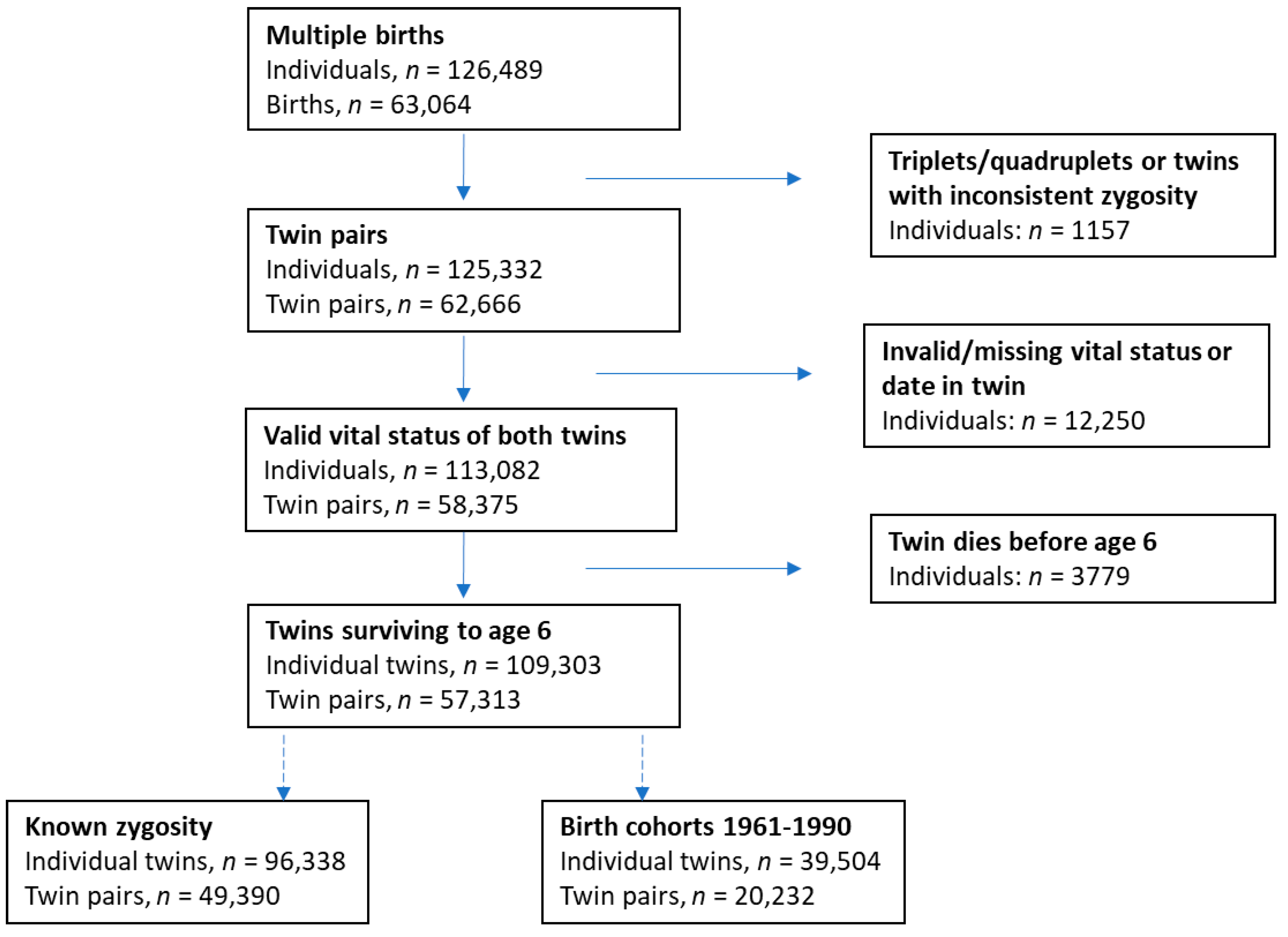
Studies with twins provide fundamental insights to lifespans of humans. We aim to clarify if monozygotic and dizygotic twin individuals differ in lifespan, that is, if zygosity matters. We investigate whether a possible difference in mortality after infancy between zygosities is stable in different age cohorts, and whether the difference remains when twins with unknown zygosity are taken into account. Further, we compare the distribution of long-livers, that is, the upper-tail of the lifespan distribution, between monozygotic and same-sex dizygotic twin individuals. The Danish Twin Registry provides a nationwide cohort of 109,303 twins born during 1870 to 1990 with valid vital status. Standard survival analysis is used to compare mortality in monozygotic and dizygotic twin individuals and twin individuals with unknown zygosity. The mortality of monozygotic and dizygotic twin individuals differs slightly after taking into consideration effects of birth- and age-cohorts, gender differences, and that twins are paired. However, no substantial nor systematic differences remain when taking twins with unknown zygosity into account. Further, the distribution of long-livers is very similar by zygosity, suggesting the same mortality process. The population-based and oldest twin cohort ever studied suggests that monozygotic and dizygotic twins have similar lifespans.
Keywords: lifespan; mortality; twins; zygosity; unknown zygosity; cumulative incidence curves; age-stratification; long-livers lifespan; mortality; twins; zygosity; unknown zygosity; cumulative incidence curves; age-stratification; long-livers

