Review

Update on the Pathomechanism, Diagnosis, and Treatment Options for Rheumatoid Arthritis


1
Paul-Ehrlich-Institut, Vice President’s Research Group 1: Molecular Allergology, 63225 Langen (Hesse), Germany
2
Paul-Ehrlich-Institut, Product Testing of Immunological Biomedicines, 63225 Langen (Hesse), Germany
*
Author to whom correspondence should be addressed.
These authors have contributed equally to this manuscript.
Cells 2020, 9(4), 880; https://doi.org/10.3390/cells9040880
Submission received: 23 January 2020 / Revised: 28 March 2020 / Accepted: 30 March 2020 / Published: 3 April 2020
(This article belongs to the Special Issue The Molecular and Cellular Basis for Rheumatoid Arthritis)

Abstract

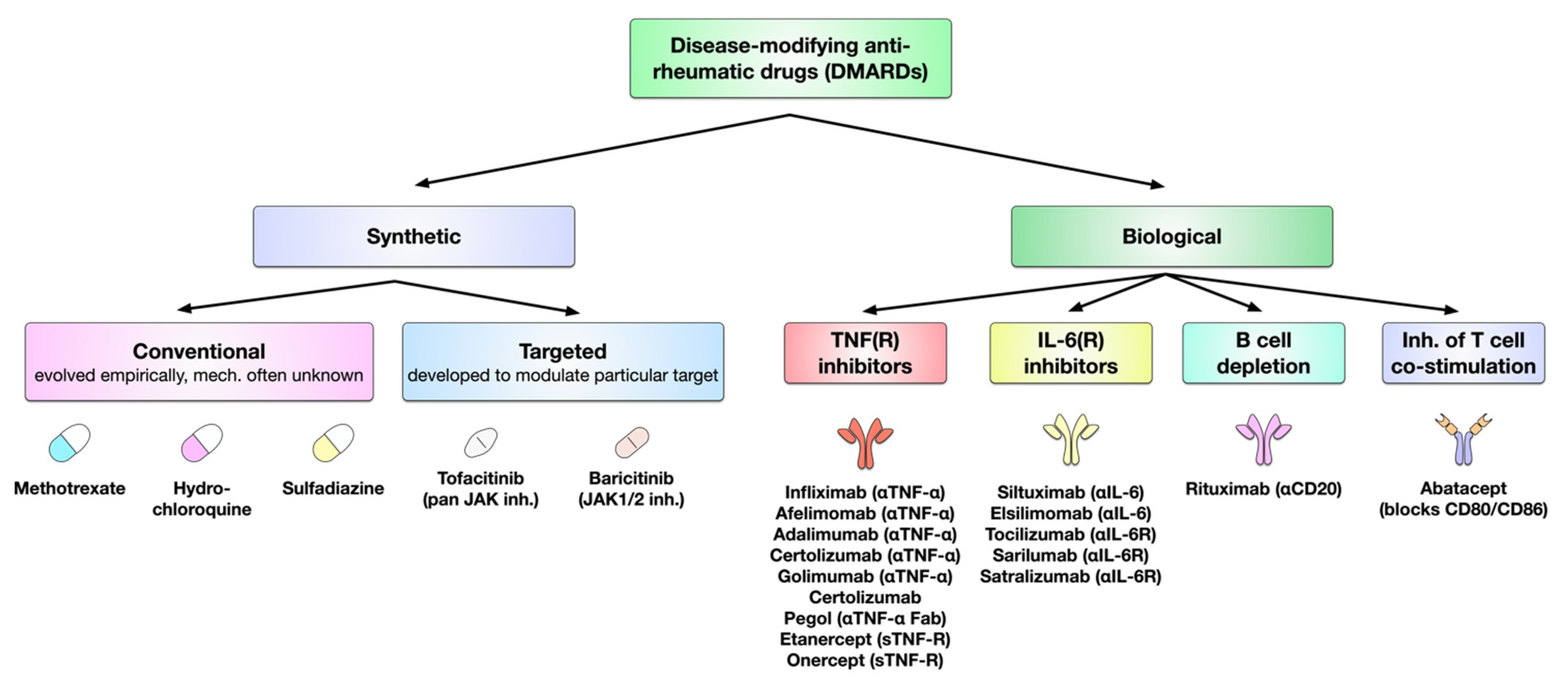
Rheumatoid arthritis (RA) is an autoimmune disease that involves multiple joints bilaterally. It is characterized by an inflammation of the tendon (tenosynovitis) resulting in both cartilage destruction and bone erosion. While until the 1990s RA frequently resulted in disability, inability to work, and increased mortality, newer treatment options have made RA a manageable disease. Here, great progress has been made in the development of disease-modifying anti-rheumatic drugs (DMARDs) which target inflammation and thereby prevent further joint damage. The available DMARDs are subdivided into (1) conventional synthetic DMARDs (methotrexate, hydrochloroquine, and sulfadiazine), (2) targeted synthetic DMARDs (pan-JAK- and JAK1/2-inhibitors), and (3) biologic DMARDs (tumor necrosis factor (TNF)-α inhibitors, TNF-receptor (R) inhibitors, IL-6 inhibitors, IL-6R inhibitors, B cell depleting antibodies, and inhibitors of co-stimulatory molecules). While DMARDs have repeatedly demonstrated the potential to greatly improve disease symptoms and prevent disease progression in RA patients, they are associated with considerable side-effects and high financial costs. This review summarizes our current understanding of the underlying pathomechanism, diagnosis of RA, as well as the mode of action, clinical benefits, and side-effects of the currently available DMARDs.
Keywords: rheumatoid arthritis; autoimmunity; TNF; IL-6 rheumatoid arthritis; autoimmunity; TNF; IL-6