Reversible Metabolic and Liver Disease in Complex III Deficiency: Novel Variants Expand the Reported UQCRC2-Associated Phenotype

 , ,
, ,  , ,
, ,  ,
,
Highlights
- Biallelic pathogenic variants in UQCRC2 cause mitochondrial complex III deficiency with recurrent metabolic crises, neurologic dysfunction, and variable clinical severity.
- Liver dysfunction, encephalopathy, and complex III abnormalities are common but often reversible, with potential for full recovery.
- Patients with 16p12.2 microdeletion and acute metabolic decompensation should be evaluated for pathogenic UQCRC2 variants in trans and for mitochondrial disease.
- These data highlight the importance of consistent respiratory and biochemical assessment of individuals with UQCRC2 variants to support continued understanding of the UQCRC2-associated mitochondrial disease phenotype.
Abstract
1. Introduction
2. Materials and Methods
2.1. Literature Review
2.2. Fibroblast Maintenance
2.3. Respirometry
2.4. Mitochondrial Enzymology
2.5. Patients
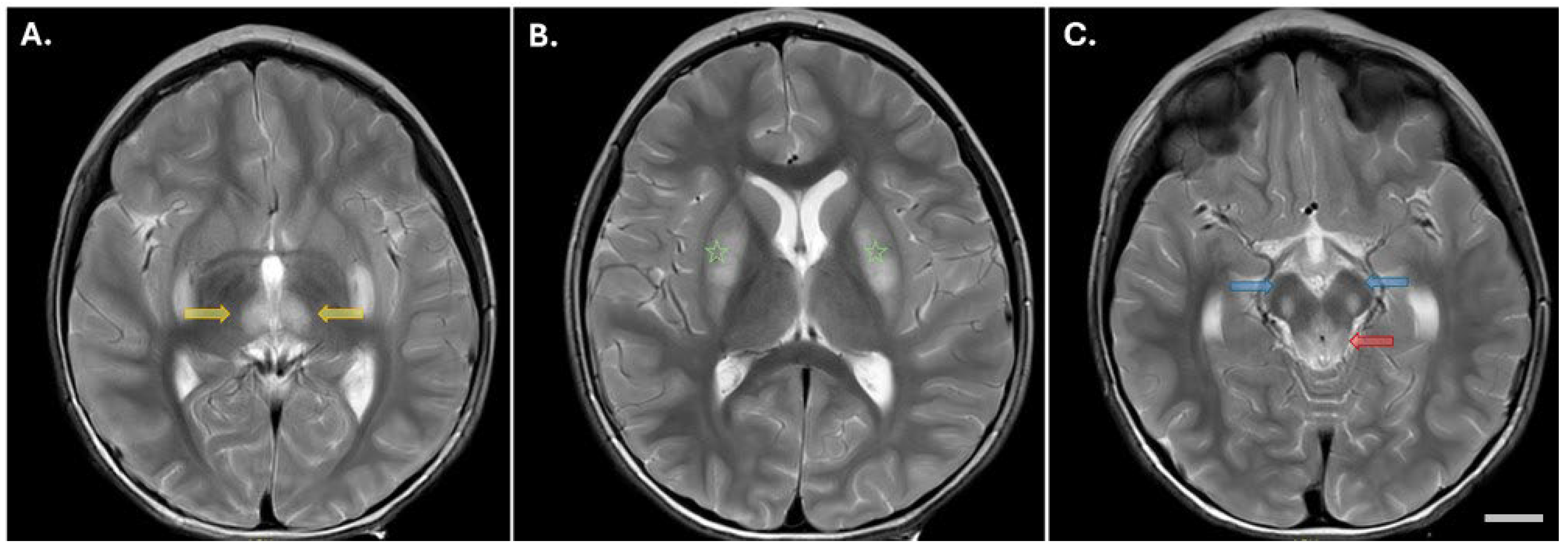
2.5.1. Patient 1
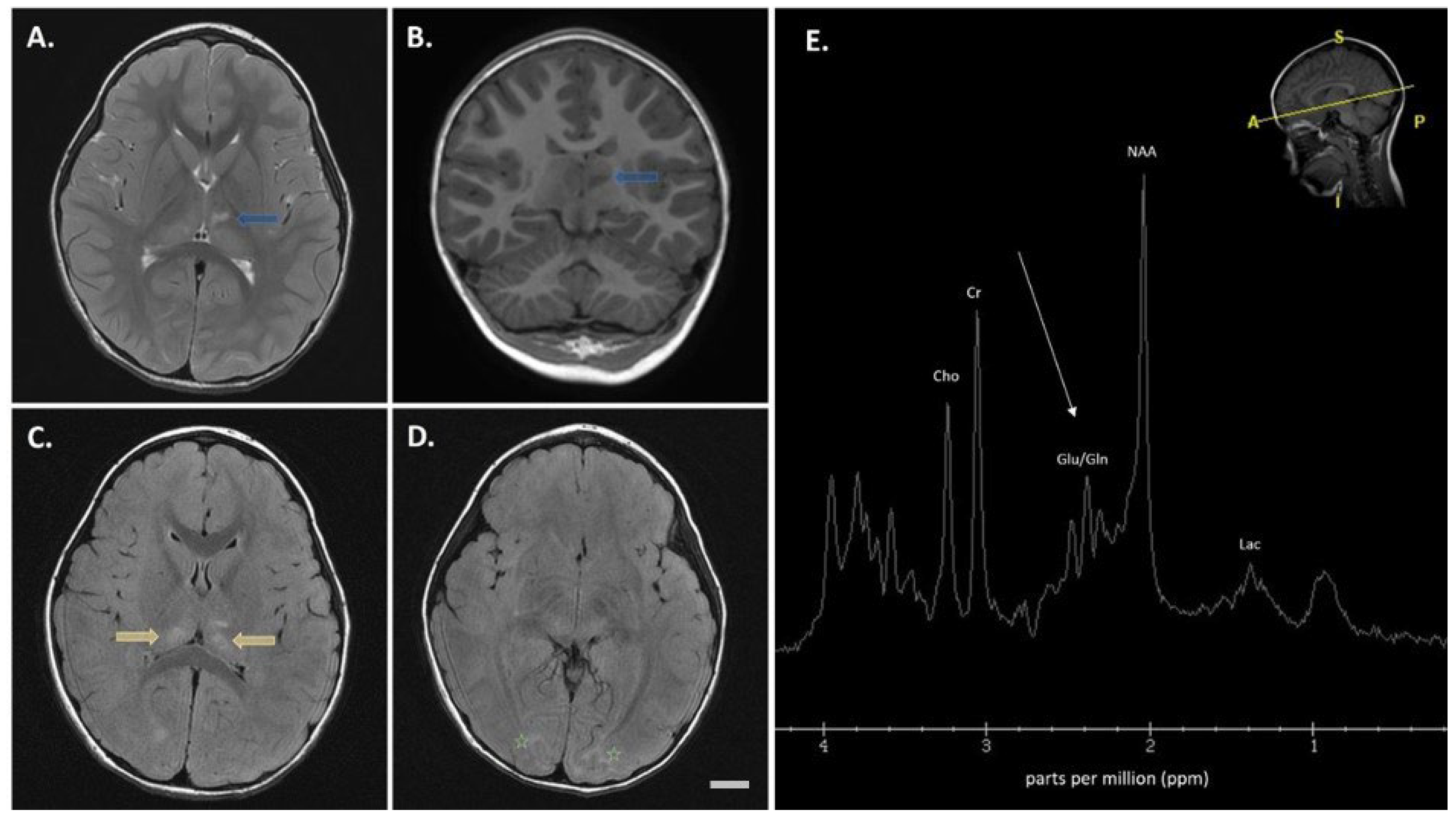
2.5.2. Patient 2
3. Results
3.1. Review of Previously Published Cases
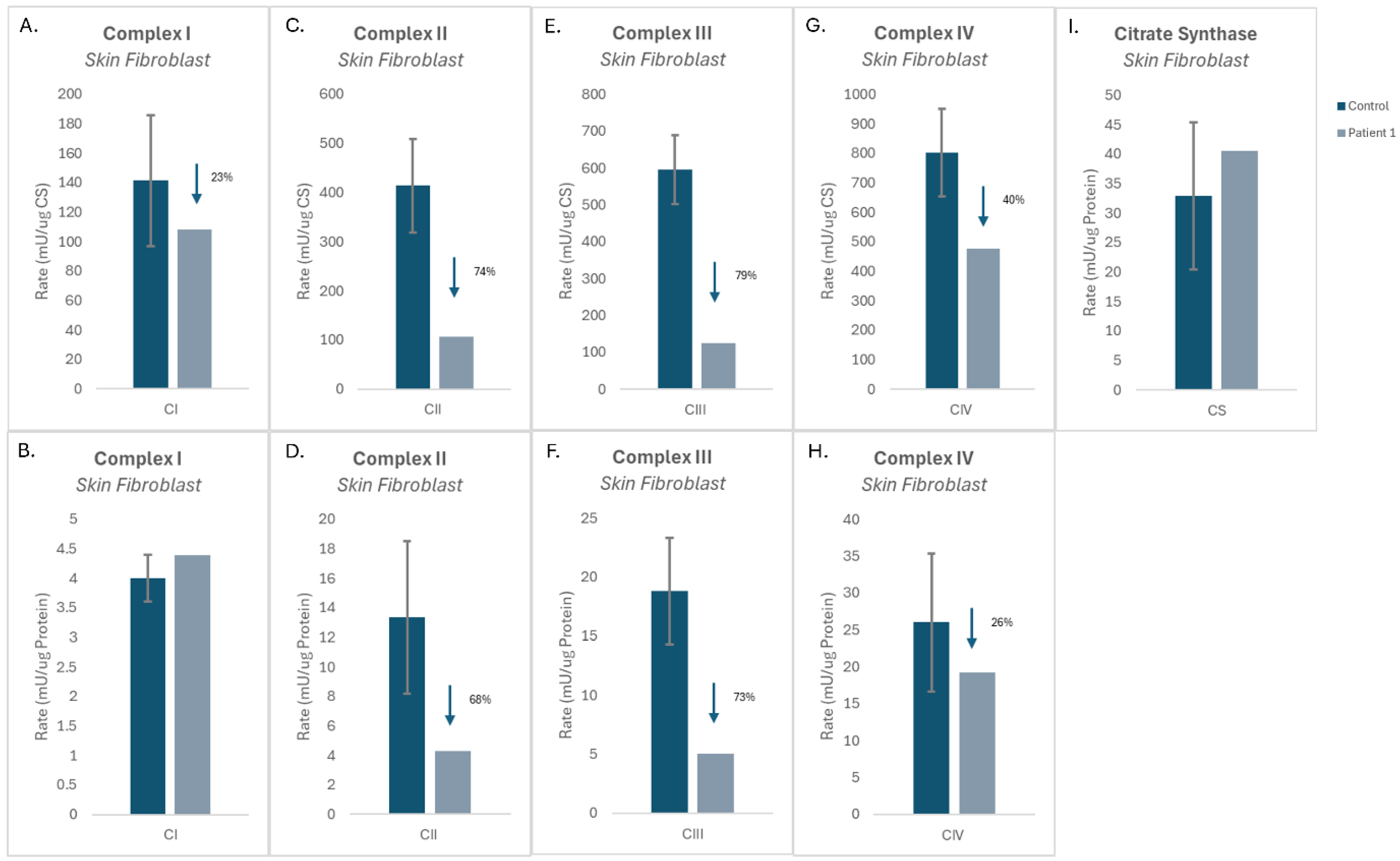
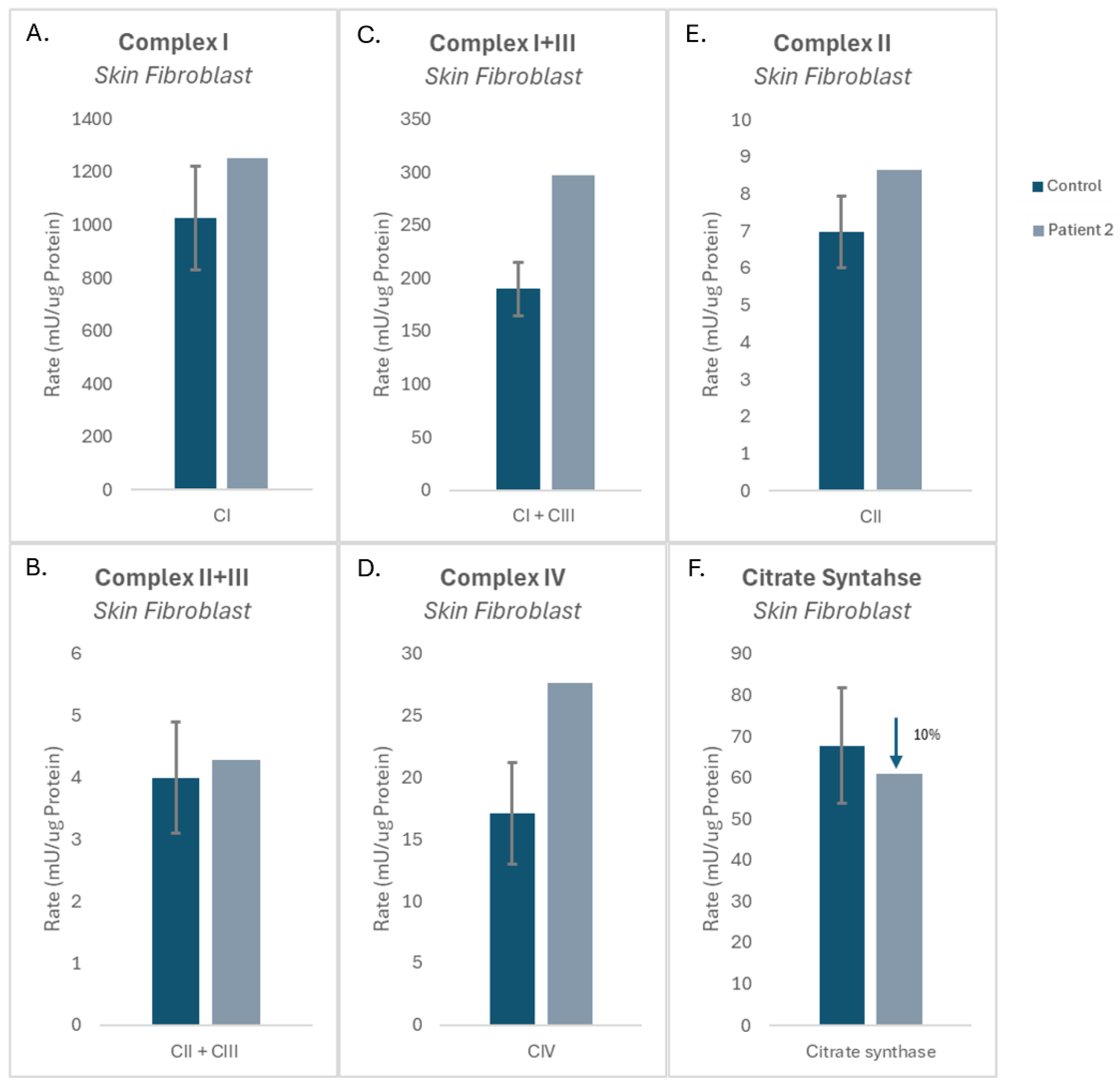
3.2. Patient Fibroblast Mitochondrial Enzymology
3.3. Patient Fibroblast Respirometry
4. Discussion
5. Conclusions
Supplementary Materials
Author Contributions
Funding
Institutional Review Board Statement
Informed Consent Statement
Data Availability Statement
Acknowledgments
Conflicts of Interest
Abbreviations
| UQCRC2 | Ubiquinol–cytochrome C reductase core protein 2 |
| MRI | Magnetic resonance imaging |
| MR | Magnetic resonance |
| OCR | Oxygen consumption rate |
| ECAR | Extracellular acidification rate |
| PER | Proton efflux rate |
| OXPHOS | Oxidative phosphorylation |
| CS | Citrate synthase |
| ETC | Electron transport chain |
| VUS | Variant of uncertain significance |
| ES | Exome sequencing |
| GS | Genome sequencing |
| INR | International normalized ratio |
| PT | Prothrombin time |
| CLPP | Caseinolytic mitochondrial matrix peptidase proteolytic subunit |
| ATP | Adenosine triphosphate |
| CI | Complex I |
| CII | Complex II |
| CIII | Complex III |
| CIV | Complex IV |
| AST | Aspartate transferase |
| ALT | Alanine transaminase |
| CoQ10 | Coenzyme Q10 |
| CIM | Confidence interval of the mean of the controls |
| EEG | Electroencephalogram |
| FCCP | Carbonyl cyanide phenylhydrazone |
| DTNB | 5,5’-Dithiobis-(2-nitrobenzoate) |
| DMEM | Dulbecco’s modified Eagle medium |
| NADH | Nicotinamide adenine dinucleotide |
| BSA | Bovine serum albumin |
| DCPIP | 2,6-Dichlorophenolindophenol |
| DUB | Decylubiquinone |
| EDTA | Ethylenediaminetetraacetic |
| NaAz | Sodium azide |
| Cytochrome C | CytC |
Appendix A
Appendix A.1. Methods for OCR Measurements
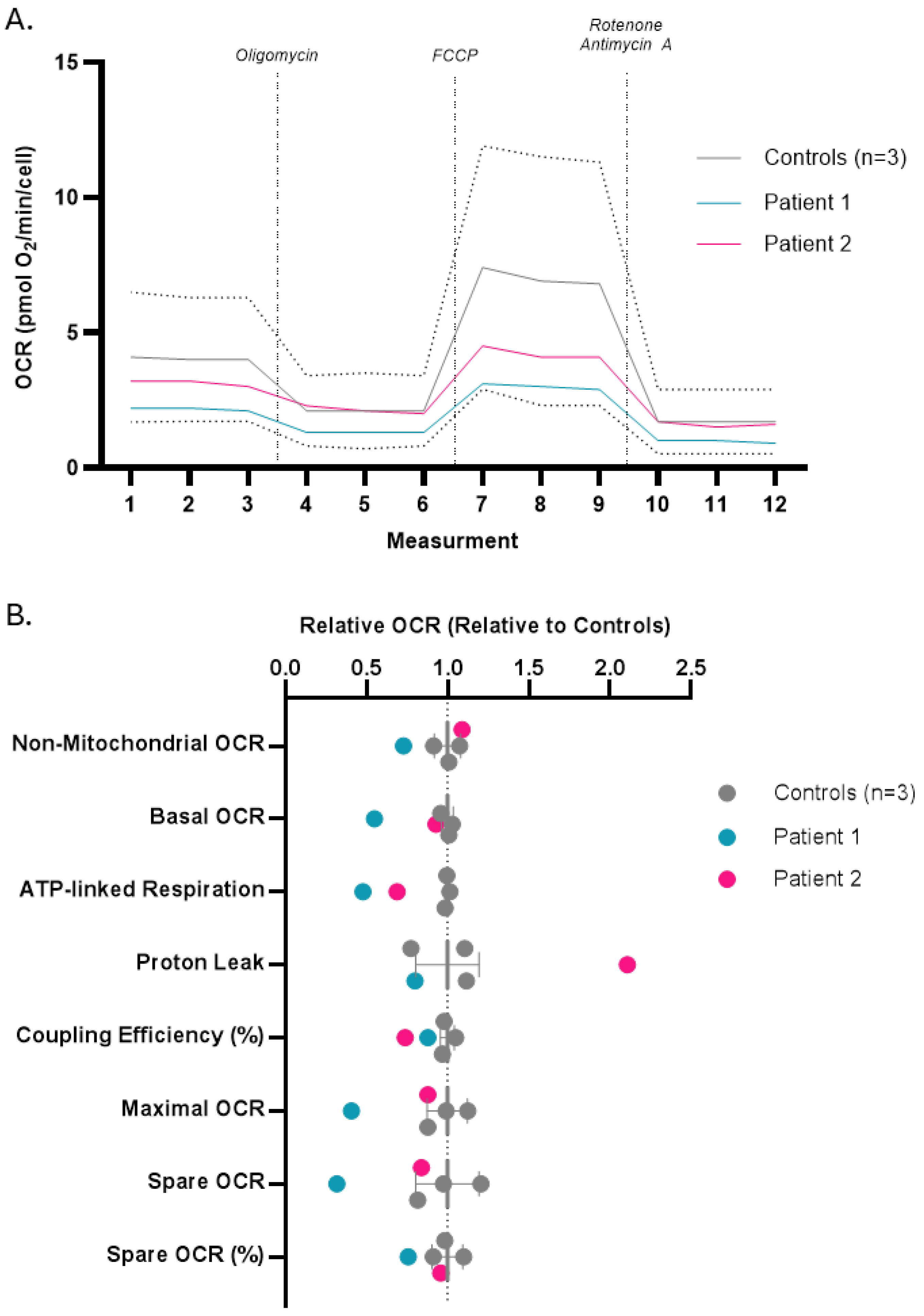
- Non-mitochondrial OCR: Oxygen consumption rate (pmol O2/min) from non-mitochondrial sources. Equal to the minimum OCR following rotenone and antimycin A administration.
- Resting OCR: Total oxygen consumption at resting conditions. Equal to the total OCR at the final time point before oligomycin administration.
- Basal OCR: Mitochondrial oxygen consumption at resting conditions. Equal to resting OCR minus the non-mitochondrial OCR.
- Mitochondrial OCR (%): Resting mitochondrial oxygen consumption as a percentage of the total resting oxygen consumption. Equal to the basal OCR divided by the resting OCR.
- ATP-associated OCR: The oxygen consumption associated with ATP synthase. Equal to the OCR at the final time point before oligomycin administration, minus the minimum OCR following oligomycin administration.
- Proton leak-associated OCR: Mitochondrial oxygen consumption following oligomycin administration. Equal to the minimum OCR following oligomycin administration minus the non-mitochondrial OCR.
- Coupling efficiency: The percentage of basal mitochondrial OCR that goes toward ATP production. Equal to the ATP-associated OCR divided by the basal OCR.
- Maximal OCR: The maximum OCR of the uncoupled mitochondrial respiratory chain (MRC). Equal to the maximum OCR following FCCP administration minus the non-mitochondrial respiration.
- Spare OCR: The difference between the maximal oxygen consumption rate of the MRC and the resting mitochondrial OCR. Equal to the maximal OCR minus the basal OCR.
- Spare OCR (%): Spare OCR as a percentage of basal OCR. Equal to the spare OCR divided by the basal OCR.
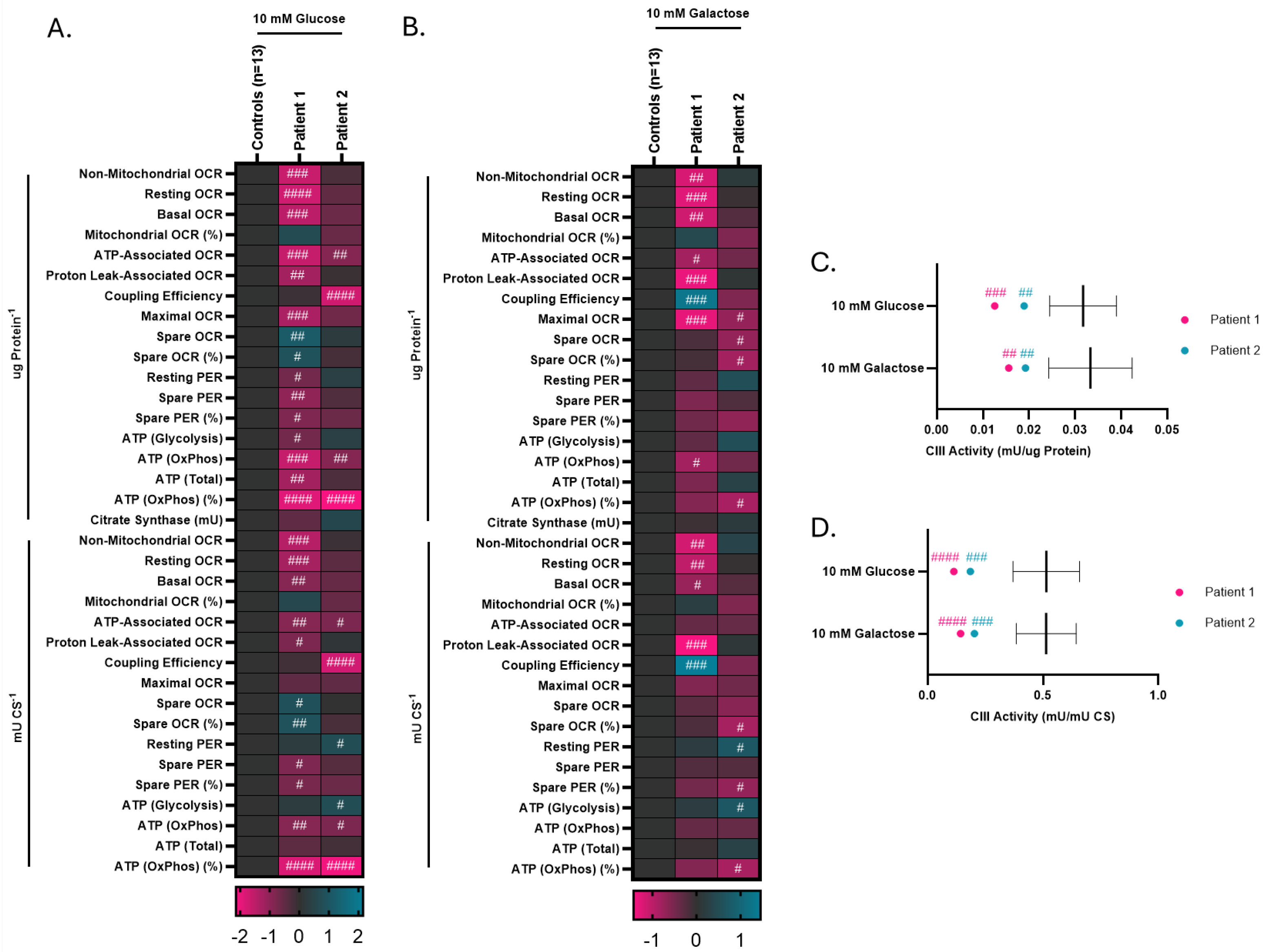
- Resting PER: The proton efflux rate (pmol H+/min) under resting conditions. Equal to the PER at the last measure before oligomycin administration.
- Spare PER: The difference between the resting and maximal glycolytic flux. Equal to the maximal PER following oligomycin administration and PER at the last measurement before oligomycin administration.
- Spare PER (%): Spare PER as a percentage of basal PER. Equal to spare PER divided by basal PER.
- ATP (Glycolysis): The ATP production rate (pmol ATP/min) from glycolysis. Equal to the resting PER.
- ATP (OXPHOS): The ATP production rate from mitochondrial oxidative phosphorylation. Equal to the ATP-associated OCR multiplied by five.
- ATP (Total): The total ATP production rate. Equal to ATP (Glycolysis) plus ATP (OXPHOS).
- ATP (OXPHOS) (%): The ATP production rate from mitochondrial oxidative phosphorylation as a percentage of the total ATP production rate, equal to ATP (OXPHOS) divided by ATP (Total).
Appendix A.2. Methods for Mitochondrial Electron Transport Chain Complex Enzymology in Fibroblasts

| Paper | Bansept et al., 2022 [4] | Gaingarrd et al., 2017 [5] | Burska et al., 2021 [7] | Ogawa et al., 2020 [8] | Miyake et al., 2012 [6] | Novel Cases | |||||||||
|---|---|---|---|---|---|---|---|---|---|---|---|---|---|---|---|
| Demographics and history | Patient number | 1 | 2 * | 3 | 4 | 5 | 6 | 7 | 8 | 9 | 10 | 11 | 12 | 13 (P1) | 14 (P2) |
| Gender | M | F | F | M | M | F | M | F | N/A | F | M | F | M | F | |
| Parent consanguinity | - | + | + | - | - | + | + | - | N/A | + | + | + | - | - | |
| Antenatal/neonatal history | IUGR/feeding difficulties | IUGR/decompensation | Hyperechogenic gut/normal | Gestational hypertension/mild jaundice | Gestational hypertension/transient hypoglycemia | IUGR/transient respiratory distress | IUGR/decompensation | Uneventful/uneventful | N/A | Pathological cardiotocogram | Uneventful/uneventful | Small for GA/mild RD | Uneventful/uneventful | Uneventful/uneventful | |
| Genetic analysis findings | Coding sequence variant | c.[1330T>A]; [1087C>T] | c.[547C>T]; [547C>T] | c.[547C>T]; [547C>T] | c.[379C>T]; [whole gene deletion] | c.[379C>T]; [whole gene deletion] | c.[266 T>C]; [266 T>C] | c.[547C>T]; [547C>T] | c.[665G>C]; [665G>C] | c.[1340C>A]; [613-3->A] | c.[547C>T]; [547C>T] | c.[547C>T]; [547C>T] | c.[547C>T]; [547C>T] | c.[361T>C]; [whole gene deletion] | c.[361T>C]; [whole gene deletion] |
| Protein change | p.[(Leu444Met)]; [(Gln363*)] | p.[(Arg183Trp)]; [(Arg183Trp)] | p.[(Arg183Trp)]; [(Arg183Trp)] | p.[(Arg127Trp)]; [(whole deletion)] | p.[(Arg127Trp)]; [(whole deletion)] | p.[(Leu89Pro)]; [(Leu89Pro)] | p.[(Arg183Trp)]; [(Arg183Trp)] | p.[(Gly222Ala)]; [(Gly222Ala)] | p.[(Thr447Lys)] | p.[(Arg183Trp)]; [(Arg183Trp)] | p.[(Arg183Trp)]; [(Arg183Trp)] | p.[(Arg183Trp)]; [(Arg183Trp)] | p.[(Tyr121His)]; [del (16)(p.12.2)] | p.[(Tyr121His)]; [del (16)(p.12.2)] | |
| ACMG classification (ClinVar) | Likely pathogenic | Likely pathogenic | Likely pathogenic | Likely pathogenic | Likely pathogenic | Likely pathogenic | Likely pathogenic | Pathogenic | N/A | Pathogenic | Pathogenic | Pathogenic | Likely pathogenic | Likely pathogenic | |
| Method of detection | NP | NP followed by familial analysis | ES | NP | NP followed by familial analysis | NP | NP | Trio-ES+ mitochondrial DNA analysis | N/A | ES with linkage analysis | ES with linkage analysis | ES with linkage analysis | GS | Trio-ES | |
| Imaging | MRI signal abnormalities | + ^ (BG) | + ^ (BG) | N/A | - | - | - | - | + ^ (BS) | N/A | + (RP and RT) | - | - | + (BS and BG) | + (BG) |
| Associated conditions | Myopia, strabismus, mild SNHL, micropenis | N/A | None | Arachnoid cyst operated on twice | TB meningitis, hypothyroidism, operated cholesteatoma | Asthma, pineal cyst. | Bilateral vision loss | Flat feet | N/A | Atrial septal defect and renal tubular acidosis | Adrenal insufficiency | None | Inferior vermis hypoplasia | Liver hemangioma | |
References
- Vercellino, I.; Sazanov, L.A. The assembly, regulation and function of the mitochondrial respiratory chain. Nat. Rev. Mol. Cell Biol. 2022, 23, 141–161. [Google Scholar] [CrossRef]
- Fernández-Vizarra, E.; Zeviani, M. Nuclear gene mutations as the cause of mitochondrial complex III deficiency. Front. Genet. 2015, 6, 134. [Google Scholar] [CrossRef] [PubMed]
- Scaglia, F.; Towbin, J.A.; Craigen, W.J.; Belmont, J.W.; Smith, E.O.; Neish, S.R.; Ware, S.M.; Hunter, J.V.; Fernbach, S.D.; Vladutiu, G.D.; et al. Clinical spectrum, morbidity, and mortality in 113 pediatric patients with mitochondrial disease. Pediatrics 2004, 114, 925–931. [Google Scholar] [CrossRef] [PubMed]
- Bansept, C.; Gaignard, P.; Lebigot, E.; Eyer, D.; Delplancq, G.; Hoebeke, C.; Mazodier, K.; Ledoyen, A.; Rouzier, C.; Fragaki, K.; et al. UQCRC2-related mitochondrial complex III deficiency, about 7 patients. Mitochondrion 2023, 68, 138–144. [Google Scholar] [CrossRef] [PubMed]
- Gaignard, P.; Eyer, D.; Lebigot, E.; Oliveira, C.; Therond, P.; Boutron, A.; Slama, A. UQCRC2 mutation in a patient with mitochondrial complex III deficiency causing recurrent liver failure, lactic acidosis and hypoglycemia. J. Hum. Genet. 2017, 62, 729–731. [Google Scholar] [CrossRef] [PubMed]
- Miyake, N.; Yano, S.; Sakai, C.; Hatakeyama, H.; Matsushima, Y.; Shiina, M.; Watanabe, Y.; Bartley, J.; Abdenur, J.E.; Wang, R.Y.; et al. Mitochondrial complex III deficiency caused by a homozygous UQCRC2 mutation presenting with neonatal-onset recurrent metabolic decompensation. Hum. Mutat. 2013, 34, 446–452. [Google Scholar] [CrossRef]
- Burska, D.; Stiburek, L.; Krizova, J.; Vanisova, M.; Martinek, V.; Sladkova, J.; Zamecnik, J.; Honzik, T.; Zeman, J.; Hansikova, H.; et al. Homozygous missense mutation in UQCRC2 associated with severe encephalomyopathy, mitochondrial complex III assembly defect and activation of mitochondrial protein quality control. Biochim. Biophys. Acta Mol. Basis Dis. 2021, 1867, 166147. [Google Scholar] [CrossRef]
- Ogawa, E.; Fushimi, T.; Ogawa-Tominaga, M.; Shimura, M.; Tajika, M.; Ichimoto, K.; Matsunaga, A.; Tsuruoka, T.; Ishige, M.; Fuchigami, T.; et al. Mortality of Japanese patients with Leigh syndrome: Effects of age at onset and genetic diagnosis. J. Inherit. Metab. Dis. 2020, 43, 819–826. [Google Scholar] [CrossRef]
- Smolen, C.; Myers, S.; Girirajan, S. 16p12.2 Recurrent Deletion. In GeneReviews(®); Adam, M.P., Bick, S., Mirzaa, G.M., Pagon, R.A., Wallace, S.E., Amemiya, A., Eds.; University of Washington: Seattle, WA, USA, 1993. [Google Scholar]
- Muylle, E.; Jiang, H.; Johnsen, C.; Byeon, S.K.; Ranatunga, W.; Garapati, K.; Zenka, R.M.; Preston, G.; Pandey, A.; Kozicz, T.; et al. TRIT1 defect leads to a recognizable phenotype of myoclonic epilepsy, speech delay, strabismus, progressive spasticity, and normal lactate levels. J. Inherit. Metab. Dis. 2022, 45, 1039–1047. [Google Scholar] [CrossRef]
- Rodenburg, R.J. Biochemical diagnosis of mitochondrial disorders. J. Inherit. Metab. Dis. 2011, 34, 283–292. [Google Scholar] [CrossRef]
- Ligezka, A.N.; Budhraja, R.; Nishiyama, Y.; Fiesel, F.C.; Preston, G.; Edmondson, A.; Ranatunga, W.; Van Hove, J.L.K.; Watzlawik, J.O.; Springer, W.; et al. Interplay of Impaired Cellular Bioenergetics and Autophagy in PMM2-CDG. Genes 2023, 14, 1585. [Google Scholar] [CrossRef] [PubMed]
- Braissant, O.; McLin, V.A.; Cudalbu, C. Ammonia toxicity to the brain. J. Inherit. Metab. Dis. 2013, 36, 595–612. [Google Scholar] [CrossRef] [PubMed]
- Hertig, D.; Felser, A.; Diserens, G.; Kurth, S.; Vermathen, P.; Nuoffer, J.M. Selective galactose culture condition reveals distinct metabolic signatures in pyruvate dehydrogenase and complex I deficient human skin fibroblasts. Metabolomics 2019, 15, 32. [Google Scholar] [CrossRef] [PubMed]
- Gatti, D.L.; Tzagoloff, A. Structure and function of the mitochondrial bc1 complex. Properties of the complex in temperature-sensitive cor1 mutants. J. Biol. Chem. 1990, 265, 21468–21475. [Google Scholar] [CrossRef]
- Oláhová, M.; Ceccatelli Berti, C.; Collier, J.J.; Alston, C.L.; Jameson, E.; Jones, S.A.; Edwards, N.; He, L.; Chinnery, P.F.; Horvath, R.; et al. Molecular genetic investigations identify new clinical phenotypes associated with BCS1L-related mitochondrial disease. Hum. Mol. Genet. 2019, 28, 3766–3776. [Google Scholar] [CrossRef]
- Hikmat, O.; Isohanni, P.; Keshavan, N.; Ferla, M.P.; Fassone, E.; Abbott, M.A.; Bellusci, M.; Darin, N.; Dimmock, D.; Ghezzi, D.; et al. Expanding the phenotypic spectrum of BCS1L-related mitochondrial disease. Ann. Clin. Transl. Neurol. 2021, 8, 2155–2165. [Google Scholar] [CrossRef]
- Magner, M.; Dvorakova, V.; Tesarova, M.; Mazurova, S.; Hansikova, H.; Zahorec, M.; Brennerova, K.; Bzduch, V.; Spiegel, R.; Horovitz, Y.; et al. TMEM70 deficiency: Long-term outcome of 48 patients. J. Inherit. Metab. Dis. 2015, 38, 417–426. [Google Scholar] [CrossRef]
- Mascalchi, M.; Montomoli, M.; Guerrini, R. Neuroimaging in mitochondrial disorders. Essays Biochem. 2018, 62, 409–421. [Google Scholar] [CrossRef]
- Eichler, E.E.; Johnson, M.E.; Alkan, C.; Tuzun, E.; Sahinalp, C.; Misceo, D.; Archidiacono, N.; Rocchi, M. Divergent origins and concerted expansion of two segmental duplications on chromosome 16. J. Hered. 2001, 92, 462–468. [Google Scholar] [CrossRef][Green Version]
- Morava, E.; Rodenburg, R.; van Essen, H.Z.; De Vries, M.; Smeitink, J. Dietary intervention and oxidative phosphorylation capacity. J. Inherit. Metab. Dis. 2006, 29, 589. [Google Scholar] [CrossRef]
- Danhauser, K.; Smeitink, J.A.; Freisinger, P.; Sperl, W.; Sabir, H.; Hadzik, B.; Mayatepek, E.; Morava, E.; Distelmaier, F. Treatment options for lactic acidosis and metabolic crisis in children with mitochondrial disease. J. Inherit. Metab. Dis. 2015, 38, 467–475. [Google Scholar] [CrossRef]
- Parikh, S.; Goldstein, A.; Karaa, A.; Koenig, M.K.; Anselm, I.; Brunel-Guitton, C.; Christodoulou, J.; Cohen, B.H.; Dimmock, D.; Enns, G.M.; et al. Patient care standards for primary mitochondrial disease: A consensus statement from the Mitochondrial Medicine Society. Genet. Med. 2017, 19, 1380–1397. [Google Scholar] [CrossRef]


| Paper | Bansept et al., 2022 [4] | Gaingarrd et al., 2017 [5] | Burska et al., 2021 [7] | Ogawa et al., 2020 [8] | Miyake et al., 2012 [6] | Novel Cases | |||||||||
|---|---|---|---|---|---|---|---|---|---|---|---|---|---|---|---|
| Initial presentation and metabolic changes | Onset age | 15 m | 5 d | 15 m | 19 m | 4.1 y | 3.5 y | 1 d | N/A | N/A | 1 d | 1 d | 18 m | 25 h | 5 y |
| Symptoms and laboratory changes | Gastro-enteritis | Neonatal period | Vomiting | Treatment with sodium valproate | Tonsillectomy | Fever, food refusal | Neonatal period | N/A | N/A | Intercurrent illness | Upper RTI | N/A | Presumed sepsis | Flu-like illness | |
| Lactic acidosis | + | + | + | + | + | + | + | - | - | + | + | - # | + | + | |
| Hypo-glycemia | + | + | + | + | + | + | + | + | - | + | + | + | + | + | |
| Hyper-ammonemia | + | + | + | + | + | + | + | - | - | + | + | - | - | + | |
| Ketosis | + in 4 patients/N/A in 3 | N/A | N/A | + | + | + | - | - | |||||||
| Elevated serum alanine | + in 3 patients | N/A | N/A | + | + | + | + | + | |||||||
| Liver failure | + | + | + | + | + | + | + | - | - | - | - | - | + | + | |
| Neurological symptoms | + | + | + | + | + | + | + | + 1 | + 1 | - | + | + | + 1 | + 1 | |
| Interval to genetic diagnosis (y) | 10 | 7 | 2 | 13 | 7 | 19 | 10 | N/A | N/A | 5 | N/A | N/A | 6 | 5 | |
| CIII activity | ↓ | ↓ | ↓ | ↓ | ↓ | ↓ | ↓ | N | N/A | ↓ | N/A | N/A | ↓ | N | |
| Development | Motor delay | 4 patients/7 patients | + | + | N | + | + | + | + | ||||||
| IQ | N | N/A | N/A | ↓ | ↓↓ | N/A | ↓ | ↓↓ | N/A | ↓↓ | ↓↓ | N/A | N | N | |
| Neurological symptoms | Tremor, cerebellar syndrome, dyskinesia | Left arm hemiparesis, hypotonia | N | Hyperreflexia, neuropathic pain in limbs, seizure | Hyperreflexia, dysmetria, seizure | N | Hyporeflexia and fatigability, hypotonia | Divergent strabismus, intention tremor, unsteady walking | Leigh-like syndrome | N | Seizure | Seizure | Hypotonia and subtle dystonia | N | |
| Management and prognosis | Intravenous glucose | + ~ | + ~ | + ~ | + ~ | + ~ | + ~ | + ~ | N/A | N/A | + 2 | + 2 | + 2 | + ~3 | + 3 |
| Hospitalizations frequency | >20 | 5 | >15 | >25 | 15 | >30 | >50 | N/A ^ | N/A ^ | >10 | >10 | N/A | 15 | 2 | |
| Follow-up years | 10.2 | 1.1 * | 4.4 | 13 | 7.8 | 18.9 | 14.1 | 6.4 | N/A | 5 | 4 | N/A | 6 | 8 | |
| Liver failure | - | + ^ | - | - | - | - | + | - | N/A | - | - | - | - | - | |
| Neurological sequelae | + | N/A | - | + | + | - | - | + ≈ | N/A | - | - | - | - | - | |
Disclaimer/Publisher’s Note: The statements, opinions and data contained in all publications are solely those of the individual author(s) and contributor(s) and not of MDPI and/or the editor(s). MDPI and/or the editor(s) disclaim responsibility for any injury to people or property resulting from any ideas, methods, instructions or products referred to in the content. |
© 2026 by the authors. Licensee MDPI, Basel, Switzerland. This article is an open access article distributed under the terms and conditions of the Creative Commons Attribution (CC BY) license.
Share and Cite
Preston, G.; Shammas, I.; Pinto e Vairo, F.; Ligezka, A.; Aschoff, C.A.d.M.; Poswar, F.; Schwartz, I.V.D.; Kozicz, T.; Morava, E. Reversible Metabolic and Liver Disease in Complex III Deficiency: Novel Variants Expand the Reported UQCRC2-Associated Phenotype. Cells 2026, 15, 596. https://doi.org/10.3390/cells15070596
Preston G, Shammas I, Pinto e Vairo F, Ligezka A, Aschoff CAdM, Poswar F, Schwartz IVD, Kozicz T, Morava E. Reversible Metabolic and Liver Disease in Complex III Deficiency: Novel Variants Expand the Reported UQCRC2-Associated Phenotype. Cells. 2026; 15(7):596. https://doi.org/10.3390/cells15070596
Chicago/Turabian StylePreston, Graeme, Ibrahim Shammas, Filippo Pinto e Vairo, Anna Ligezka, Carlos Alberto de Moura Aschoff, Fabiano Poswar, Ida Vanessa D. Schwartz, Tamas Kozicz, and Eva Morava. 2026. "Reversible Metabolic and Liver Disease in Complex III Deficiency: Novel Variants Expand the Reported UQCRC2-Associated Phenotype" Cells 15, no. 7: 596. https://doi.org/10.3390/cells15070596
APA StylePreston, G., Shammas, I., Pinto e Vairo, F., Ligezka, A., Aschoff, C. A. d. M., Poswar, F., Schwartz, I. V. D., Kozicz, T., & Morava, E. (2026). Reversible Metabolic and Liver Disease in Complex III Deficiency: Novel Variants Expand the Reported UQCRC2-Associated Phenotype. Cells, 15(7), 596. https://doi.org/10.3390/cells15070596