Profiling Osteoporosis via Integrated Multi-Omics Technologies
 ,
,
Abstract
1. Introduction
2. Methods
2.1. Information Sources and Search Strategy
2.2. Eligibility Criteria
2.3. Data Extraction and Quality Process
2.4. Methodological Approach to the Critical Appraisal
3. Results
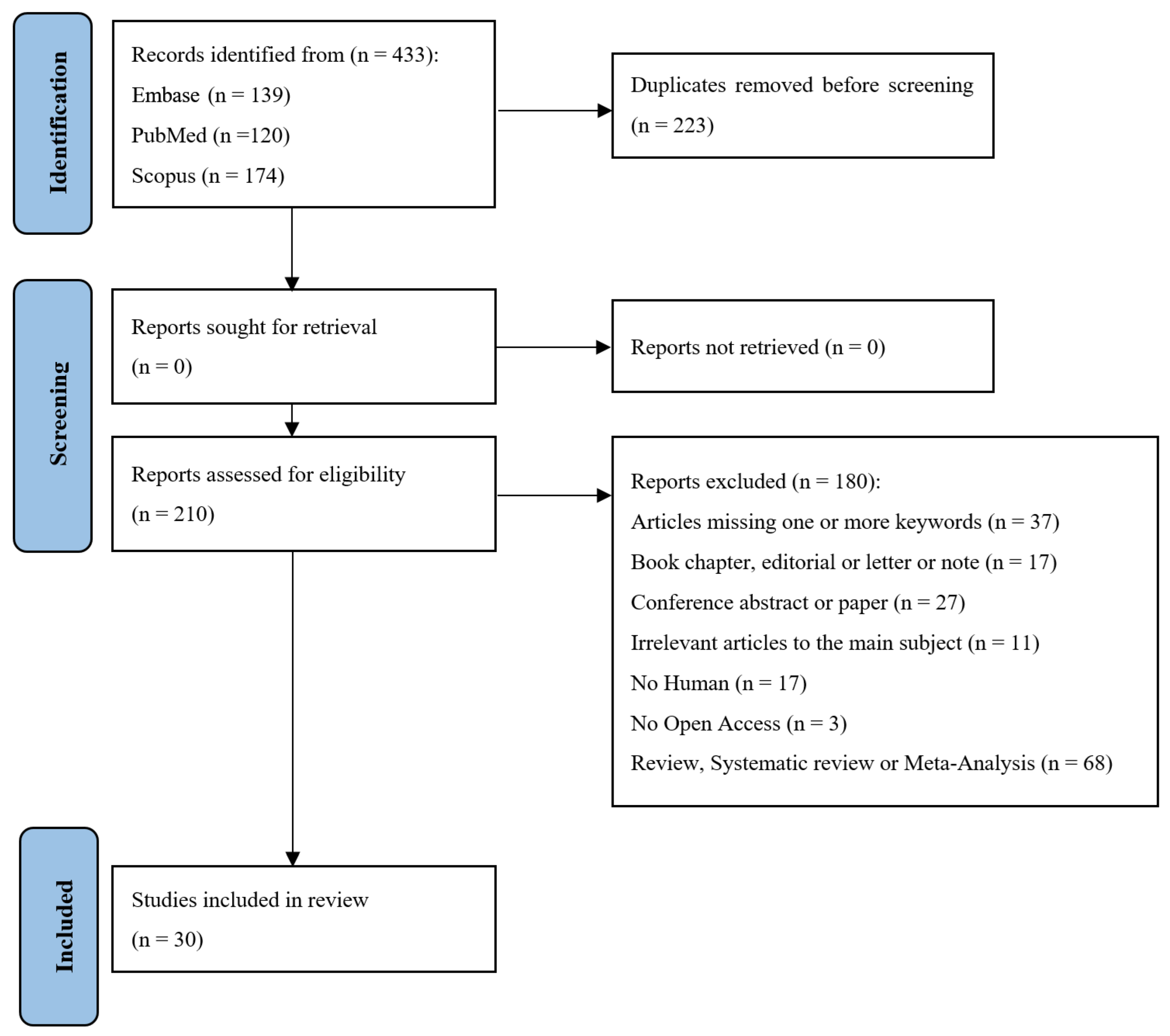
3.1. Literature Research
3.2. Study Characteristics

| Authors | Disease Stage | Biological Sample | Population | Type of Omics | Level of Integration |
|---|---|---|---|---|---|
| Chang S et al., 2025 [27] | Osteoporosis | Plasma | 45 Osteoporosis 18 Controls | Transcriptomics Metabolomics | High integration: miRNA→gene networks →metabolites mapped in osteoporosis. |
| Chen J et al., 2024 [24] | Osteoporosis Sarcopenia Age-related degeneration | Skeletal muscle Tissue Bone Tissue | 3 Osteosarcopenia 3 Osteoporosis | Transcriptomics Proteomics | Multi-tissue integration: bone + muscle, joint molecular profiling. |
| Choi JY et al., 2024 [23] | Osteopenia Osteoporosis | Lumbar Spine Femoral Neck | 17,306 Osteoporosis | Oculomics | Single-dataset predictive modeling. |
| Eisfeldt J et al., 2022 [38] | Autism Epilepsy Osteoporosis | Neuroepithelial stem cells | 1 Osteoporosis | Genomics Transcriptomics | Multi-omics: structural genome → disrupted gene → transcriptome changes; integration across genome + functional transcriptome + pathway analysis. |
| Fuzhu T et al., 2025 [34] | Post-menopausal Osteoporosis | Online Dataset | 70 Post-menopausal 63 Controls | Transcriptomics | Multi-omics + computational integration: they combine scRNA-seq and bulk transcriptome data, apply differential expression, Mendelian randomization (MR), machine learning to build a diagnostic model; immune-infiltration analysis. |
| Greenbaum J et al., 2022 [28] | Post-menopausal Osteoporosis | Stool Serum | 499 Post-menopausal | Metagenomics Metabolomics | Integration between microbiome → serum metabolome → bone mineral density (BMD) phenotype—moderate to high integration across omics and phenotypic outcome. |
| Guo J et al., 2022 [37] | Osteoporosis | Online Dataset | 76 Osteoporosis 101 Controls | Transcriptomics | Stratification of patients into subtypes based on gene expression (lipid/steroid metabolism subtype, glycolysis subtype, polysaccharide subtype)—single omics but subtype integration. |
| Lan K et al., 2025 [31] | Osteoporosis | Online Dataset | 2 Osteoporosis 2 Controls | Transcriptomics | High: gene expression (bulk and scRNA) → hub gene identification (CHAD, COL2A1). |
| Li C et al., 2023 [39] | Postmenopausal osteoporosis | Serum | 46 Post-menopausal 42 Controls | Proteomics | Single-omics (proteome) focused on biomarker discovery. |
| Li M et al., 2024 [40] | Osteoporosis | Online Dataset | 2 Osteoporosis | Transcriptomics | High integration: macrophage gene modules → ferroptosis pathway → bone microstructure deterioration. |
| Li Q et al., 2025 [41] | Osteoporosis | Online Dataset Bone marrow Femoral head | n.a. | Transcriptomics | Multi-omics integration: they integrated bulk + single-cell transcriptomics, used WGCNA (gene co-expression network), machine learning (neural nets) to identify hub genes, protein–protein interaction networks, and cellular communication inference. |
| Li Q et al., 2025 [42] | Osteoporosis | n.a. | n.a. | n.a. | Integration across gut microbiota and host immune system/gene expression. |
| Li YR et al., 2025 [43] | Osteoporosis | Online Dataset | n.a. | Transcriptomics Genomics | High integration: epidemiology + transcriptomics + machine learning + molecular modeling. |
| Lian J et al., 2025 [44] | Osteoporosis Sarcopenia Age-related degeneration | Femoral head Bone marrow | 5 Osteoporosis 4 Controls | Transcriptomics | High integration: transcriptomic → eQTL/pQTL → Mendelian Randomization causal inference. |
| Ma C et al., 2025 [30] | Developmental/early life (prenatal exposure) → reduced peak bone mass → osteoporosis risk | Maternal fecal sample Maternal and fetal serum Fetal bone tissue Bone marrow mesenchymal stem cells | 25 Pregnant | Metabolomics Transcriptomics Epigenomics | High integration: maternal microbiome → metabolite (daidzein) → offspring transcriptome/epigenome → osteogenic phenotypes. |
| Mishra BH et al., 2021 [26] | Subclinical disease stage Osteoporosis or Atherosclerosis | Serum Radius/Tibia Carotid intima-media thickness | 1494 Osteoporosis | Lipidomics | Moderate to high integration: large lipidome dataset → statistical network analysis to identify modules associated jointly with subclinical osteoporosis and atherosclerosis markers. |
| Pontes TA et al., 2019 [36] | Established disease stage: postmenopausal women with osteopenia vs. osteoporosis | Serum Plasma | 26 Osteopenia 24 Osteoporosis 28 Controls | Metabonomics | Moderate integration: metabolomic profiling + grouping by BMD/osteopenia/osteoporosis phenotype. |
| Qiu C et al., 2020 [33] | Osteoporosis | Serum | 61 High BMD 58 Low BMD | Genomics Transcriptomics Methylomics Metabolomics | High integration: single-omics initial, then integrative canonical correlation analysis (SMDCCA), followed by QTL linking and Mendelian randomization (MR) causal inference. |
| Su K et al., 2024 [32] | Osteoporosis | Online Dataset | 4982 Controls | Genomics | Moderately high: integration of SV detection, association with bone mineral density at multiple skeletal sites + co-occurrence with multi-omics. |
| Sun C et al., 2025 [45] | Osteoporosis | Online Dataset | 9046 Osteoporosis 2085 Osteoporosis with pathological fracture 1709 Postmenopausal osteoporosis with pathological fracture 1.023,862 Controls | Genomics Transcriptomics | High integration: druggable gene list MR to test causal effect on osteoporosis phenotypes mediation pathways + drug prediction. |
| Tan Z et al., 2024 [29] | Osteoporosis | Tibia | 243 Osteoporosis | Proteomics Transcriptomics | High: Integration of genetic variant → proteomics → single-cell transcriptomic trajectories → clinical phenotypes. |
| Wang H et al., 2025 [25] | Type 1 diabetes comorbid with osteoporosis | Online Dataset | 63 Type 1 diabetes 52 Osteoporosis 116 Controls | Transcriptomics | Moderate–high: integrated DEGs from two diseases + autophagy-gene intersection + machine learning (LASSO/RF) + miRNA network. |
| Wen B et al., 2024 [46] | Osteoporosis | Peripheral blood Vertebral bone samples | 500 Osteoporosis 500 Controls | Genomics Epigenomics | High: integrated genotype data + methylation profiling + clinical outcome (refracture) prediction. |
| Yuan C et al., 2024 [35] | Osteoporosis | Blood | 532 Osteoporosis | Genomics | Very high integration: used a “Deep Latent Space Fusion” (DLSF) model to fuse multi-modal molecular signatures (M3S) from multi-omics + longitudinal data. |
| Zhang B et al., 2024 [47] | Osteoporosis | Plasma | 5 Osteoporosis 5 Controls | Transcriptomics | High: Used single-cell annotation, pseudotime, machine-learning to integrate transcriptome + scRNA-seq + immune cell profiling. |
| Zhang C et al., 2019 [48] | Postmenopausal osteoporosis | Online Dataset | 10 High BMD 10 Low BMD | Genomics Metabolomics | Moderate to high: Integrated six network types into one composite network to prioritize metabolites. |
| Zhang R et al., 2025 [49] | Osteoporosis | Online Dataset | 1351 Osteoporosis 209,313 Controls | Transcriptomics Genomics | High: Integration of expression/methylation QTLs + GWAS + causal inference + colocalization. |
| Zhang ZL et al., 2024 [50] | Osteoporosis | Online Dataset | n.a. | Genomics Epigenomics | High: Two-sample lipid traits → methylation sites as mediators. |
| Zhao X et al., 2025 [51] | Osteopenia Osteoporosis | Online Dataset | 20 Osteopenia 12 Osteoporosis 19 Controls | Metagenomics Metabolomics | High: Microbiome + metabolome data integrated, correlation networks, biomarker model. |
| Zhu W et al., 2017 [52] | Osteoporosis | Online Dataset | 29 low hip BMD 30 high hip BMD | Proteomics | Moderate: Proteome profiling in monocytes, comparison low vs. high BMD; results linked to transcriptomic/genomic evidence. |
3.3. Multi-Omics Insights into Osteoporosis
| Authors | Disease Stage | Main Findings | Potential for Clinical Application | Methodological Quality |
|---|---|---|---|---|
| Chang S et al., 2025 [27] | Osteoporosis | Identified metabolic-related genes and metabolites; built regulatory network for osteoporosis metabolism. | Biomarkers with better diagnostic performance than traditional bone markers; potential early detection tool. | Moderate sample size; single-site; further validation needed for wide clinical application. |
| Chen J et al., 2024 [24] | Osteoporosis Sarcopenia Age-Related degeneration | Discovered genes/proteins (e.g., PDIA5, TUBB1, MYH7) linked to bone and muscle degeneration; highlighted osteoclast differentiation, NF-κB signaling pathways. | Offers targets for preventing/treating combined bone-muscle loss; improved stratification of older patients. | Good integration; tissue-based; likely moderate sample size. |
| Choi JY et al., 2024 [23] | Osteopenia Osteoporosis | Develop and validate risk prediction models for osteopenia/ osteoporosis using demographic, anthropometric, exam and ophthalmologic variables. | Risk stratification tool for early screening in general population. | Large, nationally representative sample; cross-sectional design; uses DXA; limited to available variables; prediction model rather than mechanistic multi-omics. |
| Eisfeldt J et al., 2022 [38] | Autism Epilepsy Osteoporosis | Identified disruption of gene MINK1 by the translocation; in patient neuroepithelial stem cells, MINK1 expression reduced >50% vs. controls; differentially expressed 539 genes; enrichment of ossification and nervous system-development pathways. | Potential diagnostic/monogenic gene identification in rare cases; shows utility of long-read genome sequencing and transcriptome in clinical genetics diagnostics. | Methodologically robust for a case study: used multiple genome sequencing technologies (short, linked, long-read) + optical mapping; derived patient iPSCs → NESCs for functional assay; but n = 1 (single patient) so generalizability limited. |
| Fuzhu T et al., 2025 [34] | Post-menopausal Osteoporosis | Identified lactylation-related genes (e.g., CSRP2, FUBP1) as biomarkers; nomogram for early prediction of osteoporosis risk. | Useful for early risk stratification in post-menopausal women; may guide preventive strategies. | Emerging study; marker discovery phase; requires larger validation cohorts. |
| Greenbaum J et al., 2022 [28] | Osteoporosis | Identified 22 bacterial species and 17 metabolites associated with BMD; constructed inter-omics network showing microbiome–metabolite crosstalk relevant to skeletal remodeling. | Novel biomarkers or mechanistic insights into bone health via gut-bone axis; potential for early risk stratification or preventive interventions. | Large sample size; cross-sectional, exploratory; associations not yet validated or causal; FDR correction limited significance. |
| Guo J et al., 2022 [37] | Osteoporosis | Identified three distinct metabolism-related gene subtypes in osteoporosis and 10 characteristic genes (e.g., GPR31, GATM, DDB2…) that may relate to metabolic pathogenesis. | May support patient stratification and design of metabolism-targeted interventions in osteoporosis; biomarker research direction. | Good genomic analysis; sample size and external validation unclear; more functional/mechanistic work needed. |
| Lan K et al., 2025 [31] | Osteoporosis | Identified CHAD and COL2A1 as down-regulated in OP; docking showed wogonin/tetrandrine high affinity with CHAD/COL2A1; in vitro wogonin enhanced chondrogenic differentiation of ATDC5 cells. | Suggests new gene target (CHAD) and compound (wogonin) for OP, possibly via cartilage/chondrocyte axis of bone health. | Rigorous bioinformatics + in vitro work; still preclinical; gene/transcriptome focused not yet in large clinical cohorts. |
| Li C et al., 2023 [39] | Postmenopausal osteoporosis | Identified serum proteins (e.g., CDH1 up, PNP down) with good diagnostic sensitivity. | Potential non-invasive biomarkers for PMOP diagnosis and prediction. | Relatively small discovery sample; strong follow-up validation; proteomic only (no multi-omics); needs further large-scale validation. |
| Li M et al., 2024 [40] | Osteoporosis | Identified 12 BM-MSC subsets with distinct distributions; key LR pairs (MIF-CD74, ITGB2-ICAM2) linked to immune score; CD74 identified as a target; 48 drugs targeting CD47/CD74 were screened, with DB01940 showing strong binding. | Provides a framework for drug repurposing in osteoporosis; identifies actionable target (CD74) and candidate drug(s) for further testing. | Strong integrative analysis; human data; still in silico/preclinical phase for many drug candidates; validation in clinical trials needed. |
| Li Q et al., 2025 [41] | Osteoporosis | Identified 1705 macrophage marker genes and 839 module genes; ferroptosis pathway enrichment; SMAD7 hub gene; validation: inhibition of SMAD7 (via Mongersen) attenuated macrophage ferroptosis and improved bone microstructure. | Suggests SMAD7 as novel therapeutic target in osteoporosis via macrophage ferroptosis. | Robust mechanistic and multi-omics work; translational step still required; more human cohort validation needed. |
| Li Q et al., 2025 [42] | Osteoporosis | Developed a novel integrative statistical method (sparse group multitask regression) for combining diverse omics datasets; applied it to osteoporosis/BMD studies; identified 7 significantly associated genes (e.g., SOD2, TREML2, HTR1E, GLO1). | The method provides an approach to identify risk genes for osteoporosis that may be otherwise missed by standard meta-analysis; could help in biomarker discovery. | Good methodological innovation; real-data application to osteoporosis; limitations include relatively modest sample sizes in expression cohorts, integration only SNP + mRNA data, no direct translational therapeutic validation. |
| Li YR et al., 2025 [43] | Osteoporosis | Cadmium exposure identified as risk factor; highlighted genes FOXO3, CCND1, MAP1LC3B, HMOX1, MT1G; HMOX1 linked to M2 macrophage polarization; geniposide identified as potential ligand for HMOX1. | Suggests HMOX1 as therapeutic target in cadmium-induced bone damage; supports exposure-based prevention. | Innovative integration; cross-sectional design limits causal inference; MR helps but exposure measurement may have limitations; needs prospective/interventional follow-up. |
| Lian J et al., 2025 [44] | Osteoporosis Sarcopenia Age-related degeneration | Identified CPXM1 as causally associated with increased osteoporosis risk; suggested ECM degradation/impaired osteoblast differentiation pathways. | CPXM1 proposed as a novel drug target; predicted repurposing candidates. | Strong multi-omics causal design; limited by small human sample; population ancestry limited; translational gap acknowledged. |
| Ma C et al., 2025 [30] | Developmental/early life (prenatal exposure) → reduced peak bone mass → osteoporosis risk | Prenatal prednisone exposure (PPE) alters maternal gut microbiota, depletes daidzein (DAI), leading to suppressed Hoxd12 expression, impaired osteogenesis and reduced peak bone mass in female offspring. Maternal DAI supplementation prevented these effects. PubMed + 1 | Maternal DAI supplementation during pregnancy may serve as a preventive strategy against offspring osteoporosis risk due to prenatal glucocorticoid exposure. | Strong experimental design: human + animal + multi-omics + mechanistic validation (cell, epigenetic) noted in full text. Limitations: translational leap to humans (supplementation in pregnancy); sex-specific effect (female only) needs broader validation. |
| Mishra BH et al., 2021 [26] | Subclinical disease stage Osteoporosis or Atherosclerosis | Identified a lipid-module (105 lipid species, mostly glycerolipids, glycerophospholipids, sphingolipids) jointly associated with subclinical osteoporosis and atherosclerosis. | The lipid module may serve as biomarker signature for comorbidity risk (osteoporosis + atherosclerosis), opening potential for dual-disease risk stratification or preventive strategies. | Large cohort, strong multi-omics profiling, good statistical network approach. Limitations: cross-sectional/associative (not necessarily causal); limited to subclinical surrogate markers; need further validation and functional mechanistic work. |
| Pontes TA 2019 et al., [36] | Established disease stage: postmenopausal women with osteopenia vs osteoporosis | ^1H NMR metabonomics could discriminate between osteopenia and osteoporosis in postmenopausal women; identified metabolites associated with disease-stage difference. | Potential use in clinical diagnosis/staging of bone health in postmenopausal women; metabonomic biomarker panels to differentiate osteopenia vs. osteoporosis. | Good proof-of-concept; modest sample size; only metabolomics layer; no downstream clinical trial or functional validation; may need larger and longitudinal studies. |
| Qiu C et al., 2020 [33] | Osteoporosis | Identified an optimal multi-omics biomarker panel (74 DEGs, 75 methylation sites, 23 metabolites). Found 199 QTLs connecting these biomarkers with genetic variants. Network/pathway analysis showed enrichment in bone-related pathways (RANK/RANKL, MAPK/TGF-β, WNT/β-catenin). Five biomarkers (FADS2, ADRA2A, FMN1, RABL2A, SPRY1) showed causal effect on BMD via MR. | Potential for biomarker development (diagnostic/predictive) for osteoporosis risk; provides mechanistic insight to guide prevention or therapeutic stratification. | Strong human multi-omics study with causal MR analysis; limitations: sample size moderate (119); only females; ethnic/caucasian limitation; follow-up functional validation limited; biomarkers still early stage for clinical translation. |
| Su K et al., 2024 [32] | Osteoporosis | Identified significant SV-BMD associations (125 for femoral neck, 99 for spine, 83 for hip) explaining ~13.3–19.1% of BMD variance. Novel genes prioritized: LINC02370, ZNF family, ZDHHC family, FMN2, LINC00494, IBSP, SPP1. | Provides new genetic targets/regions for osteoporosis risk prediction; possible novel therapeutic/biomarker targets. | Large sample, multi-ethnic, high-quality WGS and SV analysis; strengths: multi-site BMD, stratification by sex/ethnicity; limitations: still association only, SV functional validation needed; age relatively young (~39) so pre-osteoporosis rather than overt disease. |
| Sun C et al., 2025 [45] | Osteoporosis | Identified three potential therapeutic targets for osteoporosis: TAS1R3, TMX2, and SREBF1. Pathways identified include lipid metabolism, immune expression, insulin resistance. Phe-MR suggests associations. | Offers candidate targets for drug development or repositioning in osteoporosis; may inform precision therapies. | Strong methodological design (MR + multi-omics + druggable target focus); limitations: those are candidates not yet clinically tested; observational genetic inference; need functional/clinical validation. |
| Tan Z et al., 2024 [29] | Osteoporosis | Identified lactylation-related gene markers (e.g., CSRP2 downregulated, FUBP1 upregulated) associated with risk of osteoporosis. | Potential for early prediction/diagnostic biomarkers in PMOP; might lead to targeted therapies/modulation of lactylation pathways. | Relatively new area (lactylation in bone); details limited; needs validation in larger and diverse cohorts; mechanistic work pending. |
| Wang H et al., 2025 [25] | Genetic skeletal disease (type XV OI) Osteoporosis | Found that WNT1 loss-of-function causes impaired secretion/activity → porous bone structure, altered cellular differentiation trajectories (excess CXCL12+ progenitors, fewer mature osteocytes) and increased osteoclastic activity | Provides mechanistic insight into WNT1’s role in bone cell differentiation; may inform therapeutic strategies for OI and related low-bone-mass conditions (including early onset osteoporosis) | Strong study: human patients with rare variant, multi-omics + cellular assays; limitation: specific rare disease context (OI) rather than general osteoporosis; translation to common OP may need caution |
| Wen B et al., 2024 [46] | Osteoporosis | Identified 21 autophagy-related hub genes common to T1DM and OP (e.g., CPNE1, FRAT2) via machine learning; implicated Wnt, immune infiltration and autophagy pathways. | CPNE1 and FRAT2 proposed as biomarkers/targets for dual T1DM-OP intervention; opens path for targeted therapy of the comorbidity. | Strong design in silico; limitation: purely bioinformatics (no new patient validation or functional in vitro/in vivo experiments). |
| Yuan C et al., 2024 [35] | Osteoporosis | Identified two clinically relevant osteoporosis sub-types (CISs) in Chinese individuals, which differed in bone mineral density response to calcium supplementation after 2-year follow-up, and in fracture risk at 4-year follow-up. | The multi-omic subtype classification may allow more precise risk stratification (which patients benefit from supplementation) and inform tailored intervention strategies. | Strong design: large cohort, longitudinal, multi-omics, validation cohort; Limitations: ethnic/racial generalizability to non-Chinese populations may be limited; full list of multi-omics layers and effect sizes may need further detail |
| Zhang B et al., 2024 [47] | Osteoporosis | Found four hub immune-related genes (DND1, HIRA, SH3GLB2, F7) that are reduced in OP; neutrophils and BM-MSC proportions were increased in OP; indicates immune cell involvement in OP. | These hub genes could act as immune-biomarkers for OP; immune-modulatory therapies might be explored. | Good mechanistic and biomarker study; limitations: small validation sample (n = 5 + 5), mostly computational; further functional/clinical validation required. |
| Zhang C et al., 2019 [48] | Postmenopausal osteoporosis | Prioritized top 50 candidate metabolites for PMO; top 5 included glucosylgalactosyl hydroxylysine, all-trans-5,6-epoxyretinoic acid, tretinoin, colecalciferol, rocaltrol. Tretinoin and estraderm flagged as especially relevant. | Provides candidate metabolite biomarkers/therapeutic leads for PMO; could guide metabolomics-based diagnostics or interventions. | Computational network approach; limitations: small sample size (n = 20), no experimental/clinical validation of metabolites; exploratory rather than confirmatory. |
| Zhang R et al., 2025 [49] | Osteoporosis | Identified two IR-genes causally linked: increased expression of FAS → increased OP risk; increased expression of CHUK → decreased OP risk. Colocalization indicated interactions with hormones/inflammatory factors (e.g., estradiol, IL-1α). | Highlights inflammatory-gene targets for OP prevention/therapy; opens path to immune-modulatory approaches. | Good multi-omics MR design; limitations: still gene-level only, functional/clinical validation needed; as typical of MR, only infers causality under assumptions. |
| Zhang ZL et al., 2024 [50] | Osteoporosis | Found negative causal associations of lipid traits (e.g., LDL-C, VLDL-C, HDL-C) with BMD; identified 3 methylation sites (cg15707428 in GREB1; cg16000331 in SREBF2; cg14364472 in NOTCH1) linking lipid genetic effects to BMD. | Provides insight into lipid-metabolism → methylation → bone health axis and identifies epigenetic biomarkers/targets for osteoporosis related to dyslipidemia. | Strong design using MR and epigenetic mediation; limitations: observational genetic inference, need functional/clinical follow-up, BMD not always fracture outcomes. |
| Zhao X et al., 2025 [51] | Osteopenia Osteoporosis | Found distinct gut microbial/metabolic signatures in low bone mass patients. Notably, enrichment of Lachnospira eligens in low bone mass group, depletion of beneficial taxa (e.g., Bifidobacterium, Bacteroides stercoris). Identified 127 differential metabolites; built a 4-species microbial model with AUC >0.9 for LBM vs control. | Non-invasive biomarkers (microbiome and metabolite signatures) for assessing bone health in fracture patients; potential for gut-bone axis-based interventions. | Strong, novel design (human fracture patients, multi-omics). Limitations: cross-sectional (not longitudinal); modest sample size; mechanistic causality not demonstrated; needs external validation. |
| Zhu W et al., 2017 [52] | Osteoporosis | Detected ~3796 cytosolic proteins; identified 16 significant and 22 suggestive DEPs between low and high BMD. Highlighted proteins/genes ALDOA, MYH14, Rap1B as associated with BMD and likely monocyte-mediated mechanisms. | Potential biomarkers in monocyte proteome for male osteoporosis; insights into monocyte/osteoclast pathway regulation in bone loss. | Innovative subcellular proteomics in monocytes; limitations: male only, BMD low vs. high (not fracture outcome), no direct functional experiments for all identified proteins. |
3.4. Critical Evaluation of Research Quality
4. Discussion
5. Conclusions
Supplementary Materials
Author Contributions
Funding
Institutional Review Board Statement
Informed Consent Statement
Data Availability Statement
Conflicts of Interest
Abbreviations
| BMD | Bone Mineral Density |
| CT | Computed Tomography |
| DEGs | Differentially Expressed Genes |
| DLSF | Deep Latent Space Fusion |
| DXA | Dual-Energy X-ray Absorptiometry |
| eQTL | Expression Quantitative Trait Locus/Loci |
| FRAX | Fracture Risk Assessment Tool |
| LASSO | Least Absolute Shrinkage and Selection Operator |
| M3S | Multi-Modal Molecular Signatures |
| MR | Mendelian Randomization |
| MRI | Magnetic Resonance Imaging |
| OI | Osteogenesis Imperfecta |
| PMOP | Postmenopausal Osteoporosis |
| pQTL | Protein Quantitative Trait Locus/Loci |
| QTL | Quantitative Trait Locus/Loci |
| RF | Random Forest |
| scRNA-seq | Single-Cell RNA Sequencing |
| SMDCCA | Sparse Multiple Discriminant Canonical Correlation Analysis |
| SV | Structural Variant |
| WGCNA | Weighted Gene Co-Expression Network Analysis |
References
- Kanis, J.A. Diagnosis of osteoporosis and assessment of fracture risk. Lancet 2002, 359, 1929–1936. [Google Scholar] [CrossRef]
- Akkawi, I.; Zmerly, H. Osteoporosis: Current Concepts. Joints 2018, 6, 122–127. [Google Scholar] [CrossRef]
- Braile, M.; Braile, A.; Greggi, C.; Visconti, V.V.; Toro, G.; Trotta, M.C.; Conza, G.; Tarantino, U. Role of microRNAs in Osteosarcopenic Obesity/Adiposity: A Scoping Review. Cells 2025, 14, 802. [Google Scholar] [CrossRef]
- Gerdhem, P. Osteoporosis and fragility fractures: Vertebral fractures. Best Pract. Res. Clin. Rheumatol. 2013, 27, 743–755. [Google Scholar] [CrossRef]
- Clynes, M.A.; Gregson, C.L.; Bruyère, O.; Cooper, C.; Dennison, E.M. Osteosarcopenia: Where osteoporosis and sarcopenia collide. Rheumatology 2021, 60, 529–537. [Google Scholar] [CrossRef] [PubMed]
- Cruz-Jentoft, A.J.; Bahat, G.; Bauer, J.; Boirie, Y.; Bruyère, O.; Cederholm, T.; Cooper, C.; Landi, F.; Rolland, Y.; Sayer, A.A.; et al. Sarcopenia: Revised European consensus on definition and diagnosis. Age Ageing 2019, 48, 16–31. [Google Scholar] [CrossRef] [PubMed]
- Sui, H.; Dou, J.; Shi, B.; Cheng, X. The reciprocity of skeletal muscle and bone: An evolving view from mechanical coupling, secretory crosstalk to stem cell exchange. Front. Physiol. 2024, 15, 1349253. [Google Scholar] [CrossRef] [PubMed]
- Veronese, N.; Ragusa, F.S.; Sabico, S.; Dominguez, L.J.; Barbagallo, M.; Duque, G.; Al-Daghri, N. Osteosarcopenia increases the risk of mortality: A systematic review and meta-analysis of prospective observational studies. Aging Clin. Exp. Res. 2024, 36, 132. [Google Scholar] [CrossRef]
- Nielsen, B.R.; Abdulla, J.; Andersen, H.E.; Schwarz, P.; Suetta, C. Sarcopenia and osteoporosis in older people: A systematic review and meta-analysis. Eur. Geriatr. Med. 2018, 9, 419–434. [Google Scholar] [CrossRef]
- Polito, A.; Barnaba, L.; Ciarapica, D.; Azzini, E. Osteosarcopenia: A Narrative Review on Clinical Studies. Int. J. Mol. Sci. 2022, 23, 5591. [Google Scholar] [CrossRef]
- Rosen, C.J. The Epidemiology and Pathogenesis of Osteoporosis. In Endotext [Internet]; Feingold, K.R., Adler, R.A., Ahmed, S.F., Anawalt, B., Blackman, M.R., Chrousos, G., Corpas, E., de Herder, W.W., Dhatariya, K., Dungan, K., et al., Eds.; MDText.com, Inc.: South Dartmouth, MA, USA, 2000. [Google Scholar] [PubMed]
- Salamanna, F.; Faldini, C.; Veronesi, F.; Borsari, V.; Ruffilli, A.; Manzetti, M.; Viroli, G.; Traversari, M.; Marchese, L.; Fini, M.; et al. A Pilot Study on Circulating, Cellular, and Tissue Biomarkers in Osteosarcopenic Patients. Int. J. Mol. Sci. 2024, 25, 5879. [Google Scholar] [CrossRef]
- Li, X.; Fang, L.; Zhou, R.; Yao, L.; Clayton, S.W.; Muscat, S.; Kamm, D.R.; Wang, C.; Liu, C.J.; Qin, L.; et al. Current cutting-edge omics techniques on musculoskeletal tissues and diseases. Bone Res. 2025, 13, 59. [Google Scholar] [CrossRef] [PubMed]
- Nusrat, S.; Din, R.U.; Tariq, M.A.; Yang, H. Epigenetic Dysregulation and Osteocyte Senescence: Convergent Drivers of Osteosarcopenia in Aging Bone and Muscle. Aging Dis. 2025, 17, 4. [Google Scholar] [CrossRef]
- Amroodi, M.N.; Maghsoudloo, M.; Amiri, S.; Mokhtari, K.; Mohseni, P.; Pourmarjani, A.; Jamali, B.; Khosroshahi, E.M.; Asadi, S.; Tabrizian, P.; et al. Unraveling the molecular and immunological landscape: Exploring signaling pathways in osteoporosis. Biomed. Pharmacother. 2024, 177, 116954. [Google Scholar] [CrossRef]
- Dong, Q.; Li, D.; Zhang, K.; Shi, H.; Cai, M.; Li, Y.; Zhao, R.; Qin, D. Muscle-bone biochemical crosstalk in osteosarcopenia: Focusing on mechanisms and potential therapeutic strategies. J. Endocrinol. 2025, 266, e250234. [Google Scholar] [CrossRef]
- Ashikov, A.; Abu Bakar, N.; Wen, X.Y.; Niemeijer, M.; Rodrigues Pinto Osorio, G.; Brand-Arzamendi, K.; Hasadsri, L.; Hansikova, H.; Raymond, K.; Vicogne, D.; et al. Integrating glycomics and genomics uncovers SLC10A7 as essential factor for bone mineralization by regulating post-Golgi protein transport and glycosylation. Hum. Mol. Genet. 2018, 27, 3029–3045. [Google Scholar] [CrossRef]
- Lu, Y.; Cai, X.; Shi, B.; Gong, H. Gut microbiota, plasma metabolites, and osteoporosis: Unraveling links via Mendelian randomization. Front. Microbiol. 2024, 15, 1433892. [Google Scholar] [CrossRef]
- Chen, D.; Li, Y.; Wang, Q.; Zhan, P. Identification of Key Osteoporosis Genes Through Comparative Analysis of Men’s and Women’s Osteoblast Transcriptomes. Calcif. Tissue Int. 2023, 113, 618–629. [Google Scholar] [CrossRef]
- Peters, M.D.J.; Marnie, C.; Tricco, A.C.; Pollock, D.; Munn, Z.; Alexander, L.; McInerney, P.; Godfrey, C.M.; Khalil, H. Updated methodological guidance for the conduct of scoping reviews. JBI Evid. Synth. 2020, 18, 2119–2126. [Google Scholar] [CrossRef] [PubMed]
- Tricco, A.C.; Lillie, E.; Zarin, W.; O’Brien, K.K.; Colquhoun, H.; Levac, D.; Moher, D.; Peters, M.D.J.; Horsley, T.; Weeks, L.; et al. PRISMA Extension for Scoping Reviews (PRISMA-ScR): Checklist and Explanation. Ann. Intern. Med. 2018, 169, 467–473. [Google Scholar] [CrossRef]
- Xu, C.; Wang, W.; Wang, Y.; Zhang, X.; Yan, J.; Yu, L. Serum Angiopoietin-2 as a Clinical Marker for Lung Cancer in Patients with Solitary Pulmonary Nodules. Ann. Clin. Lab. Sci. 2016, 46, 60–64. [Google Scholar]
- Choi, J.Y.; Han, E.; Yoo, T.K. Application of ChatGPT-4 to oculomics: A cost-effective osteoporosis risk assessment to enhance management as a proof-of-principles model in 3PM. EPMA J. 2024, 15, 659–676. [Google Scholar] [CrossRef]
- Chen, J.; Xu, J.; Gou, L.; Zhu, Y.; Zhong, W.; Guo, H.; Du, Y. Integrating transcriptomic and proteomic data for a comprehensive molecular perspective on the association between sarcopenia and osteoporosis. Arch. Gerontol. Geriatr. 2024, 125, 105486. [Google Scholar] [CrossRef] [PubMed]
- Wang, H.; Xiao, J.; Fu, C.; Ma, J.; Jiang, Z. Exploration of autophagy-associated genes and potential molecular mechanisms in type 1 diabetes and osteoporosis. Sci. Rep. 2025, 15, 29387. [Google Scholar] [CrossRef]
- Mishra, B.H.; Mishra, P.P.; Mononen, N.; Hilvo, M.; Sievänen, H.; Juonala, M.; Laaksonen, M.; Hutri-Kähönen, N.; Viikari, J.; Kähönen, M.; et al. Uncovering the shared lipidomic markers of subclinical osteoporosis-atherosclerosis comorbidity: The Young Finns Study. Bone 2021, 151, 116030. [Google Scholar] [CrossRef] [PubMed]
- Chang, S.; Tao, W.; Shi, P.; Wu, H.; Liu, H.; Xu, J.; Chen, J.; Zhu, J. Comprehensive Analysis of the Role of Metabolic Features in Osteoporosis: A Multi-Omics Analysis. Int. J. Gen. Med. 2025, 18, 2727–2739. [Google Scholar] [CrossRef]
- Greenbaum, J.; Lin, X.; Su, K.J.; Gong, R.; Shen, H.; Shen, J.; Xiao, H.M.; Deng, H.W. Integration of the Human Gut Microbiome and Serum Metabolome Reveals Novel Biological Factors Involved in the Regulation of Bone Mineral Density. Front. Cell Infect. Microbiol. 2022, 12, 853499. [Google Scholar] [CrossRef]
- Tan, Z.; Chen, P.; Zhang, J.; Shek, H.T.; Li, Z.; Zhou, X.; Zhou, Y.; Yin, S.; Dong, L.; Feng, L.; et al. Multi-omics analyses reveal aberrant differentiation trajectory with WNT1 loss-of-function in type XV osteogenesis imperfecta. J. Bone Miner. Res. 2024, 39, 1253–1267. [Google Scholar] [CrossRef] [PubMed]
- Ma, C.; He, H.; Wang, K.; Guo, J.; Liu, L.; Chen, Y.; Li, B.; Xiao, H.; Li, X.; Lu, X.; et al. Maternal gut microbiota-derived daidzein prevents osteoporosis in female offspring following prenatal prednisone exposure. Imeta 2025, 4, e70037. [Google Scholar] [CrossRef]
- Lan, K.F.; Su, W.H.; Zhong, Y.; Wu, Y.; Ye, S.; He, D.; Lai, Y.; Wang, C.C.N.; Mo, A. Integrated bioinformatics analysis identifies CHAD association with osteoporosis and in vitro chondrogenic effects of Wogonin. Sci. Rep. 2025, 15, 24262. [Google Scholar] [CrossRef]
- Su, K.J.; Qiu, C.; Greenbaum, J.; Zhang, X.; Liu, A.; Liu, Y.; Luo, Z.; Mungasavalli Gnanesh, S.S.; Tian, Q.; Zhao, L.J.; et al. Genomic structural variations link multiple genes to bone mineral density in a multi-ethnic cohort study: Louisiana osteoporosis study. J. Bone Miner. Res. 2024, 39, 1474–1485. [Google Scholar] [CrossRef]
- Qiu, C.; Yu, F.; Su, K.; Zhao, Q.; Zhang, L.; Xu, C.; Hu, W.; Wang, Z.; Zhao, L.; Tian, Q.; et al. Multi-omics Data Integration for Identifying Osteoporosis Biomarkers and Their Biological Interaction and Causal Mechanisms. iScience 2020, 23, 100847. [Google Scholar] [CrossRef]
- Tan, F.; Cui, X.; Ren, S.; Zhang, Y. Role and Validation of Lactylation-Related Gene Markers in Postmenopausal Osteoporosis. Appl. Biochem. Biotechnol. 2025, 197, 3982–4001. [Google Scholar] [CrossRef] [PubMed]
- Yuan, C.; Yu, X.T.; Wang, J.; Shu, B.; Wang, X.Y.; Huang, C.; Lv, X.; Peng, Q.Q.; Qi, W.H.; Zhang, J.; et al. Multi-modal molecular determinants of clinically relevant osteoporosis subtypes. Cell Discov. 2024, 10, 28. [Google Scholar] [CrossRef]
- Pontes, T.A.; Barbosa, A.D.; Silva, R.D.; Melo-Junior, M.R.; Silva, R.O. Osteopenia-osteoporosis discrimination in postmenopausal women by 1H NMR-based metabonomics. PLoS ONE 2019, 14, e0217348. [Google Scholar] [CrossRef] [PubMed]
- Guo, J.; Huang, Q.; Zhou, Y.; Xu, Y.; Zong, C.; Shen, P.; Ma, Y.; Zhang, J.; Cui, Y.; Yu, L.; et al. Typing characteristics of metabolism-related genes in osteoporosis. Front. Pharmacol. 2022, 13, 999157. [Google Scholar] [CrossRef]
- Eisfeldt, J.; Schuy, J.; Stattin, E.L.; Kvarnung, M.; Falk, A.; Feuk, L.; Lindstrand, A. Multi-Omic Investigations of a 17–19 Translocation Links. Int. J. Mol. Sci. 2022, 23, 9392. [Google Scholar] [CrossRef] [PubMed]
- Li, C.; Pan, H.; Liu, W.; Jin, G.; Liang, C.; Jiang, X. Discovery of novel serum biomarkers for diagnosing and predicting postmenopausal osteoporosis patients by 4D-label free protein omics. J. Orthop. Res. 2023, 41, 2713–2720. [Google Scholar] [CrossRef]
- Li, M.; Gao, X.; Zhang, Y.; Wang, J.; Dong, R.; Li, P.; He, Y. Multi-omics Data Integration Analysis Identified Therapeutic Targets and Potential Reuse Drugs for Osteoporosis. Curr. Med. Chem. 2024, 31, 6357–6370. [Google Scholar] [CrossRef]
- Li, Q.; Tu, Y.; Diao, H.; Zheng, L.; Chen, W. SMAD7-mediated ferroptosis in macrophages drives osteoporosis progression: A multi-omics study. Mol. Immunol. 2025, 187, 11–27. [Google Scholar] [CrossRef]
- Li, Q.; Guo, R.; Wu, Z.; Zhao, C.; Shen, C. Key genes linking gut microbiota, immune cells, and osteoporosis: A multi-omics approach. Microb. Pathog. 2025, 202, 107412. [Google Scholar] [CrossRef]
- Li, Y.; Liang, X.; Rong, Y.; Jiang, K.; Zhang, J.; Li, G. Investigating the potential risk of cadmium exposure on Osteoporosis: An integrated multi-omics approach. Ecotoxicol. Environ. Saf. 2025, 301, 118502. [Google Scholar] [CrossRef]
- Lian, J.; Zhang, X.; Shi, S.; Li, X.; Wang, Z.; Pang, H.; Wang, T.; Gao, W.; Liu, X. Multi-omics Mendelian randomization integrating RNA-seq, eQTL and pQTL data revealed CPXM1 as a potential drug target for osteoporosis. Hereditas 2025, 162, 200. [Google Scholar] [CrossRef]
- Sun, C.; Liu, R.; Hu, J.; Fan, W.; Shan, P.; Wei, X. Systematic druggable genome-wide Mendelian randomization identifies therapeutic targets for osteoporosis. Osteoporos. Sarcopenia 2025, 11, 57–64. [Google Scholar] [CrossRef]
- Wen, B.; Zhang, Y.; He, J.; Tan, L.; Xiao, G.; Wang, Z.; Cui, W.; Wu, B.; Wang, X.; He, L.; et al. Causal impact of DNA methylation on refracture in elderly individuals with osteoporosis—A prospective cohort study. BMC Musculoskelet. Disord. 2024, 25, 432. [Google Scholar] [CrossRef]
- Zhang, B.; Pei, Z.; Tian, A.; He, W.; Sun, C.; Hao, T.; Ariben, J.; Li, S.; Wu, L.; Yang, X.; et al. Multi-omics Analysis to Identify Key Immune Genes for Osteoporosis based on Machine Learning and Single-cell Analysis. Orthop. Surg. 2024, 16, 2803–2820. [Google Scholar] [CrossRef] [PubMed]
- Zhang, C.; Wang, Y.; Zhang, C.L.; Wu, H.R. Prioritization of candidate metabolites for postmenopausal osteoporosis using multi-omics composite network. Exp. Ther. Med. 2019, 17, 3155–3161. [Google Scholar] [CrossRef] [PubMed]
- Zhang, R.; Zhao, J. Exploring causal correlations between inflammatory response-related genes and osteoporosis: A Multi-Omics Mendelian Randomization Study. Arch. Med. Sci. 2025, 21, 1332–1344. [Google Scholar] [CrossRef]
- Zhang, Z.; Duan, Y.; Huo, J. Lipid Metabolism, Methylation Aberrant, and Osteoporosis: A Multi-omics Study Based on Mendelian Randomization. Calcif. Tissue Int. 2024, 114, 147–156. [Google Scholar] [CrossRef] [PubMed]
- Zhao, X.; Wu, B.; Han, P.; Wang, Z.; Cao, R.; Chen, S.; Cheng, C.; Lian, H.; Zha, Y.; Li, M. Gut microbiota-metabolome remodeling associated with low bone mass: An integrated multi-omics study in fracture patients. Front. Mol. Biosci. 2025, 12, 1646361. [Google Scholar] [CrossRef]
- Zhu, W.; Shen, H.; Zhang, J.G.; Zhang, L.; Zeng, Y.; Huang, H.L.; Zhao, Y.C.; He, H.; Zhou, Y.; Wu, K.H.; et al. Cytosolic proteome profiling of monocytes for male osteoporosis. Osteoporos. Int. 2017, 28, 1035–1046. [Google Scholar] [CrossRef] [PubMed]
- Shida, T.; Hatanaka, S.; Kojima, N.; Ohta, T.; Maruo, K.; Osuka, Y.; Sasai, H. Identification of metabolites associated with the development of sarcopenia in older women: A longitudinal nested case-control study. Clin. Nutr. ESPEN 2025, 69, 133–139. [Google Scholar] [CrossRef] [PubMed]

Disclaimer/Publisher’s Note: The statements, opinions and data contained in all publications are solely those of the individual author(s) and contributor(s) and not of MDPI and/or the editor(s). MDPI and/or the editor(s) disclaim responsibility for any injury to people or property resulting from any ideas, methods, instructions or products referred to in the content. |
© 2026 by the authors. Licensee MDPI, Basel, Switzerland. This article is an open access article distributed under the terms and conditions of the Creative Commons Attribution (CC BY) license.
Share and Cite
Braile, A.; Bani, A.; Hosseininasab, S.F.; Regno, N.d.; Orabona, N.; Bove, A.; Braile, M. Profiling Osteoporosis via Integrated Multi-Omics Technologies. Cells 2026, 15, 472. https://doi.org/10.3390/cells15050472
Braile A, Bani A, Hosseininasab SF, Regno Nd, Orabona N, Bove A, Braile M. Profiling Osteoporosis via Integrated Multi-Omics Technologies. Cells. 2026; 15(5):472. https://doi.org/10.3390/cells15050472
Chicago/Turabian StyleBraile, Adriano, Adriano Bani, Seyedeh Fatemeh Hosseininasab, Nicola del Regno, Nicola Orabona, Antonio Bove, and Mariantonia Braile. 2026. "Profiling Osteoporosis via Integrated Multi-Omics Technologies" Cells 15, no. 5: 472. https://doi.org/10.3390/cells15050472
APA StyleBraile, A., Bani, A., Hosseininasab, S. F., Regno, N. d., Orabona, N., Bove, A., & Braile, M. (2026). Profiling Osteoporosis via Integrated Multi-Omics Technologies. Cells, 15(5), 472. https://doi.org/10.3390/cells15050472