The Glutamine-α-Ketoglutarate Metabolic Axis Controls Vascular Smooth Muscle Cell Function


Abstract
1. Introduction
2. Materials and Methods
2.1. Reagents
2.2. Cell Culture
2.3. Cell Proliferation and DNA Synthesis
2.4. Cell Migration
2.5. Collagen Synthesis
2.6. Cytotoxicity Assay
2.7. Western Blotting
2.8. Measurement of Intracellular Glutamate and αKG
2.9. Small Interfering RNA (siRNA) Transfection
2.10. Statistical Analysis
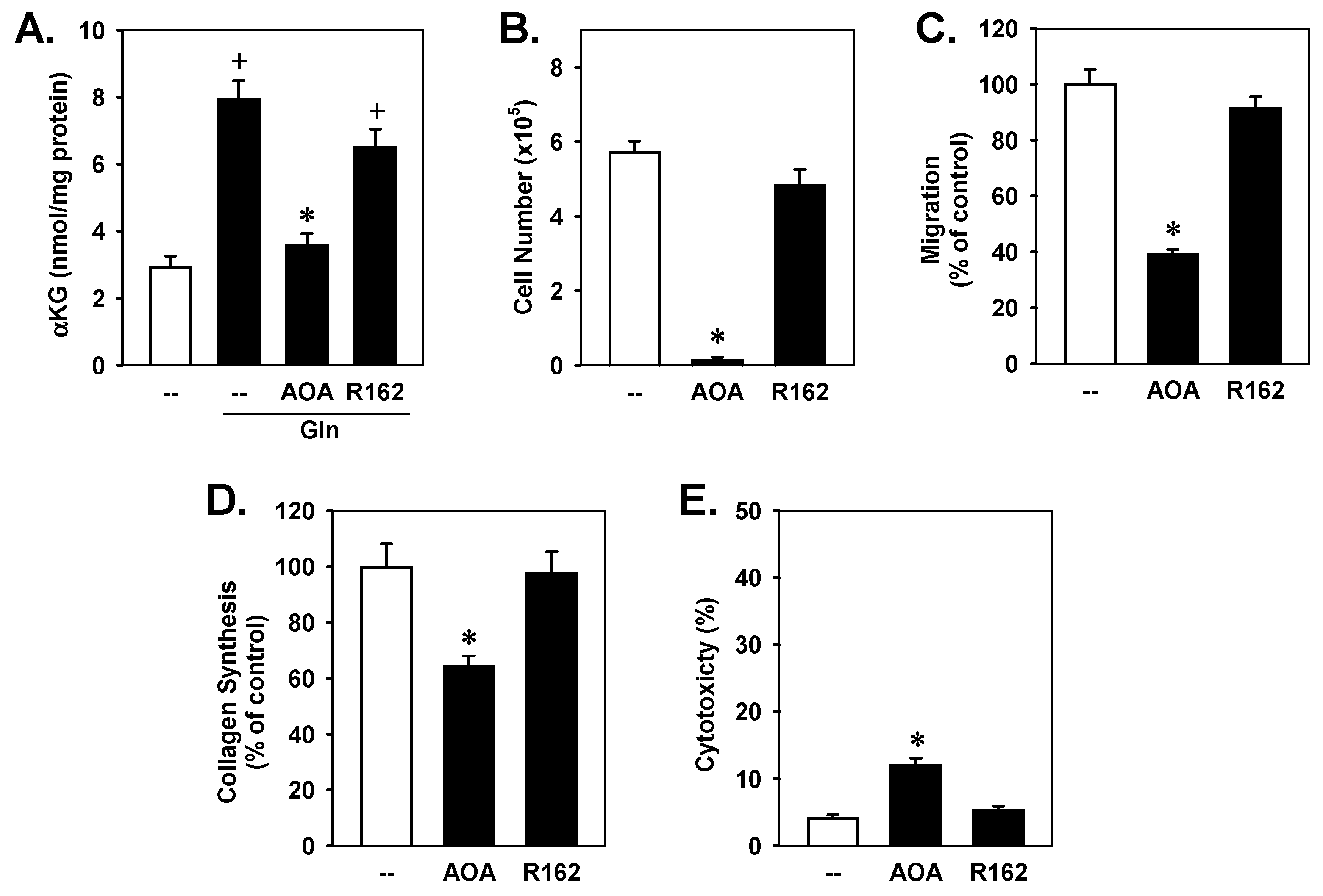
3. Results
4. Discussion
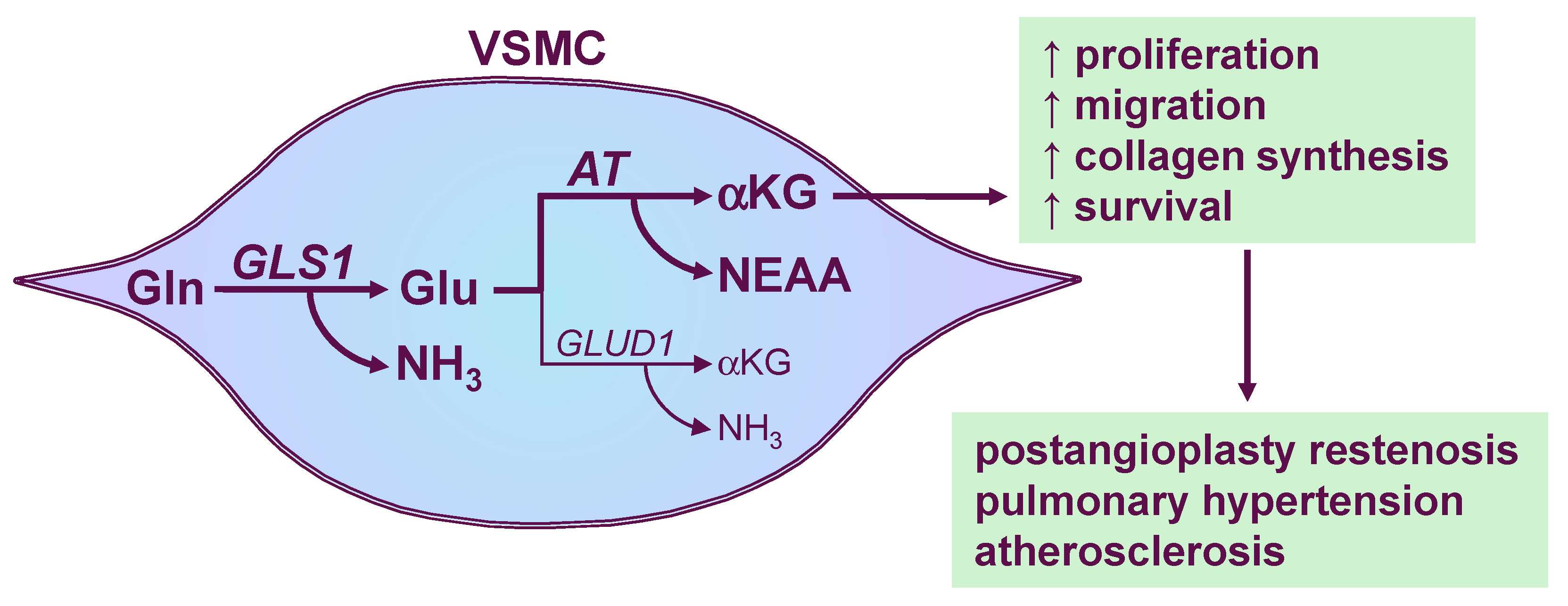
5. Conclusions
Author Contributions
Funding
Institutional Review Board Statement
Data Availability Statement
Conflicts of Interest
References
- Durante, W. The emerging role of glutamine in cardiovascular health and disease. Nutrients 2019, 11, 2092. [Google Scholar] [CrossRef] [Scilit] [PubMed]
- DeBerardinis, R.J.; Cheng, T. Q’s next: The diverse functions of glutamine in metabolism, cell biology, and cancer. Oncogene 2010, 29, 313–324. [Google Scholar] [CrossRef] [Scilit]
- Xi, P.; Jiang, Z.; Zheng, C.; Lin, Y.; Wu, G. Regulation of protein metabolism by glutamine: Implications for nutrition and health. Front. Biosci. 2011, 16, 578–597. [Google Scholar] [CrossRef] [Scilit]
- Yoo, H.C.; Yu, Y.C.; Sung, Y.; Han, J.M. Glutamine reliance in cell metabolism. Exp. Mol. Med. 2020, 52, 1496–1516. [Google Scholar] [CrossRef] [Scilit] [PubMed]
- Aledo, J.C.; Gomez-Fabre, P.M.; Olalla, L.; Marquez, J. Identification of two human glutaminase loci and tissue-specific expression of the two related genes. Mamm. Genome 2002, 9, 157–166. [Google Scholar] [CrossRef] [Scilit] [PubMed]
- Bertero, T.; Oldham, W.M.; Cottrill, K.A.; Pisano, S.; Vanderpool, R.R.; Yu, Q.; Zhao, J.; Tai, Y.; Tang, Y.; Zhang, Y.-Y.; et al. Vascular stiffness mechanoactivates YAP/TAZ-dependent glutaminolysis to drive pulmonary hypertension. J. Clin. Investig. 2016, 126, 3313–3335. [Google Scholar] [CrossRef] [Scilit]
- Erecinska, M.; Silver, I.A. Metabolism and role of glutamate in mammalian brain. Prog. Neurobiol. 1990, 35, 245–296. [Google Scholar] [CrossRef] [Scilit]
- Kumar, M.A.; Baba, S.K.; Khan, I.R.; Khan, M.S.; Husain, F.M.; Ahmad, S.; Haris, M.; Singh, M.; Akil, A.S.A.; Macha, M.A.; et al. Glutamine metabolism: Molecular regulation, biological functions, and diseases. MedComm 2020, 6, e70120. [Google Scholar] [CrossRef] [Scilit]
- Peyton, K.J.; Liu, X.M.; Yu, Y.; Yates, B.; Behnammanesh, G.; Durante, W. Glutaminase-1 stimulates the proliferation, migration, and survival of human endothelial cells. Biochem. Pharmacol. 2018, 156, 204–214. [Google Scholar] [CrossRef] [Scilit]
- Stegan, S.; Rinaldi, G.; Loopmans, S.; Stockmans, I.; Moermans, K.; Thienpont, B.; Fendt, S.-M.; Carmeliet, P.; Carmeliet, G. Glutamine metabolism controls chondrocyte identity and function. Dev. Cell 2020, 53, 530–544. [Google Scholar] [CrossRef] [Scilit]
- Bernard, K.; Logsdon, N.J.; Benavides, G.A.; Sanders, Y.; Zhang, J.; Darley-Usmar, V.M.; Thannickal, V.J. Glutaminolysis is required for transforming growth factor-β1-induced myofibroblast differentiation and activation. J. Biol. Chem. 2018, 293, 1218–1228. [Google Scholar] [CrossRef] [Scilit]
- Wang, Y.; Huang, Y.; Zhao, L.; Zheng, J. Glutaminase-1 is essential for the differentiation, proliferation, and survival of human neural progenitor cells. Stem Cells Dev. 2014, 23, 2782–2790. [Google Scholar] [CrossRef] [Scilit]
- Johnson, M.O.; Wolf, M.M.; Madden, M.Z.; Andrejeva, G.; Sugiura, A.; Contreras, D.C.; Maseda, D.; Liberti, M.V.; Paz, K.; Kishton, R.J.; et al. Dinstinct regulation of Th17 and Th1 cell differentiation by glutaminase-dependent metabolism. Cell 2018, 175, 1780–1795. [Google Scholar] [CrossRef] [Scilit] [PubMed]
- Jin, J.; Byun, J.-K.; Choi, Y.-K.; Park, K.-G. Targeting glutamine metabolism as a therapeutic strategy for cancer. Exp. Mol. Med. 2023, 55, 706–715. [Google Scholar] [CrossRef] [Scilit] [PubMed]
- Yang, F.; Wu, S.C.; Ling, S.C.; Chao, S.; Zhang, L.Y.; Yan, X.M.; He, L.; Yu, L.M.; Zhao, L.Y. Altered plasma metabolic profiles in Chinese patients with multiple sclerosis. Front. Immunol. 2021, 12, 792711. [Google Scholar] [CrossRef] [Scilit]
- Zhang, X.; Wang, G.; Bi, Y.; Jiang, Z.; Wang, X. Inhibition of glutaminolysis ameliorates lupus by regulating T and B cell subsets and downregulating the mTOR/P70S6K/4EBP1 and NLRP3/caspase-1/IL-1β pathways in MRL/Lpr mice. Int. Immunopharmacol. 2022, 112, 109133. [Google Scholar] [CrossRef] [Scilit]
- Du, K.; Hyun, J.; Premont, R.T.; Choi, S.S.; Michelotti, G.A.; Swiderska-Syn, M.; Dalton, G.D.; Thelen, E.; Rizi, B.S.; Jung, Y.; et al. Hedgehog-TAP signaling pathway regulates glutaminolysis to control activation of hepatic stellate cells. Gastroenterology 2018, 154, 1465–1479. [Google Scholar] [CrossRef] [Scilit]
- Flowers, E.M.; Sudderth, J.; Zacharias, L.; Mernaugh, G.; Zent, R.; DeBerardinis, R.J.; Carroll, T.J. Lkb1 deficiency confers glutamine dependency in polycystic kidney disease. Nat. Commun. 2024, 9, 814. [Google Scholar] [CrossRef] [Scilit]
- Durante, W. Glutamine deficiency promotes immune and endothelial cell dysfunction in COVID-19. Int. J. Mol. Sci. 2023, 24, 7593. [Google Scholar] [CrossRef] [Scilit]
- Acharya, A.P.; Tang, Y.; Bertero, T.; Tai, Y.-Y.; Harvey, L.D.; Woodcock, C.-S.C.; Sun, W.; Pineda, R.; Mitash, N.; Konigshoff, M.; et al. Simultaneous pharmacologic inhibition of Yes-associated protein 1 and glutaminase 1 via inhaled poly(lactic-co-glycolic) acid-encapsulated microparticles improves pulmonary hypertension. J. Am. Heart Assoc. 2021, 10, e019091. [Google Scholar] [CrossRef] [Scilit] [PubMed]
- Rachedi, N.S.; Tang, Y.; Tai, Y.Y.; Zhao, J.; Chauvet, C.; Grynblat, J.; Akoumia, K.K.F.; Estephan, L.; Torrino, S.; Sbai, C.; et al. Dietary intake and glutamine-serine metabolism control pathologic vascular stiffness. Cell Metab. 2024, 36, 1335–1350. [Google Scholar] [CrossRef] [Scilit]
- Yoshikawa, S.; Nagao, M.; Toh, R.; Shinohara, M.; Iino, T.; Irino, Y.; Nishimori, M.; Tanaka, H.; Satomi-Kobayashi, S.; Ishida, T.; et al. Inhibition of glutaminase 1-mediated glutaminolysis improves pathological cardiac remodeling. Am. J. Physiol. Heart Circ. Physiol. 2022, 322, H749–H761. [Google Scholar] [CrossRef] [Scilit]
- Zhong, G.; Su, S.; Li, J.; Zhao, H.; Hu, D.; Chen, J.; Li, S.; Lin, Y.; Wen, L.; Lin, X.; et al. Activation of Piezo 1 promotes osteogenic differentiation of aortic valve interstitial cell through YAP-dependent glutaminolysis. Sci. Adv. 2023, 9, eadg0478. [Google Scholar] [CrossRef] [Scilit]
- Zhou, Z.; Dong, B.; He, D.; Ma, J.; Kong, Y.; Zhu, H.; Xie, C.; Yang, T.; Zhen, X.; Zhang, Z.; et al. GLS1-mediated redundancy in glutamate accelerates arterial calcification via activating NMDAR/Ca2+/β-catenin pathway. Sci. Adv. 2025, 12, 2414252. [Google Scholar] [CrossRef] [Scilit]
- Murcy, F.; Borowczyk, C.; Gourion-Arsiquaud, S.; Torrino, S.; Ouahrouche, N.; Barouillet, T.; Dussaud, S.; Couralet, M.; Vaillant, N.; Merlin, J.; et al. GLS2 links glutamine metabolism and atherosclerosis by remodeling artery walls. Nat. Cardiovasc. Res. 2024, 3, 1454–1467. [Google Scholar] [CrossRef] [Scilit]
- Benhmammouch, S.; Borowczyk, C.; Pierrot-Blanchet, C.; Barouillet, T.; Murcy, F.; Dussaud, S.; Blanc, M.; Bleriot, C.; Ord, T.; Habbouche, L.; et al. Slc7a7 licenses macrophage glutaminolysis for restorative functions in atherosclerosis. Nat. Med. 2025, 7, 1924–1938. [Google Scholar] [CrossRef] [Scilit] [PubMed]
- Sarkar, A.; Kumar, B.; Yadav, A.K.; Pawar, S.V.; Chopra, K.; Jain, M. Targeting glutaminase C, a splice variant of glutaminase 1, suppresses smooth muscle cell phenotypic modulation and neointimal hyperplasia. Exp. Cell Res. 2025, 452, 114777. [Google Scholar] [CrossRef] [Scilit]
- Cao, G.; Xuan, X.; Hu, J.; Zhang, R.; Jin, H.; Dong, H. How vascular smooth muscle cell phenotype switching contributes to vascular disease. Cell Commun. Signal. 2022, 20, 180. [Google Scholar] [CrossRef] [Scilit]
- Zhang, C.Y.; Hu, Y.C.; Zhang, Y.; Ma, W.D.; Song, Y.F.; Quan, X.H.; Guo, C.; Wang, X. Glutamine switches vascular smooth muscle cells to synthetic phenotype through inhibiting miR-143 expression and upregulating THY1 expression. Life Sci. 2021, 277, 119365. [Google Scholar] [CrossRef] [Scilit] [PubMed]
- Osman, I.; He, Q.; Liu, J.; Dong, K.; Wen, T.; Zhang, F.; Yu, L.; Hu, G.; Xin, H.; Zhang, W.; et al. TEAD1 (TEA Domain Transcription Factor 1) promotes smooth muscle cell proliferation through upregulating SLC1A5 (Solute Carrier Family 1 Member 5)-mediated glutamine uptake. Circ. Res. 2019, 124, 1309–1322. [Google Scholar] [CrossRef] [Scilit] [PubMed]
- Koyama, S.; Yamashita, A.; Matsuura, Y.; Saito, Y.; Maekawa, K.; Gi, T.; Kitamura, K.; Asada, Y. Intracellular glutamine level determines vascular smooth muscle cell-derived thrombogenicity. Atherosclerosis 2021, 328, 62–73. [Google Scholar] [CrossRef] [Scilit]
- Park, H.Y.; Kim, M.-J.; Lee, S.; Jin, J.; Lee, S.; Kim, J.-G.; Choi, Y.-K.; Park, K.-G. Inhibitory effect of a glutamine antagonist on proliferation and migration of VSMCs via simultaneous attenuation of glycolysis and oxidative phosphorylation. Int. J. Mol. Sci. 2021, 22, 5602. [Google Scholar] [CrossRef] [Scilit]
- Park, H.Y.; Kim, M.-J.; Kim, Y.J.; Lee, S.; Jin, J.; Lee, S.; Choi, Y.-K.; Park, K.G. V9302 inhibits proliferation and migration of VSMCs, and reduces neointima formation in mice after carotid artery ligation. Biochem. Biophys. Res. Commun. 2021, 560, 45–51. [Google Scholar] [CrossRef] [Scilit]
- Durante, W.; Schini, V.B.; Catovsky, S.; Kroll, M.H.; Vanhoutte, P.M.; Schafer, A.I. Plasmin potentiates induction of nitric oxide synthesis by interleukin-1 beta in vascular smooth muscle cells. Am. J. Physiol. 1993, 264, H617–H624. [Google Scholar] [CrossRef] [Scilit]
- Peyton, K.J.; Reyna, S.V.; Chapman, G.B.; Ensenat, D.; Liu, X.M.; Wang, H.; Schafer, A.I.; Durante, W. Heme oxygenase-derived carbon monoxide is an autocrine inhibitor of vascular smooth muscle cell growth. Blood 2002, 99, 4443–4448. [Google Scholar] [CrossRef] [Scilit]
- Durante, W.; Liao, L.; Reyna, S.V.; Peyton, K.J.; Schafer, A.I. Physiologic cyclic stretch directs L-arginine transport and metabolism to collagen synthesis in vascular smooth muscle. FASEB J. 2000, 14, 1775–1783. [Google Scholar] [CrossRef] [Scilit]
- Behnammanesh, G.; Durante, G.L.; Kanna, Y.P.; Peyton, K.J.; Durante, W. Canagliflozin inhibits vascular smooth muscle cell proliferation and migration. Redox Biol. 2020, 32, 101527. [Google Scholar] [CrossRef] [Scilit] [PubMed]
- Peyton, K.J.; Shebib, A.R.; Azam, A.M.; Liu, X.M.; Tulis, D.A.; Durante, W. Bilirubin inhibits neointima formation and vascular smooth muscle cell proliferation and migration. Front. Pharmacol. 2012, 3, 48. [Google Scholar] [CrossRef] [Scilit] [PubMed]
- Robinson, M.M.; McBryant, S.J.; Tsukamoto, T.; Rojas, C.; Ferraris, D.V.; Hamilton, S.K.; Hansen, S.J.; Curthoys, N.P. Novel mechanism of inhibition of rat kidney-type glutaminase by bis-2-(5-phenylacetomido-1,3,4-thiadiazol-2-yl)ethyl sulfide (BPTES). Biochem. J. 2007, 406, 407–414. [Google Scholar] [CrossRef] [Scilit] [PubMed]
- Gross, M.L.; Demo, S.D.; Dennison, J.B.; Chen, L.; Chernov-Rogan, T.; Goyal, B.; Janes, J.R.; Laidig, G.J.; Lewis, E.R.; Andrew, J.L.; et al. Antitumor activity of the glutaminase inhibitor CB-839 in triple-negative breast cancer. Mol. Cancer Ther. 2014, 13, 890–901. [Google Scholar] [CrossRef] [Scilit]
- Jin, L.; Li, D.; Alesi, G.N.; Fan, J.; Kang, H.B.; Lu, Z.; Boggon, T.J.; Jin, P.; Yi, H.; Wright, E.R.; et al. Glutamate dehydrogenase 1 signals through antioxidant glutathione peroxidase 1 to regulate redox homeostasis and tumor growth. Cancer Cell 2015, 27, 257–270. [Google Scholar] [CrossRef] [Scilit]
- Thornburg, J.M.; Nelson, K.K.; Clem, B.F.; Lane, A.N.; Arumugam, S.; Simmons, A.; Eaton, J.W.; Telang, S.; Chesney, J. Targeting aspartate aminotransferase in breast cancer. Breast Cancer Res. 2008, 10, R84. [Google Scholar] [CrossRef] [Scilit] [PubMed]
- Eagle, H. Nutritional needs of mammalian cells in tissue culture. Science 1955, 122, 501–514. [Google Scholar] [CrossRef] [Scilit] [PubMed]
- Colombo, S.L.; Palacios-Callender, M.; Frakich, N.; Carcamo, S.; Kovacs, I.; Tudzarova, S.; Moncada, S. Molecular basis for the differential use of glucose and glutamine in cell proliferation as revealed by synchronized HeLa cells. Proc. Natl. Acad. Sci. USA 2011, 108, 21069–21074. [Google Scholar] [CrossRef] [Scilit] [PubMed]
- Gibb, A.A.; Huynh, A.T.; Gaspar, R.B.; Ploesch, T.L.; Lombardi, A.A.; Lorkiewicz, P.K.; Lazaropoulos, M.P.; Bedi, K.; Arany, Z.; Margulies, K.B.; et al. Glutamine uptake and catabolism is required for myofibroblast formation and persistence. J. Mol. Cell. Cardiol. 2022, 172, 78–89. [Google Scholar] [CrossRef] [Scilit]
- Coloff, J.L.; Murphy, J.P.; Braun, C.R.; Harris, I.S.; Shelton, L.M.; Kami, K.; Gygi, S.P.; Selfors, L.M.; Brugge, J.S. Differential glutamate metabolism in proliferating and quiescent mammary epithelial cells. Cell Metab. 2016, 23, 867–880. [Google Scholar] [CrossRef] [Scilit]
- Duran, R.V.; Opplinger, W.; Robitaille, A.M.; Heiserich, L.; Skendaj, R.; Gottlieb, E.; Hall, M.N. Gutaminolysis activates Rag-mTORC1 signaling. Mol. Cell 2012, 47, 349–358. [Google Scholar] [CrossRef] [Scilit]
- He, W.H.; Miao, F.J.P.; Lin, D.C.H.; Schwandner, R.T.; Wang, Z.; Gao, J.; Chen, J.L.; Tian, H.; Ling, L. Citric acid cycle intermediates as ligands for orphan G-protein coupled receptors. Nature 2004, 429, 188–193. [Google Scholar] [CrossRef] [Scilit]
- Sirinyan, M.; Sennlaub, F.; Saphieha, P.; Chemtob, S. Succinate and α-ketoglutarate act as sensors of hypoxia and mediate retinal angiogenesis. Investig. Ophthalmol. Vis. Sci. 2007, 48, 1755. [Google Scholar]
- Wang, Y.; Deng, P.; Liu, Y.; Wu, Y.; Chen, Y.; Guo, Y.; Zhang, S.; Zheng, X.; Zhou, L.; Liu, W.; et al. Alpha-ketoglutarate ameliorates age-related osteoporosis via regulating histone methylations. Nat. Commun. 2020, 11, 5596. [Google Scholar] [CrossRef] [Scilit]
- Krall, A.S.; Xu, S.; Graeber, T.G.; Brass, D.; Christofk, H.R. Asparagine promotes cancer cell proliferation through use as an amino acid exchange factor. Nat. Commun. 2016, 7, 11457. [Google Scholar] [CrossRef] [Scilit] [PubMed]
- Huang, H.; Vandekeere, S.; Kalucka, J.; Bierhansl, L.; Zecchin, A.; Bruning, U.; Visnagri, A.; Yuldasheva, N.; Goveia, J.; Cruys, B.; et al. Role of glutamine and interlinked asparagine metabolism in vessel formation. EMBO J. 2017, 36, 2334–2352. [Google Scholar] [CrossRef] [Scilit]
- Kim, B.; Li, J.; Jang, C.; Arany, Z. Glutamine fuels proliferation but not migration of endothelial cells. EMBO J. 2017, 36, 2321–2333. [Google Scholar] [CrossRef] [Scilit]
- Zhang, J.; Fan, J.; Venneti, S.; Cross, J.R.; Takagi, T.; Bhinder, B.; Djaballah, H.; Kanai, M.; Cheng, E.H.; Judkins, A.R.; et al. Asparagine plays a critical role in regulating cellular adaptation to glutamine depletion. Mol. Cell 2014, 56, 205–2018. [Google Scholar] [CrossRef] [Scilit] [PubMed]
- Kilberg, M.S.; Shan, J.; Su, N. Asparagine synthetase: Regulation by cell stress and involvement in tumor biology. Am. J. Physiol. Endocrinol. Metab. 2013, 304, E789–E799. [Google Scholar]
- Broer, A.; Rahimi, F.; Broer, S. Deletion of amino acid transporter ASCT2 (SLC1A5) reveals an essential role for transporters SNAT1 (SLC38A1) and SNAT2 (SLC38A2) to sustain glutaminolysis in cancer cells. J. Biol. Chem. 2016, 291, 13194–13205. [Google Scholar] [CrossRef] [Scilit] [PubMed]
- van Geldermalsen, M.; Wang, Q.; Nagarajah, R.; Marshall, A.D.; Thoeng, A.; Gao, D.; Ritchie, W.; Feng, Y.; Bailey, C.G.; Deng, N.; et al. ASCT2/SLC1A5 control glutamine uptake and tumor growth in triple-negative basal-like breast cancer. Oncogene 2016, 35, 3201–3208. [Google Scholar] [CrossRef] [Scilit]
- Pavova, N.N.; Hui, S.; Ghergurovich, J.M.; Fan, J.; Intlekofer, A.M.; White, R.M.; Rabinowitz, J.D.; Thompson, C.B.; Zhang, J. As extracellular glutamine levels decline, asparagine becomes an essential amino acid. Cell Metab. 2018, 27, 428–438. [Google Scholar] [CrossRef] [Scilit]
- Bellon, G.B.; Chaqour, B.; Wegrowski, Y.; Monboisse, J.-C.; Borel, J.-P. Glutamine increases collagen gene transcription in cultured human fibroblasts. Biochim. Biophy. Acta 1995, 1268, 311–323. [Google Scholar] [CrossRef] [Scilit]
- Ge, J.; Cui, H.; Xie, N.; Banerjee, S.; Guo, S.; Dubey, S.; Barnes, S.; Liu, G. Glutaminolysis promotes collagen translation and stability via α-ketoglutarate-mediated mTOR activation and proline hydroxylation. Am. J. Respir. Cell Mol. Biol. 2018, 58, 378–390. [Google Scholar] [CrossRef] [Scilit]
- Hamanaka, R.B.; O’Leary, E.M.; Witt, L.J.; Tian, Y.; Gokalp, G.A.; Meliton, A.Y.; Dulin, N.O.; Mutlu, G.M. Glutamine metabolism is required for collagen protein synthesis in lung fibroblasts. Am. J. Respir. Cell Mol. Biol. 2019, 61, 597–606. [Google Scholar] [CrossRef] [Scilit]
- Zhang, D.; Zhao, L.; Luo, M.; Lei, J.; Shao, S. Yap-Myc signaling induces pancreatic stellate cell activation through regulating glutaminolysis. Exp. Cell Res. 2022, 411, 113000. [Google Scholar] [CrossRef] [Scilit]
- Cai, Y.; Tian, B.; Deng, Y.; Liu, L.; Zhang, C.; Peng, W.; Li, Q.; Zhang, T.; Han, M.; Xu, G. Glutamine metabolism promotes renal fibrosis through regulation of mitochondrial energy generation and mitochondrial fission. Int. J. Biol. Sci. 2024, 20, 987–1003. [Google Scholar] [CrossRef] [Scilit]
- Pan, X.; Chen, Z.; Huang, R.; Yao, Y.; Ma, G. Transforming growth factor β1 induces the expression of collagen type I by DNA methylation in cardiac fibroblasts. PLoS ONE 2013, 8, e60335. [Google Scholar] [CrossRef] [Scilit]
- Bergmann, C.; Brandt, A.; Merlevede, B.; Hallenberger, L.; Dees, C.; Wohlfart, T.; Potter, S.; Zhang, Y.; Chen, C.-W.; Mallano, T.; et al. The histone demethylase Jumonji domain-containing protein 3 (JMJD3) regulates fibroblast activation in systemic sclerosis. Ann. Rheum. Dis. 2018, 77, 150–158. [Google Scholar] [CrossRef] [Scilit]
- Son, E.D.; Choio, G.H.; Kim, H.; Lee, B.; Chang, I.S.; Hwang, J.S. Alpha-ketoglutarate stimulates procollagen production in cultured human dermal fibroblasts, and decreases UVB-induced wrinkle formation following topical application on the dorsal skin of hairless mice. Biol. Pharm. Bull. 2007, 30, 1395–1399. [Google Scholar] [CrossRef] [Scilit] [PubMed]
- Kay, E.J.; Koulouras, G.; Zanivan, S. Regulation of extracellular matrix production in activated fibroblasts: Roles of amino acid metabolism in collagen synthesis. Front. Oncol. 2021, 11, 719922. [Google Scholar] [CrossRef] [Scilit] [PubMed]
- Reynolds, M.R.; Lane, A.N.; Robertson, B.; Kemp, S.; Liu, Y.; Hill, B.G.; Dean, D.C.; Clem, B.F. Control of glutamine metabolism by tumor suppressor Rb. Oncogene 2014, 33, 556–566. [Google Scholar] [CrossRef] [Scilit] [PubMed]
- Liu, S.; He, L.; Yao, K. The antioxidant function of alpha-ketoglutarate and its applications. BioMed Res. Int. 2018, 2018, 3408467. [Google Scholar] [CrossRef] [Scilit]
- He, L.; Wu, J.; Tang, W.; Zhou, X.; Lin, Q.; Luo, F.; Yin, Y.; Li, T. Prevention of oxidative stress by α-ketoglutarate via activation of CAR signaling and modulation of the expression of key antioxidant-associated targets. J. Agric. Food Chem. 2018, 66, 11273–11283. [Google Scholar] [CrossRef] [Scilit]
- Yu, H.; Gan, D.; Luo, Z.; Yang, Q.; An, D.; Zhang, H.; Hu, Y.; Ma, Z.; Zeng, Q.; Xu, D.; et al. α-ketoglutarate improves cardiac insufficiency through NAD+-SIRT1 signaling-mediated mitophagy and ferroptosis in pressure overload-induced mice. Mol. Med. 2024, 30, 15. [Google Scholar] [CrossRef] [Scilit]
- Liu, X.-M.; Peyton, K.J.; Durante, W. Ammonia promotes endothelial survival via the heme oxygenase-1-mediated release of carbon monoxide. Free Radic. Biol. Med. 2017, 102, 37–46. [Google Scholar] [CrossRef] [Scilit]
- Eng, C.H.; Yu, K.; Lucas, J.; White, E.; Abraham, R.T. Ammonia derived from glutaminolysis is a diffusible regulator of autophagy. Sci. Signal. 2010, 3, ra31. [Google Scholar] [CrossRef] [Scilit] [PubMed]
- Xiang, L.; Mou, J.; Shao, B.; Wei, Y.; Liang, H.; Takano, N.; Semenza, G.L.; Xie, G. Glutaminase 1 expression in colorectal cancer cells is induced by hypoxia and required for tumor growth, invasion, and metastatic colonization. Cell Death Dis. 2019, 10, 40. [Google Scholar] [CrossRef] [Scilit] [PubMed]
- Jiang, Z.-F.; Wang, M.; Xu, J.-L.; Ning, Y.-J. Hypoxia promotes mitochondrial glutamine metabolism through HIF1α-GDH pathway in human lung cancer cells. Biochem. Biophys. Res. Commun. 2017, 483, 32–38. [Google Scholar] [CrossRef] [Scilit]
- Sun, R.C.; Denko, N.C. Hypoxic regulation of glutamine metabolism through HIF1 and SIAH2 supports lipid synthesis that is necessary for tumor growth. Cell Metab. 2014, 19, 285–292. [Google Scholar] [CrossRef] [Scilit]
- Zhao, Y.; Peng, J.; Lu, C.; Hsin, M.; Mura, M.; Wu, L.; Chu, L.; Zamel, R.; Machuca, T.; Waddell, T.; et al. Metabolic heterogeneity of pulmonary arterial hypertension. PLoS ONE 2014, 9, e88727. [Google Scholar]
- Chakraborty, R.; Chatterjee, P.; Dave, J.M.; Ostiker, A.C.; Greif, D.M.; Rzucidlo, E.M.; Martin, K.A. Targeting smooth muscle cell phenotypic switching in vascular disease. JVS Vasc. Sci. 2021, 2, 79–94. [Google Scholar] [CrossRef] [Scilit] [PubMed]
- Chen, R.; McVey, D.G.; Shen, D.; Huang, X.; Ye, S. Phenotypic switching of vascular smooth muscle cells in atherosclerosis. J. Am. Heart Assoc. 2023, 12, e031121. [Google Scholar] [CrossRef] [Scilit]
- He, Y.; Yi, X.; Zhang, Z.; Luo, H.; Li, R.; Feng, X.; Fang, Z.-M.; Zhu, X.-H.; Cheng, W.; Jiang, D.-S.; et al. JIB-04, a histone demethylase Jumonji C domain inhibitor, regulates phenotypic switching of vascular smooth muscle cells. Clin. Epigenetics 2022, 14, 101. [Google Scholar] [CrossRef] [Scilit]


Disclaimer/Publisher’s Note: The statements, opinions and data contained in all publications are solely those of the individual author(s) and contributor(s) and not of MDPI and/or the editor(s). MDPI and/or the editor(s) disclaim responsibility for any injury to people or property resulting from any ideas, methods, instructions or products referred to in the content. |
© 2026 by the authors. Licensee MDPI, Basel, Switzerland. This article is an open access article distributed under the terms and conditions of the Creative Commons Attribution (CC BY) license.
Share and Cite
Peyton, K.J.; Liu, X.-M.; Durante, G.L.; Durante, W. The Glutamine-α-Ketoglutarate Metabolic Axis Controls Vascular Smooth Muscle Cell Function. Cells 2026, 15, 230. https://doi.org/10.3390/cells15030230
Peyton KJ, Liu X-M, Durante GL, Durante W. The Glutamine-α-Ketoglutarate Metabolic Axis Controls Vascular Smooth Muscle Cell Function. Cells. 2026; 15(3):230. https://doi.org/10.3390/cells15030230
Chicago/Turabian StylePeyton, Kelly J., Xiao-Ming Liu, Giovanna L. Durante, and William Durante. 2026. "The Glutamine-α-Ketoglutarate Metabolic Axis Controls Vascular Smooth Muscle Cell Function" Cells 15, no. 3: 230. https://doi.org/10.3390/cells15030230
APA StylePeyton, K. J., Liu, X.-M., Durante, G. L., & Durante, W. (2026). The Glutamine-α-Ketoglutarate Metabolic Axis Controls Vascular Smooth Muscle Cell Function. Cells, 15(3), 230. https://doi.org/10.3390/cells15030230