Targeting Cardiac Fibroblast Plasticity for Antifibrotic and Regenerative Therapy in Heart Failure
 , ,
, ,  , ,
, , 

Highlights
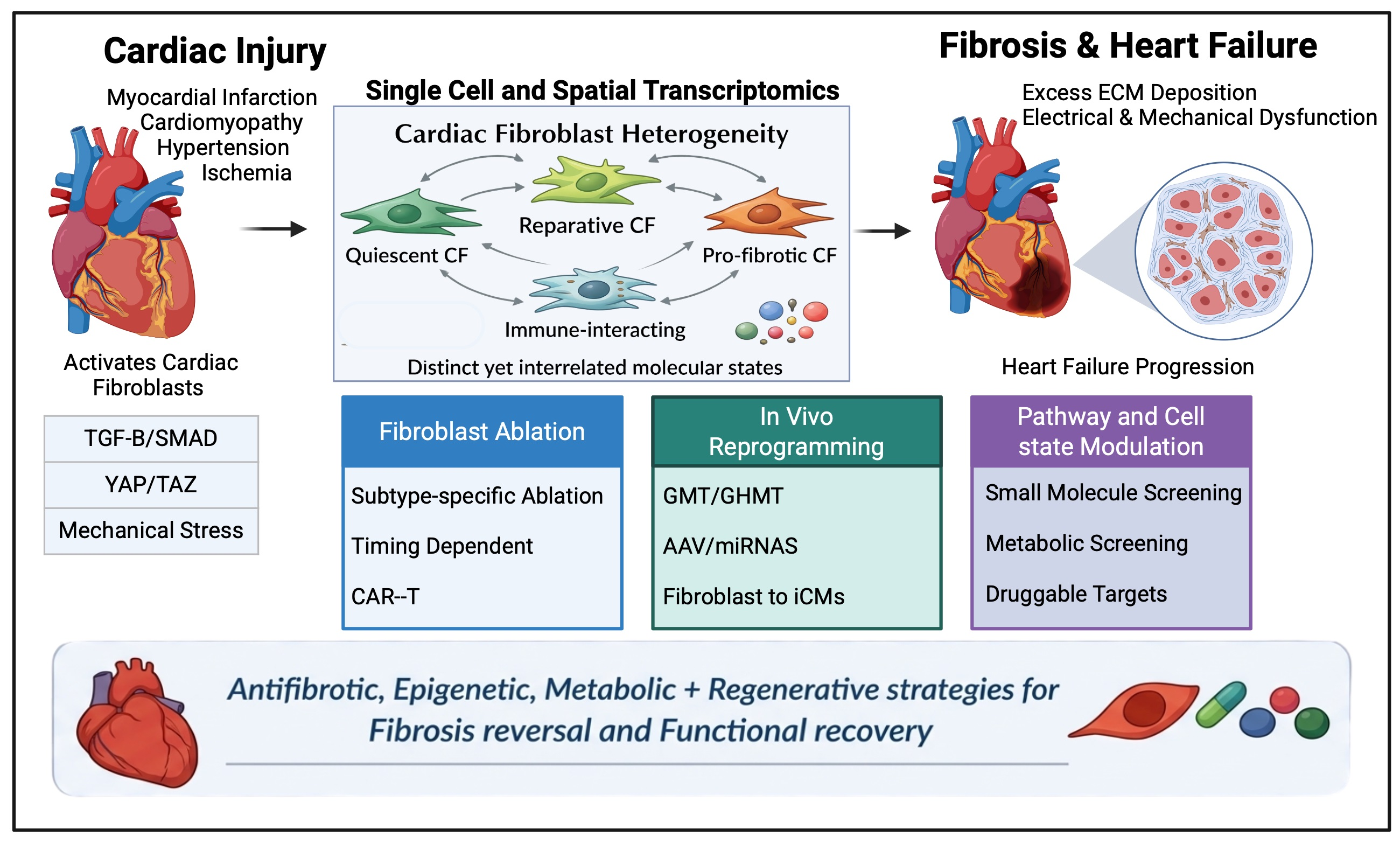
- Cardiac fibroblasts (CFs) exhibit dynamic, state-dependent plasticity revealed by single-cell and spatial transcriptomics, with distinct subsets driving reparative versus maladaptive fibrotic remodeling in heart failure (HF).
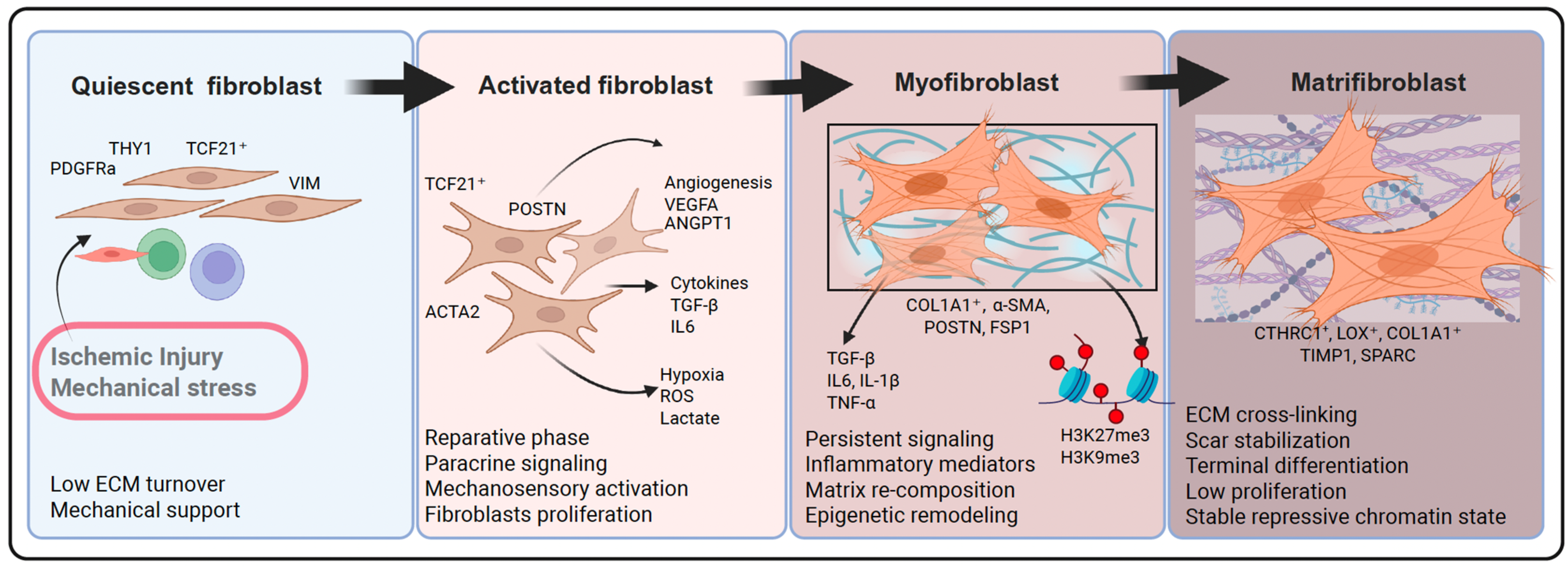
- Fibroblast activation is regulated by coordinated signaling, mechanical, and epigenetic programs that stabilize chronic fibrosis but retain partial reversibility under defined conditions.
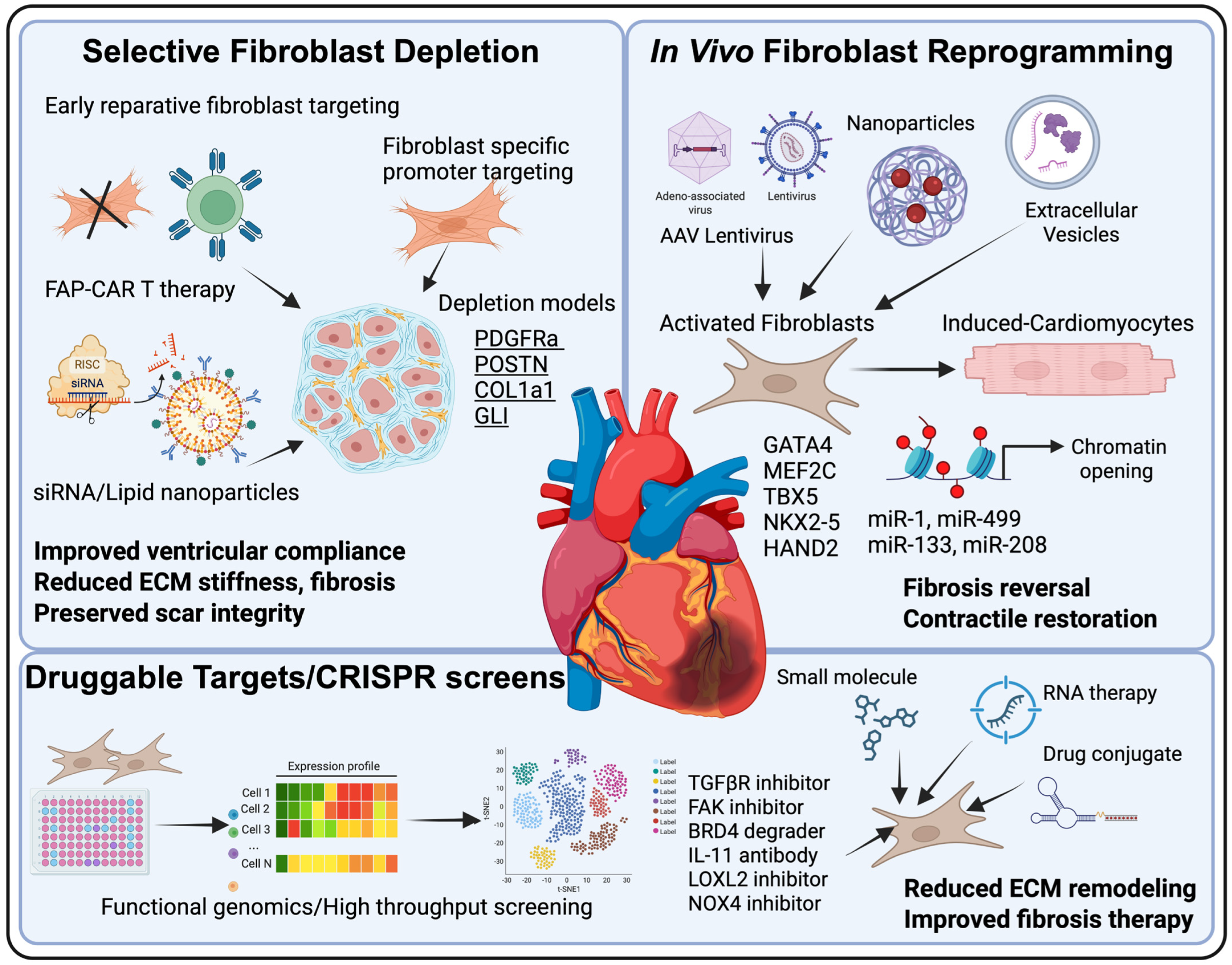
- Precision targeting of pathogenic fibroblast states, rather than global fibroblast suppression, offers a strategy to limit fibrosis while preserving essential reparative functions.
- Combining antifibrotic pathway modulation with in vivo fibroblast reprogramming, epigenetic editing, and advanced RNA/gene delivery platforms may enable reversal of established fibrosis and promote functional myocardial regeneration.
Abstract
1. Introduction
2. Fibroblast Heterogeneity and Function
2.1. Developmental Origin and Regional Heterogeneity of Cardiac Fibroblasts
2.2. Molecular Mechanisms of Fibroblast Activation
2.3. Roles of CFs Contributing to HF: Cell-Cell or Cell-ECM Interactions
2.4. Heterogeneous Fibroblast Populations in Heart Diseases
3. Current Therapeutic Strategies for Reducing or Reversing Cardiac Fibrosis
3.1. Specific Depletion of Pathological Fibroblast Subtypes
3.2. In Vivo Reprogramming: Rewiring Fibrosis Toward Functional Cardiac Regeneration
3.3. Potential Druggable Targets for Cardiac Fibrosis Therapy
4. Limitations and Translational Challenges
5. Future Directions: Convergences of New Drug Discovery and Gene Delivery Approaches
6. Conclusions
Author Contributions
Funding
Institutional Review Board Statement
Informed Consent Statement
Data Availability Statement
Acknowledgments
Conflicts of Interest
Abbreviations
| AAV | Adeno-associated virus |
| AAV9/AAV-DJ | Adeno-associated virus serotype 9/DJ capsid variant |
| ACKR3 | Atypical chemokine receptor 3 |
| ACTA2 (α-SMA) | Alpha smooth muscle actin |
| ACE/ACEi | Angiotensin-converting enzyme/ACE inhibitor |
| ANGPT1 | Angiopoietin-1 |
| ANGPTL4 | Angiopoietin-like 4 |
| ATAC-seq | Assay for Transposase-Accessible Chromatin using sequencing |
| β-blocker | Beta adrenergic receptor blocker |
| BRD4 | Bromodomain-containing protein 4 |
| CAR | Chimeric antigen receptor |
| CCL19/CCL21 | C-C motif chemokine ligand 19/21 |
| CD146 (MCAM) | Melanoma cell adhesion molecule |
| iCMs | Induced cardiomyocyte-like cells |
| CF(s) | Cardiac fibroblast(s) |
| CMs | Cardiomyocytes |
| COL1A1/COL1A2/COL3A1 | Collagen type I alpha-1/alpha-2, type III alpha-1 |
| COL15A1 | Collagen type XV alpha-1 |
| CRISPR | Clustered Regularly Interspaced Short Palindromic Repeats |
| CTGF | Connective tissue growth factor |
| CTHRC1 | Collagen triple helix repeat-containing 1 |
| CTCF | CCCTC-binding factor |
| CXCL10/CXCL12 | C-X-C motif chemokine ligand 10/12 |
| DCN | Decorin |
| dCas9 | Dead Cas9 |
| DDR2 | Discoidin domain receptor 2 |
| DNA | Deoxyribonucleic acid |
| DTA | Diphtheria toxin A |
| DTR | Diphtheria toxin receptor |
| DUSP | Dual specificity phosphatase (family) |
| ECM | Extracellular matrix |
| ED-A fibronectin (FN1-ED-A) | Extra-domain A fibronectin |
| EMT | Epithelial-to-mesenchymal transition |
| EndoMT | Endothelial-to-mesenchymal transition |
| EP300 (p300), KAT5 (TIP60), SRCAP | Chromatin regulators |
| ER | Endoplasmic reticulum |
| EV(s) | Extracellular vesicle(s) |
| FAK | Focal adhesion kinase |
| FAP | Fibroblast activation protein-α |
| FGF2 | Fibroblast growth factor 2 |
| FSP1 (S100A4) | Fibroblast-specific protein 1 |
| GATA4 | GATA-binding protein 4 |
| GHMT | GATA4–HAND2–MEF2C–TBX5 (reprogramming cocktail) |
| GMT/GMT-H | GATA4, MEF2C, TBX5 (and HAND2) |
| GLI1 | GLI family zinc finger 1 |
| GLS1 | Glutaminase 1 |
| HAND2 | Heart And Neural Crest Derivatives Expressed 2 |
| H3K27me3 | Histone H3 lysine 27 trimethylation |
| HGF | Hepatocyte growth factor |
| HF | Heart failure |
| HFpEF | Heart failure with preserved ejection fraction |
| iPSC(s) | Induced pluripotent stem cell(s) |
| IGF1 | Insulin-like growth factor 1 |
| IL-1β/IL-6/IL-11 | Interleukin-1 beta/Interleukin-6/Interleukin-11 |
| IL-33 | Interleukin-33 |
| ITGAL | Integrin alpha L (CD11a) |
| ITGB1 (ITGβ1) | Integrin beta-1 |
| LNP(s) | Lipid nanoparticle(s) |
| LOX | Lysyl oxidase |
| LOXL2 | Lysyl oxidase-like 2 |
| lncRNA | Long non-coding RNA |
| LRP1 | LDL receptor-related protein 1 |
| LUM | Lumican |
| MD2 | Myeloid differentiation factor 2 |
| MDK | Midkine |
| MEF2C | Myocyte enhancer factor 2C |
| MI | Myocardial infarction |
| miRNA | MicroRNA |
| mRNA | Messenger RNA |
| MHC-II | Major histocompatibility complex class II |
| MYC | Myc proto-oncogene |
| NG2 (CSPG4) | Neuron-glial antigen 2/Chondroitin sulfate proteoglycan 4 |
| NKX2-5 | NK2 homeobox 5 |
| NOX4 | NADPH oxidase 4 |
| PDGFRα | Platelet-derived growth factor receptor alpha |
| PDGFRβ | Platelet-derived growth factor receptor beta |
| PI16 | Peptidase inhibitor 16 |
| PLGA-PEI | Poly(lactic-co-glycolic acid)–polyethyleneimine (nanocarrier) |
| POSTN | Periostin |
| RGS5 | Regulator of G-protein signaling 5 |
| RNA | Ribonucleic acid |
| SCA-1 | Stem cell antigen-1 |
| SERPINE1 (PAI-1) | Serpin family E member 1 |
| SMAD2/3 | Mothers against decapentaplegic homolog 2/3 (TGF-β effectors) |
| STAT3 | Signal transducer and activator of transcription 3 |
| TBX18/TBX20/TBX5 | T-box transcription factors 18/20/5 |
| TEAD | Transcriptional enhanced associate domain |
| TCF21 | Transcription factor 21 |
| TGF-β | Transforming growth factor beta |
| TGF-βR1 | TGF-β receptor type I |
| THY1 (CD90) | Thymocyte differentiation antigen 1 |
| TIMPs/TIMP1/TIMP3 | Tissue inhibitor(s) of metalloproteinases 1/3 |
| TLR4 | Toll-like receptor 4 |
| TNF-α | Tumor necrosis factor alpha |
| VEGFA | Vascular endothelial growth factor A |
| VIM | Vimentin |
| WT1 | Wilms tumor 1 |
| WNT | Wnt signaling pathway |
| YAP/TAZ | Yes-associated protein/Transcriptional co-activator with PDZ-binding motif |
References
- Buja, L.M. Pathobiology of Myocardial Ischemia and Reperfusion Injury: Models, Modes, Molecular Mechanisms, Modulation, and Clinical Applications. Cardiol. Rev. 2023, 31, 252–264. [Google Scholar] [CrossRef] [Scilit] [PubMed]
- Haubner, B.J.; Schneider, J.; Schweigmann, U.; Schuetz, T.; Dichtl, W.; Velik-Salchner, C.; Stein, J.-I.; Penninger, J.M. Functional Recovery of a Human Neonatal Heart After Severe Myocardial Infarction. Circ. Res. 2016, 118, 216–221. [Google Scholar] [CrossRef] [Scilit]
- Moretti, L.; Stalfort, J.; Barker, T.H.; Abebayehu, D. The interplay of fibroblasts, the extracellular matrix, and inflammation in scar formation. J. Biol. Chem. 2022, 298, 101530. [Google Scholar] [CrossRef] [Scilit]
- Rog-Zielinska, E.A.; Norris, R.A.; Kohl, P.; Markwald, R. The Living Scar—Cardiac Fibroblasts and the Injured Heart. Trends Mol. Med. 2016, 22, 99–114. [Google Scholar] [CrossRef] [Scilit]
- Moore-Morris, T.; Guimarães-Camboa, N.; Yutzey, K.E.; Pucéat, M.; Evans, S.M. Cardiac fibroblasts: From development to heart failure. J. Mol. Med. 2015, 93, 823–830. [Google Scholar] [CrossRef] [Scilit] [PubMed]
- Morfino, P.; Aimo, A.; Castiglione, V.; Gálvez-Montón, C.; Emdin, M.; Bayes-Genis, A. Treatment of cardiac fibrosis: From neuro-hormonal inhibitors to CAR-T cell therapy. Heart Fail. Rev. 2023, 28, 555–569. [Google Scholar] [CrossRef] [Scilit] [PubMed]
- Frangogiannis, N. Transforming growth factor-β in tissue fibrosis. J. Exp. Med. 2020, 217, e20190103. [Google Scholar] [CrossRef] [Scilit]
- Steele, L.; Olabi, B.; Roberts, K.; Mazin, P.V.; Koplev, S.; Tudor, C.; Rumney, B.; Admane, C.; Jiang, T.; Correa-Gallegos, D.; et al. A single-cell and spatial genomics atlas of human skin fibroblasts reveals shared disease-related fibroblast subtypes across tissues. Nat. Immunol. 2025, 26, 1807–1820. [Google Scholar] [CrossRef] [Scilit]
- Calcagno, D.M.; Taghdiri, N.; Ninh, V.K.; Mesfin, J.M.; Toomu, A.; Sehgal, R.; Lee, J.; Liang, Y.; Duran, J.M.; Adler, E.; et al. Single-cell and spatial transcriptomics of the infarcted heart define the dynamic onset of the border zone in response to mechanical destabilization. Nat. Cardiovasc. Res. 2022, 1, 1039–1055. [Google Scholar] [CrossRef] [Scilit]
- Chen, Y.; Yang, Z.; Zhao, Z.-A.; Shen, Z. Direct reprogramming of fibroblasts into cardiomyocytes. Stem. Cell Res. Ther. 2017, 8, 1–8. [Google Scholar] [CrossRef] [Scilit]
- Ali, S.R.; Ranjbarvaziri, S.; Talkhabi, M.; Zhao, P.; Subat, A.; Hojjat, A.; Kamran, P.; Müller, A.M.S.; Volz, K.S.; Tang, Z.; et al. Developmental heterogeneity of cardiac fibroblasts does not predict pathological proliferation and activation. Circ. Res. 2014, 115, 625–635. [Google Scholar] [CrossRef] [Scilit] [PubMed]
- Zhang, J.; Tao, R.; Campbell, K.F.; Carvalho, J.L.; Ruiz, E.C.; Kim, G.C.; Schmuck, E.G.; Raval, A.N.; da Rocha, A.M.; Herron, T.J.; et al. Functional cardiac fibroblasts derived from human pluripotent stem cells via second heart field progenitors. Nat. Commun. 2019, 10, 2238. [Google Scholar] [CrossRef] [Scilit] [PubMed]
- Hu, H.; Lin, S.; Wang, S.; Chen, X. The Role of Transcription Factor 21 in Epicardial Cell Differentiation and the Development of Coronary Heart Disease. Front. Cell Dev. Biol. 2020, 8, 457. [Google Scholar] [CrossRef] [Scilit] [PubMed]
- Ivey, M.J.; Tallquist, M.D. Defining the Cardiac Fibroblast. Circ. J. 2016, 80, 2269–2276. [Google Scholar] [CrossRef] [Scilit]
- Zeisberg, E.M.; Tarnavski, O.; Zeisberg, M.; Dorfman, A.L.; McMullen, J.R.; Gustafsson, E.; Chandraker, A.; Yuan, X.; Pu, W.T.; Roberts, A.B.; et al. Endothelial-to-mesenchymal transition contributes to cardiac fibrosis. Nat. Med. 2007, 13, 952–961. [Google Scholar] [CrossRef] [Scilit]
- Snider, P.; Standley, K.N.; Wang, J.; Azhar, M.; Doetschman, T.; Conway, S.J. Origin of Cardiac Fibroblasts and the Role of Periostin. Circ. Res. 2009, 105, 934–947. [Google Scholar] [CrossRef] [Scilit]
- Harrington, A.; Moore-Morris, T. Cardiac fibroblasts in heart failure and regeneration. Front. Cell Dev. Biol. 2024, 12, 1388378. [Google Scholar] [CrossRef] [Scilit]
- Tsai, C.-R.; Martin, J.F. Hippo signaling in cardiac fibroblasts during development, tissue repair, and fibrosis. Curr. Top. Dev. Biol. 2022, 149, 91–121. [Google Scholar] [CrossRef] [Scilit]
- Chen, M.; Zhong, J.; Wang, Z.; Xu, H.; Chen, H.; Sun, X.; Lu, Y.; Chen, L.; Xie, X.; Zheng, L. Fibroblast Growth Factor 21 Protects Against Atrial Remodeling via Reducing Oxidative Stress. Front. Cardiovasc. Med. 2021, 8, 720581. [Google Scholar] [CrossRef] [Scilit]
- Kramann, R.; Schneider, R.K.; DiRocco, D.P.; Machado, F.; Fleig, S.; Bondzie, P.A.; Henderson, J.M.; Ebert, B.L.; Humphreys, B.D. Perivascular Gli1+ Progenitors Are Key Contributors to Injury-Induced Organ Fibrosis. Cell Stem. Cell 2015, 16, 51–66. [Google Scholar] [CrossRef] [Scilit]
- Nie, W.; Zhao, Z.; Xiahou, Z.; Zhang, J.; Liu, Y.; Wang, Y.; Wang, Z. Single-cell RNA sequencing reveals the potential role of Postn(+) fibroblasts in promoting the progression of myocardial fibrosis after myocardial infarction. Sci. Rep. 2025, 15, 22390. [Google Scholar] [CrossRef] [Scilit]
- Forte, E.; Skelly, D.A.; Chen, M.; Daigle, S.; Morelli, K.A.; Hon, O.; Philip, V.M.; Costa, M.W.; Rosenthal, N.A.; Furtado, M.B. Dynamic Interstitial Cell Response during Myocardial Infarction Predicts Resilience to Rupture in Genetically Diverse Mice. Cell Rep. 2020, 30, 3149–3163.e6. [Google Scholar] [CrossRef] [Scilit]
- Wang, L.; Yang, Y.; Ma, H.; Xie, Y.; Xu, J.; Near, D.; Wang, H.; Garbutt, T.; Li, Y.; Liu, J.; et al. Single-cell dual-omics reveals the transcriptomic and epigenomic diversity of cardiac non-myocytes. Cardiovasc. Res. 2022, 118, 1548–1563. [Google Scholar] [CrossRef] [Scilit]
- Hashimoto, H.; Wang, Z.; Garry, G.A.; Malladi, V.S.; Botten, G.A.; Ye, W.; Zhou, H.; Osterwalder, M.; Dickel, D.E.; Visel, A.; et al. Cardiac Reprogramming Factors Synergistically Activate Genome-wide Cardiogenic Stage-Specific Enhancers. Cell Stem. Cell 2019, 25, 69–86.e5. [Google Scholar] [CrossRef] [Scilit] [PubMed]
- Fu, X.; Khalil, H.; Kanisicak, O.; Boyer, J.G.; Vagnozzi, R.J.; Maliken, B.D.; Sargent, M.A.; Prasad, V.; Valiente-Alandi, I.; Blaxall, B.C.; et al. Specialized fibroblast differentiated states underlie scar formation in the infarcted mouse heart. J. Clin. Investig. 2018, 128, 2127–2143. [Google Scholar] [CrossRef] [Scilit]
- Khalil, H.; Kanisicak, O.; Prasad, V.; Correll, R.N.; Fu, X.; Schips, T.; Vagnozzi, R.J.; Liu, R.; Huynh, T.; Lee, S.-J.; et al. Fibroblast-specific TGF-β-Smad2/3 signaling underlies cardiac fibrosis. J. Clin. Investig. 2017, 127, 3770–3783. [Google Scholar] [CrossRef] [Scilit] [PubMed]
- Garoffolo, G.; Casaburo, M.; Amadeo, F.; Salvi, M.; Bernava, G.; Piacentini, L.; Chimenti, I.; Zaccagnini, G.; Milcovich, G.; Zuccolo, E.; et al. Reduction of Cardiac Fibrosis by Interference with YAP-Dependent Transactivation. Circ. Res. 2022, 131, 239–257. [Google Scholar] [CrossRef] [Scilit]
- Mitchell, M.D.; Laird, R.E.; Brown, R.D.; Long, C.S. IL-1β stimulates rat cardiac fibroblast migration via MAP kinase pathways. Am. J. Physiol. Circ. Physiol. 2007, 292, H1139–H1147. [Google Scholar] [CrossRef] [Scilit]
- Wang, F.; Yin, X.; Fan, Y.-M.; Zhang, X.; Ma, C.; Jia, K.; Zhou, W.; Tang, Z.; Qi, L.-W.; Li, J. Upregulation of glycolytic enzyme PFKFB3 by deubiquitinase OTUD4 promotes cardiac fibrosis post myocardial infarction. J. Mol. Med. 2023, 101, 743–756. [Google Scholar] [CrossRef] [Scilit] [PubMed]
- Wang, D.; Zhang, Y.; Ye, T.; Zhang, R.; Zhang, L.; Shi, D.; Li, T.; Xia, G.; Niu, K.; Zhao, Z.; et al. Cthrc1 deficiency aggravates wound healing and promotes cardiac rupture after myocardial infarction via non-canonical WNT5A signaling pathway. Int. J. Biol. Sci. 2023, 19, 1299–1315. [Google Scholar] [CrossRef] [Scilit]
- Zhang, Q.; Cai, Z.; Zhang, Y. Understanding of the characteristics of fibroblasts in ischemic cardiomyopathy using single-nucleus RNA sequencing. Sci. Rep. 2025, 15, 18964. [Google Scholar] [CrossRef] [Scilit] [PubMed]
- Algeciras, L.; Palanca, A.; Maestro, D.; RuizdelRio, J.; Villar, A.V. Epigenetic alterations of TGFβ and its main canonical signaling mediators in the context of cardiac fibrosis. J. Mol. Cell. Cardiol. 2021, 159, 38–47. [Google Scholar] [CrossRef] [Scilit]
- Ge, Z.; Yin, C.; Li, Y.; Tian, D.; Xiang, Y.; Li, Q.; Tang, Y.; Zhang, Y. Long noncoding RNA NEAT1 promotes cardiac fibrosis in heart failure through increased recruitment of EZH2 to the Smad7 promoter region. J. Transl. Med. 2022, 20, 7. [Google Scholar] [CrossRef] [Scilit]
- Gill, R.; Lu, D.R.; Eres, I.; Lu, J.; Cui, J.; Wang, C.; Yu, Z.J.; Yamawaki, T.; Zhou, H.; Pei, B.; et al. Dissecting regulatory non-coding GWAS loci reveals fibroblast causal genes with pathophysiological relevance to heart failure. Nat. Commun. 2025, 16, 9020. [Google Scholar] [CrossRef] [Scilit]
- Skelly, D.A.; Squiers, G.T.; McLellan, M.A.; Bolisetty, M.T.; Robson, P.; Rosenthal, N.A.; Pinto, A.R. Single-Cell Transcriptional Profiling Reveals Cellular Diversity and Intercommunication in the Mouse Heart. Cell Rep. 2018, 22, 600–610. [Google Scholar] [CrossRef] [Scilit]
- Yang, J.; Savvatis, K.; Kang, J.S.; Fan, P.; Zhong, H.; Schwartz, K.; Barry, V.; Mikels-Vigdal, A.; Karpinski, S.; Kornyeyev, D.; et al. Targeting LOXL2 for cardiac interstitial fibrosis and heart failure treatment. Nat. Commun. 2016, 7, 13710. [Google Scholar] [CrossRef] [Scilit]
- Quinn, T.A.; Camelliti, P.; Rog-Zielinska, E.A.; Siedlecka, U.; Poggioli, T.; O’TOole, E.T.; Knöpfel, T.; Kohl, P. Electrotonic coupling of excitable and nonexcitable cells in the heart revealed by optogenetics. Proc. Natl. Acad. Sci. USA 2016, 113, 14852–14857. [Google Scholar] [CrossRef] [Scilit]
- Frangogiannis, N.G.; Ren, G.; Dewald, O.; Zymek, P.; Haudek, S.; Koerting, A.; Winkelmann, K.; Michael, L.H.; Lawler, J.; Entman, M.L. Critical Role of Endogenous Thrombospondin-1 in Preventing Expansion of Healing Myocardial Infarcts. Circulation 2005, 111, 2935–2942. [Google Scholar] [CrossRef] [Scilit]
- Shi-Wen, X.; Chen, Y.; Denton, C.P.; Eastwood, M.; Renzoni, E.A.; Bou-Gharios, G.; Pearson, J.D.; Dashwood, M.; du Bois, R.M.; Black, C.M.; et al. Endothelin-1 Promotes Myofibroblast Induction through the ETA Receptor via a rac/Phosphoinositide 3-Kinase/Akt-dependent Pathway and Is Essential for the Enhanced Contractile Phenotype of Fibrotic Fibroblasts. Mol. Biol. Cell 2004, 15, 2707–2719. [Google Scholar] [CrossRef] [Scilit]
- Gibb, A.A.; Lazaropoulos, M.P.; Elrod, J.W. Myofibroblasts and Fibrosis: Mitochondrial and Metabolic Control of Cellular Differentiation. Circ. Res. 2020, 127, 427–447. [Google Scholar] [CrossRef] [Scilit] [PubMed]
- Chatterjee, M. Atypical Roles of the Chemokine Receptor ACKR3/CXCR7 in Platelet Pathophysiology. Cells 2022, 11, 213. [Google Scholar] [CrossRef] [Scilit] [PubMed]
- Koenig, A.L.; Shchukina, I.; Amrute, J.; Andhey, P.S.; Zaitsev, K.; Lai, L.; Bajpai, G.; Bredemeyer, A.; Smith, G.; Jones, C.; et al. Single-cell transcriptomics reveals cell-type-specific diversification in human heart failure. Nat. Cardiovasc. Res. 2022, 1, 263–280. [Google Scholar] [CrossRef] [Scilit] [PubMed]
- Dã¶Ring, Y.; Pawig, L.; Weber, C.; Noels, H. The CXCL12/CXCR4 chemokine ligand/receptor axis in cardiovascular disease. Front. Physiol. 2014, 5, 212. [Google Scholar] [CrossRef] [Scilit]
- Hulsmans, M.; Clauss, S.; Xiao, L.; Aguirre, A.D.; King, K.R.; Hanley, A.; Hucker, W.J.; Wülfers, E.M.; Seemann, G.; Courties, G.; et al. Macrophages Facilitate Electrical Conduction in the Heart. Cell 2017, 169, 510–522.e20. [Google Scholar] [CrossRef] [Scilit]
- Gao, Y.; Li, J.; Cheng, W.; Diao, T.; Liu, H.; Bo, Y.; Liu, C.; Zhou, W.; Chen, M.; Zhang, Y.; et al. Cross-tissue human fibroblast atlas reveals myofibroblast subtypes with distinct roles in immune modulation. Cancer Cell 2024, 42, 1764–1783.e10. [Google Scholar] [CrossRef] [Scilit]
- Liu, K.; Cui, Y.; Han, H.; Guo, E.; Shi, X.; Xiong, K.; Zhang, N.; Zhai, S.; Sang, S.; Liu, M.; et al. Fibroblast atlas: Shared and specific cell types across tissues. Sci. Adv. 2025, 11, eado0173. [Google Scholar] [CrossRef] [Scilit]
- Lendahl, U.; Muhl, L.; Betsholtz, C. Identification, discrimination and heterogeneity of fibroblasts. Nat. Commun. 2022, 13, 3409. [Google Scholar] [CrossRef] [Scilit] [PubMed]
- Ruiz-Villalba, A.; Romero, J.P.; Hernández, S.C.; Vilas-Zornoza, A.; Fortelny, N.; Castro-Labrador, L.; Martin-Uriz, P.S.; Lorenzo-Vivas, E.; García-Olloqui, P.; Palacios, M.; et al. Single-Cell RNA Sequencing Analysis Reveals a Crucial Role for CTHRC1 (Collagen Triple Helix Repeat Containing 1) Cardiac Fibroblasts After Myocardial Infarction. Circulation 2020, 142, 1831–1847. [Google Scholar] [CrossRef] [Scilit]
- Zhu, J.; Carver, W. Effects of interleukin-33 on cardiac fibroblast gene expression and activity. Cytokine 2012, 58, 368–379. [Google Scholar] [CrossRef] [Scilit]
- Heinen, A.; Nederlof, R.; Panjwani, P.; Spychala, A.; Tschaidse, T.; Reffelt, H.; Boy, J.; Raupach, A.; Gödecke, S.; Petzsch, P.; et al. IGF1 Treatment Improves Cardiac Remodeling after Infarction by Targeting Myeloid Cells. Mol. Ther. 2019, 27, 46–58. [Google Scholar] [CrossRef] [Scilit]
- Fang, M.; Xiang, F.-L.; Braitsch, C.M.; Yutzey, K.E. Epicardium-derived fibroblasts in heart development and disease. J. Mol. Cell. Cardiol. 2016, 91, 23–27. [Google Scholar] [CrossRef] [Scilit]
- Naik, P.K.; Bozyk, P.D.; Bentley, J.K.; Popova, A.P.; Birch, C.M.; Wilke, C.A.; Fry, C.D.; White, E.S.; Sisson, T.H.; Tayob, N.; et al. Periostin promotes fibrosis and predicts progression in patients with idiopathic pulmonary fibrosis. Am. J. Physiol. Lung Cell Mol. Physiol. 2012, 303, L1046–L1056. [Google Scholar] [CrossRef] [Scilit] [PubMed]
- Cho, A.; Jin, W.; Lee, J.; Shin, N.; Lee, M.S.; Li, L.; Yang, S.H.; Park, K.S.; Yang, C.W.; Kim, D.K.; et al. Periostin deficiency attenuates kidney fibrosis in diabetic nephropathy by improving pancreatic β-cell dysfunction and reducing kidney EMT. Sci. Rep. 2023, 13, 17599. [Google Scholar] [CrossRef] [Scilit]
- Tsukui, T.; Sun, K.-H.; Wetter, J.B.; Wilson-Kanamori, J.R.; Hazelwood, L.A.; Henderson, N.C.; Adams, T.S.; Schupp, J.C.; Poli, S.D.; Rosas, I.O.; et al. Collagen-producing lung cell atlas identifies multiple subsets with distinct localization and relevance to fibrosis. Nat. Commun. 2020, 11, 1920. [Google Scholar] [CrossRef] [Scilit] [PubMed]
- Ng, B.; Dong, J.; Viswanathan, S.; Widjaja, A.A.; Paleja, B.S.; Adami, E.; Ko, N.S.J.; Wang, M.; Lim, S.; Tan, J.; et al. Fibroblast-specific IL11 signaling drives chronic inflammation in murine fibrotic lung disease. FASEB J. 2020, 34, 11802–11815. [Google Scholar] [CrossRef] [Scilit]
- Jiang, H.; Yang, J.; Li, T.; Wang, X.; Fan, Z.; Ye, Q.; Du, Y. JAK/STAT3 signaling in cardiac fibrosis: A promising therapeutic target. Front. Pharmacol. 2024, 15, 1336102. [Google Scholar] [CrossRef] [Scilit]
- Tsou, P.; Palisoc, P.J.; Ali, M.; Khanna, D.; Sawalha, A.H. Genome-Wide Reduction in Chromatin Accessibility and Unique Transcription Factor Footprints in Endothelial Cells and Fibroblasts in Scleroderma Skin. Arthritis Rheumatol. 2021, 73, 1501–1513. [Google Scholar] [CrossRef] [Scilit]
- Aghajanian, H.; Kimura, T.; Rurik, J.G.; Hancock, A.S.; Leibowitz, M.S.; Li, L.; Scholler, J.; Monslow, J.; Lo, A.; Han, W.; et al. Targeting cardiac fibrosis with engineered T cells. Nature 2019, 573, 430–433. [Google Scholar] [CrossRef] [Scilit] [PubMed]
- Ma, J.; Huang, Y.; Chen, J.; Li, Y.; Yao, R.; Li, X.; Liang, Q.; Chen, X.; Peng, C.; Liu, K.; et al. FAP+ fibroblasts orchestrate tumor microenvironment remodeling in renal cell carcinoma with tumor thrombus. Nat. Commun. 2025, 16, 9387. [Google Scholar] [CrossRef] [Scilit]
- Sigafoos, A.N.; Paradise, B.D.; Fernandez-Zapico, M.E. Hedgehog/GLI Signaling Pathway: Transduction, Regulation, and Implications for Disease. Cancers 2021, 13, 3410. [Google Scholar] [CrossRef] [Scilit]
- Lanzer, J.D.; Wienecke, L.M.; Flores, R.O.R.; Zylla, M.M.; Kley, C.; Hartmann, N.; Sicklinger, F.; Schultz, J.-H.; Frey, N.; Saez-Rodriguez, J.; et al. Single-cell transcriptomics reveal distinctive patterns of fibroblast activation in heart failure with preserved ejection fraction. Basic. Res. Cardiol. 2024, 119, 1001–1028. [Google Scholar] [CrossRef] [Scilit]
- Saito, S.; Kitabatake, M.; Ouji-Sageshima, N.; Ogawa, T.; Oda, A.; Nishimura, T.; Nishioka, T.; Fushimi, S.; Hara, A.; Shichino, S.; et al. Angiopoietin-like 4 Is a Critical Regulator of Fibroblasts during Pulmonary Fibrosis Development. Am. J. Respir. Cell Mol. Biol. 2023, 69, 328–339. [Google Scholar] [CrossRef] [Scilit]
- Ghosh, A.K.; Vaughan, D.E. PAI-1 in tissue fibrosis. J. Cell Physiol. 2012, 227, 493–507. [Google Scholar] [CrossRef] [Scilit]
- Schrempf, M.; Erl, A.; Mueller, J.C.; Hoppmann, P.; Schömig, A.; Kastrati, A.; Koch, W. 4G/5G polymorphism and haplotypes of SERPINE1 in atherosclerotic diseases of coronary arteries. Thromb. Haemost. 2010, 103, 1170–1180. [Google Scholar] [CrossRef] [Scilit]
- Tuleta, I.; Frangogiannis, N.G. Fibrosis of the diabetic heart: Clinical significance, molecular mechanisms, and therapeutic opportunities. Adv. Drug Deliv. Rev. 2021, 176, 113904. [Google Scholar] [CrossRef] [Scilit]
- Ivey, M.J.; Kuwabara, J.T.; Riggsbee, K.L.; Tallquist, M.D. Platelet-derived growth factor receptor-α is essential for cardiac fibro-blast survival. Am. J. Physiol. Heart Circ. Physiol. 2019, 317, H330–H344. [Google Scholar] [CrossRef] [Scilit]
- Kanisicak, O.; Khalil, H.; Ivey, M.J.; Karch, J.; Maliken, B.D.; Correll, R.N.; Brody, M.J.; Lin, S.-C.J.; Aronow, B.J.; Tallquist, M.D.; et al. Genetic lineage tracing defines myofibroblast origin and function in the injured heart. Nat. Commun. 2016, 7, 12260. [Google Scholar] [CrossRef] [Scilit]
- Kaur, H.; Takefuji, M.; Ngai, C.; Carvalho, J.; Bayer, J.; Wietelmann, A.; Poetsch, A.; Hoelper, S.; Conway, S.J.; Möllmann, H.; et al. Targeted Ablation of Periostin-Expressing Activated Fibroblasts Prevents Adverse Cardiac Remodeling in Mice. Circ. Res. 2016, 118, 1906–1917. [Google Scholar] [CrossRef] [Scilit]
- Kuwabara, J.T.; Hara, A.; Bhutada, S.; Gojanovich, G.S.; Chen, J.; Hokutan, K.; Shettigar, V.; Lee, A.Y.; DeAngelo, L.P.; Heckl, J.R.; et al. Consequences of PDGFRα(+) fibroblast reduction in adult murine hearts. eLife 2022, 11, 69854. [Google Scholar] [CrossRef] [Scilit]
- Ubil, E.; Duan, J.; Pillai, I.C.L.; Rosa-Garrido, M.; Wu, Y.; Bargiacchi, F.; Lu, Y.; Stanbouly, S.; Huang, J.; Rojas, M.; et al. Mesenchymal–endothelial transition contributes to cardiac neovascularization. Nature 2014, 514, 585–590. [Google Scholar] [CrossRef] [Scilit]
- Mayola, M.F.; Thackeray, J.T. The Potential of Fibroblast Activation Protein-Targeted Imaging as a Biomarker of Cardiac Remodeling and Injury. Curr. Cardiol. Rep. 2023, 25, 515–523. [Google Scholar] [CrossRef] [Scilit]
- Gallant, J.P.; Hintz, H.M.; Gunaratne, G.S.; Breneman, M.T.; Recchia, E.E.; West, J.L.; Ott, K.L.; Heninger, E.; Jackson, A.E.; Luo, N.Y.; et al. Mechanistic Characterization of Cancer-associated Fibroblast Depletion via an Antibody-Drug Conjugate Targeting Fibroblast Activation Protein. Cancer Res. Commun. 2024, 4, 1481–1494. [Google Scholar] [CrossRef] [Scilit]
- Jiang, Y.-H.; Zhou, M.; Cheng, M.-D.; Chen, S.; Guo, Y.-Q. CAR-engineered cytolytic Tregs reverse pulmonary fibrosis and remodel the fibrotic niche with limited CRS. J. Clin. Investig. 2025, 10, e182050. [Google Scholar] [CrossRef] [Scilit]
- Montano-Peguero, Y.; Verdejo, H.; Riquelme, J.; Kogan, M.J.; Lavandero, S. Nanomedicine for Diagnosis and Treatment of Cardiac Fibrosis. Int. J. Nanomed. 2025, 20, 9723–9746. [Google Scholar] [CrossRef] [Scilit]
- Flugel, C.L.; Majzner, R.G.; Krenciute, G.; Dotti, G.; Riddell, S.R.; Wagner, D.L.; Abou-El-Enein, M. Overcoming on-target, off-tumour toxicity of CAR T cell therapy for solid tumours. Nat. Rev. Clin. Oncol. 2023, 20, 49–62. [Google Scholar] [CrossRef] [Scilit]
- Tran, E.; Chinnasamy, D.; Yu, Z.; Morgan, R.A.; Lee, C.-C.R.; Restifo, N.P.; Rosenberg, S.A. Immune targeting of fibroblast activation protein triggers recognition of multipotent bone marrow stromal cells and cachexia. J. Exp. Med. 2013, 210, 1125–1135. [Google Scholar] [CrossRef] [Scilit]
- Li, Y.; Song, D.; Mao, L.; Abraham, D.M.; Bursac, N. Lack of Thy1 defines a pathogenic fraction of cardiac fibroblasts in heart failure. Biomaterials 2020, 236, 119824. [Google Scholar] [CrossRef] [Scilit]
- Liu, Y.; Liu, J.; Quimbo, A.; Xia, F.; Yao, J.; Clamme, J.-P.; Zabludoff, S.; Zhang, J.; Ying, W. Anti-HSP47 siRNA lipid nanoparticle ND-L02-s0201 reverses interstitial pulmonary fibrosis in preclinical rat models. ERJ Open Res. 2021, 7, 00733-2020. [Google Scholar] [CrossRef] [Scilit]
- Labonia, M.; Senti, M.E.; van der Kraak, P.; Brans, M.; Dokter, I.; Streef, T.; Smits, A.; Deshantri, A.; de Jager, S.; Schiffelers, R.; et al. Cardiac delivery of modified mRNA using lipid nanoparticles: Cellular targets and biodistribution after intramyocardial administration. J. Control Release 2024, 369, 734–745. [Google Scholar] [CrossRef] [Scilit]
- Fernandes, I.; Funakoshi, S.; Hamidzada, H.; Epelman, S.; Keller, G. Modeling cardiac fibroblast heterogeneity from human pluripotent stem cell-derived epicardial cells. Nat. Commun. 2023, 14, 8183. [Google Scholar] [CrossRef] [Scilit]
- Farahani, R.M.; Xaymardan, M. Platelet-Derived Growth Factor Receptor Alpha as a Marker of Mesenchymal Stem Cells in Development and Stem Cell Biology. Stem. Cells Int. 2015, 2015, 362753. [Google Scholar] [CrossRef] [Scilit]
- Basalova, N.; Alexandrushkina, N.; Grigorieva, O.; Kulebyakina, M.; Efimenko, A. Fibroblast Activation Protein Alpha (FAPα) in Fibrosis: Beyond a Perspective Marker for Activated Stromal Cells? Biomolecules 2023, 13, 1718. [Google Scholar] [CrossRef] [Scilit]
- Ieda, M.; Fu, J.-D.; Delgado-Olguin, P.; Vedantham, V.; Hayashi, Y.; Bruneau, B.G.; Srivastava, D. Direct Reprogramming of Fibroblasts into Functional Cardiomyocytes by Defined Factors. Cell 2010, 142, 375–386. [Google Scholar] [CrossRef] [Scilit]
- Ahmad, W.; Dutta, S.; He, X.; Chen, S.; Saleem, M.Z.; Wang, Y.; Liang, J. In Vivo Targeted Reprogramming of Cardiac Fibroblasts for Heart Regeneration: Advances and Therapeutic Potential. Bioengineering 2025, 12, 940. [Google Scholar] [CrossRef] [Scilit]
- Ebrahimi, B. In vivo reprogramming for heart regeneration: A glance at efficiency, environmental impacts, challenges and future directions. J. Mol. Cell. Cardiol. 2017, 108, 61–72. [Google Scholar] [CrossRef] [Scilit]
- Tani, H.; Sadahiro, T.; Yamada, Y.; Isomi, M.; Yamakawa, H.; Fujita, R.; Abe, Y.; Akiyama, T.; Nakano, K.; Kuze, Y.; et al. Direct Reprogramming Improves Cardiac Function and Reverses Fibrosis in Chronic Myocardial Infarction. Circulation 2023, 147, 223–238. [Google Scholar] [CrossRef] [Scilit]
- Qian, L.; Huang, Y.; Spencer, C.I.; Foley, A.; Vedantham, V.; Liu, L.; Conway, S.J.; Fu, J.-D.; Srivastava, D. In vivo reprogramming of murine cardiac fibroblasts into induced cardiomyocytes. Nature 2012, 485, 593–598. [Google Scholar] [CrossRef] [Scilit]
- Song, K.; Nam, Y.J.; Luo, X.; Qi, X.; Tan, W.; Huang, G.N.; Acharya, A.; Smith, C.L.; Tallquist, M.D.; Neilson, E.G.; et al. Heart repair by reprogramming non-myocytes with cardiac transcription factors. Nature 2012, 485, 599–604. [Google Scholar] [CrossRef] [Scilit]
- Kurotsu, S.; Sadahiro, T.; Fujita, R.; Tani, H.; Yamakawa, H.; Tamura, F.; Isomi, M.; Kojima, H.; Yamada, Y.; Abe, Y.; et al. Soft Matrix Promotes Cardiac Reprogramming via Inhibition of YAP/TAZ and Suppression of Fibroblast Signatures. Stem. Cell Rep. 2020, 15, 612–628. [Google Scholar] [CrossRef] [Scilit]
- Zhang, Z.; Zhang, W.; Blakes, R.; Sundby, L.J.; Shi, Z.; Rockey, D.C.; Ervasti, J.M.; Nam, Y.L. Fibroblast fate determination during cardiac reprogramming by remodeling of actin filaments. Stem. Cell Reports 2022, 17, 1604–1619. [Google Scholar] [CrossRef] [Scilit]
- Zhang, Z.; Shayani, G.; Xu, Y.; Kim, A.; Hong, Y.; Feng, H.; Zhu, H. Induction of Senescence by Loss of Gata4 in Cardiac Fibroblasts. Cells 2023, 12, 1652. [Google Scholar] [CrossRef] [Scilit]
- Mahmoudi, S.; Mancini, E.; Xu, L.; Moore, A.; Jahanbani, F.; Hebestreit, K.; Srinivasan, R.; Li, X.; Devarajan, K.; Prélot, L.; et al. Heterogeneity in old fibroblasts is linked to variability in reprogramming and wound healing. Nature 2019, 574, 553–558. [Google Scholar] [CrossRef] [Scilit]
- Peng, W.G.; Getachew, A.; Zhou, Y. Decoding the epigenetic and transcriptional basis of direct cardiac reprogramming. STEM CELLS 2025, 43, sxaf002. [Google Scholar] [CrossRef] [Scilit]
- Jayawardena, T.M.; Egemnazarov, B.; Finch, E.A.; Zhang, L.; Payne, J.A.; Pandya, K.; Zhang, Z.; Rosenberg, P.; Mirotsou, M.; Dzau, V.J. MicroRNA-Mediated In Vitro and In Vivo Direct Reprogramming of Cardiac Fibroblasts to Cardiomyocytes. Circ. Res. 2012, 110, 1465–1473. [Google Scholar] [CrossRef] [Scilit]
- Jiang, L.; Liang, J.; Huang, W.; Ma, J.; Park, K.H.; Wu, Z.; Chen, P.; Zhu, H.; Ma, J.-J.; Cai, W.; et al. CRISPR activation of endogenous genes reprograms fibroblasts into cardiovascular progenitor cells for myocardial infarction therapy. Mol. Ther. 2022, 30, 54–74. [Google Scholar] [CrossRef] [Scilit]
- Fernandez-Perez, A.; Sathe, A.A.; Bhakta, M.; Leggett, K.; Xing, C.; Munshi, N.V. Hand2 Selectively Reorganizes Chromatin Accessibility to Induce Pacemaker-like Transcriptional Reprogramming. Cell Rep. 2019, 27, 2354–2369.e7. [Google Scholar] [CrossRef] [Scilit] [PubMed]
- Muraoka, N.; Yamakawa, H.; Miyamoto, K.; Sadahiro, T.; Umei, T.; Isomi, M.; Nakashima, H.; Akiyama, M.; Wada, R.; Inagawa, K.; et al. MiR-133 promotes cardiac reprogramming by directly repressing Snai1 and silencing fibroblast signatures. EMBO J. 2014, 33, 1565–1581. [Google Scholar] [CrossRef] [Scilit]
- Garry, G.A.; Bezprozvannaya, S.; Chen, K.; Zhou, H.; Hashimoto, H.; Morales, M.G.; Liu, N.; Bassel-Duby, R.; Olson, E.N. The histone reader PHF7 cooperates with the SWI/SNF complex at cardiac super enhancers to promote direct reprogramming. Nat. Cell Biol. 2021, 23, 467–475. [Google Scholar] [CrossRef] [Scilit] [PubMed]
- Yamakawa, H.; Muraoka, N.; Miyamoto, K.; Sadahiro, T.; Isomi, M.; Haginiwa, S.; Kojima, H.; Umei, T.; Akiyama, M.; Kuishi, Y.; et al. Fibroblast Growth Factors and Vascular Endothelial Growth Factor Promote Cardiac Reprogramming under Defined Conditions. Stem. Cell Rep. 2015, 5, 1128–1142. [Google Scholar] [CrossRef] [Scilit]
- Wang, H.; Yang, J.; Cai, Y.; Zhao, Y. Macrophages suppress cardiac reprogramming of fibroblasts in vivo via IFN-mediated intercellular self-stimulating circuit. Protein. Cell 2024, 15, 906–929. [Google Scholar] [CrossRef] [Scilit] [PubMed]
- Liu, Z.; Wang, L.; Welch, J.D.; Ma, H.; Zhou, Y.; Vaseghi, H.R.; Yu, S.; Wall, J.B.; Alimohamadi, S.; Zheng, M.; et al. Single-cell transcriptomics reconstructs fate conversion from fibroblast to cardiomyocyte. Nature 2017, 551, 100–104. [Google Scholar] [CrossRef] [Scilit] [PubMed]
- He, X.; Liang, J.; Paul, C.; Huang, W.; Dutta, S.; Wang, Y. Advances in Cellular Reprogramming-Based Approaches for Heart Regenerative Repair. Cells 2022, 11, 3914. [Google Scholar] [CrossRef] [Scilit]
- Nakano, K.; Sadahiro, T.; Fujita, R.; Isomi, M.; Abe, Y.; Yamada, Y.; Akiyama, T.; Honda, S.; French, B.A.; Mizukami, H.; et al. Development of adeno-associated viral vectors targeting cardiac fibroblasts for efficient in vivo cardiac reprogramming. Stem. Cell Rep. 2024, 19, 1389–1398. [Google Scholar] [CrossRef] [Scilit]
- Chaffin, M.; Papangeli, I.; Simonson, B.; Akkad, A.-D.; Hill, M.C.; Arduini, A.; Fleming, S.J.; Melanson, M.; Hayat, S.; Kost-Alimova, M.; et al. Single-nucleus profiling of human dilated and hypertrophic cardiomyopathy. Nature 2022, 608, 174–180. [Google Scholar] [CrossRef] [Scilit]
- Liu, C.; Shen, M.; Liu, Y.; Manhas, A.; Zhao, S.R.; Zhang, M.; Belbachir, N.; Ren, L.; Zhang, J.Z.; Caudal, A.; et al. CRISPRi/a screens in human iPSC-cardiomyocytes identify glycolytic activation as a druggable target for doxorubicin-induced cardiotoxicity. Cell Stem. Cell 2024, 31, 1760–1776.e9. [Google Scholar] [CrossRef] [Scilit]
- Zhang, H.; Thai, P.N.; Shivnaraine, R.V.; Ren, L.; Wu, X.; Siepe, D.H.; Liu, Y.; Tu, C.; Shin, H.S.; Caudal, A.; et al. Multiscale drug screening for cardiac fibrosis identifies MD2 as a therapeutic target. Cell 2024, 187, 7143–7163.e22. [Google Scholar] [CrossRef] [Scilit]
- Bernard, K.; Logsdon, N.J.; Benavides, G.A.; Sanders, Y.; Zhang, J.; Darley-Usmar, V.M.; Thannickal, V.J. Glutaminolysis is required for transforming growth factor-β1–induced myofibroblast differentiation and activation. J. Biol. Chem. 2018, 293, 1218–1228. [Google Scholar] [CrossRef] [Scilit]
- Philip, J.L.; Razzaque, M.A.; Han, M.; Li, J.; Theccanat, T.; Xu, X.; Akhter, S.A. Regulation of mitochondrial oxidative stress by β-arrestins in cultured human cardiac fibroblasts. Dis. Model Mech. 2015, 8, 1579–1589. [Google Scholar] [CrossRef] [Scilit] [PubMed]
- Cinato, M.; Kang, R.; Kramar, S.; Savchenko, L.; Pizzinat, N.; Swiader, A.; Kel, A.; Kalmykov, A.; Stelmashenko, D.; Martinelli, I.; et al. Transcriptome fingerprinting of aberrant fibroblast activation unlocks effective therapeutics to tackle cardiac fibrosis. Sci. Adv. 2025, 11, eadx0968. [Google Scholar] [CrossRef] [Scilit]
- Schafer, S.; Viswanathan, S.; Widjaja, A.A.; Lim, W.-W.; Moreno-Moral, A.; DeLaughter, D.M.; Ng, B.; Patone, G.; Chow, K.; Khin, E.; et al. IL-11 is a crucial determinant of cardiovascular fibrosis. Nature 2017, 552, 110–115. [Google Scholar] [CrossRef] [Scilit] [PubMed]
- Erasmus, M.; Samodien, E.; Lecour, S.; Cour, M.; Lorenzo, O.; Dludla, P.; Pheiffer, C.; Johnson, R. Linking LOXL2 to Cardiac Interstitial Fibrosis. Int. J. Mol. Sci. 2020, 21, 5913. [Google Scholar] [CrossRef] [Scilit]
- Sato, S.; Koyama, K.; Ogawa, H.; Murakami, K.; Imakura, T.; Yamashita, Y.; Kagawa, K.; Kawano, H.; Hara, E.; Nishioka, Y. A novel BRD4 degrader, ARV-825, attenuates lung fibrosis through senolysis and antifibrotic effect. Respir. Investig. 2023, 61, 781–792. [Google Scholar] [CrossRef] [Scilit] [PubMed]
- Cozzolino, C.; Floris, E.; Icolaro, F.; Pontecorvi, V.; Bordin, A.; Frati, G.; Pagano, F.; De Falco, E.; Picchio, V.; Chimenti, I. Sirtuin-mediated modulation of cardiac fibrosis: Emerging molecular insights and therapeutic perspectives. Pharmacol. Res. 2025, 221, 107970. [Google Scholar] [CrossRef] [Scilit] [PubMed]
- Gan, C.; Wei, W.; Xue, T.; Xie, Y.; Yue, L.; Su, X.; Yu, Y.; Liu, Z.; Ye, T. Focal adhesion kinase inhibitors in fibrotic diseases therapy: Development and therapeutic potential. Eur. J. Med. Chem. 2025, 296, 117882. [Google Scholar] [CrossRef] [Scilit]
- Zhang, C.; Jiao, S.; Zeng, D.; Jiang, W.; Wang, R.; Zheng, B.; Wang, M.; Wang, S.; Gui, X. IL-11/IL-11R signal inhibition by 9MW3811 remodels immune tumor microenvironment and enhances anti-tumor efficacy of PD-1 blockade. npj Precis. Oncol. 2025, 9, 138. [Google Scholar] [CrossRef] [Scilit] [PubMed]
- Chimenti, I.; Pagano, F.; Cozzolino, C.; Icolaro, F.; Floris, E.; Picchio, V. The Role of Cardiac Fibroblast Heterogeneity in Myocardial Fibrosis and Its Novel Therapeutic Potential. Int. J. Mol. Sci. 2025, 26, 5882. [Google Scholar] [CrossRef] [Scilit]
- Jin, Y.; Liu, Y.; Ge, A.; Yu, Y.; Wan, Y.; Li, C.; Zhang, C. Advances in fibroblast-based cardiac reprogramming in the treatment of heart disease. Inflamm. Res. 2025, 74, 114. [Google Scholar] [CrossRef] [Scilit]
- He, X.; Dutta, S.; Liang, J.; Paul, C.; Huang, W.; Xu, M.; Chang, V.; Ao, I.; Wang, Y. Direct cellular reprogramming techniques for cardiovascular re-generative therapeutics. Can. J. Physiol. Pharmacol. 2023, 102, 1–13. [Google Scholar] [CrossRef] [Scilit]
- Inman, G.J.; Nicolás, F.J.; Callahan, J.F.; Harling, J.D.; Gaster, L.M.; Reith, A.D.; Laping, N.J.; Hill, C.S. SB-431542 Is a Potent and Specific Inhibitor of Transforming Growth Factor-β Superfamily Type I Activin Receptor-Like Kinase (ALK) Receptors ALK4, ALK5, and ALK7. Mol. Pharmacol. 2002, 62, 65–74. [Google Scholar] [CrossRef] [Scilit]
- Spender, L.C.; Ferguson, G.J.; Hughes, G.D.; Davies, B.R.; Goldberg, F.W.; Herrera, B.; Taylor, R.G.; Strathearn, L.S.; Sansom, O.J.; Barry, S.T.; et al. Preclinical Evaluation of AZ12601011 and AZ12799734, Inhibitors of Transforming Growth Factor β Superfamily Type 1 Receptors. Mol. Pharmacol. 2019, 95, 222–234. [Google Scholar] [CrossRef] [Scilit]
- Dubey, N.; Vishwakarma, V.K.; Verma, A.; Goyal, A.; Yadav, H.N.; Reeta, K.H.; Yadav, S.C.; Parakh, N. Cardiac Fibroblast Receptors: A Preclinical Dive Into Their Regulatory Influence on Cardiovascular Diseases. J. Biochem. Mol. Toxicol. 2025, 39, e70347. [Google Scholar] [CrossRef] [Scilit] [PubMed]
- Tang, T.T.; Konradi, A.W.; Feng, Y.; Peng, X.; Ma, M.; Li, J.; Yu, F.X.; Guan, K.L.; Post, L. Small Molecule Inhibitors of TEAD Auto-palmitoylation Selectively Inhibit Proliferation and Tumor Growth of NF2-deficient Mesothelioma. Mol. Cancer Ther. 2021, 20, 986–998. [Google Scholar] [CrossRef] [Scilit] [PubMed]
- Barry-Hamilton, V.; Spangler, R.; Marshall, D.; McCauley, S.; Rodriguez, H.M.; Oyasu, M.; Mikels, A.; Vaysberg, M.; Ghermazien, H.; Wai, C.; et al. Allosteric inhibition of lysyl oxi-dase–like-2 impedes the development of a pathologic microenvironment. Nat. Med. 2010, 16, 1009–1017. [Google Scholar] [CrossRef] [Scilit] [PubMed]
- Cabrera-Fuentes, H.A.; Barreto, G.; Perez-Campos, E.; Nivon-Torres, G.F.; González, A.A.G.; Al-Suhaim, E.A.; Liehn, E.A. Targeting Inflammation and Fibrosis in Cardiovascular Disease: Emerging Mechanisms and Therapies. FASEB J. 2025, 39, e71008. [Google Scholar] [CrossRef] [Scilit]
- Yang, X.; Woldemichael, K.; Guo, X.; Zhao, S.; Qian, Y.; Huang, Z.J. CellREADR: An ADAR-based RNA sensor-actuator device. Methods Enzymol. 2025, 710, 207–227. [Google Scholar] [CrossRef] [Scilit]



| Subpopulation | Developmental Origin/Disease State | Key Markers | Functional Role |
|---|---|---|---|
| Quiescent resident fibroblasts | Epicardial-derived mesenchyme (primarily) minor endocardial contribution | PDGFRα, TCF21, VIM, CD90, SCA-1, DCN, LUM | Maintain ECM homeostasis, mechanical support, and tissue integrity |
| Early-activated fibroblasts/reparative fibroblasts | Acute injury or inflammation-induced activation of resident fibroblasts | TCF21+, POSTN+ (transient), IL6, VEGFA, ANGPT1 | Initiate reparative activation, promote angiogenesis, immune signaling, and provisional ECM synthesis |
| Reparative fibroblasts/paracrine modulators | Injury-responsive | COL1A1, COL3A1, FN1 (ED-A fibronectin), IGF-1, HGF, VEGF, FGF2, microRNA (miRNA) cargo (e.g., miR-21, miR-29) | Promote angiogenesis, CM survival, and resolution of inflammation |
| Activated myofibroblasts | Injury-induced differentiation of resident fibroblasts | α-SMA (ACTA2), POSTN, COL1A1, COL3A1, FN1 | Drive scar formation, ECM deposition, and wound contraction |
| Pro-fibrotic fibroblasts (persistent activation) matrifibroblast | Chronic injury, aging myocardium | CTHRC1, LOX, TIMP1, DDR2, CTGF, TGF-β | Promote pathological fibrosis, collagen crosslinking, and ventricular stiffening |
| Epicardial-derived fibroblasts | Embryonic epicardium | WT1, TBX18, TCF21, PDGFRα | Contribute to developmental fibroblast lineages’ contribution, reactivated post-injury |
| Perivascular fibroblasts | Pericyte-derived or adventitial mesenchyme | PDGFRβ, NG2, CD146, GLI1, RGS5 | Regulate microvascular remodeling and endothelial-stromal interactions |
| Inflammatory/ immune-interacting fibroblasts | Chronic HF, autoimmune disease, or systemic fibrosis | CCL19, CCL21, CXCL10, IL-33, CXCL12, MHC-II, MDK, LRP1 | Sustain chronic inflammation via macrophage and endothelial crosstalk, reinforce ECM turnover |
Disclaimer/Publisher’s Note: The statements, opinions and data contained in all publications are solely those of the individual author(s) and contributor(s) and not of MDPI and/or the editor(s). MDPI and/or the editor(s) disclaim responsibility for any injury to people or property resulting from any ideas, methods, instructions or products referred to in the content. |
© 2026 by the authors. Licensee MDPI, Basel, Switzerland. This article is an open access article distributed under the terms and conditions of the Creative Commons Attribution (CC BY) license.
Share and Cite
Dutta, S.; Chen, S.; Ahmad, W.; Huang, W.; Liang, J.; Wang, Y. Targeting Cardiac Fibroblast Plasticity for Antifibrotic and Regenerative Therapy in Heart Failure. Cells 2026, 15, 112. https://doi.org/10.3390/cells15020112
Dutta S, Chen S, Ahmad W, Huang W, Liang J, Wang Y. Targeting Cardiac Fibroblast Plasticity for Antifibrotic and Regenerative Therapy in Heart Failure. Cells. 2026; 15(2):112. https://doi.org/10.3390/cells15020112
Chicago/Turabian StyleDutta, Suchandrima, Sophie Chen, Waqas Ahmad, Wei Huang, Jialiang Liang, and Yigang Wang. 2026. "Targeting Cardiac Fibroblast Plasticity for Antifibrotic and Regenerative Therapy in Heart Failure" Cells 15, no. 2: 112. https://doi.org/10.3390/cells15020112
APA StyleDutta, S., Chen, S., Ahmad, W., Huang, W., Liang, J., & Wang, Y. (2026). Targeting Cardiac Fibroblast Plasticity for Antifibrotic and Regenerative Therapy in Heart Failure. Cells, 15(2), 112. https://doi.org/10.3390/cells15020112