Review

The Landscape of IFN/ISG Signaling in HIV-1-Infected Macrophages and Its Possible Role in the HIV-1 Latency

by
Masyelly Rojas
1,2,
Patricia Luz-Crawford
2,
Ricardo Soto-Rifo
3,
Sebastián Reyes-Cerpa
4,5,* and
Daniela Toro-Ascuy
1,*
1
Facultad de Ciencias de la Salud, Instituto de Ciencias Biomédicas, Universidad Autónoma de Chile, Santiago 8910060, Chile
2
Centro de Investigación e Innovación Biomédica, Facultad de Medicina, Universidad de los Andes, Santiago 7620001, Chile
3
Molecular and Cellular Virology Laboratory, Virology Program, Faculty of Medicine, Institute of Biomedical Sciences, Universidad of Chile, Santiago 8389100, Chile
4
Centro de Genómica y Bioinformática, Facultad de Ciencias, Universidad Mayor, Santiago 8580745, Chile
5
Escuela de Biotecnología, Facultad de Ciencias, Universidad Mayor, Santiago 8580745, Chile
*
Authors to whom correspondence should be addressed.
Cells 2021, 10(9), 2378; https://doi.org/10.3390/cells10092378
Submission received: 14 June 2021 / Revised: 8 July 2021 / Accepted: 13 July 2021 / Published: 9 September 2021
(This article belongs to the Special Issue HIV and Host Interactions)

Abstract

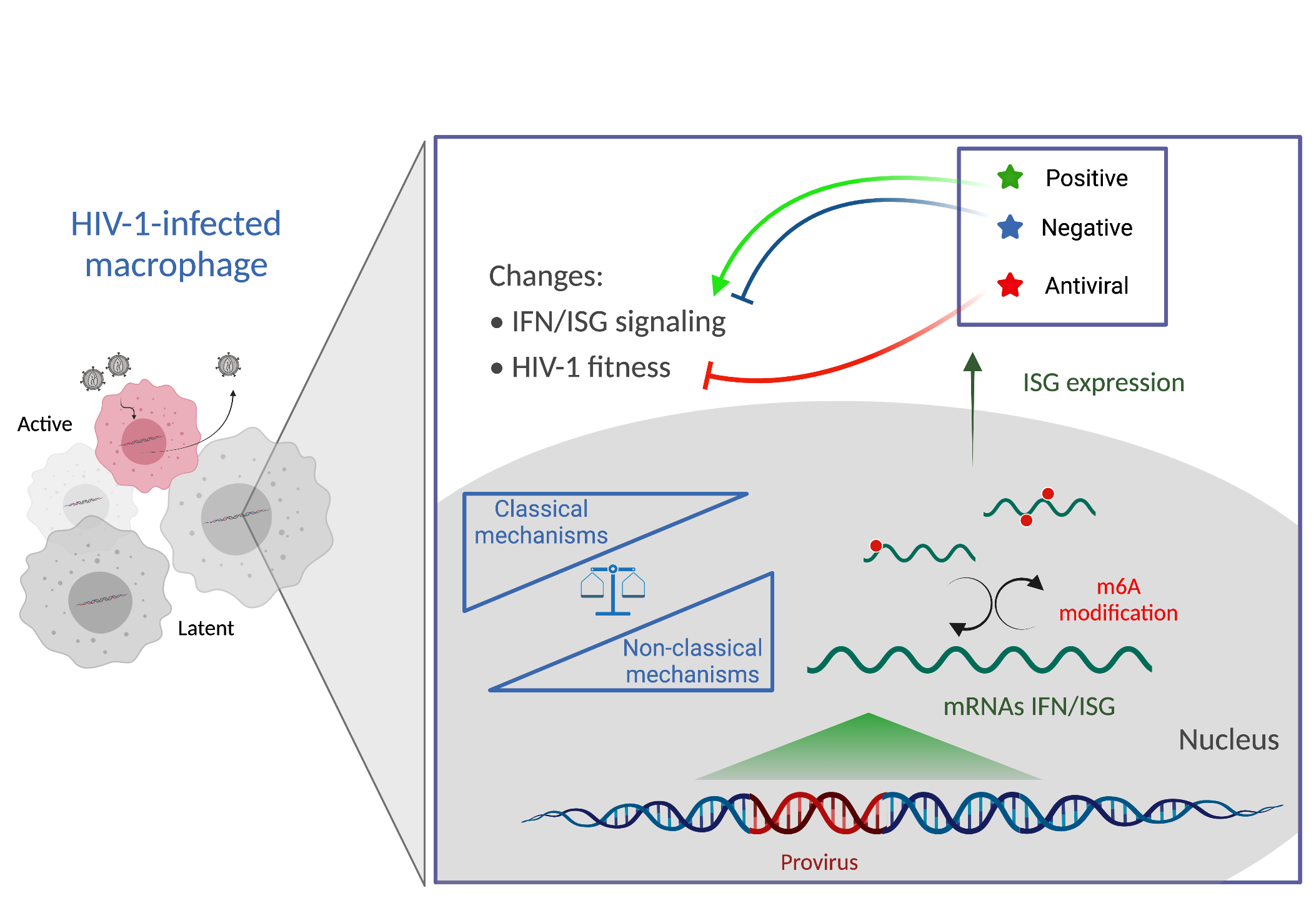
A key characteristic of Human immunodeficiency virus type 1 (HIV-1) infection is the generation of latent viral reservoirs, which have been associated with chronic immune activation and sustained inflammation. Macrophages play a protagonist role in this context since they are persistently infected while being a major effector of the innate immune response through the generation of type-I interferons (type I IFN) and IFN-stimulated genes (ISGs). The balance in the IFN signaling and the ISG induction is critical to promote a successful HIV-1 infection. Classically, the IFNs response is fine-tuned by opposing promotive and suppressive signals. In this context, it was described that HIV-1-infected macrophages can also synthesize some antiviral effector ISGs and, positive and negative regulators of the IFN/ISG signaling. Recently, epitranscriptomic regulatory mechanisms were described, being the N6-methylation (m6A) modification on mRNAs one of the most relevant. The epitranscriptomic regulation can affect not only IFN/ISG signaling, but also type I IFN expression, and viral fitness through modifications to HIV-1 RNA. Thus, the establishment of replication-competent latent HIV-1 infected macrophages may be due to non-classical mechanisms of type I IFN that modulate the activation of the IFN/ISG signaling network.
Keywords: HIV; latent HIV-1 reservoir; macrophages; IFN/ISG response; epitranscriptomic regulation HIV; latent HIV-1 reservoir; macrophages; IFN/ISG response; epitranscriptomic regulation
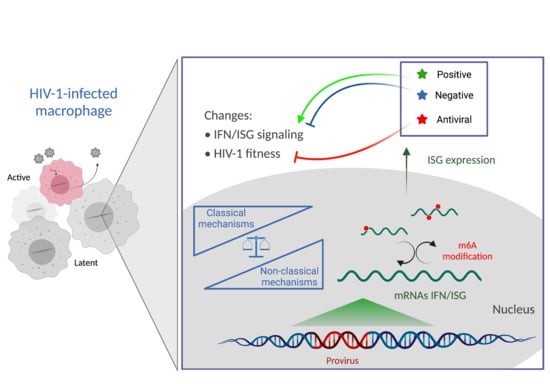
Graphical Abstract