Article

Enhancing Water Productivity and Forage Yield of Egyptian Clover Through Subirrigation Controlled Drainage and Groundwater Utilisation


by
Tarek Alshaal
1,2,3,*,
Nevien Elhawat
1,2,4,*,
Shimaa M. Elmahdy
3,
Ramy M. Khalifa
5,
Safwat Hussein Hatab
6,
Mahmoud M. A. Shabana
7 and
Mohamed Kh. El-Ghannam
7
1
Institute of Applied Plant Biology, Faculty of Agricultural and Food Sciences and Environmental Management, University of Debrecen, 4032 Debrecen, Hungary
2
Department of Food Biotechnology, Albert Kazmer Mosonmagyarovar Faculty, Széchenyi István University, 9026 Győr, Hungary
3
Soil and Water Department, Faculty of Agriculture, Kafrelsheikh University, Kafr Elsheikh 33514, Egypt
4
Faculty of Agriculture (for Girls), Al-Azhar University, Nasr City, Cairo 11884, Egypt
5
Soils and Water Department, Faculty of Agriculture, Damietta University, Damietta 34517, Egypt
6
Forage Crop Research Department, Field Crops Research Institute, Agricultural Research Center, Giza 12619, Egypt
7
Soils, Water and Environment Research Institute (SWERI), Agricultural Research Center, Giza 12619, Egypt
*
Authors to whom correspondence should be addressed.
Agronomy 2026, 16(9), 937; https://doi.org/10.3390/agronomy16090937 (registering DOI)
Submission received: 26 March 2026 / Revised: 28 April 2026 / Accepted: 4 May 2026 / Published: 5 May 2026

Abstract

Water scarcity is a critical constraint to sustainable agricultural production in arid and semi-arid regions. This study evaluated the effectiveness of subirrigation controlled drainage (SCD) systems in improving water use efficiency, soil conditions, and productivity of Egyptian clover (Trifolium alexandrinum L.) over two consecutive growing seasons (2022–2024). Three drainage treatments were investigated: subirrigation controlled drainage with water table depths of 0.4 m (SCD-0.4) and 0.8 m (SCD-0.8), and conventional free drainage at 1.2 m (SFD-1.2). The results demonstrated that SCD significantly reduced irrigation water requirements, achieving water savings of up to 27% under SCD-0.4 compared with conventional drainage. The shallow water table enhanced groundwater contribution to crop evapotranspiration, reaching over 40%, which improved soil moisture availability and reduced soil water depletion. Consequently, SCD-0.4 increased fresh and dry biomass yields by approximately 18% and significantly improved water productivity and irrigation water productivity. However, controlled drainage led to increased soil salinity due to reduced leaching, particularly in upper soil layers. Economic analysis revealed that SCD-0.4 achieved the highest net returns and water use profitability. Overall, controlled drainage at shallow depths represents an effective strategy to enhance water productivity, crop yield, and economic efficiency, although long-term salinity management must be considered for sustainable implementation.

1. Introduction

Climate change and increasing water scarcity pose significant challenges to agricultural sustainability in arid and semi-arid regions. Egypt is particularly vulnerable, as projections indicate that agricultural production could decline by up to 20% by 2050 due to these combined pressures [1]. Water availability remains the primary limiting factor affecting crop growth and productivity, with reduced water resources directly constraining agricultural output [2]. The situation is further aggravated by rapid population growth and ongoing climatic changes, which are expected to intensify water shortages across the Middle East and North Africa region [3].
Egypt relies almost entirely on the River Nile as its main freshwater source, with a fixed annual share of 55.5 × 10⁹ m3. This quantity is insufficient to satisfy the increasing demands of domestic, industrial, and agricultural sectors. Agriculture alone accounts for approximately 80–85% of the total water consumption in the country [4,5]. Under such conditions, improving water use efficiency and maximising crop productivity per unit of water have become critical priorities for sustainable agricultural development.
To address waterlogging and salinity problems, Egypt has implemented extensive subsurface drainage systems covering approximately 2.52 million hectares of cultivated land [6,7]. These systems are primarily based on free (traditional) drainage, where excess water is continuously removed without regulation. Although effective in preventing waterlogging, such systems often result in significant water and nutrient losses. The unregulated outflow of drainage water reduces the opportunity for crops to utilise shallow groundwater through capillary rise, leading to inefficient water use and nutrient depletion within the root zone [8].
At the global scale, drainage water management and reuse have been extensively investigated as key strategies to enhance agricultural water sustainability under increasing water scarcity. Controlled drainage systems have been widely implemented in North America, Europe, and Asia to regulate water table depth, reduce drainage outflows, and improve nutrient retention and water productivity [9]. In parallel, the reuse of agricultural drainage water has become an essential component of integrated water resource management, particularly in arid and semi-arid regions, where it can contribute significantly to irrigation supply [10]. Studies in countries such as the United States, China, India, and Pakistan have demonstrated that drainage water reuse can reduce freshwater withdrawals, increase crop water productivity, and support circular water use systems, although challenges related to salinity accumulation and water quality management remain [11,12,13]. Despite these advances, most previous research has focused either on drainage water quantity and quality or on major cereal crops, with comparatively limited attention given to the interaction between controlled drainage, shallow groundwater contribution, and forage crop productivity under heavy clay soils. Therefore, there remains a critical need to better understand how controlled drainage can be optimised to simultaneously enhance water use efficiency, groundwater utilisation, and crop yield under water-limited conditions, which forms the primary motivation and novelty of the present study.
Subirrigation controlled drainage (SCD) has emerged as a promising water management strategy to improve water use efficiency in irrigated agriculture. This technique involves regulating the outflow of subsurface drainage systems to control the water table depth and reduce unnecessary water losses. By maintaining water at optimal depths, controlled drainage enhances soil moisture availability while ensuring adequate aeration for plant roots [14]. The system operates by raising the water table through the adjustment of outlet structures, either by installing drains at shallower depths or by restricting outflow using control devices. This approach promotes upward water movement through capillary action, thereby supplementing crop water requirements and reducing drainage discharge [15,16].
Substantial reductions in drainage water losses have been reported under controlled drainage systems, ranging from 16% to 85% compared with conventional free drainage [17]. The effectiveness of controlled drainage is governed by its ability to regulate the water table depth, thereby reducing drainage outflow and increasing soil water storage within the root zone. By raising the outlet level, controlled drainage limits gravitational water losses and promotes upward capillary flow from shallow groundwater, which can contribute significantly to crop water requirements, particularly in fine-textured soils [18]. This mechanism not only enhances water use efficiency but also reduces nutrient losses through drainage discharge. In addition to experimental studies, modelling approaches have played a crucial role in understanding and optimising controlled drainage systems. Process-based hydrological models, such as DRAINMOD, have been widely used to simulate water table dynamics, drainage flow, soil water balance, and crop response under different drainage management scenarios [19,20]. These models are based on water balance principles and can predict the effects of drainage design, soil properties, and climatic conditions on system performance. For example, DRAINMOD has been successfully applied to evaluate controlled drainage impacts on hydrology, crop yield, and nutrient transport across different regions and scales [21]. Recent modelling studies have further highlighted the importance of integrating field experiments with simulation tools to improve the prediction of water fluxes, including lateral seepage and groundwater contributions, under controlled drainage conditions. In Egypt, drainage water reuse already contributes approximately 13.1 billion cubic metres annually to the national water supply, highlighting its strategic importance in water resource management. Moreover, the quality of drainage water in certain regions, including Kafr El-Sheikh Governorate, is generally suitable for irrigation purposes, falling within acceptable limits according to international guidelines [22,23].
Field studies conducted under different agro-environmental conditions have demonstrated the potential benefits of controlled drainage. Investigations comparing controlled and conventional drainage systems have shown that free drainage often leads to lower water use efficiency, reduced crop yields, and higher volumes of poor-quality drainage water [24]. While controlled drainage may result in a slight increase in soil salinity under certain conditions, its overall impact on crop productivity is generally positive or neutral, depending on soil characteristics and management practices. Yield increases of approximately 5–15% have been reported under controlled drainage systems compared with traditional drainage methods [17,25,26].
Egyptian clover (Trifolium alexandrinum L.) is one of the most important forage crops in Egypt, serving as the primary winter feed for livestock for nearly six months each year. The crop is cultivated on a large scale, with approximately 0.71 million hectares planted during the 2022/2023 growing season [27]. It is valued for its rapid growth, high nutritional quality, and minimal risk of causing bloat in animals. Optimising its productivity under limited water resources is therefore essential for maintaining livestock production systems.
Agronomic practices, particularly irrigation management and cutting regimes, play a crucial role in determining clover yield and water use efficiency. Variations in cutting intervals have been shown to significantly influence plant growth and biomass production, with shorter intervals often enhancing fresh and dry forage yields [28]. Irrigation strategies also affect both yield and water productivity, where higher irrigation levels tend to maximise biomass production, while moderate deficit irrigation can improve water use efficiency [29]. Differences in cultivation methods, such as dry, semi-dry, and wet systems, further influence water use efficiency and yield performance. Additionally, reductions in irrigation frequency can negatively impact reproductive development, leading to significant yield losses under moisture stress conditions [30].
Despite the growing body of research on irrigation and drainage management, limited attention has been given to the interaction between controlled drainage and groundwater contribution in clover production systems. Understanding how water table management influences crop water uptake, soil salinity dynamics, and overall productivity is essential for developing integrated water management strategies under water-scarce conditions.
The present study aims to evaluate the effects of controlled drainage and irrigation management on soil salinity, water use efficiency, groundwater contribution, and the yield performance of Egyptian clover (Trifolium alexandrinum var. El-Halaly). It is hypothesised that raising the water table through controlled drainage can enhance water availability within the root zone, reduce irrigation requirements, and improve water productivity without adversely affecting crop yield. This hypothesis is based on the premise that shallow groundwater can partially meet crop water demand through capillary rise, thereby increasing overall water use efficiency while maintaining favourable soil conditions. In the context of global research on agricultural water management, the present study provides several novel contributions. While previous studies have demonstrated the potential of controlled drainage to reduce water losses and improve water quality, most have focused on temperate regions and cereal-based systems, with limited attention to forage crops and arid environments. Moreover, the role of shallow groundwater as a direct contributor to crop evapotranspiration under controlled drainage has rarely been quantified under field conditions, particularly in heavy clay soils. This study advances current knowledge by (i) quantifying groundwater contribution to evapotranspiration under different controlled drainage depths, (ii) evaluating the combined effects of drainage management on water productivity, soil salinity dynamics, and forage yield, and (iii) integrating agronomic, hydrological, and economic analyses within a single experimental framework. The results provide new insights into the optimisation of water table management for improving water use efficiency while maintaining crop productivity under water-scarce conditions. These findings are of broad relevance to irrigated agriculture worldwide, particularly in regions facing increasing pressure on water resources and the need for sustainable intensification.

2. Materials and Methods

2.1. Study Area, Environmental Conditions, and Site Justification

Three open-field experiments were conducted at the Sakha Experimental Station, Kafr El-Sheikh district, Egypt (31°15′51″ N, 30°47′06″ E), during two consecutive winter growing seasons (2022–2023 and 2023–2024). The experimental site is located in the Middle Nile River Delta, a region selected based on several agro-environmental and hydrological considerations.
The climate of the study area is classified as arid Mediterranean, characterised by low precipitation concentrated in the winter months. During the experimental period (October to April), total rainfall reached 119.45 mm in the first season and 126.35 mm in the second season (Table 1). Additional meteorological parameters, including temperature, relative humidity, wind velocity, and pan evaporation, are presented in Table 1.
The region is equipped with a subsurface free drainage (SFD) system installed at a depth of 1.2 m below the soil surface. Irrigation water is supplied from the Nile River, characterised by high quality with an electrical conductivity of approximately 0.5 dS/m. Flood irrigation is the dominant irrigation method used in the area.
The hydrogeological setting is dominated by the quaternary Nile Delta aquifer, which is a renewable shallow aquifer system underlying the region. This aquifer is semi-confined due to the presence of an upper clay layer and contributes significantly to national groundwater resources, accounting for approximately 85% of groundwater abstraction (6.1 Mm3 annually) [31]. Recharge occurs primarily through seepage from the Nile River, irrigation canals, and drainage networks [31,32,33]. The aquifer is characterised by high productivity, shallow well depths, and relatively low pumping costs, making it highly relevant for agricultural water management.

2.2. Soil Sampling and Physicochemical Characterisation

Prior to the establishment of the experiments, soil samples were collected from four depth intervals (0–30, 30–60, 60–90, and 90–120 cm) to determine baseline physicochemical properties (Table 2). The soil was classified as clay in texture and identified as Typic Entisols according to standard soil classification systems [34]. Particle size distribution was determined using the pipette method [35], and soil texture classification was conducted following the USDA system [34]. Soil bulk density was measured using the core sampling method [36]. Soil reaction (pH) was measured in a 1:2.5 soil-to-water suspension, while electrical conductivity (ECe), as well as soluble cations and anions, was determined in the saturated soil paste extract following standard analytical procedures [37]. Soil hydro-physical properties, including field capacity (FC) and permanent wilting point (PWP), were determined using the pressure plate extractor method (Soilmoisture Equipment Corp., Goleta, CA, USA) at applied pressures of 0.33 and 15 bars, respectively, and were expressed as volumetric percentages [38].

2.3. Experimental Design and Drainage Treatments

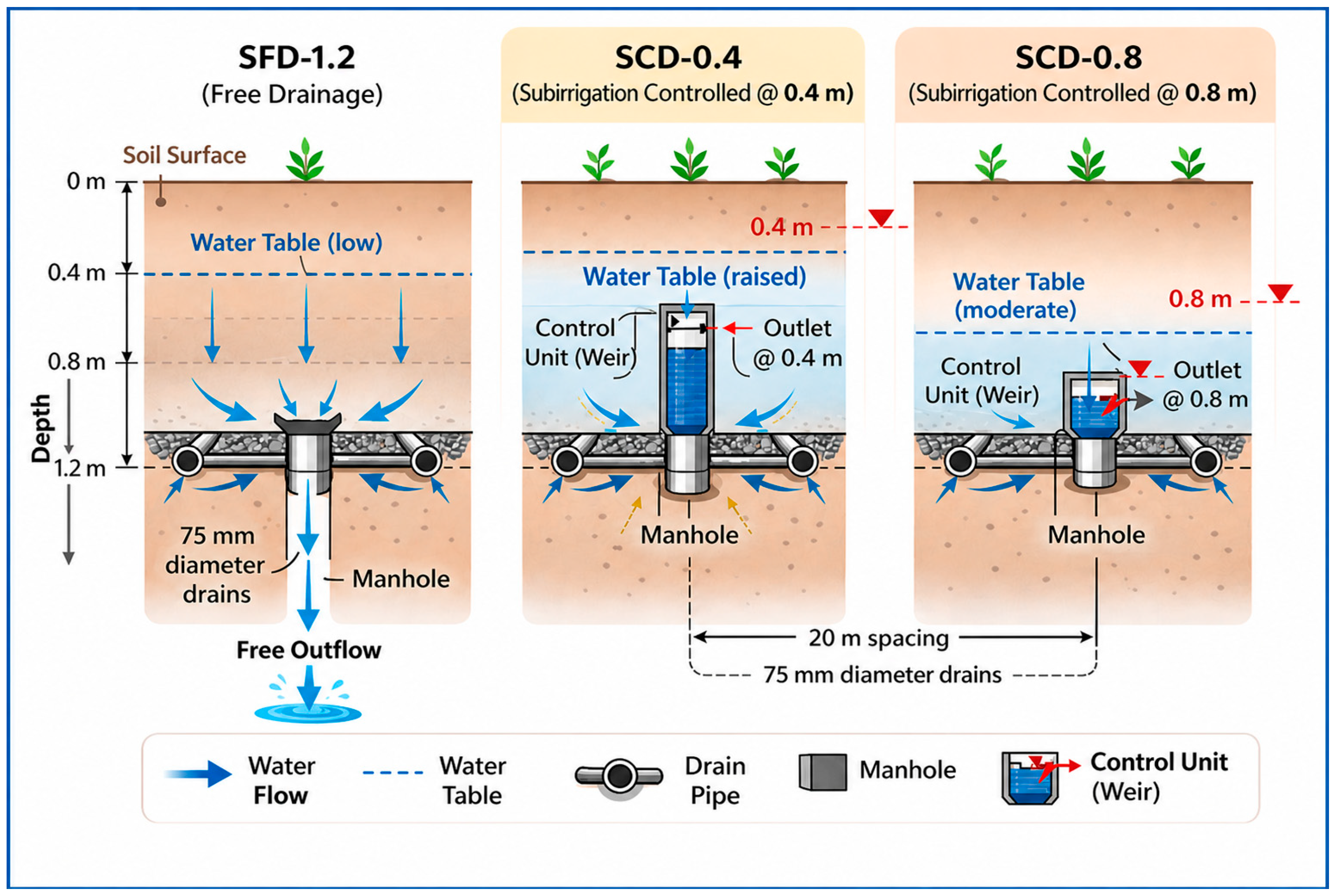
The experimental layout consisted of three independent field trials within the same agricultural farm, each covering an area of 900 m2. The treatments were defined based on different drainage conditions and water table management strategies. One field was maintained under subsurface free drainage (SFD-1.2), where the water table was kept at 1.2 m below the soil surface. The other two fields were subjected to subirrigation controlled drainage (SCD) treatments, where the water table was regulated at depths of 0.8 m (SCD-0.8) and 0.4 m (SCD-0.4) below the soil surface using adjustable weirs (Figure 1). Each field was equipped with a separate drainage control system connected to a manhole structure, allowing precise regulation of the water table. Drainage laterals with an internal diameter of 75 mm were installed at a spacing of 20 m. The outlet elevation was kept constant throughout the growing seasons. Each drainage treatment was subdivided into three plots (300 m2 each; 12 m × 25 m), forming the experimental replicates.

2.4. Crop Establishment and Agronomic Management

Seeds of Egyptian clover (Trifolium alexandrinum L., var. El-Halaly) were obtained from the Field Crops Research Institute, Agricultural Research Centre, Giza, Egypt. Sowing was carried out on 1 October 2022 and 2 October 2023 at a seeding rate of 60 kg ha−1. Fertiliser applications were conducted according to national agronomic recommendations. Phosphorus was applied before sowing at a rate of 475 kg ha−1 as calcium superphosphate (15.5% P2O5), while nitrogen was applied after germination at a rate of 35 kg ha−1 as ammonium nitrate (33.5% N) during the first irrigation. The selection of clover as the experimental crop was based on its root system characteristics, which include a taproot with well-developed lateral roots. Rooting depth typically ranges between 0.6 and 0.9 m, but may extend up to 1.2 m under favourable soil conditions [28]. This rooting depth aligns with the SFD-1.2 treatment and provides an opportunity to evaluate plant responses to elevated water tables under controlled drainage conditions.

2.5. Irrigation Management and Water Application Calculations

At the initial irrigation event, all treatments received an equal depth of water, applied through surface irrigation, to ensure uniform germination and proper crop establishment. The amount of water was estimated using the weir, and the number of irrigations was the same in all treatments, but the quantities added differed due to the difference in soil moisture. A calibrated water flow metre was installed in each experimental field to accurately quantify the volume of applied irrigation water. Subsequent irrigation scheduling was based on soil moisture depletion. Irrigation was applied when 50% of the available water content was depleted in the SFD-1.2 treatment, corresponding to a soil moisture level of 30.84%. At this threshold, all treatments were irrigated to restore soil moisture to field capacity. Soil moisture was monitored using time-domain reflectometry (TDR) sensors (HH2 Moisture Metre, Delta-T Devices, Cambridge, UK) as a rapid field indicator, while precise measurements were obtained using the gravimetric method (Section 2.8).
The irrigation applied (IW) was calculated using the following equation [39]:
I W = ( F C M C ) 100 × B D × D
where
  • IW = irrigation applied (cm),
  • FC = soil field capacity (% by weight),
  • MC = soil moisture content before irrigation (% by weight),
  • BD = soil bulk density (g cm−1),
  • D = effective root zone depth (cm), set at 60 cm.
An additional 10% of the calculated irrigation water was applied as a leaching requirement to prevent salt accumulation within the root zone.
Water discharge over the weir was determined using the following relationship:
Q = C × L × H 3 / 2
where
  • Q = discharge rate (m3 s−1),
  • L = weir crest length (m),
  • H = water head above the weir crest (m),
  • C = discharge coefficient (1.84 m1/2 s−1).
During irrigation, a constant effective head of 10 cm was maintained, resulting in a flow rate of approximately 4 L s−1 m−1 width [40].
Seasonal applied water (AW) was calculated according to the following equation [41]:
A W = I W + E R + G W C
where
  • AW = total seasonal applied water (m3 ha−1),
  • IW = irrigation water applied,
  • ER = effective rainfall,
  • GWC = groundwater contribution.

2.6. Drainage Monitoring and Water Balance Components

Drain discharge was monitored after each irrigation or rainfall event. Measurements were taken twice daily until drainage flow became negligible. The volume of drainage water was determined using a calibrated tank and a stopwatch method [24,42]. Cumulative drainage water over the growing season was expressed in mm/ha. Drainage water samples were collected periodically throughout the day for further analysis.
To provide a comprehensive assessment of soil water dynamics, a complete root-zone water balance equation was considered in this study. The general form of the water balance is expressed as:
Δ W = ( I W + E R + G W C ) ( E T c + D + D P )
where
  • ΔW = change in soil water storage,
  • IW = irrigation applied,
  • ER = effective rainfall,
  • GWC = groundwater contribution,
  • ETc = actual crop evapotranspiration,
  • D = drainage discharge,
  • DP = deep percolation
where all inflow and outflow components affecting soil water storage are explicitly accounted for. This formulation ensures that changes in soil moisture reflect the combined effects of irrigation, rainfall, groundwater contribution, evapotranspiration, drainage, and deep percolation.
In the present study, effective rainfall was negligible during most of the growing period, while deep percolation was assumed minimal due to controlled irrigation and soil conditions. Therefore, the water balance was simplified for practical estimation of groundwater contribution and soil moisture depletion within the monitored root zone.

2.7. Water Table Monitoring

Water table fluctuations were monitored using three observation wells installed in each treatment. Each well consisted of a polyethylene tube (5 cm diameter, 200 cm length), with the lower 30 cm perforated and covered with a permeable screen to prevent clogging. The wells were installed to a depth of 140 cm below the soil surface, leaving 60 cm above ground level. Water table depth was measured using a sounder device at regular intervals, and monthly averages were calculated for each treatment. The measurements were conducted using a water level sounder device with a measurement resolution of 1.0 mm and an accuracy of ±1.0 mm over the entire measured depth. The probe had a diameter of 14 mm and was shrouded to prevent false triggering during operation. These specifications ensure reliable detection of water level fluctuations within the observation wells.

2.8. Crop Water Use and Productivity Indices

Soil moisture sampling was limited to the 0–60 cm soil profile based on the rooting characteristics of Egyptian clover, which is known to have a relatively shallow and fibrous root system. Previous studies have shown that the majority of root biomass and water uptake for clover and similar forage legumes is concentrated within the upper 0–60 cm of the soil profile, with significantly reduced root density below this depth (e.g., <20–30% contribution) [28].
As a result, soil moisture changes below 60 cm contribute minimally to crop water uptake and evapotranspiration under typical irrigation and soil conditions. Therefore, restricting measurements to the 0–60 cm layer provides a reliable estimate of root-zone soil water dynamics and crop evapotranspiration while avoiding unnecessary sampling effort at depths with negligible plant water extraction.
Consumptive water use (CU), representing actual crop evapotranspiration (ETc), was calculated using the soil moisture depletion method [43]:
C U = ( ( θ 2 θ 1 ) 100 × B D × D )
where
  • CU = consumptive use (cm),
  • θ2 = soil moisture content 48 h after irrigation (%),
  • θ1 = soil moisture content before the next irrigation (%),
  • BD = bulk density of soil layer (g cm−3),
  • D = Effective root zone depth (cm), set at 60 cm.
Water productivity (WP) was calculated as follows [44]:
W P = Y E T c
where
  • WP = water productivity (kg m−3),
  • Y = fresh yield (kg/ha),
  • ETc = seasonal crop water consumption (m3 ha−1).
Productivity of irrigation water (PIW) was calculated using:
P I W = Y W A
where
  • PIW = irrigation water productivity (kg m−3),
  • WA = seasonal applied water (m3 ha−1).
Groundwater contribution (GWC; mm day−1) was estimated as the difference between the crop evapotranspiration (ETc) and the observed soil moisture depletion (SMD):
G W C = E T c S M D
where
  • ETc = represents the crop water requirement (mm month−1) estimated from meteorological data using standard procedures “crop evapotranspiration”, and calculated as:
E T c = E T o × K c
  • ETo = reference evapotranspiration estimated using the modified Blaney–Criddle method [45],
  • Kc = crop coefficient,
  • SMD = represents the net depletion of soil water within the monitored root zone (0–60 cm), as measured in situ.
The SMD was expressed as a percentage (%) of total available water within the root zone. It was calculated based on the difference between soil moisture content at field capacity (FC) and the measured soil moisture content, relative to the available water (AW), as follows:
SMD ( % ) = ( θ F C θ ) ( θ F C θ W P ) × 100
where
  • θ F C = volumetric soil moisture at field capacity,
  • θ W P = volumetric soil moisture at wilting point,
  • θ = measured volumetric soil moisture content.
The SMD was calculated in volumetric terms and expressed as water depth (mm) and subsequently converted to m3 ha−1 for consistency with irrigation and water balance components.
S M D ( m 3 h a 1 ) = S M D ( % ) 100 × A W ( m m ) × 10
In this context, SMD reflects the actual change in soil water storage over time, integrating all incoming and outgoing fluxes within the root zone. When ETc exceeds the measured SMD, the difference is attributed to an upward flux from shallow groundwater (capillary rise), which partially compensates for crop water demand. This approach assumes negligible deep percolation and surface runoff during the measurement intervals and is consistent with simplified root-zone water balance methods commonly used under shallow water table conditions [46]. Under these assumptions, groundwater contribution is inferred indirectly as the residual required to satisfy crop evapotranspiration demand.
To ensure transparency in the calculation of GWC, a simplified root-zone water balance approach was applied. In this framework, ETc represents the atmospheric water demand estimated from meteorological data, while SMD represents the observed change in soil water storage within the monitored root zone (0–60 cm). Groundwater contribution was therefore estimated as a residual term, representing the additional water required to satisfy crop evapotranspiration when ETc exceeds the measured SMD. This method assumes that surface runoff and deep percolation are negligible or minimised during the observation period due to controlled irrigation practices. Although this approach does not directly measure capillary rise, it is widely used in field studies where direct quantification of groundwater flux is not feasible. Under such conditions, GWC provides a reasonable estimate of upward water movement from shallow groundwater into the root zone.
In this study, the gravimetric method was considered the standard reference for determining soil moisture content and was used for all calculations of SMD. Time-domain reflectometry (TDR) measurements were used only as a rapid field assessment tool to monitor temporal variations in soil moisture and to verify the consistency of gravimetric measurements. TDR readings were not directly used in quantitative calculations but served as a supplementary method for cross-checking field observations.

2.9. Salt Balance Assessment

Salt balance was determined by calculating the difference between salt inputs and outputs during the growing season. Salt added through irrigation water was calculated as:
S a l t a d d e d = I W × E C i w × 0.64
where
  • IW = irrigation water applied (m3/ha),
  • EC(iw) = electrical conductivity of irrigation water (dS m−1).
Salt removed via drainage water was calculated as:
S a l t r e m o v e d = D W × E C d w × 0.64
where
  • DW = drainage water (m3/ha),
  • EC(dw) = electrical conductivity of drainage water (dS m−1).
Salt residual was determined as:
S a l t r e s i d u a l = S a l t a d d e d S a l t r e m o v e d

2.10. Crop Growth and Yield Measurements

Four harvests were conducted during each growing season, beginning on April 29 (first season) and April 30 (second season). Fresh forage yield was determined by harvesting and weighing biomass per plot, followed by conversion to tonnes per hectare. Subsamples (100 g) were oven-dried at 70 °C until constant weight to determine dry yield. Plant height was measured from the soil surface to the top of the plant using ten randomly selected plants per plot.

2.11. Water Savings

Water savings were calculated as a percentage reduction in irrigation water applied under controlled drainage relative to free drainage conditions, using the following equation:
Water   savings   ( % ) = ( I F D I C D ) I F D × 100
where
  • I F D = total irrigation water applied under free drainage treatment (m3 ha−1),
  • I C D = total irrigation water applied under controlled drainage treatment (m3 ha−1).
This calculation quantifies the relative reduction in irrigation water use achieved through controlled drainage management.

2.12. Economic Analysis

Economic performance was evaluated by calculating net revenue and return per unit of applied irrigation water. These indices were derived from yield data and total water input to assess the economic efficiency of each treatment.

2.13. Statistical Analysis

Statistical analysis was conducted to evaluate the effects of irrigation treatments on measured variables, including SMD, ETc, and GWC. Data were analysed using analysis of variance (ANOVA) under a randomised complete block design. Treatment means were compared using the least significant difference (LSD) test at the 5% probability level (p ≤ 0.05).
All measured variables were expressed as the mean values of three independent replicates for each treatment. Prior to conducting statistical comparisons, the dataset was examined to ensure compliance with the assumptions of parametric analysis. The normality of data distribution was evaluated using appropriate normality tests (e.g., Shapiro–Wilk test), while the homogeneity of variances among treatments was assessed using variance homogeneity tests (e.g., Levene’s test). These preliminary analyses were performed to confirm the suitability of the data for analysis of variance (ANOVA). Following validation of these assumptions, one-way analysis of variance (ANOVA) was applied to determine the significance of treatment effects on the studied parameters. When significant differences were detected, mean comparisons were performed using Duncan’s multiple range test at the appropriate probability level to separate treatment means [47]. All statistical analyses were carried out using SAS 9.3 software.

3. Results

3.1. Seasonal Water Application Under Drainage Systems

Seasonal applied water (WA) to Egyptian clover varied significantly among drainage systems in both seasons, with the lowest values consistently recorded under SCD-0.4 and the highest under SFD-1.2 (Table 3). During the 2022–2023 season, irrigation water (IW) amounted to 4507, 5723, and 6545 m3 ha−1 under SCD-0.4, SCD-0.8, and SFD-1.2, respectively, resulting in corresponding WA values of 5444, 6582, and 7380 m3 ha−1, while groundwater contribution (GWC) was observed only under controlled drainage treatments (101 and 23 m3 ha−1 for SCD-0.4 and SCD-0.8). A similar trend appeared in the 2023–2024 season, where IW reached 4724, 5950, and 6925 m3 ha−1 and WA reached 5710, 6852, and 7809 m3 ha−1 under SCD-0.4, SCD-0.8, and SFD-1.2, respectively, with GWC values of 103 and 19 m3 ha−1 recorded only for the controlled drainage systems. Effective rainfall (ER) remained statistically insignificant between treatments within each season (836 and 884 m3 ha−1), whereas IW and WA differed significantly (p ≤ 0.05). Water saving was markedly higher under SCD-0.4 compared with SCD-0.8 in both seasons, reaching 1937 and 2099 m3 ha−1 (26.2% and 26.9%) versus 797 and 957 m3 ha−1 (10.8% and 12.3%), respectively.

3.2. Soil Moisture Depletion Under Drainage Systems

Seasonal SMD values differed significantly among drainage systems in both growing seasons, with the highest depletion consistently recorded under SFD-1.2 and the lowest under SCD-0.4 (Table 4). During the 2022–2023 season, seasonal SMD reached 4536, 4849, and 5457 m3 ha−1 under SCD-0.4, SCD-0.8, and SFD-1.2, respectively, while in 2023–2024, the corresponding values were 44.71, 47.89, and 54.64 m3 ha−1. Monthly SMD followed a similar pattern in most cases across both seasons, where SFD-1.2 generally produced the highest depletion values, particularly during the late growth stages (March and April), whereas SCD-0.4 maintained the lowest depletion throughout most months. In the 2022–2023 season, the highest monthly depletion values were observed in April (800, 1061, and 1245 m3 ha−1, while in 2023–2024, the same trend persisted, with April values reaching 768, 918, and 1167 m3 ha−1 under SCD-0.4, SCD-0.8, and SFD-1.2, respectively. The statistical analysis indicated significant differences (p ≤ 0.05) among drainage treatments for all monthly and seasonal SMD values in both seasons.

3.3. Water Productivity and Consumptive Use

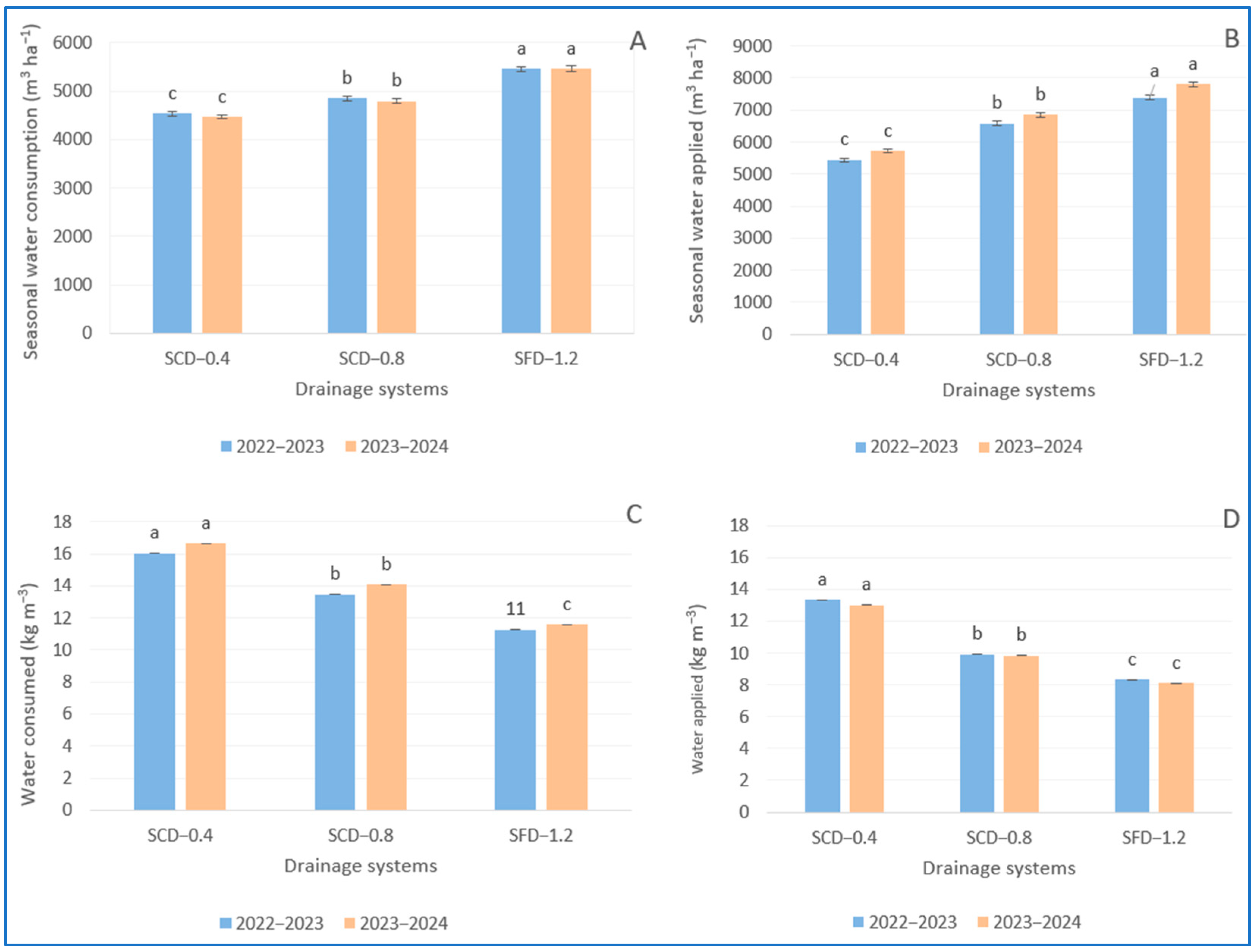
Seasonal water consumptive use (CU) and seasonal water applied (WA) increased significantly with increasing drainage depth in both growing seasons, while water productivity (WP) and productivity of irrigation water (PIW) showed the opposite trend (Figure 2). The highest CU values were recorded under SFD-1.2, reaching 5455 and 5462 m3 ha−1 during the 2022–2023 and 2023–2024 seasons, respectively, followed by SCD-0.8 (4848 and 4787 m3 ha−1), whereas the lowest values were observed under SCD-0.4 (4534 and 4469 m3 ha−1). A similar pattern was found for WA, where SFD-1.2 recorded the highest values (7381 and 7809 m3 ha−1), followed by SCD-0.8 (6583 and 6853 m3 ha−1), while SCD-0.4 recorded the lowest applied water (5444 and 5711 m3 ha−1) in the respective seasons. In contrast, WP values were significantly higher under SCD-0.4, reaching 16 and 17 kg m−3 water consumed in the first and second seasons, respectively, compared with 13 and 14 kg m−3 under SCD-0.8 and 11 and 12 kg m−3 under SFD-1.2. Likewise, PIW followed the same trend, where SCD-0.4 achieved the highest values (13 kg m−3 in both seasons), followed by SCD-0.8 (10 kg m−3), while SFD-1.2 recorded the lowest values (8 kg m−3). The observed differences in water application and groundwater contribution among drainage treatments corresponded with variations in crop yield, where treatments with lower applied water and higher groundwater contribution (SCD-0.4) were associated with higher fresh and dry biomass production compared with the other treatments.

3.4. Effect of Drainage Systems on Clover Yield and Growth

Plant height increased significantly with deeper drainage levels, where SFD-1.2 consistently produced the tallest plants (58.67 and 59.60 cm), followed by SCD-0.8, while SCD-0.4 recorded the shortest plants in both seasons (Table 5). In contrast, total fresh and dry yields showed an opposite trend, with SCD-0.4 achieving the highest values (72.6 and 74.3 ton ha−1 fresh yield; 14.6 and 15.1 ton ha−1 dry yield) across the two seasons, significantly outperforming the other treatments. SCD-0.8 ranked second for both yield parameters, whereas SFD-1.2 recorded the lowest yields despite its superiority in plant height. These trends were consistent over both growing seasons, and all measured traits were significantly affected by drainage systems at the 0.01 probability level. These yield patterns were observed alongside differences in soil salinity among treatments, where higher biomass production under SCD-0.4 occurred despite relatively higher salinity levels compared with the deeper drainage treatment.

3.5. Effect of Drainage Systems on Soil Salinity

Soil salinity (ECe) was significantly influenced by drainage systems across all soil depths in both seasons, with consistent trends observed (Table 6). The SCD-0.4 treatment recorded the highest salinity values at all depths, reaching averages of 4.45 and 4.62 dS m−1 in 2022–2023 and 2023–2024, respectively, while SFD-1.2 resulted in the lowest salinity levels, with corresponding averages of 3.50 and 3.46 dS m−1. SCD-0.8 showed intermediate values between the two treatments. Salinity generally increased with soil depth, particularly under SCD-0.4, where the highest values were observed in the 90–120 cm layer (4.75 and 5.00 dS m−1 for the two seasons). In contrast, SFD-1.2 maintained relatively lower salinity throughout the profile, indicating more effective salt leaching. These differences were statistically significant at p ≤ 0.05 for all depths and seasons. The variation in salinity among drainage treatments coincided with differences in drainage outflow and applied water, where treatments with reduced SCD-0.4 exhibited higher salinity levels compared with treatments with greater drainage volumes.

3.6. Effect of Drainage Systems on Salt Balance Dynamics

Increasing the drainage depth from SCD-0.4 to SFD-1.2 consistently resulted in higher irrigation water inputs, salt addition, and drainage volumes across both growing seasons, with statistically significant differences observed among treatments (Table 7). In the 2022–2023 season, irrigation water increased from 5444 to 7381 m3 ha−1, accompanied by a corresponding rise in salt added from 2091 to 2834 kg ha−1, while drainage water and salt removed also showed significant increments, indicating enhanced leaching under deeper drainage conditions. Despite this, salt residuals remained highest under SFD-1.2, suggesting that increased inputs outweighed removal. A similar trend was recorded in 2023–2024, where irrigation water ranged from 5711 to 7809 m3 ha−1 and salt added from 2193 to 2999 kg ha−1, with drainage water and salt removal again significantly increasing with drainage depth. Notably, salt residuals differed significantly among all treatments in the second season, with the lowest values under SCD-0.4 and the highest under SFD-1.2. In contrast, the electrical conductivity of irrigation and drainage water showed no significant variation among treatments in both seasons, indicating that differences in salt balance were primarily driven by water volume rather than salinity concentration. Overall, deeper drainage systems enhanced both salt input and removal, but also led to greater residual salt accumulation in the soil.

3.7. Effect of Drainage Depth on Groundwater Contribution

Groundwater contribution (GWC) to evapotranspiration of Egyptian clover varied markedly with drainage depth, with the shallowest water table (SCD-0.4) consistently producing the highest values in both seasons (Table 8). Under SCD-0.4, GWC reached 1.01 and 1.03 cm, accounting for 40.4% and 42.4% of ETC in the first and second seasons, respectively. In contrast, the intermediate drainage level (SCD-0.8) resulted in a sharp decline in groundwater contribution, with values of 0.23 cm (8.9%) and 0.19 cm (8.0%) across the two seasons, reflecting limited upward water movement from deeper water tables. No groundwater contribution was observed under the deepest drainage treatment (SFD-1.2), where GWC remained at 0.0 cm (0.0%) in both seasons, confirming that deeper water tables effectively eliminate capillary rise to the root zone. Overall, the results demonstrate a clear inverse relationship between drainage depth and groundwater contribution, with consistent patterns observed across both growing seasons.

3.8. Drainage Outflow and Water Table Dynamics Under Different Drainage Systems

A total of nine irrigations were applied throughout the growing season; however, only five irrigations involved flow estimation and groundwater monitoring. The volume of water applied was calculated for each irrigation event. Drainage outflow and water table depth exhibited clear differences among drainage systems across all irrigation events, with deeper drainage consistently resulting in greater outflow and deeper water tables (Table 9). The SFD-1.2 treatment recorded the highest drainage outflow rates throughout all irrigations, with totals of 16.96, 19.97, 20.63, 18.73, and 18.95 mm day−1 for the first through fifth irrigations, respectively, culminating in a significantly higher cumulative outflow (95.24 mm day−1) compared with the other treatments. In contrast, SCD-0.8 showed moderate drainage behaviour, with total outflows ranging from 6.00 to 8.00 mm day−1 per irrigation and a cumulative value of 35.85 mm day−1, while SCD-0.4 consistently produced the lowest outflow values, ranging between 3.10 and 6.20 mm and totalling 22.4 mm. Water table levels followed an opposite trend, remaining shallowest under SCD-0.4 and progressively deeper under SCD-0.8 and SFD-1.2 across days after irrigation, reflecting the imposed drainage depths. Additionally, drainage outflow generally decreased with time after each irrigation event in all treatments. The statistical analysis confirmed significant differences among drainage systems for total drainage outflow in each irrigation, highlighting the strong influence of drainage depth on both water table dynamics and drainage losses.

3.9. Economic Performance Under Different Drainage Systems

Economic performance varied noticeably among drainage systems, with SCD-0.4 consistently delivering the highest returns and efficiency across both seasons (Table 10). In 2022–2023, SCD-0.4 achieved the greatest fresh yield (72.6 t ha−1), generating a total revenue of 2178 US$ ha−1 and a net revenue of 1607 US$ ha−1, compared with 1385 and 1244 US$ ha−1 under SCD-0.8 and SFD-1.2, respectively. This advantage was maintained in 2023–2024, where SCD-0.4 produced 74.3 t ha−1 and a net revenue of 1745 US$ ha−1, exceeding both SCD-0.8 (1525 US$ ha−1) and SFD-1.2 (1391 US$ ha−1). Despite identical total production costs across treatments within each season, differences in applied water volumes were evident, with SCD-0.4 requiring the least water (5444 and 5711 m3 ha−1), while SFD-1.2 required the most (7383 and 7809 m3 ha−1). Consequently, net revenue per unit of water was highest under SCD-0.4 (0.30 and 0.31 US$ m−3), followed by SCD-0.8 and SFD-1.2. Economic efficiency also followed the same trend, with SCD-0.4 recording the highest values (2.81 and 2.76), indicating superior profitability relative to costs, whereas SFD-1.2 consistently showed the lowest efficiency. Overall, shallower controlled drainage improved both productivity and water use profitability compared with deeper or conventional drainage systems.

4. Discussion

The observed reduction in irrigation water requirements and enhanced groundwater contribution under controlled drainage can be attributed to improved water retention within the soil profile and increased capillary rise from shallow water tables. By restricting drainage outflow, controlled drainage systems maintain higher soil moisture levels, allowing crops to utilise both applied irrigation water and shallow groundwater more effectively. This process is particularly pronounced in fine-textured soils, where capillary continuity facilitates upward water movement into the root zone. Consequently, the interaction between water table depth and soil hydraulic properties plays a critical role in determining water availability and crop water uptake.
The results of the present study provide robust evidence that SCD, particularly at a shallow water table depth of 0.4 m, constitutes a highly effective strategy for improving water use efficiency, crop productivity, and economic performance in Egyptian clover systems cultivated on heavy clay soils. Across both growing seasons, the substantial reduction in seasonal applied water under SCD treatments compared with conventional free drainage clearly demonstrates the capacity of controlled drainage to conserve water resources under arid and semi-arid conditions. The SCD drainage has demonstrated substantial water-saving benefits in arid regions with clay and clayey soils, with numerous field studies reporting clear and quantified reductions in irrigation demand. In the heavy clay soils of the Northern Nile Delta, raising the drainage outlet to 0.4 m reduced irrigation water requirements by 42.0%, while an outlet level of 0.8 m achieved savings of 19.9% compared with free drainage. These adjustments were also associated with reduced drainage outflow and increased contributions of shallow groundwater to crop evapotranspiration [16]. Comparable levels of water conservation have been observed in other arid Egyptian clay soils, where subsurface drip irrigation, used as a water-table-related management strategy, reduced irrigation water use by 31.58% relative to flood irrigation, while deficit subsurface and surface drip systems achieved even greater savings of 48.68% and 45.82%, respectively [48]. More broadly, research in arid irrigated systems has confirmed that controlled drainage reduces drainage volumes and enhances soil water retention, supporting the mechanism whereby elevated outlet levels limit gravitational water losses and improve soil moisture availability under water-scarce conditions [49]. This reduction in irrigation requirement can be mechanistically explained by the restriction of drainage outflow, which enhances water retention within the soil profile and prolongs its availability to plant roots, thereby reducing the need for frequent irrigation applications.
The relatively small GWC observed under the SCD 0.8 treatment, despite substantially higher irrigation inputs, can be explained by changes in soil water balance dynamics under wetter conditions. Although irrigation water applied in SCD 0.8 exceeded that in SCD 0.4 by approximately 1200 m3 ha−1, the corresponding increase in SMD was comparatively small (~300 m3 ha−1), indicating that a significant portion of the applied water did not contribute to root-zone storage or evapotranspiration. Under higher irrigation regimes, soil moisture conditions approach or exceed field capacity more frequently, which reduces the upward hydraulic gradient from the groundwater table and consequently suppresses capillary rise into the root zone. At the same time, excess water is more likely to be lost through deep percolation and drainage beyond the monitored soil profile. Therefore, groundwater contribution becomes minimal under well-irrigated conditions, as crop water demand is largely satisfied by direct irrigation rather than upward flux. This behaviour is consistent with established soil–water balance theory and experimental observations showing that capillary rise from shallow groundwater is significant mainly under water-deficit conditions and decreases markedly when the soil profile is frequently replenished by irrigation (e.g., <10% contribution under near-saturated conditions). Similar findings have been reported in studies of irrigated systems with shallow water tables, where increased irrigation leads to higher drainage losses and reduced groundwater contribution to evapotranspiration [50,51,52,53]. These results suggest that the low GWC values observed in the SCD 0.8 treatment are physically consistent and reflect a shift from groundwater-supported evapotranspiration under deficit irrigation (SCD 0.4) to irrigation-dominated water supply with increased percolation losses under higher irrigation levels.
The improvement in soil water availability under controlled drainage is closely associated with the elevation of the water table and the resulting enhancement of capillary rise. The findings clearly demonstrate that shallow water table management under SCD-0.4 significantly increased groundwater contribution to crop evapotranspiration, exceeding 40% in both seasons, whereas no measurable contribution was detected under free drainage conditions. This outcome strongly supports the concept that shallow groundwater can act as a supplementary water source for crops when hydraulic conditions permit upward flux into the root zone [15,46]. The effectiveness of this mechanism is strongly influenced by soil texture, and the clayey nature of the experimental soil likely facilitated capillary continuity due to its fine pore structure and high water-holding capacity. Similar observations have been reported under comparable conditions, where shallow water tables enhanced root zone water storage and reduced irrigation demand through increased groundwater utilisation [40]. Consequently, the enhanced groundwater contribution under SCD treatments represents a fundamental process underpinning the improved water productivity observed in this study.
The observed reduction in soil moisture depletion under controlled drainage further reinforces the role of improved water retention in enhancing crop water relations. Lower seasonal and monthly depletion values under SCD-0.4 indicate that soil moisture was maintained closer to field capacity for longer periods, thereby minimising water stress and supporting continuous plant growth. In contrast, higher depletion under free drainage reflects rapid water loss from the root zone due to unrestricted drainage, leading to less efficient water utilisation. These findings are in agreement with previous research demonstrating that controlled drainage stabilises the soil moisture regime and enhances water availability between irrigation events [14,24]. Improved soil moisture conditions are known to support key physiological processes such as stomatal conductance, nutrient uptake, and photosynthetic activity, which collectively contribute to enhanced biomass production.
The results also revealed that consumptive water use increased with increasing drainage depth, with the highest values recorded under free drainage. This trend is primarily attributed to the greater volumes of irrigation water applied under deeper drainage systems, which in turn increased evapotranspiration losses. Conversely, the reduced consumptive use under SCD-0.4 reflects both lower irrigation input and improved water retention within the root zone. Similar trends have been reported in earlier studies, where controlled drainage reduced evapotranspiration losses by maintaining optimal soil moisture conditions and minimising excessive water application [16,24]. These results highlight the importance of optimising water table depth to balance water supply and crop demand, thereby enhancing overall water use efficiency.
Despite the shorter plant height observed under SCD-0.4, the significantly higher fresh and dry biomass yields indicate that controlled drainage enhanced overall crop productivity. This apparent discrepancy between plant height and yield suggests that biomass accumulation under controlled drainage was more efficient, likely due to improved canopy structure and resource allocation. Taller plants under free drainage conditions may reflect elongation growth associated with lower water availability or deeper rooting, whereas the more compact growth under SCD-0.4 likely promoted higher leaf area index and photosynthetic efficiency. Similar findings have been reported in forage crops, where biomass yield is more closely related to leaf development and canopy density than to plant height alone [54,55]. The yield increases observed in this study, reaching approximately 18% under SCD-0.4, exceed the commonly reported range of 5–15% for controlled drainage systems, indicating a strong positive response under the specific soil and climatic conditions of the study area [25,26]. The enhancement in yield can be attributed to improved soil moisture availability, increased groundwater contribution, and reduced water stress during critical growth stages.
The improvements in water productivity and irrigation water productivity under controlled drainage are a direct consequence of the combined effects of reduced water input and increased crop yield. The highest values recorded under SCD-0.4 clearly demonstrate the efficiency of this system in maximising output per unit of water consumed. These findings are consistent with previous studies showing that controlled drainage can significantly enhance irrigation water productivity compared with conventional systems [24]. The increased efficiency reflects better synchronisation between water supply and crop demand, as well as improved utilisation of both irrigation and groundwater resources. This is particularly important in water-scarce regions, where maximising water productivity is essential for sustainable agricultural development.
The influence of controlled drainage on drainage outflow and water table dynamics provides further insight into the mechanisms driving these improvements. The substantial reduction in drainage discharge under SCD treatments, particularly SCD-0.4, confirms that restricting outflow effectively retains water within the soil profile. The shorter duration of drainage following irrigation events under controlled drainage compared with free drainage indicates a more efficient water retention system, which reduces losses and enhances water availability for plant uptake. These results are in line with numerous studies reporting reductions in drainage outflow ranging from 17% to 100% under controlled drainage systems [17,56,57]. The reduced drainage discharge not only improves water use efficiency but also has important environmental implications, as it decreases nutrient leaching and the transport of pollutants to surrounding water bodies [57].
The dynamics of the water table observed in this study further illustrate the effectiveness of controlled drainage in regulating soil water conditions. The rapid rise in water table following irrigation, followed by a gradual decline, reflects the balance between water input, drainage, and crop uptake. The consistently shallower water table under SCD-0.4 ensured continuous access of roots to moisture through capillary rise, whereas deeper water tables under free drainage limited this interaction. These findings are consistent with previous research indicating that controlled drainage modifies the temporal and spatial distribution of soil moisture, thereby enhancing water availability during periods of high evaporative demand [58,59].
The results related to soil salinity highlight an important trade-off associated with controlled drainage systems. The increase in soil salinity observed under SCD treatments, particularly in the upper soil layers, can be attributed to reduced leaching and enhanced upward movement of salts through capillary rise. This mechanism reflects a fundamental trade-off between water conservation and salt management, where restricting drainage outflow improves water retention but limits salt leaching from the root zone. Over time, this may lead to progressive salt accumulation, particularly in arid and semi-arid environments where evaporation rates are high and natural leaching is limited. The extent of salinity build-up is strongly influenced by irrigation water quality, soil texture, and groundwater salinity, all of which govern salt transport and accumulation processes. Therefore, while controlled drainage enhances water use efficiency, its long-term sustainability depends on the implementation of appropriate salinity management strategies, such as periodic leaching, blending of irrigation water sources, or crop rotation with more salt-tolerant species. These considerations are essential for ensuring that the benefits of controlled drainage are not offset by gradual soil degradation. This process is especially pronounced in fine-textured soils, where evaporation and plant water uptake lead to salt accumulation at the surface. Similar findings have been reported in previous studies, where controlled drainage led to moderate increases in soil salinity due to restricted drainage outflow [16,17]. However, the salinity levels recorded in this study remained below the threshold known to adversely affect clover growth, suggesting that the crop was able to tolerate the prevailing conditions. This observation is supported by earlier reports indicating that berseem clover can withstand moderate salinity levels without significant yield reduction [60].
The salt balance analysis further elucidates the complex interactions between water management and salinity dynamics. While deeper drainage systems enhanced salt removal due to increased leaching, they also resulted in greater salt input through higher irrigation water volumes. Consequently, the net salt residual was highest under free drainage, indicating that excessive irrigation can offset the benefits of increased leaching. This finding challenges the traditional assumption that deeper drainage is always beneficial for salinity control and emphasises the need for a balanced approach that considers both water input and salt removal [8]. The results suggest that controlled drainage, when properly managed, can maintain acceptable salinity levels while significantly improving water use efficiency.
The economic analysis clearly demonstrates the advantages of controlled drainage in terms of profitability and resource use efficiency. The highest net returns and economic efficiency recorded under SCD-0.4 reflect the combined benefits of increased yield and reduced water input. These findings are consistent with previous studies showing that improvements in water use efficiency translate directly into economic gains for farmers [61]. The higher return per unit of water is particularly significant in regions facing water scarcity, as it highlights the potential of controlled drainage to enhance the economic value of limited water resources. A more detailed examination of the economic results indicates that the superiority of SCD-0.4 is not solely attributable to increased yield, but also to the combined effect of reduced irrigation water use and improved water productivity. The higher net returns per unit of water highlight the importance of integrating water-saving technologies into economic evaluations, particularly in regions where water scarcity imposes increasing constraints on agricultural production. Moreover, while total production costs remained relatively similar across treatments, differences in water application and yield resulted in substantial variation in economic efficiency. These findings underscore the need to consider both physical water savings and economic water productivity when evaluating drainage management strategies. However, it is important to recognise that economic outcomes are influenced by local market conditions, input costs, and price variability, which may affect the transferability of results to other regions.
The results also underscore the importance of optimising drainage system design and management to achieve the best balance between productivity and sustainability. While SCD-0.4 provided the greatest benefits in terms of water productivity and yield, it also posed a higher risk of salinity accumulation. In contrast, SCD-0.8 offered intermediate outcomes, suggesting that it may represent a viable compromise under certain conditions. The selection of an appropriate water table depth should therefore be based on site-specific factors, including soil properties, crop tolerance, and water quality. Long-term monitoring and adaptive management are essential to ensure that the benefits of controlled drainage are sustained without compromising soil health.
The interaction between controlled drainage and groundwater utilisation represents a critical component of sustainable water management in irrigated agriculture. The findings of this study demonstrate that shallow groundwater can significantly contribute to crop water requirements when the water table is maintained within an optimal range. This has important implications for reducing reliance on surface water resources and improving the resilience of agricultural systems to water scarcity. However, the potential risks associated with salinity accumulation highlight the need for integrated management practices, including periodic leaching, appropriate crop selection, and the use of agronomic techniques to minimise evaporation losses.
Overall, the combined results confirm that controlled drainage is a highly effective strategy for enhancing water use efficiency, crop productivity, and economic performance in Egyptian clover cultivation. The improvements observed are primarily driven by enhanced soil moisture retention, increased groundwater contribution, and reduced drainage losses. At the same time, the potential for salinity accumulation necessitates careful management to ensure long-term sustainability. The findings contribute to the growing body of evidence supporting the adoption of controlled drainage as a key component of integrated water management strategies in arid and semi-arid regions and provide valuable insights into the mechanisms governing its effectiveness under heavy clay soil conditions.

5. Conclusions

The results of this study clearly demonstrate that drainage water table management is a decisive factor in improving water use efficiency, crop productivity, and economic returns in Egyptian clover cultivation under water-limited conditions. Among the evaluated treatments, SCD at a shallow water table depth of 0.4 m (SCD-0.4) consistently outperformed both moderate controlled drainage (SCD-0.8) and conventional free drainage (SFD-1.2). Quantitatively, SCD-0.4 reduced irrigation water requirements by approximately 26–27% compared with SFD-1.2, while SCD-0.8 achieved only 10–12% savings. In addition, SCD-0.4 increased groundwater contribution to crop evapotranspiration to more than 40%, compared with substantially lower contributions under deeper drainage conditions. These improvements were directly reflected in crop performance, where SCD-0.4 produced the highest fresh and dry biomass yields, as well as the greatest water productivity and net economic return. Therefore, the superiority of SCD-0.4 is attributed to its combined effect on reducing irrigation demand, enhancing groundwater utilisation, and maximising yield. Based on these quantitative results, this study recommends the adoption of shallow controlled drainage systems with a water table depth of approximately 0.4 m under similar soil and climatic conditions. However, this approach should be accompanied by appropriate salinity management practices, such as periodic leaching or crop rotation, to mitigate the risk of salt accumulation associated with reduced drainage outflow. Despite the clear benefits, this study has several limitations that should be acknowledged. The experiment was conducted under specific conditions of heavy clay soil in a single location and over a limited number of growing seasons, which may influence the generalisability of the results. In addition, the economic analysis was based on local market conditions, which may vary across regions and time. Furthermore, the long-term impacts of controlled drainage on soil salinity and groundwater quality were not fully assessed. Future research should therefore focus on long-term field experiments to evaluate the sustainability of controlled drainage under different climatic and soil conditions, particularly with respect to salinity dynamics and groundwater quality. The integration of field data with simulation models is also recommended to improve the prediction of water and solute transport processes under varying drainage scenarios. Moreover, evaluating the performance of controlled drainage across different crop types and irrigation systems would further enhance its applicability.
Overall, the findings highlight that optimising drainage depth is essential for achieving a balance between water conservation, crop productivity, and soil sustainability. The results provide practical guidance for improving irrigation–drainage management and offer a scalable solution for enhancing agricultural water use efficiency in regions facing increasing water constraints.

Author Contributions

Conceptualisation, M.M.A.S. and M.K.E.-G.; methodology, T.A., M.M.A.S.; software, R.M.K.; validation, S.M.E. and S.H.H.; formal analysis, N.E.; investigation, M.M.A.S.; resources, M.K.E.-G.; data curation, T.A.; writing—original draft preparation, N.E.; writing—review and editing, T.A.; visualisation, M.M.A.S.; supervision, T.A.; project administration, N.E.; funding acquisition, N.E. All authors have read and agreed to the published version of the manuscript.

Funding

This research received no external funding.

Data Availability Statement

The original contributions presented in this study are included in the article. Further inquiries can be directed to the corresponding authors.

Acknowledgments

The work was supported by TKP2021-NKTA-32. Project no. TKP2021-NKTA-32 has been implemented with the support provided by the National Research, Development and Innovation Fund of Hungary, financed under the TKP2021-NKTA funding scheme. The present work is also supported by the NKFI SNN_24 No. 150907 project. This work is also supported by the University of Debrecen Programme for Scientific Publication. This work is also supported by the Institute of Soils, Water and Environment Research (SWERI), Agricultural Research Centre.

Conflicts of Interest

The authors declare no conflicts of interest.

References

  1. Abou-Hadid, A.F. Impact of Climate Change on Egyptian Agriculture, Challenges, and Opportunities. In Climate Changes Impacts on Aquatic Environment; Khalil, M.T., Emam, W.W.M., Negm, A., Eds.; Earth and Environmental Sciences Library; Springer Nature Switzerland: Cham, Switzerland, 2025; pp. 171–182. ISBN 978-3-031-74896-7. [Google Scholar]
  2. AbdAllah, A.M.; Burkey, K.O.; Mashaheet, A.M. Reduction of Plant Water Consumption through Anti-Transpirants Foliar Application in Tomato Plants (Solanum lycopersicum L.). Sci. Hortic. 2018, 235, 373–381. [Google Scholar] [CrossRef]
  3. Hamed, Y.; Hadji, R.; Redhaounia, B.; Zighmi, K.; Bâali, F.; El Gayar, A. Climate Impact on Surface and Groundwater in North Africa: A Global Synthesis of Findings and Recommendations. Euro-Mediterr. J. Environ. Integr. 2018, 3, 25. [Google Scholar] [CrossRef]
  4. Ahmed, M.; Abdelrehim, R.; Elshalkany, M.; Abdrabou, M. Impacts of the Grand Ethiopian Renaissance Dam on the Nile River’s Downstream Reservoirs. J. Hydrol. 2024, 633, 130952. [Google Scholar] [CrossRef]
  5. Mishra, R.K. Fresh Water Availability and Its Global Challenge. Br. J. Multidiscip. Adv. Stud. 2023, 4, 1–78. [Google Scholar] [CrossRef]
  6. Bakr, N.; Bahnassy, M.H. Egyptian Natural Resources. In The Soils of Egypt; El-Ramady, H., Alshaal, T., Bakr, N., Elbana, T., Mohamed, E., Belal, A.-A., Eds.; World Soils Book Series; Springer International Publishing: Cham, Switzerland, 2019; pp. 33–49. ISBN 978-3-319-95515-5. [Google Scholar]
  7. Mostafa, H.; Fujimoto, N. Monitoring and Evaluation of Irrigation Management Projects in Egypt. Jpn. Agric. Res. Q. 2015, 49, 111–118. [Google Scholar] [CrossRef]
  8. Hussain, M.I.; Muscolo, A.; Farooq, M.; Ahmad, W. Sustainable Use and Management of Non-Conventional Water Resources for Rehabilitation of Marginal Lands in Arid and Semiarid Environments. Agric. Water Manag. 2019, 221, 462–476. [Google Scholar] [CrossRef]
  9. Tzanakakis, V.A.; Capodaglio, A.G.; Angelakis, A.N. Insights into Global Water Reuse Opportunities. Sustainability 2023, 15, 13007. [Google Scholar] [CrossRef]
  10. Alharbi, S.; Felemban, A.; Abdelrahim, A.; Al-Dakhil, M. Agricultural and Technology-Based Strategies to Improve Water-Use Efficiency in Arid and Semiarid Areas. Water 2024, 16, 1842. [Google Scholar] [CrossRef]
  11. Murad, K.F.I.; Hossain, A.; Fakir, O.A.; Biswas, S.K.; Sarker, K.K.; Rannu, R.P.; Timsina, J. Conjunctive Use of Saline and Fresh Water Increases the Productivity of Maize in Saline Coastal Region of Bangladesh. Agric. Water Manag. 2018, 204, 262–270. [Google Scholar] [CrossRef]
  12. Kama, R.; Song, J.; Liu, Y.; Hamani, A.K.M.; Zhao, S.; Li, Z. Water Availability and Status of Wastewater Treatment and Agriculture Reuse in China: A Review. Agronomy 2023, 13, 1187. [Google Scholar] [CrossRef]
  13. Ritter, W. State Regulations and Guidelines for Wastewater Reuse for Irrigation in the U.S. Water 2021, 13, 2818. [Google Scholar] [CrossRef]
  14. Lavaire, T.; Gentry, L.E.; David, M.B.; Cooke, R.A. Fate of Water and Nitrate Using Drainage Water Management on Tile Systems in East-Central Illinois. Agric. Water Manag. 2017, 191, 218–228. [Google Scholar] [CrossRef]
  15. Lu, B.; Shao, G.; Yu, S.; Wu, S.; Xie, X. The Effects of Controlled Drainage on N Concentration and Loss in Paddy Field. J. Chem. 2016, 2016, 1073691. [Google Scholar] [CrossRef]
  16. El-Ghannam, M.K.; Wassar, F.; Morsy, S.; Hafez, M.; Parihar, C.M.; Burkey, K.O.; Abdallah, A.M. Controlled Drainage in the Nile River Delta of Egypt: A Promising Approach for Decreasing Drainage off-Site Effects and Enhancing Yield and Water Use Efficiency of Wheat. J. Arid Land 2023, 15, 460–476. [Google Scholar] [CrossRef]
  17. Skaggs, R.W.; Fausey, N.R.; Evans, R.O. Drainage Water Management. J. Soil. Water Conserv. 2012, 67, 167A–172A. [Google Scholar] [CrossRef]
  18. Kęsicka, B.; Kozłowski, M.; Stasik, R.; Pińskwar, I. Controlled Drainage Effectiveness in Reducing Nutrient Outflow in Light of Climate Changes. Appl. Sci. 2023, 13, 9077. [Google Scholar] [CrossRef]
  19. Skaggs, R.W.; Youssef, M.A.; Chescheir, G.M. DRAINMOD: Model Use, Calibration, and Validation. Trans. ASABE 2012, 55, 1509–1522. [Google Scholar] [CrossRef]
  20. Youssef, M.A.; Liu, Y.; Chescheir, G.M.; Skaggs, R.W.; Negm, L.M. DRAINMOD Modeling Framework for Simulating Controlled Drainage Effect on Lateral Seepage from Artificially Drained Fields. Agric. Water Manag. 2021, 254, 106944. [Google Scholar] [CrossRef]
  21. Abduljaleel, Y.; Awad, A.; Al-Ansari, N.; Salem, A.; Negm, A.; Gabr, M.E. Assessment of Subsurface Drainage Strategies Using DRAINMOD Model for Sustainable Agriculture: A Review. Sustainability 2023, 15, 1355. [Google Scholar] [CrossRef]
  22. Elsherpiny, M.; Yousif, E.; El-Kfarawy, M.; Baddour, A.G. Evaluating the Response of Peanuts Plant Irrigated with Agricultural Drainage Water to Organic Fertilization and Foliar Application of Magnesium and Selenium, Along with Soil Property Assessment. Egypt. J. Soil. Sci. 2023, 63, 621–639. [Google Scholar] [CrossRef]
  23. Abd El-Aziz, Z.H.; El-Ghannam, M.K.; Amin, O.F.; Abd El-Al, S.S.M. Environmental Studies on Some Irrigation and Drainage Water in Egypt. Egypt. J. Soil. Sci. 2025, 65, 371–386. [Google Scholar] [CrossRef]
  24. Jouni, H.J.; Liaghat, A.; Hassanoghli, A.; Henk, R. Managing Controlled Drainage in Irrigated Farmers’ Fields: A Case Study in the Moghan Plain, Iran. Agric. Water Manag. 2018, 208, 393–405. [Google Scholar] [CrossRef]
  25. El-Ghannam, M.K.; Khalifa, R.M.; Mikhael, B.B. Effect of laterals drain spacing and groundwater depth on soil water relations and rice productivity in the north nile delta. Menoufia J. Soil. Sci. 2020, 5, 217–234. [Google Scholar] [CrossRef]
  26. Sobeih, M.M.; El-Arabi, N.E.; Helal, E.E.D.Y.; Awad, B.S. Management of Water Resources to Control Groundwater Levels in the Southern Area of the Western Nile Delta, Egypt. Water Sci. 2017, 31, 137–150. [Google Scholar] [CrossRef]
  27. FAOSTAT. Statistical Yearbook World Food and Agriculture 2023. Available online: https://openknowledge.fao.org/server/api/core/bitstreams/28cfd24e-81a9-4ebc-b2b5-4095fe5b1dab/content/cc8166en.html (accessed on 16 April 2026).
  28. Muhammad, D.; Misri, B.; El-Nahrawy, M.; Khan, S.; Serkan, A. Egyptian Clover (Trifolium alexandrinum); FAO: Rome, Italy, 2014; pp. 1–140. [Google Scholar]
  29. Bondok, A.E.T.; Saad-Allah, K.M. Optimizing Water Requirements for Green and Dry Fodder Yield in Egyptian Clover (Trifolium alexandrinum L.) Using Sub-Surface Irrigation in Old Lands. Int. J. Agron. Agric. Res. 2024, 24, 27–39. [Google Scholar]
  30. Din, S.; Ullah, I.; Khan, G.D.; Ramzan, M.; Ahmad, B.; Hameed, M. Sowing Dates and Irrigation Schedule Influenced on Yiled and Yield Components of Berseem in District Peshawar. J. Nat. Sci. Res. 2014, 4, 91. [Google Scholar]
  31. Negm, A.M.; Sakr, S.; Abd-Elaty, I.; Abd-Elhamid, H.F. An Overview of Groundwater Resources in Nile Delta Aquifer. In Groundwater in the Nile Delta; The Handbook of Environmental Chemistry; Negm, A.M., Ed.; Springer International Publishing: Cham, Switzerland, 2018; Volume 73, pp. 3–44. ISBN 978-3-319-94282-7. [Google Scholar]
  32. El-Rawy, M.; Makhloof, A.A.; Hashem, M.D.; Eltarabily, M.G. Groundwater Management of Quaternary Aquifer of the Nile Valley under Different Recharge and Discharge Scenarios: A Case Study Assiut Governorate, Egypt. Ain Shams Eng. J. 2021, 12, 2563–2574. [Google Scholar] [CrossRef]
  33. Abd El Moniem, A. Overview of Water Resources and Requirements in Egypt; the Factors Controlling Its Management and Development. J. Environ. Stud. 2009, 2, 82–97. [Google Scholar] [CrossRef]
  34. Soil Survey Staff Keys to Soil Taxonomy|Natural Resources Conservation Service. Available online: https://www.nrcs.usda.gov/resources/guides-and-instructions/keys-to-soil-taxonomy (accessed on 26 March 2026).
  35. Pansu, M.; Gautheyrou, J. Handbook of Soil Analysis; Springer: Berlin/Heidelberg, Germany, 2006; ISBN 978-3-540-31210-9. [Google Scholar]
  36. Sparks, D.L.; Page, A.L.; Helmke, P.A.; Loeppert, R.H.; Soltanpour, P.N.; Tabatabai, M.A.; Johnston, C.T.; Sumner, M.E. Methods of Soil Analysis: Part 3 Chemical Methods; SSSA Book Series; Soil Science Society of America, American Society of Agronomy: Madison, WI, USA, 1996; ISBN 978-0-89118-866-7. [Google Scholar]
  37. Jackson, M.L. Soil Chemical Analysis; Prentice Hall of India Pvt. Ltd.: New Delhia, India, 1973. [Google Scholar]
  38. Klute, A. Water Retention: Laboratory Methods. In SSSA Book Series; Klute, A., Ed.; Wiley: Hoboken, NJ, USA, 1986; Volume 5, pp. 635–662. ISBN 978-0-89118-088-3. [Google Scholar]
  39. Masoud, F.I. Principles of Soil Science; College of Agriculture, University of Alexandria: Alexandria, Egypt, 1969. [Google Scholar]
  40. Bos, M.G. (Ed.) Discharge Measurement Structures; International Institute for Land Reclamation and Improvement: Wageningen, DC, USA, 1990; ISBN 978-90-70754-15-0. [Google Scholar]
  41. Giriappa, S. Water Use Efficiency in Agriculture; Oxford & IBH: New Delhi, India, 1983. [Google Scholar]
  42. El-Ghannam, M.K.; Aiad, M.A.; Abdallah, A.M. Irrigation Efficiency, Drain Outflow and Yield Responses to Drain Depth in the Nile Delta Clay Soil, Egypt. Agric. Water Manag. 2021, 246, 106674. [Google Scholar] [CrossRef]
  43. Hansen, V.E. Irrigation Principles and Practices; Wiley: New York, NY, USA, 1979; ISBN 978-0-471-03058-4. [Google Scholar]
  44. Ali, M.H.; Hoque, M.R.; Hassan, A.A.; Khair, A. Effects of Deficit Irrigation on Yield, Water Productivity, and Economic Returns of Wheat. Agric. Water Manag. 2007, 92, 151–161. [Google Scholar] [CrossRef]
  45. Doorenbos, J.; Pruitt, W.O. Guidelines for Predicting Crop Water Requirements; FAO irrigation and drainage paper; Food and Agriculture Organization of the United Nations: Rome, Italy, 1977; ISBN 978-92-5-100279-7. [Google Scholar]
  46. Wright, J.L. New Evapotranspiration Crop Coefficients. J. Irrig. Drain. Div. 1982, 108, 57–74. [Google Scholar] [CrossRef]
  47. Gomez, K.A. Gomez Statistical Procedures for Agricultural Research, 2nd ed.; Wiley: Hoboken, NJ, USA, 1984; Available online: https://www.wiley.com/en-us/Statistical+Procedures+for+Agricultural+Research%2C+2nd+Edition-p-9780471870920 (accessed on 26 March 2026).
  48. Farag, A.A.; El-Aziz, M.A.A.; El-Husseiny, A.M. Effects of Irrigation Systems and Water Management Strategies on Soil Chemical Properties and Citrus Tree Productivity in Clayey Soils. Sci. Rep. 2025, 15, 33324. [Google Scholar] [CrossRef] [PubMed]
  49. Ayars, J.E.; Christen, E.W.; Hornbuckle, J.W. Controlled Drainage for Improved Water Management in Arid Regions Irrigated Agriculture. Agric. Water Manag. 2006, 86, 128–139. [Google Scholar] [CrossRef]
  50. Rouphael, Y.; Cardarelli, M.; Rea, E.; Battistelli, A.; Colla, G. Comparison of the Subirrigation and Drip-Irrigation Systems for Greenhouse Zucchini Squash Production Using Saline and Non-Saline Nutrient Solutions. Agric. Water Manag. 2006, 82, 99–117. [Google Scholar] [CrossRef]
  51. The Agricultural Groundwater Revolution: Opportunities and Threats to Development, 1st ed.; Giordano, M., Villholth, K.G., Eds.; CABI: Wallingford, UK, 2007; ISBN 978-1-84593-172-8. [Google Scholar]
  52. Gao, X.; Huo, Z.; Qu, Z.; Xu, X.; Huang, G.; Steenhuis, T.S. Modeling Contribution of Shallow Groundwater to Evapotranspiration and Yield of Maize in an Arid Area. Sci. Rep. 2017, 7, 43122. [Google Scholar] [CrossRef] [PubMed]
  53. Gao, X.; Qu, Z.; Huo, Z.; Tang, P.; Qiao, S. Understanding the Role of Shallow Groundwater in Improving Field Water Productivity in Arid Areas. Water 2020, 12, 3519. [Google Scholar] [CrossRef]
  54. Marmanillo, M.; Kulshreshtha, S.N. Economic Analysis of the Controlled Drainage System: A Case Study of a Vegetable Farm in Ontario, Canada. Agric. Sci. 2022, 4, p1. [Google Scholar] [CrossRef]
  55. Iannucci, A. Effects of Harvest Management on Growth Dynamics, Forage and Seed Yield in Berseem Clover. Eur. J. Agron. 2001, 14, 303–314. [Google Scholar] [CrossRef]
  56. Rozemeijer, J.C.; Visser, A.; Borren, W.; Winegram, M.; van der Velde, Y.; Klein, J.; Broers, H.P. High-Frequency Monitoring of Water Fluxes and Nutrient Loads to Assess the Effects of Controlled Drainage on Water Storage and Nutrient Transport. Hydrol. Earth Syst. Sci. 2016, 20, 347–358. [Google Scholar] [CrossRef]
  57. Ritzema, H.P.; Stuyt, L.C.P.M. Land Drainage Strategies to Cope with Climate Change in the Netherlands. Acta Agric. Scand. Sect. B Soil. Plant Sci. 2015, 65, 80–92. [Google Scholar] [CrossRef]
  58. Liu, Y.; Youssef, M.A.; Chescheir, G.M.; Appelboom, T.W.; Poole, C.A.; Arellano, C.; Skaggs, R.W. Effect of Controlled Drainage on Nitrogen Fate and Transport for a Subsurface Drained Grass Field Receiving Liquid Swine Lagoon Effluent. Agric. Water Manag. 2019, 217, 440–451. [Google Scholar] [CrossRef]
  59. Negm, L.M.; Youssef, M.A.; Jaynes, D.B. Evaluation of DRAINMOD-DSSAT Simulated Effects of Controlled Drainage on Crop Yield, Water Balance, and Water Quality for a Corn-Soybean Cropping System in Central Iowa. Agric. Water Manag. 2017, 187, 57–68. [Google Scholar] [CrossRef]
  60. Ranjbar, G.A. Using Leaf Production Efficiency as an Effective Criterion for Evaluation of Berseem Clover (Trifolium alexandrinum) Cultivars. J. Agric. Soc. Sci. 2008, 4, 107–111. [Google Scholar]
  61. Akram, M.I.; Akhtar, L.H.; Minhas, R.; Zubair, M.; Bukhari, M.S.J.; Ullah, R.; Ikhlaq, M.; Hussain, S.; Aslam, M.Z.; Ali, B.; et al. Enhancing Seed and Fodder Yield Potential of Berseem (Trifolium alexandrinum L.) with Combined Application Phosphorous and Potassium under Irrigated Conditions of Bahawalpur, Pakistan. Egypt. J. Agron. 2022, 44, 1–9. [Google Scholar] [CrossRef]
Figure 1. Schematic representation of the experimental drainage treatments evaluated in this study.
Agronomy 16 00937 g001
Figure 2. The impact of different subirrigation drainage systems (i.e., SCD-0.4, SCD-0.8, and SFD-1.2) on (A) seasonal water consumptive use (CU), (B) seasonal water applied (WA), (C) water productivity (WP), and (D) productivity of applied irrigation water (PIW) for Egyptian clover plants (Trifolium alexandrinum) during two seasons (2022–2023 and 2023–2024). Different letters on bars of the same treatment are significant at p ≤ 0.05 by Duncan’s Multiple Range Test. SCD-0.4, SCD-0.8, and SDF-1.2: water table levels were maintained at 0.4, 0.8, and 1.2 m from the soil surface, respectively.
Agronomy 16 00937 g002
Table 1. Meteorological data for the experimental location (Sakha, Kafr El-Sheikh district Governorate, Egypt ) during the two winter seasons (2022–2023/2023–2024).
MonthTemperature (°C)Relative Humidity (%)Wind Velocity
km/24 h
Pan Evaporation (mm/Month)Rainfall Rate (mm/Month)
Max.Min.MeanMax.Min.Mean
1st season (2022/2023)
October28.820.8024.890.960.775.884.9334.41.40
November25.516.621.192.261.977.157.4216.9-
December23.214.719.090.767.178.948.9168.10.80
January20.912.716.891.368.479.960.7158.610.90
February18.410.414.487.463.875.561.7223.938.00
March23.614.919.387.557.272.479.3329.644.35
April26.717.622.281.853.667.770.9473.324.00
2nd (2023/2024)
October30.221.525.991.560.375.979.5245.7-
November26.718.622.792.765.178.954.8138.448.80
December23.115.219.291.765.878.866.2222.422.35
January20.912.016.589.362.575.961.5200.92.90
February20.412.216.390.867.879.370.1234.335.80
March23.814.118.887.059.673.379.6278.714.50
April28.119.924.083.957.670.882.7441.02.00
The Sakha Agriculture Research station, located at 31°07′ N latitude and 30°57′ E longitude, at an elevation of roughly 6 m above mean sea level, is the source of the meteorological data.
Table 2. Physical and chemical characteristics of the experimental site’s soil prior to the clover crop’s planting (average of the two growing seasons).
PropertySoil Layer (cm)
0–3030–6060–9090–120
ECe * (dS/m)3.25 ± 0.013.45 ± 0.024.15 ± 0.024.56 ± 0.03
SAR7.84 ± 0.018.64 ± 0.019.46 ± 0.0210.56 ± 0.03
pH 8.25 ± 0.018.15 ± 0.018.10 ± 0.018.17 ± 0.00
Soluble cations (mmolc/L)Ca2+12.15 ± 0.1114.18 ± 0.1318.75 ± 0.1519.45 ± 0.14
Mg2+8.75 ± 0.0910.50 ± 0.1612.45 ± 0.1213.45 ± 0.10
Na+25.35 ± 0.1930.35 ± 0.2037.35 ± 0.2142.85 ± 0.23
K+0.25 ± 0.010.25 ± 0.010.20 ± 0.010.15 ± 0.01
Soluble anions (mmolc/L)CO32−nd §ndndnd
HCO33.75 ± 0.094.50 ± 0.087.75 ± 0.078.15 ± 0.08
Cl25.45 ± 0.1627.46 ± 0.1435.25 ± 0.1335.45 ± 0.11
SO42−17.30 ± 0.0923.32 ± 0.1025.75 ± 0.1432.30 ± 0.15
Particle size distribution (%)Sand13.25 ± 0.0219.45 ± 0.0221.45 ± 0.0323.15 ± 0.02
Silt32.75 ± 0.0635.85 ± 0.0543.75 ± 0.0242.25 ± 0.03
Clay54.00 ± 0.0244.70 ± 0.0334.80 ± 0.0134.60 ± 0.02
Class of texture ClayClayClayClay
Bulk density (g/cm3)1.28 ± 0.011.29 ± 0.011.31 ± 0.011.32 ± 0.01
Ks (M/day) 0.8± 0.01
Constants of soil water ¥FC %42.5 ± 0.1240.87 ± 0.1339.40 ± 0.1437.39 ± 0.12
PWP (%)20.69 ± 0.1022.66 ± 0.0921.86 ± 0.0820.78 ± 0.09
AW (%)21.81 ± 0.0818.21 ± 0.1117.54 ± 0.0816.61 ± 0.06
* measured in soil paste extract. measured in soil water suspension (1:2.5). § not detected. measured by Auger hole method. ¥ FC = soil field capacity, PWP = soil permanent wilting point, AW = soil available water as gravimetric water content.
Table 3. The impact of different drainage systems (i.e., SCD-0.4, SCD-0.8, and SFD-1.2) on the quantity of seasonal applied water to Egyptian clover plants (Trifolium alexandrinum) during two seasons (2022–2023 and 2023–2024).
SeasonDrainage SystemIW
(m3/ha)
ER
(m3/ha)
GWC
(m3/ha)
WA
(m3/ha)
Water Saving
m3%
2022–2023SCD-0.44507 c8361015444 c193726.2
SCD-0.85723 b836236582 b79710.8
SFD-1.26545 a836--7380 a----
F-test*ns *
2023–2024SCD-0.44724 c8841035710 c209926.9
SCD-0.85950 b884196852 b95712.3
SFD-1.26925 a884--7809 a----
F-test*ns *
Means in the same column followed by different letters are significant at p ≤ 0.05. ns = insignificant. * = significant at p ≤ 0.05 level by Duncan’s Multiple Range Test. SCD-0.4, SCD-0.8, and SDF-1.2: water table levels were maintained at 0.4, 0.8, and 1.2 m from the soil surface, respectively. IW = irrigation water, ER = effective rainfall, GWC = groundwater contribution, and WA = seasonal water applied.
Table 4. Monthly and seasonal soil moisture depletion (SMD; m3 ha−1) of Egyptian clover (Trifolium alexandrinum) as affected by subirrigation drainage systems (i.e., SCD-0.4, SCD-0.8, and SFD-1.2) during two seasons (2022–2023 and 2023–2024).
Drainage Systems2022–2023
MonthlySeasonal
Oct.Nov.Dec.Jan.Feb.Mar.Aprilm3 ha−1
SCD-0.4425 c650 a655 ab650 a715 a641 c800 c4534 c
SCD-0.8525 b620 b665 a548 b695 b735 b1061 b4847 b
SFD-1.2625 a640 a650 b551 b721 a1025 a1245 a5454 a
F-test********
(2023–2024)
SCD-0.4415 c515 b695 a690 a760 c628 c768 c4469 c
SCD-0.8450 b575 a615 b590 c813 b828 b918 b4787 b
SFD-1.2465 a612 a612 b630 b933 a1045 a1167 a5462 a
F-test******* *
Means in the same column followed by different letters are significant at p ≤ 0.05. * = significant at p ≤ 0.05 level by Duncan’s Multiple Range Test. SCD-0.4, SCD-0.8, and SDF-1.2: water table levels were maintained at 0.4, 0.8, and 1.2 m from soil the surface, respectively.
Table 5. The impact of different subirrigation drainage systems (i.e., SCD-0.4, SCD-0.8, and SFD-1.2) on yield and yield components of Egyptian clover plants (Trifolium alexandrinum) during two seasons (2022–2023 and 2023–2024).
SeasonDrainage SystemsPlant Height (cm)Total Fresh Yield
(ton ha−1)
Total Dry Yield
(ton ha−1)
2022–2023SCD-0.454.88 c72.6 a14.6 a
SCD-0.856.80 b65.2 b13.0 b
SFD-1.258.67 a61.4 c12.1 c
F test******
2023–2024SCD-0.455.08 c74.3 a15.1 a
SCD-0.856.92 b67.4 b13.5 b
SFD-1.259.60 a63.2 c12.9 c
F test******
Means in the same column followed by different letters are significant at p ≤ 0.05. ** = significant at p ≤ 0.01 level, respectively, using Duncan’s Multiple Range Test. SCD-0.4, SCD-0.8, and SDF-1.2: water table levels were maintained at 0.4, 0.8, and 1.2 m from the soil surface, respectively.
Table 6. The impact of different subirrigation drainage systems (i.e., SCD-0.4, SCD-0.8, and SFD-1.2) on soil salinity (ECe) during two seasons (2022–2023 and 2023–2024).
Soil Depth
(cm)
Initial Soil Salinity
(ECe; dS m−1)
SCD-0.4SCD-0.8SFD-1.2F-Test
2202–2023
0–303.254.50 a3.95 b3.15 c*
30–603.454.10 a3.75 b3.10 c*
60–904.154.45 a4.10 b3.90 c*
90–1204.564.75 a4.35 b3.85 c*
Average3.854.45 a4.03 b3.50 c*
2023–2024F-test
0–303.354.75 a4.10 b3.10 c*
30–603.584.25 a3.95 b3.20 c*
60–904.204.50 a4.15 b3.75 c*
90–1204.605.0 a4.40 b3.80 c*
Average3.934.62 a4.15 b3.46 c*
Means in the same column followed by different letters are significant at p ≤ 0.05. * = significant at p ≤ 0.05 level by Duncan’s Multiple Range Test. SCD-0.4, SCD-0.8, and SDF-1.2: water table levels were maintained at 0.4, 0.8, and 1.2 m from the soil surface, respectively.
Table 7. The impact of different subirrigation drainage systems (i.e., SCD-0.4, SCD-0.8, and SFD-1.2) on salt balance during two seasons (2022–2023 and 2023–2024) of Egyptian clover (Trifolium alexandrinum) plantation.
VariablesUnitSCD-0.4SCD-0.8SFD-1.2F-Test
2022–2023
Irrigation water m3 ha−15444 c6582 b7381 a*
ECIWdS m−10.600.600.60ns
Salt added kg ha−12091 c2528 b2834 a*
Drainage water m3 ha−11199 c1800 b2006 a*
ECDWdS m−10.951.001.10ns
Salt removed kg ha−1729 c1152 b1412 a*
Salt residual kg ha−11362 b1375 b1660 a*
2023–2024
Irrigation water m3 ha−15711 c6849 b7809 a*
ECIWdS m−10.550.550.55ns
Salt added kg ha−12193 c2630 b2999 a*
Drainage water m3 ha−11249 c1518 b1733 a*
ECDWdS m−11.001.101.12ns
Salt removed kg ha−1799 c1069 b1242 a*
Salt residual kg ha−11394 c1561 b1757 a*
Means in the same column followed by different letters are significant at p ≤ 0.05. * = significant at p ≤ 0.05 level by Duncan’s Multiple Range Test. ns = non-significant. SCD-0.4, SCD-0.8, and SDF-1.2: water table levels were maintained at 0.4, 0.8, and 1.2 m from the soil surface, respectively.
Table 8. The impact of different subirrigation drainage systems (i.e., SCD-0.4, SCD-0.8, and SFD-1.2) on seasonal groundwater contribution (GWC) to ETC of Egyptian clover (Trifolium alexandrinum) plantation during two seasons (2022–2023 and 2023–2024).
Drainage System2022–20232023–2024
GWC
(mm)
%GWC
(mm)
%
SCD-0.410.140.410.342.4
SCD-0.82.38.91.98.0
SFD-1.200.000.0
SCD-0.4, SCD-0.8, and SDF-1.2: water table levels were maintained at 0.4, 0.8, and 1.2 m from the soil surface, respectively.
Table 9. The impact of different subirrigation drainage systems (i.e., SCD-0.4, SCD-0.8, and SFD-1.2) on drainage outflow and depth of water table of Egyptian clover (Trifolium alexandrinum) plantation during the 2022–2023 season.
Numbers of IrrigationsDays After IrrigationDrainage SystemsF-Test
SCD-0.4SCD-0.8SFD-1.2
Water Table (cm)Drainage Outflow
(mm Day−1)
Water Table (cm)Drainage Outflow
(mm Day−1)
Water Table (cm)Drainage Outflow
(mm Day−1)
1st irrigation1361.15653.10704.15
2381.95672.45723.50
340-721.55762.90
442-790.90782.50
543-81-801.95
645-85-861.10
750-88-950.86
Total 3.10 c 8.00 b 16.96 a*
2nd irrigation 1332.40693.60814.50
2371.50723.20863.89
3390.90761.00923.80
440-82-932.78
543-83-962.50
648-88-1001.50
751-90-1021.00
Total 4.80 c 7.80 b 19.97 a*
3rd irrigation1302.50702.45754.00
2352.00722.00793.85
3391.70761.10853.45
442-790.45903.25
543-82-932.58
644-83-992.00
749-87-1031.5
Total 6.20 b 6.00 b 20.63 a*
4th irrigation1371.50692.60853.98
2381.30712.30893.45
3391.00751.00933.00
442-760.75982.50
543-83-1022.00
644 84-1031.95
746-89-1051.85
Total 3.80 c 6.65 b 18.73 a*
5th irrigation1352.00713.50884.00
2361.65742.80893.80
3390.85781.10903.45
440-80-942.80
542-83-982.15
646-84-1022.00
749-89-1070.75
Total 4.50 c 7.40 b 18.95 a*
Total drainage outflow 22.4 c 35.85 b 95.24 a*
Means in the same column followed by different letters are significant at p ≤ 0.05. * = significant at p ≤ 0.05 level by Duncan’s Multiple Range Test. SCD-0.4, SCD-0.8, and SDF-1.2: water table levels were maintained at 0.4, 0.8, and 1.2 m from the soil surface, respectively.
Table 10. Economic evaluation of Egyptian clover (Trifolium alexandrinum) as impacted by various subirrigation drainage systems (i.e., SCD-0.4, SCD-0.8, and SFD-1.2) during the 2022–2023 season.
VariablesControlled Drainage Conventional Drainage
SCD-0.4SCD-0.8SFD-1.2
2022–2023
Total fresh yield (ton ha−1)72.665.260.5
Average of price (US$ ton−1)303030
Total revenue (US$ ha−1)217819561815
Costs of VC ** (US$ ha−1)167167167
Fixed cost (US$ ha−1)405405405
Total cost * (US$ ha−1)571571571
Net revenue (US$ ha−1)160713851244
Applied water (m3 ha−1)544465837383
Net revenue from water unit (US$ m−3)0.300.210.18
Economic efficiency2.812.432.18
2023–2024
Total fresh yield (ton ha−1)74.367.463.2
Average of price (US$ ton−1)323232
Total revenue (US$ ha−1)237821582024
Costs of VC (US$ ha−1)195195195
Fixed cost (US$ ha−1)438438438
Total cost (US$ ha−1)633633633
Net revenue (US$ ha−1)174515251391
Applied water (m3 ha−1)571168537809
Net revenue from water unit (US$ m−3) 0.310.220.18
Economic efficiency2.762.412.19
* Total cost comprises all agricultural operations’ costs, including variable and fixed, such as the price of mineral fertilisers, additions, and seeds. Machinery costs (ploughing, scraping, land levelling, and striping), labour wages for (planting, fertiliser broadcast, irrigation, pesticide, and clover cutting) and land rent, in both seasons. ** Variable costs. The price in US $ was calculated using the exchange ratio of 1 US$ = 50 Egyptian pounds (based on the average rate on 9 December 2024).
Disclaimer/Publisher’s Note: The statements, opinions and data contained in all publications are solely those of the individual author(s) and contributor(s) and not of MDPI and/or the editor(s). MDPI and/or the editor(s) disclaim responsibility for any injury to people or property resulting from any ideas, methods, instructions or products referred to in the content.