Article

Intra- and Interspecific Competition Between Ile1781Leu ACCase-Resistant and Susceptible Johnsongrass (Sorghum halepense) Populations and Corn or Sunflower

by
Aristeidis P. Papapanagiotou
1,
Ioannis Vasilakoglou
2 and
Ilias G. Eleftherohorinos
3,*
1
Department of Agriculture, University of Western Macedonia, 53100 Florina, Greece
2
Department of Agriculture-Agrotechnology, University of Thessaly, 41500 Larissa, Greece
3
Department of Field Crops and Ecology, Aristotle University of Thessaloniki, 54006 Thessaloniki, Greece
*
Author to whom correspondence should be addressed.
Agronomy 2026, 16(9), 915; https://doi.org/10.3390/agronomy16090915
Submission received: 3 April 2026 / Revised: 24 April 2026 / Accepted: 28 April 2026 / Published: 30 April 2026
(This article belongs to the Section Weed Science and Weed Management)

Abstract

The evolution of herbicide resistance can increase, decrease, or have no effect on the growth rate, competitive ability, and fitness of field-selected populations. The growth response of an ACCase-resistant (R) johnsongrass [Sorghum halepense (L.) Pers.] population harboring an Ile1781Leu mutation, and a susceptible (S) population was studied in pot experiments under intraspecific and interspecific competition with corn or sunflower, using a target-neighborhood design. The R population in the intraspecific competition indicated greater fitness-related traits such as height (H), tiller number (TN), aboveground fresh weight (AFW), and rhizome fresh weight (RFW) than the S population. Aggressiveness, competitive ratio, competition intensity index, and relative competition intensity indices confirmed also the superiority of the R population. Similarly, the R population grown in interspecific competition with corn or sunflower produced greater H, TN, and AFW than the S population. In addition, both R and S populations growing in competition with corn produced more H, TN, and AFW than those growing in competition with sunflower. Furthermore, the R population in competition with corn hybrids resulted in a greater reduction in H and AFW in corn plants. These findings strongly support the evidence of fitness advantage in the R population harboring the 1781Leu mutant allele as compared to the S counterpart.

1. Introduction

Johnsongrass [Sorghum halepense (L.) Pers.] is an erect, perennial, tetraploid (2n = 40) grass weed, with a C4 photosynthetic pathway, native to the Mediterranean regions of Europe, Africa, and Asia. It arose as a naturally occurring hybrid between annual sorghum [Sorghum bicolor (L.) Moench] and the wild perennial rhizome-producing [Sorghum propinquum (Kunth) Hitchc.], which is native to Southeast Asia [1,2]. Sorghum halepense is also ranked as the world’s sixth-worst weed and is reported to infest 30 crops in 53 countries [3]. It reproduces via seed through self- or cross-pollination. This characteristic leads to increased homozygosity over time, whereas the monoporate pollen of S. halepense indicates the absence of apomixis in the species [4]. It can also propagate asexually, by producing below-ground storage organs (an extremely extensive creeping rhizome network) [4]. A single S. halepense plant can produce up to 90 m of rhizomes [5] and up to 80,000 seeds per plant in a single growing season [6], ensuring efficient dispersal and seedbank enrichment. It is generally an invasive species, displacing natural endemic species, able to rapidly invade, successfully colonize, and persist in a remarkably wide range of habitats [7]. Sorghum halepense shows higher biomass accumulation, specific leaf area, and nitrogen use efficiency. Meanwhile, its early growth advantage over crop or other weed plants [8] can probably be attributed to its ability to gain carbon as a C4 plant [9].
The early emergence and more rapid, vigorous growth of sprouting rhizomes compared to plants emerging from seeds greatly increases their competitive ability against crop plants [10]. Smith et al. [11] pointed out that S. halepense grown in competition with crop plants can enhance its competitive ability because of the large genetic or phenotypic differences between ecotypes originating from either infested crop fields or non-agricultural environments. In general, S. halepense ecotypes infesting agroecosystems are distributed within a narrower climatic and geographic range compared to non-agricultural ecotypes [11,12]. Regarding their distribution within arable fields, they exhibit an aggregated pattern, forming spatially stable, irregularly shaped dense patches that gradually expand during each growing season. Sorghum halepense infestations are detrimental to neighboring plants, especially row crops, due to strong competition for vital resources (light, nutrients, and water) and the release of allelochemical compounds [3]. Weed density, crop stage at which weed competition occurs, duration of competition, prevailing environmental conditions, and management strategies are all crucial factors that determine crop yield losses [13]. Season-long competition reduces the yield potential of major row crops like cotton (Gossypium hirsutum L.), corn (Zea mays L.), and soybean (Glycine max L.) by 70%, 88–100%, and 59–88%, respectively [3].
Farmers mainly rely on post-emergence herbicide applications to control this noxious weed because nonchemical control methods (hand removal, mechanical cultivation, plowing) have limited success, and pre-emergence herbicides are effective only against S. halepense seedlings [14]. The overreliance on herbicides to manage S. halepense infestations exerted immense selective pressure, inevitably leading to the selection of herbicide-resistant populations across various crop fields and production systems worldwide [15]. Resistance has already evolved to four different herbicide modes of action among S. halepense populations [acetyl CoA carboxylase (ACCase)-, acetolactate synthase (ALS)-, enolpyruvylshikimate-3-phosphate synthase (EPSPS)-, and microtubule assembly-inhibiting herbicides] [1,5,14,15,16,17,18,19,20]. In most documented cases, resistance was target-site mediated by spontaneous mutations in specific codons that result in amino acid substitutions in the genes encoding the target enzymes, and in a few cases by overexpression of the target protein [21]. Structural modifications resulting from changes in the amino acid sequence reduce the proteins’ affinity for the toxophores, thereby surpassing herbicide phytotoxicity [14,16,19,20]. In some cases, non-target-site-mediated mechanisms are suspected to contribute to enhanced detoxification capacity of either ACCase [1] or ALS inhibitors [18]. In contrast, reduced translocation and increased sequestration compromise the efficacy of glyphosate [5,22].
Fitness can be defined as the average success of a phenotype in each environment in producing offspring that contribute to the next generation, relative to another phenotype [23]. Differences between resistant and susceptible weed populations in fitness and their ability to compete for resources in intraspecific or interspecific competitive interactions are crucial factors that greatly influence the evolutionary dynamics of adaptive mutant alleles conferring herbicide resistance. The lack of a fitness penalty enhances the evolution, establishment, persistence, spread, and gradual dominance of field-selected populations, even in the absence of the selective herbicide(s). In contrast, expression and magnitude of negative pleiotropic effects associated with evolved resistance-endowing mutant alleles result in an impaired ability of resistant populations to compete for resources and to reduce their biomass and reproductive output [24]. The expression of fitness costs in crucial growth traits of the resistant population allows wild-type populations, once herbicide selection pressure is removed, to gain an advantage through natural selection over time (especially at high competition intensity) and progressively suppress resistant populations [25]. Therefore, determining the cost/benefit tradeoffs of mutant and wild-type alleles will be very useful for implementing diversified management strategies to effectively reduce the selection and prevalence of resistance-endowing alleles [26]. In theory, target-site-mediated resistance due to point mutations in the target enzyme is generally predicted to have negative pleiotropic effects on plant metabolism and, consequently, various plant traits that can affect whole-plant fitness [25]. As pointed out by Panozzo and Sattin [25] and Panozzo et al. [26], the phenotypic expression of fitness cost depends on weed species, resistance mechanism involved, specific spontaneous point mutation(s) conferring resistance, pleiotropic effects on the kinetics of herbicide resistance proteins, genetic background, dominance of fitness penalty, and prevailing environmental conditions. However, several researchers have shown that resistance-endowing mutant alleles can have a negative, positive, or neutral impact on growth traits, competitive ability, and the fitness of field-selected populations, precluding generalizations. Therefore, case-specific investigations to move from qualitative to quantitative research are necessary.
Taking into consideration the above research, the aims of this study were as follows: i. To evaluate the intraspecific competition between one field-evolved, highly ACCase inhibitor cross-resistant S. halepense population (harboring a target-site mutation that resulted in an Ile1781Leu amino acid change) and one herbicide susceptible population (as reported by Papapanagiotou et al. [27]). ii. To evaluate their interspecific competitive ability against corn and sunflower (Helianthus annuus L.).

2. Materials and Methods

2.1. Seed Collection

Seeds of two S. halepense populations were collected in autumn 2022 from surviving mature plants of a whole plant rate-response assay conducted by Papapanagiotou et al. [27]. In particular, one population had been collected from a cotton monoculture field (40°36′184″ N, 22°20′522″ E) located in the prefecture of Imathia county in northern Greece (agricultural population), where S. halepense plants were highly cross-resistant (R) to ACCase-inhibiting aryloxyphenoxypropionate herbicides fluazifop-P-butyl (Fusilade 12.5 EC, Syngenta Hellas, Athens, Greece) and propaquizafop (Agil 10 EC, ADAMA, Hellas, Athens, Greece), as well as to the cyclohexanedione cycloxydim (Focus 10 EC, BASF Hellas, Athens, Greece) [27]. Meanwhile, the other population had been collected from the margins of a close cotton field (40°36′238″ N, 22°20′504″ E) where S. halepense plants were effectively controlled by the three abovementioned ACCase-inhibiting herbicides and thus considered susceptible (S, no-agricultural population). Collecting both populations from a close area was conducted to minimize differences in genetic background between the R and S populations. Furthermore, a point mutation at position 1781 in the CT domain of the ACCase gene in the R population was identified by the molecular study conducted during our previous study [27]. This mutation results in an amino acid substitution from isoleucine (Ile) to leucine (Leu) at position 1781 (Ile1781Leu). In contrast, the S population harbored the wild-type allele (1781Ile). The resistance and susceptibility of the R and S seedlings used in this experiment were confirmed by the application of the recommended (200 g ai ha−1) and twice the recommended (400 g ai ha−1) rates of cycloxydim (Focus 10 EC, BASF Hellas, Athens, Greece). Cycloxydim was chosen because it was the selected agent for the field-evolved ACCase-resistant S. halepense population and reflects the intensive, widespread use of cyclohexanediones after the initial evolution of S. halepense cross-resistance to aryloxyphenoxypropionate herbicides in cotton fields of Greece [28].

2.2. Intraspecific Competition Between the R and the S Populations

To determine possible differences in competitive response between the R and S populations grown in the absence of crop plants, an intraspecific competitive experiment was conducted at the Aristotle University of Thessaloniki farm during the spring and summer of 2023 and repeated in 2024. The interaction of S. halepense populations was studied in plastic pots (25 cm × 30 cm × 35 cm), filled with a mixture (1:1:1 v/v/v) of peat, sand, and soil, characterized by the following physicochemical properties: 32% clay, 56% silt, 12% sand, 1.5% organic matter, 7.5% CaCO3, pH 7.7 (1:1 H2O), and a cation exchange capacity of 28.6 meq g−1. During this experiment, the S. halepense growth traits [(height (H), tiller number (TN), aboveground fresh weight (AFW), rhizome fresh weight (RFW), and panicle number (PN)] reflecting their competitive ability were assessed under five different densities [4:0, 3:1, 2:2, 1:3, or 0:4 (R vs. S weed plants)]. Uniform seeds of R and S populations underwent chemical scarification using concentrated sulfuric acid (96%) for approximately 4–5 min, followed by thorough rinsing with water. Subsequently, seeds were placed in 9 cm diameter Petri dishes lined with filter paper, moistened with 10 mL of 1.5% KNO3 solution, and incubated in a growth chamber set at alternating temperatures of 20/30 °C (night/day) with a 12-h photoperiod. Sorghum halepense seedlings, approximately 1 cm in length, were transplanted into small jiffy pots at a depth of around 1 cm and allowed to develop until reaching the 1–2 leaf stage (BBCH code 11–12) [29]. Uniformly grown seedlings at the two-leaf stage were then transplanted into the competition pots, using a template to ensure uniform spacing between neighboring plants. Seedlings of the R and S populations were allowed to grow in each pot, competing at the aforementioned densities (Figure 1a), to reveal the presence or absence of a fitness tradeoff associated with ACCase inhibitor resistance conferred by the 1781Leu mutant allele in the R population. Pots were randomly placed in a net-protected area and regularly rearranged to mitigate any environmental differences, mainly to minimize differences in light interception. For this purpose, a 20 cm spacing was kept between all pots to provide adequate room for growth, air circulation, and light exposure while maximizing space in small areas. Also, pots were irrigated and fertilized (weekly with 0.5 g per pot of the 20–10–0 fertilizer) as required to optimize the vigorous growth of both populations. Sorghum halepense plants were harvested (cut at the soil surface) at 65 days after transplanting (DAT), and the H, TN, AFW, RFW, and PN (of the fully developmental panicles) were measured. The two experiments (established in 2023 and 2024 growing seasons) were conducted using a completely randomized design with three replicates.
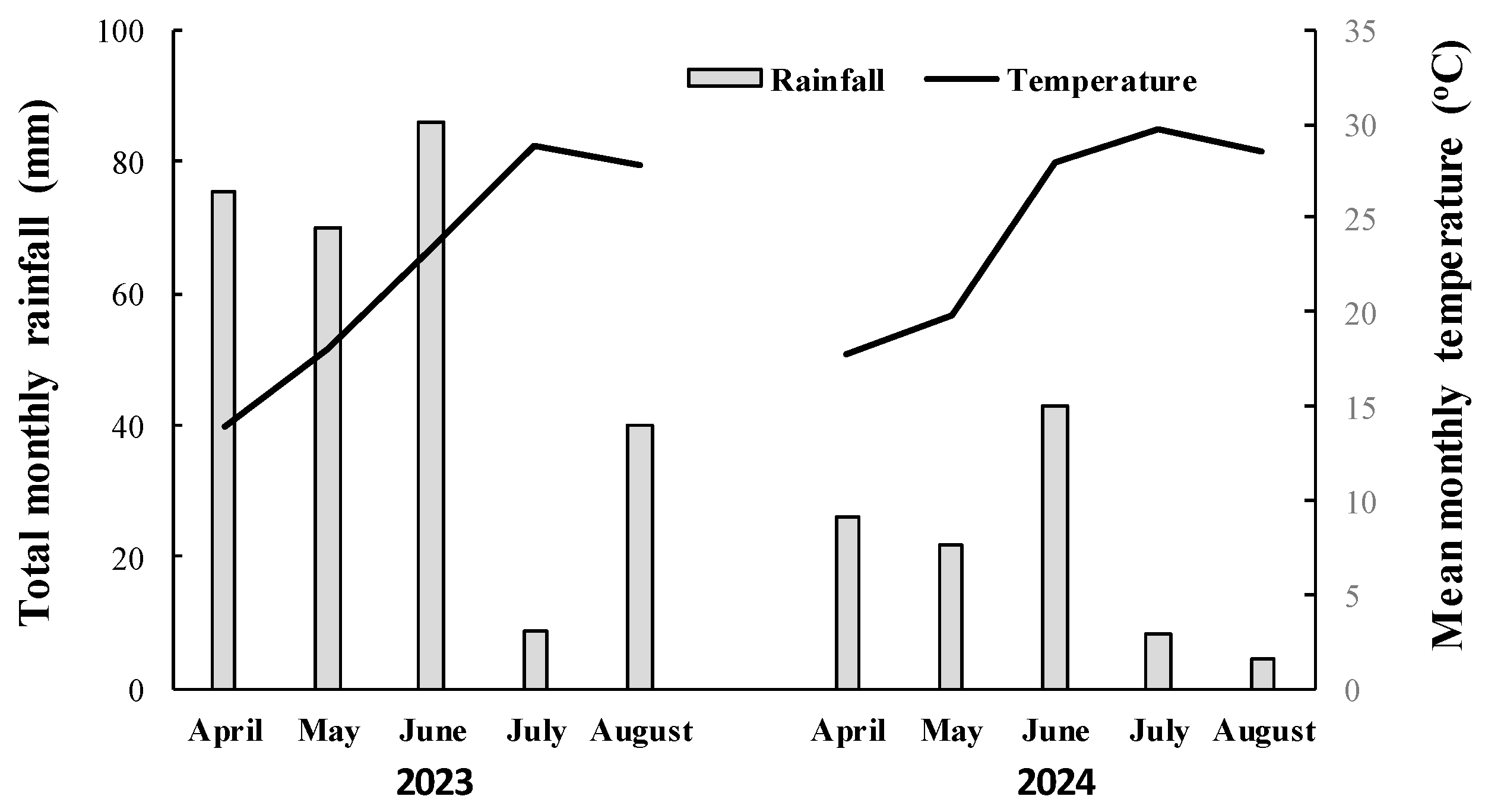
Mean monthly temperature and total monthly rainfall near the experimental area are presented in Figure 2.

2.3. Competition Indices

For both S. halepense populations in the intraspecific competition experiment, the aggressiveness (A), the competitive ratio (CR), the competition intensity index (CI), and the relative competition intensity (RCI)—regarding the TN, AFW, RFW, and PN data per pot—were calculated according to Equations (1)–(4) reported by Weigelt and Jolliffe [30]:
A = ½[(Rmix/Rmono) − (Smix/Smono)],
CR = (Rmix/Rmono)/(Smix/Smono)
CI = [(Rmono + Smono)/(Rmix + Smix)] − 1
RCI = (Rmono − Rmix)/Rmono or RCI = (Smono − Smix)/Smono
where the Rmix is the yield per pot (TN, AFW, RFW, or PN) (at 1, 2, or 3 plants per pot), and Rmono is the yield per pot of the R population grown in a pure stand (at 4 plants per pot). The Smix and Smono are the respective values of the S population. The A values > 0 indicate the possible advantage of the R population grown in competition with the S population, while A values < 0 indicate the possible advantage of the S population. Similarly, CR values > 1 indicate greater competitive ability of the R population, while CR values < 1 indicate superiority of the S population. Finally, regarding the CI and RCI, the smaller the value, the greater the possible advantage for the R population.
The bivariate double-logarithmic model [31] was also used to describe the linear relationship between the S. halepense tiller number, aboveground fresh weight, rhizome fresh weight, and panicle number per pot of the R (dependent variable) against S (independent variable) population.

2.4. Interspecific Competition Between S. halepense and Corn or Sunflower

The two populations were evaluated during the spring and summer of 2023. Experimentation was repeated in 2024 for their interspecific competition against two corn hybrids [‘Hamilton’, American Genetics Seeds (FAO 600, cycle length 132 days) and Hybrid P0937, Corteva Agriscience Seeds (FAO 500, cycle length 120–125 days)] and one sunflower hybrid (‘Neoma’, Syngenta Hellas Seeds). The experiments were carried out at the Aristotle University of Thessaloniki Farm in Central Macedonia, Greece. In particular, the competitive interaction between the R and S populations and corn or sunflower was evaluated using a target-neighborhood design, in which vegetative growth and reproductive potential of the S and R populations were assessed in plastic pots (25 × 30 × 35 cm). Corn and sunflower were selected for evaluation in this study because they are used in Greece as rotational crops after cotton and because their competitive ability against S. halepense with evolved ALS inhibitor resistance is already known to differ [32]. Plastic pots were filled with the soil mixture, with the same characteristics as in the abovementioned intraspecific experiment, to optimize plant growth. A planting template ensured uniform spacing between the target weed plants and neighboring crop plants, as well as between individual neighbors. Uniform S. halepense seedlings at the two-leaf stage (BBCH code 12) [29] produced with procedures already described previously were then transplanted into the competition pots containing two crop plants (spaced 30 cm apart) when corn reached the one-leaf stage (BBCH code 11) and sunflower plants were at the cotyledon to one-leaf stage (BBCH code 11). Three additional pots for each crop species, seeded similarly but without S. halepense, served as weed-free controls. Treatments consisted of pots seeded with two crop seeds per hill (two hills per pot) and varying weed densities (one, two, three, or four plants per pot), as illustrated in Figure 1b. Upon reaching the one-leaf stage (corn) or cotyledon to one-leaf stage (sunflower), crop plants were carefully thinned to one plant per hill. All pots were positioned outdoors in an area protected by netting, exposed to natural temperature and light conditions, and received regular irrigation and weekly fertilization throughout the experimental duration, as needed, to promote optimal growth of crop and weed plants. The 20 cm spacing was kept between all pots to provide adequate room for growth, air circulation, and light exposure while maximizing space in small areas. Emerging grasses and broad-leaved weeds were manually removed to eliminate additional weed competition. Plant growth was determined by measuring height (H) and aboveground fresh weight (AFW) of the crop plants and various growth and reproductive parameters of S. halepense (H, TN, AFW, RFW, and PN), harvested by cutting plants at the soil level. The two experiments employed a completely randomized design with three replicates for each crop-weed density combination.
The meteorological data (mean monthly temperature and total monthly rainfall) near the experimental area are presented in Figure 2.

2.5. Statistical Analyses

A 2 × 2 × 5 factorial over two years approach (2 years × 2 weed populations × 5 densities) was used for S. halepense intraspecific competition experiments data. The competition indices A, CR, CI, and RCI data were analyzed using a factorial over a two-year arrangement, including the effect of plant density per pot. Also, a bivariate double-logarithmic comparison was conducted to contrast the growth traits (TN, AFW, RFW, and PN) of the R and S populations [31]. Moreover, a 2 × 3 × 2 × 5 factorial across two years approach (2 years × 3 crops × 2 weed populations × 5 weed densities) was used for the ANOVA of the crop data obtained from the interspecific competition experiments between R and S populations and three crop hybrids (two corn hybrids and one sunflower hybrid), while a 2 × 3 × 2 × 4 factorial over two years approach (2 years × 3 crops × 2 weed populations × 4 weed densities) was used for the ANOVA of S. halepense data obtained from the same experiments.
The MSTAT-C program was used for the ANOVAs [33], and the differences between means were compared using Fisher’s protected LSD test at p = 0.05. The R software (version 4.4.1; R Foundation for Statistical Computing, Vienna, Austria) was used to estimate the parameters of the bivariate log-logistic comparisons [34]. The linear equations for the crop data (H and AFW) and weed data (H, TN, AFW, RFW, and PN) were also tested for their suitability for describing the relationships between crop or weed growth traits and weed plant responses at various crop/weed densities. In these regression equations, the crop/weed plants per pot (density) was the independent variable (x), and the crop or weed growth parameters were the dependent variables (y).

3. Results

3.1. Intraspecific Competition Between the S. halepense R and S Populations

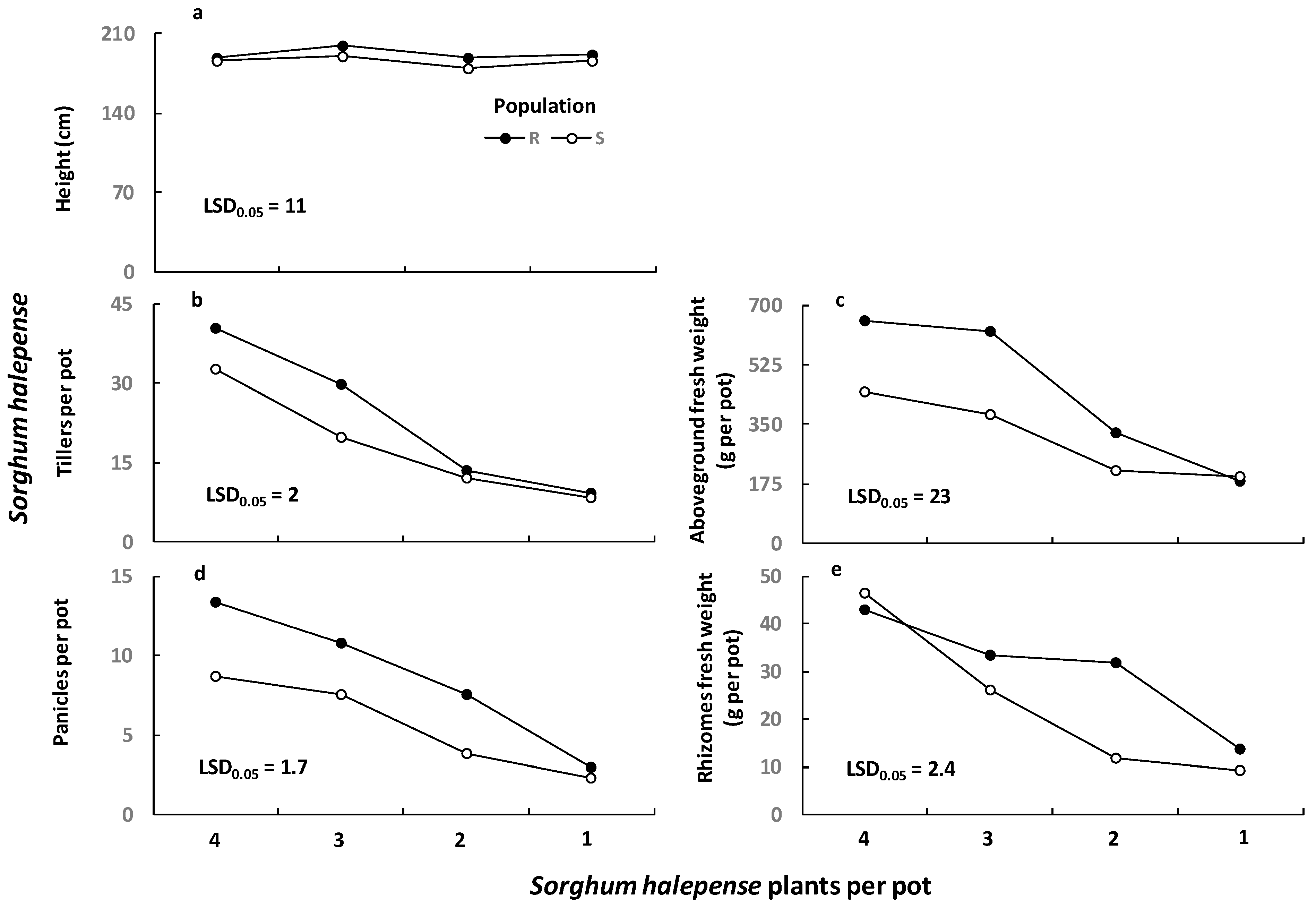
The application of the recommended and twice the recommended rates of cycloxydim resulted in excellent control (100%) of the population labeled as susceptible. However, they failed to control (efficacy lower than 10%) the plants of the population labeled as resistant (Appendix ATable A1). The ANOVAs conducted for the intraspecific competition data indicated no significant year × treatments interaction (Appendix ATable A2 and Table A3). However, as highly significant (p < 0.001) S. halepense population and density main effects, as well as a highly significant (p < 0.001) population × density interaction, were indicated in most cases, the interaction means (averaged across two years) are presented in Figure 3. In general, the R population (averaged over years and weed density) produced 3.5%, 26.9%, 45%, 29.9%, and 55.4% greater H, TN, AFW, RFW, and PN than the S population (Table 1).
The weed population × density interaction, the R population plants produced 2.6% to 4.8% taller plants and 10.8% to 50% more tillers than plants of the S population at densities of one to three S. halepense plants per pot (Figure 3a,b), while the respective AFW increase of the R population was 52% and 65% compared to the S population (Figure 3c). Concerning the reproductive organs, the R population produced 30.4% to 97.4% more panicles (Figure 3d) and 27.7% to 70.9% greater RFW (Figure 3e) than the S population.
The H, TN, PN, and AFW of the R population grown in pure stand (4 plants per pot) were 0%, 21%, 72%, and 32%, respectively, higher than those of the S population (Table 2). The H, TN, AFW, and RFW of 2 R plants grown in competition with 2 S plants per pot were 5%, 12%, 34%, and 73%, respectively, higher than those of the S population.
The ANOVAs conducted for the index data indicated that the calculated A, CR, CI, and RCI values from the TN, PN, AFW, and RFW data exhibited a ratio-dependent (p < 0.001) pattern (Table 3). More specifically, the A values of 3 S. halepense plants per pot were greater than 0, and the CR values were greater than 1 in most cases. Meanwhile, the CI values were less than 1, and the RCI values for the R population were lower than those for the S population (Table 3). On the contrary, at the density of one weed plant per pot, the A values were lower than 0, and the CR values were lower than 1 (except for the RFW data). In contrast, the CI values were greater than 1, and the RCI values (except for the RFW data) of the S population were lower than or equal to those of the R population.
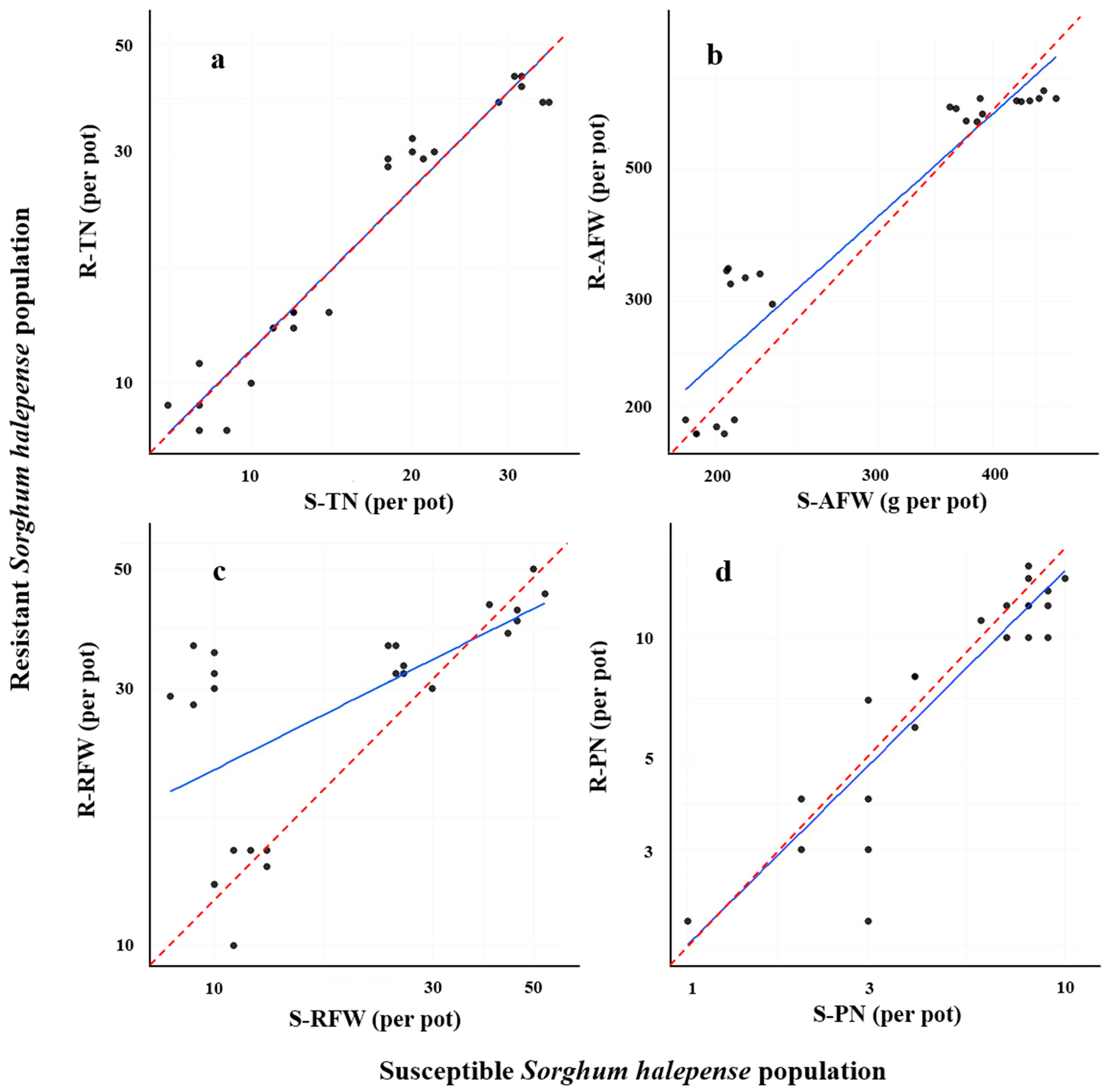
The bivariate double-logarithmic comparison showed significant differences between the R and S populations in AFW (Figure 4b) and RFW (Figure 4c) per pot, but not in TN (Figure 4a) or PN (Figure 4d).

3.2. Interspecific Competition Between S. halepense and Corn or Sunflower

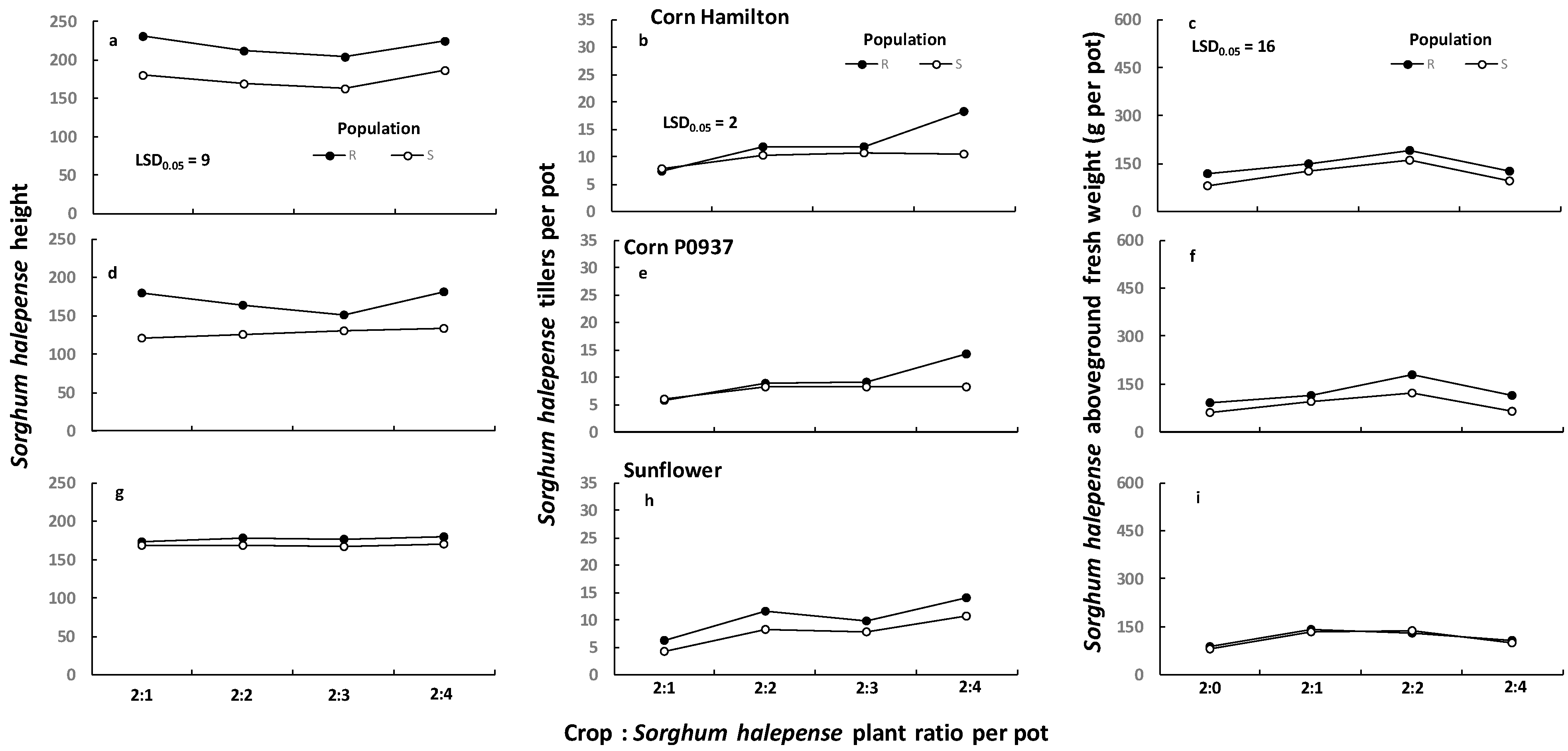
The ANOVAs performed for the trait data of S. halepense growing in competition with crop plants indicated no significant year × treatments interaction. However, they indicated significant differences (p < 0.001) between populations, population × density, and population × density × crop interactions (Appendix ATable A4 and Table A5). Thus, the population × density × crop interactions interaction means (averaged across two years) are presented in Figure 5, Figure 6 and Figure 7. In general, the R population (averaged over years, crops, and crop/weed density) produced 19.4%, 28.6%, 24.2%, 32.4%, and 50% significantly greater H, TN, AFW, RFW, and PN than the S population (Table 4).
The R population growing in competition with the Hamilton corn hybrid achieved 24.3%, 25.5%, and 27.4% significantly greater H, TN, and AFW (averaged across weed density), respectively, than the S population (Figure 5a–c). Moreover, the respective growth and reproductive traits of the R population growing in competition with corn hybrid P0937 were 32.1%, 24.7%, and 45.2% significantly higher (Figure 5d–f) than those of the S population. However, the R population growing in competition with sunflower produced 4.7%, 33.3%, and 4.7% greater H, TN, and AFW, respectively (Figure 5g–i), than the S population. In both corn hybrids, the effect of competition on TN was similar and increased with increasing weed density (Figure 5a,b).
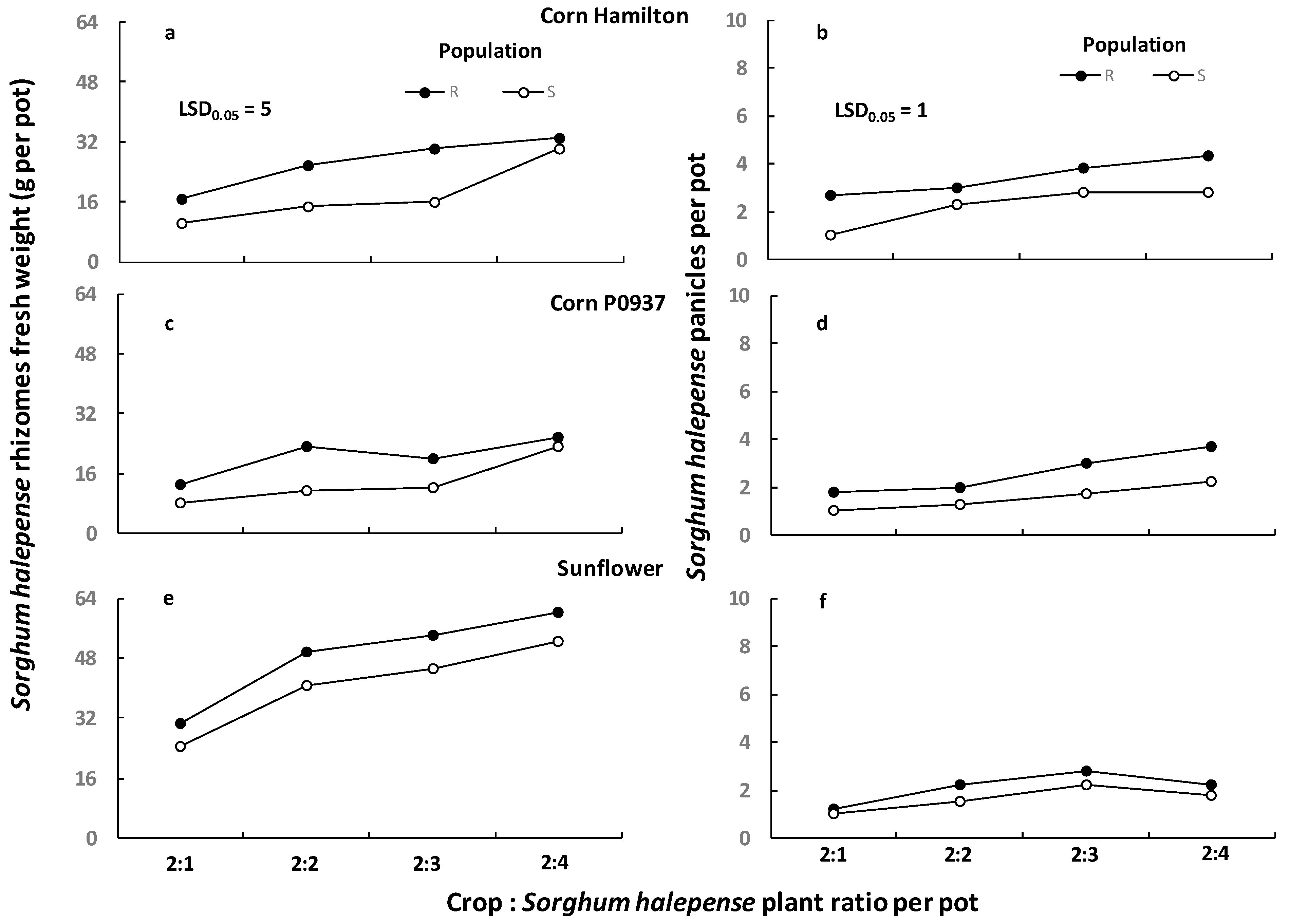
The R population, in competition with both corn hybrids, produced 49.4% to 49.6% and 59.1% to 62.5% greater RFW and PN, respectively, than the S population (Figure 6a–d), while the respective RFW and PN of the R population growing in competition with sunflower was 19.4% and 31.3% higher than growing with the S population (Figure 6e,f).
The H of 2 R plants growing in competition with 2 corn Hamilton, corn P0937, or sunflower plants was 25%, 29.9%, or 5.5%, respectively, higher than those of 2 S plants, while the respective TN were 13.6%, 8.4%, or 38.6% higher (Table 5). In addition, the PN produced by 2 R plants growing in competition with 2 corn Hamilton, corn P0937, or sunflower plants were 30.4%, 33.8%, or 46.7%, respectively, higher than those of 2 S plants. Meanwhile, the respective AFWs of 2 R plants were 21.0%, 21.0%, and 7.4%, respectively, higher than those of 2 S plants. Furthermore, the RFW of 2 R plants growing in competition with 2 corn Hamilton, corn P0937, or sunflower plants was 74.3%, 106.2%, or 21.8%, respectively, greater than those of 2 S plants.
The 2 R S. halepense plants, growing in intraspecific competition with 2 S plants, showed higher values in most cases than the respective ones in interspecific competition with 2 plants of corn Hamilton, corn P0937, or sunflower (Table 2 and Table 5). More specifically, the AFW of 2 R plants growing in competition with 2 S plants was 54%, 74%, and 56% higher than the AFW of the 2 R plants growing in competition with 2 plants of corn Hamilton, corn P0937, or sunflower, respectively. Regarding the AFW of 2 S. halepense plants growing in competition with 2 R plants, it was 42%, 55%, and 38% higher than that produced by the 2 S plants growing in competition with 2 plants of corn Hamilton, corn P0937, or sunflower, respectively. In addition, the RFW of 2 R plants in competition with 2 S plants was 19% and 26% higher than that yielded by 2 R plants growing in competition with 2 plants of corn Hamilton or corn P0937, but it was 38% lower in competition with sunflower. Concerning the RFW of 2 S plants growing in competition with 2 R plants, it was 21% and 71% lower than that produced by 2 S plants growing in competition with corn Hamilton or sunflower. In contrast, the respective RFW produced by 2 S S. halepense plants in competition with corn P0937 was 4% higher than that produced by the R population.
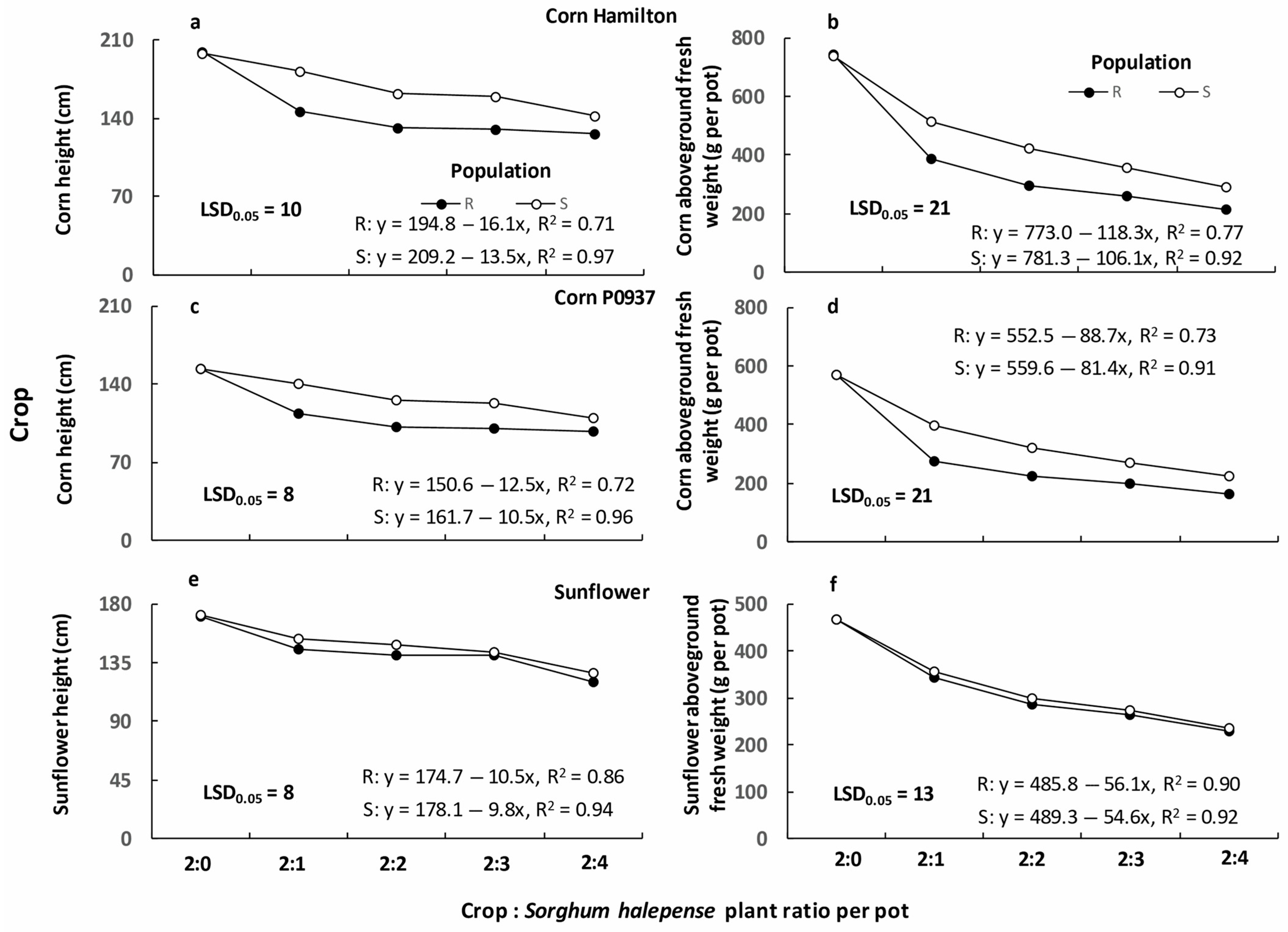
The ANOVAs performed for the data of the three crops in competition with S. halepense indicated, in most cases, no significant year × treatments interaction (Appendix ATable A5 and Table A6). However, the ANOVAs performed for the crop data indicated significant differences (p < 0.001) due to weed, weed population × density, and weed populations × density × crop interactions (Appendix ATable A6 and Table A7). Hence, weed populations × density × crop interactions means (averaged across years) are presented (Figure 7). In general, the plants of corn hybrid Hamilton, corn hybrid P0937, and sunflower growing in competition with the R population produced 15%, 15%, and 4% lower H, respectively, and 22%, 24%, and 3% lower AFW than growing in competition with the S population (Table 3). The H of Hamilton and P0937 corn hybrids was reduced by 26.0% to 36.7% in the presence of the R population compared with weed-free controls. Meanwhile, the corresponding reduction in plant H corn hybrids due to competition with the S population ranged from 8.6% to 28.6% (Figure 7a,c). Similarly, the AFW of corn plants was reduced by 48.2% to 71.4% due to competition imposed by the R population. In contrast, the corresponding reduction by the S population ranged from 30.2% to 61% (Figure 7b,d). The reduction in the H of the sunflower hybrid, due to the competition of the R and S populations, ranged from 14.7% to 29.5% and from 10.2% to 25.7%, respectively (Figure 7e). The corresponding reductions in sunflower AFW ranged from 26.3% to 51.3% and from 23.7% to 49.6% (Figure 7f).
The use of a linear equation to describe the relationship between H or AFW for all crop plants and crop/weed density indicated a good fit, as confirmed by the high R2 values in most cases. The comparison of the estimated regression coefficients (b = slope) from the regression equations fitted showed higher regression coefficient values of both crop traits for the two corn hybrids growing in competition with the R population than growing with the S population (Figure 7a–d). However, the respective estimated regression coefficients of sunflower plants growing in competition with the R or S populations were similar.

4. Discussion

4.1. Intraspecific Competition Between the S. halepense R and the S Populations

Although an effort was made during the design of the experiment to minimize genetic differences between the two populations of S. halepense, the fact that the susceptible population was not collected from the same field from which the resistant one was collected does not exclude the possible presence of some individual genetic differences that may (to some extent) affect the growth rate of the plants. Despite this fact, the R population (agricultural), grown either in pure stand (4 plants per pot) or in intraspecific competition with the S population (non-agricultural) under five densities [4:0, 3:1, 2:2, 1:3, or 0:4 (R vs. S weed plants)], produced greater H, TN, AFW, PN, and RFW in most cases than the S population, strongly supports the evidence that the R population has a competitive advantage over the S population, especially in fields where ACCase inhibitors are recurrently applied. Similar results were reported by Atwater et al. [35], who found that S. halepense agricultural accessions produced more plant biomass and a greater total number of tillers, were taller, and had a greater mean culm diameter than the non-agricultural accessions. These findings, according to several researchers [36,37,38,39], provide convincing evidence for ecotype, phenotypic, and genetic differences between S. halepense populations growing in agricultural (receiving optimum irrigation and fertilization) and non-agricultural conditions, as well as apparent differential adaptation to competitor identity, climate origin, photosynthetic cues, and edaphic origin.
The above growth advantage of the R S. halepense population as compared to the S counterpart may result from its specific adaptation to a narrower range of environmental conditions. More specifically, the R population, which grows over successive seasons within a crop field, evolved traits that maximize its plant fitness and reproductive capacity. On the contrary, the S population, growing in the absence of crop plants, has not developed an enhanced competitive ability against crops like the R population [11]. In contrast to these findings, Panozzo and Sattin [25] reported distinct biomass allocation patterns only, with no difference between ACCase inhibitor-resistant S. halepense populations harboring the Ile2041Asn mutation and the S population. However, Vila-Aiub et al. [39] and Weiner [40] reported that changes in growth rate and plant size are positively correlated with increased height and aboveground vegetative biomass, thereby allowing for greater seed and rhizome production by the ACCase-resistant S. halepense population. Based on the above results, it can be concluded that the competitive ability, growth traits, and fitness impacts of S. halepense vary according to specific resistance-conferring mutations, genetic backgrounds, and environmental conditions.
The associated fitness advantage of the ACCase cross-resistant S. halepense population bearing the 1781Leu mutant allele compared to the herbicide susceptible population, which was also supported by the bivariate double-logarithmic, the competition indices, and the linear regression results, is not in agreement with the findings of Picapietra and Acciaresi [41] who reported no fitness differences between glyphosate-susceptible and glyphosate-resistant junglerice [Echinochloa colona (L.) Link] populations, especially at high plant densities.

4.2. Interspecific Competition Between S. halepense and Corn or Sunflower

The superior H, TN, PN, AFW, and RFW (averaged over year and crop-weed density) of the ACCase-R S. halepense population, compared with the S population growing in competition with either the crop hybrid or sunflower, strongly support the evidence of greater overall competitive ability for the R population. This is also confirmed by the fact that corn Hamilton and P0937 (averaged over year and five crop/weed densities) growing in competition with the R population produced 18% and 19%, respectively, less AFW than growing with the S population, but this was not the case for sunflower, which was similarly affected by the competition of R and S populations. In addition, the greater reduction in corn growth due to competition from the R than from the S population was supported by higher estimated linear regression coefficients for the relationship between corn traits and the R population than for the S population. However, the estimated linear regression coefficients for sunflower traits were similar across competition/allelopathy treatments in both R and S populations. These results show a greater reduction in aboveground fresh weight for the three crops growing in competition with the R than with the S population. This is in contrast to the results reported by Papapanagiotou et al. [32], who found that the aboveground biomass of corn and sunflower was reduced to a greater extent by the ALS-S than by the ALS-R S. halepense population. In addition, the recorded lower reduction in sunflower growth parameters in the presence of the ALS-R and ALS-S populations, as compared to corn, was attributed not only to sunflower’s increased competitive ability but also to its possible allelopathic potential compared to corn [42].
The higher AFW of 2 R or S plants growing with 2 S or R plants, respectively, than the 2 R or S plants growing with 2 plants of either corn hybrid or sunflower, strongly supports the evidence that S. halepense plants of R and S populations are affected more under interspecific than under intraspecific competition. These results contrast with those of Smith et al. [11], who found that S. halepense produced more rhizomes when grown with corn (50.8%) than when grown alone (39.7%) or with conspecifics (35%). The higher AFW observed for the 2 R than for the 2 S plants growing under either intraspecific or interspecific competition suggests greater competitive ability for the R population, which was also confirmed by the lower reduction in fresh weight of all three crop plants growing in competition with the S than with the R population.
The higher AFW of the two corn hybrid plants growing with the S population than with the R population suggests a possible association between enhanced competitive ability and the target-site-mediated resistance mechanism in the R population. Similarly, Picapietra and Acciaresi [41] found that soybean was affected more by the competition of the glyphosate R E. colona population compared to the S population, and this was attributed to higher recorded growth traits (height, tillers, dry weight, and weight of 100 seeds) of the R than the S population.

5. Conclusions

The results of this study provide valuable insights into the intraspecific competition between ACCase inhibitor-resistant and susceptible S. halepense populations and their interspecific competition with corn or sunflower. The intraspecific and interspecific data, along with the bivariate double-logarithmic plots, the competition indices, and the linear regression results, support an appreciable fitness advantage associated with the ACCase cross-resistant S. halepense population bearing the 1781Leu mutant allele compared to the S population. In addition, the higher AFW of the R than S S. halepense plants growing under either intraspecific or interspecific conditions, combined with the lower reduction in the two corn hybrids growing in competition with S than with R, suggests greater competitive ability for the R population. Therefore, the recorded clear competitive advantage of the R population growing in competition with corn or sunflower emphasizes the necessity for implementing integrated, long-term weed management strategies based on both proactive and reactive tactics that can hopefully retard the evolution of resistance and reduce the potential dominance of already evolved resistant populations.

Author Contributions

Conceptualization, A.P.P. and I.G.E.; methodology, A.P.P. and I.G.E.; investigation, A.P.P. and I.G.E.; data curation, A.P.P. and I.V.; formal analysis, I.V.; writing—original draft preparation, A.P.P.; writing—review and editing, I.V. and I.G.E.; supervision, I.G.E. All authors have read and agreed to the published version of the manuscript.

Funding

This research received no specific grant from any funding agency, commercial or not-for-profit sectors.

Data Availability Statement

The original contributions presented in this study are included in the article. Further inquiries can be directed to the corresponding author.

Conflicts of Interest

The authors declare no conflicts of interest.

Appendix A

Table A1. Cycloxydim efficacy against two S. halepense populations, as % aboveground fresh weight reduction (AFW). Means are averaged over two experiments (six replications per treatment) a.
S. halepense PopulationCycloxydim Efficacy (% AFW Reduction)
Rate (g ai ha−1)
200400
R5 b2 b
S100 a100 a
a Values followed by the same letter did not differ according to Fisher’s protected LSD test (a = 0.05).
Table A2. Analysis of variance of two S. halepense populations’ height, tiller number, and aboveground fresh weight (AFW) data as affected by plant density (intraspecific competition experiment).
SourcedF Height Tillers AFW
MSFpMSFpMSFp
Year163.01.700.26200.020.01 261.32.260.2075
R(Y)437.01.00 1.00.44 69.80.60
Population1513.513.870.0204295.0136.160.0003231,018.81994.050.0000
Y × P193.52.530.18729.24.240.1085184.11.590.2760
Error437.0 2.2 115.9
Density3108.24.670.01051867.2632.650.0000365,707.21803.180.0000
Y × D331.70.71 4.21.420.2617352.91.740.1855
P × D333.60.75 60.120.360.00040,035.6197.400.0000
Y × P × D37.90.18 0.40.12 103.50.51
Error2444.6 3.0 202.8
Where Y: year of experiment, P: population, D: Density, dF: degrees of freedom, F: f-values, p: p-values, MS: mean square.
Table A3. Analysis of variance of two S. halepense population rhizome fresh weight and panicle number data as affected by plant density (intraspecific competition experiment).
SourcedFRhizome Fresh WeightPanicle Number
MSFpMSFp
Year16.84.760.09441.32.460.1917
R(CY)415.110.680.02070.51.00
Population1288.0415.060.0000114.1210.620.0001
Y × P10.30.24 0.10.10
Error41.4 0.5
Density32277.5274.440.0000164.8162.490.0000
Y × D314.71.770.17960.70.66
P × D3370.444.630.00008.88.630.0005
Y × P × D33.10.37 0.20.22
Error248.3 1.0
Where Y: year of experiment, P: population, D: Density, dF: degrees of freedom, F: f-values, p: p-values, MS: mean square.
Table A4. Analysis of variance of two S. halepense populations’ height, tiller number, and aboveground fresh weight (AFW) data as affected by corn or sunflower competition (interspecific competition experiment) and S. halepense density.
SourcedF Height Tillers AFW
MSFpMSFpMSFp
Year15.30.14 0.020.008 108.01.800.1975
Crop321,797.1578.290.00003375.61301.450.00001,077,172.118,032.700.0000
Y × C344.61.180.3470.90.33 132.82.220.1249
R(CY)1617.10.45 2.50.96 92.01.540.1982
Population139,216.31040.420.0000212.581.940.0000107,636.01801.910.0000
Y × P172.51.920.18444.11.570.2276154.12.580.1278
C × P33222.385.490.00003.31.270.317625,942.7434.300.0000
Y × C × P366.01.750.19701.30.48 38.710.65
Error1637.7 2.6 59.73
Density3606.718.380.0000571.5326.220.000037,208.1380.170.0000
Y × D381.92.480.06566.93.940.0107156.11.600.1956
C × D9776.123.510.000071.040.520.00007669.878.370.0000
Y × C × D926.60.80 0.90.50 91.40.93
P × D3497.315.060.000020.511.670.00004979.150.870.0000
Y × P × D326.40.80 2.11.210.3092133.91.370.2572
C × P × D9242.07.330.000021.712.390.00006159.962.940.0000
Y × C × P × D922.20.67 1.10.63 115.11.180.3188
Error9633.0 1.8 97.9
Where Y: year of experiment, P: population, D: Density, C: crop, dF: degrees of freedom, F: f-values, p: p-values, MS: mean square.
Table A5. Analysis of variance of two S. halepense population rhizome fresh weight and panicle number data as affected by corn or sunflower competition (interspecific competition experiment) and S. halepense density.
SourcedFRhizome Fresh WeightPanicle Number
MSFpMSFp
Year11.30.17 0.0050.007
Crop312,751.01588.700.0000117.3155.300.0000
Y × C31.20.15 0.20.32
R(CY)165.70.71 0.30.43
Population11564.1194.880.000089.4118.350.0000
Y × P10.50.06 0.0050.007
C × P3219.927.400.000010.914.460.0001
Y × C × P310.71.330.29850.40.50
Error168.0 0.8
Density31692.1219.720.000010.427.720.0000
Y × D31.60.21 0.40.94
C × D9441.357.310.00004.812.890.0000
Y × C × D97.71.00 0.30.83
P × D340.45.240.00221.12.830.0426
Y × P × D36.30.81 0.40.94
C × P × D942.05.460.00002.66.980.0000
Y × C × P × D92.00.25 0.20.41
Error967.7 0.4
Where Y: year of experiment, P: population, D: Density, C: crop, dF: degrees of freedom, F: f-values, p: p-values, MS: mean square.
Table A6. Analysis of variance of two corn (Hamilton and P0937) and one sunflower hybrid’s height data as affected by the competition of two S. halepense populations (interspecific experiment).
SourcedFCorn HamiltonCorn P0397 Sunflower
MSFpMSFpMSFp
Year10.070.002 1.40.08 0.020.002
R(Y)46.70.20 2.70.16 4.50.55
Population17437.1222.110.00011120.4255.020.0001464.857.620.0016
Y × P129.40.88 12.20.70 4.80.60
Error433.5 17.3 8.1
Density47642.6225.220.00004642.8214.780.00003351.7141.770.0000
Y × D482.92.440.066747.82.210.089920.10.85
P × D4631.218.600.0000335.715.530.0000100.44.250.0072
Y × P × D47.80.23 8.90.41 7.90.34
Error3233.9 21.6 23.6
Where Y: year of experiment, P: population, D: Density, dF: degrees of freedom, F: f-values, p: p-values, MS: mean square.
Table A7. Analysis of variance of two corn (Hamilton and P0937) and one sunflower hybrid’s fresh weight data as affected by the competition of two S. halepense populations (interspecific experiment).
SourcedFCorn HamiltonCorn P0397Sunflower
MSFpMSFpMSFp
Year115.00.17 144.20.79 9.60.65
R(Y)445.90.52 60.90.33 80.75.450.0647
Population1107,357.41204.460.000071,346.0389.480.0000992.366.970.0012
Y × P124.10.27 522.22.850.166652.33.530.1336
Error489.1 183.2 14.8
Density4446,364.52869.510.0000263,455.51553.770.0000101,221.01719.860.0000
Y × D440.30.26 14.00.08 159.62.710.0473
P × D48897.957.200.00006612.939.000.000077.61.310.2845
Y × P × D4195.91.260.3061647.93.820.011949.20.84
Error32155.6 169.6 58.9
Where Y: year of experiment, P: population, D: Density, dF: degrees of freedom, F: f-values, p: p-values, MS: mean square.

References

  1. González-Torralva, F.; Norsworthy, J.K. Target-site mutations Ile1781Leu and Ile2041Asn in the ACCase2 gene confer resistance to fluazifop-P-butyl and pinoxaden herbicides in a johnsongrass accession from Arkansas, USA. Plant Direct 2024, 8, e576. [Google Scholar] [CrossRef] [Scilit]
  2. Paterson, A.H.; Kong, W.; Johnston, R.M.; Nabukalu, P.; Wu, G.; Poehlman, W.L.; Goff, V.H.; Isaacs, K.; Lee, T.-H.; Guo, H.; et al. The evolution of an invasive plant, Sorghum halepense (Johnsongrass). Front. Genet. 2020, 11, 317. [Google Scholar] [CrossRef] [Scilit]
  3. Peerzada, A.M.; Ali, H.H.; Hanif, Z.; Bajwa, A.A.; Kebaso, L.; Frimpong, D.; Iqbal, N.; Namubiru, H.; Hashim, S.; Rasool, G.; et al. Eco-biology, impact, and management of Sorghum halepense (L.) Pers. Biol. Invasions 2017, 25, 955–973. [Google Scholar] [CrossRef] [Scilit]
  4. Kaur, R.; Soodan, A.S. Reproductive biology of Sorghum halepense (L.) Pers. (Poaceae; Panicoideae; Andropogoneae) in relation to invisibility. Flora 2017, 229, 32–49. [Google Scholar] [CrossRef] [Scilit]
  5. Riar, D.S.; Norsworthy, J.K.; Johnson, D.B.; Scott, R.C.; Bagavathiannan, M. Glyphosate resistance in a johnsongrass (Sorghum halepense) biotype from Arkansas. Weed Sci. 2011, 59, 299–304. [Google Scholar] [CrossRef] [Scilit]
  6. Ryder, N.; Dorn, K.M.; Huitsing, M.; Adams, M.; Ploegstra, J.; DeHaan, L.; Larson, S.; Tintle, N.L. Transcriptome assembly and annotation of johnsongrass (Sorghum halepense) rhizomes identify candidate rhizome-specific genes. Plant Direct 2018, 2, e00065. [Google Scholar] [CrossRef] [Scilit] [PubMed]
  7. Follak, S.; Essl, F. Spread dynamics and agricultural impact of Sorghum halepense, an emerging invasive species in Central Europe. Weed Res. 2013, 53, 53–60. [Google Scholar] [CrossRef] [Scilit]
  8. Schwinning, S.; Meckel, H.; Reichmann, L.G.; Polley, H.W.; Fay, P.A. Accelerated development in johnsongrass seedlings (Sorghum halepense) suppresses the growth of native grasses through size-asymmetric competition. PLoS ONE 2017, 12, e0176042. [Google Scholar] [CrossRef] [Scilit] [PubMed]
  9. Reichmann, L.G.; Schwinning, S.; Polley, H.W.; Fay, P.A. Traits of an invasive grass conferring an early growth advantage over native grasses. J. Plant Ecol. 2016, 9, 672–681. [Google Scholar] [CrossRef] [Scilit]
  10. Acciaresi, H.A.; Guiamet, J.J. Below- and above-ground growth and biomass allocation in maize and Sorghum halepense in response to soil water competition. Weed Res. 2010, 50, 481–492. [Google Scholar] [CrossRef] [Scilit]
  11. Smith, A.L.; Atwater, D.Z.; Kim, W.; Haak, D.C.; Barney, J.N. Invasive plant rhizome production and competitiveness vary based on neighbor identity. J. Plant Ecol. 2021, 14, 638–647. [Google Scholar] [CrossRef] [Scilit]
  12. Atwater, D.Z.; Fletcher, R.A.; Dickinson, C.C.; Paterson, A.H.; Barney, J.N. Evidence for fine-scale habitat specialization in an invasive weed. J. Plant Ecol. 2018, 11, 189–199. [Google Scholar]
  13. Andújar, D.; Rodríguez, X.; Rueda-Ayala, V.; San Martín, C.; Ribeiro, A.; Fernández-Quintanilla, C.; Dorado, J. A geometrical model to predict the spatial expansion of Sorghum halepense in maize fields. Gesunde Pflanz. 2017, 69, 73–81. [Google Scholar] [CrossRef] [Scilit]
  14. Scarabel, L.; Panozzo, S.; Savoia, W.; Sattin, M. Target-site ACCase-resistant johnsongrass (Sorghum halepense) selected in summer dicot crops. Weed Technol. 2014, 28, 307–315. [Google Scholar] [CrossRef] [Scilit]
  15. Heap, I. The International Survey of Herbicide Resistant Weeds. 2025. Available online: https://www.weedscience.org (accessed on 10 December 2025).
  16. Hernández, M.J.; León, R.; Fischer, A.J.; Gebauer, M.; Galdames, R.; Figueroa, R. Target-site resistance to nicosulfuron in johnsongrass (Sorghum halepense) from Chilean corn fields. Weed Sci. 2015, 63, 631–640. [Google Scholar] [CrossRef] [Scilit]
  17. Kaloumenos, N.S.; Eleftherohorinos, I.G. Identification of a johnsongrass (Sorghum halepense) biotype resistant to ACCase-inhibiting herbicides in northern Greece. Weed Technol. 2009, 23, 470–476. [Google Scholar] [CrossRef] [Scilit]
  18. Panozzo, S.; Milani, A.; Scarabel, L.; Balogh, A.; Dancza, I.; Sattin, M. Occurrence of different resistance mechanisms to acetolactate synthase inhibitors in European Sorghum halepense. J. Agric. Food Chem. 2017, 65, 7320–7327. [Google Scholar] [CrossRef] [Scilit]
  19. Werle, R.; Jhala, A.J.; Yerka, M.K.; Dille, J.A.; Lindquist, J.L. Distribution of herbicide-resistant shattercane and johnsongrass populations in sorghum production areas of Nebraska and northern Kansas. Agron. J. 2016, 108, 321–328. [Google Scholar] [CrossRef] [Scilit]
  20. Bradley, K.W.; Wu, J.; Hatzios, K.K.; Hagood, E.S., Jr. Mechanism of resistance to aryloxyphenoxypropionate and cyclohexanedione herbicides in a johnsongrass biotype. Weed Sci. 2001, 49, 477–484. [Google Scholar] [CrossRef] [Scilit]
  21. Vasquez-Garcia, J.G.; Palma-Bautista, C.; Rojano-Delgado, A.M.; de Prado, R.; Menendez, J. The first case of glyphosate resistance in johnsongrass (Sorghum halepense) in Europe. Plants 2020, 9, 313. [Google Scholar] [CrossRef] [Scilit]
  22. Vila-Aiub, M.M.; Gundel, P.E.; Preston, C. Experimental methods for estimation of plant fitness costs associated with herbicide-resistance genes. Weed Sci. 2015, 63, 203–216. [Google Scholar] [CrossRef] [Scilit]
  23. Vila-Aiub, M.M.; Neve, P.; Powles, S.B. Fitness costs associated with evolved herbicide resistance alleles in plants. Heredity 2009, 102, 386–394. [Google Scholar] [CrossRef] [Scilit] [PubMed]
  24. Cousens, R.D.; Fournier-Level, A. Herbicide resistance costs: What are we measuring and why? Pest Manag. Sci. 2018, 74, 1539–1546. [Google Scholar] [CrossRef] [Scilit]
  25. Panozzo, S.; Sattin, M. Fitness costs associated with an Ile2041Asn mutation in the geophyte Sorghum halepense resistant to ACCase-inhibiting herbicides. Front. Agron. 2021, 3, 711840. [Google Scholar] [CrossRef] [Scilit]
  26. Panozzo, S.; Scarabel, L.; Rosan, V.; Sattin, M. A new Ala-122-Asn amino acid change confers decreased fitness to ALS-resistant Echinochloa crus-galli. Front. Plant Sci. 2017, 8, 2042. [Google Scholar] [CrossRef] [Scilit]
  27. Papapanagiotou, A.; Vasilakoglou, I.; Alvanou, M.; Giantsis, G.; Eleftherohorinos, I. Johnsongrass (Sorghum halepense) resistance to cycloxydim, fluazifop, and propaquizafop due to an Ile1781Leu mutation and its impact on growth rate. Notul. Bot. Horti. Agrobot. Cluj-Napoca 2025, 53, 14605. [Google Scholar] [CrossRef] [Scilit]
  28. Papapanagiotou, A.P.; Loukovitis, D.; Damalas, C.A.; Eleftherohorinos, I.G. Identification of an acetyl-CoA carboxylase-resistant johnsongrass (Sorghum halepense) population from a cotton field in northern Greece. Weed Biol. Manag. 2022, 22, 88–93. [Google Scholar] [CrossRef] [Scilit]
  29. Meier, U. Growth Stages of Mono- and Dicotyledonous Plants: BBCH Monograph; Julius Kühn-Institute: Quedlinburg, Germany, 2018; p. 204. [Google Scholar]
  30. Weigelt, A.; Jolliffe, P. Indices of plant competition. J. Ecol. 2003, 91, 707–720. [Google Scholar] [CrossRef] [Scilit]
  31. Snaydon, R.W.; Satorre, E.H. Bivariate diagrams for plant competition data: Modifications and interpretation. J. Appl. Ecol. 1989, 26, 1043–1057. [Google Scholar] [CrossRef] [Scilit] [PubMed]
  32. Papapanagiotou, A.P.; Anthimidou, E.A.; Eleftherohorinos, I.G.; Giantsis, I.A. Comparison of molecularly identified resistant and susceptible johnsongrass (Sorghum halepense L.) populations at ALS gene, in the absence and presence of field crops. Genes 2024, 15, 1415. [Google Scholar] [CrossRef] [Scilit]
  33. MSTAT-C. A Microcomputer Program for the Design, Management, and Analysis of Agronomic Research Experiments; Michigan State University: East Lansing, MI, USA, 1988; p. 152. [Google Scholar]
  34. Ritz, C.; Streibig, J.C. Bioassay analysis using R. J. Statist. Soft. 2005, 12, 1–22. [Google Scholar]
  35. Atwater, D.Z.; Callaway, Ρ.Μ. Testing the mechanisms of diversity-dependent over yielding in a grass species. Ecology 2016, 9, 3332–3342. [Google Scholar]
  36. Sezen, U.U.; Barney, J.N.; Atwater, D.Z.; Pederson, G.A.; Pederson, J.F.; Chandler, J.M.; Cox, T.S.; Cox, S.; Dotray, P.; Kopec, D.; et al. Multi-phase US spread and habitat switching of a post-Columbian invasive, Sorghum halepense. PLoS ONE 2016, 11, e0164584. [Google Scholar] [CrossRef] [Scilit]
  37. Kelly, S.; Fletcher, R.A.; Barney, J.N. Intraspecific, ecotypic and home climate variation in photosynthetic traits of the widespread invasive grass Johnsongrass. AoB Plants 2020, 12, plaa015. [Google Scholar] [CrossRef] [Scilit] [PubMed]
  38. Lakoba, T.; Atwater, D.Z.; Thomas, V.E.; Strahm, B.D.; Barney, J.N. A global invader’s niche dynamics with intercontinental introduction, novel habitats, and climate change. Glob. Ecol. Conserv. 2021, 31, e01848. [Google Scholar] [CrossRef] [Scilit]
  39. Vila-Aiub, M.M.; Yu, Q.; Han, H.; Powles, S.B. Effect of herbicide resistance-endowing Ile-1781-Leu and Asp-2078-Gly ACCase gene mutations on ACCase kinetics and growth traits in Lolium rigidum. J. Exp. Bot. 2015, 66, 4711–4718. [Google Scholar] [CrossRef] [Scilit]
  40. Weiner, J. Allocation, plasticity and allometry in plants. Perspect. Plant Ecol. Evol. Syst. 2004, 6, 207–215. [Google Scholar] [CrossRef] [Scilit]
  41. Picapietra, G.; Acciaresi, H.A. Intra- and interspecific competition between glyphosate-resistant and susceptible junglerice (Echinochloa colona) populations and soybean. Weed Technol. 2025, 39, e70. [Google Scholar] [CrossRef] [Scilit]
  42. Adamic, A. Sunflower extracts effects on seedling growth. Inter. J. Adv. Appl. Sci. 2015, 2, 1–7. [Google Scholar]
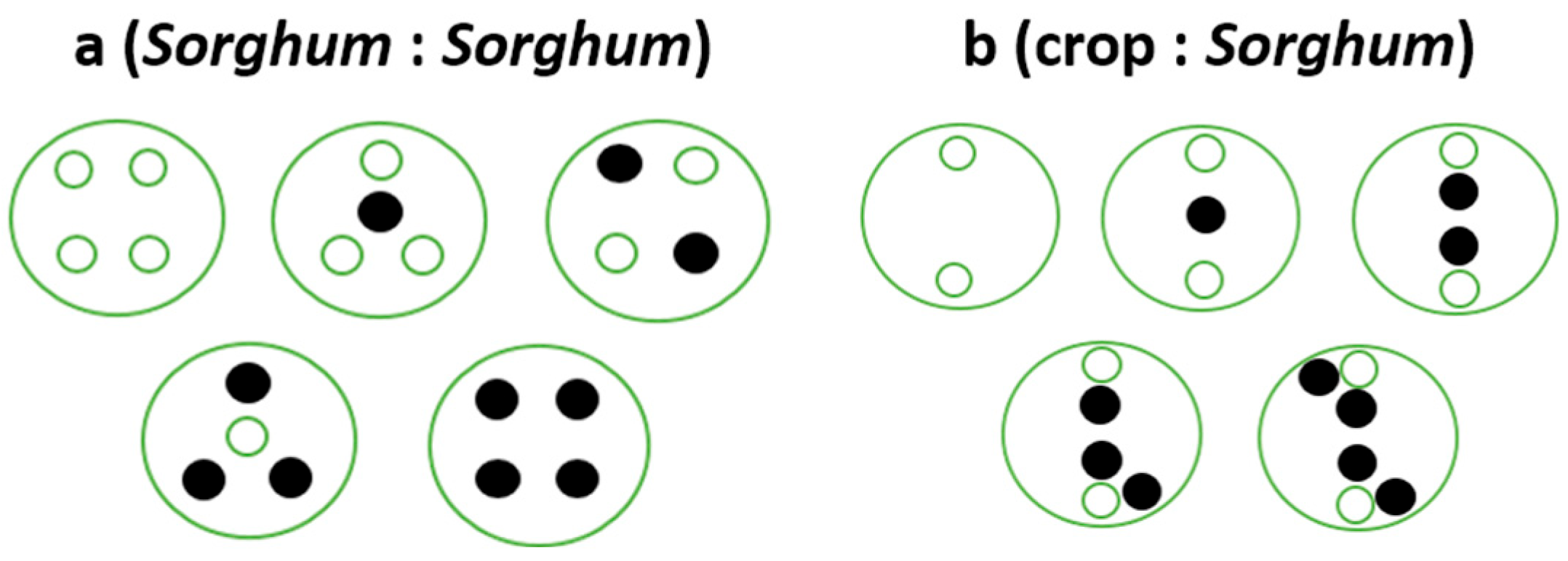
Figure 1. Schematic presentation: (a) of the weed density pattern (4:0, 3:1, 2:2, 1:3, 0:4) to assess growth traits of the ACCase-herbicide resistant (R) S. halepense population grown alone or in competition with the S (susceptible) population. R S. halepense plants = open circles, S S. halepense plants = black circles, and (b) of the crop/weed density pattern (2:0, 2:1, 2:2, 2:3, 2:4) to assess plant responses of corn or sunflower grown in pure stands and in competition with the R (ACCase-inhibitor resistant) or S (susceptible) populations. Corn or sunflower plants = open circles, R or S S. halepense plants = black circles.
Agronomy 16 00915 g001
Figure 2. Mean monthly temperature and total monthly rainfall data recorded close to the experimental area (source: Hellenic National Meteorological Service).
Agronomy 16 00915 g002
Figure 3. Sorghum halepense height (a), tiller number (b), aboveground fresh weight (c), panicle number (d), and rhizome fresh weight (e) in intraspecific competition between one R and one S populations as affected by R/S plant ratio (4:0, 3:1, 2:2, 1:3, 0:4). Means are averaged across two years.
Agronomy 16 00915 g003
Figure 4. Bivariate double-logarithmic plot of S. halepense yield per pot, adapted to tiller number (TN, (a)), aboveground fresh weight (AFW, (b)), rhizome fresh weight (RFW, (c)), and panicle number (PN, (d)), based on Snaydon and Satorre (31). In the intraspecific competition between one ACCase-resistant (R; y-axis—dependent variable) and one susceptible (S; x-axis—independent variable), 1, 2, and 3 plants per pot were established. The spotted diagonal line represents equality of the variable between R and S individuals. The solid line represents the relation between traits of the R and S populations. The dots represent the raw data.
Agronomy 16 00915 g004
Figure 5. Plant height (a,d,g), tiller number (b,e,h), and aboveground (shoot) fresh weight (c,f,i) of the R or S S. halepense populations as affected by the competition of corn or sunflower (Crop/R or S population ratio: 2:1, 2:2, 2:3, 2:4). Means are averaged across two years.
Agronomy 16 00915 g005
Figure 6. Rhizome fresh weight (a,c,e) and panicle number (b,d,f) of the R or S S. halepense populations as affected by the competition of corn or sunflower (Crop/R or S S. halepense population ratio: 2:1, 2:2, 2:3, 2:4). Means are averaged across two years.
Agronomy 16 00915 g006
Figure 7. Plant height (a,c,e) and aboveground fresh weight (b,d,f) of corn or sunflower as affected by the competition of the R or S S. halepense populations (Crop/R or S S. halepense population ratio: 2:0, 2:1, 2:2, 2:3, 2:4). Means are averaged across two years.
Agronomy 16 00915 g007
Table 1. Growth traits (averaged across year and weed density) of two S. halepense populations [one ACCase-resistant (R) and one susceptible (S)] in the intraspecific competition a,b.
S. halepense PopulationIntraspecific Competition
HTNAFWRFWPN
Increase Increase Increase Increase Increase
R191.9 a3.5%23.1 a26.9%447.0 a45.0%30.4 a29.9%8.7 a55.4%
S185.4 b 18.2 b 308.2 b 23.4 b 5.6 b
a Values (averaged across two years) in the same trait followed by the same letter did not differ according to Fisher’s protected LSD test (a = 0.05). b Abbreviations: H, height; TN, tiller number; AFW, aboveground fresh weight; RFW, rhizome fresh weight; PN, panicle number.
Table 2. Sorghum halepense growth traits (per pot) as affected by plant density in the intraspecific competition. Values are averaged across two years.
Sorghum halepense
Traits per Pot
4 R Plants2 R Plants2 S Plants4 S PlantsLSD0.005
Height (cm)188.5189.3179.8185.811.0
Tiller numbers40.213.512.032.52.0
Panicle numbers13.37.53.88.71.7
Fresh weight (g)655.5325.7214.3445.023.0
Rhizomes weight (g)43.031.711.746.52.4
Table 3. Aggressiveness (A), competitive ratio (CR), competition intensity index (CI), and relative competition intensity (RCI) values of the competition between the S. halepense ACCase-resistant (R) and the susceptible (S) populations a,b.
Plants per PotAggressiveness (A)
TNAFWRFWPN
30.06 a0.05 a0.11 b−0.03 b
2−0.02 b0.01 b0.03 c0.06 a
1−0.01 b−0.08 c0.27 a−0.02 b
Competitive ratio (CR)
TNAFWRFWPN
31.22 a1.12 a1.39 b0.96 b
20.91 b1.03 a1.27 b1.29 a
10.90 b0.64 b3.68 a0.92 b
Competition intensity index (CI)
TNAFWRFWPN
30.44 c0.10 c0.51 c0.20 b
21.79 b1.04 b2.57 a0.95 b
13.09 a1.89 a1.20 b3.42 a
Relative competition intensity (RCI)
TNAFWRFWPN
RSRSRSRS
30.26 d0.39 c0.05 e0.15 b0.23 d0.49 c0.19 d0.13 d
20.66 b0.63 b0.50 c0.52 c0.68 b0.75 a0.44 c0.56 b
10.77 a0.74 a0.72 a0.56 b0.26 d0.80 a0.77 a0.73 a
a Values (averaged across two years) in the same trait followed by the same letter did not differ according to Fisher’s protected LSD test (a = 0.05). b Abbreviations: TN, tiller number; AFW, aboveground fresh weight; RFW, rhizome fresh weight; PN, panicle number.
Table 4. Growth traits (averaged across year and weed-crop density) of two S. halepense populations [one ACCase-resistant (R) and one susceptible (S)] growing in the interspecific competition a,b.
S. halepense
Populations
Interspecific Competition
HTNAFWRFWPN
Increase Increase Increase Increase Increase
R187.5 a19.4%10.8 a28.6%129.5 a24.2%31.9 a32.4%2.7 a50.0%
S157.1 b 8.4 b 104.3 b 24.1 b 1.8 b
a Values (averaged across two years) in the same trait followed by the same letter did not differ according to Fisher’s protected LSD test (a = 0.05). b Abbreviations: H, height; TN, tiller number; AFW, aboveground fresh weight; RFW, rhizome fresh weight; PN, panicle number.
Table 5. Sorghum halepense growth traits of two R plants per pot in the interspecific competition with two plants of corn or sunflower hybrids. Means are averaged across years.
Crops2 R Plants2 S PlantsLSD0.05
Height (cm)
Corn Hamilton212.2169.89.0
Corn P0937163.3125.7
Sunflower177.7168.5
Tillers (numbers per pot)
Corn Hamilton11.710.32.0
Corn P09379.08.3
Sunflower11.58.3
Panicles (number per pot)
Corn Hamilton3.02.31.0
Corn P09372.01.3
Sunflower2.21.5
Aboveground fresh weight (g per pot)
Corn Hamilton150.3124.216.0
Corn P0937115.895.7
Sunflower141.8132.0
Rhizomes fresh weight (g per pot)
Corn Hamilton25.814.85.0
Corn P093723.311.3
Sunflower49.740.8
Disclaimer/Publisher’s Note: The statements, opinions and data contained in all publications are solely those of the individual author(s) and contributor(s) and not of MDPI and/or the editor(s). MDPI and/or the editor(s) disclaim responsibility for any injury to people or property resulting from any ideas, methods, instructions or products referred to in the content.