Article

Evaluation of Grapevine Germplasm Resources Based on Phenotypic Traits and SSR Markers

1
Jiangxi Key Laboratory of Horticultural Crops (Fruit, Vegetable & Tea) Breeding, Jiangxi Academy of Agricultural Sciences, Nanchang 330200, China
2
Nanchang Key Laboratory of Germplasm Innovation and Utilization of Fruit and Tea, Jiangxi Academy of Agricultural Sciences, Nanchang 330200, China
3
Ji’an City Horticultural Field, Jian 343016, China
4
Nanchang Field Research Station for Agricultural Meteorology, China Meteorological Administration, Nanchang 330200, China
*
Author to whom correspondence should be addressed.
Agronomy 2026, 16(9), 911; https://doi.org/10.3390/agronomy16090911
Submission received: 15 March 2026 / Revised: 28 April 2026 / Accepted: 28 April 2026 / Published: 30 April 2026

Abstract

To clarify the genetic background and biological characteristics of grape germplasm resources and provide theoretical support for germplasm innovation and new-variety breeding, we conducted systematic morphological identification and SSR molecular-marker analysis on 38 core grape germplasms (29 fresh-eating cultivars, 1 local cultivar, and 8 wild germplasms) from the National Southeast Mountainous Crop Germplasm Repository (Jiangxi·Yichun) and other regions. For morphological identification, 14 quantitative traits and 5 descriptive traits of leaves, floral organs and fruits were determined in strict accordance with the NY/T 2932-2016 Descriptors for Grape Germplasm Resources. For SSR molecular-marker analysis, eight pairs of internationally universal core primers were used for PCR amplification and fluorescence detection referring to the NY/T 3640-2020 Identification of Grape Cultivars Using SSR Markers, and genetic diversity analysis was conducted on 11 local and wild grape germplasms. The results revealed abundant phenotypic diversity among the tested germplasms: the functional leaves of cultivars were predominantly pentagonal and cuneate, while those of wild germplasms were mostly reniform and cordate, with 3–5 lobes for most germplasms; all germplasms were hermaphroditic, except for two wild accessions with unisexual flowers. Significant variations were observed in fruit traits, with the coefficient of variation (CV) of cluster weight and berry weight reaching 67.64% and 50.53%, respectively. The genetic plasticity of weight-related traits was much higher than that of shape- and length-related traits, and the average Shannon–Wiener index (H′) of 19 morphological traits was 3.47, indicating a high level of overall phenotypic diversity. SSR analysis showed that the eight primer pairs amplified a total of 42 genotypes (5.25 per primer pair on average). The population had a mean observed number of alleles (Na) of 5.28, a mean effective number of alleles (Ne) of 7.25, and a mean polymorphism information content (PIC) of 0.74, demonstrating rich genetic diversity and high polymorphism of the tested loci. Cluster analysis divided the 11 local germplasms into four groups, which clearly reflected the genetic relationships among them, and genetic admixture was found in some germplasms due to unclear introduction traceability. In this study, fresh-eating grape cultivars suitable for the climatic conditions of Jiangxi Province were screened, the utilization value of local germplasm resources was clarified, and a two-dimensional evaluation system based on phenotypic traits and SSR molecular markers was constructed. The findings provide basic data and a scientific basis for the precise evaluation, elite gene mining, and new-variety breeding of grape germplasm resources in Jiangxi Province.

1. Introduction

Grapes (Vitis L.) are among the fruit crops with the longest cultivation history and highest economic value globally, playing a pivotal role in worldwide agricultural production and industrial development [1]. China is not only a major global grape producer but also a core center of origin and distribution for Vitis species, boasting exceptionally rich germplasm resources that provide an irreplaceable material foundation for genetic improvement and variety innovation in the global grape industry [2]. To date, more than 70 Vitis species have been identified worldwide, among which 40 species, 1 subspecies, and 13 varieties are native to China, accounting for approximately 60% of the total global Vitis resources [3]. These abundant germplasm resources carry a variety of elite genes related to stress resistance and high quality, serving as a core genetic treasure trove for grape genetic improvement, stress-resistant breeding, and quality enhancement. Notably, wild grape germplasm has proven indispensable in addressing industry-wide challenges—for example, North American wild species (Vitis riparia, Vitis rupestris) provided resistance genes against phylloxera, a pest that devastated global vineyards in the 19th century, enabling the development of resistant rootstocks and safeguarding modern viticulture [4]. In China, Vitis amurensis Rupr., a cold-hardy wild species native to Northeast China, has been used to breed 17 cold-adapted cultivars such as ‘Beibinghong’, the world’s first cultivar suitable for ice wine production, revolutionizing viticulture in cold regions [5].
From a geographical distribution perspective, wild Vitis resources in China exhibit distinct regional aggregation characteristics. The subtropical and temperate climatic zones south of the Yangtze River constitute the core distribution area, covering nine provinces, including Anhui, Zhejiang, Jiangxi, Hunan, and Hubei, and harboring 37 wild Vitis species and varieties [6]. As a core region in the southeast mountainous areas, Jiangxi Province features complex and diverse landforms coupled with a warm and humid monsoon climate. Its unique ecological environment provides natural conditions for the survival and reproduction of wild grape resources, making it an important “conservation bank” for wild grape resources in China [7]. Leveraging this unique resource advantage, the National Southeast Mountainous Crop Germplasm Repository was successfully included in the first batch of 72 national crop germplasm repositories (gardens) in 2022 (Announcement No. 595 of the Ministry of Agriculture and Rural Affairs), officially becoming a core platform for the conservation, research, and innovative utilization of germplasm resources in the southeast mountainous areas. To date, the repository has systematically collected more than 2500 crop germplasm accessions covering the southeast mountainous regions, among which grape germplasm resources have accumulated to over 40 accessions, forming a diversified resource pattern of “elite cultivars + characteristic local germplasms”. Specifically, it has introduced more than 30 high-quality, fresh-eating grape varieties bred in recent years, such as Nina Queen, Black King, and Shine Muscat, to precisely meet the consumer demand for premium fruit in the southern market. More importantly, through rescue collection, it has preserved nearly 10 local grape resources carrying regional cultural characteristics, including the endemic ancient cultivated variety from Jinggangshan and Vitis davidii Foex from Chongyi County. However, the genetic background of most grape germplasms in the repository remains unclear, and the excavation and utilization of elite agronomic traits (such as stress resistance and high quality) are still in their initial stages. The abundant resource potential has not been fully exploited, which restricts the high-quality development of the regional grape industry and the process of germplasm innovation.
Accurate identification and evaluation of germplasm resources are the prerequisite and foundation for their efficient utilization [8]. The identification and standardized description of morphological traits are the most basic and critical technical means in plant germplasm resource research which can provide an intuitive and reliable basis for phenotypic classification, characteristic evaluation, and preliminary screening of germplasm resources [9]. To systematically clarify the biological background of grape germplasms in the National Southeast Mountainous Crop Germplasm Repository, this study strictly followed the agricultural industry standard NY/T2932-2016 Descriptors for Grape Germplasm Resources (Ministry of Agriculture of the People’s Republic of China: Beijing, China, 2016), taking 38 grape materials in the repository—including cultivars, local characteristic resources, and wild germplasms—as research objects, and conducted multi-organ and multi-dimensional precise morphological identification throughout the entire growth period. Meanwhile, morphological identification is susceptible to interference from environmental factors and cultivation measures, making it difficult to accurately analyze the inherent genetic differences among germplasms [10]. Simple Sequence Repeat (SSR) molecular markers, with the advantages of strong genetic stability, abundant polymorphic information, codominant inheritance, and high detection efficiency, have been listed as one of the core technologies for variety identification by the International Union for the Protection of New Varieties of Plants (UPOV), and are widely used in the analysis of genetic diversity and the genetic relationships of grape germplasm resources [11].
Based on this, this study combined systematic morphological identification and SSR molecular-marker technology to evaluate 38 grape germplasm resources from Jiangxi Province. The objectives of this study were as follows: (1) to clarify the phenotypic variation characteristics and diversity level of the tested germplasms; (2) to construct DNA fingerprint profiles of 11 local and wild grape germplasms and analyze their genetic background; (3) to screen excellent fresh-eating grape varieties suitable for cultivation in Jiangxi Province and clarify the breeding utilization value of local germplasms; and (4) to preliminarily establish a two-dimensional evaluation system based on phenotypic traits and SSR molecular markers for grape germplasm resources. The results will provide a scientific basis for the precise identification, efficient conservation, innovative utilization, and new variety breeding of grape germplasm resources in Jiangxi Province and southern China.

2. Materials and Methods

2.1. Plant Materials

A total of 38 grape germplasm accessions, representing a diversified system of “elite cultivars—local characteristic resources—wild germplasms”, were selected as experimental materials in this study. The ‘Benifuji’ cultivar was sourced from Xixia Vineyard in Nanchang. The remaining 37 accessions were preserved in the National Southeast Mountainous Crop Germplasm Repository, including 29 fresh-eating cultivars, 1 local cultivar, and 8 wild germplasms, totaling 38 accessions (1 + 37 = 38). The experiment was conducted from 2022 to 2025, with standardized cultivation management to minimize environmental interference. The basic information of all tested materials is shown in Table 1.
The experiment was conducted from 2022 to 2025, covering three consecutive full growth cycles for repeated observations. All tested grape germplasms were managed with a standardized cultivation system: a high-stem small “V” trellis combined with a linear training mode was adopted. Field management followed technical specifications, including orchard grass cover, precision irrigation, formula fertilization, and green pest control. Key phenological stages were synchronized with agronomic measures such as bud thinning, pinching, and flower/fruit thinning to ensure consistent growth conditions for all test materials, thereby minimizing the interference of non-genetic factors on the experimental results.
For each germplasm, 3 healthy adult plants with consistent growth vigor were selected as biological replicates. In total, 38 germplasms × 3 plants = 114 plants used for phenotypic investigation and data collection. The field experiment adopted a completely randomized block design (CRBD) with three replications. Each germplasm was planted in a single row with 3 individuals, spaced at 1.5 m between plants and 2.5 m between rows. Standardized cultivation and management were performed uniformly to minimize environmental error.

2.2. Experimental Methods

2.2.1. Morphological Identification and Trait Measurement

This study strictly followed the guidelines of NY/T 2932-2016 Descriptors for Grape Germplasm Resources and conducted standardized morphological identification and quantitative description of 38 grape accessions throughout the entire growth period. A total of 19 key traits were determined, including 14 quantitative traits and 5 descriptive traits.
Quantitative traits: Vegetative growth traits: leaf length (LL, cm), leaf width (LW, cm), petiole length (PL, cm), shoot internode length (INL, cm); Reproductive growth and fruit quality traits: cluster weight (CW, g), cluster transverse diameter (CTD, cm), cluster longitudinal diameter (CLD, cm), berry weight (BW, g), berry transverse diameter (BTD, mm), berry longitudinal diameter (BLD, mm), berry shape index (BSI), total soluble solids (TSS, %), total acid (TA, %), solid-acid ratio (TSS/TA).
Descriptive traits: Leaf shape (LSH), floral organ type (FO), cluster shape (CSH), cluster density (CD), berry shape (BS). Descriptive traits were analyzed by frequency and percentage without grade assignment, in line with standard qualitative statistical methods., as detailed in Table 2.

2.2.2. Measurement Methods and Precision Control

Length-related traits: A ruler with a precision of 1 mm was used to measure LL, LW, PL, and INL; a digital vernier caliper with a precision of 0.01 mm was used to determine BTD and BLD.
Weight-related traits: An electronic balance (precision 0.01 g) was used to measure CW and BW. Each trait was measured with 30 biological replicates, and the average value was calculated.
Quality-related traits: A portable fruit sugar-acid meter (ATAGO, Tokyo, Japan) was used to determine TSS (precision 0.1%) and TA (precision 0.01%). For each germplasm, 10 fruits with consistent maturity were selected, mixed, and measured with 3 technical replicates.
Morphological image recording: A high-definition digital camera with a macro lens was used to capture standard morphologies of leaves, flowers, clusters, and berries under natural light for subsequent morphological comparison and visualization analysis.

2.2.3. Genomic DNA Extraction and SSR-PCR Amplification

Among the 38 accessions, 11 representative materials (local cultivars, wild germplasms, and two cultivars with regional genetic characteristics) were selected for SSR analysis to clarify the genetic background of local germplasms. The 29 fresh-eating cultivars were not included in SSR analysis because they are mainstream commercial varieties with publicly available genetic information and clear genetic backgrounds; this study focused on the local and wild germplasms with unclear backgrounds and high breeding values in Jiangxi. Approximately 0.5 g of fresh, healthy young grape leaves were collected and immediately ground into fine powder in liquid nitrogen. Genomic DNA was extracted using a modified CTAB method to effectively remove polysaccharide and polyphenol impurities. DNA integrity was assessed by 1.2% agarose gel electrophoresis, and DNA concentration and purity (OD260/OD280 ratio) were measured using a Nanodrop ultra-micro spectrophotometer (IMPLEN, Westlake Village, CA, USA). Qualified DNA samples were diluted to a working concentration of 10 ng/μL and stored at −20 °C for subsequent PCR amplification [12,13].
Eight pairs of internationally universal core SSR primers for grapes (VvMD28, VvMD27, VrZAG79, VvMD7, VrZAG62, VvMD25, VvS2, VvMD5) were selected in accordance with NY/T 3640-2020 Identification of Grape Cultivars Using SSR Markers guidelines. The chromosome positions of the 8 SSR loci are as follows: VvMD28 (Chr1), VvMD27 (Chr5), VrZAG79 (Chr2), VvMD7 (Chr4), VrZAG62 (Chr7), VvMD25 (Chr14), VvS2 (Chr11), VvMD5 (Chr15). A standard 20 μL PCR reaction system was used—3 μL genomic DNA template (10~30 ng/μL), 10 μL 2× Taq PCR Master Mix, 1 μL forward primer (10 pmol/L), 1 μL reverse primer (10 pmol/L), and ddH2O—to bring the final volume to 20 μL. A touchdown PCR program was adopted to improve amplification specificity.
Only 11 representative local and wild germplasms were used for SSR analysis, because the 29 commercial fresh-eating cultivars have clear genetic background and published genotypic information, and their inclusion would not improve the resolution of genetic relationship analysis for local germplasms in Jiangxi. For DNA extraction, 1 healthy young plant per germplasm was randomly selected according to the standard procedure of SSR fingerprinting for woody fruit trees. The selection criteria included the following: no pests or diseases, consistent growth period, young functional leaves, and typical phenotypic characteristics of the germplasm.

2.2.4. Capillary Electrophoresis and Genotyping

PCR products were detected by fluorescent capillary electrophoresis using an ABI 3730 automatic genetic analyzer (Applied Biosystems, Foster City, CA, USA). The loading mixture was prepared by mixing 700 μL Hi-Di Formamide with 3~10 μL GeneScan™ 500 LIZTM Size Standard. A total of 7 μL of the mixture and 1 μL of diluted PCR product were added to each well of a 96-well plate, centrifuged, and loaded for detection. After data collection, GeneMarker software (v2.6.4/v3.0.1, SoftGenetics LLC, State College, PA, USA) was used for electrophoretogram analysis. The fragment size was calibrated with LIZ500 as the internal standard, and the amplification fragment lengths of each germplasm at each primer locus were counted to construct SSR fingerprint data [14].

2.3. Data Analysis

2.3.1. Phenotypic Trait Statistical Analysis

Microsoft Excel 2007 was used to collate morphological data, and descriptive statistical indicators including mean, standard deviation (SD), range, and coefficient of variation (CV) were calculated. The Shannon–Wiener diversity index (H′) for each trait was computed using PAST 4.09 software [15]. For quantitative traits, a standardized 10-grade grading method was adopted with the overall mean (μ) as the center and 0.5 standard deviations (0.5σ) as the class interval; for descriptive traits, statistics were conducted directly in accordance with the grading standard shown in Table 2. The formula for H′ is as follows:
H = n = i n ( P i × l n P i )
where Pi represents the frequency of the i-th grade trait in the population, and ln denotes the natural logarithm.

2.3.2. SSR Marker Genetic Diversity Analysis

After sorting the SSR fragment length data, DataFormater 5.0 software was used for format conversion. POPGENE version 1.32 software was employed to calculate core genetic diversity indicators: observed number of alleles (Na), effective number of alleles (Ne), Nei’s gene diversity index (H), Shannon’s information index (I), and observed heterozygosity (Ho). Expected heterozygosity and F-statistics (Fis, Fst, Fit) were not calculated because the grape accessions are clonally propagated and do not fit Hardy–Weinberg assumptions. Analysis of molecular variance (AMOVA) was performed using GenAlEx 6.51 to partition molecular variation among genotypes, with 999 permutations for significance testing. PowerMarker V3.25 software was used to count the number of genotypes and calculate the polymorphism information content (PIC). Cluster analysis was performed based on Nei’s genetic distance using the Neighbor–Joining (NJ) method in MEGA-X software, and a phylogenetic tree was constructed to analyze the genetic relationships among germplasms [16].

2.3.3. Estimation of Broad-Sense Heritability

Broad-sense heritability (H2) was calculated for 14 quantitative traits using one-way ANOVA, based on the following formula:
H2 = Vg/(Vg + Ve)
where Vg = genetic variance and Ve = environmental variance.
Before analysis, normality tests were performed, and all quantitative traits conformed to normal or approximately normal distribution, meeting the requirements for ANOVA and heritability estimation.

2.3.4. Integrated Multivariate Analysis

Multiple Factor Analysis (MFA) with mixed data (quantitative phenotypic traits + categorical SSR markers) and Generalized Procrustes Analysis (GPA) were used to integrate phenotypic and molecular variation, using FactoMineR package in R (v2.13, François Husson, CRAN).

3. Results

3.1. Morphological Characterization of Grape Germplasm Resources

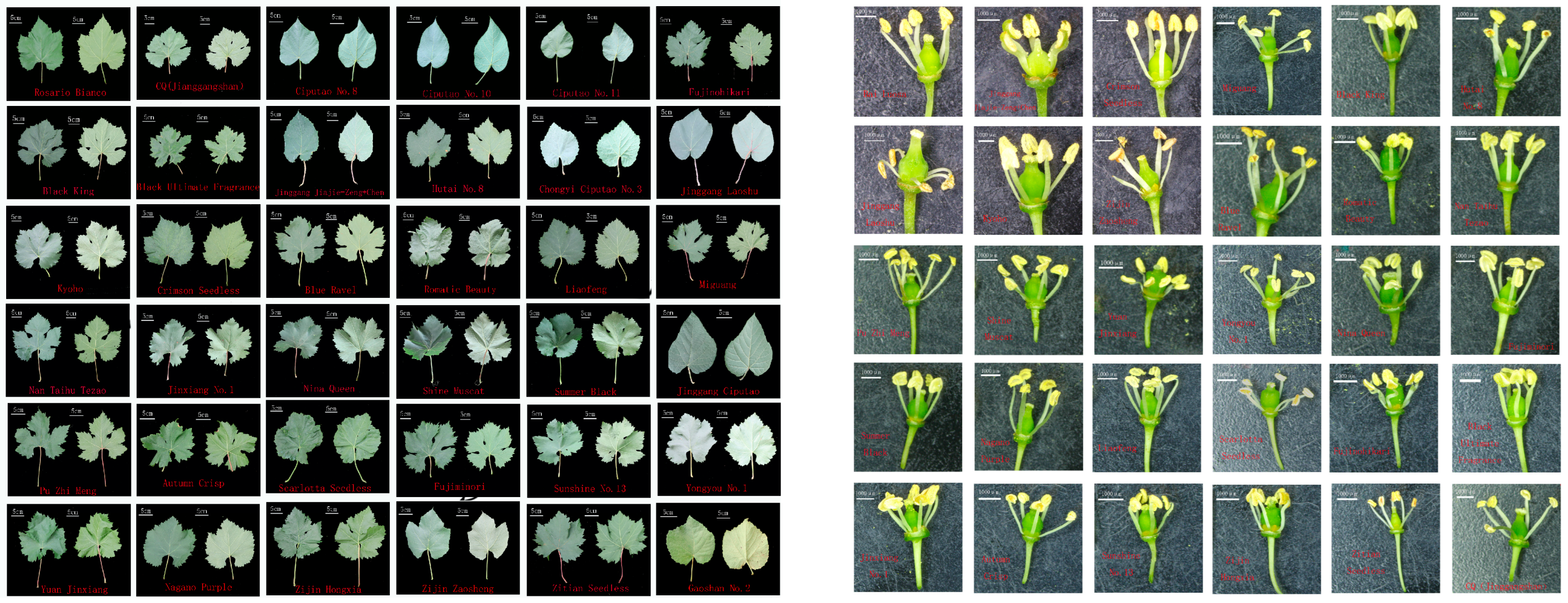
The functional leaves of all 38 tested grape germplasms were simple leaves, with significant morphological divergence between cultivars and wild germplasms. Leaf shape was analyzed by frequency: cultivars were predominantly pentagonal (42.1%) and cuneate (36.8%), while wild germplasms were mostly reniform (75.0%) and cordate (25.0%) (Figure 1). Figure 1 shows the leaf and floral organ morphology of representative germplasms. (Figure 1). Figure 1 shows the leaf and floral organ morphology of representative germplasms. Most germplasms had 3–5 lobes. The petiole sinus shapes were mainly U-shaped (63.2%) and V-shaped (36.8%).
Floral organ identification revealed that except for two wild accessions, the remaining 36 materials possessed hermaphroditic flowers capable of self-pollination and fruiting. The two wild germplasms exhibited typical dioecious characteristics: “Jinggang Laoshu” possessed female flowers with degenerated stamens, while “Jinggang Jiajiezeng+Chen” possessed male flowers with degenerated pistils (Figure 1).
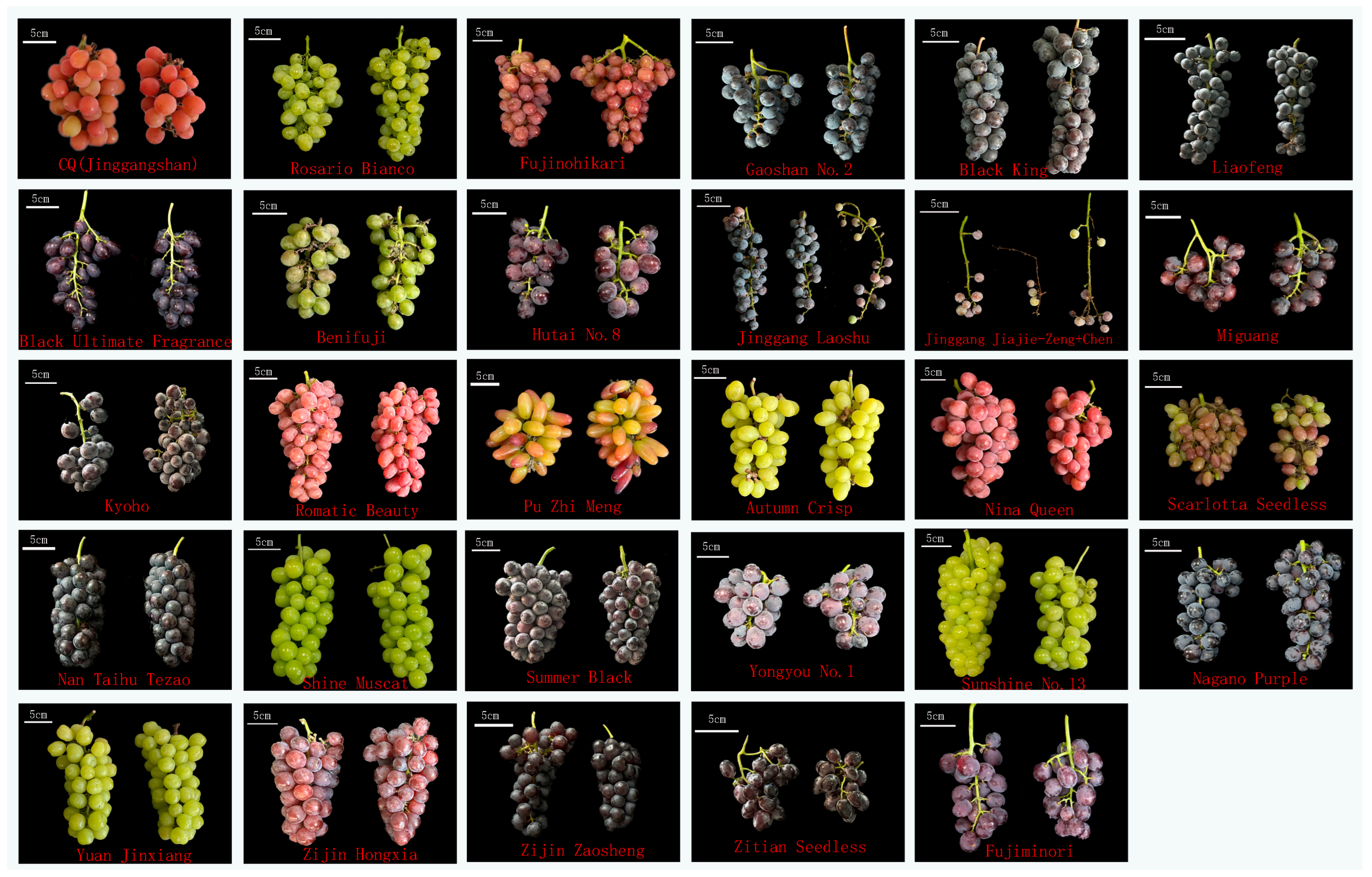
Figure 2 shows the fruit-cluster and berry morphology of representative germplasms. Fruit phenotypic characterization showed that the cluster shapes of the 38 germplasms were primarily cylindrical (47.4%) and conical (44.7%), with only a few materials exhibiting branched forms. Cluster density was predominantly compact (63.2%) or very compact (21.1%), with loose clusters accounting for only 15.8%. Berry shape displayed rich variation; most materials had a fruit shape index between 1 and 1.5, manifesting as oval (34.2%), long oval (26.3%), round (18.4%), or subround (15.8%), while only two materials were slender cylindrical (fruit shape index > 1.5). Skin color fell into four categories: yellow-green, pink-red, purple-red, and blue-purple, with purple-red materials being the most abundant, accounting for 42.11% (16/38). The thickness of the waxy bloom was significantly correlated with skin color: purple-red and blue-purple varieties had thicker bloom, while yellow-green varieties had virtually no bloom (Figure 2).

3.2. Phenotypic Diversity and Variation Analysis of Quantitative Traits

The diversity analysis of 19 morphological traits showed that the Shannon–Wiener index (H′) ranged from 3.08 to 3.85, with a mean of 3.47, indicating a high level of overall phenotypic diversity among the tested grape germplasms (Table 3). Specifically, floral organ type (H′ = 3.85), berry longitudinal diameter (H′ = 3.73), and berry shape index (H′ = 3.73) exhibited the richest genetic diversity, while cluster weight (H′ = 3.08) had the lowest diversity. Broad-sense heritability (H2) of the 14 quantitative traits ranged from 0.78 to 0.88, indicating that phenotypic variation was mainly controlled by genetic factors.
The coefficient of variation (CV) analysis showed that the average CV of 19 traits was 30.49%, with significant differences in variation among different trait types. The CV of weight-related traits was the highest—cluster weight was 67.64% and berry weight was 50.53%, followed by shape-related traits (leaf shape 47.78%, berry shape 47.01%)—and the CV of length-related traits was the lowest, indicating that the genetic plasticity of weight-related traits was much higher than that of shape- and length-related traits.
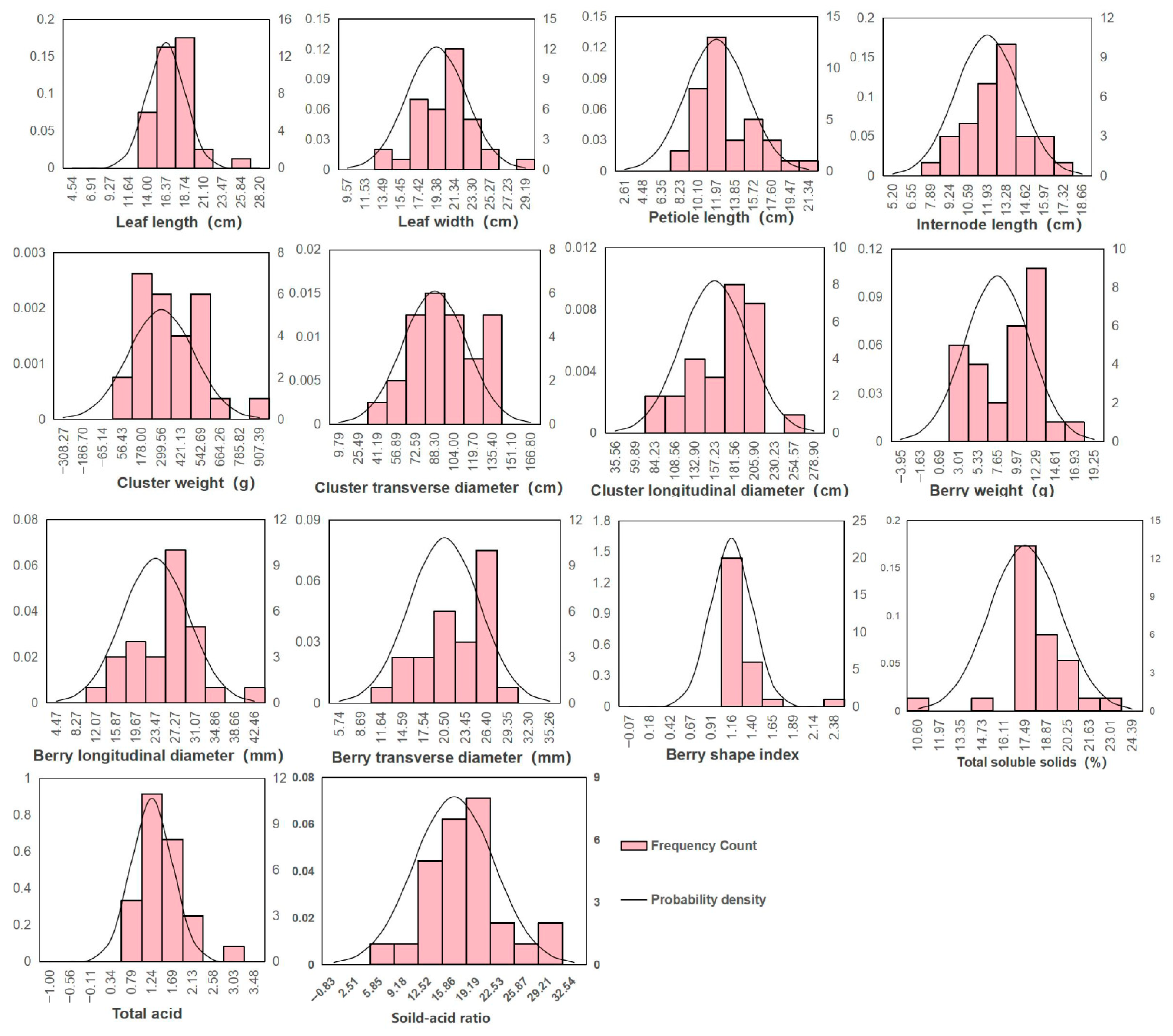
Frequency distribution analysis showed that all 14 quantitative traits followed a normal or skewed normal distribution (Figure 3), indicating that the phenotypic variation of the tested population aligns with quantitative genetic laws.

3.3. SSR Molecular Fingerprinting of Local Grape Germplasms

Eight pairs of core SSR primers were used to amplify 11 local and wild grape germplasms, and clear, stable amplification alleles were obtained for all primers. The DNA fingerprint profiles of 11 grape germplasms were successfully constructed, as shown in Table 4. Based on the allele sizes of the eight primer pairs, a unique molecular ID was assigned to each germplasm, and the banding pattern codes are shown in Table 5.
Statistical analysis showed that the eight SSR markers detected a total of 42 alleles across the 11 grape accessions, with an average of 5.25 genotypes per locus. Among them, primers VvMD25 and VrZAG79 exhibited the highest polymorphism, each resolving seven alleles, while primer VvS2 detected only three alleles, showing relatively low variability.

3.4. Genetic Diversity Analysis Based on SSR Markers

All germplasms included in the SSR analysis are asexually propagated clones. Therefore, the genetic parameters are used to evaluate allelic polymorphism and genetic relationships among clones, and are not intended for Hardy–Weinberg equilibrium testing. The genetic diversity parameters of the eight SSR loci are shown in Table 6. The results showed that the mean observed number of alleles (Na) per locus was 5.28, and the mean effective number of alleles (Ne) was 7.25, indicating abundant allelic variation in the tested population. The observed heterozygosity (Ho) ranged from 0.38 to 1.00, with an average of 0.67. The mean Nei’s gene diversity index (H) was 0.76, the mean Shannon’s information index (I) was 1.73, and the mean polymorphism information content (PIC) was 0.74. All loci had PIC values greater than 0.5, indicating that the selected SSR markers had high polymorphism and strong discriminatory power. Among them, VvMD28 (PIC = 0.88) and VrZAG79 (PIC = 0.85) were the most informative loci, which were optimal core markers for the molecular identification of Jiangxi local grape germplasms.

3.5. Genetic Clustering and Relationship Analysis

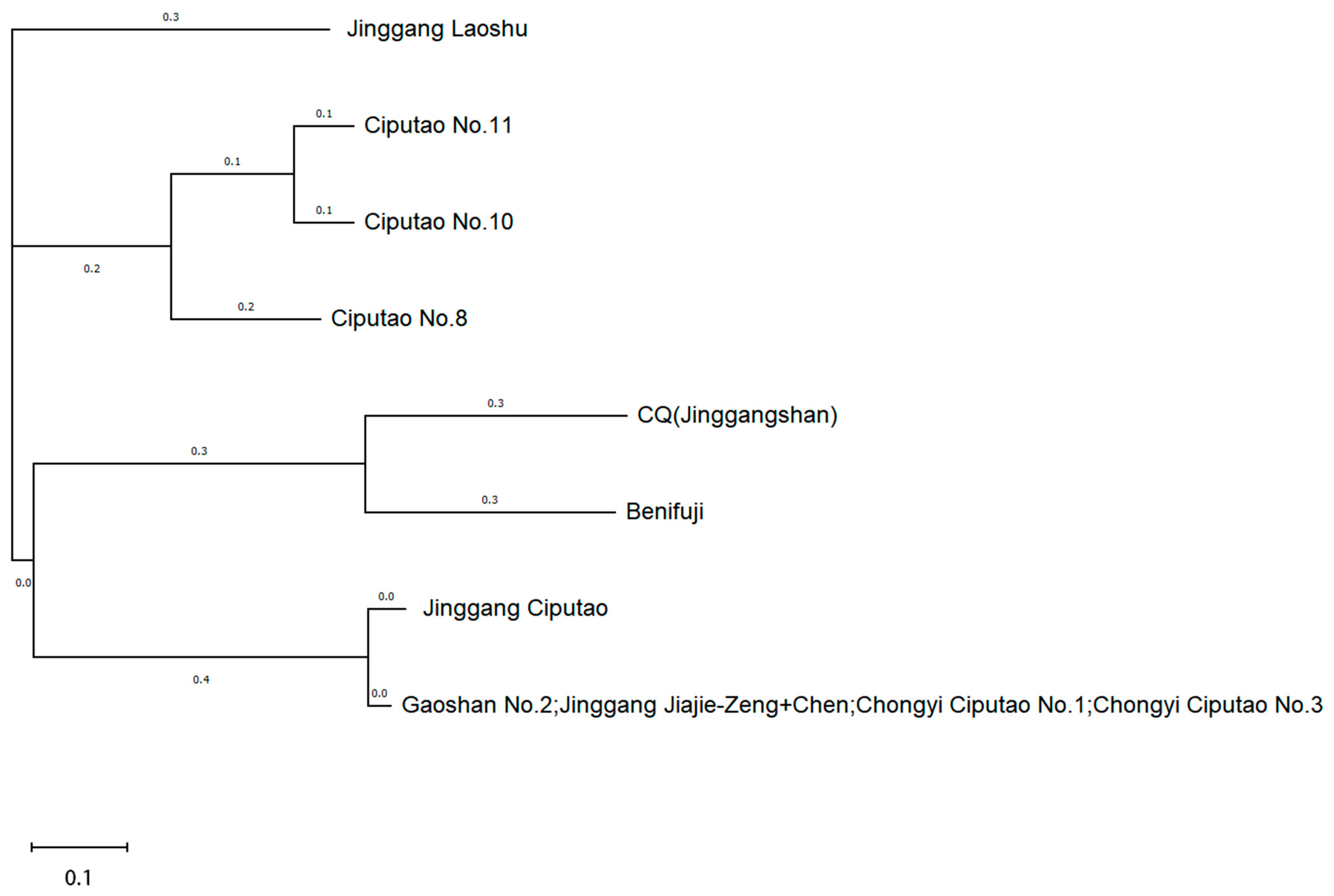
Based on Nei’s genetic distance, a phylogenetic tree of 11 local grape germplasms was constructed using the NJ method (Figure 4). At a genetic distance threshold of 0.4, the tested germplasms were divided into four distinct clusters, which clearly reflected the genetic relationships among the materials.
Cluster I: Included three accessions: Ciputao No. 8, Ciputao No. 10, and Ciputao No. 11. Ciputao No. 10 and Ciputao No. 11 clustered first at a genetic distance of 0.1, indicating highly similar genetic backgrounds, while Ciputao No. 8 joined this subgroup at a genetic distance of 0.2, showing a certain degree of genetic differentiation.
Cluster II: Jinggang Laoshu formed a solitary clade at a genetic distance of 0.3, indicating a distinct genetic background and a distant genetic relationship with other tested germplasms.
Cluster III: Benifuji and CQ (Jinggangshan) clustered together at a genetic distance of 0.3, supporting a close genetic relationship between these two cultivated accessions.
Cluster IV: Included five accessions: Jinggang Ciputao Wu, Gaoshan No. 2, Jinggang Jiajiezeng+Chen, Chongyi Ciputao No. 1, and Chongyi Ciputao No. 3. Among them, Gaoshan No. 2, Jinggang Jiajiezeng+Chen, and Chongyi Ciputao No. 1 and No. 3 exhibited extremely short genetic distances, indicating they are synonymous or highly similar germplasms, which may be caused by unclear provenance tracking during introduction.

3.6. Analysis of Molecular Variance (AMOVA)

AMOVA was performed to partition molecular variation among the 11 clonal grape genotypes (Table 7). The results showed that 100% of the total molecular variation was attributed to differences among genotypes, and no variation was detected within genotypes. The variation among genotypes was highly significant (p < 0.001, 999 permutations), confirming that each genotype represents a distinct genetic unit suitable for clonal germplasm evaluation.

3.7. Integrated Phenotypic–Molecular Analysis

Multiple Factor Analysis (MFA) with mixed data and Generalized Procrustes Analysis (GPA) were used to integrate phenotypic traits and SSR marker data. The MFA ordination revealed consistent differentiation between wild and cultivated germplasms, consistent with both phenotypic and cluster results. GPA revealed a high degree of consensus between the phenotypic distance matrix and the molecular distance matrix, supporting the reliability of the two-dimensional evaluation system.

4. Discussion

4.1. Phenotypic Divergence Between Cultivated and Wild Germplasms

Morphological characterization is the most basic and intuitive method for germplasm resource evaluation, which can directly reflect the phenotypic variation and genetic differentiation among germplasms [17]. In this study, significant morphological divergence was observed between cultivated and wild grape germplasms: cultivars predominantly exhibited pentagonal or wedge-shaped leaves, while wild accessions displayed cordate or reniform leaf forms, which is consistent with the morphological characteristics of Chinese wild Vitis species reported in previous studies [18]. Meanwhile, two wild accessions exhibited typical dioecious unisexual flowers, which is a primitive biological characteristic of wild grapes, and these germplasms are important materials for studying the sex determination mechanism of grapes [19].
The coefficient of variation (CV) reflects the degree of genetic variation of traits, and the higher the CV value, the greater the breeding potential of the trait [20]. In this study, the average CV of 19 morphological traits was 30.49%, indicating abundant phenotypic variation in the tested population. Among them, the CV of cluster weight (67.64%) and berry weight (50.53%) was the highest, which is consistent with the previous finding that yield-related weight traits have the highest genetic plasticity [21]. This indicates that these two traits have great potential for genetic improvement, and that targeted selection can effectively improve the yield traits of grapes. The average Shannon–Wiener index of 19 traits was 3.47, further confirming the high level of phenotypic diversity of the tested grape germplasms, which provides a rich material basis for the selection of excellent parents and new variety breeding.

4.2. SSR Marker Polymorphism and Genetic Diversity of Local Germplasms

Since grapes are clonally propagated, the genetic diversity indexes in this study reflect the polymorphism level of SSR markers and genetic differences among genotypes, rather than population genetics under random mating. SSR molecular markers have become the core technology for grape germplasm identification and genetic diversity analysis due to their high polymorphism, good stability, and co-dominant inheritance, and have been recognized by UPOV as the standard technology for plant variety identification [22]. In this study, eight pairs of internationally universal core SSR primers were used to analyze 11 local grape germplasms, and the results showed that the mean PIC value of the eight loci was 0.74 and that all loci had PIC values greater than 0.5, indicating that the selected markers had high polymorphism and strong discriminatory power, which is consistent with the results of previous studies on grape germplasm genetic diversity using these core primers [23].
The genetic diversity parameters showed that the mean Na was 5.28, mean Ne was 7.25, mean He was 0.82, and mean I was 1.73, all of which were at a high level, indicating that the 11 analyzed local and wild germplasms present abundant genetic diversity. This is mainly because these local germplasms have adapted to the local climatic conditions through long-term natural selection, accumulating abundant allelic variation. Among them, VvMD28 and VrZAG79 had the highest PIC values, which can be used as the optimal core markers for rapid molecular identification and fingerprint construction of Jiangxi local grape germplasms. Observed heterozygosity (Ho = 0.67) reflected moderate genetic polymorphism within genotypes. Since materials are clonally propagated, population genetic indices such as heterozygote deficiency are not applicable. AMOVA confirmed that all molecular variation exists among genotypes, supporting their unique genetic identities [24]. In subsequent breeding programs, it is recommended to introduce genetically divergent germplasms to broaden the genetic base and avoid inbreeding depression. It should be noted that the eight pairs of SSR primers used in this study are the core universal primers recommended by national standards, but they only cover part of the grape chromosomes and cannot achieve full-genome coverage. Therefore, the evaluation in this study is preliminary and targeted. In future research, high-density molecular markers such as SNPs will be used to realize genome-wide genotyping and more comprehensive genetic evaluation.

4.3. Genetic Clustering and Germplasm Synonymy Identification

Cluster analysis based on SSR markers can clearly reflect the genetic relationships among germplasms, which is an important basis for germplasm conservation, parent selection, and variety identification [25]. In this study, 11 local grape germplasms were divided into four clusters at a genetic distance threshold of 0.4, and the clustering results were highly consistent with the germplasm type and geographic origin. For example, all Chongyi Ciputao accessions were clustered into the same group, reflecting their close genetic relationship and the same geographic origin.
Notably, Gaoshan No. 2, Jinggang Jiajiezeng+Chen, and Chongyi Ciputao No. 1 and No. 3 exhibited extremely short genetic distances and almost identical SSR banding patterns, indicating they are synonymous germplasms (same genotype with different names), which is a common problem in regional germplasm collections [26]. This may be caused by unclear introduction traceability or variety name confusion during germplasm collection and preservation. Synonym identification in this study was limited to local and wild germplasms. The 29 fresh-eating cultivars were not genotyped because they are standard commercial varieties with clear nomenclature. A complete fingerprint system covering all 38 accessions will be constructed in future research to achieve full-collection identity verification. However, morphological identification showed that Jinggang Jiajiezeng+Chen is a male plant with degenerated pistils, while Gaoshan No. 2 is a hermaphroditic plant, indicating that the limited SSR markers may not fully capture the genome-wide variation, especially the variation in sex-determination loci. Therefore, the taxonomic status of these accessions needs to be further verified by whole-genome resequencing or high-density SNP genotyping.
The integrated MFA and GPA confirmed that phenotypic divergence and molecular genetic relationships are highly consistent, validating the two-dimensional evaluation system. This multivariate framework improves the accuracy of germplasm identification and parent selection for breeding.

4.4. Integrated Evaluation and Utilization Strategy of Germplasm Resources

Based on the evaluation of phenotypic traits and molecular markers, we screened excellent fresh-eating grape cultivars suitable for the subtropical monsoon climate of Jiangxi Province, and clarified the breeding utilization value of local germplasms. For the 29 fresh-eating cultivars, we recommend stratified selection according to the ripening season: first, early-maturing cultivars such as Summer Black, Zijin Zaosheng, and Nan Taihu Tezao, which can avoid the adverse effects of late spring cold and summer rain; second, mid-season cultivars such as Shine Muscat, Kyoho, and Zijin Hongxia, which have strong adaptability, disease resistance, and high market acceptance; third, late-maturing cultivars such as Nina Queen and Sunshine No. 13, which can extend the fresh market supply period.
For the local and wild germplasms, they have important breeding utilization value: CQ (Jinggangshan) has excellent fruit flavor and a high solids–acid ratio, which is a valuable material for grape flavor quality improvement; the dioecious wild germplasms (Jinggang Laoshu and Jinggang Jiajiezeng+Chen) are ideal materials for studying the molecular mechanism of grape sex determination, and also carry excellent stress-resistance genes, which can be used to broaden the genetic base of cultivated grapes.
In summary, this study established a two-dimensional evaluation system based on phenotypic traits and SSR molecular markers for grape germplasm resources, which provides a scientific basis for the precise conservation and innovative utilization of grape germplasm resources in Jiangxi Province. Future work will focus on QTL mapping of key agronomic traits, elite gene mining, and molecular marker-assisted breeding to accelerate the breeding of new grape varieties with independent intellectual property rights suitable for cultivation in southern China.


5. Conclusions

In this study, 38 grape germplasm resources were evaluated based on 19 morphological traits, 11 local and wild accessions were analyzed using eight SSR molecular markers, and a two-dimensional evaluation system based on phenotypic traits and SSR molecular markers was preliminarily established. The main conclusions are as follows:
  • The tested grape germplasms showed abundant phenotypic diversity. Clear morphological divergence existed between cultivars and wild germplasms. Weight-related traits had high variation coefficients, indicating great potential for yield improvement.
  • Eight SSR markers revealed high polymorphism in 11 local and wild grape germplasms, effectively distinguishing their genetic relationships. Some accessions were highly similar at the molecular level, indicating possible synonymous resources.
  • Phenotypic screening identified suitable fresh-eating grape cultivars for Jiangxi Province. Local and wild germplasms have important utilization value for breeding.
This study provides basic phenotypic and molecular information for the identification, conservation, and utilization of grape germplasms in Jiangxi. Further research will be needed to achieve integrated multi-dimensional analysis.

Author Contributions

Conceptualization, H.T. and C.X.; methodology, Q.C. and M.Z.; validation, S.W. and M.Z.; formal analysis, S.W.; investigation, G.L. and Q.C.; resources, Q.C. and M.Z.; data curation, H.T. and W.X.; writing—original draft preparation, H.T. and C.X.; writing—review and editing, C.X.; visualization, S.W. and W.X.; Supervision, G.L. and W.X.; project administration, G.L. and W.X.; funding acquisition, C.X. All authors have read and agreed to the published version of the manuscript.

Funding

This research was funded by “the Earmarked Fund for Jiangxi Agriculture Research System”, grant number JXARS-05.

Data Availability Statement

The original contributions presented in this study are included in the article. Further inquiries can be directed to the corresponding author.

Conflicts of Interest

The authors declare no conflicts of interest.

References

  1. Grassi, F.; De Lorenzis, G. Back to the origins: Background and perspectives of grapevine domestication. Int. J. Mol. Sci. 2021, 22, 4518. [Google Scholar] [CrossRef] [PubMed]
  2. Wan, Y.; Li, D.; Wang, Y.; Zhang, C.; Schwaninger, H.; Simon, C.J. A review of taxonomic research on Chinese wild grapes. Vitis 2008, 47, 81–88. [Google Scholar]
  3. Dong, Y.; Duan, S.; Xia, Q.; Liang, Z.; Dong, X.; Margaryan, K.; Musayev, M.; Goryslavets, S.; Zdunić, G.; Bert, P.-F. Dual domestications and origin of traits in grapevine evolution. Science 2023, 379, 892–901. [Google Scholar] [CrossRef]
  4. Heinitz, C.C.; Uretsky, J.; Dodson Peterson, J.C.; Huerta-Acosta, K.G.; Walker, M.A. Crop wild relatives of grape (Vitis vinifera L.) throughout North America. In North American Crop Wild Relatives, Volume 2: Important Species; Springer: Berlin/Heidelberg, Germany, 2019; pp. 329–351. [Google Scholar]
  5. Atak, A. Vitis species for stress tolerance/resistance. Genet. Resour. Crop Evol. 2025, 72, 2425–2444. [Google Scholar] [CrossRef]
  6. Liang, Z.; Duan, S.; Sheng, J.; Zhu, S.; Ni, X.; Shao, J.; Liu, C.; Nick, P.; Du, F.; Fan, P. Whole-genome resequencing of 472 Vitis accessions for grapevine diversity and demographic history analyses. Nat. Commun. 2019, 10, 1190. [Google Scholar] [CrossRef]
  7. Xiao, Y.; Jiang, X.; Lu, C.; Liu, J.; Diao, S.; Jiang, J. Genetic diversity and population structure analysis in the Chinese endemic species Michelia crassipes based on SSR markers. Forests 2023, 14, 508. [Google Scholar] [CrossRef]
  8. Nguyen, G.N.; Norton, S.L. Genebank phenomics: A strategic approach to enhance value and utilization of crop germplasm. Plants 2020, 9, 817. [Google Scholar] [CrossRef] [PubMed]
  9. Kumari, J.; Tripathi, K.; Adhikari, S.; Pardeshi, P.; Sathee, L.; Kumar, M.; Panda, R.R.; Suby, S.; Hooda, K.; Raubach, S. Germplasm characterization and evaluation. In Textbook of Plant Genetic Resources; Springer: Berlin/Heidelberg, Germany, 2025; pp. 245–301. [Google Scholar]
  10. Hbyaj, K.; Diria, G.; Mouniane, Y.; Chriqui, A.; Lebkiri, N.; Hmouni, D.; El Oualkadi, A. Identifying grapevine (Vitis vinifera L.): A comprehensive approach using morphology, sugar analysis, and ISSR markers, illustrated with Taferialte cultivars. Genet. Resour. Crop Evol. 2024, 71, 3181–3191. [Google Scholar] [CrossRef]
  11. Ahmad, A.; Wang, J.-D.; Pan, Y.-B.; Sharif, R.; Gao, S.-J. Development and use of simple sequence repeats (SSRs) markers for sugarcane breeding and genetic studies. Agronomy 2018, 8, 260. [Google Scholar] [CrossRef]
  12. Zhao, H.; Ju, Y.; Jiang, J.; Min, Z.; Fang, Y.; Liu, C. Downy mildew resistance identification and SSR molecular marker screening of different grape germplasm resources. Sci. Hortic. 2019, 252, 212–221. [Google Scholar] [CrossRef]
  13. Guo, Z.; Fan, Z.; Li, X.; Du, H.; Wu, Z.; Li, T.; Yang, G. Combined Analysis of SRAP and SSR Markers Reveals Genetic Diversity and Phylogenetic Relationships in Raspberry (Rubus idaeus L.). Agronomy 2025, 15, 1492. [Google Scholar] [CrossRef]
  14. Tomaz, I.; Buljević, N.; Šikuten, I.; Preiner, D. Advancing Grapevine Breeding with Reliable SSR Genotyping: The Qsep100 Approach. Horticulturae 2025, 11, 1506. [Google Scholar] [CrossRef]
  15. Kunakh, O.; Volkova, A.; Tutova, G.; Zhukov, O. Diversity of diversity indices: Which diversity measure is better? Biosyst. Divers. 2023, 31, 131–146. [Google Scholar] [CrossRef]
  16. Labate, J.A. Software for population genetic analyses of molecular marker data. Crop Sci. 2000, 40, 1521–1528. [Google Scholar] [CrossRef]
  17. Chen, T.; Liu, L.; Zhou, Y.; Zheng, Q.; Luo, S.; Xiang, T.; Zhou, L.; Feng, S.; Yang, H.; Ding, C. Characterization and comprehensive evaluation of phenotypic characters in wild Camellia oleifera germplasm for conservation and breeding. Front. Plant Sci. 2023, 14, 1052890. [Google Scholar] [CrossRef] [PubMed]
  18. Min, Z.; Li, R.; Zhao, X.; Li, R.; Zhang, Y.; Liu, M.; Wei, X.; Fang, Y.; Chen, S. Morphological variability in leaves of Chinese wild Vitis species. Sci. Hortic. 2018, 238, 138–146. [Google Scholar] [CrossRef]
  19. Cheng, D.-W.; Jiang, J.-F.; Fan, X.-C.; Zhang, Y.; Zhang, G.-H.; Liu, C.-H. Diversity analysis of Chinese wild grape species. J. Plant Genet. Resour. 2013, 14, 996–1012. [Google Scholar]
  20. Pélabon, C.; Hilde, C.H.; Einum, S.; Gamelon, M. On the use of the coefficient of variation to quantify and compare trait variation. Evol. Lett. 2020, 4, 180–188. [Google Scholar] [CrossRef]
  21. Vafaee, Y.; Ghaderi, N.; Khadivi, A. Morphological variation and marker-fruit trait associations in a collection of grape (Vitis vinifera L.). Sci. Hortic. 2017, 225, 771–782. [Google Scholar] [CrossRef]
  22. Liu, S.; Zhong, H.; Zhang, F.; Wang, X.; Wu, X.; Wang, J.; Shi, W. Genetic diversity and core germplasm research of 144 munake grape resources using 22 pairs of SSR markers. Horticulturae 2023, 9, 917. [Google Scholar] [CrossRef]
  23. Liu, S.; Wang, J.; Li, X.; Wang, X.; Wang, X.; Zhong, H.; Aibibul, I.; Sun, F.; Li, H.; Shi, W. Genetic diversity analysis and construction of a core germplasm resource bank of xinjiang’s indigenous cultivated grapes. Agriculture 2025, 15, 871. [Google Scholar] [CrossRef]
  24. Maia, A.L.d.S.; Ferreira, D.M.C.; Louzada, R.B. Cryptic diversity and species delimitation in the Cryptanthus pickelii LB Sm. complex (Bromeliaceae) from morphometrics and molecular markers. Bot. J. Linn. Soc. 2025, boaf080. [Google Scholar] [CrossRef]
  25. Çilesiz, Y. Genetic relationship among grape (Vitis vinifera L.) genotypes grown in inner Anatolia region Turkey analyzed by ISSR and RAPD markers. Sci. Rep. 2025, 15, 32842. [Google Scholar] [CrossRef] [PubMed]
  26. Kaya, H.B.; Dilli, Y.; Oncu-Oner, T.; Ünal, A. Exploring genetic diversity and population structure of a large grapevine (Vitis vinifera L.) germplasm collection in Türkiye. Front. Plant Sci. 2023, 14, 1121811. [Google Scholar] [CrossRef] [PubMed]
Figure 1. Morphology of leaves and floral organs of representative grape germplasms.
Agronomy 16 00911 g001
Figure 2. Morphology of fruit clusters and berries of representative grape germplasms.
Agronomy 16 00911 g002
Figure 3. Frequency distribution of 14 quantitative phenotypic traits of grape germplasms.
Agronomy 16 00911 g003
Figure 4. Cluster analysis of 11 grape germplasms based on SSR molecular markers.
Agronomy 16 00911 g004
Table 1. Germplasm basic information and fruit characters of 38 grape varieties in Jiangxi region.
NumberGermplasm NamePurposeCultivarsFruit Characteristics
1Shine MuscatFresh consumptionCultivated varietyMid-season, yellow-green, oval
2Romatic BeautyFresh consumptionCultivated varietyMid-late season, red, long oval/ovate
3Summer BlackFresh consumptionCultivated varietyEarly season, dark purple-black, oval
4KyohoFresh consumptionCultivated varietyMid-season, dark purple-black, round/subround
5Zijin HongxiaFresh consumptionCultivated varietyMid-season, red, oval
6Zijin ZaoshengFresh consumptionCultivated varietyEarly season, dark purple-black, oval
7Nina QueenFresh consumptionCultivated varietyLate season, pink, long oval/ovate
8Black KingFresh consumptionCultivated varietyMid-late season, dark purple-black, oval
9Yuan JinxiangFresh consumptionCultivated varietyEarly season, yellow-green, round/subround
10Nan Taihu TezaoFresh consumptionCultivated varietyEarly season, dark purple-black, round/subround
11MiguangFresh consumptionCultivated varietyEarly season, dark purple-black, oval
12Jinxiang No. 1Fresh consumptionCultivated varietyMid-season, yellow-green, oval
13FujiminoriFresh consumptionCultivated varietyMid-season, dark purple-black, oval
14Yongyou No. 1Fresh consumptionCultivated varietyMid-season, dark purple-black, oval
15FujinohikariFresh consumptionCultivated varietyMid-late season, dark purple-black, long oval/ovate
16Scarlotta SeedlessFresh consumptionCultivated varietyLate season, deep red, slender cylindrical
17Rosario BiancoFresh consumptionCultivated varietyLate season, yellow-green, oval
18Zitian seedlessFresh consumptionCultivated varietyLate season, dark purple-black, long oval/ovate
19Crimson SeedlessFresh consumptionCultivated varietyLate season, bright red, long oval/ovate
20Hutai No. 8Fresh consumptionCultivated varietyMid-late season, dark purple-black, oval
21LiaofengFresh consumptionCultivated varietyMid-season, dark purple-black, round/subround
22Blue RavelFresh consumptionCultivated varietyVery early season, bluish-purple, short oval
23Nagano PurpleFresh consumptionCultivated varietyMid-late season, dark purple-black, round/subround
24Autumn CrispFresh consumptionCultivated varietyMid-late season, purplish-red, long oval/ovate
25Black Ultimate FragranceFresh consumptionCultivated varietyMid-late season, black, long oval/ovate
26Sunshine No. 13Fresh consumptionCultivated varietyMid-late season, yellow-green, oval
27Pu Zhi MengFresh consumptionCultivated varietyMid-late season, red, slender cylindrical
28BenifujiFresh consumptionCultivated varietyMid-late season, pink, oval
29CQ (Jinggangshan)Fresh consumptionLocal cultivarMid-late season, pink, oval
30Gaoshan No. 2Fresh consumption & winemakingCultivated varietyLate season, bluish-black, round
31Jinggang Jiajiezeng+ChenWild germplasmLate season, bluish-black, round
32Chongyi Ciputao No. 1Wild germplasm
33Chongyi Ciputao No. 3Wild germplasm
34Jinggang LaoshuWild germplasmLate season, bluish-black, round
35Ciputao No. 10Wild germplasm
36Jinggang CiputaoWild germplasm
37Ciputao No. 8Wild germplasm
38Ciputao No. 11Wild germplasm
Notes: “—” indicates that the primary use is unspecified, and the accession is mainly used for breeding and resistance research.
Table 2. Classification standards of qualitative traits (for morphological description only, not for quantitative scoring).
TraitsGrade
12345678910
Leaf shapeCordateCuneatePentagonalSuborbicularReniform
Floral organ typeMale flowerPerfect flower (Hermaphroditic flower)Female flower
Cluster shapeCylindricalConicalBranched
Cluster densityVery looseLooseMediumDenseVery dense
Berry shapeOblongLong ellipticalEllipticalRoundOblateCordiformObtuse ovoidObovoidCurvedConstricted (Hourglass-shaped)
Table 3. Diversity analysis of morphological traits of grape germplasms.
TraitsChange RangeRangeMean ± SDCoefficient of Variation (CV, %)Shannon-Wiener Index (H′)Broad-Sense Heritability (H2)
Leaf length (cm)12.67~25.3012.6316.37 ± 2.3714.453.600.82
Leaf width (cm)11.57~27.3815.8119.38 ± 3.2716.883.590.84
Petiole length (cm) 6.53~20.8314.3011.97 ± 3.1226.083.590.81
Internode length (cm) 8.95~17.258.3011.93 ± 2.2418.803.490.79
Cluster weight (g)46.16~800.03753.87299.56 ± 202.6167.643.080.88
Cluster transverse diameter (cm) 48.72~130.0081.2888.30 ± 26.1729.643.260.83
Cluster longitudinal diameter (cm) 81.62~204.32122.70157.23 ± 40.5625.793.270.82
Berry weight (g) 0.95~14.7913.847.65 ± 3.8750.533.250.86
Berry transverse diameter (mm) 9.89~31.5421.6523.47 ± 6.3326.983.330.84
Berry longitudinal diameter (mm)9.53~26.0816.5520.50 ± 4.9224.013.730.85
Berry shape index 0.95~2.181.231.16 ± 0.2421.203.730.83
Total soluble solids (%) TSS8.87~22.3613.4917.49 ± 2.3013.143.310.78
Total acid0.59~1.831.241.24 ± 0.4536.243.630.80
Solid-acid ratio4.85~27.8523.0015.86 ± 5.5635.073.270.81
Leaf shape 1~54.002.72 ± 1.3047.783.64
Floral organ type 1~32.002.00 ± 0.2311.473.85
Cluster shape 1~32.001.71 ± 0.6638.423.54
Cluster density1~98.006.17 ± 1.7328.083.40
Berry shape 2~97.003.39 ± 1.5947.013.39
Average30.493.470.82
Table 4. DNA fingerprinting profiles of 11 regional grape germplasms.
NumberVarietyPrimer
VvMD28VvMD27VrZAG79VvMD7VrZAG62VvMD25VvS2VvMD5
1Gaoshan No. 2230/254183/187250243/251195246/255124/146245/247
2Jinggang Jiajiezeng+Chen230/254183/187250243/251195246/255124/146245/247
3Chongyi Ciputao No. 1230/254183/187250243/251195246/255124/146245/247
4Chongyi Ciputao No. 3230/254183/187250243/251195246/255124/146245/247
5Jinggang Laoshu236/244177/179240/244251195259/261122247
6Ciputao No. 10248/255177/183242/256245193/195234/270122245
7Jinggang Ciputao Wu230/254183/187250243/251195246/255124/146242/245
8Ciputao No. 8242/246177/183240/255245195268/270122245
9Ciputao No. 11248/255177/183242/255245193/195233/270122245
10CQ (Jinggangshan)257/257175/181236/242/246/250235/245/247/249185/203241/250/256120/130231/231
11Benifuji225/244181239/258235/249185/201241/250120/130235/237
Note: All fragment allele sizes are in base pairs (bp).
Table 5. Banding pattern codes of eight SSR primer pairs for 11 regional grape germplasms.
Banding Pattern CodeVvS2VrZAG62VvMD7VvMD27VvMD5VvMD28VvMD25VrZAG79
1120/130185/201235/249175/181231/231225/244233/270236/242/246/250
2122185/203235/245/247/249177/179235/237230/254234/270239/258
3124/146193/195243/251177/183242/245236/244241/250240/244
4195245181245242/246241/250/256240/255
5183/187245/247248/255246/255242/255
6247257/257259/261242/256
7268/270250
Note: All fragment allele sizes are in base pairs (bp).
Table 6. Genetic diversity analysis of 11 regional grape germplasms based on eight SSR markers.
LocusGenotype NumberNaNeHoHPIC
VrZAG797107.110.750.860.85
VvMD257108.531.000.880.87
VvMD286109.140.880.890.88
VvMD5663.200.380.690.68
VvMD27564.570.880.780.76
VvMD7464.130.500.760.74
VrZAG62452.330.500.570.56
VvS2353.200.500.690.68
Average5.255.287.250.670.760.74
Note: Na: Observed number of alleles; Ne: Effective number of alleles; Ho: Observed heterozygosity; H: Nei’s gene diversity index; I: Shannon’s information index; PIC: Polymorphism information content.
Table 7. Analysis of molecular variance (AMOVA) for 11 grape genotypes based on eight SSR markers.
Source of VariationdfSum of SquaresMean SquareEstimated VariancePercentage of Variation (%)p-Value
Among genotypes10SSaMSaVa100<0.001
Within genotypes00000
Total10SStMStVt100
Disclaimer/Publisher’s Note: The statements, opinions and data contained in all publications are solely those of the individual author(s) and contributor(s) and not of MDPI and/or the editor(s). MDPI and/or the editor(s) disclaim responsibility for any injury to people or property resulting from any ideas, methods, instructions or products referred to in the content.